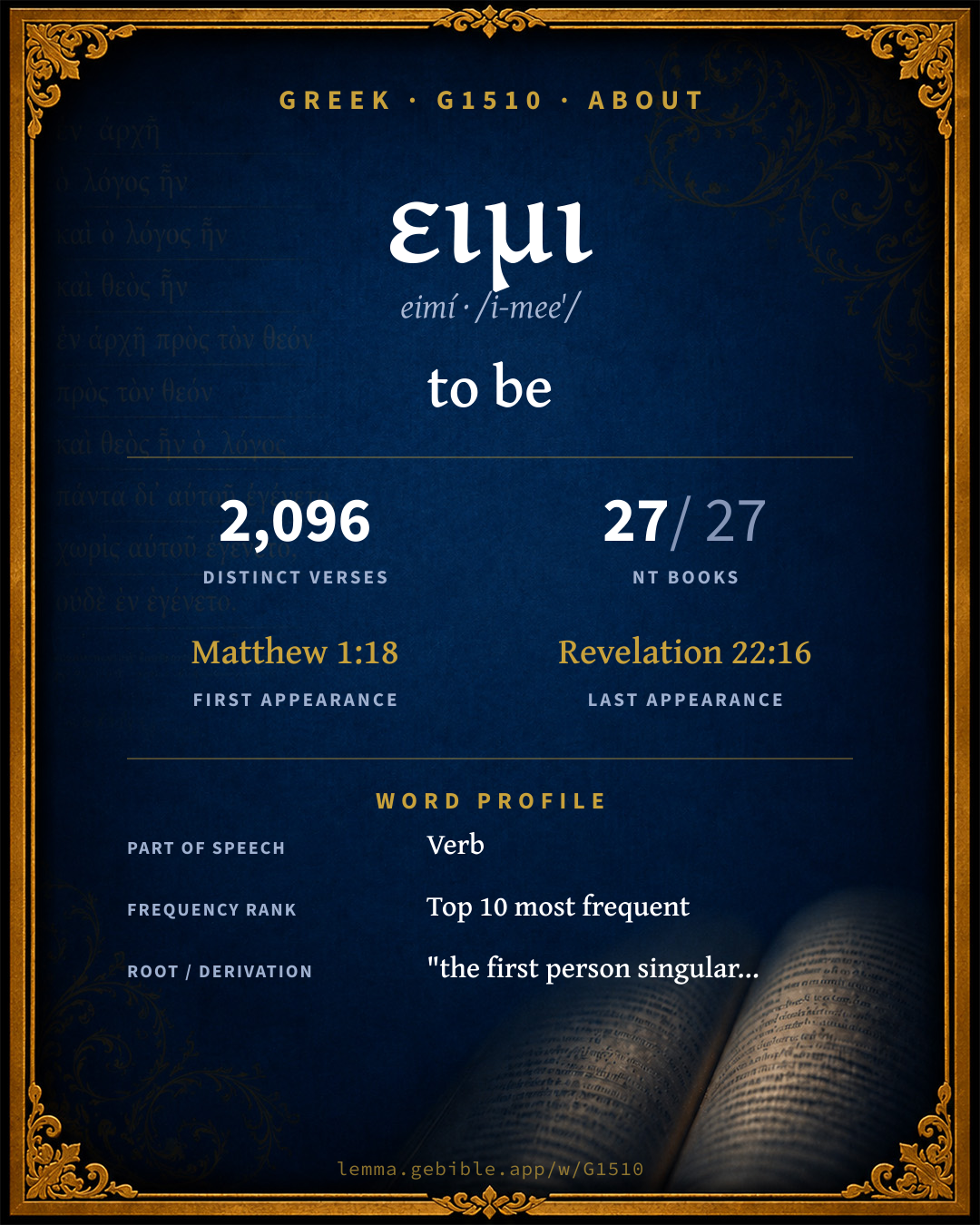
εἰμί
to be
Full lexicon entry — Thayer's Greek Lexicon
From Thayer's Greek Lexicon
Where this word appears
See every Present-tense verb in the Greek New Testament →
Grammar key — what these labels mean
Part of speech
- Verb
- An action or state-of-being word.
Tense
- Present
- Ongoing or general action in present time (imperfective aspect).
- Imperfect
- Continuous or repeated action in past time (“was writing”).
- Future
- Action expected in future time.
Voice
- Active
- The subject performs the action.
- Middle deponent
- Middle in form but active in meaning.
- Middle
- The subject acts on or for itself, or with special interest in the action.
Mood
- Indicative
- States a fact or asks a factual question (the mood of reality).
- Infinitive
- A verbal noun (“to write”), unmarked for person or number.
- Participle
- A verbal adjective (“writing,” “having written”).
- Subjunctive
- Expresses probability, purpose, or possibility (the mood of contingency).
- Imperative
- Expresses a command or request.
- Optative
- Expresses a wish or a remote possibility.
Case
- Nominative
- The case of the subject (and the predicate nominative).
- Genitive
- The case of source, possession, or “of” — answers “whose / from what.”
- Accusative
- The case of the direct object and of extent.
- Dative
- The case of the indirect object, means, or location — “to / for / with / in.”
Person
- 3rd person
- The one spoken about (“he / she / it / they”).
- 1st person
- The speaker (“I / we”).
- 2nd person
- The one addressed (“you”).
Gender
- Masculine
- Grammatically masculine.
- Feminine
- Grammatically feminine.
- Neuter
- Grammatically neuter.
Number
- Singular
- One.
- Plural
- More than one.
Grammatical forms 51 distinct
- Verb, Present, Active, Indicative, 3rd person, Singular 895 times (36%)
- Verb, Imperfect, Active, Indicative, 3rd person, Singular 315 times (13%)
- Verb, Present, Active, Indicative, 3rd person, Plural 157 times (6%)
- Verb, Present, Active, Indicative, 1st person, Singular 138 times (6%)
- Verb, Present, Active, Infinitive 123 times (5%)
- Verb, Future, Middle deponent, Indicative, 3rd person, Singular 119 times (5%)
- Verb, Imperfect, Active, Indicative, 3rd person, Plural 96 times (4%)
- Verb, Present, Active, Indicative, 2nd person, Plural 92 times (4%)
+43 more forms (524 occurrences)
Parsed forms decoded from the imported morphology (Robinson–Tischendorf, public domain), counted across 2,459 parsed occurrences — not distinct verses.
Page 1 of 11 — showing verses 1–200 of 2,096 distinct verses where G1510 appears, across 27 books. Click any verse to open its interlinear word-by-word view. Verse text shown in the World English Bible for context — . Each verse’s Greek form is shown with its reference; the English is not keyword-highlighted, since the data carries no word-level English alignment. Use “Compare translations” on any verse to read it across multiple English versions. This concordance covers the Greek New Testament; Septuagint (Greek Old Testament) occurrences of this word are not indexed here.
Matthew 253 verses
- Matthew 1:18 ἦν impf act ind 3sg Now the birth of Jesus Christ was like this; for after his mother, Mary, was engaged to Joseph, before they came together, she was found pregnant by the Holy Spirit.
- Matthew 1:19 ὢν pres act ptcp nom sg masc Joseph, her husband, being a righteous man, and not willing to make her a public example, intended to put her away secretly.
- Matthew 1:20 ἐστιν pres act ind 3sg But when he thought about these things, behold, an angel of the Lord appeared to him in a dream, saying, "Joseph, son of David, don't be afraid to take to yourself Mary, your wife, for that which is conceived in her is of the Holy Spirit.
- Matthew 1:23 ἐστιν pres act ind 3sg "Behold, the virgin shall be with child, And shall bring forth a son. They shall call his name Immanuel;" Which is, being interpreted, "God with us."
- Matthew 2:2 ἐστιν pres act ind 3sg "Where is he who is born King of the Jews? For we saw his star in the east, and have come to worship him."
- Matthew 2:6 εἶ pres act ind 2sg 'You Bethlehem, land of Judah, Are in no way least among the princes of Judah: For out of you shall come forth a governor, Who shall shepherd my people, Israel.'"
- Matthew 2:9 ἦν impf act ind 3sg They, having heard the king, went their way; and behold, the star, which they saw in the east, went before them, until it came and stood over where the young child was.
- Matthew 2:13 ἴσθι pres act impv 2sg Now when they had departed, behold, an angel of the Lord appeared to Joseph in a dream, saying, "Arise and take the young child and his mother, and flee into Egypt, and stay there until I tell you, for Herod will seek the young child to destroy him."
- Matthew 2:15 ἦν impf act ind 3sg and was there until the death of Herod; that it might be fulfilled which was spoken by the Lord through the prophet, saying, "Out of Egypt I called my son."
- Matthew 2:18 εἰσίν pres act ind 3pl "A voice was heard in Ramah, Lamentation, weeping and great mourning, Rachel weeping for her children; She wouldn't be comforted, Because they are no more."
- Matthew 3:3 ἐστιν pres act ind 3sg For this is he who was spoken of by Isaiah the prophet, saying, "The voice of one crying in the wilderness, Make ready the way of the Lord, Make his paths straight."
- Matthew 3:4 ἦν impf act ind 3sg Now John himself wore clothing made of camel's hair, with a leather belt around his waist. His food was locusts and wild honey.
- Matthew 3:11 ἐστιν εἰμὶ pres act ind 3sg pres act ind 1sg I indeed baptize you in water for repentance, but he who comes after me is mightier than I, whose shoes I am not worthy to carry. He will baptize you in the Holy Spirit.
- Matthew 3:15 ἐστὶν pres act ind 3sg But Jesus, answering, said to him, "Allow it now, for this is the fitting way for us to fulfill all righteousness." Then he allowed him.
- Matthew 3:17 ἐστιν pres act ind 3sg Behold, a voice out of the heavens said, "This is my beloved Son, with whom I am well pleased."
- Matthew 4:3 εἶ pres act ind 2sg The tempter came and said to him, "If you are the Son of God, command that these stones become bread."
- Matthew 4:6 εἶ pres act ind 2sg and said to him, "If you are the Son of God, throw yourself down, for it is written, 'He will give his angels charge concerning you.' and, 'On their hands they will bear you up, So that you don't dash your foot against a stone.'"
- Matthew 4:18 ἦσαν impf act ind 3pl Walking by the sea of Galilee, he saw two brothers: Simon, who is called Peter, and Andrew, his brother, casting a net into the sea; for they were fishermen.
- Matthew 5:3 ἐστιν pres act ind 3sg "Blessed are the poor in spirit, For theirs is the Kingdom of Heaven.
- Matthew 5:10 ἐστιν pres act ind 3sg Blessed are those who have been persecuted for righteousness' sake, For theirs is the Kingdom of Heaven.
- Matthew 5:11 ἐστε pres act ind 2pl "Blessed are you when people reproach you, persecute you, and say all kinds of evil against you falsely, for my sake.
- Matthew 5:13 ἐστε pres act ind 2pl "You are the salt of the earth, but if the salt has lost its flavor, with what will it be salted? It is then good for nothing, but to be cast out and trodden under the feet of men.
- Matthew 5:14 ἐστε pres act ind 2pl You are the light of the world. A city located on a hill can't be hidden.
- Matthew 5:21 ἔσται fut mid.dep ind 3sg "You have heard that it was said to the ancient ones, 'You shall not murder;' and 'Whoever shall murder shall be in danger of the judgment.'
- Matthew 5:22 ἔσται ἔσται ἔσται fut mid.dep ind 3sg fut mid.dep ind 3sg fut mid.dep ind 3sg But I tell you, that everyone who is angry with his brother without a cause shall be in danger of the judgment; and whoever shall say to his brother, 'Raca!' shall be in danger of the council; and whoever shall say, 'You fool!' shall be in danger of the fire of Gehenna.
- Matthew 5:25 ἴσθι εἶ pres act impv 2sg pres act ind 2sg Agree with your adversary quickly, while you are with him in the way; lest perhaps the prosecutor deliver you to the judge, and the judge deliver you to the officer, and you be cast into prison.
- Matthew 5:34 ἐστὶν pres act ind 3sg but I tell you, don't swear at all: neither by heaven, for it is the throne of God;
- Matthew 5:35 ἐστιν ἐστὶν pres act ind 3sg pres act ind 3sg nor by the earth, for it is the footstool of his feet; nor by Jerusalem, for it is the city of the great King.
- Matthew 5:37 ἔστω ἐστιν pres act impv 3sg pres act ind 3sg But let your 'Yes' be 'Yes' and your 'No' be 'no.' Whatever is more than these is of the evil one.
- Matthew 5:48 ἔσεσθε ἐστιν fut mid.dep ind 2pl pres act ind 3sg Therefore you shall be perfect, just as your Father in heaven is perfect.
- Matthew 6:4 ᾖ pres act subj 3sg so that your merciful deeds may be in secret, then your Father who sees in secret will reward you openly.
- Matthew 6:5 ἔσεσθε fut mid.dep ind 2pl "When you pray, you shall not be as the hypocrites, for they love to stand and pray in the synagogues and in the corners of the streets, that they may be seen by men. Most assuredly, I tell you, they have received their reward.
- Matthew 6:21 ἐστιν ἔσται pres act ind 3sg fut mid.dep ind 3sg for where your treasure is, there your heart will be also.
- Matthew 6:22 ἐστιν ᾖ ἔσται pres act ind 3sg pres act subj 3sg fut mid.dep ind 3sg "The lamp of the body is the eye. If therefore your eye is sound, your whole body will be full of light.
- Matthew 6:23 ᾖ ἔσται ἐστίν pres act subj 3sg fut mid.dep ind 3sg pres act ind 3sg But if your eye is evil, your whole body will be full of darkness. If therefore the light that is in you is darkness, how great is the darkness!
- Matthew 6:25 ἐστιν pres act ind 3sg Therefore, I tell you, don't be anxious for your life: what you will eat, or what you will drink; nor yet for your body, what you will wear. Isn't life more than food, and the body more than clothing?
- Matthew 6:30 ὄντα pres act ptcp acc sg masc But if God so clothes the grass of the field, which today exists, and tomorrow is thrown into the oven, won't he much more clothe you, you of little faith?
- Matthew 7:9 ἐστιν pres act ind 3sg Or who is there among you, who, if his son asks him for bread, will give him a stone?
- Matthew 7:11 ὄντες pres act ptcp nom pl masc If you then, being evil, know how to give good gifts to your children, how much more will your Father who is in heaven give good things to those who ask him!
- Matthew 7:12 ἐστιν pres act ind 3sg Therefore whatever you desire for men to do to you, you shall also do to them; for this is the law and the prophets.
- Matthew 7:13 εἰσιν pres act ind 3pl "Enter in by the narrow gate; for wide is the gate and broad is the way that leads to destruction, and many are those who enter in by it.
- Matthew 7:14 εἰσὶν pres act ind 3pl How narrow is the gate, and restricted is the way that leads to life! Few are those who find it.
- Matthew 7:15 εἰσιν pres act ind 3pl "Beware of false prophets, who come to you in sheep's clothing, but inwardly are ravening wolves.
- Matthew 7:27 ἦν impf act ind 3sg The rain came down, the floods came, and the winds blew, and beat on that house; and it fell--and great was its fall."
- Matthew 7:29 ἦν impf act ind 3sg for he taught them with authority, and not like the scribes.
- Matthew 8:8 εἰμὶ pres act ind 1sg The centurion answered, "Lord, I'm not worthy for you to come under my roof. Just say the word, and my servant will be healed.
- Matthew 8:9 εἰμι pres act ind 1sg For I am also a man under authority, having under myself soldiers. I tell this one, 'Go,' and he goes; and tell another, 'Come,' and he comes; and tell my servant, 'Do this,' and he does it."
- Matthew 8:12 ἔσται fut mid.dep ind 3sg but the children of the Kingdom will be thrown out into the outer darkness. There will be weeping and the gnashing of teeth."
- Matthew 8:26 ἐστε pres act ind 2pl He said to them, "Why are you fearful, oh you of little faith?" Then he got up, rebuked the wind and the sea, and there was a great calm.
- Matthew 8:27 ἐστιν pres act ind 3sg The men marveled, saying, "What kind of man is this, that even the wind and the sea obey him?"
- Matthew 8:30 ἦν impf act ind 3sg Now there was a herd of many pigs feeding far away from them.
- Matthew 9:5 ἐστιν pres act ind 3sg For which is easier, to say, 'Your sins are forgiven;' or to say, 'Get up, and walk?'
- Matthew 9:13 ἐστιν pres act ind 3sg But you go and learn what this means: 'I desire mercy, and not sacrifice,' for I came not to call the righteous, but sinners to repentance."
- Matthew 9:15 ἐστιν pres act ind 3sg Jesus said to them, "Can the friends of the bridegroom mourn, as long as the bridegroom is with them? But the days will come when the bridegroom will be taken away from them, and then they will fast.
- Matthew 9:36 ἦσαν impf act ind 3pl But when he saw the multitudes, he was moved with compassion for them, because they were harassed and scattered, like sheep without a shepherd.
- Matthew 10:2 ἐστιν pres act ind 3sg Now the names of the twelve apostles are these. The first, Simon, who is called Peter; Andrew, his brother; James the son of Zebedee; John, his brother;
- Matthew 10:11 ἐστιν pres act ind 3sg Into whatever city or village you enter, find out who in it is worthy; and stay there until you go on.
- Matthew 10:13 ᾖ ᾖ pres act subj 3sg pres act subj 3sg If the household is worthy, let your peace come on it, but if it isn't worthy, let your peace return to you.
- Matthew 10:15 ἔσται fut mid.dep ind 3sg Most assuredly I tell you, it will be more tolerable for the land of Sodom and Gomorrah in the day of judgment than for that city.
- Matthew 10:20 ἐστε pres act ind 2pl For it is not you who speak, but the Spirit of your Father who speaks in you.
- Matthew 10:22 ἔσεσθε fut mid.dep ind 2pl You will be hated by all men for my name's sake, but he who endures to the end will be saved.
- Matthew 10:24 ἔστιν pres act ind 3sg "A disciple is not above his teacher, nor a servant above his lord.
- Matthew 10:26 ἐστιν pres act ind 3sg Therefore don't be afraid of them, for there is nothing covered that will not be revealed; and hidden that will not be known.
- Matthew 10:30 εἰσίν pres act ind 3pl but the very hairs of your head are all numbered.
- Matthew 10:37 ἔστιν ἔστιν pres act ind 3sg pres act ind 3sg He who loves father or mother more than me is not worthy of me; and he who loves son or daughter more than me isn't worthy of me.
- Matthew 10:38 ἔστιν pres act ind 3sg He who doesn't take his cross and follow after me, isn't worthy of me.
- Matthew 11:3 εἶ pres act ind 2sg and said to him, "Are you he who comes, or should we look for another?"
- Matthew 11:6 ἐστιν pres act ind 3sg Blessed is he who finds no occasion for stumbling in me."
- Matthew 11:10 ἐστιν pres act ind 3sg For this is he, of whom it is written, 'Behold, I send my messenger before your face, who will prepare your way before you.'
- Matthew 11:11 ἐστιν pres act ind 3sg Most assuredly I tell you, among those who are born of women there has not arisen anyone greater than John the Baptizer; yet he who is least in the Kingdom of Heaven is greater than he.
- Matthew 11:14 ἐστιν pres act ind 3sg If you are willing to receive it, this is Elijah, who is to come.
- Matthew 11:16 ἐστὶν pres act ind 3sg "But to what shall I compare this generation? It is like children sitting in the marketplaces, who call to their companions
- Matthew 11:22 ἔσται fut mid.dep ind 3sg But I tell you, it will be more tolerable for Tyre and Sidon on the day of judgment than for you.
- Matthew 11:24 ἔσται fut mid.dep ind 3sg But I tell you that it will be more tolerable for the land of Sodom, on the day of judgment, than for you."
- Matthew 11:29 εἰμι pres act ind 1sg Take my yoke upon you, and learn from me, for I am gentle and lowly in heart; and you will find rest for your souls.
- Matthew 11:30 ἐστιν pres act ind 3sg For my yoke is easy, and my burden is light."
- Matthew 12:4 ἦν impf act ind 3sg how he entered into the house of God, and ate the show bread, which was not lawful for him to eat, neither for those who were with him, but only for the priests?
- Matthew 12:5 εἰσιν pres act ind 3pl Or have you not read in the law, that on the Sabbath day, the priests in the temple profane the Sabbath, and are guiltless?
- Matthew 12:6 ἐστιν pres act ind 3sg But I tell you that one greater than the temple is here.
- Matthew 12:7 ἐστιν pres act ind 3sg But if you had known what this means, 'I desire mercy, and not sacrifice,' you would not have condemned the guiltless.
- Matthew 12:8 ἐστιν pres act ind 3sg For the Son of Man is Lord of the Sabbath."
- Matthew 12:11 ἔσται fut mid.dep ind 3sg He said to them, "What man is there among you, who has one sheep, and if this one falls into a pit on the Sabbath day, won't he grab on to it, and lift it out?
- Matthew 12:23 ἐστιν pres act ind 3sg All the multitudes were amazed, and said, "Can this be the son of David?"
- Matthew 12:27 ἔσονται fut mid.dep ind 3pl If I by Beelzebul cast out demons, by whom do your children cast them out? Therefore they will be your judges.
- Matthew 12:30 ὢν ἐστιν pres act ptcp nom sg masc pres act ind 3sg "He who is not with me is against me, and he who doesn't gather with me, scatters.
- Matthew 12:34 ὄντες pres act ptcp nom pl masc You offspring of vipers, how can you, being evil, speak good things? For out of the abundance of the heart, the mouth speaks.
- Matthew 12:40 ἦν ἔσται impf act ind 3sg fut mid.dep ind 3sg For as Jonah was three days and three nights in the belly of the whale, so will the Son of Man be three days and three nights in the heart of the earth.
- Matthew 12:45 ἔσται fut mid.dep ind 3sg Then he goes, and takes with himself seven other spirits more evil than he is, and they enter in and dwell there. The last state of that man becomes worse than the first. Even so will it be also to this evil generation."
- Matthew 12:48 ἐστιν εἰσὶν pres act ind 3sg pres act ind 3pl But he answered him who spoke to him, "Who is my mother? Who are my brothers?"
- Matthew 12:50 ἐστίν pres act ind 3sg For whoever does the will of my Father who is in heaven, he is my brother, and sister, and mother."
- Matthew 13:19 ἐστιν pres act ind 3sg When anyone hears the word of the Kingdom, and doesn't understand it, the evil one comes, and snatches away that which has been sown in his heart. This is what was sown by the roadside.
- Matthew 13:20 ἐστιν pres act ind 3sg What was sown on the rocky places, this is he who hears the word, and immediately with joy receives it;
- Matthew 13:21 ἐστιν pres act ind 3sg yet he has no root in himself, but endures for a while. When oppression or persecution arises because of the word, immediately he stumbles.
- Matthew 13:22 ἐστιν pres act ind 3sg What was sown among the thorns, this is he who hears the word, but the cares of this age and the deceitfulness of riches choke the word, and he becomes unfruitful.
- Matthew 13:23 ἐστιν pres act ind 3sg What was sown on the good ground, this is he who hears the word, and understands it, who most assuredly bears fruit, and brings forth, some one hundred times as much, some sixty, and some thirty."
- Matthew 13:31 ἐστὶν pres act ind 3sg He set another parable before them, saying, "The Kingdom of Heaven is like a grain of mustard seed, which a man took, and sowed in his field;
- Matthew 13:32 ἐστιν ἐστὶν pres act ind 3sg pres act ind 3sg which indeed is smaller than all seeds. But when it is grown, it is greater than the herbs, and becomes a tree, so that the birds of the air come and lodge in its branches."
- Matthew 13:33 ἐστὶν pres act ind 3sg He spoke another parable to them. "The Kingdom of Heaven is like yeast, which a woman took, and hid in three measures of meal, until it was all leavened."
- Matthew 13:37 ἐστὶν pres act ind 3sg He answered them, "He who sows the good seed is the Son of Man,
- Matthew 13:38 ἐστιν εἰσιν εἰσιν pres act ind 3sg pres act ind 3pl pres act ind 3pl the field is the world; and the good seed, these are the children of the Kingdom; and the darnel are the children of the evil one.
- Matthew 13:39 ἐστιν ἐστιν εἰσιν pres act ind 3sg pres act ind 3sg pres act ind 3pl The enemy who sowed them is the devil. The harvest is the end of the age, and the reapers are angels.
- Matthew 13:40 ἔσται fut mid.dep ind 3sg As therefore the darnel is gathered up and burned with fire; so will it be at the end of this age.
- Matthew 13:42 ἔσται fut mid.dep ind 3sg and will cast them into the furnace of fire. There will be weeping and the gnashing of teeth.
- Matthew 13:44 ἐστὶν pres act ind 3sg "Again, the Kingdom of Heaven is like a treasure hidden in the field, which a man found, and hid. In his joy, he goes and sells all that he has, and buys that field.
- Matthew 13:45 ἐστὶν pres act ind 3sg "Again, the Kingdom of Heaven is like a man who is a merchant seeking fine pearls,
- Matthew 13:47 ἐστὶν pres act ind 3sg "Again, the Kingdom of Heaven is like a dragnet, that was cast into the sea, and gathered some fish of every kind,
- Matthew 13:49 ἔσται fut mid.dep ind 3sg So will it be in the end of the world. The angels will come forth, and separate the wicked from among the righteous,
- Matthew 13:50 ἔσται fut mid.dep ind 3sg and will cast them into the furnace of fire. There will be the weeping and the gnashing of teeth."
- Matthew 13:52 ἐστιν pres act ind 3sg He said to them, "Therefore, every scribe who has been made a disciple in the Kingdom of Heaven is like a man who is a householder, who brings out of his treasure new and old things."
- Matthew 13:55 ἐστιν pres act ind 3sg Isn't this the carpenter's son? Isn't his mother called Mary, and his brothers, James, Joses, Simon, and Judas?
- Matthew 13:56 εἰσιν pres act ind 3pl Aren't all of his sisters with us? Where then did this man get all of these things?"
- Matthew 13:57 ἔστιν pres act ind 3sg They were offended by him. But Jesus said to them, "A prophet is not without honor, except in his own country, and in his own house."
- Matthew 14:2 ἐστιν pres act ind 3sg and said to his servants, "This is John the Baptizer. He is risen from the dead. That is why these powers work in him."
- Matthew 14:15 ἐστιν pres act ind 3sg When evening had come, his disciples came to him, saying, "This place is deserted, and the hour is already late. Send the multitudes away, that they may go into the villages, and buy themselves food."
- Matthew 14:21 ἦσαν impf act ind 3pl Those who ate were about five thousand men, besides women and children.
- Matthew 14:23 ἦν impf act ind 3sg After he had sent the multitudes away, he went up into the mountain by himself to pray. When evening had come, he was there alone.
- Matthew 14:24 ἦν ἦν impf act ind 3sg impf act ind 3sg But the boat was now in the middle of the sea, distressed by the waves, for the wind was contrary.
- Matthew 14:26 ἐστιν pres act ind 3sg When the disciples saw him walking on the sea, they were troubled, saying, "It's a ghost!" and they cried out for fear.
- Matthew 14:27 εἰμι pres act ind 1sg But immediately Jesus spoke to them, saying "Cheer up! I AM! Don't be afraid."
- Matthew 14:28 εἶ pres act ind 2sg Peter answered him and said, "Lord, if it is you, command me to come to you on the waters."
- Matthew 14:33 εἶ pres act ind 2sg Those who were in the boat came and worshiped him, saying, "You are truly the Son of God!"
- Matthew 15:14 εἰσιν pres act ind 3pl Leave them alone. They are blind guides of the blind. If the blind guide the blind, both will fall into a pit."
- Matthew 15:16 ἐστε pres act ind 2pl So Jesus said, "Do you also still not understand?
- Matthew 15:20 ἐστιν pres act ind 3sg These are the things which defile the man; but to eat with unwashed hands doesn't defile the man."
- Matthew 15:38 ἦσαν impf act ind 3pl Those who ate were four thousand men, besides women and children.
- Matthew 16:13 εἶναι pres act inf Now when Jesus came into the parts of Caesarea Philippi, he asked his disciples, saying, "Who do men say that I, the Son of Man, am?"
- Matthew 16:15 εἶναι pres act inf He said to them, "But who do you say that I am?"
- Matthew 16:16 εἶ pres act ind 2sg Simon Peter answered, "You are the Christ, the Son of the living God."
- Matthew 16:17 εἶ pres act ind 2sg Jesus answered him, "Blessed are you, Simon Bar Jonah, for flesh and blood has not revealed this to you, but my Father who is in heaven.
- Matthew 16:18 εἶ pres act ind 2sg I also tell you that you are Peter, and on this rock I will build my assembly, and the gates of Hades will not prevail against it.
- Matthew 16:19 ἔσται ἔσται fut mid.dep ind 3sg fut mid.dep ind 3sg I will give to you the keys of the Kingdom of Heaven, and whatever you bind on earth will be bound in heaven; and whatever you release on earth will be released in heaven."
- Matthew 16:20 ἐστιν pres act ind 3sg Then he charged the disciples that they should tell no one that he is Jesus the Christ.
- Matthew 16:22 ἔσται fut mid.dep ind 3sg Peter took him aside, and began to rebuke him, saying, "Far be it from you, Lord! This will never be done to you."
- Matthew 16:23 εἶ pres act ind 2sg But he turned, and said to Peter, "Get behind me, Satan! You are a stumbling-block to me, for you are not setting your mind on the things of God, but on the things of men."
- Matthew 16:28 εἰσίν pres act ind 3pl Most assuredly I tell you, there are some standing here who will in no way taste of death, until they see the Son of Man coming in his Kingdom."
- Matthew 17:4 ἐστιν εἶναι pres act ind 3sg pres act inf Peter answered, and said to Jesus, "Lord, it is good for us to be here. If you want, let's make three tents here: one for you, one for Moses, and one for Elijah."
- Matthew 17:5 ἐστιν pres act ind 3sg While he was still speaking, behold, a bright cloud overshadowed them. Behold, a voice came out of the cloud, saying, "This is my beloved Son, in whom I am well pleased. Listen to him."
- Matthew 17:17 ἔσομαι fut mid.dep ind 1sg Jesus answered, "Faithless and perverse generation! How long will I be with you? How long will I bear with you? Bring him here to me."
- Matthew 17:26 εἰσιν pres act ind 3pl Peter said to him, "From strangers." Jesus said to him, "Therefore the children are exempt.
- Matthew 18:1 ἐστὶν pres act ind 3sg In that hour the disciples came to Jesus, saying, "Who then is greatest in the Kingdom of Heaven?"
- Matthew 18:4 ἐστιν pres act ind 3sg Whoever therefore humbles himself as this little child, the same is the greatest in the Kingdom of Heaven.
- Matthew 18:7 ἐστιν pres act ind 3sg "Woe to the world because of occasions of stumbling! For it must be that the occasions come, but woe to that person through whom the occasion comes!
- Matthew 18:8 ἐστιν pres act ind 3sg If your hand or your foot causes you to stumble, cut it off, and cast it from you. It is better for you to enter into life maimed or crippled, rather than having two hands or two feet to be cast into the eternal fire.
- Matthew 18:9 ἐστιν pres act ind 3sg If your eye causes you to stumble, pluck it out, and cast it from you. It is better for you to enter into life with one eye, rather than having two eyes to be cast into the Gehenna of fire.
- Matthew 18:14 ἔστιν pres act ind 3sg Even so it is not the will of your Father who is in heaven that one of these little ones should perish.
- Matthew 18:17 ἔστω pres act impv 3sg If he refuses to listen to them, tell it to the assembly. If he refuses to hear the assembly also, let him be to you as a Gentile or a tax collector.
- Matthew 18:18 ἔσται ἔσται fut mid.dep ind 3sg fut mid.dep ind 3sg Most assuredly I tell you, whatever things you will bind on earth will be bound in heaven, and whatever things you will release on earth will be released in heaven.
- Matthew 18:20 εἰσιν εἰμι pres act ind 3pl pres act ind 1sg For where two or three are gathered together in my name, there I am in the midst of them."
- Matthew 19:5 ἔσονται fut mid.dep ind 3pl and said, 'For this cause a man shall leave his father and mother, and shall join to his wife; and the two shall become one flesh?'
- Matthew 19:6 εἰσὶν pres act ind 3pl So that they are no more two, but one flesh. What therefore God has joined together, don't let man tear apart."
- Matthew 19:10 ἐστὶν pres act ind 3sg His disciples said to him, "If this is the case of the man with his wife, it is not expedient to marry."
- Matthew 19:12 εἰσὶν εἰσὶν εἰσὶν pres act ind 3pl pres act ind 3pl pres act ind 3pl For there are eunuchs who were born that way from their mother's womb, and there are eunuchs who were made eunuchs by men; and there are eunuchs who made themselves eunuchs for the Kingdom of Heaven's sake. He who is able to receive it, let him receive it."
- Matthew 19:14 ἐστὶν pres act ind 3sg But Jesus said, "Allow the little children, and don't forbid them to come to me; for to such belongs the Kingdom of Heaven."
- Matthew 19:17 ἐστιν pres act ind 3sg He said to him, "Why do you call me good? No one is good but one, that is, God. But if you want to enter into life, keep the commandments."
- Matthew 19:21 εἶναι pres act inf Jesus said to him, "If you want to be perfect, go, sell what you have, and give to the poor, and you will have treasure in heaven; and come, follow me."
- Matthew 19:22 ἦν impf act ind 3sg But when the young man heard the saying, he went away sad, for he was one who had great possessions.
- Matthew 19:24 ἐστιν pres act ind 3sg Again I tell you, it is easier for a camel to go through a needle's eye, than for a rich man to enter into the Kingdom of God."
- Matthew 19:26 ἐστιν pres act ind 3sg Looking at them, Jesus said, "With men this is impossible, but with God all things are possible."
- Matthew 19:27 ἔσται fut mid.dep ind 3sg Then Peter answered, "Behold, we have left everything, and followed you. What then will we have?"
- Matthew 19:30 ἔσονται fut mid.dep ind 3pl But many will be last who are first; and first who are last.
- Matthew 20:1 ἐστιν pres act ind 3sg "For the Kingdom of Heaven is like a man who was the master of a household, who went out early in the morning to hire laborers for his vineyard.
- Matthew 20:4 ᾖ pres act subj 3sg To them he said, 'You also go into the vineyard, and whatever is right I will give you.' So they went their way.
- Matthew 20:15 ἐστιν εἰμι pres act ind 3sg pres act ind 1sg Isn't it lawful for me to do what I want to with what I own? Or is your eye evil, because I am good?'
- Matthew 20:16 ἔσονται fut mid.dep ind 3pl So the last will be first, and the first last. For many are called, but few are chosen."
- Matthew 20:23 ἔστιν pres act ind 3sg He said to them, "You will indeed drink my cup, and be baptized with the baptism that I am baptized with, but to sit on my right hand and on my left hand is not mine to give; but it is for whom it has been prepared by my Father."
- Matthew 20:26 ἔσται ἔσται fut mid.dep ind 3sg fut mid.dep ind 3sg It shall not be so among you, but whoever desires to become great among you shall be your servant.
- Matthew 20:27 εἶναι ἔσται pres act inf fut mid.dep ind 3sg Whoever desires to be first among you shall be your bondservant,
- Matthew 21:10 ἐστιν pres act ind 3sg When he had come into Jerusalem, all the city was stirred up, saying, "Who is this?"
- Matthew 21:11 ἐστιν pres act ind 3sg The multitudes said, "This is the prophet, Jesus, from Nazareth of Galilee."
- Matthew 21:25 ἦν impf act ind 3sg The baptism of John, where was it from? From heaven or from men?" They reasoned with themselves, saying, "If we say, 'From heaven,' he will ask us, 'Why then did you not believe him?'
- Matthew 21:33 ἦν impf act ind 3sg "Hear another parable. There was a man who was a master of a household, who planted a vineyard, set a hedge about it, dug a winepress in it, built a tower, leased it out to farmers, and went into another country.
- Matthew 21:38 ἐστιν pres act ind 3sg But the farmers, when they saw the son, said among themselves, 'This is the heir. Come, let's kill him, and seize his inheritance.'
- Matthew 21:42 ἔστιν pres act ind 3sg Jesus said to them, "Did you never read in the Scriptures, 'The stone which the builders rejected, The same was made the head of the corner. This was from the Lord. It is marvelous in our eyes?'
- Matthew 22:8 ἐστιν ἦσαν pres act ind 3sg impf act ind 3pl "Then he said to his servants, 'The wedding is ready, but those who were invited weren't worthy.
- Matthew 22:13 ἔσται fut mid.dep ind 3sg Then the king said to the servants, 'Bind him hand and foot, take him away, and throw him into the outer darkness; there is where the weeping and grinding of teeth will be.'
- Matthew 22:14 εἰσιν pres act ind 3pl For many are called, but few chosen."
- Matthew 22:16 εἶ pres act ind 2sg They sent their disciples to him, along with the Herodians, saying, "Teacher, we know that you are honest, and teach the way of God in truth, no matter who you teach, for you aren't partial to anyone.
- Matthew 22:23 εἶναι pres act inf On that day Sadducees (those who say that there is no resurrection) came to him. They asked him,
- Matthew 22:25 ἦσαν impf act ind 3pl Now there were with us seven brothers. The first married and died, and having no seed left his wife to his brother.
- Matthew 22:28 ἔσται fut mid.dep ind 3sg In the resurrection therefore, whose wife will she be of the seven? For they all had her."
- Matthew 22:30 εἰσίν pres act ind 3pl For in the resurrection they neither marry, nor are given in marriage, but are like God's angels in heaven.
- Matthew 22:32 εἰμι ἔστιν pres act ind 1sg pres act ind 3sg 'I am the God of Abraham, and the God of Isaac, and the God of Jacob?' God is not the God of the dead, but of the living."
- Matthew 22:38 ἐστὶν pres act ind 3sg This is the first and great commandment.
- Matthew 22:42 ἐστιν pres act ind 3sg saying, "What do you think of the Christ? Whose son is he?" They said to him, "Of David."
- Matthew 22:45 ἐστιν pres act ind 3sg "If then David calls him Lord, how is he his son?"
- Matthew 23:8 ἐστιν ἐστε pres act ind 3sg pres act ind 2pl But don't you be called 'Rabbi,' for one is your teacher, the Christ, and all of you are brothers.
- Matthew 23:9 ἐστιν pres act ind 3sg Call no man on the earth your father, for one is your Father, he who is in heaven.
- Matthew 23:10 ἐστιν pres act ind 3sg Neither be called masters, for one is your master, the Christ.
- Matthew 23:11 ἔσται fut mid.dep ind 3sg But he who is greatest among you will be your servant.
- Matthew 23:16 ἐστιν pres act ind 3sg "Woe to you, you blind guides, who say, 'Whoever swears by the temple, it is nothing; but whoever swears by the gold of the temple, he is obligated.'
- Matthew 23:17 ἐστίν pres act ind 3sg You blind fools! For which is greater, the gold, or the temple that sanctifies the gold?
- Matthew 23:18 ἐστιν pres act ind 3sg 'Whoever swears by the altar, it is nothing; but whoever swears by the gift that is on it, he is obligated.'
- Matthew 23:28 ἐστε pres act ind 2pl Even so you also outwardly appear righteous to men, but inwardly you are full of hypocrisy and iniquity.
- Matthew 23:30 ἤμεθα ἤμεθα impf mid ind 1pl impf mid ind 1pl and say, 'If we had lived in the days of our fathers, we wouldn't have been partakers with them in the blood of the prophets.'
- Matthew 23:31 ἐστε pres act ind 2pl Therefore you testify to yourselves that you are children of those who killed the prophets.
- Matthew 24:3 ἔσται fut mid.dep ind 3sg As he sat on the Mount of Olives, the disciples came to him privately, saying, "Tell us, when will these things be? What is the sign of your coming, and of the end of the age?"
- Matthew 24:5 εἰμι pres act ind 1sg For many will come in my name, saying, 'I am the Christ,' and will lead many astray.
- Matthew 24:6 ἐστὶν pres act ind 3sg You will hear of wars and rumors of wars. See that you aren't troubled, for all this must happen, but the end is not yet.
- Matthew 24:7 ἔσονται fut mid.dep ind 3pl For nation will rise against nation, and kingdom against kingdom; and there will be famines, plagues, and earthquakes in various places.
- Matthew 24:9 ἔσεσθε fut mid.dep ind 2pl Then they will deliver you up to oppression, and will kill you. You will be hated by all of the nations for my name's sake.
About this entry
At a glance — auto-summarized from this page’s data, not written by a person. Every figure links to its source below. This summary describes the numbers; it doesn’t interpret them.
“to be” is the headline sense of the Greek verb ειμι (eimí). Translators differ — “am” in the King James Version, then “is” (Berean Standard Bible), as the renderings breakdown shows. With 2,096 verses in 27 books, it is one of the most common word in the Greek New Testament. First canonically at Matthew 1:18, it enters the text early. It clusters with ει, ειην and ειναι under a shared root. The sections below give every sense, occurrence, and version rendering.
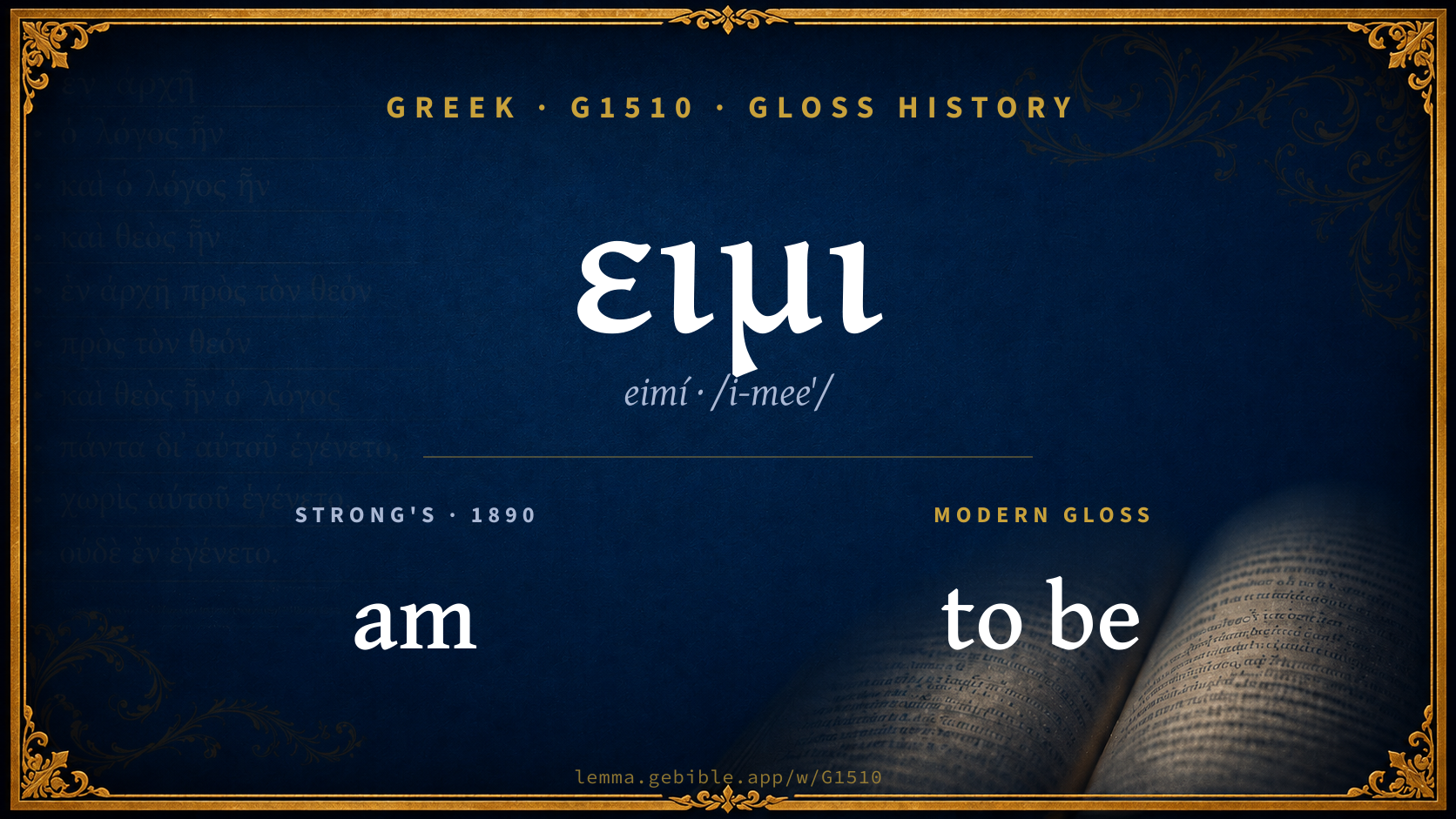
Gloss history
Strong's 1890 vs modern scholarship
About this word
Strong's G1510 catalogs a Greek word from the Greek New Testament.
These counts are not copied from any lexicon or concordance. They are computed here, from the morphology-tagged Greek New Testament. What Lemma adds →
- 2,096
- distinct verses
- The word appears in 2,096 distinct verses.
- 27 / 27
- NT books
- The word appears in 27 of 27 New Testament books.
- #6
- by frequency
- Top 10 most frequent Greek words (rank 6 of 5,347 Greek words by occurrence).
View all 2,096 occurrences in the concordance →
By section of the New Testament
By traditional corpus
Conventional, traditional groupings — biblical authorship is debated, so this is a traditional corpus grouping, not an authorship claim. Some books belong to more than one corpus (Luke is in both the Gospels and the Lukan corpus, and so on), so these shares overlap and need not total 100%. Each figure is a share of the word’s 2,096 distinct verses.
- Gospels 1,097 verses · 52%
- Lukan (Luke–Acts) 567 verses · 27%
- Johannine 514 verses · 25%
- Pauline corpus 484 verses · 23%
- General (Catholic) Epistles 133 verses · 6%
- Revelation 81 verses · 4%
- Hebrews 48 verses · 2%
How translations render this word
Counts come from each version’s own published word-to-Strong’s tagging or interlinear alignment — an approximate guide to how each version renders this word, not a word-level alignment the data otherwise carries. Because each total is that version’s own tagged count, the per-version totals vary from one another and need not match the appearance or distinct-verse counts above. These counts may also differ from a printed concordance because Lemma counts each distinctly tagged rendering and does not collapse phrase taggings into a single head-word total. This is a fixed set of word-tagged versions (KJV, ASV, BSB, ULT) and does not change with the reading translation you choose elsewhere. Each version’s license is shown beside its name below (and on Sources).
- King James Version: Am 82×, I am 44×, Is 6×
- American Standard Version: Am 75×, I am 45×, We were 6×
- Berean Standard Bible: Is 651×, Was 240×, Are 233×
- unfoldingWord Literal Text: Is 789×, Are 272×, Was 248×
King James Version Public Domain
Renders G1510 across 140 tagged occurrences — most commonly:
Plus 3 renderings that appear only once — usually multi-word phrases or single function words the recovered tagging swept in, not distinct renderings. Not rendered by a distinct English word in 6 further occurrences.
American Standard Version Public Domain
Renders G1510 across 154 tagged occurrences — most commonly:
Plus 7 renderings that appear only once — usually multi-word phrases or single function words the recovered tagging swept in, not distinct renderings. Not rendered by a distinct English word in 1 further occurrence.
Berean Standard Bible Public Domain
Renders G1510 across 2,237 tagged occurrences — most commonly:
Plus other, less common renderings. Plus 167 renderings that appear only once — usually multi-word phrases or single function words the recovered tagging swept in, not distinct renderings. Not rendered by a distinct English word in 169 further occurrences.
unfoldingWord Literal Text CC BY-SA 4.0
Renders G1510 across 2,561 tagged occurrences — most commonly:
Plus other, less common renderings. Plus 65 renderings that appear only once — usually multi-word phrases or single function words the recovered tagging swept in, not distinct renderings.
Senses in Thayer's
The 1 sense Thayer's distinguishes for this word, in lexicon order (not ranked by frequency or importance). The full entry — with sub-senses — is in the Lexicon Entry tab.
- to be, to exist, to happen, to be present
Word origin
Origin: "the first person singular present indicative; a prolonged form of a primary and defective verb"
Forms in the corpus
The 70 distinct written forms G1510 takes in the Greek New Testament, most frequent first — each parse links to that tense’s occurrences in the concordance.
The 60 most common forms are shown; 10 rarer forms follow in the full concordance.
Same root — word family
Other Thayer's entries built from the same root as G1510, grouped by Strong’s listed origin. These share a root / origin per the lexicon — not necessarily a shared meaning. Each links to that word’s own entry.
Derived from this word
- ει eî G1488 you are
- ειην eíēn G1498 to be
- ειναι eînai G1511 to be
- εισι eisí G1526 are
- εσμεν esmén G2070 we are
- εστε esté G2075 you are
- εστι estí G2076 he is
- εστω éstō G2077 let be
- ην ēn G2258 was
- ητω ḗtō G2277 let be
- ισθι ísthi G2468 be
- ω ō G5600 to be
- ων ṓn G5607 being
Proper names from this root
People and places named from this root — a name, not an additional meaning of the word.
Compare all same-root words → Showing 4 of 15 — not the complete family. 1 of the same-root words is a proper name (a person or place). They share a root, not necessarily a meaning.
Septuagint usage
The same Greek word ειμι appears 5,347 times in the Greek Old Testament (Septuagint), across 4,423 verses in 38 books.
- 5,347
- LXX occurrences
- Tagged occurrences of this Greek word in the Septuagint.
- 4,423
- verses
- Distinct Septuagint verses containing this word.
- 38 / 39
- OT books
- The word appears in 38 of the 39 Old Testament books.
Sample Septuagint occurrences
- Genesis 1:2 εἰμί
- Exodus 1:5 εἰμί
- Leviticus 1:8 εἰμί
- Numbers 1:4 εἰμί
- Deuteronomy 1:10 εἰμί
- Joshua 1:4 εἰμί
- Judges 1:7 εἰμί
- Ruth 1:2 εἰμί
- 1 Samuel 1:1 εἰμί
- 2 Samuel 1:8 εἰμί
- 1 Kings 1:2 εἰμί
- 2 Kings 1:3 εἰμί
Septuagint occurrences (same lexeme)
Every verse where the same Strong’s number (G1510) appears in the Greek Septuagint — showing the first 50 of 4,423. Verse text shown in the World English Bible for context; the Greek form is the matched word — the English is not keyword-highlighted.
- Genesis 1:2 εἰμί Now the earth was formless and empty. Darkness was on the surface of the deep. God's Spirit was hovering over the surface of the waters.
- Genesis 1:6 εἰμί God said, "Let there be an expanse in the midst of the waters, and let it divide the waters from the waters."
- Genesis 1:7 εἰμί God made the expanse, and divided the waters which were under the expanse from the waters which were above the expanse, and it was so.
- Genesis 1:14 εἰμί God said, "Let there be lights in the expanse of sky to divide the day from the night; and let them be for signs, and for seasons, and for days and years;
- Genesis 1:15 εἰμί and let them be for lights in the expanse of sky to give light on the earth," and it was so.
- Genesis 1:29 εἰμί God said, "Behold, I have given you every herb yielding seed, which is on the surface of all the earth, and every tree, which bears fruit yielding seed. It will be your food.
- Genesis 2:5 εἰμί No plant of the field was yet in the earth, and no herb of the field had yet sprung up; for Yahweh God had not caused it to rain on the earth. There was not a man to till the ground,
- Genesis 2:11 εἰμί The name of the first is Pishon: this is the one which flows through the whole land of Havilah, where there is gold;
- Genesis 2:12 εἰμί and the gold of that land is good. There is aromatic resin and the onyx stone.
- Genesis 2:18 εἰμί Yahweh God said, "It is not good that the man should be alone; I will make him a helper suitable for him."
- Genesis 2:24 εἰμί Therefore a man will leave his father and his mother, and will join with his wife, and they will be one flesh.
- Genesis 2:25 εἰμί They were both naked, the man and his wife, and were not ashamed.
- Genesis 3:1 εἰμί Now the serpent was more subtle than any animal of the field which Yahweh God had made. He said to the woman, "Yes, has God said, 'You shall not eat of any tree of the garden?'"
- Genesis 3:3 εἰμί but of the fruit of the tree which is in the midst of the garden, God has said, 'You shall not eat of it, neither shall you touch it, lest you die.'"
- Genesis 3:5 εἰμί for God knows that in the day you eat it, your eyes will be opened, and you will be like God, knowing good and evil."
- Genesis 3:6 εἰμί When the woman saw that the tree was good for food, and that it was a delight to the eyes, and that the tree was to be desired to make one wise, she took of the fruit of it, and ate; and she gave some to her husband with her, and he ate.
- Genesis 3:7 εἰμί Both of their eyes were opened, and they knew that they were naked. They sewed fig leaves together, and made themselves aprons.
- Genesis 3:9 εἰμί Yahweh God called to the man, and said to him, "Where are you?"
- Genesis 3:10 εἰμί The man said, "I heard your voice in the garden, and I was afraid, because I was naked; and I hid myself."
- Genesis 3:11 εἰμί God said, "Who told you that you were naked? Have you eaten from the tree that I commanded you not to eat from?"
- Genesis 3:19 εἰμί By the sweat of your face will you eat bread until you return to the ground, for out of it you were taken. For you are dust, and to dust you shall return."
- Genesis 4:2 εἰμί Again she gave birth, to Cain's brother Abel. Abel was a keeper of sheep, but Cain was a tiller of the ground.
- Genesis 4:8 εἰμί Cain said to Abel, his brother, "Let's go into the field." It happened, when they were in the field, that Cain rose up against Abel, his brother, and killed him.
- Genesis 4:9 εἰμί Yahweh said to Cain, "Where is Abel, your brother?" He said, "I don't know. Am I my brother's keeper?"
- Genesis 4:12 εἰμί From now on, when you till the ground, it won't yield its strength to you. You shall be a fugitive and a wanderer in the earth."
- Genesis 4:14 εἰμί Behold, you have driven me out this day from the surface of the ground. I will be hidden from your face, and I will be a fugitive and a wanderer in the earth. It will happen that whoever finds me will kill me."
- Genesis 4:17 εἰμί Cain knew his wife. She conceived, and gave birth to Enoch. He built a city, and called the name of the city, after the name of his son, Enoch.
- Genesis 4:20 εἰμί Adah gave birth to Jabal, who was the father of those who dwell in tents and have cattle.
- Genesis 4:21 εἰμί His brother's name was Jubal, who was the father of all who handle the harp and pipe.
- Genesis 4:22 εἰμί Zillah also gave birth to Tubal Cain, the forger of every cutting instrument of brass and iron. Tubal Cain's sister was Naamah.
- Genesis 5:32 εἰμί Noah was five hundred years old, and Noah became the father of Shem, Ham, and Japheth.
- Genesis 6:2 εἰμί that God's sons saw that men's daughters were beautiful, and they took for themselves wives of all that they chose.
- Genesis 6:3 εἰμί Yahweh said, "My Spirit will not strive with man forever, because he also is flesh; yet will his days be one hundred twenty years."
- Genesis 6:4 εἰμί The Nephilim were in the earth in those days, and also after that, when God's sons came to men's daughters. They bore children to them: the same were the mighty men who were of old, men of renown.
- Genesis 6:9 εἰμί This is the history of the generations of Noah. Noah was a righteous man, blameless among the people of his time. Noah walked with God.
- Genesis 6:12 εἰμί God saw the earth, and saw that it was corrupt, for all flesh had corrupted their way on the earth.
- Genesis 6:17 εἰμί I, even, I do bring the flood of waters on this earth, to destroy all flesh having the breath of life from under the sky. Everything that is in the earth will die.
- Genesis 6:19 εἰμί Of every living thing of all flesh, you shall bring two of every sort into the ark, to keep them alive with you. They shall be male and female.
- Genesis 6:21 εἰμί Take with you of all food that is eaten, and gather it to you; and it will be for food for you, and for them."
- Genesis 7:6 εἰμί Noah was six hundred years old when the flood of waters came on the earth.
- Genesis 7:15 εἰμί They went to Noah into the ark, by pairs of all flesh with the breath of life in them.
- Genesis 7:19 εἰμί The waters prevailed exceedingly on the earth. All the high mountains that were under the whole sky were covered.
- Genesis 7:22 εἰμί All in whose nostrils was the breath of the spirit of life, of all that was on the dry land, died.
- Genesis 7:23 εἰμί Every living thing was destroyed that was on the surface of the ground, including man, cattle, creeping things, and birds of the sky. They were destroyed from the earth. Only Noah was left, and those who were with him in the ark.
- Genesis 8:1 εἰμί God remembered Noah, all the animals, and all the cattle that were with him in the ark; and God made a wind to pass over the earth. The waters subsided.
- Genesis 8:9 εἰμί but the dove found no place to rest her foot, and she returned to him into the ark; for the waters were on the surface of the whole earth. He put forth his hand, and took her, and brought her to him into the ark.
- Genesis 8:17 εἰμί Bring forth with you every living thing that is with you of all flesh, including birds, cattle, and every creeping thing that creeps on the earth; that they may breed abundantly in the earth, and be fruitful, and multiply on the earth."
- Genesis 9:2 εἰμί The fear of you and the dread of you will be on every animal of the earth, and on every bird of the sky. Everything that the ground teems with, and all the fish of the sea are delivered into your hand.
- Genesis 9:3 εἰμί Every moving thing that lives will be food for you. As the green herb, I have given everything to you.
- Genesis 9:11 εἰμί I will establish my covenant with you; neither will all flesh be cut off any more by the waters of the flood; neither will there any more be a flood to destroy the earth."
These are occurrences of the same Greek lexeme (G1510) in the Septuagint — not a translation of any one Hebrew word. The store carries no word-level Hebrew↔Greek alignment, so no Hebrew original is asserted here. Counts come from the recovered LXX Strong's tagging — high-frequency vocabulary is well covered, while rare or late forms may be untagged — so they reflect tagged occurrences and may slightly undercount.