
Acts 11:28

Greek (Tischendorf 8th ed.) Acts 11:28 appears in the Greek New Testament. The text above is from the Tischendorf 8th edition. Each word links to its Strong’s number and a concise gloss. Click any word for its full Thayer’s Greek Lexicon entry.
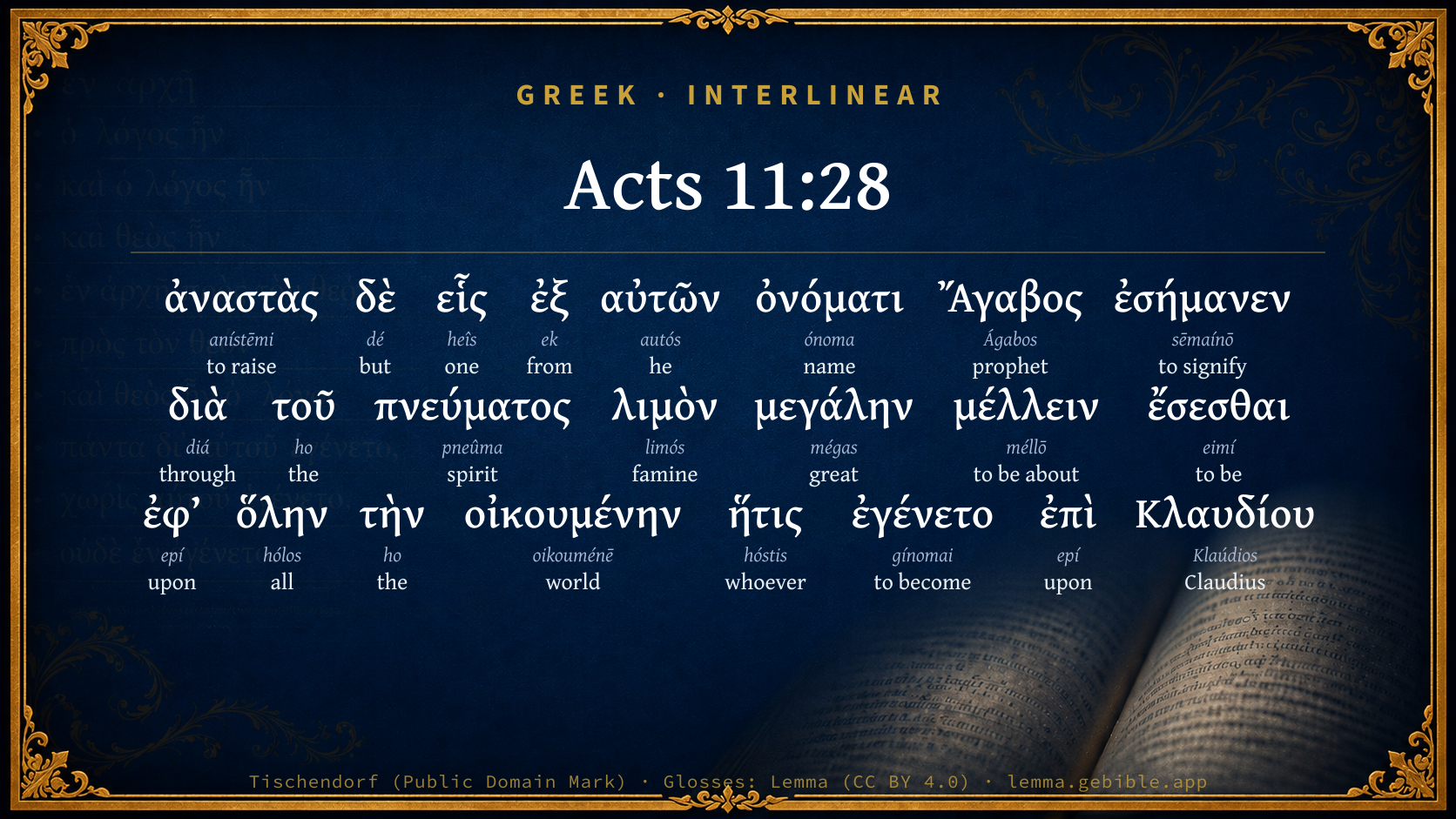
Download image
Cite this verse

Acts 11:28 (World English Bible). Public Domain. Lemma interlinear Bible study tool, https://lemma.gebible.app/v/acts/11/28.

Show BibTeX & RIS
BibTeX
RIS
English Translation
One of them named Agabus stood up, and indicated by the Spirit that there should be a great famine all over the world, which also happened in the days of Claudius.
World English Bible · Public Domain
Highlights
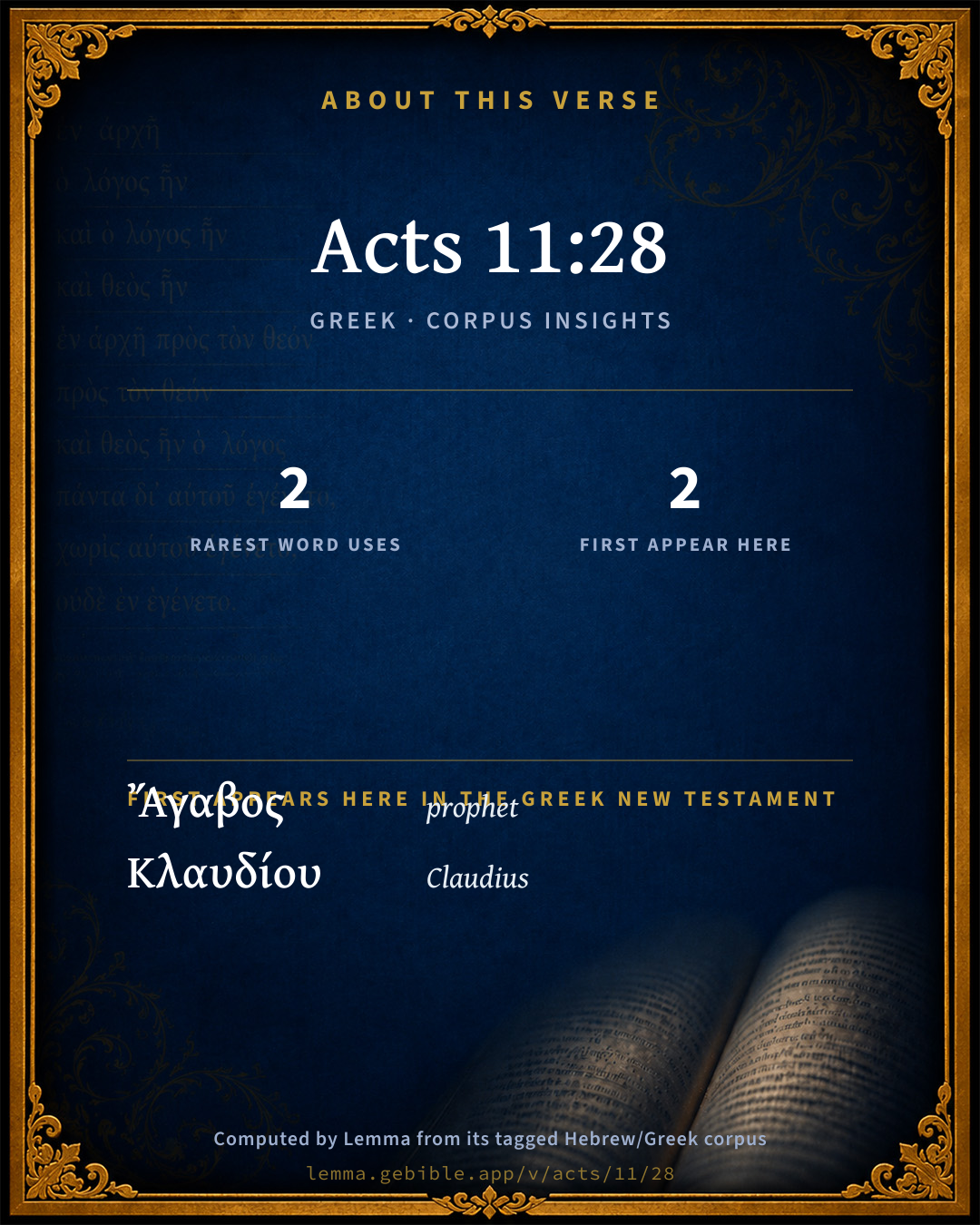
  • 2 first appearances in the Greek New Testament
Full analysis ↓
Download a study sheet

One document with this verse’s original text, its word-by-word gloss line, the meaning frame, cross-references with their text, attributed commentary, and full source and license credits — printable, and it pastes into notes with its structure intact.

This verse Autodidact and up

Study sheet (.html) Plain text (.txt)

A passage Seminary Student

Up to 50 verses in one chapter. A passage sheet keeps up to 6 commentary sources and 12 cross-references per verse, in the order this page ranks them, and says so on the sheet whenever that leaves anything out. Ask for a single verse and you get the Autodidact verse sheet above.

Everything on this page stays free to read, with no account — the sheet is a download of what is already on screen, not access to it.

Want to remove ads? Support Godless Engineer
Compare translations 3

The same verse in 3 English versions, stacked beneath the original-language interlinear above. Click any original word for its lexicon entry.

Each is an independent rendering of the whole verse — the interlinear is not word-aligned to these translations.

Highlighted words mark where these versions differ — a whole-verse word diff, not a word-by-word alignment.

  • World English Bible Public Domain
    One of them named Agabus stood up, and indicated by the Spirit that there should be a great famine all over the world, which also happened in the days of Claudius.
  • King James Version Public Domain
    And there stood up one of them named Agabus, and signified by the Spirit that there should be great dearth throughout all the world: which came to pass in the days of Claudius Caesar.
  • unfoldingWord Literal Text CC BY-SA 4.0
    And one of them, Agabus by name, having arisen, signified through the Spirit a great famine was about to occur over the whole world. This happened upon Claudius.

unfoldingWord Literal Text — © unfoldingWord, licensed CC BY-SA 4.0. Word-aligned USFM3 via Door43 (git.door43.org/unfoldingWord/en_ult).

Versions to compare (up to 4)

3 of 4 selected

Show all 19 translations

Every available English version of this verse, each an independent rendering of the whole verse.

  • World English Bible Public Domain
    One of them named Agabus stood up, and indicated by the Spirit that there should be a great famine all over the world, which also happened in the days of Claudius.
  • Berean Standard Bible Public Domain
    One of them named Agabus stood up and predicted through the Spirit that a great famine would sweep across the whole world. (This happened under Claudius.)
  • Majority Standard Bible Public Domain
    One of them named Agabus stood up and predicted through the Spirit that a great famine would sweep across the whole world. (This happened under Claudius Caesar.)
  • King James Version Public Domain
    And there stood up one of them named Agabus, and signified by the Spirit that there should be great dearth throughout all the world: which came to pass in the days of Claudius Caesar.
  • American Standard Version (1901) Public Domain
    And there stood up one of them named Agabus, and signified by the Spirit that there should be a great famine over all the world: which came to pass in the days of Claudius.
  • Revised Version (1885) Public Domain
    And there stood up one of them named Agabus, and signified by the Spirit that there should be a great famine over all the world: which came to pass in the days of Claudius.
  • Geneva Bible (1599) Public Domain
    And there stoode vp one of them named Agabus, and signified by the Spirit, that there should be great famine throughout all the world, which also came to passe vnder Claudius Cesar.
  • Douay-Rheims (1899) Public Domain
    And one of them named Agabus, rising up, signified by the Spirit, that there should be a great famine over the whole world, which came to pass under Claudius.
  • Young's Literal Translation Public Domain
    and one of them, by name Agabus, having stood up, did signify through the Spirit a great dearth is about to be throughout all the world -- which also came to pass in the time of Claudius Caesar --
  • Literal Standard Version CC BY-SA 4.0
    and one of them, by name Agabus, having stood up, signified through the Spirit a great scarcity is about to be throughout all the world—which also came to pass in the time of Claudius Caesar—
  • Unlocked Literal Bible CC BY-SA 4.0
    One of them, Agabus by name, stood up and indicated by the Spirit that a great famine would occur over all the world. This happened in the days of Claudius.
  • unfoldingWord Literal Text CC BY-SA 4.0
    And one of them, Agabus by name, having arisen, signified through the Spirit a great famine was about to occur over the whole world. This happened upon Claudius.
  • Darby Bible Public Domain
    and one from among them, by name Agabus, rose up and signified by the Spirit that there was going to be a great famine over all the inhabited earth, which also came to pass under Claudius.
  • World Messianic Bible Public Domain
    One of them named Agabus stood up and indicated by the Spirit that there should be a great famine all over the world, which also happened in the days of Claudius.
  • Webster's Bible Public Domain
    And there stood up one of them named Agabus, and signified by the Spirit that there should be great dearth throughout all the world: which came to pass in the days of Claudius Cesar.
  • Free Bible Version CC BY-SA 4.0
    One of them called Agabus stood up and gave a prophetic warning by the Spirit that there would be a terrible famine that would affect the known world. (This came true in the reign of Emperor Claudius.)
  • Bible in Basic English Public Domain
    And one of them, named Agabus, said publicly through the Spirit that there would be serious need of food all over the earth: which came about in the time of Claudius.
  • Text-Critical English NT CC BY 4.0
    One of them, named Agabus, stood up and indicated by the Spirit that a severe famine was about to come upon the entire world (which indeed took place in the time of Claudius Caesar).
  • Tyndale New Testament (1534) Public Domain
    And ther stode vp one of them named Agabus and signified by the sprete that ther shuld be great derth throughoute all the worlde which came to passe in the Emproure Claudius dayes.

Literal Standard Version (2020), Covenant Press — licensed CC BY-SA 4.0. Text via the HelloAO Bible API (eBible.org). Unlocked Literal Bible (unfoldingWord) — licensed CC BY-SA 4.0. Text via the HelloAO Bible API (eBible.org). unfoldingWord Literal Text — © unfoldingWord, licensed CC BY-SA 4.0. Word-aligned USFM3 via Door43 (git.door43.org/unfoldingWord/en_ult). Free Bible Version, Dr. Jonathan Gallagher — licensed CC BY-SA 4.0. Text via the HelloAO Bible API (eBible.org).

Word by word

More ways to search: Search by grammar → Find every occurrence → Compare this word →

Practice this passage: Drill this verse → Learn its vocabulary →

Ἄγαβος
Ágabos
G13
“prophet”
Noun, Nominative, Singular, Masculine
Part of Speech
Noun
Case
Nominative
Number
Singular
Gender
Masculine
Full Thayer's Definition

Origin: of hebrew origin, cf G2285

TDNT: None

Agabus = "locust" 1. a Christian prophet
  1. ἀναστὰς anístēmi G450 “to raise” Verb, Aorist, Active, Participle, Nominative, Singular, Masculine
  2. δὲ dé G1161 “but” Conjunction
  3. εἷς heîs G1520 “one” Adjective, Nominative, Singular, Masculine
  4. ἐξ ek G1537 “from” Preposition
  5. αὐτῶν autós G846 “he” Personal pronoun, Genitive, Plural, Masculine
  6. ὀνόματι ónoma G3686 “name” Noun, Dative, Singular, Neuter
  7. ἐσήμανεν sēmaínō G4591 “to signify” Verb, Aorist, Active, Indicative, 3rd person, Singular
  8. διὰ diá G1223 “through” Preposition
  9. τοῦ ho G3588 “the” Article, Genitive, Singular, Neuter
  10. πνεύματος pneûma G4151 “spirit” Noun, Genitive, Singular, Neuter
  11. λιμὸν limós G3042 “famine” Noun, Accusative, Singular, Masculine
  12. μεγάλην mégas G3173 “great” Adjective, Accusative, Singular, Feminine
  13. μέλλειν méllō G3195 “to be about” Verb, Present, Active, Infinitive
  14. ἔσεσθαι eimí G1510 “to be” Verb, Future, Middle deponent, Infinitive
  15. ἐφ’ epí G1909 “upon” Preposition
  16. ὅλην hólos G3650 “all” Adjective, Accusative, Singular, Feminine
  17. τὴν ho G3588 “the” Article, Accusative, Singular, Feminine
  18. οἰκουμένην oikouménē G3625 “world” Noun, Accusative, Singular, Feminine
  19. ἥτις hóstis G3748 “whoever” Relative pronoun, Nominative, Singular, Feminine
  20. ἐγένετο gínomai G1096 “to become” Verb, Aorist, Middle deponent, Indicative, 3rd person, Singular
  21. ἐπὶ epí G1909 “upon” Preposition
  22. Κλαυδίου Klaúdios G2804 “Claudius” Noun, Genitive, Singular, Masculine

About this verse

These counts appear in no published source. They are computed here, from the morphology-tagged text and Lemma’s own curated glosses. What Lemma adds →

23
words
21
distinct lemmas
Acts
section

Notable vocabulary

The rarest word here is Ἄγαβος prophet G13 — appearing just 2 times in the whole Greek New Testament.

First appearance in Scripture

These words make their first canonical appearance in the Greek New Testament here:

  • Ἄγαβος prophet G13
  • Κλαυδίου Claudius G2804

Shared distinctive vocabulary

Ἄγαβος prophet G13 occurs in 2 verses of the Greek New Testament. Also found in:
Repetition

Words recur within this verse:

Cross-references

9

Topical passages linked to Acts 11:28 in the Treasury of Scripture Knowledge — connected by theme and wording, ordered by reader-vote popularity; previews shown in the World English Bible.

  • Acts 21:10 As we stayed there some days, a certain prophet named Agabus came down from Judea.
  • Acts 18:2 He found a certain Jew named Aquila, a man of Pontus by race, who had recently come from Italy, with his wife Priscilla, because Claudius had commanded all the Jews to depart from Rome. He came to them,
  • 1 Kings 17:1–16 Elijah the Tishbite, who was of the foreigners of Gilead, said to Ahab, As Yahweh, the God of Israel, lives, before whom I stand, there shall not be dew nor rain these years, but according to my word.
  • Luke 2:1 Now it happened in those days, that a decree went out from Caesar Augustus that all the world should be enrolled.
  • Luke 3:1 Now in the fifteenth year of the reign of Tiberius Caesar, Pontius Pilate being governor of Judea, and Herod being tetrarch of Galilee, and his brother Philip tetrarch of the region of Ituraea and Trachonitis, and Lysanias tetrarch of Abilene,
  • Genesis 41:30–31 There will arise after them seven years of famine, and all the plenty will be forgotten in the land of Egypt. The famine will consume the land,
  • Genesis 41:38 Pharaoh said to his servants, "Can we find such a one as this, a man in whom is the Spirit of God?"
  • 2 Kings 8:1–2 Now Elisha had spoken to the woman, whose son he had restored to life, saying, Arise, and go you and your household, and sojourn wherever you can sojourn: for Yahweh has called for a famine; and it shall also come on the land seven years.
  • Matthew 24:14 This Gospel of the Kingdom will be preached in the whole world for a testimony to all the nations, and then the end will come.

Cross-references courtesy of OpenBible.info (CC BY 4.0).

Where the printed editions differ

1 variant

Places in this verse where the major printed Greek editions disagree on the wording in a way that affects the translation — a comparison of editions, not a manuscript-by-manuscript collation. The editions are the modern critical texts (Nestlé-Aland 28/27, SBL, Westcott-Hort, Tregelles, Tyndale House) and the traditional texts behind the KJV (the Textus Receptus and the Byzantine/Majority text). It is not a claim about which reading is original.

  1. Extra text
    Καίσαρος.

    “of Caesar.”

    In TRByz Not in NA28NA27TynSBLWHTreg

    Καίσαρος. (Kaisaros) 'of Caesar.' is only in traditional manuscripts (TR+Byz)

Textual data: Translators Amalgamated Greek New Testament (STEPBible TAGNT) · CC BY 4.0.

Commentary

Notes on Acts 11:28 from classic Christian and Jewish commentators (each source and its license shown beneath its notes). The classic Christian expositions comment on the surrounding passage and are grouped to its opening verse, so a note may address several verses; the Jewish commentaries on the Tanakh (Rashi and others) are per-verse, so they appear only where the commentator wrote on this verse.

Lemma curates 59 commentaries, every one of them public domain or Creative Commons licensed, each selected and text-cleaned for this edition rather than reprinted as found. About our sources →

Adam Clarke's Commentary

Verse 28. Agabus] This prophet, of whom we know nothing, is once more mentioned, Ac 21:10. He was probably a Jew, but whether converted now to Christianity we cannot tell.

Great dearth throughout all the world] The words εφ ολην την οικουμενην probably here mean the land of Judea; though sometimes by this phrase the whole Roman empire is intended. In the former sense the disciples appear to have understood it, as the next verse informs us; for they determined to send relief to their brethren in Judea, which they could not have done had the famine been general. It does not appear that they expected it to extend even to Antioch in Syria, where they then were, else they would have thought of making provision for themselves.

It is well known from history that there were several famines in the reign of Claudius. Dion Cassius, lib. lx., mentions a severe famine in the first and second year of the reign of Claudius, which was sorely felt ln Rome itself. This famine, it is supposed, induced Claudius to build a port at Ostia, for the more regular supply of Rome with provisions.

A second famine happened about the fourth year of this reign, which continued for several years, and greatly afflicted the land of Judea. Several authors notice this, but particularly Josephus, Ant. lib. xx. cap. 5, sect. 2, where, having mentioned Tiberius Alexander as succeeding to the procuratorship in the place of Cuspius Fadus, he says that, "during the government of these procurators, a great famine afflicted Judea." Επι τουτοις δη και τον μεγαν λιμον κατα την Ιουδαιαν συνεβη γενεσθαι.

A third famine is mentioned by Eusebius, in An. Abrahami, which commences with the calends of October, A.D. 48, which was so powerful "in Greece that a modius (about half a bushel of grain) was sold for six drachms," about three shillings and sixpence English. Vid. Euseb. in Chron. edit. Scalig. The same author mentions another famine in Rome, in the tenth year of Claudius, of which Orosius gives the details, lib. vii.

A fourth famine, which took place in the eleventh year of Claudius, is mentioned by Tacitus, Annal. lib. xii. sect. 43, in which there was so great a dearth of provisions, and famine in consequence, that it was esteemed a Divine judgment. Frugrum quoque egestas, et orta ex ea fames, in prodigium accipiebatur. At this time, the same author tells us, that in all the stores of Rome there were no more than fifteen days' provision; and, had not the winter been uncommonly mild, the utmost distress and misery must have prevailed.

It may now be inquired, to which of these famines in the reign of Claudius does the prophecy of Agabus refer? Most learned men are of opinion that the famine of which Agabus prophesied was that mentioned above, which took place in the fourth year of this emperor. A.D. 47. This famine is particularly mentioned by Josephus, Ant. lib xx. cap. 2, sect. 5, who describes it as "a very great famine, in which many died for want of food." - "That Helena, queen of Adiabene, who had embraced the Jewish religion, sent some of her servants to Alexandria, to buy a great quantity of corn; and others of them to Cyprus, to buy a cargo of dried figs, which she distributed to those who were in want." And in cap. 5, sect. 2, he says that this happened" when Tiberius Alexander succeeded Cuspids Fadus; and that under these procurators the famine happened in which Queen Helena, at a vast expense, procured relief to the Jews." Dr. Hudson's note on this passage in Josephus deserves to be copied: "This," says he, "is that famine foretold by Agabus, Ac 11:28, which happened when Claudius was consul the fourth time, (A.D. 47,) and not that which happened when Claudius was consul the second time, and Caecina was his colleague, (A.D. 42,) as Scaliger says, upon Eusebius, p. 174. Now when Josephus had said, a little after, cap. 5, sect. 2, that Tiberius Alexander succeeded Cuspius Fadus as procurator, he immediately subjoins, under these procurators there happened a great famine in Judea." From this it is evident that this famine must have continued several years, as it existed under both these procurators. Fadus, says Mr. Whiston, was not sent into Judea till after the death of Agrippa, i.e. towards the end of the fourth year of Claudius, in the end of A.D. 44, or beginning of 45. So that this famine, foretold by Agabus, happened on the fifth, sixth, and seventh years of Claudius, A.D. 45, 46, and 47. See Whiston's Josephus; and see Krebs' Observat. in Nov. Test. on this place.

Adam Clarke's Commentary on the Bible (1810–1826) — public domain. Text from a community e-Sword/MySword module.

Tyndale Open Study Notes

Tyndale Open Resources

11:28 Claudius, nephew of Tiberius Caesar (Luke 3:1), was the Roman emperor in AD 41–54. His last wife was his niece Agrippina, whose son Nero he adopted.

Tyndale Open Study Notes — © Tyndale Open Resources, licensed CC BY-SA 4.0. Text via the HelloAO Bible API.

Bengel's Gnomon

Johann Albrecht Bengel

Act 11:28. Ἀναστὰς, having stood up) in the assembly.—ἐσήμαινε, signified) What, in the case of all other men, natural or political sagacity may foresee, that the Spirit foresees in the case of believers. [This prophecy was a great gain to the brethren in Judea. Never is the indication of things future unattended with its use, where it is laid out to good account.—V. g.]—μέλλειν ἔσεσθαι, that there was about to be) A double future.

Bengel's Gnomon of the New Testament — English translation (T&T Clark, Edinburgh, 1860) — public domain. Text from a community e-Sword module.

Expositor's Greek Testament

ed. W. Robertson Nicoll

Act 11:28 . Ἄγαβος : on derivation see W.H [245] , ii., 313, from עגב “to love”; or from חגב “a locust,” Ezr 2:45 , Neh 7:48 , with rough breathing Ἅγ . W.H [246] follow Syriac and read the former as in T.R., so Weiss; Blass doubtful; Klostermann would connect it with Ἀγαυός , Probleme im Aposteltexte , p. 10. As a Jewish prophet he would naturally use the symbolic methods of a Jeremiah or an Ezekiel, see on Act 21:10-11 . On insertion in [247] see critical notes. μέλλειν ἔσεσθαι : future infinitive only used in N.T. with μέλλειν in this one phrase, and only so in Acts, cf. Act 24:15 ; Act 27:10 . In Act 23:30 μέλλειν omitted (although in T.R.), and in Act 24:25 ἔσεσθαι omitted (although in T.R.). Klostermann, Vindiciæ Lucanæ , p. 51, Simcox, Language of the N. T. , p. 120, and Viteau, Le Grec du N. T. , p. 158 (1893). λιμὸν : masculine in Luk 4:25 , and so in common usage, but in Doric usage, as it is called, feminine, and so also in later Greek; feminine in Luk 15:14 and here; see critical notes; Blass, Gram. , p. 26. ἐφʼ ὅλην τὴν οἰκ . the civilised world, i.e. , the Roman Empire. Cf. Act 24:5 , and Luk 2:1 , see Plummer’s note on Luk 4:5 (and Hackett’s attempt, in loco , to limit the expression), and Ramsay, Was Christ born at Bethlehem? p. 118. We have ample evidence as to a widespread dearth over various parts of the Roman Empire, to which Suetonius, Dion Cassius, Tacitus, and Eusebius all bear witness, in the reign of Claudius; and in no other reign do we find such varied allusions to periodical famines, “assiduae sterilitates,” Suetonius, Claudius , xviii., cf. Dion Cassius, lx., 11; Tac., Ann. , xii., 43, etc. These and other references are given by Schürer, Jewish People , div. i., vol. ii., p. 170, E.T. (so also by O. Holtzmann, Neutest. Zeitgeschichte , p. 124), but instead of drawing from these varied references the inference that the author of Acts had ample justification for his statement as to the prevalence of famine over the Roman Empire, he takes him to task for speaking of a famine “over the whole world”. See Ramsay, St. Paul , pp. 48, 49, and also Was Christ Born at Bethlehem? pp. 251, 252, cf. Act 11:29-30 . At least there is no ground to suppose, with Clemen and others, that the writer of Acts was here dependent on Josephus for the mention of the famine which that historian confined to Judæa, but which the writer of Acts, or rather Clemen’s Redactor Antijudaicus, magnified according to his usual custom.

[245] Westcott and Hort’s The New Testament in Greek: Critical Text and Notes.

[246] Westcott and Hort’s The New Testament in Greek: Critical Text and Notes.

[247] Codex Claromontanus (sæc. vi.), a Græco-Latin MS. at Paris, edited by Tischendorf in 1852.

The Expositor's Greek Testament, edited by W. Robertson Nicoll (1897–1910) — public domain. Text from a community e-Sword module.

Jamieson, Fausset & Brown

Robert Jamieson, A. R. Fausset & David Brown

that there should be great dearth throughout all the world--the whole Roman empire.

which came to pass in the days of Claudius Cæsar--Four famines occurred during his reign. This one in Judea and the adjacent countries took place, A.D. 41 [JOSEPHUS, Antiquities, 20.2,5]. An important date for tracing out the chronology of the Acts. (But this subject is too difficult and extensive to admit of being handled here).

Jamieson, Fausset & Brown — Commentary Critical and Explanatory on the Whole Bible (1871) — public domain (CC PDM 1.0). Text via the HelloAO Bible API.

John Calvin's Commentaries

28. He signified by the Spirit. Luke doth plainly express that the Spirit of God was the author of this prophecy, that we may know that it was not a conjecture taken by the stars, or some other natural causes; again, that Agabus did not play the philosopher after the manner of men, but he uttered that which God had appointed by the secret inspiration of the Spirit. Barrenness may indeed be sometimes foretold by the disposition of the stars, but there is no certainty in such foretellings, both because of the opposite concourses, and also, especially, because God doth govern earthly things at his pleasure, far otherwise than can be gathered by the stars, that he may lead men away from the perverse beholding of stars. And although these foretellings have their degree, yet the prophecies of the Spirit do far exceed them. But it seemeth that the foretelling of the famine was unlucky, [of evil omen,] and not to be wished for; for to what end was it for men to be made miserable before their time, by having the unhappy event foretold? I answer, that there be many causes for which it is expedient that men should be warned before in time when the judgments of God hang over their heads, and punishments [are] due to their sins. I omit others which are usual in the prophets, because [viz. that] they have a space granted wherein to repent, that they may prevent God’s judgment, who have provoked his wrath against themselves; because [that] the faithful are instructed in time to arm themselves with patience; because [that] the obstinate wickedness of wicked men is convict; because [that] both good and evil learn that miseries do not come by chance, but that they are punishments wherewith God doth punish the sins of the world; because [that] those are awakened out of their sleep and sluggishness by this means, who took great delight in their vices. The profit of this present prophecy appeareth by the text, because the men of Antioch were thereby pricked forward to relieve their brethren which were in misery.

Which happened under Claudius. Suetonius also maketh mention of this famine, who saith that there were crusts or shards thrown at Claudius’ head in the midst of the market and that he was so sore afraid of stoning, that he had a singular care afterward, during his whole life, to make provision for victual. And Josephus, in his Fifteenth Book of Antiquity, saith, that Judea was sore oppressed with scarcity, by reason of continual drought.

John Calvin's Commentaries (1540-1563) — public domain. Text from the Calvin Translation Society English edition (1840s-50s) via the Christian Classics Ethereal Library (ccel.org). Calvin's coverage is partial (roughly two-thirds of the Bible); uncommented books and verses are honest gaps, never fabricated. The 19th-century editor's footnotes and remarks are omitted so the notes are faithfully Calvin's own voice.

Ellicott's Commentary for English Readers

(28) There stood up one of them named Agabus.—The same prophet appears again in Act_21:10 as coming down from Jerusalem to Cæsarea. Nothing more is known of him. The prophecy of the “dearth” or “famine” was in part an echo of Mat_24:7.

Throughout all the world.—Literally, the inhabited earth, used, as in Luk_2:1; Luk_4:5, and elsewhere in the New Testament, for the Roman empire.

Which came to pass in the days of Claudius Cæsar.—The reign of Caligula lasted from A.D. 37-41, that of Claudius from A.D. 41-54. The whole reign of the latter emperor was memorable for frequent famines (Suetonius, Claud. 28; Tacitus, Ann. xii. 43). Josephus (Ant. xx. 5) speaks of one as specially affecting Judæa and Syria, under the procuratorship of Cuspius Fadus, A.D. 45. The population of Jerusalem were reduced to great distress, and were chiefly relieved by the bounty of Helena, Queen of Adiabene, who sent in large supplies of corn, figs, and other articles of food. She was herself a proselyte to Judaism, and was the mother of Izates, whose probable conversion to the faith of Christ by Ananias of Damascus is mentioned in the Note on Act_9:10. The title of “Cæsar” is omitted in the better MSS.

A Bible Commentary for English Readers, edited by Charles John Ellicott (1878–1897) — public domain. Text from a community e-Sword module.

The Cambridge Bible for Schools and Colleges

gen. ed. J. J. S. Perowne

28. one of them named Agabus] He is mentioned again Act_21:10, where by a significant action, as well as by his words, he foretells the imprisonment of St Paul at Jerusalem.

and signified by the Spirit] So too Act_21:11, the words of Agabus are, “Thus saith the Holy Ghost, So shall the Jews at Jerusalem bind the man that owneth this girdle.”

great dearth] This famine is mentioned by Josephus (Antiq. xx. 2. 5), who tells how Helena, queen of Adiabene, being at Jerusalem, succoured the people by procuring for them corn from Alexandria and a cargo of figs from Cyprus. The date of this severe famine was a.d. 45.

throughout all the world] Though one region might be specially afflicted by the failure of its crops, all the rest of the Roman empire would be sure to suffer in some degree at the same time, and especially when famines were, as at this time, of frequent recurrence.

in the days of Claudius Cesar] The oldest MSS. omit “Cæsar.” The reign of Claudius (a.d. 41–54) was remarkable for the famines with which various parts of the empire were afflicted. The first, second, fourth, ninth and eleventh years of this Emperor’s reign are recorded as years of famine in some district or other. See Suetonius, Claudius, 28; Tacitus, Ann. xii. 43; Josephus, Antiq. xx. 2. 5, Dio Cassius ix. p. 949, Euseb. H. E. ii. 8.

The Cambridge Bible for Schools and Colleges (gen. ed. J. J. S. Perowne; Cambridge University Press, 1878–1918) — public domain. Text from a community e-Sword module.

Trapp's Complete Commentary

John Trapp

28 And there stood up one of them named Agabus, and signified by the Spirit that there should be great dearth throughout all the world: which came to pass in the days of Claudius Caesar.

Ver. 28. And there stood up one] So Bishop Hooper prophesied, long before, of his own death. For, taking Mr Bullinger by the hand, at his return from Zurich, There, said he, where I take most pains you shall hear of me to be burnt to ashes. And being made bishop, he took for his arms a lamb in a fiery bush, and the sunbeams descending down upon the lamb; rightly denoting, as it seemeth, the order of his suffering, which afterward followed. So father Latimer ever affirmed of himself, that the preaching of the gospel would cost him his life; to the which he no less cheerfully prepared himself, than certainly was persuaded that Winchester was kept in the Tower (in King Edward VI’s days) for the same purpose; and it proved so. In November, 1572, appeared a new star in Cassiopeia, and continued sixteen months. Theodore Beza wittily applied it to that star at Christ’s birth, and to the infanticide then, and warned Charles IX, author of the French massacre, to beware, in this verse:

" Tu vero Herodes sanguinolente time."

The fifth month after the vanishing of this star the said Charles, after long and grievous pains, died of exceeding bleeding. Spotswood, Archbishop of St Andrews, a deep and subtle dissembler, who had discouraged, and by degrees rooted out, most of the faithful ministers of Scotland, thought it seasonable (A. D. 1639) to repair into England, where he died a martyr, to the design of bringing in Popery and slavery. And so was the prediction of Mr Walsh, a famous Scotch minister, fulfilled upon him, who in a letter to the bishop, written 1604, told him he should die an outcast.

Great dearth throughout the world] Suetonius and Josephus make mention of this famine. It went hard when this voice was uttered in the marketplace at Rome, Pone pretium humanae carni. Let us set a price on human flesh. At Antioch in Syria, many of the Christians engaged in the holy war (as they called it) were glad, through famine, to eat the dead bodies of their recently slain enemies. This was that Antioch here mentioned in the text.

In the days of Claudius Caesar] Who was an arrant slowbelly, counted for a fool by his own mother Antonia, judged unworthy of the empire by his own sister Livilla, poisoned at length by his own wife Agrippina, and her son Nero, qui dixit boletos Θεων βρωμα ειναι, quod Claudius bolero in numerum Deorum relatus esset. The times were then so bad when he ruled the empire, ut nihil amplius virtus esse putaretur quam το γενναιως επιθανειν, saith the historian. (Dio.) What marvel, then, though God scourged the world with extreme famine; wherein the Church also was inwrapped, but graciously provided for, as ever she is in a common calamity.

John Trapp, A Commentary or Exposition upon All the Books of the Old and New Testament (1647–1656) — public domain. Text from a community e-Sword module.

Albert Barnes' Notes on the Bible

Named Agabus - This man is mentioned but in one other place in the New Testament. In Act 21:10-11, he is referred to as having foretold that Paul would be delivered into the hands of the Gentiles. It is not expressly said that he was a Christian, but the connection seems to imply that he was.

And signified - See Joh 12:33. The word usually denotes “to indicate by signs, or with a degree of obscurity and uncertainty, not to declare in explicit language.” But here it seems to denote simply “to foretell, to predict.”

By the Spirit - Under the influence of the Spirit. He was inspired.

Great dearth - A great famine.

Throughout all the world - The word used here οἰκουμένην oikoumenēn usually denotes “the inhabitable world, the parts of the earth which are cultivated and occupied.” It is sometimes used, however, to denote “an entire land or country,” in contradistinction from the parts of it: thus, to denote “the whole of the land of Palestine” in distinction from its parts; or to denote that an event would have reference to all the land, and not be confined to one or more parts, as Galilee, Samaria, etc. See the notes on Luk 2:1. The meaning of this prophecy evidently is, that the famine would be extensive; that it would not be confined to a single province or region, but that it would extend so far as that it might be called “general.” In fact, though the famine was particularly severe in Judea, it extended much further. This prediction was uttered not long after the conversion of Saul, and probably, therefore, about the year, 38 a.d. or 40 a.d. Dr. Lardner has attempted to show that the prophecy had reference only to the land of Judea, though in fact there were famines in other places (Lardher’s Works, vol. 1, pp. 253, 254, edit. London, 1829).

Which came to pass ... - This is one of the few instances in which the sacred writers in the New Testament affirm the fulfillment of a prophecy. The history having been written after the event, it was natural to give a passing notice of the fulfillment.

In the days of Claudius Caesar - The Roman emperor. He began his reign in 41 a.d., and he reigned for 13 years. He was at last poisoned by one of his wives, Agrippina, who wished to raise her son Nero to the throne. During his reign no less than four different famines are mentioned by ancient writers, one of which was particularly severe in Judea, and was the one, doubtless, to which the sacred writer here refers:

(1) The first happened at Rome, and occurred in the first or second year of the reign of Claudius. It arose from the difficulties of importing provisions from abroad. It is mentioned by Dio, whose words are these: “There being a great famine, he (Claudius) not only took care for a present supply, but provided also for the time to come.” He then proceeds to state the great expense which Claudius was at in making a good port at the mouth of the Tiber, and a convenient passage from thence up to the city (did, lib. Ix. p. 671, 672; see also Suetonius, Claudius, cap. 20).

(2) A second famine is mentioned as having been particularly severe in Greece. Of this famine Eusebius speaks in his Chronicon, p. 204: “There was a great famine in Greece, in which a modius of wheat (about half a bushel) was sold for six drachmas.” This famine is said by Eusebius to have occurred in the ninth year of the reign of Claudius.

(3) In the latter part of his reign, 51 a.d., there was another famine at Rome, mentioned by Suetonius (Claudius, cap. 18), and by Tacitus (Ann., Joh 12:43). Of this, Tacitus says that it was so severe that it was deemed to be a divine judgment.

(4) A fourth famine is mentioned as having occurred particularly in Judea. This is described by Josephus (Antiq., book 20, chapter 2, section 5). “A famine,” says he, “did oppress them at the time (in the time of Claudius); and many people died for the lack of what was necessary to procure food withal. Queen Helena sent some of her servants to Alexandria with money to buy a great quantity of grain, and others of them to Cyprus to bring a cargo of dried figs.” This famine is described as having continued under the two procurators of Judea, Tiberius Alexander and Cassius Fadus. Fadus was sent into Judea, on the death of Agrippa, about the fourth year of the reign of Claudius, and the famine, therefore, continued probably during the fifth, sixth, and seventh years of the reign of Claudius. See the note in Whiston’s Josephus, Antiq., book 20, chapter 2, section 5; also Lardner as quoted above. Of this famine, or of the want consequent on the famine, repeated mention is made in the New Testament.

Albert Barnes' Notes on the Bible (1834–1885) — public domain. Text from a community e-Sword/MySword module.

Matthew Poole's English Annotations

By the Spirit; by a resolution from the Spirit, as one of his gifts, and not by judicial astrology, or any other means real or pretended; for it is a prerogative of God only to foretell things to come, as Isa 41:22,23.

Which came to pass in the days of Claudius Caesar: this famine Suetonius and other heathen writers make mention of, though some place it in one year, and some in another year, of Claudius’s reign. It may be there were divers famines, or one might continue divers years; but thus God, who provided for the patriarchs by means of Joseph’s foreseeing of the scarcity in Egypt and elsewhere, provides for his church now also by a like prediction. God’s omniscience is exerted for his church’s preservation.

Matthew Poole's English Annotations on the Holy Bible (1683–1685) — public domain. Text from a community e-Sword/MySword module.

Whedon's Commentary on the Bible

Daniel D. Whedon

28. Stood up—Doubtless in the public congregation.

Agabus—The name is probably derived from the Hebrew verb עגב, Agab, he loved; cognate with the Agape, love. Agabus again appears a true prophet, but a prophet of evil, in Act_21:11.

All the world—Literally, the whole inhabited land. The extent of this land depends upon the subject of the discourse. In this case Agabus was doubtless speaking of a particular land, namely, Palestine. This appears plainly from the fact that the Antiochians forthwith determined to send relief to Judea, as if there, and not in Syria, was to be the dearth.

The Codex Beza has here a remarkable addition: “And when we were all gathered about him he said,” etc. This would be, if authentic, an addition to “the we passages,” and prove Luke to have been at Antioch at this time. (See note on Act_16:10.) It only indicates, as it is, an ancient belief that he then was there.

Daniel D. Whedon (gen. ed.), Commentary on the Old and New Testaments (1874–1909) — public domain. Text from a community e-Sword module.

John Wesley's Explanatory Notes

Agabus rising up - In the congregation. All the world - The word frequently signifies all the Roman empire. And so it is doubtless to be taken here.

John Wesley, Explanatory Notes Upon the Whole Bible (1754–1765) — public domain. Text via the GEBible commentary corpus.

Scofield Reference Notes

C. I. Scofield

world

"oikoumene" = "inhabited earth." (See Scofield "Luk 2:1").

The Scofield Reference Bible (1917 edition), notes by C. I. Scofield — public domain. Text from a community e-Sword module.

McGarvey & Pendleton's Commentaries

J. W. McGarvey

See notes one verse 27

J. W. McGarvey (with Philip Y. Pendleton), Commentaries on the New Testament (The Fourfold Gospel, 1914; Acts; and the epistles) — public domain. Text from a community e-Sword/MySword module.

Cambridge Greek Testament for Schools and Colleges

28. μεγάλην after λιμόν with אABD, and so ἤτις to agree with it instead of ὅστις.

Καίσαρος omitted with אABD. Unrepresented in Vulg.

28. εἶς ἐξ αὐτῶν ὀνόματι Ἄγαβος, one of them, named Agabus. He is mentioned again in Act 21:10, where, after the fashion of some of the prophets of the O.T., he by a significant action, as well as by his words, foretells the imprisonment of St Paul at Jerusalem.

διὰ τοῦ πνεύματος. So too Act 21:11 the words of Agabus are prefaced by τάδε λέγει τὸ πνεῦμα τὸ ἅγιον.

λιμὸν μεγάλην, great dearth. This noun is usually masculine, but the grammarians notice that, as St Luke makes it here, it is sometimes feminine. The Megarean in Aristoph. Acharn. 743 uses it as feminine.

This famine is mentioned by Josephus (Ant. XX. 2. 5) who tells how Helena, queen of Adiabene, being at Jerusalem, succoured the people by procuring for them corn from Alexandria and a cargo of figs from Cyprus. The date of this severe famine was A.D. 45.

ἐφ’ ὅλην τὴν οἰκουμένην, throughout all the world, ἡ οἰκουμένη is the phrase used for the whole Roman empire, as in Luk 2:1, but here perhaps it has a wider signification. Though one region might be specially afflicted by the failure of its crops, all the rest of the Roman empire would be sure to suffer in some degree at the same time, and especially when famines were, as at this time, of frequent recurrence.

ἐπὶ Κλαυδίου, in the days of Claudius. The reign of Claudius (A.D. 41–54) was remarkable for the famines with which various parts of the empire were afflicted. The first, second, fourth, ninth and eleventh years of this emperor’s reign are recorded as years of famine in some district or other. See Suetonius, Claudius, 28; Tacitus, Ann. XII. 43; Josephus, Ant. XX. 2. 5; Dio Cassius, IX. p. 949; Euseb. H. E. II. 8.

Cambridge Greek Testament for Schools and Colleges (Cambridge University Press, 1896; 21 vols, various authors incl. Carr, Maclear, Plummer, Farrar, Lumby, Moule, M. R. James, Simcox) — public domain. Text from a community e-Sword module.

Alford’s Greek Testament

Henry Alford

28. Ἄγαβος] The same who prophesied Paul’s imprisonment in Jerusalem, ch. 21:10, ff. From the form of his announcement there, we may infer the manner in which he ἐσήμανεν διὰ τοῦ πνεύματος here. It was τάδε λὲγει τὸ πν. τὸ ἅγιον.

The fem. usage of λιμός prevailed among the Dorians (cf. Aristoph. Acharn. 708) and later Greeks: see Meyer, edn. 2, and Lobeck on Phryn. p. 188. We find it sometimes also in Ionic poets, e.g. in Hom. Hymn to Demeter, 311, λιμοῦ ὑπʼ ἀργαλέης: see other examples in Palm and Rost, sub voce.

ὅλην τ. οἰκουμένην] not, ‘all Judæa,’ though in fact it was so: the expression is a hyperbolical one in ordinary use, and not to be pressed as strictly implying that to which its literal meaning would extend. That it occurs in a prophecy (Meyer) is no objection to this: the scope and not the wording of the prophecy is given. But see below.

ἐπὶ Κλαυδίου] In the fourth year of Claudius, a.d. 44, there was a famine in Judæa and the neighbouring countries (Jos. Antt. xx. 2. 5). And three others are mentioned during his reign: one in Greece (Eus. Chron. i. 79), and two in Rome (Dio Cassius, lx. 11. Tacitus, Ann. xii. 43), so that scarcity ἐπὶ Κλαυδίου did extend through the greater part of the ‘orbis terrarum,’ if it be thought necessary to press the words of the prophecy. The queen Helena of Adiabene and her son Izates helped the Jews with subsidies on the occasion (Jos. ibid., see also xx. 5. 2, where he calls it τὸν μέγαν λιμόν), both of corn and money.

I do not believe that the words ἐπὶ Κλ. imply that the events just related were not also in the reign of Claudius: but they are inserted to particularize the famine as being that well-known one, and only imply that the author was not writing under Claudius.

Henry Alford, The Greek Testament (1849–1861) — public domain. Text from a community e-Sword module.

Vincent's Word Studies in the New Testament

Marvin R. Vincent

The world. See on Luk 2:1.

Marvin R. Vincent, Word Studies in the New Testament (1887–1900) — public domain. Text from a community e-Sword/MySword module.

Lesson kit

Teaching starters — assembled from the data on this page, not authored interpretation. Every prompt links to the verse data it draws on. Edit before teaching.

Acts, in the Acts, opens this verse with 23 words (21 distinct Greek lemmas). Its most distinctive word is Ágabos (“prophet”). A historical commentator’s framing appears above. Read the whole chapter for the surrounding context.

Discussion questions

  1. What does “prophet” (Ágabos) contribute to the verse as a whole?
  2. 2 words make their first appearance in Scripture here. What does this debut establish?
  3. How does Acts 21:10, which shares the word «prophet», read alongside this verse?
  4. What does the repetition of “upon” (2× in this one verse) do in this verse?
  5. These translations render this verse differently. What is at stake in choosing one wording over another?
  6. Compare how Adam Clarke's Commentary and Tyndale Open Study Notes read this verse. Where do they agree or differ?

Things to notice

  • 2 words make their first canonical appearance in Scripture here.
  • These translations choose different wording for 27 words in this verse.
  • “upon” occurs 2× in this single verse.
  • 21 distinct Greek lemmas span 23 words in this verse.

Reading settings

Reading text

Shown beneath each verse's original-language words.

Old Testament
Old Testament edition

Read the OT as the Masoretic Hebrew (MT) or the Greek Septuagint (LXX).

English shown for the Greek Septuagint (in the Hebrew ↔ Greek comparison).

Comparing translations? Open the Compare panel on any verse page to stack up to four side by side.