
Matthew 6:23

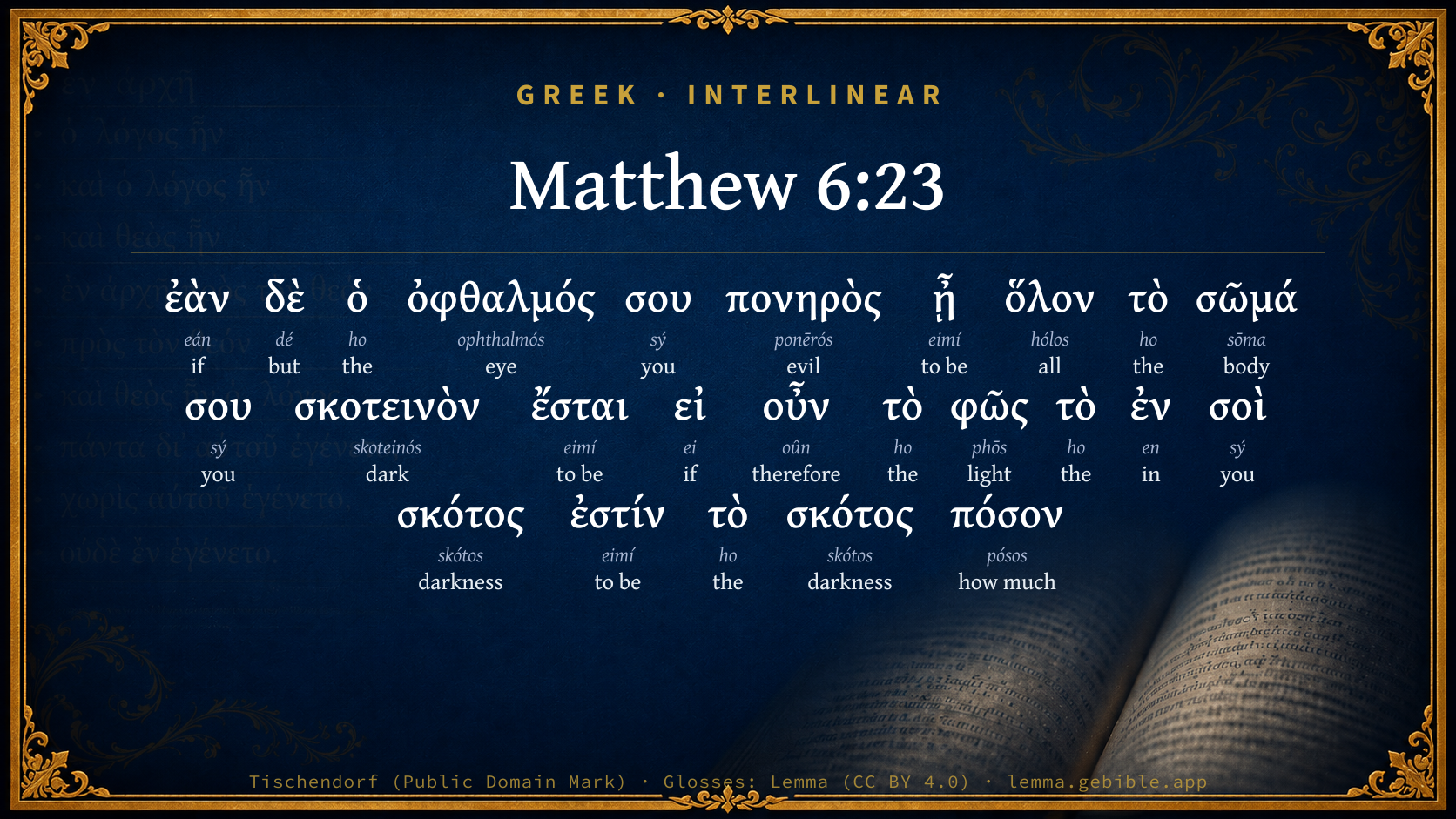
Greek (Tischendorf 8th ed.) Matthew 6:23 appears in the Greek New Testament. The text above is from the Tischendorf 8th edition. Each word links to its Strong’s number and a concise gloss. Click any word for its full Thayer’s Greek Lexicon entry.
Download image
Cite this verse

Matthew 6:23 (World English Bible). Public Domain. Lemma interlinear Bible study tool, https://lemma.gebible.app/v/matthew/6/23.

Show BibTeX & RIS
BibTeX
RIS
English Translation
But if your eye is evil, your whole body will be full of darkness. If therefore the light that is in you is darkness, how great is the darkness!
World English Bible · Public Domain
Highlights
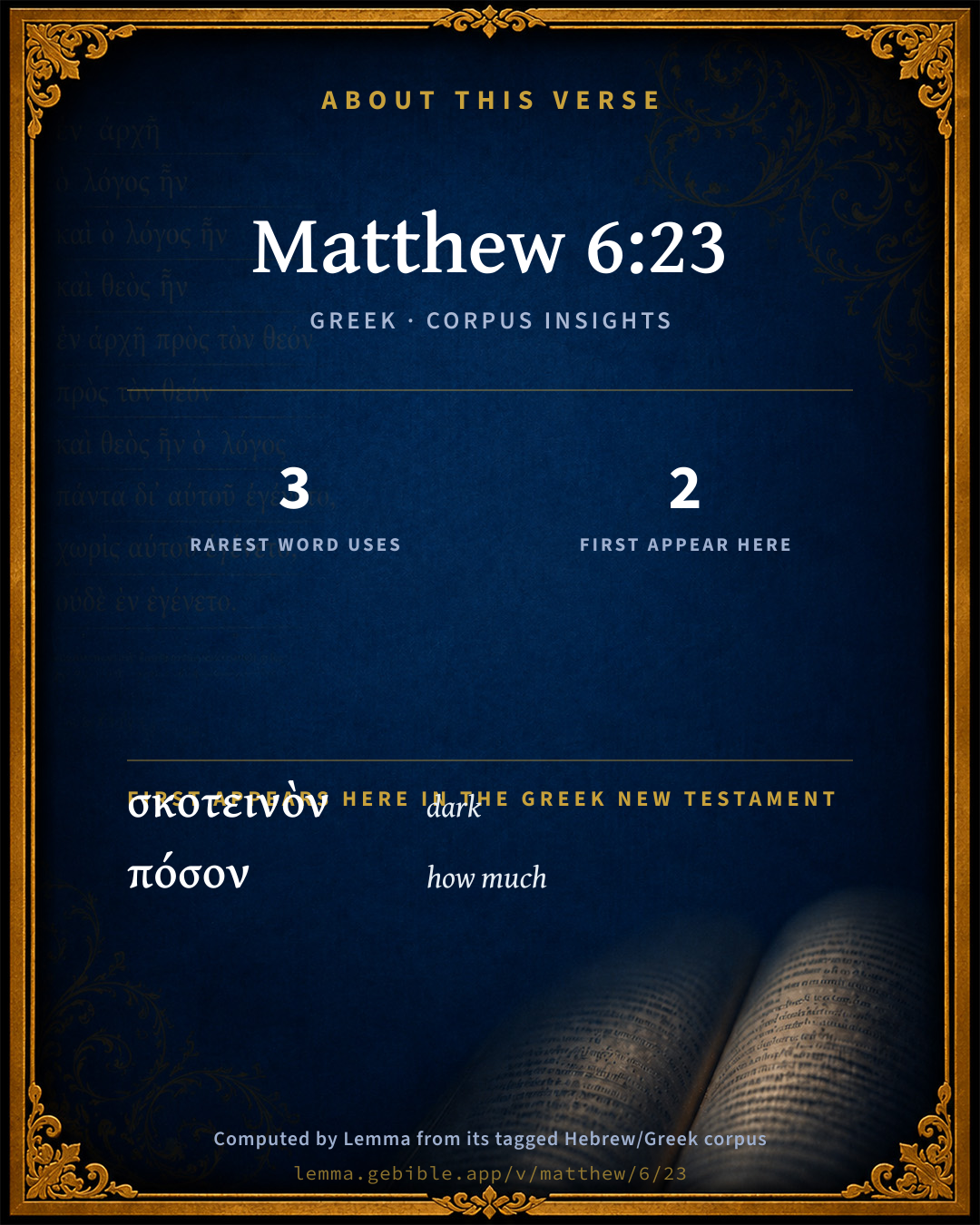
  • 2 first appearances in the Greek New Testament
Full analysis ↓
Download a study sheet

One document with this verse’s original text, its word-by-word gloss line, the meaning frame, cross-references with their text, attributed commentary, and full source and license credits — printable, and it pastes into notes with its structure intact.

This verse Autodidact and up

Study sheet (.html) Plain text (.txt)

A passage Seminary Student

Up to 50 verses in one chapter. A passage sheet keeps up to 6 commentary sources and 12 cross-references per verse, in the order this page ranks them, and says so on the sheet whenever that leaves anything out. Ask for a single verse and you get the Autodidact verse sheet above.

Everything on this page stays free to read, with no account — the sheet is a download of what is already on screen, not access to it.

Want to remove ads? Support Godless Engineer
Compare translations 3

The same verse in 3 English versions, stacked beneath the original-language interlinear above. Click any original word for its lexicon entry.

Each is an independent rendering of the whole verse — the interlinear is not word-aligned to these translations.

Highlighted words mark where these versions differ — a whole-verse word diff, not a word-by-word alignment.

  • World English Bible Public Domain
    But if your eye is evil, your whole body will be full of darkness. If therefore the light that is in you is darkness, how great is the darkness!
  • King James Version Public Domain
    But if thine eye be evil, thy whole body shall be full of darkness. If therefore the light that is in thee be darkness, how great is that darkness!
  • unfoldingWord Literal Text CC BY-SA 4.0
    But if your eye is evil, your whole body will be dark. Therefore, if the light in you is darkness, how great the darkness!

unfoldingWord Literal Text — © unfoldingWord, licensed CC BY-SA 4.0. Word-aligned USFM3 via Door43 (git.door43.org/unfoldingWord/en_ult).

Versions to compare (up to 4)

3 of 4 selected

Show all 19 translations

Every available English version of this verse, each an independent rendering of the whole verse.

  • World English Bible Public Domain
    But if your eye is evil, your whole body will be full of darkness. If therefore the light that is in you is darkness, how great is the darkness!
  • Berean Standard Bible Public Domain
    But if your eyes are bad, your whole body will be full of darkness. If then the light within you is darkness, how great is that darkness!
  • Majority Standard Bible Public Domain
    But if your eyes are bad, your whole body will be full of darkness. If then the light within you is darkness, how great is that darkness!
  • King James Version Public Domain
    But if thine eye be evil, thy whole body shall be full of darkness. If therefore the light that is in thee be darkness, how great is that darkness!
  • American Standard Version (1901) Public Domain
    But if thine eye be evil, thy whole body shall be full of darkness. If therefore the light that is in thee be darkness, how great is the darkness!
  • Revised Version (1885) Public Domain
    But if thine eye be evil, thy whole body shall be full of darkness. If therefore the light that is in thee be darkness, how great is the darkness!
  • Geneva Bible (1599) Public Domain
    But if thine eye be wicked, then all thy body shalbe darke. Wherefore if the light that is in thee, be darkenes, howe great is that darkenesse?
  • Douay-Rheims (1899) Public Domain
    But if thy eye be evil thy whole body shall be darksome. If then the light that is in thee, be darkness: the darkness itself how great shall it be!
  • Young's Literal Translation Public Domain
    but if thine eye may be evil, all thy body shall be dark; if, therefore, the light that `is' in thee is darkness -- the darkness, how great!
  • Literal Standard Version CC BY-SA 4.0
    but if your eye may be evil, all your body will be dark; if, therefore, the light that [is] in you is darkness—the darkness, how great!
  • Unlocked Literal Bible CC BY-SA 4.0
    But if your eye is bad, your whole body is full of darkness. Therefore, if the light that is in you is actually darkness, how great is that darkness!
  • unfoldingWord Literal Text CC BY-SA 4.0
    But if your eye is evil, your whole body will be dark. Therefore, if the light in you is darkness, how great the darkness!
  • Darby Bible Public Domain
    but if thine eye be wicked, thy whole body will be dark. If therefore the light that is in thee be darkness, how great the darkness!
  • World Messianic Bible Public Domain
    But if your eye is evil, your whole body will be full of darkness. If therefore the light that is in you is darkness, how great is the darkness!
  • Webster's Bible Public Domain
    But if thy eye be evil, thy whole body will be full of darkness. If therefore the light that is in thee is darkness, how great is that darkness!
  • Free Bible Version CC BY-SA 4.0
    But if your eye is evil, then your whole body will be in the dark. If the ‘light’ you have is actually darkness, how dark is that!
  • Bible in Basic English Public Domain
    But if your eye is evil, all your body will be dark. If then the light which is in you is dark, how dark it will be!
  • Text-Critical English NT CC BY 4.0
    But if yoʋr eye is bad, yoʋr whole body will be full of darkness. If then the light within yoʋ is darkness, how great is the darkness!
  • Tyndale New Testament (1534) Public Domain
    But and if thyne eye be wycked then all thy body shalbe full of derckenes. Wherfore yf the light that is in the be darckenes: how greate is that darckenes.

Literal Standard Version (2020), Covenant Press — licensed CC BY-SA 4.0. Text via the HelloAO Bible API (eBible.org). Unlocked Literal Bible (unfoldingWord) — licensed CC BY-SA 4.0. Text via the HelloAO Bible API (eBible.org). unfoldingWord Literal Text — © unfoldingWord, licensed CC BY-SA 4.0. Word-aligned USFM3 via Door43 (git.door43.org/unfoldingWord/en_ult). Free Bible Version, Dr. Jonathan Gallagher — licensed CC BY-SA 4.0. Text via the HelloAO Bible API (eBible.org).

Word by word

More ways to search: Search by grammar → Find every occurrence → Compare this word →

Practice this passage: Drill this verse → Learn its vocabulary →

σκοτεινὸν
skoteinós
G4652
“dark”
Adjective, Nominative, Singular, Neuter
Part of Speech
Adjective
Case
Nominative
Number
Singular
Gender
Neuter
Full Thayer's Definition

Origin: from G4655

TDNT: 14:03,1

1. full of darkness, covered with darkness
  1. ἐὰν eán G1437 “if” Conditional
  2. δὲ dé G1161 “but” Conjunction
  3. ὁ ho G3588 “the” Article, Nominative, Singular, Masculine
  4. ὀφθαλμός ophthalmós G3788 “eye” Noun, Nominative, Singular, Masculine
  5. σου sý G4771 “you” Personal pronoun, 2nd person, Genitive, Singular
  6. πονηρὸς ponērós G4190 “evil” Adjective, Nominative, Singular, Masculine
  7. ᾖ eimí G1510 “to be” Verb, Present, Active, Subjunctive, 3rd person, Singular
  8. ὅλον hólos G3650 “all” Adjective, Nominative, Singular, Neuter
  9. τὸ ho G3588 “the” Article, Nominative, Singular, Neuter
  10. σῶμά sōma G4983 “body” Noun, Nominative, Singular, Neuter
  11. σου sý G4771 “you” Personal pronoun, 2nd person, Genitive, Singular
  12. ἔσται eimí G1510 “to be” Verb, Future, Middle deponent, Indicative, 3rd person, Singular
  13. εἰ ei G1487 “if” Conditional
  14. οὖν oûn G3767 “therefore” Conjunction
  15. τὸ ho G3588 “the” Article, Nominative, Singular, Neuter
  16. φῶς phōs G5457 “light” Noun, Nominative, Singular, Neuter
  17. τὸ ho G3588 “the” Article, Nominative, Singular, Neuter
  18. ἐν en G1722 “in” Preposition
  19. σοὶ sý G4771 “you” Personal pronoun, 2nd person, Dative, Singular
  20. σκότος skótos G4655 “darkness” Noun, Nominative, Singular, Neuter
  21. ἐστίν eimí G1510 “to be” Verb, Present, Active, Indicative, 3rd person, Singular
  22. τὸ ho G3588 “the” Article, Nominative, Singular, Neuter
  23. σκότος skótos G4655 “darkness” Noun, Nominative, Singular, Neuter
  24. πόσον pósos G4214 “how much” Correlative/interrogative pronoun, Nominative, Singular, Neuter

About this verse

These counts appear in no published source. They are computed here, from the morphology-tagged text and Lemma’s own curated glosses. What Lemma adds →

25
words
16
distinct lemmas
Gospels
section

Notable vocabulary

The rarest word here is σκοτεινὸν dark G4652 — appearing just 3 times in the whole Greek New Testament.

First appearance in Scripture

These words make their first canonical appearance in the Greek New Testament here:

  • σκοτεινὸν dark G4652
  • πόσον how much G4214

Shared distinctive vocabulary

σκοτεινὸν dark G4652 occurs in 3 verses of the Greek New Testament. Also found in:
Repetition

Words recur within this verse:

Cross-references

21

Topical passages linked to Matthew 6:23 in the Treasury of Scripture Knowledge — connected by theme and wording, ordered by reader-vote popularity; previews shown in the World English Bible.

  • Matthew 6:22 "The lamp of the body is the eye. If therefore your eye is sound, your whole body will be full of light.
  • 1 John 2:11 But he who hates his brother is in the darkness, and walks in the darkness, and doesn't know where he is going, because the darkness has blinded his eyes.
  • Isaiah 5:20–21 Woe to those who call evil good, and good evil; Who put darkness for light, And light for darkness; Who put bitter for sweet, And sweet for bitter!
  • Proverbs 26:12 Do you see a man wise in his own eyes? There is more hope for a fool than for him.
  • Jeremiah 4:22 For my people are foolish, they don't know me; they are foolish children, and they have no understanding; they are wise to do evil, but to do good they have no knowledge.
  • 1 Corinthians 3:18–19 Let no one deceive himself. If anyone thinks that he is wise among you in this world, let him become a fool, that he may become wise.
  • 1 Corinthians 1:18–20 For the word of the cross is foolishness to those who are dying, but to us who are saved it is the power of God.
  • Isaiah 44:18–20 They don't know, neither do they consider: for he has shut their eyes, that they can't see; and their hearts, that they can't understand.
  • Romans 2:17–23 Indeed you bear the name of a Jew, and rest on the law, and glory in God,
  • 1 Corinthians 2:14 Now the natural man doesn't receive the things of God's Spirit, for they are foolishness to him, and he can't know them, because they are spiritually discerned.
  • Ephesians 4:18 being darkened in their understanding, alienated from the life of God, because of the ignorance that is in them, because of the hardening of their hearts;
  • Luke 8:10 He said, "To you it is given to know the mysteries of the Kingdom of God, but to the rest in parables; that 'seeing they may not see, and hearing they may not understand.'
  • Romans 1:22 Professing themselves to be wise, they became fools,
  • Ephesians 5:8 For you were once darkness, but are now light in the Lord. Walk as children of light,
  • Isaiah 8:20 To the law and to the testimony! if they don't speak according to this word, surely there is no morning for them.
  • Matthew 20:15 Isn't it lawful for me to do what I want to with what I own? Or is your eye evil, because I am good?'
  • Revelation 3:17–18 Because you say, 'I am rich, and have gotten riches, and have need of nothing;' and don't know that you are the wretched one, miserable, poor, blind, and naked;
  • Jeremiah 8:8–9 How do you say, We are wise, and the law of Yahweh is with us? But, behold, the false pen of the scribes has worked falsely.
  • Matthew 23:16–28 "Woe to you, you blind guides, who say, 'Whoever swears by the temple, it is nothing; but whoever swears by the gold of the temple, he is obligated.'
  • John 9:39–41 Jesus said, "I came into this world for judgment, that those who don't see may see; and that those who see may become blind."
  • Mark 7:22 covetings, wickedness, deceit, lustful desires, an evil eye, blasphemy, pride, and foolishness.

Cross-references courtesy of OpenBible.info (CC BY 4.0).

Commentary

Notes on Matthew 6:23 from classic Christian and Jewish commentators (each source and its license shown beneath its notes). The classic Christian expositions comment on the surrounding passage and are grouped to its opening verse, so a note may address several verses; the Jewish commentaries on the Tanakh (Rashi and others) are per-verse, so they appear only where the commentator wrote on this verse.

Lemma curates 59 commentaries, every one of them public domain or Creative Commons licensed, each selected and text-cleaned for this edition rather than reprinted as found. About our sources →

Bengel's Gnomon

Johann Albrecht Bengel

Mat 6:23. Πονηρὸς, evil) sc. shifting, double, inconsistent, imbued with self-love.—τὸ φῶς, the light) which the lamp should give.—τὸ σκότος, the darkness) How great darkness must be the darkness of the whole body![277]—πόσον, how great) As great as the body.

[277] In the original the passage runs thus—

“Tenebr totius corporis, quantæ erunt tenebræ!” and then proceeds,

“Singularis tenebra, veteribus non ignotus, a multis Theologis in loco adhibitus, sæpius conveniret simplicitati hermeneuticæ.”—(I. B.)

Bengel's Gnomon of the New Testament — English translation (T&T Clark, Edinburgh, 1860) — public domain. Text from a community e-Sword module.

International Critical Commentary

6:23. But if thine eye be evil (niggardly), thy whole body is dark. If therefore the light which is in thee be darkness, how great is the darkness t] Luk 11:34-35 has: “But if it be evil, then thy body is dark. Take heed, therefore ! Perhaps the light which is in thee is darkness.”

The meaning is, “If thine eye be evil, i.e. if you are miserly and grudging, keeping your wealth for yourself, then spiritual light cannot penetrate unto you; and such light as you have becomes ever darker, till it ceases to be light, and becomes darkness.”

International Critical Commentary — older volumes (1896–1929), various authors — public domain. Text from a community e-Sword module.

Jamieson, Fausset & Brown

Robert Jamieson, A. R. Fausset & David Brown

But if thine eye be evil--distempered, or, as we should say, If we have got a bad eye.

thy whole body shall be full of darkness--darkened. As a vitiated eye, or an eye that looks not straight and full at its object, sees nothing as it is, so a mind and heart divided between heaven and earth is all dark.

If therefore the light that is in thee be darkness, how great is that darkness!--As the conscience is the regulative faculty, and a man's inward purpose, scope, aim in life, determines his character--if these be not simple and heavenward, but distorted and double, what must all the other faculties and principles of our nature be which take their direction and character from these, and what must the whole man and the whole life be but a mass of darkness? In Luke (Luk 11:36) the converse of this statement very strikingly expresses what pure, beautiful, broad perceptions the clarity of the inward eye imparts: "If thy whole body therefore be full of light, having no part dark, the whole shall be full of light, as when the bright shining of a candle doth give thee light." But now for the application of this.

Jamieson, Fausset & Brown — Commentary Critical and Explanatory on the Whole Bible (1871) — public domain (CC PDM 1.0). Text via the HelloAO Bible API.

Ellicott's Commentary for English Readers

(23) If thine eye be evil.—If the spiritual faculty, whose proper work it is to give light, be itself diseased—if it discerns not singly but doubly, and therefore dimly—then the whole life also is shrouded in gloom. If that is the case with the higher life, what will be the state of the lower! If the light is darkened, what will be the state of the region of life which is in itself naturally dark—the region of appetites and passions, which needs the presence of the light to keep them at all in check! “If the light that is in thee be darkness, the darkness how great will it be!”

A Bible Commentary for English Readers, edited by Charles John Ellicott (1878–1897) — public domain. Text from a community e-Sword module.

The Cambridge Bible for Schools and Colleges

gen. ed. J. J. S. Perowne

23. the light that is in thee] Here the Greek word is correctly rendered “light.” If the light admitted to the body be distorted and obscured by the diseased medium, how great will be the darkness!

The Cambridge Bible for Schools and Colleges (gen. ed. J. J. S. Perowne; Cambridge University Press, 1878–1918) — public domain. Text from a community e-Sword module.

John Gill's Exposition

No man can serve two masters,.... Whose orders are directly contrary to one another: otherwise, if they were the same, or agreed, both might be served; but this is rarely the case, and seldom done. This is a proverbial expression, and is elsewhere used by Christ, Luk 16:13. The Jews have sayings pretty much like it, and of the same sense as when they say (w),

"we have not found that , "any man is fit for two tables."''

And again (x),

"that it is not proper for one man to have two governments:''

their meaning is, that two things cannot be done together:

for, either he will hate the one, and love the other; he will have less affection and regard to the one, than to the other; as the service or orders of the one, are less agreeable to him than the others;

or else he will hold to the one; hearken to his commands, obey his orders, and abide in his service;

and despise the other; show disrespect to his person, neglect his orders, and desert his service:

ye cannot serve God and mammon. The word "mammon" is a Syriac word, and signifies money, wealth, riches, substance, and everything that comes under the name of worldly goods. Jerom says, that riches, in the Syriac language, are called "mammon"; and so the word is often used in the above senses, in the Chaldee paraphrases (y), and in the Talmudic writings; where (z) , "pecuniary judgments", or causes relating to money affairs, in which were pecuniary mulcts, are opposed to , "judgment of souls", or causes relating to life and death. The account and interpretation Irenaeus (a) gives of the word, is very wide and foreign; who says, that

"Mammon, according to the Jewish way of speaking, which the Samaritans used, is one that is greedy, and would have more than he ought; but, according to the Hebrew language, it is called adjectively Mam, and signifies one that is gluttonous; that is, who cannot refrain himself from gluttony.''

Whereas it is not an Hebrew word, nor an adjective, but a substantive, and signifies riches; which are opposed to God, being by some men loved, admired, trusted in, and worshipped, as if they were God; and which is incompatible with the service of the true God: for such persons, whose hearts go after their covetousness, and are set upon earthly riches, who give up themselves to them, are eagerly and anxiously pursuing after them, and place their confidence in them; whatever pretensions they may make to the service of God, as did the Scribes and Pharisees, who are particularly struck at by this expression, both here and elsewhere, they cannot truly and heartily serve the Lord. "Mammon" is the god they serve; which word may well be thought to answer to Pluto, the god of riches, among the Heathens. The Jews, in Christ's time, were notorious for the love of "mammon"; and they themselves own, that this was the cause of the destruction of the second temple: the character they give of those, who lived under the second temple, is this:

"we know that they laboured in the law, and took care of the commandments, and of the tithes, and that their whole conversation was good; only that they , "loved the mammon", and hated one another without a cause (b).''

(w) Praefat. Celi Jaker, fol. 3. 1. (x) Piske Tosephot Cetubot, art. 359. (y) Vid. Targum Onkelos & Jon. in Gen. xiii. 13. & in Jud. v. 19. & in Prov. iii. 9. & in Isa. xlv. 13. & passim. (z) Misn. Sanhed. c. 1. sect. 1. & c. 4. sect. 1. (a) Adv. Haeres. l. 3. c. 8. p. 249. (b) T. Hieros. Yoma, fol. 38. 3.

John Gill's Exposition of the Whole Bible (1746–1763) — public domain (CC PDM 1.0). Text via the HelloAO Bible API.

Trapp's Complete Commentary

John Trapp

23 But if thine eye be evil, thy whole body shall be full of darkness. If therefore the light that is in thee be darkness, how great is that darkness!

Ver. 23. But if thine eye be evil, &c. If the light that is in thee be darkness, &c.] An evil eye is here opposed to a single eye, that looks on God singly abstracted from all other things, and affects the heart with pure love to him for himself, more than for his love tokens. These we may lawfully have, but they may not have us. "If any man love the world, the love of the Father is not in him. For all that is in the world, the lust of the flesh, the lust of the eyes, and the pride of life," 1Jn 2:16, that is, pleasure, profit, and preferment, -these three, like those three troops of the Chaldeans, Job 1:17, fall upon the faculties of the soul, and carry them away from God the right owner. The mind is filled with greater darkness than can be expressed. How great is that darkness! "The prince that lacketh understanding is a great oppressor: but he that hateth covetousness," that hath not his eyes bleared and blinded with the dust of earthly mindedness,"shall prolong his days," Pro 28:16; "His watchmen are blind:" and why? "they are greedy dogs, which can never have enough, and they are shepherds which cannot understand; they all look to their own way, every one for his gain from his quarter," Isa 56:10-11. {a} Of this sort were those covetous Pharisees, that devoured widows’ houses; therefore blind, because covetous, Luk 16:14; Luk 20:47, the property of which sin is to besot and infatuate, as it did Judas, who, though he wanted for nothing in our Saviour’s retinue, but was sufficiently provided for, yet for filthy lucre basely sold his Master, and that for thirty silverlings (the known and pitched price of the vilest slave), and had the face, after all, to ask, "Master, is it I?" when he knew Christ to be the true God, and to know all things. Blazing comets (though but comets) as long as they keep aloft, shine bright, but when they decline from their pitch, they fall to the earth. So, when men forsake the Lord and mind earthly things, they lose that light they had, and are dissipated, destroyed, and come to nothing. Good, therefore, is the counsel of Solomon, "Labour not to be rich: wilt thou set thine eyes upon that which is not?" Or as Mercerus otherwise reads that text, "Wilt thou darken thine eyes upon them?" {b} As those that walk long in the snow, or that sit in a smoky corner, can see little at length. "Whoredom and wine take away the heart," saith Hosea, {Hos 4:11} as they did Solomen’s; they drew out his spirits, and dissolved his reason; so doth covetousness. It makes a man that he cannot see the net that is spread before him, which every bird can do, Pro 1:17: {c} but while he coveteth the bait, loseth his life, as Shimei did by looking for his servants; as Lot, who had like to have run the same hazard, by choosing the plain of Jordan; as Jonas, that suffered himself to be cast into the sea, that the ship with her lading might come safe to shore. How many carnal minds, like Noah’s raven, fly out of the ark of God’s Church, and embrace this present world: and like the mariners, when they found out Jonas, yet fain they would have saved him. So many will rather venture their own casting away, than cast their worldly lusts overboard. How much better Joseph, who let go his garment to save himself, as Elijah did his mantle to go to heaven, and Bartimeus his cloak to come to Christ! How much better Moses, who by faith seeing him that is invisible, and having an eye to the reward, when he was come to years, as the text noteth, and therefore well knew what he did, for he was no baby, refused to be called the son of Pharaoh’s daughter and the world’s darling; and choosing rather the afflictions of God’s poor people than the pleasures of sin for a season, he esteemed the reproach of Christ (the worst part of him) greater riches than the treasures of Egypt. And why all this? "for he had respect to the recompence of reward," Heb 11:24-26. He set his foot, as it were, upon the battlements of heaven, and there hence looked upon these earthly happinesses as base and abject, slight and slender, waterish and worthless. The great cities of Campania seem but small cottages to them that stand on the top of the Alps: {d} the moon covereth herself with a pale veil and shines not at all in the presence of the sun: no more doth the beauty and bravery of the world (wherewith carnal minds are so bedazzled and bewitched) to a man that hath been in Paradise with Paul, that hath already laid hold on eternal life. The moles of the earth, that are blind and cannot see far off, that have animam triticiam, a wheaten soul, with that fool in the Gospel, and know no other happiness than to have and to hold; these have their eyes blinded by the god of this world, as Isaac had his wells stopped up with earth by the Philistines. And as a small dish being held near the eyes hideth from our sight a great mountain; and a little hill or cloud, the great body of the sun, though it be far bigger than the whole earth; so these earthly trifles being placed near men’s sight, do so shadow and cloud out those great and glorious excellencies that are above, that they can neither truly behold them, nor rightly judge of them. {e} When men travel so far into the south that the sight of the north pole is at length intercepted by the earth, it is a sign they are far from it: so is it, that men are far from heaven when the love of the earth comes in between their souls and the sight thereof. Earth damps quench the spirit’s lamp. Much water of affliction cannot quench that love, that yet a little earth may soon do.

{a} Avidus a non videndo dicitur; et Midas secundum Etymologiam Graecam caecus est.

{b} Pro 23:4-5. Num facies obtenebrescere oculos tuos in eas? Job 11:17; Amo 4:13.

{c} Aves quae vident rete suspensum non capiuntur, sed videntes periculum cavent. Bayn.

{d} Postquam in montium verticem ascenderimus parva nobis et urbes et moenia etiam videntur: sit parva videbuntur otium gloria divitiae cum coelum respicias.

{e} 2Pe 1:9, μυωπαζοντες. Muris oculos habentes, subterranei scilicet muris, hoc est, talpae. Gen 26:15. The poets feigned Plutus, the god of riches, to be blind. Divites facultatibus suis alligati magis aurum suspiciunt, quam coelum. Minut. Octan.

John Trapp, A Commentary or Exposition upon All the Books of the Old and New Testament (1647–1656) — public domain. Text from a community e-Sword module.

Whedon's Commentary on the Bible

Daniel D. Whedon

23. If thine eye be evil — If the eye is evil by corrupting disease or foreign substance. Darkness — Of course a blind eye makes a dark body and soul. And morally, where the spiritual eye is disturbed and blinded by unholy motives and worldly self-interest, the soul is filled with darkness.

But the Jews were often inclined to struggle against this heathen world-worship; and so a rivalry and a compromise arose in their hearts between the world-god and the true God. Our Lord now meets this case.

Daniel D. Whedon (gen. ed.), Commentary on the Old and New Testaments (1874–1909) — public domain. Text from a community e-Sword module.

Cambridge Greek Testament for Schools and Colleges

23. τὸ φῶς, here correctly in A.V. ‘the light.’ If the light be darkened by the diseased and impervious medium which prevents it gaining an entrance all will be darkness within. Covetousness permits no ray of divine light to enter.

Cambridge Greek Testament for Schools and Colleges (Cambridge University Press, 1896; 21 vols, various authors incl. Carr, Maclear, Plummer, Farrar, Lumby, Moule, M. R. James, Simcox) — public domain. Text from a community e-Sword module.

Alford’s Greek Testament

Henry Alford

23. ὁ λύχνος] as lighting and guiding the body and its members: not as containing light in itself. Similarly the inner light, the conscience, lights the spirit and its faculties, but by light supernal to itself.

ἁπλοῦς, clear, untroubled in vision, as the eye which presents a well-defined and single image to the brain. πονηρός, perverse, as the eye which dims and distorts the visual images. φωτεινὸς … σκοτεινός: in full light, as an object in the bright sunshine; in darkness, as an object in the deep shade. The comparison is found in Aristotle. Topic, i. 14 (Wetst.), ὡς ὄψις ἐν ὀφθαλμῷ, νοῦς ἐν ψυχῇ: in Galen, and Philo de Mund. Opif.

εἰ οὖν κ.τ.λ.] If then the light which is in thee is darkness, how dark must the darkness be! i.e. ‘if the conscience, the eye and light of the soul, be darkened, in how much grosser darkness will all the passions and faculties be, which are of themselves naturally dark!’ The opposition is between τὸ φῶς and τὸ σκότος. This interpretation is borne out by the Vulgate: ‘Ipsæ tenebræ quantæ erunt!’ by Jerome: ‘Si sensus, qui lumen est, animæ vitio caligatur, ipsa putas caligo quantis tenebris obvolvetur!’ and by Chrysostom: ὅταν γὰρ ὁ κυβερνήτης ὑποβρόχιος γένηται, καὶ ὁ λύχνος σβεσθῇ καὶ ὁ ἡγεμὼν αἰχμάλωτος γένηται, ποία λοιπὸν ἔσται τοῖς ὑπηκόοις ἐλπίς: Hom. xx. 3, p. 264, and Euthymius: εἰ οὖν τὸ φῶς τὸ ἐν σοί, ὅ ἐστιν ὁ νοῦς, ὁ δωρηθεὶς εἰς τὸ φωτίζειν καὶ ὁδηγεῖν τὴν ψυχήν, σκότος ἐστί, τουτέστιν ἐσκότισται, λοιπὸν τὸ σκότος, τὸ ἀπὸ τῶν παθῶν, πόσον ἔσται, εἰς τὸ σκοτίζειν τὴν ψυχήν, σκοτισθέντος τοῦ ἀνατέλλοντος αὐτῇ φωτός. Augustine (de Serm. Dom. ii. c. 13 (46), vol. iii.) renders it similarly, but understands σκότος to refer to a different thing: ‘Si ipsa cordis intentio, qua facis quod facis, quæ tibi nota est, sordidatur appetitu rerum terrenarum … atque cæcatur: quanto magis ipsum factum, cujus incertus est exitus, sordidum et tenebrosum est!’ So too the Syr. . versions; and Erasm.: “Si ratio excæcata id judicat imprimis esse expetendum, quod vel contemnendum, vel neglectui habendum, in quas tenebras totum hominem rapiet ambitio reliquæque animi perturbationes, quæ suapte natura caliginem habent!”—Bucer, Luther. Stier expands this well, Reden Jesu, i. 208, edn. 2, “As the body, of itself a dark mass, has its light from the eye, so we have here compared to it the sensuous, bestial life (ψυχικόν) of men, their appetites, desires, and aversions, which belong to the lower creature. This dark region—human nature under the gross dominion of the flesh—shall become spiritualized, enlightened, sanctified, by the spiritual light: but if this light be darkness, how great must then the darkness of the sensuous life be!” The usual modern interpretation makes τὸ σκότος πόσον a mere expression of the greatness of the darkness thereby occasioned, and thus loses the force of the sentence.

Henry Alford, The Greek Testament (1849–1861) — public domain. Text from a community e-Sword module.

Vincent's Word Studies in the New Testament

Marvin R. Vincent

In thee - darkness. Seneca, in one of his letters, tells of an idiot slave in his house, who had suddenly become blind. "Now, incredible as the story seems, it is really true that she is unconscious of her blindness, and consequently begs her attendant to go elsewhere because the house is dark. But you may be sure that this, at which we laugh in her, happens to us all; no one understands that he is a avaricious or covetous. The blind seek for a guide; we wander about without a guide."

"Seeing falsely is worse than blindness. A man who is too dim - sighted to discern the road from the ditch, may feel which is which; but if the ditch appears manifestly to him to be the road, and the road to be the ditch, what shall become of him? False seeing is unseeing, on the negative side of blindness" (Ruskin, " Modern Painters ").

Marvin R. Vincent, Word Studies in the New Testament (1887–1900) — public domain. Text from a community e-Sword/MySword module.

Lesson kit

Teaching starters — assembled from the data on this page, not authored interpretation. Every prompt links to the verse data it draws on. Edit before teaching.

Matthew, in the Gospels, opens this verse with 25 words (16 distinct Greek lemmas). Its most distinctive word is skoteinós (“dark”). A historical commentator’s framing appears above. Read the whole chapter for the surrounding context.

Discussion questions

  1. The word skoteinós carries the sense “dark.” How does it shape the verse?
  2. 2 words make their first appearance in Scripture here. What does this debut establish?
  3. How does Luke 11:34, which shares the word «dark», read alongside this verse?
  4. What does the repetition of “to be” (3× in this one verse) do in this verse?
  5. The translations on this page render this verse differently — a whole-verse word diff, not a word-by-word alignment. What might account for the different wordings?
  6. Compare how Bengel's Gnomon and International Critical Commentary read this verse. Where do they agree or differ?

Things to notice

  • 2 words make their first canonical appearance in Scripture here.
  • These translations choose different wording for 5 words in this verse.
  • “to be” occurs 3× in this single verse.
  • 16 distinct Greek lemmas span 25 words in this verse.

Reading settings

Reading text

Shown beneath each verse's original-language words.

Old Testament
Old Testament edition

Read the OT as the Masoretic Hebrew (MT) or the Greek Septuagint (LXX).

English shown for the Greek Septuagint (in the Hebrew ↔ Greek comparison).

Comparing translations? Open the Compare panel on any verse page to stack up to four side by side.