
Genesis 4:14

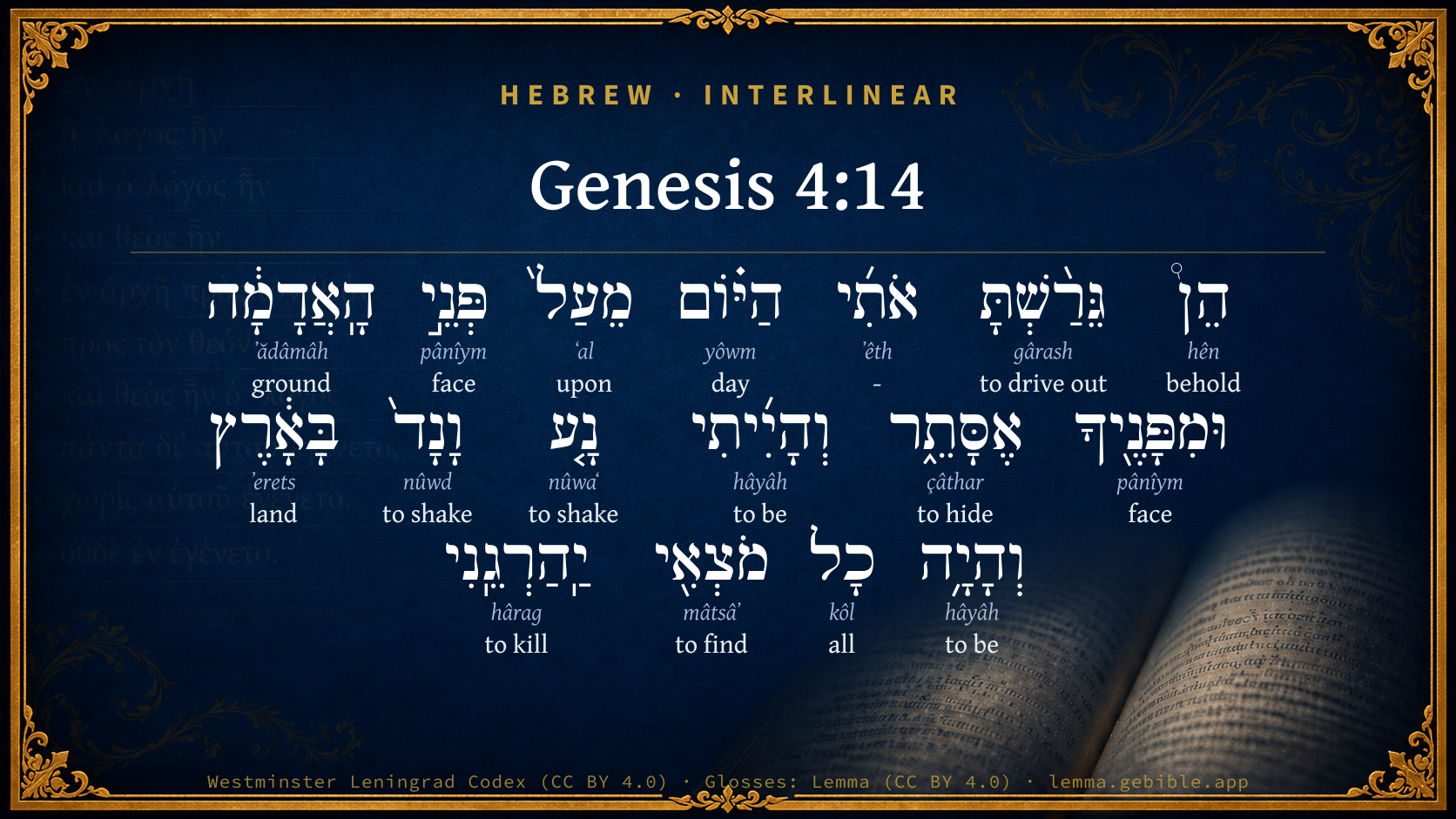
Hebrew (Westminster Leningrad Codex) Genesis 4:14 appears in the Hebrew Old Testament. The text above is from the Westminster Leningrad Codex. Each word links to its Strong’s number, a concise gloss, and parsing drawn from the Open Scriptures Hebrew Bible morphology. Click any word for its full Brown-Driver-Briggs (BDB) entry.
Download image
Cite this verse

Genesis 4:14 (World English Bible). Public Domain. Lemma interlinear Bible study tool, https://lemma.gebible.app/v/genesis/4/14.

Show BibTeX & RIS
BibTeX
RIS
English Translation
Behold, you have driven me out this day from the surface of the ground. I will be hidden from your face, and I will be a fugitive and a wanderer in the earth. It will happen that whoever finds me will kill me."
World English Bible · Public Domain
Highlights
  • 1 first appearance in the Hebrew Bible
Full analysis ↓
Download a study sheet

One document with this verse’s original text, its word-by-word gloss line, the meaning frame, cross-references with their text, attributed commentary, and full source and license credits — printable, and it pastes into notes with its structure intact.

This verse Autodidact and up

Study sheet (.html) Plain text (.txt)

A passage Seminary Student

Up to 50 verses in one chapter. A passage sheet keeps up to 6 commentary sources and 12 cross-references per verse, in the order this page ranks them, and says so on the sheet whenever that leaves anything out. Ask for a single verse and you get the Autodidact verse sheet above.

Everything on this page stays free to read, with no account — the sheet is a download of what is already on screen, not access to it.

Want to remove ads? Support Godless Engineer
Compare translations 3

The same verse in 3 English versions, stacked beneath the original-language interlinear above. Click any original word for its lexicon entry.

Each is an independent rendering of the whole verse — the interlinear is not word-aligned to these translations.

Highlighted words mark where these versions differ — a whole-verse word diff, not a word-by-word alignment.

  • World English Bible Public Domain
    Behold, you have driven me out this day from the surface of the ground. I will be hidden from your face, and I will be a fugitive and a wanderer in the earth. It will happen that whoever finds me will kill me."
  • King James Version Public Domain
    Behold, thou hast driven me out this day from the face of the earth; and from thy face shall I be hid; and I shall be a fugitive and a vagabond in the earth; and it shall come to pass, that every one that findeth me shall slay me.
  • unfoldingWord Literal Text CC BY-SA 4.0
    Behold, today you are driving me from the surface of the ground, and I will be hidden from your presence. And I will be a fugitive and a wanderer on the earth, and it will be everyone who finds me will kill me!”

unfoldingWord Literal Text — © unfoldingWord, licensed CC BY-SA 4.0. Word-aligned USFM3 via Door43 (git.door43.org/unfoldingWord/en_ult).

Versions to compare (up to 4)

3 of 4 selected

Show all 18 translations

Every available English version of this verse, each an independent rendering of the whole verse.

  • World English Bible Public Domain
    Behold, you have driven me out this day from the surface of the ground. I will be hidden from your face, and I will be a fugitive and a wanderer in the earth. It will happen that whoever finds me will kill me."
  • Berean Standard Bible Public Domain
    Behold, this day You have driven me from the face of the earth, and from Your face I will be hidden; I will be a fugitive and a wanderer on the earth, and whoever finds me will kill me.”
  • Majority Standard Bible Public Domain
    Behold, this day You have driven me from the face of the earth, and from Your face I will be hidden; I will be a fugitive and a wanderer on the earth, and whoever finds me will kill me.”
  • King James Version Public Domain
    Behold, thou hast driven me out this day from the face of the earth; and from thy face shall I be hid; and I shall be a fugitive and a vagabond in the earth; and it shall come to pass, that every one that findeth me shall slay me.
  • American Standard Version (1901) Public Domain
    Behold, thou hast driven me out this day from the face of the ground; and from thy face shall I be hid; and I shall be a fugitive and a wanderer in the earth; and it will come to pass, that whosoever findeth me will slay me.
  • Revised Version (1885) Public Domain
    Behold, thou hast driven me out this day from the face of the ground; and from thy face shall I be hid; and I shall be a fugitive and a wanderer in the earth; and it shall come to pass, that whosoever findeth me shall slay me.
  • Geneva Bible (1599) Public Domain
    Behold, thou hast cast me out this day from the earth, and from thy face shall I be hid, and shalbe a vagabond, and a runnagate in the earth, and whosoeuer findeth me, shall slay me.
  • Douay-Rheims (1899) Public Domain
    Behold thou dost cast me out this day from the face of the earth, and I shall be hidden from thy face, and I shall be a vagabond and a fugitive on the earth: everyone, therefore, that findeth me, shall kill me.
  • Young's Literal Translation Public Domain
    lo, Thou hast driven me to-day from off the face of the ground, and from Thy face I am hid; and I have been a wanderer, even a trembling one, in the earth, and it hath been -- every one finding me doth slay me.'
  • Literal Standard Version CC BY-SA 4.0
    behold, You have driven me today from off the face of the ground, and from Your face I am hid; and I have been a wanderer, even a trembling one, in the earth, and it has been—everyone finding me will slay me.”
  • Unlocked Literal Bible CC BY-SA 4.0
    Indeed, you have driven me out this day from this ground, and I will be hidden from your face. I will be a fugitive and a wanderer in the earth, and whoever finds me will kill me.”
  • unfoldingWord Literal Text CC BY-SA 4.0
    Behold, today you are driving me from the surface of the ground, and I will be hidden from your presence. And I will be a fugitive and a wanderer on the earth, and it will be everyone who finds me will kill me!”
  • Darby Bible Public Domain
    Behold, thou hast driven me this day from the face of the ground, and from thy face shall I be hid; and I shall be a wanderer and fugitive on the earth; and it will come to pass, [that] every one who finds me will slay me.
  • World Messianic Bible Public Domain
    Behold, you have driven me out today from the surface of the ground. I will be hidden from your face, and I will be a fugitive and a wanderer in the earth. Whoever finds me will kill me.”
  • Webster's Bible Public Domain
    Behold, thou hast driven me this day from the face of the earth; and from thy face shall I be hid; and I shall be a fugitive and a vagabond in the earth; and it will come to pass, that every one that findeth me will slay me.
  • Free Bible Version CC BY-SA 4.0
    “Look! You're driving me away right now—cursing the ground and banishing me from your presence. I'm going to have to hide and always be on the run, left to wander all over the earth. Anyone who finds me is going to kill me!”
  • Bible in Basic English Public Domain
    You have sent me out this day from the face of the earth and from before your face; I will be a wanderer in flight over the earth, and whoever sees me will put me to death.
  • JPS Tanakh (1917) Public Domain
    Behold, Thou hast driven me out this day from the face of the land; and from Thy face shall I be hid; and I shall be a fugitive and a wanderer in the earth; and it will come to pass, that whosoever findeth me will slay me.'

Literal Standard Version (2020), Covenant Press — licensed CC BY-SA 4.0. Text via the HelloAO Bible API (eBible.org). Unlocked Literal Bible (unfoldingWord) — licensed CC BY-SA 4.0. Text via the HelloAO Bible API (eBible.org). unfoldingWord Literal Text — © unfoldingWord, licensed CC BY-SA 4.0. Word-aligned USFM3 via Door43 (git.door43.org/unfoldingWord/en_ult). Free Bible Version, Dr. Jonathan Gallagher — licensed CC BY-SA 4.0. Text via the HelloAO Bible API (eBible.org).

Word by word

More ways to search: Search by grammar → Find every occurrence → Compare this word →

Practice this passage: Drill this verse → Learn its vocabulary →

וָנָד֙
nûwd
H5110
“and · shaking”
Conjunction + Verb, Qal, Participle Active, Masculine, Singular, Absolute
Part of Speech
Conjunction + Verb
Stem
Qal
Form
Participle Active
Gender
Masculine
Number
Singular
State
Absolute
Full BDB Definition

Origin: a primitive root

TWOT: 1319

to shake, waver, wander, move to and fro, flutter, show grief, have compassion on - (Qal) - to move to and fro, wander (aimlessly), take flight - to flutter - to waver, wave, shake - to show grief - to lament, condole, show sympathy - (Hiphil) - to cause to wander (aimlessly) - to make a wagging, wag (with the head) - (Hithpolel) - to move oneself to and fro, sway, totter - to shake oneself - to bemoan oneself
  1. הֵן֩ hên H2005 “behold” Particle, Demonstrative
  2. גֵּרַ֨שְׁתָּ gârash H1644 “to drive out” Verb, Piel, Perfect, 2nd Person, Masculine, Singular
  3. אֹתִ֜י ʼêth H853 “- · me” Particle, Direct Object + Suffix, Personal, 1st Person, Common, Singular
  4. הַיּ֗וֹם yôwm H3117 “the · day” Particle, Definite Article + Noun, Common, Masculine, Singular, Absolute
  5. מֵעַל֙ ʻal H5921 “from · upon” Preposition + Preposition
  6. פְּנֵ֣י pânîym H6440 “face(s) of” Noun, Common, Both, Plural, Construct
  7. הָֽאֲדָמָ֔ה ʼădâmâh H127 “the · ground” Particle, Definite Article + Noun, Common, Feminine, Singular, Absolute
  8. וּמִפָּנֶ֖יךָ pânîym H6440 “and · from · face(s) · your” Conjunction + Preposition + Noun, Common, Both, Plural, Construct + Suffix, Personal, 2nd Person, Masculine, Singular
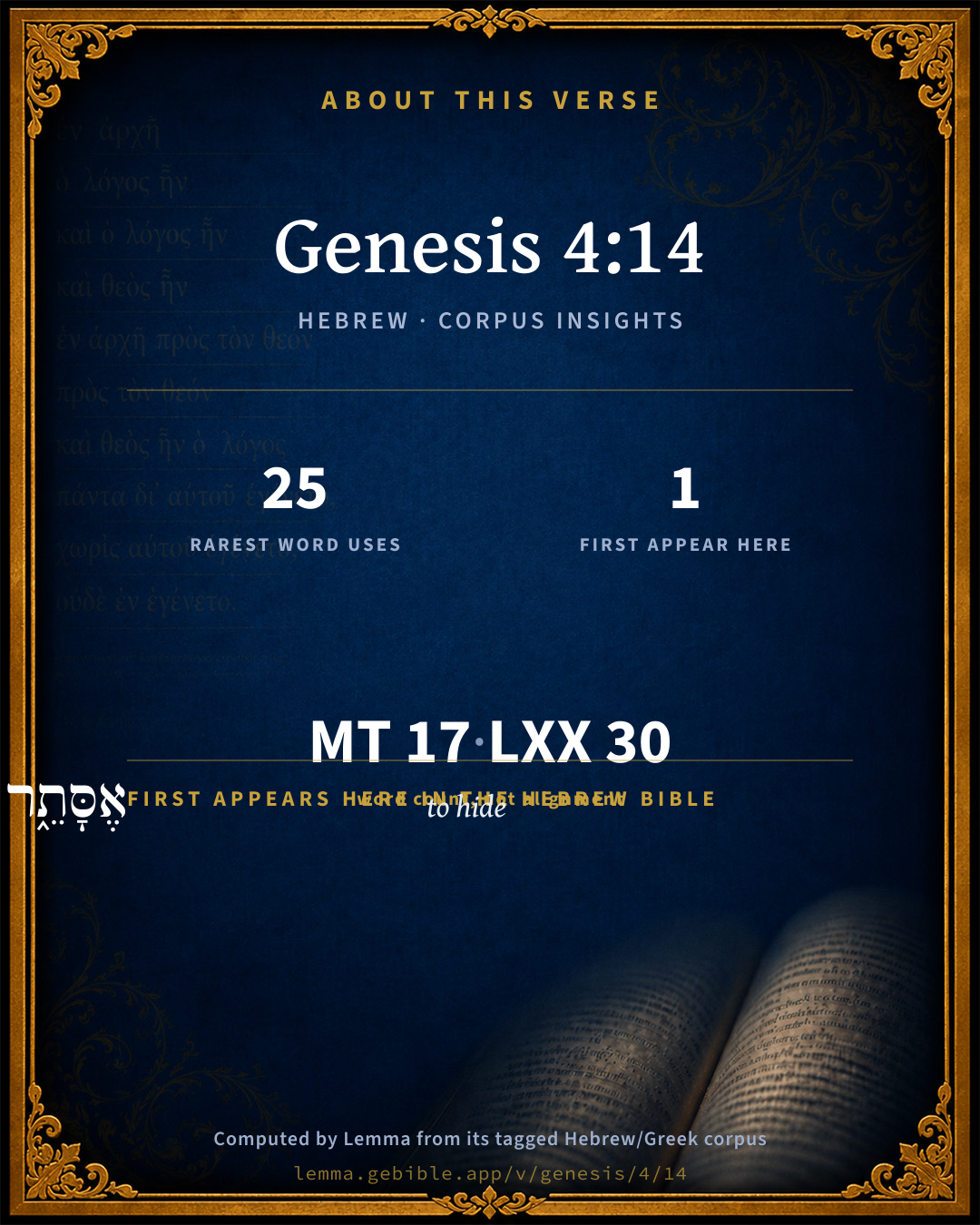
  9. אֶסָּתֵ֑ר çâthar H5641 “to hide” Verb, Niphal, Imperfect, 1st Person, Common, Singular
  10. וְהָיִ֜יתִי hâyâh H1961 “and · to be” Conjunction + Verb, Qal, Sequential Perfect, 1st Person, Common, Singular
  11. נָ֤ע nûwaʻ H5128 “shaking” Verb, Qal, Participle Active, Masculine, Singular, Absolute
  12. בָּאָ֔רֶץ ʼerets H776 “in/at the · land” Preposition, Determined + Noun, Common, Both, Singular, Absolute
  13. וְהָיָ֥ה hâyâh H1961 “and · to be” Conjunction + Verb, Qal, Sequential Perfect, 3rd Person, Masculine, Singular
  14. כָל kôl H3605 “all of” Noun, Common, Masculine, Singular, Construct
  15. מֹצְאִ֖י mâtsâʼ H4672 “finding · me” Verb, Qal, Participle Active, Masculine, Singular, Construct + Suffix, Personal, 1st Person, Common, Singular
  16. יַֽהַרְגֵֽנִי hârag H2026 “to kill · me” Verb, Qal, Imperfect, 3rd Person, Masculine, Singular + Suffix, Personal, 1st Person, Common, Singular

About this verse

These counts appear in no published source. They are computed here, from the morphology-tagged text and Lemma’s own curated glosses. What Lemma adds →

17
words
15
distinct lemmas
Pentateuch
section

Notable vocabulary

The rarest word here is וָנָד֙ to shake H5110 — appearing just 25 times in the whole Hebrew Bible.

First appearance in Scripture

This word makes its first canonical appearance in the Hebrew Bible here:

  • אֶסָּתֵ֑ר to hide H5641

Shared distinctive vocabulary

וָנָד֙ to shake H5110 occurs in 24 verses of the Hebrew Bible. Also found in:

Grammatical profile

  • 8 verbs
  • 6 nouns
  • 1 preposition
  • 2 particles

Verb forms

  • גֵּרַ֨שְׁתָּ Piel · Perfect
  • אֶסָּתֵ֑ר Niphal · Imperfect
  • וְהָיִ֜יתִי Qal · Sequential Perfect
  • נָ֤ע Qal · Participle Active
  • וָנָד֙ Qal · Participle Active
  • וְהָיָ֥ה Qal · Sequential Perfect
  • מֹצְאִ֖י Qal · Participle Active
  • יַֽהַרְגֵֽנִי Qal · Imperfect

Repetition

Words recur within this verse — often emphatic in Hebrew:

  • פְּנֵ֣י face H6440 ×2
  • וְהָיִ֜יתִי to be H1961 ×2

Hebrew & Septuagint length

In English translation the verse runs 43 words from the Hebrew and 44 from the Septuagint (LXX English) — closely comparable.

A rough comparison of the two English renderings, which tokenize alike — not a word-level alignment.

Word counts can differ between the Hebrew and the Greek without any difference in meaning — e.g. the Hebrew direct-object marker אֵת has no separate Greek word, and Greek often adds the article ὁ.

In the original languages it is 17 Hebrew tokens and 30 Greek tokens — but the two are counted differently (Hebrew bundles its prefixes and suffixes into one token; the Greek is in lemma form), so that isn’t a like-for-like length.

Cross-references

24

Topical passages linked to Genesis 4:14 in the Treasury of Scripture Knowledge — connected by theme and wording, ordered by reader-vote popularity; previews shown in the World English Bible.

  • Numbers 35:19 The avenger of blood shall himself put the murderer to death: when he meets him, he shall put him to death.
  • Job 15:20–24 The wicked man travails with pain all his days, Even the number of years that are laid up for the oppressor.
  • Psalms 143:7 Hurry to answer me, Yahweh. My spirit fails. Don't hide your face from me, So that I don't become like those who go down into the pit.
  • Deuteronomy 28:65 Among these nations shall you find no ease, and there shall be no rest for the sole of your foot: but Yahweh will give you there a trembling heart, and failing of eyes, and pining of soul;
  • Proverbs 28:1 The wicked flee when no one pursues; But the righteous are as bold as a lion.
  • 2 Thessalonians 1:9 who will pay the penalty: eternal destruction from the face of the Lord and from the glory of his might,
  • Genesis 4:15–16 Yahweh said to him, "Therefore whoever slays Cain, vengeance will be taken on him sevenfold." Yahweh appointed a sign for Cain, lest any finding him should strike him.
  • Genesis 9:5–6 I will surely require your blood of your lives. At the hand of every animal I will require it. At the hand of man, even at the hand of every man's brother, I will require the life of man.
  • Numbers 35:21 or in enmity struck him with his hand, so that he died; he who struck him shall surely be put to death; he is a murderer: the avenger of blood shall put the murderer to death, when he meets him.
  • Numbers 35:27 and the avenger of blood find him outside of the border of his city of refuge, and the avenger of blood kill the manslayer; he shall not be guilty of blood,
  • Jeremiah 52:3 For through the anger of Yahweh did it happen in Jerusalem and Judah, until he had cast them out from his presence. Zedekiah rebelled against the king of Babylon.
  • Matthew 25:46 These will go away into eternal punishment, but the righteous into eternal life."
  • Leviticus 26:17 I will set my face against you, and you will be struck before your enemies. Those who hate you will rule over you; and you will flee when no one pursues you.
  • Leviticus 26:36 "'As for those of you who are left, I will send a faintness into their hearts in the lands of their enemies: and the sound of a driven leaf will put them to flight; and they shall flee, as one flees from the sword; and they will fall when no one pursues.
  • Numbers 17:12–13 The children of Israel spoke to Moses, saying, Behold, we perish, we are undone, we are all undone.
  • 2 Samuel 14:7 Behold, the whole family is risen against your handmaid, and they say, Deliver him who struck his brother, that we may kill him for the life of his brother whom he killed, and so destroy the heir also. Thus will they quench my coal which is left, and will leave to my husband neither name nor remainder on the surface of the earth.
  • Job 21:14–15 They tell God, 'Depart from us, For we don't want to know about your ways.
  • Psalms 51:11–14 Don't throw me from your presence, And don't take your holy Spirit from me.
  • Psalms 109:10 Let his children be wandering beggars. Let them be sought from their ruins.
  • Proverbs 14:32 The wicked is brought down in his calamity, But in death, the righteous has a refuge.
  • Isaiah 8:22 and they shall look to the earth, and see, distress and darkness, the gloom of anguish; and into thick darkness [they shall be] driven away.
  • Hosea 13:3 Therefore they will be like the morning cloud, And like the dew that passes away early, Like the chaff that is driven with the whirlwind out of the threshing floor, And like the smoke out of the chimney.
  • Matthew 25:41 Then he will say also to those on the left hand, 'Depart from me, you cursed, into the eternal fire which is prepared for the devil and his angels;
  • Psalms 109:12 Let there be none to extend kindness to him, Neither let there be any to have pity on his fatherless children.

Cross-references courtesy of OpenBible.info (CC BY 4.0).

Hebrew and Greek witnesses Masoretic Hebrew ↔ Greek Septuagint

The same verse in the two great witnesses to the Old Testament, shown verse-for-verse.

These are two independent witnesses, not word-aligned to each other, and the Septuagint is shown in lemma (dictionary) form.

Hebrew Genesis 4:14 Masoretic · Westminster Leningrad Codex

הֵן֩ גֵּרַ֨שְׁתָּ אֹתִ֜י הַיּ֗וֹם מֵעַל֙ פְּנֵ֣י הָֽאֲדָמָ֔ה וּמִפָּנֶ֖יךָ אֶסָּתֵ֑ר וְהָיִ֜יתִי נָ֤ע וָנָד֙ בָּאָ֔רֶץ וְהָיָ֥ה כָל מֹצְאִ֖י יַֽהַרְגֵֽנִי

Behold, you have driven me out this day from the surface of the ground. I will be hidden from your face, and I will be a fugitive and a wanderer in the earth. It will happen that whoever finds me will kill me."

World English Bible · Public Domain

Greek LXX Genesis 4:14 Septuagint · lemma form

εἰ ἐκβάλλω ἐγώ σήμερον ἀπό πρόσωπον ὁ γῆ καί ἀπό ὁ πρόσωπον σύ κρύπτω καί εἰμί στένω καί τρέμω ἐπί ὁ γῆ καί εἰμί πᾶς ὁ εὑρίσκω ἐγώ ἀποκτείνω ἐγώ

If you cast me out this day from the face of the earth, and I shall be hidden from your presence, and I shall be groaning and trembling upon the earth, then it will be that any one that finds me shall kill me.

LXX2012 (modern English Septuagint) · Public Domain

Hebrew: Westminster Leningrad Codex (CC BY 4.0). Greek: Septuagint (public domain); English from LXX2012 (modern English Septuagint) (Public Domain). How the Septuagint differs from the Hebrew →

Targum (Aramaic paraphrase)

2

The Targum is the ancient Jewish Aramaic paraphrase of the Hebrew Scriptures — an interpretive translation, not the Hebrew text itself. Onkelos (literal) and Pseudo-Jonathan (expansive) render the Torah, and Jonathan the Prophets. Coverage is partial: where no permissively-licensed English translation exists for a verse, only the Aramaic is shown. This is verse-level text, not a word-by-word alignment to the Hebrew.

  1. Targum Onkelos Torah (Genesis–Deuteronomy)
    הָא תָרִיכְתָּא יָתִי יוֹמָא דֵּין מֵעַל אַפֵּי אַרְעָא וּמִן קֳדָמָךְ לֵית אֶפְשָׁר לְאִטַּמָּרָא וָאֱהִי מְטַלְטֵל וְגָלֵי בְּאַרְעָא וִיהֵי כָל דְּיִשְׁכְּחִנַנִי יִקְטְּלִינַנִי

    (no public-domain English translation for this verse)

    Targum Onkelos — Aramaic: “Onkelos Genesis” (public domain); “Onkelos Exodus” (public domain); “Onkelos Leviticus” (public domain); “Onkelos Numbers” (public domain); “Onkelos Deuteronomy” (public domain). English: “Sefaria Community Translation” (CC0 1.0 (public-domain dedication)); “J.W. Etheridge. The Targums of Onkelos and Jonathan Ben Uzziel on the Pentateuch. London: Longmans, Green, 1862” (public domain). Text via Sefaria.

  2. Targum Pseudo-Jonathan Torah (Genesis–Deuteronomy)
    הָא טָרַדְתָּא יָתִי יוֹמָא דֵין מֵעַל אַנְפֵּי אַרְעָא מִן קָדָמָךְ הַאֶפְשַׁר דְאִיטְמַר וְאִין אֶהִי מְטַלְטֵל וְגָלִי בְּאַרְעָא כָּל זַכְיַי דְיִשְׁכְּחִנַנִי יִקְטְלִינַנִי

    Behold, Thou hast cast me forth today from the face of the earth, and from before Thee is it possible to be hidden? And because I am a wanderer and an exile in the earth, any just one who findeth me will kill me.

    Targum Pseudo-Jonathan — Aramaic: “Targum Jonathan on Genesis” (public domain); “Targum Jonathan on Exodus” (public domain); “Targum Jonathan on Leviticus” (public domain); “Targum Jonathan on Numbers” (public domain); “Targum Jonathan on Deuteronomy” (public domain). English: “The Targum of Jonathan ben Uzziel, trans. J. W. Etheridge, London, 1862” (public domain). Text via Sefaria.

Commentary

Notes on Genesis 4:14 from classic Christian and Jewish commentators (each source and its license shown beneath its notes). The classic Christian expositions comment on the surrounding passage and are grouped to its opening verse, so a note may address several verses; the Jewish commentaries on the Tanakh (Rashi and others) are per-verse, so they appear only where the commentator wrote on this verse.

Lemma curates 59 commentaries, every one of them public domain or Creative Commons licensed, each selected and text-cleaned for this edition rather than reprinted as found. About our sources →

Trapp's Complete Commentary

John Trapp

Gen 4:14 Behold, thou hast driven me out this day from the face of the earth; and from thy face shall I be hid; and I shall be a fugitive and a vagabond in the earth; and it shall come to pass, [that] every one that findeth me shall slay me.

Ver. 14. From the face of the earth.] That is, of this earth, this country, my father’s family; which in the next words he calls God’s face, the place of his public worship, from the which Cain was here justly excommunicated. And surely St Jude’s woe will light heavily upon all such as, going in the way of Cain, and not willing to hear of their wicked ways, do wilfully absent themselves from the powerful preaching of the word. They that will not hear the word, shall hear the rod. {Mic 6:9} Yea, a sword shall pierce through their souls, as it did Cain’s here; in whom was fulfilled that of Eliphaz; - "A dreadful sound was in his ears, lest in his prosperity the destroyer should come upon him. He believed not that he should return out of darkness, and he is waited for of the sword." {Job 15:21-22}

Every one that finds me shall slay me.] Quam male est extra legem viventibus! quicquid meruerunt semper expectant. {a} Fat swine cry hideously, if but touched or meddled with, as knowing they owe their life to them that will take it. Tiberius felt the remorse of conscience so violent, that he protested to the senate, that he suffered death daily; whereupon Tacitus makes this good note, Tandem facinora et flagitia in supplicium vertuntur. As every body hath its shadow appertaining to it, so hath every sin its punishment. And although they escape the lash of the law, yet "vengeance will not suffer them to live," {Act 28:4} as the barbarians rashly censured St Paul, - to live quietly at least. Richard III., after the murder of his two innocent nephews, had fearful dreams and visions; insomuch that he did often leap out of his bed in the dark, and catching his sword, which, always naked, stuck by his side, he would go distractedly about the chamber, everywhere seeking to find out the cause of his own occasioned disquiet. {b} Polidor Virgil thus writes of his dream that night before Bosworth Field, where he was slain, that he thought that all the devils in hell pulled and hailed him in most hideous and ugly shapes; and concludes of it at last, "I do not think it was so much his dream, as his evil conscience that bred those terrors." It is as proper for sin to raise fears in the soul, as for rotten flesh and wood to breed worms. That worm that never dies is bred here in the froth of filthy lusts and flagitious courses, and lies gnawing and grubbing upon men’s inwards, many times in the ruffe of all their jollity. This makes Saul call for a minstrel, Belshazzar for his carousing cups, Cain for his workmen to build him a city, others for other of the devil’s drugs, to put on the pangs of their wounded spirits and throbbing consciences. Charles IX., after the massacre of France, could never endure to be awakened in the night without music, or some like diversion; he became as terrible to himself, as formerly he had been to others. {c} But above all, I pity the loss of their souls, who serve themselves as the Jesuit in Lancashire, followed by one that found his glove, with a desire to restore it him. But pursued inwardly with a guilty conscience, he leaps over a hedge, plunges into a deep pit behind it, unseen and unthought of, wherein he was drowned. {d}

{a} Petron.

{b} Daniel’s Chron. continued by Trussel, 249.

{c} Thuan. lib. lvii.

{d} M. Ward’s Sermon.

John Trapp, A Commentary or Exposition upon All the Books of the Old and New Testament (1647–1656) — public domain. Text from a community e-Sword module.

Geneva Bible (1599)

Geneva Bible translators

Hebrew, from off the face of.

Geneva Bible (1599) marginal notes — public domain. Text via Bolls.life.

Jamieson, Fausset & Brown

Robert Jamieson, A. R. Fausset & David Brown

every one that findeth me shall slay me--This shows that the population of the world was now considerably increased.

Jamieson, Fausset & Brown — Commentary Critical and Explanatory on the Whole Bible (1871) — public domain (CC PDM 1.0). Text via the HelloAO Bible API.

Adam Clarke's Commentary

Verse 14. Behold, thou hast driven me out] In Ge 4:11-12, God states two parts of Cain's punishment:

1. The ground was cursed, so that it was not to yield any adequate recompense for his most careful tillage.

2. He was to be a fugitive and a vagabond having no place in which he could dwell with comfort or security.

To these Cain himself adds others.

1. His being hidden from the face of God; which appears to signify his being expelled from that particular place where God had manifested his presence. in or contiguous to Paradise, whither our first parents resorted as to an oracle, and where they offered their daily adorations. So in Ge 4:16, it is said, Cain went out from the presence of the Lord, and was not permitted any more to associate with the family in acts of religious worship.

2. The continual apprehension of being slain, as all the inhabitants of the earth were at that time of the same family, the parents themselves still alive, and each having a right to kill this murderer of his relative. Add to all this,

3. The terrors of a guilty conscience; his awful apprehension of God's judgments, and of being everlastingly banished from the beatific vision. To this part of the punishment of Cain St. Paul probably alludes, 2Th 1:9: Who shall be punished with everlasting destruction from the presence of the Lord, and from the glory of his power. The words are so similar that we can scarcely doubt of the allusion.

Adam Clarke's Commentary on the Bible (1810–1826) — public domain. Text from a community e-Sword/MySword module.

John Calvin's Commentaries

14. Every one that findeth me. Since he is no longer covered by the protection of God, he concludes that he shall be exposed to injury and violence from all men. And he reasons justly; for the hand of God alone marvelously preserves us amid so many dangers. And they have spoken prudently who have said, not only that our life hangs on a thread, but also that we have been received into this fleeting life, out of the womb, from a hundred deaths. Cain, however, in this place, not only considers himself as deprived of God’s protection, but also supposes all creatures to be divinely armed to take vengeance of his impious murder. This is the reason why he so greatly fears for his life from any one who may meet him; for as man is a social animal, and all naturally desire mutual intercourse, this is certainly to be regarded as a portentous fact, that the meeting with any man was formidable to the murderer.

John Calvin's Commentaries (1540-1563) — public domain. Text from the Calvin Translation Society English edition (1840s-50s) via the Christian Classics Ethereal Library (ccel.org). Calvin's coverage is partial (roughly two-thirds of the Bible); uncommented books and verses are honest gaps, never fabricated. The 19th-century editor's footnotes and remarks are omitted so the notes are faithfully Calvin's own voice.

The Cambridge Bible for Schools and Colleges

gen. ed. J. J. S. Perowne

14. Behold, thou hast, &c.] Cain accepts Jehovah’s sentence as a banishment from the cultivated ground. “And from thy face shall I be hid,” Cain recognizes that banishment from the land, in which Jehovah’s presence was manifested, implied expulsion from Jehovah’s presence. In the desert to which he was to flee, Jehovah would not be found: Cain would be hidden from His face. The early Israelites believed that, if a man was driven from the land in which Jehovah was worshipped, he was no longer in the presence of Jehovah, but of other gods. Thus David says, 1Sa_26:19, “they have driven me out this day that I should not cleave unto the inheritance of the Lord, saying, Go, serve other gods.” The desert to which Cain would be driven was a region believed to be haunted by the demon Azazel (Lev_16:8) and dangerous spirits.

whosoever findeth me, &c.] Of whom was Cain afraid? Different answers have been given. 1. The wild beasts (Josephus). 2. A pre-Adamite race of Man_1:3. Other sons of Adam. 4. It has been suggested that the present story formed part of a tradition originally referring to a later time, when the earth was numerously inhabited, and has been adapted, on account of its moral significance, to the story of the first family. But it is unreasonable to expect from the detached narratives of early folk-lore the logical completeness of history. Cain’s words are rightly understood as a reference to the custom of blood-revenge, which went back to the remotest prehistoric age. The cultivated land was regarded as the region in which there prevailed social order and regard for life; but in the desert there would be none of the restrictions which regulated the existence of settled communities.

In the desert Cain, as the murderer, would be destitute of the protection of Jehovah. He would have no rights of kinship: anyone might slay him with impunity. He would find no friendly tribe; he would be an outlaw.

The Cambridge Bible for Schools and Colleges (gen. ed. J. J. S. Perowne; Cambridge University Press, 1878–1918) — public domain. Text from a community e-Sword module.

John Gill's Exposition

And the Lord said unto him,.... In order to satisfy him, and make him easy in this respect, that: he need not fear an immediate or bodily death, which was showing him great clemency and lenity; or in answer to his begging for death, "therefore", or as some render the word, taking them for two, "not so" (y); it shall not be that whoever finds thee shall slay thee, thou needest not be afraid of that; nor shall thy request be granted, that thou mightest be slain by the first man that meets thee: it was the will of God, that though Cain deserved to die, yet that he should not die immediately, but live a long miserable life, that it might be a terror to others not to commit the like crime; though rather the particle should be rendered "verily, surely, of a truth" (z); so it will certainly be, it may be depended on:

whosoever slayeth Cain, vengeance shall be taken on him sevenfold; seven times more than on Cain; that is, he shall be exceedingly punished; vengeance shall be taken on him in a very visible manner, to a very great degree; the Targums of Onkelos and Jonathan are"unto or through seven generations;''the meaning of which is, that the slayer of Cain should not only be punished in his own person, but in his posterity, even unto seven generations; and not as Jarchi and Aben Ezra interpret it, that God deferred his vengeance on Cain unto seven generations, and at the end of them took vengeance on him by Lamech, one of his own posterity, by whom he is supposed by that Jewish writer to be slain:

and the Lord set a mark upon Cain; about which there is a variety of sentiments (a): some say it was a horn in his forehead: others, a leprosy in his face; others, a wild ghastly look; others, a shaking and trembling in all his limbs; and others, that there was an earthquake wherever he stepped: and others will have it, that the dog which guarded Abel's flock was given him to accompany him in his travels, by which sign it might be known that he was not to be attacked, or to direct him from taking any dangerous road: some say it was a letter imprinted on his forehead, either taken out of the great and glorious name of God, as the Targum of Jonathan, or out of his own name, as Jarchi; others the mark or sign of the covenant of circumcision (b): but as the word is often used for a sign or miracle, perhaps the better rendering and sense of the words may be, "and the Lord put", or "gave a sign" (c); that is, he wrought a miracle before him to assure him, that "whoever found him should not kill him": so that this was not a mark or sign to others, to direct or point out to them that they should not kill him, or to deter them from it; but was a sign or miracle confirming him in this, that no one should kill him; agreeably to which is the note of Aben Ezra,"it is right in my eyes that God made a sign (or wrought a miracle) for him, until he believed;''by which he was assured that his life would be secure, go where he would; even that no one should "strike" (d) him, as the word is, much less kill him.

(y) "quasi" , Sept. "nequaquam ita fiet", V. L. (z) "In veritate, certe", Vatablus; "profecto, utique", De Dieu. (a) See Bayle's General Diet. art. "Cain". (b) Tikkune Zohar, correct. 69. fol. 115. 1. & 117. 1. 2. (c) , "sed et posuit Kaino miraculum (in confirmationem) quod non caesurus esset ipsum quisque", &c, Schmidt. (d) , "ne percuteret eum", Pagninus; "ad non percutiendum eum", Montanus.

John Gill's Exposition of the Whole Bible (1746–1763) — public domain (CC PDM 1.0). Text via the HelloAO Bible API.

Haydock's Catholic Bible Commentary

Every one that findeth me, shall kill me. His guilty conscience made him fear his own brothers, and nephews; of whom, by this time, there might be a good number upon the earth: which had now endured near 130 years; as may be gathered from Genesis v. 3, compared with chap. iv. 25, though in the compendious account given in the Scripture, only Cain and Abel are mentioned. (Challoner) --- Cain is little concerned about any thing but the loss of life. (Menochius)

George Leo Haydock (1774–1849), Haydock's Catholic Family Bible and Commentary, 1859 edition — public domain. Excludes Psalms (Douay-Rheims chapter numbering differs from Protestant) and Deuterocanonical books (Catholic canon only).

Matthew Poole's English Annotations

Consider how severely thou usest me; thou hast driven me out, with public infamy, as the word signifies,

from the face of the earth, or, this earth, my native land,

and from thy face, i.e. favour and protection, as the public enemy of mankind, and as one devoted by thee to destruction.

Quest. Whom did Cain fear, when it appears not that there were any but his father and mother?

Answ. So ignorant people conceive; but it is a fond conceit to think that there were no more men than are expressed in this book, where God never intended to give a catalogue of all men, but only of the church, or those who had some relation to or concern with it. Nay, that there were very many thousands of men now in being, is very credible upon these rational grounds and suppositions.

1. That Adam and Eve did, according to God’s precept and blessing, Gen 1:26, procreate children presently after the fall, and God’s gracious reconcilement to them; and consequently their children did so, when they came to competent age.

2. That those first men and women were endowed by God with extraordinary fruitfulness, and might have two, three, four, or more at a time, (as divers persons long after had), which was then expedient for the replenishing of the world; and the like may be judged of their children during the world’s infancy.

3. That this murder was committed but a little before the hundred and thirtieth year of Adam’s age, which appears by comparing Gen 4:25 and Gen 5:3. Before which time, how vast and numerous an offspring might have come from Adam, none can be ignorant that can and shall make a rational computation.

Matthew Poole's English Annotations on the Holy Bible (1683–1685) — public domain. Text from a community e-Sword/MySword module.

Whedon's Commentary on the Bible

Daniel D. Whedon

14. Thou hast driven — Cain seems to charge all his curse on God, as if ignoring that he himself was the guilty cause.

From the face of the earth — Special reference to the district of Eden. Compare Gen_4:16. His sentence to be a vagabond and a fugitive involved this separation from Eden.

From thy face — From that hallowed spot on the east of the garden of Eden where the symbols of the divine Presence were set, (Gen_3:24,) and where, probably, all sacrifices to Jehovah had hitherto been offered. Comp. Gen_4:16.

Every one… shall slay me — Thus in that first age we note how the guilty conscience fears the avenger of blood. It has been plausibly supposed that the murder of Abel occurred not long before the birth of Seth, (see Gen_4:25,) when Adam was one hundred and thirty years old, (Gen_5:3;) at which time there was probably a considerable population in man’s primeval seat. “By every one we are not to understand every creature, as though Cain had excited the hostility of all creatures, but every man. Cain is evidently afraid of revenge on the part of relatives of the slain, who were either already in existence or yet to be born.” — Keil.

Daniel D. Whedon (gen. ed.), Commentary on the Old and New Testaments (1874–1909) — public domain. Text from a community e-Sword module.

Radak

Rabbi David Kimhi (Radak)

הן גרשת אותי...מעל פני האדמה, a reference to the soil of Eden, near the garden, where his father and mother had taken up residence. This is what the Torah had meant with the words לעבוד את האדמה אשר לקח משם, “to work the soil from which he had originally been taken.” (3,23)

ומפנך אסתר, “and I have to hide from You, seeing that You are angry at me and have hidden Your face from me. I am in a position where everybody will be entitled to kill me, seeing You have withdrawn Your protection from me. Even the wild beasts will be entitled to kill me as I am forced to roam around a fugitive on earth.” In Bereshit Rabbah 22,11 Kayin’s complaint is “yesterday You expelled my father, and now You expel me. Am I supposed to hide from You, how could I?”

Radak on the Tanakh — English translations: “Sefaria Community Translation” (CC0 1.0 (public-domain dedication)); “Eliyahu Munk, HaChut Hameshulash” (CC BY 4.0); “Rabbi Mike Feuer, Jerusalem Anthology” (CC BY 4.0); and “R. David Kimhi on the first book of Psalms, Translated by R.G. Finch, London, 1919” (public domain). Text via Sefaria.

Lesson kit

Teaching starters — assembled from the data on this page, not authored interpretation. Every prompt links to the verse data it draws on. Edit before teaching.

Genesis, in the Pentateuch, opens this verse with 17 words (15 distinct Hebrew lemmas). Its most distinctive word is nûwd (“to shake”). A historical commentator’s framing appears above. Read the whole chapter for the surrounding context.

Discussion questions

  1. How does “to shake” (nûwd) shape what this verse is saying?
  2. This is the first place “to hide” appears in Scripture (first appears here). What does its debut here establish?
  3. How does Genesis 4:12, which shares the word «to shake», read alongside this verse?
  4. What does the repetition of “face” (2× in this one verse) do in this verse?
  5. These translations render this verse differently. What is at stake in choosing one wording over another?
  6. «גֵּרַ֨שְׁתָּ» is a Piel Perfect verb. How does that grammatical form shape the action described?
  7. Compare how Trapp's Complete Commentary and Geneva Bible (1599) read this verse. Where do they agree or differ?

Things to notice

Reading settings

Reading text

Shown beneath each verse's original-language words.

Old Testament
Old Testament edition

Read the OT as the Masoretic Hebrew (MT) or the Greek Septuagint (LXX).

English shown for the Greek Septuagint (in the Hebrew ↔ Greek comparison).

Comparing translations? Open the Compare panel on any verse page to stack up to four side by side.