Revelation 22:16

Greek (Tischendorf 8th ed.) Revelation 22:16 appears in the Greek New Testament. The text above is from the Tischendorf 8th edition. Each word links to its Strong’s number and a concise gloss. Click any word for its full Thayer’s Greek Lexicon entry.
Download image
Cite this verse

Revelation 22:16 (World English Bible). Public Domain. Lemma interlinear Bible study tool, https://lemma.gebible.app/v/revelation/22/16.

Show BibTeX & RIS
BibTeX
RIS
English Translation
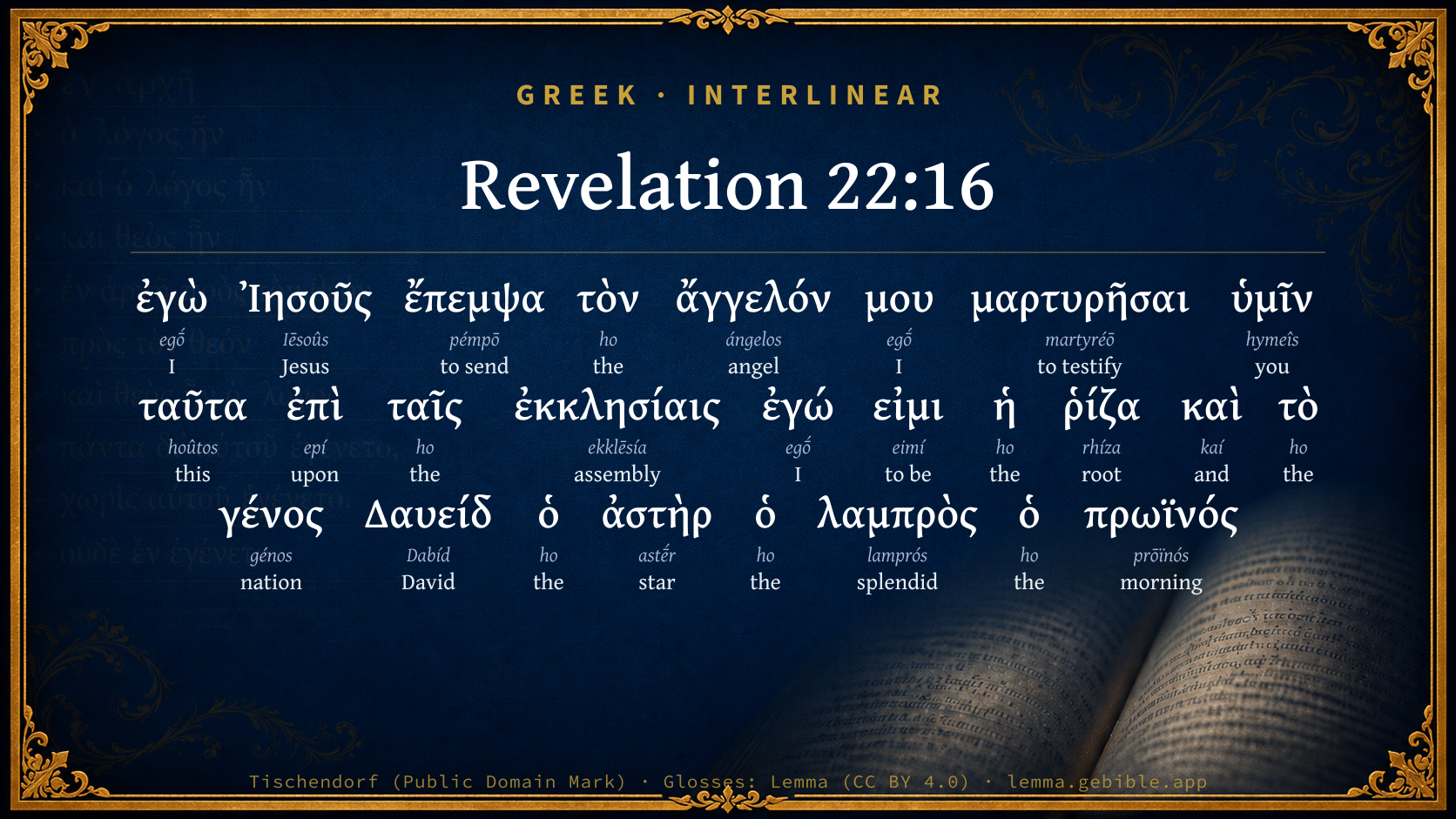
I, Jesus, have sent my angel to testify these things to you for the assemblies. I am the root and the offspring of David; the Bright and Morning Star."
World English Bible · Public Domain
Download a study sheet

One document with this verse’s original text, its word-by-word gloss line, the meaning frame, cross-references with their text, attributed commentary, and full source and license credits — printable, and it pastes into notes with its structure intact.

This verse Autodidact and up

Study sheet (.html) Plain text (.txt)

A passage Seminary Student

Up to 50 verses in one chapter. A passage sheet keeps up to 6 commentary sources and 12 cross-references per verse, in the order this page ranks them, and says so on the sheet whenever that leaves anything out. Ask for a single verse and you get the Autodidact verse sheet above.

Everything on this page stays free to read, with no account — the sheet is a download of what is already on screen, not access to it.

Want to remove ads? Support Godless Engineer
Compare translations 3

The same verse in 3 English versions, stacked beneath the original-language interlinear above. Click any original word for its lexicon entry.

Each is an independent rendering of the whole verse — the interlinear is not word-aligned to these translations.

Highlighted words mark where these versions differ — a whole-verse word diff, not a word-by-word alignment.

  • World English Bible Public Domain
    I, Jesus, have sent my angel to testify these things to you for the assemblies. I am the root and the offspring of David; the Bright and Morning Star."
  • King James Version Public Domain
    I Jesus have sent mine angel to testify unto you these things in the churches. I am the root and the offspring of David, and the bright and morning star.
  • unfoldingWord Literal Text CC BY-SA 4.0
    I, Jesus, have sent my angel to testify these things to you concerning the churches. I am the root and the offspring of David, the bright morning star.”

unfoldingWord Literal Text — © unfoldingWord, licensed CC BY-SA 4.0. Word-aligned USFM3 via Door43 (git.door43.org/unfoldingWord/en_ult).

Versions to compare (up to 4)

3 of 4 selected

Show all 19 translations

Every available English version of this verse, each an independent rendering of the whole verse.

  • World English Bible Public Domain
    I, Jesus, have sent my angel to testify these things to you for the assemblies. I am the root and the offspring of David; the Bright and Morning Star."
  • Berean Standard Bible Public Domain
    “I, Jesus, have sent My angel to give you this testimony for the churches. I am the Root and the Offspring of David, the bright Morning Star.”
  • Majority Standard Bible Public Domain
    “I, Jesus, have sent My angel to give you this testimony for the churches. I am the Root and the Offspring of David, the bright Morning Star.”
  • King James Version Public Domain
    I Jesus have sent mine angel to testify unto you these things in the churches. I am the root and the offspring of David, and the bright and morning star.
  • American Standard Version (1901) Public Domain
    I Jesus have sent mine angel to testify unto you these things for the churches. I am the root and the offspring of David, the bright, the morning star.
  • Revised Version (1885) Public Domain
    I Jesus have sent mine angel to testify unto you these things for the churches. I am the root and the offspring of David, the bright, the morning star.
  • Geneva Bible (1599) Public Domain
    I Iesus haue sent mine Angell, to testifie vnto you these things in the Churches: I am the root and the generation of Dauid, and the bright morning starre.
  • Douay-Rheims (1899) Public Domain
    I Jesus have sent my angel, to testify to you these things in the churches. I am the root and stock of David, the bright and morning star.
  • Young's Literal Translation Public Domain
    `I, Jesus did send my messenger to testify to you these things concerning the assemblies; I am the root and the offspring of David, the bright and morning star!
  • Literal Standard Version CC BY-SA 4.0
    I, Jesus, sent My messenger to testify to you these things concerning the assemblies; I am the root and the offspring of David, the radiant morning star!
  • Unlocked Literal Bible CC BY-SA 4.0
    I, Jesus, have sent my angel to testify to you about these things for the churches. I am the root and the descendant of David, the bright morning star.”
  • unfoldingWord Literal Text CC BY-SA 4.0
    I, Jesus, have sent my angel to testify these things to you concerning the churches. I am the root and the offspring of David, the bright morning star.”
  • Darby Bible Public Domain
    *I* Jesus have sent mine angel to testify these things to you in the assemblies. *I* am the root and offspring of David, the bright [and] morning star.
  • World Messianic Bible Public Domain
    I, Yeshua, have sent my angel to testify these things to you for the assemblies. I am the root and the offspring of David, the Bright and Morning Star.”
  • Webster's Bible Public Domain
    I Jesus have sent my angel to testify to you these things in the churches. I am the root and the offspring of David, and the bright and morning-star.
  • Free Bible Version CC BY-SA 4.0
    I, Jesus, have sent my angel to give you this testimony to share with the churches. I am both the root and the descendant of David, the bright morning star.”
  • Bible in Basic English Public Domain
    I, Jesus, have sent my angel to give witness to you of these things in the churches. I am the root and the offspring of David, the bright and morning star.
  • Text-Critical English NT CC BY 4.0
    “I, Jesus, have sent my angel to testify to you about these things for the churches. I am the root and offspring of David, the bright morning star.”
  • Tyndale New Testament (1534) Public Domain
    I Iesus sent myne angell to testyfye vnto you these thynges in the congregacions. I am the rote and the generacion of David and the bright mornynge starre.

Literal Standard Version (2020), Covenant Press — licensed CC BY-SA 4.0. Text via the HelloAO Bible API (eBible.org). Unlocked Literal Bible (unfoldingWord) — licensed CC BY-SA 4.0. Text via the HelloAO Bible API (eBible.org). unfoldingWord Literal Text — © unfoldingWord, licensed CC BY-SA 4.0. Word-aligned USFM3 via Door43 (git.door43.org/unfoldingWord/en_ult). Free Bible Version, Dr. Jonathan Gallagher — licensed CC BY-SA 4.0. Text via the HelloAO Bible API (eBible.org).

Word by word

More ways to search: Search by grammar → Find every occurrence → Compare this word →

Practice this passage: Drill this verse → Learn its vocabulary →

πρωϊνός
prōïnós
G4407
“morning”
Adjective, Nominative, Singular, Masculine
Part of Speech
Adjective
Case
Nominative
Number
Singular
Gender
Masculine
Full Thayer's Definition

Origin: from G4404

TDNT: None

1. pertaining to the morning
  1. ἐγὼ egṓ G1473 “I” Personal pronoun, 1st person, Nominative, Singular
  2. Ἰησοῦς Iēsoûs G2424 “Jesus” Noun, Nominative, Singular, Masculine
  3. ἔπεμψα pémpō G3992 “to send” Verb, Aorist, Active, Indicative, 1st person, Singular
  4. τὸν ho G3588 “the” Article, Accusative, Singular, Masculine
  5. ἄγγελόν ángelos G32 “angel” Noun, Accusative, Singular, Masculine
  6. μου egṓ G1473 “I” Personal pronoun, 1st person, Genitive, Singular
  7. μαρτυρῆσαι martyréō G3140 “to testify” Verb, Aorist, Active, Infinitive
  8. ὑμῖν hymeîs G5210 “you” Personal pronoun, 2nd person, Dative, Plural
  9. ταῦτα hoûtos G3778 “this” Demonstrative pronoun, Accusative, Plural, Neuter
  10. ἐπὶ epí G1909 “upon” Preposition
  11. ταῖς ho G3588 “the” Article, Dative, Plural, Feminine
  12. ἐκκλησίαις ekklēsía G1577 “assembly” Noun, Dative, Plural, Feminine
  13. ἐγώ egṓ G1473 “I” Personal pronoun, 1st person, Nominative, Singular
  14. εἰμι eimí G1510 “to be” Verb, Present, Active, Indicative, 1st person, Singular
  15. ἡ ho G3588 “the” Article, Nominative, Singular, Feminine
  16. ῥίζα rhíza G4491 “root” Noun, Nominative, Singular, Feminine
  17. καὶ kaí G2532 “and” Conjunction
  18. τὸ ho G3588 “the” Article, Nominative, Singular, Neuter
  19. γένος génos G1085 “nation” Noun, Nominative, Singular, Neuter
  20. Δαυείδ Dabíd G1138 “David” Noun, Proper, indeclinable
  21. ὁ ho G3588 “the” Article, Nominative, Singular, Masculine
  22. ἀστὴρ astḗr G792 “star” Noun, Nominative, Singular, Masculine
  23. ὁ ho G3588 “the” Article, Nominative, Singular, Masculine
  24. λαμπρὸς lamprós G2986 “splendid” Adjective, Nominative, Singular, Masculine
  25. ὁ ho G3588 “the” Article, Nominative, Singular, Masculine

About this verse

These counts appear in no published source. They are computed here, from the morphology-tagged text and Lemma’s own curated glosses. What Lemma adds →

26
words
18
distinct lemmas
Revelation
section

Notable vocabulary

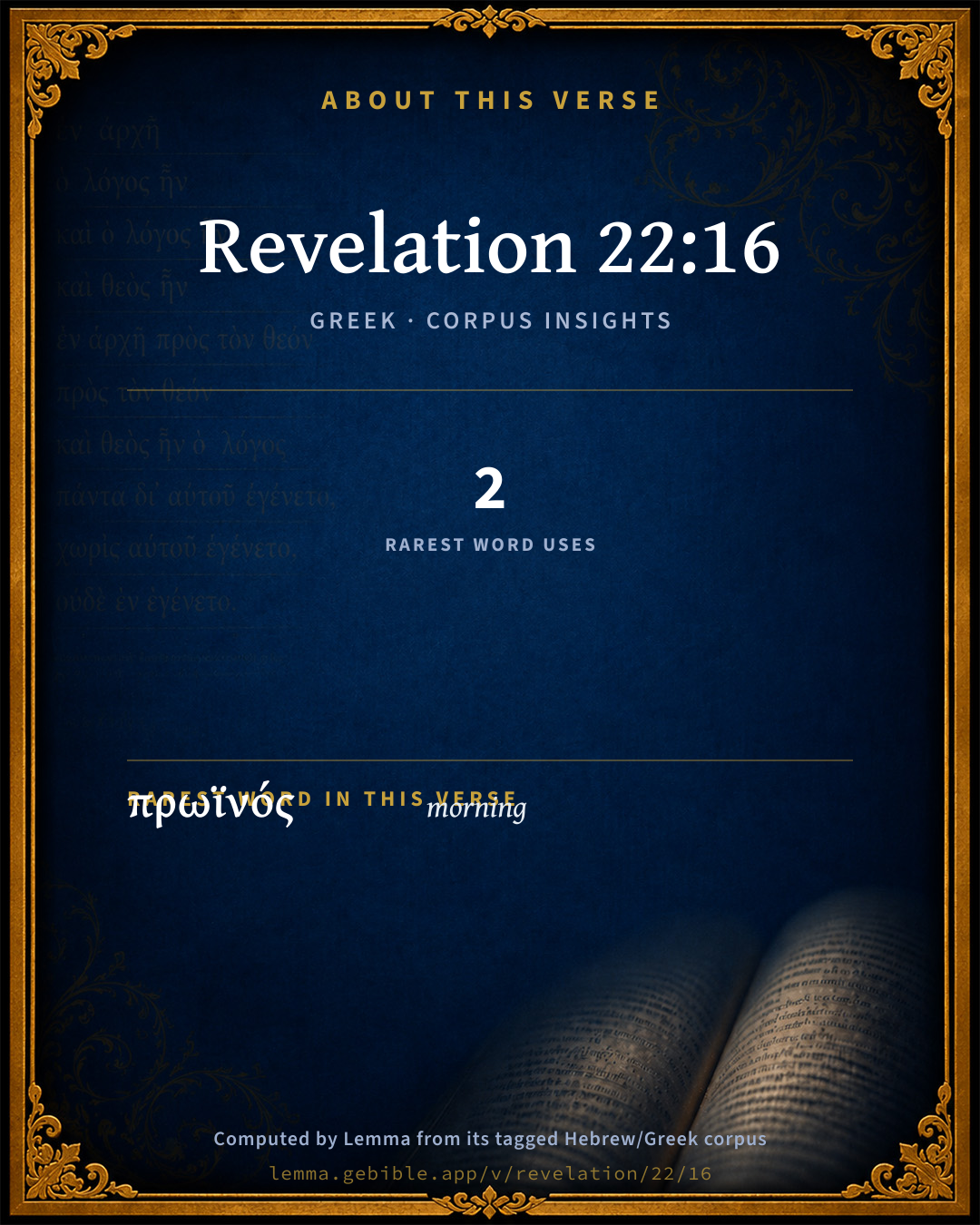
The rarest word here is πρωϊνός morning G4407 — appearing just 2 times in the whole Greek New Testament.

Shared distinctive vocabulary

πρωϊνός morning G4407 occurs in 2 verses of the Greek New Testament. Also found in:

Repetition

Words recur within this verse:

Cross-references

26

Topical passages linked to Revelation 22:16 in the Treasury of Scripture Knowledge — connected by theme and wording, ordered by reader-vote popularity; previews shown in the World English Bible.

  • Revelation 5:5 One of the elders said to me, "Don't weep. Behold, the Lion who is of the tribe of Judah, the Root of David, has overcome; he who opens the book and its seven seals."
  • 2 Peter 1:19 We have the more sure word of prophecy; whereunto you do well that you take heed, as to a lamp shining in a dark place, until the day dawns, and the day star arises in your hearts:
  • Isaiah 11:1 There shall come forth a shoot out of the stock of Jesse, and a branch out of his roots shall bear fruit.
  • Romans 1:3–4 concerning his Son, who was born of the seed of David according to the flesh,
  • Revelation 1:4 John, to the seven assemblies that are in Asia: Grace to you and peace, from God, who is and who was and who is to come; and from the seven Spirits who are before his throne;
  • Matthew 22:42 saying, "What do you think of the Christ? Whose son is he?" They said to him, "Of David."
  • Revelation 22:20 He who testifies these things says, "Yes, I come quickly." Amen! Yes, come, Lord Jesus.
  • Revelation 22:6 He said to me, "These words are faithful and true. The Lord God of the spirits of the prophets sent his angel to show to his bondservants the things which must happen soon."
  • Numbers 24:17 I see him, but not now; I see him, but not near: There shall come forth a star out of Jacob, A scepter shall rise out of Israel, Shall strike through the corners of Moab, Break down all the sons of tumult.
  • Zechariah 6:12 and speak to him, saying, 'Thus says Yahweh of Hosts, "Behold, the man whose name is the Branch: and he shall grow up out of his place; and he shall build the temple of Yahweh;
  • Matthew 2:2 "Where is he who is born King of the Jews? For we saw his star in the east, and have come to worship him."
  • Revelation 1:1 This is the Revelation of Jesus Christ, which God gave him to show to his servants the things which must happen soon, which he sent and made known by his angel to his servant, John,
  • Revelation 2:28–29 and I will give him the morning star.
  • Revelation 3:6 He who has an ear, let him hear what the Spirit says to the assemblies.
  • Revelation 3:13 He who has an ear, let him hear what the Spirit says to the assemblies.
  • Revelation 3:22 He who has an ear, let him hear what the Spirit says to the assemblies."
  • Romans 9:5 of whom are the fathers, and from whom is Christ as concerning the flesh, who is over all, God, blessed forever. Amen.
  • Luke 1:78 Because of the tender mercy of our God, Whereby the dawn from on high will visit us,
  • Revelation 2:7 He who has an ear, let him hear what the Spirit says to the assemblies. To him who overcomes I will give to eat of the tree of life, which is in the Paradise of my God.
  • Revelation 2:17 He who has an ear, let him hear what the Spirit says to the assemblies. To him who overcomes, to him I will give of the hidden manna, and I will give him a white stone, and on the stone a new name written, which no one knows but he who receives it.
  • Revelation 22:1 He showed me a river of water of life, clear as crystal, proceeding out of the throne of God and of the Lamb,
  • Revelation 22:11 He who acts unjustly, let him act unjustly still. He who is filthy, let him be filthy still. He who is righteous, let him do righteousness still. He who is holy, let him be holy still."
  • Matthew 1:1 The book of the generation of Jesus Christ, the son of David, the son of Abraham.
  • Matthew 22:45 "If then David calls him Lord, how is he his son?"
  • Revelation 2:11 He who has an ear, let him hear what the Spirit says to the assemblies. He who overcomes won't be harmed by the second death.
  • Matthew 2:7–10 Then Herod secretly called the wise men, and learned from them exactly what time the star appeared.

Cross-references courtesy of OpenBible.info (CC BY 4.0).

Where the printed editions differ

1 variant

Places in this verse where the major printed Greek editions disagree on the wording in a way that affects the translation — a comparison of editions, not a manuscript-by-manuscript collation. The editions are the modern critical texts (Nestlé-Aland 28/27, SBL, Westcott-Hort, Tregelles, Tyndale House) and the traditional texts behind the KJV (the Textus Receptus and the Byzantine/Majority text). It is not a claim about which reading is original.

  1. Different wording
    ὁ

    “the”

    In NA28NA27TynSBLWHTregByz Not in TR

    καὶ (kai) 'and' occurs in traditional manuscripts (TR) instead of ὁ (ho) 'the' in older manuscripts (NA28+NA27+Tyn+SBL+WH+Treg+Byz)

Textual data: Translators Amalgamated Greek New Testament (STEPBible TAGNT) · CC BY 4.0.

Commentary

Notes on Revelation 22:16 from classic Christian and Jewish commentators (each source and its license shown beneath its notes). The classic Christian expositions comment on the surrounding passage and are grouped to its opening verse, so a note may address several verses; the Jewish commentaries on the Tanakh (Rashi and others) are per-verse, so they appear only where the commentator wrote on this verse.

Lemma curates 59 commentaries, every one of them public domain or Creative Commons licensed, each selected and text-cleaned for this edition rather than reprinted as found. About our sources →

The Biblical Illustrator

Joseph S. Exell

Rev_22:16-21

I, Jesus, have sent Mine angel

Our Lords angel

Would our Lord I say this of any angel of the Lord, because all things that the Father hath are His?

Or has our Lord, as man, an angel of His own in the same way that His saints have? St. Luk_22:43 seems as if He needed and had, in the days of His flesh, such angelic guardianship as is implied in St. Mat_18:10; and this passage is at least consistent with the view that His angel appears in His form, as St. Peters was supposed to do (Act_12:15). It is very ably argued by St. Augustine (de Cura pro Mortuis) that if any apparitions after death or at the moment of death are really objective and supernatural they must be ascribed to angels, not to the spirits of the dead. But we must remember that our Lords state is not the same as that of His departed servants. He is already in the body of the resurrection, and so conceivably visible. And there can be no doubt that He appeared in His own risen body to St. Paul, and probably to St. Stephen. It may be, therefore, that He now appears personally to St. John, at once superseding and authenticating the previous ministry of the angel. (W. H. Simcox, M. A.)

I am the root and the offspring of David, and the bright and morning star.

The Root and Offspring of David

I. This title implies the entire identification of Christ with humanity. The certainty of final triumph for humanity rests on the fact of its vital union with Christ.

II. The title connects Him with the stream of human history. A mysterious consciousness belonged to many of the members of His house and line. Some of them were prophets, and from them sounded out on the youth of the world sayings pregnant with distant meaning. They themselves were types, signs, representatives of Christ, until He Himself should appear.

III. The title establishes a unity in the history of the Jewish nation. Since, in the Divine counsels, it had been determined that the Redeemer should arise out of the bosom of humanity, some line must be necessarily selected as that of His descent. The line is that of the royal David, and this is the clue by which to traverse the maze of the worlds history until the incarnation.

IV. The title embodies a reference to the kingly office of Christ. The favourite representation of the prophets is that of the King, whose reign shall be in peace, in truth, in equity, in righteousness for ever and ever (Psa_122:1-9; Isa_2:4; Isa_42:1-4; Isa_52:13-16; Dan_2:44; Dan_7:13-14; Mic_5:1-4).

V. The title alludes to the vigorous growth and surpassing greatness of the kingdom of Christ. The word root evidently refers to the prophecy in Isa_1:1-10 (see also Isa_4:2; Jer_23:5; Zec_3:8; Zec_6:12). Not the actual root of the tree is meant, but the scion or sucker, which sprouts from the decaying root. At the advent of the Saviour the kingdom of David was indeed like the fallen trunk of a noble tree. A foreign people treads on Judeas soil, and bows a once powerful nation beneath its yoke. Yet behold the vigorous sprout which comes forth out of this decayed root! (E. Johnson, B. A.)

The bright and morning star.--

The bright and morning star

Stars shine in the darkness. When there is no other light their brightness and beauty cheer us. The stars have always been recognised to be among the loveliest of natures beauties. When men have sought for the fairest ornaments to adorn the brows of queens and stately ladies, they have tried to make for them stars of gold or gleaming diamonds. And by their steady laws, their regulated movements, the stars act as our guides. Have you ever thought, moreover, how wonderful is the revelation given to us by the stars? If the cloud had never cleared, if men had never seen those lights shining in the far-away distance, how narrow would our ideas have remained! So as we watch the morning star in the pale eastern sky there comes over us a sense of gladness in its beauty, of wonder and awe at the magnificent stellar system to which it belongs, and at the same time a sense of joyful hope in its prophecy that the darkness is passing and the day about to dawn. And I am, says the Saviour of the world--I am the Bright and Morning Star.

I. We might think of the precious knowledge diffused by Christs gospel through the world; we might think of the ideal of life presented by the life of Christ--the ideal of a life meek and lowly, loving and tender, gentle and self-sacrificing, and yet brave with unflinching courage, generous with noble self-sacrifice. But as our thoughts at Christmas rather turn to our homes, we may try to see how Christ is there the Bright and Morning Star. The Christ-light in the home alone can make it happy. The Christ-light, the Lord Himself honoured, the influence of His wishes felt, the restraining power of His teaching moulding the character; tempers subdued for His sake, self-will controlled, self-conceit kept down with a strong hand, angry and harsh-judging words silenced, mutual bearing and forbearing, kindness, courtesy, consideration for others, proceeding from thought of Christ and wish to do His will; these are the things that make the home bright. Even one person in a household, thoroughly influenced by the love of Christ, and walking in the light of His presence, will bring wonderful brightness to a whole family. They hardly know what makes home so pleasant. What is it? It is the light from the Bright and Morning Star. It glistens in the kind eyes and pleasant countenance of a humble follower of Jesus; and sullenness, gloom, and ill-humour flee before it like shadows before the breaking day. But homes are sometimes darkened by causes over which we seem to have less control--by poverty, sickness, anxiety, sorrow. And the greeting of Happy Christmas sometimes comes with a bitter sense of unreality to those who know that food is scanty, or the hearth dark and lonely. Still, there is a power that brings cheer to the poor mans board, and comfort to the mourners sorrow. When the Morning Star shines in the heart, those words are often thought of, I was hungry, and ye fed Me; thirsty, and ye gave Me drink; sick and in prison, and ye visited Me. And so Christian charity, Christian kindness, Christian sympathy, passes on the light of Christ from home to home.

II. And then our second thought of heavenly Joy applies here. If there is a sorrow too deep to be reached by human kindness, it is not too deep to be reached by the light of the Morning Star. The revelation of the great unseen realities--is not this the true Light for a shadowed home? A Father in heaven who cares and loves, a Saviour acquainted with grief, a kind Providence which will make all work together for good--is not this revelation like the opening of the shutters of a darkened chamber, so that there streams in the light of the Morning Star--the harbinger of day?

III. And this brings us to our last thought, the Morning Star is a star of heavenly hope. There are many young and happy hearts at Christmastide. But among them all there are few that have not felt the chill of disappointment, the shadow of doubt and uncertainty from the mystery of life, the solemn darkness of self-reproach and an accusing conscience. The soul is getting farther away from God. Ideas have been entertained, habits have been allowed to grow that have made the gap wider and wider between daily life and the aspirations after goodness that were once felt. The soul is in darkness. Yes, say what we will, the soul must be dark if it is without God. Show me a man who does not know God, who does not care for God, who does not trust and honour the infinite Lord, and I can tell you that whatever be his outward circumstances, his spirit is in awful darkness. On Christmas Day, let any such listen to the words of Jesus--I am the Bright and Morning Star. Let that Day Star from on high arise and shine in your heart. Christ loves you, and came into the world and lived and died for you. Let His glory enlighten your soul. (Bp. Wynne.)

Christ the morning star

The Lord speaks here in a manner that is all His own. Nothing is more profoundly characteristic in His words, from first to last, than His witness to Himself. He, the sacred exemplar of all self-denial, yet always and immoveably presents Himself in terms of self-assertion, and such self-assertion as must mean either Deity, however in disguise, or a delusion moral as well as mental, of infinite depth. I am the Truth; I am the Life; I am the Bread of Life; I am the True Vine; I am the Good Shepherd. We have but this same tone, perfectly retained, when here the same Voice speaks from amidst the realities of the unseen. The imagery, indeed, is lifted to the scenery of the firmament; He who is the genial Vine and the laborious Shepherd, now also reveals Himself as the Star of Stars in a spiritual sky. I am the Star. For the moment we will take the text in this briefest form, for it will suggest to us, in part at least, the reason of the use of the starry metaphor at all. I am the Star; why the Star? We may be perfectly sure that the word, with all its radiant beauty, is no mere flight of fancy. Prophecy, not poetry, underlies these last oracles of the Bible. Balaam had heard, among the words of God, of a mysterious Person, or at least of a mysterious Power, strong to destroy and save; figured to his soul in vision as a star, destined in other days to appear out of Israel; and the belief of the Jewish Church, in the lifetime of Jesus, certainly was that the Star of that prediction was the King Messiah. The word indicated, probably, the royal dignity, touched and glorified with the light of Deity, or of Divinity at least. As such the Lord here takes it up. He claims here to be the spiritual and immortal King, the Conqueror, beating down His adversaries and possessing His redeemed. This is what appears in special fulness, in other forms, in earlier passages of the Apocalypse; the Lamb is in the midst of the throne; the throne is the throne of God and of the Lamb. But now look further into the text. The voice at Patmos not only claims the primeval prophecy for Jesus, as the King of the new Israel. It expands that prophecy, and discloses truth within truth treasured there. For the Lord does not only assert Himself to be the star, the bright star; as of course His brightness must be surpassing if He is in any sense at all a star. His own presentation of the metaphor has something in it new and special--I am the Morning Star. Why was not the word Star left alone in the utterance? In pointing to Messiah as the Star, were not the ideas of brilliancy, and elevation, and all that is ethereal, sufficient? No; it was not to be so. Messiah Himself so qualifies the word by this one bright epithet as to show Himself as not the King merely, but the King of Morning; around whom gathered, and should gather for ever, all that is real in tenderest hope and youngest vigour, and most cheerful aspiration, and such beginnings, as shall eternally develope and never contract into fixity and decline. It reminds the disciple that his blessed Lord is no mere name of tender recollection, no dear relic of a perished past, to be drawn sometimes in silence from its casket and clasped with the aching fondness and sprinkled with the hot tears, of hopeless memory. He is not Hesperus that sets, but Phosphorus that rises, springing into the sky through the earliest dawn; the pledge of reviving life, and growing light, and all the energies and all the pleasures of the happy day. And the word speaks of a kind of joy for which the open day would not be so true a simile. It indicates the delights of hope along with those of fruition; a happiness in which one of the deep elements is always the thought of something yet to be revealed; light with more light to follow, joy to develope into further joy, as the dawn passes into the morning and then into the day.

1. First, then, we are reminded here that as His commandments are not grievous, so the principles He gives to animate His follower to obedience are not melancholy. The life eternal, the annihilation of the second death, is the knowledge of Himself; and to know Him is to live in light indeed. It is to touch a sympathy boundless alike in its tenderness and its power; it is to deal perpetually and everywhere with One who is not poetic legend but the central rock of History; One who has proved Himself in the fields of fact to be a reality for ever, and who is exercising at this hour in human experience a multiplicity of personal influence too vast and too peculiar to be accounted for by any mere memory of departed power. He being such, and such being the knowledge of Him, what in brief are His sacred principles for the soul that seeks Him? Simply these in their essence:--first to trust Him, then, to follow Him.

2. And again, this glorious epithet of the Star of salvation--this morning-word--reminds us that not for a part only but for the whole of the earthly course, early as well as late, and late as well as early, Jesus Christ is the true Light to light every man. Not for the sick-mans room only and the dying bed is His faith good. Let us thank God often that it is good there. But this same religion is not only the last light for dying eyes. It is the star of the morning of even this lower life. There is that in it (or rather in Him who is His own religion), which is of all things fittest to enter with harmonious power into all the confiding joy of childhood, and all the strongest aspirations of youthful thought and will. One condition does the Lord propose to the young soul, as to all others--the condition of submission to Himself. And where that condition is, through grace, in its true sense, accepted, there will there be found to develop within the life an influence essentially of strength and gladness; an assurance of a companionship most tender because Divine; of a sympathy meeting every true need of grief or of happiness; of a wisdom which concerns itself with every detail of every day; of an affection to which the best endearments of earth can but point as to their glorious archetype; and, above all this and with it all, the power of the presence of an invisible but awful purity, and the spoken promise, in connection with that presence, of a final life of endless joy.

3. In a few short years there may, there must, come over you the sense of approaching maturity and fixity as to earthly conditions of life and action. You must find, soon or late, as to the world, that your rate of movement in vigour and enjoyment is no longer, in itself, what once it was. But if Christ dwells in your heart by faith, there will be a charm there which will not only console you under the change, but will glorify it to you. As eternity approaches, you will more distinctly see the connection between it and time. The appointed task, even under the burthen of the slow failure of outward power, will be met by you as those only can meet it who know that these things are links in the indissoluble will of an eternal Friend, and that the veil is already parting which shuts out for a season the open view of the perfection and acceptability of all that will.

4. May we not, in conclusion, move a step further in our meditation, and find here a promise which is concerned also with the immortal world itself? We remember, of course, that He who is here called the Star is elsewhere called the Sun; and we might think, therefore, that He here speaks as, in a certain sense, His own forerunner; the Firstborn of the dead, whose own resurrection is the herald of His own final triumph. But it seems truer to the analogy of His other metaphoric titles to view this title as belonging to no passing phrase of His majesty, if such could be, but to its essence for ever. What elsewhere he claims to be, He is in perpetuity. On the throne as truly as on the Cross, He is the Lamb. In the fields of heaven He is still the Shepherd, leading His flock to the living fountains of waters. And surely in the upper sky He will be for ever the Star of Morning, so far as He will be the eternal pledge and joy of a life that will be for ever young, of energies that will accumulate without end, of a service before the throne that will always deepen in its ardour and its triumph, of discoveries in the knowledge of the Eternal which will carry the experience of the blessed from glory to glory in a succession that cannot close. (H. C. G. Moule, M. A.)

The bright and morning star

I. Because, by His coming in the flesh, He introduces into our world the light of gospel day. What was the state of the world when the Word was made flesh, and dwelt among men? In the emphatic language of holy writ, darkness covered the earth, and thick darkness the people. Survey the state of the heathen at this eventful crisis of the worlds history. How dark and how confused were the notions of Deity entertained by the shrewdest of their philosophers! Their religious rites were full of lust and cruelty, and were so far from having a tendency to promote virtue, that they excited them to every species of crime and wickedness. Truly they sat in darkness, and in the shadow of death. And what was the state of the Jews at this eventful period? Theirs, doubtless, was a less deplorable condition. They had the oracles of God, and some faint glimmerings of light, by means of figures, and prophecies, and sacrifices; still theirs was s, dispensation of types and of shadows. And at the time when God was manifested in the flesh, the Scribes and the Pharisees had spread a mist over the Mosaic observances; the elders, by their vain traditions had rendered its shadows tenfold more obscure, and the whole Jewish system was enveloped in gloom and darkness. But the fulness of time arrived when the bright and morning star appeared above the earths horizon, scattering the shadows of the Jewish Economy, and pouring a flood of light upon the darkness of Pagan delusions. This light of the world came, and gave to mankind a clear and a full revelation of the nature and perfections of the Deity, made known the way of reconciliation with an offended God, taught man his duty, and unfolded to him the bliss and the glory of heaven.

II. Because, by His rising in the heart, He introduces the day of salvation into the soul of sinner. The soul of man, in its native and unrenewed state, is full of disorder and darkness. He cannot see himself, or God, or Christ, or the way to heaven, in their true light. He may, indeed, give his assent to statements which he hears made upon these subjects, but he cannot have an experimental or abiding sense, even of the most obvious spiritual truths, till his mind is enlightened by the grace of Gods Son; till then, even the light that is in him, is darkness. But when the morning star arises in the heart of a sinful being, it produces change at once great and glorious. Before its rays, the darkness of the mind is dispelled, the understanding is illumined, and the whole soul is renewed in knowledge, as well as in righteousness and true holiness. How vast, for instance, was the change from darkness to light in the case of Saul and Tarsus.

III. Because, by His rising at the time appointed in prophecy, He will introduce into our world the glory of millennial day.

IV. Because, by His rising at the end of time, He will usher in the bliss and the light of eternal day. (John McGregor.)

The bright and morning star

I. The title declares the brilliance of His lustre. Amongst the Orientals, the morning star is the favourite emblem of great ruler, a martial leader, or a wise teacher. Christ claims this epithet on the ground of possessing the truest glory; that of being the Witness for the Truth, of being the truth itself, and thus of bringing minds under His sway. Compare this title which Christ gives of Himself in the vision of St. John, with that He gives of Himself in the gospel: I am the Light of the World. In that Light alone can the solution of the great world problems be found. His lustre cannot now be withdrawn, nor can men refuse to open their eyes to its presence. He is the Morning Star of all humanity, the brightest light that has ever dawned upon the world--that guides it onwards to the eternal day.

II. It implies the power of His attraction. Man can be moved and drawn only by man. Hence the wisdom of God manifest in the flesh.

III. It implies the fixity of His office. Amidst the progress and the changes of human thought, the revolutions of opinion, the advances or the retrogressions of moral and spiritual life, He abides a steady, ever-shining light. All others are flickering torches, throwing a momentary and misleading glare, then waning and dying out.

IV. It is emblematic of the hope of humanity. The morning star is the herald of the dawn. So our hope of a morning for humanity is in Christ. Our only hope is in Him. He is one with us; He has come to His own, and knows its wants, its weakness, its sorrow, and its sin. He shines down upon us now, with powerful and influential brilliance; and He will be associated with all our future struggles as He has been with all our past. Therefore, as Christians, we are confident and hopeful. (E. Johnson, B. A.)

The bright and morning star

I. The promise of Messiah was the Morning Star to the ancient believer. When first introduced to the faith of the sinning pair in the garden of Eden, it became their Morning Star; all besides was dark! They had lost the favour of God.

II. The advent of Jesus was the Morning Star of a more perfect economy.

III. Christ preached, is the Morning Star of any people to whom He is proclaimed.

IV. Christ is the Morning Star to all who believe on Him. (H. Wilkes, D. D.)

Christ the morning star

The morning star is one of the most beautiful objects in the sky. Last in the train of night, it yet sheds the brightest radiance. Too faint by far to penetrate the recesses of ocean, or the deep places of the forest, it slumbers on the surface of the wave, it trembles through the cottage window, or tips with silver every mountains head. It rivals not the strong sunlight, nor doth it vie with even that holier day which the moon casts abroad; nevertheless, in the heaven, doth it form a beauteous beacon; nor is the eye satisfied with gazing, when the fierce monarch of the skies arises and chases it away.

1. Apt and beautiful emblem this, of the gentle but glorious light, which Jesus has darted upon the souls of His people! Previous to the coming of Christ, the character of God was, in a great measure, unknown. The adversary had trampled on the shrine of the Lord of Hosts; it was as if that name had ceased to be manifested; it was as if the fire by which he was wont to maintain it, had been quenched. But the Morning Star at length arose: and an uncreated glory, streaming from the revealed attitude of a God at once just and the justifier of the ungodly, flowed with it. But had nothing more than the true character of God been included in this revelation, it had been made in vain. What cares man for the character of God? Were he, indeed, a being much better than he is, we could conceive him, in this case, entertaining such a care; starting up perhaps suddenly, and shivering with fear, at the bare idea of his God being charged with cruelty or injustice. But man as he is, sensual, selfish, unthinking, diseased, deluded, or despairing, entertains not one anxiety about the character of his Maker. But for his own destiny he must care; and he will ask eagerly, What sort of light has the Morning Star brought, concerning this? What am I told about my future state? Open the volume and see; start not at the apparent darkness; gaze steadily, and you will be richly rewarded. There are, indeed, no minute views of the future state. The Bible communicates only a few great facts, and leading features of the eternal world. But Christ has cast a light also upon the duty of man. This Moses had, in a great measure, done; but he had not taught man to answer the question fully, What shall I do to be saved? Christ came at once to prompt the question, and to provide the reply. Here is no list of austerities; no staggering invitation to swallow down absurdities, to believe what is impossible or revolting; no requirement of an ideal perfection from a child of clay; all is plain and easy, yet leadeth to heaven. Oh, then, will ye not bless the Morning Star, which has risen to guide you along this path to glory? and will you not walk on in its tender light, trusting that it will shine on more and more unto the perfect day?

2. Christ further resembles the morning star, as He is a giver of joy. The sun-rising is, in truth, a summons to rejoice; and it is obeyed and echoed in a thousand voices of gladness. The moon-beam also communicates its own pensive pleasures, and quieter harmonies to those who can baptize their spirits in its beauty. Nor is the morning star destitute of joy-giving influence. How does it cheer the labourer as he goes forth to his toil, amid the dews of the dawn! How does it soothe the soul of the mariner who gazes at it, till quiet tears bedim his eyelids! How is it the sun of the sleepless, especially of those who are awake through sorrow! Count up the raptures of earth, and you will find the rarest of them coming from Christ. Consult your own bosoms, and you will find your purest pleasure coming from Him. Sum up the ecstasies of the departed saints, and you will find all of them coming from Him.

3. Again, Christ resembles the morning star, as He is the precursor of a brighter revelation. The morning star is a pledge in the sky that the day is dawning, and at length it melts away into the light of heaven. So the light we have is comparatively dim; but there is a day behind it.

4. This Morning Star is a precursor of the day of Millennial brightness. There is no change in the outward aspect of the world; the same alternation of hill and valley, of waste and woodland, is presented to the view. But the shadow of sin has passed away. Man has become a nobler being; he is holler and happier. His land is not heaven; but it is no longer accursed in the anger of God. It is a land redeemed, though not glorified. On all its landscapes is written, Holiness to the Lord. (G. Gilfillan.)

The stellar beauty of Christ

The meaning of my text is this: as the morning star precedes and promises the coming of the day, so Christ heralds the natural and spiritual dawn.

1. Christ heralded the coming of the creation. Oh, it is an interesting thought to me to know that Christ had something to do with the creation! I see now why it was so easy for Him to change our water into wine; He first created the water. I see now why it was so easy for Him to cure the maniac; He first created the intellect. I see now why it was so easy for Him to hush the tempest; He sank Genessaret. I see now why it was so easy for Him to give sight to the blind man; He created the optic nerve. I see now why it was so easy for Him to raise Lazarus from the dead; He created the body of Lazarus, and the rock that shut him in. Hail! Lord Jesus, Morning Star of the first creation.

2. Christ heralds the dawn of comfort in a Christian soul. You are building up some great enterprise. You have built the foundation--the wail--you are just about to put on the capstone, when everything is demolished. Instead of the quick feet in the hall, the heavy tread of those who march to the grave. Oh! what are people to do amid all these sorrows? Some know not which way to turn. But not so the Christian man. He looks up toward the heavens. He sees a bright appearance in the heavens. Can it be only a flashing meteor? Can it be only a failing star? Nay, nay. The longer he looks the more distinct it becomes, until, after a while, he cries out: A star! a morning star! a star of comfort! a star of grace! a star of peace! The star of the Redeemer! The Lord gave, and the Lord hath taken away; blessed be the name of the Lord. Peace, troubled soul! I put the balm on your wounded heart to-night. The morning star, the morning star of the Redeemer.

3. Christ heralds the dawn of Millennial glory. It is night in China, night in India, night in Siberia, night for the vast majority of the worlds population. But it seems to me there are some intimations of the morning. The Hottentot will come out of his mud hovel to look at the dawn; the Chinaman will come up on the granite cliffs, the Norwegian will get up on the rocks, and all the beach of heaven will be crowded with celestial inhabitants come out to see the sun rise over the ocean of the worlds agony. They shall come from the east, and from the west, from the north, and from the south, and sit down in the kingdom of God.

4. Christ heralds the dawn of heaven upon every Christians dying pillow. All other lights will fail--the light that falls from the scroll of fame, the light that flashes from the gem in the beautiful apparel, the light that flames from the burning lamps of a banquet--but this light burns on and burns on. No other star ever pointed a mariner into so safe a harbour. No other star ever sunk its silvered anchor so deep into the waters. No other star ever pierced such accumulated cloud, or beckoned with such a holy lustre. (T. De Witt Talmage.)

The morning star

Throughout the Bible the star is made a symbol of dominion, glory, and triumph.

1. What figure more exquisite, more apt in illustrating the relation of the Lord Jesus Christ to His kingdom and to the destinies of humanity! The star appears small up yonder, and yet it is a very vast planet; so Christ appears small to the bystanders at His coming--a mere humble man like ourselves. How little did they know what was in Him! The star is small, but how wide-spreading is its light! And so, in reference to the breadth of Christs kingdom and its extent, is the figure exquisite and applicable.

2. In a time of gloom the star appeared. The Roman Empire was apparently in its pride and strength; but, as we all know now, it was bloom outside and worm within. All the hopes of the Jews, one after another, had disappeared. The desires for the coming of a Deliverer, which had been cherished and expressed here and there and yonder--not merely in Judea, but in all other countries, by the foremost minds, whether inspired or uninspired--had failed, and it was an era of desolateness, vice, and darkness, of intellectual pride, along with intellectual weakness when Christ came upon earth. It was what the Apostle calls the fulness of time. It is fitting that this manifestation of Christ at such a time should be called the dawning of the day-star.

3. The birds of night cannot stand before the coming dawn when Venus shines in her lustre in the sky. When Christ appeared upon the earth, the very first scintillation of the day-star was to warn all the old systems of wrong and outrage, oppression and darkness, that their time had come. (Christian Age.)

The bright and morning star

All the stars are very beautiful to look at. But if we get up before daylight, in the morning, and look out towards the east, where the bright and morning star is shining, we shall see that this is more beautiful than the others. How clearly it stands out in the dark sky! With what soft and silvery light it shines! And, as we stand gazing at it, we cannot help thinking how well it may remind us of Jesus.

I. Guidance. Our sailors understand this better than any other people. And there is nothing that we need so much as guidance. We know not how to steer our vessel so as to be able to reach that blessed harbour. And one reason why Jesus is called the bright and morning star is because He shows us the way to heaven, and guides us in that way. There are rocks and shoals in the sailors way, and he needs guidance to enable him to steer clear of them, and keep from being wrecked. And, in trying to make our way to heaven, the sins and temptations around us are the rocks and shoals we meet with; and if we look to Jesus, as our star, He will guide us, so that we can steer clear of these dangers. It is mainly through the Bible that Jesus, our bright and Morning Star, gives us the guidance that we need. If we read it carefully and follow its teachings, it will help us to escape a great many dangers, and keep us safe from a great many troubles

II. Hope. The morning star is very beautiful to look at. It does not give a great deal of light. You cannot see to read by that star. But, as you look at it, it tells you that the night is almost gone. You know that the sun will soon rise and shine, and then there will be light enough for everything. You will be able to see the fields and the woods, and the beautiful flowers, and all the glorious things that God has made. That morning star gives us the hope that the darkness will soon be gone, and the light of day be shining all about us. And Jesus may well be compared to such a star, because when He rises and shines on our hearts He fills them with the sweet hope that the darkness of this world will soon pass away, and the bright, clear light of heaven will be shining around us. And this hope is a bright and beautiful thing. It is able to make us happy, when nothing else in the world can do so.

III. Joy. One of our great poets has said: A thing of beauty is a joy for ever. The meaning of this is, that it always makes people glad, or gives them joy, to see a beautiful thing. And this is true. Now a star is a beautiful thing. And the bright and morning star is very beautiful. Whenever I think of this star I am reminded of my first visit to Switzerland a good many years ago. We went up from Geneva to the valley of Chamouni, to see Mont Blanc. It was Saturday evening when we arrived there. I wanted very much to see how that great mountain would look when the sun was rising on it, So, on the next morning, I got up between three and four oclock to be in good time to see the sun rise. I dressed myself, and, all alone, walked quietly down the valley, that I might be ready to catch the first sight of the beams of the sun, as they began to shine upon the snowy summit of the mountain, and gild it with golden beauty. It was a beautifully clear night, or rather morning, though it was still quite dark. There was no mist around the mountain, and not a cloud in the sky. The summit of Mont Blanc is a great, rounded dome of snow. This was lifted far up into the clear, dark sky. And right over the top of the mountain I saw the morning star. How calm it seemed there! How soft and silvery was the light it shed! How brightly and beautifully it was shining down on the snowy summit of that great mountain. It was one of the most lovely sights I ever saw. I thought it was worth while to go all the way to Switzerland, if there had been nothing else to see there but just that beautiful sight of the morning star above the summit of Mont Blanc. As I walked slowly down the valley, looking at that beautiful star, I thought of these sweet words of Jesus: I am the bright and morning star. The sight of that star made me glad. It gave me joy then, while I was looking at it. And it gives me joy now, whenever I think about it. But all the stars in the world put together are not half so beautiful as Jesus is. And when we see Him, and know Him, as our bright and Morning Star, there is no joy to be found in anything so great as that which He gives. (R. Newton, D. D.)

The Biblical Illustrator, edited by Joseph S. Exell (c. 1880s–1900s) — public domain. Text from a community e-Sword module.

Joseph Benson's Commentary

Rev 22:16. I Jesus have sent mine angel — It was not thought sufficient to represent the angel as speaking in the person of Christ, but Christ himself also is here introduced speaking in his own person, and confirming the divine authority of this book, and attesting it to be properly his revelation; to testify unto you these things — Primarily to you, the seven angels of the churches; then to those churches, and afterward to all other churches in succeeding ages. I, as God, am the root — And source; and, as man, the offspring of David — And his family; and the bright and morning star — Who wear a glory exceeding that of the most brilliant and celestial luminary, and who put an end to the night of ignorance, sin, and sorrow, and usher in an eternal day of light, purity, and joy.

Joseph Benson's Commentary on the Old and New Testaments (1811–1818) — public domain. Text from a community e-Sword module.

Tyndale Open Study Notes

Tyndale Open Resources

22:16 I am both the source of David and the heir to his throne: Jesus validates the message of Revelation (cp. John 21:24) by swearing that he is simultaneously the source of David (see Rev 5:5; Isa 11:10) and David’s heir (see Ezek 37:23-24; Rom 1:3). • The morning star was a name for the Messiah (see Num 24:17; 2 Pet 1:19; cp. Luke 1:78-79).

Tyndale Open Study Notes — © Tyndale Open Resources, licensed CC BY-SA 4.0. Text via the HelloAO Bible API.

Bengel's Gnomon

Johann Albrecht Bengel

Rev 22:16. Ταῖς ἐκκλησίαις) The genuine reading,[248] to which, as not being understood, one has prefixed ἘΝ, another ἘΠΊ. If either particle had been originally written, the copyists would not so easily either have changed or omitted it. But, as Wolf well reminds us, they who are intended by the particle you, are distinguished from the churches. For ὑμῖν is the dative, and ΤΑῖς ἘΚΚΛΗΣΊΑΙς the ablative, as ch. Rev 8:3-4. The seven churches in Asia altogether are witnesses to the individual churches, and these to their individual angels and hearers.—Ὁ ἈΣΤῊΡ Ὁ ΛΑΜΠΡῸς Ὁ ΠΡΩΪΝΌς) He does not say ἙΩΣΦΌΡΟς, nor ΦΩΣΦΌΡΟς, but uses a new appellation, Ὁ ἈΣΤῊΡ Ὁ ΛΑΜΠΡῸς Ὁ ΠΡΩΪΝΌς. This greatly increases the force of the signification.

[248] A Vulg. prefix ἐν: so Lachm. Rec. Text has ἐπί, with B; Tisch., with minor authorities, omits the preposition.—E.

Bengel's Gnomon of the New Testament — English translation (T&T Clark, Edinburgh, 1860) — public domain. Text from a community e-Sword module.

Expositor's Greek Testament

ed. W. Robertson Nicoll

Jesus in person now speaks in the colloquy (Rev 22:16 ; Rev 22:13 ; Rev 22:12 ) to ratify what has just been said. This apocalypse is not an individual fantasy (2Pe 1:21 ). For the contemporary need of such accrediting, cf. Herm. Sim. ix. 22 and Ascension. Isa. 3:30, 31 (where in the last days “everyone will say what is pleasing in his own eyes. And they will make of none effect the prophecy of the prophets which were before me, and these my visions also will they make of none effect, in order to speak after the impulse of their own hearts.”) ἄγγελον , not John (Weiss, Wellh.) but the angelus interpres ( cf. on Rev 1:2 ; Rev 1:20 ). ὑμῖν , the plural here and in Rev 22:6 ( cf. Rev 1:1 ) might suggest that John’s apocalypse incorporated some visions of other members belonging to the prophets in the Asiatic circle or school ( cf. the tradition about the co-operative origin of the Fourth gospel, in the Muratorian canon). But while any Jewish Christian sources may have been drawn from this quarter, the final authorship and authority is claimed by (or, for) John himself ( cf. Rev 22:8 ). Δαυείδ . Like most early Christians, John attached more weight to the Davidic descent of Jesus as messiah (Baldensperger, 82 f.), than Jesus himself allowed. Here Christ’s authority in revelation is bound up with his legitimate claim to be messiah, and thus to inaugurate the new and eternal day of God. As ἀνατολή (the dawn = צֶמַח ) was already a messianic symbol, and employed in LXX (Jer 23:5 , Zec 3:8 ; Zec 6:12 ) to denote the messianic branch or stem, this double usage explains the imagery here (so Justin, Apol. i. 32). Jesus has not only the historic preparation of Israel behind him but the infinite future before him. In one sense he was the climax of Hebrew expectation; in another, he is of world-wide significance. In connexion with the heavenly Jerusalem it was natural that Jesus should be hailed as the scion of the David who had founded the first Jerusalem. The star-metaphor reflects the significance of the morning-star which meant the beginning of a new day for toilers in the Levant; but its eschatological outlook was taken ultimately from Babylonian astro-theology, where Nebo-Mercury (nebî = prophet), the morning-star, announced the new era, or from Egyptian theology where ( cf. E. B. D. p. cxliii.) Pepi the dead king “goeth forth into heaven among the Stars which never perish, and his guide the Morning-Star leadeth him to Sekhet-Hetep [the fields of peace]”. The phraselogy brings out the conviction of the early church that the present trial was only the cold, dark hour before the dawn. Their faith in Jesus assured them that an eternal prospect of bliss awaited them, and that this vista of hope was hound up with the person of the risen Jesus ( cf. Rev 22:13 ). The watchword was, sunrise and morning-star ( cf. Expos. Dec. 1902, 424 441). Christianity was not some ephemeral Oriental cult, which had had its day; the cosmic overthrow meant a new era for its adherents. The Apocalypse thus closes, as it began (Rev 1:5-6 ) with a note of ringing emphasis upon the eternal significance of Christ in the divine plan and purpose.

Rev 22:13 Gathers up the double thought of 16 and of 12. As the Christian ἔργα (Rev 2:2 ; Rev 2:5 ; Rev 2:19 , etc.) are done within the sphere of faith, their recompense is a religious as well as a thoroughly moral conception ( cf. Hastings’ D. B. iii. 82, and Montefiore’s Hibbert Lectures , p. 538). To the day’s work, the day’s wage. For the origin of this feeling on Syrian or Semitic soil, where the fellahin’s work “was scrutinised before the wages were paid” by one who was “at once the paymaster of his dependents and their judge,” cf. Hatch’s Hibb. Lectures , pp. 224 f. and Dalman, i. § viii. 3. The reward, like the new Jerusalem, was safely stored in heaven. No fear of inadequate moral appreciation in the next world, at any rated

The Expositor's Greek Testament, edited by W. Robertson Nicoll (1897–1910) — public domain. Text from a community e-Sword module.

Geneva Bible (1599)

Geneva Bible translators

The second place of confirmation, as I said, is the speech of Christ, ratifying the vocation of S. John, and the authority of his calling and testimony, both from the condition of his own person being God and man, in whom all the promises of God are Yea and Amen, 2 Cor. 1:20: and also from the testification of other persons, by the acclamation of the holy Ghost, who here is as it were an honorable assistant of the marriage of the Church as the spouse: and of every of the godly as members: and finally from the thing present, that of their own knowledge and accord they are called forth unto the participation of the good things of God, verse 17.

Geneva Bible (1599) marginal notes — public domain. Text via Bolls.life.

Jamieson, Fausset & Brown

Robert Jamieson, A. R. Fausset & David Brown

mine angel--for Jesus is Lord of the angels.

unto you--ministers and people in the seven representative churches, and, through you, to testify to Christians of all times and places.

root . . . offspring of David--appropriate title here where assuring His Church of "the sure mercies of David," secured to Israel first, and through Israel to the Gentiles. Root of David, as being Jehovah; the offspring of David as man. David's Lord, yet David's son (Mat 22:42-45).

the morning star--that ushered in the day of grace in the beginning of this dispensation and that shall usher in the everlasting day of glory at its close.

Jamieson, Fausset & Brown — Commentary Critical and Explanatory on the Whole Bible (1871) — public domain (CC PDM 1.0). Text via the HelloAO Bible API.

Adam Clarke's Commentary

Verse 16. I Jesus] The Maker, the Redeemer, and Judge of all men.

Have sent mine angel] An especial messenger from heaven.

I am the root and the offspring of David] Christ is the root of David as to his Divine nature; for from that all the human race sprang, for he is the Creator of all things, and without him was nothing made which is made. And he is the offspring of David as to his human nature; for that he took of the stock of David, becoming thereby heir to the Jewish throne, and the only heir which then existed; and it is remarkable that the whole regal family terminated in Christ: and as HE liveth for ever, he is the alone true David and everlasting King.

The bright and morning star.] I am splendour and glory to my kingdom; as the morning star ushers in the sun, so shall I usher in the unclouded and eternal glories of the everlasting kingdom.

Adam Clarke's Commentary on the Bible (1810–1826) — public domain. Text from a community e-Sword/MySword module.

Ellicott's Commentary for English Readers

(16) I Jesus have sent mine angel . . .—The warning is followed by the voice of our Lord Himself testifying to the truth of the revelation made, I Jesus sent (not “have sent,” as in the English version) my angel to testify to you these things to the churches. But it is not merely a message, or the confirmation of a message that we have—we have also stated what Christ is—the root and pledge of hope to all. I am the root and offspring of David, and the star, the bright, the morning (star). He is David’s Lord and David’s Son, possessing David’s throne (Mat_22:42-45; Luk_1:32); He is the bright star which leads up the dawn of everlasting day (Mal_4:2; 2Pe_1:19).

A Bible Commentary for English Readers, edited by Charles John Ellicott (1878–1897) — public domain. Text from a community e-Sword module.

The Cambridge Bible for Schools and Colleges

gen. ed. J. J. S. Perowne

16. I Jesus] Here only does our Lord reveal His Name, though from Rev_1:13; Rev_1:18 onwards, it has been obvious that He is the revealer; as was expressed in the title, Rev_1:1. Whether He is personally present, however, is doubtful: the words are His, but it is probably still the angel that speaks them.

mine angel] Would our Lord say this of any angel of the Lord, because “all things that the Father hath are His.” Or has our Lord, as Man, an angel of His own in the same way that His saints have? St Luk_22:43 seems as if He needed and had, in the days of His flesh, such angelic guardianship as is implied in St Mat_18:10 : and this passage is at least consistent with the view, that His angel appears in His form, as St Peter’s was supposed to do, Act_12:15. It is very ably argued by St Augustine (de Cura pro Mortuis), that if any apparitions after death or at the moment of death are really objective and supernatural, they must be ascribed to angels, not to the spirits of the dead. But we must remember that our Lord’s state is not the same as that of His departed servants. He is already in the body of the Resurrection, and so conceivably visible. And there can be no doubt that He appeared in His own risen body to St Paul, and probably to St Stephen. It may be, therefore, that He now appears personally to St John, at once superseding and authenticating the previous ministry of the angel.

the root and the offspring of David] He bears the former title in Rev_5:5, where see note. The latter is substantially the same as the familiar one, “the Son of David.”

and the bright and morning star] Both “and”s should be omitted. There may be a reference to Num_24:17, or to the title of “the Day-spring,” St Luk_1:78, and perhaps Zec_3:8; Zec_6:12. In Rev_2:28, though the words are more nearly the same as here, the sense is different: see note there.

The Cambridge Bible for Schools and Colleges (gen. ed. J. J. S. Perowne; Cambridge University Press, 1878–1918) — public domain. Text from a community e-Sword module.

John Gill's Exposition

I Jesus have sent mine angel,.... As John, the writer of this book, sets down his own name, who was an eye and ear witness of the things contained in it, that they might be more surely believed, Rev 22:8 so Christ, the author of it, puts his name Jesus to it, to engage the greater attention to hear and read, and keep the words of it, as well as to make it plain and manifest, who is the person speaking of his coming, Rev 22:7 and who that has any value for Jesus the Saviour, but will give credit, and pay a regard to this revelation of his, which he sent by his angel, one of his ministering spirits, made by him, and under his command, he being the Creator, Lord, and head of angels: this expresses the dignity of his person, and is no inconsiderable proof of his deity: and this was done, in order

to testify, to bear witness to the truth of the things contained in it; to signify and show them, to set them forth in emblems and visions:

unto you these things in the churches; to the servants of the Lord, Rev 22:6 to John, and by him to others, to the pastors of the seven churches, who were "over" the churches, as it may be rendered, and to the members of the churches, to all that were in them; for the Alexandrian copy, the Vulgate Latin and Arabic versions read "in"; the Syriac version renders it, "before the churches". What John saw he wrote in a book, and sent it to these churches, Rev 1:11. The words may be rendered, "concerning the churches"; and then the sense is, that the angel was sent to show to John, and by him to others, even to all the saints in all ages, the things relating to the church of Christ, in the several periods of time, represented in succession by the seven churches of Asia. Christ gives a further account of himself, for the greater confirmation of the faith of his people, in the certain accomplishment of the things herein written, by saying,

I am the root and the offspring of David. The former of these is mentioned in the note; see Gill on Rev 5:5; and the meaning of it is, either that Christ, as God, is David's Lord and head, from whom he had his being, both in a temporal and spiritual sense, and by whom he was supported and sustained; or that, as man, he sprung from the root of David, or descended from him; and so it falls in with the latter, which may be explanative of it, "the offspring of David"; that is, the soft of David, according to the flesh, a frequent name of the Messiah; See Gill on Mat 1:1. God promised that the Messiah should be of the seed of David, and according to his promise he raised up unto Israel of his seed, a Saviour Jesus, the same person here speaking, Act 13:23 who adds,

and the bright and morning star; Christ is compared to a "star", as in Num 24:17 for its light, the light of nature, and of grace, and of the new Jerusalem state being from him; and for its glory, his glory being the glory of the only begotten of the Father, and he having a glory, as Mediator, which his saints will ever behold, and be delighted with; and for its influence, all the blessings of grace, life, and righteousness, being from him; and to a "bright" star, because he is the brightness of his Father's glory, and so splendid, shining, and illustrious, that he is light itself, and in him is no darkness at all; and to a bright "morning" star, which shows the night is going off and the day is coming on, and is the phosphorus, or bringer of light; as Christ by his first coming, who was then the dayspring from on high, put an end to the night of Jewish darkness, and sprung the great Gospel day, so often spoken of by the prophets, and brought life and immortality to light by the Gospel, and showed the way to eternal life by himself; so by his second coming, to which this character refers, he will put an end to the night of antichristian darkness, Pagan, Papal, and Mahometan; so that there shall be no more night, and shall make an everlasting day, and bring such light into the holy city, that it shall need no candle, nor light of the sun or moon. The dawn of light at the Reformation was a presage of this, Rev 2:28 called there the morning star. With great propriety and pertinence are these titles here assumed by Christ, as "the root and offspring of David", or David's son, when he was about to sit on the throne of his father David, and possess his kingdom in the most visible and glorious manner; and "the bright and morning star", when he was going to usher in such light into the new Jerusalem, as would make all other light unnecessary. Aijeleth Shahar, in the title of Psa 22:1 which is a psalm that belongs to the Messiah, is, by some Jewish writers (l), interpreted, , "the morning star", the title of Christ here.

(l) Apud Kimchi in loc.

John Gill's Exposition of the Whole Bible (1746–1763) — public domain (CC PDM 1.0). Text via the HelloAO Bible API.

Trapp's Complete Commentary

John Trapp

16 I Jesus have sent mine angel to testify unto you these things in the churches. I am the root and the offspring of David, and the bright and morning star.

Ver. 16. Have sent mine angel] With weariness of flight, as Dan 9:21.

I am the root] That bear up David by my Deity; but am born of him in regard of my humanity.

John Trapp, A Commentary or Exposition upon All the Books of the Old and New Testament (1647–1656) — public domain. Text from a community e-Sword module.

Albert Barnes' Notes on the Bible

I Jesus - Here the Saviour appears expressly as the speaker - ratifying and confirming all that had been communicated by the instrumentality of the angel.

Have sent mine angel - See the notes on Rev 1:1.

To testify unto you - That is, to be a witness for me in communicating these things to you.

In the churches - Directly and immediately to the seven churches in Asia Minor Rev 2:3; remotely and ultimately to all churches to the end of time. Compare the notes on Rev 1:11.

I am the root - Not the root in the sense that David sprang from him, as a tree does from a root, but in the sense that he was the “root-shoot” of David, or that he himself sprang from him, as a sprout starts up from a decayed and fallen tree - as of the oak, the willow, the chestnut, etc. See this explained in the notes on Isa 11:1. The meaning then is, not that he was the ancestor of David, or that David sprang from him, but that he was the offspring of David, according to the promise in the Scripture, that the Messiah should be descended from him. No argument, then, can be derived from this passage in proof of the pre-existence, or the divinity of Christ.

And the offspring - The descendant; the progeny of David; “the seed of David according to the flesh.” See the notes on Rom 1:3. It is not unusual to employ two words in close connection to express the same idea with some slight shade of difference.

And the bright and morning star - See the notes on Rev 2:28. It is not uncommon to compare a prince, a leader, a teacher, with that bright and beautiful star which at some seasons of the year precedes the rising of the sun, and leads on the day. Compare the notes on Isa 14:12. The reference here is to that star as the harbinger of day; and the meaning of the Saviour is, that he sustains a relation to a dark world similar to this beautiful star. At one time he is indeed compared with the sun itself in giving light to the world; here he is compared with that morning star rather with reference to its beauty than its light. May it not also have been one object in this comparison to lead us, when we look on that star, to think of the Saviour? It is perhaps the most beautiful object in nature; it succeeds the darkness of the night; it brings on the day - and as it mingles with the first rays of the morning, it seems to be so joyous, cheerful, exulting, bright, that nothing can be better adapted to remind us of Him who came to lead on eternal day. Its place - the first thing that arrests the eye in the morning - might serve to remind us that the Saviour should be the first object that should draw the eye and the heart on the return of each day. In each trial - each scene of sorrow - let us think of the bright star of the morning as it rises on the darkness of the night - emblem of the Saviour rising on our sorrow and our gloom.

Albert Barnes' Notes on the Bible (1834–1885) — public domain. Text from a community e-Sword/MySword module.

Whedon's Commentary on the Bible

Daniel D. Whedon

16. I Jesus—Giving now in his own person his attestation to this book as really from his commissioned angel.

In the churches—Greek, επι, literally, upon; but upon as an audience on whom the utterances are expended as to them addressed, Rev_2:7. So in Rev_10:11, the same preposition (rendered in our translation before) does not signify that the peoples named would be the subject of the prophecies, (as Dusterdieck insists,) but would be the object of their direct address.

The churches—First the seven Churches of Asia, and through them to the churches of all lands and ages.

Root and the offspring—Note on Rev_5:5.

The bright and morning star—A beautiful image of the Saviour, presented by St. John here on the threshold of the celestial world. This new world is the morning of our endless existence; in its gray dawn happy is the man upon whose faith beams this bright and morning star, the promise and harbinger of an eternal day.

Daniel D. Whedon (gen. ed.), Commentary on the Old and New Testaments (1874–1909) — public domain. Text from a community e-Sword module.

The Pulpit Commentary

I Jesus have sent mine angel. Here our Lord himself asserts what was at the very beginning set forth. (Rev_1:1) The revelation proper being now ended, the epistolary form in which the book opens is now resumed. Either our Lord himself is here the speaker, or the angel speaks in his name (cf. vers. 9, 10, 12, etc.). To testify unto you these things in the Churches (epi taiv ekklhsiaiv). The Revised Version translates, for margin. or over the Churches. (cf. the expression in Mat_24:33) Probably this preposition is used as expressing the idea of motion towards, especially from above, which is contained in the fact that the message is from heaven to the Churches. Dusterdieck, Hengstenberg, and others would translate, "concerning the Churches." En , "in," is found in A and some other manuscripts. Some cursives omit the preposition entirely. This gives another possible reading: "to testify these things unto you, the Churches." I am the Root and the Offspring of David, and the Bright and Morning Star. Omit the second "and." (On "Root," see on Rev_5:5; for "Morning Star," cf. Rev_2:28) At the word "David," the manuscript 1, from which Erasmus compiled the Textus Receptus, ends. In order to supply the remainder, which is deficient, Erasmus retranslated the Vulgate Version into Greek. The Greek, therefore, of the Textus Receptus from this point onwards is the Greek of Erasmus.

The Root, the Branch, and the Star.

We are perpetually bidden in God"s Word to look to Christ. All manner of means are employed to lead us so to do. Amongst others, the vast variety of names that are given to our Lord serve this purpose. There axe some two hundred of these, and they cannot but arrest attention, excite inquiry, and impress the mind, of any thoughtful reader. Here we have three of them.

I THE ROOT OF DAVID. So is Christ named here, or rather so does he name himself. What is the meaning of this name? The reference is to Isaiah 11, where we read, "Behold, there shall come forth a shoot from the stock of Jesse, and a scion shall spring forth from his roots; ... and in that day there shall be a root of Jesse." Hence the meaning is:

1. Not that our Lord was the Author, the Source of the family of David, as well as its Offspring. It does not mean that before David was, Christ was, as he said concerning Abraham. Many, however, have so understood these words as if they were equivalent to what we mean when we call our Lord "the second Adam;" as St. Paul does. No doubt Christ is, in this sense, the Root of David, as he is of us all. Unless we believe matter to be eternal, man must have sprung from some spiritual root. We are told that God by Christ "created the heavens and the earth," and that "the things which are made were not made of things which do appear." We and all men and things are the product of his Divine essence. No doubt these words are beyond our comprehension. It is "by faith" we accept them. Therefore, in this sense, Christ was the Root of David. But it is not the truth taught here. That truth is:

2. Christ is as a stem springing from the root of David. Oftentimes there may be seen springing up from the roots of a tree which has been cut down or broken off, and which has disappeared all but its roots, a vigorous but slender stem, which may grow up to be itself a stalwart tree. Now it was when the house of David had fallen low, its glory all gone, that as a stem out of the ancient root Christ appeared. True, he was of the house and lineage of David, but the fortunes of that house were at their lowest when Jesus was born. The crown of Judah had left the line of David, and had passed into the Asmonean, and then into the Maccabean, and then into the Herodian dynasties. And now when the noble tree had fallen, and nothing but the roots were left, and these hidden, buried, altogether unnoticed by men, lo! there springs up a stem, a shoot, out of that ancient root, small and insignificant to the eye, but destined to be great indeed. And in a spiritual sense Christ is the Root, not only of David, lint of many others also. How often, when all men"s earthly pride and greatness have been taken away, the tender plant of grace springs up, and Christ becomes in and to them "the Hope of glory"! What an encouragement this fact is! Nothing seemed less likely than that the house of David should flourish once more. But in Christ it does so still. Yes, out of the roots, when all else is gone, this new, blessed, and Divine growth may spring.

II THE OFFSPRING OF DAVID. That Christ was so is shown:

1. By many Scriptures. Continually is he called the "Son of David.

2. By the silence of his enemies. Could they have shown that he was not descended from David, they would have gained a great advantage against him. But they tacitly admitted it because they could not disprove it.

3. By the genealogies given in Matthew 1 and in Luke. The former gives our Lord"s legal descent, the latter his natural descent. Jesus being adopted by Joseph, whose descent St. Matthew gives, took the place of his son, and was reckoned legally as such. But St. Luke gives the descent of Mary from the elder branch of the house of David. God had promised that it should be so, that Christ should be born of his house, and when it seemed as if the promise had failed, lo! it was abundantly fulfilled. Learn: "He is faithful that promised,

III THE BRIGHT AND MORNING STAR, This august name declares our Lord to be:

1. The Brightness of the Father"s glory. Stars have been chosen by all nations as fit symbols of majesty, and especially by the nations of the East, where the stars shine out with a glory of which we in our cloudy climates little know. Hence they were regarded as symbols of kingly rule. (cf. Nu 24, "A star shall rise, and a sceptre," etc.) And their majestic appearance led to their worship (cf. the Magi). The kingly glory of Christ, the brightness of the Father"s glory, is there meant. "Thou art the King of glory, O Christ.

2. The Pledge and Bringer in of the perfect day. Not only is he the Star, but the Bright and Morning Star. The Star which foretold the day dawn; the "Day Star," as he is elsewhere called. And Christ is this. The shadows of night rest on man and his dwelling place; but Christ has come, and what treasure store of hope is there not in him for us all? S. C.

The self declared titles of our Lord Jesus.

"I Jesus have sent mine angel to testify unto you these things for the Churches. I am the Root and the Offspring of David, the Bright, the Morning Star." Homiletically, we employ these words in fastening attention upon two subjects of thought.

I HE CALLS HIMSELF THE "ROOT AND OFFSPRING OF DAVID." What does this mean? Is it to be taken in a lineal sense? We are told that he came from the line of David. He was the "Son of David." He came from the same ancestral line. (Luk_2:4 Luk_3:31) He was the "Son of David." Or is it to be taken in an official sense? David by the permission of Jehovah became a king. We are told that he was a "man after God"s own heart." A misunderstood passage, I trow, meaning only that he was so from Divine permission. In kingly office Christ may be said to have sprung from David. But whilst lineally and officially Christ may be represented as the "Root and Offspring of David," the supposition that he sprang from him morally, or in respect to character, is an idea that must be repudiated with abhorrence. Morally, David was confessedly a very corrupt man. Christ was holy and Divine, and "separate from sinners.

II HE CALLS HIMSELF THE "BRIGHT AND MORNING STAR." This is the "light that lighteth every man that cometh into the world," reflecting all the rays of him who is the Light, and in whom is no darkness at all. This is a Star whose orbit encircles the moral universe, whose revolutions are without pause or cessation, and whose beams no clouds can obscure, no time can quench. "Christ was the Brightness of his Father"s glory. D.T.

The Pulpit Commentary (1880–1919), ed. H.D.M. Spence-Jones & Joseph S. Exell — public domain. Text from a community e-Sword module.

John Wesley's Explanatory Notes

I Jesus have sent my angel to testify these things - Primarily. To you - The seven angels of the churches; then to those churches - and afterwards to all other churches in succeeding ages. I - as God. Am the root - And source of David's family and kingdom; as man, an descended from his loins. "I am the star out of Jacob," Num. xxiv, 17; like the bright morning star, who put an end to the night of ignorance, sin, and sorrow, and usher in an eternal day of light, purity, and joy.

John Wesley, Explanatory Notes Upon the Whole Bible (1754–1765) — public domain. Text via the GEBible commentary corpus.

Kretzmann's Popular Commentary

Paul E. Kretzmann

A final call to come:

v. 16. I, Jesus, have sent Mine angel to testify unto you these things in the churches. I am the Root and the Offspring of David and the bright and Morning Star.

v. 17. And the Spirit and the bride say, Come. And let him that that heareth say, Come. And let him that is athirst come. And whosoever will, let him take the water of life freely.

v. 18. For I testify unto every man that heareth the words of the prophecy of this book, if any man shall add unto these things, God shall add unto him the plagues that are written in this book;

v. 19. and if any man shall take away from the words of the book of this prophecy, God shall take away his parts out of the Book of Life and out of the Holy City and from the things which are written in this book.

v. 20. He which testifieth these things saith, Surely I come quickly. Amen. Even so, come, Lord Jesus.

v. 21. The grace of our Lord Jesus Christ be with you all. Amen.

The Lord Himself signs the Book of Revelation with His name: I, Jesus, sent My angel to testify to you these things concerning the churches; I am the Root and the Generation of David, the bright Star of the morning. It is a solemn and impressive declaration that is here recorded by Him who inspired John to write, as His angel testified to him concerning the churches of Asia Minor and the Church as a whole until the end of time. He has the right, the authority, to do so; for He, Jesus, is both the Scion and the Offspring of David, the relation of these two being like dawn and sunrise, both David’s Lord and David’s Son; and He is the bright Star of the morning, the Day-spring from on high, Luk 1:78, of whom the prophets have spoken; He is the eternal God.

It is the tenderest and most gracious invitation that He sends forth in this book and in the entire Gospel: And the Spirit and the bride say, Come; and he that hears it should say, Come; and let the thirsty come, let him that desires it, take the water of life without price. Here is certainly sufficient proof of the sincerity of God’s call to repentance and faith. What the Spirit says in so many passages of Scriptures, what the Church has preached for so many centuries, that should be echoed by every one that hears the gracious invitation to partake of the joys of eternal salvation. He that hungers and thirsts for the righteousness of the Lord as revealed in His Word is freely invited to partake of it in full measure, without money and without price. With this gracious call and invitation ringing in their ears, the believers should continue their march onward and upward, until their battle-cry will be changed into the eternal shout of triumph.

Now John adds his own personal testimony as to the divine truth of his statements. For I testify to everyone that hears the words of the prophecy of this book, If any one adds to them, God will add to Him the plagues that are written in this book, and if any one takes away from the words of the book of this prophecy, God will take away his part from the tree of life and from the Holy City, as described in this book. John has described the visions and revelations which he had; he has written down the prophecies which he received. He himself has not added thereto, nor taken there from. But he earnestly advises others also not to meddle with the prophecies as recorded by him. To do so would expose a person to a loss of all the bliss which is held out to those that are faithful unto death, and to all the terrible plagues that are described in the entire book as descending upon the enemies of God.

Once more John hears the voice of the Lord: He that testifies these things says, Yes, I am coming soon. This fact must never be forgotten. by the Christians; the coming of the Lord may be expected at any time. And we, all believers, answer the Lord in joyful cry: Amen, come, Lord Jesus! And with this in mind, we accept and welcome the apostolic blessing with which John closes his book: The grace of the Lord Jesus Christ be with you all. Amen. He that has forgiveness of sins has also life and salvation. That is our comfort throughout this life, until we open our eyes in eternity to see and enjoy what we here hoped and believed.

Summary

The seer finishes his picture of the glories of heaven and describes the longing of Christ for His believers and their eager call for Him to come.

Paul E. Kretzmann, Popular Commentary of the Bible (1921–1924) — public domain. Text from a community e-Sword module.

Burkitt's Expository Notes on the New Testament

William Burkitt

Observe here, 1. That the Lord Jesus Christ is the author of this Revelation, and owneth it to be his; the angel did but declare it, St. John did but write it, Christ himself was the inditer of it; they were not the inventions of St. John, nor the sayings of the angel, but the revelation was Christ’s; which leaves all men inexcusable who believe not the same, but question the divine authority thereof.

Observe, 2. The titles here by Christ given of himself,

1. The root of David, that is, as God, from whom by creation David and all mankind had their being, and did spring.

2. The offspring of David, according to his humanity; Christ as God was the root of David: but considered as man, David was the root of Christ, There shall come forth a rod out of the stem of Jesse, and a branch shall grow out of his roots. Isa 11:1

3. Christ styles himself the bright morning star, that is, the light of the world, enlightening and enlivening the new creation; the fountain of all knowledge, grace, and comfort, on earth, and of all glory and happiness in heaven. As the morning star first brings light to the world, so Christ first published the light of the gospel, and now, by this revelation, gives a superadded light to his people, informing them what shall befall his church until his second coming to judgment.

William Burkitt's Expository Notes on the New Testament (1700–1703) — public domain. Text from a community e-Sword module.

The People's New Testament

B. W. Johnson

16. I Jesus. The Lord is still Jesus, that is the Savior. Have sent mine angel to testify. See 1:1. Here at the close where the Lord speaks in personal communication to John, he speaks of himself by the name Jesus. I am the root and the offspring of David. See Chap. 5:5.

B. W. Johnson's The People's New Testament with Notes (1889–1891) — public domain. Electronic text from the Christian Classics Ethereal Library (CCEL) ThML edition.

unfoldingWord translationNotes

Door43 World Missions Community

to testify to you

Here the word "you" is plural. (See: Forms of You)

the root and the descendant of David

The words "root" and "descendant" mean basically the same thing. Jesus speaks of being a "descendant" as if he were a "root" that grew out of David. Together the words emphasize that Jesus belongs to the family of David. (See: Metaphor and Doublet)

the bright morning star

Jesus speaks of himself as if he were the bright star that sometimes appears early in the morning and indicates that a new day is about to begin. See how you translated "morning star" in Revelation 2:28. (See: Metaphor)

translationWords

Jesus

angel

testimony

church

descend

David

unfoldingWord translationNotes — © Distant Shores Media and the Door43 World Missions Community, licensed CC BY-SA 4.0. Source: git.door43.org/Door43/en_tn.

Cambridge Greek Testament for Schools and Colleges

16. ἐπὶ ταῖς. 1 Primas[887] (vobis septem) omit ἐπί. Lach[888] reads ἐν with A.

[887] Primasius, edited by Haussleiter.

[888] Lachmann’s larger edition.

γένος. Text. Rec[889] adds τοῦ with 1, which contains nothing after δᾶδ = δανείδ to the end of the book.

[889] Rec. Textus Receptus as printed by Scrivener.

16. ἐγὼ Ἰησοῦς. Here only does our Lord reveal His Name, though from Rev 1:13; Rev 1:18 onwards, it has been obvious that He is the revealer; as was expressed in the title, Rev 1:1. Whether He is personally present, however, is doubtful: the words are His, but it is probably still the Angel that speaks them.

τὸν ἄγγελόν μου. Would our Lord say this of any Angel of the Lord, because “all things that the Father hath are His”? Or has our Lord, as Man, an Angel of His own in the same way that His saints have? This passage is at least consistent with the view that His Angel appears in His form, as St Peter’s was supposed to do, Act 12:15. It is very ably argued by St Augustine (de Cura pro Mortuis), that if any apparitions after death or at the moment of death are really objective and supernatural, they must be ascribed to angels, not to the spirits of the dead. But we must remember that our Lord’s state is not the same as that of His departed servants. He is already in the body of the Resurrection, and so conceivably visible. And there can be no doubt that He appeared in His own risen body to St Paul, and probably to St Stephen. It may be therefore, that He now appears personally to St John, at once superseding and authenticating the previous ministry of the Angel.

ἡ ῥίζα καὶ τὸ γένος Δαυείδ. For the former of these identical titles see on Rev 5:5. The accumulation of synonyms in this and the next clause is like “assemble” and “meet,” “dissemble” and “cloke” in the Prayer-book.

ὁ ἀστὴρ ὁ λαμπρὸς ὁ πρωϊνός. There may be a reference to Num 24:17, or to the title of “the Day-spring,” St Luk 1:78, and perhaps Zec 3:8; Zec 6:12. In Rev 2:28, though the words are more nearly the same as here, the sense is different; see note there.

Cambridge Greek Testament for Schools and Colleges (Cambridge University Press, 1896; 21 vols, various authors incl. Carr, Maclear, Plummer, Farrar, Lumby, Moule, M. R. James, Simcox) — public domain. Text from a community e-Sword module.

Vincent's Word Studies in the New Testament

Marvin R. Vincent

The root. Compare Isa 11:1, 10. See on Nazarene, Mt 2:23. The morning - star. See on ch. Rev 2:28.

Marvin R. Vincent, Word Studies in the New Testament (1887–1900) — public domain. Text from a community e-Sword/MySword module.

Lesson kit

Teaching starters — assembled from the data on this page, not authored interpretation. Every prompt links to the verse data it draws on. Edit before teaching.

Revelation, in the Revelation, opens this verse with 26 words (18 distinct Greek lemmas). Its most distinctive word is prōïnós (“morning”). A historical commentator’s framing appears above. Read the whole chapter for the surrounding context.

Discussion questions

  1. The word prōïnós carries the sense “morning.” How does it shape the verse?
  2. Revelation 2:28 shares the word «morning» with this verse. How do the two illuminate each other?
  3. “the” occurs 7× in this one verse. What is the effect of the repetition?
  4. These translations render this verse differently; the difference is in the English rendering, not the original. What questions does that raise?
  5. Reading how The Biblical Illustrator and Joseph Benson's Commentary read this verse, where do the two commentators agree and where do they part?

Things to notice

Reading settings

Reading text

Shown beneath each verse's original-language words.

Old Testament
Old Testament edition

Read the OT as the Masoretic Hebrew (MT) or the Greek Septuagint (LXX).

English shown for the Greek Septuagint (in the Hebrew ↔ Greek comparison).

Comparing translations? Open the Compare panel on any verse page to stack up to four side by side.