
Luke 9:12

Greek (Tischendorf 8th ed.) Luke 9:12 appears in the Greek New Testament. The text above is from the Tischendorf 8th edition. Each word links to its Strong’s number and a concise gloss. Click any word for its full Thayer’s Greek Lexicon entry.
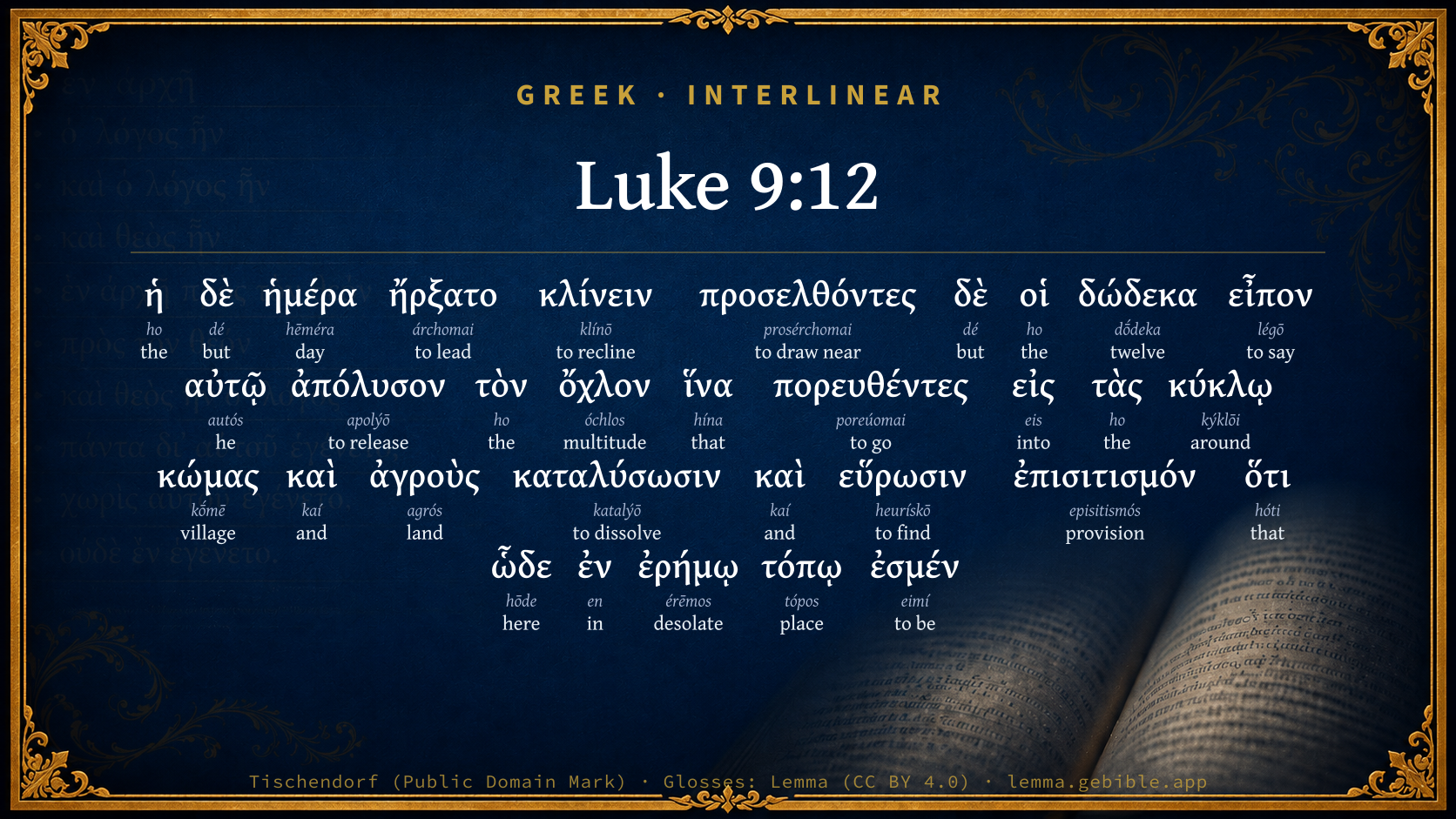
Download image
Cite this verse

Luke 9:12 (World English Bible). Public Domain. Lemma interlinear Bible study tool, https://lemma.gebible.app/v/luke/9/12.

Show BibTeX & RIS
BibTeX
RIS
English Translation
The day began to wear away; and the twelve came, and said to him, "Send the multitude away, that they may go into the surrounding villages and farms, and lodge, and get food, for we are here in a deserted place."
World English Bible · Public Domain
Highlights
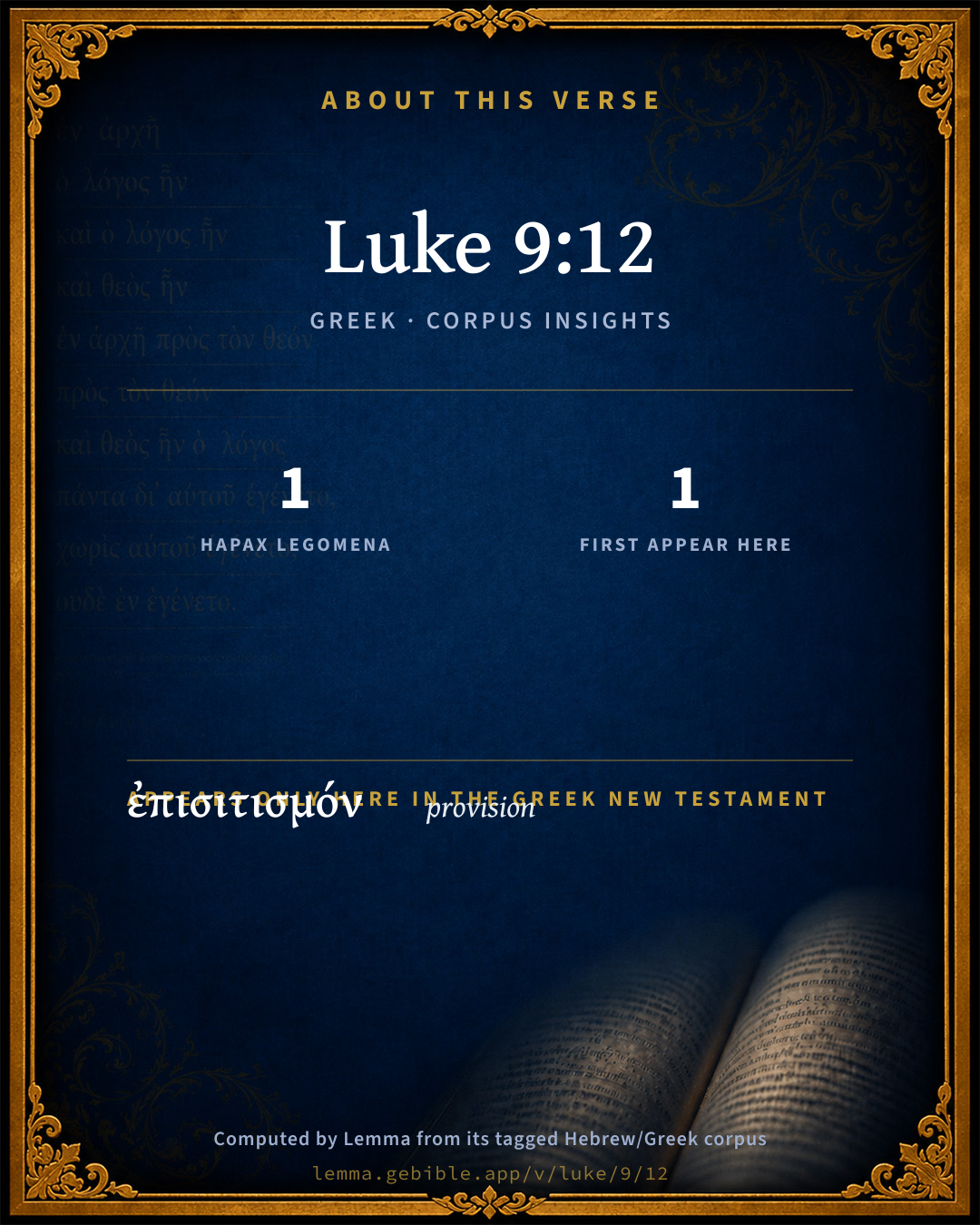
  • 1 hapax legomenon — only here in the Greek New Testament
  • 1 first appearance in the Greek New Testament
Full analysis ↓
Download a study sheet

One document with this verse’s original text, its word-by-word gloss line, the meaning frame, cross-references with their text, attributed commentary, and full source and license credits — printable, and it pastes into notes with its structure intact.

This verse Autodidact and up

Study sheet (.html) Plain text (.txt)

A passage Seminary Student

Up to 50 verses in one chapter. A passage sheet keeps up to 6 commentary sources and 12 cross-references per verse, in the order this page ranks them, and says so on the sheet whenever that leaves anything out. Ask for a single verse and you get the Autodidact verse sheet above.

Everything on this page stays free to read, with no account — the sheet is a download of what is already on screen, not access to it.

Want to remove ads? Support Godless Engineer
Compare translations 3

The same verse in 3 English versions, stacked beneath the original-language interlinear above. Click any original word for its lexicon entry.

Each is an independent rendering of the whole verse — the interlinear is not word-aligned to these translations.

Highlighted words mark where these versions differ — a whole-verse word diff, not a word-by-word alignment.

  • World English Bible Public Domain
    The day began to wear away; and the twelve came, and said to him, "Send the multitude away, that they may go into the surrounding villages and farms, and lodge, and get food, for we are here in a deserted place."
  • King James Version Public Domain
    And when the day began to wear away, then came the twelve, and said unto him, Send the multitude away, that they may go into the towns and country round about, and lodge, and get victuals: for we are here in a desert place.
  • unfoldingWord Literal Text CC BY-SA 4.0
    And the day began to end, and the Twelve, having come, said to him, “Send the crowd away so that, going into the surrounding villages and countryside, they may find lodging and food, because we are here in a desolate place.”

unfoldingWord Literal Text — © unfoldingWord, licensed CC BY-SA 4.0. Word-aligned USFM3 via Door43 (git.door43.org/unfoldingWord/en_ult).

Versions to compare (up to 4)

3 of 4 selected

Show all 19 translations

Every available English version of this verse, each an independent rendering of the whole verse.

  • World English Bible Public Domain
    The day began to wear away; and the twelve came, and said to him, "Send the multitude away, that they may go into the surrounding villages and farms, and lodge, and get food, for we are here in a deserted place."
  • Berean Standard Bible Public Domain
    As the day neared its end, the Twelve came to Jesus and said, “Dismiss the crowd so they can go to the surrounding villages and countryside for lodging and provisions. For we are in a desolate place here.”
  • Majority Standard Bible Public Domain
    As the day neared its end, the Twelve came to Jesus and said, “Dismiss the crowd so they can go to the surrounding villages and countryside for lodging and provisions. For we are in a desolate place here.”
  • King James Version Public Domain
    And when the day began to wear away, then came the twelve, and said unto him, Send the multitude away, that they may go into the towns and country round about, and lodge, and get victuals: for we are here in a desert place.
  • American Standard Version (1901) Public Domain
    And the day began to wear away; and the twelve came, and said unto him, Send the multitude away, that they may go into the villages and country round about, and lodge, and get provisions: for we are here in a desert place.
  • Revised Version (1885) Public Domain
    And the day began to wear away; and the twelve came, and said unto him, Send the multitude away, that they may go into the villages and country round about, and lodge, and get victuals: for we are here in a desert place.
  • Geneva Bible (1599) Public Domain
    And when the day began to weare away, the twelue came, and sayd vnto him, Sende the people away, that they may goe into the townes and villages round about, and lodge, and get meate: for we are here in a desart place.
  • Douay-Rheims (1899) Public Domain
    Now the day began to decline. And the twelve came and said to him: Send away the multitude, that going into the towns and villages round about, they may lodge and get victuals; for we are here in a desert place.
  • Young's Literal Translation Public Domain
    And the day began to decline, and the twelve having come near, said to him, `Let away the multitude, that having gone to the villages and the fields round about, they may lodge and may find provision, because here we are in a desert place.'
  • Literal Standard Version CC BY-SA 4.0
    And the day began to decline, and the Twelve having come near, said to Him, “Let away the multitude, that having gone into the surrounding villages and the fields, they may lodge and may find provision, because here we are in a desolate place.”
  • Unlocked Literal Bible CC BY-SA 4.0
    Now the day was about to come to an end, and the twelve came to him and said, “Send the crowd away that they may go into the surrounding villages and countryside to find lodging and food, because we are here in an isolated place.”
  • unfoldingWord Literal Text CC BY-SA 4.0
    And the day began to end, and the Twelve, having come, said to him, “Send the crowd away so that, going into the surrounding villages and countryside, they may find lodging and food, because we are here in a desolate place.”
  • Darby Bible Public Domain
    But the day began to decline, and the twelve came and said to him, Send away the crowd that they may go into the villages around, and [into] the fields, and lodge and find victuals, for here we are in a desert place.
  • World Messianic Bible Public Domain
    The day began to wear away; and the twelve came and said to him, “Send the multitude away, that they may go into the surrounding villages and farms and lodge and get food, for we are here in a deserted place.”
  • Webster's Bible Public Domain
    And when the day began to decline, then came the twelve, and said to him, Send the multitude away, that they may go into the towns and country around, and lodge, and get victuals: for we are here in a desert place.
  • Free Bible Version CC BY-SA 4.0
    Late in the day, the twelve disciples came to him and said, “You should send the crowd away now so they can go to the villages and farms nearby and find a place to stay and food to eat—there's nothing here where we are.”
  • Bible in Basic English Public Domain
    And the day went on; and the twelve came to him and said, Send these people away so that they may go into the towns and the country round about and get resting-places and food for themselves, for we are in a waste place.
  • Text-Critical English NT CC BY 4.0
    As the day began to draw to a close, the twelve came up and said to Jesus, “Send the crowd away so that they can go into the surrounding villages and countryside and find lodging and provisions, for we are in a desolate place here.”
  • Tyndale New Testament (1534) Public Domain
    And when the daye beganne to weare awaye then came the twelve and sayde vnto him: sende the people awaye that they maye goo into the tounes and villages roundabout and lodge and get meate for we are here in a place of wyldernes.

Literal Standard Version (2020), Covenant Press — licensed CC BY-SA 4.0. Text via the HelloAO Bible API (eBible.org). Unlocked Literal Bible (unfoldingWord) — licensed CC BY-SA 4.0. Text via the HelloAO Bible API (eBible.org). unfoldingWord Literal Text — © unfoldingWord, licensed CC BY-SA 4.0. Word-aligned USFM3 via Door43 (git.door43.org/unfoldingWord/en_ult). Free Bible Version, Dr. Jonathan Gallagher — licensed CC BY-SA 4.0. Text via the HelloAO Bible API (eBible.org).

Word by word

More ways to search: Search by grammar → Find every occurrence → Compare this word →

Practice this passage: Drill this verse → Learn its vocabulary →

ἐπισιτισμόν
episitismós
G1979
“provision”
Noun, Accusative, Singular, Masculine
Part of Speech
Noun
Case
Accusative
Number
Singular
Gender
Masculine
Full Thayer's Definition

Origin: from a compound of G1909 and a derivative of G4621

TDNT: None

1. foraging, providing food 2. supplies, provisions, food
  1. ἡ ho G3588 “the” Article, Nominative, Singular, Feminine
  2. δὲ dé G1161 “but” Conjunction
  3. ἡμέρα hēméra G2250 “day” Noun, Nominative, Singular, Feminine
  4. ἤρξατο árchomai G756 “to lead” Verb, Aorist, Middle deponent, Indicative, 3rd person, Singular
  5. κλίνειν klínō G2827 “to recline” Verb, Present, Active, Infinitive
  6. προσελθόντες prosérchomai G4334 “to draw near” Verb, Aorist, Active, Participle, Nominative, Plural, Masculine
  7. δὲ dé G1161 “but” Conjunction
  8. οἱ ho G3588 “the” Article, Nominative, Plural, Masculine
  9. δώδεκα dṓdeka G1427 “twelve” Adjective, Numeral (indeclinable)
  10. εἶπον légō G3004 “to say” Verb, Aorist, Active, Indicative, 3rd person, Plural
  11. αὐτῷ autós G846 “he” Personal pronoun, Dative, Singular, Masculine
  12. ἀπόλυσον apolýō G630 “to release” Verb, Aorist, Active, Imperative, 2nd person, Singular
  13. τὸν ho G3588 “the” Article, Accusative, Singular, Masculine
  14. ὄχλον óchlos G3793 “multitude” Noun, Accusative, Singular, Masculine
  15. ἵνα hína G2443 “that” Conjunction
  16. πορευθέντες poreúomai G4198 “to go” Verb, Aorist, Passive deponent, Participle, Nominative, Plural, Masculine
  17. εἰς eis G1519 “into” Preposition
  18. τὰς ho G3588 “the” Article, Accusative, Plural, Feminine
  19. κύκλῳ kýklōi G2945 “around” Noun, Dative, Singular, Masculine
  20. κώμας kṓmē G2968 “village” Noun, Accusative, Plural, Feminine
  21. καὶ kaí G2532 “and” Conjunction
  22. ἀγροὺς agrós G68 “land” Noun, Accusative, Plural, Masculine
  23. καταλύσωσιν katalýō G2647 “to dissolve” Verb, Aorist, Active, Subjunctive, 3rd person, Plural
  24. καὶ kaí G2532 “and” Conjunction
  25. εὕρωσιν heurískō G2147 “to find” Verb, Aorist, Active, Subjunctive, 3rd person, Plural
  26. ὅτι hóti G3754 “that” Conjunction
  27. ὧδε hōde G5602 “here” Adverb
  28. ἐν en G1722 “in” Preposition
  29. ἐρήμῳ érēmos G2048 “desolate” Adjective, Dative, Singular, Masculine
  30. τόπῳ tópos G5117 “place” Noun, Dative, Singular, Masculine
  31. ἐσμέν eimí G1510 “to be” Verb, Present, Active, Indicative, 1st person, Plural

About this verse

These counts appear in no published source. They are computed here, from the morphology-tagged text and Lemma’s own curated glosses. What Lemma adds →

32
words
27
distinct lemmas
Gospels
section

Notable vocabulary

1 hapax legomenon — a word that appears only here in the entire Greek New Testament:

  • ἐπισιτισμόν provision G1979

First appearance in Scripture

This word makes its first canonical appearance in the Greek New Testament here:

  • ἐπισιτισμόν provision G1979

Shared distinctive vocabulary

κλίνειν to recline G2827 occurs in 7 verses of the Greek New Testament. Also found in:
Repetition

Words recur within this verse:

Cross-references

9

Topical passages linked to Luke 9:12 in the Treasury of Scripture Knowledge — connected by theme and wording, ordered by reader-vote popularity; previews shown in the World English Bible.

  • Hosea 13:5 I knew you in the wilderness, In the land of great drought.
  • Matthew 15:23 But he answered her not a word. His disciples came and begged him, saying, "Send her away; for she cries after us."
  • Mark 6:35–44 When it was late in the day, his disciples came to him, and said, "This place is deserted, and it is late in the day.
  • John 6:1 After these things, Jesus went away to the other side of the sea of Galilee, which is also called the Sea of Tiberias.
  • John 6:5–15 Jesus therefore lifting up his eyes, and seeing that a great multitude was coming to him, said to Philip, "Where are we to buy bread, that these may eat?"
  • Psalms 78:19–20 Yes, they spoke against God. They said, "Can God prepare a table in the wilderness?
  • Ezekiel 34:25 I will make with them a covenant of peace, and will cause evil animals to cease out of the land; and they shall dwell securely in the wilderness, and sleep in the woods.
  • Matthew 14:15–21 When evening had come, his disciples came to him, saying, "This place is deserted, and the hour is already late. Send the multitudes away, that they may go into the villages, and buy themselves food."
  • Matthew 15:32 Jesus summoned his disciples and said, "I have compassion on the multitude, because they continue with me now three days and have nothing to eat. I don't want to send them away fasting, or they might faint on the way."

Cross-references courtesy of OpenBible.info (CC BY 4.0).

Commentary

Notes on Luke 9:12 from classic Christian and Jewish commentators (each source and its license shown beneath its notes). The classic Christian expositions comment on the surrounding passage and are grouped to its opening verse, so a note may address several verses; the Jewish commentaries on the Tanakh (Rashi and others) are per-verse, so they appear only where the commentator wrote on this verse.

Lemma curates 59 commentaries, every one of them public domain or Creative Commons licensed, each selected and text-cleaned for this edition rather than reprinted as found. About our sources →

Expositor's Greek Testament

ed. W. Robertson Nicoll

Luk 9:12 . κλίνειν , the day began to decline ; the fact is alluded to here, not in a participial clause, but in an independent sentence, as bringing an unwelcome close to the beneficent labours of Jesus. He went on teaching and healing, but ( δὲ ) the day, etc. καταλύσωσι : the disciples in Lk. are solicitous about the lodging as well as the feeding of the people. ἐπισιτισμόν , provisions, here only in N. T., but often in classics, e.g. , with reference to the provisioning of an army (commeatus).

The Expositor's Greek Testament, edited by W. Robertson Nicoll (1897–1910) — public domain. Text from a community e-Sword module.

Godet's Commentaries

Frédéric Louis Godet

2 d. Luk 9:12-15. The Preparations.

It was absolutely impossible to find sufficient food in this place for such a multitude; and Jesus feels Himself to some extent responsible for the circumstances. This miracle was not, therefore, as Keim maintains, a purely ostentatious prodigy. But in order to understand it thoroughly, it must be looked at from the point of view presented by John. In the Syn. it is the disciples who, as evening draws near, call the attention of Jesus to the situation of the people; He answers them by inviting them to provide for the wants of the multitude themselves. In John it is Jesus who takes the initiative, addressing Himself specially to Philip; then He confers with Andrew, who has succeeded in discovering a young lad furnished with some provisions. It is not difficult to reconcile these two accounts; but in the first we recognise the blurred lines of tradition, in the second the recollections of an eyewitness full of freshness and accuracy.

The two hundred pennyworth of bread forms a remarkable mark of agreement between the narrative of John and that of Mark. John does not depend on Mark; his narrative is distinguished by too many marks of originality. Neither has Mark copied from John; he would not have effaced the strongly-marked features of the narrative of the latter. From this coincidence in such a very insignificant detail we obtain a remarkable confirmation of all those little characteristics by which Mark’s narrative is so often distinguished, and which De Wette, Bleek, and others regard as amplifications.

Jesus has no sooner ascertained that there are five loaves and two fishes than He is satisfied. He commands them to make the multitude sit down. Just as though He had said: I have what I want; the meal is ready; let them be seated! But He takes care that this banquet shall be conducted with an order worthy of the God who gives it. Everything must be calm and solemn; it is a kind of passover meal. By the help of the apostles, He seats His guests in rows of fifty each (Matthew), or in double rows of fifty, by hundreds (Mark). This orderly arrangement allowed of the guests being easily counted. Mark describes in a dramatic manner the striking spectacle presented by these regularly-formed companies, each consisting of two equal ranks, and all arranged upon the slope of the hill (συμπόσια συμπόσια, πρασιαὶ πρασιαί, Luk 9:39-40). The pastures at that time were in all their spring splendour, and John and Mark offer a fresh coincidence here, in that they both bring forward the beauty of this natural carpet (χόρτος πολύς, John; χλωρὸς χόρτος, Mark; Matthew says, οἱ χόρτοι). In conformity with oriental usage, according to which women and children must keep themselves apart, the men alone (οἱ ἄνδρες, Joh 6:10) appear to be seated in the order indicated. This explains why, according to the Syn., they alone were counted, as Luke says (Luk 9:14), also Mark (Mar 6:44), and, more emphatically still, Matthew (Mat 14:21, “without women and children”).

Frédéric Louis Godet — Commentaries on Luke, John, Romans, and 1 Corinthians — English translation (T&T Clark, Edinburgh, 1870s–1890s) — public domain. Text from a community e-Sword module.

Adam Clarke's Commentary

Verse 12. Send the multitude away] See this miracle explained at large, on the parallel places, Mt 14:15-21; Mr 6:36-44.

Adam Clarke's Commentary on the Bible (1810–1826) — public domain. Text from a community e-Sword/MySword module.

Ellicott's Commentary for English Readers

(12) And when the day began . . .—Literally, and the day began to wear away, and the Twelve came . . .

Into the towns and country.—Better, as before (Luk_9:6, Luk_8:34), the villages and farms.

A Bible Commentary for English Readers, edited by Charles John Ellicott (1878–1897) — public domain. Text from a community e-Sword module.

The Cambridge Bible for Schools and Colleges

gen. ed. J. J. S. Perowne

12. to wear away] Rather, to decline.

then came the twelve] They were afraid that when once the brief twilight was over, the famished multitude might lose their way or come to harm, and some calamity happen which would give a fresh handle against Jesus. John alone tells us that He had compassionately suggested the difficulty to Philip, watching with gentle irony the trial of his faith; and that Philip despairingly said that it would cost more than 200 denarii (as we might say $10) to procure them even a minimum of food. Philip was “of Bethsaida,” but this had nothing to do with our Lord’s speaking to him, for he belonged to the western Bethsaida.

The Cambridge Bible for Schools and Colleges (gen. ed. J. J. S. Perowne; Cambridge University Press, 1878–1918) — public domain. Text from a community e-Sword module.

John Gill's Exposition

When the day began to wear away,.... Or "to decline", as the Vulgate Latin and Arabic versions; or "to incline", as the Syriac; that is, as the Ethiopic version renders it, "when the sun was declining" towards the "horizon" and was almost set; or "when the evening time was come", as the Persic version:

then came the twelve; that is, "the disciples", as the Persic version; or "his disciples", as the Syriac: and

said unto him, send the multitude away, that they may go into the towns and country round about; the place where they were, round about the city of Bethsaida, the several adjacent houses in the fields, villages, towns, and cities:

and lodge, and get victuals; where they might have lodging for that night, it being too far for them to reach their habitations that evening; and also that they might provide themselves with proper and sufficient food, which was not to be had in the place where they were:

for we are here in a desert place; which afforded no conveniency for lodging, nor any supply of food.

John Gill's Exposition of the Whole Bible (1746–1763) — public domain (CC PDM 1.0). Text via the HelloAO Bible API.

Trapp's Complete Commentary

John Trapp

12 And when the day began to wear away, then came the twelve, and said unto him, Send the multitude away, that they may go into the towns and country round about, and lodge, and get victuals: for we are here in a desert place.

Ver. 12. See Mat 14:15; Mar 6:35; Joh 6:5.

John Trapp, A Commentary or Exposition upon All the Books of the Old and New Testament (1647–1656) — public domain. Text from a community e-Sword module.

Matthew Poole's English Annotations

The history of this miracle is recorded by all the four evangelists. See Poole on "Mat 14:15", and following verses to Mat 14:22, and See Poole on "Mar 6:35", and following verses to Mar 6:44. We shall again meet with it, Joh 6:5-14, with some further circumstances. Luke hath nothing but what we have before met with.

Matthew Poole's English Annotations on the Holy Bible (1683–1685) — public domain. Text from a community e-Sword/MySword module.

The Pulpit Commentary

And when the day began to wear away, then came the twelve, and said unto him, Send the multitude away, that they may go into the towns and country round about, and lodge, and get victuals: for we are here in a desert place. Simple consideration for the crowds, among whom we know were women and children, probably dictated this remark of the twelve, though it has been with some ingenuity suggested that the advice of the disciples was owing to their fear that, as darkness would soon creep over the scene, some calamity might happen which would give a fresh handle against Jesus to his many enemies.

Vers. 12-17. The Divine provision for the world"s need.

This miracle of our Lord, meeting as it did the present bodily necessities of the multitude about him, stands for ever as a picture and parable of the far more wonderful and the gloriously bountiful provision which the Saviour of mankind has made for the deeper necessities of our race.

I OUR HOLY SOLICITUDE FOR THE SPIRITUALLY DESTITUTE. There is a note of true sympathy in the language of the disciples. (ver. 12; see Mar_6:35, 36) They were concerned to think of that great number of people, among whom were "women and children", (Mat_14:21) having gone so long without food, and being "in a desert place" where none could be obtained. How strong and keen should be our sympathy with those who are spiritually destitute; who have received from God a nature with immeasurable capacities, with profound cravings for that which is eternally true and divinely good, and who "have nothing to eat"! No solicitude for hungering human hearts can be extravagant; it is only too common to be guiltily and pitifully unconcerned. And if the stage of spiritual hunger and thirst should have passed into that of spiritual unconsciousness, that is one degree (and a large degree too) more deplorable, for it is one stage nearer to spiritual death. We do well to pity the multitudes at home and abroad who might be and who should be living on Divine and everlasting truth, but who are pining and perishing on miserable husks, on errors, on superstitions, on morbid fancies, on low ambitions, on unsatisfying and perhaps demoralizing pleasures.

II THE APPARENT INADEQUACY OF THE DIVINE PROVISION. Well may the disciples, not yet enlightened as to their Master"s purpose, regard "five loaves and two fishes" as hopelessly inadequate to the occasion. So to human judgment they seemed. Not less strikingly disproportioned must the Divine provision for man"s higher necessities have seemed to those who first regarded it. What was it? It was, in the language of our Lord recorded a few verses on in this chapter (ver. 22), "the Son of man suffering many things, being rejected.., and slain, and being raised the third day." A crucified and restored Messiah was to be offered as the Bread of life to a hungering world! Would this satisfy the needs of all mankind of Jew and Gentile, of barbarian and cultured, of bond and free, of man and woman? Could One that seemed to fail, whose cause was all but extinguished in obloquy and desertion, be the Redeemer of mankind? It was unlikely in the last degree; speaking after the manner of men, it was impossible! And the machinery, too, the instrumentality by which this strange provision was to be conveyed to all human souls everywhere and through all generations, was that not equally inadequate? A few "unlearned and ignorant men," a few earnest and true but obscure and uninfluential women, could they establish and perpetuate this new system? could they pass on these scanty provisions to the waiting and perishing multitude? How hopeless! how impossible! Yet see

III ITS PROVED SUFFICIENCY. As those five loaves and two fishes, under the multiplying hand of Christ, proved to be far more than enough for the thousands who partook of them, so is the provision in the gospel of Christ for the needs of man found to be all-sufficient. In a once-crucified and now exalted Saviour we have One in whom is found:

1. Pardon for every sin and for every repentant sinner.

2. Admission, instant and full, to the presence and favour of God.

3. A source of purity of heart, and excellency, and even nobility, of life.

4. Comfort in all the sorrows and privations of our earthly course.

5. Peace and hope in death.

6. A glorious immortality.

Well does this great Benefactor say, "I am come that ye might have life, and, have it more abundantly. " The provision is more than equal to the necessity; there is a marvellous overflow of truth and grace. C.

The Pulpit Commentary (1880–1919), ed. H.D.M. Spence-Jones & Joseph S. Exell — public domain. Text from a community e-Sword module.

John Wesley's Explanatory Notes

Matt. xiv, 15; Mark vi, 35; John vi, 3.

John Wesley, Explanatory Notes Upon the Whole Bible (1754–1765) — public domain. Text via the GEBible commentary corpus.

MacLaren's Expositions of Holy Scripture

Alexander MacLaren

Luke

BREAD FROM HEAVEN

Luk 9:10 - Luk 9:17.

The Apostles needed rest after their trial trip as evangelists. John the Baptist’s death had just been told to Christ. The Passover was at hand, and many pilgrims were on the march. Prudence and care for His followers as well as Himself suggested a brief retirement, and our Lord sought it at the Eastern Bethsaida, a couple of miles up the Jordan from its point of entrance to the lake. Matthew and Mark tell us that He went by boat, which Luke does not seem to have known. Mark adds that the curious crowd, which followed on foot, reached the place of landing before Him, and so effectually destroyed all hope of retirement. It was a short walk round the north-western part of the head of the lake, and the boat would be in sight all the way, so that there was no escape for its passengers.

Luke records the self-oblivious cordiality of Christ’s reception of the intrusive crowd. Without a sigh or sign of impatience, He ‘welcomed them’-a difficult thing to do, and one which few of us could have achieved. The motives of most of them can have been nothing higher than what leads vulgar people of all ranks and countries to buzz about distinguished men, utterly regardless of delicacy or considerateness. They want to see the notoriety, no matter what it costs him. But Jesus received them patiently, because, as Mark touchingly tells, He was ‘moved with pity,’ and saw in their rude crowding round Him the token of their lack of guides and teachers. They seemed to Him, not merely a mob of intrusive sight-seers, but like a huddled mass of unshepherded sheep.

Christ’s heart felt more lovingly than ours because His eye saw deeper, and His eye saw deeper because His heart felt more lovingly. If we would live nearer Him, we should see, as He did, enough in every man to draw our pity and help, even though he may jostle and interfere with us.

The short journey to Bethsaida would be in the early morning, and a long day of toil followed instead of the hoped-for quiet. Note that singular expression, ‘Them that had need of healing He healed.’ Why not simply ‘them that were sick’? Probably to bring out the thought that misery made unfailing appeal to Him, and that for Him to see need was to supply it. His swift compassion, His all-sufficient power to heal, and the conditions of receiving His healing, are all wrapped up in the words. Coming to the miracle itself, we may throw the narrative into three parts-the preliminaries, the miracle, and the abundant overplus.

I. Our Lord leads up to the miracle by forcing home on the minds of the disciples the extent of the need and the utter inadequacy of their resources to meet it, and by calling on them and the crowd for an act of obedience which must have seemed to many of them ludicrous.

John shows us that He had begun to prepare them, at the moment of meeting the multitude, by His question to Philip. That had been simmering in the disciples’ minds all day, while they leisurely watched Him toiling in word and work, and now they come with their solution of the difficulty. Their suggestion was a very sensible one in the circumstances, and they are not to be blamed for not anticipating a miracle as the way out. However many miracles they saw, they never seem to have expected another. That has been thought to be unnatural, but surely it is true to nature. They moved in a confusing mixture of the miraculous and the natural which baffled calculation as to which element would rule at any given moment. Their faith was feeble, and Christ rebuked them for their slowness to learn the lesson of this very miracle and its twin feeding of the four thousand. They were our true brothers in their failure to grasp the full meaning of the past, and to trust His power.

The strange suggestion that the disciples should feed the crowd must have appeared to them absurd, but it was meant to bring out the clear recognition of the smallness of their supply. Therein lie great lessons. Commands are given and apparent duties laid on us, in order that we may find out how impotent we are to do them. It can never be our duty to do what we cannot do, but it is often our duty to attempt tasks to which we are conspicuously inadequate, in the confidence that He who gives them has laid them on us to drive us to Himself, and there to find sufficiency. The best preparation of His servants for their work in the world is the discovery that their own stores are small. Those who have learned that it is their task to feed the multitude, and who have said ‘We have no more than such and such scanty resources,’ are prepared to be the distributors of His all-sufficient supply.

What a strange scene that must have been as the hundred groups of fifty each arranged themselves on the green grass, in the setting sunlight, waiting for a meal of which there were no signs! It took a good deal of faith to seat the crowd, and some faith for the crowd to sit. How expectant they would be! How they would wonder what was to be done next! How some of them would laugh, and some sneer, and all watch the event! We, too, have to put ourselves in the attitude to receive gifts of which sense sees no sign; and if, in obedience to Christ’s word, we sit down expecting Him to find the food, we shall not be disappointed, though the table be spread in the wilderness, and neither storehouse nor kitchen be in sight.

II. The miracle itself has some singular features.

Like that of the draught of fishes, it was not called forth by the cry of suffering, nor was the need which it met one beyond the reach of ordinary means. It was certainly one of the miracles most plainly meant to strike the popular mind, and the enthusiasm excited by it, according to John’s account, was foreseen by Christ. Why did He evoke enthusiasm which He did not mean to gratify? For the very purpose of bringing the carnal expectations of the crowd to a head, that they might be the more conclusively disappointed. The miracle and its sequel sifted and sent away many ‘disciples,’ and were meant to do so.

All the accounts tell of Christ’s ‘blessing.’ Matthew and Mark do not say what He blessed, and perhaps the best supplement is ‘God,’ but Luke says that He blessed the food. What He blesses is blessed; for His words are deeds, and communicate the blessing which they speak. The point at which the miraculous multiplication of the food came in is left undetermined, but perhaps the difference in the tenses of the verbs hints at it. ‘Blessed’ and ‘brake’ are in the tense which describes a single act; ‘gave’ is in that which describes a continuous repeated action. The pieces grew under His touch, and the disciples always found His hands full when they came back with their own empty. But wherever the miraculous element appeared, creative power was exercised by Jesus; and none the less was it creative, because there was the ‘substratum’ of the loaves and fishes. Too much stress has been laid on their being used, and some commentators have spoken as if without them the miracle could not have been wrought. But surely the distinction between pure creation and multiplication of a thing already existing vanishes when a loaf is ‘multiplied’ so as to feed a thousand men.

The symbolical aspect of the miracle is set forth in the great discourse which follows it in John’s Gospel. Jesus is the ‘Bread of God which came down from heaven.’ That Bread is broken for us. Not in His Incarnation alone, but in His Death, is He the food of the world; and we have not only to ‘eat His flesh,’ but to ‘drink His blood,’ if we would live. Nor can we lose sight of the symbol of His servants’ task. They are the distributors of the heaven-sent bread. If they will but take their poor stores to Jesus, with the acknowledgment of their insufficiency, He will turn them into inexhaustible supplies, and they will find that ‘there is that scattereth, and yet increaseth.’ What Christ blesses is always enough.

III. The abundance left over is significant.

Twelve baskets, such as poor travellers carried their belongings in, were filled; that is to say, each Apostle who had helped to feed the hungry had a basketful to bring off for future wants. The ‘broken pieces’ were not crumbs that littered the grass, but the portions that came from Christ’s hands.

His provision is more than enough for a hungry world, and they who share it out among their fellows have their own possession of it increased. There is no surer way to receive the full sweetness and blessing of the Gospel than to carry it to some hungry soul. These full baskets teach us, too, that In Christ’s gift of Himself as the Bread of Life there is ever more than at any given moment we can appropriate. The Christian’s spiritual experiences have ever an element of infinity in them; and we feel that if we were able to take in more, there would be more for us to take. Other food cloys and does not satisfy, and leaves us starving. Christ satisfies and does not cloy, and we have always remaining, yet to be enjoyed, the boundless stores which neither eternity will age nor a universe feeding on them consume. The Christian’s capacity of partaking of Christ grows with what it feeds on, and he alone is safe in believing that ‘To-morrow shall be as this day, and much more abundant.’

Alexander MacLaren, Expositions of Holy Scripture (1904–1910) — public domain. Text from a community e-Sword module.

Kretzmann's Popular Commentary

Paul E. Kretzmann

The miracle of the loaves and the fish:

v. 12. And when the day began to wear away, then came the Twelve and said unto Him, Send the multitude away that they may go into the towns and country round about, and lodge, and get victuals; for we are here in a desert place.

v. 13. But He said unto them, Give ye them to eat. And they said, We have no more but five loaves and two fishes; except we should go and buy meat for all this people.

v. 14. For they were about five thousand men. And He said to His disciples, Make them sit down by fifties in a company.

v. 15. And they did so, and made them all sit down.

v. 16. Then He took the five loaves and the two fishes, and looking up to heaven, He blessed them, and brake, and gave to the disciples to set before the multitude.

v. 17. And they did eat, and were all filled; and there was taken up of fragments that remained to them twelve baskets.

Jesus had been busy preaching and healing without ceasing all day long. But now the day began to decline, to draw near its close, bringing an unwelcome interruption in the Lord’s beneficent labors. The apostles felt it their duty to interfere at this point. They urged Jesus to dismiss the people, to send them away. The place where they were was an uninhabited region; but there were towns, Bethsaida Julias itself and other small hamlets, within walking distance round about; there the people might go and find places to lodge and also provisions for themselves. The disciples were not yet filled with the love for others which recognizes no sacrifice and sternly represses all selfishness. Their words rather express a certain peevishness as though they had been bothered long enough by these unwelcome guests. But Jesus gives them a lesson, both as to hospitality and trust in Him. He suggested immediately that the disciples be hosts to the multitudes. But their faces fell at the mere suggestion. They had, by some exploration, ascertained that there were five loaves and two fishes as provisions; that was the entire stock. And they add: Unless perhaps we are to go and buy food for the whole people. Neither their words nor their tone implied that they relished the idea very strongly or were very fond of the prospect. One of them had even figured out that the amount of money on hand would not be sufficient to buy bread for all those present, since there were some five thousand men present, without the women and children. And all this fuss and excitement with Jesus standing before them, of whom they knew and had the evidence of their senses that He was able to help at all times, even when death had laid his cold hands on a person and driven away the living soul. The disciples certainly do not appear to good advantage in this story. Note: This same lack of faith is found all too often in the Christians of these latter days. Worry and care for the body is all too apt to take the place of firm, and undoubting trust in the providence and goodness of Christ and our heavenly Father. "That is the great fault that we, also in our days, not only on account of food, but also in manifold troubles and temptations feel that we know well how to figure out what we need, and how these needs should be met and help given to us. But if it is not there quickly as we like it, then nothing remains of our figuring but discontent and sadness. And it would be far better if we would leave God to deal with the situation and would not think of what we need. " But Jesus now took the matter in hand. He had His disciples command the people to recline on the grass which grew at that place, in dining parties, or companies, of fifty each. He was preparing to spread a banquet before them. Then He took the five loaves and the two fishes, and, looking up to heaven, He spoke a blessing upon them, He blessed the food. Then He broke both bread and fishes into smaller pieces and gave these to His disciples, who acted as His waiters upon this momentous occasion. And all ate, and all were filled, they were fully satisfied, they had all they wanted to eat. And then, at Christ’s command, that which was left over to them that ate, the fragments, were picked up, and these filled twelve large baskets. Christ here appears again as the almighty Lord and Creator of heaven and earth, upon whom the eyes of all creatures wait, that He may give them their food in due season. There is a world of comfort for Christians in the fact that Jesus, to whom we owe the salvation and life of our soul, also has the food for every day in His hand and will give us our daily bread every day. We are taken care of in body and soul.

Paul E. Kretzmann, Popular Commentary of the Bible (1921–1924) — public domain. Text from a community e-Sword module.

Burkitt's Expository Notes on the New Testament

William Burkitt

This miracle of our Saviour’s feeding five thousand with five loaves and two fishes, is recorded by all the evangelists, and in the history of it we have these observable particulars:

1. The seasonable expression of the disciples’ pity towards the multitude, who had long fasted, and wanted now the ordinary comforts and supports of life; it well becomes the ministers of Christ to have respect to the bodily wants as well as to the spiritual necessities of their people.

Observe, 2. The motion which the disciples make to Christ on behalf of the multitude: Send them away, that they may go into the towns and country, and get victuals. Here was a strong charity, but a weak faith; a strong charity in desiring the people’s relief, but a weak faith in supposing that they could no other way be relieved, but by sending them away; forgetting that Christ, who had healed the multitude miraculously, could also feed them miraculously whenever he pleased; all things being equally easy to an almighty power.

Observe, 3. Our Saviour’s strange reply to the disciples’ request: They need not depart, give ye them to eat. Need not depart, why? The people must either feed or famish; victuals they must have, and a dry desert will afford none; yet says Christ to his disciples, Give ye them to eat. Alas poor disciples! They had nothing for themselves to eat, how then should they give the multitude to eat?

When Christ requires of us what we of ourselves are unable to perform, it is to discover to us our own impotency and weakness, to provoke us to look up to him, and to depend by faith on his almighty power.

Observe, 4. What a poor and slender provision the Lord of the whole earth has for himself and his family: five barley loaves, and two fishes: teaching us, that these bodies of ours must be fed, but not pampered. Our belly must not be our master, much less our god. The end of food is to sustain nature; we must not stifle her with a gluttonous variety. And as the quality of the victuals was plain, so the quantity of it was small; five loaves, and two fishes: well might the disciples say, What are they among so many? The eye of sense and reason sees an utter impossibility of those effects which faith can easily apprehend, and a divine power more easily reproduce.

Observe, 5. How Christ, the great master of the feast does marshal his guests: He commands them all to sit down by fifties in a company. None of them reply, "Sit down! But to what? Here are the mouths, but where’s the meat? We may soon be set, but what shall we be served?" Not a word like this, but they obey and expect.

Lord! How easy it is to trust thy providence, and rely upon thy power, when there is corn in the barn, bread in the cupboard, money in the purse; but when our stores are empty, when we have nothing in hand, then to depend upon an invisible bounty, is a noble act of faith indeed.

Observe, 6. The actions performed by our blessed Saviour: He blessed, and brake, and gave the loaves to the disciples, and they to the multitude.

1. He blessed them teaching us by his example never to use or receive the good creatures of God, without prayer and praise; never to sit down to our food as a beast to his fodder.

2. Christ brake the loaves: he could have multiplied them whole. Why then would he rather do it in the breaking? Perhaps to teach us that we may rather expect his blessing in the distribution of his bounty than in the reservation of it. Scattering is the way to increasing, liberality is the way to riches.

3. Christ gave the loaves thus broken to the disciples, that they might distribute to the multitude. But why did Christ distribute by the disciples’ hands? Doubtless to gain respect to his disciples from the people: and the same course does our Lord take in a spiritual distribution. He that could feed the world by his own immediate hand, chooses rather by the hand of his ministers to divide the bread of life amongst his people.

Observe, 7. The certainty and greatness of this miracle: They did all eat, and were filled, they did all eat, not a crumb or a bit, but a satiety and fullness; all that were hungry did eat, and all that did eat were satisifed; and yet twelve baskets of fragments remain: more is left than was at first set on.

It is hard to say which was the greatest miracle; the miraculous eating or the miraculous leaving. If we consider what they left, we may wonder that they ate anything; if what they ate, that they left anything.

Observe lastly, these fragments, though of barley loaves and fish-bones, must not be lost, but at our Saviour’s command gathered up: the great Housekeeper of the world will not allow the loss of his leftovers.

Lord! How tremendous will their accounts be, who having large and plentiful estates, do consume them upon their lust! How will they wish they had been born to poverty and want, when they appear to make up their account before God!

William Burkitt's Expository Notes on the New Testament (1700–1703) — public domain. Text from a community e-Sword module.

unfoldingWord translationNotes

Door43 World Missions Community

the day was about to come to an end

"the day was about to end" or it was near the end of the day"

five loaves of bread

A loaf of bread is a lump of dough that is shaped and baked.

two fish—unless we go and buy food for all these people

If "unless" is difficult to understand in your language, you could make a new sentence. "two fish. In order to feed all these people, we would have to go and buy food"

about five thousand men

"about 5,000 men." This number does not include the women and children who might have been present. (See: Numbers)

Have them sit down

"Tell them to sit down"

fifty each

"50 each" (See: Numbers)

translationWords

the twelve

desert

bread

disciple

unfoldingWord translationNotes — © Distant Shores Media and the Door43 World Missions Community, licensed CC BY-SA 4.0. Source: git.door43.org/Door43/en_tn.

Cambridge Greek Testament for Schools and Colleges

12. κλίνειν. ‘To decline.’

οἱ δώδεκα. They were afraid that when once the brief twilight was over, the famished multitude might lose their way or come to harm, and some calamity happen which would give a fresh handle against Jesus. John alone tells us that He had compassionately suggested the difficulty to Philip, watching with gentle irony the trial of his faith; and that Philip despairingly said that it would cost more than 200 denarii (as we might say £20, i.e. the day’s wages of 200 people; see on Luk 7:41) to procure them even a minimum of food. Philip was “of Bethsaida,” but this had nothing to do with our Lord’s speaking to him, for he belonged to the western Bethsaida.

ἐπισιτισμόν. ‘A store of provision,’ as in Xen. Anab. VII. 1, § 9. It is a classic word, but an ἅπαξ λεγόμενον in the N.T.

Cambridge Greek Testament for Schools and Colleges (Cambridge University Press, 1896; 21 vols, various authors incl. Carr, Maclear, Plummer, Farrar, Lumby, Moule, M. R. James, Simcox) — public domain. Text from a community e-Sword module.

Alford’s Greek Testament

Henry Alford

12.] As the three agree in their account, and John differs from them, see the difference discussed in notes there. In his account, the enquiry proceeds from our Lord Himself, and is addressed to Philip, and answered by Philip and Andrew.

Henry Alford, The Greek Testament (1849–1861) — public domain. Text from a community e-Sword module.

International Critical Commentary

12. ἡ δὲ ἡμέρα ἤρξατο κλίειν. Comp. Jer 6:4 ; Jdg 19:11, Jdg 19:9:3; 1Sa 4:2. In N.T. Lk. alone uses κλίνειν intransitively (24:29). Comp. ἐκκλίνετε ἀπʼ αὐτῶν (Rom 16:17). In Att. Grk. κλίνειν is generally trans., ἀποκλίνειν intrans. Win. 38:1, p. 315.

προσελθόντες δὲ οἱ δώδεκα. In the three it is the Twelve who take the initiative; in Jn. it is the Lord who does so.

εἰς τὰς κύκλῳ κώμας καὶ ἀγρούς. Being similar in meaning, the nouns have only one article, although they differ in gender: comp. 1:6 and 14:23, and contrast 10:21 and 14:26. See on 1:6.

ἐπισιτισμόν. Here only in N. T., but quite class. It is specially used of provisions for a journey: Gen 42:25, 45:21; Jos 9:5, Jos 9:11; Judith 2:18, 4:5; Xen. Anab. i. 5, 9, vii. 1, 9.

International Critical Commentary — older volumes (1896–1929), various authors — public domain. Text from a community e-Sword module.

Vincent's Word Studies in the New Testament

Marvin R. Vincent

And when the day began to wear away. Omit when. Render, and the day began, etc. To wear away [κλινειν] . Lit., to decline. Wyc., very literally, to bow down.

Lodge [καταλυσωσιν] . Peculiar to Luke. Primarily the verb means to break up or dissolve. Hence often in New Testament to destroy (Mt 5:17; Mr 13:2). Intransitively, to take up one's quarters; lodge; either because the harness of the traveler's horses is loosed, or because the fastenings of their garments are untied. The kindred word kataluma, a guest - chamber, occurs, Mr 14:14; or inn, Luk 2:7.

Victuals [επισιτισμον] . Only here in New Testament. Properly a stock of provisions. Thus Xenophon. "Cyrus hastened the whole journey, except when he halted in order to furnish himself with supplies" [επισιτισμου ενεκα] .

Desert [ερημω] . See on Mt 14:15.

Marvin R. Vincent, Word Studies in the New Testament (1887–1900) — public domain. Text from a community e-Sword/MySword module.

Lesson kit

Teaching starters — assembled from the data on this page, not authored interpretation. Every prompt links to the verse data it draws on. Edit before teaching.

Luke, in the Gospels, opens this verse with 32 words (27 distinct Greek lemmas). Its most distinctive word is episitismós (“provision”). A historical commentator’s framing appears above. Read the whole chapter for the surrounding context.

Discussion questions

  1. What does “provision” (episitismós) contribute to the verse as a whole?
  2. 1 word here appears nowhere else in the Greek New Testament. Why might the author reach for such rare wording?
  3. This is the first place “provision” appears in Scripture (first appears here). What does its debut here establish?
  4. How does Matthew 8:20, which shares the word «to recline», read alongside this verse?
  5. What does the repetition of “the” (4× in this one verse) do in this verse?
  6. These translations render this verse differently; the difference is in the English rendering, not the original. What questions does that raise?
  7. Compare how Expositor's Greek Testament and Godet's Commentaries read this verse. Where do they agree or differ?

Things to notice

  • 1 word in this verse appears nowhere else in the Greek New Testament.
  • 1 word makes its first canonical appearance in Scripture here.
  • These translations choose different wording for 28 words in this verse.
  • “the” occurs 4× in this single verse.
  • 27 distinct Greek lemmas span 32 words in this verse.

Reading settings

Reading text

Shown beneath each verse's original-language words.

Old Testament
Old Testament edition

Read the OT as the Masoretic Hebrew (MT) or the Greek Septuagint (LXX).

English shown for the Greek Septuagint (in the Hebrew ↔ Greek comparison).

Comparing translations? Open the Compare panel on any verse page to stack up to four side by side.