
Matthew 12:45

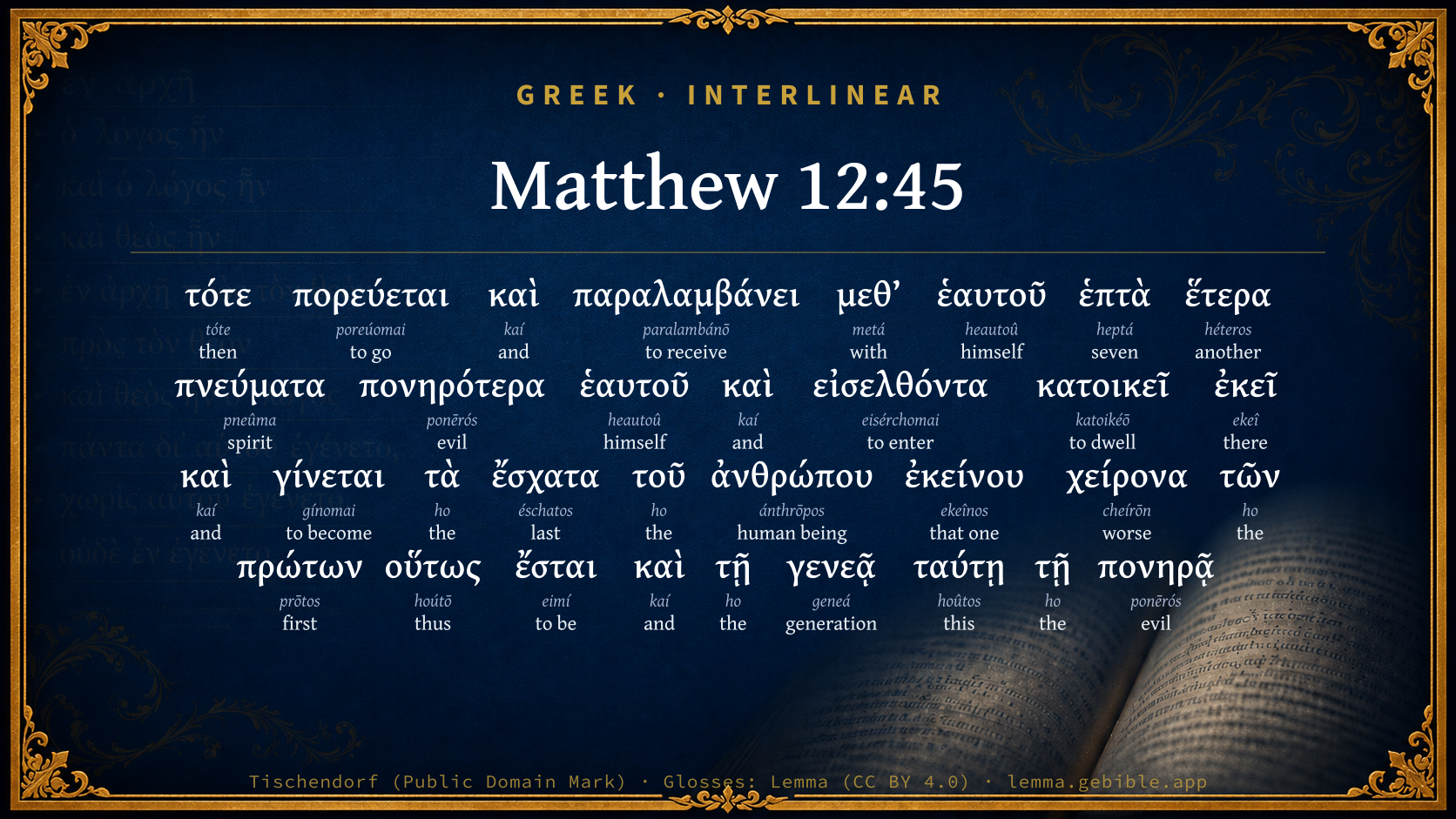
Greek (Tischendorf 8th ed.) Matthew 12:45 appears in the Greek New Testament. The text above is from the Tischendorf 8th edition. Each word links to its Strong’s number and a concise gloss. Click any word for its full Thayer’s Greek Lexicon entry.
Download image
Cite this verse

Matthew 12:45 (World English Bible). Public Domain. Lemma interlinear Bible study tool, https://lemma.gebible.app/v/matthew/12/45.

Show BibTeX & RIS
BibTeX
RIS
English Translation
Then he goes, and takes with himself seven other spirits more evil than he is, and they enter in and dwell there. The last state of that man becomes worse than the first. Even so will it be also to this evil generation."
World English Bible · Public Domain
Highlights
  • 1 first appearance in the Greek New Testament
Full analysis ↓
Download a study sheet

One document with this verse’s original text, its word-by-word gloss line, the meaning frame, cross-references with their text, attributed commentary, and full source and license credits — printable, and it pastes into notes with its structure intact.

This verse Autodidact and up

Study sheet (.html) Plain text (.txt)

A passage Seminary Student

Up to 50 verses in one chapter. A passage sheet keeps up to 6 commentary sources and 12 cross-references per verse, in the order this page ranks them, and says so on the sheet whenever that leaves anything out. Ask for a single verse and you get the Autodidact verse sheet above.

Everything on this page stays free to read, with no account — the sheet is a download of what is already on screen, not access to it.

Want to remove ads? Support Godless Engineer
Compare translations 3

The same verse in 3 English versions, stacked beneath the original-language interlinear above. Click any original word for its lexicon entry.

Each is an independent rendering of the whole verse — the interlinear is not word-aligned to these translations.

Highlighted words mark where these versions differ — a whole-verse word diff, not a word-by-word alignment.

  • World English Bible Public Domain
    Then he goes, and takes with himself seven other spirits more evil than he is, and they enter in and dwell there. The last state of that man becomes worse than the first. Even so will it be also to this evil generation."
  • King James Version Public Domain
    Then goeth he, and taketh with himself seven other spirits more wicked than himself, and they enter in and dwell there: and the last state of that man is worse than the first. Even so shall it be also unto this wicked generation.
  • unfoldingWord Literal Text CC BY-SA 4.0
    Then it goes and takes along with itself seven other spirits more evil than itself and they having entered, it resides there. And the last things of that man become worse than the first things. Thus it will be also with this evil generation.”

unfoldingWord Literal Text — © unfoldingWord, licensed CC BY-SA 4.0. Word-aligned USFM3 via Door43 (git.door43.org/unfoldingWord/en_ult).

Versions to compare (up to 4)

3 of 4 selected

Show all 19 translations

Every available English version of this verse, each an independent rendering of the whole verse.

  • World English Bible Public Domain
    Then he goes, and takes with himself seven other spirits more evil than he is, and they enter in and dwell there. The last state of that man becomes worse than the first. Even so will it be also to this evil generation."
  • Berean Standard Bible Public Domain
    Then it goes and brings with it seven other spirits more wicked than itself, and they go in and dwell there; and the final plight of that man is worse than the first. So will it be with this wicked generation.”
  • Majority Standard Bible Public Domain
    Then it goes and brings with it seven other spirits more wicked than itself, and they go in and dwell there. And the final plight of that man is worse than the first. So will it be with this wicked generation.”
  • King James Version Public Domain
    Then goeth he, and taketh with himself seven other spirits more wicked than himself, and they enter in and dwell there: and the last state of that man is worse than the first. Even so shall it be also unto this wicked generation.
  • American Standard Version (1901) Public Domain
    Then goeth he, and taketh with himself seven other spirits more evil than himself, and they enter in and dwell there: and the last state of that man becometh worse than the first. Even so shall it be also unto this evil generation.
  • Revised Version (1885) Public Domain
    Then goeth he, and taketh with himself seven other spirits more evil than himself, and they enter in and dwell there: and the last state of that man becometh worse than the first. Even so shall it be also unto this evil generation.
  • Geneva Bible (1599) Public Domain
    Then he goeth, and taketh vnto him seuen other spirites worse then himselfe, and they enter in, and dwell there: and the ende of that man is worse then the beginning. Euen so shall it be with this wicked generation.
  • Douay-Rheims (1899) Public Domain
    Then he goeth, and taketh with him seven other spirits more wicked than himself, and they enter in and dwell there: and the last state of that man in made worse than the first. So shall it be also to this wicked generation.
  • Young's Literal Translation Public Domain
    then doth it go, and take with itself seven other spirits more evil than itself, and having gone in they dwell there, and the last of that man doth become worse than the first; so shall it be also to this evil generation.'
  • Literal Standard Version CC BY-SA 4.0
    then it goes, and takes with itself seven other spirits more evil than itself, and having gone in they dwell there, and the last of that man becomes worse than the first; so will it also be to this evil generation.”
  • Unlocked Literal Bible CC BY-SA 4.0
    Then it goes and takes along with it seven other spirits more evil than itself, and they all come in to live there. Then the final condition of that man becomes worse than the first. It will be just like that with this evil generation.”
  • unfoldingWord Literal Text CC BY-SA 4.0
    Then it goes and takes along with itself seven other spirits more evil than itself and they having entered, it resides there. And the last things of that man become worse than the first things. Thus it will be also with this evil generation.”
  • Darby Bible Public Domain
    Then he goes and takes with himself seven other spirits worse than himself, and entering in, they dwell there; and the last condition of that man becomes worse than the first. Thus shall it be to this wicked generation also.
  • World Messianic Bible Public Domain
    Then he goes and takes with himself seven other spirits more evil than he is, and they enter in and dwell there. The last state of that man becomes worse than the first. Even so will it be also to this evil generation.”
  • Webster's Bible Public Domain
    Then goeth he, and taketh with himself seven other spirits more wicked than himself, and they enter in and dwell there: and the last state of that man is worse than the first. Even so shall it be also to this wicked generation.
  • Free Bible Version CC BY-SA 4.0
    Then it goes and brings back seven other spirits even more evil than it is, and it enters and lives there. So the person ends up worse than they were at the beginning. That's the way it will be with this evil generation.”
  • Bible in Basic English Public Domain
    Then he goes and takes with him seven other spirits worse than himself, and they go in and make it their living-place: and the last condition of that man is worse than the first. Even so will it be with this evil generation.
  • Text-Critical English NT CC BY 4.0
    Then it goes and takes with it seven other spirits more evil than itself, and they go in and dwell there, and the last state of that person becomes worse than the first. So will it be with this evil generation also.”
  • Tyndale New Testament (1534) Public Domain
    Then he goeth his waye and taketh vnto him seven other spretes worsse then himsilfe and so entre they in and dwell there. And the ende of that man is worsse then the beginning. Even so shall it be with this evell nacion.

Literal Standard Version (2020), Covenant Press — licensed CC BY-SA 4.0. Text via the HelloAO Bible API (eBible.org). Unlocked Literal Bible (unfoldingWord) — licensed CC BY-SA 4.0. Text via the HelloAO Bible API (eBible.org). unfoldingWord Literal Text — © unfoldingWord, licensed CC BY-SA 4.0. Word-aligned USFM3 via Door43 (git.door43.org/unfoldingWord/en_ult). Free Bible Version, Dr. Jonathan Gallagher — licensed CC BY-SA 4.0. Text via the HelloAO Bible API (eBible.org).

Word by word

More ways to search: Search by grammar → Find every occurrence → Compare this word →

Practice this passage: Drill this verse → Learn its vocabulary →

χείρονα
cheírōn
G5501
“worse”
Adjective, Nominative, Plural, Neuter
Part of Speech
Adjective
Case
Nominative
Number
Plural
Gender
Neuter
Full Thayer's Definition

Origin: irregular comparative of G2556

TDNT: None

1. worse
  1. τότε tóte G5119 “then” Adverb
  2. πορεύεται poreúomai G4198 “to go” Verb, Present, Middle or Passive deponent, Indicative, 3rd person, Singular
  3. καὶ kaí G2532 “and” Conjunction
  4. παραλαμβάνει paralambánō G3880 “to receive” Verb, Present, Active, Indicative, 3rd person, Singular
  5. μεθ’ metá G3326 “with” Preposition
  6. ἑαυτοῦ heautoû G1438 “himself” Reflexive pronoun, 3rd person, Genitive, Singular, Neuter
  7. ἑπτὰ heptá G2033 “seven” Adjective, Numeral (indeclinable)
  8. ἕτερα héteros G2087 “another” Adjective, Accusative, Plural, Neuter
  9. πνεύματα pneûma G4151 “spirit” Noun, Accusative, Plural, Neuter
  10. πονηρότερα ponērós G4190 “evil” Adjective, Accusative, Plural, Neuter, Comparative
  11. ἑαυτοῦ heautoû G1438 “himself” Reflexive pronoun, 3rd person, Genitive, Singular, Neuter
  12. καὶ kaí G2532 “and” Conjunction
  13. εἰσελθόντα eisérchomai G1525 “to enter” Verb, Aorist, Active, Participle, Nominative, Plural, Neuter
  14. κατοικεῖ katoikéō G2730 “to dwell” Verb, Present, Active, Indicative, 3rd person, Singular
  15. ἐκεῖ ekeî G1563 “there” Adverb
  16. καὶ kaí G2532 “and” Conjunction
  17. γίνεται gínomai G1096 “to become” Verb, Present, Middle or Passive deponent, Indicative, 3rd person, Singular
  18. τὰ ho G3588 “the” Article, Nominative, Plural, Neuter
  19. ἔσχατα éschatos G2078 “last” Adjective, Nominative, Plural, Neuter, Superlative
  20. τοῦ ho G3588 “the” Article, Genitive, Singular, Masculine
  21. ἀνθρώπου ánthrōpos G444 “human being” Noun, Genitive, Singular, Masculine
  22. ἐκείνου ekeînos G1565 “that one” Demonstrative pronoun, Genitive, Singular, Masculine
  23. τῶν ho G3588 “the” Article, Genitive, Plural, Neuter
  24. πρώτων prōtos G4413 “first” Adjective, Genitive, Plural, Neuter, Superlative
  25. οὕτως hoútō G3779 “thus” Adverb
  26. ἔσται eimí G1510 “to be” Verb, Future, Middle deponent, Indicative, 3rd person, Singular
  27. καὶ kaí G2532 “and” Conjunction
  28. τῇ ho G3588 “the” Article, Dative, Singular, Feminine
  29. γενεᾷ geneá G1074 “generation” Noun, Dative, Singular, Feminine
  30. ταύτῃ hoûtos G3778 “this” Demonstrative pronoun, Dative, Singular, Feminine
  31. τῇ ho G3588 “the” Article, Dative, Singular, Feminine
  32. πονηρᾷ ponērós G4190 “evil” Adjective, Dative, Singular, Feminine

About this verse

These counts appear in no published source. They are computed here, from the morphology-tagged text and Lemma’s own curated glosses. What Lemma adds →

33
words
24
distinct lemmas
Gospels
section

Notable vocabulary

The rarest word here is χείρονα worse G5501 — appearing just 11 times in the whole Greek New Testament.

First appearance in Scripture

This word makes its first canonical appearance in the Greek New Testament here:

Shared distinctive vocabulary

χείρονα worse G5501 occurs in 11 verses of the Greek New Testament. Also found in:
Repetition

Words recur within this verse:

  • ἑαυτοῦ himself G1438 ×2
  • πονηρότερα evil G4190 ×2
  • τὰ the G3588 ×5
  • καὶ and G2532 ×4

Cross-references

20

Topical passages linked to Matthew 12:45 in the Treasury of Scripture Knowledge — connected by theme and wording, ordered by reader-vote popularity; previews shown in the World English Bible.

  • Luke 11:26 Then he goes, and takes seven other spirits more evil than himself, and they enter in and dwell there. The last state of that man becomes worse than the first."
  • Mark 5:9 He asked him, "What is your name?" He said to him, "My name is Legion, for we are many."
  • Hebrews 6:4–8 For concerning those who were once enlightened and tasted of the heavenly gift, and were made partakers of the Holy Spirit,
  • Hebrews 10:26–31 For if we sin willfully after we have received the knowledge of the truth, there remains no more a sacrifice for sins,
  • 2 Peter 2:14–22 having eyes full of adultery, and who can't cease from sin; enticing unsettled souls; having a heart trained in greed; children of cursing;
  • Mark 16:9 Now when he had risen early on the first day of the week, he appeared first to Mary Magdalene, from whom he had cast out seven demons.
  • John 15:22–24 If I had not come and spoken to them, they would not have had sin; but now they have no excuse for their sin.
  • Jude 1:10–13 But these speak evil of whatever things they don't know. What they understand naturally, like the creatures without reason, in these things are they destroyed.
  • Romans 11:8–10 According as it is written, "God gave them a spirit of stupor, eyes that they should not see, and ears that they should not hear, to this very day."
  • Hebrews 10:39 But we are not of those who shrink back to destruction, but of those who have faith to the saving of the soul.
  • 1 John 5:16–17 If anyone sees his brother sinning a sin not leading to death, he shall ask, and God will give him life for those who sin not leading to death. There is a sin leading to death. I don't say that he should make a request concerning this.
  • Matthew 12:24 But when the Pharisees heard it, they said, "This man does not cast out demons, except by Beelzebul, the prince of the demons."
  • Matthew 21:38–44 But the farmers, when they saw the son, said among themselves, 'This is the heir. Come, let's kill him, and seize his inheritance.'
  • Matthew 23:24 You blind guides, who strain out a gnat, and swallow a camel!
  • Luke 11:49–51 Therefore also the wisdom of God said, 'I will send to them prophets and apostles; and some of them they will kill and persecute,
  • Luke 19:41–44 When he drew near, he saw the city and wept over it,
  • Ephesians 6:12 For our wrestling is not against flesh and blood, but against the principalities, against the powers, against the world's rulers of the darkness of this age, and against the spiritual hosts of wickedness in the heavenly places.
  • 1 Thessalonians 2:15–16 who killed both the Lord Jesus and their own prophets, and drove us out, and didn't please God, and are contrary to all men;
  • Matthew 23:15 Woe to you, scribes and Pharisees, hypocrites! For you travel around by sea and land to make one proselyte; and when he becomes one, you make him twice as much of a son of Gehenna as yourselves.
  • Matthew 23:32–39 Fill up, then, the measure of your fathers.

Cross-references courtesy of OpenBible.info (CC BY 4.0).

Commentary

Notes on Matthew 12:45 from classic Christian and Jewish commentators (each source and its license shown beneath its notes). The classic Christian expositions comment on the surrounding passage and are grouped to its opening verse, so a note may address several verses; the Jewish commentaries on the Tanakh (Rashi and others) are per-verse, so they appear only where the commentator wrote on this verse.

Lemma curates 59 commentaries, every one of them public domain or Creative Commons licensed, each selected and text-cleaned for this edition rather than reprinted as found. About our sources →

The Biblical Illustrator

Joseph S. Exell

Mat_12:43; Mat_12:45

When the unclean spirit is gone out of a man.

Furnished, but vacant

The central lesson of this text is this: that reformation is not necessarily salvation-that, indeed, reformation without godliness may bring a curse rather than a blessing. And it is not the history of the Jewish nation only which illustrates this principle. Look at the reaction which, in our own country, followed the Puritan Reformation. Again, there are not a few in our day who have lost all faith in the gospel of Christ, but who are firm relievers is the power of science and material civilization to elevate and bless mankind. Science may expel the devils of ignorance and superstition; it may sweep the house, and garnish it with information on a thousand subjects. But can it supply the house with a tenant strong enough to keep out the seven worse devils when they come? I do not know that ignorance is more dangerous than intellectual pride. I do not know that a superstitious idolatry is worse than an atheistic materialism. Nay, it may perhaps be more healthful for a man to worship the stars than to worship his own telescope, it is surely better to feel after God in the darkness, than to cease caring for Him in the light. Coming nearer home, my text also teaches us a pratical lesson as to our dealings with individuals whom we are seeking to save and BLESS. AS a parent you endeavour by earnest discipline to expel from your child the demons of disobedience, untruthfulness, self-will. You do well in thus sweeping the house; but this is not salvation. One deed done by your boy through the love of God or Christ or goodness, is worth all the sweeping and garnishing in the world; for it indicates that the house is tenanted. Take another case. Here, let us suppose, is a drunkard whom you are anxious to reform. He is ruining his body, breaking his wifes heart, injuring his family. You succeed in reforming him. This a matter for rejoicing. You have done well in sweeping the house from one vice; but that vice had its root in ungodliness, and if after his reformation the man continues ungodly, there is danger of that ungodliness breaking out in worse sins than ever. Finally, the text has a solemn application to the state of our own souls. The grand question is: Are our souls inhabited by the principles of godliness? Is the spirit of God dwelling within us? Let us choose and cherish all things good. (T. C. Finlayson)

To let, furnished

You may perhaps have seen some large mansion filled with substantial and elegant furniture, and surrounded with a beautiful and well kept garden, and having in its windows a placard bearing the words To let, furnished. I fear there is many a man in modern Christendom of whom such a house is only too fitting an emblem! He may have been well instructed in the truths of Christianity; his mind may be richly stored with the fruits of modern culture; he may be brilliant and accomplished; his acquirements may be substantial, his manners gentlemanly, his tastes refined, his conduct decorous: but the well-furnished rooms are all vacant: they are not tenanted by the spiritual life; they are sadly too open to the incursions of evil; and one day, perhaps, the seven devils may come and abuse to their own purposes all those intellectual and aesthetic treasures. (T. C. Finlayson.)

Reaction

I suppose there never was a time in the history of England which equalled in licentiousness and profanity the period ushered in by the Restoration. And doubtless the chief cause of this is to be found in the endeavour of the Puritans, when they were in power, to force upon the nation both their own theology and their own code of morals. The Puritans, in their intense eagerness to reform the nation, fell into the great mistake of supposing that they could make the people orthodox and virtuous by Acts of Parliament. At least, their deeds were in accordance with some such theory. The Book of Common Prayer was forbidden, under penalty, to be used either in churches or in private houses. Punishments were threatened against such as should find fault with the Calvinistic mode of worship. Public amusements were attacked. Theatrical representstions were proscribed. One statute ordered that all the maypoles in England should be cut down. The Long Parliament gave orders that Christmas Day should be strictly observed as a fast-a day of national humiliation. No person was to be admitted into the public service until the House of Legislature should be satisfied as to his real godliness. Thus the Puritans set themselves most vigorously to sweep England and to garnish it. And it cannot be denied that to some extent they succeeded. The country did present an aspect of greater devoutness and morality. But all such Acts of Parliament could not communicate one spark of religious life; they could sweep away much visible dust, they could garnish the house with external observances, but they could not send the indwelling tenant. And so, in due time, to the untenanted house came the seven devils:-first, hypocrisy and all manner of cant, and secret debauchery, even during the Protectorate; and then, at the Restoration, an unblushing profanity sand licentiousness, the like of which England had never seen before. The king and his courtiers set the example of profligacy. The statesmen of the land became mere selfish tricksters. Literature draggled itself in the mire of pollution. The stage became utterly corrupt. Conventicles were proscribed. John Bunyan was only one of many who were sent to prison for preaching the gospel. (T. C. Finlayson.)

The return of the dispossessed spirit

And if we look to England at the period of the Reformation, we find that men, raised up by God, and endowed of Him with singular boldness, and wisdom, and piety, exorcised the unclean spirit of Romish superstition, and ejected from amongst us the corruptions of Popery. It was a sublime moral revolution, and never did the human mind struggle free from a more oppressive shackle, never was there thrown off from a people a mightier weight, than when Reformers had won the hard-fought battle, and Protestantism was enthroned as the religion of these realms. But we should like to have it carefully considered, whether there has been no receiving back the unclean spirit. The human mind, long enslaved, was intoxicated with its freedom, and, in place of stopping at liberty, went on to lawlessness. Hence the overspreading of the land with a thousand sects and a thousand systems; as though, in casting out the one spirit of ecclesiastical tyranny, we had taken in the seven of ecclesiastical disunion. And over and above this melancholy disruption of the visible Church, Popery itself has too often found a home in our Protestantism: for whenever formality has insinuated itself into religion, or self-righteousness, or the substitution of means for an end, then has there been introduced the very essence of Romanism: the ejected spirit has come back, the same in nature, though less repulsive in appearance. (H. Melvill, B. D.)

The genius of moral evil

I. Amazing audacity-My house.

II. Unscrupulous dishonesty.

1. Not a particle of its materials belong to him.

2. Not an effort in its workmanship was his.

III. Intense selfishness. Why does he return to the house, for injury.

IV. Egregious folly. Possession precarious. (Dr. Thomas.)

Transient religious impressions

I. The withdrawal of the evil spirit,

II. His restless anxiety to return.

III. The re-entrance he at length effects.

1. Of the state in which he found it. Empty. Garnished but not furnished.

2. The possession he again takes.

IV. The affecting ,consequence of his repossession.

1. He will now run greater lengths in impiety than before.

2. He is less likely than ever to be recovered from Satanic dominion.

3. It must prove the occasion of more severe and aggravated suffering. (H. Bromley.)

The house swept and garnished

I. A miserable condition indicated. It is that of a man under the influence of an evil spirit.

1. This influence is powerful. It is inward, controlling, directing.

2. It is defiling.

II. An agreeable deliverance experienced. Men may undergo considerable change for the better, without being really converted.

1. In the Word of God this truth is frequently set forth.

2. It is confirmed by innumerable instances.

3. This subject demands serious thought, and vigorous self-examination.

III. A fearful relapse described.

1. When the evil spirit returned he found the house unoccupied.

2. His return under these circumstances was easily effected.

3. The consequences attending this re-possession were truly awful. (Expository Outlines.)

The dangers of relapse

Evil, in every form or stage, is dangerous. But if one comes out of these evils, and lapses back into them, the dangers are increased. This is well understood in disease. When the fever has subsided, and pulse and temperature have become normal, if then, through some indiscretion or exposure, the disease returns, the physician looks for a wider variation of pulse and temperature, and greater danger. The forces of nature are weakened; the house of the body was swept clean of all those gracious energies that filled it full of life and health, and now the disease runs riot through all its undefended chambers and passages. So one may dwell in a marsh at the foot of a mountain-a miserable existence, it may be, in malarious damps and under fatal shades; but it is better to stay there than to climb the mountain and heedlessly slip over a precipice. Life may be maintained below, though under wretched conditions; but the fall may cripple or end it. So one may live a contented life in rude poverty; the single room of the hut, water from the spring, the wild forest around, the homespun suit, the plain diet, the unhelped toil, the dull and narrow routine-a picture for pity, perhaps, and not representing the best forms of life; but if one escapes it, and comes into finer and larger ways of living, and then is driven back to the old place and ways, the lapse breeds a discontent and misery before unknown. To venture forth and then return; to rise and fall back; to promise and not fulfil; to undertake and not do-this is the tragedy of character.

I. One who lapses from religious earnestness does not easily regain it; and if the lapses are frequent there is danger of losing it altogether. The Divine flame cannot often go out and be re-kindled. Once out, it is apt to stay out. The religious nature cannot be tampered with, and retain its integrity. It is largely made up of emotions and passions that lose their quality, and turn into scourges, if treated fitfully. You may bend a bar of iron, and straighten it again; but after repeating this process a few times it suddenly parts in your hands, and only fusing fire can weld it. Take a finer passion-love. You cannot give and take back love without ceasing to love; it is, by its nature, a continuous thing. Violate its nature as such, and it becomes a name and a disgust. One cannot fall in love many times, and have a heart left … Fire always burns; water seeks its level; the crystal keeps its angle; light extinguishes darkness. So in spiritual matters; we cannot trifle with these great passions of love and reverence, devotion, fidelity and enthusiasm without destroying them … It is dangerous, because self-destructive to say, I will do a thing, and then not do it; to take a place of responsibility, and shirk its duties when they begin to press hard and grow monotonous. If we trifle with truth and duty, we do not merely lose them; we change them into avenging spirits that return to us with consuming power.

II. One who takes up and lays off a duty, and is fitful in religious habits and feelings, grows sceptical of the reality of these things. A religious life gets its vindication and comes to a full proof of its reality, only as it is continuous and lived out to the full. One cannot in a year test the full power of a single Christian quality. A personal vindication of the faith is a life-work, and requires all its years. Thus only does one come to know in whom and what one believes. But if the test is a short or vacillating one; if you try prayer, worship, self-denial, meekness, charity, forgiveness, self-control, devotion for a while, and lapse out of them, you doubt their reality. Why should you not? They bore you no fruit, gave you no proof. But alas for him who reaches such a conclusion by such a process. It is something to believe in goodness, though we may not be good; to believe that honest men walk the streets, though we may not be honest; that the light which shines from the downcast eves of modesty is not a false light, though it may have died out in our own; that when men speak of prayer and faith, they speak of realities and powers, though we may be strangers to them. But to doubt them, to disbelieve their existence-that is perdition. Then the soul begins to depart from all things, the glory of humanity fades Out; inspiration ceases to play within us; nobility is gone out of all our life.

III. The reasons for stedfastness. Only one true goal of human effort-character. To know its conditions and obey them is the sum of all knowledge and duty. Regularity, bending the powers to one end, doing always the right thing under the right motive-it is thus that character takes shape and becomes a reality. A habit of religious thought may be formed as truly as a trade can be learned, and under the same law of repetition, guided by will and sympathetic purpose. Lapse, alternations, fluctuations, now earnest, now slothful, now up and doing, and now doing nothing, now alive with religious enthusiasm, now sunk down in apathy-such a history is the defeat and the denial of character. There is still hope no doubt, for one who has had such a history; but he must take care not to repeat it. Character is justly adjudged by its faults and vices, rather than from its virtues; just as it is the weakest spot in the iron that measures the strength of the bar, and just as the rope will hold only the weight that the frayed and chafed strands can endure. In character, the vice blackens the virtue; the virtue cannot whiten the vice … And so, when we turn to the Bible, we find all the promises and all the rewards poured out on those who are faithful unto the end. The patience of the saints is the burden of its exhortation. Be thou faithful unto death, and thou shalt win the crown of life. And in keeping with this, the picture of heavenly perfection, is that of constancy-serving God day and night in His temple; and so they reign for ever and ever. (T. T. Munger.)

The empty life

As wealth increases, as we multiply men-servants and maid-servants in our houses, as life becomes less primitive and more artificial, there come to be found a large number of persons, both men and women, who have little or nothing to do, unless they seek or make an occupation for themselves. It is out of such a condition of things that there is sure to arise, sooner or later, every imaginable evil that can afflict society or ruin the individual soul. Given the growth of wealth, luxury and indolence, and straightway you have prepared a nest in which a whole brood of vices will soon and swiftly be hatched. When one home is clouded or shattered by the shame of some wretched intrigue, and another stung and wounded by the cruelty of some causeless calumny, and a third dishonoured and disbanded perhaps by some foolish and criminal extravagance, have we ever paused to consider amid what idleness, what aimlessness, amid what vapid seeking for a fresh excitement in the dead dull level of an unemployed and uninterested life, these manifold forms of evil were conceived and initiated? Ah! if we could trace back some crime or baseness to its incipient beginning, how often should we find it true that, into the life, empty, swept and garnished, there had entered, just because it was so empty, its hands so idle and unemployed, its heart so uninterested and indifferent, a whole legion of devils to drag it down to hell. (Bishop H. C. Potter.)

The entrance of evil

It is not here said that the evil spirit breaks open the door, or that he does so much as draw the latch; but that he finds it empty and open already, and all things ready for his entertainment; so that, if we reach not out our hands to welcome him when he comes, and set not our doors open to let him in when he knocks, his temptations can never do us hurt; he can but entreat us, as he did Christ; and, if we fall, the fault is our own; we cast ourselves down headlong into misery and sin. (Bishop Cosin.)

The heart a house

So the malicious heart is a house for the spirit of envy: the drunken for the spirit of sobriety: the proud for the spirit of pride: the unchaste for the spirit of uncleanness: usurer for the spirit of covetousness. (T. Adams.)

Satanic disquietude when cast out of man

The discontented devil cast out of man seeks about for a new lodging; and finds all places dry: he esteems every place, but in mans heart, irksome and unpleasant, as a dry, barren, and healthy wilderness. Now, as when a man hath long lived in a fertile valley, abounding with delightful fruits, and necessary comforts, the grounds standing thick with corn, and a pleasant river running along, to glad his heart with a welcome moisture; it cannot be other than a displeasing change to be banished into a mountainous desert, where the scorching sun burns up the grass, and withers the fruit; or the unhindered force of the wind finds a bleak object to work upon; where the veins of blood, the springs of water, rise not, run not, to modify the earth, and cherish her plants. Such is Satans case and cause of perplexity. The wicked heart was his delighted orchard, where the fruits of disobedience, oaths, lies, blasphemies, oppressions, cozenages, contentions, drunken, proud, covetous actions and habits made him fat.

The concealed occupant

The devil may be within the grate, though he thrust not out his apparent horns, or say, he be walked abroad, yet be returns home at night: and in the mean time, like a mistrustful churl, locks the door after him; spares up the heart with security, that his treasure be not stolen. Thus as a snail, he gathers up himself into his shell and house of the heart, when he fears discovery, and puts not forth his horns. Sometimes he plays not in the sun actually, but burrows deep in the affections. The fox keeps his den close, when he knows that Gods huntsmen be abroad to seek him. (T. Adams.)

Satanic relaxation not expulsion

Nero is still in Rome, though he remits taxations, and forbears massacres for a season. (T. Adams.)

The apostate, or black saint

Man compared to a fort, and the devil to its captain.

I. The unclean spirits egress, forsaking the hold.

1. His unroosting:

(a) the person going out;

(b) the manner;

(c) the measure, of his going out.

2. His unresting: which is seen in

(a) his travel;

(b) his trial;

(c) his trouble;

(d) the event-finding none.

II. His regress, striving for a re-entry into that which he lost.

1. Intentively:

(a) his resolution;

(b) his revolution;

(c) the description of the seat;

(d) his affection to the same place.

2. Inventively: for he findeth in it,

(a) Clearness;

(b) Cleanness:

(c) Trimness.

III. His ingress: manifest by-

1. His associates;

(a) their number;

(b) their nature;

(c) the measure of their malice.

2. His assault:

(a) the invasion;

(b) the inhabitation;

(c) the cohabitation. (T. Adams.)

Partial Sweeping

For like as a lazy and slothful housewife uses to sweep a little of the loose dust and filth in the open and middle of the room, and lets many secret corners lie foul as before, and maybe leaves the dirt behind the door out of the public view of people: so the false and counterfeit Christian reforms his life in the sight of men; or, like the Pharisees, makes clean the outside of the cup and platter, but their hearts are still polluted, and as vile as ever. (B. Keach.)

A natural improvement, not a saving operation

And remarkable is the phrase of our Saviour, garnished, which we know is commonly a curious piece of art, men by their ingenuity strive to imitate nature; they will draw the face of a man, etc., with curious painting, very exact, so that it much resembles the persons natural face, yet it is not the same, it is but a piece of paint, an artificial invention. Even so in like manner by the improvement of mans natural parts, common grace, light and knowledge, he may appear in the view and sight of men, as a true child of God, and may talk and discourse like a saint, read and hear Gods Word-nay, and pray also with much seeming devotion and piety, and may likewise bridle many unruly lusts, and gross enormities of life, and give alms to the poor, insomuch that he may very exactly resemble a true and sincere Christian, and be taken by all godly people to be indeed such an one; but notwithstanding all, it is but an artificial piece, it is but like a curious paint, or vainglorious garnish; it is not the image of God, it is not the new creature; though it looks like it, much resembles it, yet is not the same; for the man is a mere hypocrite, a counterfeit Christian, the work upon him being only the product of natural improvements, and not the effects of the saving operations of the Holy Spirit. (B. Keach.)

The Biblical Illustrator, edited by Joseph S. Exell (c. 1880s–1900s) — public domain. Text from a community e-Sword module.

Bengel's Gnomon

Johann Albrecht Bengel

Mat 12:45. Τότε, then) sc. when he has reconnoitred it.—ἑπτὰ, seven) Therefore, counting him, there are eight. The fathers have numbered also eight deadly sins: see Columbanus,[589] and Goldastus[590] on him; also Ephraem Syrus,[591] f. ΥΚΒ. The seven, however, differ from that one in wickedness, perhaps also among themselves. The greater number includes the lesser numbers also disjunctively; cf. Luk 8:8, with Mat 13:8. Therefore, six spirits may occupy one, five another, four another, etc.—ΠΟΝΗΡΌΤΕΡΑ, more evil) i.e., operating with greater subtilty, not by violent paroxysms. There are, therefore, unclean spirits who are yet less evil than others; and there are other spirits exceedingly malignant.—κατοικεῖ; inhabit) make their habitation more perseveringly than before.—χείρονα, worse) Seven times worse and more.—καὶ, also) That which happened to the man in his body, shall be done to this generation spiritually.[592]

[589] ST COLUMBANUS was a native of Ireland, who flourished towards the close of the sixth and commencement of the seventh century. He was celebrated for his writings, theological and poetical, as well as for the extent and success of his missionary labours.—(I. B.)

[590] MELCHIOR GOLDASTCS VON HAIMENSFELD, a Swiss by birth, edited the works of St Columbanus, and others, in 1604. He was a laborious antiquarian and philologist. Born in 1576 or 1578; died in 1635.—(I. B.)

[591] EPHRAEM SYRUS was an eminent father of the Church, who flourished in the fourth century. He was born at Nisibis, where he became a pupil of St James, the celebrated bishop of that place. He went to Edessa A.D. 363, and, embracing a monastic life, retired to a cavern in one of the adjacent mountains, where he is said to have composed most of his works, which are very numerous. Some, however, are attributed to him, of which he was not the author. He obtained a high character for sanctity, and died in 378 or 379.

[592] Inasmuch as this generation has had so great a deliverance vouchsafed (offered) to it by the power of Christ.—V. g.

Bengel's Gnomon of the New Testament — English translation (T&T Clark, Edinburgh, 1860) — public domain. Text from a community e-Sword module.

Expositor's Greek Testament

ed. W. Robertson Nicoll

Mat 12:45 . ἑπτὰ ἕτερα πνεύματα , etc. This feature is introduced to make the picture answer to the moral condition of the Pharisees as conceived by Jesus. The parable here passes out of the region of popular imagination and natural probability into a region of deeper psychological insight. Why should the demon want associates in occupancy of the house? Why not rather have it all to himself as before? οὕτως ἔσται , etc. Ethical application. The general truth implied is: moral and religious reform may be, has been, succeeded by deeper degeneracy. The question naturally suggests itself: what is the historical range of the application? It has been answered variously. From the lawgiving till the present time (Hil., Jer.); from the exile till now (Chrys., Grotius, etc.); from the Baptist till now (Weiss. etc.). Christ gives no hint of what period was in His thoughts, unless we find one in the epithet μοιχαλὶς (Mat 12:39 ), which recalls prophetic charges of unfaithfulness to her Divine Husband against Israel, and points to the exile as the crisis at which she seriously repented of that sin. It is not at all likely that Christ’s view was limited to the period dating from John’s ministry. Moral laws need large spaces of time for adequate exemplification. The most instructive exemplification of the degeneracy described is supplied by the period from Ezra till Christ’s time. With Ezra ended material idolatry. But from that period dates the reign of legalism, which issued in Rabbinism, a more subtle and pernicious idolatry of the letter , the more deadly that it wore the fair aspect of zeal for God and righteousness.

The Expositor's Greek Testament, edited by W. Robertson Nicoll (1897–1910) — public domain. Text from a community e-Sword module.

Adam Clarke's Commentary

Verse 45. Seven other spirits more wicked] Seven was a favourite number with the Jews, implying frequently, with them, something perfect, completed, filled up, for such is the proper import of the Hebrew word sheva or shevang: nearly allied in sound to our seven. And perhaps this meaning of it refers to the seventh day, when God rested from his work, having filled up, or completed the whole of his creative design. Seven demons-as many as could occupy his soul, harassing it with pride, anger, self-will, lust, c., and torturing the body with disease.

The last state of that man is worse than the first.] His soul, before influenced by the Spirit of God, dilated and expanded under its heavenly influences, becomes more capable of refinement in iniquity, as its powers are more capacious than formerly. Evil habits are formed and strengthened by relapses and relapses are multiplied, and become more incurable, through new habits.

So shall it be also unto this wicked generation.] And so it was: for they grew worse and worse, as if totally abandoned to diabolic influence; till at last the besom of destruction swept them and their privileges, national and religious, utterly away. What a terrible description of a state of apostasy is contained in these verses! May he who readeth understand!

Adam Clarke's Commentary on the Bible (1810–1826) — public domain. Text from a community e-Sword/MySword module.

Ellicott's Commentary for English Readers

(45) Seven other spirits more wicked than himself.—The number seven, as in the case of Mary Magdalene (Mar_16:9; Luk_8:2), represents a greater intensity of possession, showing itself in more violent paroxysms of frenzy, and with less hope of restoration.

In applying the parable to the religious life of the Jewish people, we have to ask, (1) What answers to the first possession and the expulsion of the evil spirit? (2) What to the seven other spirits joined with the first, and yet more evil? (3) What is the last state, yet future at the time our Lord spoke, which was to be worse than the first? The answer to the first question lies on the surface of their history. Their besetting sin from the time of the Exodus to that of the Captivity had been idolatry and apostasy. The worship of other gods exercised a strange and horrible fascination over them, deprived them, as it were, of light, reason, and true freedom of will. They were enslaved and possessed. Then came the return from the Exile, when, not so much by the teaching of the prophets as by that of the scribes and the Pharisees, idolatry seemed banished for ever. But the house was “empty, swept, and garnished.” There was no in dwelling presence of the enthusiasm of a higher life, only an outward ceremonial religion and rigid precepts, and the show of piety. The hypocrisy of the scribes was the garnishing of the house. And then the old evil came back in the form of Mammon-worship, the covetousness which is idolatry (Eph_5:5), and with it, bitterness and hate, and the license of divorce, and self-righteousness, and want of sympathy, and that antagonism to good which had come so terribly near to “the sin against the Holy Ghost.” That state was bad enough as it was, but our Lord’s words point to a future that should be yet worse. We must turn to the picture drawn by the Jewish historian of the crimes, frenzies, insanities of the final struggle that ended in the destruction of Jerusalem, if we would take an adequate measure of the “last state” of that “wicked generation.”

A Bible Commentary for English Readers, edited by Charles John Ellicott (1878–1897) — public domain. Text from a community e-Sword module.

The Cambridge Bible for Schools and Colleges

gen. ed. J. J. S. Perowne

45. Even so shall it be also unto this wicked generation] Israel had cast forth the demon of idolatry—the sin of its earlier history, but worse demons had entered in—the more insidious and dangerous sins of hypocrisy and hardness of heart.

The Cambridge Bible for Schools and Colleges (gen. ed. J. J. S. Perowne; Cambridge University Press, 1878–1918) — public domain. Text from a community e-Sword module.

John Gill's Exposition

For whosoever shall do the will of my Father,.... This is not to be understood of a perfect obedience to the will of God, revealed in his righteous law; for since this cannot be performed by any mere man, no one could be in such a spiritual relation to Christ: but of the obedience of faith to the will of God, revealed in the Gospel; which is to believe in Christ, and have everlasting life; see Joh 6:40. This is the will of Christ's Father,

which is in heaven, and which is good news from heaven, to sinners on earth; and which Christ came down from heaven to do, and to declare to the children of men: such as "hear the word of God and do it", as Luke says, Luk 8:21 that is, hear the Gospel, understand and believe it, and become obedient to the faith of it; these are in this near manner related to Christ, evidentially and openly, as well as those who were now present:

the same is my brother, and sister, and mother; as dear to me, as such are to those, to whom they stood thus related in the flesh: and these natural relations serve to convey some ideas of that relation, union, nearness, and communion, there are between Christ and his people; all these relative characters may be observed in the book of Solomon's Song, to which our Lord may be reasonably thought to have respect; see Sol 3:11.

Next: Matthew Chapter 13

John Gill's Exposition of the Whole Bible (1746–1763) — public domain (CC PDM 1.0). Text via the HelloAO Bible API.

Trapp's Complete Commentary

John Trapp

45 Then goeth he, and taketh with himself seven other spirits more wicked than himself, and they enter in and dwell there: and the last state of that man is worse than the first. Even so shall it be also unto this wicked generation.

Ver. 45. And taketh seven other spirits] As the jailor lays more load of irons on him that had escaped his hands, and is now recovered.

And they enter in and dwell there] So they never do in a heart once truly sanctified. Lust was but a stranger to David (no home dweller) as Peter Martyr observes out of that passage in Nathan’s parable, 2Sa 12:4; "And there came a traveller to the rich man," &c. Faith leaves never a slut’s corner, Act 15:9.

And the last state of that man is worse] An apostate cannot choose unto himself a worse condition. It is with such, as in that case, Lev 13:18-20. If a man had a boil healed, and it afterwards broke out, it proved the plague of leprosy. These are called forsakers of the covenant, Dan 11:30, and wicked doers against the covenant, Mat 12:32. Renegade Christians prove the most desperate devotees to the devil. We see by experience, that none are worse than those that have been good and are naught; or those that might be good, and will be naught. Such as were these Jews in the text, to whom therefore our Saviour applies the parable in these words.

Even so shall it be also unto this wicked generation] Their sins were not common sins (but as those of Korah and his accomplices), therefore they died not common deaths. As they pleased not God, but were contrary to all men, so wrath came upon them to the uttermost, 1Th 2:16, as Josephus witnesseth. And Mr Fox relates of Bonner, that wicked apostate, that as he wretchedly died in his blind Popery (after he had been long time prisoner in the reign of Queen Elizabeth), so, as stinkingly and blindly at midnight was he brought out, and buried in the outside of all the city, among thieves and murderers. A place, saith he, right convenient with confusion and derision both of men and children, who, trampling upon his grave, well declared how he was hated both of God and man.

John Trapp, A Commentary or Exposition upon All the Books of the Old and New Testament (1647–1656) — public domain. Text from a community e-Sword module.

Haydock's Catholic Bible Commentary

Seven is taken frequently, in Scripture, for an indefinite number; for several. (Bible de Vence)

George Leo Haydock (1774–1849), Haydock's Catholic Family Bible and Commentary, 1859 edition — public domain. Excludes Psalms (Douay-Rheims chapter numbering differs from Protestant) and Deuterocanonical books (Catholic canon only).

Whedon's Commentary on the Bible

Daniel D. Whedon

45. Goeth… taketh… seven — He will not re-enter weak and alone. He will take with him a strong reinforcement, so as not again to be ejected. Worse than the first — At least seven times worse. This wicked generation — From whom John’s preaching briefly expelled the devil, but to whom eight devils have now returned.

Daniel D. Whedon (gen. ed.), Commentary on the Old and New Testaments (1874–1909) — public domain. Text from a community e-Sword module.

The Pulpit Commentary

Then. On seeing that this is the case. (cf Mat_3:5, note) Goeth he (poreuetai). Part of the figure; the others would not be far off. And taketh with himself seven other spirits more wicked (evil, ponhrotera) than himself. Christ emphasizes the force and the malignity of a spiritual relapse. And they enter in. Into the heart, and thence into the whole body and soul. And dwell there. Permanently. And the last state of that man is worse than the first. Our Lord"s words are apparently quoted in 2Pe_2:20. Observe that the idea of pollution is found there as well as here. (For the form of the expression, comp. also Mat_27:64) Is; becometh (Revised Version), as the result. Even so shall it be, This is more than a warning; it is a verdict. Also unto this wicked generation. Observe Christ"s solemn addition of "wicked" (evil, Revised Version; cf. ver. 340; th genea tauth th pouhra . The twofold use of "evil" in this verse is not accidental; this evil generation is already fit for the coming of the evil spirits.

The Pulpit Commentary (1880–1919), ed. H.D.M. Spence-Jones & Joseph S. Exell — public domain. Text from a community e-Sword module.

John Wesley's Explanatory Notes

Seven other spirits - That is, a great many; a certain number being put for an uncertain: More wicked than himself - Whence it appears, that there are degrees of wickedness among the devils themselves: They enter in and dwell - For ever in him who is forsaken of God. So shall it be to this wicked generation - Yea, and to apostates in all ages.

John Wesley, Explanatory Notes Upon the Whole Bible (1754–1765) — public domain. Text via the GEBible commentary corpus.

Scofield Reference Notes

C. I. Scofield

generation

(See Scofield "Mat 24:34").

The Scofield Reference Bible (1917 edition), notes by C. I. Scofield — public domain. Text from a community e-Sword module.

Cambridge Greek Testament for Schools and Colleges

45. οὕτως ἔσται καὶ τῇ γενεᾷ ταύτῃ. Israel had cast forth the demon of idolatry—the sin of its earlier history, but worse demons had entered in—the more insidious and dangerous sins of hypocrisy and hardness of heart.

Cambridge Greek Testament for Schools and Colleges (Cambridge University Press, 1896; 21 vols, various authors incl. Carr, Maclear, Plummer, Farrar, Lumby, Moule, M. R. James, Simcox) — public domain. Text from a community e-Sword module.

International Critical Commentary

(L) 45. Then he goeth, and taketh with himself seven other spirits worse than himself, and entering in they dwell there; and the last state of that man becomes worse than the first.] So Lk. without μεθʼ ἑαυτοῦ, and with ἑπτά after ἑαυτοῦ.—ἑπτά] For the seven evil spirits of Babylonian demonology, cf. Thompson, pp. xlii ff.

So shall it be to this evil generation.] These words are not found in Lk.

C. (7) His relations seek Him.

International Critical Commentary — older volumes (1896–1929), various authors — public domain. Text from a community e-Sword module.

Lesson kit

Teaching starters — assembled from the data on this page, not authored interpretation. Every prompt links to the verse data it draws on. Edit before teaching.

Matthew, in the Gospels, opens this verse with 33 words (24 distinct Greek lemmas). Its most distinctive word is cheírōn (“worse”). A historical commentator’s framing appears above. Read the whole chapter for the surrounding context.

Discussion questions

  1. The word cheírōn carries the sense “worse.” How does it shape the verse?
  2. The word “seven” first appears here in Scripture. What is being introduced at this debut?
  3. Matthew 9:16 shares the word «worse» with this verse. How do the two illuminate each other?
  4. “himself” occurs 2× in this one verse. What is the effect of the repetition?
  5. These translations render this verse differently. What is at stake in choosing one wording over another?
  6. Reading how The Biblical Illustrator and Bengel's Gnomon read this verse, where do the two commentators agree and where do they part?

Things to notice

  • 1 word makes its first canonical appearance in Scripture here.
  • These translations choose different wording for 22 words in this verse.
  • “himself” occurs 2× in this single verse.
  • 24 distinct Greek lemmas span 33 words in this verse.

Reading settings

Reading text

Shown beneath each verse's original-language words.

Old Testament
Old Testament edition

Read the OT as the Masoretic Hebrew (MT) or the Greek Septuagint (LXX).

English shown for the Greek Septuagint (in the Hebrew ↔ Greek comparison).

Comparing translations? Open the Compare panel on any verse page to stack up to four side by side.