
Matthew 13:22

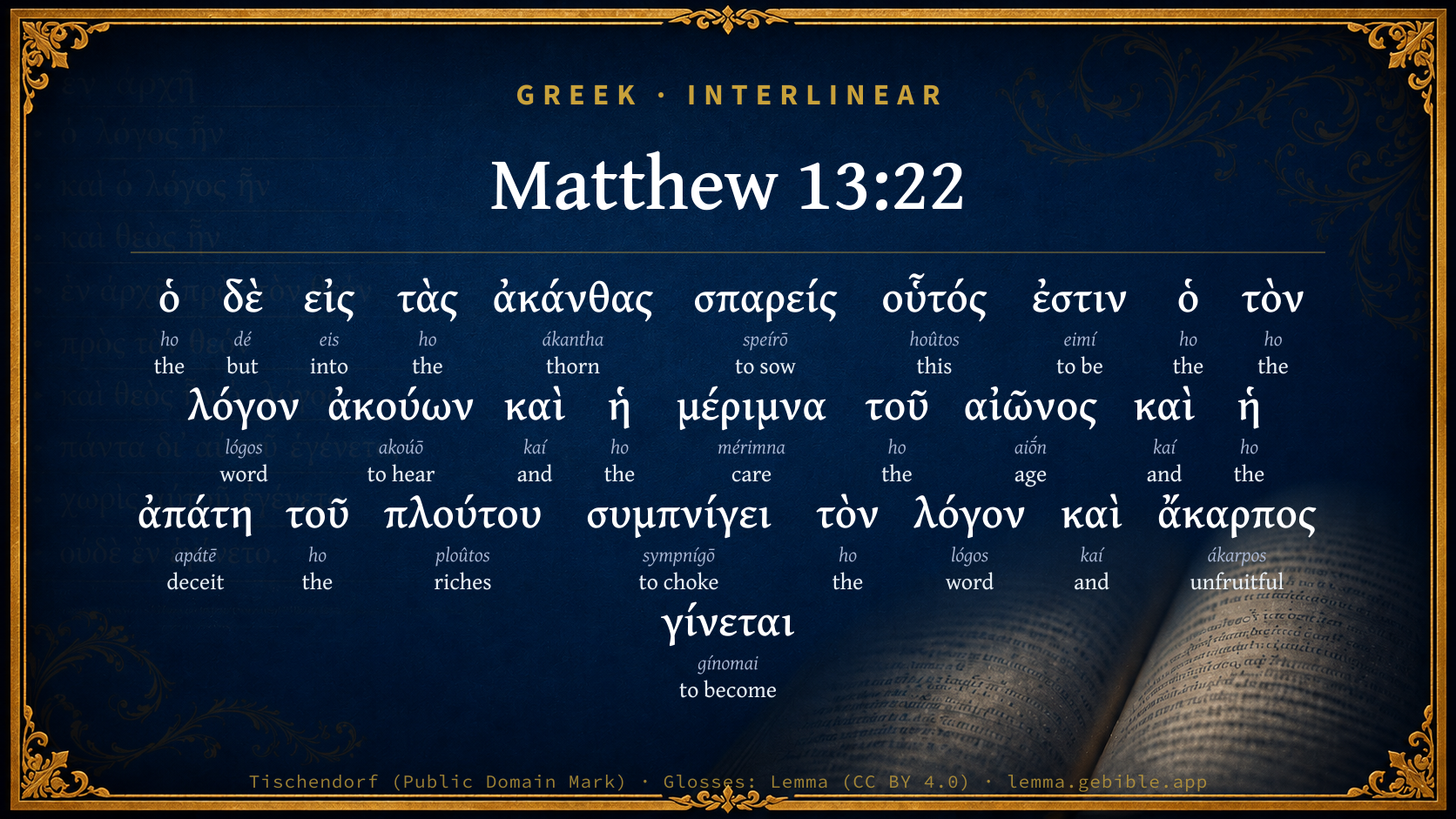
Greek (Tischendorf 8th ed.) Matthew 13:22 appears in the Greek New Testament. The text above is from the Tischendorf 8th edition. Each word links to its Strong’s number and a concise gloss. Click any word for its full Thayer’s Greek Lexicon entry.
Download image
Cite this verse

Matthew 13:22 (World English Bible). Public Domain. Lemma interlinear Bible study tool, https://lemma.gebible.app/v/matthew/13/22.

Show BibTeX & RIS
BibTeX
RIS
English Translation
What was sown among the thorns, this is he who hears the word, but the cares of this age and the deceitfulness of riches choke the word, and he becomes unfruitful.
World English Bible · Public Domain
Highlights
  • 5 first appearances in the Greek New Testament
Full analysis ↓
Download a study sheet

One document with this verse’s original text, its word-by-word gloss line, the meaning frame, cross-references with their text, attributed commentary, and full source and license credits — printable, and it pastes into notes with its structure intact.

This verse Autodidact and up

Study sheet (.html) Plain text (.txt)

A passage Seminary Student

Up to 50 verses in one chapter. A passage sheet keeps up to 6 commentary sources and 12 cross-references per verse, in the order this page ranks them, and says so on the sheet whenever that leaves anything out. Ask for a single verse and you get the Autodidact verse sheet above.

Everything on this page stays free to read, with no account — the sheet is a download of what is already on screen, not access to it.

Want to remove ads? Support Godless Engineer
Compare translations 3

The same verse in 3 English versions, stacked beneath the original-language interlinear above. Click any original word for its lexicon entry.

Each is an independent rendering of the whole verse — the interlinear is not word-aligned to these translations.

Highlighted words mark where these versions differ — a whole-verse word diff, not a word-by-word alignment.

  • World English Bible Public Domain
    What was sown among the thorns, this is he who hears the word, but the cares of this age and the deceitfulness of riches choke the word, and he becomes unfruitful.
  • King James Version Public Domain
    He also that received seed among the thorns is he that heareth the word; and the care of this world, and the deceitfulness of riches, choke the word, and he becometh unfruitful.
  • unfoldingWord Literal Text CC BY-SA 4.0
    Now the one having been sown among the thorns, this is the one hearing the word, but the worry of this age and the deceitfulness of riches choke the word, and it becomes unfruitful.

unfoldingWord Literal Text — © unfoldingWord, licensed CC BY-SA 4.0. Word-aligned USFM3 via Door43 (git.door43.org/unfoldingWord/en_ult).

Versions to compare (up to 4)

3 of 4 selected

Show all 19 translations

Every available English version of this verse, each an independent rendering of the whole verse.

  • World English Bible Public Domain
    What was sown among the thorns, this is he who hears the word, but the cares of this age and the deceitfulness of riches choke the word, and he becomes unfruitful.
  • Berean Standard Bible Public Domain
    The seed sown among the thorns is the one who hears the word, but the worries of this life and the deceitfulness of wealth choke the word, and it becomes unfruitful.
  • Majority Standard Bible Public Domain
    The seed sown among the thorns is the one who hears the word, but the worries of this life and the deceitfulness of wealth choke the word, and it becomes unfruitful.
  • King James Version Public Domain
    He also that received seed among the thorns is he that heareth the word; and the care of this world, and the deceitfulness of riches, choke the word, and he becometh unfruitful.
  • American Standard Version (1901) Public Domain
    And he that was sown among the thorns, this is he that heareth the word; and the care of the world, and the deceitfulness of riches, choke the word, and he becometh unfruitful.
  • Revised Version (1885) Public Domain
    And he that was sown among the thorns, this is he that heareth the word; and the care of the world, and the deceitfulness of riches, choke the word, and he becometh unfruitful.
  • Geneva Bible (1599) Public Domain
    And hee that receiued the seede among thornes, is hee that heareth the woorde: but the care of this worlde, and the deceitfulnesse of riches choke the word, and he is made vnfruitfull.
  • Douay-Rheims (1899) Public Domain
    And he that received the seed among thorns, is he that heareth the word, and the care of this world and the deceitfulness of riches choketh up the word, and he becometh fruitless.
  • Young's Literal Translation Public Domain
    `And that sown toward the thorns, this is he who is hearing the word, and the anxiety of this age, and the deceitfulness of the riches, do choke the word, and it becometh unfruitful.
  • Literal Standard Version CC BY-SA 4.0
    And that sown toward the thorns, this is he who is hearing the word, and the anxiety of this age, and the deceitfulness of the riches, chokes the word, and it becomes unfruitful.
  • Unlocked Literal Bible CC BY-SA 4.0
    What was sown among the thorn plants, this is the person who hears the word, but the cares of the world and the deceitfulness of riches choke the word, and he becomes unfruitful.
  • unfoldingWord Literal Text CC BY-SA 4.0
    Now the one having been sown among the thorns, this is the one hearing the word, but the worry of this age and the deceitfulness of riches choke the word, and it becomes unfruitful.
  • Darby Bible Public Domain
    And he that is sown among the thorns -- this is he who hears the word, and the anxious care of this life, and the deceit of riches choke the word, and he becomes unfruitful.
  • World Messianic Bible Public Domain
    What was sown among the thorns, this is he who hears the word, but the cares of this age and the deceitfulness of riches choke the word, and he becomes unfruitful.
  • Webster's Bible Public Domain
    He also that received seed among the thorns is he that heareth the word; and the care of this world, and the deceitfulness of riches choke the word, and he becometh unfruitful.
  • Free Bible Version CC BY-SA 4.0
    The seeds sown among thorns are people who hear the message, but then life's worries and the temptation of money choke the message so that they become fruitless.
  • Bible in Basic English Public Domain
    And that which was dropped among the thorns, this is he who has the word; and the cares of this life, and the deceits of wealth, put a stop to the growth of the word and it gives no fruit.
  • Text-Critical English NT CC BY 4.0
    The seed sown among the thorns is he who hears the word, but the cares of this world and the deceitfulness of riches choke the word, and it becomes unfruitful.
  • Tyndale New Testament (1534) Public Domain
    He that was sowne amonge thornes is he that heareth the worde of God: but the care of this worlde and the dissaytfulnes of ryches choke the worde and so is he made vnfrutfull.

Literal Standard Version (2020), Covenant Press — licensed CC BY-SA 4.0. Text via the HelloAO Bible API (eBible.org). Unlocked Literal Bible (unfoldingWord) — licensed CC BY-SA 4.0. Text via the HelloAO Bible API (eBible.org). unfoldingWord Literal Text — © unfoldingWord, licensed CC BY-SA 4.0. Word-aligned USFM3 via Door43 (git.door43.org/unfoldingWord/en_ult). Free Bible Version, Dr. Jonathan Gallagher — licensed CC BY-SA 4.0. Text via the HelloAO Bible API (eBible.org).

Word by word

More ways to search: Search by grammar → Find every occurrence → Compare this word →

Practice this passage: Drill this verse → Learn its vocabulary →

συμπνίγει
sympnígō
G4846
“to choke”
Verb, Present, Active, Indicative, 3rd person, Singular
Part of Speech
Verb
Tense
Present
Voice
Active
Mood
Indicative
Person
3rd person
Number
Singular
Full Thayer's Definition

Origin: from G4862 and G4155

TDNT: 13:35,9

1. to choke utterly a. metaph. the seed of the divine word sown in the mind b. to press round or throng one so as almost to suffocate him
  1. ὁ ho G3588 “the” Article, Nominative, Singular, Masculine
  2. δὲ dé G1161 “but” Conjunction
  3. εἰς eis G1519 “into” Preposition
  4. τὰς ho G3588 “the” Article, Accusative, Plural, Feminine
  5. ἀκάνθας ákantha G173 “thorn” Noun, Accusative, Plural, Feminine
  6. σπαρείς speírō G4687 “to sow” Verb, Aorist, Passive, Participle, Nominative, Singular, Masculine
  7. οὗτός hoûtos G3778 “this” Demonstrative pronoun, Nominative, Singular, Masculine
  8. ἐστιν eimí G1510 “to be” Verb, Present, Active, Indicative, 3rd person, Singular
  9. ὁ ho G3588 “the” Article, Nominative, Singular, Masculine
  10. τὸν ho G3588 “the” Article, Accusative, Singular, Masculine
  11. λόγον lógos G3056 “word” Noun, Accusative, Singular, Masculine
  12. ἀκούων akoúō G191 “to hear” Verb, Present, Active, Participle, Nominative, Singular, Masculine
  13. καὶ kaí G2532 “and” Conjunction
  14. ἡ ho G3588 “the” Article, Nominative, Singular, Feminine
  15. μέριμνα mérimna G3308 “care” Noun, Nominative, Singular, Feminine
  16. τοῦ ho G3588 “the” Article, Genitive, Singular, Masculine
  17. αἰῶνος aiṓn G165 “age” Noun, Genitive, Singular, Masculine
  18. καὶ kaí G2532 “and” Conjunction
  19. ἡ ho G3588 “the” Article, Nominative, Singular, Feminine
  20. ἀπάτη apátē G539 “deceit” Noun, Nominative, Singular, Feminine
  21. τοῦ ho G3588 “the” Article, Genitive, Singular, Masculine
  22. πλούτου ploûtos G4149 “riches” Noun, Genitive, Singular, Masculine
  23. τὸν ho G3588 “the” Article, Accusative, Singular, Masculine
  24. λόγον lógos G3056 “word” Noun, Accusative, Singular, Masculine
  25. καὶ kaí G2532 “and” Conjunction
  26. ἄκαρπος ákarpos G175 “unfruitful” Adjective, Nominative, Singular, Masculine
  27. γίνεται gínomai G1096 “to become” Verb, Present, Middle or Passive deponent, Indicative, 3rd person, Singular

About this verse

These counts appear in no published source. They are computed here, from the morphology-tagged text and Lemma’s own curated glosses. What Lemma adds →

28
words
17
distinct lemmas
Gospels
section

Notable vocabulary

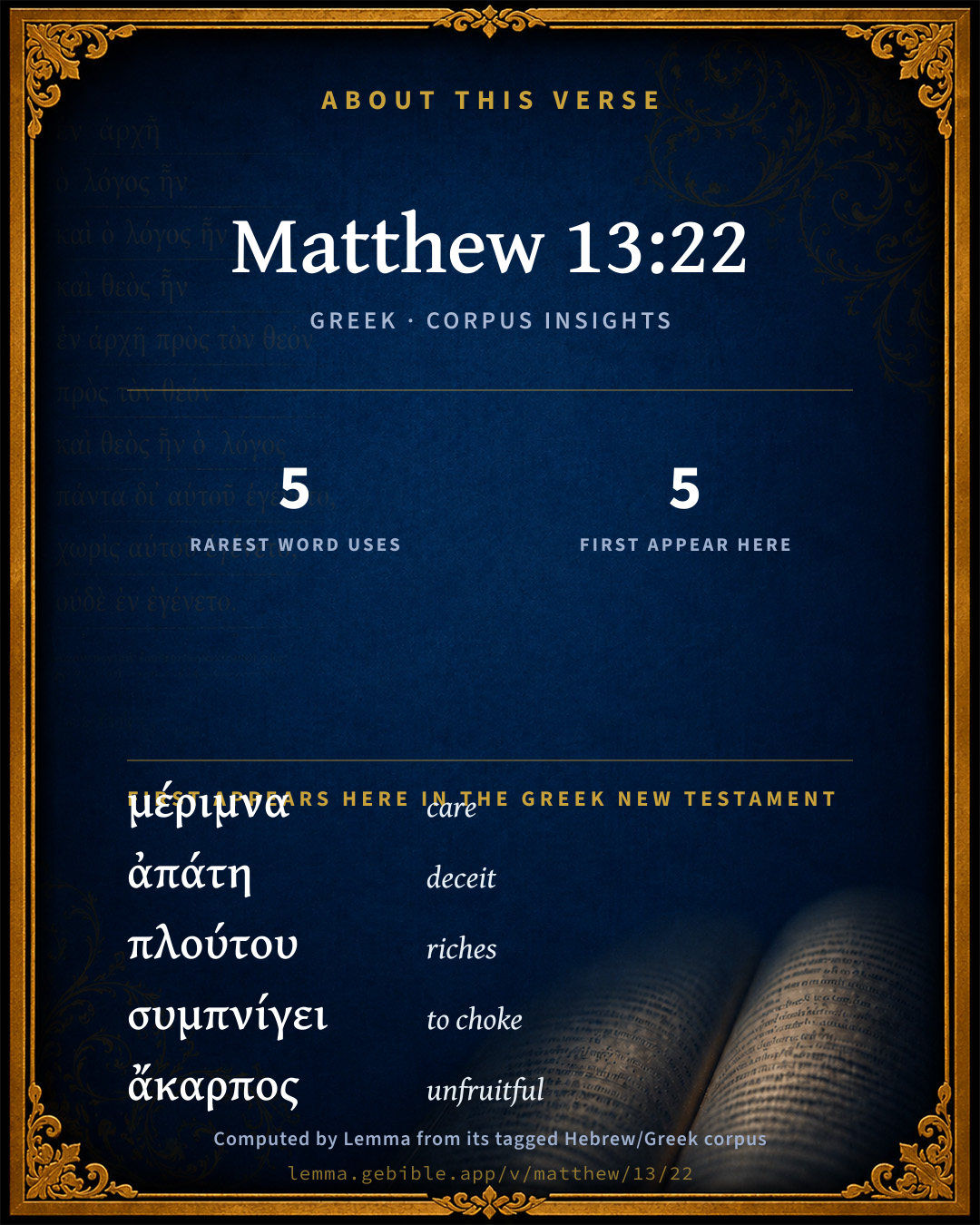
The rarest word here is συμπνίγει to choke G4846 — appearing just 5 times in the whole Greek New Testament.

First appearance in Scripture

These words make their first canonical appearance in the Greek New Testament here:

  • μέριμνα care G3308
  • ἀπάτη deceit G539
  • πλούτου riches G4149
  • συμπνίγει to choke G4846
  • ἄκαρπος unfruitful G175

Shared distinctive vocabulary

συμπνίγει to choke G4846 occurs in 5 verses of the Greek New Testament. Also found in:
Repetition

Words recur within this verse:

Cross-references

31

Topical passages linked to Matthew 13:22 in the Treasury of Scripture Knowledge — connected by theme and wording, ordered by reader-vote popularity; previews shown in the World English Bible.

  • 1 Timothy 6:17 Charge those who are rich in this present world that they not be haughty, nor have their hope set on the uncertainty of riches, but on the living God, who richly provides us with everything to enjoy;
  • Luke 8:14 That which fell among the thorns, these are those who have heard, and as they go on their way they are choked with cares, riches, and pleasures of life, and bring no fruit to maturity.
  • 1 Timothy 6:9–10 But those who are determined to be rich fall into a temptation and a snare and many foolish and harmful lusts, such as drown men in ruin and destruction.
  • Mark 4:18–19 Others are those who are sown among the thorns. These are those who have heard the word,
  • Luke 12:15 He said to them, "Beware! Keep yourselves from covetousness, for a man's life doesn't consist of the abundance of the things which he possesses."
  • Ecclesiastes 5:10–11 He who loves silver shall not be satisfied with silver; nor he who loves abundance, with increase: this also is vanity.
  • 2 Timothy 4:10 for Demas left me, having loved this present world, and went to Thessalonica; Crescens to Galatia, and Titus to Dalmatia.
  • Psalms 52:7 "Behold, this is the man who didn't make God his strength, But trusted in the abundance of his riches, And strengthened himself in his wickedness."
  • 1 John 2:15–16 Don't love the world, neither the things that are in the world. If anyone loves the world, the Father's love isn't in him.
  • Matthew 6:24–25 "No one can serve two masters, for either he will hate the one and love the other; or else he will be devoted to one and despise the other. You can't serve both God and Mammon.
  • Luke 12:29–30 Don't seek what you will eat or what you will drink; neither be anxious.
  • Matthew 13:7 Others fell among thorns. The thorns grew up and choked them:
  • Luke 12:21 So is he who lays up treasure for himself, and is not rich toward God."
  • Luke 21:34 "So be careful, or your hearts will be loaded down with carousing, drunkenness, and cares of this life, and that day will come on you suddenly.
  • Psalms 62:10 Don't trust in oppression. Don't become vain in robbery. If riches increase, Don't set your heart on them.
  • Proverbs 11:28 He who trusts in his riches will fall, But the righteous shall flourish as the green leaf.
  • Jeremiah 4:3 For thus says Yahweh to the men of Judah and to Jerusalem, Break up your fallow ground, and don't sow among thorns.
  • Genesis 13:10–13 Lot lifted up his eyes, and saw all the plain of the Jordan, that it was well watered every where, before Yahweh destroyed Sodom and Gomorrah, like the garden of Yahweh, like the land of Egypt, as you go to Zoar.
  • Joshua 7:20–21 Achan answered Joshua, and said, Of a truth I have sinned against Yahweh, the God of Israel, and thus and thus have I done:
  • 2 Kings 5:20–27 But Gehazi the servant of Elisha the man of God, said, Behold, my master has spared this Naaman the Syrian, in not receiving at his hands that which he brought: as Yahweh lives, I will run after him, and take somewhat of him.
  • Proverbs 23:5 Why do you set your eyes on that which is not? For it certainly sprouts wings like an eagle and flies in the sky.
  • Ecclesiastes 4:8 There is one who is alone, and he has neither son nor brother. There is no end to all of his labor, neither are his eyes satisfied with wealth. For whom then, do I labor, and deprive my soul of enjoyment? This also is vanity, yes, it is a miserable business.
  • Ecclesiastes 5:13–14 There is a grievous evil which I have seen under the sun: wealth kept by its owner to his harm.
  • Matthew 19:16–24 Behold, one came to him and said, "Good teacher, what good thing shall I do, that I may have eternal life?"
  • Luke 14:16–24 But he said to him, "A certain man made a great supper, and he invited many people.
  • Luke 18:24–25 Jesus, seeing that he became very sad, said, "How hard it is for those who have riches to enter into the Kingdom of God!
  • Acts 5:1–11 But a certain man named Ananias, with Sapphira, his wife, sold a possession,
  • Acts 8:18 Now when Simon saw that the Holy Spirit was given through the laying on of the apostles' hands, he offered them money,
  • 2 Peter 2:14–15 having eyes full of adultery, and who can't cease from sin; enticing unsettled souls; having a heart trained in greed; children of cursing;
  • Jude 1:11–12 Woe to them! For they went in the way of Cain, and ran riotously in the error of Balaam for hire, and perished in Korah's rebellion.
  • Mark 10:23–25 Jesus looked around, and said to his disciples, "How difficult it is for those who have riches to enter into the Kingdom of God!"

Cross-references courtesy of OpenBible.info (CC BY 4.0).

Commentary

Notes on Matthew 13:22 from classic Christian and Jewish commentators (each source and its license shown beneath its notes). The classic Christian expositions comment on the surrounding passage and are grouped to its opening verse, so a note may address several verses; the Jewish commentaries on the Tanakh (Rashi and others) are per-verse, so they appear only where the commentator wrote on this verse.

Lemma curates 59 commentaries, every one of them public domain or Creative Commons licensed, each selected and text-cleaned for this edition rather than reprinted as found. About our sources →

The Biblical Illustrator

Joseph S. Exell

Mat_13:7; Mat_13:22

And some fell among thorns.

1. Thorns and thistles occupying the field suck in the sap which should go to nourish the good seed. The capability of the ground is limited.

2. Thorns and thistles favoured as indigenous plants by the suitability of soil and climate outgrow the grain. The thorns are at home, the wheat is an exotic.

3. Anxieties about work, clothes, etc., become the thorn plants, harmless in appearance at first, which in the end may choke the seed of grace in your heart.

4. Worldly cares nursed by indulgence into a dangerous strength are further like thorns growing in a corn field, in that they interpose a veil between the ace of Jesus and the opening, trustful look of a longing soul. The seed must be exposed to the sun.

5. As long as weeds live they grow. They must be cast out of the field.

6. The thorn is a prickly thing; it tears the husbandmans flesh, as well as destroys the fruit of his field. (W. Arnot.)

The deceitfulness of riches

Greek mythology tells of one who, being offererd a valuable reward if successful in a race, resolved to outstrip all competitors. But, alas I she did not, and why? Because enemies ever and anon flung pieces of gold just before her. The temptation was too strong; as often as she saw the glittering coins she stopped to pick them up, and so lost the prize. A picture that of some who start on the spiritual course; they forfeit the recompense because they stop to pick up gold. The deceitfulness of riches choke the word, and it becometh unfruitful.

The deceitfulness of riches

1. Riches are deceitful in the insidious growth which they promote of the desire for wealth, quite independent of what it is worth in its positive power.

2. In the transition from a normal desire for wealth to the fervour of avarice, there is great danger of deception among men.

3. Wealth is deceitful in taking the place of legitimate enjoyments in life.

4. The relative growth of the selfish over the generous.

5. In the gradual development of self-esteem and self-sufficiency.

6. In an entire perversion which takes place in the minds of men.

7. Wealth deceives men by promises. (H. W. Beecher.)

Worldliness

In gold there is a halter: in silver there is bird-lime; in the farm there is a bond; in the love of the world there is a chain. While we search for gold we are strangled; while for silver we stick fast; while we seize upon the farm, we are taken prisoners. (Ambrose.)

The soul has a limited capacity for growth

There is nutriment enough in the ground for thorns, and enough for wheat; but not enough, in any ground, for both wheat and thorns. The agriculturist thins his nursery-ground, and the farmer weeds his field, and the gardener removes the superfluous grapes, for that very reason: in order that the dissipated sap may be concentrated in a few plants vigorously. So in the same way, the heart has a certain power of loving. But love, dissipated on many objects, concentrates itself on none. God or the world-not both. No man can serve two masters. If any man love the world, the love of the ]Father is not in him. He that has learned many accomplishments or sciences, generally knows none thoroughly. Multifariousness of knowledge is commonly opposed to depth-variety of affections is generally not found with intensity. (F. W. Robertson.)

The word choked

A merchant of-, engaged in a lucrative trade, was convinced by the Spirit of God that he was an heir of hell, but might, by repentance and faith in Jesus Christ, become an heir of heaven. The god of this world tempted him with much earthly gain; and God, in the Person of the Holy Ghost, offered him durable riches and righteousness. He was fully convinced, as he said, that the riches of earth and the riches of heaven were set before him, and that he could not obtain both, but might take his choice. He glanced at heavens durable riches, and then settled his covetous gaze on earths glittering tinsel. He paused, feeling his choice was for eternity; but, at length, strangely, madly cried, Give me my portion here. His prayer was answered-his fiches were multiplied; but, said he, I know that to gain the world, I have lost my soul.

Deceitfulness of riches

Some years ago, when preaching at Bristol, amongst other notes I received to pray for individuals, one was this: A person earnestly desires the prayers of the congregation, who is prospering in trade. Ah, said I to myself, here is a man who knows something of his own heart, and who has read the Scriptures to some purpose. (W. Jay.)

Riches like thorns

Riches are like thorns: they may be touched, but not rested upon. Canst thou set thy heart upon a thorn without piercing thyself through with many sorrows? (Venning.)

The Biblical Illustrator, edited by Joseph S. Exell (c. 1880s–1900s) — public domain. Text from a community e-Sword module.

Joseph Benson's Commentary

Mat 13:22. He that received seed among thorns is he that heareth the word — And proceeds further in the way of duty than either of those mentioned in the former instances. In spite of Satan and his agents, the person here intended considers, marks, learns, and inwardly digests what he hears. Yea, he has root in himself. The word sinks into his mind and heart. He is deeply humbled under a sense of his sinfulness and guilt, and brought to experience repentance toward God, and faith in our Lord Jesus Christ. He is even inwardly changed, so that he does not draw back even when tribulation and persecution ariseth. And yet, even in him, together with the good seed, the thorns, &c., spring up, (perhaps unperceived at first, at least neglected and not rooted up,) till they gradually choke it, destroy all its life and power, and it becometh unfruitful. To thorns among corn our Lord here compares the cares of the world, namely, anxious cares, which most beset the poor, but not them only; for persons in the middling ranks of life, and even the rich, are often no little harassed by them, and greatly obstructed in their Christian progress. By thorns also our Lord intends the deceitfulness of riches; deceitful indeed! for they promise much, but perform little; offer themselves to many, but give themselves to few; and to those few bring care and perplexity, rather than satisfaction and comfort. They promise to abide with us through life, if not to preserve our name in everlasting remembrance: but, alas! frequently take themselves wings and fly away. They engage our dependance, and we lean on them as though they were the staff of life; but quickly find, by sad experience, they are but “a broken reed at best, and oft a spear,” piercing us through with many sorrows. Like Judas, whom they corrupted, “they kiss and betray, they smile and smite into hell. They put out the eyes, harden the heart, steal away all the life of God, fill the soul with pride, anger, and love to the world, and make men enemies to self-denial and the whole cross of Christ.” — Wesley. Luke also mentions the pleasures of life as another weed, choking and rendering unfruitful the good seed. To which pleasures deceitful riches minister, and are a great temptation, putting it into men’s power to gratify their carnal desires and unruly appetites and passions in every excess to which Satan or their own hearts prompt them. But not only are such gross indulgences as these here included in the hurtful pleasures which are represented as choking the good seed, but all the fashionable amusements and gratifications of sense and fancy in which mankind, and especially the young of both sexes, are prone to seek their happiness. There is yet another weed, which too frequently prevents the fruitfulness of the incorruptible seed, and all improvement, if not even perseverance in true piety, and that is, desires after other things, mentioned in the parallel passage by Mark. This equally annoys high and low, rich and poor, young and old; and if not eradicated or suppressed is equally destructive to the life of God in all. God himself is all-sufficient to satisfy the most enlarged desires of all his intelligent creatures. There is enough in him to make them completely happy. All our desire therefore should be unto him, or, at least, nothing should be esteemed, desired, delighted in, or pursued, but in perfect subordination to him and his love: and when this is not the case, but the desire of our heart is turned toward other objects, our intercourse with God is of necessity interrupted, and the influences of his Spirit withheld from us; the consequence of which is, we lose all union with him, and become twice dead, plucked up by the roots. Now when all these, who receive the seed as among thorns, who begin in the Spirit, but end in the flesh; run well for a time, but are afterward hindered; are also, as well as the two preceding classes, excepted, alas! how few yet remain to be compared to the good ground, mentioned in the next verse!

Joseph Benson's Commentary on the Old and New Testaments (1811–1818) — public domain. Text from a community e-Sword module.

Tyndale Open Study Notes

Tyndale Open Resources

13:22 Jesus spoke of competing demands in life, (see also 8:18-22). The worries of this life can become so great that they divert one from the path of faithful obedience (see 6:19-34). The lure of wealth, particularly in its ability to deceive, appears often in Matthew (e.g., 4:8-10; 6:24; 13:44-45). God does not desire that his people have wealth as much as that they have faith, obey him, and willingly help those in need (e.g., 19:21; 25:31-46).

Tyndale Open Study Notes — © Tyndale Open Resources, licensed CC BY-SA 4.0. Text via the HelloAO Bible API.

Bengel's Gnomon

Johann Albrecht Bengel

Mat 13:22. Ἠ ἀπάτη τοῦ πλούτου, the deceitfulness of riches)[616] Riches remove the soul from that tranquillity which is here opposed to the care of this world.[617]—ἄκαρπος γίνεται, becometh unfruitful) sc. the word in man becometh so (see Mar 4:19); i.e., the word in him who hears it does not arrive at good and perfect fruit fit for use: the man bringeth no fruit to perfection, οὐ τελεσφορεὶ, Luk 8:14. Thomas Magister[618] says, εὔκαρπα δένδρα, ὧν ὁ καρπός ἐστι χρήσιμος ἀνθρώποις εὶς τροφήν· ἄκαρπα, τὸ ἐναντίον, ὧν τοῖς καρποῖς οὐ χρῶνται οἱ ἄνθρωποι· ἄκαρπον δὲ, τὸ μὴ ποιοῦν καρπὸν, παρʼ οὐδενὶ τῶν παλαιῶν εὕρηται: i.e., “Trees which are styled εὔκαρπα, are those, the fruit (ΚΑΡΠΌς) of which is serviceable for food to men: ἌΚΑΡΠΑ, on the other hand, are those, the fruit of which men do not use for food: but ἌΚΑΡΠΟΝ, in the sense of having no fruit, is not found in any of the ancients.”

[616] Which is manifold in its varieties of form, and which, though it deceives men in an awful manner, yet scarcely ever seems to them worth while being taken into consideration at all.—V. g.

[617] Συμπνίγει, choke) Many engage in the discussion (treating) of the Word of GOD in such a way as if the heart were not a field in which the seed is to remain and grow, but a granary which can contain at one time less stores, at another time more—at one time something, at another time nothing.—V. g.

[618] THOMAS MAGISTER, surnamed THEODULUS (ΘΕΟΔΟΥΛΟΣ, The Servant of GOD), was a Monk and a Grammarian, who flourished at the beginning of the fourteenth century. Saxius describes him as “vocum Atticarum magister.”—(I. B.)

Bengel's Gnomon of the New Testament — English translation (T&T Clark, Edinburgh, 1860) — public domain. Text from a community e-Sword module.

Meyer's Critical & Exegetical Commentary

Heinrich August Wilhelm Meyer

Mat_13:22. Ἀκούων] is simply to hear, as in all the other cases in which it is here used; and neither, with Grotius, are we to supply καὶ μετὰ χαρᾶς λαμβάνων, nor, with Kuinoel and Bleek, to take it in the sense of admittere.

The care for this world, which (Mat_13:39; Mat_13:49) extends even to the setting up of the promised kingdom (τούτου is a correct gloss), is the care which men cherish with regard to temporal objects and temporal affairs, as contrasted with the higher concern, the striving after the Messiahs kingdom (Mat_6:33). Comp. Tim. Mat_4:10.

ἀπάτη] the deceitfulness of those riches, which (personified) delude men with their enticements; not: Delectatio, qua divitiae animos hominum afficiunt (Kuinoel), a classical meaning of ἀπάτη (Polyb. ii. 56. 12, iv. 20. 5) which is foreign to the New Testament, and which in this instance is as unnecessary as it is flat. 2Th_2:10; Heb_3:13.

ἄκαρπ. γίν.] not the word (Bengel), but the man; see Mat_13:23.

Meyer — Critical and Exegetical Commentary on the New Testament — English translation by Peter Christie, edited by Frederick Crombie (T&T Clark, 1880) — public domain. Text from a community e-Sword module.

Expositor's Greek Testament

ed. W. Robertson Nicoll

Mat 13:22 . ἀκούων , hearing alone predicated of the third type, but receiving both intellectually and emotionally implied; everything necessary present except purity of heart, singleness of mind. Hearing is to be taken here in a pregnant sense as distinct from the hearing that is no hearing (Mat 13:13 ). μέριμνα τ . α ., ἀπάτη τ . π .: together = worldliness. Lust for money and care go together and between them spoil many an earnest religious nature. ἄκαρπος may refer cither to the man (Meyer) or to the word ( λόγον just before; Bengel, Weiss); sense the same. There is fruit in this case; the crop does not wither in the blade: it reaches the green ear, but it never ripens.

The Expositor's Greek Testament, edited by W. Robertson Nicoll (1897–1910) — public domain. Text from a community e-Sword module.

Adam Clarke's Commentary

Verse 22. He also that received seed among the thorns] In land ploughed, but not properly cleared and seeded. Is he - represents that person who heareth the word, but the cares, rather the anxiety, η μεριμνα, the whole system of anxious carking cares. Lexicographers derive the word μεριμνα from μεριζειν τον νουν, dividing, or distracting the mind. Thus a poet,

Tot me impediunt curae quae meum animum diverse

trahunt.

"So many cares hinder me which draw my mind

different ways." Terence.

The deceitfulness of riches] Which promise peace and pleasure, but can never give them.

Choke the word] Or, together choke the word, συμπνιγει meaning, either that these grow up together with the word, overtop, and choke it; or that these united together, viz. carking worldly cares, with the delusive hopes and promises of riches, cause the man to abandon the great concerns of his soul, and seek, in their place, what he shall eat, drink, and wherewithal he shall be clothed. Dreadful stupidity of man, thus to barter spiritual for temporal good-a heavenly inheritance for an earthly portion! The seed of the kingdom can never produce much fruit in any heart, till the thorns and thistles of vicious affections and impure desires be plucked up by the roots and burned. The Persic translator renders it [Persic] asle kalme-ra khube kund, chokes the root of the word: for it appears the seed had taken root, and that these cares, &c., choked it in the root, before even the blade could show itself.

Adam Clarke's Commentary on the Bible (1810–1826) — public domain. Text from a community e-Sword/MySword module.

Ellicott's Commentary for English Readers

(22) He also that received seed among the thorns.—See Note on Mat_13:19. Here there is no over-rapid growth, and there is some depth of earth. The character is not one that wastes its strength in vague emotions, but has the capacity for sustained effort. The evil here is, that while there is strength of purpose, there is not unity of spirit. The man is double-minded, and would fain serve two masters. The “care of this world” (the word is the root of the verb “take no thought” in Mat_6:25), the deceitfulness of earthly riches—cheating the soul with its counterfeit shows of good—these choke the “word” in its inner life, and it becomes “unfruitful.” There may be some signs of fruitfulness, perhaps the “blade” and the “ear” of partial reformation and strivings after holiness, but there is no “full corn in the ear.” In St. Luke’s words, such men “bring no fruit to perfection” (Luk_8:14). To the simpler root-forms of evil in St. Matthew, St. Mark adds “the lusts (or desires) about other things”—i.e., the things that are other than the true life—and St. Luke, “the pleasures of life” to which wealth ministers, and for the sake of which, therefore, men pursue it.

A Bible Commentary for English Readers, edited by Charles John Ellicott (1878–1897) — public domain. Text from a community e-Sword module.

The Cambridge Bible for Schools and Colleges

gen. ed. J. J. S. Perowne

22. the care of this world, and the deceitfulness of riches] St Mark adds “the lusts of other things,” St Luke, “the pleasures of this life.” These things destroy the “singleness” of the Christian life. Compare with this the threefold employment of the world as described by Christ, at the time of the Flood, at the destruction of Sodom and Gomorrah, and at the coming of the Son of man. (Luk_17:26-30.)

The Cambridge Bible for Schools and Colleges (gen. ed. J. J. S. Perowne; Cambridge University Press, 1878–1918) — public domain. Text from a community e-Sword module.

John Gill's Exposition

Another parable put he forth unto them, saying,.... Somewhat like the former, but with a different view: for whereas the design of the former was to show the different sorts of hearers that attend upon the ministry of the word, three parts in four being bad; this is to show the difference of members in churches, some being comparable to good seed, and others to tares.

The kingdom of heaven is likened unto a man which sowed good seed in his field: by "the kingdom of heaven", is not meant the ultimate glory of the saints in heaven, or the state of happiness in the other world; for there will be no tares there; nor the Gospel, and the ministration of it, but the Gospel dispensation, and times, and kingdom of the Messiah; or rather the Gospel visible church state, on earth, called a "kingdom", of which Christ is king, and in which the saints are subject to him; where proper laws are made for the orderly government of it, and proper officers appointed to explain, and put those laws in execution; and which consists of various persons, united under one head, and independent of any other government: and it is styled the kingdom of heaven, in distinction from the kingdoms of this world; the subjects of it are, or should be, heaven born souls; the word, laws, and ordinances of it are from heaven; and there is some resemblance between a Gospel church state and heaven, and it is very near unto it, and is even the suburbs of it: or else the king Messiah himself is intended, who is compared to a man, a sower; and so it is explained, Mat 13:37 "he that soweth the good seed is the son of man": which is a name and title of the Messiah, by which he is called both in the Old and New Testament; who, though the seed of the woman, yet was the son of man, as of Abraham, and David; and which denotes the truth, and yet the infirmity of his human nature: he is the sower that went about preaching the Gospel of the kingdom, in the Jewish world, or throughout Judea and Galilee, in his own person: and who also, by the ministry of his apostles, sowed the seed of the word in the several parts of the world, which was made effectual for the beginning of a good work of grace on the souls of many; for by "his field" is meant "the world", as appears from Mat 13:38 and means either the whole world, in which both good and bad men live and dwell; and is the field Christ is the proprietor of, both by creation, as God, and by gift, as mediator: or the church, the visible Gospel church state throughout the world; which is as a field well tilled and manured; and is Christ's by gift, purchase, and grace: and by the good seed sown in it, are meant "the children of the kingdom"; as is said, Mat 13:38 such as have a good work begun in them, and bring forth good fruit in their lives and conversations.

John Gill's Exposition of the Whole Bible (1746–1763) — public domain (CC PDM 1.0). Text via the HelloAO Bible API.

Trapp's Complete Commentary

John Trapp

22 He also that received seed among the thorns is he that heareth the word; and the care of this world, and the deceitfulness of riches, choke the word, and he becometh unfruitful.

Ver. 22. He that received the seed among thorns] So the love of money is called, because it chokes the word, pricks the conscience, harbours vermin lusts. Magna cognatio, ut rei sic nominis divitiis et vitiis. Let rich men look to it, saith Gregory, that they handle their thorns without pricking their fingers; that while they load themselves with earth, they lose not heaven, as Shimei, seeking his servants, lost himself. {a} "Set not thy heart upon the asses" (said Samuel to Saul), since "to thee is the desire of all Israel." Set not your hearts, say I, on this world’s trash, since better things abide you. Martha was troubled about many things, but neglected that one thing necessary, to sit, as her sister did, at Christ’s feet, and hear his word. This Christ checks her for.

And the deceitfulness of riches] The world is a subtle, sly enemy, that doth easily insinuate and dangerously deceive. We may safely say of it, as he sometimes did of a historian, Both its words and shows are full of fraud. {b} As the panther hides his deformed head, till the sweet scent have drawn other beasts into his danger; so deals the world, alluring men by the deceitfulness of riches, and masking the monstrous and deformed head, the end thereof, under the gilded show of good husbandry, or disguised shape of sin. In a word, these outward things, howsoever as hosts they welcome us into our inn with smiling countenance, yet, unless we look better to them, they will cut our throats in our beds.

And he becometh unfruitful] Because the thorns over shadow the grain; whereas the good ground, though it hath many thorns, yet the grain ascends above them: grace is superior to corruption, the fruit springs up and increaseth, as St Mark {Mar 4:8} hath it. These thorny ground hearers, though they stood out persecution, and shrank not in the wetting, as the stony ground did, yet, because the plough had not gone so low as to break up the roots, whereby their hearts were fastened to earthly contents, they proved also unfruitful. See how far a man may go, and yet be never the nearer after all. The stony and thorny ground were nearer to the nature of the good ground, than that of the highway, and yet fell short of heaven.

{a} Dum peritura paras per male parta peris. Viderint divites quomodo spinas sine panctione contrecteat.

{b} Δολερα μεν τα σχηματα, δολερα δε τα ρηματα. Plut. de Herodot.

John Trapp, A Commentary or Exposition upon All the Books of the Old and New Testament (1647–1656) — public domain. Text from a community e-Sword module.

Matthew Poole's English Annotations

Mark adds, Mar 4:19, and the lusts of other things entering in, choke the word. Luke saith, Luk 8:14, And that which fell among thorns are they, which, when they have heard, go forth, and are choked with cares, and riches, and pleasures of this life, and bring no fruit to perfection. Under these terms, the care of this world, the deceitfulness of riches, and the pleasures of this life, or the lusts of other things, our Saviour comprehends all that which St. John calls the lust of the eye, the lust of the flesh, and the pride of life. The immoderate desires of our hearts after lawful things, or their desires after things prohibited and unlawful, these he compares to thorns: as thorns in a ground choke the seed, shadowing the blade when it comes up, and keeping off the warmth of the sun, and drawing the fatness of the ground from it; so these divert men’s thoughts; and draw men’s affections off from the word of God, so as it bringeth forth no fruit; or if there be some little appearance of fruit, it dwindles away, and cometh to no perfection. None of these were profane, godless persons, who make no conscience of neglecting to hear the word preached; they are all hearers. Oh how strait is the way, how narrow is the gate, that leadeth to everlasting life! How few there be that find it!

Matthew Poole's English Annotations on the Holy Bible (1683–1685) — public domain. Text from a community e-Sword/MySword module.

Whedon's Commentary on the Bible

Daniel D. Whedon

22. Among thorns — This is a sad case. The seed is good, the soil is good, the growth is genuine, internally everything is right. But while all is going well within, there are difficulties without, which in time prove fatal. What are those enemies to salvation without? They are the care of this world and the deceitfulness of riches. Adversities and prosperities may both be enemies to our soul. Some become soured by trouble, and their time is so engrossed, that they have no heart, no room for the service of God. Others become wealthy and proud; too fine and too fashionable to be pious. Becometh unfruitful — There once was fruit. But, alas! fruit and blossom, leaf and stock become choked and disappear. This is genuine apostacy. It is the loss of real life and fruitfulness once existing. Let him that thinketh he standeth take heed lest he fall; and let no false theology induce him to think most presumptously, “once in grace always in grace.”

Daniel D. Whedon (gen. ed.), Commentary on the Old and New Testaments (1874–1909) — public domain. Text from a community e-Sword module.

The Pulpit Commentary

And the care (h merimna); Mat_6:25, note. Of this world (of the world, Revised Version, tou aiwnov , omitting the toutou of the Received Text). (For aiwn "age," Revised Version margin, cf. Mat_12:32, note) Choke the word. Which is no unchanging thing, but is always affected for good or evil, however great progress it has made.

The Pulpit Commentary (1880–1919), ed. H.D.M. Spence-Jones & Joseph S. Exell — public domain. Text from a community e-Sword module.

John Wesley's Explanatory Notes

He that received the seed among the thorns, is he that heareth the word and considereth it - In spite of Satan and his agents: yea, hath root in himself is deeply convinced, and in a great measure inwardly changed; so that he will not draw back, even when tribulation or persecution ariseth. And yet even in him, together with the good seed, the thorns spring up, ver. 7. (perhaps unperceived at first) till they gradually choke it, destroy all its life and power, and it becometh unfruitful. Cares are thorns to the poor: wealth to the rich; the desire of other things to all. The deceitfulness of riches - Deceitful indeed! for they smile, and betray: kiss, and smite into hell. They put out the eyes, harden the heart, steal away all the life of God; fill the soul with pride, anger, love of the world; make men enemies to the whole cross of Christ! And all the while are eagerly desired, and vehemently pursued, even by those who believe there is a God!

John Wesley, Explanatory Notes Upon the Whole Bible (1754–1765) — public domain. Text via the GEBible commentary corpus.

unfoldingWord translationNotes

Door43 World Missions Community

Connecting Statement:

Jesus continues to explain to his disciples the parable about a person who sows seeds.

What was sown

This refers to seed that was sown or that fell. AT: "The seed that was sown" or "The seed that fell" (See: Assumed Knowledge and Implicit Information)

What was sown among the thorn plants

"The ground with the thorn plants where seed was sown"

this is the person

"this represents the person"

the word

"the message" or "God's teaching"

the cares of the world and the deceitfulness of riches choke the word

Jesus speaks about the cares of the world and the deceitfulness of riches distracting a person from obeying God's word as if they were weeds that could wind around a plant and keep it from growing. AT: "as weeds prevent good plants from growing, the cares of the world and the deceitfulness of riches keep this person from listening to God's word" (See: Metaphor)

cares of the world

"the things in this world that people worry about"

the deceitfulness of riches

Jesus describes "riches" as if it were a person who could deceive someone. This means people think having more money will make them happy, but it will not. AT: "the love of money" (See: Personification)

he becomes unfruitful

The person is spoken of as if he were a plant. Being unfruitful represents being unproductive. AT: "he becomes unproductive" or "he does not do what God wants" (See: Metaphor)

What was sown on the good soil

"The good soil where seeds were sown"

He bears fruit and makes a crop

The person is spoken of as if he were a plant. AT: "Like a healthy plant that bears a crop of fruit, he is productive" (See: Metaphor)

yielding one hundred times as much as was planted, some sixty, and some thirty times as much

The phrase "as much as was planted" is understood following each of these numbers. See how you translated this in Matthew 13:8. AT: "Some people produce 100 times as much as was planted, some produce 60 times as much, and some produce 30 times as much" (See: Ellipsis and Numbers)

translationWords

plant

thorn

word

world

deceive

unfoldingWord translationNotes — © Distant Shores Media and the Door43 World Missions Community, licensed CC BY-SA 4.0. Source: git.door43.org/Door43/en_tn.

Cambridge Greek Testament for Schools and Colleges

22. ἡ μέριμνα τοῦ αἰῶνος καὶ ἡ ἀπάτη τοῦ πλούτου. St Mark adds αἱ περὶ τὰ λοιπὰ ἐπιθυμίαι, St Luke ἡδονῶν τοῦ βίου. These things destroy the ‘singleness’ of the Christian life. Compare with this the threefold employment of the world as described by Christ, at the time of the Flood, at the destruction of Sodom and Gomorrah, and at the coming of the Son of man. (Luk 17:26-30.)

μέριμνα, ‘absorbing care,’ from a root that connects it with μερμηρίζω, μάρτυς, memoria, mora.

Cambridge Greek Testament for Schools and Colleges (Cambridge University Press, 1896; 21 vols, various authors incl. Carr, Maclear, Plummer, Farrar, Lumby, Moule, M. R. James, Simcox) — public domain. Text from a community e-Sword module.

Alford’s Greek Testament

Henry Alford

22.] In this third sort, all as regards the soil is well; the seed goes deep, the plant springs up; all is as in the next case, with but one exception, and that, the bearing of fruit—ἄκαρπος γίνεται = οὐ τελεσφοροῦσι Luke. And this because the seeds or roots of thorns are in, and are suffered to spring up in, the heart, and to overwhelm the plant. There is a divided will, a half-service (μέριμνα from μερίζω, see on ch. 6:25) which ever ends in the prevalence of evil over good. This class is not confined to the rich: πλοῦτος in Scripture is not riches absolutely, as possessed, but riches relatively, as estimated by the desire and value for them. Mark adds καὶ αἱ περὶ τὰ λοιπὰ ἐπιθυμίαι, viz. the τὰ λοιπά which shall be added to us if we seek first the Kingdom of God and His righteousness. The identity of the seeds sown with the individuals of these classes, as maintained above, is strikingly shewn in Luke here: τὸ δὲ εἰς τὰς ἀκάνθας πεσόν, οὗτοί εἰσιν οἱ ἀκούσαντες κ.τ.λ. (8:14.) We may notice: (I) That there is in these three classes a progress, and that a threefold one:—(1) in time:—the first receives a hindrance at the very outset: the seed never springs up:—the second after it has sprung up, but soon after:—the third when it has entered, sprung up, and come to maturity: or while it is so coming.—(2) in apparent degree. The climax is apparently from bad to better;—the first understand not: the second understand and feel: the third understand, feel, and practise. But also (3) in real degree, from bad to worse. Less awful is the state of those who understand not the word and lose it immediately, than that of those who feel it, receive it with joy, and in time of trial fall away: less awful again this last, than that of those who understand, feel, and practise, but are fruitless and impure.

It has been noticed also that the first is more the fault of careless inattentive childhood; the second of ardent shallow youth; the third of worldly self-seeking age. (II) That these classes do not exclude one another. They are great general divisions, the outer circles of which fall into one another, as they very likely might in the field itself, in their different combinations.

Henry Alford, The Greek Testament (1849–1861) — public domain. Text from a community e-Sword module.

International Critical Commentary

(M) 22. And he that was sown into the thorns, this is he who hears the word; and the care of the world and the deceitfulness of riches choke the word, and it becomes unfruitful.] Mk. has: “And others there are who are being sown into the thorns. These are they who heard the word; and the cares of the world, and the desires concerning the rest, enter in and choke the word, and it becometh unfruitful.” Again the same verbal confusion. Lk. here simplifies by substituting the neuter: “And that which was sown,” etc. Mt. omits καὶ αἱ περὶ τὰ λοιπὰ ἐπιθυμίαι as being involved in ἡ μέριμνα τοῦ αἰῶνος. τοῦ αἰῶνος probably implies the distinction between this and the coming age; see on 12:32.

International Critical Commentary — older volumes (1896–1929), various authors — public domain. Text from a community e-Sword module.

Lesson kit

Teaching starters — assembled from the data on this page, not authored interpretation. Every prompt links to the verse data it draws on. Edit before teaching.

Matthew, in the Gospels, opens this verse with 28 words (17 distinct Greek lemmas). Its most distinctive word is sympnígō (“to choke”). A historical commentator’s framing appears above. Read the whole chapter for the surrounding context.

Discussion questions

  1. How does “to choke” (sympnígō) shape what this verse is saying?
  2. 5 words here appear for the first time in Scripture. What is being introduced at this debut?
  3. Mark 4:7 shares the word «to choke» with this verse. How do the two illuminate each other?
  4. “word” occurs 2× in this one verse. What is the effect of the repetition?
  5. The translations on this page render this verse differently — a whole-verse word diff, not a word-by-word alignment. What might account for the different wordings?
  6. Reading how The Biblical Illustrator and Joseph Benson's Commentary read this verse, where do the two commentators agree and where do they part?

Things to notice

  • 5 words make their first canonical appearance in Scripture here.
  • These translations choose different wording for 20 words in this verse.
  • “word” occurs 2× in this single verse.
  • 17 distinct Greek lemmas span 28 words in this verse.

Reading settings

Reading text

Shown beneath each verse's original-language words.

Old Testament
Old Testament edition

Read the OT as the Masoretic Hebrew (MT) or the Greek Septuagint (LXX).

English shown for the Greek Septuagint (in the Hebrew ↔ Greek comparison).

Comparing translations? Open the Compare panel on any verse page to stack up to four side by side.