
Matthew 7:15

Greek (Tischendorf 8th ed.) Matthew 7:15 appears in the Greek New Testament. The text above is from the Tischendorf 8th edition. Each word links to its Strong’s number and a concise gloss. Click any word for its full Thayer’s Greek Lexicon entry.
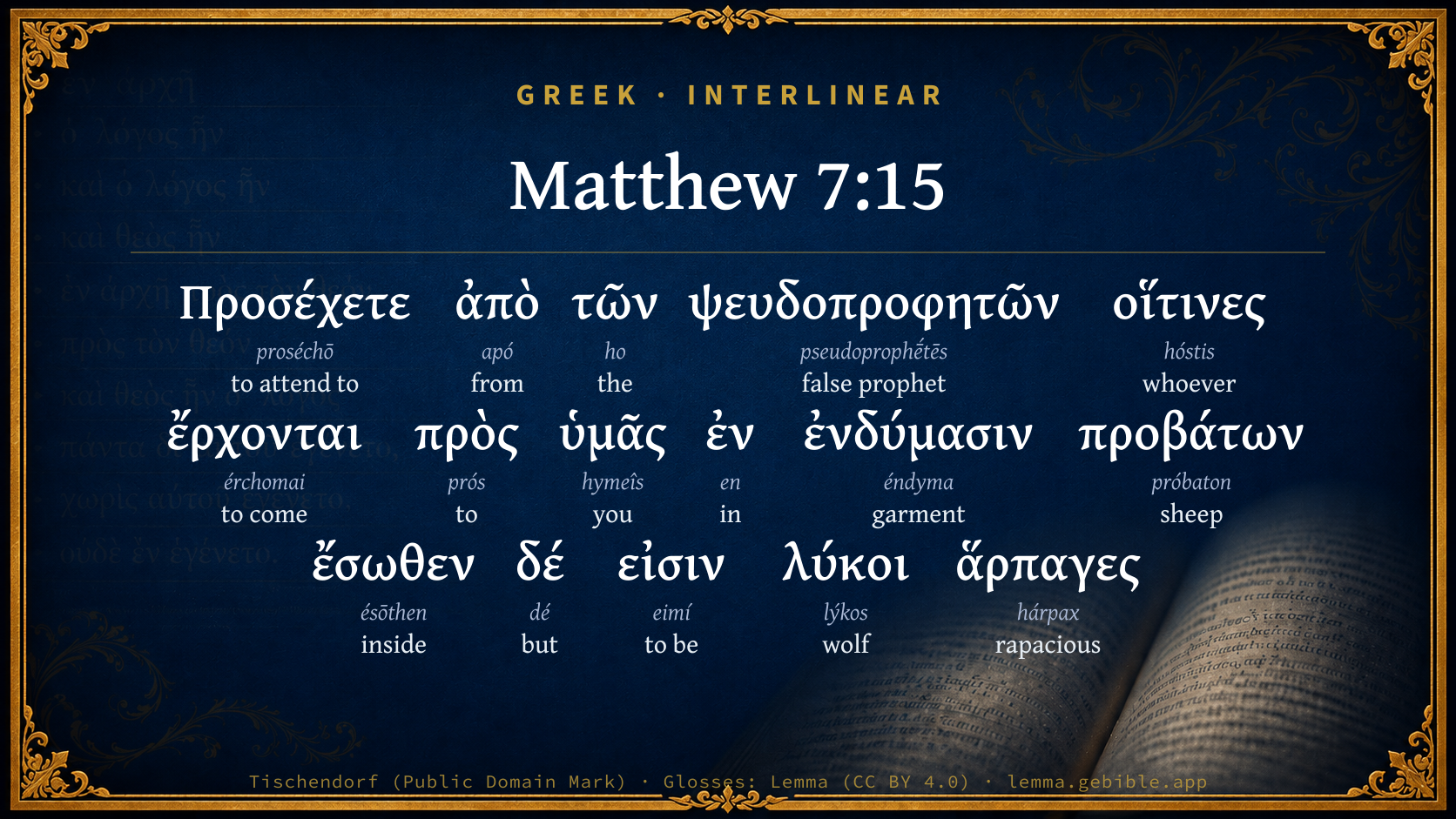
Download image
Cite this verse

Matthew 7:15 (World English Bible). Public Domain. Lemma interlinear Bible study tool, https://lemma.gebible.app/v/matthew/7/15.

Show BibTeX & RIS
BibTeX
RIS
English Translation
"Beware of false prophets, who come to you in sheep's clothing, but inwardly are ravening wolves.
World English Bible · Public Domain
Highlights
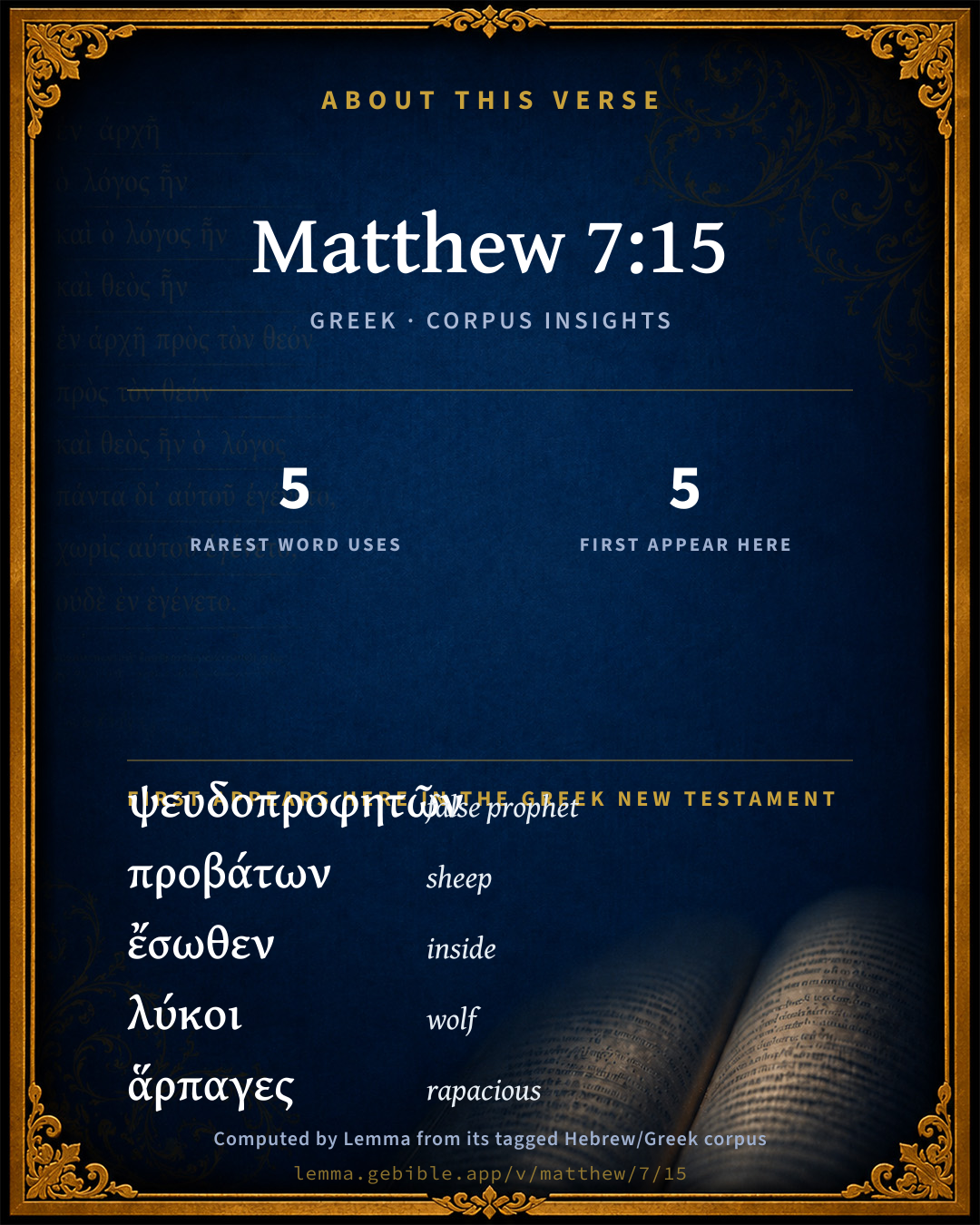
  • 5 first appearances in the Greek New Testament
Full analysis ↓
Download a study sheet

One document with this verse’s original text, its word-by-word gloss line, the meaning frame, cross-references with their text, attributed commentary, and full source and license credits — printable, and it pastes into notes with its structure intact.

This verse Autodidact and up

Study sheet (.html) Plain text (.txt)

A passage Seminary Student

Up to 50 verses in one chapter. A passage sheet keeps up to 6 commentary sources and 12 cross-references per verse, in the order this page ranks them, and says so on the sheet whenever that leaves anything out. Ask for a single verse and you get the Autodidact verse sheet above.

Everything on this page stays free to read, with no account — the sheet is a download of what is already on screen, not access to it.

Want to remove ads? Support Godless Engineer
Compare translations 3

The same verse in 3 English versions, stacked beneath the original-language interlinear above. Click any original word for its lexicon entry.

Each is an independent rendering of the whole verse — the interlinear is not word-aligned to these translations.

Highlighted words mark where these versions differ — a whole-verse word diff, not a word-by-word alignment.

  • World English Bible Public Domain
    "Beware of false prophets, who come to you in sheep's clothing, but inwardly are ravening wolves.
  • King James Version Public Domain
    Beware of false prophets, which come to you in sheep's clothing, but inwardly they are ravening wolves.
  • unfoldingWord Literal Text CC BY-SA 4.0
    Beware of the false prophets, who come to you in sheep’s clothing, but inwardly they are ravenous wolves.

unfoldingWord Literal Text — © unfoldingWord, licensed CC BY-SA 4.0. Word-aligned USFM3 via Door43 (git.door43.org/unfoldingWord/en_ult).

Versions to compare (up to 4)

3 of 4 selected

Show all 19 translations

Every available English version of this verse, each an independent rendering of the whole verse.

  • World English Bible Public Domain
    "Beware of false prophets, who come to you in sheep's clothing, but inwardly are ravening wolves.
  • Berean Standard Bible Public Domain
    Beware of false prophets. They come to you in sheep’s clothing, but inwardly they are ravenous wolves.
  • Majority Standard Bible Public Domain
    Beware of false prophets. They come to you in sheep’s clothing, but inwardly they are ravenous wolves.
  • King James Version Public Domain
    Beware of false prophets, which come to you in sheep's clothing, but inwardly they are ravening wolves.
  • American Standard Version (1901) Public Domain
    Beware of false prophets, who come to you in sheep's clothing, but inwardly are ravening wolves.
  • Revised Version (1885) Public Domain
    Beware of false prophets, which come to you in sheep’s clothing, but inwardly are ravening wolves.
  • Geneva Bible (1599) Public Domain
    Beware of false prophets, which come to you, in sheepes clothing, but inwardly they are rauening wolues.
  • Douay-Rheims (1899) Public Domain
    Beware of false prophets, who come to you in the clothing of sheep, but inwardly they are ravening wolves.
  • Young's Literal Translation Public Domain
    `But, take heed of the false prophets, who come unto you in sheep's clothing, and inwardly are ravening wolves.
  • Literal Standard Version CC BY-SA 4.0
    But take heed of the false prophets who come to you in sheep’s clothing, and inwardly are ravenous wolves.
  • Unlocked Literal Bible CC BY-SA 4.0
    Beware of false prophets, who come to you in sheep's clothing but are truly ravenous wolves.
  • unfoldingWord Literal Text CC BY-SA 4.0
    Beware of the false prophets, who come to you in sheep’s clothing, but inwardly they are ravenous wolves.
  • Darby Bible Public Domain
    But beware of false prophets, which come to you in sheep's clothing, but within are ravening wolves.
  • World Messianic Bible Public Domain
    “Beware of false prophets, who come to you in sheep’s clothing, but inwardly are ravening wolves.
  • Webster's Bible Public Domain
    Beware of false prophets, who come to you in sheep's clothing, but inwardly they are ravening wolves.
  • Free Bible Version CC BY-SA 4.0
    Watch out for false prophets who come wearing sheep's clothing, but who on the inside are vicious wolves.
  • Bible in Basic English Public Domain
    Be on the watch for false prophets, who come to you in sheep's clothing, but inside they are cruel wolves.
  • Text-Critical English NT CC BY 4.0
    “Beware of false prophets, who come to you in sheep's clothing but inwardly are ravenous wolves.
  • Tyndale New Testament (1534) Public Domain
    Beware of false Prophetes which come to you in shepes clothinge but inwardly they are ravenynge wolves.

Literal Standard Version (2020), Covenant Press — licensed CC BY-SA 4.0. Text via the HelloAO Bible API (eBible.org). Unlocked Literal Bible (unfoldingWord) — licensed CC BY-SA 4.0. Text via the HelloAO Bible API (eBible.org). unfoldingWord Literal Text — © unfoldingWord, licensed CC BY-SA 4.0. Word-aligned USFM3 via Door43 (git.door43.org/unfoldingWord/en_ult). Free Bible Version, Dr. Jonathan Gallagher — licensed CC BY-SA 4.0. Text via the HelloAO Bible API (eBible.org).

Word by word

More ways to search: Search by grammar → Find every occurrence → Compare this word →

Practice this passage: Drill this verse → Learn its vocabulary →

ἅρπαγες
hárpax
G727
“rapacious”
Adjective, Nominative, Plural, Masculine
Part of Speech
Adjective
Case
Nominative
Number
Plural
Gender
Masculine
Full Thayer's Definition

Origin: from G726

TDNT: None

1. rapacious, ravenous 2. a extortioner, a robber
  1. Προσέχετε proséchō G4337 “to attend to” Verb, Present, Active, Imperative, 2nd person, Plural
  2. ἀπὸ apó G575 “from” Preposition
  3. τῶν ho G3588 “the” Article, Genitive, Plural, Masculine
  4. ψευδοπροφητῶν pseudoprophḗtēs G5578 “false prophet” Noun, Genitive, Plural, Masculine
  5. οἵτινες hóstis G3748 “whoever” Relative pronoun, Nominative, Plural, Masculine
  6. ἔρχονται érchomai G2064 “to come” Verb, Present, Middle or Passive deponent, Indicative, 3rd person, Plural
  7. πρὸς prós G4314 “to” Preposition
  8. ὑμᾶς hymeîs G5210 “you” Personal pronoun, 2nd person, Accusative, Plural
  9. ἐν en G1722 “in” Preposition
  10. ἐνδύμασιν éndyma G1742 “garment” Noun, Dative, Plural, Neuter
  11. προβάτων próbaton G4263 “sheep” Noun, Genitive, Plural, Neuter
  12. ἔσωθεν ésōthen G2081 “inside” Adverb
  13. δέ dé G1161 “but” Conjunction
  14. εἰσιν eimí G1510 “to be” Verb, Present, Active, Indicative, 3rd person, Plural
  15. λύκοι lýkos G3074 “wolf” Noun, Nominative, Plural, Masculine

About this verse

These counts appear in no published source. They are computed here, from the morphology-tagged text and Lemma’s own curated glosses. What Lemma adds →

16
words
16
distinct lemmas
Gospels
section

Notable vocabulary

The rarest word here is ἅρπαγες rapacious G727 — appearing just 5 times in the whole Greek New Testament.

First appearance in Scripture

These words make their first canonical appearance in the Greek New Testament here:

  • ψευδοπροφητῶν false prophet G5578
  • προβάτων sheep G4263
  • ἔσωθεν inside G2081
  • λύκοι wolf G3074
  • ἅρπαγες rapacious G727

Shared distinctive vocabulary

ἅρπαγες rapacious G727 occurs in 5 verses of the Greek New Testament. Also found in:
Cross-references

50

Topical passages linked to Matthew 7:15 in the Treasury of Scripture Knowledge — connected by theme and wording, ordered by reader-vote popularity; previews shown in the World English Bible.

  • 1 John 4:1 Beloved, don't believe every spirit, but test the spirits, whether they are of God, because many false prophets have gone out into the world.
  • Matthew 24:11 Many false prophets will arise, and will lead many astray.
  • 2 Peter 2:1–3 But there also arose false prophets among the people, as among you also there will be false teachers, who will secretly bring in destructive heresies, denying even the Master who bought them, bringing on themselves swift destruction.
  • Mark 13:22–23 For there will arise false christs and false prophets, and will show signs and wonders, that they may lead astray, if possible, even the chosen ones.
  • Acts 20:29–31 For I know that after my departure, vicious wolves will enter in among you, not sparing the flock.
  • Deuteronomy 13:1–3 If there arise in the midst of you a prophet, or a dreamer of dreams, and he give you a sign or a wonder,
  • Colossians 2:8 Be careful that you don't let anyone rob you through his philosophy and vain deceit, after the tradition of men, after the elements of the world, and not after Christ.
  • 2 Corinthians 11:13–15 For such men are false apostles, deceitful workers, masquerading as Christ's apostles.
  • Jude 1:4 For there are certain men who crept in secretly, even those who were long ago written about for this condemnation: ungodly men, turning the grace of our God into lasciviousness, and denying our only Master, God, and Lord, Jesus Christ.
  • Revelation 19:20 The beast was taken, and with him the false prophet who worked the signs in his sight, with which he deceived those who had received the mark of the beast and those who worshiped his image. These two were thrown alive into the lake of fire that burns with sulfur.
  • Micah 3:11 Her leaders judge for bribes, And her priests teach for a price, And her prophets of it tell forturnes for money: Yet they lean on Yahweh, and say, Isn't Yahweh in the midst of us? No disaster will come on us.
  • Micah 3:5–7 Thus says Yahweh concerning the prophets who lead my people astray; for those who feed their teeth, they proclaim, "Peace!" and whoever doesn't provide for their mouths, they prepare war against him:
  • Matthew 24:24–25 For there will arise false christs, and false prophets, and they will show great signs and wonders, so as to lead astray, if possible, even the chosen ones.
  • Luke 6:26 Woe, when men speak well of you! For their fathers did the same thing to the false prophets.
  • Romans 16:17–18 Now I beg you, brothers, look out for those who are causing the divisions and occasions of stumbling, contrary to the doctrine which you learned, and turn away from them.
  • 2 Timothy 3:5–9 holding a form of godliness, but having denied the power thereof. Turn away from these, also.
  • 2 Peter 3:17 You therefore, beloved, knowing these things beforehand, beware lest, being carried away with the error of the wicked, you fall from your own steadfastness.
  • Jeremiah 14:14–16 Then Yahweh said to me, The prophets prophesy lies in my name; I didn't send them, neither have I commanded them, neither spoke I to them: they prophesy to you a lying vision, and divination, and a thing of nothing, and the deceit of their own heart.
  • Revelation 13:11–17 I saw another beast coming up out of the earth. He had two horns like a lamb, and he spoke like a dragon.
  • Isaiah 56:10–11 His watchmen are blind, they are all without knowledge; they are all mute dogs, they can't bark; dreaming, lying down, loving to slumber.
  • 2 Timothy 3:13 But evil men and impostors will grow worse and worse, deceiving and being deceived.
  • Isaiah 9:15–16 The elder and the honorable man, he is the head; and the prophet who teaches lies, he is the tail.
  • Jeremiah 23:13–16 I have seen folly in the prophets of Samaria; they prophesied by Baal, and caused my people Israel to err.
  • Jeremiah 28:15–17 Then said the prophet Jeremiah to Hananiah the prophet, Hear now, Hananiah: Yahweh has not sent you; but you make this people to trust in a lie.
  • Jeremiah 29:21 Thus says Yahweh of Hosts, the God of Israel, concerning Ahab the son of Kolaiah, and concerning Zedekiah the son of Maaseiah, who prophesy a lie to you in my name: Behold, I will deliver them into the hand of Nebuchadrezzar king of Babylon; and he shall kill them before your eyes;
  • Jeremiah 29:32 therefore thus says Yahweh, Behold, I will punish Shemaiah the Nehelamite, and his seed; he shall not have a man to dwell among this people, neither shall he see the good that I will do to my people, says Yahweh, because he has spoken rebellion against Yahweh.
  • Ezekiel 22:27 Her princes in the midst of it are like wolves ravening the prey, to shed blood, [and] to destroy souls, that they may get dishonest gain.
  • Mark 12:38–40 In his teaching he said to them, "Beware of the scribes, who like to walk in long robes, and to get greetings in the marketplaces,
  • Luke 12:15 He said to them, "Beware! Keep yourselves from covetousness, for a man's life doesn't consist of the abundance of the things which he possesses."
  • Galatians 2:4 This was because of the false brothers secretly brought in, who stole in to spy out our liberty which we have in Christ Jesus, that they might bring us into bondage;
  • Ephesians 4:14 that we may no longer be children, tossed back and forth and carried about with every wind of doctrine, by the trickery of men, in craftiness, after the wiles of error;
  • Philippians 3:2 Beware of the dogs, beware of the evil workers, beware of the false circumcision.
  • 1 Timothy 4:1–3 But the Spirit says expressly that in later times some will fall away from the faith, paying attention to seducing spirits and doctrines of demons,
  • 2 Timothy 4:3 For the time will come when they will not listen to the sound doctrine, but, having itching ears, will heap up for themselves teachers after their own lusts;
  • Ezekiel 13:16 [to wit], the prophets of Israel who prophesy concerning Jerusalem, and who see visions of peace for her, and there is no peace, says the Lord Yahweh.
  • Ezekiel 13:22 Because with lies you have grieved the heart of the righteous, whom I have not made sad; and strengthened the hands of the wicked, that he should not return from his wicked way, and be saved alive:
  • Ezekiel 22:25 There is a conspiracy of her prophets in the midst of it, like a roaring lion ravening the prey: they have devoured souls; they take treasure and precious things; they have made her widows many in the midst of it.
  • Zephaniah 3:3–4 Her princes in the midst of her are roaring lions. Her judges are evening wolves. They leave nothing until the next day.
  • Zechariah 13:4 It will happen in that day, that the prophets will each be ashamed of his vision, when he prophesies; neither will they wear a hairy mantle to deceive:
  • Matthew 10:17 But beware of men: for they will deliver you up to councils, and in their synagogues they will scourge you.
  • Matthew 16:6 Jesus said to them, "Take heed and beware of the yeast of the Pharisees and Sadducees."
  • Matthew 16:11 How is it that you don't perceive that I didn't speak to you concerning bread? But beware of the yeast of the Pharisees and Sadducees."
  • Matthew 24:4–5 Jesus answered them, "Be careful that no one leads you astray.
  • John 10:12 He who is a hired hand, and not a shepherd, who doesn't own the sheep, sees the wolf coming, leaves the sheep, and flees. The wolf snatches the sheep, and scatters them.
  • Acts 13:40 Beware therefore, lest that come on you which is spoken in the prophets:
  • Ephesians 5:6 Let no one deceive you with empty words. For because of these things, the wrath of God comes on the children of disobedience.
  • 2 Peter 2:18–19 For, uttering great swelling words of emptiness, they entice in the lusts of the flesh, by licentiousness, those who are indeed escaping from those who live in error;
  • Revelation 16:13 I saw coming out of the mouth of the dragon, and out of the mouth of the beast, and out of the mouth of the false prophet, three unclean spirits, something like frogs;
  • Revelation 17:6 I saw the woman drunken with the blood of the saints, and with the blood of the martyrs of Jesus. When I saw her, I wondered with great amazement.
  • Acts 13:6 When they had gone through the island to Paphos, they found a certain sorcerer, a false prophet, a Jew, whose name was Bar Jesus,

Cross-references courtesy of OpenBible.info (CC BY 4.0).

Commentary

Notes on Matthew 7:15 from classic Christian and Jewish commentators (each source and its license shown beneath its notes). The classic Christian expositions comment on the surrounding passage and are grouped to its opening verse, so a note may address several verses; the Jewish commentaries on the Tanakh (Rashi and others) are per-verse, so they appear only where the commentator wrote on this verse.

Lemma curates 59 commentaries, every one of them public domain or Creative Commons licensed, each selected and text-cleaned for this edition rather than reprinted as found. About our sources →

Matthew Henry's Commentary

We have here a caution against false prophets, to take heed that we be not deceived and imposed upon by them. Prophets are properly such as foretel things to come; there are some mentioned in the Old Testament, who pretended to that without warrant, and the event disproved their pretensions, as Zedekiah, Kg1 22:11, and another Zedekiah, Jer 29:21. But prophets did also teach the people their duty, so that false prophets here are false teachers. Christ being a Prophet and a Teacher come from God, and designing to send abroad teachers under him, gives warning to all to take heed of counterfeits, who, instead of healing souls with wholesome doctrine, as they pretend, would poison them.

They are false teachers and false prophets, 1. Who produce false commissions, who pretend to have immediate warrant and direction from God to set up for prophets, and to be divinely inspired, when they are not so. Though their doctrine may be true, we are to beware of them as false prophets. False apostles are those who say they are apostles, and are not (Rev 2:2); such are false prophets. "Take heed of those who pretend to revelation, and admit them not without sufficient proof, lest that one absurdity being admitted, a thousand follow." 2. Who preach false doctrine in those things that are essential to religion; who teach that which is contrary to the truth as it is in Jesus, to the truth which is accordingly to godliness. The former seems to be the proper notion of pseudo-propheta, a false or pretending prophet, but commonly the latter falls in with it; for who would hang out false colours, but with design, under pretence of them, the more successfully to attack the truth. "Well, beware of them, suspect them, try them, and when you have discovered their falsehood, avoid them, have nothing to do with them. Stand upon your guard against this temptation, which commonly attends the days of reformation, and the breakings out of divine light in more than ordinary strength and splendour." When God's work is revived, Satan and his agents are most busy. Here is,

I. A good reason for this caution, Beware of them, for they are wolves in sheep's clothing, Mat 7:15.

1. We have need to be very cautious, because their pretences are very fair and plausible, and such as will deceive us, if we be not upon our guard. They come in sheep's clothing, in the habit of prophets, which was plain and coarse, and unwrought; they wear a rough garment to deceive, Zac 13:4. Elijah's mantle the Septuagint calls hē mēlotē - a sheep-skin mantle. We must take heed of being imposed upon by men's dress and garb, as by that of the scribes, who desire to walk in long robes, Luk 20:46. Or it may be taken figuratively; they pretend to be sheep, and outwardly appear so innocent, harmless, meek, useful, and all that is good, as to be excelled by none; they feign themselves to be just men, and for the sake of their clothing are admitted among the sheep, which gives them an opportunity of doing them a mischief ere they are aware. They and their errors are gilded with the specious pretences of sanctity and devotion. Satan turns himself into an angel of light, Co2 11:13, Co2 11:14. The enemy has horns like a lamb (Rev 13:11); faces of men, Rev 9:7, Rev 9:8. Seducers in language and carriage are soft as wool, Rom 16:18; Isa 30:10.

2. Because under these pretensions their designs are very malicious and mischievous; inwardly they are ravening wolves. Every hypocrite is a goat in sheep's clothing; not only not a sheep, but the worst enemy the sheep has, that comes not but to tear and devour, to scatter the sheep (Joh 10:12), to drive them from God, and from one another, into crooked paths. Those that would cheat us of any truth, and possess us with error, whatever they pretend, design mischief to our souls. Paul calls them grievous wolves, Act 20:29. They raven for themselves, serve their own belly (Rom 16:18), make a prey of you, make a gain of you. Now since it is so easy a thing, and withal so dangerous, to be cheated, Beware of false prophets.

II. Here is a good rule to go by in this caution; we must prove all things (Th1 5:21), try the spirits (Jo1 4:1), and here we have a touchstone; ye shall know them by their fruits, Mat 7:16-20. Observe,

1. The illustration of this comparison, of the fruit's being the discovery of the tree. You cannot always distinguish them by their bark and leaves, nor by the spreading of their boughs, but by their fruits ye shall know them. The fruit is according to the tree. Men may, in their professions, put a force upon their nature, and contradict their inward principles, but the stream and bent of their practices will agree with them. Christ insists upon this, the agreeableness between the fruit and the tree, which is such as that, (1.) If you know what the tree is, you may know what fruit to expect. Never look to gather grapes from thorns, nor figs from thistles; it is not in their nature to produce such fruits. An apple may be stuck, or a bunch of grapes may hang, upon a thorn; so may a good truth, a good word or action, be found in a bad man, but you may be sure it never grew there. Note, [1.] Corrupt, vicious, unsanctified hearts are like thorns and thistles, which came in with sin, are worthless, vexing, and for the fire at last. [2.] Good works are good fruit, like grapes and figs, pleasing to God and profitable to men. [3.] This good fruit is never to be expected from bad men, and more than a clean thing out of an unclean: they want an influencing acceptable principle. Out of an evil treasure will be brought forth evil things. (2.) On the other hand, if you know what the fruit is, you may, by that, perceive what the tree is. A good tree cannot bring forth evil fruit; and a corrupt tree cannot bring forth good fruit, nay, it cannot but bring forth evil fruit. But then that must be reckoned the fruit of the tree which it brings forth naturally and which is its genuine product - which it brings forth plentifully and constantly and which is its usual product. Men are known, not by particular acts, but by the course and tenour of their conversation, and by the more frequent acts, especially those that appear to be free, and most their own, and least under the influence of external motives and inducements.

2. The application of this to the false prophets.

(1.) By way of terror and threatening (Mat 7:19); Every tree that brings not forth good fruit is hewn down. This very saying John the Baptist had used, Mat 3:10. Christ could have spoken the same sense in other words; could have altered it, or given it a new turn; but he thought it no disparagement to him to say the same that John had said before him; let not ministers be ambitious of coining new expressions, nor people's ears itch for novelties; to write and speak the same things must not be grievous, for it is safe. Here is, [1.] The description of barren trees; they are trees that do not bring forth good fruit; though there be fruit, if it be not good fruit (though that be done, which for the matter of it is good, if it be not done well, in a right manner, and for a right end), the tree is accounted barren. [2.] The doom of barren trees; they are, that is, certainly they shall be, hewn down, and cast into the fire; God will deal with them as men use to deal with dry trees that cumber the ground: he will mark them by some signal tokens of his displeasure, he will bark them by stripping them of their parts and gifts, and will cut them down by death, and cast them into the fire of hell, a fire blown with the bellows of God's wrath, and fed with the wood of barren trees. Compare this with Eze 31:12, Eze 31:13; Dan 4:14; Joh 15:6.

(2.) By way of trial; By their fruits ye shall know them.

[1.] By the fruits of their persons, their words and actions, and the course of their conversation. If you would know whether they be right or not, observe how they live; their works will testify for them or against them. The scribes and Pharisees sat in Moses's chair, and taught the law, but they were proud, and covetous, and false, and oppressive, and therefore Christ warned him disciples to beware of them and of their leaven, Mar 12:38. If men pretend to be prophets and are immoral, that disproves their pretensions; those are no true friends to the cross of Christ, whatever they profess, whose God is their belly, and whose mind earthly things, Phi 3:18, Phi 3:19. Those are not taught nor sent of the holy God, whose lives evidence that they are led by the unclean spirit. God puts the treasure into earthen vessels, but not into such corrupt vessels: they may declare God's statutes, but what have they to do to declare them?

[2.] By the fruits of their doctrine; their fruits as prophets: not that this is the only way, but it is one way, of trying doctrines, whether they be of God or not. What do they tend to do? What affections and practices will they lead those into, that embrace them? If the doctrine be of God, it will tend to promote serious piety, humility, charity, holiness, and love, with other Christian graces; but if, on the contrary, the doctrines these prophets preach have a manifest tendency to make people proud, worldly, and contentious, to make them loose and careless in their conversations, unjust or uncharitable, factious or disturbers of the public peace; if it indulge carnal liberty, and take people off from governing themselves and their families by the strict rules of the narrow way, we may conclude, that this persuasion comes not of him that calleth us, Gal 5:8. This wisdom is from above, Jam 3:15. Faith and a good conscience are held together, Ti1 1:19; Ti1 3:9. Note, Doctrines of doubtful disputation must be tried by graces and duties of confessed certainty: those opinions come not from God that lead to sin: but if we cannot know them by their fruits, we must have recourse to the great touchstone, to the law, and to the testimony; do they speak according to that rule?

Matthew Henry's Commentary on the Whole Bible (1708–1710) — public domain (CC PDM 1.0). Text via the HelloAO Bible API.

The Biblical Illustrator

Joseph S. Exell

Mat_7:15

Beware of false prophets.

The false and the true

I. The tests by which the false and the true may be known.

II. The ultimate destiny of the false and the true.

1. In respect to the paths they tread.

2. In respect to the fruit they bear.

3. In respect to the profession they make.

4. In respect to the foundations on which they build. The plainness of these tests. (D. C. Hughes, M. A.)

False prophets.

But while we are thinking of the teachers that are without, let us not forget that we all have within us a false prophet, the most insidious, and therefore the most dangerous of all. (W. O. Humphry, M. A.)

False prophets and false Christians

The Scriptures treat largely of the false-false gods, false doctrines, false Christs, and false hopes.

I. False prophets. A prophet in the strict sense of the word is one who foretells future events. A false prophet is one who assumes the office without a call from God, or who puts forward his own thoughts as if they had Divine sanction. It is not always easy to detect which are the true prophets, and which the false; but though difficult, they may be detected. Their plausible guises are among their marks. Some under-estimate errors in matters of doctrine.

II. False christians. Most men have some religion; man has religious instincts. The religion of some is a mere profession: they say unto Him, Lord, Lord. Others add to their profession some of the more striking works and offices of Christianity. The fearful end of this self-deception. Let us not receive the grace of God in vain. (J. A. Seiss, D. D.)

The prophecies of deceit

They hinder repentance by bidding us believe

(1) In delay: no need to repent now;

(2) In an easy return to holiness;

(3) That sin is not so dreadful as it is represented:

(4) That repentance may be worse for us in the end, if we fall away from it;

(5) That by some one great act we can atone for sin. (J. M. Ashley.)

The false prophet

I. The imposture. They come in sheeps clothing: in the garb of

(1) innocence;

(2) weakness;

(3) gentleness.

II. Its detection.

III. Its punishment. (J. M. Ashley.)

Wisdom needed to detect little errors

The first appearances of error are many times modest. There is a chain of truths; the devil taketh out a link here and there, that all may fall to pieces. (T. Manton, D. D.)

Satan knows that we would never consent to give up a wheel of the gospel chariot, and therefore in his craftiness he only asks for the linch-pins to be handed over to him. (C. H. Spurgeon.)

Ability cannot condone error

Mere talent ought not to attract us; carrion well dressed and served upon Palissy ware, is still unfit for men. Who thrusts his arm into the fire because its flame is brilliant? Who knowingly drinks from a poisoned cup because the beaded bubbles on the brim reflect the colours of the rainbow? As we would not be fascinated by the azure hues of a serpent, so neither should we be thrown off our guard by the talent-of an unsound theologian. (C. H. Spurgeon.)

The Biblical Illustrator, edited by Joseph S. Exell (c. 1880s–1900s) — public domain. Text from a community e-Sword module.

Joseph Benson's Commentary

Mat 7:15-16. Beware of false prophets — Who in their preaching describe a broad way to heaven: it is their prophesying, their teaching the broad way, rather than walking in it themselves, that is here chiefly spoken of. All those are false prophets who teach any other way than that which our Lord hath here marked out. Who come to you in sheep’s clothing — With a form of godliness and fair professions of love; but inwardly they are ravening wolves — Not feeding but destroying souls; feeding themselves by the destruction of the flock. “A wolf in sheep’s clothing,” says Doddridge, is “grown into a proverb for a wicked man that makes a great profession of religion, yet cannot dissemble so well as not to be discovered by attentive observation; which was just the character of the Pharisees in our Saviour’s days.” Ye shall know them by their fruits — “A short, plain, easy rule,” says Mr. Wesley, “whereby to know true from false prophets: and one that may be applied by people of the meanest capacity, who are not accustomed to deep reasoning. True prophets convert sinners to God; or at least confirm and strengthen those that are converted. False prophets do not. They also are false prophets who, though they may declare the very truth, and that clearly and fully, yet do not adorn, but bring a reproach upon it by their unholy conduct; and therefore are not sent of God by his Spirit, but come in their own name to declare God’s word: hence, which is their grand mark, they do not turn men from the power of Satan unto God. Do men gather grapes of thorns, &c. — Can it be expected by you, in a common way, that you should reap spiritual advantage, or should obtain religious improvement, from the teaching of wicked men, or of men whom God has not called to that work?

Joseph Benson's Commentary on the Old and New Testaments (1811–1818) — public domain. Text from a community e-Sword module.

Tyndale Open Study Notes

Tyndale Open Resources

7:15-20 False prophets speak what people want to hear rather than calling people to live according to God’s will. Deuteronomy 13:1-5 and 18:21-22 set standards for evaluating a prophet’s truthfulness: His words must conform to God’s word, and his predictions must come true. Jesus unpacks the first requirement: A prophet’s actions must match his words in order to be believable; accordingly, a true prophet’s actions will also match God’s word. Just as the fruit indicates the nature of a tree, so one’s life indicates either a regenerate or unregenerate heart. False prophets are expected at the end of the age (see Matt 24:11, 24; Acts 20:28-35; Rev 13:11-18; 16:13; 19:20; 20:10). In order not to be deceived, Christians must be discerning (see 1 Cor 12:10; 14:29; 1 Thes 5:21; 1 Jn 4:1-3; Rev 2:20).

Tyndale Open Study Notes — © Tyndale Open Resources, licensed CC BY-SA 4.0. Text via the HelloAO Bible API.

Bengel's Gnomon

Johann Albrecht Bengel

Mat 7:15. Προσέχετε, beware of) There are many dangers: therefore we are frequently warned.—See ch. Mat 6:1, Mat 16:6, Mat 24:4; Luk 12:1; Luk 12:15, etc.—δὲ, but) Whilst you are endeavouring yourselves to enter, beware of those who close the gate against you. See ch. Mat 23:13.—ψευδοπροφητῶν, false prophets) whose teaching is different from that of true prophets. See ch. Mat 5:17. [comp. Mat 7:12. He who works iniquity, however he may prophesy in the name of Christ (Mat 7:22), is nevertheless a false prophet. In our day, they who delight in casting against others the taunt of being Pharisees and false prophets, are themselves that which they lay to the charge of others.—V. g.]—ἐνδύμασι προβάτων, in sheep’s clothing) i.e. in such clothing as they would wear if they were sheep.

Mat 7:15-16. Οἵτινες ἔρχονται—ἐπιγνώσεσθε αὐτούς, who come—ye shall know them) a very similar passage occurs in Luk 20:45-47.[325]

[325] True judgment looks to the inward character of persons and things [“inwardly they are ravening wolves”].—V. g.

Bengel's Gnomon of the New Testament — English translation (T&T Clark, Edinburgh, 1860) — public domain. Text from a community e-Sword module.

Expositor's Greek Testament

ed. W. Robertson Nicoll

Mat 7:15-20 . Warning against pseudo-prophets . Again, without connecting particle and possibly not a part of the Sermon on the Mount. But the more important question here is: Does this section belong to Christ’s teaching at all, or has it been introduced by the Evangelist that false teachers of after days appearing in the Church might be condemned under the authority of the Master? (Holtz., H.C.). What occasion had Christ to speak of false prophets? The reference can hardly be to the Pharisees or the Rabbis. They were men of tradition, not prophetic, either in the true or in the false sense. But, apart from them, there might be another class of men in evidence in our Lord’s day, who might be so characterised. It was a time of religious excitement; the force of custom broken, the deep fountains of the soul bursting forth; witness the crowds who followed John and Jesus, and the significant saying about the kingdom of heaven suffering violence (Mat 11:12 ). Such times call forth true prophets and also spurious ones, so far in religious sympathy with prevalent enthusiasms, but bent on utilising them for their own advantage in gain or influence, men of the Judas type. If such men, as is likely, existed, Jesus would have something to say about them, as about all contemporary religious phenomena.

Mat 7:15 . Προσέχετε ἀπὸ , take heed to and beware of. οἵτινες , I mean, such as. ἐν ἐνδύμασι προβάτων . Grotius, Rosenm. and Holtz. (H.C.) take this as referring to the dress worn ( ἐν μηλωταῖς , Heb 11:37 ) as the usual badge of a prophet, but not without reference to the plausible manner of the wearer; deceptive and meant to deceive (Zechar. Mat 13:4 ); gentle, innocent as sheep; speaking with “unction,” and all but deceiving “the very elect”. The manner more than the dress is doubtless intended. ἔσωθεν δὲ : manner and nature utterly different; within, λύκοι ἅρπαγες ; greedy, sometimes for power, ambitious to be first; often for gain, money. The Didache speaks of a type of prophet whom it pithily names a χριστέμπορος (chap. 12), a Christ-merchant . There have always been prophets of this type, “each one to his gain” (Isa 56:11 ), Evangel-merchants, traders in religious revival.

The Expositor's Greek Testament, edited by W. Robertson Nicoll (1897–1910) — public domain. Text from a community e-Sword module.

Cambridge Greek Testament for Schools and Colleges

(d) The false guides to the narrow entrance, and the test of the true, Mat 7:15-23

15. προσέχετε ἀπό. The classical constructions of προσέχειν (νοῦν) are τινί, πρός τι, πρός τινι: from the idea of attention to a thing comes that of caution about a thing, and ἀπὸ denotes the source of expected danger, cp. φοβεῖσθαι ἀπό. St Luke has this unclassical usage Luk 12:1, προσέχετε ἑαυτοῖς ἀπὸ τῆς ζύμης, and Luk 20:46, ἀπὸ τῶν γραμματέων. The construction is not used in N.T. except by St Matthew and St Luke.

ψευδοπροφητῶν, who will not help you to find the narrow way.

ἐν ἐνδύμασιν προβάτων. Not in a literal sense, but figuratively, ‘wearing the appearance of guilelessness and truth.’

λύκοι ἅρπαγες. Cp. Act 20:29, where St Paul, possibly with this passage in his thoughts, says to the presbyters of Ephesus, ἐγὼ οἶδα ὅτι ἐλεύσονται μετὰ τὴν ἄφιξίν μου λύκοι βαρεῖς εἰς ὑμᾶς μὴ φειδόμενοι τοῦ ποιμνίου. Cp. Eze 22:27, οἱ ἄρχοντες αὐτῆς ἐν μέσῳ αὐτῆς ὡς λύκοι ἁρπάζοντες ἁρπάγματα τοῦ ἐκχέαι αἶμα κ.τ.λ. Such images as this contain implicitly a whole range of thoughts which would be present to the instructed disciples of the Lord—the fold of Christ—the Good Shepherd—the thief ‘whose own the sheep are not.’

Wolves are still common in Palestine. Canon Tristram observes that they are larger than any European wolf and of a lighter colour.

Cambridge Greek Testament for Schools and Colleges (Cambridge University Press, 1896; 21 vols, various authors incl. Carr, Maclear, Plummer, Farrar, Lumby, Moule, M. R. James, Simcox) — public domain. Text from a community e-Sword module.

Geneva Bible (1599)

Geneva Bible translators

False teachers must be taken heed of, and they are known by false doctrine and evil living.

Geneva Bible (1599) marginal notes — public domain. Text via Bolls.life.

Jamieson, Fausset & Brown

Robert Jamieson, A. R. Fausset & David Brown

Beware--But beware.

of false prophets--that is, of teachers coming as authorized expounders of the mind of God and guides to heaven. (See Act 20:29-30; Pe2 2:1-2).

which come to you in sheep's clothing--with a bland, gentle, plausible exterior; persuading you that the gate is not strait nor the way narrow, and that to teach so is illiberal and bigoted--precisely what the old prophets did (Eze 13:1-10, Eze 13:22).

but inwardly they are ravening wolves--bent on devouring the flock for their own ends (Co2 11:2-3, Co2 11:13-15).

Jamieson, Fausset & Brown — Commentary Critical and Explanatory on the Whole Bible (1871) — public domain (CC PDM 1.0). Text via the HelloAO Bible API.

Adam Clarke's Commentary

Verse 15. Beware of false prophets] By false prophets we are to understand teachers of erroneous doctrines, who come professing a commission from God, but whose aim is not to bring the heavenly treasure to the people, but rather to rob them of their earthly good. Teachers who preach for hire, having no motive to enter into the ministry but to get a living, as it is ominously called by some, however they may bear the garb and appearance of the innocent useful sheep, the true pastors commissioned by the Lord Jesus, or to whatever name, class or party they may belong, are, in the sight of the heart-searching God, no other than ravenous wolves, whose design is to feed themselves with the fat, and clothe themselves with the fleece, and thus ruin, instead of save, the flock.

Adam Clarke's Commentary on the Bible (1810–1826) — public domain. Text from a community e-Sword/MySword module.

Ellicott's Commentary for English Readers

(15) Beware of false prophets.—The sequence again is below the surface. How was the narrow way to be found? Who would act as guide? Many would offer their help who would simply lead men to the destruction which they sought to escape. Such teachers, claiming authority as inspired, there had been in the days of Isaiah and Jeremiah, and there would be again. The true gift of prophecy is always followed by its counterfeit. Even at the time when our Lord was speaking, the influence of such men as Judas of Galilee (Act_5:37), Theudas, and other popular leaders, was still fresh in men’s memories.

Which come to you in sheep’s clothing.—The illustration implies something like the conception of the wolf disguising himself as a sheep in order to gain entrance into the fold. So far a special feature is added to the general allegory of Joh_10:12 and Act_20:29. It is possible, though not, I think, probable, that there may be some allusion to the “rough garments,” the “sheep-skins and goat-skins” of Heb_11:37, worn by false prophets of the hermit or ascetic type.

A Bible Commentary for English Readers, edited by Charles John Ellicott (1878–1897) — public domain. Text from a community e-Sword module.

The Cambridge Bible for Schools and Colleges

gen. ed. J. J. S. Perowne

(d) The false guides to the narrow entrance, and the test of the true, 15–23

15. false prophets] who will not help you to find the narrow way.

in sheep’s clothing] Not in a literal sense, but figuratively, “wearing the appearance of guilelessness and truth.”

The Cambridge Bible for Schools and Colleges (gen. ed. J. J. S. Perowne; Cambridge University Press, 1878–1918) — public domain. Text from a community e-Sword module.

John Gill's Exposition

Ye shall know them by their fruits,.... By "fruits" are meant, not so much their external works in life and conversation; for a false prophet may so behave, as not to be discovered thereby. So the Pharisees were outwardly righteous before men; and false teachers among Christians may have the form of godliness, and keep it up, though they are strangers to, and even deny the power of it: but their doctrines are here meant, and the effects of them. When doctrines are contrary to the perfections of God, repugnant to the Scriptures of truth, tend to depreciate the person and offices, blood, righteousness, and sacrifice of Christ, to lessen the glory of God's grace, to exalt the creature, and to fill men's minds with notions of the purity, self-sufficiency, and ability of human nature; when they are calculated to feed the pride and vanity of men, to get money, and gain applause, to serve their own interests, and gratify men's lusts and passions, they may be easily discerned who they are, and from whence they come. The Jews have a proverb pretty much like this (u), , "a gourd is known by its branches". The gloss upon it is,

"it is, as if it was said, from the time it buds forth, and goes out of the branch, it is known whether it is good or not;''

i.e. the goodness of the gourd is known by the fruit its branches bear. So a good preacher is known by the good doctrine he brings, and a bad one, by his unsound doctrine. Christ is not speaking of these false prophets, as men, or as private professors of religion, but as prophets, or teachers. "Do men gather grapes of thorns, or figs of thistles?" Grapes and figs were common fruit; there was great plenty of them in Judea; we often read of the "gathering" of them. It is a matter in dispute with the doctors (w),

"if a man intends , "to gather figs, and he gathers grapes", black ones, and he gathers white ones, white ones, and he gathers black ones, whether he is guilty of a sin offering or not.''

One says he is, another says he is not. These words of Christ put me in mind of another passage, which seems to speak of grapes of thorns (x);

"he that marries his daughter to a scholar, it is like to grapes of the vine, with grapes of the vine, a thing beautiful and acceptable; but he that marries his daughter to a plebeian, it is like to grapes of the vine, "with grapes of the thorn", a thing ugly, and unacceptable.''

Though in the last sentence, must be taken for berries which grow on some thorn bushes, and not what are properly grapes; for grapes do not grow upon, and are not to be gathered from thorns, and bramble bushes. The meaning of our Lord is, that from the false doctrines of men comes no good fruit of faith, holiness, joy, peace, and comfort. Their doctrines are like "thorns", which prick and pierce, give pain and uneasiness; and, like "thistles", choke, and are unprofitable, afford no solid food and nourishment; yea, their words eat as do a canker, are contrary to vital religion and powerful godliness. This sense I prefer; because, on the one hand, it is possible for a false teacher to do works, which may be externally good; though indeed no good works, properly speaking, can be performed by an unregenerate man, because he has neither good principles to act from, nor good ends in view: and, on the other hand, a man who is destitute of the grace of God, and lives ill, may yet have right notions of the Gospel, though he has no experimental knowledge and relish of it; but where false doctrines are imbibed, and propagated, no good fruit can follow upon it.

(u) T. Bab. Beracot, fol. 48. 1. (w) T. Bab. Ceritot, fol. 19. 1, 2. & 20. 1. (x) T. Bab. Pesachim, fol. 49. 1.

John Gill's Exposition of the Whole Bible (1746–1763) — public domain (CC PDM 1.0). Text via the HelloAO Bible API.

Trapp's Complete Commentary

John Trapp

15 Beware of false prophets, which come to you in sheep’s clothing, but inwardly they are ravening wolves.

Ver. 15. Beware of false prophets, which come to you, &c.] This is another dangerous rock, that the less careful may easily split against. Take heed, therefore, lest while ye shun a shelf ye fall not into a whirlpool. By corrupt teachers Satan catcheth men, as a cunning fisher by one fish catcheth another, that he may feed upon both. He circuiteth the world, seeketh whom to devour, and usually beginneth with violence and cruelty. If this take not, then he puts off the frock of a wolf, and makes his next encounter in sheep’s clothing. Now what havoc he hath made by this means of silly souls laden with lusts, who knows not? The old Church was pestered with false prophets, Deu 13:1; 2Pe 2:1. There were false prophets among the people, and there shall be false teachers among you, who privily shall bring in damnable heresies, and many shall follow their pernicious ways. This was Peter’s prophecy; and Paul saith the same, Act 20:30: Grievous wolves shall enter in among you (in sheep’s clothing you must think), speaking perverse things (while they pervert the Scriptures to the defence of their own devices), to draw away (αποσπαν) disciples after them. The word signifieth to pull them limb meal, as wolves use to do the sheep they seize upon. A like expression there is, Deu 13:13, where these naughty men are said to thrust or drive away folk from the true God, as Jeroboam is said to have driven Israel from following the Lord, 2Ki 17:21. This they do, not so much by cruelty as by craft, by force as by fraud; "deceitful workers," St Paul calls them, "transforming themselves into the apostles of Christ," and ministers of righteousness, "and by good words and fair speeches deceive the hearts of the simple" and overly credulous, 2Co 11:13; Rom 16:18. This they have learned of the devil, that grand magician, who can soon transform himself into an angel of light. St John in his First Epistle tells us of many petty antichrists, even then gone out, 1Jn 4:1, who professing Christ’s name did yet oppose his truth. And in his Revelation, that the beast, which is the great antichrist, hath two horns like the lamb’s, but speaks like the dragon, Rev 13:11. The locusts also, which are his limbs and agents, have faces like women, insinuative and flattering. Tertullian tells us that the Valentinian heretics had a trick to persuade before they taught, whereas the truth persuadeth by teaching, doth not teach by persuading. And how much hurt Julian the Apostate did by this art in the Church of God is better known than that I need here to relate it. {a} It was not therefore without good ground of reason that Placilla the empress, when Theodosius senior desired to confer with Eumonius the heretic, dissuaded her husband very earnestly; lest being perverted by his speeches, he might fall into heresy. She knew their cunning, and, as it were, cheaping at dice, Eph 4:14, where the apostle compareth seducers to cheaters and false gamesters, who have a device, by cheating at dice, to deceive the unskilful; and further telleth us, that they are wittily wicked by methods and crafty conveyances, winding up and down, and turning every way, to get the greatest advantage. {b} Neither was that good empress ignorant how catching we are this way, and inclinable to the worse side. As the Israelites soon forgot their God, and called for a calf, as the ten tribes were easily prevailed with to go after the two golden calves, and as the whole world wondered and wandered after the beast. This to prevent, as much as may be, God in delivering the law is most large in the second and fourth commandments, which we are most apt to transgress; that by superstition, this by profaneness.

{a} Abduxit a fide plures Iuliani versutia, quam antecedentium omnium Ethnicorum praeceps saevitia.

{b} εν τη κυβεια, Quod verbum ductum est a lusu tesserarum. Erasm. την μεθοδειαν της πλανης, Ibid. Ingeniosi sunt methodici.

John Trapp, A Commentary or Exposition upon All the Books of the Old and New Testament (1647–1656) — public domain. Text from a community e-Sword module.

Albert Barnes' Notes on the Bible

False prophets - The word prophet originally means one who foretells future events. As prophets, however, were commonly regarded as public instructors on the subject of religion, the word came to denote all who were religious teachers. See the notes at Rom 12:6. In this sense it is probably used here. A false prophet is a teacher of incorrect doctrine, or one falsely and unjustly laying claims to divine inspiration. It probably had reference to the false teachers then among the Jews.

Who come in sheep’s clothing - The sheep is an emblem of innocence, sincerity, and harmlessness. To come in sheep’s clothing is to assume the appearance of sanctity and innocence, when the heart is evil.

Ravening wolves - Rapacious; voraciously devouring; hungry even to rage. Applied to the false teachers, it means that they assumed the appearance of holiness in order that they might the more readily get the property of the people. They were full of extortion and excess. See Mat 23:25.

Albert Barnes' Notes on the Bible (1834–1885) — public domain. Text from a community e-Sword/MySword module.

Haydock's Catholic Bible Commentary

In the clothing of sheep. Beware of hypocrites, with their outward appearance of sanctity, and sound doctrine --- by their fruits you shall know them. Such hypocrites can scarcely ever continue constant in the practice of what is good. (Witham) --- Heretics usually affect an extraordinary appearance of zeal and holiness, calling themselves evangelical preachers and teachers of the gospel, as if that Church which preceded them, and which descends by an uninterrupted succession from the apostles, did not teach the pure gospel of Christ. (Haydock) --- Beware of false prophets, or heretics. They are far more dangerous than the Jews, who being rejected by the apostles, are also avoided by Christians, but these having the appearance of Christianity, having churches, sacraments, &c. &c. deceive many. These are the rapacious wolves, of whom St. Paul speaks, Acts xx. (St. John Chrysostom, hom. xix.) Origen styles them, the gates of death, and the path to hell. (Com. in Job. lib. i. Tom. 2.)

George Leo Haydock (1774–1849), Haydock's Catholic Family Bible and Commentary, 1859 edition — public domain. Excludes Psalms (Douay-Rheims chapter numbering differs from Protestant) and Deuterocanonical books (Catholic canon only).

Matthew Poole's English Annotations

The term

prophets in holy writ is of larger extent than to signify only such as foretold things to come; others also who taught the people, pretending authority from God so to do, were called prophets. Thus Bar-jesus, Act 13:6, is called

a false prophet. A false prophet is of the same significance with a false teacher. Against those our Saviour cautions his hearers, as being the most fatal and dangerous enemies to faith and holiness. Some of them indeed come

in sheep’s clothing, under very fair pretences, and a fair show of religion and strictness; but

they are ravening wolves, as dangerous to your souls as ravenous wolves are to a flock of sheep.

Matthew Poole's English Annotations on the Holy Bible (1683–1685) — public domain. Text from a community e-Sword/MySword module.

Whedon's Commentary on the Bible

Daniel D. Whedon

15. False prophets — Who would, like false guides, lead you from the strait gate.

Sheep’s clothing — Symbol of a professional and merely external holiness. Wolves — Symbol of doctrinaries, who destroy the souls of men by error and vice.

Daniel D. Whedon (gen. ed.), Commentary on the Old and New Testaments (1874–1909) — public domain. Text from a community e-Sword module.

The Pulpit Commentary

Vers. 15-23. Matthew only in this form, though most of the separate verses have much matter common to other passages; viz.: vers. 16, 18, parallel with Luk_6:43, Luk_6:44, cf. also infra, cf. Mat_12:33; ver. 19,Mat_3:10; ver. 21, cf. Luk_6:46; ver. 22, cf. Luk_13:26; ver. 23, parallel with Luk_13:27. (For the connexion of these verses, cf. ver. 13, note.)

Matthew only. Beware. The warning against being led from the right entrance and the right way is all the more emphatic for there being no adversative particle in the true text. Beware of false prophets. The whole class of them (twn). Not, observe, "false teachers", (2Pe_2:1) as though these persons only falsely interpreted fundamental truths, but "false prophets," as falsely claiming to bring messages from God. They claim to bring from God the true message of salvation, but their claim is false. These were doubtless found, at the time that our Lord spoke the words, especially among the Pharisees; but when St. Matthew recorded them, chiefly among Christians, either on the Jewish or on the Gnostic side. (Col_2:8 1Ti_6:20, 1Ti_6:21; cf. also 1Jn_4:1 and "Did.," Which; qualitative (oitinev); seeing that they. Come unto you in sheep"s clothing. In, as it were, the skins of sheep (en endumasi probatwn), professing simplicity and gentleness, and (for, perhaps, this thought is also included) claiming to be members of God"s true flock. Externally they are all this, but at heart they are something very different. But inwardly they are ravening wolves. The thought of "ravening" (arpagev) is of both violence and greed. These false prophets are not merely wicked at heart and opposed to the truth, but they wish to injure you, and that for their own gain. (cf. Gal_6:13) "Of the ravenousness of wolves among the Jewes, take these two examples besides others. The elders proclaimed a fast in their cities upon this occasion , because the wolves had devoured two little children beyond Jordan. More than three hundred sheep of the sons of Judah ben Shamoe were torn by wolves" (Lightfoot, "Hor. Hebr.;" cf. Eze_34:4, on false shepherds).

Vers. 15-20. The tree and its fruit.

It is not enough for Christ to spread his own wholesome teaching; he must warn against the dangerous influence of bad teachers. Later in his ministry he had occasion to speak of the pretended shepherds, who were really thieves, or at best hirelings. (Joh_10:10, Joh_10:12) Here his reference to the tree and its fruit is meant to be applied to the teacher and his work. It shows that he expects people to be watchful over those who assume to be their instructors. Christians are to judge prophets.

I THE QUALITY OF THE WORK IS DETERMINED BY THE CHARACTER OF THE WORKER.

1. Work is fruit. A man"s true work is not something which he has chosen to do by free selection from any number of possibilities. It is the very product of his being; it is himself thrown out and expressed in action. All real work is a growth from a man"s life.

2. The fruit must correspond to the tree. It is not just a miniature tree, but it is "after its kind." The teaching and life-work may not be merely photographs of the mind of the teacher and worker, but they will correspond in kind. This is necessary because it is natural. Christ"s parallel goes beyond an illustration, and becomes an argument from analogy. The whole course of nature makes it monstrous to suppose that good work can come from bad men, or bad work from good men.

II THE WORKER MUST BE JUDGED BY HIS WORK.

1. He should not be judged prematurely. We are tempted to form hasty prejudices about people, the results of first impressions. But these are most delusive. A pretentious or an attractive teacher may be worthless. One who vexes and offends us may be a very prophet of God. The present popularity of a preacher is a poor test of the value of his ministrations.

2. His work must be examined. Our Lord distinctly requires this. We are not to judge men in private life and as to their own individual conduct. But when any one takes on him the office of a public teacher he invites examination. It is not incumbent on us to criticize for the sake of the criticism, but we must decide whether a man whom we follow is leading us aright.

3. The test is to be found in final effects. There are snares in the judgment by results. We may look only at external effects; we may be impatient for quick returns; we may mistake quantity for quality. It is necessary to wait for some autumn fruit ripening. Then the question is as to kind and quality. If these are good, the teaching is wholesome. The best form of Christian evidences is the biography of Christian men. Honest missionary reports are an important element in apologetics.

III THE BAD WORK WILL CONDEMN THE UNWORTHY WORKER. The tree only exists for the sake of its fruit. Its goodly shape, its vigorous growth, its luxuriant foliage, count for nothing, or worse them nothing, for they cumber the ground. What would be a merit in the forest is a fault in the garden. Trees planted for fruit must bear fruit, or they will be useless. It is bad to produce poisonous or worthless fruit; but it is also a matter of condemnation to be barren, like the fruitless fig tree of the parable. (Luk_13:6-9) God"s test at the great judgment will ignore the fame of popular preaching, the glitter of daring thinking, the honour of exalted position. All will go by the quality of the output. And on this test will follow more than the acceptance or the condemnation of the work. The worker himself will be judged condemned or rewarded. W.F.A.

Vers. 15-20. The branded false prophets.

This passage brings us to the last but one of the great typical admonitions of this primaeval discourse in Christian ethics. Typical they must surely be regarded. Nor, as we scan them with ever so jealous eye, do we find it at all easy to make comparisons as to any imagined relative temporariness of application belonging to them, or the reverse. But if, on the contrary, we suffered ourselves for a moment to be the victims of mere plausible impression, and to court illusion therein, then, perhaps, we might be tempted to rule that this present admonition, though it should be the only one, was the one the importance of which had dwindled in the growth of time, however real it had once been. The impression cannot vindicate itself, but it might serve to convict us of the extent the depth and breadth to which the evil has spread which it fancied was not existent. And we come round to the persuasion that this last but one of the series of admonitions is not behind any other whatsoever in testifying to the foresight of Christ, to his forecast of the character of the history of untold Christian generations, and to his measured, faithful, emphatic warning of his Church respecting them. In language that cannot be mistaken, the passage certifies to us

I THE BRAND THAT CHRIST SETS UPON FALSE RELIGIOUS TEACHERS. They are ravening wolves, covered over with sheep"s clothing. It may be that through the centuries of Christendom the name of these has been truly enough legion many times multiplied. And it may be that because of this our vexed thought blankly refuses to face the deadly field of slaughter, the widespread, disastrous havoc the ravening wolves have wrought! But on our wearied ear may not then these words of Christ fall, with all their original forcible simplicity, to waken a more natural conscience, graciously to exorcise its callous indifference, and to freshen young faith? E.g.:

1. They suggest how Christ would guard, and does guard, the springs and the rudiments and the inspirations of our higher life.

2. They give us to infer the genuine honour in which Christ holds our real teachers, though they be still only human teachers.

3. They caution us, if for the hundredth time, against deserting well-assured principles in favour of appearance, of soft voices, of smooth vestures, of complaisant manner. These all are but other versions of sheep"s clothing, disguising the ravening wolf. Christ strengthens our faith in the sure landmarks of matter, of reality, of plain sincerity, howsoever plain.

II THE CRITERION ACCORDING- TO WHICH THEY ARE TO BE JUDGED. The fruits" of "false prophets," of false teachers, who invest themselves with the abused title of "religious," are both those fruits which appear in their own manner of life, and those which appear in their work, their ill work, among and in others. The false prophet often denounces himself in the utter incoherence of his doctrines, and in the inconsistency and impurity of his life. But whereas he is also a "ravening wolf," on the highest authority, it is because of the dissensions, divisions, malice, and schism that his path is strewed with; and because of the falseness of his creed erring now by defect, now by invention and addition, and now by contradiction of the Word and the Spirit. Not all the hostile forces that array themselves from without against the Church compare for a moment, in the disastrous, ravening havoc that follow in their track, with the cunning, dissembling, subtle havoc of the ravening wolves a widespread foe, that haunt the fold within in the fleece of the flock that belong to it. And, lastly, it is to be remembered that, whereas it is not always of design, nor always of ill intention and pure malice towards souls, that false prophets work the havoc of ravening wolves, for this very reason the criterion of their works, or "fruits," is the one given to men. For charity"s sake we may not make ourselves judges by any assumed superiority of our own knowledge or wisdom; yet less may we arrogate the authority of the only omniscient, unerring Judge, nor offer to do the angels" work prematurely, and presume to separate the tares from the wheat; but, says Christ, "by their fruits ye shall know them." Let intention be what it may, if the fruit is bad, that prophet is a false prophet. Some of the less crew of ill quality, vanity, conceit of superior illumination that worst ignorance that is so ignorant that it has not a suspicion of it irresistible or certainly unresisted loquacity, presumptuousness, these may have the dominion that effectually make the self-sent prophet, the false prophet. He wears the clothing of the sheep, and did not don it for the conscious purposes of deceiving; but he is deceived himself, and in nothing would be more individually surprised and mortified, if that could be brought home to him than which nothing is more certain that he is doing the odious work of the ravening wolf. Who can count the number of these deceived and deceivers, and the number of grievous wounds and rendings of limbs which these have made in the body of Christ in this one current half-century? We are entitled to say it, we are compelled to bewail it of their fruits." And in the seething multitude of those who name the Name of Christ now, one warning, one merciful, gracious caution, needs to be uttered aloud and to be listened to, "Beware of false prophets! B.

Vers. 15-29. Sermon on the mount: 8. Wise and foolish b uilders.

The righteousness required in Gods kingdom is the subject of our Lord"s teaching in this sermon. After contrasting this with various spurious forms of righteousness, he shows the ruin that results from false pretensions. This he does by means of three figures:

1. The mere pretender is like a wolf in sheep"s clothing; you cannot turn a wolf into a sheep by merely putting on it from the outside a fleece.

2. Or he is like a thorn-bush that has artificial flowers and fine fruits stuck on to it. It may for a time excite the admiration of the ignorant, but the tree remains wholly unaffected.

3. Or he is like a man who builds a superb mansion, sparing neither pains nor cost upon it, and yet neglecting the one essential that it should have a foundation. Two objections may be taken to this simile, the first a trifling one.

(1) It may be said no man is such a fool as to build in the situation here described. This, though the objection of a pedant, serves to bring out a point in the comparison. What no man would be fool enough to do with a house, many and many a man is fool enough to do in matters of religion. So ineradicable is the feeling that there all is mere show, that the rashness no man would be guilty of in practical matters is almost universal in religion.

(2) Our Lord here indicates that the wise man is he who not only hears, but does, while in the scene from the last day which he introduces he seems to make no account of doing. By this seeming inconsistency he brings out his meaning more exactly. There must be works, fruits, a shining light, a fleece; there must be a visible manifestation; the inward influence of the words of Christ must become apparent in the life; but there need not be a loud profession of Christ"s name a crying, "Lord, Lord!" a doing of wonderful works. The pretentious religion he seeks to expose abounds in these. It may be identical in appearance with the true righteousness. But the works in the one case are done for the sake of persuading either the pretender or others that he is a good and godly person; in the other case they are the natural, spontaneous, necessary outflow of what is within, and would surely be done though there were no judgment to be passed on them. They are produced as the apple tree produces apples because it is its nature to do so. To gather up the practical teaching of this passage, we see

I THAT OUR LORD WARNS AGAINST TRUSTING TO APPEARANCES. He indicates that there is a stronger tendency to this in religion than in secular life, and more unsparingly and thoroughly does he tear off the mask of the hypocrite than the fiercest assailant of Christianity has ever done. The tendency to display, though we sometimes smile at the ways in which it manifests itself in others, is no venial fault; it is a species of dishonesty which gradually corrodes the whole character. In religion it is damaging in various ways.

1. There is a large class among us, the class of respectable people, whose whole character and habits have been so formed under the influence of social opinion that when they wish to ascertain what is right or wrong, they think whether it will shock people or not. They unconsciously reverse our Lord"s judgment; and to them the poor wretch who has fallen under the power of some evil habit, and ruined his prospects in life, is a far more hopeless and pitiable object than the hardhearted, self-righteous, respectable sinner, who has not a tenth part of the other"s humility or longing after righteousness.

2. However quick we may be to detect and repudiate what is showy in other departments of life, we are all liable to be shallow in religion. The primitive idea of God that he is exacting, a Lord who must be propitiated, is one so native to the guilty conscience, that it lingers among the motives of conduct long after we have mentally repudiated it. We will not comprehend that it is all for our benefit religion exists; that it is an essential of human life and happiness. So we do those things which it is supposed God requires, but we remain in nature unchanged.

3. Or we may admire a certain kind of character, and set it up as our ideal, without possessing it even in its beginning. A man may have the reputation of being a Christian, and may learn to accept himself as one, while he has no foundation; it is only the appearance which is in his favour.

4. Or we may have such an eagerness to hear teaching about righteousness, that we feel as if the hearing itself were sufficient evidence of a devout mind; we make such efforts to understand what God"s will is, that we exonerate ourselves from doing it; we make such profuse declarations of our obligation to obey, that we feel we have done enough. But do not believe in your purpose to serve God better until you do serve him better. Give no credit to yourself for anything which is not actually accomplished. Do not let us be always speaking of endeavours, hopes, and intentions, and struggles, and convictions of what is right, but let us do God"s will.

II THE RESULTS OF SUPERFICIALITY are portrayed in language intended to bring out their overwhelmingly disastrous nature, but not less their certainty. For what is it that brings the house about the builder"s ears? It is nothing exceptional; it is the inevitable that tests it. So it is with character. It is tested by the ordinary emergencies of life. Time is all that is required to test anything. The wolf may pretend to be a sheep for an hour or two, but his natural appetite soon reveals him; the tree makes a fair show till autumn tests it. So some reputations are short-lived. Some sudden temptation may reveal to others, and even to a man himself, that his most rooted motives are not what his conduct indicates. Other reputations survive all the storms of life, and a man passes to another world undetected by himself or others. But the evil day is thereby only delayed. Under the eye of Christ all disguises must drop off, and we shall be known for what we really are. The catastrophe of which we are forewarned can be averted by spending pains on the foundation. Through the surface soil of inherited tastes and tendencies, of social restraints and traditional morality, of pious desires and righteous resolves, try and get down to the very basis of your character; make sure that it has such a foundation that it will stand all the shocks of time and last to eternity. Make sure that you know why you strive and labour to reach righteousness, why you hope through all failure that yet righteousness awaits you. Make sure especially that if you are not bringing forth fruit as spontaneously and as regularly as a good tree, you yet know what is changing your nature, and giving you every day an increasing love for what is good and a readiness to do it. D.

The Pulpit Commentary (1880–1919), ed. H.D.M. Spence-Jones & Joseph S. Exell — public domain. Text from a community e-Sword module.

John Wesley's Explanatory Notes

Beware of false prophets - Who in their preaching describe a broad way to heaven: it is their prophesying, their teaching the broad way, rather than their walking in it themselves, that is here chiefly spoken of. All those are false prophets, who teach any other way than that our Lord hath here marked out. In sheep's clothing - With outside religion and fair professions of love: Wolves - Not feeding, but destroying souls.

John Wesley, Explanatory Notes Upon the Whole Bible (1754–1765) — public domain. Text via the GEBible commentary corpus.

Kretzmann's Popular Commentary

Paul E. Kretzmann

Warning against false prophets:

v. 15. Beware of false prophets, which come to you in sheep’s clothing’, but inwardly they are ravening wolves.

This shows one of the ways in which the disciples of Christ may be enticed from the narrow way to heaven, a fact which makes the warning necessary. Beware, take yourselves away from, have nothing to do with, pseudo-prophets, with false teachers. It is foolish even to stop and argue with them. For they are false prophets; they deliberately falsify God’s Word, they substitute their own lies and the wisdom of fallible men for the eternal truth. They come, without invitation, without call; they make a practice of going to such people as are members of a church with the deliberate intention of coaxing them away from the truth. They are wise in their own conceit and in the forms of deceit; they come in a very inconspicuous manner, in the garment of innocence and harmlessness. They profess to have a commission from God Himself. and are adept at pretending gentleness. But their real character will show itself afterward, since they are by inclination and training ravening wolves. Their nature is to devour; they are greedy for money, ambitious for power, but anxious, above all, to destroy the soul. They are murderers of the souls of men.

Paul E. Kretzmann, Popular Commentary of the Bible (1921–1924) — public domain. Text from a community e-Sword module.

Burkitt's Expository Notes on the New Testament

William Burkitt

Observe here, 1. A caution given, Beware of false prophets. There were two sorts of deceivers which our Saviour gave his disciples a special warning of; namely false Christs and false prophets: false Christs were such as pretended to be the true Messiahs; false prophets were such as pretended to own Christianity, but drew people away from the simplicity of the gospel.

Observe, 2. The ground of this caution: They come in sheep’s clothing, but inwardly are ravening wolves; that is, they make fair pretences to strictness in religion, and to greater measures and degrees of mortification and self-denial than others.

Whence we learn, That such who go about to seduce others, usually pretend to extraordinary measures of sanctity themselves, to raise an admiration among those who judge of saints more by their looks than by their lives; more by their expressions than by their actions. What heavenly looks and devout gestures, what long prayers and frequent fastings had the hypocritical Pharisees, beyond what Christ or his disciples ever practised!

Observe, 3. The rule laid down by Christ, whereby we are to judge of false teachers; by their fruits ye shall know them.

Learn, That the best course we can take to judge of teachers pretending to be sent of God, is to examine the design and tendency of their doctrines, and the course and tenor of their conversations. Good teachers, like good trees, will bring forth the good fruits of truth and holiness; but evil men and seducers, like corrupt trees, will bring forth error and wickedness in their life and doctrine.

William Burkitt's Expository Notes on the New Testament (1700–1703) — public domain. Text from a community e-Sword module.

The People's New Testament

B. W. Johnson

15. Beware of false prophets. The word prophet, as used in the Scriptures, means any one who teaches authoritatively the will of God. A false prophet is one who is a false teacher. Christ refers to the scribes and Pharisees. Come to you in sheep's clothing. While appearing as harmless as sheep they are wolves.

B. W. Johnson's The People's New Testament with Notes (1889–1891) — public domain. Electronic text from the Christian Classics Ethereal Library (CCEL) ThML edition.

unfoldingWord translationNotes

Door43 World Missions Community

Beware of

"Be on guard against"

who come to you in sheep's clothing but are truly ravenous wolves

This metaphor means that false prophets will pretend they they are good and want to help people, but they are really evil and will do people harm. (See: Metaphor)

By their fruits you will know them

This metaphor refers to a person's actions. AT: "Just as you know a tree by the fruit that grows on it, you will know false prophets by how they act" (See: Metaphor)

Do people gather ... thistles?

Jesus uses a question to teach the people. The people would have known that the answer is no. AT: "People do not gather ... thistles." (See: Rhetorical Question)

every good tree produces good fruit

Jesus continues to use the metaphor of fruit to refer to good prophets who produce good works or words. (See: Metaphor)

the bad tree produces bad fruit

Jesus continues to use the metaphor of fruit to refer to bad prophets who produce evil works. (See: Metaphor)

translationWords

false prophet

ewe

wolf

fruit

grape

thorn

fig

unfoldingWord translationNotes — © Distant Shores Media and the Door43 World Missions Community, licensed CC BY-SA 4.0. Source: git.door43.org/Door43/en_tn.

Alford’s Greek Testament

Henry Alford

15.] The connexion (with δέ) is as Chrys. Hom. xxiii. 6, p. 292: καὶ γὰρ πρὸς τῷ στενὴν εἶναι, πολλοὶ καὶ οἱ ὑποσκελίζοντες τὴν ἐκεῖσε φέρουσάν εἰσιν ὁδόν:—strive to enter, &c.: but (δέ, not accordingly, as Webst. and Wilk.) be not misled by persons who pretend to guide you into it, but will not do so in reality.

These ψευδοπρ., directly, refer to the false prophets who were soon to arise, to deceive, if possible, even the very elect, ch. 24:24; and, indirectly, to all such false teachers in all ages.

In ἐνδύμασι προβ. there may be allusion to the prophetic dress, ch. 3:4: but most probably it only means that, in order to deceive, they put on the garb and manners of the sheep themselves.

Henry Alford, The Greek Testament (1849–1861) — public domain. Text from a community e-Sword module.

International Critical Commentary

15-23. False prophets. Cf. Luk 6:43-49, Luk 13:26-27.

(L)

15. Beware of false prophets, such as come to you in sheep’s clothing, but are inwardly ravening wolves.]

(L)

International Critical Commentary — older volumes (1896–1929), various authors — public domain. Text from a community e-Sword module.

Lesson kit

Teaching starters — assembled from the data on this page, not authored interpretation. Every prompt links to the verse data it draws on. Edit before teaching.

Matthew, in the Gospels, opens this verse with 16 words (16 distinct Greek lemmas). Its most distinctive word is hárpax (“rapacious”). A historical commentator’s framing appears above. Read the whole chapter for the surrounding context.

Discussion questions

  1. How does “rapacious” (hárpax) shape what this verse is saying?
  2. 5 words make their first appearance in Scripture here. What does this debut establish?
  3. How does Luke 18:11, which shares the word «rapacious», read alongside this verse?
  4. These translations render this verse differently; the difference is in the English rendering, not the original. What questions does that raise?
  5. Compare how Matthew Henry's Commentary and The Biblical Illustrator read this verse. Where do they agree or differ?

Things to notice

  • 5 words make their first canonical appearance in Scripture here.
  • These translations choose different wording for 6 words in this verse.
  • 16 distinct Greek lemmas span 16 words in this verse.

Reading settings

Reading text

Shown beneath each verse's original-language words.

Old Testament
Old Testament edition

Read the OT as the Masoretic Hebrew (MT) or the Greek Septuagint (LXX).

English shown for the Greek Septuagint (in the Hebrew ↔ Greek comparison).

Comparing translations? Open the Compare panel on any verse page to stack up to four side by side.