Matthew 10:22

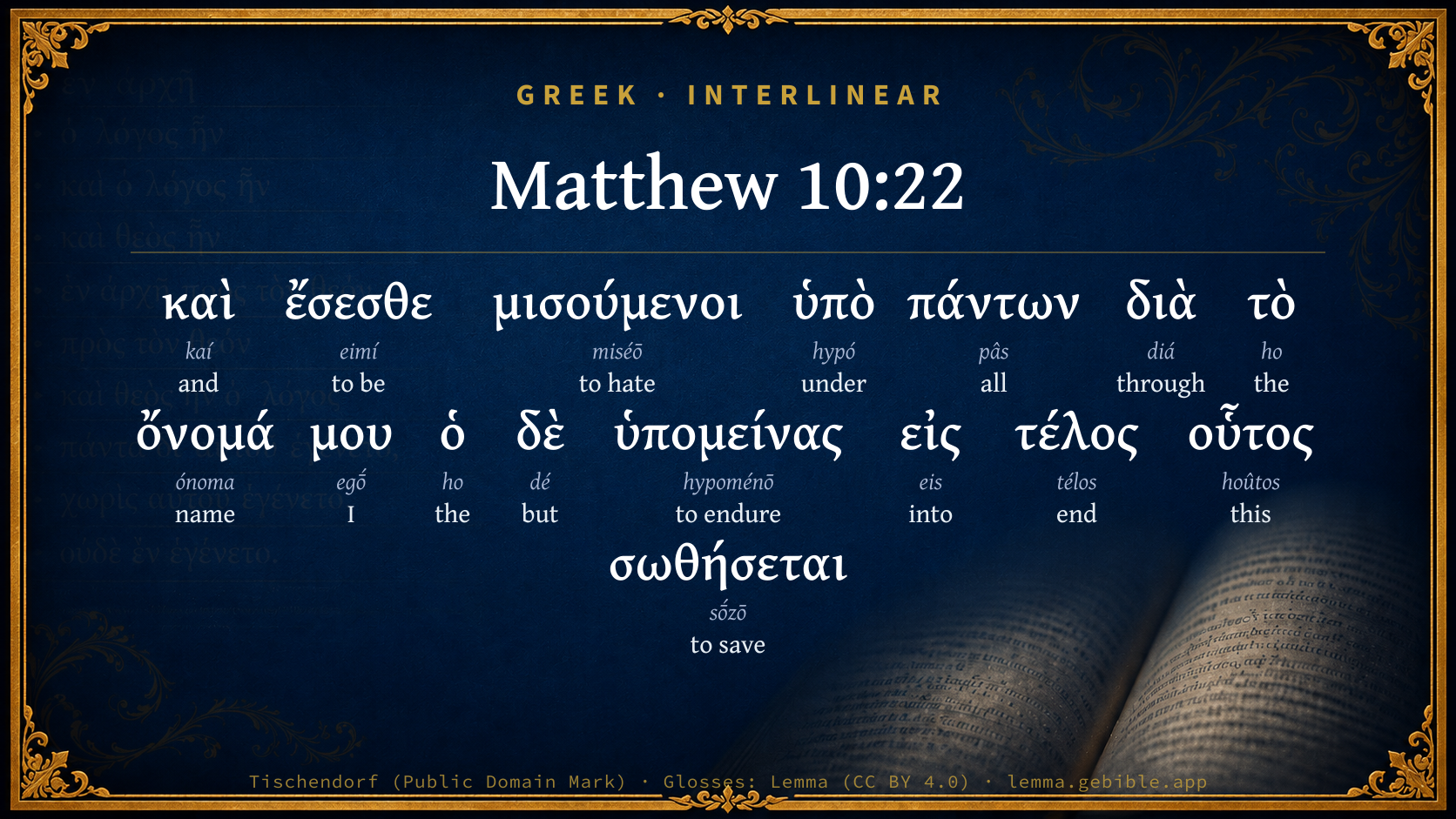
Greek (Tischendorf 8th ed.) Matthew 10:22 appears in the Greek New Testament. The text above is from the Tischendorf 8th edition. Each word links to its Strong’s number and a concise gloss. Click any word for its full Thayer’s Greek Lexicon entry.
Download image
Cite this verse

Matthew 10:22 (World English Bible). Public Domain. Lemma interlinear Bible study tool, https://lemma.gebible.app/v/matthew/10/22.

Show BibTeX & RIS
BibTeX
RIS
English Translation
You will be hated by all men for my name's sake, but he who endures to the end will be saved.
World English Bible · Public Domain
Highlights
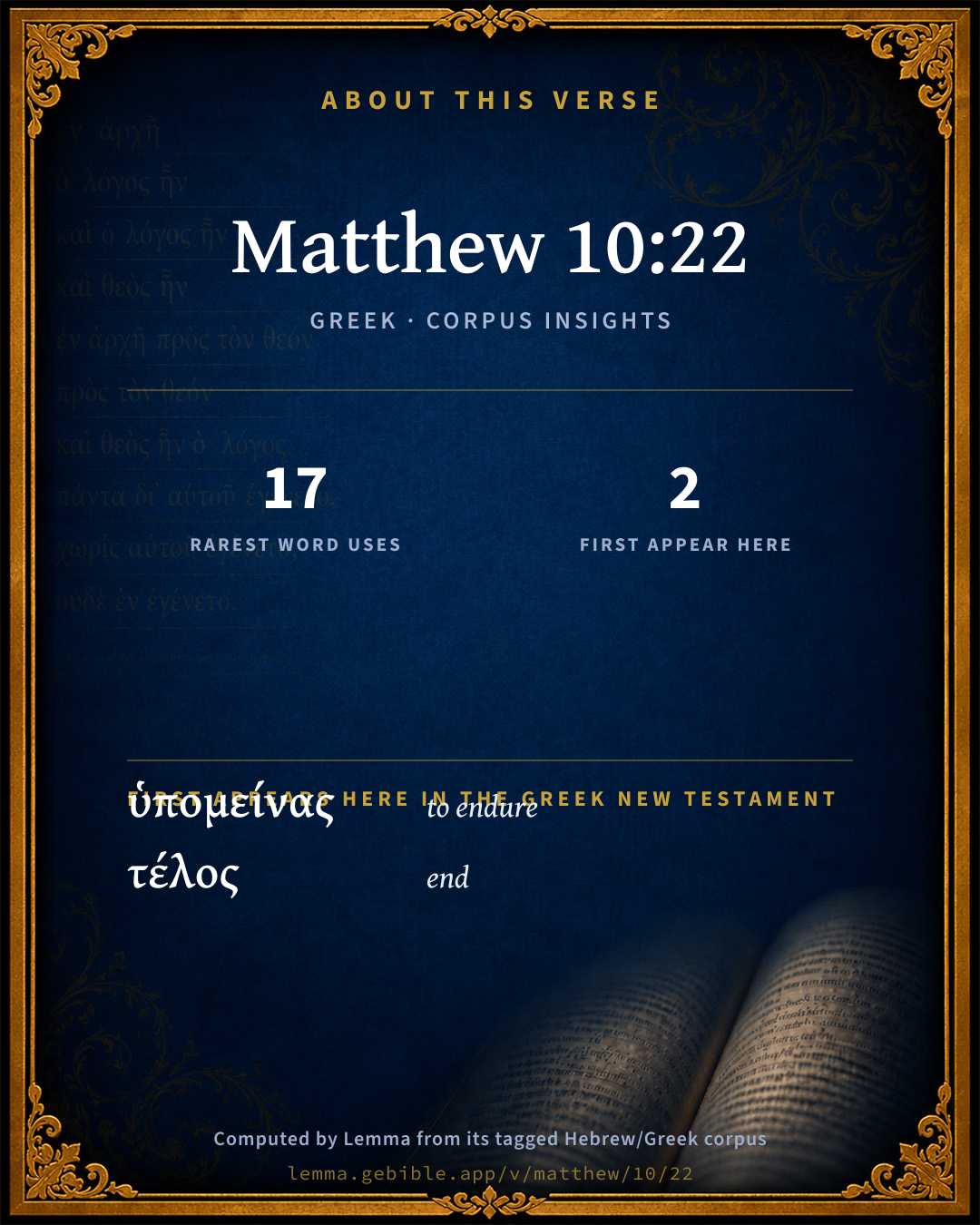
  • 2 first appearances in the Greek New Testament
Full analysis ↓
Download a study sheet

One document with this verse’s original text, its word-by-word gloss line, the meaning frame, cross-references with their text, attributed commentary, and full source and license credits — printable, and it pastes into notes with its structure intact.

This verse Autodidact and up

Study sheet (.html) Plain text (.txt)

A passage Seminary Student

Up to 50 verses in one chapter. A passage sheet keeps up to 6 commentary sources and 12 cross-references per verse, in the order this page ranks them, and says so on the sheet whenever that leaves anything out. Ask for a single verse and you get the Autodidact verse sheet above.

Everything on this page stays free to read, with no account — the sheet is a download of what is already on screen, not access to it.

Want to remove ads? Support Godless Engineer
Compare translations 3

The same verse in 3 English versions, stacked beneath the original-language interlinear above. Click any original word for its lexicon entry.

Each is an independent rendering of the whole verse — the interlinear is not word-aligned to these translations.

Highlighted words mark where these versions differ — a whole-verse word diff, not a word-by-word alignment.

  • World English Bible Public Domain
    You will be hated by all men for my name's sake, but he who endures to the end will be saved.
  • King James Version Public Domain
    And ye shall be hated of all men for my name's sake: but he that endureth to the end shall be saved.
  • unfoldingWord Literal Text CC BY-SA 4.0
    And you will be hated by all because of my name, but the one having endured to the end, this one will be saved.

unfoldingWord Literal Text — © unfoldingWord, licensed CC BY-SA 4.0. Word-aligned USFM3 via Door43 (git.door43.org/unfoldingWord/en_ult).

Versions to compare (up to 4)

3 of 4 selected

Show all 19 translations

Every available English version of this verse, each an independent rendering of the whole verse.

  • World English Bible Public Domain
    You will be hated by all men for my name's sake, but he who endures to the end will be saved.
  • Berean Standard Bible Public Domain
    You will be hated by everyone because of My name, but the one who perseveres to the end will be saved.
  • Majority Standard Bible Public Domain
    You will be hated by everyone because of My name, but the one who perseveres to the end will be saved.
  • King James Version Public Domain
    And ye shall be hated of all men for my name's sake: but he that endureth to the end shall be saved.
  • American Standard Version (1901) Public Domain
    And ye shall be hated of all men for my name's sake: but he that endureth to the end, the same shall be saved.
  • Revised Version (1885) Public Domain
    And ye shall be hated of all men for my name’s sake: but he that endureth to the end, the same shall be saved.
  • Geneva Bible (1599) Public Domain
    And yee shall be hated of all men for my Name: but he that endureth to the end, he shall be saued.
  • Douay-Rheims (1899) Public Domain
    And you shall be hated by all men for my name's sake: but he that shall persevere unto the end, he shall be saved.
  • Young's Literal Translation Public Domain
    and ye shall be hated by all because of my name, but he who hath endured to the end, he shall be saved.
  • Literal Standard Version CC BY-SA 4.0
    and you will be hated by all because of My Name, but he who has endured to the end, he will be saved.
  • Unlocked Literal Bible CC BY-SA 4.0
    You will be hated by everyone because of my name. But whoever endures to the end, that person will be saved.
  • unfoldingWord Literal Text CC BY-SA 4.0
    And you will be hated by all because of my name, but the one having endured to the end, this one will be saved.
  • Darby Bible Public Domain
    and ye shall be hated of all on account of my name. But he that has endured to [the] end, *he* shall be saved.
  • World Messianic Bible Public Domain
    You will be hated by all men for my name’s sake, but he who endures to the end will be saved.
  • Webster's Bible Public Domain
    And ye will be hated by all men for my name's sake: but he that endureth to the end shall be saved.
  • Free Bible Version CC BY-SA 4.0
    Everyone will hate you because you follow me, but those who endure until the end will be saved.
  • Bible in Basic English Public Domain
    And you will be hated by all men because of my name: but he who is strong to the end will have salvation.
  • Text-Critical English NT CC BY 4.0
    You will be hated by all because of my name, but he who endures to the end will be saved.
  • Tyndale New Testament (1534) Public Domain
    and ye shall be hated of all me for my name. But he that endureth to the ende shalbe saved.

Literal Standard Version (2020), Covenant Press — licensed CC BY-SA 4.0. Text via the HelloAO Bible API (eBible.org). Unlocked Literal Bible (unfoldingWord) — licensed CC BY-SA 4.0. Text via the HelloAO Bible API (eBible.org). unfoldingWord Literal Text — © unfoldingWord, licensed CC BY-SA 4.0. Word-aligned USFM3 via Door43 (git.door43.org/unfoldingWord/en_ult). Free Bible Version, Dr. Jonathan Gallagher — licensed CC BY-SA 4.0. Text via the HelloAO Bible API (eBible.org).

Word by word

More ways to search: Search by grammar → Find every occurrence → Compare this word →

Practice this passage: Drill this verse → Learn its vocabulary →

ὑπομείνας
hypoménō
G5278
“to endure”
Verb, Aorist, Active, Participle, Nominative, Singular, Masculine
Part of Speech
Verb
Tense
Aorist
Voice
Active
Mood
Participle
Case
Nominative
Number
Singular
Gender
Masculine
Full Thayer's Definition

Origin: from G5259 and G3306

TDNT: 13:41,6

1. to remain a. to tarry behind 2. to remain i.e. abide, not recede or flee a. to preserve: under misfortunes and trials to hold fast to one's faith in Christ b. to endure, bear bravely and calmly: ill treatments
  1. καὶ kaí G2532 “and” Conjunction
  2. ἔσεσθε eimí G1510 “to be” Verb, Future, Middle deponent, Indicative, 2nd person, Plural
  3. μισούμενοι miséō G3404 “to hate” Verb, Present, Passive, Participle, Nominative, Plural, Masculine
  4. ὑπὸ hypó G5259 “under” Preposition
  5. πάντων pâs G3956 “all” Adjective, Genitive, Plural, Masculine
  6. διὰ diá G1223 “through” Preposition
  7. τὸ ho G3588 “the” Article, Accusative, Singular, Neuter
  8. ὄνομά ónoma G3686 “name” Noun, Accusative, Singular, Neuter
  9. μου egṓ G1473 “I” Personal pronoun, 1st person, Genitive, Singular
  10. ὁ ho G3588 “the” Article, Nominative, Singular, Masculine
  11. δὲ dé G1161 “but” Conjunction
  12. εἰς eis G1519 “into” Preposition
  13. τέλος télos G5056 “end” Noun, Accusative, Singular, Neuter
  14. οὗτος hoûtos G3778 “this” Demonstrative pronoun, Nominative, Singular, Masculine
  15. σωθήσεται sṓzō G4982 “to save” Verb, Future, Passive, Indicative, 3rd person, Singular

About this verse

These counts appear in no published source. They are computed here, from the morphology-tagged text and Lemma’s own curated glosses. What Lemma adds →

16
words
15
distinct lemmas
Gospels
section

Notable vocabulary

The rarest word here is ὑπομείνας to endure G5278 — appearing just 17 times in the whole Greek New Testament.

First appearance in Scripture

These words make their first canonical appearance in the Greek New Testament here:

  • ὑπομείνας to endure G5278
  • τέλος end G5056

Shared distinctive vocabulary

ὑπομείνας to endure G5278 occurs in 16 verses of the Greek New Testament. Also found in:

Repetition

A word recurs within this verse:

Cross-references

27

Topical passages linked to Matthew 10:22 in the Treasury of Scripture Knowledge — connected by theme and wording, ordered by reader-vote popularity; previews shown in the World English Bible.

  • Matthew 24:13 But he who endures to the end, the same will be saved.
  • James 1:12 Blessed is the man who endures temptation, for when he has been approved, he will receive the crown of life, which the Lord promised to those who love him.
  • Revelation 2:10 Don't be afraid of the things which you are about to suffer. Behold, the devil is about to throw some of you into prison, that you may be tested; and you will have oppression for ten days. Be faithful to death, and I will give you the crown of life.
  • Mark 13:13 You will be hated by all men for my name's sake, but he who endures to the end, the same will be saved.
  • Matthew 10:39 He who finds his life will lose it; and he who loses his life for my sake will find it.
  • 1 John 3:13 Don't be surprised, my brothers, if the world hates you.
  • Matthew 24:9 Then they will deliver you up to oppression, and will kill you. You will be hated by all of the nations for my name's sake.
  • Romans 2:7 to those who by patience in well-doing seek for glory and honor and incorruptibility, eternal life;
  • Hebrews 6:11 We desire that each one of you may show the same diligence to the fullness of hope even to the end,
  • John 17:14 I have given them your word. The world hated them, because they are not of the world, even as I am not of the world.
  • Luke 6:22 Blessed are you when men shall hate you, and when they shall exclude and mock you, and throw out your name as evil, for the Son of Man's sake.
  • Galatians 6:9 Let us not be weary in doing good, for we will reap in due season, if we don't give up.
  • Jude 1:20–21 But you, beloved, keep building up yourselves on your most holy faith, praying in the Holy Spirit.
  • John 15:18–21 If the world hates you, you know that it has hated me before it hated you.
  • Matthew 5:11 "Blessed are you when people reproach you, persecute you, and say all kinds of evil against you falsely, for my sake.
  • 2 Corinthians 4:11 For we who live are always delivered to death for Jesus' sake, that the life also of Jesus may be revealed in our mortal flesh.
  • Revelation 2:7 He who has an ear, let him hear what the Spirit says to the assemblies. To him who overcomes I will give to eat of the tree of life, which is in the Paradise of my God.
  • Isaiah 66:5–6 Hear the word of Yahweh, you who tremble at his word: Your brothers who hate you, who cast you out for my name's sake, have said, Let Yahweh be glorified, that we may see your joy; but it is those who shall be disappointed.
  • Luke 8:15 That in the good ground, these are such as in an honest and good heart, having heard the word, hold it tightly, and bring forth fruit with patience.
  • John 7:7 The world can't hate you, but it hates me, because I testify about it, that its works are evil.
  • Revelation 2:17 He who has an ear, let him hear what the Spirit says to the assemblies. To him who overcomes, to him I will give of the hidden manna, and I will give him a white stone, and on the stone a new name written, which no one knows but he who receives it.
  • Revelation 3:21 He who overcomes, I will give to him to sit down with me on my throne, as I also overcame, and sat down with my Father on his throne.
  • Daniel 12:12–13 Blessed is he who waits, and comes to the one thousand three hundred thirty-five days.
  • Acts 9:16 For I will show him how many things he must suffer for my name's sake."
  • Hebrews 3:14 For we have become partakers of Christ, if we hold fast the beginning of our confidence firm to the end:
  • Revelation 2:26 He who overcomes, and he who keeps my works to the end, to him I will give authority over the nations.
  • Revelation 2:3 You have perseverance and have endured for my name's sake, and have not grown weary.

Cross-references courtesy of OpenBible.info (CC BY 4.0).

Commentary

Notes on Matthew 10:22 from classic Christian and Jewish commentators (each source and its license shown beneath its notes). The classic Christian expositions comment on the surrounding passage and are grouped to its opening verse, so a note may address several verses; the Jewish commentaries on the Tanakh (Rashi and others) are per-verse, so they appear only where the commentator wrote on this verse.

Lemma curates 59 commentaries, every one of them public domain or Creative Commons licensed, each selected and text-cleaned for this edition rather than reprinted as found. About our sources →

The Biblical Illustrator

Joseph S. Exell

Mat_10:22

But he that endureth to the end shall be saved.

Enduring to the end

We must not enter the work of the ministry without counting the cost.

I. Perseverance is the badge of the saint.

1. It is the Scriptural mark.

2. Analogy shows us that it is perseverance which must mark the Christian. The winner in the race.

3. The common-sense judgment of mankind tells us, that those who merely begin and do not hold out, will not be saved.

II. Perseverance is therefore the target of all our spiritual enemies.

1. The world.

2. The flesh.

3. It will try our perseverance in service, in suffering, in steadfastness, in doctrine.

III. Perseverance is the glory of Christ.

IV. Perseverance should be the great care of every Christian. (C. H. Spurgeon.)

Only he who reaches the goal may be accounted a Christian

A ship starts on a voyage to Australia-if it stops at Madeira, or returns after reaching the Cape, would you consider that it ought to be called an emigrant ship for new South Wales? It must go the whole voyage, or it does not deserve the name. A man has begun to build a house, and has erected one side of it-do you consider him a builder if he stops there, and fails to cover it in or to finish the other walls? Do we give men praise for being warriors because they know how to make one desperate charge, but lose the campaign? Have we not, of late, smiled at the boasting despatches of commanders, in fights where both combatants fought with valour, and yet neither of them had the common sense to push on to reap the victory? What was the very strength of Wellington, but that when a triumph had been achieved, he knew how to reap the harvest which had been sown in blood? And he only is a true conqueror, and shall be crowned at the last, who continueth till wars trumpet is blown no more. It is with a Christian as it was with the great Napoleon: he said, Conquest has made me what I am, and conquest must maintain me. So, under God, conquest has made you what you are, and conquest must sustain you. (C. H. Spurgeon.)

Perseverance in the midst of trial

When Mr. Smeaton had built the lighthouse upon the Eddystone, he looked out anxiously after a storm to see if the edifice was still there, and it was his great joy when he could see it still standing, for a former builder had constructed an edifice which he thought to be indestructible, and expressed a wish that he might be in it in the worst storm which ever blew, and he was so, and neither himself nor his lighthouse were ever seen afterwards. Now you have to be exposed to multitudes of storms; you must be in your lighthouse in the worst storm which ever blew; build firmly then on the Rock of Ages, and make sure work for eternity, for if you do these things, ye shall never fall. For this Churchs sake, I pray you do it; for nothing can dishonour and weaken a Church so much as the falls of professors. A thousand rivers flow to the sea, and make rich the meadows, but no man heareth the sound thereof; but if there be one cataract, its roaring will be heard for miles, and every traveller will mark the fall. A thousand Christians can scarcely do such honour to their Master as one hypocrite can do dishonour to Him. (C. H. Spurgeon.)

Final perseverance

It cannot be guaranteed by-

1. Habit, which may extend only to the outer framework, and not to the spirit, motive, temper of the religious life.

2. Determination. The will can do almost everything except be sure of itself amid circumstances which go against the grain.

3. Indefectible Grace. This doctrine is no part of the New Testament teaching. It reduces the sacraments and ordinances of religion to mere charms. It brings probation to an end, for it practically abolishes freewill. The Christians perseverance may be morally, but it is assuredly not mechanically, certain. (Canon Liddon.)

The causes which make endurance difficult

1. Persecution arising because of the Word.

2. False christs and false prophets, which in our day may mean a sceptical friend, an insidious article in a magazine, or merely the dangerous atmosphere of the social circle in which we live.

3. The spiritual weariness which steals over the soul with the lapse of time. We cannot sustain ourselves for ever on the mountains; we must, sooner or later, descend to the plain. Depression ensues, and we find it difficult to struggle on.

4. Trifling with conscience-not necessarily in great matters, but in a number of little matters-omissions or curtailments of daily prayers, neglect of a regular review of conscience, carelessness as to objects on which money is spent, recklessness in intercourse with others. These, and like matters, help forward a dull and inoperative state of conscience, which is itself preparatory to a great failure. (Canon Liddon.)

How to secure perseverance

1. A sense of constant dependence on God. To be self-confident is to be in danger, for God resisteth the proud, but giveth grace to the humble.

2. Prayer for this special grace. To win perseverance, prayer must persevere. Be not discouraged, although your prayer does not seem to be answered all at once. God may be testing your integrity of purpose. It is after describing all the parts of a Christians armour-the girdle of truth, the breastplate of righteousness, the sandals of preparation, the shield of faith, the helmet of salvation, the sword of the Spirit-that the apostle adds, Praying alway, with all prayer and supplication in the Spirit, and watching thereunto with all perseverance.

3. Keeping the mind fixed, as much as possible, on the end of life, and on that which follows it. Death is as certain for each one of us as the how, the when, and the where of its occurrence are uncertain. Let us then set lightly by this life, and embark something less than the best half of our hearts in its concerns and interests. The shore may still be distant, but the sailor keeps his eye on it as he prays for the skill and the strength to weather the passing storm. On those heights which are beyond the valley of death, the eyes of the predestinate constantly rest, and the sight sustains them in times of trouble, darkness, and despair, which would otherwise prove beyond the powers of their endurance. The end is well worth the effort; and, since we are in the hands of infinite Love, the effort will be enduring, if the end be kept steadily in view. (Canon Liddon.)

Staying power

It is not the fiery, headlong running in the course, nor the rapid, hurried stroke in the boat, which mean victory. The man who has what is called staging power, who endureth to the end, wins. (Wilmot Buxton.)

Perseverance is the only triumphing grace. (St. Bernard.)

The Biblical Illustrator, edited by Joseph S. Exell (c. 1880s–1900s) — public domain. Text from a community e-Sword module.

Bengel's Gnomon

Johann Albrecht Bengel

Mat 10:22. Διὰ τὸ ὄνομά Μου, for My name’s sake) which the world hates.—οὗτος, κ.τ.λ., this man, etc.) truly. This is one of the apothegms which our Lord uttered more than once.—See ch. Mat 24:13.

Bengel's Gnomon of the New Testament — English translation (T&T Clark, Edinburgh, 1860) — public domain. Text from a community e-Sword module.

Meyer's Critical & Exegetical Commentary

Heinrich August Wilhelm Meyer

Mat_10:22. Ὑπὸ πάντων] Popular way of expressing the universal character of the hatred.

διὰ τὸ ὄνομά μου] because you confess and preach it. Tertullian, Apol. 2 : Torquemur confitentes et punimur perseverantes et absolvimur negantes, quia nominis proelium est.

ὑπομείνας] whosoever will have persevered in the confessing of my name. This is to be inferred from διὰ τὰ ὄνομά μου. Comp. note on Mat_24:13.

εἰς τέλος] usque ad finem horum malorum (Theophylact, Beza, Fritzsche). Others think that the end of life is meant, or (as also Bleek) mingle together a variety of references. Contrary to Mat_10:23.

σώζεσθαι] obtain the blessedness of the Messianic kingdom.

Meyer — Critical and Exegetical Commentary on the New Testament — English translation by Peter Christie, edited by Frederick Crombie (T&T Clark, 1880) — public domain. Text from a community e-Sword module.

Expositor's Greek Testament

ed. W. Robertson Nicoll

Mat 10:22 . εἰς τέλος , to the end (of the tribulations) described (Mat 10:21-22 ); to the end, and not merely at the beginning (Theophy., Beza, Fritzsche, Weiss, etc.). No easy thing to do, when such inhumanities and barbarities are going on, all natural and family affections outraged. But it helps to know, as is here indirectly intimated, that there will be an end, that religious animosities will not last for ever. Even persecutors and guillotineers get weary of their savage work. On εἰς τέλος Beza remarks: declarat neque momentaneam neque perpetuam hanc conditionem fore. οὗτος σωθήσεται , he , emphatic, he and no other, shall be saved, in the day of final award (Jas 1:12 , “shall receive the crown of life”); also, for the word is pregnant, shall be saved from moral shipwreck. How many characters go miserably down through cowardice and lack of moral fibre in the day of trial!

The Expositor's Greek Testament, edited by W. Robertson Nicoll (1897–1910) — public domain. Text from a community e-Sword module.

Jamieson, Fausset & Brown

Robert Jamieson, A. R. Fausset & David Brown

And ye shall be hated of all men for my name's sake--The universality of this hatred would make it evident to them, that since it would not be owing to any temporary excitement, local virulence, or personal prejudice, on the part of their enemies, so no amount of discretion on their part, consistent with entire fidelity to the truth, would avail to stifle that enmity--though it might soften its violence, and in some cases avert the outward manifestations of it.

but he that endureth to the end shall be saved--a great saying, repeated, in connection with similar warnings, in the prophecy of the destruction of Jerusalem (Mat 24:13); and often reiterated by the apostle as a warning against "drawing back unto perdition" (Heb 3:6, Heb 3:13; Heb 6:4-6; Heb 10:23, Heb 10:26-29, Heb 10:38-39, &c.). As "drawing back unto perdition" is merely the palpable evidence of the want of "root" from the first in the Christian profession (Luk 8:13), so "enduring to the end" is just the proper evidence of its reality and solidity.

Jamieson, Fausset & Brown — Commentary Critical and Explanatory on the Whole Bible (1871) — public domain (CC PDM 1.0). Text via the HelloAO Bible API.

Adam Clarke's Commentary

Verse 22. Ye shall be hated of all men for my name's sake] Because ye are attached to me, and saved from the corruption that is in the world; therefore the world will hate you. "The laws of Christ condemn a vicious world, and gall it to revenge."

He that endureth to the end shall be saved] He who holds fast faith and a good conscience to the end, till the punishment threatened against this wicked people be poured out, he shall be saved, preserved from the destruction that shall fall upon the workers of iniquity. This verse is commonly understood to refer to the destruction of Jerusalem. It is also true that they who do not hold fast faith and a good conscience till death have no room to hope for an admission into the kingdom of God.

Adam Clarke's Commentary on the Bible (1810–1826) — public domain. Text from a community e-Sword/MySword module.

Ellicott's Commentary for English Readers

(22) Hated of all men for my name’s sake.—Here, as before, the words sketch out the history of the persecution with a precision which marks and attests the divine foreknowledge. From the days of Stephen to that of the last martyr under Diocletian it was always as a Christian and for the name of Christ that men thus suffered. Would they but renounce that, all would have gone smoothly with them. As Tertullian said of the sufferers of his day, “We are tortured when we confess our guilt, we are set free if we deny it, for the battle is about a Name” (Apol. c. 2). (Comp. 1Pe_4:16.)

He that endureth to the end—i.e., endures, as the context shows, in the confession of the name of Christ as long as the trial lasts, or to the end of his own life. Such a one should receive “salvation” in its highest sense, the full participation in the blessedness of the kingdom of the Christ.

A Bible Commentary for English Readers, edited by Charles John Ellicott (1878–1897) — public domain. Text from a community e-Sword module.

The Cambridge Bible for Schools and Colleges

gen. ed. J. J. S. Perowne

22. he that endureth to the end shall be saved] The parallel expression in Luk_21:18 is made clear by this verse; “by your patience win for yourselves your souls,” i. e. win your true life by enduring to the end. Comp. Rom_5:4-5, “we glory in tribulation also, knowing that tribulation worketh patience, and patience experience, and experience hope.”

The Cambridge Bible for Schools and Colleges (gen. ed. J. J. S. Perowne; Cambridge University Press, 1878–1918) — public domain. Text from a community e-Sword module.

John Gill's Exposition

But when they persecute you in this city,.... Or any city into which they went, and preached the Gospel; and would not suffer them to go on in their work, they were not to desist, but to go elsewhere, where they might hope for a better reception, and a longer continuance, and so of doing more good:

flee ye into another; not so much for their own safety, though this, according to the circumstances of things, is lawful, but for the further spreading of the Gospel. The exhortation is not to take methods to avoid persecution, or to make an escape from it, but to perseverance under it: the sense is, they were not to be discouraged, and to leave off, because of persecution in one place, but to persist in the ministration of the Gospel, by carrying it to other cities; and it seems to be a spur to them to make haste, and fulfil their office of preaching the Gospel, in the land of Judea: nor need they fear going on too fast, lest they should have no places to preach in;

for verily I say unto you, this is a certain and indisputable truth not to be called in question, being strongly affirmed by truth itself,

ye shall not have gone over the cities of Israel, or "finished" them; that is, their tour through them, and their ministry, or the preaching of the Gospel in them,

till the son of man be come; which is not to be understood of his second coming to judgment, but either of his resurrection from the dead, when he was declared to be the Son of God, and when his glorification began; or of the pouring forth of the Spirit at the day of Pentecost, when his kingdom began more visibly to take place, and he was made, or manifested to be the Lord and Christ; or of his coming to take vengeance on his enemies, that would not have him to rule over them, and the persecutors of his ministers, at the destruction of Jerusalem.

John Gill's Exposition of the Whole Bible (1746–1763) — public domain (CC PDM 1.0). Text via the HelloAO Bible API.

Trapp's Complete Commentary

John Trapp

22 And ye shall be hated of all men for my name’s sake: but he that endureth to the end shall be saved.

Ver. 22. And ye shall be hated] Haud perinde crimine incendii quam odio humani generis convicti sunt, saith Tacitus of those poor Christians, that by Nero were haled to death for setting the city of Rome on fire, which was done by himself. Tertullian telleth us that their name, and not their crime, was punished in Christians. So Luther complaineth that there was in his days no crime comparable to that of professing the gospel. Nullum flagitium hodie par est huic uni et summo sacrilegio, sc. Evangelion Dei confiteri. Luther, Epist. ad Episc. Sambiensem. Melch. Adam, in Vit. Brent.

But he that endureth to the end] Apostasy loseth the things that it hath wrought, 2Jn 1:8. Non quaeruntur in Christianis initia, sed finis, saith Jerome. It is the evening that crowneth the day, and the last scene that commends the interlude.

John Trapp, A Commentary or Exposition upon All the Books of the Old and New Testament (1647–1656) — public domain. Text from a community e-Sword module.

Albert Barnes' Notes on the Bible

Ye shall be hated of all men - That is, of all kinds of people. The human heart would be opposed to them, because it is opposed to Christ.

But he that endureth to the end ... - That is, to the end of life, be it longer or shorter. He that bears all these unspeakable sufferings, and who does not shrink and apostatize, will give decisive evidence of attachment to me, and shall enter into heaven. See Rev 3:21-22.

Albert Barnes' Notes on the Bible (1834–1885) — public domain. Text from a community e-Sword/MySword module.

Haydock's Catholic Bible Commentary

He that shall persevere, &c. We are here told, that to be saved it is not sufficient that we were once virtuous, we must persevere to the end. We are also assured of the same truth in Ezechiel. If the just man shall turn away from his justice, and shall commit iniquity, he shall die in his sins, and his justice which he hath done shall not be remembered. (Chap. iii, ver. 20.) (Haydock) --- Some, says St. Chrysostom, are accustomed to be fervent at the beginning of their conversion, but afterwards grow remiss; of what advantage are seeds that flourish in the beginning, but afterwards wither and die? (St. John Chrysostom in St. Thomas Aquinas)

George Leo Haydock (1774–1849), Haydock's Catholic Family Bible and Commentary, 1859 edition — public domain. Excludes Psalms (Douay-Rheims chapter numbering differs from Protestant) and Deuterocanonical books (Catholic canon only).

Whedon's Commentary on the Bible

Daniel D. Whedon

22. Shall be hated of all men — That is, of all men out of the Christian community. Tacitus, the Roman historian, says, like a true pagan, that “the Christians were convicted of enmity to the human race;” Jews hated them as revolters from their own religion. Pagans could tolerate each other, and respect and worship each other’s gods. But the Christians abhorred all paganism, and so all pagans abhorred them; thus, Christians were hated of all men, whether Jews or Gentiles. The Christian was surrounded on every side by Jewish and by pagan rites. Every hour of the day, and at every turn, he was called upon to manifest his aversion to them. The consequence was, that while every other sect was tolerated, Christianity was the object of bloody persecution. For my name’s sake — This endurance of persecution, and this abhorrence of false religions, was neither a fiery fanaticism nor a vain superstition. It was for Jesus’s sake. It was suffering for truth, for Christ, and for God. Endureth to the end — To the end of his life and probation. To have once put faith in Christ is not the full condition of salvation. Faith, and perseverance of faith to the end, are the complete condition. That faith may be renounced. The Saviour once accepted, may be afterward rejected. Apostacy, total and final, may forfeit the reward.

Daniel D. Whedon (gen. ed.), Commentary on the Old and New Testaments (1874–1909) — public domain. Text from a community e-Sword module.

The Pulpit Commentary

And ye shall be hated. For no little time (esesye misoumenoi). "Suffering sometimes becomes as a reward for debug. You read of the heifers which brought home the ark out of the Philistines" country, that, when they brought the ark home, the Israelites took the heifers and offered them up to God, as a sacrifice. (1Sa_6:14) "Why so?" saith one. "It is an ill requital to the heifers." No; the heifers could not have so high an honour put upon them" (Php_1:29 Act_9:16 Act_21:13) (Wm. Bridge, in Ford). Of all men (ver. 17, note). As with the old Israel, so also with the new (cf. Kubel). For my name"s sake. (2Ti_2:11) To the end (eiv telov); i.e. not to the end of the time during which persecution shall last (eiv to telov ), but to completeness in the endurance required. (cf. Joh_13:1 Bishop Westcott"s note 1Th_2:16) Shall be saved. In the fullest sense. (cf. the parallel passage, Luk_21:19)

The Pulpit Commentary (1880–1919), ed. H.D.M. Spence-Jones & Joseph S. Exell — public domain. Text from a community e-Sword module.

John Wesley's Explanatory Notes

Of all men - That know not God. Matt. xxiv, 13.

John Wesley, Explanatory Notes Upon the Whole Bible (1754–1765) — public domain. Text via the GEBible commentary corpus.

The People's New Testament

B. W. Johnson

22. Ye shall be hated of all men. As they assailed and sought to destroy all evil, and evil is wont to unite against them. Jews and pagans made a common cause against early Christianity. The wicked and perverse hate it still. He that endureth to the end. Holds out faithful. Perseverance gives proof of genuine faith, and is sure of reward.

B. W. Johnson's The People's New Testament with Notes (1889–1891) — public domain. Electronic text from the Christian Classics Ethereal Library (CCEL) ThML edition.

Cambridge Greek Testament for Schools and Colleges

22. ὁ δὲ ὑπομείνας εἰς τέλος κ.τ.λ. The parallel expression Luk 21:19 is made clear by this verse, ἐν τῇ ὑπομονῇ ὑμῶν κτήσεσθε τὰς ψυχὰς ὑμῶν, ‘by your patience ye shall win for yourselves your souls,’ i.e. win your true life by enduring to the end. Comp. Rom 5:3-5, καυχῶμεθα ἐν ταῖς θλίψεσιν εἰδότες ὅτι η θλίψις ὑπομονὴν κατεργάζεται ἡ δὲ ὑπομονὴ δοκιμὴν, ἡ δὲ δοκιμὴ ἐλπίδα ἡ δὲ ἐλπὶς οὐ καταισχύνει.

σωθήσεται. ‘Shall be saved,’ shall win σωτηρία. In classical Greek σωτηρία means, ‘safety,’ ‘welfare,’ i.e. life secure from evil, cp. Luk 1:71; in the Christian sense it is a life of secured happiness, hence ‘salvation’ is the highest sense. So σώζεσθαι = ‘to live securely’ with an additional notion of rescue from surrounding danger, οἱ σωζόμενοι means those who are enjoying this life of blessed security.

Cambridge Greek Testament for Schools and Colleges (Cambridge University Press, 1896; 21 vols, various authors incl. Carr, Maclear, Plummer, Farrar, Lumby, Moule, M. R. James, Simcox) — public domain. Text from a community e-Sword module.

Alford’s Greek Testament

Henry Alford

22. πάντων] i.e. all else but yourselves; not, as De Wette so often interprets, ‘a strong expression, intended to signify many, or the majority of mankind.’

ὁ δὲ ὑπομ.] In order to understand these words it is necessary to enter into the character of our Lord’s prophecies respecting His coming, as having an immediate literal, and a distant foreshadowed fulfilment. Throughout this discourse and the great prophecy in ch. 24, we find the first apostolic period used as a type of the whole ages of the Church; and the vengeance on Jerusalem, which historically put an end to the old dispensation, and was in its place with reference to that order of things, the coming of the Son of Man, as a type of the final coming of the Lord. These two subjects accompany and interpenetrate one another in a manner wholly inexplicable to those who are unaccustomed to the wide import of Scripture prophecy, which speaks very generally not so much of events themselves, points of time,—as of processions of events, all ranging under one great description. Thus in the present case there is certainly direct reference to the destruction of Jerusalem; the τέλος directly spoken of is that event, and the σωθήσεται the preservation provided by the warning afterwards given in ch. 24:15-18. And the next verse directly refers to the journeys of the Apostles over the actual cities of Israel, territorial, or where Jews were located. But as certainly do all these expressions look onwards to the great final coming of the Lord, the τέλος of all prophecy; as certainly the σωθήσεται here bears its full scripture meaning, of everlasting salvation; and the endurance to the end is the finished course of the Christian; and the precept in the next verse is to apply to the conduct of Christians of all ages with reference to persecution, and the announcement that hardly will the Gospel have been fully preached to all nations (or, to all the Jewish nation, i.e. effectually) when the Son of Man shall come. It is most important to keep in mind the great prophetic parallels which run through our Lord’s discourses, and are sometimes separately, sometimes simultaneously, presented to us by Him. That the tracing out and applying such parallels should be called by such expositors as Meyer, ‘lauter wortwidrige und nothgedrungene Ausflúchte’ (Com. i. 211), is just as if a man should maintain that a language unknown to him had therefore no meaning.

Henry Alford, The Greek Testament (1849–1861) — public domain. Text from a community e-Sword module.

International Critical Commentary

(M) 22. And ye shall be hated by all for My name’s sake. But he that endured to the end, he shall be saved.] So Mk. In Mk. the τέλος is the coming of the Son of Man in the period after the great tribulation; cf. 2 Es 6:25 “Whosoever remaineth—he shall be saved, and shall see My salvation, and the end of the world”; 9:7, 8 “And every one that shall be saved—shall be preserved.”—ὑπομείνας] cf. Dan 12:12 (Th.) μακάριος ὁ ὑπομένων.

International Critical Commentary — older volumes (1896–1929), various authors — public domain. Text from a community e-Sword module.

Lesson kit

Teaching starters — assembled from the data on this page, not authored interpretation. Every prompt links to the verse data it draws on. Edit before teaching.

Matthew, in the Gospels, opens this verse with 16 words (15 distinct Greek lemmas). Its most distinctive word is hypoménō (“to endure”). A historical commentator’s framing appears above. Read the whole chapter for the surrounding context.

Discussion questions

  1. How does “to endure” (hypoménō) shape what this verse is saying?
  2. 2 words make their first appearance in Scripture here. What does this debut establish?
  3. How does Matthew 24:13, which shares the word «to endure», read alongside this verse?
  4. What does the repetition of “the” (2× in this one verse) do in this verse?
  5. These translations render this verse differently; the difference is in the English rendering, not the original. What questions does that raise?
  6. Compare how The Biblical Illustrator and Bengel's Gnomon read this verse. Where do they agree or differ?

Things to notice

  • 2 words make their first canonical appearance in Scripture here.
  • These translations choose different wording for 14 words in this verse.
  • “the” occurs 2× in this single verse.
  • 15 distinct Greek lemmas span 16 words in this verse.

Reading settings

Reading text

Shown beneath each verse's original-language words.

Old Testament
Old Testament edition

Read the OT as the Masoretic Hebrew (MT) or the Greek Septuagint (LXX).

English shown for the Greek Septuagint (in the Hebrew ↔ Greek comparison).

Comparing translations? Open the Compare panel on any verse page to stack up to four side by side.