
Matthew 3:15

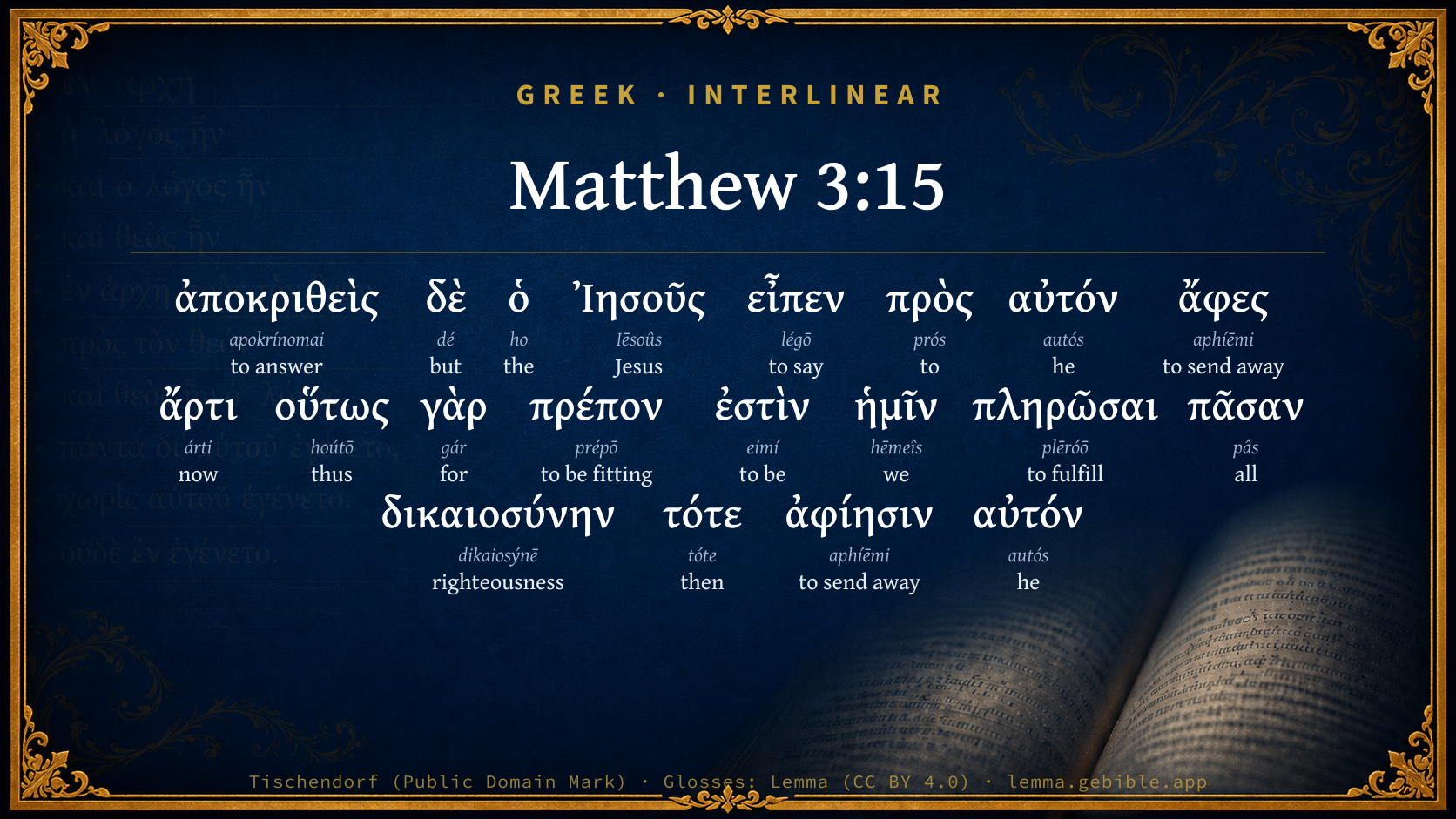
Greek (Tischendorf 8th ed.) Matthew 3:15 appears in the Greek New Testament. The text above is from the Tischendorf 8th edition. Each word links to its Strong’s number and a concise gloss. Click any word for its full Thayer’s Greek Lexicon entry.
Download image
Cite this verse

Matthew 3:15 (World English Bible). Public Domain. Lemma interlinear Bible study tool, https://lemma.gebible.app/v/matthew/3/15.

Show BibTeX & RIS
BibTeX
RIS
English Translation
But Jesus, answering, said to him, "Allow it now, for this is the fitting way for us to fulfill all righteousness." Then he allowed him.
World English Bible · Public Domain
Highlights
  • 5 first appearances in the Greek New Testament
Full analysis ↓
Download a study sheet

One document with this verse’s original text, its word-by-word gloss line, the meaning frame, cross-references with their text, attributed commentary, and full source and license credits — printable, and it pastes into notes with its structure intact.

This verse Autodidact and up

Study sheet (.html) Plain text (.txt)

A passage Seminary Student

Up to 50 verses in one chapter. A passage sheet keeps up to 6 commentary sources and 12 cross-references per verse, in the order this page ranks them, and says so on the sheet whenever that leaves anything out. Ask for a single verse and you get the Autodidact verse sheet above.

Everything on this page stays free to read, with no account — the sheet is a download of what is already on screen, not access to it.

Want to remove ads? Support Godless Engineer
Compare translations 3

The same verse in 3 English versions, stacked beneath the original-language interlinear above. Click any original word for its lexicon entry.

Each is an independent rendering of the whole verse — the interlinear is not word-aligned to these translations.

Highlighted words mark where these versions differ — a whole-verse word diff, not a word-by-word alignment.

  • World English Bible Public Domain
    But Jesus, answering, said to him, "Allow it now, for this is the fitting way for us to fulfill all righteousness." Then he allowed him.
  • King James Version Public Domain
    And Jesus answering said unto him, Suffer it to be so now: for thus it becometh us to fulfil all righteousness. Then he suffered him.
  • unfoldingWord Literal Text CC BY-SA 4.0
    But answering, Jesus said to him, “Permit now, for in this way it is fitting for us to fulfill all righteousness.” Then he permits him.

unfoldingWord Literal Text — © unfoldingWord, licensed CC BY-SA 4.0. Word-aligned USFM3 via Door43 (git.door43.org/unfoldingWord/en_ult).

Versions to compare (up to 4)

3 of 4 selected

Show all 19 translations

Every available English version of this verse, each an independent rendering of the whole verse.

  • World English Bible Public Domain
    But Jesus, answering, said to him, "Allow it now, for this is the fitting way for us to fulfill all righteousness." Then he allowed him.
  • Berean Standard Bible Public Domain
    “Let it be so now,” Jesus replied. “It is fitting for us to fulfill all righteousness in this way.” Then John permitted Him.
  • Majority Standard Bible Public Domain
    “Let it be so now,” Jesus replied. “It is fitting for us to fulfill all righteousness in this way.” Then John permitted Him.
  • King James Version Public Domain
    And Jesus answering said unto him, Suffer it to be so now: for thus it becometh us to fulfil all righteousness. Then he suffered him.
  • American Standard Version (1901) Public Domain
    But Jesus answering said unto him, Suffer `it' now: for thus it becometh us to fulfil all righteousness. Then he suffereth him.
  • Revised Version (1885) Public Domain
    But Jesus answering said unto him, Suffer it now: for thus it becometh us to fulfill all righteousness. Then he suffereth him.
  • Geneva Bible (1599) Public Domain
    Then Iesus answering, saide to him, Let be nowe: for thus it becommeth vs to fulfill all righteousnes. So he suffered him.
  • Douay-Rheims (1899) Public Domain
    And Jesus answering, said to him: Suffer it to be so now. For so it becometh us to fulfill all justice. Then he suffered him.
  • Young's Literal Translation Public Domain
    But Jesus answering said to him, `Suffer now, for thus it is becoming to us to fulfill all righteousness,' then he doth suffer him.
  • Literal Standard Version CC BY-SA 4.0
    But Jesus answering said to him, “Permit [it] now, for thus it is fitting to us to fulfill all righteousness,” then he permits Him.
  • Unlocked Literal Bible CC BY-SA 4.0
    Jesus responded and said to him, “Permit it now, for it is right for us to fulfill all righteousness.” Then John permitted him.
  • unfoldingWord Literal Text CC BY-SA 4.0
    But answering, Jesus said to him, “Permit now, for in this way it is fitting for us to fulfill all righteousness.” Then he permits him.
  • Darby Bible Public Domain
    But Jesus answering said to him, Suffer [it] now; for thus it becometh us to fulfil all righteousness. Then he suffers him.
  • World Messianic Bible Public Domain
    But Yeshua, answering, said to him, “Allow it now, for this is the fitting way for us to fulfill all righteousness.” Then he allowed him.
  • Webster's Bible Public Domain
    And Jesus answering said to him, Suffer it to be so now: for thus it becometh us to fulfill all righteousness. Then he suffered him.
  • Free Bible Version CC BY-SA 4.0
    “Please do so, because it's good for us to do what God says is right,” Jesus told him. So John agreed to do it.
  • Bible in Basic English Public Domain
    But Jesus made answer, saying to him, Let it be so now: because so it is right for us to make righteousness complete. Then he gave him baptism.
  • Text-Critical English NT CC BY 4.0
    But Jesus answered him, “Permit it for now, for thus it is fitting for us to fulfill all righteousness.” Then John permitted him.
  • Tyndale New Testament (1534) Public Domain
    Iesus answered and sayd to hym: Let it be so now. For thus it becommeth vs to fulfyll all rightwesnes. Then he suffred hym.

Literal Standard Version (2020), Covenant Press — licensed CC BY-SA 4.0. Text via the HelloAO Bible API (eBible.org). Unlocked Literal Bible (unfoldingWord) — licensed CC BY-SA 4.0. Text via the HelloAO Bible API (eBible.org). unfoldingWord Literal Text — © unfoldingWord, licensed CC BY-SA 4.0. Word-aligned USFM3 via Door43 (git.door43.org/unfoldingWord/en_ult). Free Bible Version, Dr. Jonathan Gallagher — licensed CC BY-SA 4.0. Text via the HelloAO Bible API (eBible.org).

Word by word

More ways to search: Search by grammar → Find every occurrence → Compare this word →

Practice this passage: Drill this verse → Learn its vocabulary →

πρέπον
prépō
G4241
“to be fitting”
Verb, Present, Active, Participle, Nominative, Singular, Neuter
Part of Speech
Verb
Tense
Present
Voice
Active
Mood
Participle
Case
Nominative
Number
Singular
Gender
Neuter
Full Thayer's Definition

Origin: apparently a root word

TDNT: None

1. to stand out, to be conspicuous, to be eminent 2. to be becoming, seemly, fit
  1. ἀποκριθεὶς apokrínomai G611 “to answer” Verb, Aorist, Passive deponent, Participle, Nominative, Singular, Masculine
  2. δὲ dé G1161 “but” Conjunction
  3. ὁ ho G3588 “the” Article, Nominative, Singular, Masculine
  4. Ἰησοῦς Iēsoûs G2424 “Jesus” Noun, Nominative, Singular, Masculine
  5. εἶπεν légō G3004 “to say” Verb, Aorist, Active, Indicative, 3rd person, Singular
  6. πρὸς prós G4314 “to” Preposition
  7. αὐτόν autós G846 “he” Personal pronoun, Accusative, Singular, Masculine
  8. ἄφες aphíēmi G863 “to send away” Verb, Aorist, Active, Imperative, 2nd person, Singular
  9. ἄρτι árti G737 “now” Adverb
  10. οὕτως hoútō G3779 “thus” Adverb
  11. γὰρ gár G1063 “for” Conjunction
  12. ἐστὶν eimí G1510 “to be” Verb, Present, Active, Indicative, 3rd person, Singular
  13. ἡμῖν hēmeîs G2249 “we” Personal pronoun, 1st person, Dative, Plural
  14. πληρῶσαι plēróō G4137 “to fulfill” Verb, Aorist, Active, Infinitive
  15. πᾶσαν pâs G3956 “all” Adjective, Accusative, Singular, Feminine
  16. δικαιοσύνην dikaiosýnē G1343 “righteousness” Noun, Accusative, Singular, Feminine
  17. τότε tóte G5119 “then” Adverb
  18. ἀφίησιν aphíēmi G863 “to send away” Verb, Present, Active, Indicative, 3rd person, Singular
  19. αὐτόν autós G846 “he” Personal pronoun, Accusative, Singular, Masculine

About this verse

These counts appear in no published source. They are computed here, from the morphology-tagged text and Lemma’s own curated glosses. What Lemma adds →

20
words
18
distinct lemmas
Gospels
section

Notable vocabulary

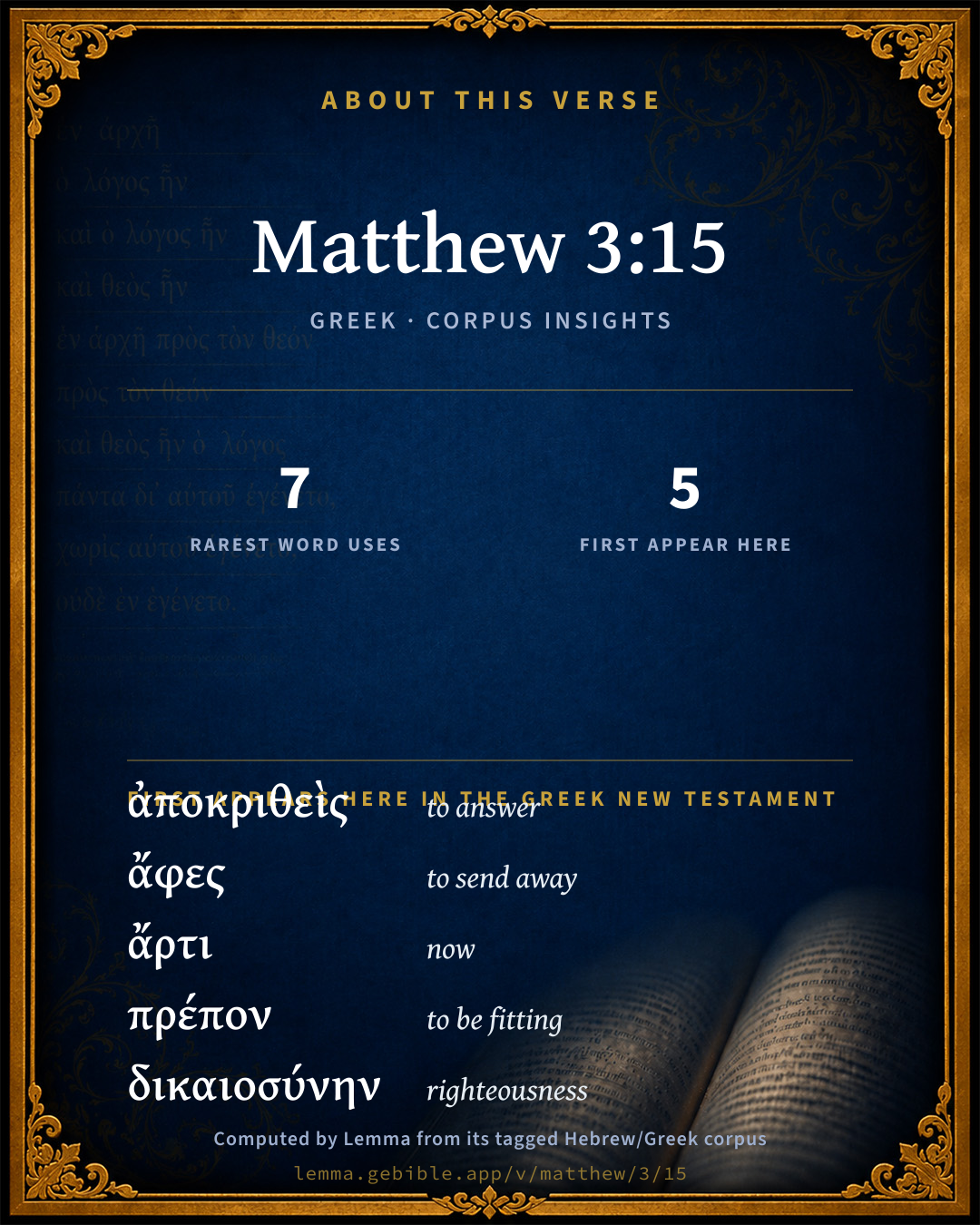
The rarest word here is πρέπον to be fitting G4241 — appearing just 7 times in the whole Greek New Testament.

First appearance in Scripture

These words make their first canonical appearance in the Greek New Testament here:

  • ἀποκριθεὶς to answer G611
  • ἄφες to send away G863
  • ἄρτι now G737
  • πρέπον to be fitting G4241
  • δικαιοσύνην righteousness G1343

Shared distinctive vocabulary

πρέπον to be fitting G4241 occurs in 7 verses of the Greek New Testament. Also found in:
Repetition

Words recur within this verse:

  • ἄφες to send away G863 ×2
  • αὐτόν he G846 ×2

Cross-references

12

Topical passages linked to Matthew 3:15 in the Treasury of Scripture Knowledge — connected by theme and wording, ordered by reader-vote popularity; previews shown in the World English Bible.

  • John 4:34 Jesus said to them, "My food is to do the will of him who sent me, and to accomplish his work.
  • Isaiah 42:21 It pleased Yahweh, for his righteousness' sake, to magnify the law, and make it honorable.
  • John 15:10 If you keep my commandments, you will remain in my love; even as I have kept my Father's commandments, and remain in his love.
  • Luke 1:6 They were both righteous before God, walking blamelessly in all the commandments and ordinances of the Lord.
  • John 13:15 For I have given you an example, that you also should do as I have done to you.
  • Philippians 2:7–8 but emptied himself, taking the form of a servant, being made in the likeness of men.
  • Psalms 40:7–8 Then I said, "Behold, I have come. It is written about me in the book in the scroll.
  • John 8:29 He who sent me is with me. The Father hasn't left me alone, for I always do the things that are pleasing to him."
  • John 13:7–9 Jesus answered him, "You don't know what I am doing now, but you will understand later."
  • 1 Peter 2:21–24 For to this you were called, because Christ also suffered for us, leaving you an example, that you should follow his steps,
  • 1 John 2:6 he who says he remains in him ought himself also to walk just like he walked.
  • Hebrews 7:26 For such a high priest was fitting for us: holy, guiltless, undefiled, separated from sinners, and made higher than the heavens;

Cross-references courtesy of OpenBible.info (CC BY 4.0).

Commentary

Notes on Matthew 3:15 from classic Christian and Jewish commentators (each source and its license shown beneath its notes). The classic Christian expositions comment on the surrounding passage and are grouped to its opening verse, so a note may address several verses; the Jewish commentaries on the Tanakh (Rashi and others) are per-verse, so they appear only where the commentator wrote on this verse.

Lemma curates 59 commentaries, every one of them public domain or Creative Commons licensed, each selected and text-cleaned for this edition rather than reprinted as found. About our sources →

The Biblical Illustrator

Joseph S. Exell

Mat_3:15

Then he suffered Him.

-When the pilot of a ship will not turn his sail to the winds, nor observe how to let a turbulent wave pass by him, he splits his vessel; therefore the conclusion of the point shall be with Solomon, A haughty spirit goes before a fall; and it savours much more of a Christian mildness to be easily drawn off from our own imaginations than to hold a stiff opinion in our teeth, in despite as it were of all wise persuasions. (Hacker.)

The Biblical Illustrator, edited by Joseph S. Exell (c. 1880s–1900s) — public domain. Text from a community e-Sword module.

Joseph Benson's Commentary

Mat 3:15. Suffer it to be so now — In this my state of humiliation: For thus — By this appearance in the form of a sinner, and stooping to thee, my inferior; it becomes us — Me, and my disciples according to my example, to fulfil all righteousness — To do whatsoever is just, fit, and requisite in our circumstances. Or, it becometh every messenger of God, and even every follower of mine, to observe every divine appointment, and to honour every divine ordinance. I therefore offer myself to be baptized, that I may show my readiness to obey all God’s righteous precepts, and to justify God and approve his counsel, Luk 7:29-30, and celebrate his wisdom in sending thee to prepare his and my way, by calling men to repentance, and in that way fitting them for the blessings of my kingdom. “Our Lord’s baptism tended,” says Dr. Macknight, “to promote the ends both of his own mission and of his forerunner’s, as it established the authority of both. It established John’s mission, great honour being done him by the Messiah’s receiving his baptism. It established our Lord’s mission also; for after he was baptized, the testimonies of the Spirit and voice from heaven were given him in the presence of the multitude assembled at Jordan. That these testimonies should have been given on this occasion, rather than on any other, was fit; because it was an august manner of opening our Lord’s ministry, was the most public occasion that could be found, and pointed him out as Messiah to the Baptist, who was thereby qualified for the principal duty of his mission, Joh 1:31.” By this we are taught a holy exactness in the observance even of those institutions which owe their obligations merely to a divine appointment. Surely thus it becometh all his followers to fulfil all righteousness. Jesus had no sin to wash away, and yet he was baptized. And God owned his ordinance so as to make it the season of pouring forth the Holy Spirit upon him. And where can we expect this sacred effusion, but in an humble attendance on divine appointments? Then he suffered him — He that sins through ignorance, will correct his error upon better information.

Joseph Benson's Commentary on the Old and New Testaments (1811–1818) — public domain. Text from a community e-Sword module.

Tyndale Open Study Notes

Tyndale Open Resources

3:15 for we must carry out all that God requires: Or for we must fulfill all righteousness. This statement refers to accomplishing what the Old Testament demanded or foreshadowed (e.g., Jer 31:31-34). “Righteousness” in Matthew refers to behavior that conforms to God’s will (see Matt 5:20; 6:1, 33; 21:32).

Tyndale Open Study Notes — © Tyndale Open Resources, licensed CC BY-SA 4.0. Text via the HelloAO Bible API.

Bengel's Gnomon

Johann Albrecht Bengel

Mat 3:15. Ἄφες, permit) He courteously reduces John to silence. The word ἀφίησιν, he permits, at the end of the verse, refers to this.—ἄρτι, now) sc. without delay, this once.—οὕτω, thus) as I have come to thee.—πρέπον, becoming) That, which did not to John appear becoming, was in reality especially so, because it was righteous. The propriety which is manifested in all the counsels and works of God, claims our attention and admiration. See Heb 2:10; Heb 7:26. The discourses and actions of Christ are pre-eminently conspicuous for that propriety, which, so well expressed by the Evangelists, affords a proof that they wrote under the impulse of the Holy Spirit, since it could not have been the product of human genius, however exalted.—ἡμῖν, to us) Our Lord speaks as if He were not yet fully known by John. It becomes Me, as the principal; thee, as the minister. In the mind of Jesus it might also have this sense, “It becomes Me and My Father that I should fulfil all righteousness.” See Mat 5:17, and cf. Heb 2:10.—πληρῶσαι, to fulfil) all righteousness. This is effected, not by John and Jesus, but by Jesus alone, who undertook that very thing in His baptism; whence the appellation, “baptism,” is transferred also to His passion, Luk 12:50.—πᾶσαν δικαιοσύνην, all righteousness) i.e. all the component parts of righteousness; and therefore this part also, the earnest of the other greater parts. In accordance with the particular view of righteousness, it would seem that John should be baptized by Jesus: in accordance with the universal compass of righteousness, the matter was inverted. Jesus uttered the words here recorded, instead of that which others who were baptized, being sinners, confessed concerning their sins. Such a speech suited none save the Messiah Himself. In matters even the most humble, the Son of God watches over the right of His own majesty. See Joh 13:7, seqq., Joh 14:30, Joh 18:5, John 20:36.—τότε, then) sc. forthwith.

Bengel's Gnomon of the New Testament — English translation (T&T Clark, Edinburgh, 1860) — public domain. Text from a community e-Sword module.

Meyer's Critical & Exegetical Commentary

Heinrich August Wilhelm Meyer

Mat_3:15. Ἄρτι] now, suffer it just now. The antithesis of time is here not that of the past (see on Gal_1:9), but of the future, as in Joh_13:37; 1Co_13:12. Chrysostom: οὐ διηνεκῶς ταῦτα ἔσται. ἀλλʼ ὄψει με ἐν τούτοις οἷς ἐπιθυμεῖς· ἄρτι μέντοι ὑπόμεινον τοῦτο.

The meaning: sine paulisper (Fritzsche), comp. de Wette: let it be for once, is not sufficient. Schneckenburger, p. 122, regards the ἄφες as having been inappropriately transferred from the Gospel according to the Hebrews. Erroneously, as it there belongs (in the sense: let it remain) to the apocryphal addition, according to which John, after the baptism of Jesus, prays the latter to baptize him; and Jesus answers: ἄφες, ὅτι οὕτως ἐστὶ πρέπον πληρωθῆναι πάντα (Epiphanius, Haer. xxx. 13). This apocryphal outgrowth is manifestly a farther spinning out of the tradition, as recorded in Matthew. Several of the Fathers likewise inferred from ἄρτι, in our verse, that John was afterwards baptized by Jesus.

ἡμῖν] to thee and to me. To refer it merely to Jesus (Chrysostom, Theophylact, Euth. Zigabenus, Glöckler), or, in the first place to Jesus (de Wette, Bleek), is opposed to the context. See Mat_3:14.

πᾶσαν δικαιοσύνην] all righteousness, all which as duty it is obligatory on us to do. Ch. F. Fritzsche in Fritzschior. Opusc. p. 81. Comp. πληρ. εὐσέβειαν, 4Ma_14:15. If I do not allow myself to be baptized, and thou dost not baptize me, there remains something unfulfilled (therefore, οὕτω) which ought to be done by us, in accordance with the divine will; then satisfaction is not made by us to all righteousness. Comp. on πᾶσαν the plural expression δικαιοσύναι in Sir_44:10; Job_2:13.

Meyer — Critical and Exegetical Commentary on the New Testament — English translation by Peter Christie, edited by Frederick Crombie (T&T Clark, 1880) — public domain. Text from a community e-Sword module.

Expositor's Greek Testament

ed. W. Robertson Nicoll

Mat 3:15 . The reasoning with which Jesus replies to John’s scruples is characteristic. His answer is gentle, respectful, dignified, simple, yet deep. Ἄφες ἄρτι deferential, half-yielding, yet strong in its very gentleness. Does ἄρτι imply a tacit acceptance of the high position assigned to Him by John (Weiss-Meyer)? We may read that into it, but I doubt if the suggestion does justice to the feeling of Jesus. οὕτω γὰρ πρέπον : a mild word when a stronger might have been used, because it refers to John as well as Jesus: fitting, becoming, congruous; vide Heb 2:10 , where the same word is used in reference to the relation of God to Christ’s sufferings. “It became Him.” πᾶσαν δικαιοσύνην : this means more than meets the ear, more than could be explained to a man like John. The Baptist had a passion for righteousness, yet his conception of righteousness was narrow, severe, legal. Their ideas of righteousness separated the two men by a wide gulf which is covered over by this general, almost evasive, phrase: all righteousness or every form of it. The special form meant is not the mere compliance with the ordinance of baptism as administered by an accredited servant of God, but something far deeper, which the new era will unfold. John did not understand that love is the fulfilling of the law. But he saw that under the mild words of Jesus a very earnest purpose was hid. So at length he yielded τότε ἀφίησιν αὐτόν .

The Expositor's Greek Testament, edited by W. Robertson Nicoll (1897–1910) — public domain. Text from a community e-Sword module.

Geneva Bible (1599)

Geneva Bible translators

All such things as it hath appointed us to keep.

Geneva Bible (1599) marginal notes — public domain. Text via Bolls.life.

Jamieson, Fausset & Brown

Robert Jamieson, A. R. Fausset & David Brown

And Jesus answering said unto him, Suffer it to be so now--"Let it pass for the present"; that is, "Thou recoilest, and no wonder, for the seeming incongruity is startling; but in the present case do as thou art bidden."

for thus it becometh us--"us," not in the sense of me and thee," or "men in general," but as in Joh 3:11.

to fulfil all righteousness--If this be rendered, with SCRIVENER, "every ordinance," or, with CAMPBELL, "every institution," the meaning is obvious enough; and the same sense is brought out by "all righteousness," or compliance with everything enjoined, baptism included. Indeed, if this be the meaning, our version perhaps best brings out the force of the opening word "Thus." But we incline to think that our Lord meant more than this. The import of circumcision and of baptism seems to be radically the same. And if our remarks on the circumcision of our Lord (see on Luk 2:21-24) are well founded, He would seem to have said, "Thus do I impledge Myself to the whole righteousness of the Law--thus symbolically do enter on and engage to fulfil it all." Let the thoughtful reader weigh this.

Then he suffered him--with true humility, yielding to higher authority than his own impressions of propriety.

Descent of the Spirit upon the Baptized Redeemer (Mat 3:16-17).

Jamieson, Fausset & Brown — Commentary Critical and Explanatory on the Whole Bible (1871) — public domain (CC PDM 1.0). Text via the HelloAO Bible API.

Adam Clarke's Commentary

Verse 15. To fulfil all righteousness.] That is, Every righteous ordinance: so I think the words πασανδικαιοσυνην should be translated; and so our common version renders a similar word, Lu 1:6. The following passage, quoted from Justin Martyr, will doubtless appear a strong vindication of this translation. "Christ was circumcised, and observed all the other ordinances of the law of Moses, not with a view to his own justification; but to fulfil the dispensation committed to him by the Lord, the God and Creator of all things."- Wakefield.

How remarkable are the following words of Creeshna (an Incarnation of the Supreme God, according to the Hindoo theology) related in the Bhagvat Geeta, p. 47. Addressing his disciple Arjoon, he says, "I myself, Arjoon, have not, in the three regions of the universe, any thing which is necessary for me to perform; nor any thing to obtain, which is not obtained; and yet I live in the exercise of the moral duties. If I were not vigilantly to attend to those duties, all men would presently follow my example. If I were not to perform the moral actions, this world would fail in their duties: I should be the cause of spurious births, and should drive the people from the right way. As the ignorant perform the duties of life from a hope of reward, so the wise man, out of respect to the opinions and prejudices of mankind, should perform the same without motives of interest. The wise man, by industriously performing all the duties of life, should induce the vulgar to attend to them."

The Septuagint use this word often for the Hebrew משפת mishpat, judgment, appointment. And in Eze 18:19; Eze 18:21, the person who δικαιοσυνην και ελεος πεποιηκε - hath done righteousness and mercy, is he who sacredly attended to the performance of all the religious ordinances mentioned in that chapter, and performed them in the genuine spirit of mercy. δικαιωματα is used 1Mac 1:13, 49; 2:21, and in He 10:1; He 10:10, to denote religious ceremonies. Michaelis supposes that כל חק kol chok, all religious statutes or ordinances, were the words used in the Hebrew original of this Gospel.

But was this an ordinance? Undoubtedly: it was the initiatory ordinance of the Baptist's dispensation. Now, as Christ had submitted to circumcision, which was the initiatory ordinance of the Mosaic dispensation, it was necessary that he should submit to this, which was instituted by no less an authority, and was the introduction to his own dispensation of eternal mercy and truth. But it was necessary on another account: Our Lord represented the high priest, and was to be the high priest over the house of God: - now, as the high priest was initiated into his office by washing and anointing, so must Christ: and hence he was baptized, washed, and anointed by the Holy Ghost. Thus he fulfilled the righteous ordinance of his initiation into the office of high priest, and thus was prepared to make an atonement for the sins of mankind.

Then he suffered him.] In the Opus Imperfectum, quoted by Griesbach, there is the following addition, which, at least, may serve to show the opinion of its author: Et Johannes quidem baptizauit ilium in aqua, ille autem Johannem cum Spiritu. "Then John baptized him with water, and he baptized John with the Spirit."

Adam Clarke's Commentary on the Bible (1810–1826) — public domain. Text from a community e-Sword/MySword module.

Ellicott's Commentary for English Readers

(15) Suffer it to be so now.—The “now” is emphatic, at the present time, in contrast with what was to follow. Hereafter, John should be the receiver and not the giver, but as yet there was a fitness in each retaining his position (the words “it becometh us” seem to refer to both, not to the speaker only). The word and the thought are the same as those of Heb_2:10. Even He had to pass through the normal stages of growth, and so an outward ordinance was even for Him the appointed way to the fulness of spiritual power. He was in His place receiving that rite. John was doing his proper work in administering it.

A Bible Commentary for English Readers, edited by Charles John Ellicott (1878–1897) — public domain. Text from a community e-Sword module.

The Cambridge Bible for Schools and Colleges

gen. ed. J. J. S. Perowne

15. righteousness] Here = the requirements of the law.

The Cambridge Bible for Schools and Colleges (gen. ed. J. J. S. Perowne; Cambridge University Press, 1878–1918) — public domain. Text from a community e-Sword module.

John Gill's Exposition

And Jesus answering, said unto him,.... This is an Hebrew way of speaking, often used in the Old Testament, and answers to see Job 3:1. He replied to John, who had made use of very forbidding words, after this manner,

suffer it to be so now; let me have my request; do not go on to object, but comply with my desire; let it be done now, immediately, directly, at this present time; do not put me off with any excuse; it is a proper season for it, even "now", since the time is not yet come that I am to baptize with the Holy Ghost; and besides, thus it becometh us to fulfil all righteousness. It became John to administer the ordinance of baptism to Christ, as he was his forerunner, and the only administrator of it, and that he might fulfil the ministry which he had received; and as it became Christ to fulfil all righteousness, moral and ceremonial, and baptism being a part of his Father's will, which he came to do, it became him to fulfil this also. And since it became Christ, it cannot be unbecoming us to submit to this ordinance; and since he looked upon it as a part of righteousness to be fulfilled by him, it ought to be attended to by all those who would be accounted followers of him. Christ having strongly urged the conveniency and equity of the administration of baptism to him, which showed his eager desire after it, and the lowliness of his mind; and John being convinced, and overcome by the force of his reasoning, agrees to his baptism;

then he suffered him, i.e. to be baptized in water by him, as he had requested, and accordingly did administer it to him.

John Gill's Exposition of the Whole Bible (1746–1763) — public domain (CC PDM 1.0). Text via the HelloAO Bible API.

Trapp's Complete Commentary

John Trapp

15 And Jesus answering said unto him, Suffer it to be so now: for thus it becometh us to fulfil all righteousness. Then he suffered him.

Ver. 15. Suffer it to be so now] Or, let be now: for the Baptist seems to have laid hands upon Christ to keep him off. {a} Our Saviour assents to that John had said, but yet shows cause why he should suffer it so to be for the present.

To fulfil all righteousness] Not legal only, and of equality, but that of his present condition also, and of equity; to the end that all kind of sinners might have all kind of comfort in Christ, an absolute and all-sufficient Saviour.

Then he suffered him] The wisdom from above is gentle, and easy to be persuaded, when better reason is alleged, ευπειθης, Jas 3:17: as in Peter, Joh 13:8, first peremptory, but after conviction pliable. A humble man will never be a heretic: show him his error, and he will soon retract it. Joannes Bugenhagius (a reverend Dutch divine) lighting upon Luther’s book de Captivitate Babylonica, and reading some few pages of it as he sat at supper, rashly pronounced him the most pestilent and pernicious heretic that ever the Church had been troubled with since the times of Christ. But a few days after, having seriously read over the book, and well weighed the business, he returned to his collegioners, and recanted what he had said among them; affirming and proving that Luther only was in the light, and all the world besides in gross darkness, so that many of them were converted by him to the truth. (Scultet. Annal.) Joannes Denckius (a learned Bavarian) held this heresy, that no man or devil should be damned eternally, because God willeth that all should be saved: and Christ saith, "There shall be one shepherd and one sheep-fold." But being a humble minded man, he was convinced and converted by Oecolampadius, and died of the plague (but piously) at Basil, A.D. 1528. Of Swenckfeldius the heretic, because he prayed ardently, and lived unblameably, Bucholcerus the chronologer was wont to say that his heart was good, but his head not well regulated. {b} But how that could be, I see not, so long as he lived and died in his detestable opinions, and would not forego them. If the leprosy were gotten into the head, the priest was to pronounce such utterly unclean, Lev 13:44. And the prophet pronounceth his soul that is lifted up with pride and pertinace not to be upright in him, Hab 2:4.

{a} Consentaneum est, iniecta manu Ioannem conatum vetare Iesum. Erasmus.

{b} Non defuisse Swenckfeldio cor bonum sed caput regulatum.

John Trapp, A Commentary or Exposition upon All the Books of the Old and New Testament (1647–1656) — public domain. Text from a community e-Sword module.

Albert Barnes' Notes on the Bible

Thus it becometh us - It is suitable and proper. And though you may feel yourself unworthy, yet it is proper it should be done.

All righteousness - There was no particular precept in the Old Testament requiring this, but he chose to give the sanction of his example to the baptism of John, as to a divine ordinance. The phrase “all righteousness,” here, is the same as a righteous institution or appointment. Jesus had no sin. But he was about to enter on his great work. It was proper that he should be set apart by his forerunner, and show his connection with him, and give his approbation to what John had done. He submitted to the ordinance of baptism, also, in order that occasion might be taken, at the commencement of his work, for God publicly to declare his approbation of him, and his solemn appointment to the office of the Messiah.

Albert Barnes' Notes on the Bible (1834–1885) — public domain. Text from a community e-Sword/MySword module.

Matthew Poole's English Annotations

Jesus said unto him, Suffer it to be so now. The question is not whether thou or I be more excellent. It is thy duty to baptize, for my Father hath sent thee to baptize. It is my pleasure and duty to be obedient to my Father, whose will I know, though it be hidden from thee. Baptism is a new law of the gospel church, of which though I be the Head, yet I must be conformed to the members of it, concerning which my Father’s will is, that they should be baptized with water, as well as with the Holy Ghost. Besides that, I am to put an end to the Jewish typical circumcision, and to put a new face upon the church, by instituting another sacrament of initiation. It is therefore both just and equal that I should be baptized (though not for those ends for which others, that are my members, are baptized, not for remission of sins, but) for the fulfilling of all righteousness, in obeying my Father’s will.

Then he suffered him: he that erreth through ignorance will correct his error upon better information. We may learn from this example of Christ, that being baptized with the Holy Ghost will excuse none for contempt or neglect of baptism by water, because it is the revealed will of God, that all the members of his church should come under that ordinance; so as there is a fulfilling of righteousness in our case, as well as in Christ’s, though in a different measure.

Matthew Poole's English Annotations on the Holy Bible (1683–1685) — public domain. Text from a community e-Sword/MySword module.

Whedon's Commentary on the Bible

Daniel D. Whedon

15. Suffer it — Gently the Baptist declines, gently the Saviour insists. He could command, he only requests. It becometh — Such is the divine propriety. Us — That is, it becometh not one alone, but both of us. It is becoming my mission to submit to humilities; it becomes your office to recognize my submission. To fulfil all righteousness — To meet every legal and official requirement.

In regard to our Saviour’s baptism, there are three difficult questions to be answered: 1. Being sinless, how could he be baptized with the baptism of repentance? 2. Being John’s superior, how could he receive baptism from him? 3. Being king, Messiah, how could he be prepared to become a subject of his own kingdom?

1. To the first question it is replied, that Christ’s whole life was a bearing the sins of others. He assumed humanity, that the penal liabilities of humanity might be imputed to him.

2. To the second question it is replied, that, however superior our Lord was in nature, John was at that moment his superior in office. So the priest who anoints the king, or the chancellor or judge who administers the oath to the president, is at that moment his official superior.

3. To the third question it is replied, that every candidate baptized for fitness for the coming kingdom, is baptized for his own place in that kingdom; the subject for subjection, the king for royalty. John’s baptism of Jesus, therefore, was, as it were, an unction for his kingship or priesthood.

Daniel D. Whedon (gen. ed.), Commentary on the Old and New Testaments (1874–1909) — public domain. Text from a community e-Sword module.

The Pulpit Commentary

Suffer it to be so now; suffer it now (Revised Version); "suffer me now" (Revised Version margin); afev arti , only here (apparently) in the New Testament quite absolutely, but Mat_7:4 slightly favours the Revised Version margin. Now; at this special season (arti); in contrast to the more permanent relation which shall be recognized later. Our Lord thus slightly removes the trial to John"s faith, which a mere refusal might have aggravated. Observe the implied consciousness of his Messiah-ship, even before the baptism. Several of the Fathers (vide Meyer) infer from these words that John was afterwards baptized by Jesus; but this is to completely miss the point of the expression. For thus. Not exactly "by this baptism," but" by the spirit of submission in us both, which in this case will issue in my baptism." It becometh (trepon estin). Not a matter of absolute necessity, (dei , Mat_16:21 Mat_26:54) nor of absolute duty, (ofeilw , Joh_13:14) but of moral fitness. (Heb_2:10) It befits us, in our respective characters, to perform this sym bolical act. Compare Melchizedek and Abraham; the representative of the cider blesses the representative of the coming age. (Luk_16:16) Us; thee and me. To fulfil; here only with "righteousness". (cf. Mat_5:17) All righteousness (pasan dikaiosunhn). Not the whole circle of righteousness (pasan thnhn), but every part of righteous ness, as each is presented to us (similarly, Act_13:10; cf. also dikaiosunai in Ecc 44:10; Tobit 2:14, where, although Neubauer and Fuller explain it as "alms." this is improbable after the preceding elehmosunai), and that not merely every part of the righteousness included under the Mosaic, Law (cf. Alford, "requirements of the Law" and especially Lowe. "Pesach Fragm.," p. 100: 1879), but of that wider righteousness of which that was itself only a part and a type. "Let me be baptized by thee now," our Lord says to John, "for it is fitting for us, in this spirit of submission, to fill up every part of righteousness." Our Lord thus pleads for the absolute submission of John and himself to every portion of righteousness as it may be proposed to them by God to perform; his words thus somewhat resembling those to St. Peter, "If I wash thee not, thou hast no part with me". (Joh_13:8) Thy duty is to baptize, mine to be baptized. It has generally been thought that in this verse our Lord implies that his baptism was to constitute his own formal recognition and acceptance of his distinctly Messianic duties an act which involved the complete leaving of his past life and the giving himself up to a new and public life (cf. Weiss, "Life," 1:322). But have we any evidence that our Lord came to the baptism with this self-consciousness? May he not very well have known that he was to be the Messiah, and yet not have known that his official life was to begin now? May he not have come to the baptism merely as an individual, feeling the deepest interest in this consecration to the cause of the kingdom, notwithstanding the unique position in which he knew himself to stand with regard to that kingdom? But his voluntary consecration of himself for whatever he might be guided to, was the opportunity taken by the Father for the outpouring of the Holy Ghost, which had as its immediate consequence the retirement into the wilderness and the decision there come to. May not, in other words, our Lord"s descent into Jordan have been, not the first act of his public life, but the last act of his private life the former then being the withdrawal into the wilderness, in order there to have uninterrupted communion with his Father, and to meet in his official character his great adversary (cf. especially Edersheim, "Life," 1:279, etc.)?

The overruling reply.

This overruling reply of Jesus to John the Baptist, who very naturally hesitated to administer baptism to him, teaches us a lesson of

I THE MODESTY OF THOSE WHO ARE TRUE MASTERS MASTERS BY UTTEREST RIGHT; MASTERS BORN.

II THE NOBLENESS OF THAT OBEDIENCE TO DUTY WHICH LEADS A MAN, WHOEVER HE MAY BE, WHATEVER HIS PLACE MAY BE, TO SERVE, WITH SOVEREIGN SURRENDER OF SELF, THE TRUTH AND THE RIGHT.

III THE FAITHFUL REGARD THAT JESUS HAD TO THE LAW, UNDER WHICH HE HAD VOLUNTARILY AND SO CONDESCENDINGLY PLACED HIMSELF. HE REVERENCED IT AND MADE IT HONOURABLE BEYOND ALL IT MIGHT HAVE SEEMED BEFORE.

IV THE UNAFFECTED MODESTY OF THE SERVANT ALSO, WHO KNOWS THE RIGHT MOMENT TO CONQUER EMBARRASSMENT AND TO PROCEED TO ACTION. B.

The claims of righteousness.

"For thus it becometh us to fulfil all righteousness." The term "righteousness" here plainly means the lawful claims of the authority to which, at a given time, we are subject. It may be the Mosaic Law. It may be the Christian law. But the point of our Lord"s answer is really this: "The Messianic lair is not yet come in; it is not yet established; I am still under the Mosaic Law; that requires my obedience to the Jehovah-prophets who may be raised up; I have no right to make laws for myself. I must obey the Law I know until that Law is evidently set aside for another." It is the answer of the truly loyal Jew, of the man who personally feared God, and meant to show his fear by a simple, unquestioning, persistent obedience.

I THE CLAIMS OF THE RIGHTEOUSNESS WE KNOW. Every man must be judged in the light of his response to those claims. A man cannot be judged in the light of a righteousness that somebody else knows, or that he may get to know some day. He is responsible if he might have known of a higher righteousness, and made no effort to use his opportunity. From a later standpoint it would have been fitter for Jesus to baptize John; but from that standpoint it was the right thing for John to baptize Jesus. What is our idea of right to-day? And what is our conduct regarded as a response to our idea?

II THE CLAIMS OF THE RIGHTEOUSNESS WE MAY COME TO KNOW. For the standard of righteousness can improve; it does change.

Our Lord distinctly apprehended stages in the conception of righteousness when he said, "Except your righteousness shall exceed the righteousness of the scribes and Pharisees." And the old standard ceases to be our standard when we have gained a new and a better. Illustrate by the disciples found who had only reached to John"s baptism. St. Paul instructed them in the more perfect way, and they were baptized in the Name of Christ. So elevation of the standard of righteousness brings serious increase of personal responsibility. R.T.

The dove-Spirit on Christ.

"Descending like a dove, and lighting upon him." Comparing the accounts given by the evangelists, it still remains uncertain whether what was seen by John actually had the form of a dove, or hovered or brooded as a descending bird does. But for our fixed associations, and the familiar comments, we should be more willing to see that the brooding, resting, abiding of the Spirit on Jesus, is the thing intended to be set prominently before us by the figure. It will be safer, perhaps, to fix attention on both the explanations.

I THE SPIRIT ON CHRIST UNDER THE DOVE-FIGURE. "The gift of supernatural power and wisdom brought with it also the perfection of the tenderness, the purity, the gentleness, of which the dove was the acknowledged symbol". (see Mat_10:16) "Harmless as doves;" and compare the Baptist"s figures, "Behold the Lamb of God!" Seeley says, "There settled on his head a dove, in which the Baptist saw a visible incarnation of that Holy Spirit with which he declared that Christ should baptize." "According to the symbolism of the Bible, certain mental characters appear expressed m several animals, as in the lion, the lamb, the eagle, and the ox. In this system of natural hieroglyphics the dove denotes purity and sincerity, and hence the Spirit of purity may be most fittingly compared with the dove. The coming of the Spirit like a dove denotes, consequently, that the fulness of the Spirit of purity and sincerity was imparted to Jesus, whereby he became the Purifier of mankind.

II THE SPIRIT ON CHRIST UNDER THE BROODING FIGURE. The impression to be made both on John and Jesus was of the abiding, permanent endowment of Christ with the precise spiritual power needed for his Messianic mission. We are to distinguish carefully between the Divine nature of Christ, which was unaffected by this brooding Spirit, and the precise gift needed for the Messiahship. The Spirit dwelt in him. R.T.

The Pulpit Commentary (1880–1919), ed. H.D.M. Spence-Jones & Joseph S. Exell — public domain. Text from a community e-Sword module.

John Wesley's Explanatory Notes

It becometh us to fulfil all righteousness - It becometh every messenger of God to observe all his righteous ordinances. But the particular meaning of our Lord seems to be, that it becometh us to do (me to receive baptism, and you to administer it) in order to fulfil, that is, that I may fully perform every part of the righteous law of God, and the commission he hath given me.

John Wesley, Explanatory Notes Upon the Whole Bible (1754–1765) — public domain. Text via the GEBible commentary corpus.

Scofield Reference Notes

C. I. Scofield

Suffer it to be so

Why one who needed no repentance should insist upon receiving a rite which signified confession (Mat 3:6) and repentance (Mat 3:11) is nowhere directly explained. It may be suggested:

(1) That Jesus was now to receive His anointing with the Holy Spirit (Mat 3:16) unto His threefold office of Prophet, Priest, and King. In the Levitical order Exo 29:4-7 the high priest was first washed, then anointed. While Christ’s priestly work did not begin till He "offered Himself without spot to God" Heb 9:14 and His full manifestation as the King- Priest after the order of Melchizedek awaits the kingdom (See Scofield "Gen 14:18") yet He was then anointed, once for all.

(2) But John’s baptism was the voice of God to Israel, and the believing remnant responded (Mat 3:5). It was an act of righteousness on the part of Him who had become, as to the flesh, an Israelite, to take His place with this believing remnant.

righteousness (See Scofield "1Jn 3:7").

The Scofield Reference Bible (1917 edition), notes by C. I. Scofield — public domain. Text from a community e-Sword module.

Kretzmann's Popular Commentary

Paul E. Kretzmann

So Jesus overrules John’s objection:

v. 15. And Jesus, answering, said unto him, Suffer it to be so now; for thus it becometh us to fulfill all righteousness. Then he suffered Him.

Obedience and fulfillment were the outstanding traits of the Messiah’s vicarious work. In applying these, He could brook no opposition. Every righteous ordinance, all religious usages that were enjoined upon the people. He wanted to fulfill. This Jesus gently, but firmly urged. It was the proper, the right, and the expedient thing to do. And so John acquiesced.

From ancient times the teachers of the Church have found here a wider, larger reference. "Jesus says:... If that shall be performed that the poor sinners may come to righteousness and be saved, you must baptize Me. Because for the sake of sinners I have become a sinner, must therefore do what God has charged the sinners to do, in order that they may become just through Me."

Paul E. Kretzmann, Popular Commentary of the Bible (1921–1924) — public domain. Text from a community e-Sword module.

Burkitt's Expository Notes on the New Testament

William Burkitt

These words contain our Saviours’s reason why he submitted to John’s baptism, because it became him to fulfil all righteousness; that is, to own every divine institution, particularly the righteousness of the ceremonial law, which required the washing of the priests in water, when they entered upon their office, Exo 29:4.

Learn hence, 1. That whatever the law required in order to perfect righteousness, that Christ fulfilled in most absolute perfection.

2. That as it became Christ to fulfil the righteousness of the ceremonial law for himself, so it is our duty and interest to fulfil the righteousness of the moral law for ourselves, as an exidence of our being righteous in God’s sight, He that doeth righteousness is righteous, even as he is righteous. 1Jn 3:7

William Burkitt's Expository Notes on the New Testament (1700–1703) — public domain. Text from a community e-Sword module.

The People's New Testament

B. W. Johnson

15. Suffer it to be so now. The term “now” implies that the relation of Jesus to his work made it proper that now he should be baptized. It is true that baptism was for sinners; Jesus was sinless; but he humbled himself, accepted the burden of human duties, and must set a perfect example to men. He obeyed the Jewish law, and it was needful also that he obey the Divine rite that John had inaugurated. Thus it becometh us. In order to fulfill all righteousness, show forth a perfect obedience, set a perfect example, it became him to submit to the institution of baptism, and it became John to administer it to him. “Us” refers to Jesus and John.

B. W. Johnson's The People's New Testament with Notes (1889–1891) — public domain. Electronic text from the Christian Classics Ethereal Library (CCEL) ThML edition.

Cambridge Greek Testament for Schools and Colleges

15. ἀποκριθείς. ἀποκρίνομαι is the Attic word in this sense. (ὑποκρίνοιντο, Thuc. VII. 4, is a possible exception.) ὑποκρίνομαι Homeric and Ionic. Alexandrine Greek here, contrary to the general rule, follows the Attic rather than the Homeric use. ὑποκρίνομαι occurs once only in the N.T. (Luk 20:20), and there in the sense of ‘feigning.’ The aor. 1. passive (ἀποκριθείς) in middle sense is late. It occurs in Plato Alc. II. 149 B, but the genuineness of that dialogue is doubtful; see Lid. and Scott. The aor. 1. mid. is rare in the N.T. See ch. Mat 27:12.

ἄφες. Sc. ἐμὲ βαπτισθῆναι.

ἡμῖν, us. It was the privilege of John to share the work of the Messiah.

δικαιοσύνην. Here = ‘the requirements of the law.’

Cambridge Greek Testament for Schools and Colleges (Cambridge University Press, 1896; 21 vols, various authors incl. Carr, Maclear, Plummer, Farrar, Lumby, Moule, M. R. James, Simcox) — public domain. Text from a community e-Sword module.

Alford’s Greek Testament

Henry Alford

15. ἀποκριθείς] Bp. Wordsworth remarks, on this, the first occurrence of this very common form, that it is stigmatized by the grammarians as a solecism. The passage is in Phrynichus, Eclog. ed. Lobeck, p. 108,—ἀποκριθῆναι διττὸν ἁμάρτημα. ἔδει γὰρ λέγειν ἀποκρίνασθαι, καὶ εἰδέναι ὅτι τὸ διαχωρισθῆναι σημαίνει, ὥσπερ οὖν καὶ τὸ ἐναντίον αὐτοῦ, τὸ συγκριθῆναι, εἰς ἓν καὶ ταὐτὸν ἐλθεῖν. εἰδὼς οὖν τοῦτο, ἐπὶ μὲν τὸ ἀποδοῦναι τὴν ἐπερώτησιν, ἀποκρίνεσθαι λέγε, ἐπὶ δὲ τοῦ διαχωρισθῆναι, τὸ ἀποκριθῆναι.

ἄρτι] The exact meaning is difficult. It cannot well be that which the E. V. at first sight gives, that something was to be done now, inconsistent with the actual and hereafter-to-be-manifested relation of the two persons. Rather—‘though what has been said (ver. 14) is true, yet the time is not come for that:—as yet, ἄρτι, now, are we in another relation (viz. our Lord as the fulfiller of the law, John as a minister of it), therefore suffer it.’ So Chrysostom: οὐ διηνεκῶς ταῦτα ἔσται, ἀλλʼ ὄψει με ἐν τούτοις οἷς ἐπιθυμεῖς· ἄρτι μέντοι ὑπόμεινον τοῦτο (Hom. xii. 1, p. 161), ‘This ἄρτι is spoken from the Lord’s foreknowledge, that this relation of subjection to John was only temporary, and that hereafter their relative situations would be inverted.’ Meyer. Stier remarks (Reden Jesu, vol. i. p. 14, edn. 2), that now was fulfilled the prophetic announcement of Psa 40:7, Psa 40:8.

ἡμῖν] not for μοί, but for μοὶ καὶ σοί. I cannot help thinking that this word glances at the relationship and previous acknowledged destinations of the speakers. It has however a wider sense, as spoken by Him who is now first coming forth officially as the Son of Man, extending over all those whose baptism plants them in his likeness, Rom_6. See Stier, ibid.

δικαιοσύνην] requirements of the law. See ch. 6:1, where the sense is general, as here.

Henry Alford, The Greek Testament (1849–1861) — public domain. Text from a community e-Sword module.

International Critical Commentary

16. τότε ἀφίησιν αὐτόν· βαπτισθεὶς ὄὲ δ Ἰησοῦς] S1 has: “Then he suffered Him to be baptized. And when He was baptized.” S2 “Then He suffered Him to be baptized. And Jesus had been baptized; and when He was baptized.” a g1 have; “et cum baptizaretur (Jesus) lumen ingens (magnum) circumfulsit (fulgebat) de aqua ita at timerent omnes qui advenerunt (congregati erant).” For the light, cf. the Ebionite Gospel as quoted by Epiphanius, xxx. 13: καί εὐθῦς (after the voice) περιέλαμψε τὸν τόπον φῶς μέγα; and Just. Dial. lxxxviii. κατελθόντος τοῦ Ἰησοῦ ἐπὶ τὸὔδωρ καὶ πῦρ ἀνήφθη ὲν τῷ Ἰορδάνῃ.

Wellhausen and Blass both note that the text presents difficulties, and both come to the conclusion that καὶ βαπτισθεὶς—ὔδατος is an interpolation from Mk. But the difficulties are due to the work of the editor in dove-tailing his insertion vv. 14, 15 into the text of Mk. After the insertion he comes to Mk.’s words: καὶ εὐθὐς άναβαίνων ἐκ τοῦ ὔδατος εἶδεν. As he has previously changed Mk.’s καὶ ἐβαπτίσθη εἰς τὸν Ἰορδάνην ὑπὸ Ἰωάνου into ἐπὶ τὸν Ἰορδάνην πρὸς τὸν Ἰωάνην τοῦ βαπτισθῆναι ύπʼ αύτοῦ, he feels it necessary to take up the thread of the narrative, and to state the fact of the baptism by inserting βαπτισθεὶς δὲ ὁ Ἰησοῦς. This carries with it the change of Mk.’s εὐθὺς ἀναβαίνων into εύθὺάνέβη. The subject of εἶδεν is as MK. Ἰησοῦς. Contrast Joh 1:32. We might have expected Mt. to make the publicity of the whole scene more emphatic by introducing John or others as the subject of εῖδεν. But he has followed Mk. in this particular, contenting himself with suggesting the publicity of the divine proclamation by changing Σὺ εί into οὑτός έστιν. S1 S2 add “to be baptized” in order to relieve the ambiguity of ὰφίησιν and its Syriac equivalent. Both might mean “leaves Him.” S2 adds also: “And Jesus had been baptized,” from an over-scrupulous desire to have the fact of baptism explicitly stated.

International Critical Commentary — older volumes (1896–1929), various authors — public domain. Text from a community e-Sword module.

Lesson kit

Teaching starters — assembled from the data on this page, not authored interpretation. Every prompt links to the verse data it draws on. Edit before teaching.

Matthew, in the Gospels, opens this verse with 20 words (18 distinct Greek lemmas). Its most distinctive word is prépō (“to be fitting”). A historical commentator’s framing appears above. Read the whole chapter for the surrounding context.

Discussion questions

  1. How does “to be fitting” (prépō) shape what this verse is saying?
  2. 5 words make their first appearance in Scripture here. What does this debut establish?
  3. How does 1 Corinthians 11:13, which shares the word «to be fitting», read alongside this verse?
  4. What does the repetition of “to send away” (2× in this one verse) do in this verse?
  5. The translations on this page render this verse differently — a whole-verse word diff, not a word-by-word alignment. What might account for the different wordings?
  6. Compare how The Biblical Illustrator and Joseph Benson's Commentary read this verse. Where do they agree or differ?

Things to notice

  • 5 words make their first canonical appearance in Scripture here.
  • These translations choose different wording for 12 words in this verse.
  • “to send away” occurs 2× in this single verse.
  • 18 distinct Greek lemmas span 20 words in this verse.

Reading settings

Reading text

Shown beneath each verse's original-language words.

Old Testament
Old Testament edition

Read the OT as the Masoretic Hebrew (MT) or the Greek Septuagint (LXX).

English shown for the Greek Septuagint (in the Hebrew ↔ Greek comparison).

Comparing translations? Open the Compare panel on any verse page to stack up to four side by side.