
Matthew 8:27

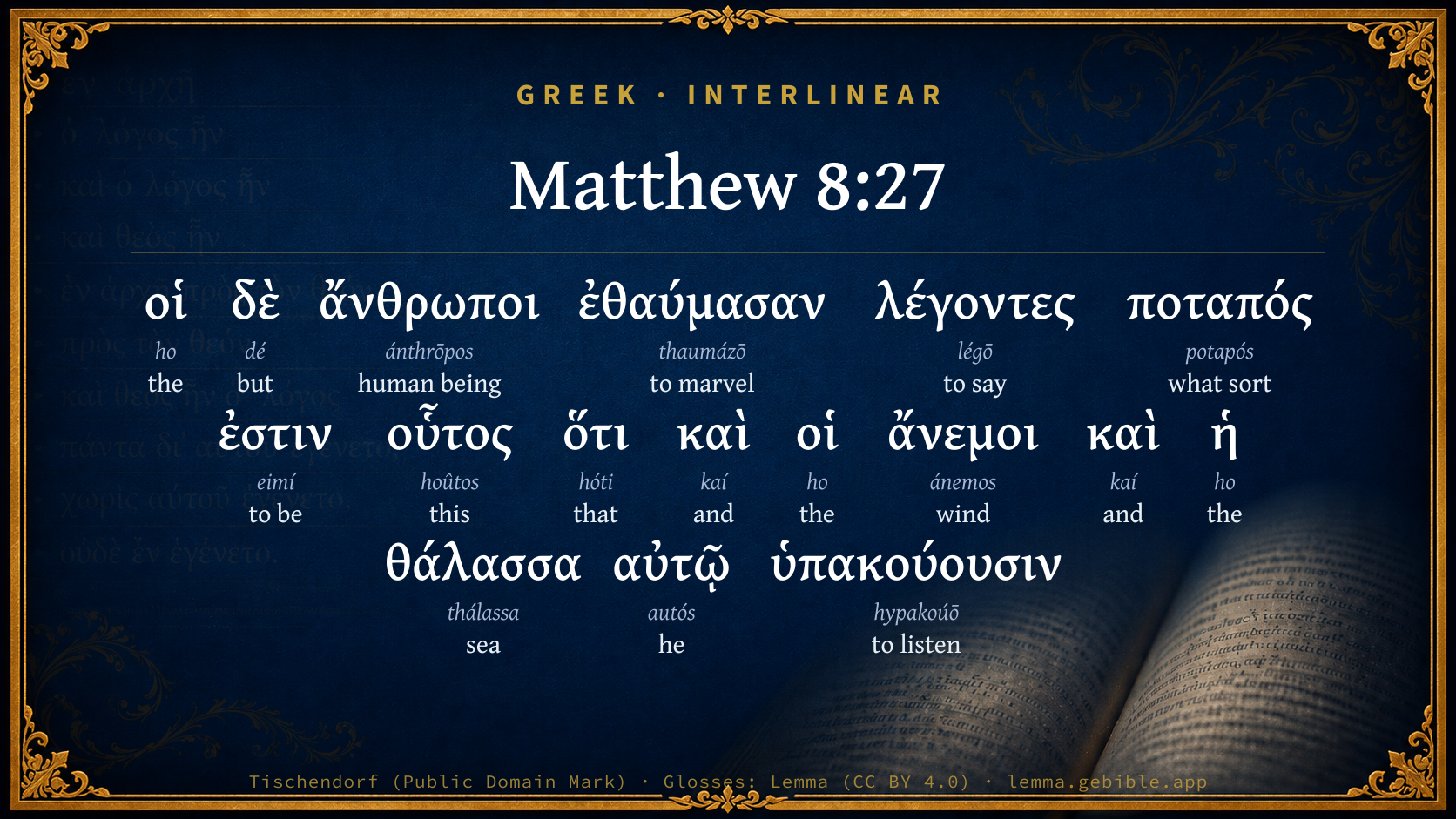
Greek (Tischendorf 8th ed.) Matthew 8:27 appears in the Greek New Testament. The text above is from the Tischendorf 8th edition. Each word links to its Strong’s number and a concise gloss. Click any word for its full Thayer’s Greek Lexicon entry.
Download image
Cite this verse

Matthew 8:27 (World English Bible). Public Domain. Lemma interlinear Bible study tool, https://lemma.gebible.app/v/matthew/8/27.

Show BibTeX & RIS
BibTeX
RIS
English Translation
The men marveled, saying, "What kind of man is this, that even the wind and the sea obey him?"
World English Bible · Public Domain
Highlights
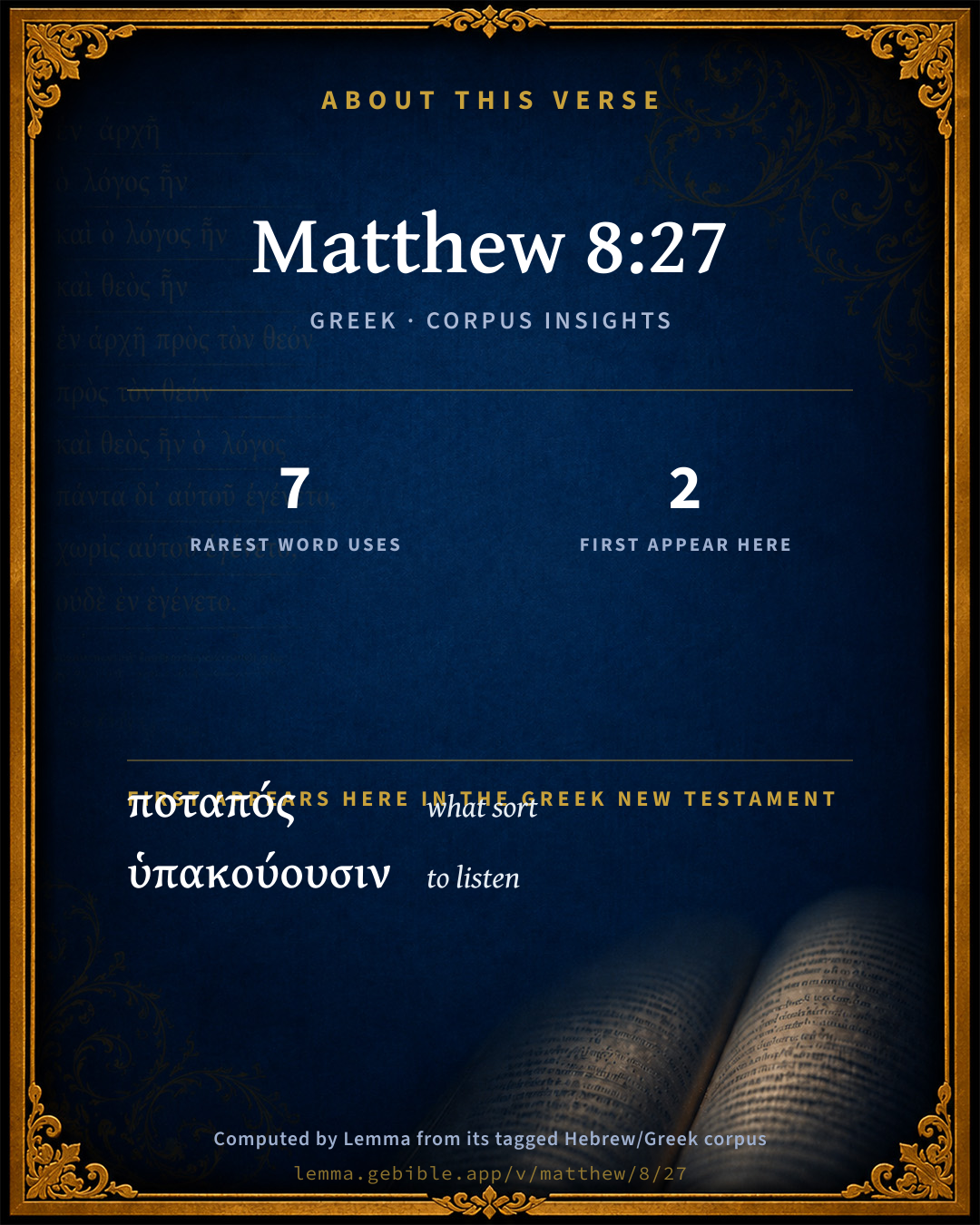
  • 2 first appearances in the Greek New Testament
Full analysis ↓
Download a study sheet

One document with this verse’s original text, its word-by-word gloss line, the meaning frame, cross-references with their text, attributed commentary, and full source and license credits — printable, and it pastes into notes with its structure intact.

This verse Autodidact and up

Study sheet (.html) Plain text (.txt)

A passage Seminary Student

Up to 50 verses in one chapter. A passage sheet keeps up to 6 commentary sources and 12 cross-references per verse, in the order this page ranks them, and says so on the sheet whenever that leaves anything out. Ask for a single verse and you get the Autodidact verse sheet above.

Everything on this page stays free to read, with no account — the sheet is a download of what is already on screen, not access to it.

Want to remove ads? Support Godless Engineer
Compare translations 3

The same verse in 3 English versions, stacked beneath the original-language interlinear above. Click any original word for its lexicon entry.

Each is an independent rendering of the whole verse — the interlinear is not word-aligned to these translations.

Highlighted words mark where these versions differ — a whole-verse word diff, not a word-by-word alignment.

  • World English Bible Public Domain
    The men marveled, saying, "What kind of man is this, that even the wind and the sea obey him?"
  • King James Version Public Domain
    But the men marvelled, saying, What manner of man is this, that even the winds and the sea obey him!
  • unfoldingWord Literal Text CC BY-SA 4.0
    But the men marveled, saying, “What sort of is he, that even the winds and the sea obey him?”

unfoldingWord Literal Text — © unfoldingWord, licensed CC BY-SA 4.0. Word-aligned USFM3 via Door43 (git.door43.org/unfoldingWord/en_ult).

Versions to compare (up to 4)

3 of 4 selected

Show all 19 translations

Every available English version of this verse, each an independent rendering of the whole verse.

  • World English Bible Public Domain
    The men marveled, saying, "What kind of man is this, that even the wind and the sea obey him?"
  • Berean Standard Bible Public Domain
    The men were amazed and asked, “What kind of man is this? Even the winds and the sea obey Him!”
  • Majority Standard Bible Public Domain
    The men were amazed and asked, “What kind of man is this? Even the winds and the sea obey Him!”
  • King James Version Public Domain
    But the men marvelled, saying, What manner of man is this, that even the winds and the sea obey him!
  • American Standard Version (1901) Public Domain
    And the men marvelled, saying, What manner of man is this, that even the winds and the sea obey him?
  • Revised Version (1885) Public Domain
    And the men marveled, saying, What manner of man is this, that even the winds and the sea obey him?
  • Geneva Bible (1599) Public Domain
    And the men marueiled, saying, What man is this, that both the windes and the sea obey him!
  • Douay-Rheims (1899) Public Domain
    But the men wondered, saying: What manner of man is this, for the winds and the sea obey him?
  • Young's Literal Translation Public Domain
    and the men wondered, saying, `What kind -- is this, that even the wind and the sea do obey him?'
  • Literal Standard Version CC BY-SA 4.0
    and the men wondered, saying, “What kind—is this, that even the wind and the sea obey Him?”
  • Unlocked Literal Bible CC BY-SA 4.0
    The men marveled and said, “What sort of man is this, that even the winds and the sea obey him?”
  • unfoldingWord Literal Text CC BY-SA 4.0
    But the men marveled, saying, “What sort of is he, that even the winds and the sea obey him?”
  • Darby Bible Public Domain
    But the men were astonished, saying, What sort [of man] is this, that even the winds and the sea obey him?
  • World Messianic Bible Public Domain
    The men marveled, saying, “What kind of man is this, that even the wind and the sea obey him?”
  • Webster's Bible Public Domain
    But the men marveled, saying, What manner of man is this, that even the winds and the sea obey him!
  • Free Bible Version CC BY-SA 4.0
    The disciples were astonished, and said, “Who is this? Even the winds and the waves obey him!”
  • Bible in Basic English Public Domain
    And the men were full of wonder, saying, What sort of man is this, that even the winds and the sea do his orders?
  • Text-Critical English NT CC BY 4.0
    And the men were amazed, saying, “What kind of man is this, that even the winds and the sea obey him?”
  • Tyndale New Testament (1534) Public Domain
    And the men marveyled and sayd: what man is this that bothe wyndes and see obey hym?

Literal Standard Version (2020), Covenant Press — licensed CC BY-SA 4.0. Text via the HelloAO Bible API (eBible.org). Unlocked Literal Bible (unfoldingWord) — licensed CC BY-SA 4.0. Text via the HelloAO Bible API (eBible.org). unfoldingWord Literal Text — © unfoldingWord, licensed CC BY-SA 4.0. Word-aligned USFM3 via Door43 (git.door43.org/unfoldingWord/en_ult). Free Bible Version, Dr. Jonathan Gallagher — licensed CC BY-SA 4.0. Text via the HelloAO Bible API (eBible.org).

Word by word

More ways to search: Search by grammar → Find every occurrence → Compare this word →

Practice this passage: Drill this verse → Learn its vocabulary →

ποταπός
potapós
G4217
“what sort”
Adjective, Nominative, Singular, Masculine
Part of Speech
Adjective
Case
Nominative
Number
Singular
Gender
Masculine
Full Thayer's Definition

Origin: apparently from G4219 and the base of G4226

TDNT: None

1. from what country, nation or tribe 2. of what sort or quality (what manner of) a. of persons b. of things
  1. οἱ ho G3588 “the” Article, Nominative, Plural, Masculine
  2. δὲ dé G1161 “but” Conjunction
  3. ἄνθρωποι ánthrōpos G444 “human being” Noun, Nominative, Plural, Masculine
  4. ἐθαύμασαν thaumázō G2296 “to marvel” Verb, Aorist, Active, Indicative, 3rd person, Plural
  5. λέγοντες légō G3004 “to say” Verb, Present, Active, Participle, Nominative, Plural, Masculine
  6. ἐστιν eimí G1510 “to be” Verb, Present, Active, Indicative, 3rd person, Singular
  7. οὗτος hoûtos G3778 “this” Demonstrative pronoun, Nominative, Singular, Masculine
  8. ὅτι hóti G3754 “that” Conjunction
  9. καὶ kaí G2532 “and” Conjunction
  10. οἱ ho G3588 “the” Article, Nominative, Plural, Masculine
  11. ἄνεμοι ánemos G417 “wind” Noun, Nominative, Plural, Masculine
  12. καὶ kaí G2532 “and” Conjunction
  13. ἡ ho G3588 “the” Article, Nominative, Singular, Feminine
  14. θάλασσα thálassa G2281 “sea” Noun, Nominative, Singular, Feminine
  15. αὐτῷ autós G846 “he” Personal pronoun, Dative, Singular, Masculine
  16. ὑπακούουσιν hypakoúō G5219 “to listen” Verb, Present, Active, Indicative, 3rd person, Plural

About this verse

These counts appear in no published source. They are computed here, from the morphology-tagged text and Lemma’s own curated glosses. What Lemma adds →

17
words
14
distinct lemmas
Gospels
section

Notable vocabulary

The rarest word here is ποταπός what sort G4217 — appearing just 7 times in the whole Greek New Testament.

First appearance in Scripture

These words make their first canonical appearance in the Greek New Testament here:

  • ποταπός what sort G4217
  • ὑπακούουσιν to listen G5219

Shared distinctive vocabulary

ποταπός what sort G4217 occurs in 6 verses of the Greek New Testament. Also found in:
Repetition

Words recur within this verse:

Cross-references

5

Topical passages linked to Matthew 8:27 in the Treasury of Scripture Knowledge — connected by theme and wording, ordered by reader-vote popularity; previews shown in the World English Bible.

  • Mark 7:37 They were astonished beyond measure, saying, "He has done all things well. He makes even the deaf hear, and the mute speak!"
  • Matthew 14:33 Those who were in the boat came and worshiped him, saying, "You are truly the Son of God!"
  • Mark 1:27 They were all amazed, so that they questioned among themselves, saying, "What is this? A new teaching? For with authority he commands even the unclean spirits, and they obey him!"
  • Mark 6:51 He got into the boat with them; and the wind ceased, and they were very amazed among themselves, and marveled;
  • Matthew 15:31 so that the multitude wondered when they saw the mute speaking, injured whole, lame walking, and blind seeing--and they glorified the God of Israel.

Cross-references courtesy of OpenBible.info (CC BY 4.0).

Commentary

Notes on Matthew 8:27 from classic Christian and Jewish commentators (each source and its license shown beneath its notes). The classic Christian expositions comment on the surrounding passage and are grouped to its opening verse, so a note may address several verses; the Jewish commentaries on the Tanakh (Rashi and others) are per-verse, so they appear only where the commentator wrote on this verse.

Lemma curates 59 commentaries, every one of them public domain or Creative Commons licensed, each selected and text-cleaned for this edition rather than reprinted as found. About our sources →

Tyndale Open Study Notes

Tyndale Open Resources

8:27 Who is this man? Salvation requires a proper answer to this question and active faith in him. Jesus’ disciples had still failed to understand.

Tyndale Open Study Notes — © Tyndale Open Resources, licensed CC BY-SA 4.0. Text via the HelloAO Bible API.

Bengel's Gnomon

Johann Albrecht Bengel

Mat 8:27. Ὑπακούουσιν Αὐτῷ, obey Him) Cf. Mar 1:27. The winds and the sea acknowledge no other control.[383]

[383] In the original, “Venti et mare alias libera.”—Bengel is very fond of the adverb “alias,” and frequently employs it emphatically.—(I. B.)

Bengel's Gnomon of the New Testament — English translation (T&T Clark, Edinburgh, 1860) — public domain. Text from a community e-Sword module.

Meyer's Critical & Exegetical Commentary

Heinrich August Wilhelm Meyer

Mat_8:27. Οἱ ἄνθρωποι] Meaning the people who, besides Jesus and His disciples, were also in the boat, not the disciples[434] included (de Wette, Baumgarten-Crusius, Bleek), seeing that the specially chosen ἄνθρωποι (Matthew does not at all say ΠΆΝΤΕς) most naturally denotes other parties than those previously mentioned, viz. quibus nondum innotuerat Christus, Calvin. Fritzsches homines quotquot hujus portenti nuntium acceperant is incorrect. From the nature of the case, and by means of the connection with Mat_8:28, Matthew represents the astonishment and the exclamation as coming immediately after the stilling of the tempest, and in the boat itself.

ὅτι] seeing that. Giving the reason for the ποταπός (qualis, see on Mar_13:1).

The narrative itself must not be traced to a misconception on the part of the disciples, who are supposed either to have attributed the cessation of the storm to the presence of Jesus and His observations regarding this condition of the weather (Paulus), or to have misapprehended the Lords command to be still, addressed to the storm within them at the moment when that which raged without was over (Hase). As little should we have recourse to a symbolical explanation of the fact, as though it had been intended to exhibit the superiority of the friend of God to the war of the elements (Ammon), or to represent the tranquillity of the inner life that is brought about by the spirit of Christ (Schleiermacher). But if Strauss has classed the narrative in the category of mythical sea stories, Keim again, though feeling sure that it is founded upon fact, is nevertheless of opinion that the actual event has been retouched, beyond recognition, with the colouring and in the spirit of the psalms (such as cvi, cvii), while Weizsäcker sees in it nothing more than an evidence of the spiritual power with which, in a case of outward distress, Jesus so works upon the faith of His disciples that they see themselves transported into a world of miracles; the miracle, he thinks, resolves itself into the extraordinary impression produced by what had taken place. It is to do manifest violence to the clear and simple account of the Gospels, to adopt such expedients for divesting the narrative of its supernatural character, as Schenkel also has had recourse to, who thinks that, after the pilot had despaired, Jesus, with assured confidence in His destiny, stood up, and, after rebuking and allaying the fears of those around Him, assumed to Himself the direction of the boat. The text renders it necessary to insist on treating the event (Neander, Steinmeyer) as miraculousas a proceeding the cause of which is to be found in the divine energy dwelling in the Lord (Luk_11:20)in a powerful exercise of His authority over the elements, which there should be no more difficulty in admitting than in the case of His other miracles in the sphere of nature (the feeding, Cana) and upon the bodily organism (even when dead).

[434] According to Mar_4:41, Luk_8:25, it was the disciples who uttered the exclamation. Possibly a more original part of the tradition than the statement in Matthew, which presupposes a wider reflection than Marks account, that statement being that what the exclamation asked the disciples already knew. Moreover, the preference, in all essential respects, is due to Matthews account; comp. Weiss in d. Stud. u. Krit. 1865, p. 344.

Meyer — Critical and Exegetical Commentary on the New Testament — English translation by Peter Christie, edited by Frederick Crombie (T&T Clark, 1880) — public domain. Text from a community e-Sword module.

Expositor's Greek Testament

ed. W. Robertson Nicoll

Mat 8:27 , f οἱ ἄνθρωποι : who? Naturally one would say the disciples with Jesus in the boat, called men to suit the tragic situation. But many think others are referred to, men unacquainted with Jesus: “quibus nondum innotuerat Christus” (Calvin); either with the disciples in the boat, and referred to alone (Jerome, Meyer) or jointly (De Wette, Bleek), or who afterwards heard the story (Hilar y, Euthy., Fritzsche: “homines, quote uot hujus portenti nuntium acceperant,” and Weiss). Holtzmann (H. C.) says they might be the men in the other ships mentioned in Mar 4:36 , but in reality the expression may simply point to the contrast between the disciples as men and the divine power displayed. ποταπός … οὗτος , what manner of person? The more classic form is ποδαπός = from what land? where born? possibly from ποῦ and ἄπο , with a euphonic δ (Passow). ποταπός , in later use, = of what sort? vide Lobeck, Phryn., p. 56. This story of the triple tradition is a genuine reminiscence of disciple life. There was a storm, Jesus slept, the disciples awoke Him in terror. He rebuked the winds and waves, and they forthwith subsided. The only escape of naturalism from a miracle of power or Providence (Weiss, Leben Jesu ) is to deny the causal sequence between Christ’s word and the ensuing calm and suggest coincidence. The storm sudden in its rise, equally sudden in its lull.

The Expositor's Greek Testament, edited by W. Robertson Nicoll (1897–1910) — public domain. Text from a community e-Sword module.

Adam Clarke's Commentary

Verse 27. The men marvelled] Every part of the creation (man excepted) hears and obeys the Creator's voice. Sinners have an ear for the world, the devil, and the flesh: till this ear is shut, God's voice is not discerned; for when it is shut to its enemies it is open to its friends.

What manner of man is this] ποταπος εστιν ουτος, How great is this person! Here was God fully manifest; but it was in the flesh-there were the hidings of his power.

Adam Clarke's Commentary on the Bible (1810–1826) — public domain. Text from a community e-Sword/MySword module.

Ellicott's Commentary for English Readers

(27) The men marvelled.—This use of so vague a term as “men,” as applied to the disciples, is so exceptional as to suggest the thought that there were others in the boat with them. The marvel was not without a “great fear” (Mar_4:41). The Presence among them was mightier even than they had thought, and the elements, which seemed far more removed from human control than leprosy or fever, were yet subject to His sovereignty.

The spiritual application of the miracle lies so near the surface that it has almost become one of the common-places of sermons and hymns. And yet there is a profound fitness in it which never ceases to be fresh. The boat is the Church of Christ, and it sails across the ocean of the world’s history to the “other side” of the life beyond the grave. The wind is the blast of persecution, and the Lord of the Church seems as though He were asleep, and heard not the cry of the sufferers, and the disciples are faint-hearted and afraid. And then He hears their prayer, and the storm of the persecution ceases, and there is a great calm, during which the Church goes on its way, and men learn to feel that it carries more than Cæsar and his fortunes.

A Bible Commentary for English Readers, edited by Charles John Ellicott (1878–1897) — public domain. Text from a community e-Sword module.

The Cambridge Bible for Schools and Colleges

gen. ed. J. J. S. Perowne

27. the men] the disciples, and other fishermen who were also on the Lake: see account in Mark.

The Cambridge Bible for Schools and Colleges (gen. ed. J. J. S. Perowne; Cambridge University Press, 1878–1918) — public domain. Text from a community e-Sword module.

John Gill's Exposition

And when he was come to the other side,.... Of the lake, or sea of Tiberias, right over against Galilee,

into the country of Gergesenes, the same with the Girgashites, Gen 15:21 whom Joshua drove out of the land of Canaan; and who, as a Jewish writer (l) says, left their country to the Israelites, and went to a country, which is called to this day, "Gurgestan", of which these people were some remains: both in Mar 5:1 it is called "the country of the Gadarenes"; and so the Syriac and Persic versions read it here; which is easily reconciled by observing, not that Gergesa and Gadara were one and the same city, called by different names; but that these two cities were near each other, in the same country, which was sometimes denominated from the one, and sometimes from the other. Origen (m) has a remarkable passage, showing the different situations of Gadara and Gergesa; and that the latter cannot be Gerasa in Arabia; and also the signification of the name, for the sake of which, I shall transcribe it.

"Gerasa (says he) is a city of Arabia, having neither sea nor lake near it; wherefore the evangelists, who well knew the countries about Judea, would never have said so manifest an untruth: and as to what we find in some few copies, "into the country of the Gadarenes", it must be said, that Gadara indeed was a city of Judea, about which were many famous baths; but there was no lake, or sea in it, adjacent with precipices; but Gergesa, from whence were the Gergasenes, is an ancient city about the lake; now called Tiberias; about which is a precipice adjacent to the lake, from whence is shown, that the swine were cast down by the devils. Gergesa is interpreted, "the habitation of those that cast out"; being called so perhaps prophetically, for what the inhabitants of those places did to the Saviour, beseeching him to depart out of their coasts.''

Dr. Lightfoot suggests, that this place might be so called, from which signifies "clay" or "dirt", and mentions Lutetia for an example. But to pass this, as soon as Christ was got out of the ship, and come to land in this country,

there met him two possessed with devils. Both Mark and Luke mention but one, which is no contradiction to Matthew; for they do not say that there was only one; and perhaps the reason why they only take notice of him is, because he was the fiercest, had a legion of devils in him, and was the principal one, that spake to Christ, and with whom he was chiefly concerned. This is to be understood, not of any natural disease of body, but of real possession by Satan. These possessed men met him, not purposely, or with design, but accidentally to them, and unawares to Satan too; for though he knows much, he is not omniscient: had he been aware of Christ's coming that way, and what he was about to do, he would have took care to have had the possessed out of the way; but so it was ordered by providence, that just as Christ landed, these should be

coming out of the tombs. Their coemeteria, or burying places, were at some distance from towns or cities; wherefore Luke says, the possessed met him "out of the city", a good way off from it; for the Jews (n) say, , "that the sepulchres were not near a city"; see Luk 7:12 and these tombs were built so large, that persons might go into them, and sit and dwell in them, as these "demoniacs" did, and therefore are said to come out of them. The rules for making them are (o) these;

"He that sells ground to his neighbour to make a burying place, or that receives of his neighbour, to make him a burying place, must make the inside of the cave four cubits by six, and open in it eight graves; three here and three there, and two over against them; and the graves must be four cubits long, and seven high, and six broad. R. Simeon says, he must make the inside of the cave six cubits by eight, and open within thirteen graves, four here, and four there, and three over against them; and one on the right hand of the door, and one on the left: and he must make "a court", at the mouth of the cave, six by six, according to the measure of the bier, and those that bury; and he must open in it two caves, one here and another there: R. Simeon says, four at the four sides. R. Simeon ben Gamaliel says, all is according to the nature of the rock.''

Now in the court, at the mouth, or entrance of the cave, which was made for the bearers to put down the bier or coffin upon, before the interment, there was room for persons to enter and lodge, as these possessed with devils did: which places were chosen by the devils, either because of the solitude, gloominess, and filthiness of them; or as some think, to confirm that persuasion some men had, that the souls of men after death, are changed into devils; or rather, to establish a notion which prevailed among the Jews, that the souls of the deceased continue for a while to be about their bodies; which drew persons to necromancy, or consulting with the dead. It is a notion that obtains among the Jews (p), that the soul for twelve months after its separation from the body, is more or less with it, hovering about it; and hence, some have been induced to go and dwell among the tombs, and inquire of spirits: they tell us (q),

"it happened to a certain holy man, that he gave a penny to a poor man, on the "eve" of the new year; and his wife provoked him, and he went , "and lodged among the tombs", and heard two spirits talking with one another.''

Or the devil chose these places, to render the persons possessed the more uncomfortable and distressed; to make them wilder and fiercer, by living in such desolate places, and so do more mischief to others: which was the case of these, who were

exceeding fierce, wicked, malignant, mischievous, and troublesome, through the influence of the devils in them;

so that no man might pass that way, without being insulted or hurt by them.

(l) Juchasin, fol. 135. 2. (m) Comment. in Joannem, T. 2. p. 131. Ed. Huet. (n) T. Bab. Kiddushin. fol. 80. 2. Gloss. (o) Misn. Bava Bathra, c. 6. sect. 8. (p) Nishmat Chayim, par. 2. c. 22. p. 81. 2. c. 24. p. 85. 1. & c. 29. p. 93. 1. p. 94. 1, 2. (q) T. Bab. Beracot, fol. 18. 2.

John Gill's Exposition of the Whole Bible (1746–1763) — public domain (CC PDM 1.0). Text via the HelloAO Bible API.

Trapp's Complete Commentary

John Trapp

27 But the men marvelled, saying, What manner of man is this, that even the winds and the sea obey him!

Ver. 27. Even the winds and the sea obey him] He lays laws upon all creatures, which are his hosts. The winds and sea fought for us apparently in that

" Octogesimus octavus mirabilis annus:" (Beza)

so that the blasphemous Spaniards said, Christ was turned Lutheran. The like was done by the winds for Theodosius, in that famous battle against Maximinus. The soldiers that were then present told us, saith St Augustine ( de Civ. Dei, v. 6), that the winds took their darts, as soon as they were out of their hands, and drove them violently upon the enemy. As for those that were cast at us by the enemy, they were with like violence carried back upon their own bodies. Hence sang Claudian the heathen poet in this sort concerning Theodosius,

" O nimium dilecte Deo, cui militat aether,

Et coniurati veniunt ad classica venti."

John Trapp, A Commentary or Exposition upon All the Books of the Old and New Testament (1647–1656) — public domain. Text from a community e-Sword module.

Albert Barnes' Notes on the Bible

The men marveled - Wondered, or were amazed.

What manner of man - What kind of a personage. How unlike other men! What a vast display of power! and how far exalted above mortals must he be!

Jesus spake to the winds; rebuked their raging, and the sea was suddenly calm. The storm subsided; the ship glided smoothly; danger fled; and in amazement they stood in the presence of him who controlled the tempests that God had raised; and they felt that “he” must be God himself, for none but God could calm the heaving billows and scatter the tempest. No scene could have been more grand than this display of the power of Jesus. The darkness; the dashing waves; the howling winds; the heaving and tossing ship; the fears and cries of the seamen, all by a single word hushed into calm repose, present an image of power and divinity irresistibly grand and awful. So the tempest rolls and thickens over the head of the awakened sinner. So he trembles over immediate and awful destruction. So, while the storm of wrath howls, and hell threatens to ingulf him, he comes trembling to the Saviour. He hears; he rebukes the storm, and the sinner is safe. An indescribable peace takes possession of the soul, and he glides on a tranquil sea to the haven of eternal rest. See Isa 57:20-21; Rom 5:1; Phi 4:7.

Albert Barnes' Notes on the Bible (1834–1885) — public domain. Text from a community e-Sword/MySword module.

Whedon's Commentary on the Bible

Daniel D. Whedon

27. The men marvelled — Not the workmen of the boat, for the disciples were probably their own workmen. They are called the men, as a humbling term, in comparison with him, the divine one. What manner of man — They expected, indeed, that he would save them; but they were overwhelmed with the majesty and ease with which he issued his orders to the elements, and at the submission with which they, like living intelligences are hushed by his word.

Daniel D. Whedon (gen. ed.), Commentary on the Old and New Testaments (1874–1909) — public domain. Text from a community e-Sword module.

The Pulpit Commentary

But (Revised Version, and) the men. Perhaps the disciples ("Sic als Menschen staunch," Nosgen), but probably those to whom the boat belonged (ver. 23, note), the crew. It seems very far-fetched to explain it of all men who heard of the miracle. Marvelled. As the multitudes. (Mat_9:33; but contrast Mat_14:33) Saying, What manner of man is this? (Potapov estin outov). Parallel passages, "Who then?" ( tiv ara; ). The term indicates the slightness of their knowledge of his character (probably not his origin, which, according to Phryn. Wetstein, would be podapov ; though it may be doubted whether the distinction can be pressed in Hellenistic Greek). They seem, with Nicodemus, to have recognized that holiness was an essential condition of performing miracles, (Joh_3:2) but not to have realized that this condition was satisfied in Jesus. That even the winds and the sea obey him. "Him," emphatic (autw upakouousin). The miracle! has been seen to be a parable of the security of the ship of the Church since at least the days of Tertullian ("De Bapt.," (For the comparison generally of the Church to a ship, compare especially Bishop Lightfoot on Ignatius, "Polyc.,"

Revelations of the mystery in Christ.

This text gives the impression produced by one of the most striking miracles that Jesus wrought. It belongs to the curlier part of the ministry, when men scarcely knew what to think of him. Christ was asleep in the boat, lying on an old sail, or on John"s fisher-coat so fast asleep that the howling wind, and creaking oars, and flapping waves, did not disturb him. The.fishermen scarcely knew what to do for the best. It took all their rowing to keep the boat"s head to the wind, and she was fast filling with the waves that broke over her sides. At last, in their despair, they awoke the Master. He rose as calmly as if there was no danger, and spoke the words which declared him to be the Lord of nature, but set the fishermen wondering who he was. All Christ"s life was a revelation of himself. Revelation can come by acts and by words, by nature, by a book, or by a life. Miracles are revelations; so we ask What does this miracle reveal?

I THE REVELATION IT MAKES OF THE PERSON OF CHRIST. Throughout his life the question was asked, "Who is he?" "What think ye of Christ?" it was asked by his countrymen of Nazareth; by his disciples; by John the Baptist; by the Pharisees from Jerusalem. Christ"s answer is, "If ye believe not me, believe the works." Then look at this work.

1. It gives deep impression of Christ"s being within humanity. See the suggestions of his sleep. His sleepless nights of prayer do not surprise us; his tiredness does. A human Saviour is he who sleeps.

2. It gives deep impression of Christ"s being beyond humanity. He controls the storms; commands the threes of nature. If that man is under limitations, he must have put himself under limitations voluntarily. Show how the thought of Christ has grown. Carpenter, great Teacher; wonderful Hakim; Messiah; Son of God. Then spiritual Savior; and to us ideal Manhood manifest in the flesh.

II THE REVELATION IT MAKES OF THE MISSION OF CHRIST. Which was to show men the Father. He told them what the Father was, and what the Father thought. He showed them what the Father was always doing in his love to them. What, then, did he show here? How the Father-God is ever at work, controlling the hindering and distressing circumstances that imperil us. In the Old Testament water is the type of the oppositions of outward circumstances. Illustrate: the Red Sea; the river Jordan. We often think ourselves mastered by outward things, or at least find in them our excuses. This is the age of masterful circumstances; so we need this miracle, and its assurance that our Father-God holds the waters and all they represent in the hollow of his hand. R.T.

The Pulpit Commentary (1880–1919), ed. H.D.M. Spence-Jones & Joseph S. Exell — public domain. Text from a community e-Sword module.

The People's New Testament

B. W. Johnson

27. What manner of man? The words express astonishment at this new proof of his control, not only over demons and disease, but also over the winds and waves, which obeyed him at a word.

B. W. Johnson's The People's New Testament with Notes (1889–1891) — public domain. Electronic text from the Christian Classics Ethereal Library (CCEL) ThML edition.

Cambridge Greek Testament for Schools and Colleges

27. οἱ ἄνθρωποι. The disciples, and other fishermen who were also on the Lake: see account in Mark.

Cambridge Greek Testament for Schools and Colleges (Cambridge University Press, 1896; 21 vols, various authors incl. Carr, Maclear, Plummer, Farrar, Lumby, Moule, M. R. James, Simcox) — public domain. Text from a community e-Sword module.

Alford’s Greek Testament

Henry Alford

27. οἱ ἄνθρ.] The men who were in the ship, besides our Lord and His disciples.

Henry Alford, The Greek Testament (1849–1861) — public domain. Text from a community e-Sword module.

International Critical Commentary

27. And men marvelled, saying, What manner of man is this, that even the winds and the sea obey Him ?] Mk. has: “And they feared greatly, and were saying to one another, Who then is this, that even the wind and the sea obey Him?” The subject of the sentence in Mk. must be inferred to be the disciples from Mk vv. 34 and 36. In the whole of the succeeding section Mk. speaks ambiguously of “they” and “them.” Mt. has introduced “the disciples” in v. 23. οἱ ἄνθρωποι might mean “men.” It generally has this meaning in the first Gospel; cf. 5:13, 16:13 and 24 times. If so, the verse would mean that “men (hearing of the miracle) marvelled,” cf. 9:8. This is more probable than that the editor should refer to the disciples as “οἱ ἄνθρωποι.” Feeling that Mk.’s “and they feared greatly” refers to the disciples, he substitutes “marvelled” to soften the expression, and then to remove all reference to the disciples inserts οἱ ἄνθρωποι as subject to the sentence. Cf. 9:8, where he inserts οἱ ὄχλοι to remove all possible reference to the disciples.

International Critical Commentary — older volumes (1896–1929), various authors — public domain. Text from a community e-Sword module.

Lesson kit

Teaching starters — assembled from the data on this page, not authored interpretation. Every prompt links to the verse data it draws on. Edit before teaching.

Matthew, in the Gospels, opens this verse with 17 words (14 distinct Greek lemmas). Its most distinctive word is potapós (“what sort”). A historical commentator’s framing appears above. Read the whole chapter for the surrounding context.

Discussion questions

  1. How does “what sort” (potapós) shape what this verse is saying?
  2. 2 words make their first appearance in Scripture here. What does this debut establish?
  3. How does Mark 13:1, which shares the word «what sort», read alongside this verse?
  4. What does the repetition of “the” (3× in this one verse) do in this verse?
  5. These translations render this verse differently. What is at stake in choosing one wording over another?
  6. Compare how Tyndale Open Study Notes and Bengel's Gnomon read this verse. Where do they agree or differ?

Things to notice

  • 2 words make their first canonical appearance in Scripture here.
  • These translations choose different wording for 8 words in this verse.
  • “the” occurs 3× in this single verse.
  • 14 distinct Greek lemmas span 17 words in this verse.

Reading settings

Reading text

Shown beneath each verse's original-language words.

Old Testament
Old Testament edition

Read the OT as the Masoretic Hebrew (MT) or the Greek Septuagint (LXX).

English shown for the Greek Septuagint (in the Hebrew ↔ Greek comparison).

Comparing translations? Open the Compare panel on any verse page to stack up to four side by side.