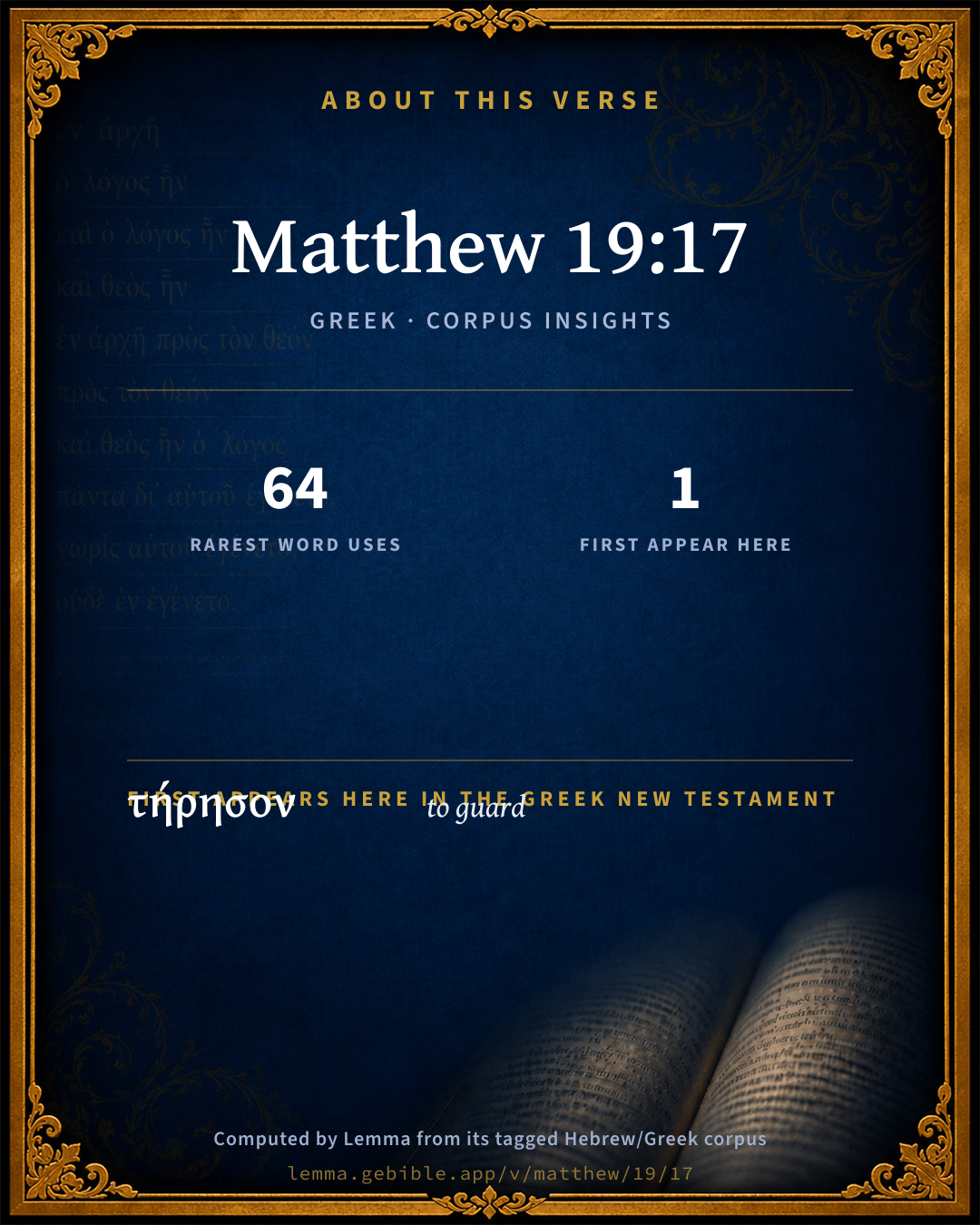
Matthew 19:17

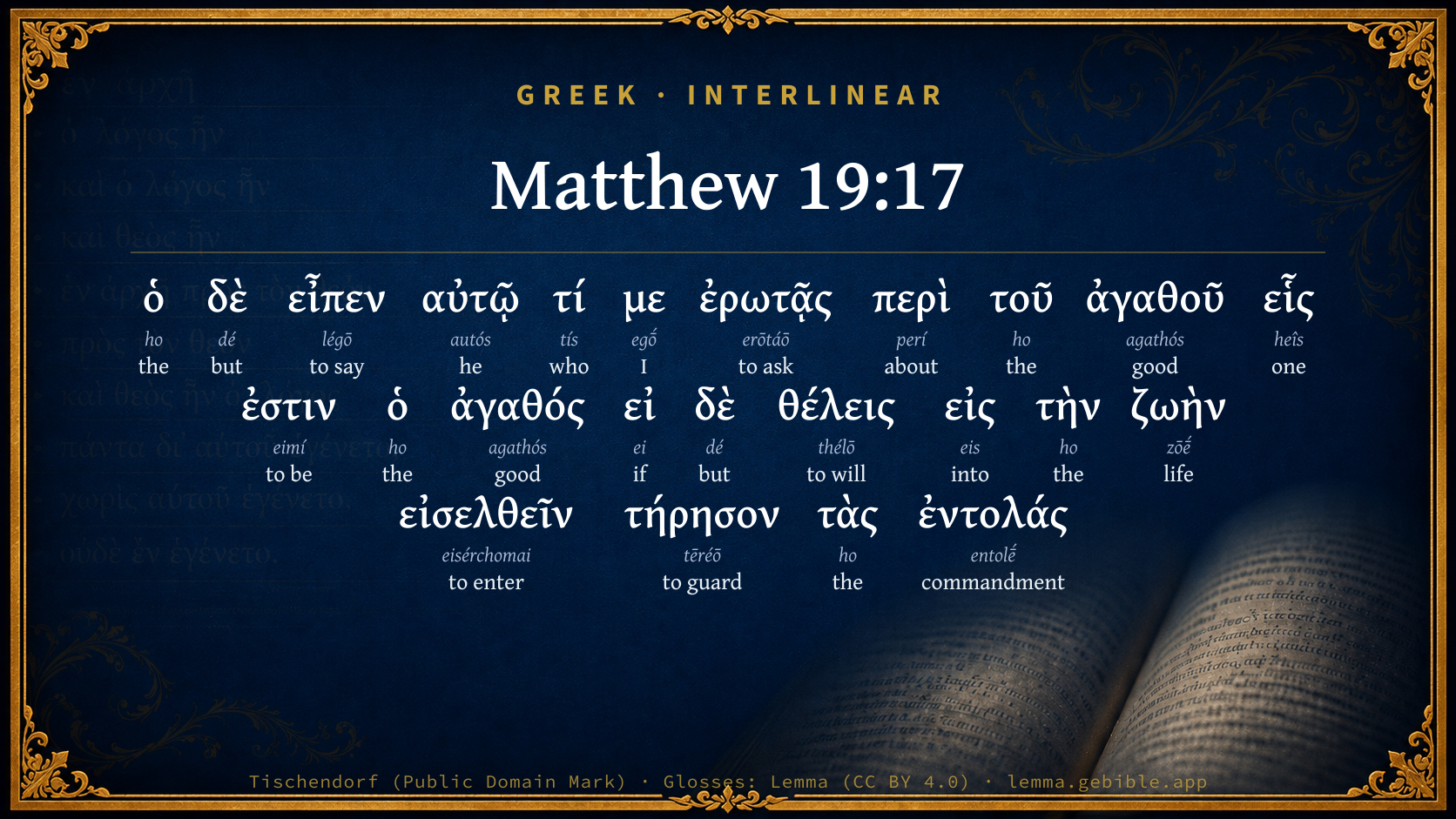
Greek (Tischendorf 8th ed.) Matthew 19:17 appears in the Greek New Testament. The text above is from the Tischendorf 8th edition. Each word links to its Strong’s number and a concise gloss. Click any word for its full Thayer’s Greek Lexicon entry.
Download image
Cite this verse

Matthew 19:17 (World English Bible). Public Domain. Lemma interlinear Bible study tool, https://lemma.gebible.app/v/matthew/19/17.

Show BibTeX & RIS
BibTeX
RIS
English Translation
He said to him, "Why do you call me good? No one is good but one, that is, God. But if you want to enter into life, keep the commandments."
World English Bible · Public Domain
Highlights
  • 1 first appearance in the Greek New Testament
Full analysis ↓
Download a study sheet

One document with this verse’s original text, its word-by-word gloss line, the meaning frame, cross-references with their text, attributed commentary, and full source and license credits — printable, and it pastes into notes with its structure intact.

This verse Autodidact and up

Study sheet (.html) Plain text (.txt)

A passage Seminary Student

Up to 50 verses in one chapter. A passage sheet keeps up to 6 commentary sources and 12 cross-references per verse, in the order this page ranks them, and says so on the sheet whenever that leaves anything out. Ask for a single verse and you get the Autodidact verse sheet above.

Everything on this page stays free to read, with no account — the sheet is a download of what is already on screen, not access to it.

Want to remove ads? Support Godless Engineer
Compare translations 3

The same verse in 3 English versions, stacked beneath the original-language interlinear above. Click any original word for its lexicon entry.

Each is an independent rendering of the whole verse — the interlinear is not word-aligned to these translations.

Highlighted words mark where these versions differ — a whole-verse word diff, not a word-by-word alignment.

  • World English Bible Public Domain
    He said to him, "Why do you call me good? No one is good but one, that is, God. But if you want to enter into life, keep the commandments."
  • King James Version Public Domain
    And he said unto him, Why callest thou me good? there is none good but one, that is, God: but if thou wilt enter into life, keep the commandments.
  • unfoldingWord Literal Text CC BY-SA 4.0
    But he said to him, “Why do you ask me about good? One is good, but if you want to enter into life, keep the commandments.”

unfoldingWord Literal Text — © unfoldingWord, licensed CC BY-SA 4.0. Word-aligned USFM3 via Door43 (git.door43.org/unfoldingWord/en_ult).

Versions to compare (up to 4)

3 of 4 selected

Show all 19 translations

Every available English version of this verse, each an independent rendering of the whole verse.

  • World English Bible Public Domain
    He said to him, "Why do you call me good? No one is good but one, that is, God. But if you want to enter into life, keep the commandments."
  • Berean Standard Bible Public Domain
    “Why do you ask Me about what is good?” Jesus replied. “There is only One who is good. If you want to enter life, keep the commandments.”
  • Majority Standard Bible Public Domain
    “Why do you call Me good?” Jesus replied. “There is no one who is good but God. If you want to enter life, keep the commandments.”
  • King James Version Public Domain
    And he said unto him, Why callest thou me good? there is none good but one, that is, God: but if thou wilt enter into life, keep the commandments.
  • American Standard Version (1901) Public Domain
    And he said unto him, Why askest thou me concerning that which is good? One there is who is good: but if thou wouldest enter into life, keep the commandments.
  • Revised Version (1885) Public Domain
    And he said unto him, Why askest thou me concerning that which is good? One there is who is good: but if thou wouldest enter into life, keep the commandments.
  • Geneva Bible (1599) Public Domain
    And he said vnto him, Why callest thou me good? there is none good but one, eue God: but if thou wilt enter into life, keepe ye commandemets.
  • Douay-Rheims (1899) Public Domain
    Who said to him: Why asketh thou me concerning good One is good, God. But if thou wilt enter into life, keep the commandments.
  • Young's Literal Translation Public Domain
    And he said to him, `Why me dost thou call good? no one `is' good except One -- God; but if thou dost will to enter into the life, keep the commands.'
  • Literal Standard Version CC BY-SA 4.0
    And He said to him, “Why do you call Me good? No one [is] good except one—God; but if you will to enter into life, keep the commands.”
  • Unlocked Literal Bible CC BY-SA 4.0
    Jesus said to him, “Why do you ask me about what is good? Only one is good, but if you want to enter into life, keep the commandments.”
  • unfoldingWord Literal Text CC BY-SA 4.0
    But he said to him, “Why do you ask me about good? One is good, but if you want to enter into life, keep the commandments.”
  • Darby Bible Public Domain
    And he said to him, What askest thou me concerning goodness? one is good. But if thou wouldest enter into life, keep the commandments.
  • World Messianic Bible Public Domain
    He said to him, “Why do you call me good? No one is good but one, that is, God. But if you want to enter into life, keep the commandments.”
  • Webster's Bible Public Domain
    And he said to him, Why callest thou me good? there is none good but one, that is, God: but if thou wilt enter into life, keep the commandments.
  • Free Bible Version CC BY-SA 4.0
    “Why do you ask me what is good?” Jesus replied. “There's only one who is good. But if you want to have eternal life, then keep the commandments.”
  • Bible in Basic English Public Domain
    And he said to him, Why are you questioning me about what is good? One there is who is good: but if you have a desire to go into life, keep the rules of the law.
  • Text-Critical English NT CC BY 4.0
    Jesus said to him, “Why do yoʋ call me good? No one is good except God alone. But if yoʋ wish to enter life, keep the commandments.”
  • Tyndale New Testament (1534) Public Domain
    He sayde vnto him: why callest thou me good? there is none good but one and that is God. But yf thou wylt entre in to lyfe kepe the commaundementes.

Literal Standard Version (2020), Covenant Press — licensed CC BY-SA 4.0. Text via the HelloAO Bible API (eBible.org). Unlocked Literal Bible (unfoldingWord) — licensed CC BY-SA 4.0. Text via the HelloAO Bible API (eBible.org). unfoldingWord Literal Text — © unfoldingWord, licensed CC BY-SA 4.0. Word-aligned USFM3 via Door43 (git.door43.org/unfoldingWord/en_ult). Free Bible Version, Dr. Jonathan Gallagher — licensed CC BY-SA 4.0. Text via the HelloAO Bible API (eBible.org).

Word by word

More ways to search: Search by grammar → Find every occurrence → Compare this word →

Practice this passage: Drill this verse → Learn its vocabulary →

ἐρωτᾷς
erōtáō
G2065
“to ask”
Verb, Present, Active, Indicative, 2nd person, Singular
Part of Speech
Verb
Tense
Present
Voice
Active
Mood
Indicative
Person
2nd person
Number
Singular
Full Thayer's Definition

Origin: apparently from G2046 cf G2045

TDNT: 13:25,3

1. to question 2. to ask a. to request, entreat, beg, beseech
  1. ὁ ho G3588 “the” Article, Nominative, Singular, Masculine
  2. δὲ dé G1161 “but” Conjunction
  3. εἶπεν légō G3004 “to say” Verb, Aorist, Active, Indicative, 3rd person, Singular
  4. αὐτῷ autós G846 “he” Personal pronoun, Dative, Singular, Masculine
  5. τί tís G5101 “who” Interrogative pronoun, Accusative, Singular, Neuter
  6. με egṓ G1473 “I” Personal pronoun, 1st person, Accusative, Singular
  7. περὶ perí G4012 “about” Preposition
  8. τοῦ ho G3588 “the” Article, Genitive, Singular, Neuter
  9. ἀγαθοῦ agathós G18 “good” Adjective, Genitive, Singular, Neuter
  10. εἷς heîs G1520 “one” Adjective, Nominative, Singular, Masculine
  11. ἐστιν eimí G1510 “to be” Verb, Present, Active, Indicative, 3rd person, Singular
  12. ὁ ho G3588 “the” Article, Nominative, Singular, Masculine
  13. ἀγαθός agathós G18 “good” Adjective, Nominative, Singular, Masculine
  14. εἰ ei G1487 “if” Conditional
  15. δὲ dé G1161 “but” Conjunction
  16. θέλεις thélō G2309 “to will” Verb, Present, Active, Indicative, 2nd person, Singular
  17. εἰς eis G1519 “into” Preposition
  18. τὴν ho G3588 “the” Article, Accusative, Singular, Feminine
  19. ζωὴν zōḗ G2222 “life” Noun, Accusative, Singular, Feminine
  20. εἰσελθεῖν eisérchomai G1525 “to enter” Verb, Aorist, Active, Infinitive
  21. τήρησον tēréō G5083 “to guard” Verb, Aorist, Active, Imperative, 2nd person, Singular
  22. τὰς ho G3588 “the” Article, Accusative, Plural, Feminine
  23. ἐντολάς entolḗ G1785 “commandment” Noun, Accusative, Plural, Feminine

About this verse

These counts appear in no published source. They are computed here, from the morphology-tagged text and Lemma’s own curated glosses. What Lemma adds →

24
words
18
distinct lemmas
Gospels
section

First appearance in Scripture

This word makes its first canonical appearance in the Greek New Testament here:

  • τήρησον to guard G5083

Repetition

Words recur within this verse:

  • ἀγαθοῦ good G18 ×2
  • ὁ the G3588 ×5
  • δὲ but G1161 ×2

Cross-references

12

Topical passages linked to Matthew 19:17 in the Treasury of Scripture Knowledge — connected by theme and wording, ordered by reader-vote popularity; previews shown in the World English Bible.

  • Leviticus 18:5 You shall therefore keep my statutes and my ordinances; which if a man does, he shall live in them: I am Yahweh.
  • Luke 10:26–28 He said to him, "What is written in the law? How do you read it?"
  • Galatians 3:11–13 Now that no man is justified by the law before God is evident, for, "The righteous will live by faith."
  • 1 Samuel 2:2 There is none holy as Yahweh; For there is none besides you, Neither is there any rock like our God.
  • Romans 10:5 For Moses writes about the righteousness of the law, "The one who does them will live by them."
  • 1 John 4:16 We know and have believed the love which God has for us. God is love, and he who remains in love remains in God, and God remains in him.
  • Nehemiah 9:29 and testified against them, that you might bring them again to your law. Yet they dealt proudly, and didn't listen to your commandments, but sinned against your ordinances, (which if a man do, he shall live in them), and withdrew the shoulder, and hardened their neck, and would not hear.
  • Ezekiel 20:11–12 I gave them my statutes, and shown them my ordinances, which if a man do, he shall live in them.
  • Ezekiel 20:21 But the children rebelled against me; they didn't walk in my statutes, neither kept my ordinances to do them, which if a man do, he shall live in them; they profaned my Sabbaths. Then I said I would pour out my wrath on them, to accomplish my anger against them in the wilderness.
  • Psalms 145:7–9 They will utter the memory of your great goodness, And will sing of your righteousness.
  • James 1:17 Every good gift and every perfect gift is from above, coming down from the Father of lights, with whom can be no variation, nor turning shadow.
  • 1 John 4:8–10 He who doesn't love doesn't know God, for God is love.

Cross-references courtesy of OpenBible.info (CC BY 4.0).

Where the printed editions differ

2 variants

Places in this verse where the major printed Greek editions disagree on the wording in a way that affects the translation — a comparison of editions, not a manuscript-by-manuscript collation. The editions are the modern critical texts (Nestlé-Aland 28/27, SBL, Westcott-Hort, Tregelles, Tyndale House) and the traditional texts behind the KJV (the Textus Receptus and the Byzantine/Majority text). It is not a claim about which reading is original.

  1. Different wording
    εἷς

    “One”

    In NA28NA27TynSBLWHTreg Not in TRByz

    Οὐδεὶς (Oudeis) 'no [one]' occurs in traditional manuscripts (TR+Byz) instead of εἷς (heis) 'One' in older manuscripts (NA28+NA27+Tyn+SBL+WH+Treg)

  2. Extra text
    εἰ μὴ εἷς ὁ θεός.

    “only except one <the> God.”

    In TRByz Not in NA28NA27TynSBLWHTreg

    εἰ μὴ εἷς ὁ θεός. (ei mē heis ho theos) 'only except one God.' is only in traditional manuscripts (TR+Byz)

Textual data: Translators Amalgamated Greek New Testament (STEPBible TAGNT) · CC BY 4.0.

Commentary

Notes on Matthew 19:17 from classic Christian and Jewish commentators (each source and its license shown beneath its notes). The classic Christian expositions comment on the surrounding passage and are grouped to its opening verse, so a note may address several verses; the Jewish commentaries on the Tanakh (Rashi and others) are per-verse, so they appear only where the commentator wrote on this verse.

Lemma curates 59 commentaries, every one of them public domain or Creative Commons licensed, each selected and text-cleaned for this edition rather than reprinted as found. About our sources →

Joseph Benson's Commentary

Mat 19:17-22. He said, Why callest thou me good? — Whom thou regardest merely as a prophet sent from God, and therefore supposest to be only a man; there is none good — Supremely, originally, essentially, but God. If thou wilt enter into life, keep the commandments — From a principle of loving faith. Believe, and thence love and obey. And this undoubtedly is the way to eternal life. Our Lord therefore does not answer ironically, which had been utterly beneath his character, but gives a plain, direct, serious answer to a serious question. The young man saith, All these have I kept from my childhood — So he imagined, and perhaps he had, as to the letter, but not as to the spirit, which our Lord immediately shows. What lack I yet? — Wherein am I deficient? What is further needful in order to my securing the glorious prize which I am pursuing? In answer to this inquiry, made by one evidently puffed up with a high opinion of his own righteousness, our Lord replies, If thou wilt be perfect — That is, a real, thorough Christian, yet lackest thou one thing, (Luke,) namely, to be saved from the love of the world; from all undue esteem for, and inordinate affection to, earthly things. Therefore, go and sell that thou hast, (Luke, all that thou hast,) and give — Distribute the money which arises from the sale thereof; to the poor, and thou shalt have treasure in heaven — Infinitely more excellent and durable than that which thou renouncest on earth. And come, (take up the cross, Mark,) and follow me — Unite thyself to me as my constant attendant, though it should be even at the expense of thy life. He who reads the heart, saw that this young man’s bosom sin was the love of his worldly possessions; and that he could not be saved from it but by literally parting with them. To him, therefore, he gave this particular direction, which he never designed for a general rule to all his followers. For him this was necessary, not only, as some suppose, in order to his giving proof of exalted piety, but in order to his salvation. For him literally to sell all, was an absolute duty; for many to do this would be an absolute sin. And yet, though God does not in fact require every man to distribute all his goods to others, and so in effect to become one of the number of the poor relieved out of his own possessions, yet sincere piety and virtue require in all an habitual readiness not only to sacrifice their possessions, but their lives, at the command of God; and Providence has in fact, in all ages, called some out to trials as severe as this. And certainly an entire renunciation of the world, so far at least as to be willing to part with it whenever God should call them to it, was peculiarly necessary for all Christians in the first ages, when the profession of Christianity so generally exposed men to persecution and death. And when he heard this he went away sorrowful — Not being willing to have salvation at so high a price; for he had great possessions — Which he now plainly showed he valued more than eternal life: and it was with great wisdom that our Lord took this direct and convincing method of manifesting both to himself and others that secret insincerity and carnality of temper which prevailed under all these specious pretences and promising appearances.

Joseph Benson's Commentary on the Old and New Testaments (1811–1818) — public domain. Text from a community e-Sword module.

Tyndale Open Study Notes

Tyndale Open Resources

19:17 Why ask me? The man, as a Jew, should have known that God’s standard of goodness is clearly reflected in his commandments. The man’s questions (also 19:20) show that he was not trusting in the adequacy of God’s revealed will. • only One . . . is good: The man may have believed he could act with perfect goodness on his own, whereas only God is truly good and thus the source of all goodness. • keep the commandments: Jesus has in mind either leading the man to see his sinfulness by asking him to do the impossible, or more probably, restating that good works are a telling gauge of the truthfulness of a person’s faith (see 7:13-27).

Tyndale Open Study Notes — © Tyndale Open Resources, licensed CC BY-SA 4.0. Text via the HelloAO Bible API.

Bengel's Gnomon

Johann Albrecht Bengel

Mat 19:17. Τί, κ.τ.λ., why? etc.) He who [alone] is Good,[865] should be asked concerning that which is good.[866] For the rest, see Gnomon on Mar 10:18.—εἰ δὲ θέλεις, (but if thou wishest) as thou declarest. The expression εἰ θέλεις (if thou wishest) occurs again at Mat 19:21.—τήρησον τὰς ἐντολὰς keep the commandments) Jesus refers those who feel secure to the law: He consoles the contrite with the Gospel.

[865] In the original, “Qui Bonus est, de bono interrogandus est,” where “Bonus” is used as a substantive (corresponding to the German “der Gute” employed by Bengel in rendering this verse), which has no equivalent in English: for though we speak of “the Evil One,” we cannot say “the Good One.” The passage might be paraphrased thus—“He who is personally and absolutely good, should be asked concerning that which is abstractly and relatively good.”—(I. B.)

[866] The reading is here meant, which the margin of both Editions prefers to the reading λέγεις—Θεός, VIZ. ἐρωτᾶς περὶ τοῦ ἀγαθοῦ; εἷς ἐστιν ὁ ἀγαθός. Comp. the margin of the Vers. Germ. and Michaelis’ Einleitung, etc., T. i., p. m. 224.—E. B.

BDLabc, Vulg. Memph. Orig. 3,664bc, read τί με ἐρωτᾶς περὶ τοῦ ἀγαθοῦ (D and Origen 3,664c omit τοῦ). Τί με λέγεις ἀγαθόν is the reading of Rec. Text with Iren. 92, Hil. 703, 994ac (‘vocas’ for λέγεις). Origen 3,664cd, writes, Ὁ μὲν Ματθαῖος, ὡς περὶ ἀγαθοῦ ἔργου ἐρωτηθέντος τοῦ Σωτῆρος ἐν τῷ τί ἀγαθὸν ποιήσω; ἀνέγραψεν· ὁ δὲ Μάρκος καὶ Λουκᾶς φασὶ τὸν Σωτῆρα εἰρηκέναι, τί με λέγεις ἀγαθόν; οὐδεὶς ἀγαθὸς εἰ μὴ εἶς ὁ Θεός. BDabc Vulg. Orig. Iren. 92 read εἷς ἐστιν ὁ ἀγαθός (D omits ὁ. bc Vulg. Memph. add ὁ Θεος; evidently, as I think, a gloss of the Harmonies from Mar 10:18 and Luk 18:19. Iren, adds “pater in cœlis”). Rec. Text, with Hil. 994, reads οὐδεὶς ἀγαθὸς εἰ μὴ εἶς ὁ Θεός. This is still more palpably a reading copied from the parallels in Mark and Luke.—ED.

Bengel's Gnomon of the New Testament — English translation (T&T Clark, Edinburgh, 1860) — public domain. Text from a community e-Sword module.

Meyer's Critical & Exegetical Commentary

Heinrich August Wilhelm Meyer

Mat_19:17. Thy question concerning the good thing, which is necessary to be done in order to have eternal life in the Messianic kingdom, is quite superfluous (τί με ἐρωτᾶς, κ.τ.λ.); the answer is self-evident, for there is but one (namely, God, the absolute ideal of moral life) who is the good one, therefore the good thing to which thy question refers can be neither more nor less than obedience to His will,one good Being, one good thing, alterum non datur! But if thou (δέ, the continuative autem: to tell thee now more precisely what I wished to impress upon thee by this εἷς ἐστὶν ὁ ἀγαθός) desirest to enter into life, keep the commandments (which are given by this One ἀγαθός). Neander explains incorrectly thus: Why askest thou me concerning that which is good? One is the good one, and to Him, thou must address thyself; He has, in fact, revealed it to thee also; but since you have asked me, then let me inform you, etc. This view is already precluded by the enclitic με (as otherwise we should necessarily have had ἐμέ).

For the explanation of the Received text, see note on Mar_10:18; the claim to originality must be decided in favour not of Matthew (in answer to Keim), but of Mark, on whom Luke has also drawn. The tradition followed by Matthew seems to have already omitted the circumstance of our Lords declining the epithet ἀγαθός. The claims of Mark and Luke are likewise favoured by Weisse, Bleek, Weiss, Schenkel, Volkmar, Holtzmann, Hilgenfeld, the last of whom, however, gives the palm in the matter of originality to the narrative of the Gospel of the Hebrews (N. T. extra can. IV. p. 16 f.).

For οὐδεὶς ἀγαθὸς. κ.τ.λ., comp. Plat. Rep. p. 379 A: ἀγαθὸς ὅ γε θεὸς τῷ ὄντι τε καὶ λεκτέον οὕτως.

On the dogmatic importance of the proposition that God alone is good, see Köster in the Stud. u. Krit. 1856, p. 420 ff.; and on the fundamental principle of the divine retribution: εἰ θέλεις … τήρησον τὰς ἐντολάς, which impels the sinner to repentance, to a renunciation of his own righteousness, and to faith; comp. notes on Rom_2:13; Gal_3:10 ff. Bengel well remarks: Jesus securos ad legem remittit, contritos evangelice consolatur. Comp. Apol. Conf. A., p. 83.

Meyer — Critical and Exegetical Commentary on the New Testament — English translation by Peter Christie, edited by Frederick Crombie (T&T Clark, 1880) — public domain. Text from a community e-Sword module.

Expositor's Greek Testament

ed. W. Robertson Nicoll

Mat 19:17 . τί με ἐρωτᾷς , etc.: it seems as if Jesus thought the question superfluous (so Weiss and Meyer), but this was only a teacher’s way of leading on a pupil = “of course there is only one answer to that: God is the one good being, and His revealed will shows us the good He would have us do”. A familiar old truth, yet new as Christ meant it. How opposed to current teaching we know from Mat 15:4-9 . εἰ δὲ θέλεις , etc., but, to answer your question directly, if, etc. τήρ - ει (- ησον ) τ . ἐν .: a vaguer direction then than it seems to us now. We now think only of the Ten Words. Then there were many commands of God besides these; and many more still of the scribes , hence most naturally the following question.

The Expositor's Greek Testament, edited by W. Robertson Nicoll (1897–1910) — public domain. Text from a community e-Sword module.

Adam Clarke's Commentary

Verse 17. Why callest thou me good?] Or, Why dost thou question me concerning that good thing? τι με ερωτας περι του αγαθου. This important reading is found in BDL, three others, the Coptic, Sahidic, Armenian, Ethiopic, latter Syriac, Vulgate, Saxon, all the Itala but one, Origen, Eusebius, Cyril, Dionysius Areop., Antiochus, Novatian, Jerome, Augustin, and Juvencus. Erasmus, Grotius, Mill, and Bengel approve of this reading. This authority appears so decisive to Griesbach that he has received this reading into the text of his second edition, which in the first he had interlined. And instead of, None is good but the one God, he goes on to read, on nearly the same respectable authorities, εις εϚιν ο αγαθος. There is one who is good. Let it be observed also that, in the 16th verse, instead of διδασκαλε αγαθε, good teacher, διδασκαλε only is read by BDL, one other, one Evangelistarium, the Ethiopic, three of the Itala, Origen, and Hilary. The whole passage therefore may be read thus: O teacher! what good thing shall I do that I may have eternal life? And he said unto him, Why dost thou question me concerning that good thing? There is one that is good. (Or he who is good is one.) But If thou art willing to enter into that life, keep the commandments. This passage, as it stood in the common editions, has been considered by some writers as an incontrovertible proof against the Divinity or Godhead of Christ. A very learned person, in his note on this place, thus concludes concerning it: "Therefore our Saviour cannot be GOD: and the notion of, I know not what, a trinity in unity, THREE Gods in ONE, is here proved beyond all controversy, by the unequivocal declaration of JESUS CHRIST HIMSELF, to be ERRONEOUS and IMPOSSIBLE." Not so. One of the greatest critics in Europe, not at all partial to the Godhead of Christ, has admitted the above readings into his text, on evidence which he judged to be unexceptionable. If they be the true readings, they destroy the whole doctrine built on this text; and indeed the utmost that the enemies of the trinitarian doctrine can now expect from their formidable opponents, concerning this text, is to leave it neuter.

Keep the commandments.] From this we may learn that God's great design, in giving his law to the Jews, was to lead them to the expectation and enjoyment of eternal life. But as all the law referred to Christ, and he became the end of the law for righteousness (justification) to all that believe, so he is to be received, in order to have the end accomplished which the law proposed.

Adam Clarke's Commentary on the Bible (1810–1826) — public domain. Text from a community e-Sword/MySword module.

Ellicott's Commentary for English Readers

(17) Why callest thou me good?—Here again the older MSS. give a different form to our Lord’s answer: “Why askest thou Me concerning that which is good? There is One that is the Good.” The alteration was probably made, as before, for the sake of agreement with the other Gospels. In either case the answer has the same force. The questioner had lightly applied the word “good” to One whom he as yet regarded only as a human teacher, to an act which, it seemed to him, was in his own power to perform. What he needed, therefore, was to be taught to deepen and widen his thoughts of goodness until they rose to Him in whom alone it was absolute and infinite, through fellowship with whom only could any teacher rightly be called good, and from whom alone could come the power to do any good thing. The method by which our Lord leads him to that conclusion may, without irreverence, be permitted to call up the thought of the method in which Socrates is related to have dealt with like questioners, both in the grave, sad irony of the process, and in the self-knowledge in which it was designed to issue.

Keep the commandments.—The questioner is answered as from his own point of view. If eternal life was to be won by doing, there was no need to come to a new Teacher for a new precept. It was enough to keep the commandments, the great moral laws of God, as distinct from ordinances and traditions (Mat_15:3), with which every Israelite was familiar.

A Bible Commentary for English Readers, edited by Charles John Ellicott (1878–1897) — public domain. Text from a community e-Sword module.

The Cambridge Bible for Schools and Colleges

gen. ed. J. J. S. Perowne

17. Why callest thou me good?] Here, but not in the parallel passages in Mark and Luke, the leading MSS. read, “Why askest thou me about what is good? He who is good is one.” With either reading the drift of our Lord’s answer is to cause reflection. “In a single breath thou hast twice used the word good; think what good really means. Am I then the one good?” Jesus refuses the conventional title of “good master;” and leads the questioner to think of the only One who could be called “good” in a high and true sense.

The Cambridge Bible for Schools and Colleges (gen. ed. J. J. S. Perowne; Cambridge University Press, 1878–1918) — public domain. Text from a community e-Sword module.

John Gill's Exposition

And he said unto him,.... By way of reply, first taking notice of, and questioning him about, the epithet he gave him:

why callest thou me good? not that he denied that he was so; for he was good, both as God and man, in his divine and human natures; in all his offices, and the execution of them; he was goodness itself, and did good, and nothing else but good. But the reason of the question is, because this young man considered him only as a mere man, and gave him this character as such; and which, in comparison of God, the fountain of all goodness, agrees with no mere man: wherefore our Lord's view is, by his own language; and from his own words, to instruct him in the knowledge of his proper deity. Some copies read, "why dost thou ask me concerning good". And so the Vulgate Latin, and the Ethiopic versions, and Munster's Hebrew Gospel read; but the Syriac, Arabic, and Persic versions, read as we do, and this the answer of Christ requires.

There is none good but one, that is God; who is originally, essentially, independently, infinitely, and immutably good, and the author and source of all goodness; which cannot be said of any mere creature. This is to be understood of God considered essentially, and not personally; or it is to be understood, not of the person of the Father, to the exclusion of the Son, or Spirit: who are one God with the Father, and equally good in nature as he. Nor does this contradict and deny that there are good angels, who have continued in that goodness in which they were created; or that there are good men, made so by the grace of God; but that none are absolutely and perfectly good, but God. What Christ here says of God, the (b) Jews say of the law of Moses, whose praise they can never enough extol; "there is nothing good but the law". The law is good indeed; but the author of it must be allowed to be infinitely more so. Christ next directly answers to the question,

but if thou wilt enter into life: eternal life, which is in the question, and which being sometimes expressed by a house, a city, and kingdom, by mansions, and everlasting habitations, enjoyment of it is fitly signified by entering into it; which, if our Lord suggests, he had a desire of having a right to by doing any good thing himself, he must

keep the commandments; that is, perfectly: he must do not only one good thing, but all the good things the law requires; he must not be deficient in any single action, in anyone work of the law, either as to matter, or manner of performance; everything must be done, and that just as the Lord in his law has commanded it. Our Lord answers according to the tenor of the covenant of works, under which this man was; and according to the law of God, which requires perfect obedience to it, as a righteousness, and a title to life; and in case of the least failure, curses and condemns to everlasting death; see Deu 6:25. This Christ said, in order to show, that it is impossible to enter into, or obtain eternal life by the works of the law, since no man can perfectly keep it; and to unhinge this man from off the legal foundation on which he was, that he might drop all his dependencies on doing good things, and come to him for righteousness and life.

(b) T. Hieroa. Roshhashanah, fol. 59. 1. Tzeror Hammor, fol. 151. 2.

John Gill's Exposition of the Whole Bible (1746–1763) — public domain (CC PDM 1.0). Text via the HelloAO Bible API.

Trapp's Complete Commentary

John Trapp

17 And he said unto him, Why callest thou me good? there is none good but one, that is, God: but if thou wilt enter into life, keep the commandments.

Ver. 17. Why callest thou me good?] And if I be not good, much less art thou, what good conceits soever thou hast of thyself. Here, then, our Saviour teaches this younker humility and self-annihilation. Phocion was surnamed Bonus Good, but what was his goodness more than a silver sin? Lacones neminem bonum fieri publicis literis columna incisis sanxerunt. Plut. in Quest. Graecis.

There is none good but one, that is God] He both is good originally (others are good by participation only), and doth good abundantly, freely, constantly: "For thou, Lord, art good, and ready to forgive," saith David, Psa 86:5; Psa 119:68; "And let the power of my Lord be great," saith Moses, "in pardoning this rebellious people." In the original there is a letter greater than ordinary in the word jigdal (be great), to show, say the Hebrew doctors, that though the people should have tempted God, or murmured against him, ten times more than they did, yet their perverseness should not interrupt the course of his ever-flowing, over-flowing goodness, Num 14:17. יגדל {Hebrew Text Note} Magnum iod quod valet decem, &c. Buxtorf. {See Trapp on "Num 14:17"}

If thou wilt enter into life, keep the commandments] That is, saith Luther, Morere, die out of hand; for there is no man lives that sins not. It is said of Charles IV, King of France, that being one time affected with the sense of his many and great sins, he fetched a deep sigh, and said to his wife, Now, by the help of God, I will so carry myself all my life long, that I will never offend him more; which word he had no sooner uttered, but he presently fell down and died. It is not our Saviour’s intent here to teach that heaven may be had or earned by keeping the law; for Adam in his innocence, if he had so continued, could not have merited heaven, neither do the angels, nor could Christ himself, had he been no more than a man. None but a proud Luciferian would have said, as Vega, the Popish perfectionary, did, Coelum gratis non accipiam, I will not go to heaven for nought, or on free cost. But our Saviour here shapes this young Pharisee an answer according to his question. He would needs be saved by doing, Christ sets him that to do which no man living can do, and so shows him his error. He sets him to school to the law, that hard schoolmaster, that sets us such lessons as we are never able to learn (unless Christ our elder brother teach us, and do our exercise for us), yea, bring us forth to God, as that schoolmaster in Livy did all his scholars (the flower of the Roman nobility) to Hannibal; who, if he had not been more merciful than otherwise, they had all perished.

John Trapp, A Commentary or Exposition upon All the Books of the Old and New Testament (1647–1656) — public domain. Text from a community e-Sword module.

Haydock's Catholic Bible Commentary

Why askest thou me concerning good?[4] In the ordinary Greek copies, why dost thou call me good? (Witham) --- One is good, &c. God alone, by his own nature, is essentially, absolutely, and unchangeably good; at the same time, he is the source of all created goodness, as all goodness is a mere emanation from his. The person here addressing our Saviour, appears not to have believed that Christ was God: wherefore our Saviour, to rectify his misconception, tells him that God alone is good, insinuating thereby, that he should believe him to be God, or cease to address him by the title of good. (Tirinus) --- The sense is, that only God is good necessarily, and by his own nature. The Arians bring this place to shew, that Christ is not truly and properly God: but by this way of speaking, Christ does not deny that he is good, even by his nature, and consequently God; but seems to speak in this manner, to make the man know who he was. (Witham)

===============================

[BIBLIOGRAPHY]

Quid me interrogas de bono? Greek: erotas peri agathou. In the common Greek copies, ti me legeis agathon.

George Leo Haydock (1774–1849), Haydock's Catholic Family Bible and Commentary, 1859 edition — public domain. Excludes Psalms (Douay-Rheims chapter numbering differs from Protestant) and Deuterocanonical books (Catholic canon only).

Matthew Poole's English Annotations

Mark omits the latter clause, and only saith, Thou knowest the commandments; so saith Luke, Luk 18:19,20. Our Saviour’s design here was, not to show this young man by this answer the way by which it was possible that he or any other might come to heaven, but only to convince him of the errors of the Pharisaical doctrine. They would not own Christ to be God, nor to be come forth from God; they taught eternal life to be obtainable by the works of the law, and by a fulfilling of the law, according to that imperfect sense which they gave of it, of which we heard much, in Mat 5:1-48. Now, saith our Saviour, seeing you will not own me to be God, nor yet to have come from God,

why callest thou me good? There is none originally, essentially, and absolutely good, but God: there is none derivatively good, but he derives his goodness from God. How callest thou me good, whom thou wilt neither own to be God, nor to derive from God?

But if thou will enter into life, keep the commandments. This was the doctrine of the Pharisees, That men might keep the commandments. Saith our Saviour, The way to eternal life, according to your doctrine, is plain before thee. You say, men may perfectly keep the commandments of God. He that doth so shall be saved. Therefore

keep the commandments. Not that our Saviour thought he could do it, or that there did lie a passable road to heaven that way, but that he might convince him of his error, and the need he had of a Saviour.

Matthew Poole's English Annotations on the Holy Bible (1683–1685) — public domain. Text from a community e-Sword/MySword module.

Whedon's Commentary on the Bible

Daniel D. Whedon

17. Why callest thou me good? — The young man had used the word good twice in his question; once to designate Jesus, and once to designate his own performance. Our Lord first proceeds to raise his own contemplations to a higher standard of goodness than he has in his mind. Perhaps he will then see that to talk of compensating God, by his good doings, for the infinite bliss of heaven, is folly.

Why callest thou me good? — Had the young rich ruler really believed Jesus to be Lord of all, our Lord would not have said this; for never did he refuse any homage offered him, however high. This passage can then be by no means considered as in any degree denying the supreme divinity of the Saviour. On the contrary, it is saying to the young man, If you call me good you should admit me to be God.

Daniel D. Whedon (gen. ed.), Commentary on the Old and New Testaments (1874–1909) — public domain. Text from a community e-Sword module.

The Pulpit Commentary

Why callest thou me good? Such is the reading of the received text here, and without any variation in the parallel passages of Mark and Luke. Our Lord takes the ruler to task for applying this epithet to him. unless the youth believed in his Divinity. You think of me only as a learned Teacher: how, then, can you speak of me in a term which can really be predicated of no child of man? Christ answers the ruler"s address before he touches the subject of his interrogation, reproving him for using a form of words without realizing its full import. This is all plain enough; but many good manuscripts, including a B, D, etc., Vulgate, and other versions, read, Why askest thou me concerning the good? Most modern editors and the Revised Version have adopted this reading, which they hold to be genuine, and to have been altered subsequently in order to conform it to the other synoptists. If this is so, it is difficult to see whence Mark and Luke obtained their wording, unless which is improbable our Lord used both interrogations on the same occasion. The revised reading expresses Christ"s astonishment at having this question asked; and it may be taken, as Bengel suggests, "He who is good ought to be interrogated about the good;" or, "What is right to do, you ought to know; it can only be obedience to the Author of all goodness." There is none good but one, that is, God. Here again the reading varies. The other synoptists agree with the received text of Matthew, except that Luke has eiv Yeov instead of eiv Yeov . Late editors, following a, B, D, etc., have printed, eiv esti agayov : one there is who is good, or one is the good. God alone is the absolutely good; he alone can instruct you and put you certainly in the right way. Persons have been found to argue from this sentence that Christ renounces all claim to be God Almighty. But it is not so. He replies to what was in the young man"s mind. The ruler regarded Jesus as man only; Jesus intimates that, in comparison with God, no man is good. He does not deny the applicability of the epithet to himself, but turns the questioner"s thoughts to the Source of all good. He will not have himself regarded simply as a pre-eminently good man, but as Son of God, one with the Father. If thou wilt (yeleiv , willest to) enter into life; i.e. enjoy eternal life. Christ uses a term equivalent to that of the ruler in ver. 16. So Christ said on another occasion to a lawyer who tempted him. "This do, and thou shalt live". (Luk_10:28) There is no real life without obedience. Keep the commandments of him who is good. The Law was given to prepare men to receive Christianity, and in proportion as they carefully observed it, so were they made ready to inherit the life which Christ gives. No mere external compliance without faith is here approved, but it is laid down that, in order to win eternal life, there must be strict observance of God"s laws not some one extraordinary performance, but constant attention to known duties from the highest motive. Faith, indeed, is belief in action, and is dead and profitless if inoperative; so that true obedience is the outcome of true faith.

The Pulpit Commentary (1880–1919), ed. H.D.M. Spence-Jones & Joseph S. Exell — public domain. Text from a community e-Sword module.

John Wesley's Explanatory Notes

Why callest thou me good - Whom thou supposest to be only a man. There is none good - Supremely, originally, essentially, but God. If thou wilt enter into life, keep the commandments - From a principle of loving faith. Believe, and thence love and obey. And this undoubtedly is the way to eternal life. Our Lord therefore does not answer ironically, which had been utterly beneath his character, but gives a plain, direct, serious answer to a serious question.

John Wesley, Explanatory Notes Upon the Whole Bible (1754–1765) — public domain. Text via the GEBible commentary corpus.

Burkitt's Expository Notes on the New Testament

William Burkitt

The person thus addressing himself unto Christ, was either a Pharisee or a disciple of the Pharisees, who did not own Christ to be God, or to come from God; but taught, that eternal life was attainable, by fulfilling of the law in that imperfect sense which the Pharisees gave of it.

And accordingly, 1. Christ reproves him for calling him good; Why callest thou me good? When thou wilt neither own me to be God, nor to come from God; For there is none good, that is, essentially and originally good, but God only; nor any derivatively good, but he that receives his goodness from God also.

From this place the Socinians argue against the divinity of Christ; thus, "He to whom the title of good doth not belong, cannot be God most high. But by our Lord’s words this title belongs not to him, but only to God the Father; therefore God the Father must be God alone."

Answer, Christ may be supposed to speak to this young man thus, "Thou givest me a title which was never given to the most renowned rabbis, and which agrees to God alone; now thou oughtest to believe that there is something in me more than human, if thou conceivest that this title of good doth belong to me."

Observe, 2. That our Saviour might convince him of the error of the Pharisees, who believed that they might, without the knowledge of him, the true Messias, enter into life by keeping the law of God according to that lax and loose interpretation which they, the Pharisees, had given of it; he bids him, Keep the commandments.

Where, Note, Christ calls him off from outward ceremonies, which the Pharisees abounded in, to the practice of moral duties; yet withal lets him understand, that if he expected salvation by the moral law, he must keep it perfectly and exactly, without the least deficiency, which is an impossibility to man in his lapsed state.

Learn, 1. That such as seek justification and salvation by the works of the law only, must keep the whole law, or covenant of works, perfectly and exactly.

Learn, 2. That the best way to prepare men for Jesus Christ, is to let them see their own impotency to keep and fulfil the covenant of works.

William Burkitt's Expository Notes on the New Testament (1700–1703) — public domain. Text from a community e-Sword module.

The People's New Testament

B. W. Johnson

17. Why callest thou me good? none good but one, God. The Revision, following the Siniatic, Vatican, and some other manuscripts, leaves off “good” before Master in verse 16, and changes this to, “Why asketh thou me concerning good?” Still, Mark and Luke give the question in the form of the Common Version as here; hence we are justified in adhering to the text as above. Some have seen in these words of Christ an affirmation that he was not divine. To these, Stier replies: “Either there is none good but God, Christ is good, therefore Christ is God; or, there is none good but God, Christ is not God, therefore Christ is not good.” There is no answer to these syllogisms but to deny the sinlessness of Christ. If thou wilt enter into life, keep the commandments. The Lord had evidently asked his first question to prepare the way for this direction. He has, in saying that no man is absolutely good, said that no man can keep the commandments perfectly.

B. W. Johnson's The People's New Testament with Notes (1889–1891) — public domain. Electronic text from the Christian Classics Ethereal Library (CCEL) ThML edition.

Cambridge Greek Testament for Schools and Colleges

17. τί με ἐρωτᾷς περὶ τοῦ ἀγαθοῦ; The form in which our Lord’s answer is reported in Mark and Luke is: τί με λέγεις ἀγαθόν; οὐδεὶς ἀγαθός, εἰ μὴ εἷς ὁ θεός. According to St Matthew’s report, our Lord seizes upon the word ἀγαθὸν in the ruler’s question; according to the other gospels the reply turns on the use of the word as applied to himself, ἀγαθὲ διδάσκαλε. But though the reports differ in form, in effect they are identical. Christ’s answer is so framed as to wake reflection. ‘Why do you put this question about “the good,” why do you call me “good?” Do you understand the meaning of your own question?’ It was not a simple question, as the ruler thought: two points are raised: (1) What is ‘the good?’ (2) How to enter life eternal. Then again the answer to the first is partly left to inference, and the answer to the second lies deeper than the young ruler’s thoughts had gone. (1) There is one only who is good, therefore (the inference is) ‘the good’ can only be the will of God. (2) Then the way to enter into life eternal is to keep God’s will as expressed in the commandments. Jesus shews that here too the questioner had not thought deeply enough. Keeping the commandments is not external observance of them, but being in heart what the commandments mean, and what the will of God is.

Note in this incident (1) the manner of Jesus adapting itself to the condition of the ‘scholar,’ one who had leisure to think, and who plumed himself on having thought. To such he points out the way to deeper reflection. (2) The mission of Jesus to ‘fulfil the law.’ (3) The spiritual use of the law (the ten commandments), as awakening the sense of sin, and so leading to repentance. Bengel says: ‘Jesus securos ad Legem remittit, contritos evangelice consolatur.’

Cambridge Greek Testament for Schools and Colleges (Cambridge University Press, 1896; 21 vols, various authors incl. Carr, Maclear, Plummer, Farrar, Lumby, Moule, M. R. James, Simcox) — public domain. Text from a community e-Sword module.

International Critical Commentary

(M) 17. And He said to him, Why askest thou Me about the good? One is the good. But if thou wilt enter into life, keep the commandments.] Mk. has: “And Jesus said to him, Why callest thou Me good? No one is good save one, God. Thou knowest the commandments.” Mt.’s changes are probably intentional, to avoid the rejection by Christ of the title “good,” and the apparent distinction made between Himself and God. In Mk. the meaning seems to be, “Why go out of your way to call one whom you regard as a human Teacher ‘good’? Goodness is a quality of character, and belongs in any full sense to God alone. But God’s goodness is revealed in His commandments, and inheritance of eternal life depends upon keeping them.” Thus the words begin as a rebuke for the thoughtless use of the epithet “good,” and end as an answer to the question, “What shall I do,” etc. Mt., by placing “good” in the main question, is obliged to treat all that follows as a direct answer to the question. The sequence of thought seems to be, “Why askest thou Me about the good? One is good,” i.e. “the good” is not an independent and limited quantity in life which can be ascertained and “done.” It is an attribute of character, and that the divine character. But the goodness of the divine nature is revealed in His commandments. In order to make clear this last thought, which is already implied in Mk., the editor substitutes “But if thou wilt enter into life, keep the commandments,” for Mk.’s “thou knowest the commandments.”

For τηρεῖν, cf. 23:3 “keep,” i.e. a continual process, not a single act which can be begun and ended (τί ποιήσω ἀγαθόν), as a necessary preliminary to entry into life.

17. τί με ἐρωτᾷς περὶ τοῦ ἀγαθοῦ] So א B D L S1 S2 latt. C E al assimilate to Mk.

εἷς ἐστὶν ὁ ἀγαθός] א B D L 1 22 S1 a; and with ὁ θέος b c ff1 2 S2. C E al assimilate to Mk.

In these verses Mt.’s omission of άγαθέ after διδάσκαλε, his insertion of ὰγαθόν after τί, his change of Mk.’s τί με λέγεις ἁγαθόν into τί με ἐρωτᾷς περὶ τοῦ άγαθοῦ, and his change of οὐδεὶς ἀγαθὸς εί μὴ εἶς ὁ θεός into εἶς έστὶν ὁ ἀγαθὁς, seem clearly due to a desire to warn readers of Mk. that the Lord did not refuse, as applied to Himself, a title which He admitted as applicable to God, and did not draw a sharp distinction between Himself and God. That these changes are due to Mt. himself rather than to the copyists of his Gospel, is suggested by the changes made by Mt. in the text of Mk., which are collected on pp. xxxi, xxxii of the Introduction.

The later copyists of the Gospel have assimilated the passage to the text of Mk.

International Critical Commentary — older volumes (1896–1929), various authors — public domain. Text from a community e-Sword module.

Vincent's Word Studies in the New Testament

Marvin R. Vincent

Why callest thou me good? [τι με λεγεις αγαθον] . But the true reading is, ti me ejrwtav peri tou ajgaqou; Why askest thou me concerning the good?

There is none good but one, that is God [ουδεις αγαθος ει υη εις ο θεος] . But the reading is, ei=v ejstin oJ ajgaqov, One there is who is good. The saying of Christ appears especially appropriate in the light of the Rabbinic apothegm, "There is nothing else that is good but the law."

Marvin R. Vincent, Word Studies in the New Testament (1887–1900) — public domain. Text from a community e-Sword/MySword module.

Lesson kit

Teaching starters — assembled from the data on this page, not authored interpretation. Every prompt links to the verse data it draws on. Edit before teaching.

Matthew, in the Gospels, opens this verse with 24 words (18 distinct Greek lemmas). Its most distinctive word is erōtáō (“to ask”). A historical commentator’s framing appears above. Read the whole chapter for the surrounding context.

Discussion questions

  1. What does “to ask” (erōtáō) contribute to the verse as a whole?
  2. The word “to guard” first appears here in Scripture. What is being introduced at this debut?
  3. Leviticus 18:5 shares this passage’s theme. How do the two illuminate each other?
  4. “good” occurs 2× in this one verse. What is the effect of the repetition?
  5. These translations render this verse differently; the difference is in the English rendering, not the original. What questions does that raise?
  6. Reading how Joseph Benson's Commentary and Tyndale Open Study Notes read this verse, where do the two commentators agree and where do they part?

Things to notice

  • 1 word makes its first canonical appearance in Scripture here.
  • These translations choose different wording for 11 words in this verse.
  • “good” occurs 2× in this single verse.
  • 18 distinct Greek lemmas span 24 words in this verse.

Reading settings

Reading text

Shown beneath each verse's original-language words.

Old Testament
Old Testament edition

Read the OT as the Masoretic Hebrew (MT) or the Greek Septuagint (LXX).

English shown for the Greek Septuagint (in the Hebrew ↔ Greek comparison).

Comparing translations? Open the Compare panel on any verse page to stack up to four side by side.