
Matthew 7:14

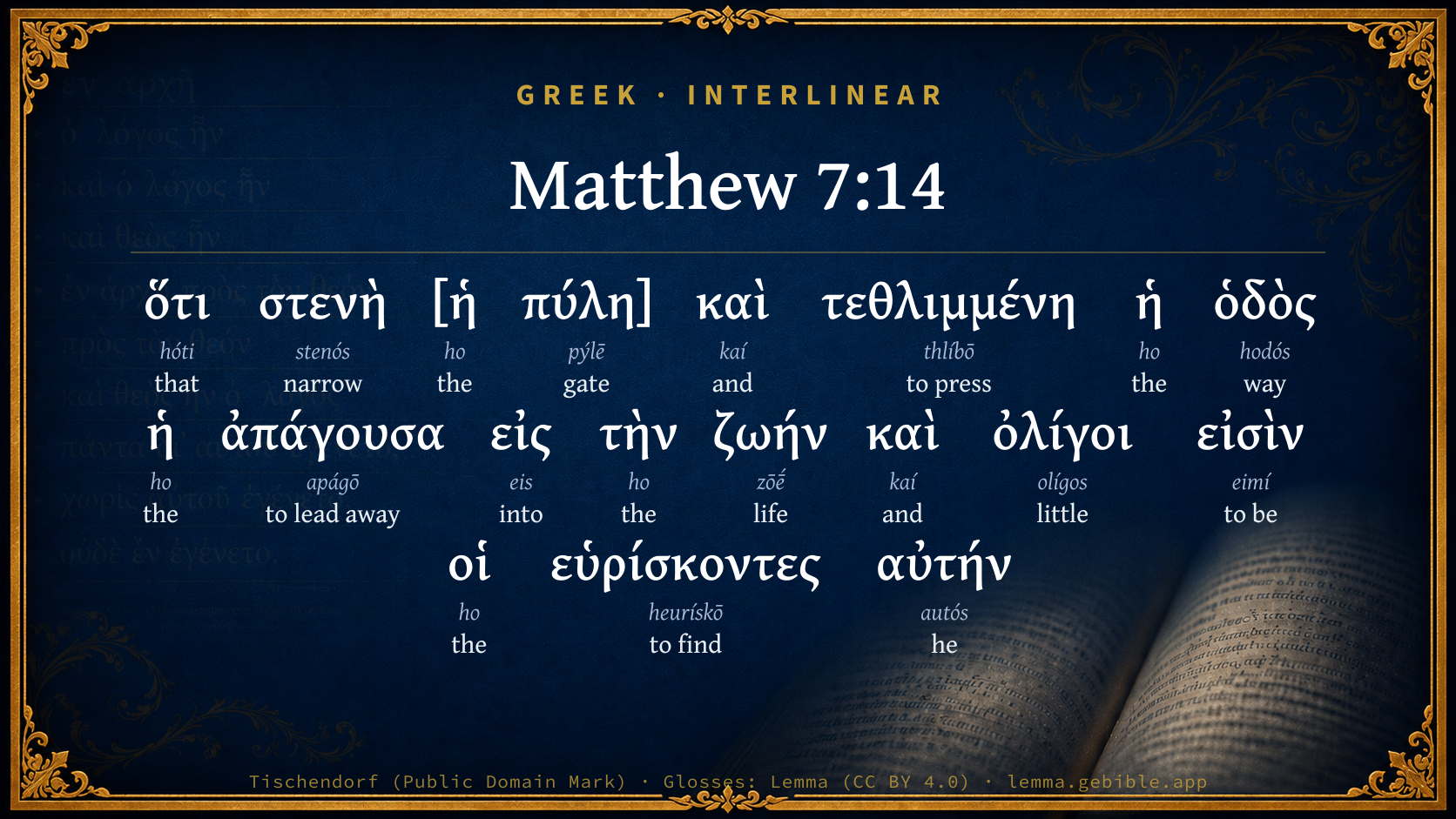
Greek (Tischendorf 8th ed.) Matthew 7:14 appears in the Greek New Testament. The text above is from the Tischendorf 8th edition. Each word links to its Strong’s number and a concise gloss. Click any word for its full Thayer’s Greek Lexicon entry.
Download image
Cite this verse

Matthew 7:14 (World English Bible). Public Domain. Lemma interlinear Bible study tool, https://lemma.gebible.app/v/matthew/7/14.

Show BibTeX & RIS
BibTeX
RIS
English Translation
How narrow is the gate, and restricted is the way that leads to life! Few are those who find it.
World English Bible · Public Domain
Highlights
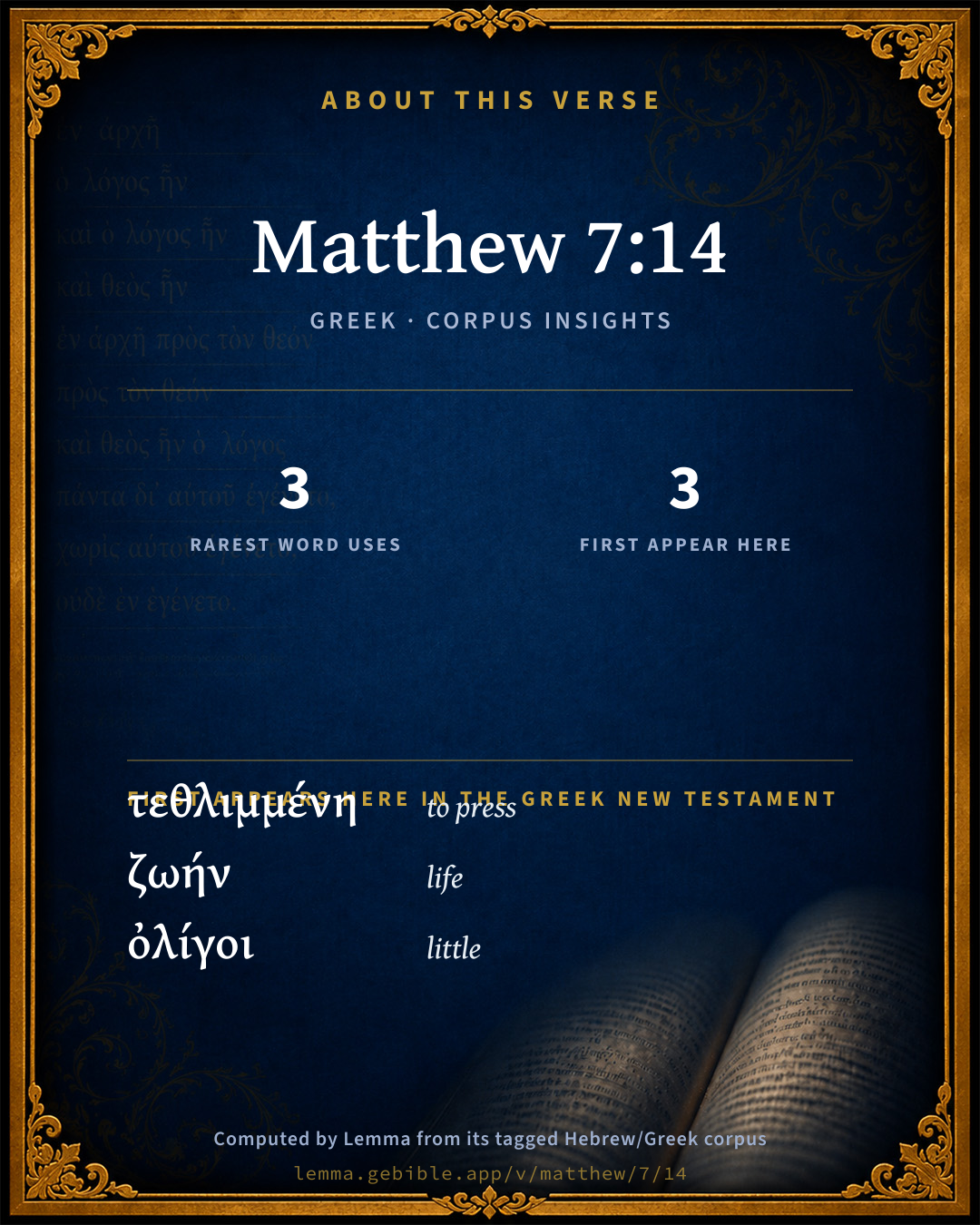
  • 3 first appearances in the Greek New Testament
Full analysis ↓
Download a study sheet

One document with this verse’s original text, its word-by-word gloss line, the meaning frame, cross-references with their text, attributed commentary, and full source and license credits — printable, and it pastes into notes with its structure intact.

This verse Autodidact and up

Study sheet (.html) Plain text (.txt)

A passage Seminary Student

Up to 50 verses in one chapter. A passage sheet keeps up to 6 commentary sources and 12 cross-references per verse, in the order this page ranks them, and says so on the sheet whenever that leaves anything out. Ask for a single verse and you get the Autodidact verse sheet above.

Everything on this page stays free to read, with no account — the sheet is a download of what is already on screen, not access to it.

Want to remove ads? Support Godless Engineer
Compare translations 3

The same verse in 3 English versions, stacked beneath the original-language interlinear above. Click any original word for its lexicon entry.

Each is an independent rendering of the whole verse — the interlinear is not word-aligned to these translations.

Highlighted words mark where these versions differ — a whole-verse word diff, not a word-by-word alignment.

  • World English Bible Public Domain
    How narrow is the gate, and restricted is the way that leads to life! Few are those who find it.
  • King James Version Public Domain
    Because strait is the gate, and narrow is the way, which leadeth unto life, and few there be that find it.
  • unfoldingWord Literal Text CC BY-SA 4.0
    For the gate narrow and the road has been made narrow that is leading to life, and there are few finding it.

unfoldingWord Literal Text — © unfoldingWord, licensed CC BY-SA 4.0. Word-aligned USFM3 via Door43 (git.door43.org/unfoldingWord/en_ult).

Versions to compare (up to 4)

3 of 4 selected

Show all 19 translations

Every available English version of this verse, each an independent rendering of the whole verse.

  • World English Bible Public Domain
    How narrow is the gate, and restricted is the way that leads to life! Few are those who find it.
  • Berean Standard Bible Public Domain
    But small is the gate and narrow the way that leads to life, and only a few find it.
  • Majority Standard Bible Public Domain
    But small is the gate and narrow the way that leads to life, and only a few find it.
  • King James Version Public Domain
    Because strait is the gate, and narrow is the way, which leadeth unto life, and few there be that find it.
  • American Standard Version (1901) Public Domain
    For narrow is the gate, and straitened the way, that leadeth unto life, and few are they that find it.
  • Revised Version (1885) Public Domain
    For narrow is the gate, and straitened the way, that leadeth unto life, and few be they that find it.
  • Geneva Bible (1599) Public Domain
    Because the gate is streight, and the way narowe that leadeth vnto life, and fewe there be that finde it.
  • Douay-Rheims (1899) Public Domain
    How narrow is the gate, and strait is the way that leadeth to life: and few there are that find it!
  • Young's Literal Translation Public Domain
    how strait `is' the gate, and compressed the way that is leading to the life, and few are those finding it!
  • Literal Standard Version CC BY-SA 4.0
    how narrow [is] the gate and compressed the way that is leading to life, and few are those finding it!
  • Unlocked Literal Bible CC BY-SA 4.0
    But the gate is narrow and the way is difficult that leads to life, and there are few who find it.
  • unfoldingWord Literal Text CC BY-SA 4.0
    For the gate narrow and the road has been made narrow that is leading to life, and there are few finding it.
  • Darby Bible Public Domain
    For narrow the gate and straitened the way that leads to life, and they are few who find it.
  • World Messianic Bible Public Domain
    How narrow is the gate and the way is restricted that leads to life! There are few who find it.
  • Webster's Bible Public Domain
    Because strait is the gate, and narrow is the way, which leadeth to life, and few there are that find it.
  • Free Bible Version CC BY-SA 4.0
    But the entrance is narrow, and the way is difficult that leads to life, and only a few find it.
  • Bible in Basic English Public Domain
    For narrow is the door and hard the road to life, and only a small number make discovery of it.
  • Text-Critical English NT CC BY 4.0
    How narrow is the gate, and restricted the way that leads to life, and there are few who find it!
  • Tyndale New Testament (1534) Public Domain
    But strayte is the gate and narowe ys the waye which leadeth vnto lyfe: and feawe there be that fynde it.

Literal Standard Version (2020), Covenant Press — licensed CC BY-SA 4.0. Text via the HelloAO Bible API (eBible.org). Unlocked Literal Bible (unfoldingWord) — licensed CC BY-SA 4.0. Text via the HelloAO Bible API (eBible.org). unfoldingWord Literal Text — © unfoldingWord, licensed CC BY-SA 4.0. Word-aligned USFM3 via Door43 (git.door43.org/unfoldingWord/en_ult). Free Bible Version, Dr. Jonathan Gallagher — licensed CC BY-SA 4.0. Text via the HelloAO Bible API (eBible.org).

Word by word

More ways to search: Search by grammar → Find every occurrence → Compare this word →

Practice this passage: Drill this verse → Learn its vocabulary →

στενὴ
stenós
G4728
“narrow”
Adjective, Nominative, Singular, Feminine
Part of Speech
Adjective
Case
Nominative
Number
Singular
Gender
Feminine
Full Thayer's Definition

Origin: probably from the base of G2476

TDNT: 17:04,1

1. narrow, strait
  1. ὅτι hóti G3754 “that” Conjunction
  2. [ἡ ho G3588 “the” Article, Nominative, Singular, Feminine
  3. πύλη] pýlē G4439 “gate” Noun, Nominative, Singular, Feminine
  4. καὶ kaí G2532 “and” Conjunction
  5. τεθλιμμένη thlíbō G2346 “to press” Verb, Perfect, Passive, Participle, Nominative, Singular, Feminine
  6. ἡ ho G3588 “the” Article, Nominative, Singular, Feminine
  7. ὁδὸς hodós G3598 “way” Noun, Nominative, Singular, Feminine
  8. ἡ ho G3588 “the” Article, Nominative, Singular, Feminine
  9. ἀπάγουσα apágō G520 “to lead away” Verb, Present, Active, Participle, Nominative, Singular, Feminine
  10. εἰς eis G1519 “into” Preposition
  11. τὴν ho G3588 “the” Article, Accusative, Singular, Feminine
  12. ζωήν zōḗ G2222 “life” Noun, Accusative, Singular, Feminine
  13. καὶ kaí G2532 “and” Conjunction
  14. ὀλίγοι olígos G3641 “little” Adjective, Nominative, Plural, Masculine
  15. εἰσὶν eimí G1510 “to be” Verb, Present, Active, Indicative, 3rd person, Plural
  16. οἱ ho G3588 “the” Article, Nominative, Plural, Masculine
  17. εὑρίσκοντες heurískō G2147 “to find” Verb, Present, Active, Participle, Nominative, Plural, Masculine
  18. αὐτήν autós G846 “he” Personal pronoun, Accusative, Singular, Feminine

About this verse

These counts appear in no published source. They are computed here, from the morphology-tagged text and Lemma’s own curated glosses. What Lemma adds →

19
words
14
distinct lemmas
Gospels
section

Notable vocabulary

The rarest word here is στενὴ narrow G4728 — appearing just 3 times in the whole Greek New Testament.

First appearance in Scripture

These words make their first canonical appearance in the Greek New Testament here:

  • τεθλιμμένη to press G2346
  • ζωήν life G2222
  • ὀλίγοι little G3641

Shared distinctive vocabulary

στενὴ narrow G4728 occurs in 3 verses of the Greek New Testament. Also found in:
Repetition

Words recur within this verse:

Cross-references

24

Topical passages linked to Matthew 7:14 in the Treasury of Scripture Knowledge — connected by theme and wording, ordered by reader-vote popularity; previews shown in the World English Bible.

  • Luke 13:23–30 One said to him, "Lord, are they few who are saved?" He said to them,
  • Matthew 22:14 For many are called, but few chosen."
  • Matthew 16:24–25 Then Jesus said to his disciples, "If anyone desires to come after me, let him deny himself, and take up his cross, and follow me.
  • Romans 12:2 Don't be conformed to this world, but be transformed by the renewing of your mind, so that you may prove what is the good, well-pleasing, and perfect will of God.
  • Isaiah 35:8 A highway shall be there, and a way, and it shall be called The way of holiness. The unclean shall not pass over it, but is shall be for for him who walks in the Way. Wicked fools will not go there.
  • Proverbs 8:20 I walk in the way of righteousness, In the midst of the paths of justice;
  • Mark 8:34 He called the multitude to himself with his disciples, and said to them, "Whoever wants to come after me, let him deny himself, and take up his cross, and follow me.
  • Acts 14:22 confirming the souls of the disciples, exhorting them to continue in the faith, and that through many afflictions we must enter into the Kingdom of God.
  • John 15:18–20 If the world hates you, you know that it has hated me before it hated you.
  • Isaiah 30:21 and your ears shall hear a word behind you, saying, This is the way, walk you in it; when you turn to the right hand, and when you turn to the left.
  • John 16:33 I have told you these things, that in me you may have peace. In the world you have oppression; but cheer up! I have overcome the world."
  • Proverbs 4:26–27 Make the path of your feet level. Let all of your ways be established.
  • Jeremiah 6:16 Thus says Yahweh, Stand you in the ways and see, and ask for the old paths, where is the good way; and walk therein, and you shall find rest for your souls: but they said, We will not walk [therein].
  • Matthew 20:16 So the last will be first, and the first last. For many are called, but few are chosen."
  • Ephesians 2:2–3 in which you once walked according to the course of this world, according to the prince of the powers of the air, the spirit who now works in the children of disobedience;
  • Luke 12:32 Don't be afraid, little flock, for it is your Father's good pleasure to give you the Kingdom.
  • Isaiah 57:14 He will say, Cast up, cast up, prepare the way, take up the stumbling-block out of the way of my people.
  • Romans 9:27–29 Isaiah cries concerning Israel, "If the number of the children of Israel are as the sand of the sea, It is the remnant who will be saved;
  • 1 Peter 3:20–21 who before were disobedient, when God waited patiently in the days of Noah, while the ark was being built. In it, few, that is, eight souls, were saved through water.
  • Matthew 25:1–12 "Then the Kingdom of Heaven will be like ten virgins, who took their lamps, and went out to meet the bridegroom.
  • 1 Thessalonians 3:2–5 and sent Timothy, our brother and God's servant in the Gospel of Christ, to establish you, and to comfort you concerning your faith;
  • Romans 11:5–6 Even so then at this present time also there is a remnant according to the election of grace.
  • Romans 9:32 Why? Because they didn't seek it by faith, but as it were by works of the law. They stumbled over the stumbling stone;
  • John 16:2 They will put you out of the synagogues. Yes, the time comes that whoever kills you will think that he offers service to God.

Cross-references courtesy of OpenBible.info (CC BY 4.0).

Where the printed editions differ

1 variant

Places in this verse where the major printed Greek editions disagree on the wording in a way that affects the translation — a comparison of editions, not a manuscript-by-manuscript collation. The editions are the modern critical texts (Nestlé-Aland 28/27, SBL, Westcott-Hort, Tregelles, Tyndale House) and the traditional texts behind the KJV (the Textus Receptus and the Byzantine/Majority text). It is not a claim about which reading is original.

  1. Different wording
    τί

    “Which”

    In NA28NA27TynTregByz Not in SBLWHTR

    ὅτι (hoti) 'Since' occurs in traditional manuscripts (SBL+WH+TR) instead of τί (ti) 'Which' in older manuscripts (NA28+NA27+Tyn+Treg+Byz)

Textual data: Translators Amalgamated Greek New Testament (STEPBible TAGNT) · CC BY 4.0.

Commentary

Notes on Matthew 7:14 from classic Christian and Jewish commentators (each source and its license shown beneath its notes). The classic Christian expositions comment on the surrounding passage and are grouped to its opening verse, so a note may address several verses; the Jewish commentaries on the Tanakh (Rashi and others) are per-verse, so they appear only where the commentator wrote on this verse.

Lemma curates 59 commentaries, every one of them public domain or Creative Commons licensed, each selected and text-cleaned for this edition rather than reprinted as found. About our sources →

Tyndale Open Study Notes

Tyndale Open Resources

7:14 Few people come to the light that is revealed in Christ (see 19:23; 20:16; 22:14; see also John 3:19; 6:66-71).

Tyndale Open Study Notes — © Tyndale Open Resources, licensed CC BY-SA 4.0. Text via the HelloAO Bible API.

Bengel's Gnomon

Johann Albrecht Bengel

Mat 7:14. Ὅτι στενὴ, κ.τ.λ., because straight, etc.) Many read τί στενὴ, κ.τ.λ.,[319] HOW straight, etc., as in the S. V. of 2Sa 6:20. where מה[320] is rendered by τί—sc. τί δεδόξασται σήμερον ὁ βασιλεὺς Ἰσραὴλ—HOW glorious was the king of Israel to-day! But there the expression is ironical.—The true reading is undoubtedly,[321] ὅτι πλατεῖα—ὅτι στενή, κ.τ.λ.,—BECAUSE broad—BECAUSE straight. Thus in 1Ki 21:15, כי[322] (rendered ὅτι by the LXX.) occurs twice.—ὅτι οὐκ ἔστι Ναβουθὰι ζῶν, ὅτι τέθνηκε: For, Naboth is not alive, but dead.[323] The last כי has the force of but; and is thus rendered by the LXX. in Dan 9:18, and 2Ch 20:15. See also Heb 8:10-11.[324]—αὐτὴν, it) sc. the gate. Cf. the commencement and conclusion of Mat 7:13.

[319] Lachm. reads τί στενὴ, with B corrected by a second hand, CLΔbc Vulg. Syr. Cypr. But Tischend. ὅτι, with B corrected by the first hand, X. Orig. 3, 527b, and Memph. Τί for ὡς is a Hellenistic idiom, Psa 8:1. where for the LXX. ὡς θαυμαστόν other versions have τί μωγα. The τί may be a gloss on ὅτι taken with the positive, as it is often with superlatives, intensively (ὅτι πλειστος, etc.): so in Plato ὅτι τάχυς, valde celeriter. However Bengel makes ὅτι, as before πλατεὶα, so to be repeated before στενή in the sense sed, ‘but.’—ED.

[320] What, or how.—(I. B.)

[321] Thus also E. M.—(I. B.)

[322] For a full account of this word and its meanings, see Gesenius’s Lexicon in voce.—(I. B.)

[323] Literally—“Because Naboth is not living, because he has died.—(I. B.)

[324] Εἰς τὴν ζωὴν is the expression used of the future life of blessedness: for the present life is not life at all.—V. g.

Bengel's Gnomon of the New Testament — English translation (T&T Clark, Edinburgh, 1860) — public domain. Text from a community e-Sword module.

Meyer's Critical & Exegetical Commentary

Heinrich August Wilhelm Meyer

Mat_7:14-15. Τί] quam (Vulg.): how strait is the gate! as conforming to the Sept., which renders מָח in this sense by τί (2Sa_6:20; Son_7:6; Luk_12:49), though not good Greek. The rendering why, as though there were something sorrowful in the question (Fritzsche), is unsuited to the whole tone of the discourse.

εὑρίσκοντες] The strait gate requires to be sought, so far is it from being readily seen, or from obtruding itself upon the attention.

By most, the gate is erroneously conceived to be at the end of the way; with Bengel, Schegg, and Lange, it is to be understood as at the beginning of it, as opening into it, for which reason, in Mat_7:13-14, the gate is mentioned before the way. The entering by the strait gate is therefore the entering into life (into the Messiahs kingdom), but still brought about through following the narrow way, which is reached by means of the strait gate.

προσέχετε δέ] But in order to find it, beware, and so on.

The ψευδοπροφῆται are not the Pharisees (Tholuck), nor Jews, pretending to be divine messengers (Bleek), nor people like Judas the Galilean (Act_5:37, de Wette), but false Christian teachers without a divine call (Mat_24:11; Mat_24:24), as is evident from Mat_7:21-23. Comp. Chrysostom, Calvin, Grotius, Calovius. A warning in view of coming events, and such as Jesus knew His followers would soon be needing.

ἐν ἐνδύμασι προβάτ.] dressed in sheeps clothing. Here we are not to think of literal sheep skins (Grotius, Kuinoel), seeing that these were worn by others, and were not specially the prophets dress (comp. Mat_3:4), but as emblematic of the outward appearance of innocence and gentleness, not of the external profession of a member of the Christian church (nominis Christiani extrinsecus superficies, Tertullian, de praescr. 4), which would have been admissible only if the context had spoken of the church in the light of a flock, in which case the false prophets would have been far more appropriately represented as in shepherds clothing. Bengel well remarks: Vestibus ut si essent oves.

ἔσωθεν] i.e., according to the figure; under the sheeps clothing; in reality; in their true inner nature, which is disguised by hypocrisy. With λύκοι ἅρπαγες, as representing soul-destroying agency, comp. Act_20:29; Joh_10:12.

Meyer — Critical and Exegetical Commentary on the New Testament — English translation by Peter Christie, edited by Frederick Crombie (T&T Clark, 1880) — public domain. Text from a community e-Sword module.

Geneva Bible (1599)

Geneva Bible translators

The way is straight and narrow we must pass through this rough way, and suffer and endure, and be thronged, and to enter into life.

Geneva Bible (1599) marginal notes — public domain. Text via Bolls.life.

Jamieson, Fausset & Brown

Robert Jamieson, A. R. Fausset & David Brown

Because strait is the gate, and narrow is the way, which leadeth unto life--In other words, the whole course is as difficult as the first step; and (so it comes to pass that).

few there be that find it--The recommendation of the broad way is the ease with which it is trodden and the abundance of company to be found in it. It is sailing with a fair wind and a favorable tide. The natural inclinations are not crossed, and fears of the issue, if not easily hushed, are in the long run effectually subdued. The one disadvantage of this course is its end--it "leadeth to destruction." The great Teacher says it, and says it as "One having authority." To the supposed injustice or harshness of this He never once adverts. He leaves it to be inferred that such a course righteously, naturally, necessarily so ends. But whether men see this or no, here He lays down the law of the kingdom, and leaves it with us. As to the other way, the disadvantage of it lies in its narrowness and solicitude. Its very first step involves a revolution in all our purposes and plans for life, and a surrender of all that is dear to natural inclination, while all that follows is but a repetition of the first great act of self-sacrifice. No wonder, then, that few find and few are found in it. But it has one advantage--it "leadeth unto life." Some critics take "the gate" here, not for the first, but the last step in religion; since gates seldom open into roads, but roads usually terminate in a gate, leading straight to a mansion. But as this would make our Lord's words to have a very inverted and unnatural form as they stand, it is better, with the majority of critics, to view them as we have done. But since such teaching would be as unpopular as the way itself, our Lord next forewarns His hearers that preachers of smooth things--the true heirs and representatives of the false prophets of old--would be rife enough in the new kingdom.

Jamieson, Fausset & Brown — Commentary Critical and Explanatory on the Whole Bible (1871) — public domain (CC PDM 1.0). Text via the HelloAO Bible API.

Adam Clarke's Commentary

Verse 14. Because strait is the gate] Instead of οτι because, I should prefer τι how, which reading is supported by a great majority of the best MSS., versions, and fathers. How strait is that gate! This mode of expression more forcibly points out the difficulty of the way to the kingdom. How strange is it that men should be unwilling to give up their worldly interests to secure their everlasting salvation! And yet no interest need be abandoned, but that which is produced by injustice and unkindness. Reason, as well as God, says, such people should be excluded from a place of blessedness. He who shows no mercy (and much more he who shows no justice) shall have judgment without mercy. Jas 2:13.

Few there be that find it.] The strait gate, στενη πυλη, signifies literally what we call a wicket, i.e. a little door in a large gate. Gate, among the Jews, signifies, metaphorically, the entrance, introduction, or means of acquiring any thing. So they talk of the gate of repentance, the gate of prayers, and the gate of tears. When God, say they, shut the gate of paradise against Adam, He opened to him the gate of repentance. The way to the kingdom of God is made sufficiently manifest - the completest assistance is promised in the way, and the greatest encouragement to persevere to the end is held out in the everlasting Gospel. But men are so wedded to their own passions, and so determined to follow the imaginations of their own hearts, that still it may be said: There are few who find the way to heaven; fewer yet who abide any time in it; fewer still who walk in it; and fewest of all who persevere unto the end. Nothing renders this way either narrow or difficult to any person, but sin. Let all the world leave their sins, and all the world may walk abreast in this good way.

Adam Clarke's Commentary on the Bible (1810–1826) — public domain. Text from a community e-Sword/MySword module.

Ellicott's Commentary for English Readers

(14) Narrow is the way.—Literally, pressed, or hemmed in between walls or rocks, like the pathway in a mountain gorge.

Which leadeth unto life.—Noteworthy as the first passage in our Lord’s recorded teaching in which the word “life” appears as summing up all the blessedness of the kingdom. The idea is developed as we advance; the life becomes “eternal,” and finally we are taught that the eternal life consists in the true and perfect knowledge of God and Christ (Joh_17:2-3).

Few there be that find it.—The sad contrast between the many and the few runs through all our Lord’s teaching. He comes to “save the world,” and yet those whom He chooses out of the world are but as a “little flock.” They are to preach the gospel, and yet the result will be but discord and division. The picture is a dark one, and yet it represents but too faithfully the impression made, I do not say on Calvinist or even Christian, but on any ethical teacher, by the actual state of mankind around us. They are, for the most part, unconscious of the greatness of their lives, and of the interests at stake in them. If there is any wider hope, it is found in hints and suggestions of the possibilities of the future (1Pe_3:19; 1Pe_4:6); in the fact that the words used are emphatically present; in the belief that the short span of this life is not necessarily the whole of the discipline of a soul made for eternity; and that the new life, nascent, and feeble, and stunted here, may be quickened by some new process of education into higher energies.

A Bible Commentary for English Readers, edited by Charles John Ellicott (1878–1897) — public domain. Text from a community e-Sword module.

The Cambridge Bible for Schools and Colleges

gen. ed. J. J. S. Perowne

14. because] To be taken after “enter ye” as in preceding verse, or it gives a reason why many go in at the wide gate.

narrow] Literally, pressed, confined.

The Cambridge Bible for Schools and Colleges (gen. ed. J. J. S. Perowne; Cambridge University Press, 1878–1918) — public domain. Text from a community e-Sword module.

John Gill's Exposition

Beware of false prophets,.... Or false teachers; for not such who pretended to foretell things to come, but such who set up themselves to be teachers of others, are here meant; see Pe2 2:1. It may be queried, whether our Lord has not respect to the Scribes and Pharisees, who sat in Moses's chair, and taught, for doctrines, the commandments of men? and of whose doctrines he elsewhere bids men beware: for whatever plausible pretences for holiness and righteousness might appear in them, they were repugnant to the word of God, and destructive to the souls of men; such as their doctrines of free will, justification by the works of the law, the traditions of the elders, &c. since it follows,

which come to you in sheep's clothing, but inwardly are ravenous wolves; for these "loved to go in long clothing", Mar 12:38.

in a garment which reached to the feet, and was made of the wool of sheep. The Babylonish garment Achan saw and stole, Rab says (r), was , a garment called "melotes": which is the very Greek word the author of the Epistle to the Hebrews uses for sheep skins, persecuted saints wandered about in, Heb 11:37 and the gloss upon the place, in the Talmud referred to, says, that this was , "a talith", or "garment of pure wool"; and Jarchi (s) says, that

"it was the way of deceivers, and profane men, to cover themselves, "with their talith", or long garment, "as if they were righteous men", that persons might receive their lies.''

All which agrees very well with the Pharisees, who would have been thought to have been holy and righteous, humble, modest, and self-denying men; when they were inwardly full of hypocrisy and iniquity, of rapine, oppression, and covetousness; and, under a pretence of religion, "devoured widows' houses". Though, it seems, by what follows, that Christ has respect, at least also, to such, who bore his name, and came in his name, though not sent by him, and called him Lord, and prophesied, and cast out devils, and did many wonderful works in his name; who, that they might get the good will and affections of the people, clothed themselves, not in garments made of sheep's wool, but in the very skins of sheep, with the wool on them, in imitation of the true prophets, and good men of old; pretending great humility, and self-denial, and so "wore a rough garment to deceive", Zac 13:4 when they were inwardly greedy dogs, grievous wolves, of insatiable covetousness; and, when opportunity offered, spared not the flock to satisfy their rapacious and devouring appetites. The Jews speak of a "wolfish humility"; like that of the wolf in the fable, which put on a sheep skin.

"There are some men, (says one of their (t) writers,) who appear to be humble, and fear God in a deceitful and hypocritical way, but inwardly lay wait: this humility our wise men call , "wolfish humility".''

Such is this our Lord inveighs against, and bids his followers beware of.

(r) T. Bab. Sanhedrim, fol. 41. 1. (s) In Zech. xiii. 4. (t) Abarbinel Nachalath Abot, fol. 192. 1.

John Gill's Exposition of the Whole Bible (1746–1763) — public domain (CC PDM 1.0). Text via the HelloAO Bible API.

Trapp's Complete Commentary

John Trapp

14 Because strait is the gate, and narrow is the way, which leadeth unto life, and few there be that find it.

Ver. 14. Because strait is the gate, and narrow is the way, &c.] "In Lollards’ tower, passing through six or seven doors I came to my lodging" (saith Philpot, martyr) "through many straits; where I called to remembrance, that strait is the way to heaven." The old copies read, Oh, how strait is the gate! by way of admiration, q.d. It is wondrous strait. {a} Not of itself, for Christ’s yoke is easy, and his burden light; but we make it so hard and heavy to ourselves, by our singular peevishness and perverseness. Besides, the prince of darkness and his black guard favour this way, that is called holy, as little as the Philistine princes did David, yea, they persecute it to the death as Saul did, Act 9:1-2. Hence the way to heaven is an afflicted way, a perplexed, persecuted way, crushed close together with crosses (as the word importeth), {b} as was the Israelites’ way in the wilderness, or that of Jonathan and his armourbearer, that had a sharp rock on the one side and a sharp rock on the other. And, while they crept upon all fours, flinty stones were under them, briers and thorns on either hand of them, mountains, crags, and promontories over them, sic petitur coelum, so heaven is caught, by pains, by patience, by violence, affliction being our inseparable companion. "The crossway is the highway to heaven," said that martyr. And another, "If there be any way to heaven on horseback, it is by the cross." Queen Elizabeth is said to have swum to the crown through a sea of sorrows. They that will to heaven must sail by hell’s gates. They that will have knighthood, must kneel for it; and they that will get in at the strait gate, must crowd for it. "Strive to enter iu at the strait gate," saith our Saviour. Strive and strain even to an agony (as the word signifieth). Heaven is compared to a hill, Psa 121:1; hell to a hole. To hell a man may go without a staff (as we say), the way thereto is easy, steep, strewed with roses. {c} It is but a yielding to Satan, a passing from sin to sin, from evil purposes to evil practices, from practice to custom, &c. Sed revocare gradum, but to turn short again, and make strait steps to our feet, that we may force through this strait gate (so strait, that as few can walk in it, so none can halt in it, but must needs go upright), hic labor, hoc opus est, onus non pulvinaris sed pulveris, this is a work of great pains, a duty of no small difficulty. "Many, I say unto you, shall seek to enter," but seeking serves not turn. Men must strive, and strive lawfully, run, and run lustily, tug and take pains till they sweat and faint, to get through this strait gate, this perplexed way; as unpleasant to nature as the way to Nineveh was to Jonah; as rough and rugged as that was to the Church, Hos 2:6; as little traced and trod as the highways to Sion hill, which were overgrown with grass, because few or none came to the solemn feasts, Lam 1:4.

And few there be that find it] So hard is it to hit, and as dangerous to miss. Many byways there are (these are so many highways to hell), besides false guides and steep declines not a few, to divert us: the devil with his false directions leading men hoodwinked to hell, as Elijah did the Syrians to Samaria. The world with its allurements and affrightments, -oh, how hardly scape we through the corruptions that are in the world through lust! {d} Our own hearts, how heavy are they to be drawn this way! A bear comes not unwillingly to the stake. It goes hard with a man when he must peremptorily deny himself; when he must deny all ungodliness and worldly lusts, as dear unto him as himself, and be tied to live holily, righteously, and soberly in this present world, Tit 2:12; making conscience of those duties which the most men’s hearts rise at, as to be hot in religion, fervent in spirit, precise in his whole course, conscientious and cautious of the least sin, &c. Heaven is a stately palace with a narrow portal, hence so few enter it. The proud man with his high looks cannot stoop to it. The ambitious with his aspiring thoughts cannot bend to it. The malicious is swollen too big for it. The covetous with his load of thick clay cannot get through it. The drunkard with his rotten lungs, the adulterer with his wasted loins, can have no admittance into it. There can in no wise enter anything filthy or loathsome, abominable or detestable, which a man would abhor for the ill-savour (as the word signifieth, Rev 21:27), {e} such as for the baseness thereof cannot be well named, it is so noisome to the senses. As soon may these men find fishes swimming in a wood, fruit trees growing in the sea, heaven in hell, as enter into the strait gate, not living strictly. Which because few can frame to, but deride those that do (counting and calling them, as the Spaniards are said to do the Portugals, poco y locos, few and foolish), therefore few are saved. Our Saviour calleth his flock a "little little flock," two diminutives, Luk 12:32, standing (as that small army of Israel in Ahab’s time) "like two little flocks of kids," 1Ki 20:27, when the wicked (as those Syrians then) fill the country. Was it not so, when Jerome complained that the whole world was turned Arian, {f} and Basil cried out, An Ecclesias suas prorsus dereliquit Dominus? Hath God utterly forsaken his Church? &c. "The love of many shall wax cold, but he that endureth to the end," &c. It is but a "he," in the singular, that endureth to the end, the "many" fall away from their former steadfastness.

{a} Τι στενη, i.e. Βαβαι, saith Theophylact; לא saith the Syriac. Non quia dura, sed quia molles patimur.

{b} Τεθλιμμενη, pressa: res enim compressione fiunt aretiores. Beza. Manibus pedibusque obnixe omnia facere. Terent.

{c} ολιγη οδος, μαλα δ εγγυθι ναιει. Hes.

{d} Irritamenta, terriculamenta, 2Pe 1:7.

{e} Βδελυγμα quod, propter foeditatem, nemo non aversatur. Βδεω, pedo.

{f} Ingemuit orbis, et miratus est se subito factum esse Arianum. Jerome.

John Trapp, A Commentary or Exposition upon All the Books of the Old and New Testament (1647–1656) — public domain. Text from a community e-Sword module.

Haydock's Catholic Bible Commentary

Our Saviour in another place says, my yoke is sweet, and my burthen light. How comes it then that so few bear it, or how can we reconcile these texts together? The answer is at hand; for if soldiers and mariners esteem wounds, storms, and shipwreck, easy to be borne with, in hopes of temporal rewards, surely no one can complain that the duties of a Christian are difficult, when compared with the glory which shall be revealed in us. (St. John Chrysostom) --- It may also be added that God, by his heavenly consolations, makes them not only supportable, but even easy and pleasant. Thus the martyrs occasionally did not feel their torments through the sweet unction of divine love, and the excessive joy which God poured into their souls. (Haydock)

George Leo Haydock (1774–1849), Haydock's Catholic Family Bible and Commentary, 1859 edition — public domain. Excludes Psalms (Douay-Rheims chapter numbering differs from Protestant) and Deuterocanonical books (Catholic canon only).

Whedon's Commentary on the Bible

Daniel D. Whedon

14. Few there be that find it — They do not look for it. They see the crowd rushing through the broad gate; they desire nothing better than so liberal a route, and they would not press through the narrow way if before their eyes.

Daniel D. Whedon (gen. ed.), Commentary on the Old and New Testaments (1874–1909) — public domain. Text from a community e-Sword module.

The Pulpit Commentary

Because (oti); for (Revised Version); "many ancient authorities read, How narrow is the gate, etc." (Revised Version margin). The reading, "how" (ti) is much easier, as avoiding the difficulty of the connexion of this verse with the preceding, but probably oti is right. The connexion is either that it is parallel to the first oti , and thus gives a second reason for decision in entering through the narrow gate; or, and better, that it gives the reason for the statement in ver. 13b many pass along the wrong way because the right way requires at the very outset so much determination and afterwards so much self denial. Strait is the gate, and narrow is the way; narrow is the gate, and straitened the way (Revised Version). Not only is the gate narrow, but the way itself seems compressed (teylimmenh) by rocks, etc., on either side. That leadeth unto life (eiv thn). Observe, Christ does not say, "life eternal." He only cares to emphasize the thought of life in the fullest nature of life life as "the fulfilment of the highest idea of being: perfect truth in perfect action". (Bishop Westcott, on 1Jn_3:14) And few there be that; Revised Version, and few be they that (ver. 13, note). Our Lord here affirms more than the disciples ask in Luk_13:23; for there the question deals with those in a state of salvation (oi swzomenoi), here those finally saved. Find it; i.e. the gate and all it leads to. The narrow gate is here looked at as involving life. Find. It needs a search (contrast ver. 13). But there is the promise of ver. 7, "Seek, and ye shall find.

The initial difficulty of all good enterprises.

"Strait is the gate... which leadeth unto life." Dean Plumptre gives the similar figure, taken from what is known as the "Tablet of Cebes, the Disciple of Socrates:" "Seest thou not a certain small door, and a pathway before the door, in no way crowded, but few, very few, go in thereat? This is the way that leadeth to true discipline". (comp. RAPC 2Est 7:1-13, "The entrance to the city was made by only one path, even between fire and water, so small that there could but one man go there at once Buckingham, the traveller among the Arabs, has a striking illustration: "Close by the sarcophagus is a curious old mosque, with a large open centre, and colonnades, or wings of three arches each, on each side. Some of the arches rest on square pillars of masonry, and others on small circular columns of basalt. One of these pillars is formed wholly of one piece of stone, including pedestal, shaft, and capital; and near it is a curious double column, the pedestals of which are in one piece, the shafts each composed of two pieces, and the two capitals with their plinths all formed out of one block. These pillars are not large, and are only distant from each other, as they stand, about a human span. They are right opposite the door of entrance into the mosque, and we were assured that it was a general belief among the Mohammedans that whoever could pass through these pillars unhurt was destined for heaven, and whoever could not might prepare either to reduce his bulk, or expect a worse fate in hell.

I THE BEGINNING OF COMMON HANDICRAFT IS DIFFICULT. So the apprentice ever finds it. A lesson in self-discipline is the first lesson every one must learn who means to do anything worth doing. This is readily illustrated in specific instances.

II THE BEGINNING OF ALL MENTAL ACQUIREMENT IS DIFFICULT, A strait gate is at the entrance of all science. He who will not wrestle with the perplexities of the alphabet shall learn nothing.

III THE BEGINNING OF ALL MORAL CULTURE IS DIFFICULT. As difficult as these other things. More difficult, because the moral nature has taken a bias to self-indulgence and evil. So there is the dead weight of self-resistance to overcome. The pillars at the entrance of the temple of all true good are only a span apart. No man who will not squeeze himself, deny himself, can hope to enter in. R.T.

The Pulpit Commentary (1880–1919), ed. H.D.M. Spence-Jones & Joseph S. Exell — public domain. Text from a community e-Sword module.

The People's New Testament

B. W. Johnson

14. For strait is the gate. What is it, Augustine asks, that makes this gate so strait to us? It is not that it is strait, or narrow, in itself, but that we want to take in our pride, our self-will, our darling sins. Few there be that find it. It has been to be sought. The reason that men do not find it is not because it is hard to find, but because they prefer to walk in the broad way.

B. W. Johnson's The People's New Testament with Notes (1889–1891) — public domain. Electronic text from the Christian Classics Ethereal Library (CCEL) ThML edition.

Cambridge Greek Testament for Schools and Colleges

14. ὅτι is rightly adopted, though τί has a great preponderance of external authority; of the uncials, א* B* and X alone exhibit ὅτι. The variant probably illustrates an interesting cause of error, by which the initial letter was sometimes overlooked through being reserved for subsequent revision and more careful work. Scrivener’s ., p. 15.

14. ὅτι. This ὅτι equally with the first, Mat 7:13, is in construction with εἰσέλθατε διὰ τῆς στενῆς πύλης.

For the reading τί στενὴ see Crit. Notes. The internal evidence against it is strong. (1) The meaning assigned to τί, ‘how narrow,’ is unexampled in the N.T.; Luk 12:49 is not an instance. (2) The reading is harsh and breaks the constructive rhythm of the passage.

τεθλιμμένη, (θλίβω), lit. ‘pressed,’ ‘confined.’ Cp. Theocr. XXI. 18, παρʼ αὐτὰν | θλιβομέναν καλύβαν (angustam casam).

ὀλίγοι οἱ εὑρίσκοντες. An answer to one of the disputed questions of the day, εἰ ὀλίγοι οἱ σωζόμενοι, Luk 13:23, the parallel passage to this (St Luke has instead of εἰσέλθατε the stronger phrase ἀγωνίζεσθε εἰσελθεῖν). It was a question that had been canvassed most earnestly in the reflective period after the cessation of prophecy. An answer to it would be demanded of every great teacher. See Prof. Westcott’s Introduction to N.T., p. 105, especially the quotation from 2Es 7:1-13. ‘The entrance to the fair city was made by one only path, even between fire and water, so small that there could but one man go there at once.’ Before Adam’s transgression it was wide and sure.

Cambridge Greek Testament for Schools and Colleges (Cambridge University Press, 1896; 21 vols, various authors incl. Carr, Maclear, Plummer, Farrar, Lumby, Moule, M. R. James, Simcox) — public domain. Text from a community e-Sword module.

Alford’s Greek Testament

Henry Alford

14.] ὅτι gives a second reason, on which that in ver. 13 depends: strive, &c., for broad is, &c., because narrow is, &c. The reason why the way to destruction is so broad, is because so few find their way into the narrow path of life. This is not merely an arbitrary assignment of the ὅτι, but there is a deep meaning in it. The reason why so many perish is not that it is so ordained by God, who will have all to come to the knowledge of the truth,—but because so few will come to Christ, that they may have life; and the rest perish in their sins. See notes on ch. 25:41. The reading τί (adopted by Lachmann, Tregelles, Meyer, De Wette) will not bear the signification commonly assigned to it, ‘How narrow is the gate?’ And the interrogative meaning (Meyer) is inconsistent with ὀλίγοι εἰσίν, which follows.

τεθλιμμένη, restricted,—crushed in, in breadth: i.e. as Strom. v. 5 (31), p. 664 Ρ, … τὴν μὲν … στενὴν κ. τεθλιμμένην τὴν κατὰ τὰς ἐντολὰς κ. ἀπαγορεύσεις περιεσταλμένην, τὴν δὲ ἐναντίαν τὴν εἰς ἀπώλειαν φέρουσαν, πλατεῖαν κ. εὐρύχωρον, ἀκώλυτον ἡδοναῖς τε καὶ θυμῷ.…

Henry Alford, The Greek Testament (1849–1861) — public domain. Text from a community e-Sword module.

International Critical Commentary

14. How narrow is the gate, and contracted is the way, which leads to life, and (how) few are they who find it !]

14. The narrow gate or narrow door (Lk.) is the gate or door into the kingdom of heaven. Lk. has the phrase in an eschatological context. Here the meaning is less definitely eschatological, but it is not improbable that we should interpret the words in the light of vv. 22ff. with reference to the future kingdom. “Enter through the narrow gate” will then mean, “remember that the gate by which you must enter into the kingdom is a narrow one”; cf. 19:24 “It is easier to go through the eye of a needle than—into the kingdom”; and 2 Ezr 7:3-14. The metaphor of the narrow gate suggests the parallel and more common metaphor of the two ways. And the speaker states the first member of that simile: “Because broad and wide is the way that leadeth to destruction, and many are they that go in through it.” For δἰ αὐτῆς = διὰ τῆς ὁδοῦ, cf. 2:12. Then instead of simply stating the second member of the simile, the speaker breaks into an exclamation which combines both metaphors: “Ah ! how narrow is the gate and contracted is the way which leads to life, and few there are who find it.” For the two ways, cf. Jer 21:8; Siphri on Deu 11:26 (Ugol.) 604, where “blessing and cursing” are interpreted as “two ways; the one at first level and at last full of thorns, the other at first full of thorns and at last level.”—ὀλίγοι εἰσίν, κ.τ.λ.] cf. 2 Est 8:3 “There be many created, but few shall be saved.”—εἰς τὴν ζωήν] cf. 18:8, 9, 19:17. In 19:16, 29, 25:46 we have “eternal life.” For “life” as equivalent to “eternal life,” see Dalm. Words, 156 ff.; Volz, Jüd. Eschat. pp. 306, 326, 368.

14. τί] So א b vid et c B2 E al S2 latt. ὄτι, א* B*, is perhaps due to assimilation to the previous verse.

(c)

International Critical Commentary — older volumes (1896–1929), various authors — public domain. Text from a community e-Sword module.

Lesson kit

Teaching starters — assembled from the data on this page, not authored interpretation. Every prompt links to the verse data it draws on. Edit before teaching.

Matthew, in the Gospels, opens this verse with 19 words (14 distinct Greek lemmas). Its most distinctive word is stenós (“narrow”). A historical commentator’s framing appears above. Read the whole chapter for the surrounding context.

Discussion questions

  1. The word stenós carries the sense “narrow.” How does it shape the verse?
  2. 3 words here appear for the first time in Scripture. What is being introduced at this debut?
  3. Matthew 7:13 shares the word «narrow» with this verse. How do the two illuminate each other?
  4. “the” occurs 5× in this one verse. What is the effect of the repetition?
  5. The translations on this page render this verse differently — a whole-verse word diff, not a word-by-word alignment. What might account for the different wordings?
  6. Reading how Tyndale Open Study Notes and Bengel's Gnomon read this verse, where do the two commentators agree and where do they part?

Things to notice

  • 3 words make their first canonical appearance in Scripture here.
  • These translations choose different wording for 17 words in this verse.
  • “the” occurs 5× in this single verse.
  • 14 distinct Greek lemmas span 19 words in this verse.

Reading settings

Reading text

Shown beneath each verse's original-language words.

Old Testament
Old Testament edition

Read the OT as the Masoretic Hebrew (MT) or the Greek Septuagint (LXX).

English shown for the Greek Septuagint (in the Hebrew ↔ Greek comparison).

Comparing translations? Open the Compare panel on any verse page to stack up to four side by side.