

Matthew 23:16
Greek (Tischendorf 8th ed.) Matthew 23:16 appears in the Greek New Testament. The text above is from the Tischendorf 8th edition. Each word links to its Strong’s number and a concise gloss. Click any word for its full Thayer’s Greek Lexicon entry.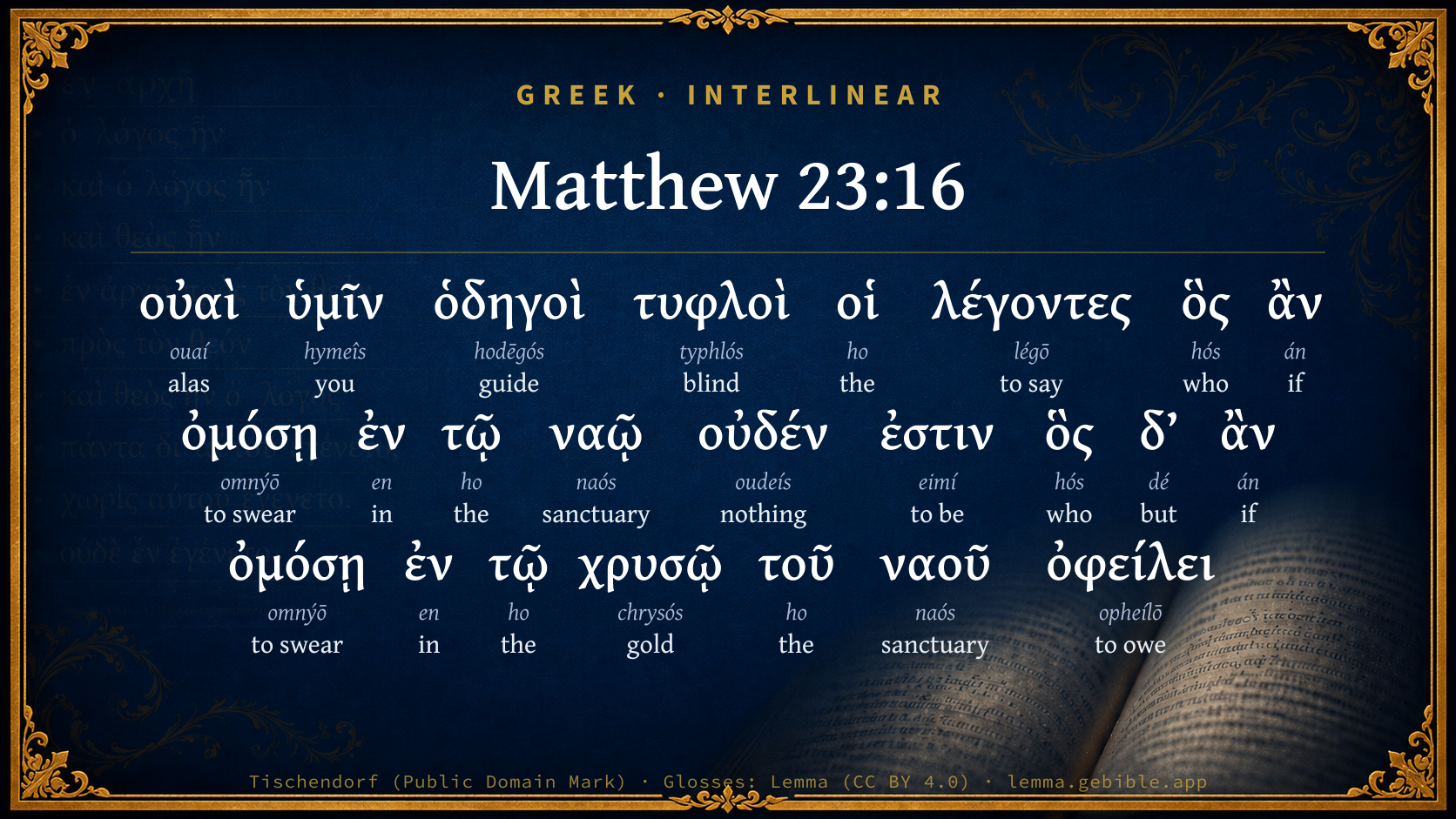
"Woe to you, you blind guides, who say, 'Whoever swears by the temple, it is nothing; but whoever swears by the gold of the temple, he is obligated.'
Download a study sheet
One document with this verse’s original text, its word-by-word gloss line, the meaning frame, cross-references with their text, attributed commentary, and full source and license credits — printable, and it pastes into notes with its structure intact.
This verse Autodidact and up
A passage Seminary Student
Up to 50 verses in one chapter. A passage sheet keeps up to 6 commentary sources and 12 cross-references per verse, in the order this page ranks them, and says so on the sheet whenever that leaves anything out. Ask for a single verse and you get the Autodidact verse sheet above.
Everything on this page stays free to read, with no account — the sheet is a download of what is already on screen, not access to it.
Compare translations 3
The same verse in 3 English versions, stacked beneath the original-language interlinear above. Click any original word for its lexicon entry.
Each is an independent rendering of the whole verse — the interlinear is not word-aligned to these translations.
Highlighted words mark where these versions differ — a whole-verse word diff, not a word-by-word alignment.
-
World English Bible Public Domain
"Woe to you, you blind guides, who say, 'Whoever swears by the temple, it is nothing; but whoever swears by the gold of the temple, he is obligated.'
-
King James Version Public Domain
Woe unto you, ye blind guides, which say, Whosoever shall swear by the temple, it is nothing; but whosoever shall swear by the gold of the temple, he is a debtor!
-
unfoldingWord Literal Text CC BY-SA 4.0
Woe to you, blind guides, the ones saying, ‘Whoever swears by the temple, it is nothing. But whoever swears by the gold of the temple, he is obligated.’
unfoldingWord Literal Text — © unfoldingWord, licensed CC BY-SA 4.0. Word-aligned USFM3 via Door43 (git.door43.org/unfoldingWord/en_ult).
Show all 19 translations
Every available English version of this verse, each an independent rendering of the whole verse.
-
World English Bible Public Domain
"Woe to you, you blind guides, who say, 'Whoever swears by the temple, it is nothing; but whoever swears by the gold of the temple, he is obligated.'
-
Berean Standard Bible Public Domain
Woe to you, blind guides! You say, ‘If anyone swears by the temple, it means nothing; but if anyone swears by the gold of the temple, he is bound by his oath.’
-
Majority Standard Bible Public Domain
Woe to you, blind guides! You say, ‘If anyone swears by the temple, it means nothing; but if anyone swears by the gold of the temple, he is bound by his oath.’
-
King James Version Public Domain
Woe unto you, ye blind guides, which say, Whosoever shall swear by the temple, it is nothing; but whosoever shall swear by the gold of the temple, he is a debtor!
-
American Standard Version (1901) Public Domain
Woe unto you, ye blind guides, that say, Whosoever shall swear by the temple, it is nothing; but whosoever shall swear by the gold of the temple, he is a debtor.
-
Revised Version (1885) Public Domain
Woe unto you, ye blind guides, which say, Whosoever shall swear by the temple, it is nothing; but whosoever shall swear by the gold of the temple, he is a debtor.
-
Geneva Bible (1599) Public Domain
Wo be vnto you blinde guides, which say, Whosoeuer sweareth by the Temple, it is nothing: but whosoeuer sweareth by the golde of the Temple, he offendeth.
-
Douay-Rheims (1899) Public Domain
Woe to you blind guides, that say, Whosoever shall swear by the temple, it is nothing; but he that shall swear by the gold of the temple, is a debtor.
-
Young's Literal Translation Public Domain
`Wo to you, blind guides, who are saying, Whoever may swear by the sanctuary, it is nothing, but whoever may swear by the gold of the sanctuary -- is debtor!
-
Literal Standard Version CC BY-SA 4.0
Woe to you, blind guides, who are saying, Whoever may swear by the temple, it is nothing, but whoever may swear by the gold of the temple—is debtor!
-
Unlocked Literal Bible CC BY-SA 4.0
Woe to you, you blind guides, you who say, 'Whoever swears by the temple, it is nothing. But whoever swears by the gold of the temple, he is bound to his oath.'
-
unfoldingWord Literal Text CC BY-SA 4.0
Woe to you, blind guides, the ones saying, ‘Whoever swears by the temple, it is nothing. But whoever swears by the gold of the temple, he is obligated.’
-
Darby Bible Public Domain
Woe to you, blind guides, who say, Whosoever shall swear by the temple, it is nothing; but whosoever shall swear by the gold of the temple, he is a debtor.
-
World Messianic Bible Public Domain
“Woe to you, you blind guides, who say, ‘Whoever swears by the temple, it is nothing; but whoever swears by the gold of the temple, he is obligated.’
-
Webster's Bible Public Domain
Woe to you, ye blind guides, who say, Whoever shall swear by the temple, it is nothing; but whoever shall swear by the gold of the temple, he is a debtor.
-
Free Bible Version CC BY-SA 4.0
What a disaster is coming on those of you who say, ‘If you swear by the Temple that doesn't count, but if you swear by the gold of the Temple, then you have to keep your oath.’ What blind guides you are!
-
Bible in Basic English Public Domain
A curse is on you, blind guides, who say, Whoever takes an oath by the Temple, it is nothing; but whoever takes an oath by the gold of the Temple, he is responsible.
-
Text-Critical English NT CC BY 4.0
“Woe to you, blind guides, who say, ‘If anyone swears by the temple, it is nothing; but if anyone swears by the gold of the temple, he is bound by his oath.’
-
Tyndale New Testament (1534) Public Domain
Wo be vnto you blynd gides which saye whosoever sweare by the temple it is no thinge: but whosoever sweare by the golde of the temple he offendeth.
Literal Standard Version (2020), Covenant Press — licensed CC BY-SA 4.0. Text via the HelloAO Bible API (eBible.org). Unlocked Literal Bible (unfoldingWord) — licensed CC BY-SA 4.0. Text via the HelloAO Bible API (eBible.org). unfoldingWord Literal Text — © unfoldingWord, licensed CC BY-SA 4.0. Word-aligned USFM3 via Door43 (git.door43.org/unfoldingWord/en_ult). Free Bible Version, Dr. Jonathan Gallagher — licensed CC BY-SA 4.0. Text via the HelloAO Bible API (eBible.org).
Word by word
More ways to search: Search by grammar → Find every occurrence → Compare this word →
Practice this passage: Drill this verse → Learn its vocabulary →
- Appears 5× in the Greek New Testament
- First appears at Matthew 15:14
- Part of Speech
- Noun
- Case
- Vocative
- Number
- Plural
- Gender
- Masculine
Full Thayer's Definition
- οὐαὶ ouaí G3759 “alas” Interjection
- ὑμῖν hymeîs G5210 “you” Personal pronoun, 2nd person, Dative, Plural
- ὁδηγοὶ hodēgós G3595 “guide” Noun, Vocative, Plural, Masculine
- τυφλοὶ typhlós G5185 “blind” Adjective, Vocative, Plural, Masculine
- οἱ ho G3588 “the” Article, Nominative, Plural, Masculine
- λέγοντες légō G3004 “to say” Verb, Present, Active, Participle, Nominative, Plural, Masculine
- ὃς hós G3739 “who” Relative pronoun, Nominative, Singular, Masculine
- ἂν án G302 “if” Particle
- ὀμόσῃ omnýō G3660 “to swear” Verb, Aorist, Active, Subjunctive, 3rd person, Singular
- ἐν en G1722 “in” Preposition
- τῷ ho G3588 “the” Article, Dative, Singular, Masculine
- ναῷ naós G3485 “sanctuary” Noun, Dative, Singular, Masculine
- οὐδέν oudeís G3762 “nothing” Adjective, Nominative, Singular, Neuter, Negative
- ἐστιν eimí G1510 “to be” Verb, Present, Active, Indicative, 3rd person, Singular
- ὃς hós G3739 “who” Relative pronoun, Nominative, Singular, Masculine
- δ’ dé G1161 “but” Conjunction
- ἂν án G302 “if” Particle
- ὀμόσῃ omnýō G3660 “to swear” Verb, Aorist, Active, Subjunctive, 3rd person, Singular
- ἐν en G1722 “in” Preposition
- τῷ ho G3588 “the” Article, Dative, Singular, Masculine
- χρυσῷ chrysós G5557 “gold” Noun, Dative, Singular, Masculine
- τοῦ ho G3588 “the” Article, Genitive, Singular, Masculine
- ναοῦ naós G3485 “sanctuary” Noun, Genitive, Singular, Masculine
- ὀφείλει opheílō G3784 “to owe” Verb, Present, Active, Indicative, 3rd person, Singular
About this verse
These counts appear in no published source. They are computed here, from the morphology-tagged text and Lemma’s own curated glosses. What Lemma adds →
- 24
- words
- 16
- distinct lemmas
- Gospels
- section
Notable vocabulary
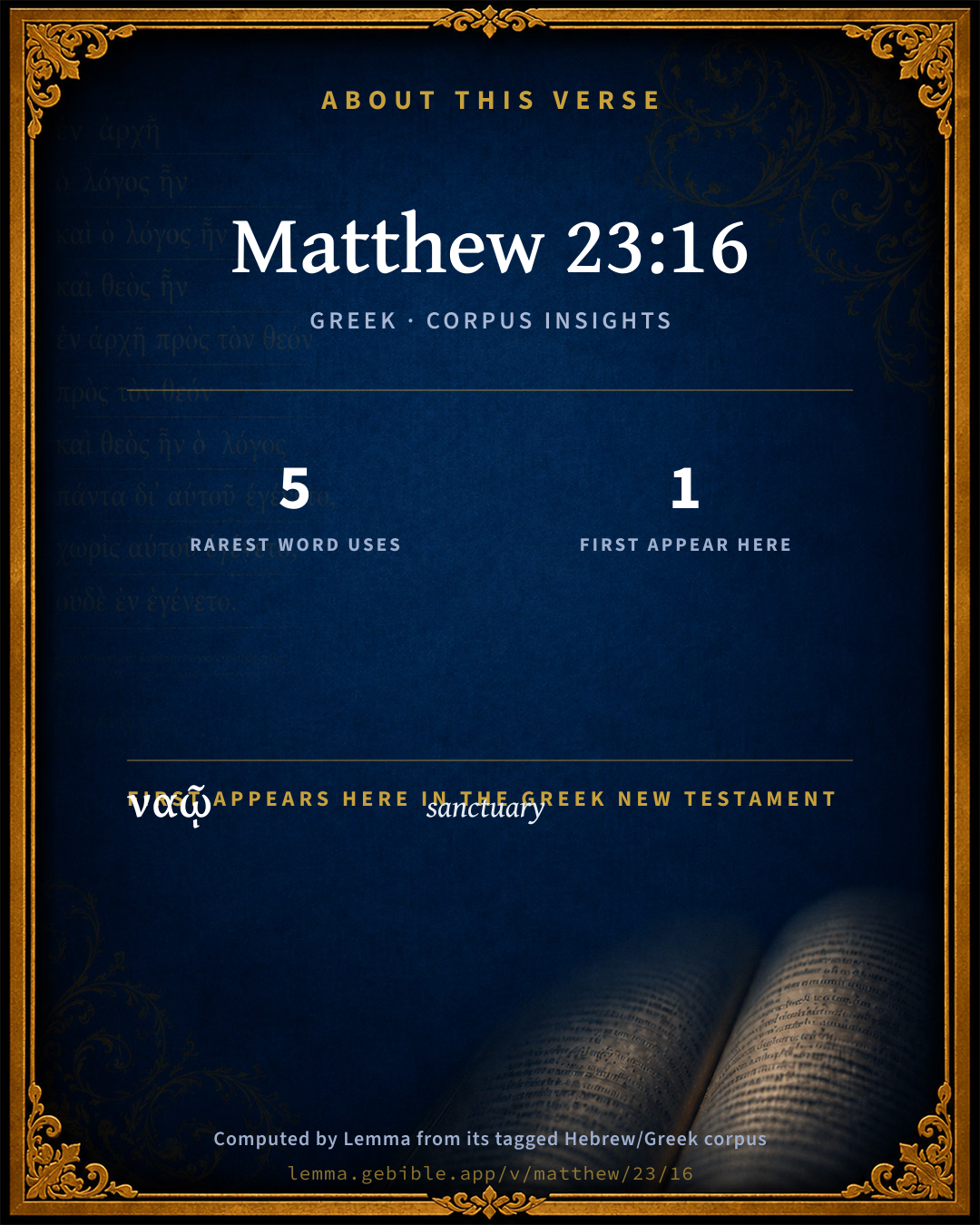
The rarest word here is ὁδηγοὶ guide G3595 — appearing just 5 times in the whole Greek New Testament.
First appearance in Scripture
This word makes its first canonical appearance in the Greek New Testament here:
- ναῷ sanctuary G3485
Shared distinctive vocabulary
ὁδηγοὶ guide G3595 occurs in 5 verses of the Greek New Testament. Also found in:
Cross-references
12Topical passages linked to Matthew 23:16 in the Treasury of Scripture Knowledge — connected by theme and wording, ordered by reader-vote popularity; previews shown in the World English Bible.
- Matthew 15:14 Leave them alone. They are blind guides of the blind. If the blind guide the blind, both will fall into a pit."
- Matthew 5:33–35 "Again you have heard that it was said to them of old time, 'You shall not make false vows, but shall perform to the Lord your vows,'
- Matthew 23:17 You blind fools! For which is greater, the gold, or the temple that sanctifies the gold?
- Matthew 23:24 You blind guides, who strain out a gnat, and swallow a camel!
- James 5:12 But above all things, my brothers, don't swear, neither by heaven, nor by the earth, nor by any other oath; but let your "yes" be "yes," and your "no," "no;" so that you don't fall into hypocrisy.
- Isaiah 56:10–11 His watchmen are blind, they are all without knowledge; they are all mute dogs, they can't bark; dreaming, lying down, loving to slumber.
- Matthew 15:5–6 But you say, 'Whoever may tell his father or his mother, "Whatever help you might otherwise have gotten from me is a gift devoted to God,"
- Matthew 23:19 You blind fools! For which is greater, the gift, or the altar that sanctifies the gift?
- Matthew 23:26 You blind Pharisee, first clean the inside of the cup and of the platter, that the outside of it may become clean also.
- John 9:39–41 Jesus said, "I came into this world for judgment, that those who don't see may see; and that those who see may become blind."
- Mark 7:10–13 For Moses said, 'Honor your father and your mother;' and, 'He who speaks evil of father or mother, let him be put to death.'
- Galatians 5:3 Yes, I testify again to every man who receives circumcision, that he is a debtor to do the whole law.
Cross-references courtesy of OpenBible.info (CC BY 4.0).
Lesson kit
Teaching starters — assembled from the data on this page, not authored interpretation. Every prompt links to the verse data it draws on. Edit before teaching.
Matthew, in the Gospels, opens this verse with 24 words (16 distinct Greek lemmas). Its most distinctive word is hodēgós (“guide”). A historical commentator’s framing appears above. Read the whole chapter for the surrounding context.
Discussion questions
- What does “guide” (hodēgós) contribute to the verse as a whole?
- The word “sanctuary” first appears here in Scripture. What is being introduced at this debut?
- Matthew 15:14 shares the word «guide» with this verse. How do the two illuminate each other?
- “to swear” occurs 2× in this one verse. What is the effect of the repetition?
- The translations on this page render this verse differently — a whole-verse word diff, not a word-by-word alignment. What might account for the different wordings?
- Reading how Jamieson, Fausset & Brown and The Biblical Illustrator read this verse, where do the two commentators agree and where do they part?
Things to notice
- 1 word makes its first canonical appearance in Scripture here.
- These translations choose different wording for 12 words in this verse.
- “to swear” occurs 2× in this single verse.
- 16 distinct Greek lemmas span 24 words in this verse.
Commentary
Notes on Matthew 23:16 from classic Christian and Jewish commentators (each source and its license shown beneath its notes). The classic Christian expositions comment on the surrounding passage and are grouped to its opening verse, so a note may address several verses; the Jewish commentaries on the Tanakh (Rashi and others) are per-verse, so they appear only where the commentator wrote on this verse.
Lemma curates 59 commentaries, every one of them public domain or Creative Commons licensed, each selected and text-cleaned for this edition rather than reprinted as found. About our sources →
Jamieson, Fausset & Brown
Robert Jamieson, A. R. Fausset & David Brown
Jamieson, Fausset & Brown — Commentary Critical and Explanatory on the Whole Bible (1871) — public domain (CC PDM 1.0). Text via the HelloAO Bible API.
The Biblical Illustrator
Joseph S. Exell
The Biblical Illustrator, edited by Joseph S. Exell (c. 1880s–1900s) — public domain. Text from a community e-Sword module.
Joseph Benson's Commentary
Joseph Benson's Commentary on the Old and New Testaments (1811–1818) — public domain. Text from a community e-Sword module.
The Preacher's Complete Homiletical Commentary
Joseph S. Exell (gen. ed.)
The Preacher's Complete Homiletical Commentary (gen. ed. Joseph S. Exell; Funk & Wagnalls, c. 1892) — public domain (pre-1929). A full-Bible homiletical/sermon-outline anthology covering 65 of 66 books (2 John is absent from the source module). Text from a community e-Sword module.
Tyndale Open Study Notes
Tyndale Open Resources
Tyndale Open Study Notes — © Tyndale Open Resources, licensed CC BY-SA 4.0. Text via the HelloAO Bible API.
Bengel's Gnomon
Johann Albrecht Bengel
Bengel's Gnomon of the New Testament — English translation (T&T Clark, Edinburgh, 1860) — public domain. Text from a community e-Sword module.
Meyer's Critical & Exegetical Commentary
Heinrich August Wilhelm Meyer
Meyer — Critical and Exegetical Commentary on the New Testament — English translation by Peter Christie, edited by Frederick Crombie (T&T Clark, 1880) — public domain. Text from a community e-Sword module.
Expositor's Greek Testament
ed. W. Robertson Nicoll
The Expositor's Greek Testament, edited by W. Robertson Nicoll (1897–1910) — public domain. Text from a community e-Sword module.
Geneva Bible (1599)
Geneva Bible translators
Geneva Bible (1599) marginal notes — public domain. Text via Bolls.life.
Adam Clarke's Commentary
Adam Clarke's Commentary on the Bible (1810–1826) — public domain. Text from a community e-Sword/MySword module.
Ellicott's Commentary for English Readers
A Bible Commentary for English Readers, edited by Charles John Ellicott (1878–1897) — public domain. Text from a community e-Sword module.
The Cambridge Bible for Schools and Colleges
gen. ed. J. J. S. Perowne
The Cambridge Bible for Schools and Colleges (gen. ed. J. J. S. Perowne; Cambridge University Press, 1878–1918) — public domain. Text from a community e-Sword module.
John Gill's Exposition
John Gill's Exposition of the Whole Bible (1746–1763) — public domain (CC PDM 1.0). Text via the HelloAO Bible API.
Trapp's Complete Commentary
John Trapp
John Trapp, A Commentary or Exposition upon All the Books of the Old and New Testament (1647–1656) — public domain. Text from a community e-Sword module.
Albert Barnes' Notes on the Bible
Albert Barnes' Notes on the Bible (1834–1885) — public domain. Text from a community e-Sword/MySword module.
Haydock's Catholic Bible Commentary
George Leo Haydock (1774–1849), Haydock's Catholic Family Bible and Commentary, 1859 edition — public domain. Excludes Psalms (Douay-Rheims chapter numbering differs from Protestant) and Deuterocanonical books (Catholic canon only).
Matthew Poole's English Annotations
Matthew Poole's English Annotations on the Holy Bible (1683–1685) — public domain. Text from a community e-Sword/MySword module.
Whedon's Commentary on the Bible
Daniel D. Whedon
Daniel D. Whedon (gen. ed.), Commentary on the Old and New Testaments (1874–1909) — public domain. Text from a community e-Sword module.
The Pulpit Commentary
The Pulpit Commentary (1880–1919), ed. H.D.M. Spence-Jones & Joseph S. Exell — public domain. Text from a community e-Sword module.
John Wesley's Explanatory Notes
John Wesley, Explanatory Notes Upon the Whole Bible (1754–1765) — public domain. Text via the GEBible commentary corpus.
Scofield Reference Notes
C. I. Scofield
The Scofield Reference Bible (1917 edition), notes by C. I. Scofield — public domain. Text from a community e-Sword module.
Kretzmann's Popular Commentary
Paul E. Kretzmann
Paul E. Kretzmann, Popular Commentary of the Bible (1921–1924) — public domain. Text from a community e-Sword module.
Burkitt's Expository Notes on the New Testament
William Burkitt
William Burkitt's Expository Notes on the New Testament (1700–1703) — public domain. Text from a community e-Sword module.
The People's New Testament
B. W. Johnson
B. W. Johnson's The People's New Testament with Notes (1889–1891) — public domain. Electronic text from the Christian Classics Ethereal Library (CCEL) ThML edition.
unfoldingWord translationNotes
Door43 World Missions Community
unfoldingWord translationNotes — © Distant Shores Media and the Door43 World Missions Community, licensed CC BY-SA 4.0. Source: git.door43.org/Door43/en_tn.
Cambridge Greek Testament for Schools and Colleges
Cambridge Greek Testament for Schools and Colleges (Cambridge University Press, 1896; 21 vols, various authors incl. Carr, Maclear, Plummer, Farrar, Lumby, Moule, M. R. James, Simcox) — public domain. Text from a community e-Sword module.
Alford’s Greek Testament
Henry Alford
Henry Alford, The Greek Testament (1849–1861) — public domain. Text from a community e-Sword module.
International Critical Commentary
International Critical Commentary — older volumes (1896–1929), various authors — public domain. Text from a community e-Sword module.