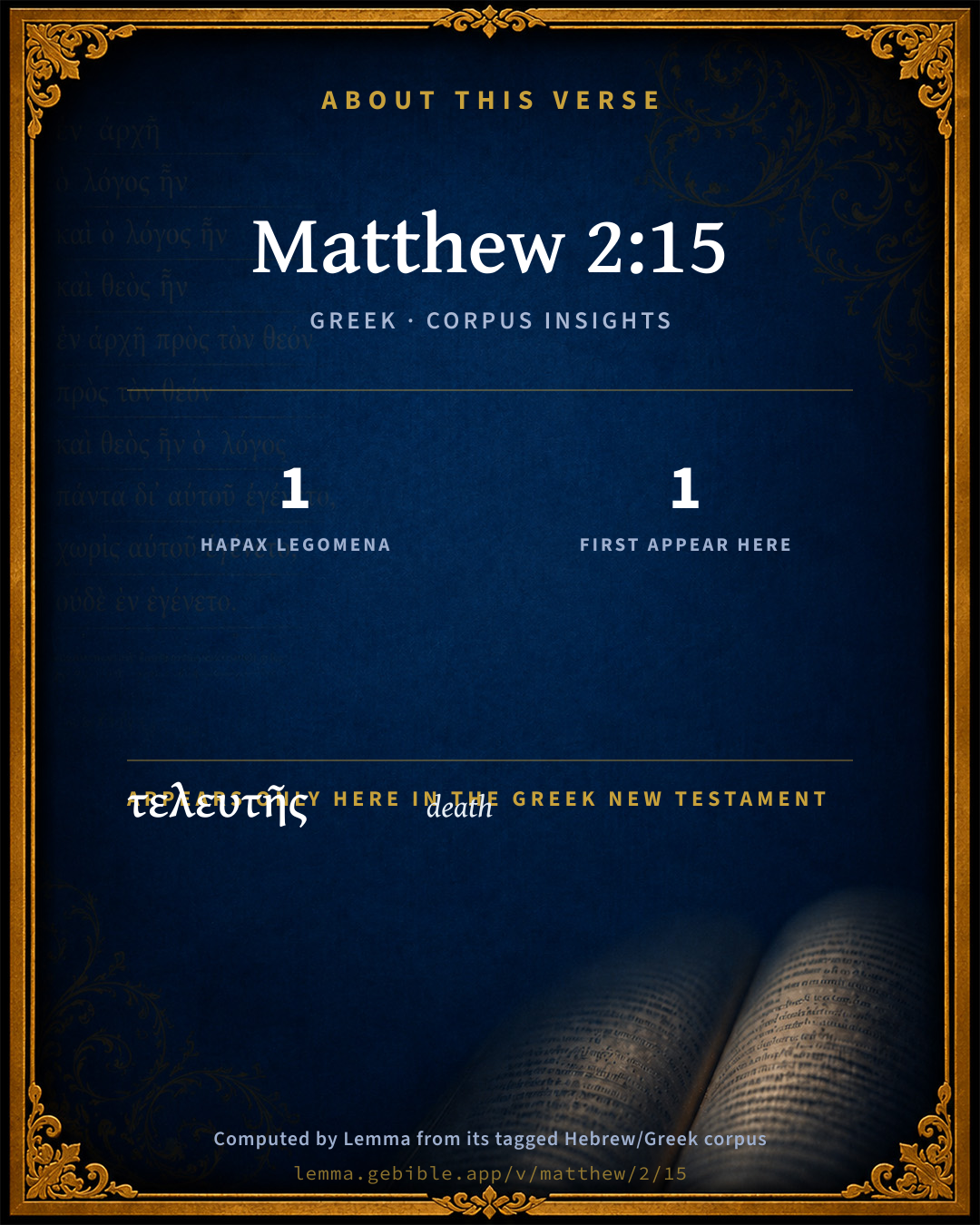
Matthew 2:15

Greek (Tischendorf 8th ed.) Matthew 2:15 appears in the Greek New Testament. The text above is from the Tischendorf 8th edition. Each word links to its Strong’s number and a concise gloss. Click any word for its full Thayer’s Greek Lexicon entry.
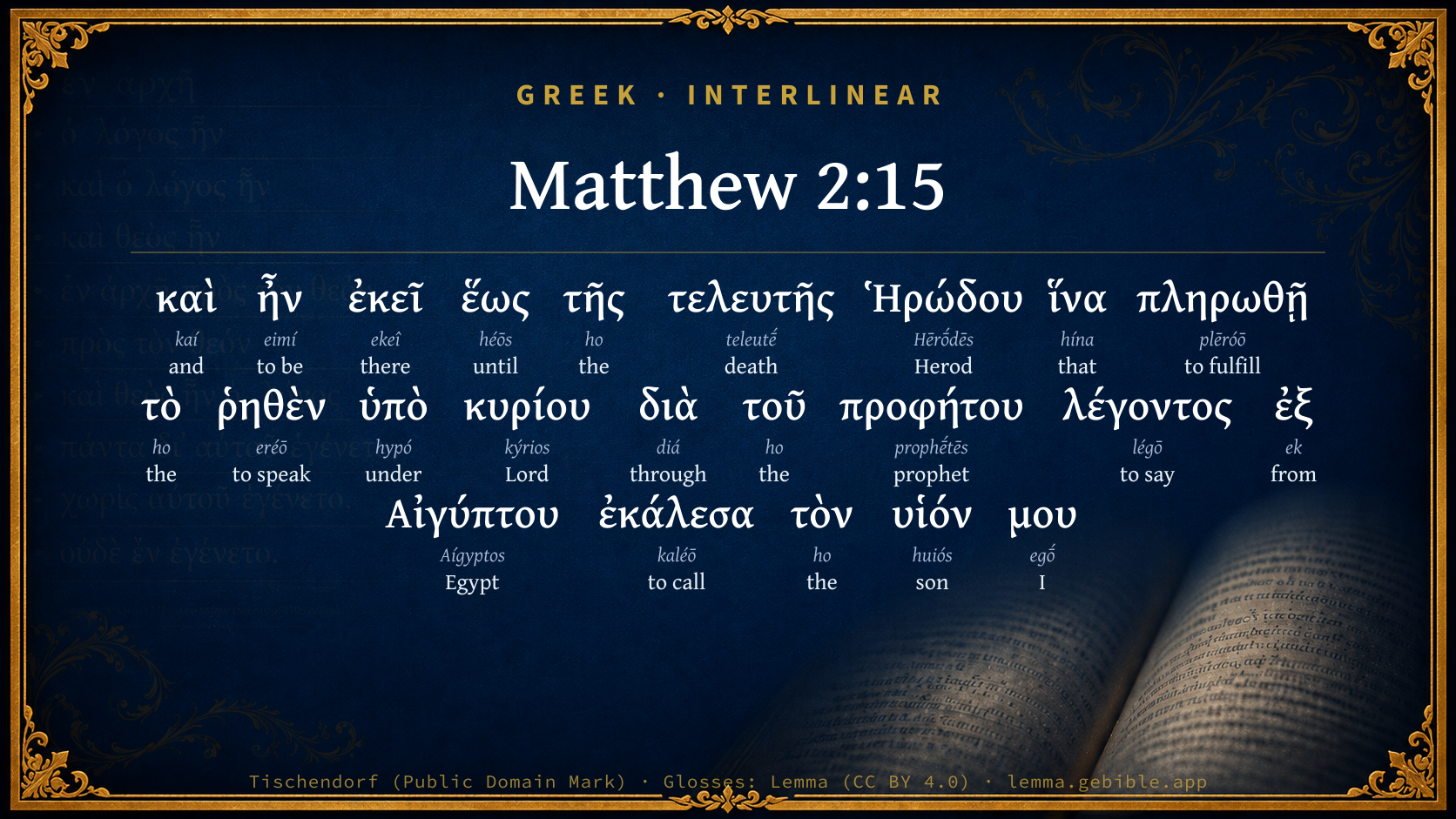
Download image
Cite this verse

Matthew 2:15 (World English Bible). Public Domain. Lemma interlinear Bible study tool, https://lemma.gebible.app/v/matthew/2/15.

Show BibTeX & RIS
BibTeX
RIS
English Translation
and was there until the death of Herod; that it might be fulfilled which was spoken by the Lord through the prophet, saying, "Out of Egypt I called my son."
World English Bible · Public Domain
Highlights
  • 1 hapax legomenon — only here in the Greek New Testament
  • 1 first appearance in the Greek New Testament
Full analysis ↓
Download a study sheet

One document with this verse’s original text, its word-by-word gloss line, the meaning frame, cross-references with their text, attributed commentary, and full source and license credits — printable, and it pastes into notes with its structure intact.

This verse Autodidact and up

Study sheet (.html) Plain text (.txt)

A passage Seminary Student

Up to 50 verses in one chapter. A passage sheet keeps up to 6 commentary sources and 12 cross-references per verse, in the order this page ranks them, and says so on the sheet whenever that leaves anything out. Ask for a single verse and you get the Autodidact verse sheet above.

Everything on this page stays free to read, with no account — the sheet is a download of what is already on screen, not access to it.

Want to remove ads? Support Godless Engineer
Compare translations 3

The same verse in 3 English versions, stacked beneath the original-language interlinear above. Click any original word for its lexicon entry.

Each is an independent rendering of the whole verse — the interlinear is not word-aligned to these translations.

Highlighted words mark where these versions differ — a whole-verse word diff, not a word-by-word alignment.

  • World English Bible Public Domain
    and was there until the death of Herod; that it might be fulfilled which was spoken by the Lord through the prophet, saying, "Out of Egypt I called my son."
  • King James Version Public Domain
    And was there until the death of Herod: that it might be fulfilled which was spoken of the Lord by the prophet, saying, Out of Egypt have I called my son.
  • unfoldingWord Literal Text CC BY-SA 4.0
    and he was there until the death of Herod, in order that might be fulfilled was spoken by the Lord through the prophet, saying, “Out of Egypt I called my son.”

unfoldingWord Literal Text — © unfoldingWord, licensed CC BY-SA 4.0. Word-aligned USFM3 via Door43 (git.door43.org/unfoldingWord/en_ult).

Versions to compare (up to 4)

3 of 4 selected

Show all 19 translations

Every available English version of this verse, each an independent rendering of the whole verse.

  • World English Bible Public Domain
    and was there until the death of Herod; that it might be fulfilled which was spoken by the Lord through the prophet, saying, "Out of Egypt I called my son."
  • Berean Standard Bible Public Domain
    where he stayed until the death of Herod. This fulfilled what the Lord had spoken through the prophet: “Out of Egypt I called My Son.”
  • Majority Standard Bible Public Domain
    where he stayed until the death of Herod. This fulfilled what the Lord had spoken through the prophet: “Out of Egypt I called My Son.”
  • King James Version Public Domain
    And was there until the death of Herod: that it might be fulfilled which was spoken of the Lord by the prophet, saying, Out of Egypt have I called my son.
  • American Standard Version (1901) Public Domain
    and was there until the death of Herod: that it might be fulfilled which was spoken by the Lord through the prophet, saying, Out of Egypt did I call my son.
  • Revised Version (1885) Public Domain
    and was there until the death of Herod: that it might be fulfilled which was spoken by the Lord through the prophet, saying, Out of Egypt did I call my son.
  • Geneva Bible (1599) Public Domain
    And was there vnto the death of Herod, that that might be fulfilled, which is spoken of the Lord by the Prophet, saying, Out of Egypt haue I called my sonne.
  • Douay-Rheims (1899) Public Domain
    That it might be fulfilled which the Lord spoke by the prophet, saying: Out of Egypt have I called my son.
  • Young's Literal Translation Public Domain
    and he was there till the death of Herod, that it might be fulfilled that was spoken by the Lord through the prophet, saying, `Out of Egypt I did call My Son.'
  • Literal Standard Version CC BY-SA 4.0
    and he was there until the death of Herod, that it might be fulfilled that was spoken by the LORD through the prophet, saying, “Out of Egypt I called My Son.”
  • Unlocked Literal Bible CC BY-SA 4.0
    He remained there until the death of Herod. This fulfilled what the Lord had spoken through the prophet, “Out of Egypt I have called my son.”
  • unfoldingWord Literal Text CC BY-SA 4.0
    and he was there until the death of Herod, in order that might be fulfilled was spoken by the Lord through the prophet, saying, “Out of Egypt I called my son.”
  • Darby Bible Public Domain
    And he was there until the death of Herod, that that might be fulfilled which was spoken by [the] Lord through the prophet, saying, Out of Egypt have I called my son.
  • World Messianic Bible Public Domain
    and was there until the death of Herod, that it might be fulfilled which was spoken by the Lord through the prophet, saying, “Out of Egypt I called my son.”
  • Webster's Bible Public Domain
    And was there until the death of Herod: that it might be fulfilled which was spoken from the Lord by the prophet, saying, Out of Egypt have I called my son.
  • Free Bible Version CC BY-SA 4.0
    They stayed there until Herod's death. This fulfilled what the Lord said through the prophet, “I called my son out of Egypt.”
  • Bible in Basic English Public Domain
    And was there till the death of Herod; so that the word of the Lord through the prophet might come true, Out of Egypt have I sent for my son.
  • Text-Critical English NT CC BY 4.0
    where he stayed until the death of Herod. This was to fulfill what the Lord had said through the prophet: “Out of Egypt I called my son.”
  • Tyndale New Testament (1534) Public Domain
    and was there vnto the deeth of Herod to fulfill that which was spoken of the Lorde by the Prophet which sayeth out of Egypte haue I called my sonne.

Literal Standard Version (2020), Covenant Press — licensed CC BY-SA 4.0. Text via the HelloAO Bible API (eBible.org). Unlocked Literal Bible (unfoldingWord) — licensed CC BY-SA 4.0. Text via the HelloAO Bible API (eBible.org). unfoldingWord Literal Text — © unfoldingWord, licensed CC BY-SA 4.0. Word-aligned USFM3 via Door43 (git.door43.org/unfoldingWord/en_ult). Free Bible Version, Dr. Jonathan Gallagher — licensed CC BY-SA 4.0. Text via the HelloAO Bible API (eBible.org).

Word by word

More ways to search: Search by grammar → Find every occurrence → Compare this word →

Practice this passage: Drill this verse → Learn its vocabulary →

τελευτῆς
teleutḗ
G5054
“death”
Noun, Genitive, Singular, Feminine
Part of Speech
Noun
Case
Genitive
Number
Singular
Gender
Feminine
Full Thayer's Definition

Origin: from G5053

TDNT: None

1. the end of life, decease, death
  1. καὶ kaí G2532 “and” Conjunction
  2. ἦν eimí G1510 “to be” Verb, Imperfect, Active, Indicative, 3rd person, Singular
  3. ἐκεῖ ekeî G1563 “there” Adverb
  4. ἕως héōs G2193 “until” Adverb
  5. τῆς ho G3588 “the” Article, Genitive, Singular, Feminine
  6. Ἡρώδου Hērṓdēs G2264 “Herod” Noun, Genitive, Singular, Masculine
  7. ἵνα hína G2443 “that” Conjunction
  8. πληρωθῇ plēróō G4137 “to fulfill” Verb, Aorist, Passive, Subjunctive, 3rd person, Singular
  9. τὸ ho G3588 “the” Article, Nominative, Singular, Neuter
  10. ῥηθὲν eréō G2046 “to speak” Verb, Aorist, Passive, Participle, Nominative, Singular, Neuter
  11. ὑπὸ hypó G5259 “under” Preposition
  12. κυρίου kýrios G2962 “Lord” Noun, Genitive, Singular, Masculine
  13. διὰ diá G1223 “through” Preposition
  14. τοῦ ho G3588 “the” Article, Genitive, Singular, Masculine
  15. προφήτου prophḗtēs G4396 “prophet” Noun, Genitive, Singular, Masculine
  16. λέγοντος légō G3004 “to say” Verb, Present, Active, Participle, Genitive, Singular, Masculine
  17. ἐξ ek G1537 “from” Preposition
  18. Αἰγύπτου Aígyptos G125 “Egypt” Noun, Genitive, Singular, Feminine
  19. ἐκάλεσα kaléō G2564 “to call” Verb, Aorist, Active, Indicative, 1st person, Singular
  20. τὸν ho G3588 “the” Article, Accusative, Singular, Masculine
  21. υἱόν huiós G5207 “son” Noun, Accusative, Singular, Masculine
  22. μου egṓ G1473 “I” Personal pronoun, 1st person, Genitive, Singular

About this verse

These counts appear in no published source. They are computed here, from the morphology-tagged text and Lemma’s own curated glosses. What Lemma adds →

23
words
20
distinct lemmas
Gospels
section

Notable vocabulary

1 hapax legomenon — a word that appears only here in the entire Greek New Testament:

  • τελευτῆς death G5054

First appearance in Scripture

This word makes its first canonical appearance in the Greek New Testament here:

  • τελευτῆς death G5054

Shared distinctive vocabulary

Αἰγύπτου Egypt G125 occurs in 23 verses of the Greek New Testament. Also found in:

Repetition

A word recurs within this verse:

Cross-references

20

Topical passages linked to Matthew 2:15 in the Treasury of Scripture Knowledge — connected by theme and wording, ordered by reader-vote popularity; previews shown in the World English Bible.

  • Hosea 11:1 "When Israel was a child, then I loved him, And called my son out of Egypt.
  • Exodus 4:22 You shall tell Pharaoh, 'Thus says Yahweh, Israel is my son, my firstborn,
  • Numbers 24:8 God brings him forth out of Egypt; He has as it were the strength of the wild-ox: He shall eat up the nations his adversaries, Shall break their bones in pieces, Smite [them] through with his arrows.
  • Luke 24:44 He said to them, "This is what I told you, while I was still with you, that all things which are written in the law of Moses, the prophets, and the psalms, concerning me must be fulfilled."
  • Matthew 1:22 Now all this has happened, that it might be fulfilled which was spoken by the Lord through the prophet, saying,
  • Matthew 2:17 Then that which was spoken by Jeremiah the prophet was fulfilled, saying,
  • Matthew 2:19 But when Herod was dead, behold, an angel of the Lord appeared in a dream to Joseph in Egypt, saying,
  • Matthew 2:23 and came and lived in a city called Nazareth; that it might be fulfilled which was spoken through the prophets: "He will be called a Nazarene."
  • Matthew 4:14–15 that it might be fulfilled which was spoken through Isaiah the prophet, saying,
  • Matthew 8:17 that it might be fulfilled which was spoken through Isaiah the prophet, saying: "He took our infirmities, and bore our diseases."
  • Matthew 12:16–18 and charged them that they should not make him known:
  • Matthew 21:4 All this was done, that it might be fulfilled which was spoken through the prophet, saying,
  • Matthew 26:54 How then would the Scriptures be fulfilled that it must be so?"
  • Acts 12:1–4 Now about that time, Herod the king stretched out his hands to oppress some of the assembly.
  • Matthew 26:56 But all this has happened, that the Scriptures of the prophets might be fulfilled." Then all the disciples left him, and fled.
  • John 19:28 After this, Jesus, seeing that all things were now finished, that the Scripture might be fulfilled, said, "I am thirsty."
  • John 19:36 For these things happened, that the Scripture might be fulfilled, "A bone of him will not be broken."
  • Acts 12:23–24 Immediately an angel of the Lord struck him, because he didn't give God the glory, and he was eaten by worms and died.
  • Matthew 27:35 When they had crucified him, they divided his clothing among them, casting lots,
  • Acts 1:16 "Brothers, it was necessary that this Scripture should be fulfilled, which the Holy Spirit spoke before by the mouth of David concerning Judas, who was guide to those who took Jesus.

Cross-references courtesy of OpenBible.info (CC BY 4.0).

Commentary

Notes on Matthew 2:15 from classic Christian and Jewish commentators (each source and its license shown beneath its notes). The classic Christian expositions comment on the surrounding passage and are grouped to its opening verse, so a note may address several verses; the Jewish commentaries on the Tanakh (Rashi and others) are per-verse, so they appear only where the commentator wrote on this verse.

Lemma curates 59 commentaries, every one of them public domain or Creative Commons licensed, each selected and text-cleaned for this edition rather than reprinted as found. About our sources →

Tyndale Open Study Notes

Tyndale Open Resources

2:15 I called my Son out of Egypt: See Hos 11:1, which refers to the Exodus.

Tyndale Open Study Notes — © Tyndale Open Resources, licensed CC BY-SA 4.0. Text via the HelloAO Bible API.

Bengel's Gnomon

Johann Albrecht Bengel

Mat 2:15. Αέγοντος, saying) This must be construed with τοῦ προφήτου, the prophet, and so also in Mat 2:17.—ἐξ Αἰγύπτου ἐκάλεσα τὸν υἱόν Μου, out of Egypt have I called my Son) Thus Hos 11:1, in the original Hebrew, though the LXX. render it, ἐξ Αἰγύπτου μετεκάλεσα τὰ τέκνα αὐτοῦ, out of Egypt have I called for (summoned) his children. Aquila,[96] however, renders it ἀπὸ Αἰγύπτου ἐκάλεσα τὸν υἱὸν Μου, From Egypt have I called [him] My son. The meaning of the passage in Hosea is, “Then when Israel was a child, I loved him: and from the time that he was in Egypt, I called him my son.” This is evident from the parallelism of either clause. And the expression, “from the land of Egypt,” occurs in the same sense in Hos 12:9; Hos 13:4; and from the Egyptian era, Israel began to be called the son of God; see Exo 4:22, etc. And God is always said to have led forth, never to have called, His people out of Egypt. In like manner, St Matthew also. when interpreting the passage of the Messiah, and that, too, of Him when a child, connects the quotation with His sojourn in, rather than His return from, Egypt.—Cf. Isa 19:19. Jesus, from His birth, was the Son of God; and immediately after His nativity, He dwelt in Egypt. It behoved, however, that the Messiah, as well as the people, should return from Egypt into the land of promise, for the same reason, viz., because God loved each of them, and called him His Son. The sojourn of Christ in Egypt was the prelude to the Christianization of that country; see Deu 23:7. In the first ages of Christianity, the Egyptian Church was greatly distinguished: perhaps it will be so again hereafter: cf. Isa 19:24-25. Concerning the double fulfilment of the single meaning of a single prophecy, cf. Gnomon on ch. Mat 1:22. In short, God embraced in one address, as with one love, both the Messiah Himself, in whom is all His good pleasure, and His people for His sake. The Messiah resembles His people in His adversity; His people resembles the Messiah in its prosperity. The head and the body are the whole Christ. Moreover, when His people was in Egypt, Jesus Christ was there also in one of those patriarchs who are enumerated in ch. Mat 1:4.—Cf. Heb 7:10.

[96] A native of Sinope, in Pontus, of Jewish descent, who flourished in the second century of the Christian æra. Having renounced Christianity, he undertook to execute a new translation of the Hebrew Scriptures into Greek.—(I. B.)

Bengel's Gnomon of the New Testament — English translation (T&T Clark, Edinburgh, 1860) — public domain. Text from a community e-Sword module.

Meyer's Critical & Exegetical Commentary

Heinrich August Wilhelm Meyer

Mat_2:15. Τὸν υἱόν μου] refers in Hos_11:1 (quoted according to the original text) to the people of Israel (Exo_4:22; Jer_31:9). The Septuagint has τὰ τέκνα αὐτοῦ (Israelis). Upon the ἵνα πληρωθῇ, see on Mat_1:22. Here it refers to the arrival of Jesus in Egypt and His residence there, which could not but take place as an antitype to the historical meaning of Hos_11:1, in order that that declaration of the prophet might receive its Messianic fulfilment.

Meyer — Critical and Exegetical Commentary on the New Testament — English translation by Peter Christie, edited by Frederick Crombie (T&T Clark, 1880) — public domain. Text from a community e-Sword module.

Expositor's Greek Testament

ed. W. Robertson Nicoll

Mat 2:15 . καὶ ἧν ἐκεῖ , etc.: the stay in Egypt cannot have been long, only a few months, prohably, before the death of Herod (Nösgen). ἵνα πληρωθῇ : another prophetic reference, this time proceeding directly from the evangelist; Hos 11:1 , given after the Hebrew, not the Sept [8] , which for בְנִי has τέκνα αὐτοῦ . The oracle states a historical fact, and can therefore only be a typical prophecy. The event in the life of the infant Jesus may seem an insignificant fulfilment. Not so did it appear to the evangelist. For him all events in the life of the Christ possessed transcendent significance. Was it an event at all? criticism asks. Did the fact suggest the prophetic reference, or did the prophecy create the fact? In reply, be it said that the narratives in this chapter of the Infancy all hang together. If any one of them occurred, all might occur. The main question is, is Herod’s solicitude credible? If so, then the caution of the Magi, the flight to Egypt, the massacre at Bethlehem, the return at the tyrant’s death to Nazareth, are all equally credible.

[8] Septuagint.

The Expositor's Greek Testament, edited by W. Robertson Nicoll (1897–1910) — public domain. Text from a community e-Sword module.

Geneva Bible (1599)

Geneva Bible translators

Hos. 11:1

Geneva Bible (1599) marginal notes — public domain. Text via Bolls.life.

Jamieson, Fausset & Brown

Robert Jamieson, A. R. Fausset & David Brown

And was there until the death of Herod--which took place not very long after this of a horrible disease; the details of which will be found in JOSEPHUS [Antiquities, 17.6.1,5,7,8].

that it might be fulfilled which was spoken of the Lord by the prophet, saying-- (Hos 11:1).

Out of Egypt have I called my son--Our Evangelist here quotes directly from the Hebrew, warily departing from the Septuagint, which renders the words, "From Egypt have I recalled his children," meaning Israel's children. The prophet is reminding his people how dear Israel was to God in the days of his youth; how Moses was bidden to say to Pharaoh, "Thus saith the Lord, Israel is My son, My first-born; and I say unto thee, Let My son go, that he may serve Me; and if thou refuse to let him go, behold, I will slay thy son, even thy first-born" (Exo 4:22-23); how, when Pharaoh refused, God having slain all his first-born, "called His own son out of Egypt," by a stroke of high-handed power and love. Viewing the words in this light, even if our Evangelist had not applied them to the recall from Egypt of God's own beloved, Only-begotten Son, the application would have been irresistibly made by all who have learnt to pierce beneath the surface to the deeper relations which Christ bears to His people, and both to God; and who are accustomed to trace the analogy of God's treatment of each respectively.

Jamieson, Fausset & Brown — Commentary Critical and Explanatory on the Whole Bible (1871) — public domain (CC PDM 1.0). Text via the HelloAO Bible API.

Adam Clarke's Commentary

Verse 15. Out of Egypt have I called my son.] This is quoted from Ho 11:1, where the deliverance of Israel, and that only, is referred to. But as that deliverance was extraordinary, it is very likely that it had passed into a proverb, so that "Out of Egypt have I called my son," might have been used to express any signal deliverance. I confess, I can see no other reference it can have to the case in hand, unless we suppose, which is possible, that God might have referred to this future bringing up of his son Jesus from Egypt, under the type of the past deliverance of Israel from the same land. Midrash Tehillin, on Ps 2:7, has these remarkable words: I will publish a decree: this decree has been published in the Law, in the Prophets, and in the Hagiographia. In the Law, Israel is my first-born son: Ex 4:22. In the Prophets, Behold, my servant shall deal prudently: Isa 52:13. In the Hagiographia, The Lord said unto my lord: Ps 110:1. All these passages the Jews refer to the Messiah. See Schoetgen.

Adam Clarke's Commentary on the Bible (1810–1826) — public domain. Text from a community e-Sword/MySword module.

Ellicott's Commentary for English Readers

(15) Until the death of Herod.—The uncertainty which hangs over the exact date of the Nativity hinders us from arriving at any precise statement as to the interval thus described. As the death of Herod took place a little before the Passover, B.C. 4 (according to the common but erroneous reckoning), it could not have been more than a few months, even if we fix the Nativity in the previous year.

Out of Egypt have I called my son.—As the words stand in Hos_11:1, “When Israel was a child, then I loved him, and called my son out of Egypt,” they refer, beyond the shadow of a doubt, to the history of Israel, as being in a special sense, among all the nations of the world, the chosen son of Jehovah (Exo_4:22-23). It is hard to imagine any reader of the prophecy not seeing that this was what we should call the meaning. But the train of thought which leads the Evangelist to apply it to the Christ has a distinct method of its own. A coincidence in what seems an accessory, a mere circumstance of the story, carries his mind on to some deeper analogies. In the days of the Exodus, Israel was the one representative instance of the Fatherhood of God manifested in protecting and delivering His people. Now there was a higher representative in the person of the only begotten Son. As the words “Out of Egypt did I call my Son” (he translated from the Hebrew instead of reproducing the Greek version of the LXX.) rose to his memory, what more natural than that mere context and historical meaning should be left unnoticed, and that he should note with wonder what a fulfilment they had found in the circumstances he had just narrated. Here, as before, the very seeming strain put upon the literal meaning of the words is presumptive evidence that the writer had before him the fact to which it had been adapted, rather than that the narrative was constructed, as some have thought, to support the strained interpretation of the prophecy.

A Bible Commentary for English Readers, edited by Charles John Ellicott (1878–1897) — public domain. Text from a community e-Sword module.

The Cambridge Bible for Schools and Colleges

gen. ed. J. J. S. Perowne

15. until the death of Herod] According to the chronology adopted above this would be for a space of less than two years.

that it might be fulfilled] See note on ch. Mat_1:22.

Out of Egypt have I called my son] Better, I called my son. The history of Israel is regarded as typical of the Messiah’s life. He alone gives significance to that history. He is the true seed of Abraham. In Him the blessing promised to Abraham finds its highest fulfilment. (See Lightfoot on Gal_3:16.) Even particular incidents in the Gospel narrative have their counterpart in the O.T. history. Accordingly St Matthew, who naturally reverts to this thought more constantly than the other Evangelists, from the very nature of his gospel, recognises in this incident an analogy to the call of Israel from Egypt.

The quotation is again from the original Hebrew of Hos_11:2, and again the LXX. differs considerably. Cp. Exo_4:22-23 : “Israel is my son, even my firstborn: and I say unto thee, Let my son go, that he may serve me.”

The Cambridge Bible for Schools and Colleges (gen. ed. J. J. S. Perowne; Cambridge University Press, 1878–1918) — public domain. Text from a community e-Sword module.

John Gill's Exposition

And was there until the death of Herod,.... Which was in a very short time; for Eusebius (i) says, that immediately, in a very little time after the slaughter of the children at Bethlehem, the divine vengeance inflicted diseases on him, which quickly brought him to his end; so that, according to the learned Dr. Lightfoot (k), Jesus was not above three or four months in Egypt. Now all this was brought about,

that it might be fulfilled; not by way of accommodation of phrases to a like event; or by way of type, which has a fresh completion in the antitype; or as a proverbial sentence which might be adapted to any remarkable deliverance out of hardship, misery and destruction; but literally, properly, and in the obvious sense thereof;

which was spoken of the Lord by the prophet, not Balaam, in Num 23:22 or Num 24:8 but in Hos 11:1 "when Israel was a child, then I loved him, and called my son out of Egypt": the meaning of which passage is, either in connection with the last clause of the foregoing chapter thus; "in a morning shall the king of Israel be cut off", "because Israel is a child", a rebellious and disobedient one, acting a very weak and wicked part; "yet I have loved him, or do love him", and "have called", or "will call", (the past tense for the future, frequent in the Hebrew language, especially in the prophetic writings,) "my son out of Egypt"; who will be obliged to retire there for some time; I will make him king, set him upon the throne, who shall execute justice, and reign for ever and ever; or thus, "because Israel is a child", helpless and imprudent, and "I love him", though he is so, "therefore l will call", or I have determined to call

my son out of Egypt: who through a tyrant's rage and malice will be obliged to abide there a while; yet I will bring him from thence into the land of Judea, where he shall live and "help" my "servant", (l), "child Israel"; shall instruct him in his duty, teach him the doctrines of the Gospel, and at last, by his sufferings and death, procure for him the pardon of all his transgressions; of which there is a particular enumeration in Mat 2:3. This is the natural and unconstrained sense of these words, which justifies the Evangelist in his citation and application of them to Christ's going to Egypt, and his return from thence, as I have elsewhere (m) shown.

(i) Hist. Eccl. l. 1. c. 8. p. 25, 26. (k) Harmony of the New Testament, p. 6. (l) Luke i. 54. (m) Prophecies of the Messiah, &c. p. 123, &c.

John Gill's Exposition of the Whole Bible (1746–1763) — public domain (CC PDM 1.0). Text via the HelloAO Bible API.

Trapp's Complete Commentary

John Trapp

15 And was there until the death of Herod: that it might be fulfilled which was spoken of the Lord by the prophet, saying, Out of Egypt have I called my son.

Ver. 15. And was there till the death of Herod] Which was a matter of two or three years at least {a} For Christ was born in 32 of Herod’s reign, fled when he was about two years old, or soon after his birth (as others are of the opinion), and returned not till Herod was dead, after he had reigned seven and thirty years.

That it might be fulfilled that was spoken, &c.] When the Old Testament is cited in the New, it is not only by way of accommodation, but because it is the proper meaning of the places both in the type and in the truth.

{a} Epiphanius vult haec biennio post natum Christum conligisse.

John Trapp, A Commentary or Exposition upon All the Books of the Old and New Testament (1647–1656) — public domain. Text from a community e-Sword module.

Albert Barnes' Notes on the Bible

The death of Herod - Herod died in the thirty-seventh year of his reign. It is not certainly known in what year he began his reign, and hence it is impossible to determine the time that Joseph remained in Egypt. The best chronologers have supposed that he died somewhere between two and four years after the birth of Christ, but at what particular time cannot now be determined. Nor can it be ascertained at what age Jesus was taken into Egypt. It seems probable that he was supposed to be a year old (see Mat 2:16), and of course the time that he remained in Egypt was not long. Herod died of a most painful and loathsome disease in Jericho. See the notes at Mat 2:16; also Josephus, Ant. xvii. 6. 5.

That it might be fulfilled ... - This language is recorded in Hos 11:1. It there evidently speaks of God’s calling His people out of Egypt, under Moses. See Exo 4:22-23. It might be said to be fulfilled in his calling Jesus from Egypt, because the words in Hosea aptly expressed this also. The same love which led him to deliver His people Israel from the land of Egypt, now led him also to deliver His Son from that place. The words used by Hosea would express both events. See the notes at Mat 1:22. Perhaps, also, the place in Hosea became a proverb, to express any great deliverance from danger; and thus it could be said to be fulfilled in Christ, as other proverbs are in cases to Which they are applicable. It cannot be supposed that the passage in Hosea was a prophecy of the Messiah. It is evidently used by Matthew only because the language is appropriate to express the event.

Albert Barnes' Notes on the Bible (1834–1885) — public domain. Text from a community e-Sword/MySword module.

Haydock's Catholic Bible Commentary

Out of Egypt have I called my son.[3] St. Jerome understands these words to be taken out of the prophet Osee, (Chap. xi. 2.) and granted they might be literally spoken of the people Israel: yet as their captivity in Egypt was a figure of the slavery of sin, under which all mankind groaned, and as their delivery by Moses was a figure of man’s redemption by our Saviour Christ, so these words in a mystical and spiritual sense apply to our Saviour, who in a more proper sense was the Son of God, than was the people of Israel. (Witham) --- The application of this passage of the prophet to Christ, whereas in the simple letter it might appear otherwise, teaches us how to interpret the Old Testament; and that the principal sense is of Christ and his Church. (Bristow)

===============================

[BIBLIOGRAPHY]

Ex Ægypto vocai filium meum. In the Septuagint Greek: ta tekna autou, filios ejus.

George Leo Haydock (1774–1849), Haydock's Catholic Family Bible and Commentary, 1859 edition — public domain. Excludes Psalms (Douay-Rheims chapter numbering differs from Protestant) and Deuterocanonical books (Catholic canon only).

Whedon's Commentary on the Bible

Daniel D. Whedon

15. By the prophet — Hos_11:1. Out of Egypt… son — The passage quoted from the prophet is spoken of Israel, the people being personified as an individual. When Israel was a child then I loved him, and called my son out of Egypt. A type is a person or object divinely designed to prefigure a future character or object to which it bears designed resemblance. The future object so prefigured is called the antitype. Type is therefore visible prediction, as prophecy is spoken prediction. Thus the sacrifices were divinely appointed types of the great atoning sacrifice of Christ. An entire set or combination of objects may be typical of an entire set of antitypical objects. The objects may resemble, and the principle which connects the objects of the combination may be the same in both sets. Thus here we have of type and antitype, then, two sets:

1. Pharaoh, Israel, Egypt, Canaan.

2. Herod, Christ, Egypt, Palestine.

The individuals of each couplet are similar or same, and the relation connecting the individuals of each set is the same. So Israel is a type of the Church, and Christ’s infantile history is a type of his Messianic history, as his Messianic history is a type of the Church. Thus: Adversary, Righteous One, Trial, Restoration.

1. Pharaoh, Israel, Egypt, Canaan.

2. Herod, Christ, Egypt, Palestine

3. Satan, Christ, World, Glory.

4. Satan, Church, World, Heaven.

When the Old Testament designedly uses words which describe the typical points in the type, those words will describe the future antitype. It thereby becomes prediction, which is fulfilled in the antitype. Thus the words, “Out of Egypt have I called my son,” describe the typical point which Israel bears to Christ. It is therefore a prediction which is fulfilled in Christ.

So God’s dispensations do repeat and reproduce similar sets of types and antitypes in continuity. In printer’s phrase, the type continually produces the same set of words and paragraphs, through successive pages and editions. In the present case, Christ’s infant history was so framed as to be brought into antitypical relation; and the words of the prophet were so framed as to predict the antitype Christ in describing the type Israel. The inspiration that enabled the prophet to utter, enabled the evangelist to explain the prediction.

As Israel was God’s chosen among the nations, so Christ was God’s chosen among men. Reciprocally, as Christ was his Son, so Israel was his son. Both are his firstborn. So Exo_4:22 : “Israel is my son, even my firstborn.” In Isa_49:3, the words, “Thou art my servant, O Israel,” are spoken of the Messiah. So the Jewish rabbis have recognized the Scripture doctrine that Israel is type of Messiah. This typeism between Israel and Christ and the Church arises from the fact of their sameness of relation to God, as being objects of divine favour, representatives of righteousness in a world of trial, under pressure of the adversary, yet destined to victory; as we have exhibited in the parallels above.

Daniel D. Whedon (gen. ed.), Commentary on the Old and New Testaments (1874–1909) — public domain. Text from a community e-Sword module.

The Pulpit Commentary

And was there until the death of Herod. The Revised Version rightly.joins this with the preceding, not with the following, clause. That it might be fulfilled which was spoken of the Lord by the prophet, saying, (Mat_1:22, notes) Out of Egypt have I called (Revised Version, did I call) my Son. (Hos_11:1, "When Israel was a child, then I loved him, and called my son out of Egypt Observe here:

(1) The quotation is not from the LXX ("Out of Egypt I summoned his children"), but from the Hebrew, which Aquila also follows.

(2) The expression in Hosea is based on Exo_4:22, "Thus saith the Lord, Israel is my son, my firstborn;" of. also RAPC Wis 18:13. "They acknowledged this people to be the son of God (wmologhsan Yeou uioneinai).

(3) The quotation is, by the context, evidently adduced, not to prove the sonship of Jesus, but to enlarge upon the treatment that he received. The fundamental thought is that the experience of Messiah was parallel to the experience of the nation.

(4) The application of the term "my Son" to Messiah is justified by Jewish thought. In Exo_4:22 the nation was so called; in Psa_2:7 the head of the nation, the theocratic king, received the same title; much more could the great theocratic King, the Messiah, be so spoken of. That, indeed, the name, "the Son of God," was used as a title of Messiahship by the Jews lacks direct evidence (of. Stanton, "The Jewish and the Christian Messiah," 1886, p. 288), but is surely to be deduced from Mat_26:63; (Mat_16:16) of. also the application of Psa_2:7 to Messiah in Talm. Bab., "Succah," 52 a, in the late Midrash "Tillim," in loc., which traces" the decree" there spoken of through the Law, (Exo_4:22) the prophets, (e.g. Isa_52:13) and the Hagiographa (e.g. Psa_2:7 Psa_110:1; for a paraphrase, cf. Edersheim, "Life," etc., App. 9.). It is hardly too much to say that no Jew could consistently, either in the early days of the Church or now, find any difficulty in St. Matthew"s reference of the term "my Son" to Christ.

(5) Seeing that St. Matthew"s reference of tile term "my Son" is justified by Jewish thought, and that the passage in Hosea is adduced to show that the experience of Messiah was parallel to that of the nation, there seems no real need to look for further reasons for the application. St. Matthew may hays held that Messiah was the Flower of Israel, so that what was predicated of Israel could be essentially explained of Messiah; he may have considered that Messiah was so organically connected with Israel that even when the nation was in Egypt Messiah was there also; (cf. Heb_7:10 Heb_11:26) he may have thought that the pro-incarnate Son of God was always with his Church, and therefore with it even in Egypt; but of none of these theories have we any hint. The application of Hos_11:1 to the early life of Christ belongs, we do not doubt, to the very earliest stage of Jewish Christian thought, and to defend it by modem subtleties of interpretation (sound though they may be in other connexions) seems quite out of place. Messiah was in some sense, as all Jews granted, the Son of God; Messiah, like the nation, went down into Egypt; what was predicated of the one was, clearly in this case, true of the other, and the prophet"s words received a "fulfilment." The fulfilment was, indeed, what we should call a coincidence (of. ver. 23, note), but to the pious mind, and especially to the pious mind of a.Jew, coincidences are not chances, they are signs of the Divine Governor (cf. Bishop Westcott, "Hebr.," p. 481: 1889).

The Pulpit Commentary (1880–1919), ed. H.D.M. Spence-Jones & Joseph S. Exell — public domain. Text from a community e-Sword module.

John Wesley's Explanatory Notes

That it might be fulfilled - That is, whereby was fulfilled. The original word frequently signifies, not the design of an action, but barely the consequence or event of it. Which was spoken of the Lord by the prophet - on another occasion: Out of Egypt have I called my Son - which was now fulfilled as it were anew; Christ being in a far higher sense the Son of God than Israel, of whom the words were originally spoken. Hosea xi, 1.

John Wesley, Explanatory Notes Upon the Whole Bible (1754–1765) — public domain. Text via the GEBible commentary corpus.

Scofield Reference Notes

C. I. Scofield

Out of Egypt

The words quoted are in Hos 11:1 and the passage illustrates the truth that prophetic utterances often have a latent and deeper meaning than at first appears. Israel, nationally, was a "Son 1:1" Exo 4:22 but Christ was the greater "Son 1:1"; Rom 9:4; Rom 9:5; Isa 41:8; Isa 42:1-4; Isa 52:13; Isa 52:14 where the servant-nation and the Servant-Son are both in view.

The Scofield Reference Bible (1917 edition), notes by C. I. Scofield — public domain. Text from a community e-Sword module.

The People's New Testament

B. W. Johnson

15. That it might be fulfilled, … Out of Egypt have I called my Son. The prophecy here quoted is found in Hosea 11:1. Israel, which was called out of Egypt, is spoken of a son. Israel, however, was a type, and the events portrayed in Israelitish history were typical prophecies. That was the dispensation of types and shadows. Hence, the great outlines were prophetic, and the calling of Israel out of Egypt a prophecy of the Leader of the true Israel being called out of that land.

B. W. Johnson's The People's New Testament with Notes (1889–1891) — public domain. Electronic text from the Christian Classics Ethereal Library (CCEL) ThML edition.

Cambridge Greek Testament for Schools and Colleges

15. κυρίου for τοῦ κυρίου. See ch. Mat 1:22.

15. ἕως τῆς τελευτῆς Ἡρώδου. According to the chronology adopted above this would be for a space of less than two years.

ἴνα πληρωθῇ. See note on ch. Mat 1:22.

ἐξ Αἰγύπτου ἐκάλεσα τὸν υἱόν μου. The history of Israel is regarded as typical of the Messiah’s life. He alone gives significance to that history. He is the true seed of Abraham. In him the blessing promised to Abraham finds its highest fulfilment. (See Lightfoot on Gal 3:16.) Even particular incidents in the Gospel narrative have their counterpart in the O.T. history. Accordingly St Matthew, who naturally reverts to this thought more constantly than the other Evangelists, from the very nature of his gospel, recognises in this incident an analogy to the call of Israel from Egypt.

The quotation is again from the original Hebrew of Hos 11:2, and again the LXX. differs considerably. It runs ἐξ Αἰγύπτου μετεκάλεσα τὰ τέκνα αὐτοῦ. Cp. Exo 4:22-23 υἱὸς πρωτότοκός μου Ἰσραήλ εἶπα δέ σοι ἐξαπόστειλον τὸν λαόν μου ἵνα μοι λατρεύσῃ, where τὸν υἱόν μου would be a closer rendering of the Hebrew than τὸν λαόν μου.

Cambridge Greek Testament for Schools and Colleges (Cambridge University Press, 1896; 21 vols, various authors incl. Carr, Maclear, Plummer, Farrar, Lumby, Moule, M. R. James, Simcox) — public domain. Text from a community e-Sword module.

Alford’s Greek Testament

Henry Alford

15. ἐξ Αἰγύπτου] This citation shews the almost universal application in the N.T. of the prophetic writings to the expected Messiah, as the general antitype of all the events of the typical dispensation. We shall have occasion to remark the same again and again in the course of the Gospels. It seems to have been a received axiom of interpretation (which has, by its adoption in the N.T., received the sanction of the Holy Spirit Himself, and now stands for our guidance), that the subject of all allusions, the represented in all parables and dark sayings, was He who was to come, or the circumstances attendant on His advent and reign.

The words are written in Hosea of the children of Israel, and are rendered from the Hebrew.

A similar expression with regard to Israel is found in Exo 4:22, Exo 4:23.

ἵνα must not be explained away; it never denotes the event or mere result, but always the purpose.

Henry Alford, The Greek Testament (1849–1861) — public domain. Text from a community e-Sword module.

International Critical Commentary

15. And was there until the death of Herod: that it might be fulfilled which was spoken by the Lord through the prophet, saying, Out of Egypt I called My Son.] Herod died shortly before Passover b.c. 4. See Schürer, i. 464 ff.—ἵνα πληρωθῇ] On the formula, see on 1:22. The quotation is from Hos 11:1. The LXX. rendering here is ἐξ Αἰγύπτου μετεκάλεσα τὰ τέκνα αὐτοῦ, which is not suitable for the editor’s purpose. He therefore makes an independent translation of the Hebrew, or more probably cites from a current Greek translation. Cf. Introduction, p. lxii.

(P)

15. προφητοῦ] S1 prefixes “Isaiah.”

International Critical Commentary — older volumes (1896–1929), various authors — public domain. Text from a community e-Sword module.

Lesson kit

Teaching starters — assembled from the data on this page, not authored interpretation. Every prompt links to the verse data it draws on. Edit before teaching.

Matthew, in the Gospels, opens this verse with 23 words (20 distinct Greek lemmas). Its most distinctive word is teleutḗ (“death”). A historical commentator’s framing appears above. Read the whole chapter for the surrounding context.

Discussion questions

  1. What does “death” (teleutḗ) contribute to the verse as a whole?
  2. This verse holds 1 word here found nowhere else in the Greek New Testament. What might the rare word draw attention to?
  3. The word “death” first appears here in Scripture. What is being introduced at this debut?
  4. Matthew 2:13 shares the word «Egypt» with this verse. How do the two illuminate each other?
  5. “the” occurs 4× in this one verse. What is the effect of the repetition?
  6. These translations render this verse differently; the difference is in the English rendering, not the original. What questions does that raise?
  7. Reading how Tyndale Open Study Notes and Bengel's Gnomon read this verse, where do the two commentators agree and where do they part?

Things to notice

  • 1 word in this verse appears nowhere else in the Greek New Testament.
  • 1 word makes its first canonical appearance in Scripture here.
  • These translations choose different wording for 4 words in this verse.
  • “the” occurs 4× in this single verse.
  • 20 distinct Greek lemmas span 23 words in this verse.

Reading settings

Reading text

Shown beneath each verse's original-language words.

Old Testament
Old Testament edition

Read the OT as the Masoretic Hebrew (MT) or the Greek Septuagint (LXX).

English shown for the Greek Septuagint (in the Hebrew ↔ Greek comparison).

Comparing translations? Open the Compare panel on any verse page to stack up to four side by side.