

Matthew 5:22
Greek (Tischendorf 8th ed.) Matthew 5:22 appears in the Greek New Testament. The text above is from the Tischendorf 8th edition. Each word links to its Strong’s number and a concise gloss. Click any word for its full Thayer’s Greek Lexicon entry.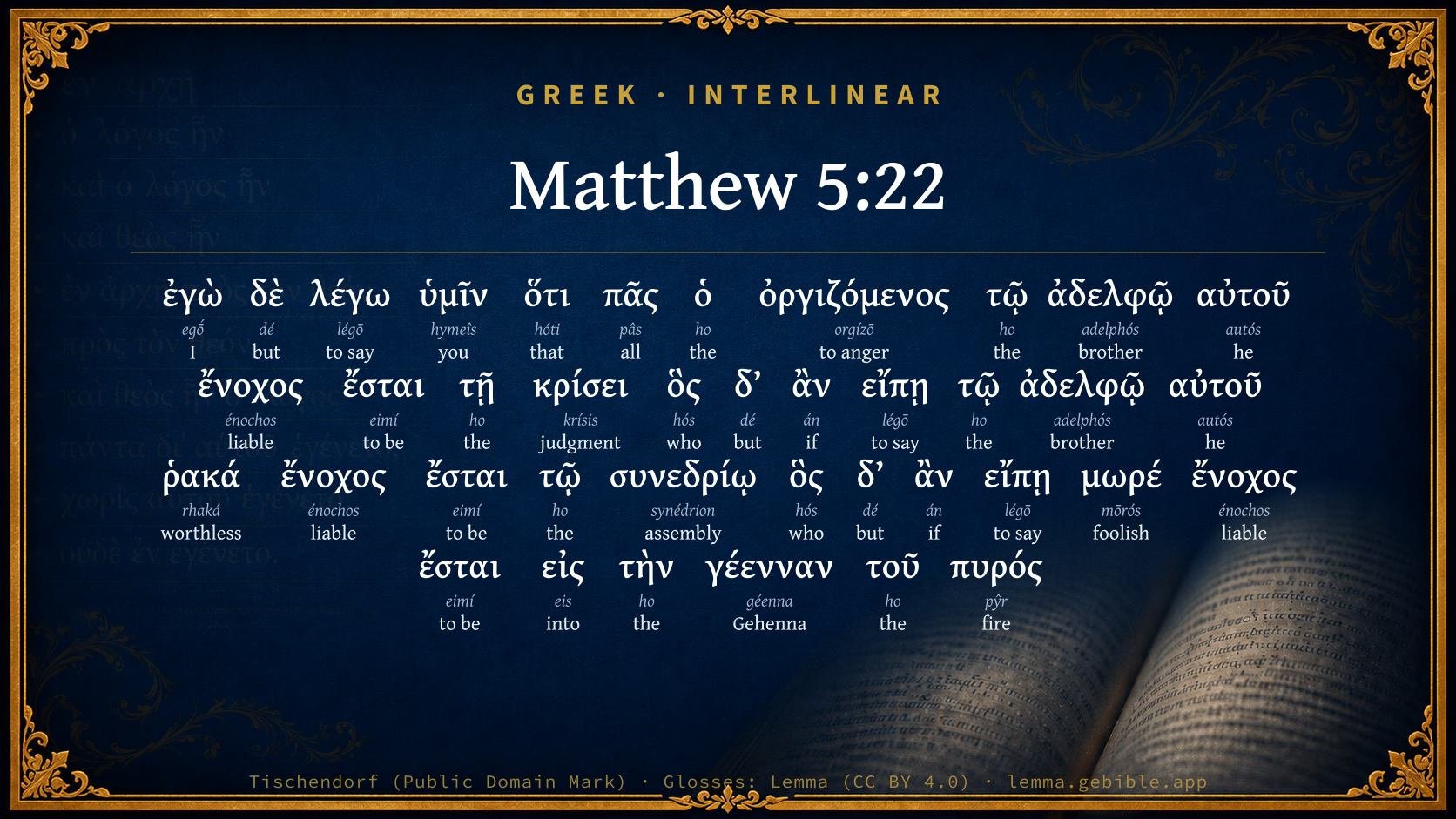
But I tell you, that everyone who is angry with his brother without a cause shall be in danger of the judgment; and whoever shall say to his brother, 'Raca!' shall be in danger of the council; and whoever shall say, 'You fool!' shall be in danger of the fire of Gehenna.
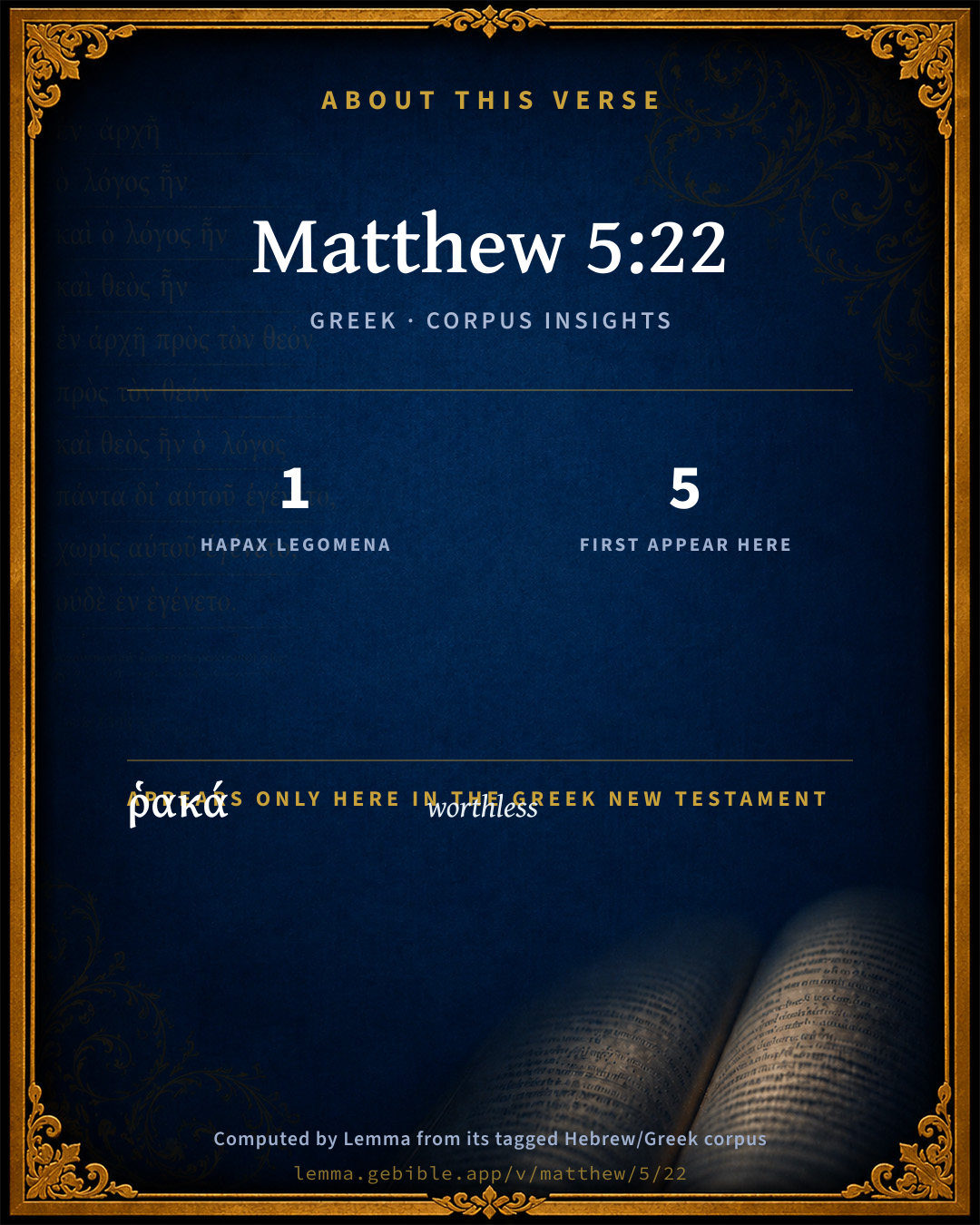
- 1 hapax legomenon — only here in the Greek New Testament
- 5 first appearances in the Greek New Testament
Download a study sheet
One document with this verse’s original text, its word-by-word gloss line, the meaning frame, cross-references with their text, attributed commentary, and full source and license credits — printable, and it pastes into notes with its structure intact.
This verse Autodidact and up
A passage Seminary Student
Up to 50 verses in one chapter. A passage sheet keeps up to 6 commentary sources and 12 cross-references per verse, in the order this page ranks them, and says so on the sheet whenever that leaves anything out. Ask for a single verse and you get the Autodidact verse sheet above.
Everything on this page stays free to read, with no account — the sheet is a download of what is already on screen, not access to it.
Compare translations 3
The same verse in 3 English versions, stacked beneath the original-language interlinear above. Click any original word for its lexicon entry.
Each is an independent rendering of the whole verse — the interlinear is not word-aligned to these translations.
Highlighted words mark where these versions differ — a whole-verse word diff, not a word-by-word alignment.
-
World English Bible Public Domain
But I tell you, that everyone who is angry with his brother without a cause shall be in danger of the judgment; and whoever shall say to his brother, 'Raca!' shall be in danger of the council; and whoever shall say, 'You fool!' shall be in danger of the fire of Gehenna.
-
King James Version Public Domain
But I say unto you, That whosoever is angry with his brother without a cause shall be in danger of the judgment: and whosoever shall say to his brother, Raca, shall be in danger of the council: but whosoever shall say, Thou fool, shall be in danger of hell fire.
-
unfoldingWord Literal Text CC BY-SA 4.0
But I say to you that everyone being angry with his brother will be subject to the judgment. And whoever says to his brother, ‘Raka!’ will be subject to the council. And whoever says, ‘You fool!’ will be subject to the Gehenna of fire.
unfoldingWord Literal Text — © unfoldingWord, licensed CC BY-SA 4.0. Word-aligned USFM3 via Door43 (git.door43.org/unfoldingWord/en_ult).
Show all 19 translations
Every available English version of this verse, each an independent rendering of the whole verse.
-
World English Bible Public Domain
But I tell you, that everyone who is angry with his brother without a cause shall be in danger of the judgment; and whoever shall say to his brother, 'Raca!' shall be in danger of the council; and whoever shall say, 'You fool!' shall be in danger of the fire of Gehenna.
-
Berean Standard Bible Public Domain
But I tell you that anyone who is angry with his brother will be subject to judgment. Again, anyone who says to his brother, ‘Raca,’ will be subject to the Sanhedrin. But anyone who says, ‘You fool!’ will be subject to the fire of hell.
-
Majority Standard Bible Public Domain
But I tell you that anyone who is angry with his brother without cause will be subject to judgment. Again, anyone who says to his brother, ‘Raca,’ will be subject to the Sanhedrin. But anyone who says, ‘You fool!’ will be subject to the fire of hell.
-
King James Version Public Domain
But I say unto you, That whosoever is angry with his brother without a cause shall be in danger of the judgment: and whosoever shall say to his brother, Raca, shall be in danger of the council: but whosoever shall say, Thou fool, shall be in danger of hell fire.
-
American Standard Version (1901) Public Domain
but I say unto you, that every one who is angry with his brother shall be in danger of the judgment; and whosoever shall say to his brother, Raca, shall be in danger of the council; and whosoever shall say, Thou fool, shall be in danger of the hell of fire.
-
Revised Version (1885) Public Domain
but I say unto you, that every one who is angry with his brother shall be in danger of the judgment; and whosoever shall say to his brother, Raca, shall be in danger of the council; and whosoever shall say, Thou fool, shall be in danger of the hell of fire.
-
Geneva Bible (1599) Public Domain
But I say vnto you, whosoeuer is angry with his brother vnaduisedly, shalbe culpable of iudgment. And whosoeuer sayth vnto his brother, Raca, shalbe worthy to be punished by the Councill. And whosoeuer shall say, Foole, shalbe worthy to be punished with hell fire.
-
Douay-Rheims (1899) Public Domain
But I say to you, that whosoever is angry with his brother, shall be in danger of the judgment. And whosoever shall say to his brother, Raca, shall be in danger of the council. And whosoever shall say, Thou Fool, shall be in danger of hell fire.
-
Young's Literal Translation Public Domain
but I -- I say to you, that every one who is angry at his brother without cause, shall be in danger of the judgment, and whoever may say to his brother, Empty fellow! shall be in danger of the sanhedrim, and whoever may say, Rebel! shall be in danger of the gehenna of the fire.
-
Literal Standard Version CC BY-SA 4.0
but I say to you that everyone who is angry at his brother without cause will be in danger of the judgment, and whoever may say to his brother, Stupid, will be in danger of the Sanhedrin, and whoever may say, Moron, will be in danger of the Gehenna of fire.
-
Unlocked Literal Bible CC BY-SA 4.0
But I say to you that everyone who is angry with his brother will be in danger of the judgment; and whoever says to his brother, 'You worthless person!' will be in danger of the council; and whoever says, 'You fool!' will be in danger of the fire of hell.
-
unfoldingWord Literal Text CC BY-SA 4.0
But I say to you that everyone being angry with his brother will be subject to the judgment. And whoever says to his brother, ‘Raka!’ will be subject to the council. And whoever says, ‘You fool!’ will be subject to the Gehenna of fire.
-
Darby Bible Public Domain
But *I* say unto you, that every one that is lightly angry with his brother shall be subject to the judgment; but whosoever shall say to his brother, Raca, shall be subject to [be called before] the sanhedrim; but whosoever shall say, Fool, shall be subject to the penalty of the hell of fire.
-
World Messianic Bible Public Domain
But I tell you that everyone who is angry with his brother without a cause will be in danger of the judgment. Whoever says to his brother, ‘You good-for-nothing!’ will be in danger of the council. Whoever says, ‘You fool!’ will be in danger of the fire of Gehinnom.
-
Webster's Bible Public Domain
But I say to you, That whoever is angry with his brother without a cause, shall be in danger of the judgment: and whoever shall say to his brother, Raca, shall be in danger of the council: but whoever shall say, Thou fool, shall be in danger of hell-fire.
-
Free Bible Version CC BY-SA 4.0
But I tell you, anyone who is angry with his brother will be condemned as guilty. Whoever calls his brother an idiot has to answer to the council, but whoever verbally abuses others is liable to the fire of Gehenna.
-
Bible in Basic English Public Domain
But I say to you that everyone who is angry with his brother will be in danger of being judged; and he who says to his brother, Raca, will be in danger from the Sanhedrin; and whoever says, You foolish one, will be in danger of the hell of fire.
-
Text-Critical English NT CC BY 4.0
But I say to you that everyone who is rashly angry with his brother will be subject to judgment. Whoever says to his brother, ‘Yoʋ idiot,’ will be subject to the Sanhedrin. And whoever says, ‘Yoʋ fool,’ will be subject to the fires of hell.
-
Tyndale New Testament (1534) Public Domain
But I say vnto you, whosoever is angre with hys brother, shalbe in daunger of iudgement. Whosoeuer sayeth vnto his brother Racha shalbe in dauger of a consell. But whosoeuer sayeth thou fole shalbe in dauger of hell fyre.
Literal Standard Version (2020), Covenant Press — licensed CC BY-SA 4.0. Text via the HelloAO Bible API (eBible.org). Unlocked Literal Bible (unfoldingWord) — licensed CC BY-SA 4.0. Text via the HelloAO Bible API (eBible.org). unfoldingWord Literal Text — © unfoldingWord, licensed CC BY-SA 4.0. Word-aligned USFM3 via Door43 (git.door43.org/unfoldingWord/en_ult). Free Bible Version, Dr. Jonathan Gallagher — licensed CC BY-SA 4.0. Text via the HelloAO Bible API (eBible.org).
Word by word
More ways to search: Search by grammar → Find every occurrence → Compare this word →
Practice this passage: Drill this verse → Learn its vocabulary →
- Appears 1× in the Greek New Testament
- First appears here
- Part of Speech
- Aramaic transliteration
Full Thayer's Definition
- ἐγὼ egṓ G1473 “I” Personal pronoun, 1st person, Nominative, Singular
- δὲ dé G1161 “but” Conjunction
- λέγω légō G3004 “to say” Verb, Present, Active, Indicative, 1st person, Singular
- ὑμῖν hymeîs G5210 “you” Personal pronoun, 2nd person, Dative, Plural
- ὅτι hóti G3754 “that” Conjunction
- πᾶς pâs G3956 “all” Adjective, Nominative, Singular, Masculine
- ὁ ho G3588 “the” Article, Nominative, Singular, Masculine
- ὀργιζόμενος orgízō G3710 “to anger” Verb, Present, Passive, Participle, Nominative, Singular, Masculine
- τῷ ho G3588 “the” Article, Dative, Singular, Masculine
- ἀδελφῷ adelphós G80 “brother” Noun, Dative, Singular, Masculine
- αὐτοῦ autós G846 “he” Personal pronoun, Genitive, Singular, Masculine
- ἔνοχος énochos G1777 “liable” Adjective, Nominative, Singular, Masculine
- ἔσται eimí G1510 “to be” Verb, Future, Middle deponent, Indicative, 3rd person, Singular
- τῇ ho G3588 “the” Article, Dative, Singular, Feminine
- κρίσει krísis G2920 “judgment” Noun, Dative, Singular, Feminine
- ὃς hós G3739 “who” Relative pronoun, Nominative, Singular, Masculine
- δ’ dé G1161 “but” Conjunction
- ἂν án G302 “if” Particle
- εἴπῃ légō G3004 “to say” Verb, Aorist, Active, Subjunctive, 3rd person, Singular
- τῷ ho G3588 “the” Article, Dative, Singular, Masculine
- ἀδελφῷ adelphós G80 “brother” Noun, Dative, Singular, Masculine
- αὐτοῦ autós G846 “he” Personal pronoun, Genitive, Singular, Masculine
- ῥακά rhaká G4469 “worthless” Aramaic transliteration
- ἔνοχος énochos G1777 “liable” Adjective, Nominative, Singular, Masculine
- ἔσται eimí G1510 “to be” Verb, Future, Middle deponent, Indicative, 3rd person, Singular
- τῷ ho G3588 “the” Article, Dative, Singular, Neuter
- συνεδρίῳ synédrion G4892 “assembly” Noun, Dative, Singular, Neuter
- ὃς hós G3739 “who” Relative pronoun, Nominative, Singular, Masculine
- δ’ dé G1161 “but” Conjunction
- ἂν án G302 “if” Particle
- εἴπῃ légō G3004 “to say” Verb, Aorist, Active, Subjunctive, 3rd person, Singular
- μωρέ mōrós G3474 “foolish” Adjective, Vocative, Singular, Masculine
- ἔνοχος énochos G1777 “liable” Adjective, Nominative, Singular, Masculine
- ἔσται eimí G1510 “to be” Verb, Future, Middle deponent, Indicative, 3rd person, Singular
- εἰς eis G1519 “into” Preposition
- τὴν ho G3588 “the” Article, Accusative, Singular, Feminine
- γέενναν géenna G1067 “Gehenna” Noun, Accusative, Singular, Feminine
- τοῦ ho G3588 “the” Article, Genitive, Singular, Neuter
- πυρός pŷr G4442 “fire” Noun, Genitive, Singular, Neuter
About this verse
These counts appear in no published source. They are computed here, from the morphology-tagged text and Lemma’s own curated glosses. What Lemma adds →
- 39
- words
- 21
- distinct lemmas
- Gospels
- section
Notable vocabulary
1 hapax legomenon — a word that appears only here in the entire Greek New Testament:
- ῥακά worthless G4469
First appearance in Scripture
These words make their first canonical appearance in the Greek New Testament here:
Shared distinctive vocabulary
ὀργιζόμενος to anger G3710 occurs in 8 verses of the Greek New Testament. Also found in:
Cross-references
79Topical passages linked to Matthew 5:22 in the Treasury of Scripture Knowledge — connected by theme and wording, ordered by reader-vote popularity; previews shown in the World English Bible.
- 1 John 3:14–15 We know that we have passed out of death into life, because we love the brothers. He who doesn't love his brother remains in death.
- 1 John 4:20–21 If a man says, "I love God," and hates his brother, he is a liar; for he who doesn't love his brother whom he has seen, how can he love God whom he has not seen?
- 1 John 2:9 He who says he is in the light and hates his brother, is in the darkness even until now.
- Ephesians 4:26–27 "Be angry, and don't sin." Don't let the sun go down on your wrath,
- Ephesians 4:31–32 Let all bitterness, wrath, anger, outcry, and slander, be put away from you, with all malice.
- James 3:6 And the tongue is a fire. The world of iniquity among our members is the tongue, which defiles the whole body, and sets on fire the course of nature, and is set on fire by Gehenna.
- Titus 3:2 to speak evil of no one, not to be contentious, to be gentle, showing all humility toward all men.
- Matthew 10:28 Don't be afraid of those who kill the body, but are not able to kill the soul. Rather, fear him who is able to destroy both soul and body in Gehenna.
- Matthew 18:35 So my heavenly Father will also do to you, if you don't each forgive your brother from your hearts for his misdeeds."
- Romans 12:10 In love of the brothers be tenderly affectionate one to another; in honor preferring one another;
- 1 Peter 3:9 not rendering evil for evil, or reviling for reviling; but instead blessing; knowing that to this were you called, that you may inherit a blessing.
- Psalms 109:3 They have also surrounded me with words of hatred, And fought against me without a cause.
- Matthew 18:21 Then Peter came and said to him, "Lord, how often shall my brother sin against me, and I forgive him? Until seven times?"
- 1 Peter 2:23 Who, when he was cursed, didn't curse back. When he suffered, didn't threaten, but committed himself to him who judges righteously;
- Psalms 37:8 Cease from anger, and forsake wrath. Don't fret, it leads only to evildoing.
- Matthew 5:23–24 "If therefore you are offering your gift at the altar, and there remember that your brother has anything against you,
- Acts 17:18 Some of the Epicurean and Stoic philosophers also were conversing with him. Some said, "What does this babbler want to say?" Others said, "He seems to be advocating foreign deities," because he preached Jesus and the resurrection.
- 1 John 3:10 In this the children of God are revealed, and the children of the devil. Whoever doesn't do righteousness is not of God, neither is he who doesn't love his brother.
- Jude 1:9 But Michael, the archangel, when contending with the devil and arguing about the body of Moses, dared not bring against him an abusive condemnation, but said, "May the Lord rebuke you!"
- Matthew 26:59 Now the chief priests, the elders, and the whole council sought false testimony against Jesus, that they might put him to death;
- Mark 14:55 Now the chief priests and the whole council sought witnesses against Jesus to put him to death, and found none.
- 1 Thessalonians 4:6 that no one should take advantage of and wrong a brother or sister in this matter; because the Lord is an avenger in all these things, as also we forewarned you and testified.
- Deuteronomy 15:11 For the poor will never cease out of the land: therefore I command you, saying, You shall surely open your hand to your brother, to your needy, and to your poor, in your land.
- Luke 16:23–24 In Hades, he lifted up his eyes, being in torment, and saw Abraham far off, and Lazarus at his bosom.
- John 11:47 The chief priests therefore and the Pharisees gathered a council, and said, "What are we doing? For this man does many signs.
- Genesis 37:4 His brothers saw that their father loved him more than all his brothers, and they hated him, and couldn't speak peaceably to him.
- Psalms 7:4 If I have rewarded evil to him who was at peace with me (Yes, I have delivered him who without cause was my adversary),
- Proverbs 14:16 A wise man fears, and shuns evil, But the fool is hotheaded and reckless.
- Obadiah 1:10 For the violence done to your brother Jacob, shame will cover you, and you will be cut off forever.
- Matthew 3:17 Behold, a voice out of the heavens said, "This is my beloved Son, with whom I am well pleased."
- Matthew 5:28–30 but I tell you that everyone who gazes at a woman to lust after her has committed adultery with her already in his heart.
- Matthew 5:34 but I tell you, don't swear at all: neither by heaven, for it is the throne of God;
- Matthew 18:8–9 If your hand or your foot causes you to stumble, cut it off, and cast it from you. It is better for you to enter into life maimed or crippled, rather than having two hands or two feet to be cast into the eternal fire.
- Luke 12:5 But I will warn you whom you should fear. Fear him, who after he has killed, has power to cast into Gehenna. Yes, I tell you, fear him.
- Acts 7:37 This is that Moses, who said to the children of Israel, 'The Lord our God will raise up a prophet for you from among your brothers, like me.'
- Revelation 20:14 Death and Hades were thrown into the lake of fire. This is the second death, the lake of fire.
- Genesis 4:5–6 but he didn't respect Cain and his offering. Cain was very angry, and the expression on his face fell.
- Genesis 37:8 His brothers said to him, "Will you indeed reign over us? Or will you indeed have dominion over us?" They hated him all the more for his dreams and for his words.
- 1 Samuel 17:27–28 The people answered him after this manner, saying, So shall it be done to the man who kills him.
- 1 Samuel 22:12–23 Saul said, Hear now, you son of Ahitub. He answered, Here I am, my lord.
- 2 Samuel 6:20 Then David returned to bless his household. Michal the daughter of Saul came out to meet David, and said, How glorious was the king of Israel today, who uncovered himself today in the eyes of the handmaids of his servants, as one of the vain fellows shamelessly uncovers himself!
- 2 Samuel 16:7 Thus said Shimei when he cursed, Be gone, be gone, you man of blood, and base fellow:
- 1 Kings 21:4 Ahab came into his house sullen and angry because of the word which Naboth the Jezreelite had spoken to him; for he had said, I will not give you the inheritance of my fathers. He laid him down on his bed, and turned away his face, and would eat no bread.
- 2 Chronicles 16:10 Then Asa was angry with the seer, and put him in the prison-house; for he was in a rage with him because of this thing. Asa oppressed some of the people at the same time.
- Nehemiah 5:8 I said to them, We after our ability have redeemed our brothers the Jews, that were sold to the nations; and would you even sell your brothers, and should they be sold to us? Then held they their peace, and found never a word.
- Esther 3:5–6 When Haman saw that Mordecai didn't bow down, nor did him reverence, then was Haman full of wrath.
- Psalms 14:1 The fool has said in his heart, "There is no God." They are corrupt. They have done abominable works. There is none who does good.
- Psalms 25:3 Yes, no one who waits for you shall be shamed. They shall be shamed who deal treacherously without cause.
- Psalms 35:19 Don't let those who are my enemies wrongfully rejoice over me; Neither let them wink with the eye who hate me without a cause.
- Psalms 49:10 For he sees that wise men die; Likewise the fool and the senseless perish, And leave their wealth to others.
- Psalms 69:4 Those who hate me without a cause are more than the hairs of my head. Those who want to cut me off, being my enemies wrongfully, are mighty. I have to restore what I didn't take away.
- Psalms 92:6 A senseless man doesn't know, Neither does a fool understand this:
- Proverbs 18:6 A fool's lips come into strife, And his mouth invites beatings.
- Jeremiah 17:11 As the partridge that sits on [eggs] which she has not laid, so is he who gets riches, and not by right; in the midst of his days they shall leave him, and at his end he shall be a fool.
- Lamentations 3:52 They have chased me sore like a bird, those who are my enemies without cause.
- Daniel 2:12–13 For this cause the king was angry and very furious, and commanded to destroy all the wise men of Babylon.
- Daniel 3:13 Then Nebuchadnezzar in [his] rage and fury commanded to bring Shadrach, Meshach, and Abednego. Then they brought these men before the king.
- Daniel 3:19 Then was Nebuchadnezzar full of fury, and the form of his visage was changed against Shadrach, Meshach, and Abednego: [therefore] he spoke, and commanded that they should heat the furnace seven times more than it was wont to be heated.
- Obadiah 1:12 But don't look down on your brother in the day of his disaster, and don't rejoice over the children of Judah in the day of their destruction. Don't speak proudly in the day of distress.
- Matthew 5:44 But I tell you, love your enemies, bless those who curse you, do good to those who hate you, and pray for those who mistreat you and persecute you,
- Matthew 10:17 But beware of men: for they will deliver you up to councils, and in their synagogues they will scourge you.
- Matthew 12:24 But when the Pharisees heard it, they said, "This man does not cast out demons, except by Beelzebul, the prince of the demons."
- Matthew 17:5 While he was still speaking, behold, a bright cloud overshadowed them. Behold, a voice came out of the cloud, saying, "This is my beloved Son, in whom I am well pleased. Listen to him."
- Matthew 23:15 Woe to you, scribes and Pharisees, hypocrites! For you travel around by sea and land to make one proselyte; and when he becomes one, you make him twice as much of a son of Gehenna as yourselves.
- Matthew 23:33 You serpents, you offspring of vipers, how will you escape the judgment of Gehenna?
- Matthew 25:41 Then he will say also to those on the left hand, 'Depart from me, you cursed, into the eternal fire which is prepared for the devil and his angels;
- Mark 9:43–48 If your hand causes you to stumble, cut it off. It is better for you to enter into life maimed, rather than having your two hands to go into Gehenna, into the unquenchable fire,
- Mark 15:1 Immediately in the morning the chief priests, with the elders and scribes, and the whole council, held a consultation, and bound Jesus, and carried him away, and delivered him up to Pilate.
- John 7:20 The multitude answered, "You have a demon! Who seeks to kill you?"
- John 8:48 Then the Jews answered him, "Don't we say well that you are a Samaritan, and have a demon?"
- John 15:25 But this happened so that the word may be fulfilled which was written in their law, 'They hated me without a cause.'
- Acts 3:20–23 and that he may send Christ Jesus, who was ordained for you before,
- Acts 5:27 When they had brought them, they set them before the council. The high priest questioned them,
- 1 Corinthians 6:6 But brother goes to law with brother, and that before unbelievers!
- 1 Corinthians 6:10 nor thieves, nor covetous, nor drunkards, nor slanderers, nor extortioners, will inherit the Kingdom of God.
- Hebrews 5:9 Having been made perfect, he became to all of those who obey him the author of eternal salvation,
- Hebrews 12:25 See that you don't refuse him who speaks. For if they didn't escape when they refused him who warned on the Earth, how much more will we not escape who turn away from him who warns from heaven,
- James 2:20 But do you want to know, vain man, that faith apart from works is dead?
- 1 John 5:16 If anyone sees his brother sinning a sin not leading to death, he shall ask, and God will give him life for those who sin not leading to death. There is a sin leading to death. I don't say that he should make a request concerning this.
Cross-references courtesy of OpenBible.info (CC BY 4.0).
Where the printed editions differ
1 variantPlaces in this verse where the major printed Greek editions disagree on the wording in a way that affects the translation — a comparison of editions, not a manuscript-by-manuscript collation. The editions are the modern critical texts (Nestlé-Aland 28/27, SBL, Westcott-Hort, Tregelles, Tyndale House) and the traditional texts behind the KJV (the Textus Receptus and the Byzantine/Majority text). It is not a claim about which reading is original.
-
Extra text
εἰκῆ
“in vain”
In TregTRByz Not in NA28NA27TynSBLWHεἰκῆ (eikē) 'in vain' is only in traditional manuscripts (Treg+TR+Byz)
Textual data: Translators Amalgamated Greek New Testament (STEPBible TAGNT) · CC BY 4.0.
Lesson kit
Teaching starters — assembled from the data on this page, not authored interpretation. Every prompt links to the verse data it draws on. Edit before teaching.
Matthew, in the Gospels, opens this verse with 39 words (21 distinct Greek lemmas). Its most distinctive word is rhaká (“worthless”). A historical commentator’s framing appears above. Read the whole chapter for the surrounding context.
Discussion questions
- The word rhaká carries the sense “worthless.” How does it shape the verse?
- 1 word here appears nowhere else in the Greek New Testament. Why might the author reach for such rare wording?
- 5 words make their first appearance in Scripture here. What does this debut establish?
- How does Matthew 18:34, which shares the word «to anger», read alongside this verse?
- What does the repetition of “to say” (3× in this one verse) do in this verse?
- The translations on this page render this verse differently — a whole-verse word diff, not a word-by-word alignment. What might account for the different wordings?
- Compare how Scofield Reference Notes and Tyndale Open Study Notes read this verse. Where do they agree or differ?
Things to notice
- 1 word in this verse appears nowhere else in the Greek New Testament.
- 5 words make their first canonical appearance in Scripture here.
- These translations choose different wording for 17 words in this verse.
- “to say” occurs 3× in this single verse.
- 21 distinct Greek lemmas span 39 words in this verse.
Commentary
Notes on Matthew 5:22 from classic Christian and Jewish commentators (each source and its license shown beneath its notes). The classic Christian expositions comment on the surrounding passage and are grouped to its opening verse, so a note may address several verses; the Jewish commentaries on the Tanakh (Rashi and others) are per-verse, so they appear only where the commentator wrote on this verse.
Lemma curates 59 commentaries, every one of them public domain or Creative Commons licensed, each selected and text-cleaned for this edition rather than reprinted as found. About our sources →
Scofield Reference Notes
C. I. Scofield
The Scofield Reference Bible (1917 edition), notes by C. I. Scofield — public domain. Text from a community e-Sword module.
Tyndale Open Study Notes
Tyndale Open Resources
Tyndale Open Study Notes — © Tyndale Open Resources, licensed CC BY-SA 4.0. Text via the HelloAO Bible API.
Bengel's Gnomon
Johann Albrecht Bengel
Bengel's Gnomon of the New Testament — English translation (T&T Clark, Edinburgh, 1860) — public domain. Text from a community e-Sword module.
Meyer's Critical & Exegetical Commentary
Heinrich August Wilhelm Meyer
Meyer — Critical and Exegetical Commentary on the New Testament — English translation by Peter Christie, edited by Frederick Crombie (T&T Clark, 1880) — public domain. Text from a community e-Sword module.
Expositor's Greek Testament
ed. W. Robertson Nicoll
The Expositor's Greek Testament, edited by W. Robertson Nicoll (1897–1910) — public domain. Text from a community e-Sword module.
Geneva Bible (1599)
Geneva Bible translators
Geneva Bible (1599) marginal notes — public domain. Text via Bolls.life.
Jamieson, Fausset & Brown
Robert Jamieson, A. R. Fausset & David Brown
Jamieson, Fausset & Brown — Commentary Critical and Explanatory on the Whole Bible (1871) — public domain (CC PDM 1.0). Text via the HelloAO Bible API.
Adam Clarke's Commentary
Adam Clarke's Commentary on the Bible (1810–1826) — public domain. Text from a community e-Sword/MySword module.
Ellicott's Commentary for English Readers
A Bible Commentary for English Readers, edited by Charles John Ellicott (1878–1897) — public domain. Text from a community e-Sword module.
The Cambridge Bible for Schools and Colleges
gen. ed. J. J. S. Perowne
The Cambridge Bible for Schools and Colleges (gen. ed. J. J. S. Perowne; Cambridge University Press, 1878–1918) — public domain. Text from a community e-Sword module.
John Gill's Exposition
John Gill's Exposition of the Whole Bible (1746–1763) — public domain (CC PDM 1.0). Text via the HelloAO Bible API.
Trapp's Complete Commentary
John Trapp
John Trapp, A Commentary or Exposition upon All the Books of the Old and New Testament (1647–1656) — public domain. Text from a community e-Sword module.
Albert Barnes' Notes on the Bible
Albert Barnes' Notes on the Bible (1834–1885) — public domain. Text from a community e-Sword/MySword module.
Haydock's Catholic Bible Commentary
George Leo Haydock (1774–1849), Haydock's Catholic Family Bible and Commentary, 1859 edition — public domain. Excludes Psalms (Douay-Rheims chapter numbering differs from Protestant) and Deuterocanonical books (Catholic canon only).
Whedon's Commentary on the Bible
Daniel D. Whedon
Daniel D. Whedon (gen. ed.), Commentary on the Old and New Testaments (1874–1909) — public domain. Text from a community e-Sword module.
The Pulpit Commentary
The Pulpit Commentary (1880–1919), ed. H.D.M. Spence-Jones & Joseph S. Exell — public domain. Text from a community e-Sword module.
John Wesley's Explanatory Notes
John Wesley, Explanatory Notes Upon the Whole Bible (1754–1765) — public domain. Text via the GEBible commentary corpus.
Kretzmann's Popular Commentary
Paul E. Kretzmann
Paul E. Kretzmann, Popular Commentary of the Bible (1921–1924) — public domain. Text from a community e-Sword module.
The People's New Testament
B. W. Johnson
B. W. Johnson's The People's New Testament with Notes (1889–1891) — public domain. Electronic text from the Christian Classics Ethereal Library (CCEL) ThML edition.
Cambridge Greek Testament for Schools and Colleges
Cambridge Greek Testament for Schools and Colleges (Cambridge University Press, 1896; 21 vols, various authors incl. Carr, Maclear, Plummer, Farrar, Lumby, Moule, M. R. James, Simcox) — public domain. Text from a community e-Sword module.
Alford’s Greek Testament
Henry Alford
Henry Alford, The Greek Testament (1849–1861) — public domain. Text from a community e-Sword module.
Vincent's Word Studies in the New Testament
Marvin R. Vincent
Marvin R. Vincent, Word Studies in the New Testament (1887–1900) — public domain. Text from a community e-Sword/MySword module.