
Matthew 3:4

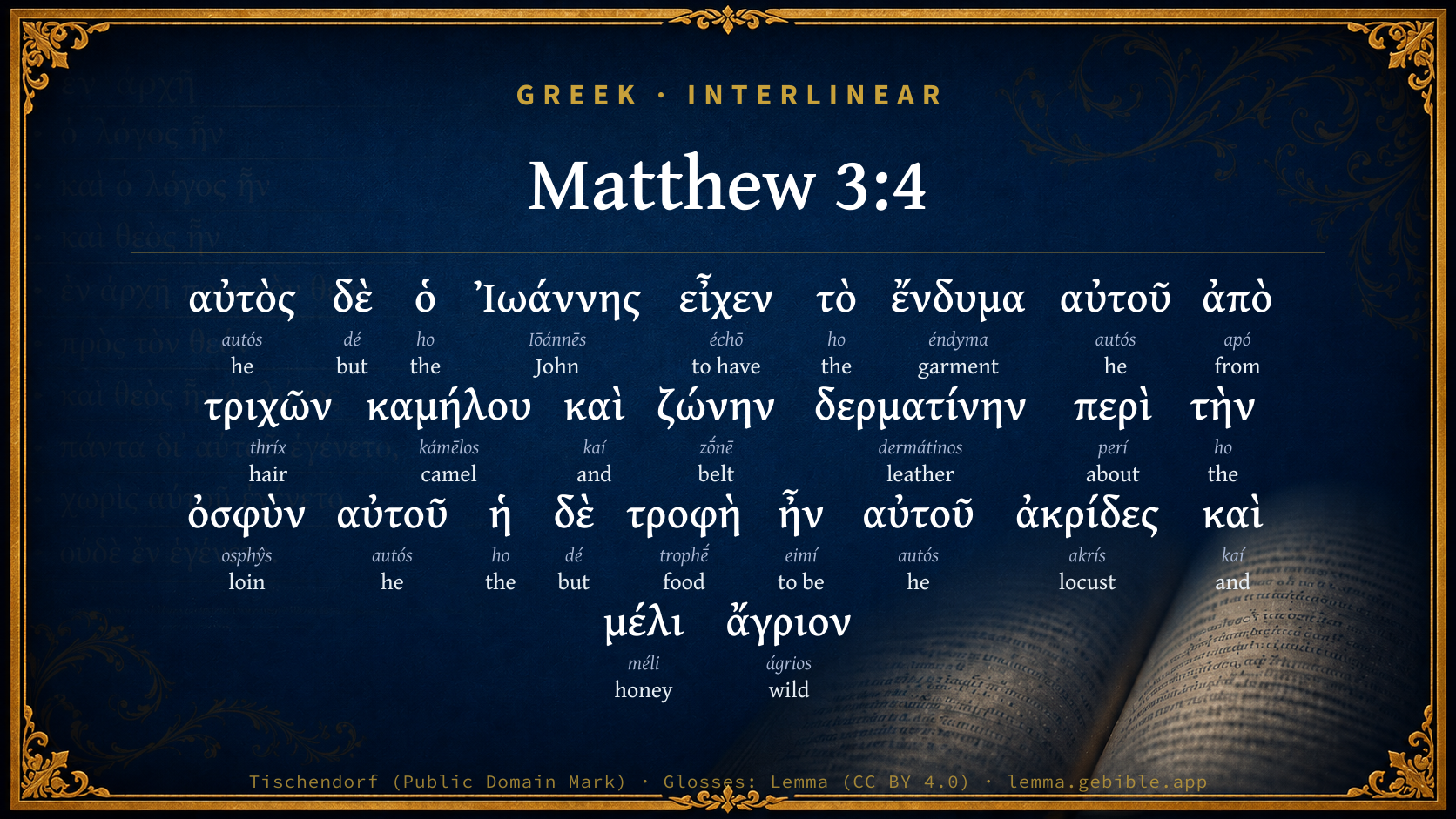
Greek (Tischendorf 8th ed.) Matthew 3:4 appears in the Greek New Testament. The text above is from the Tischendorf 8th edition. Each word links to its Strong’s number and a concise gloss. Click any word for its full Thayer’s Greek Lexicon entry.
Download image
Cite this verse

Matthew 3:4 (World English Bible). Public Domain. Lemma interlinear Bible study tool, https://lemma.gebible.app/v/matthew/3/4.

Show BibTeX & RIS
BibTeX
RIS
English Translation
Now John himself wore clothing made of camel's hair, with a leather belt around his waist. His food was locusts and wild honey.
World English Bible · Public Domain
Highlights
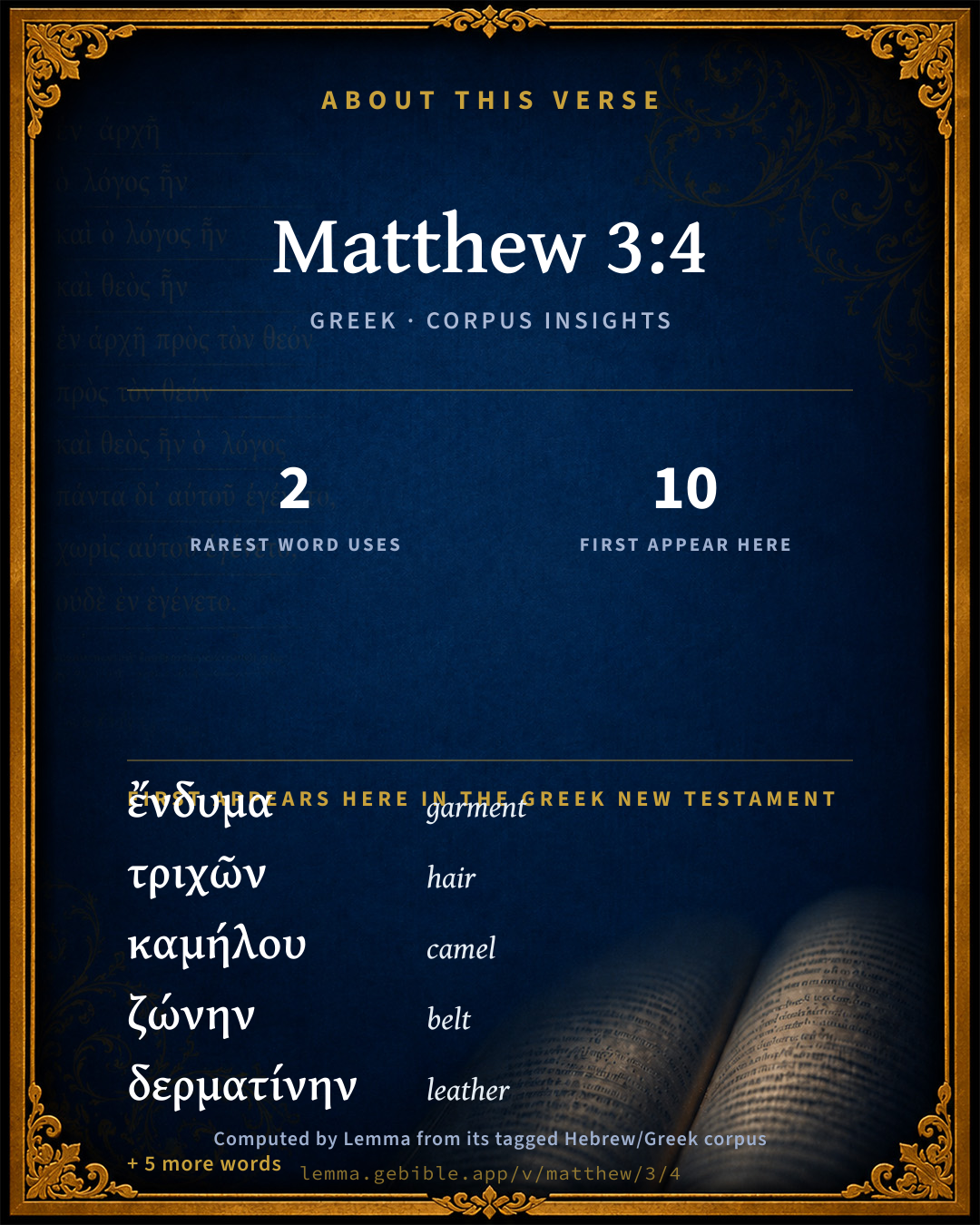
  • 10 first appearances in the Greek New Testament
Full analysis ↓
Download a study sheet

One document with this verse’s original text, its word-by-word gloss line, the meaning frame, cross-references with their text, attributed commentary, and full source and license credits — printable, and it pastes into notes with its structure intact.

This verse Autodidact and up

Study sheet (.html) Plain text (.txt)

A passage Seminary Student

Up to 50 verses in one chapter. A passage sheet keeps up to 6 commentary sources and 12 cross-references per verse, in the order this page ranks them, and says so on the sheet whenever that leaves anything out. Ask for a single verse and you get the Autodidact verse sheet above.

Everything on this page stays free to read, with no account — the sheet is a download of what is already on screen, not access to it.

Want to remove ads? Support Godless Engineer
Compare translations 3

The same verse in 3 English versions, stacked beneath the original-language interlinear above. Click any original word for its lexicon entry.

Each is an independent rendering of the whole verse — the interlinear is not word-aligned to these translations.

Highlighted words mark where these versions differ — a whole-verse word diff, not a word-by-word alignment.

  • World English Bible Public Domain
    Now John himself wore clothing made of camel's hair, with a leather belt around his waist. His food was locusts and wild honey.
  • King James Version Public Domain
    And the same John had his raiment of camel's hair, and a leathern girdle about his loins; and his meat was locusts and wild honey.
  • unfoldingWord Literal Text CC BY-SA 4.0
    Now this John had his clothing from the hair of a camel and a leather belt around his waist, and his food was locusts and wild honey.

unfoldingWord Literal Text — © unfoldingWord, licensed CC BY-SA 4.0. Word-aligned USFM3 via Door43 (git.door43.org/unfoldingWord/en_ult).

Versions to compare (up to 4)

3 of 4 selected

Show all 19 translations

Every available English version of this verse, each an independent rendering of the whole verse.

  • World English Bible Public Domain
    Now John himself wore clothing made of camel's hair, with a leather belt around his waist. His food was locusts and wild honey.
  • Berean Standard Bible Public Domain
    John wore a garment of camel’s hair, with a leather belt around his waist. His food was locusts and wild honey.
  • Majority Standard Bible Public Domain
    John wore a garment of camel’s hair and a leather belt around his waist. His food was locusts and wild honey.
  • King James Version Public Domain
    And the same John had his raiment of camel's hair, and a leathern girdle about his loins; and his meat was locusts and wild honey.
  • American Standard Version (1901) Public Domain
    Now John himself had his raiment of camel's hair, and a leathern girdle about his loins; and his food was locusts and wild honey.
  • Revised Version (1885) Public Domain
    Now John himself had his raiment of camel’s hair, and a leathern girdle about his loins; and his food was locusts and wild honey.
  • Geneva Bible (1599) Public Domain
    And this Iohn had his garment of camels heare, and a girdle of a skinne about his loynes: his meate was also locusts and wilde hony.
  • Douay-Rheims (1899) Public Domain
    And the same John had his garment of camels' hair, and a leathern girdle about his loins: and his meat was locusts and wild honey.
  • Young's Literal Translation Public Domain
    And this John had his clothing of camel's hair, and a girdle of skin round his loins, and his nourishment was locusts and honey of the field.
  • Literal Standard Version CC BY-SA 4.0
    And this John had his clothing of camel’s hair, and a girdle of skin around his loins, and his nourishment was locusts and honey of the field.
  • Unlocked Literal Bible CC BY-SA 4.0
    Now John wore clothing of camel's hair and a leather belt around his waist. His food was locusts and wild honey.
  • unfoldingWord Literal Text CC BY-SA 4.0
    Now this John had his clothing from the hair of a camel and a leather belt around his waist, and his food was locusts and wild honey.
  • Darby Bible Public Domain
    And John himself had his garment of camel's hair, and a leathern girdle about his loins, and his nourishment was locusts and wild honey.
  • World Messianic Bible Public Domain
    Now Yochanan himself wore clothing made of camel’s hair with a leather belt around his waist. His food was locusts and wild honey.
  • Webster's Bible Public Domain
    And the same John had his raiment of camel's hair, and a leathern girdle about his loins; and his food was locusts and wild honey.
  • Free Bible Version CC BY-SA 4.0
    John had clothes made of camel hair, with a leather belt around his waist. His food was locusts and wild honey.
  • Bible in Basic English Public Domain
    Now John was clothed in camel's hair, with a leather band about him; and his food was locusts and honey.
  • Text-Critical English NT CC BY 4.0
    Now John wore a garment of camel's hair and a leather belt around his waist, and his food was locusts and wild honey.
  • Tyndale New Testament (1534) Public Domain
    This Ihon had hys garmet of camels heer and a gerdell of a skynne aboute his loynes. Hys meate was locustes and wylde hony.

Literal Standard Version (2020), Covenant Press — licensed CC BY-SA 4.0. Text via the HelloAO Bible API (eBible.org). Unlocked Literal Bible (unfoldingWord) — licensed CC BY-SA 4.0. Text via the HelloAO Bible API (eBible.org). unfoldingWord Literal Text — © unfoldingWord, licensed CC BY-SA 4.0. Word-aligned USFM3 via Door43 (git.door43.org/unfoldingWord/en_ult). Free Bible Version, Dr. Jonathan Gallagher — licensed CC BY-SA 4.0. Text via the HelloAO Bible API (eBible.org).

Word by word

More ways to search: Search by grammar → Find every occurrence → Compare this word →

Practice this passage: Drill this verse → Learn its vocabulary →

δερματίνην
dermátinos
G1193
“leather”
Adjective, Accusative, Singular, Feminine
Part of Speech
Adjective
Case
Accusative
Number
Singular
Gender
Feminine
Full Thayer's Definition

Origin: from G1192

TDNT: None

1. made of skin, leathern
  1. αὐτὸς autós G846 “he” Personal pronoun, Nominative, Singular, Masculine
  2. δὲ dé G1161 “but” Conjunction
  3. ὁ ho G3588 “the” Article, Nominative, Singular, Masculine
  4. Ἰωάννης Iōánnēs G2491 “John” Noun, Nominative, Singular, Masculine
  5. εἶχεν échō G2192 “to have” Verb, Imperfect, Active, Indicative, 3rd person, Singular
  6. τὸ ho G3588 “the” Article, Accusative, Singular, Neuter
  7. ἔνδυμα éndyma G1742 “garment” Noun, Accusative, Singular, Neuter
  8. αὐτοῦ autós G846 “he” Personal pronoun, Genitive, Singular, Masculine
  9. ἀπὸ apó G575 “from” Preposition
  10. τριχῶν thríx G2359 “hair” Noun, Genitive, Plural, Feminine
  11. καμήλου kámēlos G2574 “camel” Noun, Genitive, Singular, Masculine
  12. καὶ kaí G2532 “and” Conjunction
  13. ζώνην zṓnē G2223 “belt” Noun, Accusative, Singular, Feminine
  14. περὶ perí G4012 “about” Preposition
  15. τὴν ho G3588 “the” Article, Accusative, Singular, Feminine
  16. ὀσφὺν osphŷs G3751 “loin” Noun, Accusative, Singular, Feminine
  17. αὐτοῦ autós G846 “he” Personal pronoun, Genitive, Singular, Masculine
  18. ἡ ho G3588 “the” Article, Nominative, Singular, Feminine
  19. δὲ dé G1161 “but” Conjunction
  20. τροφὴ trophḗ G5160 “food” Noun, Nominative, Singular, Feminine
  21. ἦν eimí G1510 “to be” Verb, Imperfect, Active, Indicative, 3rd person, Singular
  22. αὐτοῦ autós G846 “he” Personal pronoun, Genitive, Singular, Masculine
  23. ἀκρίδες akrís G200 “locust” Noun, Nominative, Plural, Feminine
  24. καὶ kaí G2532 “and” Conjunction
  25. μέλι méli G3192 “honey” Noun, Nominative, Singular, Neuter
  26. ἄγριον ágrios G66 “wild” Adjective, Nominative, Singular, Neuter

About this verse

These counts appear in no published source. They are computed here, from the morphology-tagged text and Lemma’s own curated glosses. What Lemma adds →

27
words
19
distinct lemmas
Gospels
section

Notable vocabulary

The rarest word here is δερματίνην leather G1193 — appearing just 2 times in the whole Greek New Testament.

First appearance in Scripture

These words make their first canonical appearance in the Greek New Testament here (10 in total — showing 8):

  • ἔνδυμα garment G1742
  • τριχῶν hair G2359
  • καμήλου camel G2574
  • ζώνην belt G2223
  • δερματίνην leather G1193
  • ὀσφὺν loin G3751
  • τροφὴ food G5160
  • ἀκρίδες locust G200

Shared distinctive vocabulary

δερματίνην leather G1193 occurs in 2 verses of the Greek New Testament. Also found in:
Repetition

Words recur within this verse:

Cross-references

11

Topical passages linked to Matthew 3:4 in the Treasury of Scripture Knowledge — connected by theme and wording, ordered by reader-vote popularity; previews shown in the World English Bible.

  • 2 Kings 1:8 They answered him, He was a hairy man, and girt with a belt of leather about his loins. He said, It is Elijah the Tishbite.
  • Leviticus 11:22 Even of these you may eat: any kind of locust, any kind of katydid, any kind of cricket, and any kind of grasshopper.
  • Zechariah 13:4 It will happen in that day, that the prophets will each be ashamed of his vision, when he prophesies; neither will they wear a hairy mantle to deceive:
  • Matthew 11:8 But what did you go out to see? A man in soft clothing? Behold, those who wear soft clothing are in king's houses.
  • Mark 1:6 John was clothed with camel's hair and a leather belt around his loins. He ate locusts and wild honey.
  • Malachi 4:5 Behold, I will send you Elijah the prophet before the great and terrible day of Yahweh comes.
  • Luke 1:17 He will go before him in the spirit and power of Elijah, 'to turn the hearts of the fathers to the children,' and the disobedient to the wisdom of the just; to make ready a people prepared for the Lord."
  • Deuteronomy 32:13 He made him ride on the high places of the earth, He ate the increase of the field; He made him to suck honey out of the rock, Oil out of the flinty rock;
  • 1 Samuel 14:25–27 All the people came into the forest; and there was honey on the ground.
  • Matthew 11:18 For John came neither eating nor drinking, and they say, 'He has a demon.'
  • Revelation 11:3 I will give power to my two witnesses, and they will prophesy one thousand two hundred sixty days, clothed in sackcloth."

Cross-references courtesy of OpenBible.info (CC BY 4.0).

Commentary

Notes on Matthew 3:4 from classic Christian and Jewish commentators (each source and its license shown beneath its notes). The classic Christian expositions comment on the surrounding passage and are grouped to its opening verse, so a note may address several verses; the Jewish commentaries on the Tanakh (Rashi and others) are per-verse, so they appear only where the commentator wrote on this verse.

Lemma curates 59 commentaries, every one of them public domain or Creative Commons licensed, each selected and text-cleaned for this edition rather than reprinted as found. About our sources →

The Biblical Illustrator

Joseph S. Exell

Mat_3:4

Raiment of camels hair.

-We read of John the Baptist having his raiment of camels hair, and many have supposed that the dress of Elijah was similar. The hair of the camel, especially the coarser woolly tufts about the hump and back, is in some places torn off, but more generally, as I have observed, closely shorn once a year, and used for weaving into a coarse thick fabric by the Arab women. It is of this material that the black tents of Kedar are generally constructed, as it is much thicker and stouter than woollen stuff. It was very harsh and rough to the touch, and thus his dress was in accordance with the austerity of the rest of the Baptists mode of life. (Canon Tristram.)

The modern Bedawin dress simply, their attire consisting of a cotton shirt, sometimes white, but oftener blue, whose loose folds descend to the ankles, and which is confined with a leathern girdle about the loins. Besides this girdle, both sexes wear from infancy a leathern girdle around the naked waist, adorned with amulets, and also with shells … A woollen cloak of camels hair, in broad stripes, brown and white, is thrown loosely over the shoulders of the desert Arab, and is his only covering at night (Exo_22:26-27) … A thick cord of brown camels hair binds their handkerchief head-dresses around their heads … The Bedawin generally go barefooted, or else make sandals of camels skin, which they bind with thongs around their feet. These sandals are always made after one model, and appear to derive their form from high antiquity. (Dr. Van-Lennep.)

Locusts

These insects are found at all times, and in every part of Western Asia, in Arabia, and in Northern Africa. The full-grown locusts are from two to three inches in length, and differ from the common grasshopper in their regularly elongated bodies, their reddish colour, and the length of their wings, which enable them to rise to a considerable height above the ground, and to pass over a distance of several miles, by sailing before the wind. The statement that John the Baptists food while in the wilderness chiefly consisted of locusts and wild honey, best describes the habitual fare of those who at the present day lead a life of isolation and poverty in the same region, and we know that the Mosaic law allowed the Hebrews to eat the locust (Lev_11:22). The full-grown insect is extensively eaten by the poorer classes,… particularly by the Bedawin of the desert. When the locusts come down upon the face of the earth, crowds of people go forth and collect vast numbers of them in bags, even loading horses and cattle with the booty. They are roasted and eaten as butter upon loaves of bread, resembling shrimps in taste, or they are boiled in water with a little salt, dried in the sun, and, being deprived of their wings and legs, are packed in bags for use. They are also beaten to a powder, which is mixed with flour and water, made into little cakes, and used as a substitute for bread when flour is scarce. Dried locusts are generally exposed for sale in the markets of Medina, Bagdad, and even Damascus. (Dr. Van-Lennep.)

Wild honey.

The frequent description of Palestine as a land flowing with milk and honey, points out the fact that the honey-bee, and, as a concomitant, wild flowers too, abounded in it anciently, as at the present day. The flowers are so various in Western Asia, that the honey of different districts assumes very marked peculiarities. The honey of Kirk-Aghai, near Pergamus in Asia Minor, chiefly made of the flower of the cotton plant, it is said, so closely resembles butter in appearance, that it can only be detected by the taste. The honey of Mount Hymettus is dark and disagreeable to persons unused to it; the Athenians prefer it to any other. In some parts of Asia Minor the hives which are kept in the villages are transported at a certain season of the year to the slopes and high plains of the mountains, where the bees feed upon the blossoms of the pine and of the mountain plants. Orientals are very fond of honey, and usually eat it in the comb. (Dr. Van-Lennep.)

When the Egyptians on the Upper Nile find that their bees obtain no more honey around their villages, they take their hives on boats, and sail down the river, stopping a| every green spot to let the bees collect honey from the flowers on the shore; so thus by the time they reach Cairo, which is their market, their hives are full of honey. (Poeocke.)

The Biblical Illustrator, edited by Joseph S. Exell (c. 1880s–1900s) — public domain. Text from a community e-Sword module.

Joseph Benson's Commentary

Mat 3:4. And the same John — The following description of John is added, that it might appear he did not live in obscurity, but was sufficiently known to all: had his raiment of camel’s hair — Not, as some have supposed, a camel’s skin, raw and undressed, but a kind of sackcloth, coarse and rough, made of the raw long hair of camels, and not of their fine and soft hair, dressed and spun into thread. The difference between these two is as great as that between flax rude or unprepared, and the same dressed or spun; or between that which we now call hair cloth, made of undressed hair, and camlet, that is made of it when it is softened, and spun, and prepared; in imitation of which, though made of wool, is the English camlet. Elijah seems to have wore a similar garment, and therefore was called a hairy man; which expression is supposed to refer to his clothing rather than his body. Most of the ancient prophets wore such garments, whence we read of the false prophets putting on a rough garment to deceive, Zec 13:4; and of the witnesses prophesying in sackcloth, Rev 6:12; and Rev 11:3. And a leathern girdle about his loins — In this respect, also, being like Elijah, in whose spirit and power he came, Mal 4:5; Luk 1:17. Hereby, as also by his spare diet, he gave an example of repentance, and of his expectation of a heavenly kingdom. And his meat was locusts — The insects called locusts are undoubtedly intended, a kind of large-winged grasshoppers. See Rev 9:3; Rev 9:7; Rev 9:9. It is true, according to Sandys (Trav. p. 183) and many others, it appears there is, in these parts, a shrub termed the locust tree, the buds of which resemble asparagus; yet it is not probable that this is here meant, nor the wild fruits of any trees, nor the tops of herbs and plants, as some, both ancients and moderns, have supposed; because the original word here used, in the LXX. and elsewhere, generally signifies the animal which we call a locust, which it is certain the law allowed the Jews to eat, and which, Pliny assures us, made a considerable part of the food of the Parthians and Ethiopians. Dr. Shaw tells us that when sprinkled with salt and fried they taste much like the river cray-fish. See his excellent Travels, p. 258. And wild honey — Such as, in those parts, was often found in hollow trees, or in the clefts of the rocks, 1Sa 14:26; Jdg 14:8; Psa 81:16. John used such a diet and such clothing as was cheap and easily obtained. He drank no wine, and frequently fasted, not through poverty, for he was the only son of a priest, but of his own free-will, as well that his severe and mortified manner of life might correspond with his doctrine, which enjoined frequent fasting to his disciples, as that in this way he might fortify both his body and mind, and prepare himself to undergo dangers, imprisonment, and death undauntedly. As the months of April and May are the time when locusts abound, it has been conjectured that John began his ministry about that season of the year, which might also seem more convenient for receiving, and especially for baptizing, so great a number of people, than the winter could have been.

Joseph Benson's Commentary on the Old and New Testaments (1811–1818) — public domain. Text from a community e-Sword module.

Tyndale Open Study Notes

Tyndale Open Resources

3:4 John’s clothes and food correspond to those of his prophetic predecessor, Elijah (2 Kgs 1:8; Mal 4:5; Sirach 48:10-11).

Tyndale Open Study Notes — © Tyndale Open Resources, licensed CC BY-SA 4.0. Text via the HelloAO Bible API.

Bengel's Gnomon

Johann Albrecht Bengel

Mat 3:4. Αὐτὸς δὲ ὁ Ἰωάννης, κ.τ.λ., And the same John, etc.) A remarkable description. Even the dress and food of John preached, being in accordance with his teaching and office. Such as should be that of penitents, such was always that of this minister of penitence.—Cf. Gnomon on ch. Mat 9:14, and Mat 11:18.—ἀπὸ τριχῶν καμήλου, of camels’ hair) His dress was mean,[121] and rough, and coarsely woven.—Cf. Mar 1:6.—καὶ ζώνην δερματίνην περὶ τὴν ὀσφὺν αὐτοῦ, and a girdle of skin around his loins) Thus the LXX. in 2Ki 1:8, of Elijah, καὶ ζώνην δερματίνην περιεζωσμένος τὴν ὀσφὺν αὐτοῦ, and girt around his loins with a girdle of skin. The girdle of John, like that of Elijah, was not of leather, but of skin rudely dressed. It is not without object that Scripture records the dress of many saints, of the Baptist, and of Jesus Christ Himself.—τροφὴ, food) We gather the nature of his drink from Luk 1:15.—ἀκρίδες, locusts) IN Lev 11:22, the LXX. render חגב (an animal which the Jews were permitted to eat), by ἈΚΡΊς, locust.—μέλι ἄγριον, wild honey) flowing spontaneously.—See 1Sa 14:25.—Locusts might sometimes fail.

[121] “Parabilis.” It is curious to see the changes which took place in the meaning of this word. In classical Latin, it signified (1) procurable, (2) easy to be procured, (3) ordinary, cheap, not costly, mean.—(See Ainsworth, in voc.) In the middle ages, as we learn from the Glossarium Manuale ad Scriptores Mediœ et Infimœ Latinitatis, it had a very different signification. The abbreviator of Du Cange writes thus: “PARABILIS. Testamentum Perpetui Episcopi Turonensis: Equum meum Parabilem, et mulum quem elegeris do, lego. Equus forte qui Gallis dicitur Cheval de parade, ad pompam, ad apparatum.”—(I. B.)

Bengel's Gnomon of the New Testament — English translation (T&T Clark, Edinburgh, 1860) — public domain. Text from a community e-Sword module.

Meyer's Critical & Exegetical Commentary

Heinrich August Wilhelm Meyer

Mat_3:4. Αὐτός] ipse autem Johannes, the historical person himself, who is intended (Mat_3:3) by that φωνή of Isaiah.

εἶχε … καμήλου] He had his (distinctive, constantly worn) robe of camels hair. The reading is αὐτοῦ, which is neither to be written αὑτοῦ (it is used from the standpoint of the narrator, and without any reflective emphasis), nor is it superfluous. Whether are we to think of a garment of camels skin, or a coarse cloth of camels hair? Er. Schmid and Fritzsche are of the former opinion. But as hair alone is expressly mentioned as the material[378] (comp. also Mar_1:6), the latter is to be preferred. Even at the present day coarse cloth is prepared from camels hair for clothing and for covering tents. See Harmar, III. p. 356. Of clothes made from the hides of camels (probably, however, from sheep and goatskins, compare Heb_11:37) there is not a trace to be found among either ancient or modern Oriental saints (Harmar, III. p. 374 ff.).

ΔΕΡΜΑΤΊΝΗΝ] not of a luxurious material, but like Elijah, 2Ki_1:8, whose copy he was (comp. Ewald, Gesch. d. Volks Isr. III. p. 529). Dress and food are in keeping with the asceticism of the Baptist, and thereby with the profound earnestness of his call to μετάνοια. Habitus quoque et victus Johannis praedicabat, Bengel.

ἀκρίδες] Several kinds of locusts were eaten, Lev_11:22. Comp. Plin. N. H. vi. 35, xi. 32, 35. This is still the custom in the East, especially amongst the poorer classes and the Bedouins. The wings and legs are torn off, and the remainder is sprinkled with salt, and either boiled or eaten roasted. Niebuhr, Reise, I. p. 402; Harmar, I. p. 274 f.; Rosenmüller, altes und neues Morgenl. in loco. The conjectures of the older writers, who, deeming this food unworthy of John, have substituted sometimes cakes (ἐγκριδες),[379] sometimes crabs (καρίδες), or fruits of the nut kind (ἀκρόδρυα) and other articles, deserve no consideration.

μέλι ἄγριον] Commonly: honey prepared by wild bees, which in the East flows out of the clefts of the rocks. Euth. Zigabenus: τὸ ἐν ταῖς τῶν πετρῶν σχισμαῖς ὑπὸ τῶν μελισσῶν γεωργούμενον. Bochart, Hieroz. II. 4. 12; Suicer, Thes. II. p. 330; Ewald, Gesch. Isr. III. p. 50. It is still frequently found in abundance at the present day in the Jewish wilderness. Schulz, Leitungen d. Höchsten auf den Reisen durch Eur. As. Afr. V. p. 133; Rosenmüller, I. 1, p. 7; Oedmann, Sammlungen aus d. Naturk. zur Erkl. d. heil. Schr. VI. p. 136 f. Others (Suidas, Salmasius, Reland, Michaelis, Kuinoel, Fritzsche, Schegg, Bleek, Volkmar) understand tree honey, a substance of the nature of honey which issues from palms, figs, and other trees. Diod. Sic. xix. 94; Wesseling in loc.; Plin. N. H. xv. 7; Suidas, s.v. ἀκρίς. Comp. Heyne, ad Virg. Ecl. iv. 30. Similarly, Polyaenus, iv. 3. 32: τὸ ὕον μέλι, the Persian manna. This explanation of tree honey is to be preferred, as, according to Diod. Sic. l.c. and Suidas, the predicate ἄγριον, as terminus technicus, actually designates this honey, whilst the expression μέλι ἄγριον cannot be proved to be employed of the honey of wild bees (which, moreover, is the common honey).

[378] Comp. Josephus, Bell. Jud. xvii. 24. 3 : ὡς ἀντὶ τῶν βασιλικῶν ἐν τάχει περιθήσουσιν ἑαυταῖς ἐκ τριχῶν πεποιημένας.

[379] Epiph. Haer. xxx. 13 quotes from the Gospel according to the Hebrews: καὶ τὸ βρῶμα αὐτοῦ, φήσι, μέλι ἄγριον, οὗ ἡ γεῦσις ἦν τοῦ μάννα ὡς ἐγκρὶς ἐν ἐλαίῳ (conjecture: ἐν μέλιτι). A confusion has here been supposed between ἀκρίδες and ἐγκρίδες, and it has been inferred that that Gospel was derived from Greek sources, especially from the Greek Matthew. So also Credner, Beitr. I. p. 344 f.; Bleek, Beitr. p. 61; Harless, Erl. Weihnachtsprogr. 1841, p. 21. Comp. Delitzsch, Entsteh. u. Anl. d. kanon. Ev. I. p. 20. But that passage from the Gospel to the Hebrews contains only one kind of sustenance employed by John, the μέλι ἄγριον, the taste of which is described according to Exo_16:31, Num_11:8. The Ebionites altogether omitted the locusts, as being animal food, but did not substitute, as Epiphanius erroneously supposes, ἐγκρίδες for ἀκρίδες. The resemblance of the tree honey to the manna could not but be welcome to their Jewish point of view; but because the word ἐγκρίς occurs in the books of Moses in the description of its taste, they adopted it; this has no relation whatever to our ἀκρίδες.

Meyer — Critical and Exegetical Commentary on the New Testament — English translation by Peter Christie, edited by Frederick Crombie (T&T Clark, 1880) — public domain. Text from a community e-Sword module.

Expositor's Greek Testament

ed. W. Robertson Nicoll

Mat 3:4 . αὐτὸς δὲ ὁ Ἰ . The story returns to the historical person, John, and identifies him with the herald of prophecy. “This same John.” Then follows a description of his way of life his clothing and his food, the details conveying a life-like picture of the manner of the man: his habits congruous to his vocation. τὸ ἔνδυμα ἀπὸ τριχῶν καμήλου : his characteristic ( αὐταῦ ) piece of clothing was a rough rude garment woven out of camel’s hair, not as some have thought, a camel’s skin. We read in Heb 11:37 , of sheep skins and goat skins worn by some of God’s saints, but not of camel skins. Fritzsche takes the opposite view, and Grotius. Euthy., following Chrysostom, says: “Do not ask who wove his garment, or whence he got his girdle; for more wonderful is it that he should live from childhood to manhood in so inhospitable a climate”. John took his fashion in dress from Elijah, described (2Ki 1:8 ) as “an hairy man, and girt with a girdle of leather about his loins”. It need not be doubted that the investment is historical, not a legendary creation, due to the opinion that John was Elijah redivivus. The imitation in dress does not imply a desire to pass for Elijah, but expresses similarity of mood. ἡ δὲ τροφὴ : his diet as poor as his clothing was mean. ἀκρίδες : the last of four kinds of edible locusts named in Lev 11:22 (Sept [13] ), still it seems used by the poor in the east; legs and wings stripped off, and the remainder boiled or roasted. “The Beduins of Arabia and of East Jordan land eat many locusts, roasted, boiled or baked in cakes. In Arabia they are sold in the market. They taste not badly” (Benzinger, Hebraische Archäologie ). Euthy. reports to the same effect as to his own time: many eat it in those parts τεταριχευμένον (pickled). Not pleasant food, palatable only to keen hunger. If we may trust Epiphanius, the Ebionites, in their aversion to animal food, grudged the Baptist even that poor diet, and restricted him to cakes made with honey ( ἐγκρίδας ἐν μελίτι ), or to honey alone. Vide Nicholson’s Gospel according to the Hebrews , p. 34, and the notes there; also Suicer’s Thesaurus , sub. v. ἀκρίς . μέλι ἄγριον : opinion is divided between bee honey and tree honey, i.e. , honey made by wild bees in trees or holes in the rocks, or a liquid exuding from palms and fig trees. (On this also consult Nicholson, Gospel of Hebrews , p. 35.) Both were used as food, but our decision should incline to vegetable honey, on the simple ground that it was the poorer food. Bee honey was a delicacy, and is associated with milk in Scripture in descriptions of a fertile land. The vegetable product would suit best John’s taste and state. “Habitatori solitudinis congruum est, non delicias ciborum, sed necessitatem humanae carnis explere.” Jerome.

[13] Septuagint.

The Expositor's Greek Testament, edited by W. Robertson Nicoll (1897–1910) — public domain. Text from a community e-Sword module.

Geneva Bible (1599)

Geneva Bible translators

Locusts were a kind of meat which certain of the East people use, which were therefore called devourers of Locusts. . . .

Geneva Bible (1599) marginal notes — public domain. Text via Bolls.life.

Jamieson, Fausset & Brown

Robert Jamieson, A. R. Fausset & David Brown

And the same John had his raiment of camel's hair--woven of it.

and a leathern girdle about his loins--the prophetic dress of Elijah (Kg2 1:8; and see Zac 13:4).

and his meat was locusts--the great, well-known Eastern locust, a food of the poor (Lev 11:22).

and wild honey--made by wild bees (Sa1 14:25-26). This dress and diet, with the shrill cry in the wilderness, would recall the stern days of Elijah.

Jamieson, Fausset & Brown — Commentary Critical and Explanatory on the Whole Bible (1871) — public domain (CC PDM 1.0). Text via the HelloAO Bible API.

Adam Clarke's Commentary

Verse 4. His raiment of camel's hair] A sort of coarse or rough covering, which, it appears, was common to the prophets, Zec 13:4. In such a garment we find Elijah clothed, 2Kg 1:8. And as John had been designed under the name of this prophet, Mal 4:5, whose spirit and qualifications he was to possess, Lu 1:17, he took the same habit and lived in the same state of self-denial.

His meat was locusts] ακριδες. ακρις may either signify the insect called the locust, which still makes a part of the food in the land of Judea; or the top of a plant. Many eminent commentators are of the latter opinion; but the first is the most likely. The Saxon translator has [Anglo-Saxon] grasshoppers.

Wild honey.] Such as he got in the rocks and hollows of trees, and which abounded in Judea: see 1Sa 14:26. It is most likely that the dried locusts, which are an article of food in Asiatic countries to the present day, were fried in the honey, or compounded in some manner with it. The Gospel according to the Hebrews, as quoted by Epiphanius, seems to have taken a similar view of the subject, as it adds here to the text, Ου η γευσις ην του μαννα, ως εγκρις εν ελαιω. And its taste was like manna, as a sweet cake baked in oil.

Adam Clarke's Commentary on the Bible (1810–1826) — public domain. Text from a community e-Sword/MySword module.

Ellicott's Commentary for English Readers

(4) His raiment of camel’s hair.—The dress was probably deliberately adopted by the Baptist as reviving the outward appearance of Elijah, who was “a hairy man, and girt with a girdle of leather” (2Ki_1:8); and the “rough garment,” that had been characteristic of the prophet’s life even at a later period (Zec_13:4), as contrasted with the “long garments” of the Pharisees (Mar_12:38), and the “gorgeous apparel” of the scribes who attached themselves to the court of Herod (Luk_7:25). The Nazarite vow of Luk_1:15 probably involved long and shaggy hair as well.

Locusts and wild honey.—Locusts were among the articles of food permitted by the Law (Lev_11:21), and were and are still used by the poor in Palestine and Syria. They are commonly salted and dried, and may be cooked in various ways, pounded, or fried in butter, and they taste like shrimps. It is needless, when the facts are so clear, to go out of the way to seek the food of the Baptist in the sweet pods of the so-called locust-tree (Ceratonia Siliqua), with which it has been sometimes identified. The “wild honey” was that found in the hollows of trees (as in the history of Jonathan, 1Sa_14:25), or in the “rocks” (Deu_32:13; Psa_81:16). Stress is laid on the simplicity of the Baptist’s fare, requiring no skill or appliances, the food of the poorest wanderer in the wilderness, presenting a marked contrast to the luxury of the dwellers in towns. The life of Banus, the hermit-master of Josephus, who lived only on herbs and water (Life, c. 2) presented analogous though not identical features.

A Bible Commentary for English Readers, edited by Charles John Ellicott (1878–1897) — public domain. Text from a community e-Sword module.

The Cambridge Bible for Schools and Colleges

gen. ed. J. J. S. Perowne

4. the same John] Translate, “John himself.”

raiment of camel’s hair] A kind of tunic or shirt coarsely woven of camel’s hair, “one of the most admirable materials for clothing, it keeps out the heat, cold and rain.” Recovery of Jerusalem, p. 445.

his meat was locusts and wild honey] Thomson, Land and Book, pp. 419, 420, states that though tolerated, as an article of food, only by the very poorest people, locusts are still eaten by the Bedawin. Burckhardt mentions having seen locust shops at Medina and Tayf. After being dried in the sun the locusts are eaten with butter and honey. Sometimes they are sprinkled with salt and either boiled or roasted. Thomson adds that wild honey is still gathered from trees in the wilderness and from rocks in the Wadies.

The Cambridge Bible for Schools and Colleges (gen. ed. J. J. S. Perowne; Cambridge University Press, 1878–1918) — public domain. Text from a community e-Sword module.

John Gill's Exposition

The same John had his raiment,.... The Evangelist goes on to describe this excellent person, the forerunner of our Lord, by his raiment;

the same John of whom Isaiah prophesied, and who came preaching the doctrine in the place and manner before expressed,

had his raiment of camel's hair; not of camel's hair softened and dressed, which the Talmudists (z) call "camel's wool"; of which wool of camels and of hares, the Jews say (a) the coats were made, with which God clothed Adam and Eve; and which being spun to a thread, and wove, and made a garment of, they call (b) and we "camlet"; for this would have been too fine and soft for John to wear, which is denied of him, Mat 11:8 but either of a camel's skin with the hair on it, such was the "rough garment", or "garment of hair", the prophets used to wear, Zac 13:4 or of camels hair not softened but undressed; and so was very coarse and rough, and which was suitable to the austerity of his life, and the roughness of his ministry. And it is to be observed he appeared in the same dress as Elijah or Elias did, Kg2 1:8 in whose spirit and power he came, and whose name he bore, Luk 1:17.

And a leathern girdle about his loins; and such an one also Elijah was girt with, Kg2 1:8 and which added to the roughness of his garment, though it shows he was prepared and in a readiness to do the work he was sent about.

And his meat was locusts and wild honey; by the "locusts" some have thought are meant a sort of fish called "crabs", which John found upon the banks of Jordan, and lived upon; others, that a sort of wild fruit, or the tops of trees and plants he found in the wilderness and fed on, are designed; but the truth is, these were a sort of creatures "called locusts", and which by the ceremonial law were lawful to be eaten, see Lev 11:22. The Misnic doctors (c) describe such as are fit to be eaten after this manner;

"all that have four feet and four wings, and whose thighs and wings cover the greatest part of their body, and whose name is "a locust."''

For it seems they must not only have these marks and signs, but must be so called, or by a word in any other language which answers to it, as the commentators (d) on this passage observe; and very frequently do these writers speak (e) of locusts that are clean, and may be eaten. Maimonides (f) reckons up "eight" sorts of them, which might be eaten according to the law. Besides, these were eaten by people of other nations, particularly the Ethiopians (g), Parthians (h), and Lybians (i).

And wild honey: this was honey of bees, which were not kept at home, but such as were in the woods and fields; of this sort was that which Jonathan found, and eat of, Sa1 14:25 now the honey of bees might be eaten, according to the Jewish laws (k), though bees themselves might not.

(z) Misn. Negaim. c. 11. sect. 2. & Kilaim, c. 9. sect. 1. Talmud, Bab. Menachot, fol. 39. 2. (a) Bereshit Rabba, fol. 18. 2. (b) T. Hieros. Nedarim, fol. 40. 3. (c) Misn. Cholin. c. 3. sect. 7. (d) Maimon. & Bartenora in ib. (e) Misn. Beracot, c. 6. sect. 3. Terumot. c. 10. sect. 9. & Ediot. c. 7. sect. 2. & 8. 4. (f) Maacolot Asurot, c. 1. sect. 21. (g) Plin. Nat. Hist. l. 6. c. 30. Alex. ab Alex. l. 3. c. 11. Ludolph. Hist. Ethiop. l. 1. c. 13. (h) Plin. Nat. Hist. l. 11. c. 29. (i) Hieron. adv. Jovinian. fol. 26. Tom. 2. (k) Moses Kotzensis Mitzvot Tora precept. neg. 132.

John Gill's Exposition of the Whole Bible (1746–1763) — public domain (CC PDM 1.0). Text via the HelloAO Bible API.

Trapp's Complete Commentary

John Trapp

4 And the same John had his raiment of camel’s hair, and a leathern girdle about his loins; and his meat was locusts and wild honey.

Ver. 4. And the same John had his raiment of camel’s hair] Suitable to Elias (in whose spirit and power he came), who was thus habited. So those worthies, of whom the world was not worthy, wandered about in sheep skins and goat skins; {Heb 11:37} but they were like the ark, without, covered with goat’s hair; within, all of pure gold. God clothed our first parents in leather, when there was means of better clothing, to humble them, doubtless, and to shame all such as are proud of their clothes, which are the ensigns of our shame, and came in with sin as its cognizance. Saepe sub attrita latitat sapientia veste. Vestes sunt peccati testes. Vestium curiositas deformitatis mentium et morum indicium est. Bernard.

And a leathern girdle about his loins] So had Elias, and God takes notice of it, and records it, when the pomp and pride of many monarchs lie hidden in obscurity, buried in oblivion. Such love beareth the Lord to his people, that everything in them is remarked and registered. He thinks the better of the very ground they go upon, Psa 87:2-6; their walls are ever in his sight, and he loveth to look upon the houses where they dwell, Isa 49:16.

And his meat was locusts] These creatures have their name in Greek from the top of the ears of grain (ακριδες) which, as they fled, they fed upon. That they were man’s food in those eastern countries appears Lev 11:22, and Pliny testifieth as much (lib. xi. cap. 29). Coarse meat they were, but nature is content with little, grace with less. Cibus et potus sunt divitiae Christianorum, Food and dring are the wealth of Christians. saith Jerome. {a} Bread and water with the gospel are good cheer, saith another. Our Saviour hath taught us to pray for bread, not for manchet {b} or junkets, but downright household bread; and himself gave thanks for barley bread and broiled fishes. A little of the creature will serve turn to carry thee through thy pilgrimage. One told a philosopher, If you will be content to please Dionysius, you need not feed upon green herbs. He replied, And if you can feed upon green herbs, you need not please Dionysius; you need not flatter, comply, be base, &c. {c} The ancients held green herbs to be good cheer, and accounted it wealth enough, μη διψαν και μη ριγαν, not to be thirsty, nor cold, saith Galen. But what miscreants were those Jews, that for ακριδες, locusts, read εγκριδες, deserts, as Epiphanius noteth against the Ebionites. The best, we see, are liable to be belied.

And wild honey] Such as naturally distilled out of trees: as did that which Jonathan tasted with the tip of his rod, called honey of the wood, 1Sa 14:27. God made Jeshurun suck honey out of the rock, and oil out of the flinty rock, Deu 32:13. Hence Judea was called Sumen totius Orbis. breeding sow of the whole world. (Heidfeldius.) And Strabo, that spitefully affirmeth it to be a dry, barren country, had not so much ingenuity as that railing Rabshakeh, 2Ki 18:32.

{a} Liba recuso,

Pane egeo, iam mellitis potiore placentis.

Hor. Epist. i. 10,11.

{b} The finest kind of wheaten bread. ŒD

{c} Adulator est qui ollam sectatus. Becman. Holus ab ολον. Prisci nihil obsonii sibi deesse existimabant, modo ne deesset holus.

John Trapp, A Commentary or Exposition upon All the Books of the Old and New Testament (1647–1656) — public domain. Text from a community e-Sword module.

Albert Barnes' Notes on the Bible

His raiment of camel’s hair - His clothing. This is not the fine hair of the camel from which our elegant cloth is made called camlet, nor the more elegant stuff brought from the East Indies under the name of “camel’s hair,” but the long shaggy hair of the camel, from which a coarse cheap cloth is made, still worn by the poorer classes in the East, and by monks. This dress of the camel’s hair, and a leather belt, it seems, was the common dress of the prophets, 2Ki 1:8; Zec 13:4.

His meat was locusts - His food. These constituted the food of the common people. Among the Greeks the vilest of the people used to eat them; and the fact that John made his food of them is significant of his great poverty and humble life. The Jews were allowed to eat them, Lev 11:22. Locusts are flying insects, and are of various kinds. The green locusts are about 2 inches in length and about the thickness of a man’s finger. The common brown locust is about 3 inches long. The general form and appearance of the locust is not unlike the grasshopper. They were one of the plagues of Egypt Exo. 10. In Eastern countries they are very numerous. They appear in such quantities as to darken the sky, and devour in a short time every green thing. The whole earth is sometimes covered with them for many leagues, Joe 1:4; Isa 33:4-5. “Some species of the locust are eaten until this day in Eastern countries, and are even esteemed as a delicacy when properly cooked. After tearing off the legs and wings, and taking out the entrails, they stick them in long rows upon wooden spits, roast them at the fire, and then proceed to devour them with great zest. There are also other ways of preparing them. For example: they cook them and dress them in oil; or, having dried them, they pulverize them, and, when other food is scarce, make bread of the meal. The Bedouins pack them with salt in close masses, which they carry in their leather sacks. From these they cut slices as they may need them. It is singular that even learned men have suffered themselves to hesitate about understanding these passages of the literal locust, when the fact that these are eaten by the Orientals is so abundantly proved by the concurrent testimony of travelers.

One of them says they are brought to market on strings in all the cities of Arabia, and that he saw an Arab on Mount Sumara who had collected a sackful of them. They are prepared in different ways. An Arab in Egypt, of whom he requested that he would immediately eat locusts in his presence, threw them upon the glowing coals; and after he supposed they were roasted enough, he took them by the legs and head, and devoured the remainder at one mouthful. When the Arabs have them in quantities they roast or dry them in an oven, or boil them and eat them with salt. The Arabs in the kingdom of Morocco boil the locusts; and the Bedouins eat locusts, which are collected in great quantities in the beginning of April, when they are easily caught. After having been roasted a little upon the iron plate on which bread is baked, they are dried in the sun, and then put into large sacks, with the mixture of a little salt.

They are never served up as a dish, but every one takes a handful of them when hungry” (Un. Bib. Dic.). Burckhardt, one of the most trustworthy of travelers, says: “All the Bedouins of Arabia and the inhabitants of towns in Nejd and Hedjaz are accustomed to eat locusts.” “I have seen at Medina and Tayf locust-shops, where these animals were sold by measure. In Egypt and Nubia they are only eaten by the poorest beggars The Land and the Book, ii. 107). “Locusts,” says Dr. Thomson (The Land and the Book, ii. 108), “are not eaten in Syria by any but the Bedouin on the extreme frontiers, and it is always spoken of as an inferior article of food, and regarded by most with disgust and loathing tolerated only by the very poorest people. John the Baptist, however, was of this class either from necessity or election.” It is remarkable that not only in respect to his food, but also in other respects, the peculiarities in John’s mode of life have their counterparts in the present habits of the same class of persons. “The coat or mantle of camel’s hair is seen still on the shoulders of the Arab who escorts the traveler through the desert, or of the shepherd who tends his flocks on the hills of Judea or in the valley of the Jordan. It is made of the thin, coarse hair of the camel, and not of the fine hair, which is manufactured into a species of rich cloth. I was told that both kinds of raiment are made on a large scale at Nablus, the ancient Shechem. The ‘leathern girdle’ may be seen around the body of the common laborer, when fully dressed, almost anywhere; whereas men of wealth take special pride in displaying a rich sash of silk or some other costly fabric” (Hackett’s Illustrations of Scripture, p. 104).

Wild honey - This was probably the honey that he found in the rocks of the wilderness. Palestine was often called the land flowing with milk and honey, Exo 3:8, Exo 3:17; Exo 13:5. Bees were kept with great care, and great numbers of them abounded in the fissures of trees and the clefts of rocks. “Bees abound there still, not only wild, but hived, as with us. I saw a great number of hives in the old castle near the Pools of Solomon; several, also, at Deburieh, at the foot of Tabor: and again at Mejdel, the Magdala of the New Testament, on the Lake of Tiberias. Maundrell says that he saw ‘bees very industrious about the blossoms’ between Jericho and the Dead Sea, which must have been within the limits of the very ‘desert’ in which John ‘did eat locusts and wild honey’” (Hackett’s Illustrations of Scripture, p. 104). There is also a species of honey called wild honey, or wood honey (1Sa 14:27, margin), or honeydew, produced by certain little insects, and deposited on the leaves of trees, and flowing from them in great quantities to the ground. See 1Sa 14:24-27. This is said to be produced still in Arabia, and perhaps it was this which John lived upon.

Albert Barnes' Notes on the Bible (1834–1885) — public domain. Text from a community e-Sword/MySword module.

Haydock's Catholic Bible Commentary

His garment of camels’ hair,[2] not wrought camlet as some would have it, but made of the skin of a camel, with the hair on it. Thus Elias (4 Kings, i. 8,) is called an hairy man, with a leathern girdle about him. --- Locusts, not sea-crabs, as others again expound it; but a sort of flies, or grasshoppers, frequent in hot countries. They are numbered among eatables. (Leviticus xi. 22) St. Jerome and others mention them as food of the common people, when dried with smoke and salt. Theophylactus, by the Greek word, understands the tops of trees or buds. (Witham)

===============================

[BIBLIOGRAPHY]

St. Hierom. [St. Jerome] lib. 2. con. Jovin. tom. 4. part. 2. p. 201. Orientales, et Libyæ populos . . . locustis vesci, moris est. Theophylactus by Greek: akrides, understands buds of trees.

George Leo Haydock (1774–1849), Haydock's Catholic Family Bible and Commentary, 1859 edition — public domain. Excludes Psalms (Douay-Rheims chapter numbering differs from Protestant) and Deuterocanonical books (Catholic canon only).

Matthew Poole's English Annotations

There are great and insignificant disputes about the habit and the diet of John the Baptist. The evangelists doubtless designed no more than to let us know, that John Baptist’s habit was not of soft raiment, like those who are in princes’ houses, but a plain country habit, suited to the place in which he lived; and his diet plain, such as the country afforded. In vain therefore do some contend that John wore watered stuff, fine and splendid, as art in our days hath improved camel’s hair; and others as vainly contend that he went in a camel’s skin raw and undressed: but he was habited in a plain suit of camel’s hair, such as ordinary persons of that country used, or else such a rough garment as is mentioned Zec 13:4, used by the prophets. Elijah had much such a habit, 2Ki 1:8. There is likewise a variety of opinions about these locusts which John did eat; the most probable is, that they were true locusts, for locusts might be eaten, Lev 11:22. Nor is it to be thought that John did eat nothing else; all that is intended is, to let us know that John was a man not at all curious as to his meat or clothes, but was habited plainly, and fared ordinarily, as the men of that country fared; if there were any difference in his habit, it was to proportion himself to Elijah and the habit of prophets. In this the evangelist teacheth us what the ministers of the gospel should be and do. They should be men contemning the gaudery and delicacies of the world, and by their habit and diet, as well as other things, set an example of severity and gravity to others.

Matthew Poole's English Annotations on the Holy Bible (1683–1685) — public domain. Text from a community e-Sword/MySword module.

Whedon's Commentary on the Bible

Daniel D. Whedon

4. Raiment of camel’s hair — Of the finer hair of the camel an elegant kind of cloth is manufactured in the East called camlet. Of this our European and American camlet is an imitation, made of wool. But John’s garment was a coarse stuff, woven of the long and shaggy hair of the camel, such as was anciently worn by monks and anchorites. It was not, therefore, as some imagine, the camel’s skin. So his type Elijah was a hairy man in his dress. 2Ki_1:8. So the false prophets imitated him by wearing a rough garment to deceive. Zec_13:4. Elijah also was girt with a leathern girdle about his loins. 2Ki_1:8. It was customary to wear a girdle around the waist, in order to confine the loose dress to its place.

Meat — Food. This sense of the word, like most of the peculiarities of phrase in the Scripture, is the old English mode in use when the Bible was translated. Locusts — The law of Moses gave permission to eat locusts. “These may ye eat, of every flying creeping thing that goeth upon all four… the locust after his kind, and the bald locust,” etc. Lev_11:21. The Eastern locust is a food of a poor kind. On this subject Dr. Thomson says: “Do you suppose that the meat of John the Baptist was literally locusts and wild honey? Why not? by the Arabs they are eaten to this day. The perfectly trustworthy Burckhardt thus speaks on this subject: ‘All the Bedouins of Arabia, and the inhabitants of towns in Nejd and Hedjaz are accustomed to eat locusts.’ ‘I have seen at Medina and Tayf locust shops where these animals were sold by measure. In Egypt and Nubia they are only eaten by the poorest beggars.’ ‘The Arabs, in preparing locusts as an article of food, throw them alive into boiling water with which a good deal of salt has been mixed. After a few minutes they are taken out and dried in the sun; the head, feet, and wings are then torn off; the bodies are cleansed from the salt and perfectly dried, after which process whole sacks are filled with them by the Bedouin. They are sometimes eaten boiled in butter, and they often contribute materials for a breakfast when spread over unleavened bread mixed with butter.’ Thus far Burckhardt. Locusts are not eaten in Syria by any but the Bedouin on the extreme frontiers, and it is always spoken of as a very inferior article of food, and regarded by most with disgust and loathing — tolerated only by the very poorest people. John the Baptist, however, was of this class, either from necessity or election. He also dwelt in the desert, where such food was and is still used, and therefore the text states the simple truth. His ordinary ‘meat’ was dried locusts; probably fried in butter and mixed with honey, as is still frequently done. This honey, too, was the article made by bees, and not dibs from grapes, nor dates from the palm, nor anything else which ingenious commentators have invented. Wild honey is still gathered in large quantities from trees in the wilderness, and from rocks in the wadies, just where the Baptist sojourned, and where he came preaching the baptism of repentance.” Wild honey — The chance honey produced by wild bees in hollow trees or clefts of rocks. So 1Sa_14:25 : “All they of the land came to a wood; and there was honey upon the ground. And when the people came into the wood, behold the honey dropped.”

This coarse and wild diet was intended by John, as well as by Elijah, to represent a perpetual fast.

John here presents the symbols of the repentance he preaches, according to ancient customs. The hair or sackcloth, the fasting and the solitude, were the ordinary outward signs of deepest humiliation. The whole process was a mode of saying: “We confess ourselves by sin unworthy of every blessing, even of food and raiment, and deserving to be sunk into humiliation and woe.” And John did not this for himself, but for the people. He was their representative. He was showing them by sign, as well as by word, what they ought to be and do. At the same time, by retreating from all society, he was protesting against the unutterable apostacy of the whole social system.

Daniel D. Whedon (gen. ed.), Commentary on the Old and New Testaments (1874–1909) — public domain. Text from a community e-Sword module.

The Pulpit Commentary

With this verse we begin to meet with matter peculiar to Matthew and Mark. And the same John (auto o Iwanhv). (For the phrase, cf. Mar_6:17 Luk_3:23)

(1) If the Revised Version "Now John himself," holds good, the phrase seems to mean that not only did Isaiah speak of him in terms that implied that he was the forerunner of Messiah, the true Elijah, (Mar_1:2) but also he himself had his very food and dress consistent with his office.

(2) But it is safer, with Thayer"s "Grimm" (1:2, a), to take autov as merely recalling the person before mentioned. "Now he, whom I spoke of, John". (cf. 2Ch_32:30) Had; during all that time (eicen). His habitual dress, etc., was as follows. Of (apo) camel"s hair. Not, as Dgr Old Lat. a in the parallel passage in Mark, derrhn , pellem, "a camel"s hide," but coarse cloth made from the hair. So probably," hairy man". (2Ki_1:8; el. Zec_13:4) And a leathern girdle. Probably of sheep or goatskin, worn over the garment. Mentioned because

(1) it formed another point of similarity to Elijah; (2Ki_1:8)

(2) girdles were frequently very costly (cf. Smith"s "Dict. of Bible," 1:701). Every part of John the Baptist"s dress was for use, not ornament. And his meat; food (Revised Version); trofh , not brwma . He cared not what he ate, but what nourished and supported him. Was. The right order of the words (h de trofh hn autou) lays slightly more stress on the continuance of this mode of life. Locusts. Used for food in the East from the remotest times until now. Four kinds are permitted in Lev_11:22. "The wings and legs are torn off, and the remainder is sprinkled with salt, and either boiled or eaten roasted" (Meyer). They are mentioned in Talm. Bab., "Ab. Zar.," 4:0 b, as being sold after preservation in wine. The word akridev forbids the identification of these locusts with the pods of the carob, or locust tree, such as the prodigal son would fain have eaten. It seems that Jewish Christians of Essene and therefore vegetarian tendencies read egkridev (cakes) here. Such at least is the most natural meaning, accepted by Epiphanius, of a quotation which he gives from the Ebionite Gospel according to the Hebrews (vide Tischendorf, in loc. ) (On the theory that John the Baptist was an Essene, cf. Bishop Lightfoot, "Colossians," p, 161, edit. 1875.) And wild honey. This apparently simple phrase is, notwithstanding, of doubtful interpretation.

(1) Probably the honey of wild bees. This is still to be found in trees and rocks, and must have been much more common before the greater part of the timber was cut down. (cf. Jud_1:14:8 1Sa_14:25 Psa_81:16) Bee-keeping was a favourite pursuit of the Essenes (Philo, 2. p. 633), and the Talmud has frequent notices of hives and the methods of taking bees, etc. (vide Hamburger, "Real-Encyc," 1. s.v. "Biene"). Hence the need for the addition of some such epithet as "wild," although there seems to be no independent parallel instance of the exact word used (argion); cf. Pliny"s "mel silvestre.

(2) Possibly "tree-honey" (so Weiss, "Marc.," p. 44; "Life," 1:308), a sweet vegetable juice obtained from dates (vide Josephus, infra) and grapes, (as probably in Gen_43:11 Eze_27:17) and perhaps directly from wild trees, such as the manna ash and the tamarisk. So distinctly Suidas (A.D. 1100). "The forerunner ate locusts and wild honey, which is gathered together from the trees, and is commonly called manna." Diodorus Siculus (B.C. 8) seems to use the epithet "wild" (agrion) to distinguish this vegetable honey from that commonly in use (cf. Nicholson, "Gosp. Hebrews," p. 35). Josephus ("Bell. Jud:," 4:8:3) states that in the plain watered by the fountain of Jericho, "there are many sorts of palm trees watered by it, different from each other in taste and name; the better sort of them, when they are pressed, yield an excellent kind of honey (meli daqilo), not much inferior to other honey. This country withal produces honey from bees (kai melittotrofov de h cwra)." But the former interpretation seems the more probable.

A man may be his message.

The evangelists dwell on the peculiarities of John"s dress, food, and habits, as if the utmost importance attached to these, and they were an essential part of John"s witness. To see the man was to apprehend his message. His peculiarities were not personal oddities, but designed ministry. How far his dress was the recognized prophet"s dress cannot be decided; but it is clear that he designed to present an example of severe self-restraint as a marked contrast to the luxury and self-indulgence of that age. Illustrate by reference to Diogenes the Cynic, who testified against the gaiety and luxury of the Athenians. He limited his desires to necessities. He ate little, and what he ate was often the coarsest. His dress consisted solely of a cloak. A wallet and a huge stick completed his accoutrements. He lived in a tub. Note also the witness of the Quakers" plain garb; and the moral force of distinctive dress such as that worn by sisters of mercy, etc.

I A MAN HIMSELF IS A POWER OF INFLUENCE. We are so constantly thinking of, and estimating, what a man does or says, that we are in danger of thinking that a man"s power is exclusively his activity. Then we are likely to divorce character and work, and say, "It does not matter what a man is privately so that he does well publicly." But the fact is that the man himself does more than the man"s activity. "What he is is more important than what he does. His unconscious influence is more effective than his conscious. Here is the ministry of a man"s words and works, but there is also the more searching ministry of the man himself. If John the Baptist had said nothing, he would have preached repentance by his clothes and by his food. From this impress the duty of making our dress and habits the simple expression of ourselves.

II A MAN SHOULD CULTURE HIMSELF IN ORDER TO BE THE BEST POSSIBLE POWER OF INFLUENCE. Just this John did. He put his daily habits into severe self-restraint; reduced his clothes and food to the narrowest limits. And this because he intelligently set before himself a precise aim, and resolved to. secure fitness for accomplishing that aim. Impress the truth that a man is never his true self while he allows his personal influence to be a mere accident. Most men merely happen to influence. Noble men resolve to influence, decide how they will influence, and put themselves into holy restraints in order, to gain power. R.T.

The Pulpit Commentary (1880–1919), ed. H.D.M. Spence-Jones & Joseph S. Exell — public domain. Text from a community e-Sword module.

John Wesley's Explanatory Notes

John had his raiment of camel's hair - Coarse and rough, suiting his character and doctrine. A leathern girdle - Like Elijah, in whose spirit and power he came. His food was locusts and wild honey - Locusts are ranked among clean meats, Lev. xi, 22. But these were not always to be had. So in default of those, he fed on wild honey.

John Wesley, Explanatory Notes Upon the Whole Bible (1754–1765) — public domain. Text via the GEBible commentary corpus.

Kretzmann's Popular Commentary

Paul E. Kretzmann

The appearance and habits of the Baptist should also be noted:

v. 4. And the same John had his raiment of camel’s hair and a leathern girdle about his loins; and his meat was locusts and wild honey.

John was an antitype of Elijah, the great prophet and preacher of Israel, both as to his personal appearance and bearing and as to the peculiar difficulties under which his message went forth, 2Ki 1:8; 1Ki 19:10. His raiment, his usual clothing, was not a complete dress or cloak, but a covering or garment thrown over the shoulder, woven out of camel’s hair, a rough, uncomfortable protection against the elements. It was held together at the loins by a leathern girdle, without ornamentation. His main article of food was locusts, an edible species as named in Lev 11:22, still used as meat in the East: legs and wings stripped off, and the remainder boiled and roasted. To give at least some variety to the diet, or to serve for sustaining life when locusts were scarce, John used wild honey, such as was deposited by bees in trees and holes in the rocks, or the tree honey which exudes from fig-trees, palms, and other trees. The austere, ascetic appearance and mode of life of John corresponded with his message, which enjoined renunciation of the world and repentance.

Paul E. Kretzmann, Popular Commentary of the Bible (1921–1924) — public domain. Text from a community e-Sword module.

Burkitt's Expository Notes on the New Testament

William Burkitt

The plainness of John the Baptist’s habit and diet is here declared: He was habited in a plain suit of camel’s hair, much as Elijah was before him; and as his habit was plain, so his diet was ordinary, feeding upon herbs, and such things as the wilderness affords.

Hence it was that Nazianzen said, He was all voice; a voice in his habit, a voice in his diet, and a voice in his whole conversation. His example teaches us, that the ministers of the gospel are not to affect bravery in apparel, or delicacy in diet; but having the necessary comforts and needful conveniences of life, to be therewith content.

William Burkitt's Expository Notes on the New Testament (1700–1703) — public domain. Text from a community e-Sword module.

The People's New Testament

B. W. Johnson

4. Raiment of camel's hair. See 2 Kings 1:8. Not the camel's skin with hair on it, but a garment made of the shaggier camel's hair, woven in a coarse fabric. It was recognized as a garb of the prophets (Zech. 13:4), and is still worn in the East by the poor. A leathern girdle about his loins. The “leathern girdle” may be seen around the body of the common laborer. It fastens the loose raiment of the East about the waist. His meat. Food. Locusts. Permitted to the Jews as an article of food (Lev. 11:22), and still used by the poorer classes in Arabia, Egypt and Nubia. They are a large, voracious insect, much like the Rocky Mountain grasshopper. Wild honey. Honey deposited by wild swarms of bees in the rocks. So abundant was it that Palestine was described as “flowing with milk and honey.” John was no epicure, and used such food as the wilderness provided.

B. W. Johnson's The People's New Testament with Notes (1889–1891) — public domain. Electronic text from the Christian Classics Ethereal Library (CCEL) ThML edition.

unfoldingWord translationNotes

Door43 World Missions Community

Now ... wild honey

The word "Now" is used here to mark a break in the main story line. Here Matthew tells background information about John the Baptist. (See: Background Information)

wore clothing of camel's hair and a leather belt around his waist

This clothing symbolizes that John is a prophet like the prophets from long ago, especially the prophet Elijah. (See: Symbolic Action and Assumed Knowledge and Implicit Information)

Then Jerusalem, all Judea, and all the region

The words "Jerusalem," "Judea," and "the region" are metonyms for the people from those areas. The word "all" is an exaggeration to emphasize that very many people went out. AT: Then very may people from Jerusalem, Judea, and that region" (See: Metonymy and Hyperbole and Generalization)

They were baptized by him

This can be stated in active form. AT: "John baptized them" (See: Active or Passive)

They

This refers to the people coming from Jerusalem, Judea, and the region around the Jordan River.

translationWords

John (the Baptist)

camel

honey

Jerusalem

Judea

Jordan River

baptize

confess

sin

unfoldingWord translationNotes — © Distant Shores Media and the Door43 World Missions Community, licensed CC BY-SA 4.0. Source: git.door43.org/Door43/en_tn.

Cambridge Greek Testament for Schools and Colleges

4. τὸ ἔνδυμα αὐτοῦ κ.τ.λ. A kind of tunic or shirt coarsely woven of camel’s hair, ‘one of the most admirable materials for clothing, it keeps out the heat, cold and rain.’ Recovery of Jerusalem, p. 445.

ἀκρίδες καὶ μέλι ἄγριον. Thomson, Land and Book, pp. 419, 420, states that though tolerated, as an article of food, only by the very poorest people, locusts are still eaten by the Bedawin. Burckhardt mentions having seen locust shops at Medina and Tayf. After being dried in the sun the locusts are eaten with butter and honey. Sometimes they are sprinkled with salt and either boiled or roasted. Thomson adds that wild honey is still gathered from trees in the wilderness and from rocks in the Wadies.

Diod. Sic., speaking of the Nabatæans, an Arabian tribe living near this very region, says part of their fare was μέλι πολὺ τὸ καλούμενον ἄγριον ᾧ χρῶνται ποτῷ μεθʼ ὕδατος. The clothing and dress of John were in fact those of the poorest of his fellow countrymen. The description would recall—is probably intended to recall—that of Elijah, 2Ki 1:8.

Cambridge Greek Testament for Schools and Colleges (Cambridge University Press, 1896; 21 vols, various authors incl. Carr, Maclear, Plummer, Farrar, Lumby, Moule, M. R. James, Simcox) — public domain. Text from a community e-Sword module.

Alford’s Greek Testament

Henry Alford

4. αὐτὸς δὲ ὁ Ἰω.] αὐτὸς recalls the reader from the prophetic testimony, to the person of John: now John himself.… As John was the Elias of prophecy, so we find in his outward attire a striking similarity to Elias, who was ἀνὴρ δασύς, καὶ ζωνὴν δερματίνην περιεζωσμένος τὴν ὀσφὺν αὐτοῦ. 4 Kings 1:8. The garment of camel’s hair was not the camel’s skin with the hair on, which would be too heavy to wear, but raiment woven of camel’s hair, such as Josephus speaks of (B. J. i. 24. 3), ἐσθῆτες ἐκ τριχῶν πεποιημέναι, as a contrast to ἐσθ. βασιλικαί. From Zec 13:4, it seems that such a dress was known as the prophetic garb: ‘neither shall they (the prophets) wear a rough garment (δέῤῥιν τριχίνην, LXX, who, however, make it a garment of penitence for having deceived) to deceive.’

ἀκρίδες] There is no difficulty here. The ἀκρίς, permitted to be eaten, ref. Levit., was used as food by the lower orders in Judæa, and mentioned by Strabo and Pliny as eaten by the Æthiopians, and by many other authors as articles of food. Jerome, adv. Jovinian. ii. 7, vol. ii. p. 334, says, “Apud Orientales et Libyæ populos quia per desertam et calidam eremi vastitatem locustarum nubes reperiuntur, locustis vesci moris est: hoc verum esse Joannes quoque Baptista probat.” Shaw found locusts eaten by the Moors in Barbary. (Travels, p. 164) Epiphanius, Hær. xxx. 13, vol. i. p. 138, quotes this from the Gospel according to the Ebionites as follows: καὶ τὸ βρῶμα αὐτοῦ μέλι ἄγριον, οὗ ἡ γεῦσις ἦν τοῦ μάννα, ὡς ἔγκρις ἐν ἐλαίῳ, and adds, ἵνα δῆθεν μεταστρέψωσι τὸν τῆς ἀληθείας λόγον εἰς ψεῦδος, καὶ ἀντὶ ἀκρίδων ποιήσωσιν ἐγκρίδας ἐν μέλιτι.

μέλι ἄγριον] See 1Sa 14:25. Here, again, there is no need to suppose any thing else meant but honey made by wild bees; τὸ ἐν ταῖς τῶν πετρῶν σχισμαῖς ὑπὸ τῶν μελισσῶν γεωργούμενον. Euthym. Schulz (cited by Winer, Realw., and De Wette) found such honey in this very wilderness in our own time. See Psa 81:16: Jdg 14:8: Deu 32:13. The passage usually cited from Diodorus Siculus (xix. 94) to shew that μέλι ἄγριον exuded from trees, does not necessarily imply it; φύεται γὰρ παρʼ αὐτοῖς τὸ πέπερι ἀπὸ τῶν δένδρων, καὶ μέλι πολὺ τὸ καλούμενον ἄγριον, ᾧ χρῶνται ποτῷ μεθʼ ὕδατος. Suidas certainly makes it a gum: μ. ἄγ. ὅπερ ἀπὸ τῶν δένδρων ἐπισυναγόμενον, μάννα τοῖς πολλοῖς προσαγορεύεται. And Meyer prefers this view, on account of the predicate ἄγριον, which, he says, is a terminus technicus, pointing out this particular kind of honey. But he does not give any authority for this assertion: and it seems just as likely that ἄγριον might be applied to it as made by wild bees.

Henry Alford, The Greek Testament (1849–1861) — public domain. Text from a community e-Sword module.

International Critical Commentary

4. Now he, John, had his raiment (made) of camel’s hair, and a leathern girdle about his loins.1 And his food was locusts and wild honey.] Mk. has: “And John was clothed with camel’s hair, and a leathern girdle about his loins, and (was) eating locusts and wild honey.”—αὐτὸς δέ] For αὐτός before the proper name, cf. Mar 6:17. “Nach aramäscher Weise,” Wellhausen. But cf. Moulton, p. 91.—εἷχεν] Mt. avoids Mk.’s harsh construction ἦν ἐνδεδυμένος τρίχας καμήλου καὶ ζώνην.—ἡ δὲ τροφὴ ἦν αὐτοῦ] Mt. thus avoids Mk.’s loosely connected participle καὶ ἔσθων.—ἀκρίδες] Vegetarian tendencies in the early Church led to the alteration of locusts into “milk” (so Tatian; see Harris, Fragments of the Commentary of Ephrem, p. 17) or “cakes” (so the Ebionites, according to Epiph. Hœr. 30, 13).

(M)

4. καὶ ζώνην—ὀσφὺν αὐτοῦ is omitted in Mk. by D a b fl2.

μέλι ἄγριον] S1 has “honey of the hills,” S2 “honey of the waste.”

International Critical Commentary — older volumes (1896–1929), various authors — public domain. Text from a community e-Sword module.

Lesson kit

Teaching starters — assembled from the data on this page, not authored interpretation. Every prompt links to the verse data it draws on. Edit before teaching.

Matthew, in the Gospels, opens this verse with 27 words (19 distinct Greek lemmas). Its most distinctive word is dermátinos (“leather”). A historical commentator’s framing appears above. Read the whole chapter for the surrounding context.

Discussion questions

  1. How does “leather” (dermátinos) shape what this verse is saying?
  2. 10 words make their first appearance in Scripture here. What does this debut establish?
  3. How does Mark 1:6, which shares the word «leather», read alongside this verse?
  4. What does the repetition of “he” (4× in this one verse) do in this verse?
  5. These translations render this verse differently; the difference is in the English rendering, not the original. What questions does that raise?
  6. Compare how The Biblical Illustrator and Joseph Benson's Commentary read this verse. Where do they agree or differ?

Things to notice

  • 10 words make their first canonical appearance in Scripture here.
  • These translations choose different wording for 20 words in this verse.
  • “he” occurs 4× in this single verse.
  • 19 distinct Greek lemmas span 27 words in this verse.

Reading settings

Reading text

Shown beneath each verse's original-language words.

Old Testament
Old Testament edition

Read the OT as the Masoretic Hebrew (MT) or the Greek Septuagint (LXX).

English shown for the Greek Septuagint (in the Hebrew ↔ Greek comparison).

Comparing translations? Open the Compare panel on any verse page to stack up to four side by side.