
Matthew 5:25

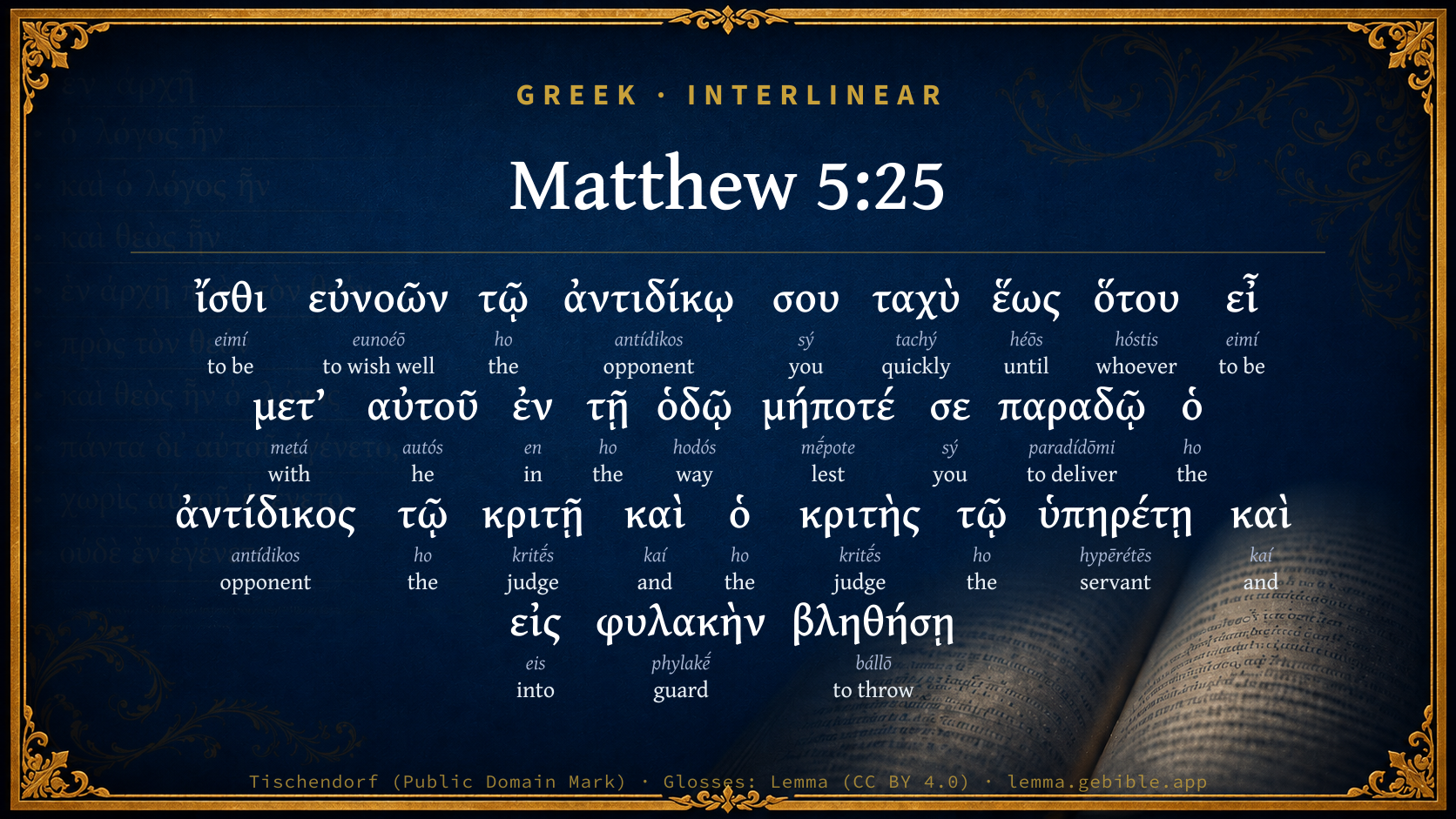
Greek (Tischendorf 8th ed.) Matthew 5:25 appears in the Greek New Testament. The text above is from the Tischendorf 8th edition. Each word links to its Strong’s number and a concise gloss. Click any word for its full Thayer’s Greek Lexicon entry.
Download image
Cite this verse

Matthew 5:25 (World English Bible). Public Domain. Lemma interlinear Bible study tool, https://lemma.gebible.app/v/matthew/5/25.

Show BibTeX & RIS
BibTeX
RIS
English Translation
Agree with your adversary quickly, while you are with him in the way; lest perhaps the prosecutor deliver you to the judge, and the judge deliver you to the officer, and you be cast into prison.
World English Bible · Public Domain
Highlights
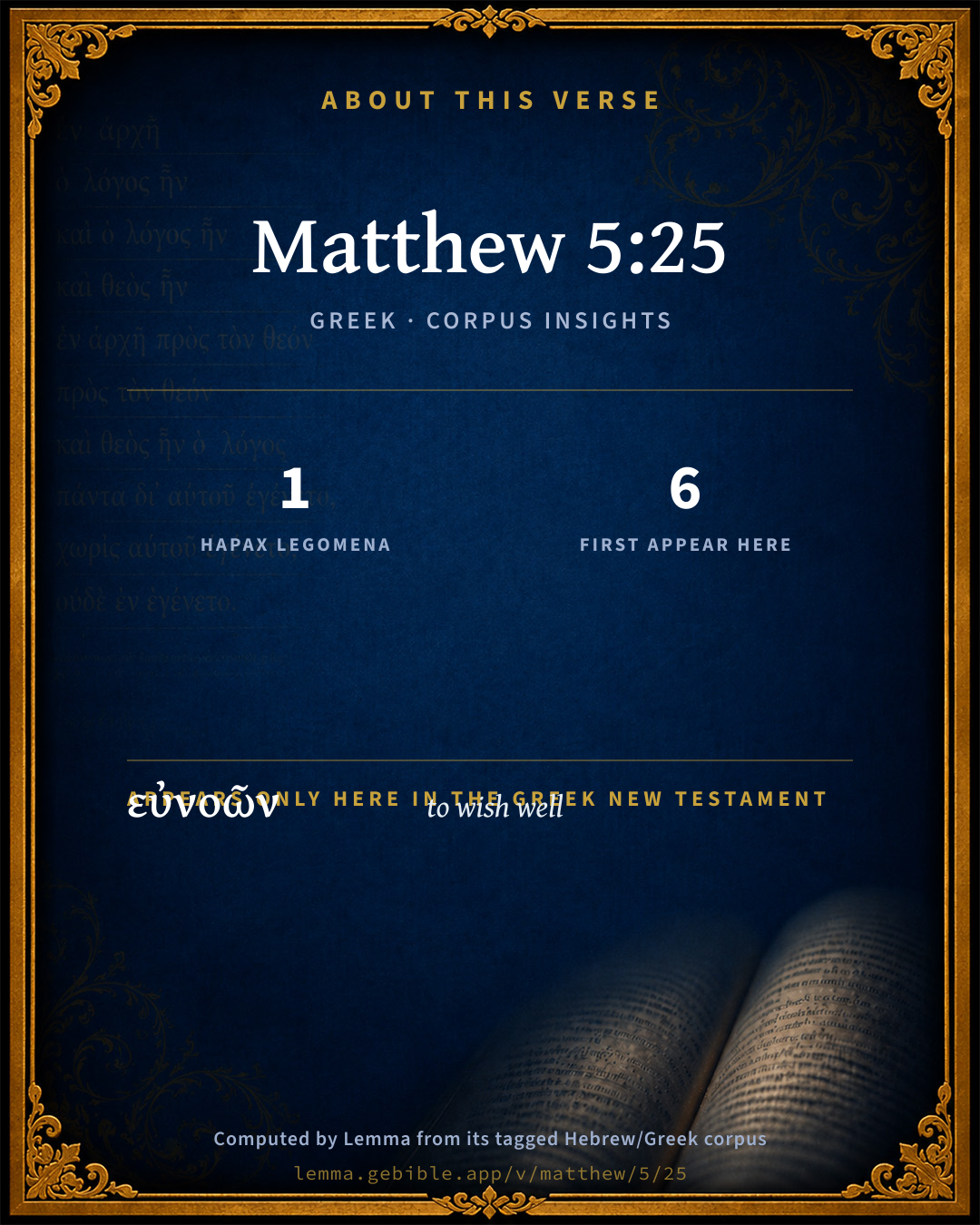
  • 1 hapax legomenon — only here in the Greek New Testament
  • 6 first appearances in the Greek New Testament
Full analysis ↓
Download a study sheet

One document with this verse’s original text, its word-by-word gloss line, the meaning frame, cross-references with their text, attributed commentary, and full source and license credits — printable, and it pastes into notes with its structure intact.

This verse Autodidact and up

Study sheet (.html) Plain text (.txt)

A passage Seminary Student

Up to 50 verses in one chapter. A passage sheet keeps up to 6 commentary sources and 12 cross-references per verse, in the order this page ranks them, and says so on the sheet whenever that leaves anything out. Ask for a single verse and you get the Autodidact verse sheet above.

Everything on this page stays free to read, with no account — the sheet is a download of what is already on screen, not access to it.

Want to remove ads? Support Godless Engineer
Compare translations 3

The same verse in 3 English versions, stacked beneath the original-language interlinear above. Click any original word for its lexicon entry.

Each is an independent rendering of the whole verse — the interlinear is not word-aligned to these translations.

Highlighted words mark where these versions differ — a whole-verse word diff, not a word-by-word alignment.

  • World English Bible Public Domain
    Agree with your adversary quickly, while you are with him in the way; lest perhaps the prosecutor deliver you to the judge, and the judge deliver you to the officer, and you be cast into prison.
  • King James Version Public Domain
    Agree with thine adversary quickly, whiles thou art in the way with him; lest at any time the adversary deliver thee to the judge, and the judge deliver thee to the officer, and thou be cast into prison.
  • unfoldingWord Literal Text CC BY-SA 4.0
    Be in agreement with your accuser quickly while you are with him on the way, lest your accuser might hand you over to the judge, and the judge to the officer, and you will be thrown into prison.

unfoldingWord Literal Text — © unfoldingWord, licensed CC BY-SA 4.0. Word-aligned USFM3 via Door43 (git.door43.org/unfoldingWord/en_ult).

Versions to compare (up to 4)

3 of 4 selected

Show all 19 translations

Every available English version of this verse, each an independent rendering of the whole verse.

  • World English Bible Public Domain
    Agree with your adversary quickly, while you are with him in the way; lest perhaps the prosecutor deliver you to the judge, and the judge deliver you to the officer, and you be cast into prison.
  • Berean Standard Bible Public Domain
    Reconcile quickly with your adversary, while you are still on the way to court. Otherwise, he may hand you over to the judge, and the judge may hand you over to the officer, and you may be thrown into prison.
  • Majority Standard Bible Public Domain
    Reconcile quickly with your adversary, while you are still on the way to court. Otherwise, he may hand you over to the judge, and the judge may hand you over to the officer, and you may be thrown into prison.
  • King James Version Public Domain
    Agree with thine adversary quickly, whiles thou art in the way with him; lest at any time the adversary deliver thee to the judge, and the judge deliver thee to the officer, and thou be cast into prison.
  • American Standard Version (1901) Public Domain
    Agree with thine adversary quickly, while thou art with him in the way; lest haply the adversary deliver thee to the judge, and the judge deliver thee to the officer, and thou be cast into prison.
  • Revised Version (1885) Public Domain
    Agree with thine adversary quickly, whiles thou art with him in the way; lest haply the adversary deliver thee to the judge, and the judge deliver thee to the officer, and thou be cast into prison.
  • Geneva Bible (1599) Public Domain
    Agree with thine aduersarie quickly, whiles thou art in the way with him, lest thine aduersarie deliuer thee to the Iudge, and the Iudge deliuer thee to ye sergeant, and thou be cast into prison.
  • Douay-Rheims (1899) Public Domain
    Be at agreement with thy adversary betimes, whilst thou art in the way with him: lest perhaps the adversary deliver thee to the judge, and the judge deliver thee to the officer, and thou be cast into prison.
  • Young's Literal Translation Public Domain
    `Be agreeing with thy opponent quickly, while thou art in the way with him, that the opponent may not deliver thee to the judge, and the judge may deliver thee to the officer, and to prison thou mayest be cast,
  • Literal Standard Version CC BY-SA 4.0
    Be agreeing with your opponent quickly, while you are in the way with him, that the opponent may not deliver you to the judge, and the judge may deliver you to the officer, and you may be cast into prison;
  • Unlocked Literal Bible CC BY-SA 4.0
    Agree with your accuser quickly while you are with him on the way to court, or your accuser may hand you over to the judge, and the judge may hand you over to the officer, and you may be thrown into prison.
  • unfoldingWord Literal Text CC BY-SA 4.0
    Be in agreement with your accuser quickly while you are with him on the way, lest your accuser might hand you over to the judge, and the judge to the officer, and you will be thrown into prison.
  • Darby Bible Public Domain
    Make friends with thine adverse party quickly, whilst thou art in the way with him; lest some time the adverse party deliver thee to the judge, and the judge deliver thee to the officer, and thou be cast into prison.
  • World Messianic Bible Public Domain
    Agree with your adversary quickly while you are with him on the way; lest perhaps the prosecutor deliver you to the judge, and the judge deliver you to the officer, and you be cast into prison.
  • Webster's Bible Public Domain
    Agree with thy adversary quickly, while thou art in the way with him; lest at any time the adversary deliver thee to the judge, and the judge deliver thee to the officer, and thou be cast into prison.
  • Free Bible Version CC BY-SA 4.0
    While you're on the way to court with your opponent, make sure you settle things quickly. Otherwise your opponent might hand you over to the judge, and the judge will hand you over to the court official, and you will be thrown into jail.
  • Bible in Basic English Public Domain
    Come to an agreement quickly with him who has a cause against you at law, while you are with him on the way, for fear that he may give you up to the judge and the judge may give you to the police and you may be put into prison.
  • Text-Critical English NT CC BY 4.0
    Make friends with yoʋr adversary quickly while yoʋ are on the way with him, lest yoʋr adversary hand yoʋ over to the judge, and the judge hand yoʋ over to the guard, and yoʋ be thrown into prison.
  • Tyndale New Testament (1534) Public Domain
    Agre with thyne adversary quicklye, whyles thou arte in the waye with hym lest that adversary deliver ye to the iudge and the iudge, delivre ye to the minister, and the thou be cast into preson.

Literal Standard Version (2020), Covenant Press — licensed CC BY-SA 4.0. Text via the HelloAO Bible API (eBible.org). Unlocked Literal Bible (unfoldingWord) — licensed CC BY-SA 4.0. Text via the HelloAO Bible API (eBible.org). unfoldingWord Literal Text — © unfoldingWord, licensed CC BY-SA 4.0. Word-aligned USFM3 via Door43 (git.door43.org/unfoldingWord/en_ult). Free Bible Version, Dr. Jonathan Gallagher — licensed CC BY-SA 4.0. Text via the HelloAO Bible API (eBible.org).

Word by word

More ways to search: Search by grammar → Find every occurrence → Compare this word →

Practice this passage: Drill this verse → Learn its vocabulary →

εὐνοῶν
eunoéō
G2132
“to wish well”
Verb, Present, Active, Participle, Nominative, Singular, Masculine
Part of Speech
Verb
Tense
Present
Voice
Active
Mood
Participle
Case
Nominative
Number
Singular
Gender
Masculine
Full Thayer's Definition

Origin: from a compound of G2095 and G3563

TDNT: 20:11,6

1. to wish (one) well 2. to be well disposed, of a peaceable spirit
  1. ἴσθι eimí G1510 “to be” Verb, Present, Active, Imperative, 2nd person, Singular
  2. τῷ ho G3588 “the” Article, Dative, Singular, Masculine
  3. ἀντιδίκῳ antídikos G476 “opponent” Noun, Dative, Singular, Masculine
  4. σου sý G4771 “you” Personal pronoun, 2nd person, Genitive, Singular
  5. ταχὺ tachý G5035 “quickly” Adverb
  6. ἕως héōs G2193 “until” Adverb
  7. ὅτου hóstis G3748 “whoever” Relative pronoun, Genitive, Singular, Neuter, Attic form
  8. εἶ eimí G1510 “to be” Verb, Present, Active, Indicative, 2nd person, Singular
  9. μετ’ metá G3326 “with” Preposition
  10. αὐτοῦ autós G846 “he” Personal pronoun, Genitive, Singular, Masculine
  11. ἐν en G1722 “in” Preposition
  12. τῇ ho G3588 “the” Article, Dative, Singular, Feminine
  13. ὁδῷ hodós G3598 “way” Noun, Dative, Singular, Feminine
  14. μήποτέ mḗpote G3379 “lest” Adverb, Negative
  15. σε sý G4771 “you” Personal pronoun, 2nd person, Accusative, Singular
  16. παραδῷ paradídōmi G3860 “to deliver” Verb, Aorist, Active, Subjunctive, 3rd person, Singular
  17. ὁ ho G3588 “the” Article, Nominative, Singular, Masculine
  18. ἀντίδικος antídikos G476 “opponent” Noun, Nominative, Singular, Masculine
  19. τῷ ho G3588 “the” Article, Dative, Singular, Masculine
  20. κριτῇ kritḗs G2923 “judge” Noun, Dative, Singular, Masculine
  21. καὶ kaí G2532 “and” Conjunction
  22. ὁ ho G3588 “the” Article, Nominative, Singular, Masculine
  23. κριτὴς kritḗs G2923 “judge” Noun, Nominative, Singular, Masculine
  24. τῷ ho G3588 “the” Article, Dative, Singular, Masculine
  25. ὑπηρέτῃ hypērétēs G5257 “servant” Noun, Dative, Singular, Masculine
  26. καὶ kaí G2532 “and” Conjunction
  27. εἰς eis G1519 “into” Preposition
  28. φυλακὴν phylakḗ G5438 “guard” Noun, Accusative, Singular, Feminine
  29. βληθήσῃ bállō G906 “to throw” Verb, Future, Passive, Indicative, 2nd person, Singular

About this verse

These counts appear in no published source. They are computed here, from the morphology-tagged text and Lemma’s own curated glosses. What Lemma adds →

30
words
20
distinct lemmas
Gospels
section

Notable vocabulary

1 hapax legomenon — a word that appears only here in the entire Greek New Testament:

  • εὐνοῶν to wish well G2132

First appearance in Scripture

These words make their first canonical appearance in the Greek New Testament here:

  • εὐνοῶν to wish well G2132
  • ἀντιδίκῳ opponent G476
  • ταχὺ quickly G5035
  • κριτῇ judge G2923
  • ὑπηρέτῃ servant G5257
  • φυλακὴν guard G5438

Shared distinctive vocabulary

ἀντιδίκῳ opponent G476 occurs in 4 verses of the Greek New Testament. Also found in:
Repetition

Words recur within this verse:

  • ἴσθι to be G1510 ×2
  • ἀντιδίκῳ opponent G476 ×2
  • κριτῇ judge G2923 ×2
  • τῷ the G3588 ×6
  • σου you G4771 ×2
  • καὶ and G2532 ×2

Cross-references

17

Topical passages linked to Matthew 5:25 in the Treasury of Scripture Knowledge — connected by theme and wording, ordered by reader-vote popularity; previews shown in the World English Bible.

  • Luke 12:58–59 For when you are going with your adversary before the magistrate, try diligently on the way to be released from him, lest perhaps he drag you to the judge, and the judge deliver you to the officer, and the officer throw you into prison.
  • Proverbs 25:8 Don't be hasty in bringing charges to court. What will you do in the end when your neighbor shames you?
  • Hebrews 3:13 but exhort one another day by day, so long as it is called "today;" lest any one of you be hardened by the deceitfulness of sin.
  • Isaiah 55:6–7 Seek you Yahweh while he may be found; call you on him while he is near:
  • Luke 14:31–32 Or what king, as he goes to encounter another king in war, will not sit down first and consider whether he is able with ten thousand to meet him who comes against him with twenty thousand?
  • Hebrews 3:7 Therefore, even as the Holy Spirit says, "Today if you will hear his voice,
  • Luke 13:24–25 "Strive to enter in by the narrow door, for many, I tell you, will seek to enter in, and will not be able.
  • 1 Kings 22:26–27 The king of Israel said, Take Micaiah, and carry him back to Amon the governor of the city, and to Joash the king's son;
  • Job 22:21 "Acquaint yourself with him, now, and be at peace. Thereby good shall come to you.
  • Proverbs 6:1–5 My son, if you have become collateral for your neighbor, If you have struck your hands in pledge for a stranger;
  • Hebrews 12:17 For you know that even when he afterward desired to inherit the blessing, he was rejected, for he found no place for a change of mind though he sought it diligently with tears.
  • Genesis 32:3–8 Jacob sent messengers in front of him to Esau, his brother, to the land of Seir, the field of Edom.
  • Genesis 33:3–11 He himself passed over in front of them, and bowed himself to the ground seven times, until he came near to his brother.
  • Psalms 32:6 For this, let everyone who is godly pray to you in a time when you may be found. Surely when the great waters overflow, they shall not reach to him.
  • 2 Corinthians 6:2 for he says, "At an acceptable time I listened to you, In a day of salvation I helped you." Behold, now is the acceptable time. Behold, now is the day of salvation.
  • Genesis 32:13–22 He lodged there that night, and took from that which he had with him, a present for Esau, his brother:
  • 1 Samuel 25:17–35 Now therefore know and consider what you will do; for evil is determined against our master, and against all his house: for he is such a worthless fellow that one can't speak to him.

Cross-references courtesy of OpenBible.info (CC BY 4.0).

Where the printed editions differ

1 variant

Places in this verse where the major printed Greek editions disagree on the wording in a way that affects the translation — a comparison of editions, not a manuscript-by-manuscript collation. The editions are the modern critical texts (Nestlé-Aland 28/27, SBL, Westcott-Hort, Tregelles, Tyndale House) and the traditional texts behind the KJV (the Textus Receptus and the Byzantine/Majority text). It is not a claim about which reading is original.

  1. Extra text
    σε παραδῷ

    “you he may betray”

    In TregTRByz Not in NA28NA27TynSBLWH

    σε παραδῷ (se paradō) 'you he may betray' is only in traditional manuscripts (Treg+TR+Byz)

Textual data: Translators Amalgamated Greek New Testament (STEPBible TAGNT) · CC BY 4.0.

Commentary

Notes on Matthew 5:25 from classic Christian and Jewish commentators (each source and its license shown beneath its notes). The classic Christian expositions comment on the surrounding passage and are grouped to its opening verse, so a note may address several verses; the Jewish commentaries on the Tanakh (Rashi and others) are per-verse, so they appear only where the commentator wrote on this verse.

Lemma curates 59 commentaries, every one of them public domain or Creative Commons licensed, each selected and text-cleaned for this edition rather than reprinted as found. About our sources →

The Biblical Illustrator

Joseph S. Exell

Mat_5:25

Agree with thine adversary.

Reconciliation with God

1. Man by his sin has made God his adversary.

2. God has opened a way by which sinners, though they have thus grossly offended, may be brought back into a state of reconciliation with Him.

3. To show you that it is mans duty and interest to avail himself of the opportunity of coming into agreement with God.

I. Who are the persons that may rightly apply to themselves the motives by which i shall urge the business of agreement with God. God is the adversary of any child of Adam who has not availed himself of pardon, the man of private virtue as well as his profligate neighbour.

II. Motives by which this business is urged won you.

1. Consider what it is I am endeavouring to enforce upon your attention. No trifle, agreement with God.

2. What would be the blessings that would result if you were thus reconciled to God.

3. What will be the consequences if you are not reconciled?

4. Let me remind you of the interest others take in your reconciliation with God.

III. Begin that reconciliation immediately Whiles thou art in the way.

1. God is now waiting to come to agreement with you.

2. What reason have you to advance why you should not.

3. Consider the uncertainty of life.

4. All the opportunities of agreement are confined to this present life.

5. The results that in another world will follow a want of reconciliation with God in this, are indescribably dreadful.

6. The punishment will be inevitable and eternal. (J. A. James, D. D.)

Agree with thine adversary quickly

1. The Lord warns us to make our Christian peace in time.

2. To take care that our sacramental offering of charity and forgiveness be not delayed.

3. Lest our adversary be no more in the way with us; lest, among the many partings of this world, we lose sight of him for ever.

4. And that on the ground of Gods awful judgment.

5. For to Him the unreconciled quarrels of this world must be referred.

6. He will exact the uttermost farthing of His own incalculable debt from those who have been unkind and unforgiving to their fellow-servants. (G. Moberley, D. C. L.)

The Biblical Illustrator, edited by Joseph S. Exell (c. 1880s–1900s) — public domain. Text from a community e-Sword module.

Joseph Benson's Commentary

Mat 5:25. Agree, &c. — Here our Lord enforces the preceding exhortation, from the consideration of what is reckoned prudent in ordinary quarrel and law-suits. “In such cases, wise men always advise the party that has done wrong to make up matters with his adversary while it is in his power, lest the sentence of a judge, being interposed, fall heavy on him. For the same reason, we, who have offended our brother, ought to make it up with him, while an opportunity of repentance is allowed us; and that though our quarrel should have proceeded to the greatest lengths, lest the sentence of the Supreme Judge overtake us, and put reconciliation out of our power for ever.” With thine adversary quickly — With any against whom thou hast thus offended; whiles thou art in the way with him — Going with him to a magistrate; or, instantly, on the spot; before you part. Lest the adversary deliver thee to the judge — To be tried before him; and the judge, deciding the cause against thee, deliver thee to the officer of the court, to keep thee in custody till satisfaction be made, and thou be cast into prison — Not being able to discharge an account enhanced with so many additional articles of expense. Thou shalt by no means come out thence — Be released out of prison; till thou hast paid the uttermost farthing — For thy antagonist, when he has got thee at such an advantage, will be more rigorous in his demands than before. And surely, if by impenitent wickedness thou makest thyself the prisoner of the divine justice, thy case will be yet more deplorable and hopeless. Understanding the words in a figurative sense, which is, partly at least, intended by Christ here, the prison is taken for hell, out of which the unrelenting sinner can never come, according to our Lord’s declaration, because he can never be able to make that satisfaction. “Lord, we are all the debtors, and, in one sense, the prisoners of thy justice, and of ourselves were most incapable, not only of paying the uttermost farthing, but even of discharging the least part of the debt! We bless thee for that generous Surety who has taken and discharged it for us; and by the price of whose atoning blood we are delivered from the chains of darkness, and are translated into the glorious liberty of thy children.” — Doddridge. What has hitherto been said refers to meekness; what follows, to purity of heart.

Joseph Benson's Commentary on the Old and New Testaments (1811–1818) — public domain. Text from a community e-Sword module.

Bengel's Gnomon

Johann Albrecht Bengel

Mat 5:25. Ἴσθι εὐνοῶν, be friendly) Seek kindly feeling by showing it yourself.—τῷ ἀντιδίκῳ, with the adversary) to whom you owe money.—Cf. Mat 5:26. The language is parabolical, it applies principally to an adversary who entertains grave animosity even beyond death.—ταχὺ, quickly) The pride of the human heart is slow in deprecation and satisfaction.—ἐν τῇ ὁδῷ, in the way) sc. to the tribunal.—μετʼ αὐτοῦ, with him) The plaintiff used himself to apprehend the defendant.—σε παραδῷ, deliver thee) Great is the power of the adversary. God, as Judge, prosecutes the demand of him who pleads for justice.—φυλακὴν, ward) where thou thy whole self wilt be the pledge of payment for the debt.

Bengel's Gnomon of the New Testament — English translation (T&T Clark, Edinburgh, 1860) — public domain. Text from a community e-Sword module.

Meyer's Critical & Exegetical Commentary

Heinrich August Wilhelm Meyer

Mat_5:25 f. The precept, to be reconciled with the injured person in order not to be cast into hell by God the judge, is made clear by the prudential doctrine of satisfying a creditor in order not to become liable to imprisonment. To abide merely by the prudential doctrine itself which the words convey (Theophylact, Vatablus, and others, including Paulus), is opposed to the context (Mat_5:21-24); to take the φυλακή, however, as the representation of purgatory (many Catholics, not Schegg), or of Sheol (not Gehenna) (Olshausen), is forbidden by the idea of the judgment which also excludes the vague and indefinite transference of that which is destructive for the external life to that which is destructive in a higher sense (de Wette). Luk_12:58 has the precept in quite a different connection; but this does not justify us in not regarding it in the present passage as belonging to it (Pott, Kuinoel, Neander, Bleek, Holtzmann, Weiss, and others), since it may be given here and there as a popular symbolical proverb; while precisely here it is most clearly and simply appropriate to the connection.

εὐνοῶν] be well disposedthat is, inclined to satisfy him by making payment or composition.

τῷ ἀντιδίκῳ σου] The opponent (in a lawsuit) is to be conceived of as a creditor (Mat_5:26). The injured brother is intended; comp. Mat_5:23. Explanations of the Fathers referring it to the devil (Clement of Alexandria), to God (Augustine), to the conscience (Euth. Zigabenus), see in Tholuck.

ταχύ] without delay, without putting off, Mat_28:7 f.; Joh_11:29; Rev_2:16. Tarda est superbia cordis ad deprecandum et satisfaciendum, Bengel.

ἕως ὅτου] If by ταχύ it was intimated that the compliance should begin without delay, so it is now stated that it shall remain till the extreme termination: even until thou art with him on the road to the judgeeven then still shalt thou yield compliance. Not of itself (in answer to Tittmann, Synon. p. 167), but, in virtue of the context, is ἕως the inclusive until, as according to the context it may also be exclusive (comp. on the passage, Mat_1:25).

The servant of justice (ὑπηρέτης) belongs to the representative of the legal act; and who is meant thereby, is evident from Mat_13:41 f.

βληθήσῃ] The future, which might be dependent on μήποτε (Winer, p. 468 f. [E. T. 629]; Buttmann, neut. Gr. p. 201 [E. T. 233]; see on the passage, Col_2:8), taken independently, gives the appropriate emphasis to the tragic closing act.

In Mat_5:26 is by no means contained the finality of the condition of punishment, but its non-finality; since the ἀποδιδόναι, that is, the removal of the guilt of sin, is for him who is in this φυλακή an impossibility, Mat_18:34, Mat_25:41; Mat_25:46, etc. ἕως states, then, a terminus which is never reached. Comp. Mat_18:34.

The quadrans is ¼ As in copper, or 2 λεπτά, ¾ of a farthing (Mar_12:42); see an the Roman coins in circulation amongst the Jews, Cavedoni, bibl. Numismat. I. p. 78 ff.

Meyer — Critical and Exegetical Commentary on the New Testament — English translation by Peter Christie, edited by Frederick Crombie (T&T Clark, 1880) — public domain. Text from a community e-Sword module.

Expositor's Greek Testament

ed. W. Robertson Nicoll

Mat 5:25-26 . There is much more reason for regarding this passage as an interpolation. It is connected only externally (by the references to courts of law) with what goes before, and it is out of keeping with the general drift of the teaching on the hill. It occurs in a different connection in Luk 12:58 , there as a solemn warning to the Jewish people, on its way to judgment, to repent. Meyer pleads that the logion might be repeated. It might, but only on suitable occasions, and the teaching on the hill does not seem to offer such an occasion. Kuinoel, Bleek, Holtzmann, Weiss and others regard the words as foreign to the connection. Referring to the exposition in Luke, I offer here only a few verbal notes mainly on points in which Matthew differs from Luke. ἴσθι εὐνοῶν , be in a conciliatory mood, ready to come to terms with your opponent in a legal process ( ἀντίδικος ). It is a case of debt, and the two, creditor and debtor, are on the way to the court where they must appear together (Deu 21:18 ; Deu 25:1 ). Matthew’s expression implies willingness to come to terms amicably on the creditor’s part, and the debtor is exhorted to meet him half way. Luke’s δὸς ἐργασίαν throws the willingness on the other side, or at least implies that the debtor will need to make an effort to bring the creditor to terms. παραδῷ , a much milder word than Luke’s κατασύρῃ , which points to rough, rude handling, dragging an unwilling debtor along whither he would rather not go. ὑπηρέτῃ , the officer of the court whose business it was to collect the debt and generally to carry out the decision of the judge; in Luke πράκτωρ . κοδράντην = quadrans , less than a farthing. Luke has λεπτὸν , half the value of a κοδ ., thereby strengthening the statement that the imprisoned debtor will not escape till he has paid all he owes.

The Expositor's Greek Testament, edited by W. Robertson Nicoll (1897–1910) — public domain. Text from a community e-Sword module.

Geneva Bible (1599)

Geneva Bible translators

Cut off all cause for enmity.

Geneva Bible (1599) marginal notes — public domain. Text via Bolls.life.

Jamieson, Fausset & Brown

Robert Jamieson, A. R. Fausset & David Brown

Agree with thine adversary--thine opponent in a matter cognizable by law.

quickly, whiles thou art in the way with him--"to the magistrate," as in Luk 12:58.

lest at any time--here, rather, "lest at all," or simply "lest."

the adversary deliver thee to the judge, and the judge--having pronounced thee in the wrong.

deliver thee to the officer--the official whose business it is to see the sentence carried into effect.

Jamieson, Fausset & Brown — Commentary Critical and Explanatory on the Whole Bible (1871) — public domain (CC PDM 1.0). Text via the HelloAO Bible API.

Adam Clarke's Commentary

Verse 25. Agree with thine adversary quickly] Adversary, αντιδικος, properly a plaintiff in law - a perfect law term. Our Lord enforces the exhortation given in the preceding verses, from the consideration of what was deemed prudent in ordinary law-suits. In such cases, men should make up matters with the utmost speed, as running through the whole course of a law-suit must not only be vexatious, but be attended with great expense; and in the end, though the loser may be ruined, yet the gainer has nothing. A good use of this very prudential advice of our Lord is this: Thou art a sinner; God hath a controversy with thee. There is but a step between thee and death. Now is the accepted time. Thou art invited to return to God by Christ Jesus. Come immediately at his call, and he will save thy soul. Delay not! Eternity is at hand; and if thou die in thy sins, where God is thou shalt never come.

Those who make the adversary, God; the judge, Christ; the officer, Death; and the prison, Hell, abuse the passage, and highly dishonour God.

Adam Clarke's Commentary on the Bible (1810–1826) — public domain. Text from a community e-Sword/MySword module.

Ellicott's Commentary for English Readers

(25) Agree with thine adversary.—The imagery is changed, and returns to that of human tribunals, which has met us in Mat_5:22. The man whom we have wronged appears as the “adversary,” the prosecutor bringing his charge against us. The impulse of the natural man at such a time, even if conscious of wrong, is to make the best of his case, to prevaricate, to recriminate. The truer wisdom, Christ teaches, is to “agree”—better, to be on good terms with—show our own good will, and so win his. The whole teaching, it is obvious, is addressed to one who has done wrong. The treatment of a false charge involves different considerations.

The officer.—In this case, the officer of the court, the gaoler.

In the application of the words, the judge is clearly God, and the officers, those (angels or others) who execute His judgment, and the “adversary,” those whom we have wronged, leaving the wrong unredressed. In 1Pe_5:8 the devil is described as the great “adversary,” and that meaning is, perhaps, not excluded, though it is not prominent, here. Any evil deed becomes in the end as an accusing Satan, bearing its witness against us; and Satan himself is the embodiment of all such accusers.

A Bible Commentary for English Readers, edited by Charles John Ellicott (1878–1897) — public domain. Text from a community e-Sword module.

The Cambridge Bible for Schools and Colleges

gen. ed. J. J. S. Perowne

25. Agree] Lit. be friendly with. The participle in the orig. conveys the idea of continuance. The thought of the preceding verse is extended and generalised. By the “adversary” are meant those against whom we harbour that resentment which keeps us from the kingdom of God. “While there is time in this life put away the resentment. Show thyself to be a son of God by being a peacemaker.” Mat_5:9.

The imagery is taken from the law-courts. It would be well for a man to compound with his creditor before the case should be brought before the judge.

The Cambridge Bible for Schools and Colleges (gen. ed. J. J. S. Perowne; Cambridge University Press, 1878–1918) — public domain. Text from a community e-Sword module.

John Gill's Exposition

Agree with thine adversary quickly,.... These words are not to be understood in an allegorical sense, as if "the adversary" was the justice of God, demanding payment of debts; "the way", this present life; "the judge", God himself; "the officer", the devil; "the prison", the pit of hell; and "the uttermost farthing", the least sin, which will never be remitted without satisfaction: but the design of them is to prevent lawsuits about debts, which may be in dispute; it being much better for debtor and creditor, especially the former, to compose such differences among themselves, than to litigate the matter in a court of judicature. By "the adversary" is meant not an enemy, one that bears hatred and ill will, but a brother that has ought against a man; a creditor, who demands and insists upon payment of what is owing to him; and for this purpose has taken methods towards bringing the debtor before a proper magistrate, in order to oblige him to payment: wherefore it is better for him to make up and agree the matter directly, as soon as possible,

whilst thou art in the way with him; that is, whilst the creditor and debtor are going together to some inferior magistrate, or lesser court, as the sanhedrim, which consisted of three persons only, before whom such causes might be tried: for , pecuniary causes, or causes relating to money matters, were tried "by the bench of three" (g): and the selfsame advice is given in the Talmud (h), as here, where it seems to be a common proverb; for it is said,

"there are men that say, or men usually say, , "whilst thou art in the way with thine adversary, be obedient".''

Lest at any time the adversary should deliver thee to the judge, a superior magistrate in a higher court; for if the creditor would, he could oblige the debtor to go with him to the supreme court of judicature, and try the cause there; for so say the Jewish (i); canons:

"if the creditor says we will go to the great sanhedrim, they compel the debtor, and he goes up with them, as it is said, "the borrower is servant to the lender",''

where it might go harder with the poor debtor; and therefore it was advisable to prevent it by an agreement, lest

the judge deliver thee to the officer, and thou be cast into prison,

"It was an affirmative command in the law, says Maimonides, to appoint "judges" and "officers" in every country and province, as it is said, Deu 16:18. "judges" they are the judges that are fixed in the sanhedrim, and such that engage in law suits come before them: "officers"; these are the masters of the rod and scourge, i.e. who beat and scourge delinquents; and these stand before the judges--and all they do, is by the order of the judges.''

Now it is one of these that is meant by "the officer"; in Munster's Hebrew Gospel, he is called who, when he had authority from the judge, could cast into prison, and that for debt; of which we have no account in the law of Moses.

(g) Misn. Sanhedrim, c. 1. sect. 1. (h) T. Bab. Sanhedrim, fol. 95. 2. (i) Maimof. Hilch. Sanhedrim, c. 6. sect. 7.

John Gill's Exposition of the Whole Bible (1746–1763) — public domain (CC PDM 1.0). Text via the HelloAO Bible API.

Trapp's Complete Commentary

John Trapp

25 Agree with thine adversary quickly, whiles thou art in the way with him; lest at any time the adversary deliver thee to the judge, and the judge deliver thee to the officer, and thou be cast into prison.

Ver. 25. Agree with thine adversary quickly] Habent aulae suum Cito, cito. God’s work also must be done with expedition; opportunities are headlong, delays dangerous. Let not therefore the sun go down upon your wrath, lest it grow inveterate, as it proves in many, who not only let the sun go down once or twice, but run his whole race, ere they can find hearts and means to be reconciled. {a} "Cursed be their wrath, for it is deadly. O my soul, come not thou into their secret," Gen 49:6-7. It were much to he wished, that, as Livy hath it, Amicitiae immortales, inimicitiae mortales essent, enmities were mortal among us, amities immortal.

Lest thine adversary deliver thee to the judge] By his groans and moans to God, who is gracious (though thou art stiff), and will pay thee for thy pertinacy, Exo 22:26; (and him for his patience), with extremity of law. Compound, therefore, and take up the suit before it come to execution and judgment. Suffer it not, as ill husbands do, to run on, and charges to grow from term to term, lest we pay not only the main debt, but the arrears too, the time of God’s patience, &c.

Thou be cast into prison] Into hell, worse than any prison. Of Roger, Bishop of Salisbury, the second man from King Stephen, it is reported, that he was so tortured in prison with hunger and other calamities accompanying such men, ut vivere noluerit, mori nescieret, live he would not, die he could not. This and much worse is the case of those that are cast into hell; they seek death, but find it not; they desire it, but it fleeth from them, Rev 9:6.

{a} Si quid benefeceris, levius pluma est: at si offenderis, plumbeas iras gerunt. Plaut.

John Trapp, A Commentary or Exposition upon All the Books of the Old and New Testament (1647–1656) — public domain. Text from a community e-Sword module.

Albert Barnes' Notes on the Bible

Agree with thine adversary quickly - This is still an illustration of the sixth commandment. To be in hostility, to go to law, to be litigious, is a violation always, on one side or the other, of the law requiring us to love our neighbor, and our Saviour regards it as a violation of the sixth commandment. While you are in the way with him, says he, that is, while you are going to the court, before the trial has taken place, it is your duty, if possible, to come to an agreement. It is wrong to carry the contention to a court of law. See 1Co 6:6-7. The consequence of not being reconciled, he expresses in the language of courts. The adversary shall deliver to the judge, and he to the executioner, and he shall throw you into prison. He did not mean to say that this would be literally the way with God, but that His dealings with those that harbored these feelings, and would not be reconciled with their brethren, were represented by the punishment inflicted by human tribunals. That is, he would hold all such as violators of the sixth commandment, and would punish them accordingly.

There is no propriety in the use sometimes made of this verse, in representing God as the “adversary” of the sinner, and urging him to be reconciled to God while in the way to judgment. Nor does the phrase “thou shalt by no means come out thence until thou hast paid the uttermost farthing” refer to the eternity of future punishment. It is language taken from courts of justice, to illustrate the truth that God will punish people according to justice for not being reconciled to him. The punishment in the future world will be eternal indeed Mat 25:46, but this passage does not prove it.

Thine adversary - A man that is opposed to us in law. It here means a creditor; a man who has a just claim on us.

In the way with him - While you are going before the court. Before the trial comes on. It is remarkable that this very direction is found in the Roman law of the Twelve Tables, which expressly directed the plaintiff and defendant to make up the matter while they were in the way, or going to the praetor - in via, rem uti pacunt orato. - Blackstone’s Commentary, iii. p. 299. Whether the Saviour had any reference to this cannot be determined. As the Roman laws prevailed to some extent in Palestine, however, it is possible that there was such an allusion.

The officer - The executioner; or, as we should say, the sheriff.

The uttermost farthing - The last farthing. All that is due. The farthing was a small coin used in Judea, equal to two mites. It was not quite equal to half a farthing of British money.

Albert Barnes' Notes on the Bible (1834–1885) — public domain. Text from a community e-Sword/MySword module.

Haydock's Catholic Bible Commentary

Agree whilst you are in the way, or wayfaring men, i.e. in this life, lest you be cast into prison, i.e. according to Sts. Cyprian, Ambrose, and Origen, into purgatory; according to St. Augustine, into hell, in which, as the debt is to be paid to inflexible justice, it can never be acquitted, and of course no release can be hoped for from that prison. (Haydock)

George Leo Haydock (1774–1849), Haydock's Catholic Family Bible and Commentary, 1859 edition — public domain. Excludes Psalms (Douay-Rheims chapter numbering differs from Protestant) and Deuterocanonical books (Catholic canon only).

Matthew Poole's English Annotations

Forasmuch as the overt acts and expressions of unjust wrath and malice are iniquities punishable by the judge, let it be the care of those that will be my disciples, if by their passions they have provoked any, and made them their adversaries, quickly to agree with them; for you know the ordinary course of enraged adversaries amongst men, is to bring their actions, and to bring men before the civil judge; and when the judge upon inquiry hath found them guilty, he useth to deliver them to the gaoler to be carried to prison, until they have fully paid their fines for such offences. And forasmuch as not only the overt acts, but the passions which cause such acts, are culpable before God, and make men obnoxious to his righteous judgment, and God by them is made an adversary to the soul, as having violated his great command, Thou shalt do no murder; let all my disciples, who have been or may be overtaken with such faults, by repentance and faith in me make their peace with God in this life, lest dying in impenitency they be put under the eternal displeasure and wrath of God, from whence they shall never be delivered, Mat 6:15; 18:35.

Matthew Poole's English Annotations on the Holy Bible (1683–1685) — public domain. Text from a community e-Sword/MySword module.

Whedon's Commentary on the Bible

Daniel D. Whedon

25. Adversary — A plaintiff at law, to whom a debt or payment of penalty is due. While thou art in the way with him — An allusion to the Roman law, by which the plaintiff himself seized the defendant, and drew him before the court for trial. So in Luk_12:58, it is, “When thou goest with thine adversary to the magistrate, as thou art in the way.” Our Lord here counsels a compromise on the way. Officer — Who executes the penalty.

The whole is a symbolical representation of divine judgment, as is shown by the next verse, in which justice without mercy is inflexibly declared. The Adversary stands for our offended God. Quickly and the way stand for the brief period of our probation The Judge is the Son of man at his coming. The officer is the judicial angel. Mat_25:31. The prison is hell. Sentiment, repair every wrong before divine justice inflict punishment to the utmost.

Daniel D. Whedon (gen. ed.), Commentary on the Old and New Testaments (1874–1909) — public domain. Text from a community e-Sword module.

The Pulpit Commentary

Vers. 25, 26. Parallel passage: Luk_12:58, Luk_12:59. The question of the relation of the two passages, as regards both language and original connexion, is exceedingly difficult. As to the former, the verbal differences seem to be such as would hardly have been made on purpose, and to be rather due to memory; yet the agreement is too minute to be the result of memory of a Gospel only oral. Perhaps memory of a document best satisfies the conditions. As to the original connexion of the verses, they, especially ver. 26, can hardly have been spoken twice. Most critics suppose that St. Luke gives them in their proper context; but if so, it is curious that two of his words, upageiv aphllacyai , seem to recall our preceding ver. 24. One word might have been a mere coincidence, but hardly two. It is not likely that these words in ver. 24 were derived from Luke, for this supposes a double process in St. Matthew"s mind, rejecting them from ver. 25 and placing them in ver. 24. It is more natural also to regard the first clause of Luk_12:58, "As... him," as an expansion of the corresponding clause in our ver. 25 rather than this as a compression of that. This apparent reminiscence in Luke of what is given in our vers. 24 and 25a points to the connexion of vers. 24-26 in Matthew being original, and to it having been broken by Luke or by the framer of the source that he used.

A further stage in our Lord"s warning. A man must not only seek reconciliation with the injured person (ver. 23), and that in preference to fulfilling the holiest service (ver. 24), but he must do so the more because of the danger of postponing reconciliation. It is noteworthy that our Lord in this verse does not define on whose side the cause of the quarrel lies.

Agree with. And that not with a merely formal reconciliation, but reconciliation based on a permanent kindly feeling towards him (isyi eunown). Professor Margoliouth suggests that this is a confirmation of what he thinks is the original text of Ecc 18:20, "Before judgment beg off" ("Inaugural Lect.," p. 23: 1890). Thine adversary. Primarily the injured brother (vide infra), Quickly. For such is not the tendency of the human heart. Whiles. Delay not in making reconciliation while you have opportunity. Thayer compares Son_1:12. Thou art. On the indicative, cf. Winer, b, 3. 2, a, note (p. 371, trans. 1870). In the way with him; Revised Version, with the manuscripts, with him in the way. The right reading implies that the proximity of the persons may perhaps not last throughout "the way." "The way" is the road to the judge, as explained in Luke. But being on the road to him is here not presented as a possibility (Luke), but as a certainty. For so, in fact, it is. Lest... the adversary (ver. 26, note) deliver thee. Translating from the language of parable to that of fact, it is only if reconciliation has not been made, if the heart is still unforgiving and quarrelsome, that God the Judge will take notice of the offence. And the judge... to the officer (tw uphreth); i.e. the officer whose duty it was to execute the judge"s commands (cf. Lightfoot, "Hor. Hebr.," for illustrations). The expression here belongs to the figure; but in Mat_13:41 similar duties are predicated of the angels. If the figure was derived from the synagogue, the officer would doubtless be the chazzan, of which, indeed, uphrethv is the technical rendering (cf. Schurer, II 2. p. 66). And thou be cast (kai blhyhsh). The future indicative (still dependent on "lest") brings out the reality of the danger. (cf. Bishop Lightfoot, on Col_2:8)

The Pulpit Commentary (1880–1919), ed. H.D.M. Spence-Jones & Joseph S. Exell — public domain. Text from a community e-Sword module.

John Wesley's Explanatory Notes

Agree with thine adversary - With any against whom thou hast thus offended: while thou art in the way - Instantly, on the spot; before you part. Lest the adversary deliver thee to the judge - Lest he commit his cause to God. Luke xii, 58.

John Wesley, Explanatory Notes Upon the Whole Bible (1754–1765) — public domain. Text via the GEBible commentary corpus.

Kretzmann's Popular Commentary

Paul E. Kretzmann

The same truth in a different parable:

v. 25. Agree with thine adversary quickly, whiles thou. art in the way with him, lest at any time the adversary deliver thee to the judge, and the judge deliver thee to the officer, and thou be cast into prison.

v. 26. Verily, I say unto thee, Thou shall by no means come out thence till thou hast paid the uttermost farthing.

The picture is that of a debtor on the way to court with his creditor, Deu 21:18; Deu 25:1, who is his adversary, but probably might be found willing to come to terms outside of court. The advice is that the debtor be in a very conciliatory mood, ready and eager to straighten out the difficulty without litigation. In case a settlement would not be effected in this manner, the danger would be that the adversary, losing all patience, would deliver and even forcibly drag the debtor before the judge, secure a favorable decision, have this carried out by the officer of the court, and have the satisfaction of seeing him taken to prison. All hopes of obtaining mercy would then be shattered. For even the last quadrans , the fourth part of a Roman assarin, which was worth not quite two cents, would be demanded of him. Payment would be exacted to the last fraction of a penny. A very earnest admonition not to wait or hesitate about coming to terms with our adversary, with any one whom we owe reconciliation. The brief period of life is soon behind us, and the implacable that refused to agree will find in the Lord an equally implacable Judge.

Paul E. Kretzmann, Popular Commentary of the Bible (1921–1924) — public domain. Text from a community e-Sword module.

The People's New Testament

B. W. Johnson

25. Agree with thine adversary quickly. By adversary is meant an opponent in a lawsuit who is supposed to have a just claim, in this case a creditor. Officer. The same as our sheriff. Under all the old laws debt could be punished with imprisonment.

B. W. Johnson's The People's New Testament with Notes (1889–1891) — public domain. Electronic text from the Christian Classics Ethereal Library (CCEL) ThML edition.

unfoldingWord translationNotes

Door43 World Missions Community

Agree with your

Jesus is talking to a group of people about what they as individuals should or should not do. All occurrences of "you" and "your" are singular, but in some languages they may need to be plural. (See: Forms of You)

your accuser

This is a person who blames someone for doing something wrong. He takes the wrongdoer to court to accuse him before a judge.

may hand you over to the judge

Here "hand you over" means to give someone into the control of someone else. AT: "will let the judge deal with you" (See: Idiom)

the judge may hand you over to the officer

Here "hand you over" means to give someone into the control of someone else. AT: "the judge will give you over to the officer" (See: Idiom)

officer

a person who has authority to carry out the decisions of a judge

you may be thrown into prison

This can be stated in active form. AT: "the officer might put you in prison" (See: Active or Passive)

Truly I say to you

"I tell you the truth." This phrase adds emphasis to what Jesus says next.

from there

"from prison"

translationWords

accuse

hand

judge, judges

prison

amen

unfoldingWord translationNotes — © Distant Shores Media and the Door43 World Missions Community, licensed CC BY-SA 4.0. Source: git.door43.org/Door43/en_tn.

Cambridge Greek Testament for Schools and Colleges

25, 26. The illustration is drawn from a legal process. It would be wise for the debtor to arrange with the creditor while he is on the way to the Court; otherwise the judge’s sentence and a hopeless imprisonment await him.

Sin is the debt (here especially anger the source of murder), the sense of sin or the conscience is the adversary. Let the sinner come to terms with his conscience by confession of sin and prayer for forgiveness while he has opportunity, lest he be brought unrepentant and unforgiven to the tribunal of the judge.

ἴσθι εὐνοῶν. The participle conveys the idea of continuance: be at peace with conscience all through life.

Cambridge Greek Testament for Schools and Colleges (Cambridge University Press, 1896; 21 vols, various authors incl. Carr, Maclear, Plummer, Farrar, Lumby, Moule, M. R. James, Simcox) — public domain. Text from a community e-Sword module.

Alford’s Greek Testament

Henry Alford

25.] The whole of this verse is the earthly example of a spiritual duty which is understood, and runs parallel with it. The sense may be given: ‘As in worldly affairs, it is prudent to make up a matter with an adversary before judgment is passed, which may deliver a man to a hard and rigorous imprisonment, so reconciliation with an offended brother in this life is absolutely necessary before his wrong cry against us to the Great Judge, and we be cast into eternal condemnation.’

The ἀντίδικος, in its abstract personification, is the offended law of God, which will cry against us in that day for all wrongs done to others; but in its concrete representation it is the offended brother, who is to us that law, as long as he has its claim upon us. The ὁδός, in the interpretation, is the way in which all men walk, the ὁδὸς πάσης τῆς γῆς of 3 Kings 2:2, the ὁδὸς ᾗ οὐκ ἐπαναστραφήσομαι of Job 16:22. In the civil process, it represents the attempt at arbitration or private arrangement before coming into court: see Thol. p. 192, 3rd edit. So Chrys.: πρὸ μὲν γὰρ τῆς εἰσὸδου σὺ κύριος εἶ τοῦ παντός· ἐὰν δὲ ἐπιβῇς ἐκείνων τῶν προθύρων, οὐδὲ σφόδρα σπουδάζων δυνήαῃ τὰ καθʼ ἑαυτὸν ὡς βούλει διαθεῖναι. Hom. xvi. 10, p. 219.

Henry Alford, The Greek Testament (1849–1861) — public domain. Text from a community e-Sword module.

International Critical Commentary

25, 26. Second application. Cf. Luk 12:57-59.

(L) Be agreed with thine adversary quickly, whilst thou art with him on the way (to judgement); lest the adversary deliver thee to the judge, and the judge deliver thee to the officer, and thou be cast into prison. Verily I say to thee, Thou shalt not come out thence, until thou payest the last farthing.]

εὐνοεῖν only here in N.T. “Its regular meaning is ‘be well disposed to,’ ‘have goodwill to.’ ” Abbott, Johannine Vocabulary, 1714. The ἀντίδικος in this passage should be parallel to ἀδελφός in the preceding verse. The brother who has been wronged must be appeased; and the adversary must be agreed with, in accordance with the principle that murder includes anger and all such turbulent passions of the soul.1 ἀντίδικος in this connection should therefore mean “prosecutor”; cf. Luk 18:3. But with this meaning vv. 25b and 26 have no real point, and 23-24 and 25-26 are not in any true sense parallel. Vv. 23-24 apply the principle of v. 22. “Because anger is implied in the command ‘do not murder,’ therefore remove all cause for anger before coming before God with a gift.” That is an exhortation with an implicit warning. “God will not accept the gift of an offerer whose heart is stained with evil passion.” Vv. 25-26 suggest in the first few words that we have a second application: “For the same reason be reconciled with one who has legal claims against you” “but the following words carry us into a new atmosphere of thought: “Be reconciled” not “because God condemns anger,” but “lest you meet the due reward of your wrongdoing and languish in prison.” Of course it is possible to obtain some sort of connection between the verses by spiritualising the details of vv. 25-26. “On the road throught life be careful to settle your accounts with spiritual enemies,lest you come at last before God,the Judge of all, and by Him be cast into hell.“ But in this case the idea involved in ἀντίδικος falls into the background, and must remain in ambiguity as an unessential element in the saying, whereas its position shows that it is obviously as important as is ἀδελφός in v. 23. There can be little doubt that the connection here is literary and artifical. The editor has appended to the saying about “the brother who has aught against thee” another about “thy adversary” i.e. “thy prosecutor,” in spite of the fact that as a whole the general purport of the sayings is quite different. Vv. 25-26 are clerly a warning against the risk of appearing before God at the judgement day unreconciled to Him. He is a like Prosecutor and Judge and executor of judgement. Lk (12:57-59) has the saying in a context to which this meaning is more applicable. For a somewhat similar legal smile of the relation of men to God, cf. Ab 320. “The office is open; and the broker gives credit; and the ledger is open; and the writes; and whosoever will, comes and borrows; and the bailiffs (גבאין) go round continually every day and exact from a man wherather he wills or not; and they have whereon to rest (i.e. the arm of the law), and the judgement is a judgement of truth.” For God as Judge and Prosecutor, cf. Ab 429 “He is Judge, and He is witness, and He is Plaintiff” (בעל דין).

International Critical Commentary — older volumes (1896–1929), various authors — public domain. Text from a community e-Sword module.

Vincent's Word Studies in the New Testament

Marvin R. Vincent

Agree with [ισθι ευνοων] . Lit., be well - minded towards; inclined to satisfy by paying or compromising. Wyc., Be thou consenting to.

Officer [υπηρετη] . Denoting a subordinate official, as a herald or an orderly, and in this sense applied to Mark as the "minister" or attendant of Paul and Barnabas (Act 13:5). It furnishes an interesting instance of the expansion of a word from a limited and special meaning into a more general one; and also of the influence of the Gospel in lifting words into higher and purer associations. Formed with the verb ejressw, to row, it originally signified a rower, as distinguished from a soldier, in a war - galley. This word for a galley - slave comes at last, in the hands of Luke and Paul, to stand for the noblest of all offices, that of a minister of the Lord Jesus (Luk 1:2; Act 26:16; 1Co 4:1).

Marvin R. Vincent, Word Studies in the New Testament (1887–1900) — public domain. Text from a community e-Sword/MySword module.

Lesson kit

Teaching starters — assembled from the data on this page, not authored interpretation. Every prompt links to the verse data it draws on. Edit before teaching.

Matthew, in the Gospels, opens this verse with 30 words (20 distinct Greek lemmas). Its most distinctive word is eunoéō (“to wish well”). A historical commentator’s framing appears above. Read the whole chapter for the surrounding context.

Discussion questions

  1. The word eunoéō carries the sense “to wish well.” How does it shape the verse?
  2. This verse holds 1 word here found nowhere else in the Greek New Testament. What might the rare word draw attention to?
  3. 6 words here appear for the first time in Scripture. What is being introduced at this debut?
  4. Luke 12:58 shares the word «opponent» with this verse. How do the two illuminate each other?
  5. “to be” occurs 2× in this one verse. What is the effect of the repetition?
  6. These translations render this verse differently; the difference is in the English rendering, not the original. What questions does that raise?
  7. Reading how The Biblical Illustrator and Joseph Benson's Commentary read this verse, where do the two commentators agree and where do they part?

Things to notice

  • 1 word in this verse appears nowhere else in the Greek New Testament.
  • 6 words make their first canonical appearance in Scripture here.
  • These translations choose different wording for 18 words in this verse.
  • “to be” occurs 2× in this single verse.
  • 20 distinct Greek lemmas span 30 words in this verse.

Reading settings

Reading text

Shown beneath each verse's original-language words.

Old Testament
Old Testament edition

Read the OT as the Masoretic Hebrew (MT) or the Greek Septuagint (LXX).

English shown for the Greek Septuagint (in the Hebrew ↔ Greek comparison).

Comparing translations? Open the Compare panel on any verse page to stack up to four side by side.