
Matthew 19:26

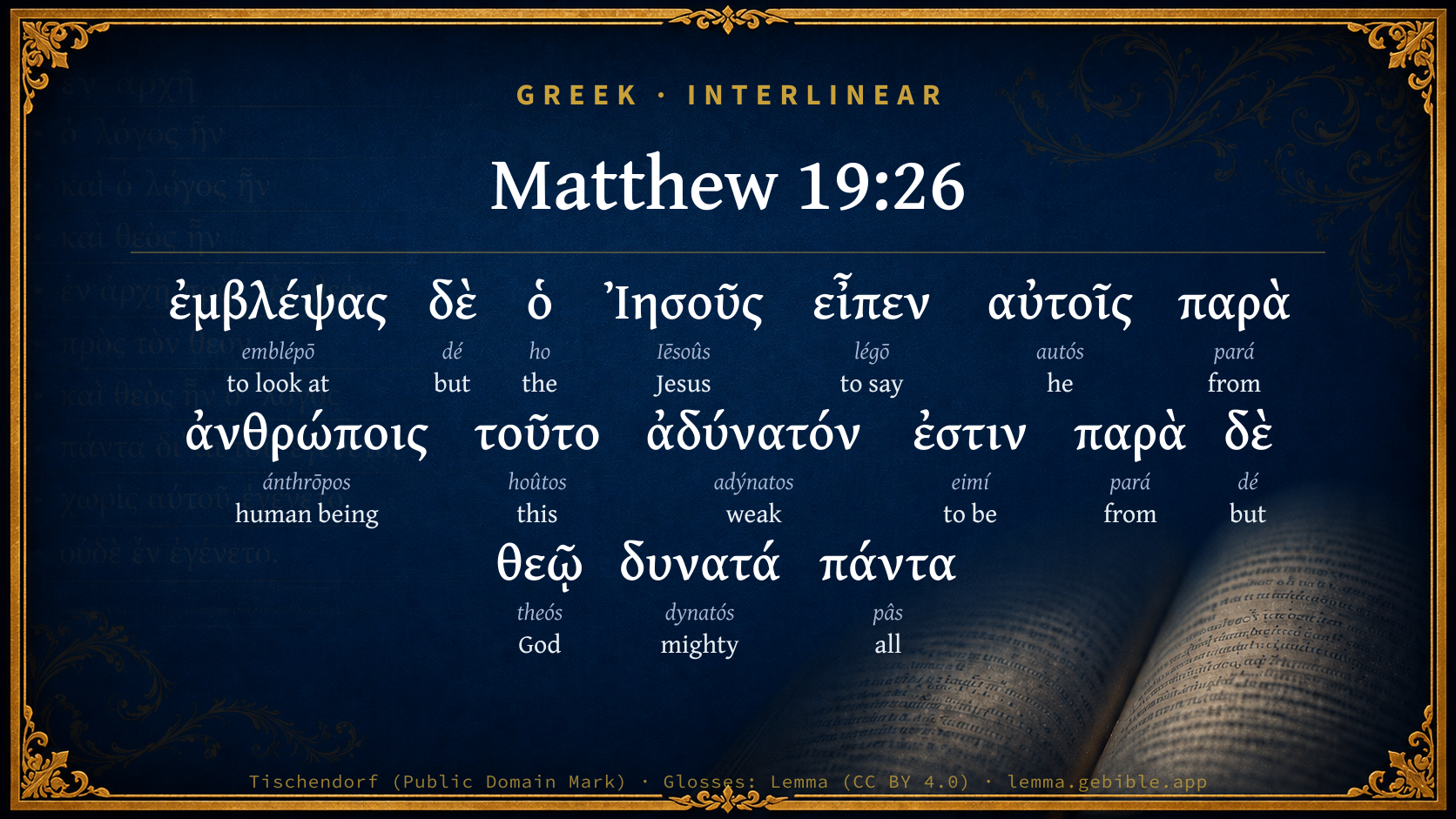
Greek (Tischendorf 8th ed.) Matthew 19:26 appears in the Greek New Testament. The text above is from the Tischendorf 8th edition. Each word links to its Strong’s number and a concise gloss. Click any word for its full Thayer’s Greek Lexicon entry.
Download image
Cite this verse

Matthew 19:26 (World English Bible). Public Domain. Lemma interlinear Bible study tool, https://lemma.gebible.app/v/matthew/19/26.

Show BibTeX & RIS
BibTeX
RIS
English Translation
Looking at them, Jesus said, "With men this is impossible, but with God all things are possible."
World English Bible · Public Domain
Highlights
  • 2 first appearances in the Greek New Testament
Full analysis ↓
Download a study sheet

One document with this verse’s original text, its word-by-word gloss line, the meaning frame, cross-references with their text, attributed commentary, and full source and license credits — printable, and it pastes into notes with its structure intact.

This verse Autodidact and up

Study sheet (.html) Plain text (.txt)

A passage Seminary Student

Up to 50 verses in one chapter. A passage sheet keeps up to 6 commentary sources and 12 cross-references per verse, in the order this page ranks them, and says so on the sheet whenever that leaves anything out. Ask for a single verse and you get the Autodidact verse sheet above.

Everything on this page stays free to read, with no account — the sheet is a download of what is already on screen, not access to it.

Want to remove ads? Support Godless Engineer
Compare translations 3

The same verse in 3 English versions, stacked beneath the original-language interlinear above. Click any original word for its lexicon entry.

Each is an independent rendering of the whole verse — the interlinear is not word-aligned to these translations.

Highlighted words mark where these versions differ — a whole-verse word diff, not a word-by-word alignment.

  • World English Bible Public Domain
    Looking at them, Jesus said, "With men this is impossible, but with God all things are possible."
  • King James Version Public Domain
    But Jesus beheld them, and said unto them, With men this is impossible; but with God all things are possible.
  • unfoldingWord Literal Text CC BY-SA 4.0
    But Jesus, having looked at, said to them, “With men this is impossible, but with God all things are possible.”

unfoldingWord Literal Text — © unfoldingWord, licensed CC BY-SA 4.0. Word-aligned USFM3 via Door43 (git.door43.org/unfoldingWord/en_ult).

Versions to compare (up to 4)

3 of 4 selected

Show all 19 translations

Every available English version of this verse, each an independent rendering of the whole verse.

  • World English Bible Public Domain
    Looking at them, Jesus said, "With men this is impossible, but with God all things are possible."
  • Berean Standard Bible Public Domain
    Jesus looked at them and said, “With man this is impossible, but with God all things are possible.”
  • Majority Standard Bible Public Domain
    Jesus looked at them and said, “With man this is impossible, but with God all things are possible.”
  • King James Version Public Domain
    But Jesus beheld them, and said unto them, With men this is impossible; but with God all things are possible.
  • American Standard Version (1901) Public Domain
    And Jesus looking upon `them' said to them, With men this is impossible; but with God all things are possible.
  • Revised Version (1885) Public Domain
    And Jesus looking upon them said to them, With men this is impossible; but with God all things are possible.
  • Geneva Bible (1599) Public Domain
    And Iesus behelde them, and sayde vnto them, With men this is vnpossible, but with God all things are possible.
  • Douay-Rheims (1899) Public Domain
    And Jesus beholding, said to them: With men this is impossible: but with God all things are possible.
  • Young's Literal Translation Public Domain
    And Jesus having earnestly beheld, said to them, `With men this is impossible, but with God all things are possible.'
  • Literal Standard Version CC BY-SA 4.0
    And Jesus having earnestly beheld, said to them, “With men this is impossible, but with God all things are possible.”
  • Unlocked Literal Bible CC BY-SA 4.0
    Jesus looked at them and said, “With people this is impossible, but with God all things are possible.”
  • unfoldingWord Literal Text CC BY-SA 4.0
    But Jesus, having looked at, said to them, “With men this is impossible, but with God all things are possible.”
  • Darby Bible Public Domain
    But Jesus, looking on [them], said to them, With men this is impossible; but with God all things are possible.
  • World Messianic Bible Public Domain
    Looking at them, Yeshua said, “With men this is impossible, but with God all things are possible.”
  • Webster's Bible Public Domain
    But Jesus beheld them, and said to them, With men this is impossible, but with God all things are possible.
  • Free Bible Version CC BY-SA 4.0
    Jesus looked at them and said, “From a human point of view it's impossible, but all things are possible with God.”
  • Bible in Basic English Public Domain
    And Jesus, looking at them, said, With men this is not possible; but with God all things are possible.
  • Text-Critical English NT CC BY 4.0
    Jesus looked at them and said to them, “With men it is impossible, but with God all things are possible.”
  • Tyndale New Testament (1534) Public Domain
    Iesus behelde the and sayde vnto them: with men this is vnpossible but with God all thinges are possible.

Literal Standard Version (2020), Covenant Press — licensed CC BY-SA 4.0. Text via the HelloAO Bible API (eBible.org). Unlocked Literal Bible (unfoldingWord) — licensed CC BY-SA 4.0. Text via the HelloAO Bible API (eBible.org). unfoldingWord Literal Text — © unfoldingWord, licensed CC BY-SA 4.0. Word-aligned USFM3 via Door43 (git.door43.org/unfoldingWord/en_ult). Free Bible Version, Dr. Jonathan Gallagher — licensed CC BY-SA 4.0. Text via the HelloAO Bible API (eBible.org).

Word by word

More ways to search: Search by grammar → Find every occurrence → Compare this word →

Practice this passage: Drill this verse → Learn its vocabulary →

ἀδύνατόν
adýnatos
G102
“weak”
Adjective, Nominative, Singular, Neuter
Part of Speech
Adjective
Case
Nominative
Number
Singular
Gender
Neuter
Full Thayer's Definition

Origin: from G1 (as a negative particle) and G1415

TDNT: 06:44,2

1. without strength, impotent, powerless, weakly, disabled 2. unable to be done, impossible
  1. ἐμβλέψας emblépō G1689 “to look at” Verb, Aorist, Active, Participle, Nominative, Singular, Masculine
  2. δὲ dé G1161 “but” Conjunction
  3. ὁ ho G3588 “the” Article, Nominative, Singular, Masculine
  4. Ἰησοῦς Iēsoûs G2424 “Jesus” Noun, Nominative, Singular, Masculine
  5. εἶπεν légō G3004 “to say” Verb, Aorist, Active, Indicative, 3rd person, Singular
  6. αὐτοῖς autós G846 “he” Personal pronoun, Dative, Plural, Masculine
  7. παρὰ pará G3844 “from” Preposition
  8. ἀνθρώποις ánthrōpos G444 “human being” Noun, Dative, Plural, Masculine
  9. τοῦτο hoûtos G3778 “this” Demonstrative pronoun, Nominative, Singular, Neuter
  10. ἐστιν eimí G1510 “to be” Verb, Present, Active, Indicative, 3rd person, Singular
  11. παρὰ pará G3844 “from” Preposition
  12. δὲ dé G1161 “but” Conjunction
  13. θεῷ theós G2316 “God” Noun, Dative, Singular, Masculine
  14. δυνατά dynatós G1415 “mighty” Adjective, Nominative, Plural, Neuter
  15. πάντα pâs G3956 “all” Adjective, Nominative, Plural, Neuter

About this verse

These counts appear in no published source. They are computed here, from the morphology-tagged text and Lemma’s own curated glosses. What Lemma adds →

16
words
14
distinct lemmas
Gospels
section

Notable vocabulary

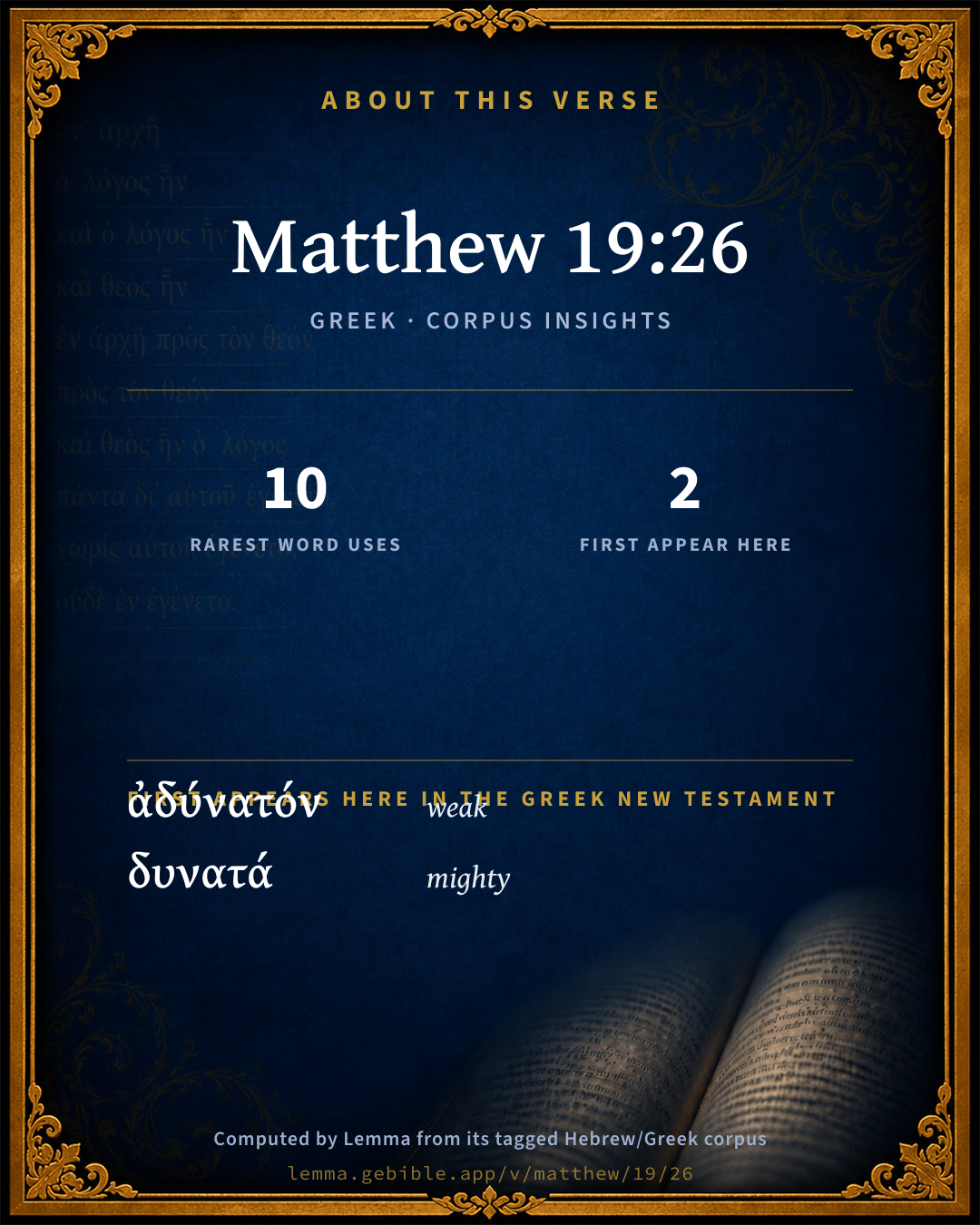
The rarest word here is ἀδύνατόν weak G102 — appearing just 10 times in the whole Greek New Testament.

First appearance in Scripture

These words make their first canonical appearance in the Greek New Testament here:

  • ἀδύνατόν weak G102
  • δυνατά mighty G1415

Shared distinctive vocabulary

ἀδύνατόν weak G102 occurs in 10 verses of the Greek New Testament. Also found in:
Repetition

Words recur within this verse:

Cross-references

11

Topical passages linked to Matthew 19:26 in the Treasury of Scripture Knowledge — connected by theme and wording, ordered by reader-vote popularity; previews shown in the World English Bible.

  • Jeremiah 32:27 Behold, I am Yahweh, the God of all flesh: is there anything too hard for me?
  • Luke 1:37 For everything spoken by God is possible."
  • Job 42:2 "I know that you can do all things, And that no purpose of yours can be restrained.
  • Mark 10:27 Jesus, looking at them, said, "With men it is impossible, but not with God, for all things are possible with God."
  • Luke 18:27 But he said, "The things which are impossible with men are possible with God."
  • Jeremiah 32:17 Ah Lord Yahweh! behold, you have made the heavens and the earth by your great power and by your outstretched arm; there is nothing too hard for you,
  • Genesis 18:14 Is anything too hard for Yahweh? At the set time I will return to you, when the season comes round, and Sarah will have a son."
  • Psalms 62:11 God has spoken once, Twice I have heard this, That power belongs to God.
  • Numbers 11:23 Yahweh said to Moses, Has Yahweh's hand grown short? now shall you see whether my word shall happen to you or not.
  • Zechariah 8:6 Thus says Yahweh of Hosts: "If it is marvelous in the eyes of the remnant of this people in those days, should it also be marvelous in my eyes?" says Yahweh of Hosts.
  • Psalms 3:8 Salvation belongs to Yahweh. Your blessing be on your people. Selah.

Cross-references courtesy of OpenBible.info (CC BY 4.0).

Commentary

Notes on Matthew 19:26 from classic Christian and Jewish commentators (each source and its license shown beneath its notes). The classic Christian expositions comment on the surrounding passage and are grouped to its opening verse, so a note may address several verses; the Jewish commentaries on the Tanakh (Rashi and others) are per-verse, so they appear only where the commentator wrote on this verse.

Lemma curates 59 commentaries, every one of them public domain or Creative Commons licensed, each selected and text-cleaned for this edition rather than reprinted as found. About our sources →

Tyndale Open Study Notes

Tyndale Open Resources

19:26 God’s regenerating grace is absolutely essential before the wealthy are able to repent from their idolatry, abandon their possessions if called to do so, and follow Jesus (19:21).

Tyndale Open Study Notes — © Tyndale Open Resources, licensed CC BY-SA 4.0. Text via the HelloAO Bible API.

Bengel's Gnomon

Johann Albrecht Bengel

Mat 19:26. Ἑμβλέψας, having looked upon) in order to fix the thoughts of the terrified disciples. Jesus taught many things even by His look and by the expression of His countenance. This look first moved Matthew, once a publican.—εἶπεν, said) with the greatest sweetness.—ἀδύνατον, impossible) more even than morally impossible.—πάντα, all things) Therefore even this. The Divine omnipotence is seen, not only in the kingdom of nature, but in those also of grace and glory. That power is more than human by which the human heart is led away from earthly things. The cause of the rich may be pleaded with the greatest, effect by the poor and the scrupulous.[876]—δυνατά, possible) as each of the elect will know.

[876] In the original, “timoratos.” In illustration and explanation of this barbarous word, the following extract will not be unwelcome:—

“TIMORATUS. Wippo de Vita Chunradi Salici, p. 428: In Dei seruitio Timorata, in orationibus et eleemosynis assidua. Gesta Innocentii iii. p. 77: Deuotus et timoratus. Ditmarns lib. 2: Filiam bene Timoratam, etc. Humiliter et Timorate, apud eumdem lib. 3. Fulbertus Carnot. Epist. 40: Haerebam timorate suspensus et expectans, etc. Occurrit non semel: Gallis Timoré, Dei timidus et a lenibus culpis auersus. Timoratus et totus plenus Deo, in Chronico Noualic. apud Murator, to. 2, part. 2, col. 735. Adde p. 2 de Imit. Christi, c. 10, n. 3, etc.” GLOSSARIUM MANUALE AD SCRIPTORES MEDIÆ ET INFIME LATINITATIS ex magnis Glossariis CABOLI DU FRESNE, DOMINI DU CANGE, et CARPENTARII in compendium redactum multisque verbis et dicendi formulis auctum.—Tom. 6, p. 563, b.—(I. B.)

Bengel's Gnomon of the New Testament — English translation (T&T Clark, Edinburgh, 1860) — public domain. Text from a community e-Sword module.

Meyer's Critical & Exegetical Commentary

Heinrich August Wilhelm Meyer

Mat_19:26. Ἐμβλέψας] This circumstance is also noticed by Mark. The look which, during a momentary pause, preceded the following utterance was doubtless one of a telling and significant character, and calculated to impress the startled disciples (Chrysostom, Euthymius Zigabenus: ἡμέρῳ βλέμματι). Comp. Luk_20:17; Joh_1:43.

παρὰ ἀνθρώποις] so far as men are concerned, i.e. not hominum judicio (Fritzsche, Ewald), but serving to indicate that the impossibility is on the part of man, is owing to human inability, Luk_1:37.

τοῦτο] namely, the σωθῆναι, not: that the rich should be saved. See Mat_19:25 (in answer to Fritzsche, de Wette). Jesus invites the disciples to turn from the thought of mans own inability to obtain salvation, to the omnipotence of Gods converting and saving grace.

Meyer — Critical and Exegetical Commentary on the New Testament — English translation by Peter Christie, edited by Frederick Crombie (T&T Clark, 1880) — public domain. Text from a community e-Sword module.

Expositor's Greek Testament

ed. W. Robertson Nicoll

Mat 19:26 . ἐμβλέψας denotes a look of observation and sympathy. Jesus sees that He has made too deep an impression, depressing in effect, and hastens to qualify what He had said: “with mild, meek eye soothing their scared mind, and relieving their distress” (Chrys., Hom. lxiii.). παρὰ ἀνθρώποις , etc.: practically this reflection amounted to saying that the previous remark was to be taken cum grano , as referring to tendency rather than to fact . He did not mean that it was as impossible for a rich man to be saved as for a camel to pass through a needle-eye, but that the tendency of wealth was to act powerfully as an obstructive to the spiritual life.

The Expositor's Greek Testament, edited by W. Robertson Nicoll (1897–1910) — public domain. Text from a community e-Sword module.

Adam Clarke's Commentary

Verse 26. With men this is impossible] God alone can take the love of the world out of the human heart. Therefore the salvation of the rich is represented as possible only to him: and indeed the words seem to intimate, that it requires more than common exertions of Omnipotence to save a rich man.

Adam Clarke's Commentary on the Bible (1810–1826) — public domain. Text from a community e-Sword/MySword module.

Ellicott's Commentary for English Readers

(26) Jesus beheld them.—We can surely conceive something of the expression of that look. He had gazed thus on the young ruler, and read his inner weakness. Now, in like manner, he reads that of the disciples; and the look, we may believe, tells of wonder, sorrow, tenderness, anxiety. Those feelings utter themselves in the words that follow, partly in direct teaching, partly in symbolic promises, partly in a parable.

With men this is impossible.—General as the words are in their form, we cannot help feeling that they must have seemed to the disciples to have rebuked their hasty judgment, not only as to the conditions of salvation generally, but as to the individual case before them. He, the Teacher, would still hope, as against hope, for one in whom He had seen so much to love and to admire. Their wider teaching is, of course, that wealth, though bringing with it many temptations, may be so used, through God’s grace, as to be a help, not a hindrance, in that deliverance from evil which is implied in the word “salvation.”

A Bible Commentary for English Readers, edited by Charles John Ellicott (1878–1897) — public domain. Text from a community e-Sword module.

John Gill's Exposition

But Jesus beheld them,.... Looking wishfully and earnestly at them; signifying thereby, that he knew their reasonings among themselves, though they did not speak out so as to be heard by him; and that there was no reason why they should be in so much concern, as their countenances showed, or possess themselves with such fears:

and said unto them, with men this is impossible. Mark adds, "but not with God; for with God all things are possible"; to be done by him, if he will, which are consistent with the glory and perfections of his nature: for as he could, by his almighty power, if he would, reduce a camel to so small a size, as to be able to go through the eye of a needle, which, with men, is an impossible thing; so by the mighty power of his grace he can work upon a rich man's heart, in such a manner, as to take off his affections from his worldly substance, and cause him to drop his trust and confidence in it: he can so influence and dispose his mind, as to distribute his riches cheerfully among the poor, and largely, and liberally supply their wants, and even part with all, when necessity requires it: he can change his heart, and cause the desires of his soul to be after true riches of grace and glory; and bring him to see his own spiritual poverty, his need of Christ, and salvation by him; and to deny himself, take up the cross, and follow him, by submitting to his most despised ordinances, and by suffering the loss of all things for his sake; and he can carry him through a thousand snares safe to his kingdom and glory, which is Christ's sense; though the thing is impossible upon the foot of human nature, and strength, which can never effect anything of this kind: and as to what the apostles suggested concerning the safety of persons in the Messiah's kingdom, if no rich man could enter there, but should be in opposition to it; our Lord's answer implies, that though, humanly speaking, it was not possible and practicable that they, a company of poor, mean, and despicable men, should be able to stand against the united force of the great and mighty men of the earth; yet God was able to support, and uphold them, succeed, and keep them, and make them both useful and comfortable, amidst all the opposition and persecution they should meet with, until he had finished his whole will and work by them.

John Gill's Exposition of the Whole Bible (1746–1763) — public domain (CC PDM 1.0). Text via the HelloAO Bible API.

Trapp's Complete Commentary

John Trapp

26 But Jesus beheld them, and said unto them, With men this is impossible; but with God all things are possible.

Ver. 26. With men this is impossible] Because rich men’s hearts are ordinarily so wedded and wedged to the world that they will not be loosened but by a powerful touch from the hand of Heaven. Think not, therefore, as many do, that there is no other hell but poverty, no better heaven than abundance. {a} Of rich men they say, What should such a man ail? The Irish ask, What they mean to die, &c. The gold ring and gay clothing carried it in St James’s time, Jas 2:2. But he utterly disliked such partiality, and tells us that "God hath chosen the poor in this world, rich in faith, to be heirs of his kingdom." In which respect he bids the brother of low degree rejoice in that he is exalted in Christ.

But with God all things are possible] He can quickly root out confidence in the creature, and rivet rich men to himself. He can do more than he will; but whatsoever he willeth, that he doth, without stop or hindrance. Men may lack their will for lack of power. Nature may be interrupted in her course, as it was at the time when the fire burned not the three worthies, the water drowned not Peter walking upon it, &c. Satan may be crossed and chained up; but who hath resisted the Almighty? who ever waxed fierce against God and prospered? Job 9:4. Nature could say, all things are easy to God, and nothing impossible, ‘Ραδια παντα θεω τελεσαι και ανηνυτον ουδεν (Linus Poeta). Howbeit for a finite creature to believe the infinite attributes of God, he is not able to do it thoroughly without supernatural grace.

{a} Luk 2:41. Divitiae vocautur τα ενοντα, quia avari animo quasi insident. Beza.

John Trapp, A Commentary or Exposition upon All the Books of the Old and New Testament (1647–1656) — public domain. Text from a community e-Sword module.

Whedon's Commentary on the Bible

Daniel D. Whedon

26. With God all things are possible — The salvation of a rich man is as miraculous as the putting a camel through a needle’s eye. It is a human impossibility. But God can do it. But does not this reduce the rich man to just the same level as any other man, and so destroy all the force of our Lord’s first reflections on the impossibility of bringing a rich man into the kingdom of heaven? We reply, that our Lord means to represent that the salvation of a rich man bears to the ordinary salvation of common men the same relation that a miracle does to an ordinary transaction. If the saving of an ordinary man be a miracle of grace, the saving of a rich man is a miracle upon a miracle. It is an event above the ordinary train of grace, just as a miracle is above the ordinary course of nature.

Daniel D. Whedon (gen. ed.), Commentary on the Old and New Testaments (1874–1909) — public domain. Text from a community e-Sword module.

The Pulpit Commentary

But Jesus beheld them (embleyav , looking upon them). He turned on his disciples a look full of earnestness, sympathy, and love, soothing their fears and claiming their full attention for a spiritual truth. With men (para anyrwpoiv) this is impossible. Men in their own strength, relying on their own natural powers, cannot save their souls or rise superior to the snare of riches. From the entanglements occasioned by wealth, and the lowering effects of its pursuit and enjoyment, the natural man is wholly unable to extricate himself. With God all things are possible. Here is the only solution of the difficulty. With the grace of God, and embracing the calls of his providence, the rich man may be delivered from his dangers, may keep a heart unspotted, may use his wealth to God"s glory and his own eternal good. So the impossibility is a conditional one, to be overcome by due recourse to the help of God and the strong hope of the future life. How a rich man may be disciplined and elevated we see in the ease of Zacchaeus. (Luk_19:8) Many such instances have occurred in our own days, as in all Christian times.

Salvation possible because it is God"s work.

As the disciples understood their Lord, he seemed to them to make it impossible for a rich man to become a Christian; and if a rich man could not be a Christian, who could be? They mistook their Master, who, as an effective Teacher, sometimes stated things very strongly, and withheld the qualifications in order to excite thought. The "immensely difficult" is not the "impossible." The impossible, if you can only reckon upon human forces, is not impossible, if you can bring in Divine forces. And, in relation to moral salvations, you have to take account of what God can do. "With men this is impossible; but with God all things are possible." This very large and unqualified statement concerning the absolute ability of God has often been misrepresented and misused, because it has been applied to things of which our Lord was not thinking. It is said God cannot make two things fill one space, or make two and two count five. But these are not "impossibilities;" they are "absurdities," proved such by the conditions of human language. God cannot do what is manifestly absurd in the very statement. Our Lord was speaking strictly of moral possibilities and impossibilities.

I GOD CAN SAVE RICH MEN, BECAUSE HE CAN TAKE AWAY THEIR RICHES. And so remove their hindrance. Man cannot do this; but all wealth is absolutely in the Divine control. This is forcibly illustrated in the story of Job; all whose worldly possessions take wings and fly away in a single overwhelming day. The rich ruler would not put his possessions away in order to enter the kingdom; but, if it had pleased Christ so to do, he could have taken them away, and so have given him his opportunity. Many a man has been brought to God by losing the riches in which he had trusted.

II GOD CAN SAVE RICH MEN BY TAKING THEM AWAY FROM THEIR RICHES. Drawing them away from their confidences. God has power over the minds and souls of men. By his Spirit he can awaken such soul anxieties that a man may become indifferent to death, put his fingers in his ears, and cry, "What must I do to be saved?" God, by his Spirit, can "convince of sin, of righteousness, and of judgment;" and under that convincement a man will surely be liberated from the enslaving of worldly possessions. R.T.

The impossible made possible.

This is the solution of the rich man"s difficulty; and it is the solution of many another difficulty. When we look away from man to God, the impossible becomes possible.

I MEN CANNOT SAVE THEMSELVES. The disciples are made to see this truth in the case of the rich, whose difficulties are peculiarly great. But that is only the extreme instance of what really applies to people in all conditions of life.

1. In experience we see that men do not save themselves. We may preach the dignity and capacity of humanity. We may argue on the faculty and scope of free will. But when we leave the pulpit and the lecture room, what we see is a world of continuous bafflement and failure. The young man starts well, but if he is left to himself and trusts to himself, he soon discovers his weakness. Good resolutions seem only to be made in order to be broken.

2. The indwelling sin of men prevents them from saving themselves. The evil is within. The prisoner might cut his way out of a stone dungeon, and the exile might escape from the ocean island; but the man whose own nature is his dungeon and his place of exile cannot escape from himself. In himself man has no lever by which he can lift himself above himself.

3. The depth of ruin prevents men from saving themselves. The Fall is so awful, the offended Law is so majestic, that self-salvation is hopeless.

4. The circumstances of life prevent men from saving themselves. Riches keep back the wealthy. Poverty, with its cares and anxieties, oppresses the destitute. Various calls and distractions, fascinations and delusions, hinder other men.

II GOD CAN SAVE WHERE MAN FAILS.

1. He does save. This is his work. He creates, and he renews. He gives life, and he regenerates. The Creator is the Saviour. We have not got a glimmer of the meaning of "the glorious gospel of the blessed God" until we have begun to perceive this great truth. All the doctrines and ethics of Christianity are of little use while we are blind to its fundamental principle. This principle is not to be lost in any figure of speech. We have to see that God puts forth real power to change and renew his children. Helpless and ruined in themselves, when they turn to his grace his strong arm saves them. This is as actual a fact as the fact that the summer sun makes the vegetation of the earth to grow and ripen. Every true Christian can testify to it from personal experience.

2. There is no limit to his saving power. There can be no limit if he is God, for God is Almighty. We see difficulties, but they all vanish as smoke when he puts forth his power. The Divine method of salvation is not as simple and easy as we might have expected. It involves the expenditure of God"s only begotten Son. Christ must come to earth, and Christ must die, if man is to be saved. But Christ has come and died; God has done all that is necessary. The salvation is perfect. Now it only rests with us to open our hearts to receive its renewing grace. There is one thing that God never does he never overrides a rebellious will. If we refuse, he cannot save us. It is for the willing that there is no limit to his saving power. W.F.A.

Salvation possible because it is God"s work.

As the disciples understood their Lord, he seemed to them to make it impossible for a rich man to become a Christian; and if a rich man could not be a Christian, who could be? They mistook their Master, who, as an effective Teacher, sometimes stated things very strongly, and withheld the qualifications in order to excite thought. The "immensely difficult" is not the "impossible." The impossible, if you can only reckon upon human forces, is not impossible, if you can bring in Divine forces. And, in relation to moral salvations, you have to take account of what God can do. "With men this is impossible; but with God all things are possible." This very large and unqualified statement concerning the absolute ability of God has often been misrepresented and misused, because it has been applied to things of which our Lord was not thinking. It is said God cannot make two things fill one space, or make two and two count five. But these are not "impossibilities;" they are "absurdities," proved such by the conditions of human language. God cannot do what is manifestly absurd in the very statement. Our Lord was speaking strictly of moral possibilities and impossibilities.

I GOD CAN SAVE RICH MEN, BECAUSE HE CAN TAKE AWAY THEIR RICHES. And so remove their hindrance. Man cannot do this; but all wealth is absolutely in the Divine control. This is forcibly illustrated in the story of Job; all whose worldly possessions take wings and fly away in a single overwhelming day. The rich ruler would not put his possessions away in order to enter the kingdom; but, if it had pleased Christ so to do, he could have taken them away, and so have given him his opportunity. Many a man has been brought to God by losing the riches in which he had trusted.

II GOD CAN SAVE RICH MEN BY TAKING THEM AWAY FROM THEIR RICHES. Drawing them away from their confidences. God has power over the minds and souls of men. By his Spirit he can awaken such soul anxieties that a man may become indifferent to death, put his fingers in his ears, and cry, "What must I do to be saved?" God, by his Spirit, can "convince of sin, of righteousness, and of judgment;" and under that convincement a man will surely be liberated from the enslaving of worldly possessions. R.T.

The Pulpit Commentary (1880–1919), ed. H.D.M. Spence-Jones & Joseph S. Exell — public domain. Text from a community e-Sword module.

John Wesley's Explanatory Notes

Jesus looking upon them - To compose their hurried spirits. O what a speaking look was there! Said to them - With the utmost sweetness: With men this is impossible - It is observable, he does not retract what he had said: no, nor soften it in the least degree, but rather strengthens it, by representing the salvation of a rich man as the utmost effort of Omnipotence.

John Wesley, Explanatory Notes Upon the Whole Bible (1754–1765) — public domain. Text via the GEBible commentary corpus.

Burkitt's Expository Notes on the New Testament

William Burkitt

As if Christ had said, "Were all men left to themselves, no man, either rich or poor would be saved; but God can bring men to heaven by the mighty power of his grace: he can make the rich in estate, poor in spirit; and them that are poor in this world, rich in grace."

Learn, 1. That it is impossible for any man, rich or poor, by his own natural strength, to get to heaven.

2. That when we are discouraged with a sense of our own impotency, we should consider the power of God, and act our faith upon it: With God all things are possible.

William Burkitt's Expository Notes on the New Testament (1700–1703) — public domain. Text from a community e-Sword module.

Cambridge Greek Testament for Schools and Colleges

26. ἐμβλέψας. These heart-searching looks of Christ doubtless gave an effect to His words which it is impossible to recall, but which would never be effaced from the memory of those who felt their meaning.

Cambridge Greek Testament for Schools and Colleges (Cambridge University Press, 1896; 21 vols, various authors incl. Carr, Maclear, Plummer, Farrar, Lumby, Moule, M. R. James, Simcox) — public domain. Text from a community e-Sword module.

Alford’s Greek Testament

Henry Alford

26. ἐμβλέψας] Probably to give force to and impress what was about to be said, especially as it was a saying reaching into the spiritual doctrines of the Gospel, which they could not yet apprehend.

τοῦτο, salvation in general, and even of those least likely to be saved.

παρά in both cases, as in E. V., with, ‘in the estimation of,’ ‘penes:’ a subjective force of the preposition derived from its local meaning of close juxtaposition, in which sense we have it only once in the N.T., Joh 19:25.

Henry Alford, The Greek Testament (1849–1861) — public domain. Text from a community e-Sword module.

International Critical Commentary

(M) 26. And Jesus looking upon (them) said to them, With men this is impossible; but with God all things are possible.] Mk. has: “Jesus looked upon them and saith, With men it is impossible, but not with God. For all things are possible with God.” Mt. inserts a conjunction, and substitutes a past tense for λέγει, as often. He omits the redundant ἀλλʼ οὐ παρὰ θεῷ: cf. Introduction, p. xxiv.

International Critical Commentary — older volumes (1896–1929), various authors — public domain. Text from a community e-Sword module.

Vincent's Word Studies in the New Testament

Marvin R. Vincent

This [τουτο] . Not the salvation of rich men, but salvation in general. It is in answer to the question, who can be saved ? Man cannot save himself nor his fellow. God only can save him.

Marvin R. Vincent, Word Studies in the New Testament (1887–1900) — public domain. Text from a community e-Sword/MySword module.

Lesson kit

Teaching starters — assembled from the data on this page, not authored interpretation. Every prompt links to the verse data it draws on. Edit before teaching.

Matthew, in the Gospels, opens this verse with 16 words (14 distinct Greek lemmas). Its most distinctive word is adýnatos (“weak”). A historical commentator’s framing appears above. Read the whole chapter for the surrounding context.

Discussion questions

  1. What does “weak” (adýnatos) contribute to the verse as a whole?
  2. 2 words here appear for the first time in Scripture. What is being introduced at this debut?
  3. Mark 10:27 shares the word «weak» with this verse. How do the two illuminate each other?
  4. “but” occurs 2× in this one verse. What is the effect of the repetition?
  5. These translations render this verse differently; the difference is in the English rendering, not the original. What questions does that raise?
  6. Reading how Tyndale Open Study Notes and Bengel's Gnomon read this verse, where do the two commentators agree and where do they part?

Things to notice

  • 2 words make their first canonical appearance in Scripture here.
  • These translations choose different wording for 4 words in this verse.
  • “but” occurs 2× in this single verse.
  • 14 distinct Greek lemmas span 16 words in this verse.

Reading settings

Reading text

Shown beneath each verse's original-language words.

Old Testament
Old Testament edition

Read the OT as the Masoretic Hebrew (MT) or the Greek Septuagint (LXX).

English shown for the Greek Septuagint (in the Hebrew ↔ Greek comparison).

Comparing translations? Open the Compare panel on any verse page to stack up to four side by side.