Matthew 14:28

Greek (Tischendorf 8th ed.) Matthew 14:28 appears in the Greek New Testament. The text above is from the Tischendorf 8th edition. Each word links to its Strong’s number and a concise gloss. Click any word for its full Thayer’s Greek Lexicon entry.
Download image
Cite this verse

Matthew 14:28 (World English Bible). Public Domain. Lemma interlinear Bible study tool, https://lemma.gebible.app/v/matthew/14/28.

Show BibTeX & RIS
BibTeX
RIS
English Translation
Peter answered him and said, "Lord, if it is you, command me to come to you on the waters."
World English Bible · Public Domain
Download a study sheet

One document with this verse’s original text, its word-by-word gloss line, the meaning frame, cross-references with their text, attributed commentary, and full source and license credits — printable, and it pastes into notes with its structure intact.

This verse Autodidact and up

Study sheet (.html) Plain text (.txt)

A passage Seminary Student

Up to 50 verses in one chapter. A passage sheet keeps up to 6 commentary sources and 12 cross-references per verse, in the order this page ranks them, and says so on the sheet whenever that leaves anything out. Ask for a single verse and you get the Autodidact verse sheet above.

Everything on this page stays free to read, with no account — the sheet is a download of what is already on screen, not access to it.

Want to remove ads? Support Godless Engineer
Compare translations 3

The same verse in 3 English versions, stacked beneath the original-language interlinear above. Click any original word for its lexicon entry.

Each is an independent rendering of the whole verse — the interlinear is not word-aligned to these translations.

Highlighted words mark where these versions differ — a whole-verse word diff, not a word-by-word alignment.

  • World English Bible Public Domain
    Peter answered him and said, "Lord, if it is you, command me to come to you on the waters."
  • King James Version Public Domain
    And Peter answered him and said, Lord, if it be thou, bid me come unto thee on the water.
  • unfoldingWord Literal Text CC BY-SA 4.0
    But, answering him, Peter said, “Lord, if it is you, command me to come to you on the water.”

unfoldingWord Literal Text — © unfoldingWord, licensed CC BY-SA 4.0. Word-aligned USFM3 via Door43 (git.door43.org/unfoldingWord/en_ult).

Versions to compare (up to 4)

3 of 4 selected

Show all 19 translations

Every available English version of this verse, each an independent rendering of the whole verse.

  • World English Bible Public Domain
    Peter answered him and said, "Lord, if it is you, command me to come to you on the waters."
  • Berean Standard Bible Public Domain
    “Lord, if it is You,” Peter replied, “command me to come to You on the water.”
  • Majority Standard Bible Public Domain
    “Lord, if it is You,” Peter replied, “command me to come to You on the water.”
  • King James Version Public Domain
    And Peter answered him and said, Lord, if it be thou, bid me come unto thee on the water.
  • American Standard Version (1901) Public Domain
    And Peter answered him and said, Lord, if it be thou, bid me come unto the upon the waters.
  • Revised Version (1885) Public Domain
    And Peter answered him and said, Lord, if it be thou, bid me come unto thee upon the waters.
  • Geneva Bible (1599) Public Domain
    Then Peter answered him, and saide, Master, if it be thou, bid me come vnto thee on the water.
  • Douay-Rheims (1899) Public Domain
    And Peter making answer, said: Lord, if it be thou, bid me come to thee upon the waters.
  • Young's Literal Translation Public Domain
    And Peter answering him said, `Sir, if it is thou, bid me come to thee upon the waters;'
  • Literal Standard Version CC BY-SA 4.0
    And Peter answering Him said, “Lord, if it is You, command me to come to You on the waters”;
  • Unlocked Literal Bible CC BY-SA 4.0
    Peter answered him and said, “Lord, if it is you, command me to come to you on the water.”
  • unfoldingWord Literal Text CC BY-SA 4.0
    But, answering him, Peter said, “Lord, if it is you, command me to come to you on the water.”
  • Darby Bible Public Domain
    And Peter answering him said, Lord, if it be *thou*, command me to come to thee upon the waters.
  • World Messianic Bible Public Domain
    Peter answered him and said, “Lord, if it is you, command me to come to you on the waters.”
  • Webster's Bible Public Domain
    And Peter answered him and said, Lord, if it is thou, bid me come to thee on the water.
  • Free Bible Version CC BY-SA 4.0
    “Lord, if it's really you, tell me to come over to you, walking on the water,” Peter replied.
  • Bible in Basic English Public Domain
    And Peter, answering, said to him, Lord, if it is you, give me the order to come to you on the water.
  • Text-Critical English NT CC BY 4.0
    In response Peter said to him, “Lord, if it is yoʋ, command me to come to yoʋ on the water.”
  • Tyndale New Testament (1534) Public Domain
    Peter answered him and sayde: master if thou be he bid me come vnto the on the water.

Literal Standard Version (2020), Covenant Press — licensed CC BY-SA 4.0. Text via the HelloAO Bible API (eBible.org). Unlocked Literal Bible (unfoldingWord) — licensed CC BY-SA 4.0. Text via the HelloAO Bible API (eBible.org). unfoldingWord Literal Text — © unfoldingWord, licensed CC BY-SA 4.0. Word-aligned USFM3 via Door43 (git.door43.org/unfoldingWord/en_ult). Free Bible Version, Dr. Jonathan Gallagher — licensed CC BY-SA 4.0. Text via the HelloAO Bible API (eBible.org).

Word by word

More ways to search: Search by grammar → Find every occurrence → Compare this word →

Practice this passage: Drill this verse → Learn its vocabulary →

κέλευσόν
keleúō
G2753
“to command”
Verb, Aorist, Active, Imperative, 2nd person, Singular
Part of Speech
Verb
Tense
Aorist
Voice
Active
Mood
Imperative
Person
2nd person
Number
Singular
Full Thayer's Definition

Origin: from a primary kello (to urge on)

TDNT: None

1. to command, to order
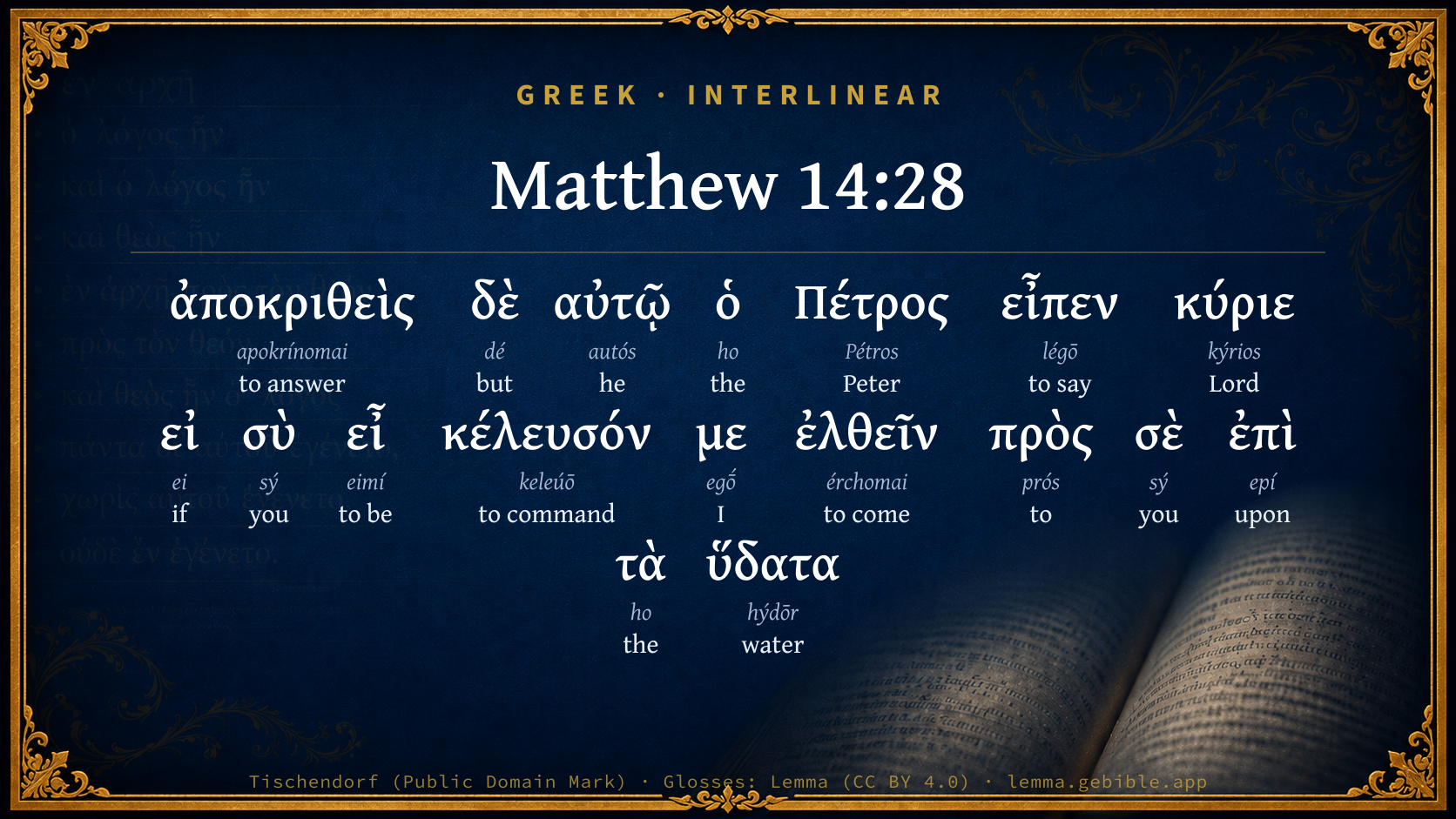
  1. ἀποκριθεὶς apokrínomai G611 “to answer” Verb, Aorist, Passive deponent, Participle, Nominative, Singular, Masculine
  2. δὲ dé G1161 “but” Conjunction
  3. αὐτῷ autós G846 “he” Personal pronoun, Dative, Singular, Masculine
  4. ὁ ho G3588 “the” Article, Nominative, Singular, Masculine
  5. Πέτρος Pétros G4074 “Peter” Noun, Nominative, Singular, Masculine
  6. εἶπεν légō G3004 “to say” Verb, Aorist, Active, Indicative, 3rd person, Singular
  7. κύριε kýrios G2962 “Lord” Noun, Vocative, Singular, Masculine
  8. εἰ ei G1487 “if” Conditional
  9. σὺ sý G4771 “you” Personal pronoun, 2nd person, Nominative, Singular
  10. εἶ eimí G1510 “to be” Verb, Present, Active, Indicative, 2nd person, Singular
  11. με egṓ G1473 “I” Personal pronoun, 1st person, Accusative, Singular
  12. ἐλθεῖν érchomai G2064 “to come” Verb, Aorist, Active, Infinitive
  13. πρὸς prós G4314 “to” Preposition
  14. σὲ sý G4771 “you” Personal pronoun, 2nd person, Accusative, Singular
  15. ἐπὶ epí G1909 “upon” Preposition
  16. τὰ ho G3588 “the” Article, Accusative, Plural, Neuter
  17. ὕδατα hýdōr G5204 “water” Noun, Accusative, Plural, Neuter

About this verse

These counts appear in no published source. They are computed here, from the morphology-tagged text and Lemma’s own curated glosses. What Lemma adds →

18
words
16
distinct lemmas
Gospels
section

Notable vocabulary

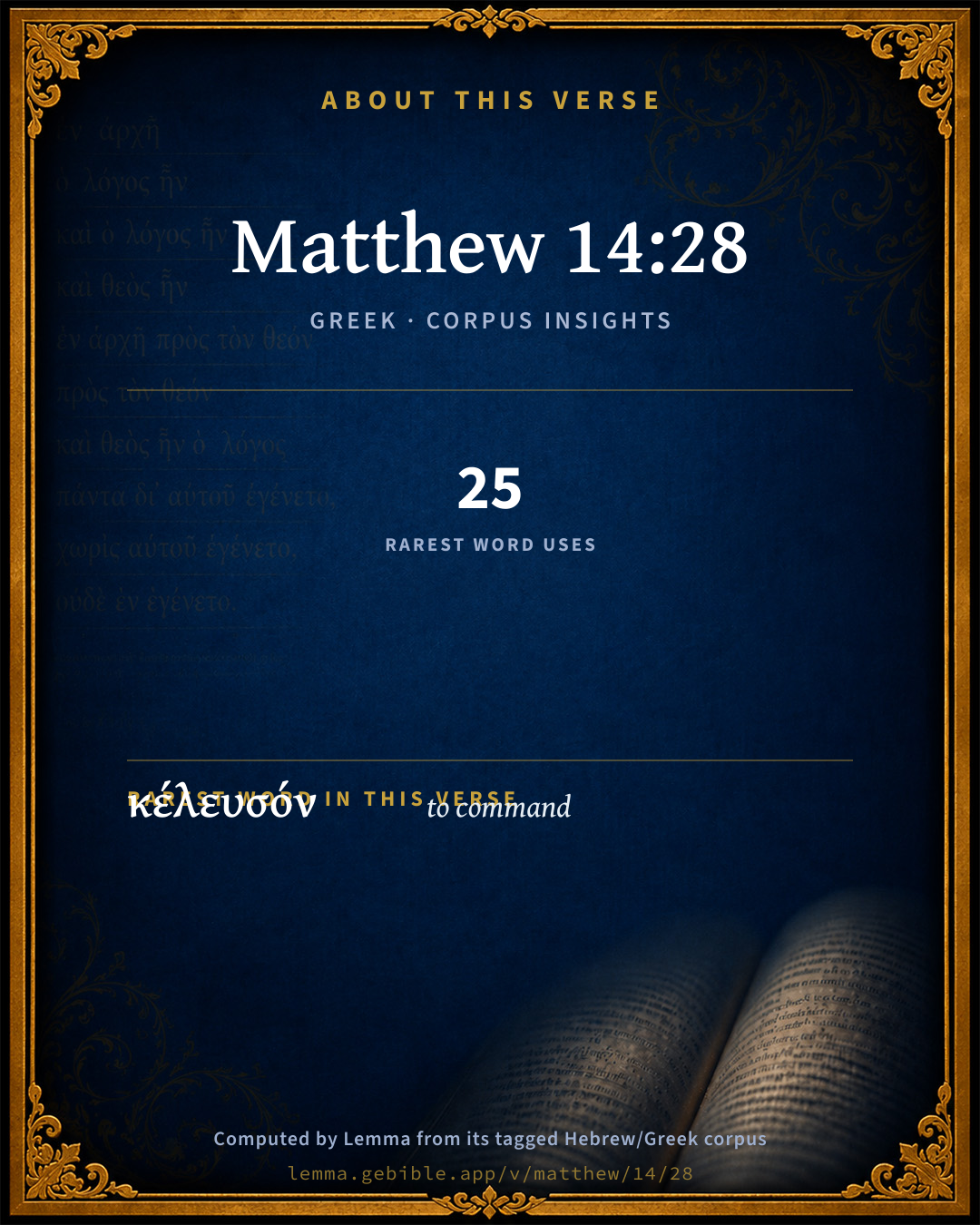
The rarest word here is κέλευσόν to command G2753 — appearing just 25 times in the whole Greek New Testament.

Shared distinctive vocabulary

κέλευσόν to command G2753 occurs in 25 verses of the Greek New Testament. Also found in:

Repetition

Words recur within this verse:

Cross-references

8

Topical passages linked to Matthew 14:28 in the Treasury of Scripture Knowledge — connected by theme and wording, ordered by reader-vote popularity; previews shown in the World English Bible.

  • John 6:68 Simon Peter answered him, "Lord, to whom would we go? You have the words of eternal life.
  • Romans 12:3 For I say, through the grace that was given me, to every man who is among you, not to think of himself more highly than he ought to think; but to think reasonably, as God has apportioned to each person a measure of faith.
  • Matthew 26:33–35 But Peter answered him, "Even if all will be made to stumble because of you, I will never be made to stumble."
  • John 13:36–38 Simon Peter said to him, "Lord, where are you going?" Jesus answered, "Where I am going, you can't follow now, but you will follow afterwards."
  • Matthew 19:27 Then Peter answered, "Behold, we have left everything, and followed you. What then will we have?"
  • Mark 14:31 But he spoke all the more, "If I must die with you, I will not deny you." They all said the same thing.
  • Luke 22:31–34 The Lord said, "Simon, Simon, behold, Satan asked to have you, that he might sift you as wheat,
  • Luke 22:49–50 When those who were around him saw what was about to happen, they said to him, "Lord, shall we strike with the sword?"

Cross-references courtesy of OpenBible.info (CC BY 4.0).

Commentary

Notes on Matthew 14:28 from classic Christian and Jewish commentators (each source and its license shown beneath its notes). The classic Christian expositions comment on the surrounding passage and are grouped to its opening verse, so a note may address several verses; the Jewish commentaries on the Tanakh (Rashi and others) are per-verse, so they appear only where the commentator wrote on this verse.

Lemma curates 59 commentaries, every one of them public domain or Creative Commons licensed, each selected and text-cleaned for this edition rather than reprinted as found. About our sources →

The Biblical Illustrator

Joseph S. Exell

Mat_14:28; Mat_14:33

And Peter answered Him and said, Lord, if it be Thou, bid me come unto Thee on the water.

Impulse and regulation

There are two powers working side by side under which Christ has taught us He means every true Christian life shall move forward, undervaluing neither the one nor the other. One of these is the impelling power, impulse. This impulsive part of religious character is indispensable. St. Peter was right in his outset Bid me come to Thee, etc. The other is the regulating power. It is this that keeps alive the life that has been awakened, and fulfils the good intentions. Impulses spring up in the region of feeling. Their continuance, regulation, and practical results, depend on the conscience and the will. It is easy to reach the transition point between impulse and principle; some reach it as soon as danger threatens. How shall I turn the ardent impulse of penitent faith into consistent piety? By leaving no good impulse to grow cold or waste in a neglected sentiment, but by embodying it immediately in its corresponding action; in other words, by Christian regulation. Steadfastness will come as you are really planted in Christ. (Bishop Huntingdon.)

The religion of impulse

The religious feeling is the soul of humanity. It may exist in these three forms:

I. Acting without intellect, under the control of the external.

II. Acting under intellect-controlled by the judgment. This is as it should be.

III. Acting against intellect. This is the religion of impulse, and it is here exemplified by Peter in three aspects.

1. Urging an extravagant request. Men are not made to walk on water; were never known to do so; have no capacity for it. To guard against this evil, we must study general laws, cultivate self-command, and seek Divine guidance.

2. Impelling to perilous conduct. One foolish act has often plunged men into a sea of difficulties.

3. Corrected by a merciful God. Christ first allows full liberty for the play of passion and freaks of folly. Then He helps, if asked to. And, lastly, He exposes the error-Wherefore didst thou doubt? Peter ought not to have engaged in the act without faith-and faith implies the full action of intellect. Do not act from impulse-nor even from custom or habit. Act ever from faith. Remember that faith implies intellect, evidence, and reliance. (D. Thomas, D. D.)

Peters unwise experiment in faith

1. His walking on the sea was needless. There is no pressing necessity shutting him up to this sea-walk-ing; but it is faith experimenting in high and holy things. No important end to be served.

2. He asks permission to do that which is not commanded by Christ. Peter asks help to do what Christ had not done; to walk on the sea for the walkings sake. This Christ permits to prove what is in him, but not to his honour or comfort. A salutary discipline.

3. Yet Christ does not fail Peter; it is not the power or word of Christ that gives way, but only the faith of Peter in this power or word. So long as he looks to Jesus this word supports him. It is easier to believe in the ship than on the waters. Now he fears, his faith gives way. Peter in his extremity cries aloud to Jesus. He has not faith enough to walk on the waters, but enough to cry for help. (A. M. Stuart.)

Walking on the waters

It is not difficult to discover the characteristics of St. Peter as they come out here. Whatever he felt for the moment was sure to come out in his words or actions. It is easy to blame and say that Peter should not have been so eager to meet his Lord, or he should have maintained his faith to the last. But we must not forget that the very height to which his faith had for the moment attained, exposed him, more than others, to the temptation of unbelief. They who sit securely in their boats are not liable to sink. The men of even temperament cannot understand an experience such as this. They know nothing of ups and downs. Where the hills are highest the ravines are deepest, Peter must not, therefore, be unduly blamed. We learn from the incident:

1. That when His disciples are in danger of being carried away by earthly influences, Christ sends them into trial. If we are bent on something which shall endanger our spirituality, God may send us serious affliction to keep us out of mischief.

2. That while our trial lasts the Lord prays for us.

3. That when Christ comes to us in our trials we are able to rise above them. He did not come at once. He came over the big waves which constituted their trial. He makes a pathway into our hearts over the affliction which distresses us. The disciples did not know Christ when he came. Have we never mistaken him? When Christ comes, and is recognized, He brings relief. (W. M. Taylor, D. D.)

Failure teaching humilit

y:-Peter required a lesson in humility: and it is instructive to observe in what way he received the lesson from our Lord. He did not meet the erring disciple with sharp and sudden reproof. He did not refuse the mans petition; but He taught the required lesson by its very fulfilment. We have seen a father adopt the same plan in giving a lesson to his son. The boy was anxious to carry a heavy burden, believing that he was able for the task. The father let him try; and as the little arms struggled and quivered, and failed, the little mind was taught its own weakness, and the little heart was truly humbled. Just so when Peter asked to walk with Jesus upon the water. He said, Come. The request is granted, but not approved; and Peter is left to try the work in his own strength, and fail through inglorious weakness. (P. Thompson.)

Failure in the midst of success

He failed in the midst of success. It is difficult to carry a full cup, or walk upon the high places of the earth. It is more difficult to walk erect, and firm, and far among the tossing waves of adversity. The movement of Peter at the outset was grandly courageous. How truly the other disciples would gaze upon him with admiration! He stepped over the little boat; placed his foot upon the rising billow; walked step after step with perfect safety. It was a great moment in the mans life; but it was a greatness for which the man was not equal. His nerve was too weak to carry the full cup, or bear the heavy burden, or tread the stormy water. He failed in the hour of triumph, and lost all by not looking to Jesus. The word is very touching. When he saw the wind boisterous, he was afraid. There was the defect. He looked to the raging winds and the surging waters. He looked to the danger, and not to the Saviour. He forgot the power of Christ, and trusting to himself, and trembling like a breaking wave beneath the boisterous wind, he began to sink. The work was done, and the lesson learned, with great rapidity. His faith, and courage, and devotion, were not so great as he imagined. He discovered his helplessness, and prayed for safety. Lord save me; and now the daring man was brought to regard the Lords band as the fountain of spiritual strength. (P. Thompson.)

Peter in the storm

1. The presumption of faith-Bid me come to Thee on the water.

2. The power of faith Come.

3. The weakness of faith.

4. The power of prayer. (T. Dale, M. A.)

The earnest prayer

I. We must feel our need of salvation.

II. We must know the only source of salvation.

III. We must pray individually for salvation. (W. D. Harwood.)

The fear of Peter when walking on the water

I. The fear which Peter betrayed on this occasion.

1. The transient nature of our best and strongest feelings when they are not kept alive by Divine grace.

2. The danger of needlessly putting to the trial cur highest graces. Never make a presumptuous display of grace.

II. The cause of Peters fear. When he saw the wind boisterous, etc. Here we are taught not to be unmindful of our dangers, but to keep our thoughts fixed on the greatness and faithfulness of Christ when we are surrounded by them.

III. The consequence of Peters fear. He began to sink. Our support in dangers and trials depends on our faith.

IV. The prayer which the fear of Peter drew from him.

1. In all our troubles, if we are Christians, we shall be men of prayer.

2. The fears of the real believer, however strong, are still accompanied with a cleaving to Christ.

V. The connect of Christ towards him.

1. There is no situation in which Christ cannot help us.

2. There is no state in which Christ will not save us. (C. Bradley.)

Doubting a hindrance to the Christian life.

I. St. Peters desire-Bid me come unto Thee. The truthfulness of the Bible seen in the striking preservation of the individuality of the characters brought into view. Peter uniformly rash. Many a time does the yearning spirit of the believer say, Bid me come, etc.

1. There is the memory of joys of which earth knows nothing, experienced in His Presence.

2. There is the consciousness of security from every harm.

3. The confidence created by so many trials of His love. No wonder that this desire of Peter should be the longing of Christs faithful followers.

II. St. Peters failure. The first part of the history show us his daring zeal; now his failing faith. At first his faith laid hold on Divine power, and he was able to tread the waves without sinking. There was an element of wrong in the undertaking; self-confidence again. It was regarding the danger more than the Saviour that made him weak.

III. At the reproof ministered to St. Peter by our Lord. The rebuke was gentle. After all seen of the power of Christ could he doubt? Christ bids us come to Him in the gospel. His power works in those who heed the message. The need and value of true faith in our Lord. There is no happiness without it. (R. H. Baynes, B. A.)

Beginning to sink

There are three conditions of soul.

1. Some think they are sinking, and are not.

2. Some are sinking and do not know it.

3. Some are sinking and miserably do know it.

4. The consequent is evident, what was below you is now over you, your servant has become your master, cares, and anxieties.

5. Your escape is in looking again to Jesus. (J. Vaughan, M. A.)

The cause of sinking

Let me gather up the steps to the sinking:-an emotional state, with abrupt and strong reactions-a self-exaltation-a breaking out, under a good and religious aspect, of an old infirmity and sin-a disproportion between the act and the frame of mind in which the act was done-neglect of ordinary means, with not sufficient calculation of difficulties-a devious eye-a want of concentration-a regard to circumstances more than to the Power which wields them-a certain inward separation from God-a human measurement-a descent to a fear, unnecessary, dishonouring fear-depression-a sense of perishing-beginning to sink. (J. Vaughan, M. A.)

No safety in mere feeling

In the spiritual navigation, it is well to remember that the feelings are the sails, and very quickly and very beautifully do our feelings carry us along while all is favourable. But let once difficulties and temptations come, and if we have only feelings, we shall stop. The best-spread feeling, if it be only feeling, will never make head against a contrary wind. (J. Vaughan, M. A.)

Presumption of early martyrs

Of this nature was that extravagant desire of martyrdom in many of the Primitive Church, when even novices in Christianity, and those of the weaker sex, must needs be thrusting themselves into the hands of the persecutors, when they might easily, and without sin, have escaped them; and thereby exposed themselves to such cruel torments as they were not able to endure, and then did very ill things to be free from them again, to the great dishonour of their holy religion, the deep wounding of their consciences, and their lasting shame and reproach, which they could not wipe off but by a long and very severe repentance. And, indeed, tis no better than knight-errantry in religion thus to seek out hazardous adventures, and lead ourselves into temptations, and then expect that God should support us, and bring us safely off. Tis not faith, but presumption, that engages men so far. (Francis Bragge.)

Christ and mens fears

In this verse are considerable.

1. The Person that spake; the Lord Jesus Christ.

2. Those to whom He spake, viz., the disciples in their present distress.

3. The kind nature and design of Christs speech to them at this time.

4. The argument He used to silence their fears.

5. The time when He spake to them thus comfortably-straightway.

I. Whence is it, that even real delievers may be ready to sink under their troubles. Causes of despondence are: we have not thought of the cross as we ought, or not counted upon it at all, and so have taken little care to prepare for it. Perhaps from our being so long spared, we promised ourselves an exemption from any remarkable trials; or perhaps we mistake the nature, end, and design of afflictions when they come, and so are ready to faint under Divine rebukes. There is a peculiar anguish with which some are overtaken, when they are under apprehensions of approaching death. As to the springs of this-

(a) We are too prone to put from us the evil day.

(b) Death may find us in the dark as to our title to the life to come, or meetness for it.

(c) Conscience may be awakened in our last hours to revive the sense of past sins, and so may increase our sorrows and terrors.

(d) Satan sometimes joins in with an awakened conscience, to make the trial the more sore.

(e) God sometimes withdraws the light of His countenance.

II. What Christ spake to his disciples now, when they were in great distress, He is ready to speak to all His members, whenever they are any of them distressed.

III. What is carried in these comfortable words, and may be gathered from them, for their support. It notes His presence with them and His wisdom, power, faithfulness, and love to be engaged for them. (Daniel Wilcox.)

The Biblical Illustrator, edited by Joseph S. Exell (c. 1880s–1900s) — public domain. Text from a community e-Sword module.

Joseph Benson's Commentary

Mat 14:28-31. And Peter said, Lord, if it be thou — Or, since it is thou, (the particle if frequently bearing this meaning;) bid me come unto thee on the water — This was a rash request, proceeding from the warmth and forwardness of Peter’s natural temper. And he said, Come — Our Lord granted his request, doubtless with a view to show him the weakness of his faith, and thereby to give a check to the high opinion he seems to have entertained of himself, as well as to demonstrate the greatness of his own power: for in supporting Peter on the water along with himself, he manifested greater power than if he had walked thereon singly. And when Peter was come down out of the ship — Being fully satisfied that Jesus was able to uphold and bear him up; he walked on the water — For a while; no little pleased, we may suppose, to find it firm under his feet. But when he saw the wind boisterous — Doubtless it became more so than before, making a dreadful noise, and causing the sea to rage horribly: he was afraid — His faith failed, his courage staggered, and, in the hurry of his thoughts, he forgot that Jesus was at hand, and was seized with a sudden terror. And now the secret power of God, which, while Peter confidently relied on Jesus, had made the sea firm under him, began to be withdrawn, and in proportion as his faith decreased, the water yielded, and he sunk. In this extremity he looked round for Christ, and on the very brink of being swallowed up, cried, Lord, save me — Peter, being a fisherman, had been used to the sea, and it appears from Joh 21:7, was a skilful swimmer. And probably he ventured on the attempt he now made with some secret dependance on his art, which God, for wise reasons, suffered to fail him. The word καταποντιζεσθαι, here rendered to sink, is very expressive, and may intimate that he felt himself sinking with such a weight that he had no hope of recovering himself, and expected nothing but that he should go directly to the bottom of the sea. Immediately Jesus stretched forth his hand, and caught him — Dealing thus mercifully with his servant, in not suffering him to perish as a punishment of his preceding rashness and self- confidence, and his subsequent diffidence and distrust of Christ’s power: And said, O thou of little faith, wherefore didst thou doubt? — Namely, of my protection, when I was so near? when thou hadst my commission to make the trial, and hadst in part experienced my power in supporting thee thus far on the waves? The reader must observe, Peter did not doubt that it was Jesus who walked upon the water. He was convinced of that before he left the vessel; yea, and while he was sinking; otherwise he would not have called to him for assistance: but he was afraid that Jesus could not, or would not support him against the wind, which blew more fiercely than before; a doubt most unreasonable, since it was as easy for Christ to support him against the storm, as to keep him up on the water, which Jesus had virtually promised to do in his permission, and which he had actually performed while Peter relied on him. “The people of God, warned by this example, should beware of presumption and self-sufficiency, and in all their actions should take care not to be precipitate. Wherever God calls them, they are boldly to go, not terrified at the danger or difficulty of the duty; his providence being always able to support and protect them. But he who goes without a call, or proceeds further than he is called; who rushes into difficulties and temptations without any reason, may, by the unhappy issue of his conduct, be made to feel how dangerous a thing it is for a person to go out of his sphere.” — Macknight.

Joseph Benson's Commentary on the Old and New Testaments (1811–1818) — public domain. Text from a community e-Sword module.

Bengel's Gnomon

Johann Albrecht Bengel

Mat 14:28. Κέλευσον, command) A remarkable exercise of faith. Peter, from desire for Jesus, leaves the vessel, whether he has to walk on the sea or to swim through it. Cf. Joh 21:7.

Bengel's Gnomon of the New Testament — English translation (T&T Clark, Edinburgh, 1860) — public domain. Text from a community e-Sword module.

Expositor's Greek Testament

ed. W. Robertson Nicoll

Mat 14:28-33 . Peter-episode , peculiar to Mt. The story is true to the character of Peter.

The Expositor's Greek Testament, edited by W. Robertson Nicoll (1897–1910) — public domain. Text from a community e-Sword module.

Geneva Bible (1599)

Geneva Bible translators

By faith we tread under our feet even the tempests themselves, but yet by the virtue of Christ, which helpeth that virtue, which he of his mercy hath given.

Geneva Bible (1599) marginal notes — public domain. Text via Bolls.life.

Jamieson, Fausset & Brown

Robert Jamieson, A. R. Fausset & David Brown

JESUS CROSSES TO THE WESTERN SIDE OF THE LAKE WALKING ON THE SEA--INCIDENTS ON LANDING. ( = Mar 6:45; Joh 6:15-24). (Mat 14:22-26)

And Peter answered him and said, Lord, if it is thou, bid me come to thee on the water--(Also see on Mar 6:50.)

Jamieson, Fausset & Brown — Commentary Critical and Explanatory on the Whole Bible (1871) — public domain (CC PDM 1.0). Text via the HelloAO Bible API.

Adam Clarke's Commentary

Verse 28. Bid me come unto thee on the water.] A weak faith is always wishing for signs and miracles. To take Christ at his word, argues not only the perfection of faith, but also the highest exercise of sound reason. He is to be credited on his own word, because he is the TRUTH, and therefore can neither lie nor deceive.

Adam Clarke's Commentary on the Bible (1810–1826) — public domain. Text from a community e-Sword/MySword module.

Ellicott's Commentary for English Readers

(28, 29) And Peter answered him.—The incident that follows is narrated by St. Matthew only. It may have been one which the Apostle did not willingly recall, and which was therefore omitted by his disciple St. Mark and by his friend St. John, while St. Luke, writing as a compiler, came into the circle of those among whom it was seldom, if ever, mentioned. It is, however, eminently characteristic. Eager but not steadfast, daring and yet fearful, the Apostle is on that stormy night, as he was afterwards among the scoffs and questionings in the porch of the high priest’s palace. “If it be Thou . . .” The voice, the form are not enough for him. It may yet, he thinks, be a spectre or a dream, and therefore he demands a sign. He, too, must walk upon the waters. And at first his faith sustains him. He is a sharer with his Master in that intensity of spiritual life which suspends the action of natural laws by one which is supernatural.

A Bible Commentary for English Readers, edited by Charles John Ellicott (1878–1897) — public domain. Text from a community e-Sword module.

John Gill's Exposition

And he said, come,.... This he said, partly to assure them who he was; for had he denied him, he and the rest might have concluded, it was none of Jesus; and partly to commend his love, and confirm his faith, by giving a further instance of his power, in enabling him to walk upon the water, as he did:

and when Peter was come down out of the ship; as he immediately did, having orders from Christ; and being by this second speech fully convinced it was he

he walked on the water; a little way, being supported and enabled by the power of Christ; for this was an extraordinary and miraculous action: for if it was so in Christ, it was much more so in Peter: Christ walked upon the water by his own power, as God; Peter walked upon the water, being held up by the power of Christ. The Jews (w) indeed, call swimming , "walking upon the face of the waters": hence we read of a swimmer's vessel, which is explained to be what men make to learn in it, how "to go or walk upon the face of the waters" (x); but then this is not going upon them upright, but prone, or lying along upon the surface of the waters, which was not Peter's case; he did not, as at another time, cast himself into the sea, and swim to Christ; see Joh 21:7 but as soon as he came down from the ship, standing upright, he walked upon the waters,

to go to Jesus; not merely for walking sake, but for the sake of Christ, he dearly loved; that he might be with him, and be still more confirmed of the truth of its being he, and not a spirit.

(w) R. David Kimchi, Sepher Shorash. rad. (x) R. Sol. Urbin. Ohel moed, fol. 78. 1.

John Gill's Exposition of the Whole Bible (1746–1763) — public domain (CC PDM 1.0). Text via the HelloAO Bible API.

Trapp's Complete Commentary

John Trapp

28 And Peter answered him and said, Lord, if it be thou, bid me come unto thee on the water.

Ver. 28. If it be thou, bid me come unto thee, &c.] This fact of Peter some extol as an argument of his strong faith and love to Christ. But others of better judgment censure it as an effect of unbelief and rashness in him, requiring to be confirmed by a miracle; to the which, though our Saviour assented, yet we cannot say that he approved it. The other disciples believed Christ upon his bare word, but Peter must have a sign. He had it, but with a check, Mat 14:31.

John Trapp, A Commentary or Exposition upon All the Books of the Old and New Testament (1647–1656) — public domain. Text from a community e-Sword module.

Albert Barnes' Notes on the Bible

And Peter answered ... - Here is an instance of the characteristic ardor and rashness of Peter. He had less real faith than he supposed, and more ardor than his faith would justify. He was rash, headlong, incautious, really attached to Jesus, but still easily daunted and prone to fall. He was afraid, therefore, when in danger, and, sinking, cried again for help. Thus he was suffered to learn his own character, and his dependence on Jesus: a lesson which all Christians are permitted sooner or later to learn by dear-bought experience.

Albert Barnes' Notes on the Bible (1834–1885) — public domain. Text from a community e-Sword/MySword module.

Haydock's Catholic Bible Commentary

And Peter ... said. Everywhere Peter appears full of faith and love. He now with his usual ardour believes he can do at the command of his Master, what by nature he is unable to perform. He desires to be with his Lord, and cannot bear delay; and, in reward of his eagerness, Christ works a miracle in his favour. (Jansenius) --- Lord, if it be thou. Peter, by saying if, did not doubt in faith, as Calvin pretends; nor was he guilty of any arrogance, as others conjecture; for our Lord granted his request. Peter knew that his request would be pleasing to Christ, who had shewn himself so very considerate for his apostles. Peter had also worked miracles himself in the name of Christ, and observing that he wished to pass by, Peter hastened to be with him, to embrace him, and serve him. (Tirinus)

George Leo Haydock (1774–1849), Haydock's Catholic Family Bible and Commentary, 1859 edition — public domain. Excludes Psalms (Douay-Rheims chapter numbering differs from Protestant) and Deuterocanonical books (Catholic canon only).

Whedon's Commentary on the Bible

Daniel D. Whedon

28. Peter — Ever forward to venture at the risk of failure. Bid me — He knew that he could do so only by his Master’s power, and he only wished to show what confidence he had, that by that power he could do anything. This was a noble faith, but it was mixed with vain glory. Of course the Lord must select me to be the hero.

Daniel D. Whedon (gen. ed.), Commentary on the Old and New Testaments (1874–1909) — public domain. Text from a community e-Sword module.

The Pulpit Commentary

Vers. 28-31. St. Peter"s venture. Matthew only.

And; de , slightly adversative, because St. Peter"s words were so contrary to what might have been expected. Peter answered him and said, Lord, if it be thou (ei su ei). No doubt is implied. (Mat_4:3, note) Bid me (keleuson me); jube me (Vulgate). He will only come at Christ"s command. In this lies the difference and it is a decisive difference from the second temptation. (Mat_4:6) Come unto thee on the water. Not "bid me walk on the water;" for he does not want to perform a miracle, but to come to Jesus. His request is not due to the hope of making a show, but to impulsive love. Observe, too, that he seems to have realized that the Lord would enable his followers to do as he himself did (cf. Chrysostom). On the water; the waters (Revised Version); rough though they were. Had we any ether account of this incident, it would be interesting to see if it contained these words. They read very like an explanatory addition by the narrator.

The Pulpit Commentary (1880–1919), ed. H.D.M. Spence-Jones & Joseph S. Exell — public domain. Text from a community e-Sword module.

Kretzmann's Popular Commentary

Paul E. Kretzmann

Peter’s impetuousness:

v. 28. And Peter answered Him and said, Lord, if it be Thou, bid me come unto Thee on the water.

v. 29. And He said, Come. And when Peter was come down out of the ship, he walked on the water to go to Jesus.

v. 30. But when he saw the wind boisterous, he was afraid; and beginning to sink, he cried, saying, Lord, save me.

v. 31. And immediately Jesus stretched forth His hand, and caught him, and said unto him, O thou of little faith, wherefore didst thou doubt?

Peter was always impetuous, quicker to act than to think. The voice of the Lord filled him with a courage that made him almost reckless. It was the joy of faith that made him cry out to the Lord. He wanted to be the first to grasp the Lord by the hand. And following the assuring invitation of Christ, he actually stepped out of the boat and walked on the water towards Jesus. As long as the eyes of his faith as well as his physical eyes were directed toward his Lord and Master, everything went well. But an unusually strong gust of wind, an exceptionally high wave, caused him to falter; his faith wavered; he began to sink. He no longer trusted in the word of assurance that had been given him. But in this emergency he cries to the Master, whom he still knows to be the Lord of the universe. And the patient kindness of Jesus saves him. He quickly caught him and held him above the water, not, however, without chiding him for his weakness of faith, which caused him to doubt at the critical moment. The Lord has patience with the weakness of those that are His own; He hears their crying; He holds them up even in the hour of death with His strong arm.

Paul E. Kretzmann, Popular Commentary of the Bible (1921–1924) — public domain. Text from a community e-Sword module.

Burkitt's Expository Notes on the New Testament

William Burkitt

Observe here, 1. The mixture of Peter’s faith and distrust: it was faith that said, Master; it was distrust that said, If it be thou: It was faith that said, Bid me come to thee: it was faith that enables him to step down on the watery pavement: it was faith that said, Lord save me: but it was distrust that made him sink.

O the imperfect composition of faith and fear in the best of saints here on earth! Sincerity of grace is found with the saints here on earth; perfection of grace with the saints in heaven. Here the saints look forth, fair as the moon, which has some spots in her greatest beauties; hereafter they shall be clear as the sun, whose face is all bright and glorious.

Observe, 2. That whilst Peter believes, the sea is as firm as brass under him; when he begins to fear, then he begins to sink. Two hands upheld Peter; the hand of Christ’s power, and the hand of his own faith. The hand of Christ’s power laid hold on Peter, and the hand of Peter’s faith laid hold on the power of Christ. If we let go our hold on Christ, we sink: if he lets go his hold on us, we drown. Now Peter answered his name Cephas, and he sunk like a stone.

William Burkitt's Expository Notes on the New Testament (1700–1703) — public domain. Text from a community e-Sword module.

The People's New Testament

B. W. Johnson

28. Bid me come unto thee. Peter is led by no praiseworthy motives, but rather by vain glory.

B. W. Johnson's The People's New Testament with Notes (1889–1891) — public domain. Electronic text from the Christian Classics Ethereal Library (CCEL) ThML edition.

unfoldingWord translationNotes

Door43 World Missions Community

Peter answered him

"Peter answered Jesus"

when Peter saw the wind

Here "saw the wind" means he became aware of the wind. AT: "when Peter saw that the wind was tossing the waves back and forth" or "when he realized how strong the wind was" (See: Idiom)

translationWords

Peter

lord

command

water

fear

save

unfoldingWord translationNotes — © Distant Shores Media and the Door43 World Missions Community, licensed CC BY-SA 4.0. Source: git.door43.org/Door43/en_tn.

Alford’s Greek Testament

Henry Alford

28.] This narrative respecting Peter is peculiar to Matthew. It is in very strict accordance with his warm and confident character, and has been called almost a ‘rehearsal’ of his denial afterwards. It contains one of the most pointed and striking revelations which we have of the nature and analogy of faith; and a notable example of the power of the higher spiritual state of man over the inferior laws of matter, so often brought forward by our Lord. See ch. 17:20; 21:21.

Henry Alford, The Greek Testament (1849–1861) — public domain. Text from a community e-Sword module.

International Critical Commentary

28-31. The editor here inserts four verses from tradition:

(P) And Peter answered Him and said, Lord, if it be Thou, bid me come to Thee over the waters. And He said, Come. And Peter descended from the boat, and walked over the waters to come to Jesus. And seeing the wind to be strong, he feared; and, beginning to be immersed, he cried, saying, Lord, save me. And immediately Jesus stretched out His hand, and took hold of him, and saith to him, O thou of little faith, Why didst thou doubt?]—τὸν ἄνεμον] B2 C D al S1 S2 latt add ἰσχυρόν; omit א B.—καταποντίζεσθαι] occurs again in 18:6.—διστάζειν] occurs again in 28:17.—ὀλιγόπιστε] See on 6:30. Here the object of πίστις seems to be not so much the providence of God as the power of Christ and His good will.

(M)

International Critical Commentary — older volumes (1896–1929), various authors — public domain. Text from a community e-Sword module.

Lesson kit

Teaching starters — assembled from the data on this page, not authored interpretation. Every prompt links to the verse data it draws on. Edit before teaching.

Matthew, in the Gospels, opens this verse with 18 words (16 distinct Greek lemmas). Its most distinctive word is keleúō (“to command”). A historical commentator’s framing appears above. Read the whole chapter for the surrounding context.

Discussion questions

  1. How does “to command” (keleúō) shape what this verse is saying?
  2. How does Matthew 8:18, which shares the word «to command», read alongside this verse?
  3. What does the repetition of “the” (2× in this one verse) do in this verse?
  4. These translations render this verse differently; the difference is in the English rendering, not the original. What questions does that raise?
  5. Compare how The Biblical Illustrator and Joseph Benson's Commentary read this verse. Where do they agree or differ?

Things to notice

Reading settings

Reading text

Shown beneath each verse's original-language words.

Old Testament
Old Testament edition

Read the OT as the Masoretic Hebrew (MT) or the Greek Septuagint (LXX).

English shown for the Greek Septuagint (in the Hebrew ↔ Greek comparison).

Comparing translations? Open the Compare panel on any verse page to stack up to four side by side.