
Genesis 8:17

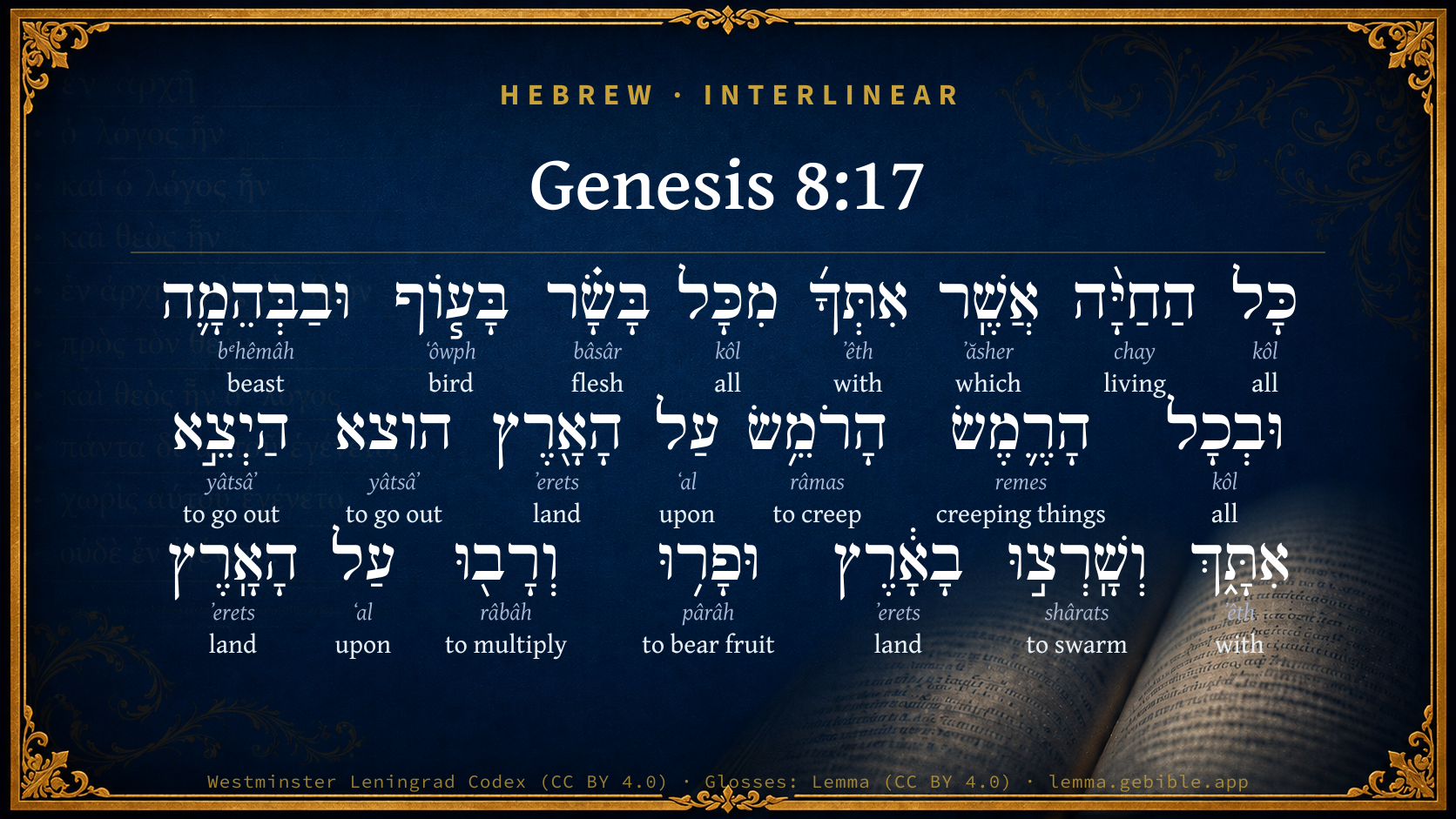
Hebrew (Westminster Leningrad Codex) Genesis 8:17 appears in the Hebrew Old Testament. The text above is from the Westminster Leningrad Codex. Each word links to its Strong’s number, a concise gloss, and parsing drawn from the Open Scriptures Hebrew Bible morphology. Click any word for its full Brown-Driver-Briggs (BDB) entry.
Download image
Cite this verse

Genesis 8:17 (World English Bible). Public Domain. Lemma interlinear Bible study tool, https://lemma.gebible.app/v/genesis/8/17.

Show BibTeX & RIS
BibTeX
RIS
English Translation
Bring forth with you every living thing that is with you of all flesh, including birds, cattle, and every creeping thing that creeps on the earth; that they may breed abundantly in the earth, and be fruitful, and multiply on the earth."
World English Bible · Public Domain
Download a study sheet

One document with this verse’s original text, its word-by-word gloss line, the meaning frame, cross-references with their text, attributed commentary, and full source and license credits — printable, and it pastes into notes with its structure intact.

This verse Autodidact and up

Study sheet (.html) Plain text (.txt)

A passage Seminary Student

Up to 50 verses in one chapter. A passage sheet keeps up to 6 commentary sources and 12 cross-references per verse, in the order this page ranks them, and says so on the sheet whenever that leaves anything out. Ask for a single verse and you get the Autodidact verse sheet above.

Everything on this page stays free to read, with no account — the sheet is a download of what is already on screen, not access to it.

Want to remove ads? Support Godless Engineer
Compare translations 3

The same verse in 3 English versions, stacked beneath the original-language interlinear above. Click any original word for its lexicon entry.

Each is an independent rendering of the whole verse — the interlinear is not word-aligned to these translations.

Highlighted words mark where these versions differ — a whole-verse word diff, not a word-by-word alignment.

  • World English Bible Public Domain
    Bring forth with you every living thing that is with you of all flesh, including birds, cattle, and every creeping thing that creeps on the earth; that they may breed abundantly in the earth, and be fruitful, and multiply on the earth."
  • King James Version Public Domain
    Bring forth with thee every living thing that is with thee, of all flesh, both of fowl, and of cattle, and of every creeping thing that creepeth upon the earth; that they may breed abundantly in the earth, and be fruitful, and multiply upon the earth.
  • unfoldingWord Literal Text CC BY-SA 4.0
    Bring out with you every living thing that with you, all flesh, including the birds and the livestock and every creeper creeping on the earth, so that they will abound on the earth and be fruitful and multiply over the earth.”

unfoldingWord Literal Text — © unfoldingWord, licensed CC BY-SA 4.0. Word-aligned USFM3 via Door43 (git.door43.org/unfoldingWord/en_ult).

Versions to compare (up to 4)

3 of 4 selected

Show all 18 translations

Every available English version of this verse, each an independent rendering of the whole verse.

  • World English Bible Public Domain
    Bring forth with you every living thing that is with you of all flesh, including birds, cattle, and every creeping thing that creeps on the earth; that they may breed abundantly in the earth, and be fruitful, and multiply on the earth."
  • Berean Standard Bible Public Domain
    Bring out all the living creatures that are with you—birds, livestock, and everything that crawls upon the ground—so that they can spread out over the earth and be fruitful and multiply upon it.”
  • Majority Standard Bible Public Domain
    Bring out all the living creatures that are with you—birds, livestock, and everything that crawls upon the ground—so that they can spread out over the earth and be fruitful and multiply upon it.”
  • King James Version Public Domain
    Bring forth with thee every living thing that is with thee, of all flesh, both of fowl, and of cattle, and of every creeping thing that creepeth upon the earth; that they may breed abundantly in the earth, and be fruitful, and multiply upon the earth.
  • American Standard Version (1901) Public Domain
    Bring forth with thee every living thing that is with thee of all flesh, both birds, and cattle, and every creeping thing that creepeth upon the earth; that they may breed abundantly in the earth, and be fruitful, and multiply upon the earth.
  • Revised Version (1885) Public Domain
    Bring forth with thee every living thing that is with thee of all flesh, both fowl, and cattle, and every creeping thing that creepeth upon the earth; that they may breed abundantly in the earth, and be fruitful, and multiply upon the earth.
  • Geneva Bible (1599) Public Domain
    Bring forth with thee euery beast that is with thee, of all flesh, both foule and cattell, and euery thing that creepeth and moueth vpon the earth, that they may breede abundantly in ye earth, and bring forth fruite and increase vpon ye earth.
  • Douay-Rheims (1899) Public Domain
    All livings things that are with thee of all flesh, as well in fowls as in beasts, and all creeping things that creep upon the earth, bring out with thee, and go ye upon the earth: increased and multiply upon it.
  • Young's Literal Translation Public Domain
    and they have teemed in the earth, and been fruitful, and have multiplied on the earth.'
  • Literal Standard Version CC BY-SA 4.0
    and they have teemed in the earth, and been fruitful, and have multiplied on the earth.”
  • Unlocked Literal Bible CC BY-SA 4.0
    Take out with you every living creature of all flesh that is with you—the birds, the animals, and every creeping thing that creeps upon the earth—so that they may grow unto very large numbers of living creatures throughout the earth, be fruitful, and multiply upon the earth.”
  • unfoldingWord Literal Text CC BY-SA 4.0
    Bring out with you every living thing that with you, all flesh, including the birds and the livestock and every creeper creeping on the earth, so that they will abound on the earth and be fruitful and multiply over the earth.”
  • Darby Bible Public Domain
    Bring forth with thee every animal which is with thee, of all flesh, fowl as well as cattle, and all the creeping things which creep on the earth, that they may swarm on the earth, and may be fruitful and multiply on the earth.
  • World Messianic Bible Public Domain
    Bring out with you every living thing that is with you of all flesh, including birds, livestock, and every creeping thing that creeps on the earth, that they may breed abundantly in the earth, and be fruitful, and multiply on the earth.”
  • Webster's Bible Public Domain
    Bring forth with thee every living animal that is with thee, of all flesh, of fowl, and of cattle, and of every creeping animal that creepeth upon the earth; that they may breed abundantly on the earth, and be fruitful, and multiply upon the earth.
  • Free Bible Version CC BY-SA 4.0
    Let all the animals go—the birds, the wild animals, the creatures that run along the ground—so that they can breed and increase their numbers on the earth.”
  • Bible in Basic English Public Domain
    Take out with you every living thing which is with you, birds and cattle and everything which goes on the earth, so that they may have offspring and be fertile and be increased on the earth.
  • JPS Tanakh (1917) Public Domain
    Bring forth with thee every living thing that is with thee of all flesh, both fowl, and cattle, and every creeping thing that creepeth upon the earth; that they may swarm in the earth, and be fruitful, and multiply upon the earth.'

Literal Standard Version (2020), Covenant Press — licensed CC BY-SA 4.0. Text via the HelloAO Bible API (eBible.org). Unlocked Literal Bible (unfoldingWord) — licensed CC BY-SA 4.0. Text via the HelloAO Bible API (eBible.org). unfoldingWord Literal Text — © unfoldingWord, licensed CC BY-SA 4.0. Word-aligned USFM3 via Door43 (git.door43.org/unfoldingWord/en_ult). Free Bible Version, Dr. Jonathan Gallagher — licensed CC BY-SA 4.0. Text via the HelloAO Bible API (eBible.org).

Word by word

More ways to search: Search by grammar → Find every occurrence → Compare this word →

Practice this passage: Drill this verse → Learn its vocabulary →

וְשָֽׁרְצ֣וּ
shârats
H8317
“and · to swarm”
Conjunction + Verb, Qal, Sequential Perfect, 3rd Person, Common, Plural
Part of Speech
Conjunction + Verb
Stem
Qal
Form
Sequential Perfect
Person
3rd Person
Gender
Common
Number
Plural
Full BDB Definition

Origin: a primitive root

TWOT: 2467

(Qal) to teem, swarm, multiply - to swarm, teem - to swarm
  1. כָּל kôl H3605 “all of” Noun, Common, Masculine, Singular, Construct
  2. הַחַיָּ֨ה chay H2416 “the · living” Particle, Definite Article + Noun, Common, Feminine, Singular, Absolute
  3. אֲשֶֽׁר ʼăsher H834 “which” Particle, Relative
  4. אִתְּךָ֜ ʼêth H854 “with · you” Preposition + Suffix, Personal, 2nd Person, Masculine, Singular
  5. מִכָּל kôl H3605 “from · all of” Preposition + Noun, Common, Masculine, Singular, Construct
  6. בָּשָׂ֗ר bâsâr H1320 “flesh” Noun, Common, Masculine, Singular, Absolute
  7. בָּע֧וֹף ʻôwph H5775 “in/at the · bird” Preposition, Determined + Noun, Common, Masculine, Singular, Absolute
  8. וּבַבְּהֵמָ֛ה bᵉhêmâh H929 “and · in/at the · beast” Conjunction + Preposition, Determined + Noun, Common, Feminine, Singular, Absolute
  9. וּבְכָל kôl H3605 “and · in/at · all of” Conjunction + Preposition + Noun, Common, Masculine, Singular, Construct
  10. הָרֶ֛מֶשׂ remes H7431 “the · creeping things” Particle, Definite Article + Noun, Common, Masculine, Singular, Absolute
  11. הָרֹמֵ֥שׂ râmas H7430 “the · creeping” Particle, Definite Article + Verb, Qal, Participle Active, Masculine, Singular, Absolute
  12. עַל ʻal H5921 “upon” Preposition
  13. הָאָ֖רֶץ ʼerets H776 “the · land” Particle, Definite Article + Noun, Common, Both, Singular, Absolute
  14. הוצא yâtsâʼ H3318 “go out” Verb, Hiphil, Imperative, 2nd Person, Masculine, Singular
  15. הַיְצֵ֣א yâtsâʼ H3318 “go out” Verb, Hiphil, Imperative, 2nd Person, Masculine, Singular
  16. אִתָּ֑ךְ ʼêth H854 “with · you” Preposition + Suffix, Personal, 2nd Person, Feminine, Singular
  17. בָאָ֔רֶץ ʼerets H776 “in/at the · land” Preposition, Determined + Noun, Common, Both, Singular, Absolute
  18. וּפָר֥וּ pârâh H6509 “and · to bear fruit” Conjunction + Verb, Qal, Sequential Perfect, 3rd Person, Common, Plural
  19. וְרָב֖וּ râbâh H7235 “and · to multiply” Conjunction + Verb, Qal, Sequential Perfect, 3rd Person, Common, Plural
  20. עַל ʻal H5921 “upon” Preposition
  21. הָאָֽרֶץ ʼerets H776 “the · land” Particle, Definite Article + Noun, Common, Both, Singular, Absolute

About this verse

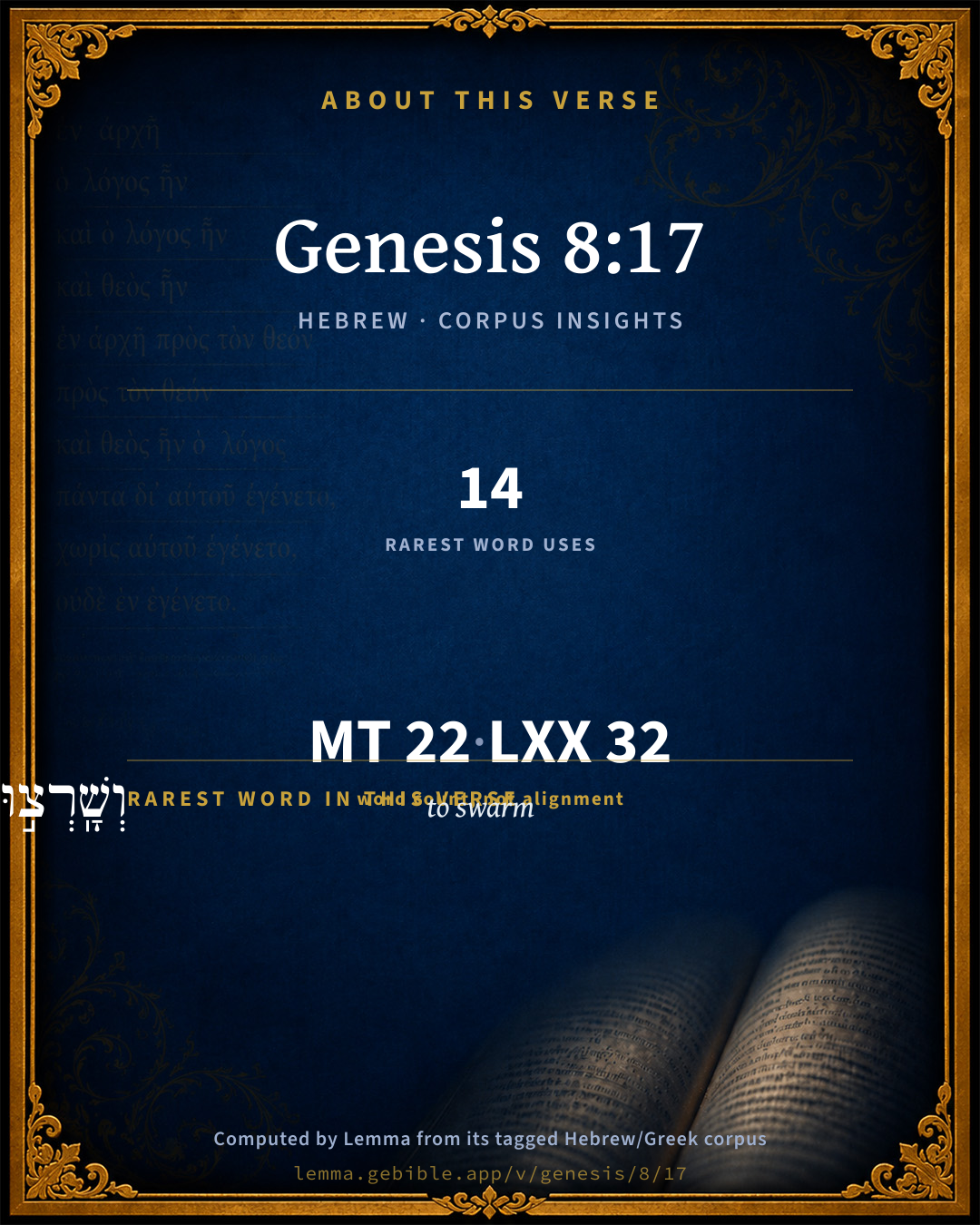
These counts appear in no published source. They are computed here, from the morphology-tagged text and Lemma’s own curated glosses. What Lemma adds →

22
words
15
distinct lemmas
Pentateuch
section

Notable vocabulary

The rarest word here is וְשָֽׁרְצ֣וּ to swarm H8317 — appearing just 14 times in the whole Hebrew Bible.

Shared distinctive vocabulary

וְשָֽׁרְצ֣וּ to swarm H8317 occurs in 14 verses of the Hebrew Bible. Also found in:

Grammatical profile

  • 6 verbs
  • 11 nouns
  • 4 prepositions
  • 1 particle

Verb forms

  • הָרֹמֵ֥שׂ Qal · Participle Active
  • הוצא Hiphil · Imperative
  • הַיְצֵ֣א Hiphil · Imperative
  • וְשָֽׁרְצ֣וּ Qal · Sequential Perfect
  • וּפָר֥וּ Qal · Sequential Perfect
  • וְרָב֖וּ Qal · Sequential Perfect

Repetition

Words recur within this verse — often emphatic in Hebrew:

  • כָּל all H3605 ×3
  • הָאָ֖רֶץ land H776 ×3
  • עַל upon H5921 ×2
  • הוצא to go out H3318 ×2
  • אִתְּךָ֜ with H854 ×2

Hebrew & Septuagint length

In English translation the verse runs 42 words from the Hebrew and 38 from the Septuagint (LXX English) — closely comparable.

A rough comparison of the two English renderings, which tokenize alike — not a word-level alignment.

Word counts can differ between the Hebrew and the Greek without any difference in meaning — e.g. the Hebrew direct-object marker אֵת has no separate Greek word, and Greek often adds the article ὁ.

In the original languages it is 22 Hebrew tokens and 32 Greek tokens — but the two are counted differently (Hebrew bundles its prefixes and suffixes into one token; the Greek is in lemma form), so that isn’t a like-for-like length.

Cross-references

8

Topical passages linked to Genesis 8:17 in the Treasury of Scripture Knowledge — connected by theme and wording, ordered by reader-vote popularity; previews shown in the World English Bible.

  • Genesis 1:22 God blessed them, saying, "Be fruitful, and multiply, and fill the waters in the seas, and let birds multiply on the earth."
  • Genesis 9:1 God blessed Noah and his sons, and said to them, "Be fruitful, and multiply, and replenish the earth.
  • Psalms 107:38 He blesses them also, so that they are multiplied greatly. He doesn't allow their cattle to decrease.
  • Jeremiah 31:27–28 Behold, the days come, says Yahweh, that I will sow the house of Israel and the house of Judah with the seed of man, and with the seed of animal.
  • Genesis 1:28 God blessed them. God said to them, "Be fruitful, multiply, fill the earth, and subdue it. Have dominion over the fish of the sea, over the birds of the sky, and over every living thing that moves on the earth."
  • Genesis 7:14–15 they, and every animal after its kind, all the cattle after their kind, every creeping thing that creeps on the earth after its kind, and every bird after its kind, every bird of every sort.
  • Genesis 9:7 Be fruitful, and multiply. Bring forth abundantly in the earth, and multiply in it."
  • Psalms 144:13–14 Our barns are full, filled with all kinds of provision. Our sheep bring forth thousands and ten thousands in our fields.

Cross-references courtesy of OpenBible.info (CC BY 4.0).

Hebrew and Greek witnesses Masoretic Hebrew ↔ Greek Septuagint

The same verse in the two great witnesses to the Old Testament, shown verse-for-verse.

These are two independent witnesses, not word-aligned to each other, and the Septuagint is shown in lemma (dictionary) form.

Hebrew Genesis 8:17 Masoretic · Westminster Leningrad Codex

כָּל הַחַיָּ֨ה אֲשֶֽׁר אִתְּךָ֜ מִכָּל בָּשָׂ֗ר בָּע֧וֹף וּבַבְּהֵמָ֛ה וּבְכָל הָרֶ֛מֶשׂ הָרֹמֵ֥שׂ עַל הָאָ֖רֶץ הוצא הַיְצֵ֣א אִתָּ֑ךְ וְשָֽׁרְצ֣וּ בָאָ֔רֶץ וּפָר֥וּ וְרָב֖וּ עַל הָאָֽרֶץ

Bring forth with you every living thing that is with you of all flesh, including birds, cattle, and every creeping thing that creeps on the earth; that they may breed abundantly in the earth, and be fruitful, and multiply on the earth."

World English Bible · Public Domain

Greek LXX Genesis 8:17 Septuagint · lemma form

καί πᾶς ὁ θηρίον ὅσος εἰμί μετά σύ καί πᾶς σάρξ ἀπό πετεινόν ἕως κτῆνος καί πᾶς ἑρπετόν κινέω ἐπί ὁ γῆ ἐκἄγω μετά σεαυτοῦ καί αὐξάνω καί πληθύνω ἐπί ὁ γῆ

And all the wild beasts as many as are with you, and all flesh both of birds and beasts, and every reptile moving upon the earth, bring forth with you: and increase you⌃ and multiply upon the earth.

LXX2012 (modern English Septuagint) · Public Domain

Hebrew: Westminster Leningrad Codex (CC BY 4.0). Greek: Septuagint (public domain); English from LXX2012 (modern English Septuagint) (Public Domain). How the Septuagint differs from the Hebrew →

Targum (Aramaic paraphrase)

2

The Targum is the ancient Jewish Aramaic paraphrase of the Hebrew Scriptures — an interpretive translation, not the Hebrew text itself. Onkelos (literal) and Pseudo-Jonathan (expansive) render the Torah, and Jonathan the Prophets. Coverage is partial: where no permissively-licensed English translation exists for a verse, only the Aramaic is shown. This is verse-level text, not a word-by-word alignment to the Hebrew.

  1. Targum Onkelos Torah (Genesis–Deuteronomy)
    כָּל חַיְתָא דְּעִמָּךְ מִכָּל בִּשְׂרָא בְּעוֹפָא וּבִבְעִירָא וּבְכָל רִחֲשָׁא דְּרָחֵשׁ עַל אַרְעָא אַפֵּיק עִמָּךְ וְיִתְיַלְּדוּן בְּאַרְעָא וְיִפְּשׁוּן וְיִסְגּוּן עַל אַרְעָא

    Every living thing which is with thee of all flesh, of fowl, and of cattle, and every creeping thing that creepeth upon the earth, bring forth with thee, and they shall generate in the earth, and spread abroad and multiply upon the earth.

    Targum Onkelos — Aramaic: “Onkelos Genesis” (public domain); “Onkelos Exodus” (public domain); “Onkelos Leviticus” (public domain); “Onkelos Numbers” (public domain); “Onkelos Deuteronomy” (public domain). English: “Sefaria Community Translation” (CC0 1.0 (public-domain dedication)); “J.W. Etheridge. The Targums of Onkelos and Jonathan Ben Uzziel on the Pentateuch. London: Longmans, Green, 1862” (public domain). Text via Sefaria.

  2. Targum Pseudo-Jonathan Torah (Genesis–Deuteronomy)
    כָּל חַיְתָא דְעִמָךְ מִכָּל בִּשְרָא בְּעוֹפָא וּבִבְעִירָא וּבְכָל רִיחֲשָׁא דַרְחֵישׁ עַל אַרְעָא הַנְפֵּק עִמָךְ וְיִתְיַלְדוּן בְּאַרְעָא וְיִפְשׁוּן וְיִסְגוּן עַל אַרְעָא

    Every living animal that is with thee of all flesh, of fowl, of cattle, and of every reptile that creepeth on the earth, bring forth with thee, that they may produce in the earth, and spread abroad and multiply on the earth.

    Targum Pseudo-Jonathan — Aramaic: “Targum Jonathan on Genesis” (public domain); “Targum Jonathan on Exodus” (public domain); “Targum Jonathan on Leviticus” (public domain); “Targum Jonathan on Numbers” (public domain); “Targum Jonathan on Deuteronomy” (public domain). English: “The Targum of Jonathan ben Uzziel, trans. J. W. Etheridge, London, 1862” (public domain). Text via Sefaria.

Commentary

Notes on Genesis 8:17 from classic Christian and Jewish commentators (each source and its license shown beneath its notes). The classic Christian expositions comment on the surrounding passage and are grouped to its opening verse, so a note may address several verses; the Jewish commentaries on the Tanakh (Rashi and others) are per-verse, so they appear only where the commentator wrote on this verse.

Lemma curates 59 commentaries, every one of them public domain or Creative Commons licensed, each selected and text-cleaned for this edition rather than reprinted as found. About our sources →

Trapp's Complete Commentary

John Trapp

Gen 8:17 Bring forth with thee every living thing that [is] with thee, of all flesh, [both] of fowl, and of cattle, and of every creeping thing that creepeth upon the earth; that they may breed abundantly in the earth, and be fruitful, and multiply upon the earth.

Ver. 17. That they may breed abundantly.] R. Solomon thinks that not only reasonable, but unreasonable creatures also did forbear carnal copulation during the flood; {See Trapp on "Gen 7:7"} which yet Mercer holds not probable.

John Trapp, A Commentary or Exposition upon All the Books of the Old and New Testament (1647–1656) — public domain. Text from a community e-Sword module.

Tyndale Open Study Notes

Tyndale Open Resources

8:17 be fruitful and multiply: See 9:1.

Tyndale Open Study Notes — © Tyndale Open Resources, licensed CC BY-SA 4.0. Text via the HelloAO Bible API.

John Calvin's Commentaries

17. That they may breed abundantly, etc. With these words the Lord would cheer the mind of Noah, and inspire him with confidence, that a seed had been preserved in the ark which should increase till it replenished the whole earth. In short, the renovation of the earth is promised to Noah; to the end that he may know that the world itself was inclosed in the ark, and that the solitude and devastation, at the sight of which his heart might faint, would not be perpetual.

John Calvin's Commentaries (1540-1563) — public domain. Text from the Calvin Translation Society English edition (1840s-50s) via the Christian Classics Ethereal Library (ccel.org). Calvin's coverage is partial (roughly two-thirds of the Bible); uncommented books and verses are honest gaps, never fabricated. The 19th-century editor's footnotes and remarks are omitted so the notes are faithfully Calvin's own voice.

The Cambridge Bible for Schools and Colleges

gen. ed. J. J. S. Perowne

17. that they may breed abundantly] The same word as in Gen_1:20, “let the waters bring forth abundantly” (see note). Cf. Gen_9:7.

be fruitful, and multiply] as in Gen_1:22; Gen_1:24-28. The repetition of the Creation command marks the beginning of a new era in the history of the world. The fuller blessing, according to P, is given in chap. 9 (Gen_8:1-7). For the detailed enumeration in Gen_8:18-19, cf. Gen_7:13-14 P.

The Cambridge Bible for Schools and Colleges (gen. ed. J. J. S. Perowne; Cambridge University Press, 1878–1918) — public domain. Text from a community e-Sword module.

John Gill's Exposition

And Noah went forth,.... Being obedient to the divine command, and no doubt with great pleasure in his countenance, and with a heart full of thankfulness for so great a deliverance:

and his sons, and his wife, and his sons' wives with him: in all eight persons, and no more were saved in the ark, as Peter observes, Pe1 3:20 and the Arabic writers say (a), Noah and his sons built a city near the place where they came out of the ark, and called it Themanin, giving this as a reason of the name, we are eight, that is, who have escaped; so Berosus says (b), that the earth being dried of the waters, there were then only eight men in Armenia, from whence all mankind sprung.

(a) Elmacleus, p. 12. Patricides, p. 10. apud Hottinger. Smegma Oriental. l. 1. c. 8. p. 282. (b) Hist. l. 2. fol. 11. 1.

John Gill's Exposition of the Whole Bible (1746–1763) — public domain (CC PDM 1.0). Text via the HelloAO Bible API.

Haydock's Catholic Bible Commentary

Increase. Hebrew, "let them increase." This is spoken of the brute creation, the blessing is given to men. (chap. ix.) --- Neither Noe’s family, nor any of the animals, had any young in the ark. (Calmet)

George Leo Haydock (1774–1849), Haydock's Catholic Family Bible and Commentary, 1859 edition — public domain. Excludes Psalms (Douay-Rheims chapter numbering differs from Protestant) and Deuterocanonical books (Catholic canon only).

Matthew Poole's English Annotations

Quest. How could these creatures which came out of the ark in Asia get thence to America, or to the islands remote from the continent?

Answ. 1. As for America, it is thought by divers learned men, that it is either joined to this continent, or separated from it only by a narrow sea, which divers living creatures could easily swim over.

2. Many living creatures are, and always were, transported by men in their vessels, either for their supply, or profit, or diversion, or other ends, and thence might easily be propagated there.

3. The same God who made all these creatures, and caused them to come first to Adam, and afterwards to Noah, could afterwards both incline and empower them to go whither he pleased, without the advice of these vain men, who will believe nothing of God which themselves either do not see or cannot do.

Matthew Poole's English Annotations on the Holy Bible (1683–1685) — public domain. Text from a community e-Sword/MySword module.

Rashi

Rabbi Shlomo Yitzchaki (Rashi)

הוצא BRING FORTH — The Ketib is הוצא and the Keri היצא —;היצא means, “tell them to go forth”, הוצא means, ‘‘if they do not wish (if they refuse) to go forth, you make them go out”.

ושרצו בארץ THAT THEY MAY BRING FORTH ABUNDANTLY IN THE EARTH but not in the Ark: this teaches that cattle and fowls also were separated, male and female, in the Ark (Genesis Rabbah 34:8).

Rashi on the Tanakh — English translations: “The Judaica Press complete Tanach with Rashi, translated by A. J. Rosenberg” (CC BY 4.0); “Pentateuch with Rashi's commentary by M. Rosenbaum and A.M. Silbermann, 1929-1934” (public domain); “The Metsudah Tanach series, Lakewood, N.J” (CC BY 4.0); and “The Book of Joshua, Metsudah Publications, 1997” (CC BY 4.0). Text via Sefaria.

Radak

Rabbi David Kimhi (Radak)

כל החיה, a general clause followed by a specific clause. The meaning of the expression כל החיה is “all the living creatures,” as in מכל בשר on a previous occasion, whereas the meaning of the words later on in 9,10 is the same. The verse speaks about the life-force {abstract, i.e. נפש החיה, often equated in the Torah with the life-blood, Ed.] hence the prefixes ב before the words עוף, בהמה כל הרמש.

הוצא, the letter ו in the middle instead of the letter י is not unusual in verbs whose first root letter is supplanted by the letter ו. Nonetheless the ו is read as if it were a י. We have a similar construction in Psalms 5,9 הישר לפני דרכך, which is spelled הושר, “make Your way straight before me.” Proverbs 4,25 יישירו נגדך is another such example. The meaning of the instruction is: “take them out just as you have brought them in!”

ושרצו בארץ, a duplication of the blessing/command after the living creatures had been created (Genesis 1,22. The reason why this time G’d uses the word שרץ previously applied to the multiple births by fish, (1,20) is because this time only a very few of each species left the ark so that they needed the encouragement by being told they would once more be very numerous. ושרצו ופרו ורבו, this is a most unusual sequence, beginning with the word שרצו, implying the very least individuality, switching to relative individuality by the use of the word פרו, implying single births, and ending with the word רבו implying single births at frequent intervals (compare our comments in chapter 1 20 and 28 on the meaning of these terms. In Bereshit Rabbah 34,8 the emphasis in this verse is on the word בארץ, meaning that whereas it had been forbidden to engage in reproduction while in the ark, now this could all be made up for.

Radak on the Tanakh — English translations: “Sefaria Community Translation” (CC0 1.0 (public-domain dedication)); “Eliyahu Munk, HaChut Hameshulash” (CC BY 4.0); “Rabbi Mike Feuer, Jerusalem Anthology” (CC BY 4.0); and “R. David Kimhi on the first book of Psalms, Translated by R.G. Finch, London, 1919” (public domain). Text via Sefaria.

Lesson kit

Teaching starters — assembled from the data on this page, not authored interpretation. Every prompt links to the verse data it draws on. Edit before teaching.

Genesis, in the Pentateuch, opens this verse with 22 words (15 distinct Hebrew lemmas). Its most distinctive word is shârats (“to swarm”). A historical commentator’s framing appears above. Read the whole chapter for the surrounding context.

Discussion questions

  1. What does “to swarm” (shârats) contribute to the verse as a whole?
  2. Genesis 1:20 shares the word «to swarm» with this verse. How do the two illuminate each other?
  3. “all” occurs 3× in this one verse. What is the effect of the repetition?
  4. The translations on this page render this verse differently — a whole-verse word diff, not a word-by-word alignment. What might account for the different wordings?
  5. The verb «הָרֹמֵ֥שׂ» is Qal Participle Active. How does its form color the action?
  6. Reading how Trapp's Complete Commentary and Tyndale Open Study Notes read this verse, where do the two commentators agree and where do they part?

Things to notice

Reading settings

Reading text

Shown beneath each verse's original-language words.

Old Testament
Old Testament edition

Read the OT as the Masoretic Hebrew (MT) or the Greek Septuagint (LXX).

English shown for the Greek Septuagint (in the Hebrew ↔ Greek comparison).

Comparing translations? Open the Compare panel on any verse page to stack up to four side by side.