

2 Corinthians 6:16
Greek (Tischendorf 8th ed.) 2 Corinthians 6:16 appears in the Greek New Testament. The text above is from the Tischendorf 8th edition. Each word links to its Strong’s number and a concise gloss. Click any word for its full Thayer’s Greek Lexicon entry.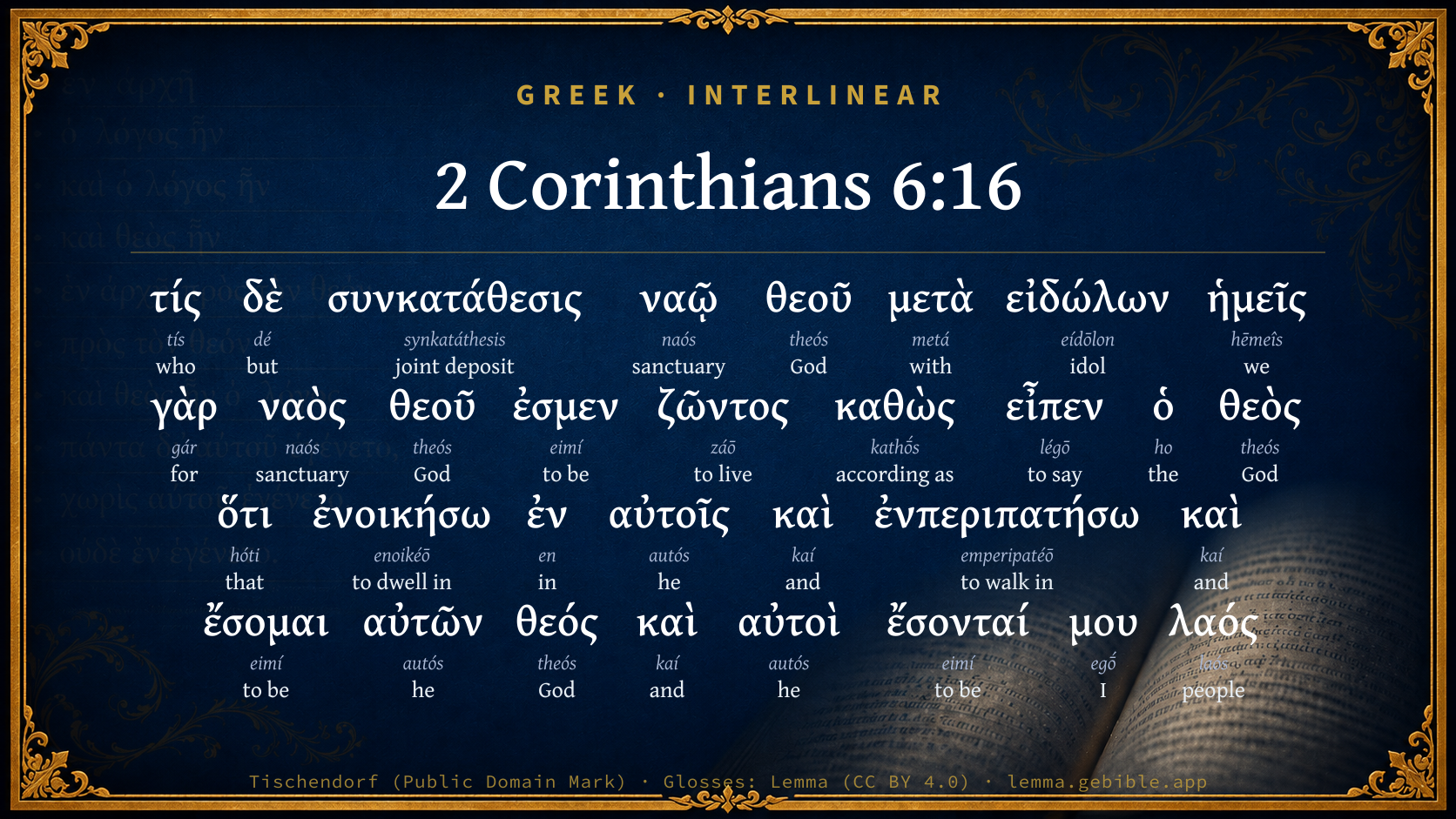
What agreement has a temple of God with idols? For you are a temple of the living God. Even as God said, "I will dwell in them, and walk in them; and I will be their God, and they will be my people."
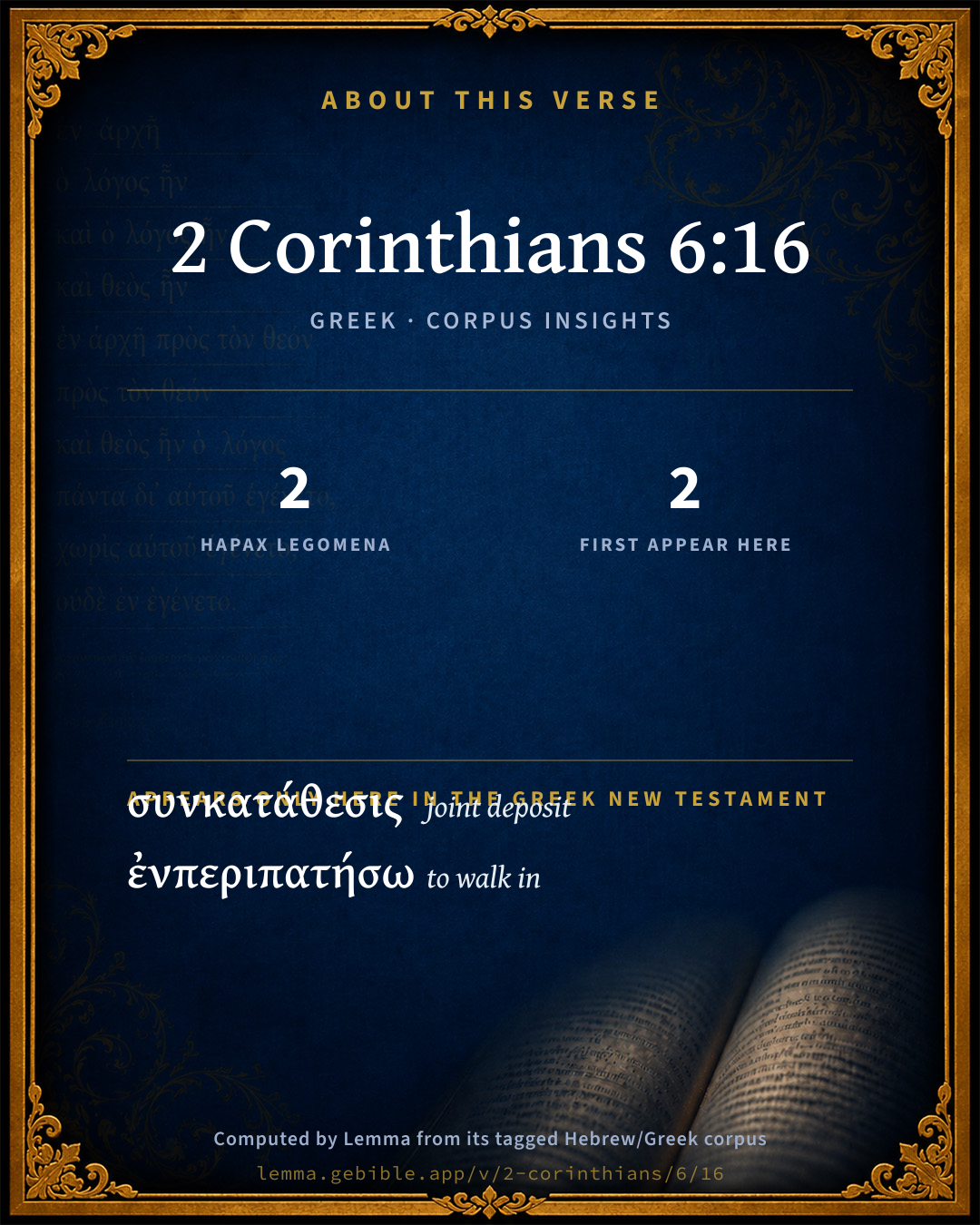
- 2 hapax legomena — only here in the Greek New Testament
- 2 first appearances in the Greek New Testament
Download a study sheet
One document with this verse’s original text, its word-by-word gloss line, the meaning frame, cross-references with their text, attributed commentary, and full source and license credits — printable, and it pastes into notes with its structure intact.
This verse Autodidact and up
A passage Seminary Student
Up to 50 verses in one chapter. A passage sheet keeps up to 6 commentary sources and 12 cross-references per verse, in the order this page ranks them, and says so on the sheet whenever that leaves anything out. Ask for a single verse and you get the Autodidact verse sheet above.
Everything on this page stays free to read, with no account — the sheet is a download of what is already on screen, not access to it.
Compare translations 3
The same verse in 3 English versions, stacked beneath the original-language interlinear above. Click any original word for its lexicon entry.
Each is an independent rendering of the whole verse — the interlinear is not word-aligned to these translations.
Highlighted words mark where these versions differ — a whole-verse word diff, not a word-by-word alignment.
-
World English Bible Public Domain
What agreement has a temple of God with idols? For you are a temple of the living God. Even as God said, "I will dwell in them, and walk in them; and I will be their God, and they will be my people."
-
King James Version Public Domain
And what agreement hath the temple of God with idols? for ye are the temple of the living God; as God hath said, I will dwell in them, and walk in them; and I will be their God, and they shall be my people.
-
unfoldingWord Literal Text CC BY-SA 4.0
And what agreement the temple of God with idols? For we are the temple of the living God, just as God said: “I will dwell among them, and walk; and I will be their God, and they themselves will be my people.”
unfoldingWord Literal Text — © unfoldingWord, licensed CC BY-SA 4.0. Word-aligned USFM3 via Door43 (git.door43.org/unfoldingWord/en_ult).
Show all 19 translations
Every available English version of this verse, each an independent rendering of the whole verse.
-
World English Bible Public Domain
What agreement has a temple of God with idols? For you are a temple of the living God. Even as God said, "I will dwell in them, and walk in them; and I will be their God, and they will be my people."
-
Berean Standard Bible Public Domain
What agreement can exist between the temple of God and idols? For we are the temple of the living God. As God has said: “I will dwell with them and walk among them, and I will be their God, and they will be My people.”
-
Majority Standard Bible Public Domain
What agreement can exist between the temple of God and idols? For you are the temple of the living God. As God has said: “I will dwell with them and walk among them, and I will be their God, and they will be My people.”
-
King James Version Public Domain
And what agreement hath the temple of God with idols? for ye are the temple of the living God; as God hath said, I will dwell in them, and walk in them; and I will be their God, and they shall be my people.
-
American Standard Version (1901) Public Domain
And what agreement hath a temple of God with idols? for we are a temple of the living God; even as God said, I will dwell in them, and walk in them; and I will be their God, and they shall be my people.
-
Revised Version (1885) Public Domain
And what agreement hath a temple of God with idols? for we are a temple of the living God; even as God said, I will dwell in them, and walk in them; and I will be their God, and they shall be my people.
-
Geneva Bible (1599) Public Domain
And what agreement hath the Temple of God with idols? for ye are the Temple of the liuing God: as God hath said, I will dwell among them, and walke there: and I will be their God, and they shalbe my people.
-
Douay-Rheims (1899) Public Domain
And what agreement hath the temple of God with idols? For you are the temple of the living God; as God saith: I will dwell in them, and walk among them; and I will be their God, and they shall be my people.
-
Young's Literal Translation Public Domain
and what agreement to the sanctuary of God with idols? for ye are a sanctuary of the living God, according as God said -- `I will dwell in them, and will walk among `them', and I will be their God, and they shall be My people,
-
Literal Standard Version CC BY-SA 4.0
And what agreement to the temple of God with idols? For you are a temple of the living God, according as God said, “I will dwell in them, and will walk among [them], and I will be their God, and they will be My people,
-
Unlocked Literal Bible CC BY-SA 4.0
And what agreement is there between the temple of God and idols? For we are the temple of the living God, just as God said: “I will dwell among them and walk among them. I will be their God, and they will be my people.”
-
unfoldingWord Literal Text CC BY-SA 4.0
And what agreement the temple of God with idols? For we are the temple of the living God, just as God said: “I will dwell among them, and walk; and I will be their God, and they themselves will be my people.”
-
Darby Bible Public Domain
and what agreement of God's temple with idols? for *ye* are [the] living God's temple; according as God has said, I will dwell among them, and walk among [them]; and I will be their God, and they shall be to me a people.
-
World Messianic Bible Public Domain
What agreement does a temple of God have with idols? For you are a temple of the living God. Even as God said, “I will dwell in them and walk in them. I will be their God and they will be my people.”
-
Webster's Bible Public Domain
And what agreement hath the temple of God with idols? for ye are the temple of the living God; as God hath said, I will dwell in them, and walk in them; and I will be their God, and they shall be my people.
-
Free Bible Version CC BY-SA 4.0
What compromise could the Temple of God make with idols? For we are a temple of the living God, just as God said: “I will live in them and walk among them. I will be their God, and they will be my people.”
-
Bible in Basic English Public Domain
And what agreement has the house of God with images? for we are a house of the living God; even as God has said, I will be living among them, and walking with them; and I will be their God, and they will be my people.
-
Text-Critical English NT CC BY 4.0
And what agreement does the temple of God have with idols? For you are the temple of the living God, just as God said, “I will dwell in them and walk among them. I will be their God, and they will be my people.
-
Tyndale New Testament (1534) Public Domain
how agreeth the temple of god with ymages? And ye are the temple of that lyuynge god as sayde god. I will dwell amonge the and walke amonge the and wilbe their god: and they shalbe my people.
Literal Standard Version (2020), Covenant Press — licensed CC BY-SA 4.0. Text via the HelloAO Bible API (eBible.org). Unlocked Literal Bible (unfoldingWord) — licensed CC BY-SA 4.0. Text via the HelloAO Bible API (eBible.org). unfoldingWord Literal Text — © unfoldingWord, licensed CC BY-SA 4.0. Word-aligned USFM3 via Door43 (git.door43.org/unfoldingWord/en_ult). Free Bible Version, Dr. Jonathan Gallagher — licensed CC BY-SA 4.0. Text via the HelloAO Bible API (eBible.org).
Word by word
More ways to search: Search by grammar → Find every occurrence → Compare this word →
Practice this passage: Drill this verse → Learn its vocabulary →
- Appears 1× in the Greek New Testament
- First appears here
- Part of Speech
- Noun
- Case
- Nominative
- Number
- Singular
- Gender
- Feminine
Full Thayer's Definition
- τίς tís G5101 “who” Interrogative pronoun, Nominative, Singular, Feminine
- δὲ dé G1161 “but” Conjunction
- συνκατάθεσις synkatáthesis G4783 “joint deposit” Noun, Nominative, Singular, Feminine
- ναῷ naós G3485 “sanctuary” Noun, Dative, Singular, Masculine
- θεοῦ theós G2316 “God” Noun, Genitive, Singular, Masculine
- μετὰ metá G3326 “with” Preposition
- εἰδώλων eídōlon G1497 “idol” Noun, Genitive, Plural, Neuter
- ἡμεῖς hēmeîs G2249 “we” Personal pronoun, 1st person, Nominative, Plural
- γὰρ gár G1063 “for” Conjunction
- ναὸς naós G3485 “sanctuary” Noun, Nominative, Singular, Masculine
- θεοῦ theós G2316 “God” Noun, Genitive, Singular, Masculine
- ἐσμεν eimí G1510 “to be” Verb, Present, Active, Indicative, 1st person, Plural
- ζῶντος záō G2198 “to live” Verb, Present, Active, Participle, Genitive, Singular, Masculine
- καθὼς kathṓs G2531 “according as” Adverb
- εἶπεν légō G3004 “to say” Verb, Aorist, Active, Indicative, 3rd person, Singular
- ὁ ho G3588 “the” Article, Nominative, Singular, Masculine
- θεὸς theós G2316 “God” Noun, Nominative, Singular, Masculine
- ὅτι hóti G3754 “that” Conjunction
- ἐνοικήσω enoikéō G1774 “to dwell in” Verb, Future, Active, Indicative, 1st person, Singular
- ἐν en G1722 “in” Preposition
- αὐτοῖς autós G846 “he” Personal pronoun, Dative, Plural, Masculine
- καὶ kaí G2532 “and” Conjunction
- ἐνπεριπατήσω emperipatéō G1704 “to walk in” Verb, Future, Active, Indicative, 1st person, Singular
- καὶ kaí G2532 “and” Conjunction
- ἔσομαι eimí G1510 “to be” Verb, Future, Middle deponent, Indicative, 1st person, Singular
- αὐτῶν autós G846 “he” Personal pronoun, Genitive, Plural, Masculine
- θεός theós G2316 “God” Noun, Nominative, Singular, Masculine
- καὶ kaí G2532 “and” Conjunction
- αὐτοὶ autós G846 “he” Personal pronoun, Nominative, Plural, Masculine
- ἔσονταί eimí G1510 “to be” Verb, Future, Middle deponent, Indicative, 3rd person, Plural
- μου egṓ G1473 “I” Personal pronoun, 1st person, Genitive, Singular
- λαός laós G2992 “people” Noun, Nominative, Singular, Masculine
About this verse
These counts appear in no published source. They are computed here, from the morphology-tagged text and Lemma’s own curated glosses. What Lemma adds →
- 32
- words
- 22
- distinct lemmas
- Pauline Epistles
- section
Notable vocabulary
2 hapax legomena — words that appear only here in the entire Greek New Testament:
First appearance in Scripture
These words make their first canonical appearance in the Greek New Testament here:
Shared distinctive vocabulary
ἐνοικήσω to dwell in G1774 occurs in 6 verses of the Greek New Testament. Also found in:
Cross-references
51Topical passages linked to 2 Corinthians 6:16 in the Treasury of Scripture Knowledge — connected by theme and wording, ordered by reader-vote popularity; previews shown in the World English Bible.
- Revelation 21:3 I heard a loud voice out of heaven saying, "Behold, God's dwelling is with people, and he will dwell with them, and they will be his people, and God himself will be with them as their God.
- Exodus 29:45 I will dwell among the children of Israel, and will be their God.
- Hebrews 8:10 "For this is the covenant that I will make with the house of Israel. After those days," says the Lord; "I will put my laws into their mind, I will also write them on their heart. I will be to them a God, And they will be to me a people.
- Leviticus 26:12 I will walk among you, and will be your God, and you will be my people.
- Jeremiah 32:38 and they shall be my people, and I will be their God:
- Ezekiel 37:26–27 Moreover I will make a covenant of peace with them; it shall be an everlasting covenant with them; and I will place them, and multiply them, and will set my sanctuary in the midst of them forevermore.
- 1 Corinthians 3:16–17 Don't you know that you are a temple of God, and that God's Spirit lives in you?
- Ezekiel 11:20 that they may walk in my statutes, and keep my ordinances, and do them: and they shall be my people, and I will be their God.
- Jeremiah 31:33 But this is the covenant that I will make with the house of Israel after those days, says Yahweh: I will put my law in their inward parts, and in their heart will I write it; and I will be their God, and they shall be my people:
- Zechariah 2:10–11 Sing and rejoice, daughter of Zion; for, behold, I come, and I will dwell in the midst of you,' says Yahweh.
- Jeremiah 24:7 I will give them a heart to know me, that I am Yahweh: and they shall be my people, and I will be their God; for they shall return to me with their whole heart.
- 1 Corinthians 6:19 Or don't you know that your body is a temple of the Holy Spirit which is in you, which you have from God? You are not your own,
- Hosea 2:23 I will sow her to me in the earth; And I will have mercy on her who had not obtained mercy; And I will tell those who were not my people, 'You are my people;' And they will say, 'My God!'"
- Romans 8:11 But if the Spirit of him who raised up Jesus from the dead dwells in you, he who raised up Christ Jesus from the dead will also give life to your mortal bodies through his Spirit who dwells in you.
- Revelation 21:7 He who overcomes, I will give him these things. I will be his God, and he will be my son.
- 1 John 4:15 Whoever confesses that Jesus is the Son of God, God remains in him, and he in God.
- Zechariah 8:8 and I will bring them, and they will dwell in the midst of Jerusalem; and they will be my people, and I will be their God, in truth and in righteousness."
- Zechariah 13:9 I will bring the third part into the fire, And will refine them as silver is refined, And will test them like gold is tested. They will call on my name, and I will hear them. I will say, 'It is my people;' And they will say, 'Yahweh is my God.'"
- Genesis 17:7–8 I will establish my covenant between me and you and your seed after you throughout their generations for an everlasting covenant, to be a God to you and to your seed after you.
- Ephesians 3:17 that Christ may dwell in your hearts through faith; to the end that you, being rooted and grounded in love,
- Ezekiel 36:28 You shall dwell in the land that I gave to your fathers; and you shall be my people, and I will be your God.
- John 6:56 He who eats my flesh and drinks my blood lives in me, and I in him.
- Hebrews 3:6 but Christ is faithful as a Son over his house; whose house we are, if we hold fast our confidence and the glorying of our hope firm to the end.
- 1 Peter 2:5 You also, as living stones, are built up as a spiritual house, to be a holy priesthood, to offer up spiritual sacrifices, acceptable to God through Jesus Christ.
- 2 Timothy 1:14 That good thing which was committed to you, guard through the Holy Spirit who dwells in us.
- 1 John 5:20–21 We know that the Son of God has come, and has given us an understanding, that we know him who is true, and we are in him who is true, in his Son Jesus Christ. This is the true God, and eternal life.
- 1 John 4:12 No one has seen God at any time. If we love one another, God remains in us, and his love has been perfected in us.
- Romans 9:26 "It will be that in the place where it was said to them, 'You are not my people,' There they will be called 'children of the living God.'"
- Ezekiel 43:9 Now let them put away their prostitution, and the dead bodies of their kings, far from me; and I will dwell in the midst of them forever.
- Romans 8:9 But you are not in the flesh but in the Spirit, if it is so that the Spirit of God dwells in you. But if any man doesn't have the Spirit of Christ, he is not his.
- Joshua 24:14–24 Now therefore fear Yahweh, and serve him in sincerity and in truth; and put away the gods which your fathers served beyond the River, and in Egypt; and serve you Yahweh.
- Ezekiel 43:7 He said to me, Son of man, [this is] the place of my throne, and the place of the soles of my feet, where I will dwell in the midst of the children of Israel forever. The house of Israel shall no more defile my holy name, neither they, nor their kings, by their prostitution, and by the dead bodies of their kings [in] their high places;
- 2 Chronicles 33:4–5 He built altars in the house of Yahweh, of which Yahweh said, In Jerusalem shall my name be forever.
- Ephesians 2:20 being built on the foundation of the apostles and prophets, Christ Jesus himself being the chief cornerstone;
- 1 Samuel 7:3–4 Samuel spoke to all the house of Israel, saying, If you do return to Yahweh with all your heart, then put away the foreign gods and the Ashtaroth from among you, and direct your hearts to Yahweh, and serve him only; and he will deliver you out of the hand of the Philistines.
- Ezekiel 36:25 I will sprinkle clean water on you, and you shall be clean: from all your filthiness, and from all your idols, will I cleanse you.
- Deuteronomy 5:7 You shall have no other gods before me.
- Deuteronomy 6:14–15 You shall not go after other gods, of the gods of the peoples who are round about you;
- Exodus 20:3 You shall have no other gods before me.
- Exodus 34:14 for you shall worship no other god: for Yahweh, whose name is Jealous, is a jealous God.
- Deuteronomy 4:23–24 Take heed to yourselves, lest you forget the covenant of Yahweh your God, which he made with you, and make you an engraved image in the form of anything which Yahweh your God has forbidden you.
- Psalms 90:1 Lord, you have been our dwelling place for all generations.
- Exodus 23:13 "Be careful to do all things that I have said to you; and don't invoke the name of other gods, neither let them be heard out of your mouth.
- Matthew 6:24 "No one can serve two masters, for either he will hate the one and love the other; or else he will be devoted to one and despise the other. You can't serve both God and Mammon.
- Revelation 2:1 To the angel of the assembly in Ephesus write: "He who holds the seven stars in his right hand, he who walks among the seven golden lampstands says these things:
- Hosea 14:8 Ephraim, what have I to do any more with idols? I answer, and will take care of him. I am like a green fir tree; From me your fruit is found."
- 1 Kings 18:21 Elijah came near to all the people, and said, "How long will you waver between the two sides? If Yahweh is God, follow him; but if Baal, then follow him." The people answered him not a word.
- 2 Kings 17:33–34 They feared Yahweh, and served their own gods, after the manner of the nations from among whom they had been carried away.
- 2 Kings 21:4–5 He built altars in the house of Yahweh, of which Yahweh said, In Jerusalem will I put my name.
- 2 Kings 23:5–7 He put down the idolatrous priests, whom the kings of Judah had ordained to burn incense in the high places in the cities of Judah, and in the places round about Jerusalem; those also who burned incense to Baal, to the sun, and to the moon, and to the planets, and to all the host of the sky.
- Zephaniah 1:5 those who worship the host of the sky on the housetops, those who worship and swear by Yahweh and also swear by Malcam,
Cross-references courtesy of OpenBible.info (CC BY 4.0).
Where the printed editions differ
2 variantsPlaces in this verse where the major printed Greek editions disagree on the wording in a way that affects the translation — a comparison of editions, not a manuscript-by-manuscript collation. The editions are the modern critical texts (Nestlé-Aland 28/27, SBL, Westcott-Hort, Tregelles, Tyndale House) and the traditional texts behind the KJV (the Textus Receptus and the Byzantine/Majority text). It is not a claim about which reading is original.
-
Different wording
ἡμεῖς
“We ourselves”
In NA28NA27TynSBLWHTreg Not in TRByzὙμεῖς (Humeis) 'you yourselves' occurs in traditional manuscripts (TR+Byz) instead of ἡμεῖς (hēmeis) 'We ourselves' in older manuscripts (NA28+NA27+Tyn+SBL+WH+Treg)
-
Different wording
ἐσμεν
“we are”
In NA28NA27TynSBLWHTreg Not in TRByzἐστε (este) 'you are' occurs in traditional manuscripts (TR+Byz) instead of ἐσμεν (esmen) 'we are' in older manuscripts (NA28+NA27+Tyn+SBL+WH+Treg)
Textual data: Translators Amalgamated Greek New Testament (STEPBible TAGNT) · CC BY 4.0.
Lesson kit
Teaching starters — assembled from the data on this page, not authored interpretation. Every prompt links to the verse data it draws on. Edit before teaching.
2 Corinthians, in the Pauline Epistles, opens this verse with 32 words (22 distinct Greek lemmas). Its most distinctive word is synkatáthesis (“joint deposit”). A historical commentator’s framing appears above. Read the whole chapter for the surrounding context.
Discussion questions
- How does “joint deposit” (synkatáthesis) shape what this verse is saying?
- 2 words here appear nowhere else in the Greek New Testament. Why might the author reach for such rare wording?
- 2 words make their first appearance in Scripture here. What does this debut establish?
- How does Romans 7:17, which shares the word «to dwell in», read alongside this verse?
- What does the repetition of “God” (4× in this one verse) do in this verse?
- The translations on this page render this verse differently — a whole-verse word diff, not a word-by-word alignment. What might account for the different wordings?
- Compare how The Biblical Illustrator and Tyndale Open Study Notes read this verse. Where do they agree or differ?
Things to notice
- 2 words in this verse appear nowhere else in the Greek New Testament.
- 2 words make their first canonical appearance in Scripture here.
- These translations choose different wording for 8 words in this verse.
- “God” occurs 4× in this single verse.
- 22 distinct Greek lemmas span 32 words in this verse.
Commentary
Notes on 2 Corinthians 6:16 from classic Christian and Jewish commentators (each source and its license shown beneath its notes). The classic Christian expositions comment on the surrounding passage and are grouped to its opening verse, so a note may address several verses; the Jewish commentaries on the Tanakh (Rashi and others) are per-verse, so they appear only where the commentator wrote on this verse.
Lemma curates 59 commentaries, every one of them public domain or Creative Commons licensed, each selected and text-cleaned for this edition rather than reprinted as found. About our sources →
The Biblical Illustrator
Joseph S. Exell
The Biblical Illustrator, edited by Joseph S. Exell (c. 1880s–1900s) — public domain. Text from a community e-Sword module.
Tyndale Open Study Notes
Tyndale Open Resources
Tyndale Open Study Notes — © Tyndale Open Resources, licensed CC BY-SA 4.0. Text via the HelloAO Bible API.
Bengel's Gnomon
Johann Albrecht Bengel
Bengel's Gnomon of the New Testament — English translation (T&T Clark, Edinburgh, 1860) — public domain. Text from a community e-Sword module.
Meyer's Critical & Exegetical Commentary
Heinrich August Wilhelm Meyer
Meyer — Critical and Exegetical Commentary on the New Testament — English translation by Peter Christie, edited by Frederick Crombie (T&T Clark, 1880) — public domain. Text from a community e-Sword module.
Expositor's Greek Testament
ed. W. Robertson Nicoll
The Expositor's Greek Testament, edited by W. Robertson Nicoll (1897–1910) — public domain. Text from a community e-Sword module.
Geneva Bible (1599)
Geneva Bible translators
Geneva Bible (1599) marginal notes — public domain. Text via Bolls.life.
Jamieson, Fausset & Brown
Robert Jamieson, A. R. Fausset & David Brown
Jamieson, Fausset & Brown — Commentary Critical and Explanatory on the Whole Bible (1871) — public domain (CC PDM 1.0). Text via the HelloAO Bible API.
Adam Clarke's Commentary
Adam Clarke's Commentary on the Bible (1810–1826) — public domain. Text from a community e-Sword/MySword module.
John Calvin's Commentaries
John Calvin's Commentaries (1540-1563) — public domain. Text from the Calvin Translation Society English edition (1840s-50s) via the Christian Classics Ethereal Library (ccel.org). Calvin's coverage is partial (roughly two-thirds of the Bible); uncommented books and verses are honest gaps, never fabricated. The 19th-century editor's footnotes and remarks are omitted so the notes are faithfully Calvin's own voice.
Ellicott's Commentary for English Readers
A Bible Commentary for English Readers, edited by Charles John Ellicott (1878–1897) — public domain. Text from a community e-Sword module.
The Cambridge Bible for Schools and Colleges
gen. ed. J. J. S. Perowne
The Cambridge Bible for Schools and Colleges (gen. ed. J. J. S. Perowne; Cambridge University Press, 1878–1918) — public domain. Text from a community e-Sword module.
John Gill's Exposition
John Gill's Exposition of the Whole Bible (1746–1763) — public domain (CC PDM 1.0). Text via the HelloAO Bible API.
Trapp's Complete Commentary
John Trapp
John Trapp, A Commentary or Exposition upon All the Books of the Old and New Testament (1647–1656) — public domain. Text from a community e-Sword module.
Albert Barnes' Notes on the Bible
Albert Barnes' Notes on the Bible (1834–1885) — public domain. Text from a community e-Sword/MySword module.
Haydock's Catholic Bible Commentary
George Leo Haydock (1774–1849), Haydock's Catholic Family Bible and Commentary, 1859 edition — public domain. Excludes Psalms (Douay-Rheims chapter numbering differs from Protestant) and Deuterocanonical books (Catholic canon only).
Matthew Poole's English Annotations
Matthew Poole's English Annotations on the Holy Bible (1683–1685) — public domain. Text from a community e-Sword/MySword module.
Whedon's Commentary on the Bible
Daniel D. Whedon
Daniel D. Whedon (gen. ed.), Commentary on the Old and New Testaments (1874–1909) — public domain. Text from a community e-Sword module.
The Pulpit Commentary
The Pulpit Commentary (1880–1919), ed. H.D.M. Spence-Jones & Joseph S. Exell — public domain. Text from a community e-Sword module.
John Wesley's Explanatory Notes
John Wesley, Explanatory Notes Upon the Whole Bible (1754–1765) — public domain. Text via the GEBible commentary corpus.
Scofield Reference Notes
C. I. Scofield
The Scofield Reference Bible (1917 edition), notes by C. I. Scofield — public domain. Text from a community e-Sword module.
Burkitt's Expository Notes on the New Testament
William Burkitt
William Burkitt's Expository Notes on the New Testament (1700–1703) — public domain. Text from a community e-Sword module.
McGarvey & Pendleton's Commentaries
J. W. McGarvey
J. W. McGarvey (with Philip Y. Pendleton), Commentaries on the New Testament (The Fourfold Gospel, 1914; Acts; and the epistles) — public domain. Text from a community e-Sword/MySword module.
The People's New Testament
B. W. Johnson
B. W. Johnson's The People's New Testament with Notes (1889–1891) — public domain. Electronic text from the Christian Classics Ethereal Library (CCEL) ThML edition.
Cambridge Greek Testament for Schools and Colleges
Cambridge Greek Testament for Schools and Colleges (Cambridge University Press, 1896; 21 vols, various authors incl. Carr, Maclear, Plummer, Farrar, Lumby, Moule, M. R. James, Simcox) — public domain. Text from a community e-Sword module.
Alford’s Greek Testament
Henry Alford
Henry Alford, The Greek Testament (1849–1861) — public domain. Text from a community e-Sword module.
International Critical Commentary
International Critical Commentary — older volumes (1896–1929), various authors — public domain. Text from a community e-Sword module.
Vincent's Word Studies in the New Testament
Marvin R. Vincent
Marvin R. Vincent, Word Studies in the New Testament (1887–1900) — public domain. Text from a community e-Sword/MySword module.