
Matthew 25:35

Greek (Tischendorf 8th ed.) Matthew 25:35 appears in the Greek New Testament. The text above is from the Tischendorf 8th edition. Each word links to its Strong’s number and a concise gloss. Click any word for its full Thayer’s Greek Lexicon entry.

Download image
Cite this verse

Matthew 25:35 (World English Bible). Public Domain. Lemma interlinear Bible study tool, https://lemma.gebible.app/v/matthew/25/35.

Show BibTeX & RIS
BibTeX
RIS
English Translation
for I was hungry, and you gave me food to eat; I was thirsty, and you gave me drink; I was a stranger, and you took me in;
World English Bible · Public Domain
Highlights
  • 1 first appearance in the Greek New Testament
Full analysis ↓
Download a study sheet

One document with this verse’s original text, its word-by-word gloss line, the meaning frame, cross-references with their text, attributed commentary, and full source and license credits — printable, and it pastes into notes with its structure intact.

This verse Autodidact and up

Study sheet (.html) Plain text (.txt)

A passage Seminary Student

Up to 50 verses in one chapter. A passage sheet keeps up to 6 commentary sources and 12 cross-references per verse, in the order this page ranks them, and says so on the sheet whenever that leaves anything out. Ask for a single verse and you get the Autodidact verse sheet above.

Everything on this page stays free to read, with no account — the sheet is a download of what is already on screen, not access to it.

Want to remove ads? Support Godless Engineer
Compare translations 3

The same verse in 3 English versions, stacked beneath the original-language interlinear above. Click any original word for its lexicon entry.

Each is an independent rendering of the whole verse — the interlinear is not word-aligned to these translations.

Highlighted words mark where these versions differ — a whole-verse word diff, not a word-by-word alignment.

  • World English Bible Public Domain
    for I was hungry, and you gave me food to eat; I was thirsty, and you gave me drink; I was a stranger, and you took me in;
  • King James Version Public Domain
    For I was an hungred, and ye gave me meat: I was thirsty, and ye gave me drink: I was a stranger, and ye took me in:
  • unfoldingWord Literal Text CC BY-SA 4.0
    For I was hungry, and you gave me to eat; I was thirsty, and you gave me to drink; I was a stranger, and you gathered together with me;

unfoldingWord Literal Text — © unfoldingWord, licensed CC BY-SA 4.0. Word-aligned USFM3 via Door43 (git.door43.org/unfoldingWord/en_ult).

Versions to compare (up to 4)

3 of 4 selected

Show all 19 translations

Every available English version of this verse, each an independent rendering of the whole verse.

  • World English Bible Public Domain
    for I was hungry, and you gave me food to eat; I was thirsty, and you gave me drink; I was a stranger, and you took me in;
  • Berean Standard Bible Public Domain
    For I was hungry and you gave Me something to eat, I was thirsty and you gave Me something to drink, I was a stranger and you took Me in,
  • Majority Standard Bible Public Domain
    For I was hungry and you gave Me something to eat, I was thirsty and you gave Me something to drink, I was a stranger and you took Me in,
  • King James Version Public Domain
    For I was an hungred, and ye gave me meat: I was thirsty, and ye gave me drink: I was a stranger, and ye took me in:
  • American Standard Version (1901) Public Domain
    for I was hungry, and ye gave me to eat; I was thirsty, and ye gave me drink; I was a stranger, and ye took me in;
  • Revised Version (1885) Public Domain
    for I was an hungred, and ye gave me meat: I was thirsty, and ye gave me drink: I was a stranger, and ye took me in;
  • Geneva Bible (1599) Public Domain
    For I was an hungred, and ye gaue me meate: I thirsted, and ye gaue me drinke: I was a stranger, and ye tooke me in vnto you.
  • Douay-Rheims (1899) Public Domain
    For I was hungry, and you gave me to eat; I was thirsty, and you gave me to drink; I was a stranger, and you took me in:
  • Young's Literal Translation Public Domain
    for I did hunger, and ye gave me to eat; I did thirst, and ye gave me to drink; I was a stranger, and ye received me;
  • Literal Standard Version CC BY-SA 4.0
    for I hungered, and you gave Me to eat; I thirsted, and you gave Me to drink; I was a stranger, and you received Me;
  • Unlocked Literal Bible CC BY-SA 4.0
    For I was hungry and you gave me food; I was thirsty and you gave me a drink; I was a stranger and you took me in;
  • unfoldingWord Literal Text CC BY-SA 4.0
    For I was hungry, and you gave me to eat; I was thirsty, and you gave me to drink; I was a stranger, and you gathered together with me;
  • Darby Bible Public Domain
    for I hungered, and ye gave me to eat; I thirsted, and ye gave me to drink; I was a stranger, and ye took me in;
  • World Messianic Bible Public Domain
    for I was hungry and you gave me food to eat. I was thirsty and you gave me drink. I was a stranger and you took me in.
  • Webster's Bible Public Domain
    For I was hungry, and ye gave me food: I was thirsty, and ye gave me drink: I was a stranger, and ye took me in:
  • Free Bible Version CC BY-SA 4.0
    For I was hungry, and you gave me food to eat. I was thirsty, and you gave me a drink. I was a stranger, and you invited me in.
  • Bible in Basic English Public Domain
    For I was in need of food, and you gave it to me: I was in need of drink, and you gave it to me: I was wandering, and you took me in;
  • Text-Critical English NT CC BY 4.0
    For I was hungry, and you gave me something to eat; I was thirsty, and you gave me something to drink; I was a stranger, and you took me in;
  • Tyndale New Testament (1534) Public Domain
    For I was anhongred and ye gave me meate. I thursted and ye gave me drinke. I was herbourlesse and ye lodged me.

Literal Standard Version (2020), Covenant Press — licensed CC BY-SA 4.0. Text via the HelloAO Bible API (eBible.org). Unlocked Literal Bible (unfoldingWord) — licensed CC BY-SA 4.0. Text via the HelloAO Bible API (eBible.org). unfoldingWord Literal Text — © unfoldingWord, licensed CC BY-SA 4.0. Word-aligned USFM3 via Door43 (git.door43.org/unfoldingWord/en_ult). Free Bible Version, Dr. Jonathan Gallagher — licensed CC BY-SA 4.0. Text via the HelloAO Bible API (eBible.org).

Word by word

More ways to search: Search by grammar → Find every occurrence → Compare this word →

Practice this passage: Drill this verse → Learn its vocabulary →

ξένος
xénos
G3581
“stranger”
Adjective, Nominative, Singular, Masculine
Part of Speech
Adjective
Case
Nominative
Number
Singular
Gender
Masculine
Full Thayer's Definition

Origin: apparently a primary word

TDNT: 05:01,7

1. a foreigner, a stranger a. alien (from a person or a thing) b. without the knowledge of, without a share in c. new, unheard of 2. one who receives and entertains another hospitably a. with whom he stays or lodges, a host
  1. ἐπείνασα peináō G3983 “to hunger” Verb, Aorist, Active, Indicative, 1st person, Singular
  2. γὰρ gár G1063 “for” Conjunction
  3. καὶ kaí G2532 “and” Conjunction
  4. ἐδώκατέ dídōmi G1325 “to give” Verb, Aorist, Active, Indicative, 2nd person, Plural
  5. μοι egṓ G1473 “I” Personal pronoun, 1st person, Dative, Singular
  6. φαγεῖν phágō G5315 “to eat” Verb, Aorist, Active, Infinitive
  7. ἐδίψησα dipsáō G1372 “to thirst” Verb, Aorist, Active, Indicative, 1st person, Singular
  8. καὶ kaí G2532 “and” Conjunction
  9. ἐποτίσατέ potízō G4222 “to give drink” Verb, Aorist, Active, Indicative, 2nd person, Plural
  10. με egṓ G1473 “I” Personal pronoun, 1st person, Accusative, Singular
  11. ἤμην eimí G1510 “to be” Verb, Imperfect, Middle, Indicative, 1st person, Singular
  12. καὶ kaí G2532 “and” Conjunction
  13. συνηγάγετέ synágō G4863 “to gather together” Verb, Aorist, Active, Indicative, 2nd person, Plural
  14. με egṓ G1473 “I” Personal pronoun, 1st person, Accusative, Singular

About this verse

These counts appear in no published source. They are computed here, from the morphology-tagged text and Lemma’s own curated glosses. What Lemma adds →

15
words
11
distinct lemmas
Gospels
section

Notable vocabulary

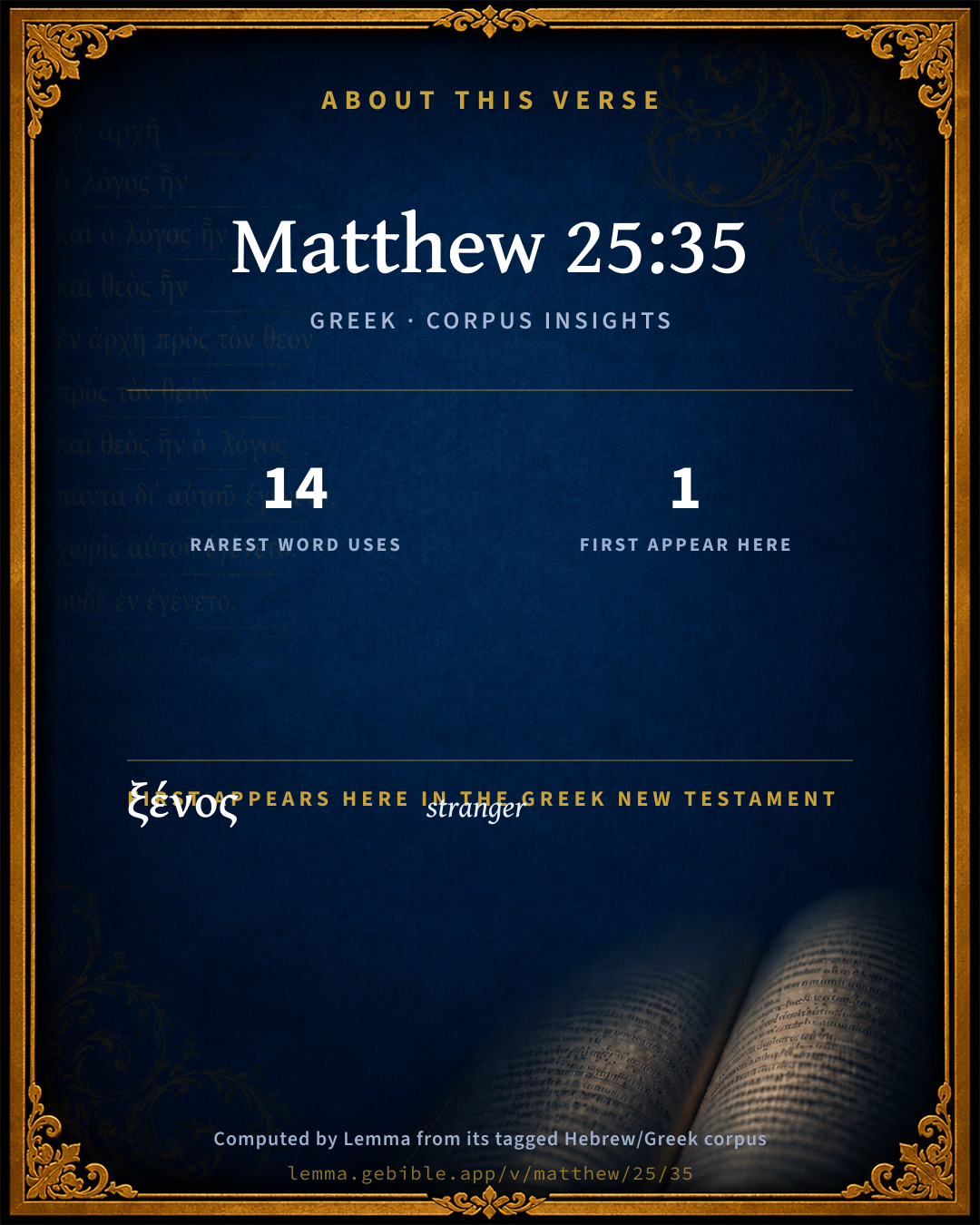
The rarest word here is ξένος stranger G3581 — appearing just 14 times in the whole Greek New Testament.

First appearance in Scripture

This word makes its first canonical appearance in the Greek New Testament here:

  • ξένος stranger G3581

Shared distinctive vocabulary

ξένος stranger G3581 occurs in 14 verses of the Greek New Testament. Also found in:
Repetition

Words recur within this verse:

Cross-references

51

Topical passages linked to Matthew 25:35 in the Treasury of Scripture Knowledge — connected by theme and wording, ordered by reader-vote popularity; previews shown in the World English Bible.

  • 1 John 3:16–19 By this we know love, because he laid down his life for us. And we ought to lay down our lives for the brothers.
  • James 2:15–16 And if a brother or sister is naked and in lack of daily food,
  • Deuteronomy 15:7–11 If there be with you a poor man, one of your brothers, within any of your gates in your land which Yahweh your God gives you, you shall not harden your heart, nor shut your hand from your poor brother;
  • Ezekiel 18:7 and has not wronged any, but has restored to the debtor his pledge, has taken nothing by robbery, has given his bread to the hungry, and has covered the naked with a garment;
  • Ezekiel 18:16 neither has wronged any, has not taken anything to pledge, neither has taken by robbery, but has given his bread to the hungry, and has covered the naked with a garment;
  • Hebrews 13:16 But don't forget to be doing good and sharing, for with such sacrifices God is well pleased.
  • Hebrews 13:1–3 Let brotherly love continue.
  • James 1:27 Pure religion and undefiled before our God and Father is this: to visit the fatherless and widows in their affliction, and to keep oneself unstained by the world.
  • 1 Peter 4:9–10 Be hospitable one to another without grumbling.
  • Romans 12:13 contributing to the needs of the saints; given to hospitality.
  • Job 31:32 (The foreigner has not lodged in the street; But I have opened my doors to the traveler);
  • Isaiah 58:7–11 Isn't it to deal your bread to the hungry, and that you bring the poor who are cast out to your house? when you see the naked, that you cover him; and that you not hide yourself from your own flesh?
  • Romans 12:20 Therefore "If your enemy is hungry, feed him. If he is thirsty, give him a drink. For in doing so, you will heap coals of fire on his head."
  • 1 Timothy 6:17–19 Charge those who are rich in this present world that they not be haughty, nor have their hope set on the uncertainty of riches, but on the living God, who richly provides us with everything to enjoy;
  • Job 29:13–16 The blessing of him who was ready to perish came on me, And I caused the widow's heart to sing for joy.
  • Job 31:16–21 "If I have withheld the poor from their desire, Or have caused the eyes of the widow to fail,
  • Acts 9:36–39 Now there was at Joppa a certain disciple named Tabitha, which when translated, means Dorcas. This woman was full of good works and acts of mercy which she did.
  • Hebrews 6:10 For God is not unrighteous, so as to forget your work and the labor of love which you showed toward his name, in that you served the saints, and still do serve them.
  • 3 John 1:5–8 Beloved, you do a faithful work in whatever you accomplish for those who are brothers and strangers.
  • Proverbs 22:9 He who has a generous eye will be blessed; For he shares his food with the poor.
  • Romans 16:23 Gaius, my host and host of the whole assembly, greets you. Erastus, the treasurer of the city, greets you, as does Quartus, the brother.
  • 2 Corinthians 8:7–9 But as you abound in everything, in faith, utterance, knowledge, all earnestness, and in your love to us, see that you also abound in this grace.
  • 2 Corinthians 9:7–14 Let each man give according as he has determined in his heart; not grudgingly, or under compulsion; for God loves a cheerful giver.
  • Ephesians 4:28 Let him who stole steal no more; but rather let him labor, working with his hands the thing that is good, that he may have something to give to him who has need.
  • 1 Timothy 5:10 being approved by good works, if she has brought up children, if she has been hospitable to strangers, if she has washed the saints' feet, if she has relieved the afflicted, and if she has diligently followed every good work.
  • Philemon 1:7 For we have much joy and comfort in your love, because the hearts of the saints have been refreshed through you, brother.
  • Genesis 18:2–8 He lifted up his eyes and looked, and saw that three men stood opposite him. When he saw them, he ran to meet them from the tent door, and bowed himself to the earth,
  • Genesis 19:1–3 The two angels came to Sodom at evening. Lot sat in the gate of Sodom. Lot saw them, and rose up to meet them. He bowed himself with his face to the earth,
  • Psalms 112:5–10 It is well with the man who deals graciously and lends. He will maintain his cause in judgment.
  • Proverbs 3:9–10 Honor Yahweh with your substance, With the first fruits of all your increase:
  • Proverbs 11:24–25 There is one who scatters, and increases yet more. There is one who withholds more than is appropriate, but gains poverty.
  • Proverbs 14:21 He who despises his neighbor sins, But blessed is he who has pity on the poor.
  • Proverbs 14:31 He who oppresses the poor shows contempt for his Maker, But he who is kind to the needy honors him.
  • Proverbs 19:17 He who has pity on the poor lends to Yahweh; He will reward him.
  • Proverbs 25:21 If your enemy is hungry, give him food to eat; If he is thirsty, give him water to drink:
  • Ecclesiastes 11:1–2 Cast your bread on the waters; For you shall find it after many days.
  • Daniel 4:27 Therefore, O king, let my counsel be acceptable to you, and break off your sins by righteousness, and your iniquities by showing mercy to the poor; if there may be a lengthening of your tranquillity.
  • Micah 6:8 He has shown you, O man, what is good. What does Yahweh require of you, but to act justly, To love mercy, and to walk humbly with your God?
  • Matthew 10:40–42 He who receives you receives me, and he who receives me receives him who sent me.
  • Matthew 25:40 "The King will answer them, 'Most assuredly I tell you, inasmuch as you did it to one of the least of these my brothers, you did it to me.'
  • Matthew 25:42–43 for I was hungry, and you didn't give me food to eat; I was thirsty, and you gave me no drink;
  • Matthew 26:11 For you always have the poor with you; but you don't always have me.
  • Mark 14:7 For you always have the poor with you, and whenever you want to, you can do them good; but you will not always have me.
  • Luke 11:41 But give for gifts to the needy those things which are within, and behold, all things will be clean to you.
  • Luke 14:12–14 He also said to the one who had invited him, "When you make a dinner or a supper, don't call your friends, nor your brothers, nor your kinsmen, nor rich neighbors, or perhaps they might also return the favor, and pay you back.
  • John 13:29 For some thought, because Judas had the money box, that Jesus said to him, "Buy what things we need for the feast," or that he should give something to the poor.
  • Acts 4:32 The multitude of those who believed were of one heart and soul. Not one of them claimed that anything of the things which he possessed was his own, but they had all things in common.
  • Acts 10:31 and said, 'Cornelius, your prayer is heard, and your gifts to the needy are remembered in the sight of God.
  • Acts 11:29 As any of the disciples had plenty, each determined to send relief to the brothers who lived in Judea;
  • Acts 16:15 When she and her household were baptized, she begged us, saying, "If you have judged me to be faithful to the Lord, come into my house, and stay." So she persuaded us.
  • 2 Corinthians 8:1–4 Moreover, brothers, we make known to you the grace of God which has been given in the assemblies of Macedonia;

Cross-references courtesy of OpenBible.info (CC BY 4.0).

Commentary

Notes on Matthew 25:35 from classic Christian and Jewish commentators (each source and its license shown beneath its notes). The classic Christian expositions comment on the surrounding passage and are grouped to its opening verse, so a note may address several verses; the Jewish commentaries on the Tanakh (Rashi and others) are per-verse, so they appear only where the commentator wrote on this verse.

Lemma curates 59 commentaries, every one of them public domain or Creative Commons licensed, each selected and text-cleaned for this edition rather than reprinted as found. About our sources →

Joseph Benson's Commentary

Mat 25:35-36. I was a hungered, and ye gave me meat, &c. — All the works of outward mercy here mentioned suppose faith and love, and must needs be accompanied with works of spiritual mercy, such as instructing the ignorant, alarming the careless, encouraging the disconsolate, comforting the distressed, strengthening the weak, confirming the wavering, reclaiming the wicked, edifying the righteous. But works of this kind could not be mentioned by the Judge in the same manner: he could not say, I was ignorant, and you instructed me; I was in error, and you recalled me to the truth; I was in sin, and you brought me to repentance. But how astonishing is it to hear the great Judge declaring, that all the good offices which men have ever performed, supposing they performed them in obedience to his will, and with a single eye to his glory, were done to him! It is as if he had said, “In the whole of your conduct you have imitated the goodness and benevolence of my Father, and therefore I now declare you blessed and beloved of him, and appoint you to inherit this kingdom. Moreover, that you may know how acceptable acts of kindness and charity are to me, I assure you that I reckon every thing of this kind as done to myself. It was I who was a hungered and athirst, and a stranger and naked, and sick and in prison. It was I whom you clothed and lodged, and visited and comforted in prison.” The word επεσκεψασθε, rendered, ye visited, properly signifies to take the oversight and care of any thing that requires diligent inspection and attendance; (compare Jas 1:27;) and it strongly intimates that such an attendance on the poor in their illness is a very acceptable charity: and this is what many may have an opportunity of doing, who have very little money to spare.

Joseph Benson's Commentary on the Old and New Testaments (1811–1818) — public domain. Text from a community e-Sword module.

Tyndale Open Study Notes

Tyndale Open Resources

25:35-36 The deeds described here, often called “deeds of mercy,” were acts of compassion shown to the helpless (see Isa 58:1-12; Ezek 18:7; Jas 1:26-27). These good deeds are not attempts to merit God’s favor; rather, they arise from a love for Christ that results in compassion toward others (see 6:1-4).

Tyndale Open Study Notes — © Tyndale Open Resources, licensed CC BY-SA 4.0. Text via the HelloAO Bible API.

Bengel's Gnomon

Johann Albrecht Bengel

Mat 25:35. Ἐδώκατέ, κ.τ.λ., ye have given, etc.[1100]) Of all good and bad actions, those will be especially mentioned which have been performed to the saints, which presuppose faith and love towards Jesus Christ and His brethren, and involve confession of His name, which are most frequent, and remarkable, and conspicuous; and then, from the manifest glory of the Lord, the dignity of His brethren, and the character of good and evil actions towards them, will be manifest; cf. ch. Mat 10:40-41. This discourse exhibits simultaneously the former misery and excellence of the saints, the former ability and wickedness of the ungodly, and the most righteous recompense of both. Of the works of mercy, however, those only which have been done to the body are mentioned, which are both more despised in the world, and will then be a more evident specimen of faith, inasmuch as a man in them expends somewhat of his material resources and trouble (whereas those which concern the spirit are without expense), and will come more sensibly under the observation of the wicked. Nor was it suitable to the Judge to say: “I have erred, I have sinned, and you have recalled me,”[1101] etc.—Μοι, to Me) This presupposes faith, for the faithful perform acts of kindness on this ground.—ἐδίψησα, κ.τ.λ., I was thirsty, etc.) Such is the condition of the faithful in this life: hunger, thirst, nakedness, captivity, etc.—συνηγάγετε, ye took (Me) in) The LXX. use the same verb in Jdg 19:15; Jdg 19:18.

[1100] Oh what a vast recompense (Vergeltung)! An eternal kingdom in return for such insignificant acts of kindness (gegen solche Wohltaten)!—B. G. V.

[1101] That is to say, The judge decides by the love, or absence of love, which existed towards Him. He could not speak of spiritual benefits done to Him, inasmuch as He was holy and sinless: He therefore mentions temporal and corporeal benefits.—ED.

Bengel's Gnomon of the New Testament — English translation (T&T Clark, Edinburgh, 1860) — public domain. Text from a community e-Sword module.

Meyer's Critical & Exegetical Commentary

Heinrich August Wilhelm Meyer

Mat_25:35 f. Συνηγάγετέ με] ye have taken me along with, introduced me, that is, into your family circle along with the members of your family. This meaning, but not that of Fritzsche: simul convivio adhibuistis, is involved in the idea of ξένος. For συνάγω, as used with reference to a single individual who is gathered in along with others, comp. Xen. Cyrop. v. 3. 11; LXX. Deu_22:2; 2Sa_11:27; Jdg_19:18; Sir_13:15. For instances of Rabbinical promises of paradise in return for hospitality, see Schoettgen and Wetstein.

γυμνός] Qui male vestitum et pannosum vidit, nudum se vidisse dicit, Seneca, de benef. v. 3; Jam_2:15. Comp. on Joh_21:7; Act_19:16.

Meyer — Critical and Exegetical Commentary on the New Testament — English translation by Peter Christie, edited by Frederick Crombie (T&T Clark, 1880) — public domain. Text from a community e-Sword module.

Expositor's Greek Testament

ed. W. Robertson Nicoll

Mat 25:35 . ἐπείνασα , ἐδίψησα , ξένος ἤμην : hungry, thirsty, a stranger. The claims created by these situations are universally recognised though often neglected; to respond to them is a duty of “common humanity”. συνηγάγετέ με , ye received me (into your house) ( cf. Jdg 19:18 , οὐκ ἔστιν ἀνὴρ συνάγων με εἰς οἰκίαν ) Meyer, Weiss, and others, with stricter adherence to the literal meaning of the word, render: ye gathered me into the bosom of your family; Fritzsche: ye admitted me to your table (“simul convivio adhibuistis”).

The Expositor's Greek Testament, edited by W. Robertson Nicoll (1897–1910) — public domain. Text from a community e-Sword module.

Adam Clarke's Commentary

Verse 35. I was an hungered, and ye gave me meat] Every thing which is done to a follower of Christ, whether it be good or evil, he considers as done to himself, see Mt 25:40; Ac 9:4-5; Heb 6:10. Of all the fruits of the Spirit, none are mentioned here but those that spring from love, or mercy; because these give men the nearest conformity to God. Jesus had said, Blessed are the merciful, for they shall obtain mercy; and he here shows how this promise shall be fulfilled. The rabbins say: "As often as a poor man presents himself at thy door, the holy blessed God stands at his right hand: if thou give him alms, know that he who stands at his right hand will give thee a reward. But if thou give him not alms, he who stands at his right hand will punish thee." Vaiyikra Rabba, s. 34, fol. 178.

A stranger, and ye took me in] συνηγαγετε με, ye entertained me: Kypke has fully proved that this is the meaning of the original. Literally, συναγειν signifies to gather together. Strangers are sometimes so destitute as to be ready to perish for lack of food and raiment: a supply of these things keeps their souls and bodies together, which were about to be separated through lack of the necessaries of life. The word may also allude to a provision made for a poor family, which were scattered abroad, perhaps begging their bread, and who by the ministry of benevolent people are collected, relieved, and put in a way of getting their bread. O blessed work! to be the instruments of preserving human life, and bringing comfort and peace into the habitations of the wretched!

While writing this, (Nov. 13, 1798,) I hear the bells loudly ringing in commemoration of the birth-day of E. Colson, Esq., a native of this city, (Bristol,) who spent a long life and an immense fortune in relieving the miseries of the distressed. His works still praise him in the gates; his name is revered, and his birth-day held sacred, among the inhabitants. Who has heard the bells ring in commemoration of the birth of any deceased hero or king? Of so much more value, in the sight even of the multitude, is a life of public usefulness than one of worldly glory or secular state. But how high must such a person rank in the sight of God, who, when Christ in his representatives was hungry, gave him food; when thirsty, gave him drink; when naked clothed him; when sick and in prison, visited him! Thou blessed of my Father! come. Thou hast been faithful in the unrighteous mammon, and now thou shalt eternally enjoy the true riches.

The Supreme God is represented in the Bhagvat Geeta as addressing mankind, when he had just formed them, thus: "Those who dress their meat but for themselves, eat the bread of sin." Geeta, p. 46.

Adam Clarke's Commentary on the Bible (1810–1826) — public domain. Text from a community e-Sword/MySword module.

Ellicott's Commentary for English Readers

(35) I was an hungred.—The passage furnishes six out of the list of the seven corporal works of mercy in Christian ethics, the seventh being found in the care and nurture of the fatherless.

A Bible Commentary for English Readers, edited by Charles John Ellicott (1878–1897) — public domain. Text from a community e-Sword module.

The Cambridge Bible for Schools and Colleges

gen. ed. J. J. S. Perowne

35, 36. There is a climax in this enumeration. The first three are recognised duties, the last three are voluntary acts of self-forgetting love. Common humanity would move a man to relieve his bitterest foe when perishing by hunger or by thirst (see Rom_12:20). Oriental custom required at least a bare hospitality. But to clothe the naked implies a liberal and loving spirit, to visit the sick is an act of spontaneous self-sacrifice, to go to the wretched outcasts in prison was perhaps an unheard of act of charity in those days; it was to enter places horrible and foul beyond description; Sallust, speaking of the Tullianum (the state prison at Rome), says “incultu, tenebris, odore fæda atque terribilis ejus facies est.”

The Cambridge Bible for Schools and Colleges (gen. ed. J. J. S. Perowne; Cambridge University Press, 1878–1918) — public domain. Text from a community e-Sword module.

John Gill's Exposition

For I was an hungered and ye gave me meat..... This, and the following, are not mentioned as causes of the kingdom being prepared for them, or of their being entitled to it, or of their being put into the possession of it; but as descriptive of their characters, and as testimonies and evidences of the grace of God in them; by which it appeared, that they were the blessed of his Father, having his special grace vouchsafed unto them; and that they were the children of God, to whom the inheritance of the kingdom belonged, and for whom it was prepared: for what was done by them in time, could never be the cause of what was done for them in eternity, or before, or from the foundation of the world; nor is there any proportion between a kingdom, and such services as here mentioned: and besides, this kingdom is by inheritance, and not, merit; is prepared by God, and not procured by men, and was got ready for them before they had a being; and therefore could not be caused by any actions of theirs: what is here, and in the following instances, said to be done to Christ, is not to be understood of him personally, but mystically, of the members of his body, as he himself explains it, Mat 25:40, and the sense is, that when some of the servants of Christ, ministers, or private Christians, were in distress for want of the necessaries of life, these gracious souls supplied them with food; which to do, especially in a time of persecution, showed not only love to Christ, but great faith in him, and that they were not ashamed of him, and their profession of him, nor of his poor ministers and members; for this was done by them, not as the effect of mere humanity to the poor in general, but as an instance of affection to Christ's poor; and was done for his sake, and because they belonged to him, were preachers of his Gospel, and professors of his name; and therefore was considered as if done to himself personally:

I was thirsty, and ye gave me drink; not gall and vinegar, as the Jews did, but a cup of cold water in the name of a disciple, prophet, and righteous person, and because belonging to Christ: this is taken notice of with acceptance by him; and such shall not lose the reward of grace. The Targumist (g) has a passage which may be compared with this:

"Solomon said, by a spirit of prophecy from before the Lord; the Lord of the world shall say to all the righteous in the presence of everyone, go taste, with joy, thy bread which is returned unto thee, for thy bread which thou hast given to the poor and needy, who were hungry; and drink with a good heart the wine which is laid up for thee in paradise, instead of thy wine, which thou hast mingled for the poor and needy, who were thirsty; for, lo! now are thy works accepted before the Lord.

I was a stranger, and ye took me in, or "gathered me": an Hebraism; see Sa2 11:27, and the Septuagint there. Such servants of Christ as were obliged to quit their habitations through the violence of persecution, and were scattered abroad, or went about preaching the Gospel; such were by these righteous ones taken into their houses, and provided for with food and lodging, and every convenience of life; as they were by Gaius, and others,

(g) Zohar in Eccl. ix. 7.

John Gill's Exposition of the Whole Bible (1746–1763) — public domain (CC PDM 1.0). Text via the HelloAO Bible API.

Trapp's Complete Commentary

John Trapp

35 For I was an hungred, and ye gave me meat: I was thirsty, and ye gave me drink: I was a stranger, and ye took me in:

Ver. 35. For I was an hungred] "For" in this place denoteth not the cause, but the evidence. It is all one as if I should say, This man liveth, for behold he moveth. Where it will easily be yielded, that motion is not the cause of life, but the evidence and effect of it. So here. Merit is a mere fiction, since there can be no proportion between the work and the wages.

John Trapp, A Commentary or Exposition upon All the Books of the Old and New Testament (1647–1656) — public domain. Text from a community e-Sword module.

Albert Barnes' Notes on the Bible

I was an hungered - The union between Christ and his people is the most tender and endearing of all connections. It is represented by the closest unions of which we have knowledge, Joh 15:4-6; Eph 5:23-32; 1Co 6:15. This is a union - not physical, but moral; a union of feelings, interests, plans, destiny; or, in other words, he and his people have similar feelings, love the same objects, share the same trials, and inherit the same blessedness, Joh 14:19; Rev 3:5, Rev 3:21; Rom 8:17. Hence, he considers favors shown to his people as shown to himself, and will reward them accordingly, Mat 10:40, Mat 10:42. They show attachment to him, and love to his cause. By showing kindness to the poor, the needy, and the sick, they show that they possess his spirit, for he did it when on earth; they evince attachment to him, for he was poor and needy; and they show that they have the proper spirit to outfit them for heaven, 1Jo 3:14, 1Jo 3:17; Jam 2:1-5; Mar 9:41.

Was a stranger - The word “stranger” means a foreigner or traveler; in our language, one unknown to us. To receive such to the rites of hospitality was, in Eastern countries, where there were few or no public houses, a great virtue. See Gen 18:1-8; Heb 8:2.

Took me in - Into your house. Received me kindly.

Naked - Poorly clothed. Among the Jews they were called “naked” who were clad in poor raiment, or who had on only the “tunic” or inner garment, without any outer garment. See the Mat 5:40 note; also Act 19:16 note; Mar 14:51-52 notes; Job 22:6 note; Isa 58:7 note.

Albert Barnes' Notes on the Bible (1834–1885) — public domain. Text from a community e-Sword/MySword module.

Haydock's Catholic Bible Commentary

For I was hungry, &c. We may take notice, that the wicked at the day of judgment, are said to be condemned for having omitted to perform good works. (Witham) --- St. Augustine, in his 33d sermon, brings a beautiful reason why the kingdom of heaven is bestowed solely upon the works of mercy, and eternal damnation for the neglect of them; viz. because, however just a man may be, still he has failings to atone for, on account of which the kingdom of heaven might be justly denied him: but because he has shewn mercy to his neighbours, he deserves in like manner to have mercy shewn him. But the wicked, not having shewn mercy to their neighbours, nor redeemed their sins by alms-deeds, or the like, are thus delivered up to eternal damnation. (Jansenius, concord.) --- Jesus Christ only mentions one species of good works, though others may be equally meritorious; for the means of salvation are not precisely the same for all the saints; some are saved by poverty, others by solitude, and each by that virtue which he shall have practiced in the greatest degree of perfection.

George Leo Haydock (1774–1849), Haydock's Catholic Family Bible and Commentary, 1859 edition — public domain. Excludes Psalms (Douay-Rheims chapter numbering differs from Protestant) and Deuterocanonical books (Catholic canon only).

Matthew Poole's English Annotations

The recompences of the last judgment are according to the tenor of our good works, and the desert of evil works. The King here gives the reason of his gracious rewarding sentence,

For I was an hungred, and ye gave me meat. This doth not imply any desert, much less any worthiness of equality between the work and the reward; but that evangelical works, the products of unfeigned faith and love, qualify us by the covenant of grace to receive it. The causes of the reward are either, the original cause, the most free and rich mercy of God, or the meritorious, the most perfect righteousness and sacrifice of Christ; and the good works here recited are infallible signs that the performers of them are the objects of the Divine favour in predestination, and are truly united to Christ. Besides, in the gospel, which is the law of grace, God has established a necessary connection between faith, that works by love, and the blessed reward; and accordingly evangelical works are the condition of our title, that qualifies us to obtain the kingdom of glory, freely promised for Christ’s sake to obedient believers. And in this respect the dispensing the reward may be said to be an act of justice, namely, in the faithful performance of the promise; as in the forgiving sins, which is an act of pure mercy, God is said to be faithful and just, 1Jo 1:9. Our Lord here reckons but one species of good works, instead of many, as is usual in Scripture, and he rather chooseth to instance in works of charity than of piety.

1. He knows the hardness of men’s hearts; and;

2. That the poor they should have always with them, especially such as would live godly, and so be more than others out of favour with the world.

3. He knew how acceptable these were to his Father, and had a mind the world should know it, Isa 58:7; Eze 18:7; Mic 6:8; Mat 9:13; 1Jo 3:17. And hereby declares, that acts of charity to the souls makes us fit subjects for the Divine mercy in the day of judgment, 2Ti 1:18.

The answer, Mat 25:37, Then shall the righteous answer him, saying, &c., only teacheth us this, That at the great day the best of men shall blush and be ashamed to hear God speak of any good works they have done, and be swallowed up in the admiration of God’s free and infinite grace, in rewarding any thing which they have done at so liberal a rate.

And the King shall answer and say unto them, &c. This only confirmeth what we had, Mat 10:42, that Christ looketh upon acts of kindness done to the meanest godly persons, and will reward them, as if they had been done unto himself; so that though our charity must not be limited only there, yet it must be chiefly shown to those of the household of faith: other charity may be showed in obedience to the command of God, and have its reward, but none can so properly be said to be done to Christ, as that which is done to those who are his true members.

Matthew Poole's English Annotations on the Holy Bible (1683–1685) — public domain. Text from a community e-Sword/MySword module.

Whedon's Commentary on the Bible

Daniel D. Whedon

35. For — A reason why they, and not others, do inherit this kingdom. Works of mercy and of love are the testimonies in their favour, that the faith and the spirit of Christ have dwelt in their hearts. All they have done has been done in his name and for him.

Because deeds only are named as grounds of reward, some reasoners have argued that the doctrine of justification by faith is here ignored; and others have even inferred thence that not the judgment day, but the destruction of Jerusalem is the subject. But,

1. The same argument would prove that the destruction of Jerusalem is not the subject; for numerous passages prove that Jerusalem was destroyed for want of faith in Christ, and her rejection of him as Messiah. Mat_23:37; Rom_9:32; Rom_11:20.

2. That no complete enumeration of the grounds of reward is intended is plain from this: only a few deeds of physical benevolence are named, and those performed solely to Christ and to “these my brethren.” And this, indeed, gives the true key, and shows that faith underlies the grounds of approval. For, 3. These my brethren are the apostles of the Lord Jesus Christ, to whom he is now delivering these discourses, and to whom he had said, “He that receiveth you receiveth me,” (Mat_10:40,) which is precisely parallel with the closing clauses of Mat_25:40; Mat_25:45 here. The same phrase is by inference applicable to all the messengers of Christ in all ages. Whosoever shall give you a cup of water to drink in my name, because ye belong to Christ, verily I say unto you he shall not lose his reward. And these are specific acts of faith. (See notes on Mat_10:40-42.) The receiving the apostles was the receiving their message and their Gospel; and that, by faith, producing these works in them.

4. The reason thence appears why our Lord’s statement of the ground of condemnation and approval in this passage are so incomplete. He takes that special view which suits the case of his apostles present. It was saying to these — the preachers of his Gospel in all the world — Whosoever, of mankind, from faith in my name, receives and gives you aid in the hunger, thirst, imprisonment, and exile you are called upon to suffer, will find in the day of judgment that I am his rewarder.

Daniel D. Whedon (gen. ed.), Commentary on the Old and New Testaments (1874–1909) — public domain. Text from a community e-Sword module.

The Pulpit Commentary

For. Jesus here gives the reason which influences him in conferring this great boon on "the sheep" of his flock. He instances certain works of mercy which they performed during their earthly pilgrimage, as examples of the kind of acts which he deems worthy of eternal reward. It is not that he regards no other with favour, but these six works, as they show the temper and virtue of the door, are taken as the type of those which are approved. They are proofs of self-denial, pity, sympathy, charity; they demonstrate that the doer has something of God in him, that according to his lights he possesses and has exercised the supreme grace of love. The Lord confined himself to one detail; he does not disparage other requirements necessary for salvation, as faith, prayer, sacraments, chastity, truth, honesty; but he looks on one particular class of works as the great result of all the aids and provocatives offered by his Spirit, and herein sets forth the principle by which judgment is guided, and which can be applied universally. The Judge asks not what we have felt or thought, but what we have done or left undone in our dealings with others. "It is plain," says Bishop Bull ("Harm. Ap.," diss. 1:5. 4), "that our works are considered as the very things on account of which (by the merciful covenant of God through Christ) eternal lifo is given us." He quotes Vossius ("De Bon. Op.," 10): "It is asked whether a reward is promised to works as signs of faith? Now, we conceive they say too much who suppose it promised to works as deserving it, and that they say too little who think it promised to them only as signs of faith. For there are many passages of Scripture where it is shown that our works, in the business of salvation, are regarded as indispensably requisite, or as a primary condition, to which the reward of eternal life is inseparably connected." I was a hungred, equivalent to "very hungry". (Mat_12:1) Christ enumerates the chief of what are called the corporal works of mercy, omitting burial of the dead (see on ver. 36). We may note here an argument a fortiori: if such simple acts (comp. Mat_10:42) meet with so great a reward, what shall he the portion of those who are enabled to rise to more perfect obedience and higher degrees of devotion and self-sacrifice? Ye took me in (sunhgagese me) i.e. into your houses, received me with hospitality, or as one of your own family. We have instances of such hospitality in Gen_18:3 Jud_1:19:20, 21; and of this use of the verb sunagein in 2Sa_11:27, Septuagint. Why Christ speaks of himself as receiving these ministrations is explained in ver. 40.

The Pulpit Commentary (1880–1919), ed. H.D.M. Spence-Jones & Joseph S. Exell — public domain. Text from a community e-Sword module.

John Wesley's Explanatory Notes

I was hungry, and ye gave me meat; I was thirsty, and ye gave me drink - All these works of outward mercy suppose faith and love, and must needs he accompanied with works of spiritual mercy. But works of this kind the Judge could not mention in the same manner. He could not say, I was in error, and ye recalled me to the truth; I was in sin, and ye brought me to repentance. In prison - Prisoners need to be visited above all others, as they are commonly solitary and forsaken by the rest of the world.

John Wesley, Explanatory Notes Upon the Whole Bible (1754–1765) — public domain. Text via the GEBible commentary corpus.

Burkitt's Expository Notes on the New Testament

William Burkitt

Here our Saviour sets forth, not the meritorious cause of his saints’ happiness, but the infallible signs of such as should inherit that happiness, the character of the persons that might expect it. Such as fed him, clothed and visited him, in his members.

Where note, 1. That the godly having their sins forgiven in this world, some would gather that there should no mention be made of them in the day of judgment.

For they observe, that Christ here only mentions the good works of his saints: ye fed me, ye clothed me, not a word of their failings.

Observe, 2. That they are not the duties of the first, but of the second table, which here Christ mentions, because works of charity are more visible to the world than works of piety.

Learn hence, 1. That at the great day every man’s sentence shall be pronounced according to his works.

2. That works of charity done out of love to Christ, shall be particularly observed, and bountifully rewarded, by Christ at the great day. The question will be, not only how have you heard, prayed, or preached, but whom have you fed, clothed, and visited.

3. That whatever good or evil is done to the poor members of Christ, Christ reckons it as done unto himself, I was an hungered, and ye gave me meat. Christ personal is not the object of our pity and charity, but Christ mystical is exposed to want and necessity; he feels hunger and thirst, cold and nakedness, in his members, and is refreshed and comforted in their refreshments and comforts. He takes it as a courtesy, who might demand it by authority.

How can we be close-handed or hard-hearted to the necessitous Christians, did we steadily believe that in administering to them, we minister refreshments to Christ himself, who parted with the glory of heaven, yea, with his heart’s blood, for us?

William Burkitt's Expository Notes on the New Testament (1700–1703) — public domain. Text from a community e-Sword module.

The People's New Testament

B. W. Johnson

35, 36. For I was an hungered, and ye gave me meat. The reason why those on the right hand are given the kingdom is now shown. They had ministered unto the Savior. The deeds of loving kindness that the truly benevolent do his needy disciples are named as having been done to Christ. It should be noted (1) that the duties named are such duties as every one can perform. Chrysostom says: “He said not I was sick and ye healed me; or in prison and ye set me free; but ye visited me and came unto me.” (2) A real, personal service of Christ is implied, one involving some sacrifice of ease, time and property.

B. W. Johnson's The People's New Testament with Notes (1889–1891) — public domain. Electronic text from the Christian Classics Ethereal Library (CCEL) ThML edition.

Cambridge Greek Testament for Schools and Colleges

35, 36. There is a climax in this enumeration. The first three are recognised duties, the last three are voluntary acts of self-forgetting love. Common humanity would move a man to relieve his bitterest foe when perishing by hunger or by thirst (see Rom 12:20). Oriental custom required at least a bare hospitality. But to clothe the naked implies a liberal and loving spirit, to visit the sick is an act of spontaneous self-sacrifice, to go to the wretched outcasts in prison was perhaps an unheard of act of charity in those days; it was to enter places horrible and foul beyond description; Sallust, speaking of the Tullianum (the state prison at Rome), says: ‘incultu, tenebris, odore fœda atque terribilis ejus facies est.’

Cambridge Greek Testament for Schools and Colleges (Cambridge University Press, 1896; 21 vols, various authors incl. Carr, Maclear, Plummer, Farrar, Lumby, Moule, M. R. James, Simcox) — public domain. Text from a community e-Sword module.

Alford’s Greek Testament

Henry Alford

35.] συνηγάγετε, sc. εἰς οἶκον, or εἰς ὑμᾶς,—a meaning confined to the LXX and N.T.—received me with hospitality—took me in; the idea is, ‘numbered me among your own circle.’

Henry Alford, The Greek Testament (1849–1861) — public domain. Text from a community e-Sword module.

International Critical Commentary

35. For I hungered, and ye gave Me to eat: I thirsted, and ye gave Me to drink: I was a stranger, and ye invited Me in.]

συνηγάγετε] Wellhausen compares אסף. It is possible that כנם was used in this sense. The noun הכנסה is common in the phrase הכנסת ארחים = hospitality, e.g. Shabbath 127a, Peah c. 1.—ἐπείνασα, κ.τ.λ.] cf. Isa 58:7, Eze 18:7, To 4:16, Secrets of Enoch 9.

(L)

International Critical Commentary — older volumes (1896–1929), various authors — public domain. Text from a community e-Sword module.

Vincent's Word Studies in the New Testament

Marvin R. Vincent

Ye took me in [συνηγαγετε με] . Tynd., I was harbourless and ye lodged me. The preposition sun implies along with. Ye took me with you into the household circle.

Marvin R. Vincent, Word Studies in the New Testament (1887–1900) — public domain. Text from a community e-Sword/MySword module.

Lesson kit

Teaching starters — assembled from the data on this page, not authored interpretation. Every prompt links to the verse data it draws on. Edit before teaching.

Matthew, in the Gospels, opens this verse with 15 words (11 distinct Greek lemmas). Its most distinctive word is xénos (“stranger”). A historical commentator’s framing appears above. Read the whole chapter for the surrounding context.

Discussion questions

  1. The word xénos carries the sense “stranger.” How does it shape the verse?
  2. This is the first place “stranger” appears in Scripture (first appears here). What does its debut here establish?
  3. How does Matthew 25:38, which shares the word «stranger», read alongside this verse?
  4. What does the repetition of “and” (3× in this one verse) do in this verse?
  5. The translations on this page render this verse differently — a whole-verse word diff, not a word-by-word alignment. What might account for the different wordings?
  6. Compare how Joseph Benson's Commentary and Tyndale Open Study Notes read this verse. Where do they agree or differ?

Things to notice

  • 1 word makes its first canonical appearance in Scripture here.
  • These translations choose different wording for 9 words in this verse.
  • “and” occurs 3× in this single verse.
  • 11 distinct Greek lemmas span 15 words in this verse.

Reading settings

Reading text

Shown beneath each verse's original-language words.

Old Testament
Old Testament edition

Read the OT as the Masoretic Hebrew (MT) or the Greek Septuagint (LXX).

English shown for the Greek Septuagint (in the Hebrew ↔ Greek comparison).

Comparing translations? Open the Compare panel on any verse page to stack up to four side by side.