John 21:11

Greek (Tischendorf 8th ed.) John 21:11 appears in the Greek New Testament. The text above is from the Tischendorf 8th edition. Each word links to its Strong’s number and a concise gloss. Click any word for its full Thayer’s Greek Lexicon entry.
Download image
Cite this verse

John 21:11 (World English Bible). Public Domain. Lemma interlinear Bible study tool, https://lemma.gebible.app/v/john/21/11.

Show BibTeX & RIS
BibTeX
RIS
English Translation
Simon Peter went up, and drew the net to land, full of great fish, one hundred fifty-three; and even though there were so many, the net wasn't torn.
World English Bible · Public Domain
Download a study sheet

One document with this verse’s original text, its word-by-word gloss line, the meaning frame, cross-references with their text, attributed commentary, and full source and license credits — printable, and it pastes into notes with its structure intact.

This verse Autodidact and up

Study sheet (.html) Plain text (.txt)

A passage Seminary Student

Up to 50 verses in one chapter. A passage sheet keeps up to 6 commentary sources and 12 cross-references per verse, in the order this page ranks them, and says so on the sheet whenever that leaves anything out. Ask for a single verse and you get the Autodidact verse sheet above.

Everything on this page stays free to read, with no account — the sheet is a download of what is already on screen, not access to it.

Want to remove ads? Support Godless Engineer
Compare translations 3

The same verse in 3 English versions, stacked beneath the original-language interlinear above. Click any original word for its lexicon entry.

Each is an independent rendering of the whole verse — the interlinear is not word-aligned to these translations.

Highlighted words mark where these versions differ — a whole-verse word diff, not a word-by-word alignment.

  • World English Bible Public Domain
    Simon Peter went up, and drew the net to land, full of great fish, one hundred fifty-three; and even though there were so many, the net wasn't torn.
  • King James Version Public Domain
    Simon Peter went up, and drew the net to land full of great fishes, an hundred and fifty and three: and for all there were so many, yet was not the net broken.
  • unfoldingWord Literal Text CC BY-SA 4.0
    Therefore, Simon Peter went up and pulled the net to the shore, full of large fish; 153. But being so many, the net was not torn.

unfoldingWord Literal Text — © unfoldingWord, licensed CC BY-SA 4.0. Word-aligned USFM3 via Door43 (git.door43.org/unfoldingWord/en_ult).

Versions to compare (up to 4)

3 of 4 selected

Show all 19 translations

Every available English version of this verse, each an independent rendering of the whole verse.

  • World English Bible Public Domain
    Simon Peter went up, and drew the net to land, full of great fish, one hundred fifty-three; and even though there were so many, the net wasn't torn.
  • Berean Standard Bible Public Domain
    So Simon Peter went aboard and dragged the net ashore. It was full of large fish, 153, but even with so many, the net was not torn.
  • Majority Standard Bible Public Domain
    So Simon Peter went aboard and dragged the net ashore. It was full of large fish, 153, but even with so many, the net was not torn.
  • King James Version Public Domain
    Simon Peter went up, and drew the net to land full of great fishes, an hundred and fifty and three: and for all there were so many, yet was not the net broken.
  • American Standard Version (1901) Public Domain
    Simon Peter therefore went up, and drew the net to land, full of great fishes, a hundred and fifty and three: and for all there were so many, the net was not rent.
  • Revised Version (1885) Public Domain
    Simon Peter therefore went up, and drew the net to land, full of great fishes, a hundred and fifty and three: and for all there were so many, the net was not rent.
  • Geneva Bible (1599) Public Domain
    Simon Peter stepped foorth and drewe the net to land, full of great fishes, an hundreth, fiftie and three: and albeit there were so many, yet was not the net broken.
  • Douay-Rheims (1899) Public Domain
    Simon Peter went up, and drew the net to land, full of great fishes, one hundred and fifty-three. And although there were so many, the net was not broken.
  • Young's Literal Translation Public Domain
    Simon Peter went up, and drew the net up on the land, full of great fishes, an hundred fifty and three, and though they were so many, the net was not rent.
  • Literal Standard Version CC BY-SA 4.0
    Simon Peter went up, and drew the net up on the land, full of great fishes—one hundred fifty-three; and though they were so many, the net was not split.
  • Unlocked Literal Bible CC BY-SA 4.0
    Simon Peter then went up and drew the net to land, full of large fish; 153. There were so many, but the net was not torn.
  • unfoldingWord Literal Text CC BY-SA 4.0
    Therefore, Simon Peter went up and pulled the net to the shore, full of large fish; 153. But being so many, the net was not torn.
  • Darby Bible Public Domain
    Simon Peter went up and drew the net to the land full of great fishes, a hundred and fifty-three; and though there were so many, the net was not rent.
  • World Messianic Bible Public Domain
    Simon Peter went up, and drew the net to land, full of one hundred fifty-three great fish. Even though there were so many, the net wasn’t torn.
  • Webster's Bible Public Domain
    Simon Peter went up, and drew the net to land full of great fishes, a hundred and fifty and three: and notwithstanding there were so many, yet the net was not broken.
  • Free Bible Version CC BY-SA 4.0
    Simon Peter went aboard and pulled the net full of fish ashore. There were 153 large fish, yet even so the net hadn't torn.
  • Bible in Basic English Public Domain
    So Peter went to the boat and came back pulling the net to land, full of great fish, a hundred and fifty-three; and though there was such a number the net was not broken.
  • Text-Critical English NT CC BY 4.0
    So Simon Peter went aboard and drew the net ashore, full of large fish, one hundred fifty-three of them. Although there were so many, the net had not torn.
  • Tyndale New Testament (1534) Public Domain
    Simon Peter stepped forthe and drewe the net to londe full of greate fysshes an hondred and.liii. And for all ther were so many yet was not the net broken.

Literal Standard Version (2020), Covenant Press — licensed CC BY-SA 4.0. Text via the HelloAO Bible API (eBible.org). Unlocked Literal Bible (unfoldingWord) — licensed CC BY-SA 4.0. Text via the HelloAO Bible API (eBible.org). unfoldingWord Literal Text — © unfoldingWord, licensed CC BY-SA 4.0. Word-aligned USFM3 via Door43 (git.door43.org/unfoldingWord/en_ult). Free Bible Version, Dr. Jonathan Gallagher — licensed CC BY-SA 4.0. Text via the HelloAO Bible API (eBible.org).

Word by word

More ways to search: Search by grammar → Find every occurrence → Compare this word →

Practice this passage: Drill this verse → Learn its vocabulary →

πεντήκοντα
pentḗkonta
G4004
“fifty”
Adjective, Numeral (indeclinable)
Part of Speech
Adjective · Numeral (indeclinable)
Full Thayer's Definition

Origin: multiplicative of G4002

TDNT: None

1. fifty
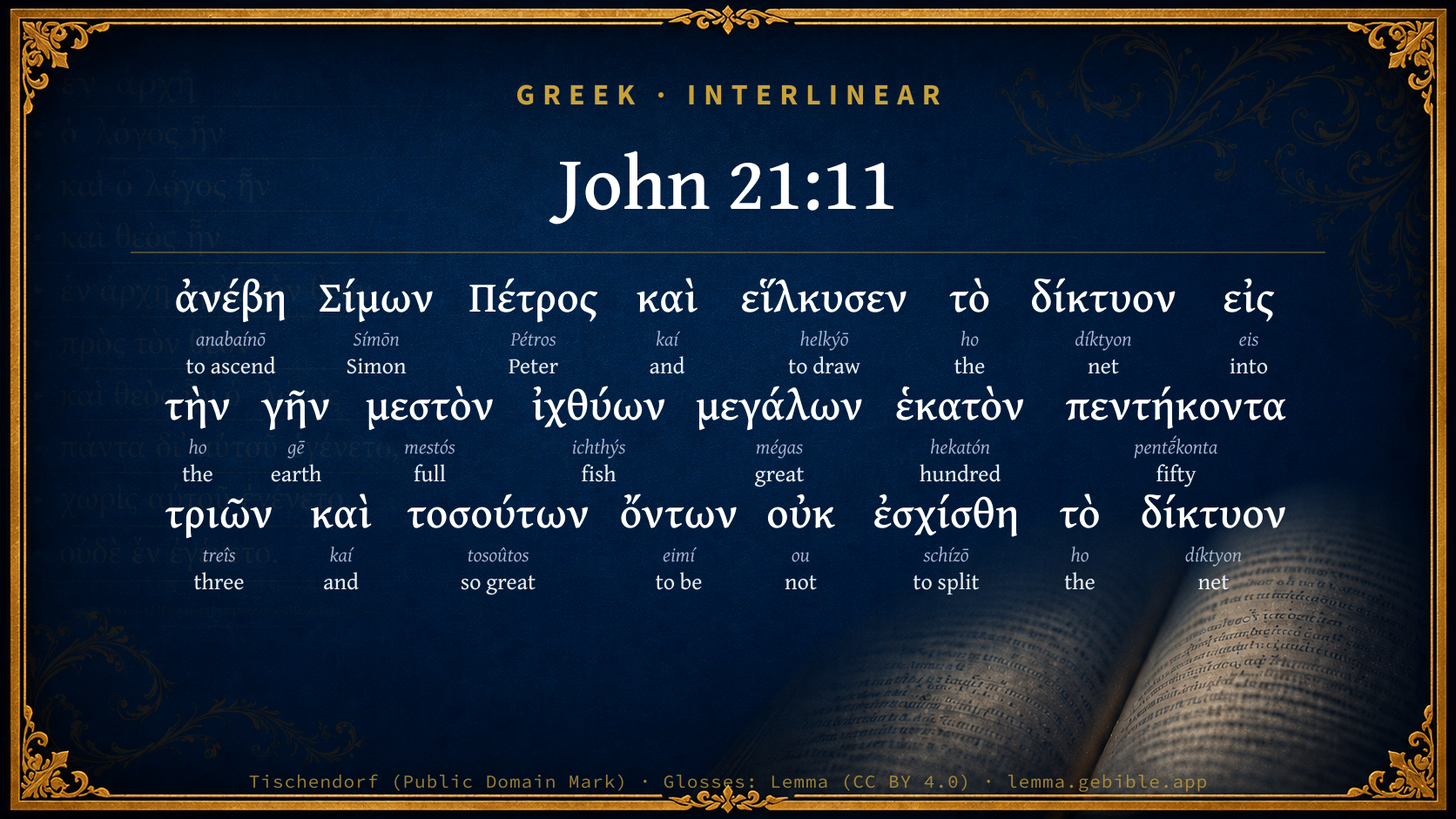
  1. ἀνέβη anabaínō G305 “to ascend” Verb, Aorist, Active, Indicative, 3rd person, Singular
  2. Σίμων Símōn G4613 “Simon” Noun, Nominative, Singular, Masculine
  3. Πέτρος Pétros G4074 “Peter” Noun, Nominative, Singular, Masculine
  4. καὶ kaí G2532 “and” Conjunction
  5. εἵλκυσεν helkýō G1670 “to draw” Verb, Aorist, Active, Indicative, 3rd person, Singular
  6. τὸ ho G3588 “the” Article, Accusative, Singular, Neuter
  7. δίκτυον díktyon G1350 “net” Noun, Accusative, Singular, Neuter
  8. εἰς eis G1519 “into” Preposition
  9. τὴν ho G3588 “the” Article, Accusative, Singular, Feminine
  10. γῆν gē G1093 “earth” Noun, Accusative, Singular, Feminine
  11. μεστὸν mestós G3324 “full” Adjective, Accusative, Singular, Neuter
  12. ἰχθύων ichthýs G2486 “fish” Noun, Genitive, Plural, Masculine
  13. μεγάλων mégas G3173 “great” Adjective, Genitive, Plural, Masculine
  14. ἑκατὸν hekatón G1540 “hundred” Adjective, Numeral (indeclinable)
  15. τριῶν treîs G5140 “three” Adjective, Genitive, Plural, Masculine
  16. καὶ kaí G2532 “and” Conjunction
  17. τοσούτων tosoûtos G5118 “so great” Demonstrative pronoun, Genitive, Plural, Masculine
  18. ὄντων eimí G1510 “to be” Verb, Present, Active, Participle, Genitive, Plural, Masculine
  19. οὐκ ou G3756 “not” Particle, Negative
  20. ἐσχίσθη schízō G4977 “to split” Verb, Aorist, Passive, Indicative, 3rd person, Singular
  21. τὸ ho G3588 “the” Article, Nominative, Singular, Neuter
  22. δίκτυον díktyon G1350 “net” Noun, Nominative, Singular, Neuter

About this verse

These counts appear in no published source. They are computed here, from the morphology-tagged text and Lemma’s own curated glosses. What Lemma adds →

23
words
19
distinct lemmas
Gospels
section

Notable vocabulary

The rarest word here is πεντήκοντα fifty G4004 — appearing just 7 times in the whole Greek New Testament.

Shared distinctive vocabulary

πεντήκοντα fifty G4004 occurs in 7 verses of the Greek New Testament. Also found in:

Repetition

Words recur within this verse:

Cross-references

2

Topical passages linked to John 21:11 in the Treasury of Scripture Knowledge — connected by theme and wording, ordered by reader-vote popularity; previews shown in the World English Bible.

  • Luke 5:6–8 When they had done this, they caught a great multitude of fish, and their net was breaking.
  • Acts 2:41 Then those who gladly received his word were baptized. There were added that day about three thousand souls.

Cross-references courtesy of OpenBible.info (CC BY 4.0).

Where the printed editions differ

1 variant

Places in this verse where the major printed Greek editions disagree on the wording in a way that affects the translation — a comparison of editions, not a manuscript-by-manuscript collation. The editions are the modern critical texts (Nestlé-Aland 28/27, SBL, Westcott-Hort, Tregelles, Tyndale House) and the traditional texts behind the KJV (the Textus Receptus and the Byzantine/Majority text). It is not a claim about which reading is original.

  1. Extra text
    οὖν

    “therefore”

    In NA28NA27TynSBLWHTreg Not in TRByz

    οὖν (oun) 'therefore' is only in older manuscripts (NA28+NA27+Tyn+SBL+WH+Treg)

Textual data: Translators Amalgamated Greek New Testament (STEPBible TAGNT) · CC BY 4.0.

Commentary

Notes on John 21:11 from classic Christian and Jewish commentators (each source and its license shown beneath its notes). The classic Christian expositions comment on the surrounding passage and are grouped to its opening verse, so a note may address several verses; the Jewish commentaries on the Tanakh (Rashi and others) are per-verse, so they appear only where the commentator wrote on this verse.

Lemma curates 59 commentaries, every one of them public domain or Creative Commons licensed, each selected and text-cleaned for this edition rather than reprinted as found. About our sources →

Tyndale Open Study Notes

Tyndale Open Resources

21:11 This miracle showed generous provision (as in 2:1-12; 6:1-15). No symbolism attaches to the number 153.

Tyndale Open Study Notes — © Tyndale Open Resources, licensed CC BY-SA 4.0. Text via the HelloAO Bible API.

Bengel's Gnomon

Johann Albrecht Bengel

Joh 21:11. Ἰχθύων μεγάλων, of great fishes) which just now the great Lord had called, little fishes, Joh 21:10. It was thus (by fishing) that they had their livelihood (whilst in Galilee) up to the time of their journey into Judea.—ἑκατὸν πεντήκοντα τριῶν, a hundred and fifty-three) It is wonderful that the actual number should be thus expressed in tin’s passage, as contrasted with Luk 5:6 (the ratio of which number might have affected the disciples more then than now), although the completely round number one hundred and fifty was so near, to which ὠς might have been also added for accuracy, as in Joh 21:8, “about two hundred cubits.” The number cliii., is memorable. Jerome, on Ezekiel 47 : [9, 10, “There shall be a very great multitude of fish—their fish shall be according to their kinds”], “They who have written of the natures and peculiar qualities of animals, who have learned ἁλιευτικὰ, as well in the Latin as in the Greek language, of whom Oppian, a Cicilian, is the most learned poet, assert that there are one hundred and fifty-three kinds of fishes, all of which were taken by the apostles, and not one remained uncaptured; whilst both the noble and base-born, the rich and poor, and every class of men, are being drawn out of the sea of the world to salvation.” Comp. Mat 13:47, “The kingdom of heaven is like unto a net that was cast into the sea, and gathered of every kind.”—οὐκ ἐσχίσθη, was not broken) A new miraculous circumstance.

Bengel's Gnomon of the New Testament — English translation (T&T Clark, Edinburgh, 1860) — public domain. Text from a community e-Sword module.

Jamieson, Fausset & Brown

Robert Jamieson, A. R. Fausset & David Brown

Peter went up--into the boat; went aboard.

and drew the net to land full of great fishes, an hundred and fifty and three; and for all there were so many, yet was not the net broken--The manifest reference here to the former miraculous draught (Luk 5:1-11) furnishes the key to this scene. There the draught was symbolical of the success of their future ministry: While "Peter and all that were with him were astonished at the draught of the fishes which they had taken, Jesus said unto him, Fear not, from henceforth thou shalt catch men." Nay, when first called, in the act of "casting their net into the sea, for they were fishers," the same symbolic reference was made to their secular occupation: "Follow Me, and I will make you fishers of men" (Mat 4:18-19). Here, then, if but the same symbolic reference be kept in view, the design of the whole scene will, we think, be clear. The multitude and the size of the fishes they caught symbolically foreshadowed the vast success of their now fast approaching ministry, and this only as a beginning of successive draughts, through the agency of a Christian ministry, till, "as the waters cover the sea, the earth should be full of the knowledge of the Lord." And whereas, at the first miraculous draught, the net "was breaking" through the weight of what it contained--expressive of the difficulty with which, after they had 'caught men,' they would be able to retain, or keep them from escaping back into the world--while here, "for all they were so many, yet was not the net broken," are we not reminded of such sayings as these (Joh 10:28): "I give unto My sheep eternal life, and they shall never perish, neither shall any pluck them out of My hand" [LUTHARDT]? But it is not through the agency of a Christian ministry that all true disciples are gathered. Jesus Himself, by unseen methods, gathers some, who afterwards are recognized by the constituted fishers of men, and mingle with the fruit of their labors. And are not these symbolized by that portion of our Galilean repast which the fishers found, in some unseen way, made ready to their hand?

Jamieson, Fausset & Brown — Commentary Critical and Explanatory on the Whole Bible (1871) — public domain (CC PDM 1.0). Text via the HelloAO Bible API.

Ellicott's Commentary for English Readers

(11) Simon Peter went up.—The better reading inserts “therefore”: Simon Peter therefore went up—i.e., because of Christ’s command. He went up into the ship now lying on the shore with one end of the net fastened to it, and drew the remainder of the net to the shore.

Full of great fishes, an hundred and fifty and three.—The greatness and the number are dwelt upon because in any ordinary haul of fish a large proportion would be small and valueless, and be cast into the lake again (Comp. Mat_13:47 et seq.). These were all “great,” and their size and number led to an exact account being taken of them. This would be talked of among the Apostles and their friends and fellow-craftsmen, and is, with the picturesque exactness which is characteristic of St. John, recorded here.

We have no clue to any mystical interpretation of this number, and it is probably not intended to convey one. The various meanings which men have read into it, such as that it represents one of every kind of fish known to the natural history of the day; or that one hundred represents the Gentile nations, fifty the Jews, and three the Trinity; or that there is a reference to the 153, 600 proselytes of 2Ch_2:17; or that it expresses symbolically the name of Simon Peter, take their place among the eccentricities of exegesis from which even the latest results of criticism are not free. Still, as all the more spiritual interpreters, from St. Augustine downwards, have seen, the differences between this and the earlier miracle (Luk_5:1-11) are too striking to be unintentional. That represents the visible Church, containing good and bad; the net is cast without special direction as to side; the net was broken and many escaped. This represents God’s elect, foreknown by Him; all are good; the net is brought to shore, and none are lost. (See Notes on the parable of the Draw-net in Mat_13:47-50, and comp. especially Trench, Notes on Miracles, §§ 3 and 33.)

Yet was not the net broken.—Comp. Note on Luk_5:6. This is again one of the details which point to an eye-witness as the writer.

A Bible Commentary for English Readers, edited by Charles John Ellicott (1878–1897) — public domain. Text from a community e-Sword module.

The Cambridge Bible for Schools and Colleges

gen. ed. J. J. S. Perowne

11. went up] Better, with the best texts, went up therefore: the meaning probably is ‘went on board’ the vessel, now in shallow water. The details in this verse are strong evidence of the writer having been an eye-witness: he had helped to count these ‘great fishes’ and gives the number, not because there is anything mystical in it, but because he remembers it.

The points of contrast between this Draught of Fishes and the similar miracle at the beginning of Christ’s ministry are so numerous and so striking, that it is difficult to resist the conclusion that the spiritual meaning, which from very early times has been deduced from them, is divinely intended. Symbolical interpretations of Scripture are of three kinds: (1) Fanciful and illegitimate. These are simply misleading: they force into plain statements meanings wholly unreal if not false; as when the 153 fishes are made to symbolize Gentiles, Jews, and the Trinity. (2) Fanciful but legitimate. These are harmless, and may be edifying: they use a plain statement to inculcate a spiritual lesson, although there is no evidence that such lesson is intended. (3) Legitimate and divinely intended. In these cases the spiritual meaning is either pointed out for us in Scripture (Luk_5:10), or is so strikingly in harmony with the narrative, that it seems reasonable to accept it as purposely included in it. Of course it requires both spiritual and intellectual power to determine in any given case to which class a particular interpretation belongs; but in the present instance we may safely assign the symbolism to the third class.

The main points are these. The two Miraculous Draughts represent the Church Militant and the Church Triumphant. The one gathers together an untold multitude of both good and bad in the troubled waters of this world. Its net is rent with schisms and its Ark seems like to sink. The other gathers a definite number of elect, and though they be many contains them all, taking them not on the stormy ocean but on the eternal shore of peace.

The Cambridge Bible for Schools and Colleges (gen. ed. J. J. S. Perowne; Cambridge University Press, 1878–1918) — public domain. Text from a community e-Sword module.

John Gill's Exposition

Simon Peter went up,.... Either to the sea, that being higher than the land, or to the ship which lay by the shore: he went aboard it, and

drew the net to land full of great fishes; not alone, but others of the disciples with him; though he only is mentioned, being the leading person in this affair; an emblem of the whole number of God's elect being brought safe to shore, to Christ, and to heaven, through various tribulations and afflictions in the world, fitly signified by the waves of the sea. What mystery there may be in the number, I know not. The conjecture of Grotius, that it is a figure of the proselytes in the days of David and Solomon, seems to be without foundation; since they were not only so many thousands, but six hundred over. And as little to be regarded is the thought of others, that the larger number, one hundred, regards the converted among the Gentiles, and the lesser those among the Jews; much better is the observation of others, that it may design a collection, out of all sorts of people, to Christ, and his church.

And for all there were so many; in number, and these so large and big, and the weight of them so great. The Syriac reads "with all this weight", or "burden", and so the Persic; but the Arabic, "with such a number"; both ideas of number and weight are to be preserved, to make what follows the more observable:

yet was not the net broken; which must be ascribed to the divine power of Christ; and is an emblem of the power of God attending the Gospel to the regeneration, conversion, and salvation of his people, and of the great usefulness of it, however mean and despicable it may be in the eyes of men, and of its permanence and duration, until all the elect of God are gathered in by it.

John Gill's Exposition of the Whole Bible (1746–1763) — public domain (CC PDM 1.0). Text via the HelloAO Bible API.

Trapp's Complete Commentary

John Trapp

11 Simon Peter went up, and drew the net to land full of great fishes, an hundred and fifty and three: and for all there were so many, yet was not the net broken.

Ver. 11. Yet was not the net broke] When God will bless a man, all second causes shall cooperate and contribute their help. As when he will cross us, the strongest sinew in the arms of flesh shall crack, our likeliest projects miscarry; he will curse our blessings, blast our proceedings, as King John confessed, "ever since I was forgiven and subject to the see of Rome, I never prospered." {a} Oto, one of the pope’s muscipulatores, mice catchers, as the story calls them, sent hither by Gregory IX, after three years’ raking together of money by most detestable arts, at last departing hence, he left not so much money in the kingdom as he either carried with him or sent to Rome before him. Such notable fishers are Peter’s pretended successors; all is fish with them that comes to net.

{a} Postquam Deo reconciliatus me ac mea regna (proh dolor) Rom. subieci ecclesiae, nulla mihi prospera, sed omnia contraria advenerunt. John Rex.

John Trapp, A Commentary or Exposition upon All the Books of the Old and New Testament (1647–1656) — public domain. Text from a community e-Sword module.

Albert Barnes' Notes on the Bible

An hundred and fifty and three - The number is mentioned because it seems to have been a very unusual draught, and it was particularly gratifying and striking to them after they had spent the whole night and had caught nothing. This convinced them that it was no other than the same Saviour who had so often worked wonders before them that was now with them.

Albert Barnes' Notes on the Bible (1834–1885) — public domain. Text from a community e-Sword/MySword module.

Haydock's Catholic Bible Commentary

Simon Peter went up, and drew the net to land, full of great fishes, one hundred and fifty-three; a figure of the great number to be converted by the labours of the apostles. (Witham)

George Leo Haydock (1774–1849), Haydock's Catholic Family Bible and Commentary, 1859 edition — public domain. Excludes Psalms (Douay-Rheims chapter numbering differs from Protestant) and Deuterocanonical books (Catholic canon only).

Whedon's Commentary on the Bible

Daniel D. Whedon

11. Great fishes—The net cast in the former similar transaction, catching fishes, good and bad, may represent the Church of the earth mixed with hypocrites and apostates. But this, where the fishes are all good and great, represents the Church of the finally saved.

A hundred and fifty and three— This reckoning presents no number of mystical signification. So it does not show that the elect are the fixed foreordained number which can be neither increased nor diminished. But it does intimate literally that the fishes were each worthy of a count, and that the whole was a lot to rejoice at. Symbolical that the finally saved will each be accounted great and worthy in the eye of the Saviour.

Not the net broken—In the former miraculous draught the net began to break. So the earthly Church is often distracted and torn by false members, by sins, and by schisms; but the Church of the advent will be an unbroken Church.

Daniel D. Whedon (gen. ed.), Commentary on the Old and New Testaments (1874–1909) — public domain. Text from a community e-Sword module.

The Pulpit Commentary

Then Simon Peter went up. Here again Simon is first in action, as John is the more rapid and real in his mental processes. The other disciples may have aided him, following his lead; but the singular verbs are used on both occasions (anebh and eilkuse). In like manner, though the twelve apostles took part in the transactions of Pentecost, Peter opened his mouth to speak. On other occasions, while John spake by the eloquent glances of his eye, and the rest of the disciples joined their leader in testimony and prayer, Peter"s voice was that which conveyed the mighty exultation of their common heart. (Act_3:12, etc.; Act_4:8, etc.; Act_8:20, etc.; Act_10:34 Act_15:7-11) The word anebh , "went up," must be explained by the fact that anabainein is used of embarking in a vessel, (Joh_21:3 Mar_6:51 Act_21:6) though in each case there is some difference in the manuscripts, with reference to the text, as there is also here. If the vessel was drawn up on the shore, with the net attached to it, the form of expression is explicable. Peter went up into the boat for the lines of the net, and, having secured it, he drew the net to the land, full of great fishes, a hundred and fifty and three. Various efforts have been made from early times to give some symbolic meaning to this enumeration. Canon Westcott has detailed several of these strange guesses. Cyril of Alexandria set the example, and was followed by Ammonius the presbyter, who both in different ways regarded the 3 as representative of the Trinity, the 100 + 50 representing, in different proportions, the success of the apostolic ministry among Gentiles and Jews. Augustine observes that 10 is the number of the Law, and 7 the number of the Spirit, 10 + 7 = 17; and the numbers from 1 + 2 + 3 + 17 = 153; so that the number represents all who are brought to God under every dispensation of grace. Gregory the Great reaches the value 17 in the same fashion as Augustine, but, says he, it is only by faith in the Trinity that either Jew or Gentile ever reaches the fullness of salvation; 17 is therefore multiplied by 3 = 3 x 17, which produces 51, which is the number of true rest; multiplied again by 3, which completes the glory of the perfected, it is 153. Hengstenberg, following Grotius, supposes a reference to the 153, 600 Canaanitish proselytes who were received into the kingdom in Solomon"s day! (2Ch_2:17) though the odd 600 certainly confuse the reckoning. Jerome refers to the opinion of a learned naturalist of the second century, Oppian, who is said to have ascertained that there were 153 different kinds of fish in the seas, and that the apostles took of every kind, revealing the ultimate success of the fishers of souls with every kind of man an allegory based on false science and insecure data, and involving a stupendous miracle, if it be meant for a historical fact. Several of the modern T school, in various but unsatisfactory ways, see in the number one made up by the letters composing the name of Simeon (71) bar (22) Jonah (31) Kephas (29); and here even Keim follows suit. Thoma finds the number in the mystic IXYUS , "Jesus Christ the Son of God, Savior." Reuss discourages mystical or occult meaning. The remark of Baumgarten-Crusius, that the number is simply an index of the authenticity of the narrative, and of the fact that the fishes were counted on the occasion, is eminently sensible (so Godet and Meyer). The fact that it is not a round number adds to the probability of this statement, and enters a caveat against allegorical interpretation. And for all they were so many, the net was not rent. This is obviously a point of contrast with the first miraculous draught of fishes, when the nets brake and the boats began to sink. This does form a probable allegory of the success with which the final ingathering of souls shall be effected.

The Pulpit Commentary (1880–1919), ed. H.D.M. Spence-Jones & Joseph S. Exell — public domain. Text from a community e-Sword module.

Scofield Reference Notes

C. I. Scofield

was not

Contra. Luk 5:6.

The Scofield Reference Bible (1917 edition), notes by C. I. Scofield — public domain. Text from a community e-Sword module.

Cambridge Greek Testament for Schools and Colleges

11. εἰς τὴν γῆν (אABCLPXΔ) for ἐπὶ τῆς γῆς (E). After ἀνέβη we should probably insert οὖν with אBCLX against ADP.

11. ἀνέβη. The meaning probably is ‘went on board’ the vessel, now in shallow water. The details in this verse are strong evidence of the writer having been an eyewitness: he had helped to count these ‘great fishes’ and gives the number, not because there is anything mystical in it, but because he remembers it; just as he remembers and states the six large water-pots (Joh 2:6), the five loaves and two fishes, the 5000 men and the 12 baskets (Joh 6:9-13).

The points of contrast between this Draught of Fishes and the similar miracle at the beginning of Christ’s ministry are so numerous and so striking, that it is difficult to resist the conclusion that the spiritual meaning, which from very early times has been deduced from them, is divinely intended. Symbolical interpretations of Scripture are of three kinds: (1) Fanciful and illegitimate. These are simply misleading: they force into plain statements meanings wholly unreal if not false; as when the 153 fishes are made to symbolize Gentiles, Jews, and the Trinity. (2) Fanciful but legitimate. These are harmless, and may be edifying: they use a plain statement to inculcate a spiritual lesson, although there is no evidence that such lesson is intended; as when the miracle at Cana is made to symbolize the substitution of the Gospel for the Law, or the intermittent spring at Bethesda, to mean the meagreness of Judaism in contrast to the fulness of Christ. (3) Legitimate and divinely intended. In these cases the spiritual meaning is either pointed out for us in Scripture (Luk 5:10), or is so strikingly in harmony with the narrative, that it seems reasonable to accept it as purposely included in it. Of course it requires both spiritual and intellectual power to determine to which class a particular interpretation belongs; but in the present instance we may safely assign the symbolism to the third class.

The main points are these. The two Miraculous Draughts represent the Church Militant and the Church Triumphant. The one gathers together an untold multitude of both good and bad in the troubled waters of this world. Its net is rent with schisms and its Ark seems like to sink. The other gathers a definite number of elect, and though they be many contains them all, taking them not on the stormy ocean but on the eternal shore of peace.

Cambridge Greek Testament for Schools and Colleges (Cambridge University Press, 1896; 21 vols, various authors incl. Carr, Maclear, Plummer, Farrar, Lumby, Moule, M. R. James, Simcox) — public domain. Text from a community e-Sword module.

Alford’s Greek Testament

Henry Alford

11.] ἀνέβη, into the boat, which apparently was now on the beach, in the shallow water.

ἑκατὸν πεντ.] This enumeration is singular, and not to be accounted for by any mystical significance of the number, but as betokening the careful counting which took place after the event, and in which the narrator took a part.

οὐκ ἐσχίσθη τὸ δίκτ., herein differing from what happened Luk 5:6, when it was broken.

Henry Alford, The Greek Testament (1849–1861) — public domain. Text from a community e-Sword module.

International Critical Commentary

11. ἀνέβη οὖν Σ. Π. “So Peter,” in obedience to the authoritative direction of Jesus, “went aboard” the dinghy, or little boat. Peter is always foremost in action.

καὶ εἳλκυσεν τὸ δίκτυον κτλ., “and drew the net to land,” which was easier to do than to haul it over the gunwale into the dinghy.

μεστὸν ἰχθύων μεγάλων κτλ. Cf. Luk 5:6 ἰχθύων πλῆθος πολύ. Unlike the story in Lk., where the net was breaking (διερρήγνυτο τὸ δίκτυον), it is noted here as remarkable, οὐκ ἐσχίσθη τὸ δίκτυον.

The simplest explanation of the number of fish, 153, being recorded, is that (as fishermen are wont to do, because the catch has to be divided into shares) the fish were counted, and their great number remembered as a notable thing. But commentators, both ancient and modern, have not been content tent with this, and have sought for a symbolic meaning in the number 153, which they (in modern times at least) assume was invented in order to suggest something esoteric. See Introd., p. lxxxvii.

International Critical Commentary — older volumes (1896–1929), various authors — public domain. Text from a community e-Sword module.

Vincent's Word Studies in the New Testament

Marvin R. Vincent

Went up. Into the vessel.

To land [επι της γης] . Strictly, upon the land.

Great fishes. All authorities agree as to the abundance of fish in the Lake of Galilee. M. Lortet, cited by Dr. Thomson, says that two castings of the net usually filled his boat. Bethsaida (there were two places of that name on the lake) means House of the Fisheries. The fame of the lake in this particular reached back to very early times; so that, according to the Rabbinical legend, one of the ten fundamental laws laid down by Joshua on the division of the country was, that any one might fish with a hook in the Lake of Galilee, so that they did not interfere with the free passage of boats. The Talmud names certain kinds of fish which might be eaten without being cooked, and designates them as small fishes. So ojyaria is rendered in Joh 6:9. Possibly the expression great fishes may imply a contrast with the small fishes which swarmed in the lake, and the salting and pickling of which was a special industry among its fishermen.

Marvin R. Vincent, Word Studies in the New Testament (1887–1900) — public domain. Text from a community e-Sword/MySword module.

Lesson kit

Teaching starters — assembled from the data on this page, not authored interpretation. Every prompt links to the verse data it draws on. Edit before teaching.

John, in the Gospels, opens this verse with 23 words (19 distinct Greek lemmas). Its most distinctive word is pentḗkonta (“fifty”). A historical commentator’s framing appears above. Read the whole chapter for the surrounding context.

Discussion questions

  1. What does “fifty” (pentḗkonta) contribute to the verse as a whole?
  2. Mark 6:40 shares the word «fifty» with this verse. How do the two illuminate each other?
  3. “net” occurs 2× in this one verse. What is the effect of the repetition?
  4. These translations render this verse differently; the difference is in the English rendering, not the original. What questions does that raise?
  5. Reading how Tyndale Open Study Notes and Bengel's Gnomon read this verse, where do the two commentators agree and where do they part?

Things to notice

Reading settings

Reading text

Shown beneath each verse's original-language words.

Old Testament
Old Testament edition

Read the OT as the Masoretic Hebrew (MT) or the Greek Septuagint (LXX).

English shown for the Greek Septuagint (in the Hebrew ↔ Greek comparison).

Comparing translations? Open the Compare panel on any verse page to stack up to four side by side.