
Matthew 4:6

Greek (Tischendorf 8th ed.) Matthew 4:6 appears in the Greek New Testament. The text above is from the Tischendorf 8th edition. Each word links to its Strong’s number and a concise gloss. Click any word for its full Thayer’s Greek Lexicon entry.
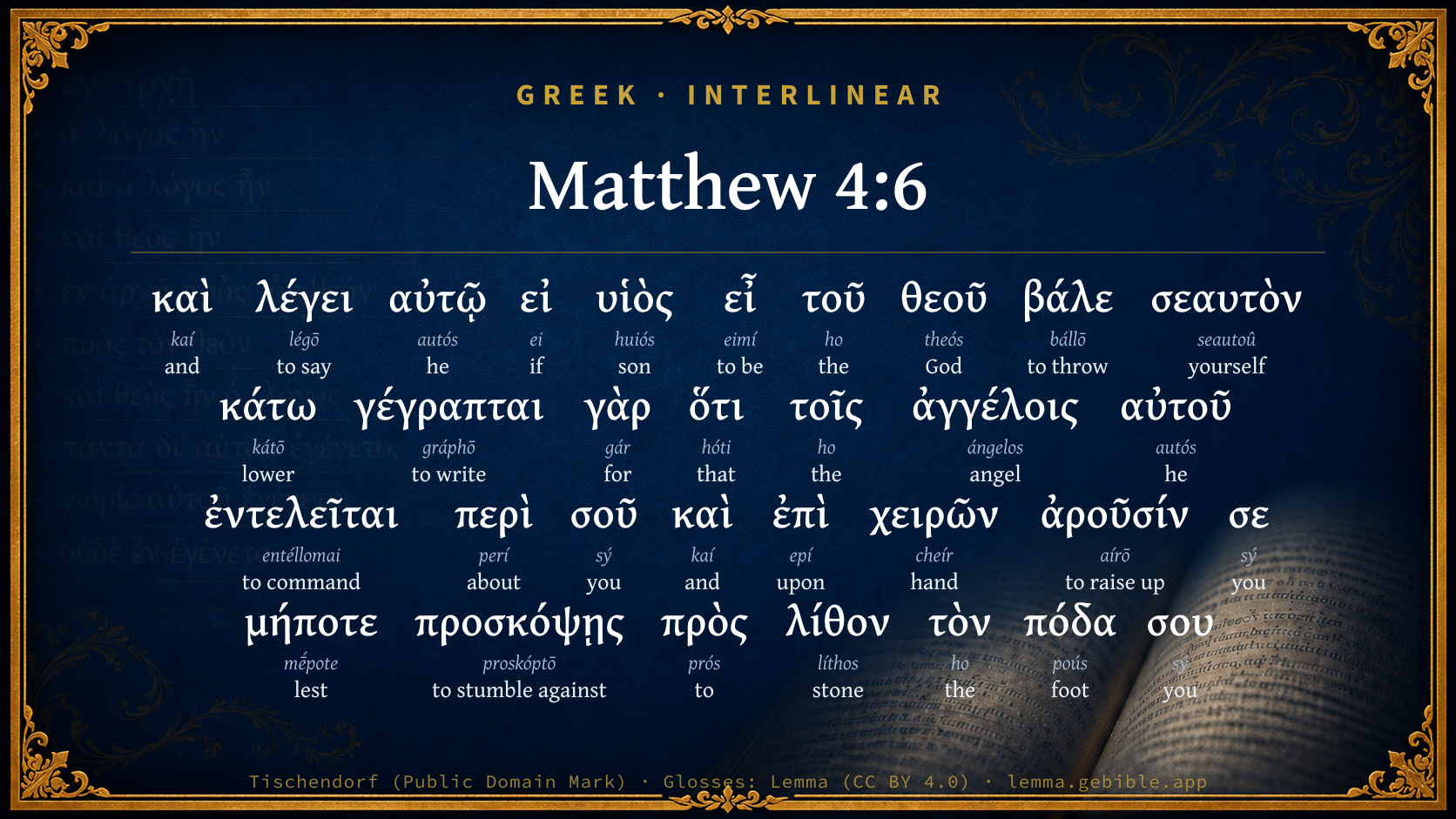
Download image
Cite this verse

Matthew 4:6 (World English Bible). Public Domain. Lemma interlinear Bible study tool, https://lemma.gebible.app/v/matthew/4/6.

Show BibTeX & RIS
BibTeX
RIS
English Translation
and said to him, "If you are the Son of God, throw yourself down, for it is written, 'He will give his angels charge concerning you.' and, 'On their hands they will bear you up, So that you don't dash your foot against a stone.'"
World English Bible · Public Domain
Highlights
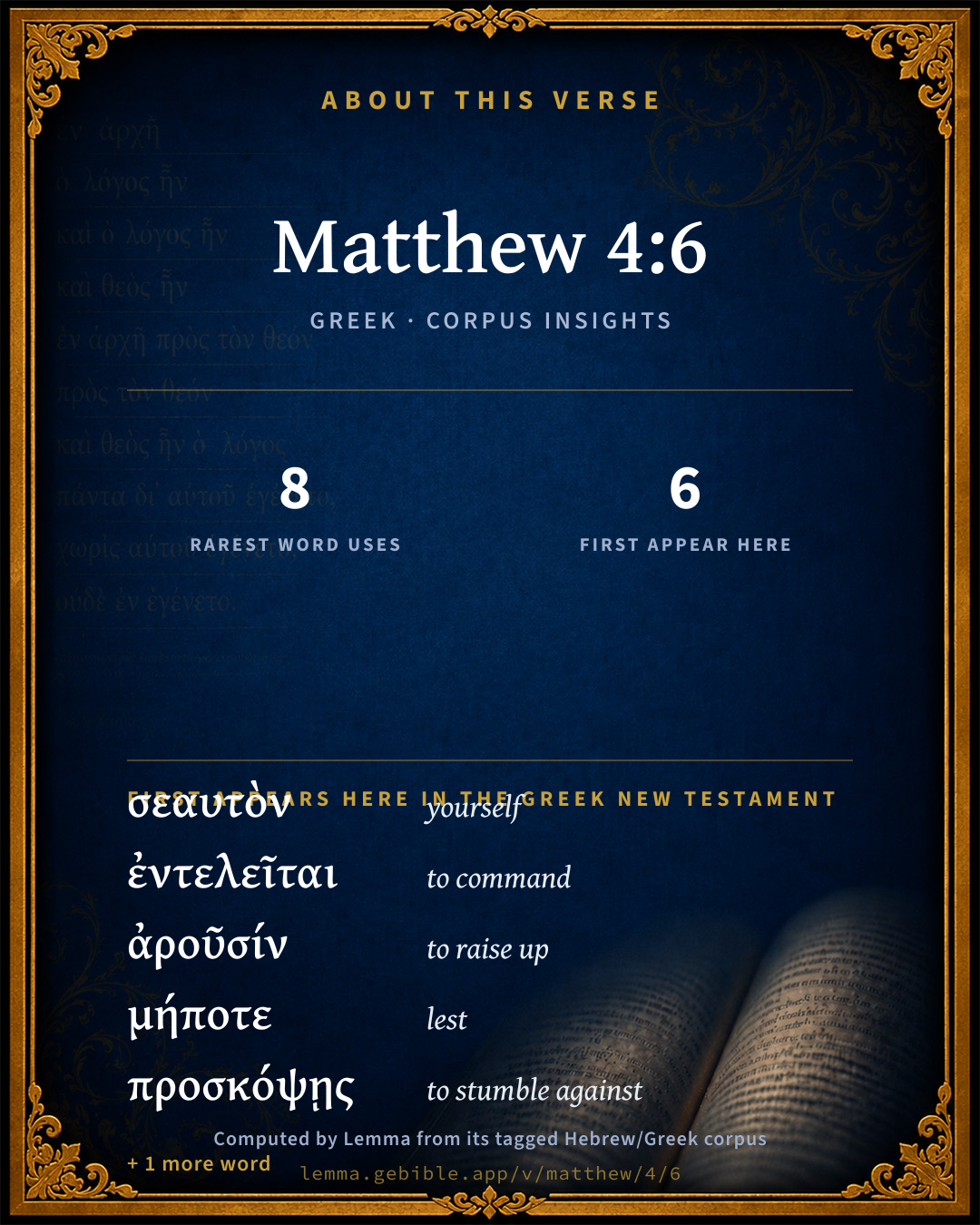
  • 6 first appearances in the Greek New Testament
Full analysis ↓
Download a study sheet

One document with this verse’s original text, its word-by-word gloss line, the meaning frame, cross-references with their text, attributed commentary, and full source and license credits — printable, and it pastes into notes with its structure intact.

This verse Autodidact and up

Study sheet (.html) Plain text (.txt)

A passage Seminary Student

Up to 50 verses in one chapter. A passage sheet keeps up to 6 commentary sources and 12 cross-references per verse, in the order this page ranks them, and says so on the sheet whenever that leaves anything out. Ask for a single verse and you get the Autodidact verse sheet above.

Everything on this page stays free to read, with no account — the sheet is a download of what is already on screen, not access to it.

Want to remove ads? Support Godless Engineer
Compare translations 3

The same verse in 3 English versions, stacked beneath the original-language interlinear above. Click any original word for its lexicon entry.

Each is an independent rendering of the whole verse — the interlinear is not word-aligned to these translations.

Highlighted words mark where these versions differ — a whole-verse word diff, not a word-by-word alignment.

  • World English Bible Public Domain
    and said to him, "If you are the Son of God, throw yourself down, for it is written, 'He will give his angels charge concerning you.' and, 'On their hands they will bear you up, So that you don't dash your foot against a stone.'"
  • King James Version Public Domain
    And saith unto him, If thou be the Son of God, cast thyself down: for it is written, He shall give his angels charge concerning thee: and in their hands they shall bear thee up, lest at any time thou dash thy foot against a stone.
  • unfoldingWord Literal Text CC BY-SA 4.0
    and says to him, “If you are the Son of God, throw yourself down, for it is written, ‘He will command his angels concerning you,’ and, ‘They will lift you up in their hands, lest you strike your foot against a stone.’”

unfoldingWord Literal Text — © unfoldingWord, licensed CC BY-SA 4.0. Word-aligned USFM3 via Door43 (git.door43.org/unfoldingWord/en_ult).

Versions to compare (up to 4)

3 of 4 selected

Show all 19 translations

Every available English version of this verse, each an independent rendering of the whole verse.

  • World English Bible Public Domain
    and said to him, "If you are the Son of God, throw yourself down, for it is written, 'He will give his angels charge concerning you.' and, 'On their hands they will bear you up, So that you don't dash your foot against a stone.'"
  • Berean Standard Bible Public Domain
    “If You are the Son of God,” he said, “throw Yourself down. For it is written: ‘He will command His angels concerning You, and they will lift You up in their hands, so that You will not strike Your foot against a stone.’”
  • Majority Standard Bible Public Domain
    “If You are the Son of God,” he said, “throw Yourself down. For it is written: ‘He will command His angels concerning You, and they will lift You up in their hands, so that You will not strike Your foot against a stone.’”
  • King James Version Public Domain
    And saith unto him, If thou be the Son of God, cast thyself down: for it is written, He shall give his angels charge concerning thee: and in their hands they shall bear thee up, lest at any time thou dash thy foot against a stone.
  • American Standard Version (1901) Public Domain
    and saith unto him, If thou art the Son of God, cast thyself down: for it is written, He shall give his angels charge concerning thee: and, On their hands they shall bear thee up, Lest haply thou dash thy foot against a stone.
  • Revised Version (1885) Public Domain
    and saith unto him, If thou art the Son of God, cast thyself down: for it is written, He shall give his angels charge concerning thee: And on their hands they shall bear thee up, Lest haply thou dash thy foot against a stone.
  • Geneva Bible (1599) Public Domain
    And said vnto him, If thou be the Sonne of God, cast thy selfe downe: for it is written, that he wil giue his Angels charge ouer thee, and with their hands they shall lift thee vp, lest at any time thou shouldest dash thy foote against a stone.
  • Douay-Rheims (1899) Public Domain
    And said to him: If thou be the Son of God, cast thyself down, for it is written: That he hath given his angels charge over thee, and in their hands shall they bear thee up, lest perhaps thou dash thy foot against a stone.
  • Young's Literal Translation Public Domain
    and saith to him, `If Son thou art of God -- cast thyself down, for it hath been written, that, His messengers He shall charge concerning thee, and on hands they shall bear thee up, that thou mayest not dash on a stone thy foot.'
  • Literal Standard Version CC BY-SA 4.0
    and says to Him, “If You are the Son of God—cast Yourself down, for it has been written that, His messengers He will charge concerning you, and on hands they will bear you up, that you may not dash your foot on a stone.”
  • Unlocked Literal Bible CC BY-SA 4.0
    and said to him, “If you are the Son of God, throw yourself down, for it is written, 'He will command his angels to take care of you,' and, 'They will lift you up in their hands, so that you will not hit your foot against a stone.'”
  • unfoldingWord Literal Text CC BY-SA 4.0
    and says to him, “If you are the Son of God, throw yourself down, for it is written, ‘He will command his angels concerning you,’ and, ‘They will lift you up in their hands, lest you strike your foot against a stone.’”
  • Darby Bible Public Domain
    and says to him, If thou be Son of God cast thyself down; for it is written, He shall give charge to his angels concerning thee, and on [their] hands shall they bear thee, lest in anywise thou strike thy foot against a stone.
  • World Messianic Bible Public Domain
    and said to him, “If you are the Son of God, throw yourself down, for it is written, ‘He will command his angels concerning you,’ and, ‘On their hands they will bear you up, so that you don’t dash your foot against a stone.’”
  • Webster's Bible Public Domain
    And saith to him, If thou art the Son of God, cast thyself down, for it is written, He shall give his angels charge concerning thee: and in their hands they shall uphold thee, lest at any time thou dash thy foot against a stone.
  • Free Bible Version CC BY-SA 4.0
    “If you really are the son of God, then throw yourself off,” he told Jesus. “As Scripture says, ‘He will order his angels to save you from harm. They will catch you so that you won't fall by tripping over a stone.’”
  • Bible in Basic English Public Domain
    If you are the Son of God, let yourself go down; for it is in the Writings, He will give his angels care over you; and, In their hands they will keep you up, so that your foot may not be crushed against a stone.
  • Text-Critical English NT CC BY 4.0
    and said to him, “If yoʋ are the Son of God, throw yoʋrself down, for it is written, ‘He will command his angels concerning yoʋ,’ and, ‘In their hands they will lift yoʋ up, so that yoʋ do not strike yoʋr foot against a stone.’ ”
  • Tyndale New Testament (1534) Public Domain
    and sayd vnto hym: yf thou be the sonne of God cast thy sylfe doune. For it is wrytte he shall geve his angels charge over the and with their handes they shall holde that vp that thou dashe not thy fote agaynst a stone.

Literal Standard Version (2020), Covenant Press — licensed CC BY-SA 4.0. Text via the HelloAO Bible API (eBible.org). Unlocked Literal Bible (unfoldingWord) — licensed CC BY-SA 4.0. Text via the HelloAO Bible API (eBible.org). unfoldingWord Literal Text — © unfoldingWord, licensed CC BY-SA 4.0. Word-aligned USFM3 via Door43 (git.door43.org/unfoldingWord/en_ult). Free Bible Version, Dr. Jonathan Gallagher — licensed CC BY-SA 4.0. Text via the HelloAO Bible API (eBible.org).

Word by word

More ways to search: Search by grammar → Find every occurrence → Compare this word →

Practice this passage: Drill this verse → Learn its vocabulary →

προσκόψῃς
proskóptō
G4350
“to stumble against”
Verb, Aorist, Active, Subjunctive, 2nd person, Singular
Part of Speech
Verb
Tense
Aorist
Voice
Active
Mood
Subjunctive
Person
2nd person
Number
Singular
Full Thayer's Definition

Origin: from G4314 and G2875

TDNT: 18:25,9

1. to strike against a. of those who strike against a stone or other obstacle in the path, to stumble b. to strike one's foot against a stone 1. i.e. to meet with some harm; c. to rush upon, beat against d. to be made to stumble by a thing 1. i.e. metaph. to be induced to sin
  1. καὶ kaí G2532 “and” Conjunction
  2. λέγει légō G3004 “to say” Verb, Present, Active, Indicative, 3rd person, Singular
  3. αὐτῷ autós G846 “he” Personal pronoun, Dative, Singular, Masculine
  4. εἰ ei G1487 “if” Conditional
  5. υἱὸς huiós G5207 “son” Noun, Nominative, Singular, Masculine
  6. εἶ eimí G1510 “to be” Verb, Present, Active, Indicative, 2nd person, Singular
  7. τοῦ ho G3588 “the” Article, Genitive, Singular, Masculine
  8. θεοῦ theós G2316 “God” Noun, Genitive, Singular, Masculine
  9. βάλε bállō G906 “to throw” Verb, Aorist, Active, Imperative, 2nd person, Singular
  10. σεαυτὸν seautoû G4572 “yourself” Reflexive pronoun, 2nd person, Accusative, Singular, Masculine
  11. κάτω kátō G2736 “lower” Adverb
  12. γέγραπται gráphō G1125 “to write” Verb, Perfect, Passive, Indicative, 3rd person, Singular
  13. γὰρ gár G1063 “for” Conjunction
  14. ὅτι hóti G3754 “that” Conjunction
  15. τοῖς ho G3588 “the” Article, Dative, Plural, Masculine
  16. ἀγγέλοις ángelos G32 “angel” Noun, Dative, Plural, Masculine
  17. αὐτοῦ autós G846 “he” Personal pronoun, Genitive, Singular, Masculine
  18. ἐντελεῖται entéllomai G1781 “to command” Verb, Future, Middle or Passive deponent, Indicative, 3rd person, Singular
  19. περὶ perí G4012 “about” Preposition
  20. σοῦ sý G4771 “you” Personal pronoun, 2nd person, Genitive, Singular
  21. καὶ kaí G2532 “and” Conjunction
  22. ἐπὶ epí G1909 “upon” Preposition
  23. χειρῶν cheír G5495 “hand” Noun, Genitive, Plural, Feminine
  24. ἀροῦσίν aírō G142 “to raise up” Verb, Future, Active, Indicative, 3rd person, Plural
  25. σε sý G4771 “you” Personal pronoun, 2nd person, Accusative, Singular
  26. μήποτε mḗpote G3379 “lest” Adverb, Negative
  27. πρὸς prós G4314 “to” Preposition
  28. λίθον líthos G3037 “stone” Noun, Accusative, Singular, Masculine
  29. τὸν ho G3588 “the” Article, Accusative, Singular, Masculine
  30. πόδα poús G4228 “foot” Noun, Accusative, Singular, Masculine
  31. σου sý G4771 “you” Personal pronoun, 2nd person, Genitive, Singular

About this verse

These counts appear in no published source. They are computed here, from the morphology-tagged text and Lemma’s own curated glosses. What Lemma adds →

32
words
26
distinct lemmas
Gospels
section

Notable vocabulary

The rarest word here is προσκόψῃς to stumble against G4350 — appearing just 8 times in the whole Greek New Testament.

First appearance in Scripture

These words make their first canonical appearance in the Greek New Testament here:

  • σεαυτὸν yourself G4572
  • ἐντελεῖται to command G1781
  • ἀροῦσίν to raise up G142
  • μήποτε lest G3379
  • προσκόψῃς to stumble against G4350
  • πόδα foot G4228

Shared distinctive vocabulary

προσκόψῃς to stumble against G4350 occurs in 8 verses of the Greek New Testament. Also found in:
Repetition

Words recur within this verse:

Cross-references

9

Topical passages linked to Matthew 4:6 in the Treasury of Scripture Knowledge — connected by theme and wording, ordered by reader-vote popularity; previews shown in the World English Bible.

  • Psalms 91:11–12 For he will give his angels charge over you, To guard you in all your ways.
  • Hebrews 1:14 Aren't they all ministering spirits, sent out to do service for the sake of those who will inherit salvation?
  • Psalms 34:7 The angel of Yahweh encamps round about those who fear him, And delivers them.
  • 2 Corinthians 11:14 And no wonder, for even Satan masquerades as an angel of light.
  • Psalms 34:20 He protects all of his bones. Not one of them is broken.
  • Matthew 4:4 But he answered, "It is written, 'Man shall not live by bread alone, but by every word that proceeds out of the mouth of God.'"
  • Job 5:23 For you shall be in league with the stones of the field. The animals of the field shall be at peace with you.
  • Job 1:10 Haven't you made a hedge around him, and around his house, and around all that he has, on every side? You have blessed the work of his hands, and his substance is increased in the land.
  • Luke 4:9–12 He led him to Jerusalem, and set him on the pinnacle of the temple, and said to him, "If you are the Son of God, cast yourself down from here,

Cross-references courtesy of OpenBible.info (CC BY 4.0).

Commentary

Notes on Matthew 4:6 from classic Christian and Jewish commentators (each source and its license shown beneath its notes). The classic Christian expositions comment on the surrounding passage and are grouped to its opening verse, so a note may address several verses; the Jewish commentaries on the Tanakh (Rashi and others) are per-verse, so they appear only where the commentator wrote on this verse.

Lemma curates 59 commentaries, every one of them public domain or Creative Commons licensed, each selected and text-cleaned for this edition rather than reprinted as found. About our sources →

The Biblical Illustrator

Joseph S. Exell

Mat_4:6

Angels charge.

The angelic ministers of the good

I. Commissioned by God. They are His angels-obey His behests, carry out His purpose.

II. Exercised for the godly as individuals. God does not overlook the individual in the multitude (1Ki_19:4-8; Dan_6:22; Act_12:7-10) …

III. By means of the exercise of this angelic ministry the godly are enabled to surmount all the hindrances and conquer all the foes that beset their way.

1. Encouragement to trust in God.

2. The dignity of the godly. (W. Jones.)

The Biblical Illustrator, edited by Joseph S. Exell (c. 1880s–1900s) — public domain. Text from a community e-Sword module.

Bengel's Gnomon

Johann Albrecht Bengel

Mat 4:6. Γέγραπται, it is written) A most specious temptation, which appears to quote Scripture appositely. There is no doubt but that Satan must have often felt the force of this saying, from the protection which the angels extended to the godly against him.—ὅτι—περὶ σοῦ καὶ ἐπὶ, κ.τ.λ.) He shall give his angels charge concerning thee, and in their hands they shall bear thee up, lest at any time thou dash thy foot against a stone. The LXX. render Psalms 91(90):11, 12,—ὅτι—περὶ σοῦ, τοῦ διαφυλάξαί σε ἐν πάσαις ταῖς ὁδοῖς σου ἐπὶ, κ.τ.λ., He shall give his angels charge over thee, to keep thee in all thy way: they shall bear thee up in their hands, lest thou dash thy foot against a stone. The fraud of Satan consists rather in false application, than in omission.—ἐπὶ χειρῶν, in their hands) That is, they shall guard Thee with great circumspection.—λίθον, a stone) i.e., one of those of which the Temple was built. The tempter applies the psalm speciously.

Bengel's Gnomon of the New Testament — English translation (T&T Clark, Edinburgh, 1860) — public domain. Text from a community e-Sword module.

Meyer's Critical & Exegetical Commentary

Heinrich August Wilhelm Meyer

Mat_4:6. In Psa_91:11-12, according to the LXX., it is Gods providential care for the pious in general that is spoken of. Here the tempter, who now himself grasps the weapon of Scripture, which had just been used against him, cunningly applies the typical expressions in the Psalms (the figure is borrowed from maternal anxiety) strictly to the Messiah.

ὅτι], not the recitative, but a part of the passage.

The Son of God, in reliance on the divine protection, must undertake a daring miracle of display in order to win over the masses for Himself. For the multitudes, with a view to influencing whom this miracle is proposed, are understood to be, as a matter of course, on the temple area; and therefore we are not to assume, with Kohlschütter, Ullmann, Engelhardt, that it was only an exhibition of divine favour and protection, and no public spectacle, which was aimed at. On that view no sufficient reason is shown why Jesus is brought from the wilderness to the most populous centre of the metropolis. Euth. Zigabenus strikingly remarks: διὰ κενοδοξίας ἑλεῖν αὐτὸν ἐπιχειρεῖ.

Meyer — Critical and Exegetical Commentary on the New Testament — English translation by Peter Christie, edited by Frederick Crombie (T&T Clark, 1880) — public domain. Text from a community e-Sword module.

Expositor's Greek Testament

ed. W. Robertson Nicoll

Mat 4:6 . βάλε σεαυτὸν κάτω : This suggestion strongly makes for the symbolic or parabolic nature of the whole representation. The mad proposal could hardly be a temptation to such an one as Jesus, or indeed to any man in his senses. The transit through the air from the desert to the winglet, like that of Ezekiel, carried by a lock of his hair from Babylon to Jerusalem, must have been “in the visions of God” (Eze 8:3 ), and the suggestion to cast Himself down a parabolic hint at a class of temptations, as the excuses in the parable of the Supper (Luk 14:16 ) simply represent the category of preoccupation . What is the class represented? Not temptations through vanity or presumption, but rather to reckless escape from desperate situations. The second temptation, like the first, belongs to the category of need . The Satanic suggestion is that there can be no sonship where there are such inextricable situations, in proof of which the Psalter is quoted (Psa 91:11-12 ). γέγραπται , it stands written, not precisely as Satan quotes it, the clause τοῦ διαφυλάξαι σε ἐν πάσαις ταῖς ὁδοῖς σου being omitted. On this account many commentators charge Satan with mutilating and falsifying Scripture.

Mat 4:7 . Jesus replies by another quotation from Deut. (Mat 6:16 ). πάλιν , on the other hand, not contradicting but qualifying: “Scriptura per scripturam interpretanda et concilianda,” Bengel. The reference is to the incident at Rephidim (Exo 17:1-7 ), where the people virtually charged God with bringing them out of Egypt to perish with thirst, the scene of this petulant outburst receiving the commemorative name of Massah and Meribah because they tempted Jehovah, saying: “Is Jehovah among us or not?” An analogous situation in the life of Jesus may be found in Gethsemane , where He did not complain or tempt, but uttered the submissive, “If it be possible”. The leap down at that crisis would have consisted in seeking escape from the cross at the cost of duty. The physical fall from the pinnacle is an emblem of a moral fall. Before passing from this temptation I note that the hypothesis that it was an appeal, to vanity presupposes a crowd at the foot to witness the performance, of Which there is no mention.

The Expositor's Greek Testament, edited by W. Robertson Nicoll (1897–1910) — public domain. Text from a community e-Sword module.

Jamieson, Fausset & Brown

Robert Jamieson, A. R. Fausset & David Brown

And saith unto him, If thou be the Son of God--As this temptation starts with the same point as the first--our Lord's determination not to be disputed out of His Sonship--it seems to us clear that the one came directly after the other; and as the remaining temptation shows that the hope of carrying that point was abandoned, and all was staked upon a desperate venture, we think that remaining temptation is thus shown to be the last; as will appear still more when we come to it.

cast thyself down--"from hence" (Luk 4:9).

for it is written-- (Psa 91:11-12). "But what is this I see?" exclaims stately BISHOP HALL. "Satan himself with a Bible under his arm and a text in his mouth!" Doubtless the tempter, having felt the power of God's Word in the former temptation, was eager to try the effect of it from his own mouth (Co2 11:14).

He shall give his angels charge concerning thee: and in their hands--rather, "on their hands."

they shall bear thee up, lest at any time thou dash thy foot against a stone--The quotation is, precisely as it stands in the Hebrew and the Septuagint, save that after the first clause the words, "to keep thee in all thy ways," are here omitted. Not a few good expositors have thought that this omission was intentional, to conceal the fact that this would not have been one of "His ways," that is, of duty. But as our Lord's reply makes no allusion to this, but seizes on the great principle involved in the promise quoted, so when we look at the promise itself, it is plain that the sense of it is precisely the same whether the clause in question be inserted or not.

Jamieson, Fausset & Brown — Commentary Critical and Explanatory on the Whole Bible (1871) — public domain (CC PDM 1.0). Text via the HelloAO Bible API.

Adam Clarke's Commentary

Verse 6. Cast thyself down] Our Lord had repelled the first temptation by an act of confidence in the power and goodness of God; and now Satan solicits him to make trial of it. Through the unparalleled subtlety of Satan, the very means we make use of to repel one temptation may he used by him as the groundwork of another. This method he often uses, in order to confound us in our confidence.

He shall give his angels charge, c.] This is a mutilated quotation of Ps 91:11. The clause, to keep thee in all thy ways, Satan chose to leave out, as quite unsuitable to his design. That God has promised to protect and support his servants, admits of no dispute but, as the path of duty is the way of safety, they are entitled to no good when they walk out of it.

In their hands they shall bear thee up] This quotation from Ps 91:11, is a metaphor taken from a nurse's management of her child: in teaching it to walk, she guides it along plain ground; but, when stones or other obstacles occur, she lifts up the child, and carries it over them, and then sets it down to walk again. Thus she keeps it in all its ways, watching over, and guarding every step it takes. To this St. Paul seems also to allude, 1Th 2:7. We were gentle among you, even as a nurse cherisheth her children. Thus the most merciful God deals with the children of men, ever guarding them by his eye, and defending them by his power.

Adam Clarke's Commentary on the Bible (1810–1826) — public domain. Text from a community e-Sword/MySword module.

Ellicott's Commentary for English Readers

(6) If thou be the Son of God.—In this case, as before, the temptation starts from the attestation of the character of Jesus as the Son of God. With this there is now joined an appeal to familiar and sacred words, and the subtlety of the Tempter lay in his perversion of their true meaning. Here, too, the words throw light on the previous spiritual life of the Son of Man. As in all analogous temptations (and the history would have but little significance or interest for us if it were not analogous to many human experiences) the words which were presented to the soul, with their true meaning obscured and perverted, must have been precisely those that had before been most precious. We can think of Him as having fed on those words, found in them the stay and comfort of His life, without ever dreaming (if one may venture so to speak) of putting them to the test by devices of His own imagining.

In their hands.—Better, on. The angelic hands are thought of as sustaining and up-bearing.

A Bible Commentary for English Readers, edited by Charles John Ellicott (1878–1897) — public domain. Text from a community e-Sword module.

The Cambridge Bible for Schools and Colleges

gen. ed. J. J. S. Perowne

6. it is written] Psa_91:11-12. The words “to keep thee in all thy ways” are omitted in the text. The omission distorts the meaning of the original, which is that God will keep the righteous on their journeys, and is no inducement to tempt God by rash venture or needless risk. The Psalmist himself probably quotes Pro_3:23. “Thus [i. e. by obedience: see preceding verses] shalt thou walk in thy way safely, and thy foot shall not stumble.”

The Cambridge Bible for Schools and Colleges (gen. ed. J. J. S. Perowne; Cambridge University Press, 1878–1918) — public domain. Text from a community e-Sword module.

John Gill's Exposition

Jesus saith unto him, it is written again,.... Christ takes no notice of the false and wrong citation of scripture made by the devil, nor of any misapplication of it; but mildly replies, by opposing another passage of scripture to him, Deu 6:16

ye shall not tempt the Lord your God, thereby tacitly showing, that he had produced scripture to a very wrong purpose, since that could never contradict itself; and also, that for a person to neglect the ordinary means of safety, and to expect, that as God can, so he will, preserve without the use of such means, is a tempting him. The Hebrew word "tempt", as Manasseh ben (f) Israel observes, is always taken in an ill part, and is to be understood of such who would try the power, goodness, or will of God. And which, as it is not fitting it should be done by any man, so not by himself; and perhaps he hereby intimates too, that he himself was God; and therefore as it was not right in him to tempt God the Father, by taking such a step as Satan solicited him to; nor would it be right in any other; so it was iniquitous in the devil to tempt him who was God over all, blessed for ever.

(f) Conciliat. in Deut. Quaest. 3. p. 223.

John Gill's Exposition of the Whole Bible (1746–1763) — public domain (CC PDM 1.0). Text via the HelloAO Bible API.

Trapp's Complete Commentary

John Trapp

6 And saith unto him, If thou be the Son of God, cast thyself down: for it is written, He shall give his angels charge concerning thee: and in their hands they shall bear thee up, lest at any time thou dash thy foot against a stone.

Ver. 6. And he saith unto him] The devil usually tempteth by speech, inward or outward. Senarclaeus (Epist. ad Bucerum) telleth of a plain countryman at Friburg in Germany, that lying on his deathbed, the devil came to him in the shape of a tall terrible man, and claimed his soul, saying, "Thou hast been a notorious sinner, and I am come to set down all thy sins;" and therewith he drew out paper and ink, and sat down at a table that stood by, and began to write. The sick man answered, "My soul is God’s, and all my sins are nailed to the cross of Christ. But if thou desire to set down my sins, write thus, ‘All our righteousnesses are as a filthy rag,’" &c. The devil set down that, and bid him say on. He did: "but thou, Lord, hast promised, for thine own sake, to blot out our iniquities, and to make our scarlet sins white as snow." The devil passed by those words, and was earnest with him to go on in his former argument. The sick man said with great cheerfulness, "The Son of God appeared to destroy the works of the devil." With that the devil vanished, and the sick man departed.

If thou be the Son of God, cast thyself, &c.] This is the devil’s logic, to argue from mercy to liberty, to do wickedly with both hands earnestly, Mic 7:3. Whereas the heathen could say, In maxima libertate, minima licentia. And the father, Ideo deteriores sumus, quia meliores esse debemus: therefore are we worse, because we ought to be better. (Salvian.) Remember but this, that thou art son to a king (said one to Antigonus), and that will keep thee from base courses. Take thou those spoils to thyself, Ανελου σαυτω (said Themistocles to his friend that followed him), συ γαρ ουκ ει θεμιστοκλης, for thou art not Themistocles, as I am: they are poor things, far below me. Shall such a man as I flee? Neh 6:11. Shall I do anything to the dishonour of my heavenly Father? and therefore sin, because grace hath abounded? Rom 8:1; that is not the guise of any of God’s children. They walk honestly, bravely, gallantly, worthy of God, who hath done so great things for them. καλως, ευσχημονως, αξιως του θεου. The more privileges, the more engagements. Scipio, when a harlot was offered unto him, said, Vellem, si non essem imperator. It was an aggravation of the fall of Solomon, that God had appeared unto him twice; and of Saul, that he fell as if he had not been anointed, 1Ki 11:9; 2Sa 1:21. So it is of any of God’s saints to sin, as if they had not been adopted.

Cast thyself down] Here our Saviour is tempted to suicide, by an old manslayer. And when Moses, Elias, Jonah, and others of the best sort of saints, were in a fit of discontent, and grew weary of their lives, wishing for death, divines doubt not but Satan gave a push at them with his ten horns, to despatch and ease themselves of the present trouble by cutting off their own days. A dangerous and hideous temptation; yet such as may befall the best, and few escape it that live out their time. But in all the book of God we read not of any of the generation of the just that ever did it, Psa 37:28. That God who kept them, will (if we look up to him) do as much for us. Only we must set against this bloody temptation with God’s arm and with God’s armour. The word and prayer are the ordinances and power of God, and, by his might, do extinguish all the fiery darts of the devil. Oppose the commination to the temptation. Herein Eve faltered (in her lest ye die, though she held the precept), and so fell.

for it is written] A vile abase of sacred Scripture, to persuade thereby to sin or plead for it; yet what more ordinary with men of corrupt minds and reprobate concerning the faith, 2Ti 3:8. Qui caedem Scripturarum faciunt ad materiam suam, as Tertullian speaketh ( De Praescript, advers. Haeret.), who murder the Scriptures to serve their own purposes? But of this more elsewhere.

He shall give his angels charge over thee] Hitherto the old liar speaketh truth. But, Satan et si semel videatur verax, millies est mendax, et semper fallax, saith Bucholcer: Satan, though he may sometimes seem a true speaker, yet he is a thousand times for it a liar, and always a deceiver. Because our Saviour had alleged Scripture, he also would do the like in a perverse, apish imitation, but mars the masculine sense by clipping off that clause, "they shall keep thee in all thy ways;" that is, in those courses that are appointed thee by God. In viis nostris, non in praecipitiis. (Bern.) But as the Israelites in the wilderness, when they went out of God’s precincts were out of his protection, so are all others. "As a bird that wandereth from the nest, so is a man that wandereth from his own place," saith Solomon, Pro 27:8. God made a law that none should molest a bird upon her nest, Deu 22:6. Doth God take care of birds? A king undertaketh the safety of his subjects while they travel within due hours and keep the king’s highway; else not. So doth God. He hath given his angels charge over us while we hold his way, which is like Jacob’s ladder, where the angels were ascending and descending. Oh the dignity and safety of a saint, in a guard so full of state and strength! Well might David (after he had said, "the angel of the Lord pitcheth his tent round about them that fear him") presently subjoin, Taste and see bow gracious the Lord is, in allowing his children so glorious an attendance, Psa 34:7-8.

And with their hands they shall lift thee up, &c.] As parents use to lift their little ones over rough and foul ways; or as servants in a house love to get up into their arms their young master. επι χειρων, in manus: ducta ab iis, significationis origine, qui onus aliquod gestaturi attollunt in humeros. (Beza.) In Christ and for Christ, they count it their greatest glory to do us any good office for soul or body; they save us from the foul fiends that else would worry us. These walk about as lions to devour us while alive, and to hinder our passage to heaven when we die; the other, as guardians, to keep us here, and to convey and conduct us through the devil’s territories (who is prince of the air) when we go hence to heaven, Luk 16:22, in despite of the evil angels that would intercept us, Dan 10:21.

Lest thou dash thy foot against a stone] Oh the tender care of our heavenly Father; he is so kind, and, in the best sense, fond over his little ones, that he cannot abide the cold wind should blow upon them, as we say, and hath therefore commanded "that the sun shall not smite them by day, nor the moon by night," Psa 121:6; yea, which way soever the wind fit, it must blow good to his; "Arise, O north, and blow, O south, upon any beloved, that her spices may flow forth," Son 4:16. What so contrary as north and south wind, cold and hot, moist and dry? &c. Yet both must blow good to God’s beloved. Well might God exalt his love above that of natural parents, which yet is wondrous great, saith the psalmist, Psa 103:13.

John Trapp, A Commentary or Exposition upon All the Books of the Old and New Testament (1647–1656) — public domain. Text from a community e-Sword module.

Albert Barnes' Notes on the Bible

And saith unto him, If thou be the Son of God, cast thyself down - The temptation here was, that he should at once avail himself of the protection of a promise of safety made to him, and thus demonstrate that he was the Messiah. If he was the true Messiah he had a certain assurance of protection, a promise that no harm could befall him; and thus, by so surprising a miracle, and such a clear proof of the divine interposition, he could at once establish his claim to the Messiahship. How much more easy would this be than to engage in a slow work of years to establish that claim; to encounter fatigue, and want, and poverty, and persecution, before that claim would be admitted! And where could be a more suitable place for thus at once demonstrating that he was the Son of God, than on this pinnacle of the temple, in the very midst of Jerusalem, and perhaps in the presence of thousands who would see the wonderful performance? The temptation, therefore, in this case was, that by thus establishing his claim he would avoid all the obloquy, persecution, and suffering which he must otherwise endure if he attempted to prove that he was the Son of God by a life of toil and privation.

It is written - That is, there is a passage of Scripture which promises special protection in such a case, and on which you may rely. The argument was not, perhaps, that this applied exclusively to the Messiah, but that, if applicable in any case, it would be in this; if any one could plead this promise, assuredly he could who claimed to be the Son of God.

He shall give his angels charge concerning thee ... - That is, they shall protect thee.

And in their hands they shall bear thee up - They shall sustain thee, or hold thee up, so that thou shalt not be endangered by the fall.

Lest at any time thou dash thy foot against a stone - This would be especially appropriate in such a case. The promise, as Satan applied it, was that he should not be injured by the stones lying at the bottom of the wall or in the valley below. The case, therefore, seemed to be one that was especially contemplated by the promise.

Albert Barnes' Notes on the Bible (1834–1885) — public domain. Text from a community e-Sword/MySword module.

Haydock's Catholic Bible Commentary

Heretics, says St. Augustine, quote Scriptures, as the devil does here, in a wrong and forced sense; the Church cites them, like Jesus Christ, in their true sense, and to confute their falsehood. (Cont. lit. Petil. lib. ii. chap. 51.) It is on this account, that the Catholic Church wishes persons who come to the study of the most mysterious and difficult book ever published, should bring with them some preparation of mind and heart; convinced that the abuse of the strongest and best food may be converted into deadly poison. The promoters of Bible societies have published in Ireland a tract to encourage the universal perusal of the Scriptures, as the sole rule of faith. In this they give not only a mutilated and corrupt version of the letter of his late Holiness Pius VI. to the now archbishop of Florence, (to be seen at the head of this edition of the Bible) but certain letters from German Jansenists, who are described as being good Catholics. (Haydock)

George Leo Haydock (1774–1849), Haydock's Catholic Family Bible and Commentary, 1859 edition — public domain. Excludes Psalms (Douay-Rheims chapter numbering differs from Protestant) and Deuterocanonical books (Catholic canon only).

Matthew Poole's English Annotations

Before the devil had tempted our Lord to diffidence or distrust in God’s providence, and the use of means not allowed by God to supply himself; here he tempts him to an unwarrantable presumption, and confidence of and concerning the Divine protection. In the former temptation the devil used no Scripture, but having been repelled in that assault by the sword of the Spirit, which is the word of God, Eph 6:17, he here takes up the same weapon. The thing to which the tempter solicits our Saviour, was the throwing himself down from a precipice, a temptation, in effect, to destroy himself; which is one of those fiery darts which he commonly throws at the people of God in their hours of melancholy, or under great pressures of affliction; but the usual argument which he useth to them, is deliverance from their terrors, the preventing of want, or avoiding shame. The argument he useth to our Lord is quite of another nature, the special protection of God promised to God’s people, Psa 91:11,12. Herein he transforms himself into an angel of light, according to 2Co 11:14, and lets us know that truth may be abused to the patronage of lies; and that there is no hook more dangerous to the members of Christ, than that which is baited with Scripture misinterpreted and misapplied, which holy writ always is when it is so interpreted or so applied as to be made an argument to sin. This portion of holy writ is both:

1. Falsely cited; and,

2. As ill applied.

a) In the quotation the tempter leaves out those words, in all thy ways. This was none of our Savour’s ways, he had no call, no warrant from God to decline the stairs by which he might have gone down, and to throw himself down. God had never promised, nor ever given, any the protection of angels in sinful and forbidden ways.

b) He misapplies this text, using it not to instruct, but to deceive; dividing between man’s duty and God’s providence; making this word a promise to be fulfilled upon Christ’s neglect of his duty; extending the promise of special providence as to dangers into which men voluntarily throw themselves; putting God upon working miracles to declare Christ to be his Son, where there was no need, and of which there was no use, mocking our Saviour’s true use of Scripture, with Scripture abused, and many other ways: but he had to do with one not ignorant of his devices.

Matthew Poole's English Annotations on the Holy Bible (1683–1685) — public domain. Text from a community e-Sword/MySword module.

Whedon's Commentary on the Bible

Daniel D. Whedon

6. If thou be the Son of God — By resisting the former temptation, Jesus had maintained himself to be the Son of God, and had sustained his own faith in his own divide mission. Let him now show that faith in his mission on a more heroic scale. A sublime faith is just the temper for a sublime display. Let him leap from the summit of the pinnacle to the depth of the gorge. All the world will wonder at so grand an exploit. Cast thyself down — Put God to the test, and astonish the universe. Use thy Father’s power, like a wanton son, for freaks and experiments at miracle. For it is written — And so the devil can quote Scripture to make out his point. Nothing makes wicked men so self-satisfied as to be able to bless their crime with a holy text. They can ridicule the Bible, and trample upon it at any other time. But they are profoundly biblical, and deep reverers of God’s holy and inspired word, if a text can be wrested to their purpose. They, like Satan, only use the Bible for the occasion, as the plaster for sin. They truly insult the word of God, and do truly add blasphemy to the sin which they try to make it cover. He shall give… charge — Psa_91:12. Some have questioned how this text in the Psalms is truly to be applied to Christ. But it is a probable fact that the main body of the book of Psalms has for its subject, a holy one, a perfect and therefore divine man, a Messiah.

Mark that the Bible, like every other good, can be misused and wrested for our own destruction. It is a part of our probation, that God has not given a revelation so unequivocal that perverse minds may not pervert it to the service of error and sin. The honest heart can alone use it with true security. Charge concerning thee — As a parent gives the nurse charge concerning the tottering child, so God has given his angels charge concerning thee, his dear son. Hands shall bear thee up — Angel nurses shall carry thee in their arms. Dash thy foot — Hit thy foot against an obstacle and stumble.

Daniel D. Whedon (gen. ed.), Commentary on the Old and New Testaments (1874–1909) — public domain. Text from a community e-Sword module.

The Pulpit Commentary

If thou be the Son of God (ver. 3, note). For it is written. Psa_91:11, Psa_91:12, verbally from the LXX, but omitting the clause, "to keep thee in all thy ways." Luke omits only "in all thy ways." The clause, according to either record, was omitted possibly because the devil shrank from reminding Jesus of "ways" which he need not take; more probably because. "ways" hardly fitted this case (cf. Weiss). Trench ("Studies," p. 40), following St. Bernard, says that the omission of the clause alters the whole character of the quotation, considering that "ways" implies ways appointed by God. But this appears to be strained. The devil, appealing to Jesus" consciousness of abiding communion with God, (Psa_91:1) bids him enjoy to the full the promise of God"s protection. There is no thought here of a "miracle of display" to the multitudes who were assembled, "as a matter of course," on the temple area (Meyer; cf. even Trench). Neither the devil"s solicitation nor our Lord"s reply hint at anything else than Divine protection. If it be urged that for this any one of the many precipices by the Dead Sea, e.g. those of the Quamntana (ver. 1, note) itself, would have been sufficient, the answer may be found in the fact that at the temple, the seat of God"s special manifestation, God"s special protection might be looked for. There is a slight doubt whether the oti after gegraptai is recitative (Westcott and Hort, and most) or part of the quotation (Rheims, Meyer, Weiss). In favour of the latter view is the fact that the recitative oti is not used elsewhere in this section (vers. 4, 7, 10), but as in Luk_4:10 it can hardly be other than recitative (for another oti is inserted before "on their hands"), the probability is that it was recitative in the oral source, and therefore recitative here. In their hands; Revised Version, on; epi ceirwn . The thought is not so much of surrounding care as of physical support through space. Lest at any time; Revised Version, lest haply; and so always, for "in the New Testament use of rids particle (mh pote ) the notion of time usual to pote seems to recede before that of contingency" (Thayer).

The limits of angel-charge.

Observe the sentence omitted in the quotation. The psalmist wrote, "For he shall give his angels charge over thee, to keep thee in all thy ways." It may be that, from our points of view, the omission is not important, because we can see that it is involved even if it be not explicitly stated. The Divine care always assumes that its objects are in the sphere of duty. But it is significant that the tempter should omit what he evidently felt would spoil his persuasion.

I ANGEL-CHARGE. There will always be two ways of dealing with the references to angels which are found in the Word of God.

1. The one way will be taken by the practical-minded, who can be content with the surface of things, and to whom facts are just facts. These will always people the unseen world with personal beings, who are conceived as constantly engaged in Divine ministries, and who have sometimes actually come into the field of human vision. "Are they not ministering spirits," etc.?

2. The other way will be taken by the mystical-minded, who cannot imprison their minds in forms, who are always seeking essences, spiritual realities, the things which gain varying embodiments for the apprehension of the human senses. To these, angels will seem to be personifications of the many Divine forces and influences that affect men"s lives. God caring for us, God working for us, is for them the fact; angel-charge is for them the appearance. All join in recognizing that angel-charge is God with us as our Helper.

II THE LIMITS UNDER WHICH ANGEL-CHARGE IS SET. "I being in the way, the Lord led me." It is always assumed that we are trying to go right and to do right. God helps those who mean to be obedient. The self-willed, those who, like Ephraim, are "joined to their idols," God lets alone. The angels are removed if a man persistently resolves to "follow the devices and desires of his own heart." "If ye be willing and obedient, ye shall eat the good of the land." There is, however, the gracious truth of the Divine overruling, even of man"s infirmity and wilfulness, of which, in this connection, clue account needs to be taken. R.T.

The Pulpit Commentary (1880–1919), ed. H.D.M. Spence-Jones & Joseph S. Exell — public domain. Text from a community e-Sword module.

John Wesley's Explanatory Notes

In their hands - That is, with great care. Psalm xci, 11, 12.

John Wesley, Explanatory Notes Upon the Whole Bible (1754–1765) — public domain. Text via the GEBible commentary corpus.

Scofield Reference Notes

C. I. Scofield

angels

(See Scofield "Heb 1:4").

The Scofield Reference Bible (1917 edition), notes by C. I. Scofield — public domain. Text from a community e-Sword module.

Burkitt's Expository Notes on the New Testament

William Burkitt

Here we have observable, first, the sin which Satan tempts Christ unto; and next, the argument which he tempts him from.

The sin tempted to, is the sin of self-murder; Cast thyself down.

Whence we learn, That self-murder is a sin which Christ himself was, and the best of saints may, by Satan, be tempted to the commission of.

But forasmuch as Satan tempted Christ to murder himself, but had not the power to do it himself,(do thou cast thyself down,) we learn, That though Satan may tempt, yet he cannot compel; he may entice, but cannot enforce any to sin, without their own consent.

Observe, 2. The argument which Satan uses; it is a scripture; argument; he quotes the promise of God. He shall give his angels charge over thee.

What a marvel is here, to find Satan with a Bible under his arm, and a text of scripture in his mouth! Christ had alleged scripture before to Satan; here Satan retorts scripture back again to Christ: It is written, says Christ; It is written, says Satan.

Learn thence, That it is no wonder to hear heretics and hypocrites quote scripture, when Satan himself durst recite it: he that had profanely touched the sacred body of Christ with his hand, sticks not presumptuously to handle the holy scripture of God with his tongue.

Yet observe, How wretchedly the devil wrests, perverts, and misapplies, the scripture. When God promises his angels shall keep us, it is in viis, non in praecipitiis; ’tis in all God’s ways, not in any of our own crooked paths.

Note here, That although the children of God have the promise of the guardianship of holy angels, yet then only may they expect their protection, when they are walking in the way of their duty, and using the means for their own preservation.

William Burkitt's Expository Notes on the New Testament (1700–1703) — public domain. Text from a community e-Sword module.

The People's New Testament

B. W. Johnson

6. If thou be the Son of God cast thyself down. Again the doubt is implied and the taunt uttered. Jesus had expressed his trust in the word of God. The devil now asks him to go from the extreme of distrust to that of rashly tempting God. It was, perhaps, the demand so often repeated and always refused, “to show a sign from heaven,” to make a display of his power to secure popular applause. Perhaps the evil spirit whispered to him to perform one stupendous miracle in Jerusalem, in the presence of all people, and to secure such fame that he would reach the throne without treading the thorny way of the cross. To have done so would have robbed the world of its Savior. “It behooved him to die, and to rise again.” He shall give his angels charge concerning thee. The enemy, like a false adviser, quotes from Psalm 91:11 to justify his request, but he garbled the Scripture, leaving out “to keep thee in all thy ways,” which follows the first clause. The promise is limited to those who walk in the way appointed to them.

B. W. Johnson's The People's New Testament with Notes (1889–1891) — public domain. Electronic text from the Christian Classics Ethereal Library (CCEL) ThML edition.

Cambridge Greek Testament for Schools and Colleges

6. βάλε σεαυτὸν κάτω. The depth was immense: Josephus speaking of the ‘Royal Porch’ (στοὰ βασιλική) says ‘if anyone looked down from the top of the battlements he would be giddy, while his sight could not reach to such an immense depth.’ Antiq. XV. 11. 5.

γέγραπται. Psalms 91 [90 LXX]:11, 12. The quotation follows the LXX. version, but the words τοῦ διαφυλάξαι σε ἐν πάσαις ταῖς ὁδοῖς σου are omitted in the text. The omission distorts the meaning of the original, which is that God will keep the righteous on their journeys. No inducement is offered by them to tempt God by rash venture or needless risk. The Psalmist himself probably quotes Pro 3:23. ‘Thus [i.e. by obedience: see preceding verses] shalt thou walk in thy way safely, and thy foot shall not stumble.’

Cambridge Greek Testament for Schools and Colleges (Cambridge University Press, 1896; 21 vols, various authors incl. Carr, Maclear, Plummer, Farrar, Lumby, Moule, M. R. James, Simcox) — public domain. Text from a community e-Sword module.

Alford’s Greek Testament

Henry Alford

6. γέγραπται] cited (nearly verbatim from the LXX, as almost all the texts in this narrative) as applying to all servants of God in general, and à fortiori to the Son of God: not as a prophecy of the Messiah.

Henry Alford, The Greek Testament (1849–1861) — public domain. Text from a community e-Sword module.

International Critical Commentary

6. And he saith to Him, If Thou art God’s Son, cast Thyself down: for it is written, that His angels He charges concerning Thee: and upon (their) hands they shall bear Thee, lest Thou strike against a stone Thy foot.] Lk. has: “And he said to Him, If Thou art God’s Son, cast Thyself hence down. For it is written, that His angels He charges concerning Thee, to guard Thee; and that upon (their) hands they shall bear Thee, lest Thou dash against a stone Thy foot.” The quotation is from Psa 90:11, Psa 90:12. Mt omits τοῦ διαφυλάξαι σε ὲν (πᾶσαις) ταῖς ὁδοῖς σου, and Lk. omits ἐν (πᾶσαις) ταῖς ὁδοῖς σου, which would not have been suitable to this context.

(X)

6. περὶ σοῦ] S1 adds: “that they should keep thee,” assimilating to Lk.

International Critical Commentary — older volumes (1896–1929), various authors — public domain. Text from a community e-Sword module.

Vincent's Word Studies in the New Testament

Marvin R. Vincent

In their hands [επι] . On their hands (so Rev.) is more correct, and gives a different picture from the A. V. in : lifted on their hands, as on a litter or platform.

Marvin R. Vincent, Word Studies in the New Testament (1887–1900) — public domain. Text from a community e-Sword/MySword module.

Lesson kit

Teaching starters — assembled from the data on this page, not authored interpretation. Every prompt links to the verse data it draws on. Edit before teaching.

Matthew, in the Gospels, opens this verse with 32 words (26 distinct Greek lemmas). Its most distinctive word is proskóptō (“to stumble against”). A historical commentator’s framing appears above. Read the whole chapter for the surrounding context.

Discussion questions

  1. How does “to stumble against” (proskóptō) shape what this verse is saying?
  2. 6 words here appear for the first time in Scripture. What is being introduced at this debut?
  3. Matthew 7:27 shares the word «to stumble against» with this verse. How do the two illuminate each other?
  4. “the” occurs 3× in this one verse. What is the effect of the repetition?
  5. These translations render this verse differently; the difference is in the English rendering, not the original. What questions does that raise?
  6. Reading how The Biblical Illustrator and Bengel's Gnomon read this verse, where do the two commentators agree and where do they part?

Things to notice

  • 6 words make their first canonical appearance in Scripture here.
  • These translations choose different wording for 20 words in this verse.
  • “the” occurs 3× in this single verse.
  • 26 distinct Greek lemmas span 32 words in this verse.

Reading settings

Reading text

Shown beneath each verse's original-language words.

Old Testament
Old Testament edition

Read the OT as the Masoretic Hebrew (MT) or the Greek Septuagint (LXX).

English shown for the Greek Septuagint (in the Hebrew ↔ Greek comparison).

Comparing translations? Open the Compare panel on any verse page to stack up to four side by side.