

Matthew 13:37
Greek (Tischendorf 8th ed.) Matthew 13:37 appears in the Greek New Testament. The text above is from the Tischendorf 8th edition. Each word links to its Strong’s number and a concise gloss. Click any word for its full Thayer’s Greek Lexicon entry.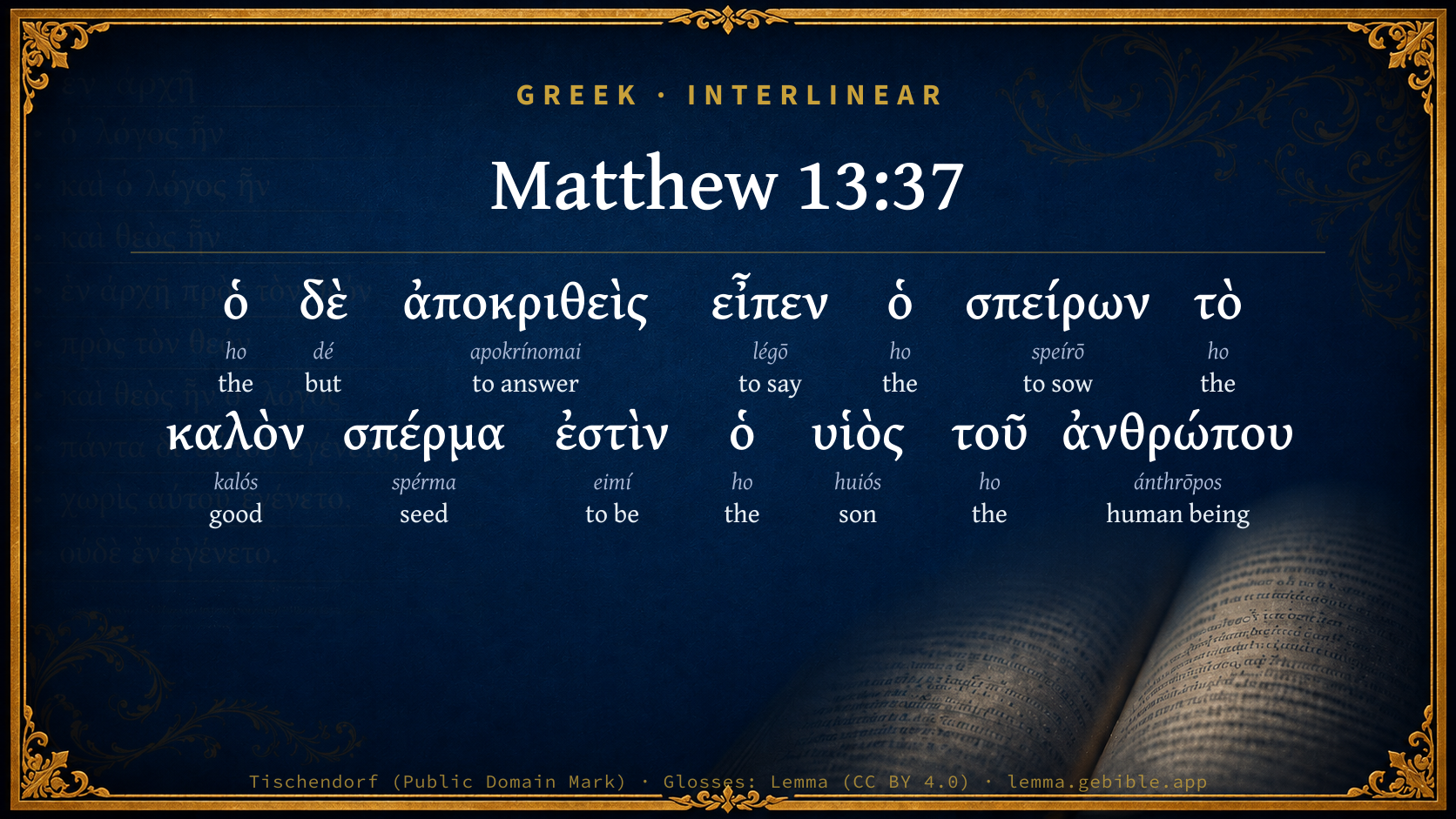
He answered them, "He who sows the good seed is the Son of Man,
Download a study sheet
One document with this verse’s original text, its word-by-word gloss line, the meaning frame, cross-references with their text, attributed commentary, and full source and license credits — printable, and it pastes into notes with its structure intact.
This verse Autodidact and up
A passage Seminary Student
Up to 50 verses in one chapter. A passage sheet keeps up to 6 commentary sources and 12 cross-references per verse, in the order this page ranks them, and says so on the sheet whenever that leaves anything out. Ask for a single verse and you get the Autodidact verse sheet above.
Everything on this page stays free to read, with no account — the sheet is a download of what is already on screen, not access to it.
Compare translations 3
The same verse in 3 English versions, stacked beneath the original-language interlinear above. Click any original word for its lexicon entry.
Each is an independent rendering of the whole verse — the interlinear is not word-aligned to these translations.
Highlighted words mark where these versions differ — a whole-verse word diff, not a word-by-word alignment.
-
World English Bible Public Domain
He answered them, "He who sows the good seed is the Son of Man,
-
King James Version Public Domain
He answered and said unto them, He that soweth the good seed is the Son of man;
-
unfoldingWord Literal Text CC BY-SA 4.0
Now answering, he said, “The one sowing the good seed is the Son of Man,
unfoldingWord Literal Text — © unfoldingWord, licensed CC BY-SA 4.0. Word-aligned USFM3 via Door43 (git.door43.org/unfoldingWord/en_ult).
Show all 19 translations
Every available English version of this verse, each an independent rendering of the whole verse.
-
World English Bible Public Domain
He answered them, "He who sows the good seed is the Son of Man,
-
Berean Standard Bible Public Domain
He replied, “The One who sows the good seed is the Son of Man.
-
Majority Standard Bible Public Domain
He replied, “The One who sows the good seed is the Son of Man.
-
King James Version Public Domain
He answered and said unto them, He that soweth the good seed is the Son of man;
-
American Standard Version (1901) Public Domain
And he answered and said, He that soweth the good seed is the Son of man;
-
Revised Version (1885) Public Domain
And he answered and said, He that soweth the good seed is the Son of man;
-
Geneva Bible (1599) Public Domain
Then answered he, and saide to them, He that soweth the good seede, is the Sonne of man.
-
Douay-Rheims (1899) Public Domain
Who made answer and said to them: He that soweth the good seed, is the Son of man.
-
Young's Literal Translation Public Domain
And he answering said to them, `He who is sowing the good seed is the Son of Man,
-
Literal Standard Version CC BY-SA 4.0
And He answering said to them, “He who is sowing the good seed is the Son of Man,
-
Unlocked Literal Bible CC BY-SA 4.0
Jesus answered and said, “He who sows the good seed is the Son of Man.
-
unfoldingWord Literal Text CC BY-SA 4.0
Now answering, he said, “The one sowing the good seed is the Son of Man,
-
Darby Bible Public Domain
But he answering said, He that sows the good seed is the Son of man,
-
World Messianic Bible Public Domain
He answered them, “He who sows the good seed is the Son of Man,
-
Webster's Bible Public Domain
He answered and said to them, He that soweth the good seed is the Son of man;
-
Free Bible Version CC BY-SA 4.0
“The one who sows the good seed is the Son of man,” Jesus explained.
-
Bible in Basic English Public Domain
And he made answer and said, He who puts the good seed in the earth is the Son of man;
-
Text-Critical English NT CC BY 4.0
So he said to them in response, “He who sows the good seed is the Son of Man.
-
Tyndale New Testament (1534) Public Domain
Then answered he and sayde to them. He that soweth the good seed is the sonne of man.
Literal Standard Version (2020), Covenant Press — licensed CC BY-SA 4.0. Text via the HelloAO Bible API (eBible.org). Unlocked Literal Bible (unfoldingWord) — licensed CC BY-SA 4.0. Text via the HelloAO Bible API (eBible.org). unfoldingWord Literal Text — © unfoldingWord, licensed CC BY-SA 4.0. Word-aligned USFM3 via Door43 (git.door43.org/unfoldingWord/en_ult). Free Bible Version, Dr. Jonathan Gallagher — licensed CC BY-SA 4.0. Text via the HelloAO Bible API (eBible.org).
Word by word
More ways to search: Search by grammar → Find every occurrence → Compare this word →
Practice this passage: Drill this verse → Learn its vocabulary →
- Appears 44× in the Greek New Testament
- First appears at Matthew 13:24
- Part of Speech
- Noun
- Case
- Accusative
- Number
- Singular
- Gender
- Neuter
Full Thayer's Definition
- ὁ ho G3588 “the” Article, Nominative, Singular, Masculine
- δὲ dé G1161 “but” Conjunction
- ἀποκριθεὶς apokrínomai G611 “to answer” Verb, Aorist, Passive deponent, Participle, Nominative, Singular, Masculine
- εἶπεν légō G3004 “to say” Verb, Aorist, Active, Indicative, 3rd person, Singular
- ὁ ho G3588 “the” Article, Nominative, Singular, Masculine
- σπείρων speírō G4687 “to sow” Verb, Present, Active, Participle, Nominative, Singular, Masculine
- τὸ ho G3588 “the” Article, Accusative, Singular, Neuter
- καλὸν kalós G2570 “good” Adjective, Accusative, Singular, Neuter
- σπέρμα spérma G4690 “seed” Noun, Accusative, Singular, Neuter
- ἐστὶν eimí G1510 “to be” Verb, Present, Active, Indicative, 3rd person, Singular
- ὁ ho G3588 “the” Article, Nominative, Singular, Masculine
- υἱὸς huiós G5207 “son” Noun, Nominative, Singular, Masculine
- τοῦ ho G3588 “the” Article, Genitive, Singular, Masculine
- ἀνθρώπου ánthrōpos G444 “human being” Noun, Genitive, Singular, Masculine
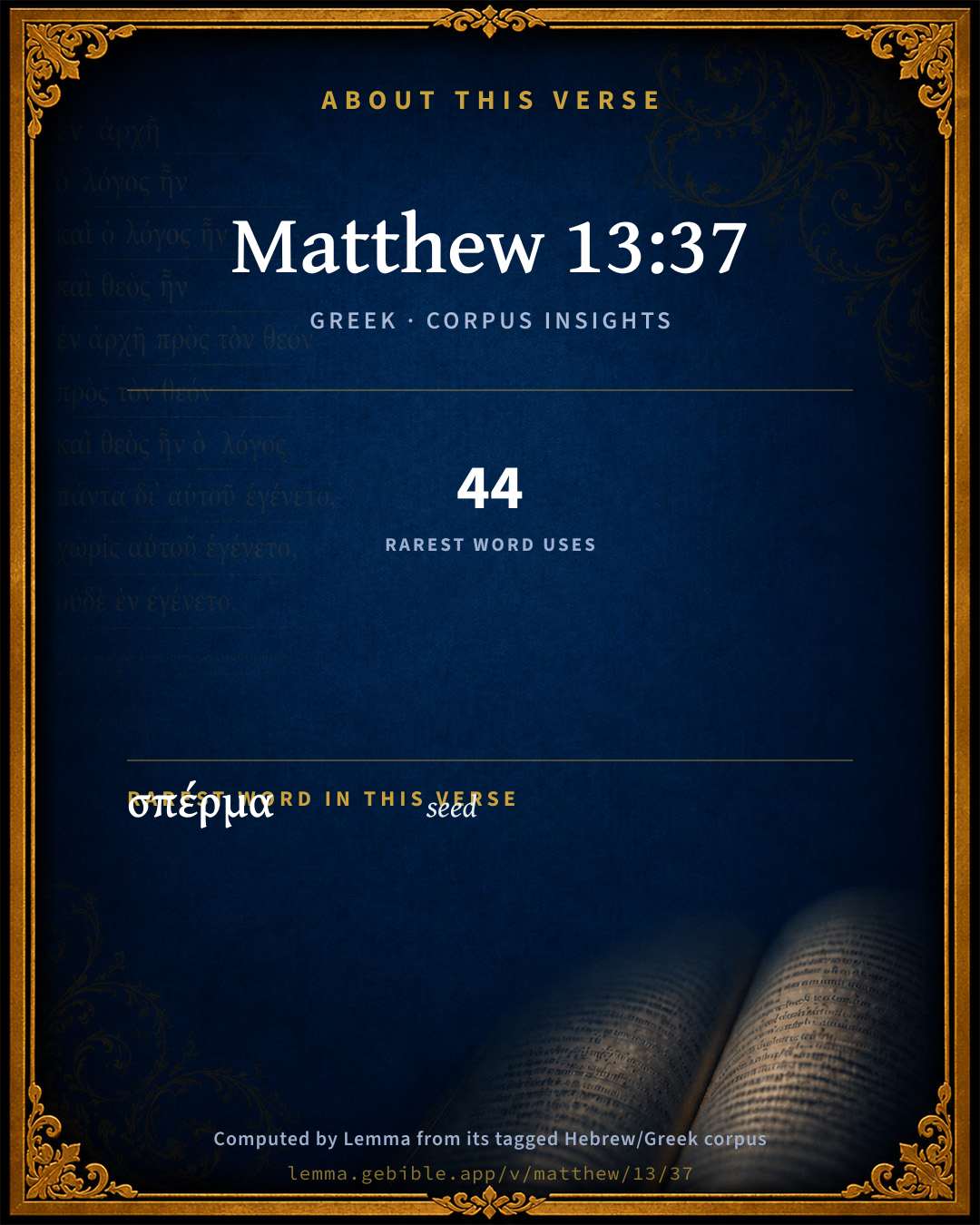
About this verse
These counts appear in no published source. They are computed here, from the morphology-tagged text and Lemma’s own curated glosses. What Lemma adds →
- 14
- words
- 10
- distinct lemmas
- Gospels
- section
Cross-references
14Topical passages linked to Matthew 13:37 in the Treasury of Scripture Knowledge — connected by theme and wording, ordered by reader-vote popularity; previews shown in the World English Bible.
- 1 Corinthians 3:5–7 Who then is Apollos, and who is Paul, but servants through whom you believed; and each as the Lord gave to him?
- Matthew 13:24 He set another parable before them, saying, "The Kingdom of Heaven is like a man who sowed good seed in his field,
- Matthew 13:27 The servants of the householder came and said to him, 'Sir, didn't you sow good seed in your field? Where did this darnel come from?'
- Matthew 13:41 The Son of Man will send out his angels, and they will gather out of his Kingdom all things that cause stumbling, and those who do iniquity,
- Luke 10:16 Whoever listens to you listens to me, and whoever rejects you rejects me. Whoever rejects me rejects him who sent me."
- Acts 1:8 But you will receive power when the Holy Spirit has come upon you. You will be witnesses to me in Jerusalem, in all Judea and Samaria, and to the uttermost parts of the earth."
- Matthew 8:20 Jesus said to him, "The foxes have holes, and the birds of the sky have nests, but the Son of Man has nowhere to lay his head."
- Matthew 10:40 He who receives you receives me, and he who receives me receives him who sent me.
- Matthew 16:13–16 Now when Jesus came into the parts of Caesarea Philippi, he asked his disciples, saying, "Who do men say that I, the Son of Man, am?"
- John 13:20 Most assuredly I tell you, he who receives whomever I send, receives me; and he who receives me, receives him who sent me."
- John 20:21 Jesus therefore said to them again, "Peace be to you. As the Father has sent me, even so I send you."
- Romans 15:18 For I will not dare to speak of any things except those which Christ worked through me, for the obedience of the Gentiles, by word and deed,
- Hebrews 1:1 God, having in the past spoken to the fathers through the prophets at many times and in various ways,
- Hebrews 2:3 how will we escape if we neglect so great a salvation-- which at the first having been spoken through the Lord, was confirmed to us by those who heard;
Cross-references courtesy of OpenBible.info (CC BY 4.0).
Lesson kit
Teaching starters — assembled from the data on this page, not authored interpretation. Every prompt links to the verse data it draws on. Edit before teaching.
Matthew, in the Gospels, opens this verse with 14 words (10 distinct Greek lemmas). Its most distinctive word is spérma (“seed”). A historical commentator’s framing appears above. Read the whole chapter for the surrounding context.
Discussion questions
- What does “seed” (spérma) contribute to the verse as a whole?
- Matthew 13:24 shares the word «seed» with this verse. How do the two illuminate each other?
- “the” occurs 5× in this one verse. What is the effect of the repetition?
- These translations render this verse differently. What is at stake in choosing one wording over another?
- Reading how Whedon's Commentary on the Bible and Meyer's Critical & Exegetical Commentary read this verse, where do the two commentators agree and where do they part?
Things to notice
- These translations choose different wording for 9 words in this verse.
- “the” occurs 5× in this single verse.
- 10 distinct Greek lemmas span 14 words in this verse.
Commentary
Notes on Matthew 13:37 from classic Christian and Jewish commentators (each source and its license shown beneath its notes). The classic Christian expositions comment on the surrounding passage and are grouped to its opening verse, so a note may address several verses; the Jewish commentaries on the Tanakh (Rashi and others) are per-verse, so they appear only where the commentator wrote on this verse.
Lemma curates 59 commentaries, every one of them public domain or Creative Commons licensed, each selected and text-cleaned for this edition rather than reprinted as found. About our sources →
Whedon's Commentary on the Bible
Daniel D. Whedon
Daniel D. Whedon (gen. ed.), Commentary on the Old and New Testaments (1874–1909) — public domain. Text from a community e-Sword module.
Meyer's Critical & Exegetical Commentary
Heinrich August Wilhelm Meyer
Meyer — Critical and Exegetical Commentary on the New Testament — English translation by Peter Christie, edited by Frederick Crombie (T&T Clark, 1880) — public domain. Text from a community e-Sword module.
Expositor's Greek Testament
ed. W. Robertson Nicoll
The Expositor's Greek Testament, edited by W. Robertson Nicoll (1897–1910) — public domain. Text from a community e-Sword module.
Geneva Bible (1599)
Geneva Bible translators
Geneva Bible (1599) marginal notes — public domain. Text via Bolls.life.
Ellicott's Commentary for English Readers
A Bible Commentary for English Readers, edited by Charles John Ellicott (1878–1897) — public domain. Text from a community e-Sword module.
John Gill's Exposition
John Gill's Exposition of the Whole Bible (1746–1763) — public domain (CC PDM 1.0). Text via the HelloAO Bible API.
Trapp's Complete Commentary
John Trapp
John Trapp, A Commentary or Exposition upon All the Books of the Old and New Testament (1647–1656) — public domain. Text from a community e-Sword module.
Matthew Poole's English Annotations
Matthew Poole's English Annotations on the Holy Bible (1683–1685) — public domain. Text from a community e-Sword/MySword module.
The Pulpit Commentary
The Pulpit Commentary (1880–1919), ed. H.D.M. Spence-Jones & Joseph S. Exell — public domain. Text from a community e-Sword module.
International Critical Commentary
International Critical Commentary — older volumes (1896–1929), various authors — public domain. Text from a community e-Sword module.