

Matthew 18:9
Greek (Tischendorf 8th ed.) Matthew 18:9 appears in the Greek New Testament. The text above is from the Tischendorf 8th edition. Each word links to its Strong’s number and a concise gloss. Click any word for its full Thayer’s Greek Lexicon entry.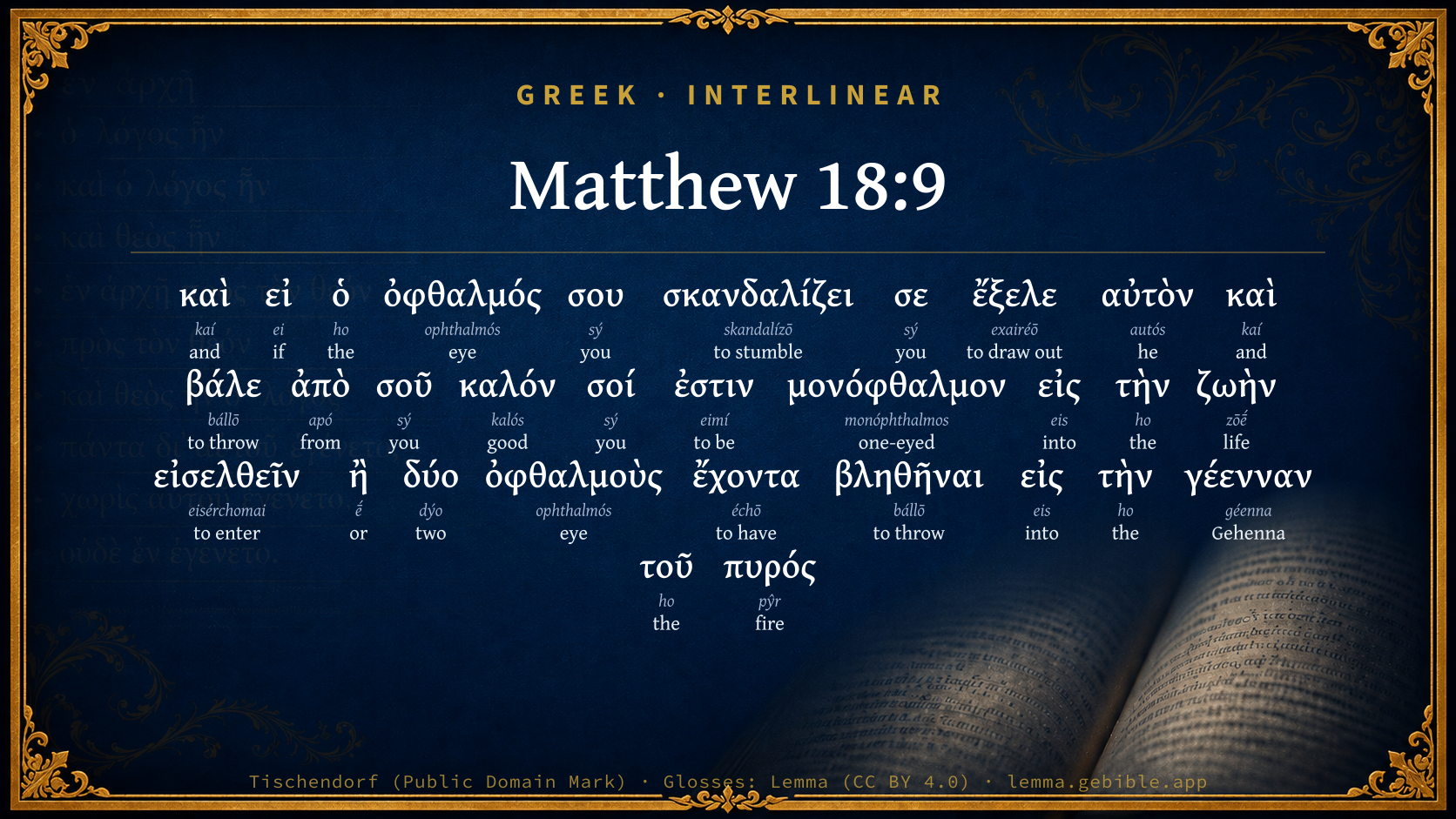
If your eye causes you to stumble, pluck it out, and cast it from you. It is better for you to enter into life with one eye, rather than having two eyes to be cast into the Gehenna of fire.
Download a study sheet
One document with this verse’s original text, its word-by-word gloss line, the meaning frame, cross-references with their text, attributed commentary, and full source and license credits — printable, and it pastes into notes with its structure intact.
This verse Autodidact and up
A passage Seminary Student
Up to 50 verses in one chapter. A passage sheet keeps up to 6 commentary sources and 12 cross-references per verse, in the order this page ranks them, and says so on the sheet whenever that leaves anything out. Ask for a single verse and you get the Autodidact verse sheet above.
Everything on this page stays free to read, with no account — the sheet is a download of what is already on screen, not access to it.
Compare translations 3
The same verse in 3 English versions, stacked beneath the original-language interlinear above. Click any original word for its lexicon entry.
Each is an independent rendering of the whole verse — the interlinear is not word-aligned to these translations.
Highlighted words mark where these versions differ — a whole-verse word diff, not a word-by-word alignment.
-
World English Bible Public Domain
If your eye causes you to stumble, pluck it out, and cast it from you. It is better for you to enter into life with one eye, rather than having two eyes to be cast into the Gehenna of fire.
-
King James Version Public Domain
And if thine eye offend thee, pluck it out, and cast it from thee: it is better for thee to enter into life with one eye, rather than having two eyes to be cast into hell fire.
-
unfoldingWord Literal Text CC BY-SA 4.0
And if your eye causes you to stumble, pluck it out and throw away from you. It is better for you to enter into life with one eye than, having two eyes, to be thrown into the Gehenna of fire.
unfoldingWord Literal Text — © unfoldingWord, licensed CC BY-SA 4.0. Word-aligned USFM3 via Door43 (git.door43.org/unfoldingWord/en_ult).
Show all 19 translations
Every available English version of this verse, each an independent rendering of the whole verse.
-
World English Bible Public Domain
If your eye causes you to stumble, pluck it out, and cast it from you. It is better for you to enter into life with one eye, rather than having two eyes to be cast into the Gehenna of fire.
-
Berean Standard Bible Public Domain
And if your eye causes you to sin, gouge it out and throw it away. It is better for you to enter life with one eye than to have two eyes and be thrown into the fire of hell.
-
Majority Standard Bible Public Domain
And if your eye causes you to sin, gouge it out and throw it away. It is better for you to enter life with one eye than to have two eyes and be thrown into the fire of hell.
-
King James Version Public Domain
And if thine eye offend thee, pluck it out, and cast it from thee: it is better for thee to enter into life with one eye, rather than having two eyes to be cast into hell fire.
-
American Standard Version (1901) Public Domain
And if thine eye causeth thee to stumble, pluck it out, and cast it from thee: it is good for thee to enter into life with one eye, rather than having two eyes to be cast into the hell of fire.
-
Revised Version (1885) Public Domain
And if thine eye causeth thee to stumble, pluck it out, and cast it from thee: it is good for thee to enter into life with one eye, rather than having two eyes to be cast into the hell of fire.
-
Geneva Bible (1599) Public Domain
And if thine eye cause thee to offende, plucke it out, and cast it from thee: it is better for thee to enter into life with one eye, then hauing two eyes to be cast into hell fire.
-
Douay-Rheims (1899) Public Domain
And if thy eye scandalize thee, pluck it out, and cast it from thee. It is better for thee having one eye to enter into life, than having two eyes to be cast into hell fire.
-
Young's Literal Translation Public Domain
`And if thine eye doth cause thee to stumble, pluck it out and cast from thee; it is good for thee one-eyed to enter into the life, rather than having two eyes to be cast to the gehenna of the fire.
-
Literal Standard Version CC BY-SA 4.0
And if your eye causes you to stumble, pluck it out and cast from you; it is good for you to enter into life one-eyed, rather than having two eyes to be cast into the Gehenna of fire.
-
Unlocked Literal Bible CC BY-SA 4.0
If your eye causes you to stumble, pluck it out and throw it away from you. It is better for you to enter into life with one eye than to be thrown into the eternal fire having both eyes.
-
unfoldingWord Literal Text CC BY-SA 4.0
And if your eye causes you to stumble, pluck it out and throw away from you. It is better for you to enter into life with one eye than, having two eyes, to be thrown into the Gehenna of fire.
-
Darby Bible Public Domain
And if thine eye offend thee, pluck it out and cast [it] from thee; it is good for thee to enter into life one-eyed, [rather] than having two eyes to be cast into the hell of fire.
-
World Messianic Bible Public Domain
If your eye causes you to stumble, pluck it out and cast it from you. It is better for you to enter into life with one eye, rather than having two eyes to be cast into the Gehinnom of fire.
-
Webster's Bible Public Domain
And if thy eye causeth thee to sin, pluck it out, and cast it from thee: it is better for thee to enter into life with one eye, rather than having two eyes, to be cast into hell-fire.
-
Free Bible Version CC BY-SA 4.0
If your eye causes you to sin, pull it out and throw it away. It's better for you to enter eternal life with one eye than to have two eyes and to be thrown into the fire of Gehenna.
-
Bible in Basic English Public Domain
And if your eye is a cause of trouble to you, take it out, and put it away from you: it is better for you to go into life with one eye than, having two eyes, to go into the hell of fire.
-
Text-Critical English NT CC BY 4.0
And if yoʋr eye causes yoʋ to stumble, pluck it out and throw it away from yoʋ. It is better for yoʋ to enter life with one eye than to have two eyes and be thrown into the fires of hell.
-
Tyndale New Testament (1534) Public Domain
And yf also thyne eye offende the plucke him oute and caste him from the. It is better for the to enter into lyfe with one eye then havyng two eyes to be cast into hell fyre.
Literal Standard Version (2020), Covenant Press — licensed CC BY-SA 4.0. Text via the HelloAO Bible API (eBible.org). Unlocked Literal Bible (unfoldingWord) — licensed CC BY-SA 4.0. Text via the HelloAO Bible API (eBible.org). unfoldingWord Literal Text — © unfoldingWord, licensed CC BY-SA 4.0. Word-aligned USFM3 via Door43 (git.door43.org/unfoldingWord/en_ult). Free Bible Version, Dr. Jonathan Gallagher — licensed CC BY-SA 4.0. Text via the HelloAO Bible API (eBible.org).
Word by word
More ways to search: Search by grammar → Find every occurrence → Compare this word →
Practice this passage: Drill this verse → Learn its vocabulary →
- Appears 2× in the Greek New Testament
- First appears here
- Part of Speech
- Adjective
- Case
- Accusative
- Number
- Singular
- Gender
- Masculine
Full Thayer's Definition
- καὶ kaí G2532 “and” Conjunction
- εἰ ei G1487 “if” Conditional
- ὁ ho G3588 “the” Article, Nominative, Singular, Masculine
- ὀφθαλμός ophthalmós G3788 “eye” Noun, Nominative, Singular, Masculine
- σου sý G4771 “you” Personal pronoun, 2nd person, Genitive, Singular
- σκανδαλίζει skandalízō G4624 “to stumble” Verb, Present, Active, Indicative, 3rd person, Singular
- σε sý G4771 “you” Personal pronoun, 2nd person, Accusative, Singular
- ἔξελε exairéō G1807 “to draw out” Verb, Aorist, Active, Imperative, 2nd person, Singular
- αὐτὸν autós G846 “he” Personal pronoun, Accusative, Singular, Masculine
- καὶ kaí G2532 “and” Conjunction
- βάλε bállō G906 “to throw” Verb, Aorist, Active, Imperative, 2nd person, Singular
- ἀπὸ apó G575 “from” Preposition
- σοῦ sý G4771 “you” Personal pronoun, 2nd person, Genitive, Singular
- καλόν kalós G2570 “good” Adjective, Nominative, Singular, Neuter
- σοί sý G4771 “you” Personal pronoun, 2nd person, Dative, Singular
- ἐστιν eimí G1510 “to be” Verb, Present, Active, Indicative, 3rd person, Singular
- μονόφθαλμον monóphthalmos G3442 “one-eyed” Adjective, Accusative, Singular, Masculine
- εἰς eis G1519 “into” Preposition
- τὴν ho G3588 “the” Article, Accusative, Singular, Feminine
- ζωὴν zōḗ G2222 “life” Noun, Accusative, Singular, Feminine
- εἰσελθεῖν eisérchomai G1525 “to enter” Verb, Aorist, Active, Infinitive
- ἢ ḗ G2228 “or” Particle
- δύο dýo G1417 “two” Adjective, Numeral (indeclinable)
- ὀφθαλμοὺς ophthalmós G3788 “eye” Noun, Accusative, Plural, Masculine
- ἔχοντα échō G2192 “to have” Verb, Present, Active, Participle, Accusative, Singular, Masculine
- βληθῆναι bállō G906 “to throw” Verb, Aorist, Passive, Infinitive
- εἰς eis G1519 “into” Preposition
- τὴν ho G3588 “the” Article, Accusative, Singular, Feminine
- γέενναν géenna G1067 “Gehenna” Noun, Accusative, Singular, Feminine
- τοῦ ho G3588 “the” Article, Genitive, Singular, Neuter
- πυρός pŷr G4442 “fire” Noun, Genitive, Singular, Neuter
About this verse
These counts appear in no published source. They are computed here, from the morphology-tagged text and Lemma’s own curated glosses. What Lemma adds →
- 31
- words
- 21
- distinct lemmas
- Gospels
- section
Notable vocabulary
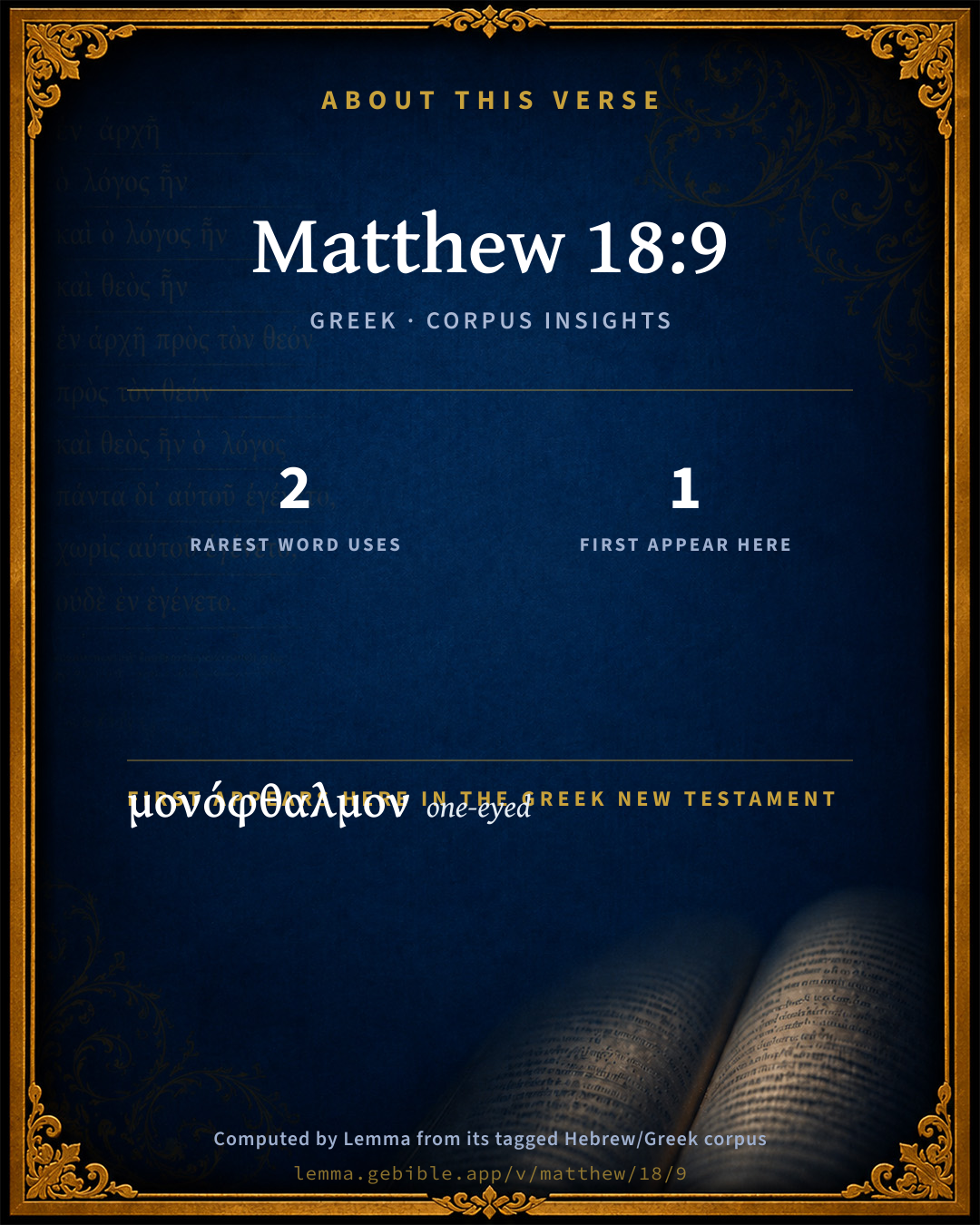
The rarest word here is μονόφθαλμον one-eyed G3442 — appearing just 2 times in the whole Greek New Testament.
First appearance in Scripture
This word makes its first canonical appearance in the Greek New Testament here:
- μονόφθαλμον one-eyed G3442
Shared distinctive vocabulary
μονόφθαλμον one-eyed G3442 occurs in 2 verses of the Greek New Testament. Also found in:
Cross-references
11Topical passages linked to Matthew 18:9 in the Treasury of Scripture Knowledge — connected by theme and wording, ordered by reader-vote popularity; previews shown in the World English Bible.
- Matthew 18:8 If your hand or your foot causes you to stumble, cut it off, and cast it from you. It is better for you to enter into life maimed or crippled, rather than having two hands or two feet to be cast into the eternal fire.
- Acts 14:22 confirming the souls of the disciples, exhorting them to continue in the faith, and that through many afflictions we must enter into the Kingdom of God.
- Matthew 5:22 But I tell you, that everyone who is angry with his brother without a cause shall be in danger of the judgment; and whoever shall say to his brother, 'Raca!' shall be in danger of the council; and whoever shall say, 'You fool!' shall be in danger of the fire of Gehenna.
- Matthew 5:29 If your right eye causes you to stumble, pluck it out and throw it away from you. For it is more profitable for you that one of your members should perish, than for your whole body to be cast into Gehenna.
- Revelation 21:27 There will in no way enter into it anything profane, or one who causes an abomination or a lie, but only those who are written in the Lamb's book of life.
- Matthew 16:26 For what will it profit a man, if he gains the whole world, and forfeits his life? Or what will a man give in exchange for his life?
- Matthew 19:17 He said to him, "Why do you call me good? No one is good but one, that is, God. But if you want to enter into life, keep the commandments."
- Matthew 19:23–24 Jesus said to his disciples, "Most assuredly I say to you, a rich man will enter into the Kingdom of Heaven with difficulty.
- Mark 9:47 If your eye causes you to stumble, cast it out. It is better for you to enter into the Kingdom of God with one eye, rather than having two eyes to be cast into the Gehenna of fire,
- Luke 9:24–25 For whoever desires to save his life will lose it, but whoever will lose his life for my sake, the same will save it.
- Hebrews 4:11 Let us therefore give diligence to enter into that rest, lest anyone fall after the same example of disobedience.
Cross-references courtesy of OpenBible.info (CC BY 4.0).
Lesson kit
Teaching starters — assembled from the data on this page, not authored interpretation. Every prompt links to the verse data it draws on. Edit before teaching.
Matthew, in the Gospels, opens this verse with 31 words (21 distinct Greek lemmas). Its most distinctive word is monóphthalmos (“one-eyed”). A historical commentator’s framing appears above. Read the whole chapter for the surrounding context.
Discussion questions
- How does “one-eyed” (monóphthalmos) shape what this verse is saying?
- The word “one-eyed” first appears here in Scripture. What is being introduced at this debut?
- Mark 9:47 shares the word «one-eyed» with this verse. How do the two illuminate each other?
- “eye” occurs 2× in this one verse. What is the effect of the repetition?
- The translations on this page render this verse differently — a whole-verse word diff, not a word-by-word alignment. What might account for the different wordings?
- Reading how The Biblical Illustrator and Bengel's Gnomon read this verse, where do the two commentators agree and where do they part?
Things to notice
- 1 word makes its first canonical appearance in Scripture here.
- These translations choose different wording for 11 words in this verse.
- “eye” occurs 2× in this single verse.
- 21 distinct Greek lemmas span 31 words in this verse.
Commentary
Notes on Matthew 18:9 from classic Christian and Jewish commentators (each source and its license shown beneath its notes). The classic Christian expositions comment on the surrounding passage and are grouped to its opening verse, so a note may address several verses; the Jewish commentaries on the Tanakh (Rashi and others) are per-verse, so they appear only where the commentator wrote on this verse.
Lemma curates 59 commentaries, every one of them public domain or Creative Commons licensed, each selected and text-cleaned for this edition rather than reprinted as found. About our sources →
The Biblical Illustrator
Joseph S. Exell
The Biblical Illustrator, edited by Joseph S. Exell (c. 1880s–1900s) — public domain. Text from a community e-Sword module.
Bengel's Gnomon
Johann Albrecht Bengel
Bengel's Gnomon of the New Testament — English translation (T&T Clark, Edinburgh, 1860) — public domain. Text from a community e-Sword module.
Expositor's Greek Testament
ed. W. Robertson Nicoll
The Expositor's Greek Testament, edited by W. Robertson Nicoll (1897–1910) — public domain. Text from a community e-Sword module.
Adam Clarke's Commentary
Adam Clarke's Commentary on the Bible (1810–1826) — public domain. Text from a community e-Sword/MySword module.
Trapp's Complete Commentary
John Trapp
John Trapp, A Commentary or Exposition upon All the Books of the Old and New Testament (1647–1656) — public domain. Text from a community e-Sword module.
The Pulpit Commentary
The Pulpit Commentary (1880–1919), ed. H.D.M. Spence-Jones & Joseph S. Exell — public domain. Text from a community e-Sword module.
Scofield Reference Notes
C. I. Scofield
The Scofield Reference Bible (1917 edition), notes by C. I. Scofield — public domain. Text from a community e-Sword module.
unfoldingWord translationNotes
Door43 World Missions Community
unfoldingWord translationNotes — © Distant Shores Media and the Door43 World Missions Community, licensed CC BY-SA 4.0. Source: git.door43.org/Door43/en_tn.
Cambridge Greek Testament for Schools and Colleges
Cambridge Greek Testament for Schools and Colleges (Cambridge University Press, 1896; 21 vols, various authors incl. Carr, Maclear, Plummer, Farrar, Lumby, Moule, M. R. James, Simcox) — public domain. Text from a community e-Sword module.
Alford’s Greek Testament
Henry Alford
Henry Alford, The Greek Testament (1849–1861) — public domain. Text from a community e-Sword module.
International Critical Commentary
International Critical Commentary — older volumes (1896–1929), various authors — public domain. Text from a community e-Sword module.