
Matthew 12:40

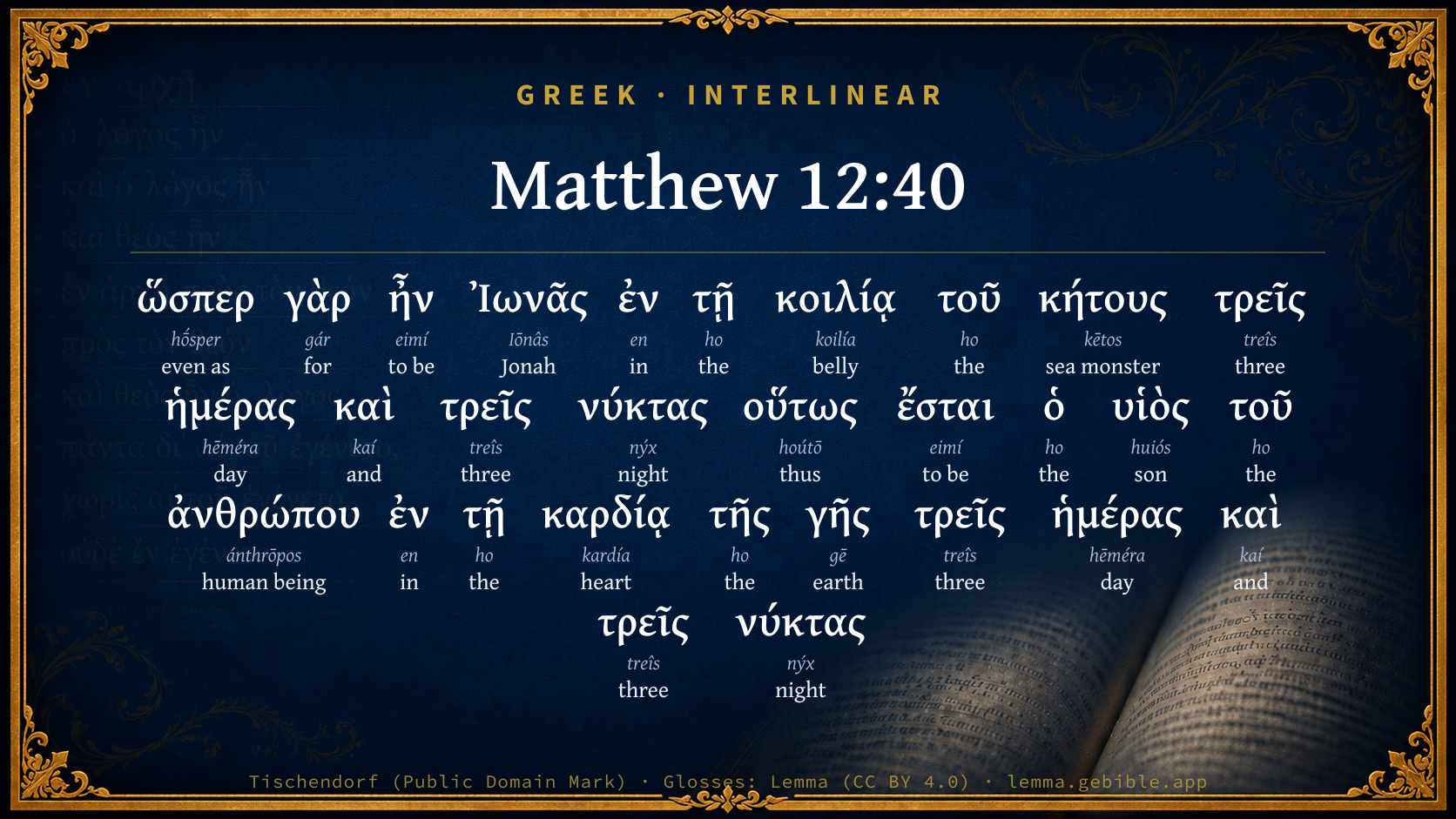
Greek (Tischendorf 8th ed.) Matthew 12:40 appears in the Greek New Testament. The text above is from the Tischendorf 8th edition. Each word links to its Strong’s number and a concise gloss. Click any word for its full Thayer’s Greek Lexicon entry.
Download image
Cite this verse

Matthew 12:40 (World English Bible). Public Domain. Lemma interlinear Bible study tool, https://lemma.gebible.app/v/matthew/12/40.

Show BibTeX & RIS
BibTeX
RIS
English Translation
For as Jonah was three days and three nights in the belly of the whale, so will the Son of Man be three days and three nights in the heart of the earth.
World English Bible · Public Domain
Highlights
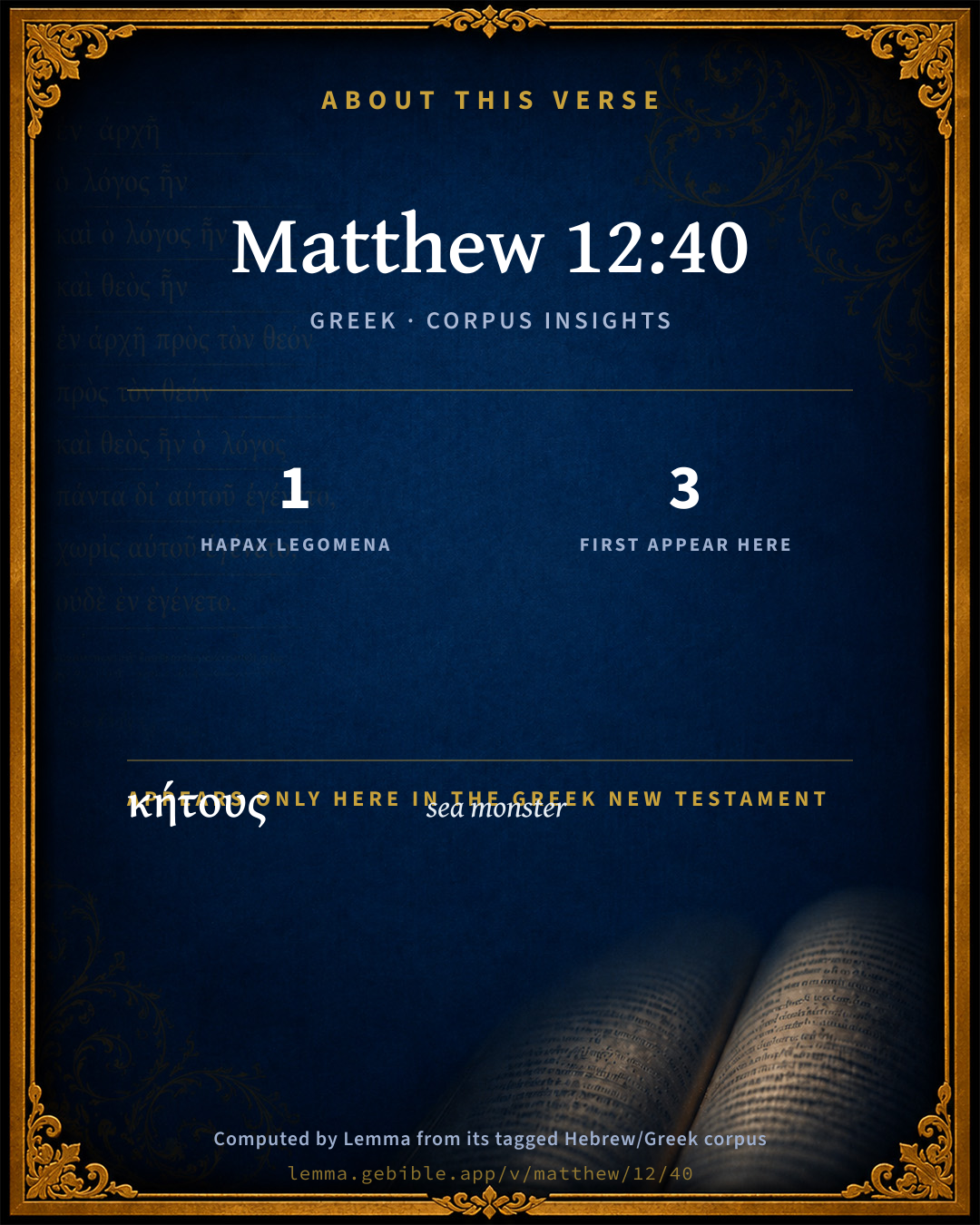
  • 1 hapax legomenon — only here in the Greek New Testament
  • 3 first appearances in the Greek New Testament
Full analysis ↓
Download a study sheet

One document with this verse’s original text, its word-by-word gloss line, the meaning frame, cross-references with their text, attributed commentary, and full source and license credits — printable, and it pastes into notes with its structure intact.

This verse Autodidact and up

Study sheet (.html) Plain text (.txt)

A passage Seminary Student

Up to 50 verses in one chapter. A passage sheet keeps up to 6 commentary sources and 12 cross-references per verse, in the order this page ranks them, and says so on the sheet whenever that leaves anything out. Ask for a single verse and you get the Autodidact verse sheet above.

Everything on this page stays free to read, with no account — the sheet is a download of what is already on screen, not access to it.

Want to remove ads? Support Godless Engineer
Compare translations 3

The same verse in 3 English versions, stacked beneath the original-language interlinear above. Click any original word for its lexicon entry.

Each is an independent rendering of the whole verse — the interlinear is not word-aligned to these translations.

Highlighted words mark where these versions differ — a whole-verse word diff, not a word-by-word alignment.

  • World English Bible Public Domain
    For as Jonah was three days and three nights in the belly of the whale, so will the Son of Man be three days and three nights in the heart of the earth.
  • King James Version Public Domain
    For as Jonas was three days and three nights in the whale's belly; so shall the Son of man be three days and three nights in the heart of the earth.
  • unfoldingWord Literal Text CC BY-SA 4.0
    For just as Jonah was three days and three nights in the belly of the big fish, in this manner the Son of Man will be three days and three nights in the heart of the earth.

unfoldingWord Literal Text — © unfoldingWord, licensed CC BY-SA 4.0. Word-aligned USFM3 via Door43 (git.door43.org/unfoldingWord/en_ult).

Versions to compare (up to 4)

3 of 4 selected

Show all 19 translations

Every available English version of this verse, each an independent rendering of the whole verse.

  • World English Bible Public Domain
    For as Jonah was three days and three nights in the belly of the whale, so will the Son of Man be three days and three nights in the heart of the earth.
  • Berean Standard Bible Public Domain
    For as Jonah was three days and three nights in the belly of the great fish, so the Son of Man will be three days and three nights in the heart of the earth.
  • Majority Standard Bible Public Domain
    For as Jonah was three days and three nights in the belly of the great fish, so the Son of Man will be three days and three nights in the heart of the earth.
  • King James Version Public Domain
    For as Jonas was three days and three nights in the whale's belly; so shall the Son of man be three days and three nights in the heart of the earth.
  • American Standard Version (1901) Public Domain
    for as Jonah was three days and three nights in the belly of the whale; so shall the Son of man be three days and three nights in the heart of the earth.
  • Revised Version (1885) Public Domain
    for as Jonah was three days and three nights in the belly of the whale; so shall the Son of man be three days and three nights in the heart of the earth.
  • Geneva Bible (1599) Public Domain
    For as Ionas was three daies and three nights in the whales belly: so shall the Sonne of man be three daies and three nights in ye heart of the earth.
  • Douay-Rheims (1899) Public Domain
    For as Jonas was in the whale's belly three days and three nights: so shall the Son of man be in the heart of the earth three days and three nights.
  • Young's Literal Translation Public Domain
    for, as Jonah was in the belly of the fish three days and three nights, so shall the Son of Man be in the heart of the earth three days and three nights.
  • Literal Standard Version CC BY-SA 4.0
    for as Jonah was in the belly of the fish three days and three nights, so will the Son of Man be in the heart of the earth three days and three nights.
  • Unlocked Literal Bible CC BY-SA 4.0
    For as Jonah was three days and three nights in the stomach of the big fish, so will the Son of Man be three days and three nights in the heart of the earth.
  • unfoldingWord Literal Text CC BY-SA 4.0
    For just as Jonah was three days and three nights in the belly of the big fish, in this manner the Son of Man will be three days and three nights in the heart of the earth.
  • Darby Bible Public Domain
    For even as Jonas was in the belly of the great fish three days and three nights, thus shall the Son of man be in the heart of the earth three days and three nights.
  • World Messianic Bible Public Domain
    For as Jonah was three days and three nights in the belly of the huge fish, so will the Son of Man be three days and three nights in the heart of the earth.
  • Webster's Bible Public Domain
    For as Jonah was three days and three nights in the whale's belly: so shall the Son of man be three days and three nights in the heart of the earth.
  • Free Bible Version CC BY-SA 4.0
    “In the same way Jonah was in the belly of a huge fish for three days and three nights, the Son of man will be in the heart of the earth for three days and three nights.
  • Bible in Basic English Public Domain
    For as Jonah was three days and three nights in the stomach of the great fish, so will the Son of man be three days and three nights in the heart of the earth.
  • Text-Critical English NT CC BY 4.0
    For just as Jonah was in the belly of the great sea creature for three days and three nights, so will the Son of Man be in the heart of the earth for three days and three nights.
  • Tyndale New Testament (1534) Public Domain
    For as Ionas was thre dayes and thre nyghtes in the whales belly: soo shall the sonne of man be thre dayes and thre nyghtes in the hert of the erth.

Literal Standard Version (2020), Covenant Press — licensed CC BY-SA 4.0. Text via the HelloAO Bible API (eBible.org). Unlocked Literal Bible (unfoldingWord) — licensed CC BY-SA 4.0. Text via the HelloAO Bible API (eBible.org). unfoldingWord Literal Text — © unfoldingWord, licensed CC BY-SA 4.0. Word-aligned USFM3 via Door43 (git.door43.org/unfoldingWord/en_ult). Free Bible Version, Dr. Jonathan Gallagher — licensed CC BY-SA 4.0. Text via the HelloAO Bible API (eBible.org).

Word by word

More ways to search: Search by grammar → Find every occurrence → Compare this word →

Practice this passage: Drill this verse → Learn its vocabulary →

κήτους
kētos
G2785
“sea monster”
Noun, Genitive, Singular, Neuter
Part of Speech
Noun
Case
Genitive
Number
Singular
Gender
Neuter
Full Thayer's Definition

Origin: probably from the base of G5490

TDNT: None

1. a sea monster, whale, huge fish
  1. ὥσπερ hṓsper G5618 “even as” Adverb
  2. γὰρ gár G1063 “for” Conjunction
  3. ἦν eimí G1510 “to be” Verb, Imperfect, Active, Indicative, 3rd person, Singular
  4. Ἰωνᾶς Iōnâs G2495 “Jonah” Noun, Nominative, Singular, Masculine
  5. ἐν en G1722 “in” Preposition
  6. τῇ ho G3588 “the” Article, Dative, Singular, Feminine
  7. κοιλίᾳ koilía G2836 “belly” Noun, Dative, Singular, Feminine
  8. τοῦ ho G3588 “the” Article, Genitive, Singular, Neuter
  9. τρεῖς treîs G5140 “three” Adjective, Accusative, Plural, Feminine
  10. ἡμέρας hēméra G2250 “day” Noun, Accusative, Plural, Feminine
  11. καὶ kaí G2532 “and” Conjunction
  12. τρεῖς treîs G5140 “three” Adjective, Accusative, Plural, Feminine
  13. νύκτας nýx G3571 “night” Noun, Accusative, Plural, Feminine
  14. οὕτως hoútō G3779 “thus” Adverb
  15. ἔσται eimí G1510 “to be” Verb, Future, Middle deponent, Indicative, 3rd person, Singular
  16. ὁ ho G3588 “the” Article, Nominative, Singular, Masculine
  17. υἱὸς huiós G5207 “son” Noun, Nominative, Singular, Masculine
  18. τοῦ ho G3588 “the” Article, Genitive, Singular, Masculine
  19. ἀνθρώπου ánthrōpos G444 “human being” Noun, Genitive, Singular, Masculine
  20. ἐν en G1722 “in” Preposition
  21. τῇ ho G3588 “the” Article, Dative, Singular, Feminine
  22. καρδίᾳ kardía G2588 “heart” Noun, Dative, Singular, Feminine
  23. τῆς ho G3588 “the” Article, Genitive, Singular, Feminine
  24. γῆς gē G1093 “earth” Noun, Genitive, Singular, Feminine
  25. τρεῖς treîs G5140 “three” Adjective, Accusative, Plural, Feminine
  26. ἡμέρας hēméra G2250 “day” Noun, Accusative, Plural, Feminine
  27. καὶ kaí G2532 “and” Conjunction
  28. τρεῖς treîs G5140 “three” Adjective, Accusative, Plural, Feminine
  29. νύκτας nýx G3571 “night” Noun, Accusative, Plural, Feminine

About this verse

These counts appear in no published source. They are computed here, from the morphology-tagged text and Lemma’s own curated glosses. What Lemma adds →

30
words
17
distinct lemmas
Gospels
section

Notable vocabulary

1 hapax legomenon — a word that appears only here in the entire Greek New Testament:

  • κήτους sea monster G2785

First appearance in Scripture

These words make their first canonical appearance in the Greek New Testament here:

  • κοιλίᾳ belly G2836
  • κήτους sea monster G2785
  • τρεῖς three G5140

Shared distinctive vocabulary

Ἰωνᾶς Jonah G2495 occurs in 7 verses of the Greek New Testament. Also found in:
Repetition

Words recur within this verse:

Cross-references

9

Topical passages linked to Matthew 12:40 in the Treasury of Scripture Knowledge — connected by theme and wording, ordered by reader-vote popularity; previews shown in the World English Bible.

  • Jonah 1:17 Yahweh prepared a great fish to swallow up Jonah, and Jonah was in the belly of the fish three days and three nights.
  • Matthew 27:63–64 saying, "Sir, we remember what that deceiver said while he was still alive: 'After three days I will rise again.'
  • Matthew 16:21 From that time, Jesus began to show his disciples that he must go to Jerusalem and suffer many things from the elders, chief priests, and scribes, and be killed, and the third day be raised up.
  • Matthew 17:23 and they will kill him, and the third day he will be raised up." They were exceedingly sorry.
  • John 2:19 Jesus answered them, "Destroy this temple, and in three days I will raise it up."
  • Matthew 27:40 and saying, "You who destroy the temple, and build it in three days, save yourself! If you are the Son of God, come down from the cross!"
  • Jonah 2:2–6 He said, "I called because of my affliction to Yahweh. He answered me. Out of the belly of Sheol I cried. You heard my voice.
  • Psalms 63:9 But those who seek my soul, to destroy it, Shall go into the lower parts of the earth.
  • Matthew 8:20 Jesus said to him, "The foxes have holes, and the birds of the sky have nests, but the Son of Man has nowhere to lay his head."

Cross-references courtesy of OpenBible.info (CC BY 4.0).

Commentary

Notes on Matthew 12:40 from classic Christian and Jewish commentators (each source and its license shown beneath its notes). The classic Christian expositions comment on the surrounding passage and are grouped to its opening verse, so a note may address several verses; the Jewish commentaries on the Tanakh (Rashi and others) are per-verse, so they appear only where the commentator wrote on this verse.

Lemma curates 59 commentaries, every one of them public domain or Creative Commons licensed, each selected and text-cleaned for this edition rather than reprinted as found. About our sources →

Bengel's Gnomon

Johann Albrecht Bengel

Mat 12:40. Ἰωνὰς, Jonas) Jonas did not then die, but yet it was as much believed that he would not return from the fish, as it was that Jesus would not return from the heart of the earth; yet both of them did return.—ἐν τῇ κοιλίᾳ τοῦ κήτους, in the belly of the whale) We ought not to doubt that Jonah was in the belly of the whale, on account of the narrow throat of some animals of that kind. For there are various sorts of whales, and in these days, the bodies of men are found in their stomachs; and even if such were not the case, we must suppose that fish especially made for the occasion; see Jon 2:1.—ἔσται, shall be) A sign for the future, as in Joh 2:19; Joh 6:62; Joh 6:39.—γῆς, of the earth) From thence shall they have a sign, and not one from heaven before that, although they sought it thence; cf. Luk 11:16. No signs, except such as were exhibited from the earth, and performed for the good of men, were suitable to the Messiah’s state of humiliation. They did not know that the sign of that time was suitable to that time; see ch. Mat 16:3. Afterwards signs were shown, and shall be shown from heaven: see Act 2:19; Mat 24:30.—τρεῖς ἡμέρας καὶ τρεῖς νύκτας, three days and three nights) No one doubts that Jesus was in the heart of the earth three days.—He remained there however only two nights, as far as night signifies the darkness interposed between day and day (cf. Mar 14:30); and yet the calculation of three days, and the same number of nights, holds good if you do not interpret it with astronomical exactness, but resolve it by synecdoche. For three days and three nights are the periphrasis of a single idea, and have the force of a single word and term, if such existed, by which the remaining of Jesus in the sepulchre is expressed, as if you should say a-space-of-three-days-and-nights (triduinoctium), or three-nights-and-days (tria noctidua). Three days might have been simply expressed, but this is the idiom of the sacred style, that in indicating continuous time the intervening nights are added; see ch. Mat 4:2; Gen 7:4; 1Sa 30:12-13; Job 2:13. And then it sounds better to say[581] three days and three nights, than three days and two nights, although the Lord was buried on the actual day of the preparation, not on the night preceding and joined to it, and the space of twenty-four hours is regarded simply as a natural day without the change of darkness and light; and in fact the first night-and-day, used synecdochically,[582] was from about the tenth hour of the Friday up to the night exclusively;[583] the second and fullest, from the beginning of that night up to the end of the Sabbath and beginning of the following night; the third, strictly speaking, from the beginning of the following night up to the resurrection of the Lord, and the rising of the sun on Sunday morning. Two nights, therefore, were certainly joined with two days; nor does one night taken from one day, i.e. the first, affect the truth of the language, which denominates the thing in question from its superior part (locutionis a potiori[584] rem denominantis). In fine, there were not two nights and days, nor four; therefore there were three. The Hebrew mode of expression is agreeable to this; concerning which, see Lightfoot and Wolfe on this passage, and Michaelis on Jos 2:16. Although what I have here said may satisfy a reader who is not unreasonable, I would also further observe, that the synecdoche does not belong so much to the three-days-and-three-nights as to the actual remaining in the heart of the earth. Scripture indeed frequently defines a certain time, and expresses not the whole matter which commensurately and exactly occupied that time, but a part of the matter longer in duration than the other parts; as, for example, the four hundred and thirty years of the sojourning in Egypt, Exo 12:40; and thus passim the whole book of Judges. In this passage, therefore, the remaining in the heart of the earth, i.e. in the sepulchre, is expressed, but at the same time the whole period of the Passion is implied, certainly from the agony in Gethsemane, when Jesus fell on the earth which He was the next day to enter, and from the capture by which the Jews commenced their undertaking to destroy that Temple (as Erasmus thinks, Annot. F. 134). Nay, the glorious beginning of the three days on Thursday is clearly intimated, in Joh 13:31 [comp. Harmon. Evang. p. 310, 366], as dating from the time when the Jews bargained for the Saviour, who was to be committed to the earth. The remaining in the earth, taken in a wider signification, includes all these things; see Psa 71:20. For the Son of Man was a sign to that generation, not only in His sepulchre, but most especially in His passion; see Joh 8:28. In this manner, the three days and three nights are exactly completed from the dawn of Thursday to the dawn of Sunday. The time of the death of the two witnesses is exactly defined, Revelation 11, to be three and a half days; therefore we ought to consider that the three days and three nights of our Lord’s remaining in the middle of the earth have been also exactly defined. The middle, or heart, of the earth should not be precisely sought for; but these phrases are opposed to the earth itself, on the surface of which Christ dwelt for more than thirty years.

[581] In the original, “concinnius dicitur,” i.e. it sounds more systematic, it sounds more uniform, to say.—(I. B.)

[582] See Appendix on the figure Synecdoche.—(I. B.)

[583] The night not being included.—ED.

[584] “A potiori” implies that the whole twenty-four-hour-day (the first of the three in question) is denominated, not only from a part, but also from the superior part, viz. the part which had the daylight, and which is regarded as superior to the part during which darkness prevailed, viz. the night preceding Friday, and attached to it, according to the Jewish mode of counting.—ED.

Bengel's Gnomon of the New Testament — English translation (T&T Clark, Edinburgh, 1860) — public domain. Text from a community e-Sword module.

Meyer's Critical & Exegetical Commentary

Heinrich August Wilhelm Meyer

Mat_12:40. Τοῦ κήτους] the monster of the deep, Hom. Il. v. 148; Od. iv. 446; Buttmann, Lexil. II. p. 95. The allusion is to the well-known story in Jon_2:1.

Jesus was dead only a day and two nights. But, in accordance with the popular method of computation (1Sa_30:12 f.; Mat_27:63), the parts of the first and third day are counted as whole days, as would be further suggested by the parallel that is drawn between the fate of the antitype and that of Jonah.[446]

The sign of Jonah has nothing to do with the withered rod that budded, Numbers 17 (in answer to Delitzsch); Jonah is the type.

[446] But the question as to what Jesus meant by ἔσται … ἐν τῇ καρδίᾳ τῆς γῆς, whether His lying in the grave (so the greater number of expositors), or His abode in Hades (Tertullian, Irenaeus, Theophylact, Bellarmin, Maldonatus, Olshausen, König, Lehre von Christi Höllenfahrt, Frankf. 1842, p. 54; Kahnis, Dogmat. I. p. 508), is determined by καρδία τἥς γῆς, to which expression the resting in the grave does not sufficiently correspond; for the heart of the earth can only indicate its lowest depths, just as καρδία τῆς θαλάσσης means the depths of the sea in Jon_2:4, from which the biblical expression καρδία in our present passage seems to have been derived. Again, the parallel in the κοιλία τοῦ κήτους is, in any case, better suited to the idea of Hades than it is to that of a grave cut out of the rock on the surface of the earth. If, on the other hand, Jesus Himself has very distinctly intimated that His dying was to be regarded as a descending into Hades (Luk_23:43), then ἔσται … ἐν τῇ καρδ. τ. γ. must be referred to His sojourn there. There is nothing to warrant Güder (Erschein. Chr. unter d. Todten, p. 18) in disputing this reference by pointing to such passages as Exo_15:8; 2Sa_18:14. We should mistake the plastic nature of the style in such passages as those, if we did not take לֵכ as referring to the inmost depth.

REMARK.

Luke (Mat_11:30) gives no explanation of the sign of Jonah (Mat_5:40), as is also the case with regard to Mat_16:4 (where, indeed, according to Holtzmann, we have only a duplicate of the present narrative). Modern critics (Paulus, Eckermann, Schleiermacher, Dav. Schulz, Strauss, Neander, Krabbe, de Wette, Baumgarten-Crusius, Ammon, Bleek, Weizsäcker, Schenkel) have maintained that what Jesus meant by the sign of Jonah was not His resurrection at all, but His preaching and His whole manifestation, so that Mat_12:40 is supposed to be an awkward interpolation, belonging to a later period (Keim), an interpolation in which it is alleged that an erroneous interpretation is put into Jesus mouth. But (1) if in Mat_12:41 it is only the preaching of Jonah that is mentioned, it is worthy of notice that what is said regarding the sign is entirely brought to a close in Mat_12:40, whereupon, by way of threatening the hearers and putting them to shame, Mat_12:41 proceeds to state, not what the Ninevites did in consequence of the sign, but what they did in consequence of the preaching of Jonah; and therefore (2) it is by no means presupposed in Mat_12:41 that the Ninevites had been made aware of the prophets fate. (3) Of course, according to the historical sense of the narrative, this fate consisted in the prophets being punished, and then pardoned again; but according to its typical reference, it at the same time constituted a σημεῖον, deriving its significance for after times from its antitype as realized in Christs resurrection; that it had been a sign for the Ninevites, is nowhere said. (4) If Jesus is ranked above Jonah in respect of His person or preaching, not in respect of the sign, this, according to what has been said under observation 1, in no way affects the interpretation of the sign. (5) The resurrection of Jesus was a sign not merely for believers, but also for unbelievers, who either accepted Him as the Risen One, or became only the more confirmed in their hostility toward him. (6) Mat_12:40 savours entirely of the mode and manner in which Jesus elsewhere alludes to His resurrection. Of course, in any case, he is found to predict it only in an obscure sort of way (see on Mat_14:21), not plainly and in so many words; and accordingly we do not find it more directly intimated in Mat_12:40, which certainly it would have been if it had been an interpretation of the sign put into the Lords mouth ex eventu. The expression is a remarkable parallel to Joh_2:21, where Johns explanation of it as referring to the resurrection has been erroneously rejected. It follows from all this that, so far as the subject-matter is concerned, the version of Luk_11:30 is not to be regarded as differing from that of Matthew, but only as less complete, though evidently proceeding on the understanding that the interpretation of the Jonah-sign is to be taken for granted (Mat_16:4).

Meyer — Critical and Exegetical Commentary on the New Testament — English translation by Peter Christie, edited by Frederick Crombie (T&T Clark, 1880) — public domain. Text from a community e-Sword module.

Expositor's Greek Testament

ed. W. Robertson Nicoll

Mat 12:40 gives an entirely different turn to the reference. he verse cannot be challenged on critical grounds. If it is an interpolation, it must have become an accepted part of the text before the date of our earliest copies. If it be genuine, then Jesus points to His resurrection as the appropriate sign for an unbelieving generation, saying in effect: you will continue to disbelieve in spite of all I can say or do, and at last you will put me to death. But I will rise again, a sign for your confusion if not for your conversion. For opposite views on this interpretation of the sign of Jonah, vide Meyer ad loc. and Holtzmann in H.C.

The Expositor's Greek Testament, edited by W. Robertson Nicoll (1897–1910) — public domain. Text from a community e-Sword module.

Jamieson, Fausset & Brown

Robert Jamieson, A. R. Fausset & David Brown

For as Jonas was--"a sign unto the Ninevites, so shall also the Son of man be to this generation" (Luk 11:30). For as Jonas was

three days and three nights in the whale's belly-- (Jon 1:17).

so shall the Son of man be three days and three nights in the heart of the earth--This was the second public announcement of His resurrection three days after His death. (For the first, see Joh 2:19). Jonah's case was analogous to this, as being a signal judgment of God; reversed in three days; and followed by a glorious mission to the Gentiles. The expression "in the heart of the earth," suggested by the expression of Jonah with respect to the sea (Jon 2:3, in the Septuagint), means simply the grave, but this considered as the most emphatic expression of real and total entombment. The period during which He was to lie in the grave is here expressed in round numbers, according to the Jewish way of speaking, which was to regard any part of a day, however small, included within a period of days, as a full day. (See Sa1 30:12-13; Est 4:16; Est 5:1; Mat 27:63-64, &c.).

Jamieson, Fausset & Brown — Commentary Critical and Explanatory on the Whole Bible (1871) — public domain (CC PDM 1.0). Text via the HelloAO Bible API.

Adam Clarke's Commentary

Verse 40. Three days and three nights] Our Lord rose from the grave on the day but one after his crucifixion: so that, in the computation in this verse, the part of the day on which he was crucified, and the part of that on which he rose again, are severally estimated as an entire day; and this, no doubt, exactly corresponded to the time in which Jonah was in the belly of the fish. Our Lord says, As Jonah was, so shall the Son of man be, c. Evening and morning, or night and day, is the Hebrew phrase for a natural day, which the Greeks termed νυξθημερον, nuchthemeron. The very same quantity of time which is here termed three days and three nights, and which, in reality, was only one whole day, a part of two others, and two whole nights, is termed three days and three nights, in the book of Esther: Go neither eat nor drink THREE DAYS, NIGHT or DAY, and so I will go in unto the king: Es 4:16. Afterwards it follows, Es 5:1. On the THIRD DAY, Esther stood in the inner court of the king's house. Many examples might be produced, from both the sacred and profane writers, in vindication of the propriety of the expression in the text. For farther satisfaction, the reader, if he please, may consult Whitby and Wakefield, and take the following from Lightfoot.

"I. The Jewish writers extend that memorable station of the unmoving sun, at Joshua's prayer, to six and thirty hours; for so Kimchi upon that place: 'According to more exact interpretation, the sun and moon stood still for six and thirty hours: for when the fight was on the eve of the Sabbath, Joshua feared lest the Israelites might break the Sabbath; therefore he spread abroad his hands, that the sun might stand still on the sixth day, according to the measure of the day of the Sabbath, and the moon according to the measure of the night of the Sabbath, and of the going out of the Sabbath, which amounts to six and thirty hours.'

"II. If you number the hours that pass from our Saviour's giving up the ghost upon the cross to his resurrection, you shall find almost the same number of hours; and yet that space is called by him three days and three nights, whereas two nights only came between, and one complete day. Nevertheless, while he speaks these words, he is not without the consent both of the Jewish schools and their computation. Weigh well that which is disputed in the tract Scabbath, concerning the separation of a woman for three days; where many things are discussed by the Gemarists, concerning the computation of this space of three days. Among other things these words occur: R. Ismael saith, Sometimes it contains four אונות onoth, sometimes five, sometimes six. But how much is the space of an אונה onah? R. Jochanan saith, Either a day or a night. And so also the Jerusalem Talmud: 'R. Akiba fixed a DAY for an onah, and a NIGHT for an onah.' But the tradition is, that R. Eliazar ben Azariah said, A day and a night make an onah: and a PART of an onah is as the WHOLE. And a little after, R. Ismael computed a part of the onah for the whole." Thus, then, three days and three nights, according to this Jewish method of reckoning, included any part of the first day; the whole of the following night; the next day and its night; and any part of the succeeding or third day.

In the whale's belly] That a fish of the shark kind, and not a whale, is here meant, Bochart has abundantly proved, vol. iii. col. 742, c., edit. Leyd. 1692. It is well known that the throat of a whale is capable of admitting little more than the arm of an ordinary man but many of the shark species can swallow a man whole, and men have been found whole in the stomachs of several. Every natural history abounds with facts of this kind. Besides, the shark is a native of the Mediterranean Sea, in which Jonah was sailing when swallowed by what the Hebrew terms דג גדול dag gadol, a great fish; but every body knows that whales are no produce of the Mediterranean Sea, thought some have been by accident found there, as in most other parts of the maritime world: but, let them be found where they may, there is none of them capable of swallowing a man. Instead of either whale or shark, some have translated דג גדול dag gadol, Jon 1:17, by a fishing cove, or something of this nature; but this is merely to get rid of the miracle: for, according to some, the whole of Divine revelation is a forgery - or it is a system of metaphor or allegory, that has no miraculous interferences in it. But, independently of all this, the criticism is contemptible. Others say, that the great fish means a vessel so called, into which Jonah went, and into the hold of which he was thrown, where he continued three days and three nights. In short, it must be any thing but a real miracle, the existence of which the wise men, so called, of the present day, cannot admit. Perhaps these very men are not aware that they have scarcely any belief even in the existence of God himself!

Adam Clarke's Commentary on the Bible (1810–1826) — public domain. Text from a community e-Sword/MySword module.

Ellicott's Commentary for English Readers

(40) As Jonas was three days and three nights.—To understand the words rightly, we have to remember the prominence which our Lord gives to the history of Jonah, and to the repentance of the men of Nineveh, in this and in the parallel passage of Luk_11:29, and in answer to another demand for a sign in Mat_16:4. In the other passages “the sign of the prophet Jonas” appears with a vague mysteriousness, unexplained. Not a few critics have accordingly inferred from this difference that the explanation given by St. Matthew was an addition to the words actually spoken by our Lord, and that “the sign of the prophet Jonas” was sufficiently fulfilled by His preaching repentance to the wicked and adulterous generation as Jonah had done to the Ninevites. Against this view, however, it may be urged:—(1) That Jonah’s work as a preacher was not a “sign” in any sense, and that nothing in his history had this character, except the two narratives of the whale (Jon_1:17) and the gourd (Jon_4:6-10). Any reference to the latter is, of course, out of the question; and it remains therefore, in any case, that we must look to the former as that to which our Lord alluded. (2) That the very difficulty presented by the prediction of “three days and three nights” as compared with the six-and-thirty hours (two nights and one day) of the actual history of the Resurrection, is against the probability of the verse having been inserted as a prophecy after the event. (3) That if we believe that our Lord had a distinct prevision of His resurrection, and foretold it, sometimes plainly and sometimes in dark sayings—and of this the Gospels leave no room for doubt (Mat_16:21; Mat_26:32; Joh_2:19)—then the history of Jonah presented an analogy which it was natural that He should notice. It does not necessarily follow that this use of the history as a prophetic symbol of the Resurrection requires us to accept it in the very letter of its details. It was enough, for the purposes of the illustration, that it was familiar and generally accepted. The purely chronological difficulty is explained by the common mode of speech among the Jews, according to which, any part of a day, though it were but a single hour, was for legal purposes considered as a whole. An instance of this mode of speech is found in 1Sa_30:12-13, and it is possible that in the history of Jonah itself the measurement of time is to be taken with the same laxity.

Some incidental facts are worth noticing: (1) that the word translated “whale” may stand vaguely for any kind of sea-monster; (2) that “the heart of the earth,” standing parallel as it does to “the heart of the seas,” the “belly of hell”—i.e., Sheol and Hades—in Jon_2:2-3, means more than the rock-hewn sepulchre, and implies the descent into Hades, the world of the dead, which was popularly believed to be far below the surface of the earth; (3) that the parable has left its mark on Christian art, partly in the constant use of Jonah as a type of our Lord’s resurrection, and partly in that of the jaws of a great whale-like monster as the symbol of Hades; (4) that the special character of the psalm in Jonah 2, corresponding as it does so closely (Jon_2:6) with Psa_16:10-11, may well be thought to have prompted our Lord’s reference to it.

A Bible Commentary for English Readers, edited by Charles John Ellicott (1878–1897) — public domain. Text from a community e-Sword module.

The Cambridge Bible for Schools and Colleges

gen. ed. J. J. S. Perowne

40. Jonah is a sign (1) as affording a type of the Resurrection, (2) as a preacher of righteousness to a people who needed repentance as this generation needs it.

the whale’s belly] The Greek word translated “whale” means “a sea monster.” The O. T. rendering is more accurate “the fish’s belly” (Jon_2:1), “a great fish” (Jon_1:17). It is scarcely needful to note that there are no whales in the Mediterranean.

The Cambridge Bible for Schools and Colleges (gen. ed. J. J. S. Perowne; Cambridge University Press, 1878–1918) — public domain. Text from a community e-Sword module.

John Gill's Exposition

Then goeth he, and taketh with himself seven other spirits,.... This is said in allusion to, and in imitation of the seven spirits before the throne; or may denote a large number of devils, seven being a number of perfection; or else the various corruptions of a man's heart, the swarms of internal lusts which are there stirred up by Satan;

more wicked than himself, as these are more pernicious to man, than the devil himself:

and they enter in and dwell there; that is, though they were there before, now they exert and show themselves, and such men appear to be under the power and government of them; when leaving their seeming religion and holiness, they return like the dog to the vomit, and the swine to the wallowing in the mire.

And the last state of that man is worse than the first: he becomes more wicked than ever he was, before he made pretensions to religion; as such apostates generally are more extravagant in sinning, and are seldom or ever recovered by repentance, and their last end is eternal damnation; see Pe2 2:20

even so shall it be also unto this wicked generation. This parable fitly suited them, the Scribes and Pharisees, and the men of that generation, from whom in some measure the unclean spirit might be said to depart through the doctrine, and miracles of Christ, to go into the Gentile world; but being followed there with the preaching of the Gospel by the apostles, returns to the Jews, and fills them with more malice, blasphemy, and blindness, than ever, which issued in their utter ruin and destruction; of which this parable may be justly thought to be prophetical.

John Gill's Exposition of the Whole Bible (1746–1763) — public domain (CC PDM 1.0). Text via the HelloAO Bible API.

Trapp's Complete Commentary

John Trapp

40 For as Jonas was three days and three nights in the whale’s belly; so shall the Son of man be three days and three nights in the heart of the earth.

Ver. 40. For as Jonas was three days, &c.] In the history of Jonah, Christ found the mystery of his death, burial, and resurrection; teaching us thereby to search the Scriptures-to search them to the bottom; as those that dig for gold content not themselves with the first or second ore that offers itself, but search on till they have all. This we should the rather do, because we need neither climb up to heaven with these Pharisees nor descend into the deep with Jonah, since "the word is nigh thee, even in thy mouth, and in thine heart," &c., Rom 10:7-8.

So shall the Son of man be three days, &c.] Taking a part for the whole. So Esther lasted three days and three nights, Ezr 4:16, and yet on the third day she went to the king, Ezr 5:1. So, then, the fast lasted not three whole days and nights, but two nights, one full day, and two pieces of days.

John Trapp, A Commentary or Exposition upon All the Books of the Old and New Testament (1647–1656) — public domain. Text from a community e-Sword module.

Haydock's Catholic Bible Commentary

In the whale’s belly.[4] The word signifies a great fish, and was not perhaps that which we commonly call a whale. In the prophet Jonas, it is called, a great fish. --- Three days and three nights; not three whole days and three nights, but part of three natural days, from which, in common computation, the nights used not to be separated. We have an instance of this, Esther iv. 16, where the Jews were ordered to fast with her three days, and three nights: and yet (Chap. v, ver. 1) Esther, after part of three days, went to the king. --- In the heart of the earth: by which is signified, Christ’s descent into hell; as St. Paul says (Ephesians iv. 9.) that he descended into the inferior parts of the earth, and this cannot be understood of the grave only. (Witham) --- Jesus Christ expired on the cross about the ninth hour, or 3 p.m. when the general and supernatural darkness that covered the earth, may be counted for the first night, and the light which again appeared, for the term of the first day. (Bible de Vence) --- As Jonas was a sign to the Ninivites, so is Christ to the Jews; for as he by the prodigy of remaining so long in the fish’s belly, and afterwards coming forth alive, gave such authority to his preaching, that the Ninivites were converted; so Christ, by his death and resurrection on the third day, shall shew that he is the true Christ, and this generation shall acknowledge him for the Messias. (Menochius)

===============================

[BIBLIOGRAPHY]

In ventre Ceti, Greek: tou ketous. By Cete, is signified, any very large fish, and so it is said in the prophet Jonas to have been, piscem grandem.

====================

George Leo Haydock (1774–1849), Haydock's Catholic Family Bible and Commentary, 1859 edition — public domain. Excludes Psalms (Douay-Rheims chapter numbering differs from Protestant) and Deuterocanonical books (Catholic canon only).

Matthew Poole's English Annotations

An evil and adulterous generation; either called adulterous for that specific sin, which reigned amongst them, and indeed their polygamy was hardly better; or else because of their degeneracy from Abraham, whom they so much gloried in as their father, Joh 8:39,44.

Seeketh after a sign; not satisfied with my miracles which I do on earth, they would have a sign from heaven. God was not difficult of confirming and encouraging people’s faith by signs; he gave Gideon a sign upon his asking, he gave Hezekiah and proffered Ahaz a sign without asking; but he had already given the Pharisees signs enough, and sufficient to convince them, but they would not believe, but out of curiosity would have a sign of another kind, a sign from heaven, as Mark expounds it, Mat 8:11, such a sign as the devil could not counterfeit.

There shall no sign be given to it; no sign of that nature, for we shall find that after this Christ wrought many miracles. But they shall have a sign when I shall be risen again from the dead, to their confusion and condemnation; when I shall answer the prophet Jonah’s type of me. He was cast into the sea, and was three days and three nights in the belly of the whale, in the heart of the sea, Jon 1:17, and then the whale vomited (him) out upon the dry land, Jon 2:10. So I shall be by them violently put to death and shall be in the grave part of three days and three nights, and then I shall rise again from the dead.

But here ariseth a difficulty. Christ indeed dying the day before the Jewish sabbath, and rising the morning after, might be said to be in the grave three days, because he was there part of three days; but how can he be said to have been there three nights? For he was only in the grave the night of the Jewish sabbath, (for their sabbath began at the evening before), and the night following, which were but two nights, either in whole or in part.

Answer: What we call day and night made up the Jewish νυχθημερον. It appears by Gen 1:5, that the evening and the morning made up a day. Three days and three nights is with us but the same thing with three natural days, and so it must be understood here. Christ was in the grave three natural days, that is, part of three natural days; every one of which days contained a day and a night, viz. twenty-four hours.

Matthew Poole's English Annotations on the Holy Bible (1683–1685) — public domain. Text from a community e-Sword/MySword module.

Whedon's Commentary on the Bible

Daniel D. Whedon

40. Three days — His resurrection, connected with the diurnal revolution, would be an astronomical sign.

Our Saviour was not in the tomb three days and three entire nights, according to our modes of calculation. He expired on Friday afternoon and rose on Sunday morning. He was therefore entombed but the nights of Friday and Saturday. But the Jews reckoned the entire twenty-four hours in an unbroken piece, as a night-and-day. They counted the odd fragment of a day, in computation, as an entire night-and-day. Our Lord therefore was dead during three night-and-days.

The sign of the prophet Jonah was full of warning to the Jews. Jerusalem was the modern Nineveh; a living parallel to Jonah, greater than Jonah himself, was predicting its destruction; and the three night-and-days suggested that without repentance Jerusalem might meet the destruction that Nineveh, by repentance, escaped. Jonah prophesied a destruction in forty days; Jerusalem was destroyed after forty years. Whale — Rather, sea monster. But Dr. Thomson has the following remarks on this subject:

“The Bible says that the Lord had prepared a great fish to swallow up the prophet; but in Matthew it is called a whale by our Saviour. Now, if I am correctly informed, there are no whales in the Mediterranean. How do you explain this?

“Simply by the fact that the multiplication of ships in this sea, after the time of Jonah, frightened them out of it, as other causes have driven all lions out of Palestine, where they were once numerous. It is well known that some of the best fishing stations, even in the great oceans, have been abandoned by the whales because of the multitude of whalers that visited them. This sea would of course be forsaken. If you could stock it thoroughly with these monsters to-day, there would be none left a year hence. But up to the time of Jonah navigation was in its infancy, ships were few and small, and they kept mostly along the shores, leaving the interior undisturbed. Whales may therefore have been common in the Mediterranean.

And there are instances on record of the appearance of huge marine creatures in this sea in ancient days. Some of these may have been whales. The Hebrew word dâg, it is true, means simply any great fish; but nothing is gained by resorting to such a solution of the difficulty. Our Lord calls it a whale, and I am contented with his translation; and whale it was, not a shark or lamia, as some critics maintain. In a word, the whole affair was miraculous, and as such, is taken out of the category of difficulties.”

Heart of the earth — As our Lord was not buried in the ground, but enclosed in a tomb of rock, some have understood by the phrase, heart of the earth, the place of departed spirits, to which our Lord at his death descended. But surely the rock is a part of the earth, as truly as the soil. The bosom of a rock is very expressively styled the heart of the earth.

Daniel D. Whedon (gen. ed.), Commentary on the Old and New Testaments (1874–1909) — public domain. Text from a community e-Sword module.

The Pulpit Commentary

Matthew only. For as Jonas (Jonah, Revised Version) was three days and three nights in the whale"s belly. Verbally from the LXX of Jon_1:17. (Jon_2:1) So shall the Son of man be three days and three nights in the heart of the earth. Since, so far as the balance of evidence goes (cf., however, Bishop Westcott, "Introduction," p. 344, edit. 1872), the Crucifixion was on Friday and the Resurrection on Sunday, the actual time between them was only one clear day and two parts of days (which might fairly be called three days) and two whole nights. The reckoning, therefore, here is, strictly speaking, inaccurate. The words are perhaps a mere adaptation of the phrase in Jonah, and are here used only to roughly mark the time of our Lord"s stay in the grave. Observe, however, that the addition of" nights" tends to emphasize the reality of our Lord"s stay there. It was a matter of days and nights; he spent both kinds of earthly time "in the heart of the earth". (cf. Mat_4:2, note) It will be noticed that the inaccuracy of the wording would, if modern Western habits were alone to be considered, make it most unlikely that the phrase is a later addition; but in view of the early Christian and Jewish method of illustrating events by passages of Scripture which do not apply in all respects, the improbability is not so great as would at first sight appear. However, upon our present information, we must say that the phrase was spoken by our Lord himself, and that although the exact time of his stay in the grave was well known to the early believers, they continued to repeat the saying in the form in which the Lord left it. In the heart of the earth. The form of the expression is derived from Jon_2:3, Jon_2:4, "in the heart of the seas", (cf. Exo_15:8) and would therefore appear to mean some deeper place than the rock-hewn sepulchre. Hence many commentators, beginning with Irenaeus ("Adv. Haer.," V 31) and Tertullian ("De Anima," Iv.), understand it as directly denoting the place of departed spirits. Eph_4:9 ("the lower parts of the earth"), on the contrary, probably refers to the earth as such in contrast to heaven.

The Pulpit Commentary (1880–1919), ed. H.D.M. Spence-Jones & Joseph S. Exell — public domain. Text from a community e-Sword module.

John Wesley's Explanatory Notes

Three days and three nights - It was customary with the eastern nations to reckon any part of a natural day of twenty-four hours, for the whole day. Accordingly they used to say a thing was done after three or seven days, if it was done on the third or seventh day, from that which was last mentioned. Instances of this may be seen, 1 Kings xx, 29; and in many other places. And as the Hebrews had no word to express a natural day, they used night and day, or day and night for it. So that to say a thing happened after three days and three nights, was with them the very same, as to say, it happened after three days, or on the third day. See Esther iv, 16; v, 1; Gen. vii, 4, 12; Exod. xxiv, 18; xxxiv, 28. Jonah ii, 1.

John Wesley, Explanatory Notes Upon the Whole Bible (1754–1765) — public domain. Text via the GEBible commentary corpus.

The People's New Testament

B. W. Johnson

40. As Jonah was three days and three nights in the belly of the great fish. See Jonah 1:17. The great fish was probably not a whale, the Greek is “sea monster,” but a white shark, which abounds abounds in the Mediterranean, and is said to swallow a horse whole. The miracle was the preservation of the life of Jonah during his living burial. This was a type of the burial and resurrection of Christ. So shall the Son of man be three days and three nights. Jesus says (Matt. 16:21) that he will “be raised again the third day.” Hence, in Jewish usage the third day must mean the same as three days and three nights. It was and is customary with the Orientals to make any part of the day stand for the whole twenty-four hours. Compare Matt. 16:21, Mark 8:31, 2 Chron. 10:5 and 10:12, Esther 4:16, Gen. 7:4, 12, Exod. 24:18, 34:28. A traveler in the East writes: “At length the tenth morning arrived—the tenth morning because, though we performed nominally ten days quarantine, yet it was, really, only eight days. We landed at nine o'clock in the evening of the first day, and were liberated at six o'clock in the morning of the tenth day, but it was held to be ten days according to the custom of the East.” Christ was buried Friday evening, lay in the grave Saturday, and rose Sunday, parts of three days, rose “on the third day,” and was in the grave the space of time meant in eastern usage by three days and three nights. In the heart of the earth. In the sepulcher.

B. W. Johnson's The People's New Testament with Notes (1889–1891) — public domain. Electronic text from the Christian Classics Ethereal Library (CCEL) ThML edition.

Cambridge Greek Testament for Schools and Colleges

40. Jonah is a sign (1) as affording a type of the Resurrection, (2) as a preacher of righteousness to a people who needed repentance as this generation needs it.

ἐν τῇ κοιλίᾳ τοῦ κήτους. The A.V. introduces a needless difficulty by translating κήτους, ‘whale.’ κῆτος (probably from a root meaning ‘cleft,’ so ‘hollow,’ &c., perhaps connected with squatus, ‘a shark’) means a ‘sea monster:’ δελφῖνάς τε κύνας τε καὶ εἴποτε μεῖζον ἕληται κῆτος. Od. XII. 97.

The O.T. rendering is more accurate, ‘the fish’s belly’ (Jon 2:1), ‘a great fish,’ (Jon 1:17). It is scarcely needful to note that there are no whales in the Mediterranean.

Cambridge Greek Testament for Schools and Colleges (Cambridge University Press, 1896; 21 vols, various authors incl. Carr, Maclear, Plummer, Farrar, Lumby, Moule, M. R. James, Simcox) — public domain. Text from a community e-Sword module.

Alford’s Greek Testament

Henry Alford

40.] If it be necessary to make good the three days and nights during which our Lord was in the heart of the earth, it must be done by having recourse to the Jewish method of computing time. In the Jerusalem Talmud (cited by Lightfoot) it is said “that a day and night together make up a עוֹנָה (a νυχθήμερον), and that any part of such a period is counted as the whole.” See Gen 40:13, Gen 40:20: 1Sa 30:12, 1Sa 30:13: 2Ch 10:5, 2Ch 10:12: Hos 6:2.

Henry Alford, The Greek Testament (1849–1861) — public domain. Text from a community e-Sword module.

Vincent's Word Studies in the New Testament

Marvin R. Vincent

The whale [του κητους] . A general term for a sea - monster.

Marvin R. Vincent, Word Studies in the New Testament (1887–1900) — public domain. Text from a community e-Sword/MySword module.

Lesson kit

Teaching starters — assembled from the data on this page, not authored interpretation. Every prompt links to the verse data it draws on. Edit before teaching.

Matthew, in the Gospels, opens this verse with 30 words (17 distinct Greek lemmas). Its most distinctive word is kētos (“sea monster”). A historical commentator’s framing appears above. Read the whole chapter for the surrounding context.

Discussion questions

  1. The word kētos carries the sense “sea monster.” How does it shape the verse?
  2. 1 word here appears nowhere else in the Greek New Testament. Why might the author reach for such rare wording?
  3. 3 words make their first appearance in Scripture here. What does this debut establish?
  4. How does Matthew 12:39, which shares the word «Jonah», read alongside this verse?
  5. What does the repetition of “three” (4× in this one verse) do in this verse?
  6. These translations render this verse differently; the difference is in the English rendering, not the original. What questions does that raise?
  7. Compare how Bengel's Gnomon and Meyer's Critical & Exegetical Commentary read this verse. Where do they agree or differ?

Things to notice

  • 1 word in this verse appears nowhere else in the Greek New Testament.
  • 3 words make their first canonical appearance in Scripture here.
  • These translations choose different wording for 10 words in this verse.
  • “three” occurs 4× in this single verse.
  • 17 distinct Greek lemmas span 30 words in this verse.

Reading settings

Reading text

Shown beneath each verse's original-language words.

Old Testament
Old Testament edition

Read the OT as the Masoretic Hebrew (MT) or the Greek Septuagint (LXX).

English shown for the Greek Septuagint (in the Hebrew ↔ Greek comparison).

Comparing translations? Open the Compare panel on any verse page to stack up to four side by side.