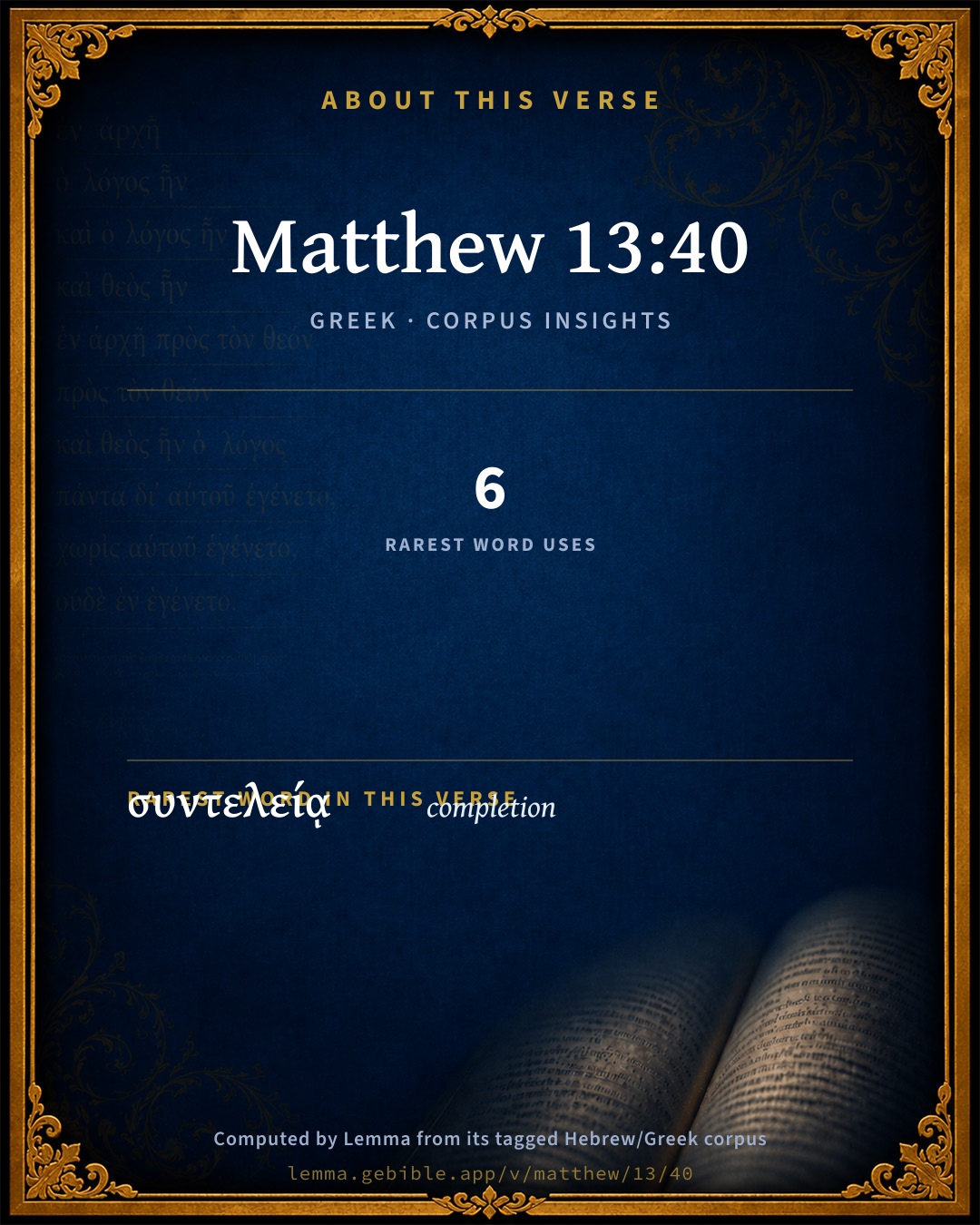
Matthew 13:40

Greek (Tischendorf 8th ed.) Matthew 13:40 appears in the Greek New Testament. The text above is from the Tischendorf 8th edition. Each word links to its Strong’s number and a concise gloss. Click any word for its full Thayer’s Greek Lexicon entry.
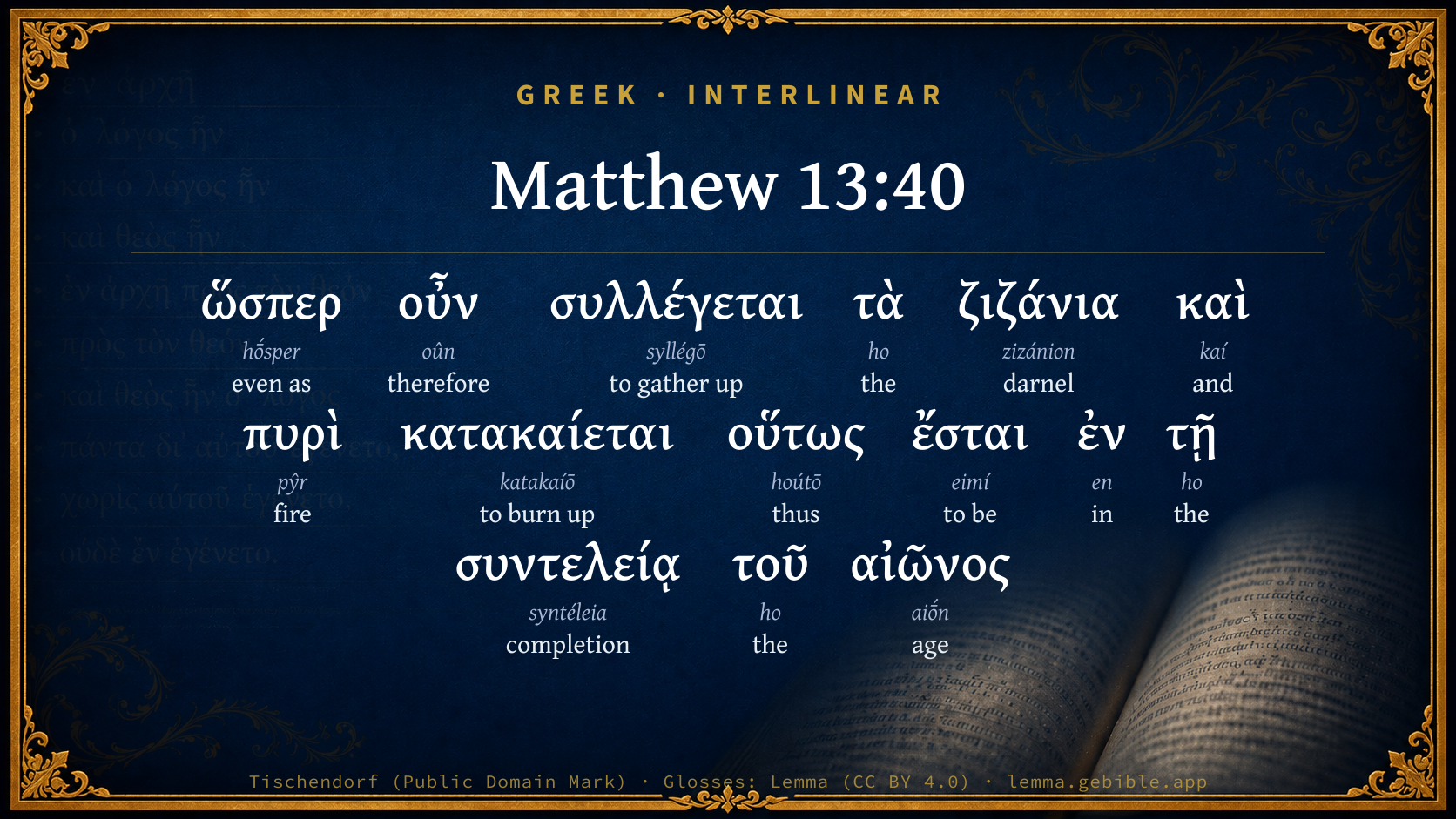
Download image
Cite this verse

Matthew 13:40 (World English Bible). Public Domain. Lemma interlinear Bible study tool, https://lemma.gebible.app/v/matthew/13/40.

Show BibTeX & RIS
BibTeX
RIS
English Translation
As therefore the darnel is gathered up and burned with fire; so will it be at the end of this age.
World English Bible · Public Domain
Download a study sheet

One document with this verse’s original text, its word-by-word gloss line, the meaning frame, cross-references with their text, attributed commentary, and full source and license credits — printable, and it pastes into notes with its structure intact.

This verse Autodidact and up

Study sheet (.html) Plain text (.txt)

A passage Seminary Student

Up to 50 verses in one chapter. A passage sheet keeps up to 6 commentary sources and 12 cross-references per verse, in the order this page ranks them, and says so on the sheet whenever that leaves anything out. Ask for a single verse and you get the Autodidact verse sheet above.

Everything on this page stays free to read, with no account — the sheet is a download of what is already on screen, not access to it.

Want to remove ads? Support Godless Engineer
Compare translations 3

The same verse in 3 English versions, stacked beneath the original-language interlinear above. Click any original word for its lexicon entry.

Each is an independent rendering of the whole verse — the interlinear is not word-aligned to these translations.

Highlighted words mark where these versions differ — a whole-verse word diff, not a word-by-word alignment.

  • World English Bible Public Domain
    As therefore the darnel is gathered up and burned with fire; so will it be at the end of this age.
  • King James Version Public Domain
    As therefore the tares are gathered and burned in the fire; so shall it be in the end of this world.
  • unfoldingWord Literal Text CC BY-SA 4.0
    Therefore, just as the darnel are gathered and burned with fire, thus it will be at the end of the age.

unfoldingWord Literal Text — © unfoldingWord, licensed CC BY-SA 4.0. Word-aligned USFM3 via Door43 (git.door43.org/unfoldingWord/en_ult).

Versions to compare (up to 4)

3 of 4 selected

Show all 19 translations

Every available English version of this verse, each an independent rendering of the whole verse.

  • World English Bible Public Domain
    As therefore the darnel is gathered up and burned with fire; so will it be at the end of this age.
  • Berean Standard Bible Public Domain
    As the weeds are collected and burned in the fire, so will it be at the end of the age.
  • Majority Standard Bible Public Domain
    As the weeds are collected and burned in the fire, so will it be at the end of this age.
  • King James Version Public Domain
    As therefore the tares are gathered and burned in the fire; so shall it be in the end of this world.
  • American Standard Version (1901) Public Domain
    As therefore the tares are gathered up and burned with fire; so shall it be in the end of the world.
  • Revised Version (1885) Public Domain
    As therefore the tares are gathered up and burned with fire; so shall it be in the end of the world.
  • Geneva Bible (1599) Public Domain
    As then the tares are gathered and burned in ye fire, so shall it be in the end of this world.
  • Douay-Rheims (1899) Public Domain
    Even as cockle therefore is gathered up, and burnt with fire: so shall it be at the end of the world.
  • Young's Literal Translation Public Domain
    `As, then, the darnel is gathered up, and is burned with fire, so shall it be in the full end of this age,
  • Literal Standard Version CC BY-SA 4.0
    As, then, the darnel is gathered up, and is burned with fire, so will it be in the full end of this age;
  • Unlocked Literal Bible CC BY-SA 4.0
    Therefore, as the weeds are gathered up and burned with fire, so will it be at the end of the age.
  • unfoldingWord Literal Text CC BY-SA 4.0
    Therefore, just as the darnel are gathered and burned with fire, thus it will be at the end of the age.
  • Darby Bible Public Domain
    As then the darnel is gathered and is burned in the fire, thus it shall be in the completion of the age.
  • World Messianic Bible Public Domain
    As therefore the darnel weeds are gathered up and burned with fire; so will it be at the end of this age.
  • Webster's Bible Public Domain
    As therefore the tares are gathered and burned in the fire; so shall it be in the end of this world.
  • Free Bible Version CC BY-SA 4.0
    Just as the weeds are harvested and burned so it will be at the end of the world.
  • Bible in Basic English Public Domain
    As then the evil plants are got together and burned with fire, so will it be in the end of the world.
  • Text-Critical English NT CC BY 4.0
    Therefore, just as the tares are gathered and burned with fire, so it will be at the end of this age.
  • Tyndale New Testament (1534) Public Domain
    For even as the tares are gaddred and bret in the fyre: so shall it be in the ende of this worlde.

Literal Standard Version (2020), Covenant Press — licensed CC BY-SA 4.0. Text via the HelloAO Bible API (eBible.org). Unlocked Literal Bible (unfoldingWord) — licensed CC BY-SA 4.0. Text via the HelloAO Bible API (eBible.org). unfoldingWord Literal Text — © unfoldingWord, licensed CC BY-SA 4.0. Word-aligned USFM3 via Door43 (git.door43.org/unfoldingWord/en_ult). Free Bible Version, Dr. Jonathan Gallagher — licensed CC BY-SA 4.0. Text via the HelloAO Bible API (eBible.org).

Word by word

More ways to search: Search by grammar → Find every occurrence → Compare this word →

Practice this passage: Drill this verse → Learn its vocabulary →

συντελείᾳ
syntéleia
G4930
“completion”
Noun, Dative, Singular, Feminine
Part of Speech
Noun
Case
Dative
Number
Singular
Gender
Feminine
Full Thayer's Definition

Origin: from G4931

TDNT: 09:04,1

1. completion, consummation, end
  1. ὥσπερ hṓsper G5618 “even as” Adverb
  2. οὖν oûn G3767 “therefore” Conjunction
  3. συλλέγεται syllégō G4816 “to gather up” Verb, Present, Passive, Indicative, 3rd person, Singular
  4. τὰ ho G3588 “the” Article, Nominative, Plural, Neuter
  5. ζιζάνια zizánion G2215 “darnel” Noun, Nominative, Plural, Neuter
  6. καὶ kaí G2532 “and” Conjunction
  7. πυρὶ pŷr G4442 “fire” Noun, Dative, Singular, Neuter
  8. κατακαίεται katakaíō G2618 “to burn up” Verb, Present, Passive, Indicative, 3rd person, Singular
  9. οὕτως hoútō G3779 “thus” Adverb
  10. ἔσται eimí G1510 “to be” Verb, Future, Middle deponent, Indicative, 3rd person, Singular
  11. ἐν en G1722 “in” Preposition
  12. τῇ ho G3588 “the” Article, Dative, Singular, Feminine
  13. τοῦ ho G3588 “the” Article, Genitive, Singular, Masculine
  14. αἰῶνος aiṓn G165 “age” Noun, Genitive, Singular, Masculine

About this verse

These counts appear in no published source. They are computed here, from the morphology-tagged text and Lemma’s own curated glosses. What Lemma adds →

15
words
13
distinct lemmas
Gospels
section

Notable vocabulary

The rarest word here is συντελείᾳ completion G4930 — appearing just 6 times in the whole Greek New Testament.

Shared distinctive vocabulary

συντελείᾳ completion G4930 occurs in 6 verses of the Greek New Testament. Also found in:

Repetition

A word recurs within this verse:

Cross-references

1

Topical passages linked to Matthew 13:40 in the Treasury of Scripture Knowledge — connected by theme and wording, ordered by reader-vote popularity; previews shown in the World English Bible.

  • Matthew 13:39 The enemy who sowed them is the devil. The harvest is the end of the age, and the reapers are angels.

Cross-references courtesy of OpenBible.info (CC BY 4.0).

Commentary

Notes on Matthew 13:40 from classic Christian and Jewish commentators (each source and its license shown beneath its notes). The classic Christian expositions comment on the surrounding passage and are grouped to its opening verse, so a note may address several verses; the Jewish commentaries on the Tanakh (Rashi and others) are per-verse, so they appear only where the commentator wrote on this verse.

Lemma curates 59 commentaries, every one of them public domain or Creative Commons licensed, each selected and text-cleaned for this edition rather than reprinted as found. About our sources →

Joseph Benson's Commentary

Mat 13:40-43. As the tares are gathered — At the command of the owner of the field; and burnt in the fire — So totally destroyed as never to revive and flourish again; so shall it be at the end of the world — With regard to the finally impenitent: their destruction, not their annihilation, shall be complete and eternal; without any hope or possibility of a restoration. See note on Mat 3:12. The Son of man shall send forth his angels — Who shall all attend him on that solemn occasion, Mat 25:31. What a high idea does our Lord here give us of himself; representing the holy angels as his attendants, who shall wait on him at the last day, and at his order assemble the whole world before him! And they shall gather out of his kingdom all things that offend — Whatever had grieved the children of God, or been an obstruction to them in their Christian course; whatever things or persons had hindered the good seed which Christ had sown from taking root or bearing fruit. The Greek, παντα τα σκανδαλα, is, all the scandals, or, stumbling-blocks. And them which do iniquity — Who shall now be perfectly and eternally separated from the righteous, and excluded from Christ’s kingdom. And shall cast them into a furnace of fire — These blessed spirits, as the executioners of the divine vengeance, shall cast them into the unquenchable fire of hell. There shall be wailing and gnashing of teeth — The most extreme torment, attended with the height of anguish, rage, and despair; a despair aggravated by all the privileges they once enjoyed, and the vain hope which, as professors of the true religion, they once entertained. Therefore they shall not be annihilated, nor their misery alleviated by any expectation of being ever restored or delivered from their sufferings. Then shall the righteous shine forth as the sun — “Being freed from all the humbling circumstances which attend mortality, they shall shine like the sun in the firmament for brightness and beauty and shall find no diminution of their splendour by age. A noble image this to represent the glory and happiness of the righteous with God their Father.” Who hath ears to hear, let him hear — “This exclamation intimates, that truths of greater importance and solemnity cannot be uttered than those which respect the final misery of the wicked, and the inconceivable happiness of the righteous, and that all who have the faculty of reason, ought therefore to regard them with becoming attention.” — Macknight.

Joseph Benson's Commentary on the Old and New Testaments (1811–1818) — public domain. Text from a community e-Sword module.

Tyndale Open Study Notes

Tyndale Open Resources

13:40-42 The harvest of judgment, which began with the first coming of the Son of Man (3:12), will be completed when he returns (Rev 14:14-16).

Tyndale Open Study Notes — © Tyndale Open Resources, licensed CC BY-SA 4.0. Text via the HelloAO Bible API.

Meyer's Critical & Exegetical Commentary

Heinrich August Wilhelm Meyer

Mat_13:40. Καἰεται] not κατακαίεται, but are set on fire. No doubt the tares are consumed by fire (Mat_13:30); still the point of the comparison does not lie in their being consumed, but in the fact of their being set on fire,a fact which is intended to illustrate the everlasting punishment now beginning to overtake the wicked in Gehenna. Joh_15:6; Mat_25:46.

The wicked (the σκάνδαλα, Mat_13:41; the σαπρά, Mat_13:47) are connected with the church as a mere outward institution, but do not belong to the number of its living members (to the body of Christ). Comp. Apol. Conf. A. p. 147 f.; Thomasius, Chr. Pers. u. Werk, III. 2, p. 370.

Meyer — Critical and Exegetical Commentary on the New Testament — English translation by Peter Christie, edited by Frederick Crombie (T&T Clark, 1880) — public domain. Text from a community e-Sword module.

Expositor's Greek Testament

ed. W. Robertson Nicoll

Mat 13:40 . his and the following verses enlarge on the final separation.

The Expositor's Greek Testament, edited by W. Robertson Nicoll (1897–1910) — public domain. Text from a community e-Sword module.

John Gill's Exposition

And shall cast them into a furnace of fire,.... Not a material, but a metaphorical one; denoting the wrath of God, which shall fall upon wicked men, and abide upon them to all eternity: which is sometimes called hell fire, sometimes a lake which burns with fire and brimstone; and here a furnace of fire, expressing the vehemency and intenseness of divine wrath, which will be intolerable; in allusion either to Nebuchadnezzar's fiery furnace, or as some think, to the custom of burning persons alive in some countries; or rather, to the burning of chaff and stubble, and the stalks of any unprofitable things that grew in the field (f), for the heating of furnaces, and is the very language of the Jews, who used to compare hell to a furnace; so Gen 15:17 is paraphrased by them (g),

"And behold the sun set, and there was darkness; and lo! Abraham saw until the seats were set, and the thrones cast down; and lo! "hell", which is prepared for the wicked in the world to come, "as a furnace", which sparks and flames of fire surrounded; "in the midst of which", the wicked fell, because they rebelled against the law, in their lifetime.

Which is expressed in much the same language, and conveys the same ideas as here; and no wonder is it that it follows,

there shall be wailing and gnashing of teeth; declaring the remorse of conscience, the tortures of mind, the sense of inexpressible pain, and punishment, the wicked shall feel; also their furious rage and black despair,

(f) Misn. Sabbat. c. 3. sect. 1. & Maimon, & Bartenora in ib. (g) Hieros. Targum in Gen. xv. 17.

John Gill's Exposition of the Whole Bible (1746–1763) — public domain (CC PDM 1.0). Text via the HelloAO Bible API.

Trapp's Complete Commentary

John Trapp

40 As therefore the tares are gathered and burned in the fire; so shall it be in the end of this world.

Ver. 40. So shall it be in the end of this world] As till then there can be no perfect purging of the Church. Nevertheless, magistrates and all good people must do their utmost within their bounds to further a reformation a little otherwise than the cardinals and prelates of Rome; whom Luther fitly compared to foxes, that came to sweep a dusty house with their tails, and instead of sweeping the dust out, sweep it all about the house, so making a great smoke for the time, but when they were gone the dust falls all down again.

John Trapp, A Commentary or Exposition upon All the Books of the Old and New Testament (1647–1656) — public domain. Text from a community e-Sword module.

Matthew Poole's English Annotations

As in the common practice of men, when they have a mind to pick their corn, and have it clean, when it is reaped, to set men to clean the wheat, and to pick out the tares, and, having tied them up in bundles, to burn them, so (saith he) I will do. I will send my angels at the day of judgment, and they shall take out of my church all impenitent sinners, all those who in this world have been scandals, and offences, and mischievous to my people, and who have made it their business to work iniquity.

And shall cast them into a furnace of fire: there shall be wailing and gnashing of teeth. That is, into hell, which, in regard of the severe torments which the damned shall feel there, is often in Scripture compared to fire, as Mat 25:41, and in other texts, by which is only set out to us the dreadfulness of the punishment of the damned, that is proportioned to, if not far exceeding, that of the burning living bodies in fire. Having thus expressed the punishment of wicked men, he expounds what he means by gathering the wheat into his barn, viz. the taking of righteous men to heaven.

Then, saith he,

shall the righteous, those whom I have clothed with my righteousness, and who have lived in obedience to my will to that degree, that though they be not perfectly righteous, yet are sincere and upright, so as I have accepted them,

shine forth as the sun in the kingdom of their Father: an expression much like that of Dan 12:2,3, significative of that glorious state of the saints in heaven, which no eye having seen, nor ear having heard, no tongue is able to express. He concludes in the same manner as he concludes the parable of the sower, exciting his hearers to a diligent consideration and belief of what he had said.

Our Saviour adding no particular explication of the two parables delivered, Mat 13:31-33, the disciples not asking him to explain them, and the evangelist having put the explication of the first parable after them, it is reasonable, that though I omitted the explication of them in their proper place, yet I should add something here for the benefit of those who possibly will not be able so readily to conceive our Saviour’s meaning in them without an interpreter as the disciples did, which is thought to be the reason why they asked no explication of them. The one is the parable of the

grain of mustard seed, Mat 13:31,32; the other, the parable of

leaven hid in three measures of meal, Mat 13:33. The scope of both is the same. Our Saviour intended them both to let his disciples know the success that his gospel should have over all the world, that they might not be discouraged at the little success of it at present. To this purpose he compares it, first, to

a grain of mustard seed, which, he saith,

is the least of all seeds, that is, one of the least of seeds, or the least seed that produces so great a plant; but becomes a tree so high,

that the birds of the air come and lodge in the branches thereof. Though that small seed with us runs up to a great height, and produces a plant which hath branches considerable enough to lodge birds which sit low, yet we must not judge of what grew in those countries by what groweth in ours; there are strange and almost incredible stories told of that plant by naturalists, as to its growth in some hot and fertile countries. Christ by this foretold his disciples, what following ages quickly verified, that the heathen should entertain the gospel, and the sound of it should go to the ends of the earth, notwithstanding its present small appearance. Upon the same score he compares it to a little

leaven, which a woman hid in three measures of meal, till the whole mass of meal was leavened. By these two expressions our Saviour also lets us know the quick and powerful nature of the word; that Christ’s words are (as he said) spirit of life, and have a hidden and extraordinary virtue in them. I do not think it worth the while to inquire into the contents of these σατα or measures of meal, and why he mentions but three. They are curiosities, the knowledge of which turneth to no account. Our Saviour certainly, by the expression, designed only to hint the small number of the Jews that believed in him, but foretold a far greater harvest.

The law should go forth out of Zion, and the word of the Lord from Jerusalem, as Isaiah prophesied, Isa 2:3; but many people (after them) should say, Come ye, let us go up to the mountain of the house of the Lord.

Matthew Poole's English Annotations on the Holy Bible (1683–1685) — public domain. Text from a community e-Sword/MySword module.

Whedon's Commentary on the Bible

Daniel D. Whedon

40. End of this world — The end of probationary time. While that lasts the good and evil mingle together. Then comes the world of retribution, in which the good and evil are parted into separate states of reward.

Daniel D. Whedon (gen. ed.), Commentary on the Old and New Testaments (1874–1909) — public domain. Text from a community e-Sword module.

The Pulpit Commentary

As therefore. Observe that in vers. 40-43 our Lord dwells at much greater length on the details of the reapers" work than on the preceding stages of the parable. lie wishes to draw special attention to the fact that the tares will, without any doubt, be one day separated, and the wheat appear in full splendour. The tares are gathered and burned in the fireburned with fire (Revised Version); cf. Mat_3:10, noteso shall it be in the end of this world (ver. 39, note).

The Pulpit Commentary (1880–1919), ed. H.D.M. Spence-Jones & Joseph S. Exell — public domain. Text from a community e-Sword module.

unfoldingWord translationNotes

Door43 World Missions Community

Connecting Statement:

Jesus finishes explaining to his disciples the parable of the field with both wheat and weeds.

Therefore, as the weeds are gathered up and burned with fire

This can be translated in active form. AT: "Therefore, as people gather up weeds and burn them in the fire" (See: Active or Passive)

The Son of Man will send out his angels

Here Jesus is speaking of himself. AT: "I, the Son of Man, will send out my angels" (See: First, Second, or Third Person)

those who commit iniquity

"those who are lawless" or "evil people"

furnace of fire

This is a metaphor for the fires of hell. If the term "furnace" is not known, "oven" can be used. AT: "fiery furnace" (See: Metaphor)

weeping and grinding of teeth

"Grinding of teeth" here is a symbolic act, representing extreme sadness and suffering. See how you translated this in Matthew 8:12. AT: "weeping and showing that they are suffering very much" (See: Symbolic Action)

shine like the sun

If this simile is not understandable in your language, you can use: "be as easy to see as the sun." (See: Simile)

Father

This is an important title for God. (See: Translating Son and Father)

He who has ears

This is a way of referring to everyone there who was hearing what Jesus was saying. See how you translated this in Matthew 11:15. AT: "Whoever can hear me" (See: Idiom)

listen

Here "listen" represents paying attention. See how you translated this in Matthew 11:15. AT: "pay attention to what I am saying" (See: Metonymy)

translationWords

fire

world

Son of Man

angel

kingdom

sin

commit

iniquity

righteous

God the Father

unfoldingWord translationNotes — © Distant Shores Media and the Door43 World Missions Community, licensed CC BY-SA 4.0. Source: git.door43.org/Door43/en_tn.

Cambridge Greek Testament for Schools and Colleges

40. There is strong support for καίεται instead of κατακαίεται which may have been influenced by Mat 13:30.

Cambridge Greek Testament for Schools and Colleges (Cambridge University Press, 1896; 21 vols, various authors incl. Carr, Maclear, Plummer, Farrar, Lumby, Moule, M. R. James, Simcox) — public domain. Text from a community e-Sword module.

International Critical Commentary

(L) 40. As therefore the tares are gathered and burned with fire; so shall it be at the consummation of the age.]

International Critical Commentary — older volumes (1896–1929), various authors — public domain. Text from a community e-Sword module.

Lesson kit

Teaching starters — assembled from the data on this page, not authored interpretation. Every prompt links to the verse data it draws on. Edit before teaching.

Matthew, in the Gospels, opens this verse with 15 words (13 distinct Greek lemmas). Its most distinctive word is syntéleia (“completion”). A historical commentator’s framing appears above. Read the whole chapter for the surrounding context.

Discussion questions

  1. What does “completion” (syntéleia) contribute to the verse as a whole?
  2. Matthew 13:39 shares the word «completion» with this verse. How do the two illuminate each other?
  3. “the” occurs 3× in this one verse. What is the effect of the repetition?
  4. The translations on this page render this verse differently — a whole-verse word diff, not a word-by-word alignment. What might account for the different wordings?
  5. Reading how Joseph Benson's Commentary and Tyndale Open Study Notes read this verse, where do the two commentators agree and where do they part?

Things to notice

Reading settings

Reading text

Shown beneath each verse's original-language words.

Old Testament
Old Testament edition

Read the OT as the Masoretic Hebrew (MT) or the Greek Septuagint (LXX).

English shown for the Greek Septuagint (in the Hebrew ↔ Greek comparison).

Comparing translations? Open the Compare panel on any verse page to stack up to four side by side.