Matthew 18:20

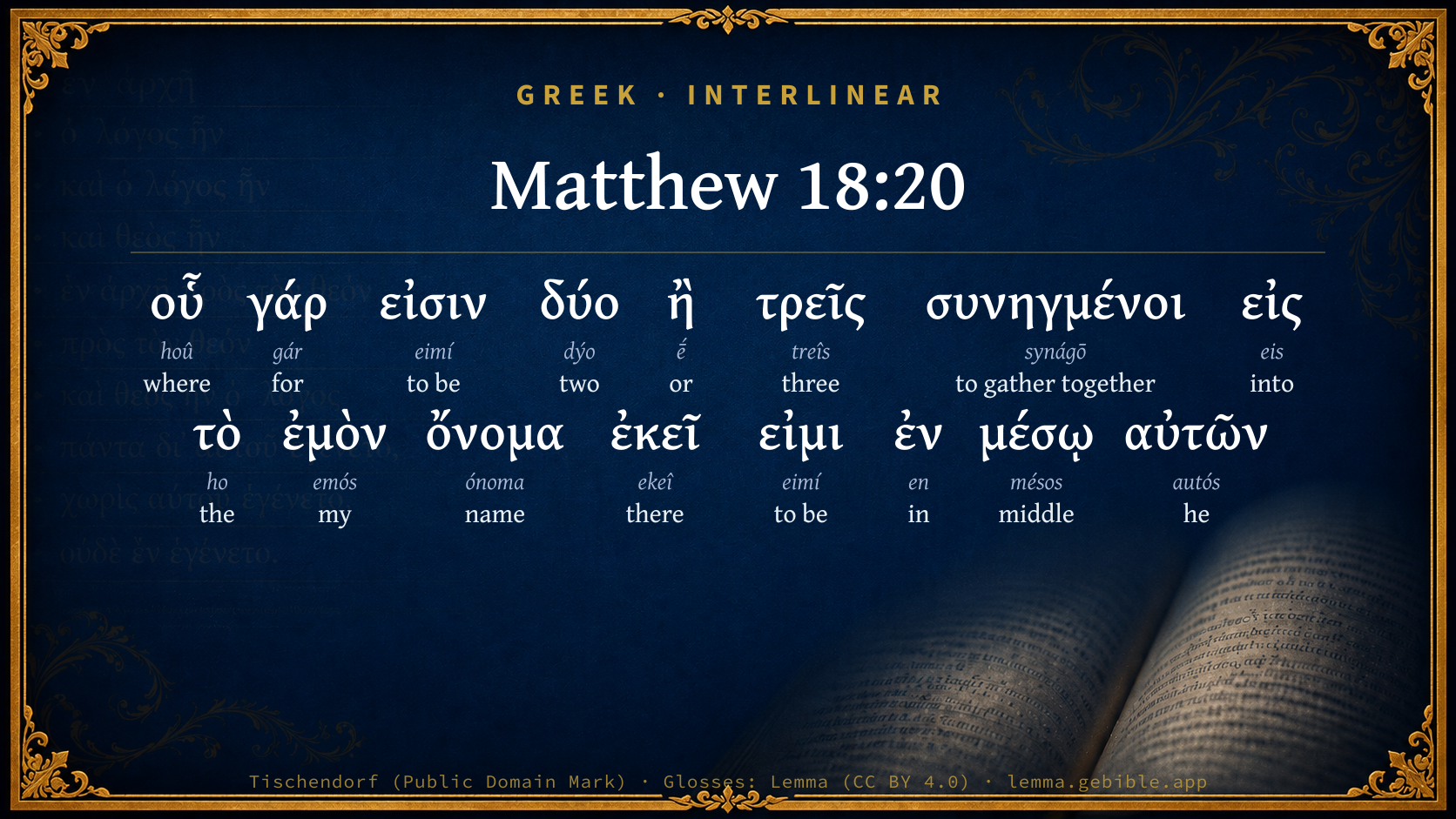
Greek (Tischendorf 8th ed.) Matthew 18:20 appears in the Greek New Testament. The text above is from the Tischendorf 8th edition. Each word links to its Strong’s number and a concise gloss. Click any word for its full Thayer’s Greek Lexicon entry.
Download image
Cite this verse

Matthew 18:20 (World English Bible). Public Domain. Lemma interlinear Bible study tool, https://lemma.gebible.app/v/matthew/18/20.

Show BibTeX & RIS
BibTeX
RIS
English Translation
For where two or three are gathered together in my name, there I am in the midst of them."
World English Bible · Public Domain
Highlights
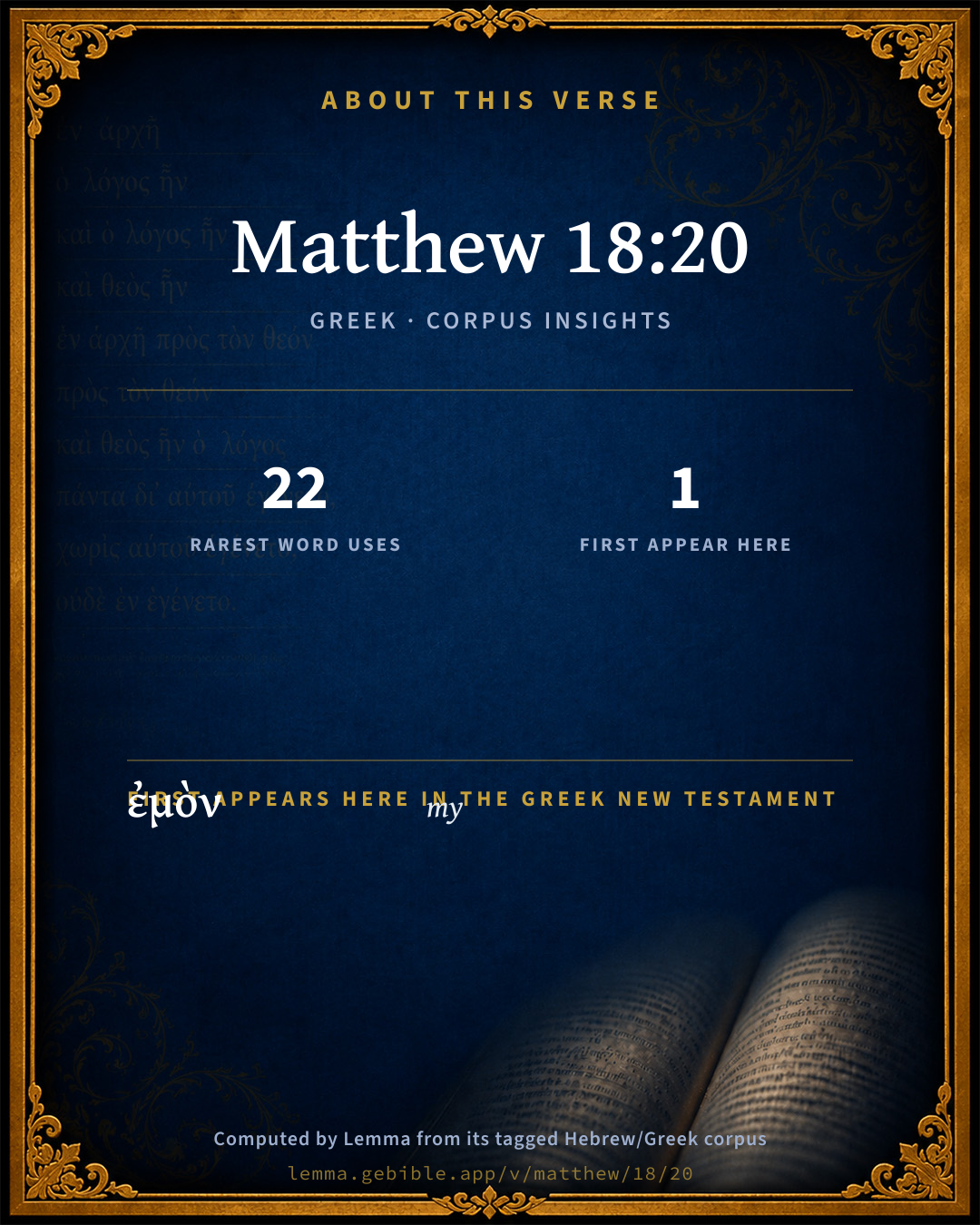
  • 1 first appearance in the Greek New Testament
Full analysis ↓
Download a study sheet

One document with this verse’s original text, its word-by-word gloss line, the meaning frame, cross-references with their text, attributed commentary, and full source and license credits — printable, and it pastes into notes with its structure intact.

This verse Autodidact and up

Study sheet (.html) Plain text (.txt)

A passage Seminary Student

Up to 50 verses in one chapter. A passage sheet keeps up to 6 commentary sources and 12 cross-references per verse, in the order this page ranks them, and says so on the sheet whenever that leaves anything out. Ask for a single verse and you get the Autodidact verse sheet above.

Everything on this page stays free to read, with no account — the sheet is a download of what is already on screen, not access to it.

Want to remove ads? Support Godless Engineer
Compare translations 3

The same verse in 3 English versions, stacked beneath the original-language interlinear above. Click any original word for its lexicon entry.

Each is an independent rendering of the whole verse — the interlinear is not word-aligned to these translations.

Highlighted words mark where these versions differ — a whole-verse word diff, not a word-by-word alignment.

  • World English Bible Public Domain
    For where two or three are gathered together in my name, there I am in the midst of them."
  • King James Version Public Domain
    For where two or three are gathered together in my name, there am I in the midst of them.
  • unfoldingWord Literal Text CC BY-SA 4.0
    For where two or three are gathered together in my name, there I am in their midst.”

unfoldingWord Literal Text — © unfoldingWord, licensed CC BY-SA 4.0. Word-aligned USFM3 via Door43 (git.door43.org/unfoldingWord/en_ult).

Versions to compare (up to 4)

3 of 4 selected

Show all 19 translations

Every available English version of this verse, each an independent rendering of the whole verse.

  • World English Bible Public Domain
    For where two or three are gathered together in my name, there I am in the midst of them."
  • Berean Standard Bible Public Domain
    For where two or three gather together in My name, there am I with them.”
  • Majority Standard Bible Public Domain
    For where two or three gather together in My name, there am I with them.”
  • King James Version Public Domain
    For where two or three are gathered together in my name, there am I in the midst of them.
  • American Standard Version (1901) Public Domain
    For where two or three are gathered together in my name, there am I in the midst of them.
  • Revised Version (1885) Public Domain
    For where two or three are gathered together in my name, there am I in the midst of them.
  • Geneva Bible (1599) Public Domain
    For where two or three are gathered together in my Name, there am I in the mids of them.
  • Douay-Rheims (1899) Public Domain
    For where there are two or three gathered together in my name, there am I in the midst of them.
  • Young's Literal Translation Public Domain
    for where there are two or three gathered together -- to my name, there am I in the midst of them.'
  • Literal Standard Version CC BY-SA 4.0
    for where there are two or three gathered together—to My Name, there am I in the midst of them.”
  • Unlocked Literal Bible CC BY-SA 4.0
    For where two or three are gathered together in my name, there I am in their midst.”
  • unfoldingWord Literal Text CC BY-SA 4.0
    For where two or three are gathered together in my name, there I am in their midst.”
  • Darby Bible Public Domain
    For where two or three are gathered together unto my name, there am I in the midst of them.
  • World Messianic Bible Public Domain
    For where two or three are gathered together in my name, there I am in the middle of them.”
  • Webster's Bible Public Domain
    For where two or three are assembled in my name, there am I in the midst of them.
  • Free Bible Version CC BY-SA 4.0
    For where two or three gather together in my name, I'm there with them.”
  • Bible in Basic English Public Domain
    For where two or three are come together in my name, there am I among them.
  • Text-Critical English NT CC BY 4.0
    For where two or three are gathered together in my name, I am there among them.”
  • Tyndale New Testament (1534) Public Domain
    For where two or thre are gathered togedder in my name there am I in the myddes of them.

Literal Standard Version (2020), Covenant Press — licensed CC BY-SA 4.0. Text via the HelloAO Bible API (eBible.org). Unlocked Literal Bible (unfoldingWord) — licensed CC BY-SA 4.0. Text via the HelloAO Bible API (eBible.org). unfoldingWord Literal Text — © unfoldingWord, licensed CC BY-SA 4.0. Word-aligned USFM3 via Door43 (git.door43.org/unfoldingWord/en_ult). Free Bible Version, Dr. Jonathan Gallagher — licensed CC BY-SA 4.0. Text via the HelloAO Bible API (eBible.org).

Word by word

More ways to search: Search by grammar → Find every occurrence → Compare this word →

Practice this passage: Drill this verse → Learn its vocabulary →

About this verse

These counts appear in no published source. They are computed here, from the morphology-tagged text and Lemma’s own curated glosses. What Lemma adds →

16
words
15
distinct lemmas
Gospels
section

Notable vocabulary

The rarest word here is οὗ where G3757 — appearing just 22 times in the whole Greek New Testament.

First appearance in Scripture

This word makes its first canonical appearance in the Greek New Testament here:

Shared distinctive vocabulary

οὗ where G3757 occurs in 22 verses of the Greek New Testament. Also found in:

Repetition

A word recurs within this verse:

  • εἰσιν to be G1510 ×2

Cross-references

13

Topical passages linked to Matthew 18:20 in the Treasury of Scripture Knowledge — connected by theme and wording, ordered by reader-vote popularity; previews shown in the World English Bible.

  • 1 Corinthians 5:4 In the name of our Lord Jesus Christ, you being gathered together, and my spirit, with the power of our Lord Jesus Christ,
  • Revelation 21:3 I heard a loud voice out of heaven saying, "Behold, God's dwelling is with people, and he will dwell with them, and they will be his people, and God himself will be with them as their God.
  • Matthew 28:20 teaching them to observe all things that I commanded you. Behold, I am with you always, even to the end of the age." Amen.
  • Zechariah 2:5 For I,' says Yahweh, 'will be to her a wall of fire around it, and I will be the glory in the midst of her.
  • John 20:26 After eight days again his disciples were inside, and Thomas was with them. Jesus came, the doors being locked, and stood in the midst, and said, "Peace be to you."
  • John 20:19 When therefore it was evening, on that day, the first day of the week, and when the doors were locked where the disciples were assembled, for fear of the Jews, Jesus came and stood in the midst, and said to them, "Peace be to you."
  • Exodus 20:24 You shall make an altar of earth for me, and shall sacrifice on it your burnt offerings and your peace-offerings, your sheep and your oxen. In every place where I record my name I will come to you and I will bless you.
  • Revelation 2:1 To the angel of the assembly in Ephesus write: "He who holds the seven stars in his right hand, he who walks among the seven golden lampstands says these things:
  • Genesis 49:10 The scepter will not depart from Judah, Nor the ruler's staff from between his feet, Until he comes to whom it belongs. To him will the obedience of the peoples be.
  • Revelation 1:11–13 saying, "What you see, write in a book and send to the seven assemblies: to Ephesus, Smyrna, Pergamum, Thyatira, Sardis, Philadelphia, and to Laodicea."
  • John 8:58 Jesus said to them, "Most assuredly, I tell you, before Abraham came into existence, I AM."
  • Philemon 1:2 to the beloved Apphia, to Archippus, our fellow soldier, and to the assembly in your house:
  • 1 Thessalonians 1:1 Paul, Silvanus, and Timothy, to the assembly of the Thessalonians in God the Father and the Lord Jesus Christ: Grace to you and peace from God our Father and the Lord Jesus Christ.

Cross-references courtesy of OpenBible.info (CC BY 4.0).

Commentary

Notes on Matthew 18:20 from classic Christian and Jewish commentators (each source and its license shown beneath its notes). The classic Christian expositions comment on the surrounding passage and are grouped to its opening verse, so a note may address several verses; the Jewish commentaries on the Tanakh (Rashi and others) are per-verse, so they appear only where the commentator wrote on this verse.

Lemma curates 59 commentaries, every one of them public domain or Creative Commons licensed, each selected and text-cleaned for this edition rather than reprinted as found. About our sources →

Tyndale Open Study Notes

Tyndale Open Resources

18:20 Christ is present in the process of discipline, so the process is a ratification of God’s decision.

Tyndale Open Study Notes — © Tyndale Open Resources, licensed CC BY-SA 4.0. Text via the HelloAO Bible API.

Bengel's Gnomon

Johann Albrecht Bengel

Mat 18:20. Οὗ γὰρ, κ.τ.λ., for where, etc.) The name of Jesus gives power to prayer.—δύο ἤ τρεῖς, two or three) see Ecc 4:12 and the preceding verses. Three is a number which can be procured even in a barren age of the Church: a greater number is not so easily obtained, and is accompanied by the danger that a hypocrite may be present; yet where many sincere professors are together, how great will be the power of their prayers.—εἰς τὸ Ἐμον ὄνομα, in My name, lit. into My name[835]) sc. with the object of worshipping it. All prayers that are offered in the name of Jesus Christ are accepted by the Father; see Mat 18:19.—ἘΚΕῖ ΕἸΜῚ, there am I) and all grace with Me; see ch. Mat 28:20; Act 18:10; 2Ti 4:17. Where the Son is, there is the Father: what the Son wishes, the Father wishes.

[835] Εἰς—ὄνομα is not identical with ἐν—ὀνόματι, either here or in Mat 28:19 (Baptizing them—not in the name, but into the name, etc., i.e. into the fellowship of the Father, etc.—so that they may be members of the church bearing the name of, etc.). The words probably mean “Gathered together unto my name;” the sense which Bengel seems to imply—εἰς, “Ut nomen meum colant.”—ED.

Bengel's Gnomon of the New Testament — English translation (T&T Clark, Edinburgh, 1860) — public domain. Text from a community e-Sword module.

Meyer's Critical & Exegetical Commentary

Heinrich August Wilhelm Meyer

Mat_18:20. Confirmation of this promise, and that not on account of any special preference for them in their official capacity, but generally (hence the absence of ὑμῶν in connection with the δύο ἢ τρεῖς) owing to the fact of His gracious presence in the midst of His people when met together: for where two or three are gathered together with reference to my name, there am I (my presence being represented by the Holy Spirit, comp. Rom_8:9 f.; 2Co_13:5; 1Co_5:4; Gal_2:20; Eph_3:16 f.; also in general, Mat_28:20) in the midst of them; so that you need therefore have no doubt as to the γενήσεται just promised to you, which I, as associated with my Father (Mat_18:19), will bring about. The statement is put in the form of an axiom; hence, although referring to the future, its terms are present. The higher, spiritual object of the meeting together of the two or three lies not in συνηγμένοι, which expresses nothing more than the simple fact of being met (in answer to Grotius, de Wette), but in εἰς τὸ ἐμὸν ὄνομα, which indicates that the name of Jesus Christ (i.e. the confession, the honouring of it, etc.) is that which in the συνηγμένον εἶναι is contemplated as its specific motive (μὴ διʼ ἑτέραν αἰτίαν, Euthymius Zigabenus). Simile dicunt Rabbini de duobus aut tribus considentibus in judicio, quod שכניה sit in medio eorum, Lightfoot.

Meyer — Critical and Exegetical Commentary on the New Testament — English translation by Peter Christie, edited by Frederick Crombie (T&T Clark, 1880) — public domain. Text from a community e-Sword module.

Expositor's Greek Testament

ed. W. Robertson Nicoll

Mat 18:20 . δύο ἢ τρεῖς . Jesus deals in small numbers, not from modesty in His anticipations, but because they suit the present condition, and in jealousy for the moral quality of the new society. συνηγμένοι εἰς , etc., not gathered to confess or worship my name, but gathered as believers in me. It is a synonym for the new society. The ecclesia is a body of men gathered together by a common relation to the name of the Christ: a Christian synagogue as yet consisting of the Twelve, or as many of them as were really one in heart. ἐκεῖ εἰμὶ ἑν , etc.: there am I, now, with as many of you, my disciples, as are one in faith and brotherly love; not with any more even of you: far away from the man of ambitious, not to say traitorous, mind. There am I in reference to the future. His presence axiomatically certain, therefore expressed as a present fact, even with reference to a future time a promise natural from One looking forward to an early death. Similar in import to Mat 28:20 . For similar sayings of the Rabbis concerning the presence of the Divine Majesty, or the Shechinah, among two or three sitting in judgment or studying the law, vide Lightfoot and Schöttgen.

The Expositor's Greek Testament, edited by W. Robertson Nicoll (1897–1910) — public domain. Text from a community e-Sword module.

Jamieson, Fausset & Brown

Robert Jamieson, A. R. Fausset & David Brown

For where two or three are gathered together in my name--or "unto my name."

there am I in the midst of them--On this passage--so full of sublime encouragement to Christian union in action and prayer--observe, first, the connection in which it stands. Our Lord had been speaking of church meetings before which the obstinate perversity of a brother was in the last resort to be brought, and whose decision was to be final--such honor does the Lord of the Church put upon its lawful assemblies. But not these assemblies only does He deign to countenance and honor. For even two uniting to bring any matter before Him shall find that they are not alone, for My Father is with them, says Jesus. Next, observe the premium here put upon union in prayer. As this cannot exist with fewer than two, so by letting it down so low as that number, He gives the utmost conceivable encouragement to union in this exercise. But what kind of union? Not an agreement merely to pray in concert, but to pray for some definite thing. "As touching anything which they shall ask," says our Lord--anything they shall agree to ask in concert. At the same time, it is plain He had certain things at that moment in His eye, as most fitting and needful subjects for such concerted prayer. The Twelve had been "falling out by the way" about the miserable question of precedence in their Master's kingdom, and this, as it stirred their corruptions, had given rise--or at least was in danger of giving rise--to "offenses" perilous to their souls. The Lord Himself had been directing them how to deal with one another about such matters. "But now shows He unto them a more excellent way." Let them bring all such matters--yea, and everything whatsoever by which either their own loving relationship to each other, or the good of His kingdom at large, might be affected--to their Father in heaven; and if they be but agreed in petitioning Him about that thing, it shall be done for them of His Father which is in heaven. But further, it is not merely union in prayer for the same thing--for that might be with very jarring ideas of the thing to be desired--but it is to symphonious prayer, the prayer by kindred spirits, members of one family, servants of one Lord, constrained by the same love, fighting under one banner, cheered by assurances of the same victory; a living and loving union, whose voice in the divine ear is as the sound of many waters. Accordingly, what they ask "on earth" is done for them, says Jesus, "of My Father which is in heaven." Not for nothing does He say, "of MY FATHER"--not "YOUR FATHER"; as is evident from what follows: "For where two or three are gathered together unto My name"--the "My" is emphatic, "there am I in the midst of them." As His name would prove a spell to draw together many clusters of His dear disciples, so if there should be but two or three, that will attract Himself down into the midst of them; and related as He is to both the parties, the petitioners and the Petitioned--to the one on earth by the tie of His assumed flesh, and to the other in heaven by the tie of His eternal Spirit--their symphonious prayers on earth would thrill upward through Him to heaven, be carried by Him into the holiest of all, and so reach the Throne. Thus will He be the living Conductor of the prayer upward, and the answer downward.

Parable of the Unmerciful Debtor (Mat 18:21-35).

Jamieson, Fausset & Brown — Commentary Critical and Explanatory on the Whole Bible (1871) — public domain (CC PDM 1.0). Text via the HelloAO Bible API.

Adam Clarke's Commentary

Verse 20. For where two - are gathered together in thy name] There are many sayings among the Jews almost exactly similar to this, such as, Wherever even two persons are sitting in discourse concerning the law, the Divine presence is among them. See much more in Schoettgen. And the following, among the ancient Hindoos, is like unto it: "When Brahma, the Lord of creation, had formed mankind, and at the same time appointed his worship, he spoke and said, 'With this worship pray for increase, and let it be that on which ye shall depend for the accomplishment of all your wishes. With this remember God, that God may remember you. Remember one another, and ye shall obtain supreme happiness. God, being remembered in worship, will grant you the enjoyment of your wishes: he who enjoyeth what hath been given unto him by God, and offereth not a portion unto him, is even as a thief. Know that good works come from Brahma, whose nature is incorruptible; wherefore, the omnipresent Brahma is PRESENT IN THE WORSHIP." See the Bagvat Geeta, p. 45, 46.

In my name] Seems to refer particularly to a public profession of Christ and his Gospel.

There am I in the midst] None but God could say these words, to say them with truth, because God alone is every where present, and these words refer to his omnipresence. Wherever - suppose millions of assemblies were collected in the same moment, in different places of the creation, (which is a very possible case), this promise states that Jesus is in each of them. Can any, therefore, say these words, except that God who fills both heaven and earth? But Jesus says these words: ergo - Jesus is God. Let it be observed, that Jesus is not among them to spy out their sins; or to mark down the imperfections of their worship; but to enlighten, strengthen, comfort, and save them.

Adam Clarke's Commentary on the Bible (1810–1826) — public domain. Text from a community e-Sword/MySword module.

Ellicott's Commentary for English Readers

(20) Where two or three . . .—The true meaning of the words is well embodied in the well-known patristic axiom, Ubi tres, ibi Ecclesia (“Where three are there is a church”). The strength of the Christian society was not to be measured by a numerical standard, but by its fulfilment of the true conditions of its life. The presence of Christ was as true and mighty, His communion with His Church as real, when His followers were but as a remnant, as when they were gathered in the great congregation. He would be with the “two or three” (there is, perhaps, a special reference to the self-same words in Mat_18:16), to plead for them as the great High Priest, to impart Himself to them, to ratify their decisions.

A Bible Commentary for English Readers, edited by Charles John Ellicott (1878–1897) — public domain. Text from a community e-Sword module.

The Cambridge Bible for Schools and Colleges

gen. ed. J. J. S. Perowne

20. two or three] In the smallest gathering of His followers Christ will be present. A derivative (synaxis) of the Greek word in the text came to be used among the early Christians for their assemblies, especially in reference to assembling for the Lord’s Supper. Synaxarium, derived from the same verb, meant a Service-book.

The Cambridge Bible for Schools and Colleges (gen. ed. J. J. S. Perowne; Cambridge University Press, 1878–1918) — public domain. Text from a community e-Sword module.

John Gill's Exposition

Therefore is the kingdom of heaven,.... The Gospel church state, or the church of Christ under the Gospel dispensation, and the methods of God's dealings in it;

likened unto a certain king: or "a man", "a king", pointing either to Christ, the king Messiah, who is King of kings, and Lord of lords, the King of saints and churches; who, as God, has a natural kingdom of providence, and as man and Mediator, a kingdom of grace; and will have a more visibly glorious one, both in this world and in the other; or rather, the Father of Christ, as appears from the application of the parable, in Mat 18:35, who is the living God, and everlasting King: whose is the kingdom of nature, grace, and glory:

which would take account of his servants; not all mankind, though these are all in a sense his servants, and accountable to him; nor only ministers of the Gospel, who are so in an eminent and peculiar sense, and must give an account to God of their time and talents, and souls committed to them; but all that bear the Christian name, that are professors of religion, that are either really or nominally the subjects and servants of God. These, it is sometimes the will and pleasure of God, to "take account of": not of their persons, or number, but of their conduct and behaviour; which, as it will be more fully done at death, or at judgment, so sometimes is taken in this life: God sometimes calls, and brings, professors of religion to an account, and reckons with them by afflictive dispensations of providence; when he puts them upon reflecting how they have spent their time, made use of their talents and gifts, and have behaved in their families, and in the world, and church; or by dealing roundly with men's consciences, awakening and convincing them of their sins, of omission and commission, which seems to be intended here.

John Gill's Exposition of the Whole Bible (1746–1763) — public domain (CC PDM 1.0). Text via the HelloAO Bible API.

Trapp's Complete Commentary

John Trapp

20 For where two or three are gathered together in my name, there am I in the midst of them.

Ver. 20. There am I in the midst] As to eye their behaviour, so to hear their suits. All that he requireth is, that they bring lawful petitions and honest hearts; and then they shall be sure to receive whatsoever heart can wish or need require. A courtier that is a favourite, gets more of his prince by one suit many times than a tradesman or husbandman haply doth with 20 years’ labour: so doth a praying Christian get much goods at God’s hands, as having the royalty of his ear and the command of whatsoever God can do for him. Isa 45:11; "Concerning the work of my hands, command ye me." Hence that transcendent rapture of Luther in a certain prayer of his, Fiat voluntas mea, Domine. Lord, do my pleasure. And hence that request of St Bernard to a certain friend of his to whom he had given divers directions for strictness and purity, Et cum talis fueris, saith he, memento mei: when thou art become such a one, think on me in thy prayers.

John Trapp, A Commentary or Exposition upon All the Books of the Old and New Testament (1647–1656) — public domain. Text from a community e-Sword module.

Albert Barnes' Notes on the Bible

For where two or three ... - This is a general assertion made to support the particular promise made Mat 18:19 to his apostles. He affirms that wherever two or three are assembled together in his name, he is in the midst of them.

In my name - That is,

By my authority, acting for me in my church. See Joh 10:25; Joh 16:23. It may mean for my service; in the place of prayer and praise, assembled in obedience to my commend, and with a desire to promote my glory.

There am I in the midst of them - Nothing could more clearly prove that Jesus must be omnipresent, and, of course, be God. Every day, perhaps every hour, two or three, or many more, may be assembled in every city or village in the United States, in England, in Greenland, in Africa, in Ceylon, in the Sandwich Islands, in Russia, and in Judea - in almost every part of the world - and in the midst of them all is Jesus the Saviour. Millions thus at the same time, in every quarter of the globe, worship in his name, and experience the truth of the promise that he is present with them. It is impossible that he should be in all these places and not be God.

Albert Barnes' Notes on the Bible (1834–1885) — public domain. Text from a community e-Sword/MySword module.

Haydock's Catholic Bible Commentary

There am I in the midst of them. This is understood of such assemblies only, as are gathered in the name and authority of Christ; and in unity of the Church of Christ. (St. Cyprian, de Unitate Ecclesiæ.) (Challoner) --- St. John Chrysostom, Theophylactus, and Euthymius explain the words in his name, thus assembled by authority received from Christ, in the manner appointed by him, or for his sake, and seeking nothing by his glory. Hence we may see what confidence we may place in an œcumenical council lawfully assembled. (Tirinus) (St. Gregory, lib. vii. Regist. Epist. cxii.)

George Leo Haydock (1774–1849), Haydock's Catholic Family Bible and Commentary, 1859 edition — public domain. Excludes Psalms (Douay-Rheims chapter numbering differs from Protestant) and Deuterocanonical books (Catholic canon only).

Whedon's Commentary on the Bible

Daniel D. Whedon

20. For where two or three — Thus does the Saviour for all ages encourage the smallest meeting of his followers. If there be two, lo, there shall be a third! If there be the faith-offered prayer, it shall be heard.

Daniel D. Whedon (gen. ed.), Commentary on the Old and New Testaments (1874–1909) — public domain. Text from a community e-Sword module.

The Pulpit Commentary

The promise is applied to the public prayer of the congregation, as we see in what is called "the prayer of St. Chrysostom" in the English Prayer book. Are gathered together. For the purpose of worship. It is a simpler form of the word used in Heb_10:25, "Not forsaking the assembling of ourselves together." In my Name (eiv to emo); literally, into my Name; i.e. with love to me, yearning for union with me, and acting for my glory. This would imply decent and orderly meeting for the highest ends. There am I in the midst of them. Christ promises a real, actual presence, though invisible, as true as when he appeared to his disciples after his resurrection, as true as when the Shechinah shone in tabernacle or temple. The rabbis had a saying that if two sat at table and conversed about the Law of God, the Shechinah rested upon them. The promise in the text, of course, implies Christ"s omnipresence and omniscience. This is his blessing on united, congregational prayer.

The conditions of Christ"s sensible presence.

"There am I in the midst of them." Familiarity with this sentence, and a circle of fixed associations gathering round it, prevent our observing what a striking and revealing sentence it is. He who spoke the words was standing in the midst of the disciples, in the necessary limitations of a human body. And vet he says to them that wherever two or three are gathered together in his name, he is actually with them; in the midst of them; and this seems to imply that his presence might actually be realized and felt by them. This was a hopelessly extravagant declaration for any mere limited man to make. Already Christ could present himself as he really was, and soon manifestly would be an unlimited spiritual presence.

I THE FIRST CONDITION IS SINCERITY. The two or three must meet in Christ"s name, distinctly as his disciples, to whom his honour is the supreme interest. The one thing that our Lord most severely rebuked was "hypocrisy." The one thing from which he turned away was "insincerity." Poverty of means or mind was no hindrance to him; but he could only show himself to the true hearted. It is the ever-working law of Christ. He comes only to the sincere.

II THE NEXT CONDITION IS CULTURE. Precisely, the culture of the spiritual faculties and susceptibilities. This is not adequately apprehended. Our Lord put it very strongly to his select disciples, when he said to them, "The world shall not see me, but ye see me." Their spiritual culture enabled them to see. The higher faculties of the soul are quickened by personal relation to Christ "who is our Life;" but those quickened faculties need culture, then the soul breathes in a spiritual atmosphere, sees spiritual things, handles spiritual realities, and recognizes the presence of the spiritual Lord. It is suggested that the gathering together of the disciples involves their helping one another to secure this spiritual culture; those of the fuller and higher attainments inspiring and aiding their brethren.

III THE NEXT CONDITION IS UNITY. It might seem as if unity in request were all that was necessary; but the true unity lies in the soul conditions of which the request is but an expression and illustration. And it will be found that the true unity lies in the spiritual growth and culture of each one; just as the health of a tree is found by the growth and enterprise of all the branches. R.T.

The Pulpit Commentary (1880–1919), ed. H.D.M. Spence-Jones & Joseph S. Exell — public domain. Text from a community e-Sword module.

John Wesley's Explanatory Notes

Where two or three are gathered together in my name - That is, to worship me. I am in the midst of them - By my Spirit, to quicken their prayers, guide their counsels, and answer their petitions.

John Wesley, Explanatory Notes Upon the Whole Bible (1754–1765) — public domain. Text via the GEBible commentary corpus.

Cambridge Greek Testament for Schools and Colleges

20. δύο ἢ τρεῖς. In the smallest gathering of His followers Christ will be present.

συνηγμένοι. συνάγειν is used specially of the ‘gathering’ of the Church, as Act 11:26, συναχθῆναι ἐν τῇ ἐκκλησίᾳ. Mat 20:8, ἐν τῷ ὑπερῴῳ οὗ ἦμεν συνηγμένοι. Hence in later Ecclesiastical Greek σύναξις is ‘a religious service,’ συναξάριον a ‘service book,’ συνάξιμος ἡμέρα ‘a day on which services are held.’

Cambridge Greek Testament for Schools and Colleges (Cambridge University Press, 1896; 21 vols, various authors incl. Carr, Maclear, Plummer, Farrar, Lumby, Moule, M. R. James, Simcox) — public domain. Text from a community e-Sword module.

Alford’s Greek Testament

Henry Alford

20.] A generalization of the term ἐκκλησία, and the powers conferred on it, which renders it independent of particular forms of government or ceremonies, and establishes at once a canon against pseudo-catholicism in all its forms: cf. 1Co 1:2.

ἐκεῖ εἰμί must be understood of the presence of the Spirit and Power of Christ, see chap. 28 ult.

Henry Alford, The Greek Testament (1849–1861) — public domain. Text from a community e-Sword module.

International Critical Commentary

20. For where two ar three are gathered in My name, there am I in the midst of them.] That is to say, the prayer of two who are agreed will receive an answer, because Christ is with His disciples in their prayer; cf. Sayings of Our Lord, Log. v.: “Wherever there are (two) they are not without God, and wherever there is one alone I say I am with him”; Mal 3:16 “They that feared the Lord spake often the one to the other, and the Lord hearkened and heard”; Aboth 3:8 “Two that sit together and are occupied in the words of the Law have the Shechinah (i.e. the Divine Presence) among them.” Cf. 3:9 and B. Berakhoth 6a quoted by Taylor, The Oxyrhynchus Logia, p. 34 f.

20. D S1 have this verse in a negative form: “For there are not two or three gathered together in My name that I am not in the midst of them.”

(L)

International Critical Commentary — older volumes (1896–1929), various authors — public domain. Text from a community e-Sword module.

Vincent's Word Studies in the New Testament

Marvin R. Vincent

In my name [εις το εμον ονομα] . Lit., "into my name." When two or three are drawn together into Christ as the common center of their desire and faith.

Marvin R. Vincent, Word Studies in the New Testament (1887–1900) — public domain. Text from a community e-Sword/MySword module.

Lesson kit

Teaching starters — assembled from the data on this page, not authored interpretation. Every prompt links to the verse data it draws on. Edit before teaching.

Matthew, in the Gospels, opens this verse with 16 words (15 distinct Greek lemmas). Its most distinctive word is hoû (“where”). A historical commentator’s framing appears above. Read the whole chapter for the surrounding context.

Discussion questions

  1. What does “where” (hoû) contribute to the verse as a whole?
  2. This is the first place “my” appears in Scripture (first appears here). What does its debut here establish?
  3. How does Matthew 2:9, which shares the word «where», read alongside this verse?
  4. What does the repetition of “to be” (2× in this one verse) do in this verse?
  5. Compare how Tyndale Open Study Notes and Bengel's Gnomon read this verse. Where do they agree or differ?

Things to notice

Reading settings

Reading text

Shown beneath each verse's original-language words.

Old Testament
Old Testament edition

Read the OT as the Masoretic Hebrew (MT) or the Greek Septuagint (LXX).

English shown for the Greek Septuagint (in the Hebrew ↔ Greek comparison).

Comparing translations? Open the Compare panel on any verse page to stack up to four side by side.