Matthew 8:12

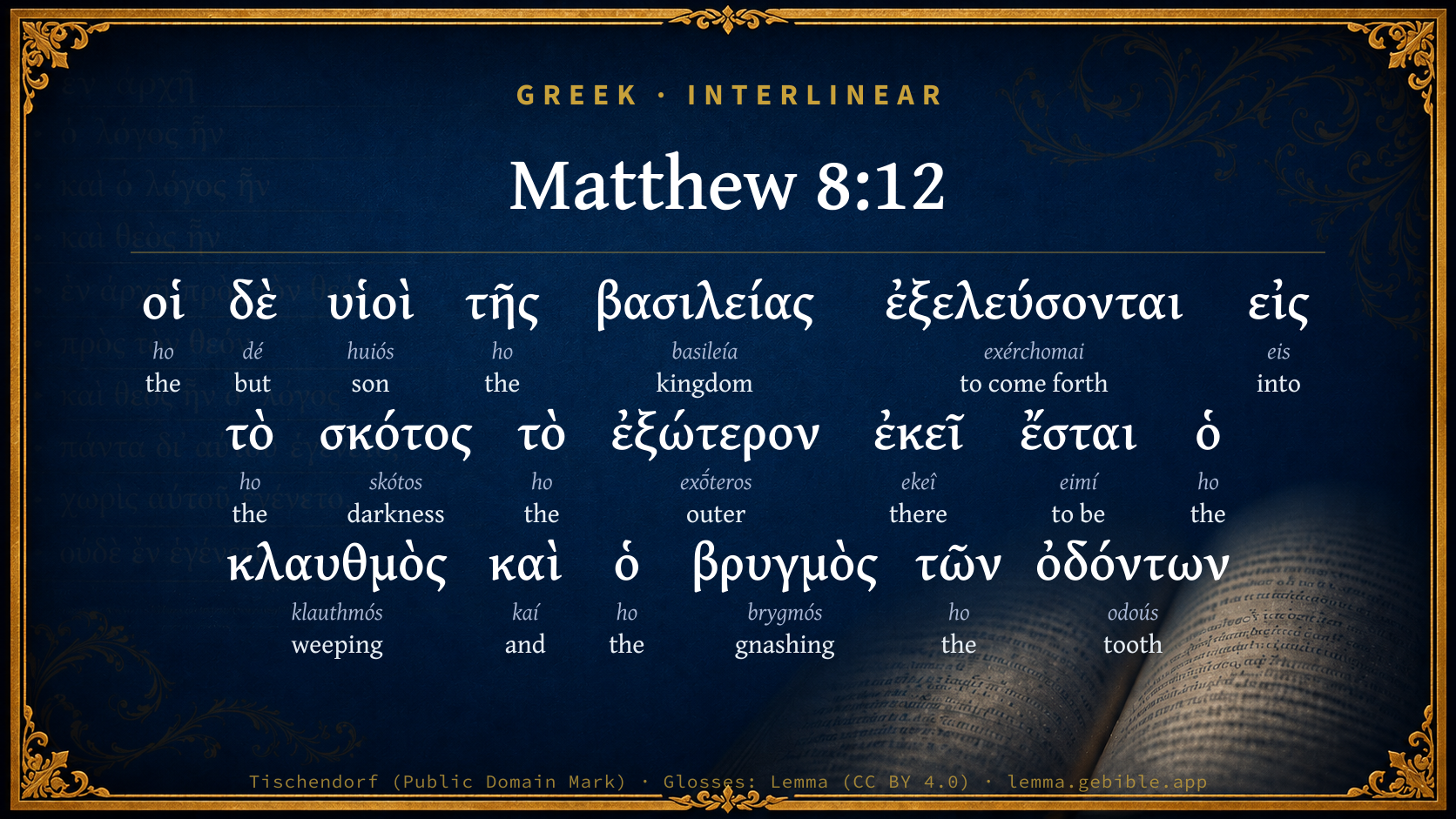
Greek (Tischendorf 8th ed.) Matthew 8:12 appears in the Greek New Testament. The text above is from the Tischendorf 8th edition. Each word links to its Strong’s number and a concise gloss. Click any word for its full Thayer’s Greek Lexicon entry.
Download image
Cite this verse

Matthew 8:12 (World English Bible). Public Domain. Lemma interlinear Bible study tool, https://lemma.gebible.app/v/matthew/8/12.

Show BibTeX & RIS
BibTeX
RIS
English Translation
but the children of the Kingdom will be thrown out into the outer darkness. There will be weeping and the gnashing of teeth."
World English Bible · Public Domain
Highlights
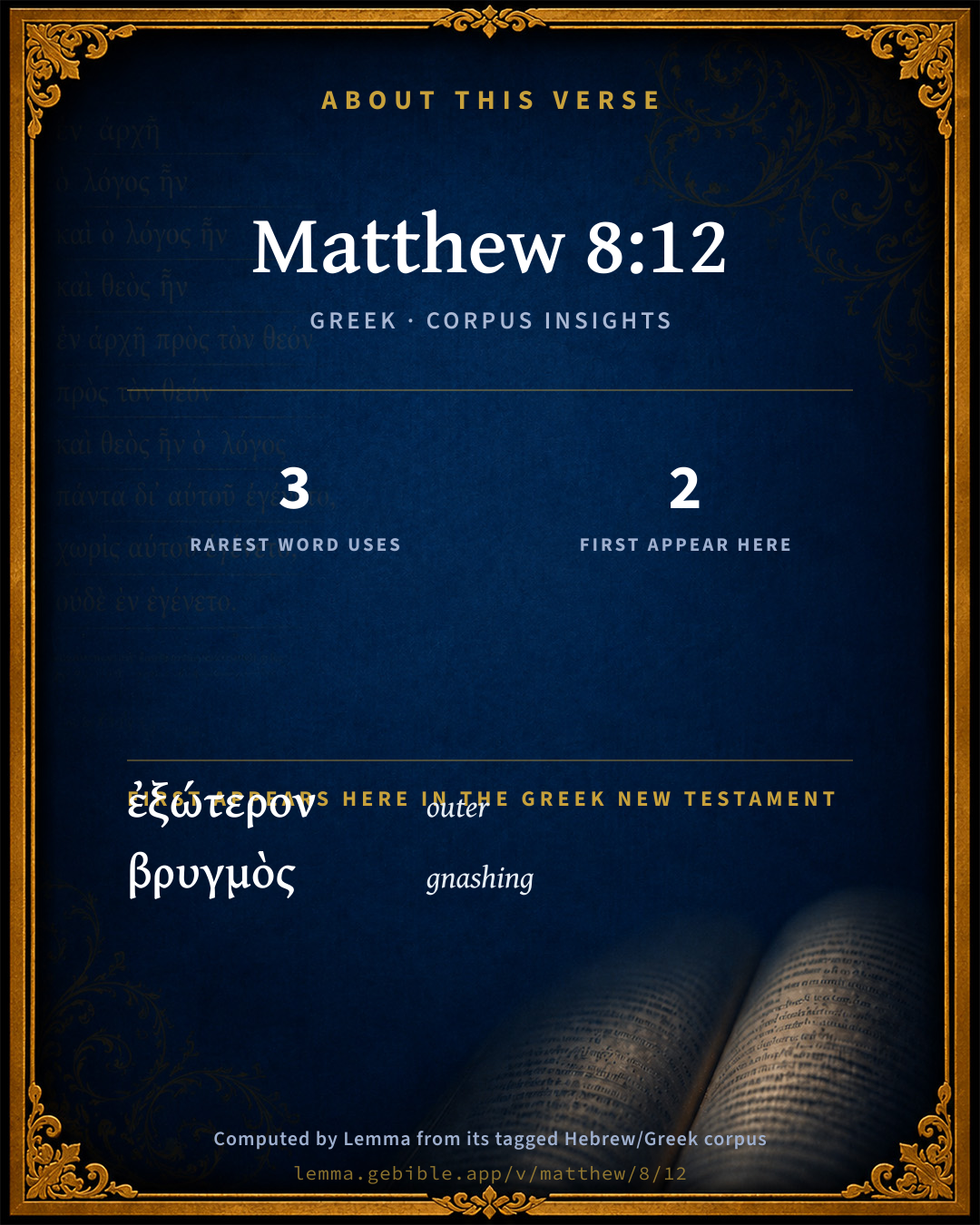
  • 2 first appearances in the Greek New Testament
Full analysis ↓
Download a study sheet

One document with this verse’s original text, its word-by-word gloss line, the meaning frame, cross-references with their text, attributed commentary, and full source and license credits — printable, and it pastes into notes with its structure intact.

This verse Autodidact and up

Study sheet (.html) Plain text (.txt)

A passage Seminary Student

Up to 50 verses in one chapter. A passage sheet keeps up to 6 commentary sources and 12 cross-references per verse, in the order this page ranks them, and says so on the sheet whenever that leaves anything out. Ask for a single verse and you get the Autodidact verse sheet above.

Everything on this page stays free to read, with no account — the sheet is a download of what is already on screen, not access to it.

Want to remove ads? Support Godless Engineer
Compare translations 3

The same verse in 3 English versions, stacked beneath the original-language interlinear above. Click any original word for its lexicon entry.

Each is an independent rendering of the whole verse — the interlinear is not word-aligned to these translations.

Highlighted words mark where these versions differ — a whole-verse word diff, not a word-by-word alignment.

  • World English Bible Public Domain
    but the children of the Kingdom will be thrown out into the outer darkness. There will be weeping and the gnashing of teeth."
  • King James Version Public Domain
    But the children of the kingdom shall be cast out into outer darkness: there shall be weeping and gnashing of teeth.
  • unfoldingWord Literal Text CC BY-SA 4.0
    But the sons of the kingdom will be thrown out into the outer darkness, where there will be weeping and grinding of the teeth.”

unfoldingWord Literal Text — © unfoldingWord, licensed CC BY-SA 4.0. Word-aligned USFM3 via Door43 (git.door43.org/unfoldingWord/en_ult).

Versions to compare (up to 4)

3 of 4 selected

Show all 19 translations

Every available English version of this verse, each an independent rendering of the whole verse.

  • World English Bible Public Domain
    but the children of the Kingdom will be thrown out into the outer darkness. There will be weeping and the gnashing of teeth."
  • Berean Standard Bible Public Domain
    But the sons of the kingdom will be thrown into the outer darkness, where there will be weeping and gnashing of teeth.”
  • Majority Standard Bible Public Domain
    But the sons of the kingdom will be thrown into the outer darkness, where there will be weeping and gnashing of teeth.”
  • King James Version Public Domain
    But the children of the kingdom shall be cast out into outer darkness: there shall be weeping and gnashing of teeth.
  • American Standard Version (1901) Public Domain
    but the sons of the kingdom shall be cast forth into the outer darkness: there shall be the weeping and the gnashing of teeth.
  • Revised Version (1885) Public Domain
    but the sons of the kingdom shall be cast forth into the outer darkness: there shall be the weeping and gnashing of teeth.
  • Geneva Bible (1599) Public Domain
    And the children of the kingdome shall be cast out into vtter darkenes: there shalbe weeping and gnashing of teeth.
  • Douay-Rheims (1899) Public Domain
    But the children of the kingdom shall be cast out into the exterior darkness: there shall be weeping and gnashing of teeth.
  • Young's Literal Translation Public Domain
    but the sons of the reign shall be cast forth to the outer darkness -- there shall be the weeping and the gnashing of the teeth.'
  • Literal Standard Version CC BY-SA 4.0
    but the sons of the kingdom will be cast forth into the outer darkness—there will be the weeping and the gnashing of the teeth.”
  • Unlocked Literal Bible CC BY-SA 4.0
    But the sons of the kingdom will be thrown into the outer darkness, where there will be weeping and grinding of teeth.”
  • unfoldingWord Literal Text CC BY-SA 4.0
    But the sons of the kingdom will be thrown out into the outer darkness, where there will be weeping and grinding of the teeth.”
  • Darby Bible Public Domain
    but the sons of the kingdom shall be cast out into the outer darkness: there shall be the weeping and the gnashing of teeth.
  • World Messianic Bible Public Domain
    but the children of the Kingdom will be thrown out into the outer darkness. There will be weeping and gnashing of teeth.”
  • Webster's Bible Public Domain
    But the children of the kingdom shall be cast out into utter darkness: there shall be weeping and gnashing of teeth.
  • Free Bible Version CC BY-SA 4.0
    But the heirs of the kingdom will be thrown out into utter darkness where there will be weeping and grinding of teeth.”
  • Bible in Basic English Public Domain
    But the sons of the kingdom will be put out into the dark, and there will be weeping and cries of pain.
  • Text-Critical English NT CC BY 4.0
    but the sons of the kingdom will be cast into the outer darkness; in that place there will be weeping and gnashing of teeth.”
  • Tyndale New Testament (1534) Public Domain
    and the chyldren of the kyngdome shalbe cast out in to vtter darcknes: there shalbe wepinge and gnasshing of tethe.

Literal Standard Version (2020), Covenant Press — licensed CC BY-SA 4.0. Text via the HelloAO Bible API (eBible.org). Unlocked Literal Bible (unfoldingWord) — licensed CC BY-SA 4.0. Text via the HelloAO Bible API (eBible.org). unfoldingWord Literal Text — © unfoldingWord, licensed CC BY-SA 4.0. Word-aligned USFM3 via Door43 (git.door43.org/unfoldingWord/en_ult). Free Bible Version, Dr. Jonathan Gallagher — licensed CC BY-SA 4.0. Text via the HelloAO Bible API (eBible.org).

Word by word

More ways to search: Search by grammar → Find every occurrence → Compare this word →

Practice this passage: Drill this verse → Learn its vocabulary →

ἐξώτερον
exṓteros
G1857
“outer”
Adjective, Accusative, Singular, Neuter, Comparative
Part of Speech
Adjective
Case
Accusative
Number
Singular
Gender
Neuter
Degree
Comparative
Full Thayer's Definition

Origin: comparative of G1854

TDNT: None

1. outer
  1. οἱ ho G3588 “the” Article, Nominative, Plural, Masculine
  2. δὲ dé G1161 “but” Conjunction
  3. υἱοὶ huiós G5207 “son” Noun, Nominative, Plural, Masculine
  4. τῆς ho G3588 “the” Article, Genitive, Singular, Feminine
  5. βασιλείας basileía G932 “kingdom” Noun, Genitive, Singular, Feminine
  6. ἐξελεύσονται exérchomai G1831 “to come forth” Verb, Future, Middle deponent, Indicative, 3rd person, Plural
  7. εἰς eis G1519 “into” Preposition
  8. τὸ ho G3588 “the” Article, Accusative, Singular, Neuter
  9. σκότος skótos G4655 “darkness” Noun, Accusative, Singular, Neuter
  10. τὸ ho G3588 “the” Article, Accusative, Singular, Neuter
  11. ἐκεῖ ekeî G1563 “there” Adverb
  12. ἔσται eimí G1510 “to be” Verb, Future, Middle deponent, Indicative, 3rd person, Singular
  13. ὁ ho G3588 “the” Article, Nominative, Singular, Masculine
  14. κλαυθμὸς klauthmós G2805 “weeping” Noun, Nominative, Singular, Masculine
  15. καὶ kaí G2532 “and” Conjunction
  16. ὁ ho G3588 “the” Article, Nominative, Singular, Masculine
  17. βρυγμὸς brygmós G1030 “gnashing” Noun, Nominative, Singular, Masculine
  18. τῶν ho G3588 “the” Article, Genitive, Plural, Masculine
  19. ὀδόντων odoús G3599 “tooth” Noun, Genitive, Plural, Masculine

About this verse

These counts appear in no published source. They are computed here, from the morphology-tagged text and Lemma’s own curated glosses. What Lemma adds →

20
words
14
distinct lemmas
Gospels
section

Notable vocabulary

The rarest word here is ἐξώτερον outer G1857 — appearing just 3 times in the whole Greek New Testament.

First appearance in Scripture

These words make their first canonical appearance in the Greek New Testament here:

  • ἐξώτερον outer G1857
  • βρυγμὸς gnashing G1030

Shared distinctive vocabulary

ἐξώτερον outer G1857 occurs in 3 verses of the Greek New Testament. Also found in:

Repetition

A word recurs within this verse:

Cross-references

15

Topical passages linked to Matthew 8:12 in the Treasury of Scripture Knowledge — connected by theme and wording, ordered by reader-vote popularity; previews shown in the World English Bible.

  • Matthew 25:30 Throw out the unprofitable servant into the outer darkness, where there will be weeping and gnashing of teeth.'
  • Luke 13:28 There will be weeping and gnashing of teeth, when you see Abraham, Isaac, Jacob, and all the prophets, in the Kingdom of God, and yourselves being thrown outside.
  • Matthew 21:43 "Therefore I tell you, the Kingdom of God will be taken away from you, and will be given to a nation bringing forth its fruits.
  • Matthew 13:42 and will cast them into the furnace of fire. There will be weeping and the gnashing of teeth.
  • Matthew 13:50 and will cast them into the furnace of fire. There will be the weeping and the gnashing of teeth."
  • Matthew 24:51 and will cut him in pieces, and appoint his portion with the hypocrites; there is where the weeping and grinding of teeth will be.
  • Matthew 22:12–13 and he said to him, 'Friend, how did you come in here not wearing wedding clothing?' He was speechless.
  • Matthew 3:9–10 Don't think to yourselves, 'We have Abraham for our father,' for I tell you that God is able to raise up children to Abraham from these stones.
  • 2 Peter 2:17 These are wells without water, clouds driven by a storm; for whom the blackness of darkness has been reserved forever.
  • Jude 1:13 wild waves of the sea, foaming out their own shame; wandering stars, for whom the blackness of darkness has been reserved forever.
  • Matthew 7:22–23 Many will tell me in that day, 'Lord, Lord, didn't we prophesy in your name, in your name cast out demons, and in your name do many mighty works?'
  • Acts 3:25 You are the children of the prophets, and of the covenant which God made with our fathers, saying to Abraham, 'In your seed will all the families of the earth be blessed.'
  • Romans 9:4 who are Israelites; whose is the adoption, the glory, the covenants, the giving of the law, the service, and the promises;
  • 2 Peter 2:4 For if God didn't spare angels when they sinned, but cast them down to Tartarus, and committed them to pits of darkness, to be reserved to judgment;
  • Matthew 13:38 the field is the world; and the good seed, these are the children of the Kingdom; and the darnel are the children of the evil one.

Cross-references courtesy of OpenBible.info (CC BY 4.0).

Commentary

Notes on Matthew 8:12 from classic Christian and Jewish commentators (each source and its license shown beneath its notes). The classic Christian expositions comment on the surrounding passage and are grouped to its opening verse, so a note may address several verses; the Jewish commentaries on the Tanakh (Rashi and others) are per-verse, so they appear only where the commentator wrote on this verse.

Lemma curates 59 commentaries, every one of them public domain or Creative Commons licensed, each selected and text-cleaned for this edition rather than reprinted as found. About our sources →

Bengel's Gnomon

Johann Albrecht Bengel

Mat 8:12. Οἱ δὲ υἱοὶ τῆς βασιλείας, but the children of the kingdom) i.e. nearest heirs to the kingdom. The same title is employed with another meaning in ch. Mat 13:38.—σκότος, darkness) Whatever is without the kingdom of God is outer: for the kingdom of God is light, and the kingdom of light. That darkness will envelope not only the eye, but also the mind, with the grossest obscurity.—ἐξώτερον, outer) the unbeliever has internal darkness in himself already, and obtains, therefore, external darkness also as his fitting home. And the nearer that any one might have approached [to the Divine presence], so much the further will he be cast forth into the depths of darkness.—ἐκεῖ, there) at length [even though not here and now]. Without the brilliant scene of the feast [the marriage supper so often mentioned].—ὁ) a remarkable article, used emphatically.[367] In this life, grief is not yet really grief.—ΚΛΑΥΘΜῸς, weeping) Then will weep heroes now ashamed to weep, from grief at the good they have lost, and the evil they have incurred. Oh horrible sound of so many wretched beings! how far more blessed to hear the sounds of heaven!—See Revelation 14 etc.—βρυγμὸς τῶν ὀδόντων, gnashing of teeth) from impatience and bitterest remorse, and indignation against themselves, as being the authors of their own damnation.[368] Self-love, indulged on earth, will then be transformed into self-hate, nor will the sufferer be ever able to depart from himself. Nor is this weeping and gnashing of teeth combined with darkness only, but also with fire, etc.; see ch. Mat 13:42; Mat 13:50; Luk 13:28. Another exposition is, the soft will weep, the stern will rage. The same phrase occurs in Act 7:54.[369]

[367] As though this were the true ideal of sorrow—the normal standard of suffering—the archetypal reality of agony.—(I. B.)

[368] As also from a spiteful and malignant feeling against others, to whom they enviously grudge the salvation which those others have obtained. Comp. Psa 112:10.—V. g.

[369] Sc. they gnashed upon him [Stephen] with their teeth.—(I. B.)

Bengel's Gnomon of the New Testament — English translation (T&T Clark, Edinburgh, 1860) — public domain. Text from a community e-Sword module.

Meyer's Critical & Exegetical Commentary

Heinrich August Wilhelm Meyer

Mat_8:12. The sons of the kingdom: the Jews, in so far as, according to the divine promise, they have the right, as the theocratic people, to the Messiahs kingdom (Joh_4:22; Rom_9:4-5; Rom_11:16 f.), and are, in consequence, its potential subjects. The article describes them, summarily, in a body, υἱός, בֵּן, as denoting physical or moral relationship, Winer, p. 223 [E. T. 298]. The true υἱοὶ τ. βας., who are so in point of fact, see Mat_13:38.

τὸ ἐξώτερον] which is outside the (illuminated) Messianic banqueting hall. Wetstein on this passage, comp. on ἐξώτερος, LXX. Exo_26:4; Exo_36:10; Eze_10:5; not found in Greek authors. For the thing, see Mat_22:13, Mat_25:30. It is not some special degree of infernal punishment that is represented to us (Grotius), but the punishments themselves, and that as poena damni et sensus at once.

ὁ κλαυθμὸς … ὀδόντων] indicating the wail of suffering, and the gnashing of teeth that accompanies despair. The article points to the well-known (κατʼ ἐξοχήν) misery reigning in hell (Mat_13:42; Mat_13:50, Mat_22:13, Mat_24:51, Mat_25:30). Found in Luke only at Mat_13:28, where the same expression occurs on a different occasion,a circumstance which is not in Lukes favour (de Wette, Gfrörer), but is to be explained from the fact that Jesus made frequent use of the figure of the Messianic reclining at table, and of the expression regarding the infernal κλαυθμός, etc.

Meyer — Critical and Exegetical Commentary on the New Testament — English translation by Peter Christie, edited by Frederick Crombie (T&T Clark, 1880) — public domain. Text from a community e-Sword module.

Geneva Bible (1599)

Geneva Bible translators

Which are without the kingdom: For in the kingdom is light, and without the kingdom darkness.

Geneva Bible (1599) marginal notes — public domain. Text via Bolls.life.

Adam Clarke's Commentary

Verse 12. Shall be cast out into outer darkness] As the enjoyment of that salvation which Jesus Christ calls the kingdom of heaven is here represented under the notion of a nuptial festival, at which the guests sat down in a reclining posture, with the master of the feast; so the state of those who were excluded from the banquet is represented as deep darkness; because the nuptial solemnities took place at night. Hence, at those suppers, the house of reception was filled with lights called δαδεςλαμπαδεςλυκνειαφανοι, torches, lamps, candles, and lanthorns, by Athenaeus and Plutarch: so they who were admitted to the banquet had the benefit of the light; but they who were shut out were in darkness, called here outer darkness, i.e. the darkness on the outside of the house in which the guests were; which must appear more abundantly gloomy, when compared with the profusion of light within the guest-chamber. And because they who were shut out were not only exposed to shame, but also to hunger and cold; therefore it is added, there shall be weeping and gnashing of teeth. As these feasts are often alluded to by the evangelists, I would observe, once for all:-that they who were invited to them entered by a gate designed to receive them; whence Christ, by whom we enter into the marriage feast, compares himself to a gate, Joh 10:1-2; Joh 10:7; Joh 10:9. This gate, at the time the guests were to come, was made narrow, the wicket only being left open, and the porter standing there, that they who were not bidden to the marriage might not rush into it. Hence Christ exhorts the Jews to enter in at the strait gate, Mt 7:13, c. When all that were invited were once come, the door was presently shut, and was not to be opened to any who came too late, and stood knocking without so after the wise virgins had entered with the bridegroom, the gate was shut, and was not opened to the foolish virgins, who stood knocking without, Mt 25:11. And in this sense we are to understand the words of Christ, Lu 13:24-25. Many shall seek to enter in, but shall not be able. Why? because the master of the house hath risen up and shut to the door; they would not come to him when they might, and now the day of probation is ended, and they must be judged according to the deeds done in the body. See Whitby on the place. How many of those who are called Christians suffer the kingdom, the graces, and the salvation which they had in their hands, to be lost; while West-India negroes, American Indians, Hindoo polytheists, and atheistic Hottentots obtain salvation! An eternity of darkness, fears, and pains, for comparatively a moment of sensual gratification, how terrible the thought! What outer darkness, or το σκοτος το εξωτερον, that darkness, that which is outermost, may refer to, in eternal damnation, is hard to say: what it alludes to I have already mentioned: but as the words βρυγμος των οδοντων, gnashing or CHATTERING of teeth, convey the idea, not only of extreme anguish, but of extreme cold; some have imagined that the punishment of the damned consists in sudden transitions from extreme heat to extreme cold; the extremes of both I have found to produce exactly the same sensation.

MILTON happily describes this in the following inimitable verses, which a man can scarcely read, even at midsummer, without shivering.

Beyond this flood a frozen continent

Lies dark and wild, heat with perpetual storms

Of whirlwind and dire hail--------

-------- the parching air

Burns frore, and cold performs the effect of fire.

Thither by harpy-footed furies haled,

At certain revolutions all the damn'd

Are brought; and feel by turns the bitter change

Of fierce extremes, extremes by change more fierce,

From beds of raging fire, to starve in ice,

-------- and there to pine

Immovable, infix'd, and frozen round

Periods of time; thence hurried back to fire.

Parad. Lost, book ii. line 586.

There is a passage in the Vulgate, Job 24:19, that might have helped Milton to this idea. Ad nimium calorem transeat ab aquis nivium. "Let him pass to excessive heat, from waters of snow." This reading, which is found only in this form in the Vulgate, is vastly expressive. Every body knows that snow water feels colder than snow itself, even when both are of the same temperature, viz. 32, because the human body, when in contact with snow water, cools quicker than when in contact with snow. Another of our poets has given us a most terrible description of perdition on the same ground.

The once pamper'd spirit

To bathe in fiery floods, or to reside

In thrilling regions of thick-ribbed ice;

To be imprison'd in the viewless winds,

And blown with restless violence round about

This pendant world; or to be worse than worst

Of those that lawless and incertain thoughts

Imagine--------

Similar to this is that dreadful description of the torments of the wicked given in the Institutes of Menu: "The wicked shall have a sensation of agony in Tamisra, or utter darkness, and in other seats of horror; in Asipatrauana, or the sword-leaved forest, and in different places of binding fast, and of rending: multifarious tortures await them: they shall be mangled by ravens and owls, and shall swallow cakes boiling hot, and shall walk over inflamed sands, and shall feel the pangs of being baked like the vessels of a potter: they shall assume the forms of beasts continually miserable, and suffer alternate afflictions from extremities of cold and heat; surrounded with terrors of various kinds. They shall have old age without resource; diseases attended with anguish; pangs of innumerable sorts, and, lastly, unconquerable death."

Institutes of MENU, chap. 12. Inst. 75-80.

In the Zend Avesta, the place of wicked spirits is termed, "The places of darkness, the germs of the thickest darkness." An uncommonly significant expression: Darkness has its birth there: there are its seeds and buds, there it vegetates everlastingly, and its eternal fruit is - darkness!

See Zend Avesta, vol. i. Vendidad sadi, Fargard. xviii. p. 412.

And is this, or, any thing as bad as this, HELL? Yes, and worse than the worst of all that has already been mentioned. Hear Christ himself. There their worm dieth not, and the fire is NOT QUENCHED! Great God! save the reader from this damnation!

Adam Clarke's Commentary on the Bible (1810–1826) — public domain. Text from a community e-Sword/MySword module.

Ellicott's Commentary for English Readers

(12) The children of the kingdom.—The form of the phrase is a Hebraism, indicating, as in “the children of the bride-chamber,” those who belonged to the kingdom, i.e., in this case, the Israelites, to whom the kingdom of heaven had, in the first instance, been promised, the natural heirs who had forfeited their inheritance.

Into outer darkness.—Strictly, the outer darkness. The words continue the imagery of the previous clause, the darkness outside the king’s palace being contrasted with the interior, blazing with lamps and torches.

There shall be weeping and gnashing of teeth.—Both words in the Greek have the emphasis of the article, “the weeping” par excellence. The two words are found in combination six times in St. Matthew, and once in St. Luke (Luk_13:28). In their literal meaning they express that intensest form of human anguish in which it ceases to be articulate. The latter word, or rather the cognate verb, is used also to express rage (Act_7:54). Their spiritual meaning we naturally connect with the misery of those who are excluded from the joy and blessedness of the completed kingdom, and that is, doubtless, what they ultimately point to. We must remember, however, that the “kingdom of heaven” was a term of very varying significance, and that our Lord had proclaimed that that kingdom was at hand, and taught men, by parable and otherwise, that it included more than the life after death. We may accordingly rightly look for like “springing and germinant accomplishments” of the words now before us. Men came “from the east and west,” when the Gentiles were admitted into the Church of Christ. The children of the kingdom were left in the “outer darkness” when they were self-excluded from fellowship with that Church and its work among the nations. The outbursts of envy and rage recorded in the Acts (Act_5:33; Act_13:45) illustrate this aspect of “the weeping and gnashing of teeth.”

A Bible Commentary for English Readers, edited by Charles John Ellicott (1878–1897) — public domain. Text from a community e-Sword module.

The Cambridge Bible for Schools and Colleges

gen. ed. J. J. S. Perowne

12. outer darkness] i. e. the darkness outside the house in which the banquet is going on.

The Cambridge Bible for Schools and Colleges (gen. ed. J. J. S. Perowne; Cambridge University Press, 1878–1918) — public domain. Text from a community e-Sword module.

John Gill's Exposition

And Jesus said unto the centurion,.... Christ having finished the digression, returns an answer to the centurion, agreeably to his desire, saying to him,

go thy way; not as displeased with him, but as granting his request: for it follows,

and as thou hast believed, so be it done unto thee. As he had faith to believe, that Christ could cure his servant by a word speaking, it was done accordingly. Christ by his almighty "fiat" said, let him be healed, and he was healed: just as God in the creation said, "let there be light, and there was light". He does not say according to thy prayer, or according to thy righteousness, and goodness, but according to thy faith: and it is further to be observed, that this cure was wrought, not so much for the sake of the servant, as his master; and therefore Christ says, "be it done unto thee"; let him be healed for thy sake, and restored unto thee, to thy use, profit, and advantage.

And his servant was healed in the selfsame hour, at the very exact time, even in that moment. Some copies add, "and when the centurion returned to his house, in the selfsame hour he found his servant healed"; which the Ethiopic version has, and it agrees with Luk 7:10.

John Gill's Exposition of the Whole Bible (1746–1763) — public domain (CC PDM 1.0). Text via the HelloAO Bible API.

Trapp's Complete Commentary

John Trapp

12 But the children of the kingdom shall be cast out into outer darkness: there shall be weeping and gnashing of teeth.

Ver. 12. But the children of the kingdom] Those that had made a covenant with God by sacrifice, Psa 50:5; and therefore held their heads on high, as already destined to the diadem. Lo, these, in the height of their hopes and expectancies, shall be excluded; a foul and fearful disappointment. Surely the tears of hell cannot sufficiently bewail the loss of heaven. John of Valois was son, brother, uncle, father to a king, yet himself never was a king; so here.

Into outer darkness] Into a darkness beyond a darkness; into a dungeon beyond and beneath the prison. In tenebras ex tenebris, infeliciter exclusi, infelicius excludendi, saith Augustine. God shall surely say to these unhappy children of the kingdom, when he casts them into condemnation, as Aulus Fulvius said to his traitorous son when he slew him with his own hands, Non Catiline te genui sed patriae. I begat you not to be a Catiline but a patriot. I called you not but to glory and virtue, neither to glory but by virtue, 2Pe 1:3. As you liked not the latter, so never look for the former. Every man is either a king or a captive; and shall either reign with Christ, or rue it for ever with the devil. {a} Aut Caesar aut nullus, Either Caesar or nothing, as he said to his mother: and as those in the Turk’s court, that are born of the blood royal, but come not to the kingdom; they must die either by the sword or halter; so here.

{a} Omnis homo aut est cum Christo regnaturus, aut cum diabolo cruciandus. Aug.

John Trapp, A Commentary or Exposition upon All the Books of the Old and New Testament (1647–1656) — public domain. Text from a community e-Sword module.

Albert Barnes' Notes on the Bible

The children of the kingdom - That is, the children, or the people, who “expected the kingdom,” or to whom it properly belonged; or, in other words, the Jews. they supposed themselves to be the special favorites of heaven. They thought that the Messiah would enlarge their nation and spread the triumphs of their kingdom. They called themselves, therefore, the children or the members of the kingdom of God, to the exclusion of the Gentiles. Our Saviour used the manner of speech to which they were accustomed, and said that “many of the pagans would be saved, and many Jews lost.

Shall be cast out into outer darkness ... - This is an image of future punishment. It is not improbable that the image was taken from Roman dungeons or prisons. They were commonly constructed under ground. They were shut out from the light of the sun. They were, of course, damp, dark, and unhealthy, and probably most filthy. Masters were in the habit of constructing such prisons for their slaves, where the unhappy prisoner, without light, or company, or comfort, spent his days and nights in weeping from grief, and in vainly gnashing his teeth from indignation. The image expresses the fact that the wicked who are lost will be shut out from the light of heaven, and from peace, and joy, and hope; will weep in hopeless grief, and will gnash their teeth in indignation against God, and complain against his justice. What a striking image of future woe! Go to a damp, dark, solitary, and squalid dungeon; see a miserable and enraged victim; add to his sufferings the idea of eternity, and then remember that this, after all, is but an image, a faint image, of hell! Compare the notes at Mat 22:13.

Albert Barnes' Notes on the Bible (1834–1885) — public domain. Text from a community e-Sword/MySword module.

Haydock's Catholic Bible Commentary

Whilst the Jews, who glory in descending from the patriarchs, and who, on this title, are children and heirs of the celestial kingdom which had been promised them, shall be excluded for having rendered themselves unworthy by their unbelief. (Bible de Vence) --- Shall be cast out into exterior darkness. This is spoken so as to imply a comparison to a supper in a great room, with a number of lights, when they who are turned out in the night, stand without, starving, weeping, and gnashing their teeth. (Witham)

George Leo Haydock (1774–1849), Haydock's Catholic Family Bible and Commentary, 1859 edition — public domain. Excludes Psalms (Douay-Rheims chapter numbering differs from Protestant) and Deuterocanonical books (Catholic canon only).

Whedon's Commentary on the Bible

Daniel D. Whedon

12. Children of the kingdom — Natural Jews. The kingdom of heaven, that is, the Gospel dispensation, including the kingdom of glory as well as of grace, is represented as a divine banquet, in which, while the Jews, the natural children of the kingdom, are excluded, the repentant Gentiles take their couches with Abraham and the other ancestral patriarchs. The heirship by faith is substituted for the heirship by birth, and the spiritual guests are the true children of Abraham.

Outer darkness — The figure of a banquet is carried out. The splendour, the joy, the society, the feast within, are an emblem of God’s kingdom below and above. The darkness of the streets without is an emblem of deep horror. The streets of Eastern cities are narrow and filthy; all the outdoor comfort being reserved for the court or square yard enclosed within the area of the building. At night they are totally dark, being unillumined even by rays from a window. Robbers and ferocious dogs render them dangerous. We have thence a strong image of that utter despair, darkness, and death of a soul excluded from God, and left to weeping and gnashing of teeth.

Daniel D. Whedon (gen. ed.), Commentary on the Old and New Testaments (1874–1909) — public domain. Text from a community e-Sword module.

John Wesley's Explanatory Notes

The outer darkness - Our Lord here alludes to the custom the ancients had of making their feast in the night time. Probably while he was speaking this, the centurion came in person. Matt. xiii, 42, 50; xxii, 13; xxiv, 51; xxv, 30.

John Wesley, Explanatory Notes Upon the Whole Bible (1754–1765) — public domain. Text via the GEBible commentary corpus.

The People's New Testament

B. W. Johnson

12. But the children of the kingdom. The Jews, the natural children of Abraham, the “Father of the faithful,” heirs of the promises made to him. Cast out. Because they rejected the Messiah, in whom all the promises center. Into outer darkness. The history of the Jews for 1,800 years has been a fulfillment of this passage. There shall be weeping and gnashing of teeth. There is a hint at the wretchedness of a future state of punishment.

B. W. Johnson's The People's New Testament with Notes (1889–1891) — public domain. Electronic text from the Christian Classics Ethereal Library (CCEL) ThML edition.

Cambridge Greek Testament for Schools and Colleges

12. τὸ σκότος τὸ ἐξώτερον, i.e. the darkness outside the house in which the banquet is going on.

ὁ κλαυθμὸς καὶ ὁ βρυγμός. The article, ignored in A.V., means ‘that wailing and gnashing of teeth which you speak of;’ τὸ λεγόμενον, it was a common figure.

Cambridge Greek Testament for Schools and Colleges (Cambridge University Press, 1896; 21 vols, various authors incl. Carr, Maclear, Plummer, Farrar, Lumby, Moule, M. R. James, Simcox) — public domain. Text from a community e-Sword module.

Alford’s Greek Testament

Henry Alford

12. οἱ υἱοί] the natural heirs, but disinherited by rebellion.

τὸ σκ. τὸ ἐξ. the darkness outside, i.e. outside the lighted chamber of the feast, see ch. 22:13, and Eph 5:7, Eph 5:8. These verses are wanting in St. Luke, and occur when our Lord repeated them on a wholly different occasion, ch. 13:28, 29.

ὁ κλ. κ. ὁ βρ.] The articles here are not possessive, as Middleton supposes, for that would give a sense the most frigid possible, and would be a rendering inadmissible after ἔσται, which generalizes the assertion; they rather import the notoriety and eminence of the κλ. κ. βρ. ‘Articulus insignis: in hac vita dolor nondum est dolor.’ Bengel.

Henry Alford, The Greek Testament (1849–1861) — public domain. Text from a community e-Sword module.

International Critical Commentary

12. But the sons of the kingdom shall be cast forth into the outer darkness: there shall be the wailing and the gnashing of teeth.] “Sons of the kingdom” is in Semitic idiom equivalent to those who should inherit it, its rightful heirs. Here it, no doubt, signifies the Jewish nation or people. Such of them as are lacking in the faith which the centurion possessed will be cast out of the kingdom, whilst Gentiles sit down with the righteous patriarchs at the banquet. For “sons of the kingdom,” cf. Bab. Shabb. 153a; “Who is a son of the world to come?” Pesaḥim 8a, and cf. 13:38. τὸ σκότος τὸ ἐξώτερον occurs only in Mat 22:13; Mat 25:30. Cf. Enoch 103:8 “into darkness—will your spirits enter”; 108:14 “those who were born in darkness will be cast into darkness”; Ps.-Sol. 14:6 “their inheritance is—darkness,” 15:11 “the inheritance of the sinners is—darkness”; Sib. Or. 4:43 He will send back the ungodly into darkness. For the Rabbinical literature, cf. Vayyikra R. 27 (Wünsche, 183): “God names gehinnom ‘darkness.’ ” Shemoth R. 14 (Wünsche, 100): “the sinners in gehinnom will be covered with darkness.” Cf. Bousset, Rel. Jud. 266; Weber, Jüd. Theol. 393; Volz, Jüd. Eschat. 284 f.: ἐκεῖ ἔσται ὁ κλαυθμὸς καὶ ὁ βρυγμὸς τῶν ὀδόντων. This refrain is characteristic of Mt. It occurs again in 13:42, 50, 22:13, 24:51, 25:30, and once in Luk 13:28. Cf. Enoch 108:3, the transgressors “will cry and make lamentation”; 5 “the voice of crying, and weeping, and lamentation, and strong pain”; Secrets of Enoch 40:12 “the mighty hell—full of lamentation.”

For the whole verse, cf. Philo, de Exsecr. vi. The proselyte (ἔπηλυς)—receive(s) for reward a sure and firm foundation in heaven, such as cannot be described. But the rightful heir (εὐπατρίδης) “will be dragged downwards, and brought into Tartarus and deep darkness.”

(X)

International Critical Commentary — older volumes (1896–1929), various authors — public domain. Text from a community e-Sword module.

Vincent's Word Studies in the New Testament

Marvin R. Vincent

The outer [το εξωτερον] . The Greek order of words is very forcible. " They shall be cast forth into the darkness, the outer (darkness). The picture is of an illuminated banqueting chamber, outside of which is the thick darkness of night.

Marvin R. Vincent, Word Studies in the New Testament (1887–1900) — public domain. Text from a community e-Sword/MySword module.

Lesson kit

Teaching starters — assembled from the data on this page, not authored interpretation. Every prompt links to the verse data it draws on. Edit before teaching.

Matthew, in the Gospels, opens this verse with 20 words (14 distinct Greek lemmas). Its most distinctive word is exṓteros (“outer”). A historical commentator’s framing appears above. Read the whole chapter for the surrounding context.

Discussion questions

  1. How does “outer” (exṓteros) shape what this verse is saying?
  2. 2 words make their first appearance in Scripture here. What does this debut establish?
  3. How does Matthew 22:13, which shares the word «outer», read alongside this verse?
  4. What does the repetition of “the” (7× in this one verse) do in this verse?
  5. These translations render this verse differently. What is at stake in choosing one wording over another?
  6. Compare how Bengel's Gnomon and Meyer's Critical & Exegetical Commentary read this verse. Where do they agree or differ?

Things to notice

  • 2 words make their first canonical appearance in Scripture here.
  • These translations choose different wording for 9 words in this verse.
  • “the” occurs 7× in this single verse.
  • 14 distinct Greek lemmas span 20 words in this verse.

Reading settings

Reading text

Shown beneath each verse's original-language words.

Old Testament
Old Testament edition

Read the OT as the Masoretic Hebrew (MT) or the Greek Septuagint (LXX).

English shown for the Greek Septuagint (in the Hebrew ↔ Greek comparison).

Comparing translations? Open the Compare panel on any verse page to stack up to four side by side.