

Matthew 18:8
Greek (Tischendorf 8th ed.) Matthew 18:8 appears in the Greek New Testament. The text above is from the Tischendorf 8th edition. Each word links to its Strong’s number and a concise gloss. Click any word for its full Thayer’s Greek Lexicon entry.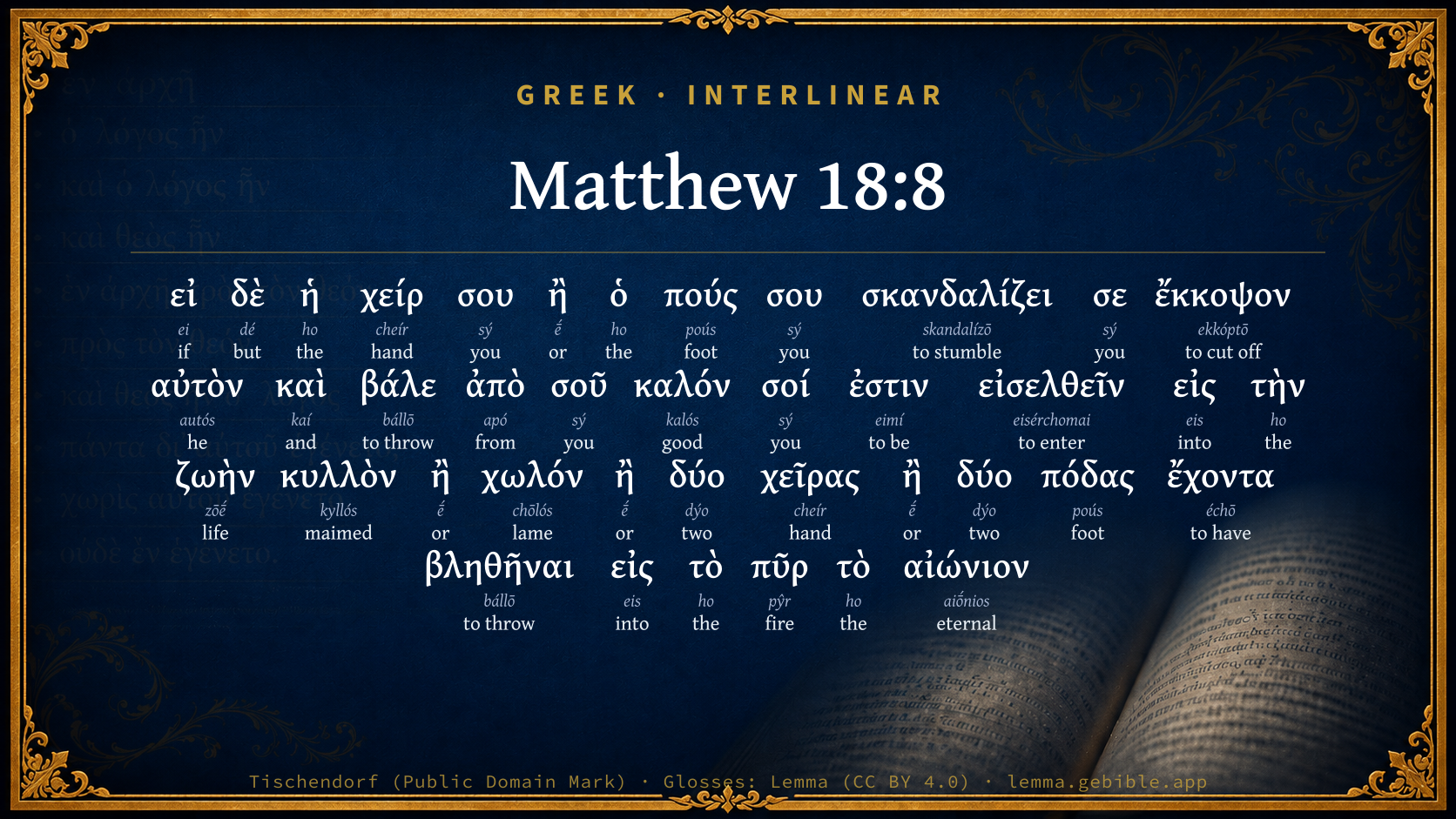
If your hand or your foot causes you to stumble, cut it off, and cast it from you. It is better for you to enter into life maimed or crippled, rather than having two hands or two feet to be cast into the eternal fire.
Download a study sheet
One document with this verse’s original text, its word-by-word gloss line, the meaning frame, cross-references with their text, attributed commentary, and full source and license credits — printable, and it pastes into notes with its structure intact.
This verse Autodidact and up
A passage Seminary Student
Up to 50 verses in one chapter. A passage sheet keeps up to 6 commentary sources and 12 cross-references per verse, in the order this page ranks them, and says so on the sheet whenever that leaves anything out. Ask for a single verse and you get the Autodidact verse sheet above.
Everything on this page stays free to read, with no account — the sheet is a download of what is already on screen, not access to it.
Compare translations 3
The same verse in 3 English versions, stacked beneath the original-language interlinear above. Click any original word for its lexicon entry.
Each is an independent rendering of the whole verse — the interlinear is not word-aligned to these translations.
Highlighted words mark where these versions differ — a whole-verse word diff, not a word-by-word alignment.
-
World English Bible Public Domain
If your hand or your foot causes you to stumble, cut it off, and cast it from you. It is better for you to enter into life maimed or crippled, rather than having two hands or two feet to be cast into the eternal fire.
-
King James Version Public Domain
Wherefore if thy hand or thy foot offend thee, cut them off, and cast them from thee: it is better for thee to enter into life halt or maimed, rather than having two hands or two feet to be cast into everlasting fire.
-
unfoldingWord Literal Text CC BY-SA 4.0
Now if your hand or your foot causes you to stumble, cut it off and throw away from you. It is better for you to enter into life crippled or lame than, having two hands or two feet, to be thrown into the eternal fire.
unfoldingWord Literal Text — © unfoldingWord, licensed CC BY-SA 4.0. Word-aligned USFM3 via Door43 (git.door43.org/unfoldingWord/en_ult).
Show all 19 translations
Every available English version of this verse, each an independent rendering of the whole verse.
-
World English Bible Public Domain
If your hand or your foot causes you to stumble, cut it off, and cast it from you. It is better for you to enter into life maimed or crippled, rather than having two hands or two feet to be cast into the eternal fire.
-
Berean Standard Bible Public Domain
If your hand or your foot causes you to sin, cut it off and throw it away. It is better for you to enter life crippled or lame than to have two hands and two feet and be thrown into the eternal fire.
-
Majority Standard Bible Public Domain
If your hand or your foot causes you to sin, cut it off and throw it away. It is better for you to enter life lame or crippled than to have two hands and two feet and be thrown into the eternal fire.
-
King James Version Public Domain
Wherefore if thy hand or thy foot offend thee, cut them off, and cast them from thee: it is better for thee to enter into life halt or maimed, rather than having two hands or two feet to be cast into everlasting fire.
-
American Standard Version (1901) Public Domain
And if thy hand or thy foot causeth thee to stumble, cut it off, and cast it from thee: it is good for thee to enter into life maimed or halt, rather than having two hands or two feet to be cast into the eternal fire.
-
Revised Version (1885) Public Domain
And if thy hand or thy foot causeth thee to stumble, cut it off, and cast it from thee: it is good for thee to enter into life maimed or halt, rather than having two hands or two feet to be cast into the eternal fire.
-
Geneva Bible (1599) Public Domain
Wherefore, if thy hand or thy foote cause thee to offend, cut them off, and cast them from thee: it is better for thee to enter into life, halt, or maimed, then hauing two hands, or two feete, to be cast into euerlasting fire.
-
Douay-Rheims (1899) Public Domain
And if thy hand, or thy foot scandalize thee, cut it off, and cast it from thee. It is better for thee to go into life maimed or lame, than having two hands or two feet, to be cast into everlasting fire.
-
Young's Literal Translation Public Domain
`And if thy hand or thy foot doth cause thee to stumble, cut them off and cast from thee; it is good for thee to enter into the life lame or maimed, rather than having two hands or two feet, to be cast to the fire the age-during.
-
Literal Standard Version CC BY-SA 4.0
And if your hand or your foot causes you to stumble, cut them off and cast [them] from you; it is good for you to enter into life lame or maimed, rather than having two hands or two feet, to be cast into the continuous fire.
-
Unlocked Literal Bible CC BY-SA 4.0
If your hand or your foot causes you to stumble, cut it off and throw it away from you. It is better for you to enter into life maimed or lame than to be thrown into the eternal fire having two hands or two feet.
-
unfoldingWord Literal Text CC BY-SA 4.0
Now if your hand or your foot causes you to stumble, cut it off and throw away from you. It is better for you to enter into life crippled or lame than, having two hands or two feet, to be thrown into the eternal fire.
-
Darby Bible Public Domain
And if thy hand or thy foot offend thee, cut it off and cast [it] from thee; it is good for thee to enter into life lame or maimed, [rather] than having two hands or two feet to be cast into eternal fire.
-
World Messianic Bible Public Domain
If your hand or your foot causes you to stumble, cut it off and cast it from you. It is better for you to enter into life maimed or crippled, rather than having two hands or two feet to be cast into the eternal fire.
-
Webster's Bible Public Domain
Wherefore, if thy hand or thy foot causeth thee to sin, cut them off, and cast them from thee: it is better for thee to enter into life halt or maimed, rather than having two hands or two feet, to be cast into everlasting fire.
-
Free Bible Version CC BY-SA 4.0
If your hand or your foot causes you to sin, cut it off and throw it away. It's better for you to enter eternal life crippled or lame rather than to have two hands or two feet and to be thrown into eternal fire.
-
Bible in Basic English Public Domain
And if your hand or your foot is a cause of trouble, let it be cut off and put it away from you: it is better for you to go into life with the loss of a hand or a foot than, having two hands or two feet, to go into the eternal fire.
-
Text-Critical English NT CC BY 4.0
If yoʋr hand or yoʋr foot causes yoʋ to stumble, cut them off and throw them away from yoʋ. It is better for yoʋ to enter life lame or crippled than to have two hands or two feet and be thrown into the eternal fire.
-
Tyndale New Testament (1534) Public Domain
Wherfore yf thy honde or thy fote offende the cut him of and cast him from the. It ys better for the to enter into lyfe halt or maymed rather then thou shuldest havinge two hondes or two fete be cast into everlasting fyre.
Literal Standard Version (2020), Covenant Press — licensed CC BY-SA 4.0. Text via the HelloAO Bible API (eBible.org). Unlocked Literal Bible (unfoldingWord) — licensed CC BY-SA 4.0. Text via the HelloAO Bible API (eBible.org). unfoldingWord Literal Text — © unfoldingWord, licensed CC BY-SA 4.0. Word-aligned USFM3 via Door43 (git.door43.org/unfoldingWord/en_ult). Free Bible Version, Dr. Jonathan Gallagher — licensed CC BY-SA 4.0. Text via the HelloAO Bible API (eBible.org).
Word by word
More ways to search: Search by grammar → Find every occurrence → Compare this word →
Practice this passage: Drill this verse → Learn its vocabulary →
- Appears 4× in the Greek New Testament
- First appears at Matthew 15:30
- Part of Speech
- Adjective
- Case
- Accusative
- Number
- Singular
- Gender
- Masculine
Full Thayer's Definition
- εἰ ei G1487 “if” Conditional
- δὲ dé G1161 “but” Conjunction
- ἡ ho G3588 “the” Article, Nominative, Singular, Feminine
- χείρ cheír G5495 “hand” Noun, Nominative, Singular, Feminine
- σου sý G4771 “you” Personal pronoun, 2nd person, Genitive, Singular
- ἢ ḗ G2228 “or” Particle
- ὁ ho G3588 “the” Article, Nominative, Singular, Masculine
- πούς poús G4228 “foot” Noun, Nominative, Singular, Masculine
- σου sý G4771 “you” Personal pronoun, 2nd person, Genitive, Singular
- σκανδαλίζει skandalízō G4624 “to stumble” Verb, Present, Active, Indicative, 3rd person, Singular
- σε sý G4771 “you” Personal pronoun, 2nd person, Accusative, Singular
- ἔκκοψον ekkóptō G1581 “to cut off” Verb, Aorist, Active, Imperative, 2nd person, Singular
- αὐτὸν autós G846 “he” Personal pronoun, Accusative, Singular, Masculine
- καὶ kaí G2532 “and” Conjunction
- βάλε bállō G906 “to throw” Verb, Aorist, Active, Imperative, 2nd person, Singular
- ἀπὸ apó G575 “from” Preposition
- σοῦ sý G4771 “you” Personal pronoun, 2nd person, Genitive, Singular
- καλόν kalós G2570 “good” Adjective, Nominative, Singular, Neuter
- σοί sý G4771 “you” Personal pronoun, 2nd person, Dative, Singular
- ἐστιν eimí G1510 “to be” Verb, Present, Active, Indicative, 3rd person, Singular
- εἰσελθεῖν eisérchomai G1525 “to enter” Verb, Aorist, Active, Infinitive
- εἰς eis G1519 “into” Preposition
- τὴν ho G3588 “the” Article, Accusative, Singular, Feminine
- ζωὴν zōḗ G2222 “life” Noun, Accusative, Singular, Feminine
- κυλλὸν kyllós G2948 “maimed” Adjective, Accusative, Singular, Masculine
- ἢ ḗ G2228 “or” Particle
- χωλόν chōlós G5560 “lame” Adjective, Accusative, Singular, Masculine
- ἢ ḗ G2228 “or” Particle
- δύο dýo G1417 “two” Adjective, Numeral (indeclinable)
- χεῖρας cheír G5495 “hand” Noun, Accusative, Plural, Feminine
- ἢ ḗ G2228 “or” Particle
- δύο dýo G1417 “two” Adjective, Numeral (indeclinable)
- πόδας poús G4228 “foot” Noun, Accusative, Plural, Masculine
- ἔχοντα échō G2192 “to have” Verb, Present, Active, Participle, Accusative, Singular, Masculine
- βληθῆναι bállō G906 “to throw” Verb, Aorist, Passive, Infinitive
- εἰς eis G1519 “into” Preposition
- τὸ ho G3588 “the” Article, Accusative, Singular, Neuter
- πῦρ pŷr G4442 “fire” Noun, Accusative, Singular, Neuter
- τὸ ho G3588 “the” Article, Accusative, Singular, Neuter
- αἰώνιον aiṓnios G166 “eternal” Adjective, Accusative, Singular, Neuter
About this verse
These counts appear in no published source. They are computed here, from the morphology-tagged text and Lemma’s own curated glosses. What Lemma adds →
- 40
- words
- 24
- distinct lemmas
- Gospels
- section
Notable vocabulary
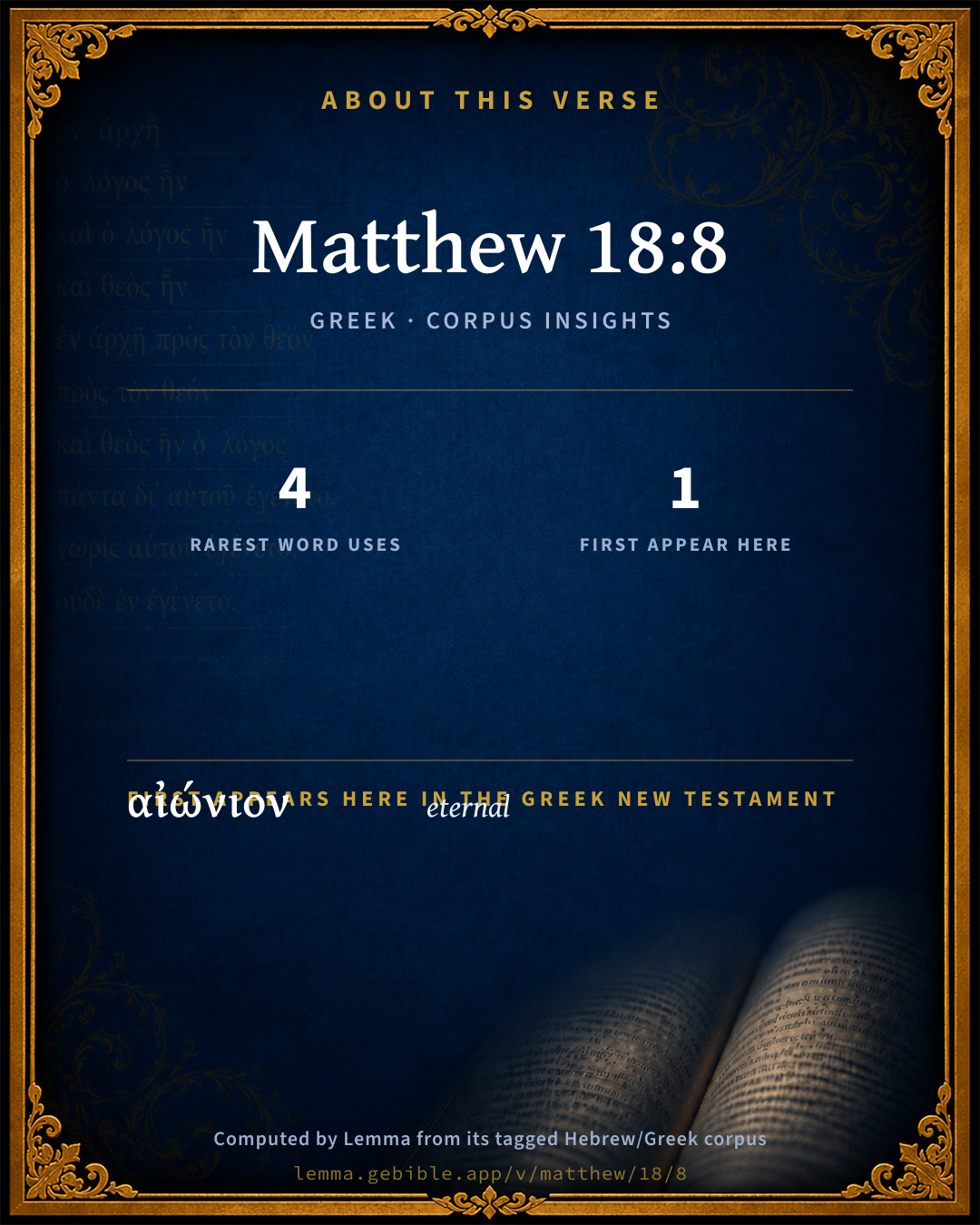
The rarest word here is κυλλὸν maimed G2948 — appearing just 4 times in the whole Greek New Testament.
First appearance in Scripture
This word makes its first canonical appearance in the Greek New Testament here:
- αἰώνιον eternal G166
Shared distinctive vocabulary
κυλλὸν maimed G2948 occurs in 4 verses of the Greek New Testament. Also found in:
Cross-references
21Topical passages linked to Matthew 18:8 in the Treasury of Scripture Knowledge — connected by theme and wording, ordered by reader-vote popularity; previews shown in the World English Bible.
- Matthew 5:29–30 If your right eye causes you to stumble, pluck it out and throw it away from you. For it is more profitable for you that one of your members should perish, than for your whole body to be cast into Gehenna.
- Philippians 3:8–9 Yes most assuredly, and I count all things to be loss for the excellency of the knowledge of Christ Jesus, my Lord, for whom I suffered the loss of all things, and count them nothing but refuse, that I may gain Christ
- Luke 18:22–23 When Jesus heard these things, he said to him, "You still lack one thing. Sell all that you have, and distribute it to the poor. You will have treasure in heaven. Come, follow me."
- Romans 13:12 The night is far gone, and the day is near. Let's therefore throw off the works of darkness, and let's put on the armor of light.
- Ezekiel 18:31 Cast away from you all your transgressions, in which you have transgressed; and make you a new heart and a new spirit: for why will you die, house of Israel?
- Matthew 25:46 These will go away into eternal punishment, but the righteous into eternal life."
- Luke 14:26–27 "If anyone comes to me, and doesn't hate his own father, mother, wife, children, brothers, and sisters, yes, and his own life also, he can't be my disciple.
- Revelation 14:10 he also will drink of the wine of the wrath of God, which is prepared unmixed in the cup of his anger. He will be tormented with fire and sulfur in the presence of the holy angels, and in the presence of the Lamb.
- Revelation 20:15 If anyone was not found written in the book of life, he was cast into the lake of fire.
- Deuteronomy 13:6–8 If your brother, the son of your mother, or your son, or your daughter, or the wife of your bosom, or your friend, who is as your own soul, entice you secretly, saying, Let us go and serve other gods, which you have not known, you, nor your fathers;
- Isaiah 33:14 The sinners in Zion are afraid; trembling has seized the godless ones: Who among us can dwell with the devouring fire? who among us can dwell with everlasting burning?
- Matthew 25:41 Then he will say also to those on the left hand, 'Depart from me, you cursed, into the eternal fire which is prepared for the devil and his angels;
- Mark 9:43–49 If your hand causes you to stumble, cut it off. It is better for you to enter into life maimed, rather than having your two hands to go into Gehenna, into the unquenchable fire,
- Luke 14:33 So therefore whoever of you who doesn't renounce all that he has, he can't be my disciple.
- Luke 16:24 He cried and said, 'Father Abraham, have mercy on me, and send Lazarus, that he may dip the tip of his finger in water, and cool my tongue! For I am in anguish in this flame.'
- Revelation 21:8 But for the cowardly, unbelieving, sinners, abominable, murderers, sexually immoral, sorcerers, idolaters, and all liars, their part is in the lake that burns with fire and sulfur, which is the second death."
- Isaiah 2:20–21 In that day, men shall cast away their idols of silver, And their idols of gold, Which have been made for themselves to worship, To the moles and to the bats;
- Isaiah 30:22 You shall defile the overlaying of your engraved images of silver, and the plating of your molten images of gold: you shall cast them away as an unclean thing; you shall tell it, Get you hence.
- Matthew 14:3–4 For Herod had laid hold of John, and bound him, and put him in prison for the sake of Herodias, his brother Philip's wife.
- Matthew 15:30–31 Great multitudes came to him, having with them the lame, blind, mute, maimed, and many others, and they put them down at his feet. He healed them,
- 2 Thessalonians 1:8–9 giving vengeance to those who don't know God, and to those who don't obey the Gospel of our Lord Jesus,
Cross-references courtesy of OpenBible.info (CC BY 4.0).
Where the printed editions differ
1 variantPlaces in this verse where the major printed Greek editions disagree on the wording in a way that affects the translation — a comparison of editions, not a manuscript-by-manuscript collation. The editions are the modern critical texts (Nestlé-Aland 28/27, SBL, Westcott-Hort, Tregelles, Tyndale House) and the traditional texts behind the KJV (the Textus Receptus and the Byzantine/Majority text). It is not a claim about which reading is original.
-
Different wording
αὐτὸν
“it”
In NA28NA27TynSBLWHTreg Not in TRByzαὐτὰ (auta) 'them' occurs in traditional manuscripts (TR+Byz) instead of αὐτὸν (auton) 'it' in older manuscripts (NA28+NA27+Tyn+SBL+WH+Treg)
Textual data: Translators Amalgamated Greek New Testament (STEPBible TAGNT) · CC BY 4.0.
Lesson kit
Teaching starters — assembled from the data on this page, not authored interpretation. Every prompt links to the verse data it draws on. Edit before teaching.
Matthew, in the Gospels, opens this verse with 40 words (24 distinct Greek lemmas). Its most distinctive word is kyllós (“maimed”). A historical commentator’s framing appears above. Read the whole chapter for the surrounding context.
Discussion questions
- How does “maimed” (kyllós) shape what this verse is saying?
- This is the first place “eternal” appears in Scripture (first appears here). What does its debut here establish?
- How does Matthew 15:30, which shares the word «maimed», read alongside this verse?
- What does the repetition of “hand” (2× in this one verse) do in this verse?
- The translations on this page render this verse differently — a whole-verse word diff, not a word-by-word alignment. What might account for the different wordings?
- Compare how Godbey's Commentary on the New Testament and Tyndale Open Study Notes read this verse. Where do they agree or differ?
Things to notice
- 1 word makes its first canonical appearance in Scripture here.
- These translations choose different wording for 17 words in this verse.
- “hand” occurs 2× in this single verse.
- 24 distinct Greek lemmas span 40 words in this verse.
Commentary
Notes on Matthew 18:8 from classic Christian and Jewish commentators (each source and its license shown beneath its notes). The classic Christian expositions comment on the surrounding passage and are grouped to its opening verse, so a note may address several verses; the Jewish commentaries on the Tanakh (Rashi and others) are per-verse, so they appear only where the commentator wrote on this verse.
Lemma curates 59 commentaries, every one of them public domain or Creative Commons licensed, each selected and text-cleaned for this edition rather than reprinted as found. About our sources →
Godbey's Commentary on the New Testament
William B. Godbey
William B. Godbey, Commentary on the New Testament (1896–1900) — public domain. Text from a community e-Sword module.
Tyndale Open Study Notes
Tyndale Open Resources
Tyndale Open Study Notes — © Tyndale Open Resources, licensed CC BY-SA 4.0. Text via the HelloAO Bible API.
Bengel's Gnomon
Johann Albrecht Bengel
Bengel's Gnomon of the New Testament — English translation (T&T Clark, Edinburgh, 1860) — public domain. Text from a community e-Sword module.
Meyer's Critical & Exegetical Commentary
Heinrich August Wilhelm Meyer
Meyer — Critical and Exegetical Commentary on the New Testament — English translation by Peter Christie, edited by Frederick Crombie (T&T Clark, 1880) — public domain. Text from a community e-Sword module.
Expositor's Greek Testament
ed. W. Robertson Nicoll
The Expositor's Greek Testament, edited by W. Robertson Nicoll (1897–1910) — public domain. Text from a community e-Sword module.
Geneva Bible (1599)
Geneva Bible translators
Geneva Bible (1599) marginal notes — public domain. Text via Bolls.life.
Adam Clarke's Commentary
Adam Clarke's Commentary on the Bible (1810–1826) — public domain. Text from a community e-Sword/MySword module.
Ellicott's Commentary for English Readers
A Bible Commentary for English Readers, edited by Charles John Ellicott (1878–1897) — public domain. Text from a community e-Sword module.
The Cambridge Bible for Schools and Colleges
gen. ed. J. J. S. Perowne
The Cambridge Bible for Schools and Colleges (gen. ed. J. J. S. Perowne; Cambridge University Press, 1878–1918) — public domain. Text from a community e-Sword module.
John Gill's Exposition
John Gill's Exposition of the Whole Bible (1746–1763) — public domain (CC PDM 1.0). Text via the HelloAO Bible API.
Trapp's Complete Commentary
John Trapp
John Trapp, A Commentary or Exposition upon All the Books of the Old and New Testament (1647–1656) — public domain. Text from a community e-Sword module.
Albert Barnes' Notes on the Bible
Albert Barnes' Notes on the Bible (1834–1885) — public domain. Text from a community e-Sword/MySword module.
Haydock's Catholic Bible Commentary
George Leo Haydock (1774–1849), Haydock's Catholic Family Bible and Commentary, 1859 edition — public domain. Excludes Psalms (Douay-Rheims chapter numbering differs from Protestant) and Deuterocanonical books (Catholic canon only).
The Pulpit Commentary
The Pulpit Commentary (1880–1919), ed. H.D.M. Spence-Jones & Joseph S. Exell — public domain. Text from a community e-Sword module.
John Wesley's Explanatory Notes
John Wesley, Explanatory Notes Upon the Whole Bible (1754–1765) — public domain. Text via the GEBible commentary corpus.
Scofield Reference Notes
C. I. Scofield
The Scofield Reference Bible (1917 edition), notes by C. I. Scofield — public domain. Text from a community e-Sword module.
Kretzmann's Popular Commentary
Paul E. Kretzmann
Paul E. Kretzmann, Popular Commentary of the Bible (1921–1924) — public domain. Text from a community e-Sword module.
Burkitt's Expository Notes on the New Testament
William Burkitt
William Burkitt's Expository Notes on the New Testament (1700–1703) — public domain. Text from a community e-Sword module.
The People's New Testament
B. W. Johnson
B. W. Johnson's The People's New Testament with Notes (1889–1891) — public domain. Electronic text from the Christian Classics Ethereal Library (CCEL) ThML edition.
Cambridge Greek Testament for Schools and Colleges
Cambridge Greek Testament for Schools and Colleges (Cambridge University Press, 1896; 21 vols, various authors incl. Carr, Maclear, Plummer, Farrar, Lumby, Moule, M. R. James, Simcox) — public domain. Text from a community e-Sword module.
Alford’s Greek Testament
Henry Alford
Henry Alford, The Greek Testament (1849–1861) — public domain. Text from a community e-Sword module.
International Critical Commentary
International Critical Commentary — older volumes (1896–1929), various authors — public domain. Text from a community e-Sword module.