

1 Corinthians 16:22
Greek (Tischendorf 8th ed.) 1 Corinthians 16:22 appears in the Greek New Testament. The text above is from the Tischendorf 8th edition. Each word links to its Strong’s number and a concise gloss. Click any word for its full Thayer’s Greek Lexicon entry.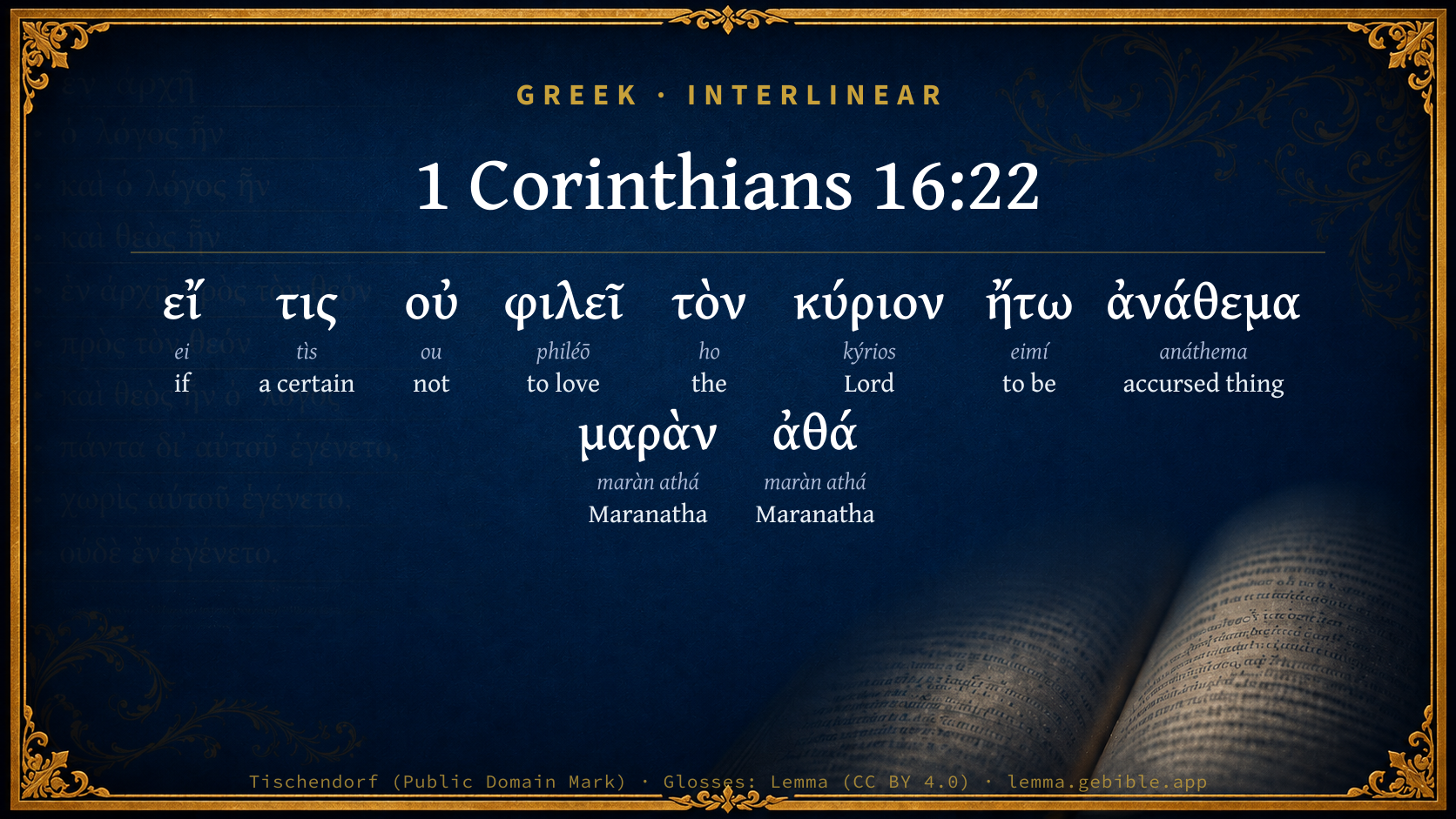
If any man doesn't love the Lord Jesus Christ, let him be accursed. Come, Lord!
Download a study sheet
One document with this verse’s original text, its word-by-word gloss line, the meaning frame, cross-references with their text, attributed commentary, and full source and license credits — printable, and it pastes into notes with its structure intact.
This verse Autodidact and up
A passage Seminary Student
Up to 50 verses in one chapter. A passage sheet keeps up to 6 commentary sources and 12 cross-references per verse, in the order this page ranks them, and says so on the sheet whenever that leaves anything out. Ask for a single verse and you get the Autodidact verse sheet above.
Everything on this page stays free to read, with no account — the sheet is a download of what is already on screen, not access to it.
Compare translations 3
The same verse in 3 English versions, stacked beneath the original-language interlinear above. Click any original word for its lexicon entry.
Each is an independent rendering of the whole verse — the interlinear is not word-aligned to these translations.
Highlighted words mark where these versions differ — a whole-verse word diff, not a word-by-word alignment.
-
World English Bible Public Domain
If any man doesn't love the Lord Jesus Christ, let him be accursed. Come, Lord!
-
King James Version Public Domain
If any man love not the Lord Jesus Christ, let him be Anathema Maranatha.
-
unfoldingWord Literal Text CC BY-SA 4.0
If anyone does not love the Lord, let him be accursed. Maranatha!
unfoldingWord Literal Text — © unfoldingWord, licensed CC BY-SA 4.0. Word-aligned USFM3 via Door43 (git.door43.org/unfoldingWord/en_ult).
Show all 19 translations
Every available English version of this verse, each an independent rendering of the whole verse.
-
World English Bible Public Domain
If any man doesn't love the Lord Jesus Christ, let him be accursed. Come, Lord!
-
Berean Standard Bible Public Domain
If anyone does not love the Lord, let him be under a curse. Come, O Lord!
-
Majority Standard Bible Public Domain
If anyone does not love the Lord Jesus Christ, let him be under a curse. Come, O Lord!
-
King James Version Public Domain
If any man love not the Lord Jesus Christ, let him be Anathema Maranatha.
-
American Standard Version (1901) Public Domain
If any man loveth not the Lord, let him be anathema. Maranatha.
-
Revised Version (1885) Public Domain
If any man loveth not the Lord, let him be anathema. Maranatha.
-
Geneva Bible (1599) Public Domain
If any man loue not the Lord Iesus Christ, let him be had in execration maran-atha.
-
Douay-Rheims (1899) Public Domain
If any man love not our Lord Jesus Christ, let him be anathema, maranatha.
-
Young's Literal Translation Public Domain
if any one doth not love the Lord Jesus Christ -- let him be anathema! The Lord hath come!
-
Literal Standard Version CC BY-SA 4.0
if anyone does not cherish the Lord Jesus Christ—let him be accursed! The LORD has come!
-
Unlocked Literal Bible CC BY-SA 4.0
If anyone does not love the Lord, may he be accursed. Our Lord, come!
-
unfoldingWord Literal Text CC BY-SA 4.0
If anyone does not love the Lord, let him be accursed. Maranatha!
-
Darby Bible Public Domain
If any one love not the Lord [Jesus Christ] let him be Anathema Maranatha.
-
World Messianic Bible Public Domain
If any man doesn’t love the Lord Yeshua the Messiah, let him be cursed. Come, Lord!
-
Webster's Bible Public Domain
If any man loveth not the Lord Jesus Christ, let him be Anathema, Maran-atha.
-
Free Bible Version CC BY-SA 4.0
Anyone who doesn't love the Lord should be excluded from the church. Come Lord!
-
Bible in Basic English Public Domain
If any man has not love for the Lord, let him be cursed. Maran atha (our Lord comes).
-
Text-Critical English NT CC BY 4.0
If anyone does not love the Lord Jesus Christ, let him be accursed. Our Lord has come!
-
Tyndale New Testament (1534) Public Domain
Yf eny man love not the Lorde Iesus Christ the same be anathema maranatha.
Literal Standard Version (2020), Covenant Press — licensed CC BY-SA 4.0. Text via the HelloAO Bible API (eBible.org). Unlocked Literal Bible (unfoldingWord) — licensed CC BY-SA 4.0. Text via the HelloAO Bible API (eBible.org). unfoldingWord Literal Text — © unfoldingWord, licensed CC BY-SA 4.0. Word-aligned USFM3 via Door43 (git.door43.org/unfoldingWord/en_ult). Free Bible Version, Dr. Jonathan Gallagher — licensed CC BY-SA 4.0. Text via the HelloAO Bible API (eBible.org).
Word by word
More ways to search: Search by grammar → Find every occurrence → Compare this word →
Practice this passage: Drill this verse → Learn its vocabulary →
- Appears 2× in the Greek New Testament
- First appears here
- Part of Speech
- Aramaic transliteration
Full Thayer's Definition
- εἴ ei G1487 “if” Conditional
- τις tìs G5100 “a certain” Indefinite pronoun, Nominative, Singular, Masculine
- οὐ ou G3756 “not” Particle, Negative
- φιλεῖ philéō G5368 “to love” Verb, Present, Active, Indicative, 3rd person, Singular
- τὸν ho G3588 “the” Article, Accusative, Singular, Masculine
- κύριον kýrios G2962 “Lord” Noun, Accusative, Singular, Masculine
- ἤτω eimí G1510 “to be” Verb, Present, Active, Imperative, 3rd person, Singular
- ἀνάθεμα anáthema G331 “accursed thing” Noun, Nominative, Singular, Neuter
- μαρὰν maràn athá G3134 “Maranatha” Aramaic transliteration
- ἀθά maràn athá G3134 “Maranatha” Aramaic transliteration
About this verse
These counts appear in no published source. They are computed here, from the morphology-tagged text and Lemma’s own curated glosses. What Lemma adds →
- 10
- words
- 9
- distinct lemmas
- Pauline Epistles
- section
Notable vocabulary
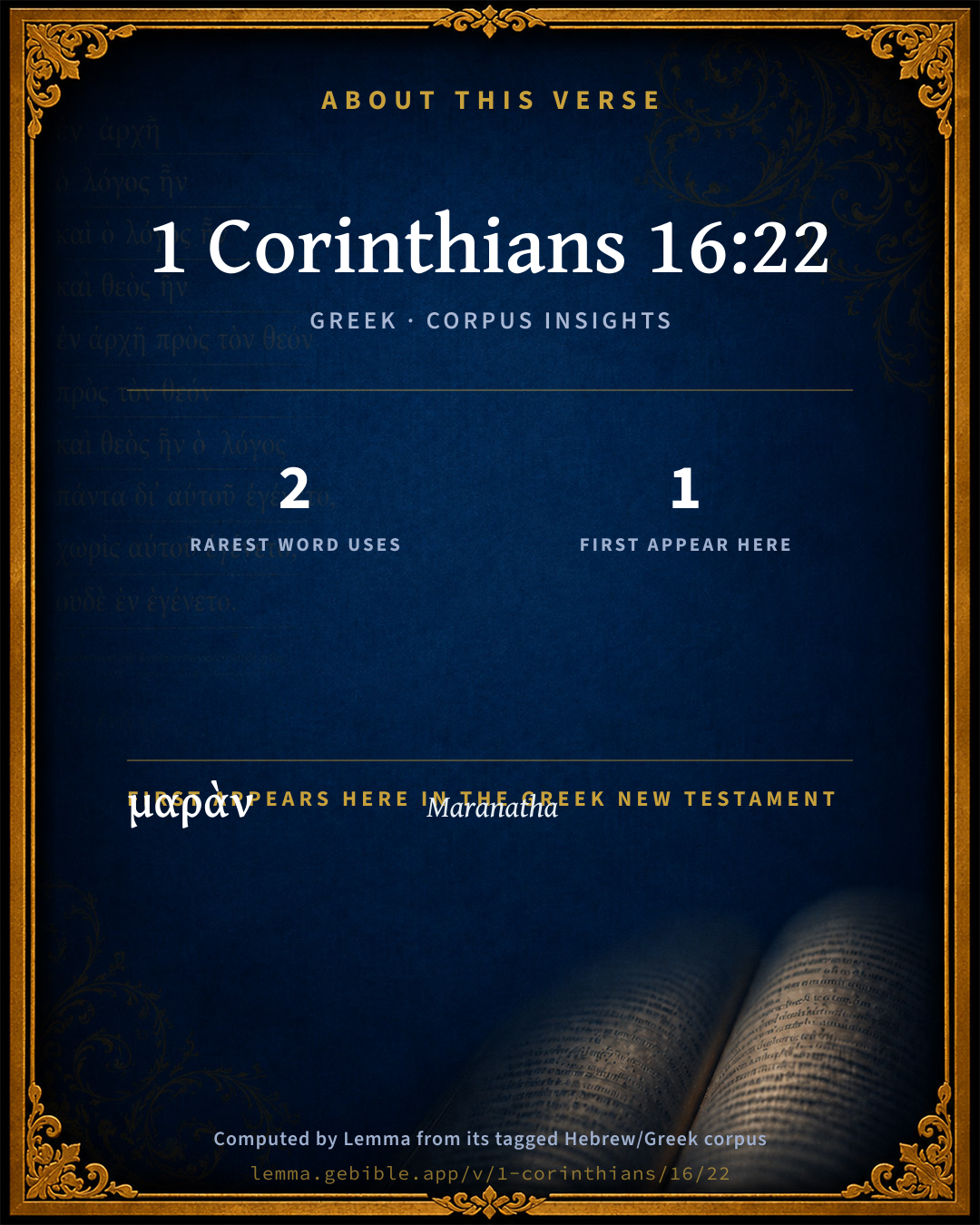
The rarest word here is μαρὰν Maranatha G3134 — appearing just 2 times in the whole Greek New Testament.
First appearance in Scripture
This word makes its first canonical appearance in the Greek New Testament here:
- μαρὰν Maranatha G3134
Repetition
A word recurs within this verse:
- μαρὰν Maranatha G3134 ×2
Cross-references
30Topical passages linked to 1 Corinthians 16:22 in the Treasury of Scripture Knowledge — connected by theme and wording, ordered by reader-vote popularity; previews shown in the World English Bible.
- Ephesians 6:24 Grace be with all those who love our Lord Jesus Christ with incorruptible love. Amen.
- John 14:21 One who has my commandments, and keeps them, that person is one who loves me. One who loves me will be loved by my Father, and I will love him, and will reveal myself to him."
- Matthew 10:37 He who loves father or mother more than me is not worthy of me; and he who loves son or daughter more than me isn't worthy of me.
- John 8:42 Therefore Jesus said to them, "If God were your Father, you would love me, for I came out and have come from God. For I haven't come of myself, but he sent me.
- 2 Corinthians 5:14–15 For the love of Christ constrains us; because we judge thus, that one died for all, therefore all died.
- Hebrews 6:10 For God is not unrighteous, so as to forget your work and the labor of love which you showed toward his name, in that you served the saints, and still do serve them.
- 1 John 4:19 We love Him, because he first loved us.
- 1 John 5:1 Whoever believes that Jesus is the Christ is born of God. Whoever loves the father also loves the child who is born of him.
- Revelation 22:20 He who testifies these things says, "Yes, I come quickly." Amen! Yes, come, Lord Jesus.
- Romans 9:3 For I could wish that I myself were accursed from Christ for my brothers' sake, my relatives according to the flesh,
- 2 Thessalonians 1:8–9 giving vengeance to those who don't know God, and to those who don't obey the Gospel of our Lord Jesus,
- 1 Peter 1:8 whom not having known you love; in whom, though now you don't see him, yet believing, you rejoice greatly with joy unspeakable and full of glory--
- 1 Peter 2:7 For you therefore who believe is the honor, but for such as are disobedient, "The stone which the builders rejected, Has become the chief cornerstone,"
- Acts 23:14 They came to the chief priests and the elders, and said, "We have bound ourselves under a great curse, to taste nothing until we have killed Paul.
- 1 Corinthians 12:3 Therefore I make known to you that no man speaking by God's Spirit says, "Jesus is accursed." No one can say, "Jesus is Lord," but by the Holy Spirit.
- 2 Corinthians 8:8–9 I speak not by way of commandment, but as proving through the earnestness of others the sincerity also of your love.
- Galatians 1:8–9 But even though we, or an angel from heaven, should preach to you any gospel other than that which we preached to you, let him be cursed.
- Galatians 5:6 For in Christ Jesus neither circumcision amounts to anything, nor uncircumcision, but faith working through love.
- Jude 1:14–15 About these also Enoch, the seventh from Adam, prophesied, saying, "Behold, the Lord came with ten thousands of his holy ones,
- Song of Solomon 1:3–4 Your oils have a pleasing fragrance. Your name is oil poured forth, Therefore the virgins love you.
- Song of Solomon 1:7 Tell me, you whom my soul loves, Where you graze your flock, Where you rest them at noon; For why should I be as one who is veiled Beside the flocks of your companions? Lover
- Song of Solomon 3:1–3 By night on my bed, I sought him whom my soul loves. I sought him, but I didn't find him.
- Song of Solomon 5:16 His mouth is sweetness; Yes, he is altogether lovely. This is my beloved, and this is my friend, Daughters of Jerusalem. Friends
- Isaiah 5:1 Let me sing for my well beloved a song of my beloved about his vineyard. My beloved had a vineyard on a very fruitful hill.
- Matthew 25:45–46 "Then he will answer them, saying, 'Most assuredly I tell you, inasmuch as you didn't do it to one of the least of these, you didn't do it to me.'
- John 14:15 If you love me, keep my commandments.
- John 14:23 Jesus answered him, "If a man loves me, he will keep my word. My Father will love him, and we will come to him, and make our home with him.
- John 15:24 If I hadn't done among them the works which no one else did, they wouldn't have had sin. But now have they seen and also hated both me and my Father.
- John 16:14 He will glorify me, for he will take from what is mine, and will declare it to you.
- John 21:15–17 So when they had eaten their breakfast, Jesus said to Simon Peter, "Simon, son of Jonah, do you love me more than these?" He said to him, "Yes, Lord; you know that I have affection for you." He said to him, "Feed my lambs."
Cross-references courtesy of OpenBible.info (CC BY 4.0).
Where the printed editions differ
1 variantPlaces in this verse where the major printed Greek editions disagree on the wording in a way that affects the translation — a comparison of editions, not a manuscript-by-manuscript collation. The editions are the modern critical texts (Nestlé-Aland 28/27, SBL, Westcott-Hort, Tregelles, Tyndale House) and the traditional texts behind the KJV (the Textus Receptus and the Byzantine/Majority text). It is not a claim about which reading is original.
-
Extra text
Ἰησοῦν Χριστόν,
“Jesus Christ”
In TRByz Not in NA28NA27TynSBLWHTregἸησοῦν Χριστόν, (Iēsoun Christon) 'Jesus Christ' is only in traditional manuscripts (TR+Byz)
Textual data: Translators Amalgamated Greek New Testament (STEPBible TAGNT) · CC BY 4.0.
Lesson kit
Teaching starters — assembled from the data on this page, not authored interpretation. Every prompt links to the verse data it draws on. Edit before teaching.
1 Corinthians, in the Pauline Epistles, opens this verse with 10 words (9 distinct Greek lemmas). Its most distinctive word is maràn athá (“Maranatha”). A historical commentator’s framing appears above. Read the whole chapter for the surrounding context.
Discussion questions
- What does “Maranatha” (maràn athá) contribute to the verse as a whole?
- The word “Maranatha” first appears here in Scripture. What is being introduced at this debut?
- Ephesians 6:24 shares this passage’s theme. How do the two illuminate each other?
- “Maranatha” occurs 2× in this one verse. What is the effect of the repetition?
- These translations render this verse differently; the difference is in the English rendering, not the original. What questions does that raise?
- Reading how The Biblical Illustrator and Joseph Benson's Commentary read this verse, where do the two commentators agree and where do they part?
Things to notice
- 1 word makes its first canonical appearance in Scripture here.
- These translations choose different wording for 11 words in this verse.
- “Maranatha” occurs 2× in this single verse.
- 9 distinct Greek lemmas span 10 words in this verse.
Commentary
Notes on 1 Corinthians 16:22 from classic Christian and Jewish commentators (each source and its license shown beneath its notes). The classic Christian expositions comment on the surrounding passage and are grouped to its opening verse, so a note may address several verses; the Jewish commentaries on the Tanakh (Rashi and others) are per-verse, so they appear only where the commentator wrote on this verse.
Lemma curates 59 commentaries, every one of them public domain or Creative Commons licensed, each selected and text-cleaned for this edition rather than reprinted as found. About our sources →
The Biblical Illustrator
Joseph S. Exell
The Biblical Illustrator, edited by Joseph S. Exell (c. 1880s–1900s) — public domain. Text from a community e-Sword module.
Joseph Benson's Commentary
Joseph Benson's Commentary on the Old and New Testaments (1811–1818) — public domain. Text from a community e-Sword module.
Tyndale Open Study Notes
Tyndale Open Resources
Tyndale Open Study Notes — © Tyndale Open Resources, licensed CC BY-SA 4.0. Text via the HelloAO Bible API.
Bengel's Gnomon
Johann Albrecht Bengel
Bengel's Gnomon of the New Testament — English translation (T&T Clark, Edinburgh, 1860) — public domain. Text from a community e-Sword module.
Hodge's Commentary on Romans, Ephesians & First Corinthians
Charles Hodge
Charles Hodge — Commentary on Romans (1835), First Corinthians (1857), and Ephesians (1856) — public domain. Text from a community e-Sword module.
Geneva Bible (1599)
Geneva Bible translators
Geneva Bible (1599) marginal notes — public domain. Text via Bolls.life.
Jamieson, Fausset & Brown
Robert Jamieson, A. R. Fausset & David Brown
Jamieson, Fausset & Brown — Commentary Critical and Explanatory on the Whole Bible (1871) — public domain (CC PDM 1.0). Text via the HelloAO Bible API.
Adam Clarke's Commentary
Adam Clarke's Commentary on the Bible (1810–1826) — public domain. Text from a community e-Sword/MySword module.
Ellicott's Commentary for English Readers
A Bible Commentary for English Readers, edited by Charles John Ellicott (1878–1897) — public domain. Text from a community e-Sword module.
The Cambridge Bible for Schools and Colleges
gen. ed. J. J. S. Perowne
The Cambridge Bible for Schools and Colleges (gen. ed. J. J. S. Perowne; Cambridge University Press, 1878–1918) — public domain. Text from a community e-Sword module.
Trapp's Complete Commentary
John Trapp
John Trapp, A Commentary or Exposition upon All the Books of the Old and New Testament (1647–1656) — public domain. Text from a community e-Sword module.
Albert Barnes' Notes on the Bible
Albert Barnes' Notes on the Bible (1834–1885) — public domain. Text from a community e-Sword/MySword module.
Haydock's Catholic Bible Commentary
George Leo Haydock (1774–1849), Haydock's Catholic Family Bible and Commentary, 1859 edition — public domain. Excludes Psalms (Douay-Rheims chapter numbering differs from Protestant) and Deuterocanonical books (Catholic canon only).
Matthew Poole's English Annotations
Matthew Poole's English Annotations on the Holy Bible (1683–1685) — public domain. Text from a community e-Sword/MySword module.
Whedon's Commentary on the Bible
Daniel D. Whedon
Daniel D. Whedon (gen. ed.), Commentary on the Old and New Testaments (1874–1909) — public domain. Text from a community e-Sword module.
The Pulpit Commentary
The Pulpit Commentary (1880–1919), ed. H.D.M. Spence-Jones & Joseph S. Exell — public domain. Text from a community e-Sword module.
John Wesley's Explanatory Notes
John Wesley, Explanatory Notes Upon the Whole Bible (1754–1765) — public domain. Text via the GEBible commentary corpus.
Scofield Reference Notes
C. I. Scofield
The Scofield Reference Bible (1917 edition), notes by C. I. Scofield — public domain. Text from a community e-Sword module.
Burkitt's Expository Notes on the New Testament
William Burkitt
William Burkitt's Expository Notes on the New Testament (1700–1703) — public domain. Text from a community e-Sword module.
Godbey's Commentary on the New Testament
William B. Godbey
William B. Godbey, Commentary on the New Testament (1896–1900) — public domain. Text from a community e-Sword module.
McGarvey & Pendleton's Commentaries
J. W. McGarvey
J. W. McGarvey (with Philip Y. Pendleton), Commentaries on the New Testament (The Fourfold Gospel, 1914; Acts; and the epistles) — public domain. Text from a community e-Sword/MySword module.
The People's New Testament
B. W. Johnson
B. W. Johnson's The People's New Testament with Notes (1889–1891) — public domain. Electronic text from the Christian Classics Ethereal Library (CCEL) ThML edition.
Cambridge Greek Testament for Schools and Colleges
Cambridge Greek Testament for Schools and Colleges (Cambridge University Press, 1896; 21 vols, various authors incl. Carr, Maclear, Plummer, Farrar, Lumby, Moule, M. R. James, Simcox) — public domain. Text from a community e-Sword module.
Alford’s Greek Testament
Henry Alford
Henry Alford, The Greek Testament (1849–1861) — public domain. Text from a community e-Sword module.
Vincent's Word Studies in the New Testament
Marvin R. Vincent
Marvin R. Vincent, Word Studies in the New Testament (1887–1900) — public domain. Text from a community e-Sword/MySword module.