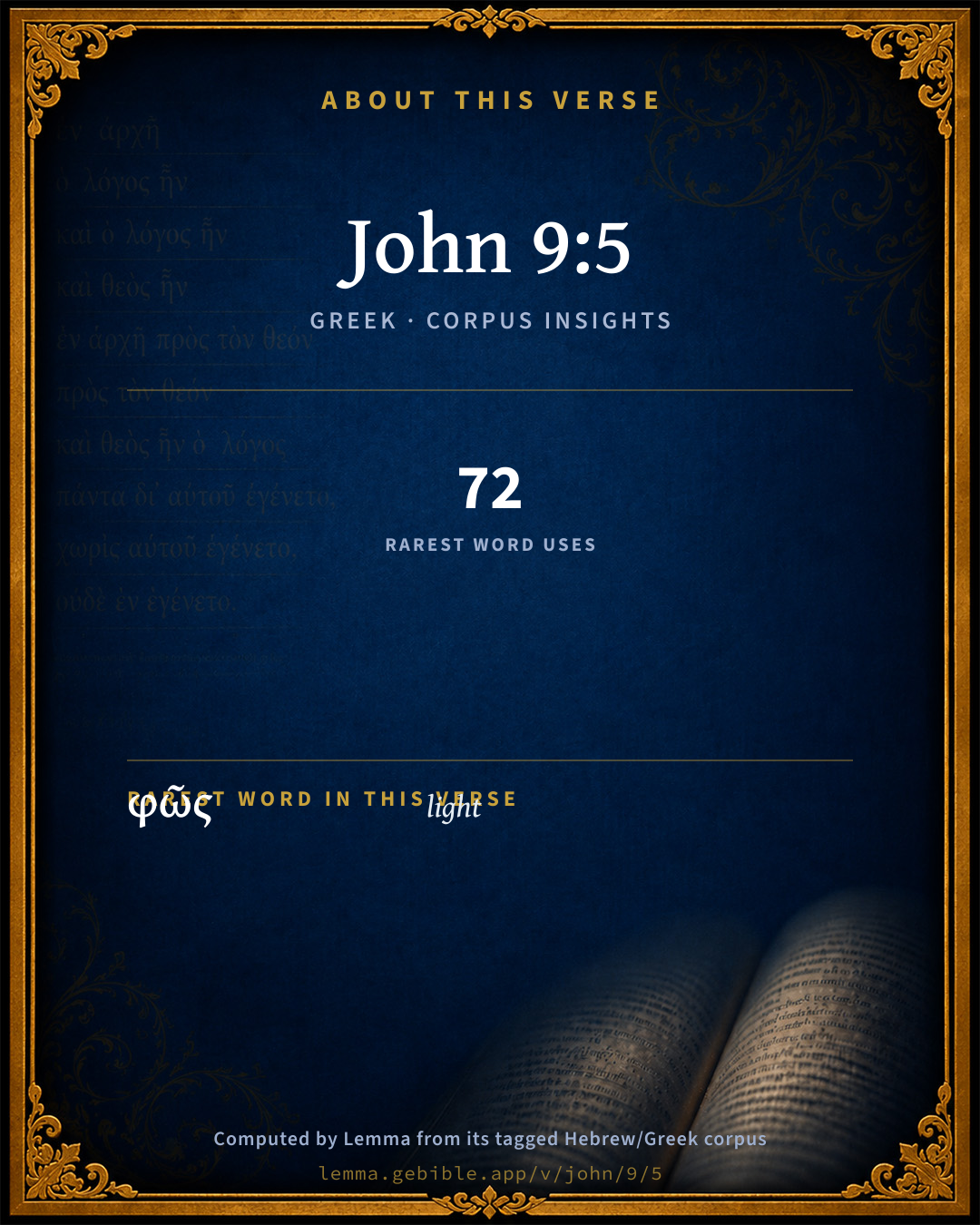
John 9:5

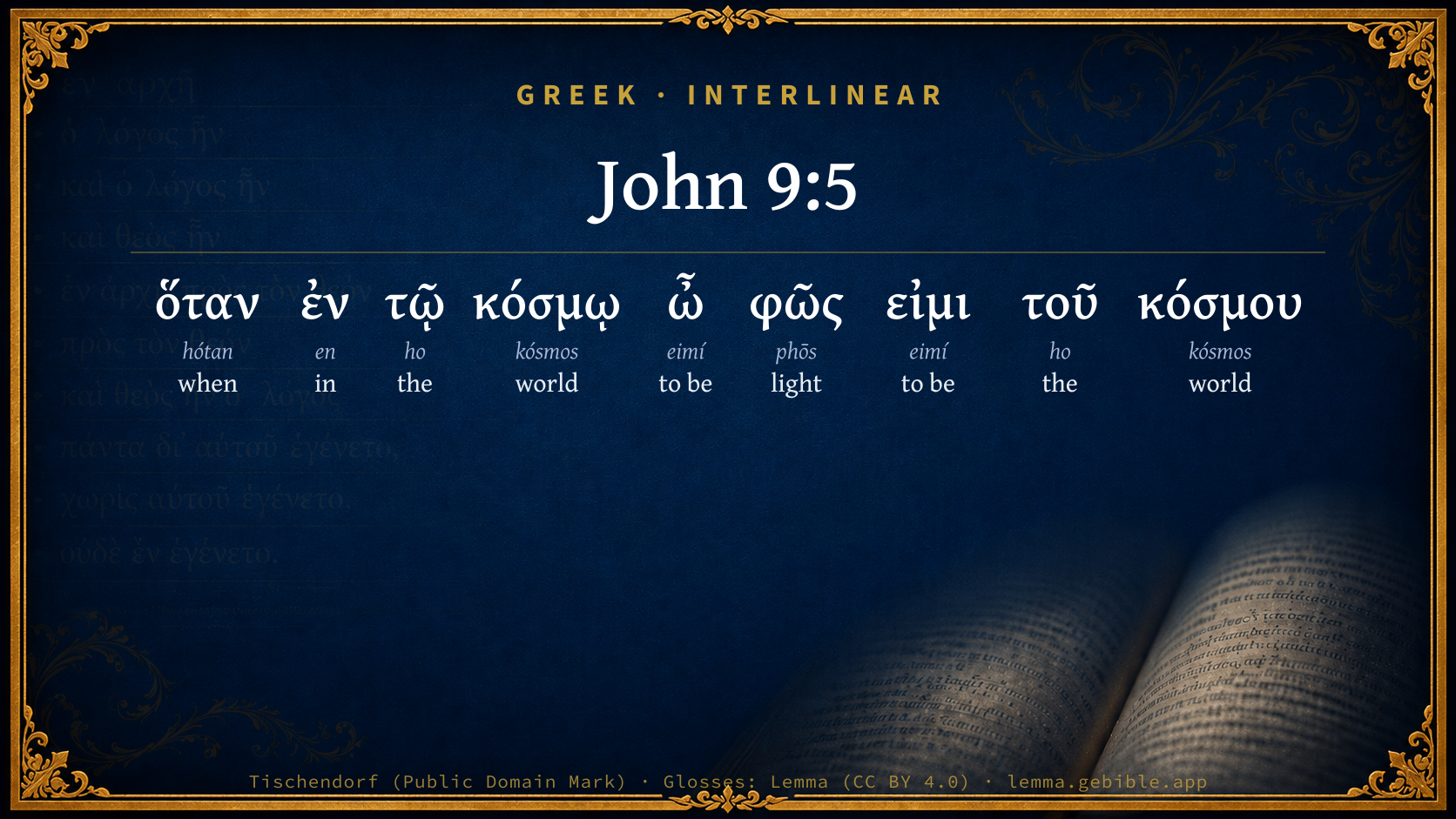
Greek (Tischendorf 8th ed.) John 9:5 appears in the Greek New Testament. The text above is from the Tischendorf 8th edition. Each word links to its Strong’s number and a concise gloss. Click any word for its full Thayer’s Greek Lexicon entry.
Download image
Cite this verse

John 9:5 (World English Bible). Public Domain. Lemma interlinear Bible study tool, https://lemma.gebible.app/v/john/9/5.

Show BibTeX & RIS
BibTeX
RIS
English Translation
While I am in the world, I am the light of the world."
World English Bible · Public Domain
Download a study sheet

One document with this verse’s original text, its word-by-word gloss line, the meaning frame, cross-references with their text, attributed commentary, and full source and license credits — printable, and it pastes into notes with its structure intact.

This verse Autodidact and up

Study sheet (.html) Plain text (.txt)

A passage Seminary Student

Up to 50 verses in one chapter. A passage sheet keeps up to 6 commentary sources and 12 cross-references per verse, in the order this page ranks them, and says so on the sheet whenever that leaves anything out. Ask for a single verse and you get the Autodidact verse sheet above.

Everything on this page stays free to read, with no account — the sheet is a download of what is already on screen, not access to it.

Want to remove ads? Support Godless Engineer
Compare translations 3

The same verse in 3 English versions, stacked beneath the original-language interlinear above. Click any original word for its lexicon entry.

Each is an independent rendering of the whole verse — the interlinear is not word-aligned to these translations.

Highlighted words mark where these versions differ — a whole-verse word diff, not a word-by-word alignment.

  • World English Bible Public Domain
    While I am in the world, I am the light of the world."
  • King James Version Public Domain
    As long as I am in the world, I am the light of the world.
  • unfoldingWord Literal Text CC BY-SA 4.0
    While I am in the world, I am the light of the world.”

unfoldingWord Literal Text — © unfoldingWord, licensed CC BY-SA 4.0. Word-aligned USFM3 via Door43 (git.door43.org/unfoldingWord/en_ult).

Versions to compare (up to 4)

3 of 4 selected

Show all 19 translations

Every available English version of this verse, each an independent rendering of the whole verse.

  • World English Bible Public Domain
    While I am in the world, I am the light of the world."
  • Berean Standard Bible Public Domain
    While I am in the world, I am the light of the world.”
  • Majority Standard Bible Public Domain
    While I am in the world, I am the light of the world.”
  • King James Version Public Domain
    As long as I am in the world, I am the light of the world.
  • American Standard Version (1901) Public Domain
    When I am in the world, I am the light of the world.
  • Revised Version (1885) Public Domain
    When I am in the world, I am the light of the world.
  • Geneva Bible (1599) Public Domain
    As long as I am in the world, I am the light of the world.
  • Douay-Rheims (1899) Public Domain
    As long as I am in the world, I am the light of the world.
  • Young's Literal Translation Public Domain
    when I am in the world, I am a light of the world.'
  • Literal Standard Version CC BY-SA 4.0
    when I am in the world, I AM [the] light of the world.”
  • Unlocked Literal Bible CC BY-SA 4.0
    While I am in the world, I am the light of the world.”
  • unfoldingWord Literal Text CC BY-SA 4.0
    While I am in the world, I am the light of the world.”
  • Darby Bible Public Domain
    As long as I am in the world, I am [the] light of the world.
  • World Messianic Bible Public Domain
    While I am in the world, I am the light of the world.”
  • Webster's Bible Public Domain
    As long as I am in the world, I am the light of the world.
  • Free Bible Version CC BY-SA 4.0
    While I'm here in the world I am the light of the world.”
  • Bible in Basic English Public Domain
    As long as I am in the world, I am the light of the world.
  • Text-Critical English NT CC BY 4.0
    As long as I am in the world, I am the light of the world.”
  • Tyndale New Testament (1534) Public Domain
    As longe as I am in the worlde I am the lyght of the worlde.

Literal Standard Version (2020), Covenant Press — licensed CC BY-SA 4.0. Text via the HelloAO Bible API (eBible.org). Unlocked Literal Bible (unfoldingWord) — licensed CC BY-SA 4.0. Text via the HelloAO Bible API (eBible.org). unfoldingWord Literal Text — © unfoldingWord, licensed CC BY-SA 4.0. Word-aligned USFM3 via Door43 (git.door43.org/unfoldingWord/en_ult). Free Bible Version, Dr. Jonathan Gallagher — licensed CC BY-SA 4.0. Text via the HelloAO Bible API (eBible.org).

Word by word

More ways to search: Search by grammar → Find every occurrence → Compare this word →

Practice this passage: Drill this verse → Learn its vocabulary →

φῶς
phōs
G5457
“light”
Noun, Nominative, Singular, Neuter
Part of Speech
Noun
Case
Nominative
Number
Singular
Gender
Neuter
Full Thayer's Definition

Origin: from an obsolete phao (to shine or make manifest, especially by rays, cf G5316 , G5346 )

TDNT: 14:10,1

1. light a. the light 1. emitted by a lamp 2. a heavenly light such as surrounds angels when they appear on earth b. anything emitting light 1. a star 2. fire because it is light and sheds light 3. a lamp or torch c. light, i.e brightness 1. of a lamp 2. metaph. a. God is light because light has the extremely delicate, subtle, pure, brilliant quality b. of truth and its knowledge, together with the spiritual purity associated with it c. that which is exposed to the view of all, openly, publicly d. reason, mind 1. the power of understanding esp. moral and spiritual truth
  1. ὅταν hótan G3752 “when” Conjunction
  2. ἐν en G1722 “in” Preposition
  3. τῷ ho G3588 “the” Article, Dative, Singular, Masculine
  4. κόσμῳ kósmos G2889 “world” Noun, Dative, Singular, Masculine
  5. ὦ eimí G1510 “to be” Verb, Present, Active, Subjunctive, 1st person, Singular
  6. εἰμι eimí G1510 “to be” Verb, Present, Active, Indicative, 1st person, Singular
  7. τοῦ ho G3588 “the” Article, Genitive, Singular, Masculine
  8. κόσμου kósmos G2889 “world” Noun, Genitive, Singular, Masculine

About this verse

These counts appear in no published source. They are computed here, from the morphology-tagged text and Lemma’s own curated glosses. What Lemma adds →

9
words
6
distinct lemmas
Gospels
section

Repetition

Words recur within this verse:

Cross-references

16

Topical passages linked to John 9:5 in the Treasury of Scripture Knowledge — connected by theme and wording, ordered by reader-vote popularity; previews shown in the World English Bible.

  • John 8:12 Again, therefore, Jesus spoke to them, saying, "I am the light of the world. He who follows me will not walk in the darkness, but will have the light of life."
  • John 12:46 I have come as a light into the world, that whoever believes in me may not remain in the darkness.
  • Acts 13:47 For so has the Lord commanded us, saying, 'I have set you as a light for the Gentiles, That you should bring salvation to the uttermost parts of the earth.'"
  • John 1:4–9 In him was life, and the life was the light of men.
  • Isaiah 42:6–7 I, Yahweh, have called you in righteousness, and will hold your hand, and will keep you, and give you for a covenant of the people, for a light of the Gentiles;
  • Acts 26:18 to open their eyes, that they may turn from darkness to light and from the power of Satan to God, that they may receive remission of sins and an inheritance among those who are sanctified by faith in me.'
  • Ephesians 5:14 Therefore he says, "Awake, you who sleep, and arise from the dead, and Christ will shine on you."
  • Revelation 21:23 The city has no need for the sun, neither of the moon, to shine, for the very glory of God illuminated it, and its lamp is the Lamb.
  • Matthew 4:16 The people who sat in darkness saw a great light, To those who sat in the region and shadow of death, To them light has dawned."
  • John 3:19–21 This is the judgment, that the light has come into the world, and men loved the darkness rather than the light; for their works were evil.
  • Isaiah 49:6 yes, he says, It is too light a thing that you should be my servant to raise up the tribes of Jacob, and to restore the preserved of Israel: I will also give you for a light to the Gentiles, that you may be my salvation to the end of the earth.
  • John 12:35–36 Jesus therefore said to them, "Yet a little while the light is with you. Walk while you have the light, that darkness doesn't overtake you. He who walks in the darkness doesn't know where he is going.
  • Malachi 4:2 But to you who fear my name shall the sun of righteousness arise with healing in its wings. You will go out, and leap like calves of the stall.
  • Acts 26:23 how the Christ must suffer, and how, by the resurrection of the dead, he would be first to proclaim light both to these people and to the Gentiles."
  • Isaiah 60:1–3 Arise, shine; for your light is come, and the glory of Yahweh is risen on you.
  • Luke 2:32 A light for revelation to the Gentiles, And the glory of your people Israel."

Cross-references courtesy of OpenBible.info (CC BY 4.0).

Commentary

Notes on John 9:5 from classic Christian and Jewish commentators (each source and its license shown beneath its notes). The classic Christian expositions comment on the surrounding passage and are grouped to its opening verse, so a note may address several verses; the Jewish commentaries on the Tanakh (Rashi and others) are per-verse, so they appear only where the commentator wrote on this verse.

Lemma curates 59 commentaries, every one of them public domain or Creative Commons licensed, each selected and text-cleaned for this edition rather than reprinted as found. About our sources →

The Biblical Illustrator

Joseph S. Exell

Joh_9:5

As long as I am in the world I am the Light of the world.

--The Word as Light visited men before the Incarnation (Joh_1:9, etc.; Joh_5:38; Rom_2:15, etc.); at the Incarnation (Joh_8:12; Joh_12:46; Joh_3:19-21; comp. Joh_11:9, etc.); and He still comes (Joh_14:21); even as the Spirit who still interprets His name (Joh_14:25; Joh_16:13; comp. 1Jn_2:20-27). St. John draws no distinction in essence between these three different forms of revelation, in nature, in conscience, and in history; all alike are natural or supernatural, parts of the same harmonious plan. But man has not independently light in himself. The understanding of the outward revelation depends upon the abiding of the Divine Word within (Joh_5:37, etc.). Love is the condition of illumination (Joh_14:22, etc.). And the end of Christs coming was that those who believe in Him may move in a new region of life (Joh_12:46), and themselves become sons of light (Joh_12:35, etc.), and so in the last issue of faith have the light of life (Joh_8:12).(Bp. Westcott.)

Christ, the Light

Among all created excellencies, none can be borrowed more fitly representing Christ, than that of light.

1. Light is primum visibile, the first object of sight: and Jesus Christ, whom the apostle styles God over all, Blessed forever, is primum intelligibile.

2. Light being the first thing visible, all things are seen by it, and it by itself. Thus is Christ among spiritual things, in the elect world of His Church Eph_5:13-14; 2Co_4:3). The rays of Christs light are displayed through both His Testaments, and in them we see Him Psa_36:9).

3. No one is ignorant there is light; yet what light is few know (Job_38:19). The generation of Christ who shall declare? (Isa_53:8).

4. Light resembles Christ in purity: it visits many impure places, and lights upon the basest parts of the earth, and yet remains most pure and undefiled. Though Christ was conversant with sinners, to communicate to them His goodness, yet He was separate from sinners, in immunity from their evil (Heb_7:26).

5. The light of the sun is neither parted nor diminished, by being imparted to many several people and nations, that behold it at one time: nor is the righteousness of this Sun of Righteousness either lessened to Himself or to individual believers, by many partaking of it at once: it is wholly conferred upon each one of them, and remains whole in itself.

6. The sun hath a vivifying power, a special influence in the generation of man. The sun we speak of is the proper and principal instrument in mans regeneration (Joh_1:4).

7. The sun drives away the sharp frosts and the heavy fogs of winter, it clears the heavens, decks the saith with variety of plants and flowers, and awakes the birds to the pleasant strains of their natural music. When Christ, after a kind of wintry absence, returns to visit a declining Church, or a deserted forsaken soul, admirable is the change that He produces, etc. Isa_55:12-13; Son_2:10-17).

8. All darkness flies before light: so Christ arising in the world made the day break, and the shadows flee away, the types and shadows of the law, ignorance, idolatry, the night of sin, misery, etc. All the stars, and the moon with them, cannot make it day in the world: this is the suns peculiar: nor can natures highest light, the most refined science and morality, make it day in the soul; for this is Christs (Joh_8:12; Joh_12:35; Psa_19:1-14; Wis_7:26-27; Luk_1:78-79; Eph_5:8). (Abp. Leighton.)

The Light of the world

I. CHRIST THE LIGHT OF THE WORLD.

1. I am the Light of the world (Joh_9:5).

2. That was the true Light (Joh_1:9).

3. For a Light of the Gentiles (Isa_13:6).

4. A Light to lighten the Gentiles (Luk_2:32).

5. He that followeth Me … shall have the Light (Joh_8:12).

6. I am come a Light into the world (Joh_12:46).

7. The Sun of righteousness (Mal_4:2).

8. The Dayspring from on high (Luk_1:78).

9. The Bright and Morning Star (Rev_22:16).

10. The Daystar (2Pe_1:19).

II. CHRISTIANS THE LIGHT OF THE WORLD.

1. Walk as children of light (Eph_5:8).

2. Ye are all the children of light (1Th_5:5).

3. Ye are the light of the world (Mat_5:14).

4. That ye may be the children of light (Joh_12:36).

5. Let your light so shine (Mat_5:16).

6. The path of the just is as the shining light (Pro_4:18).

7. He [John] was a burning and a shining light (Joh_5:35).

8. Among whom ye shine as lights in the world (Php

2:15).

9. Let us put on the armour of light (Rom_13:12).

10. They that be wise shall shine (Dan_12:3). (S. S. Times.)

Light in death

For the last day or two he (Sir D. Brewster) was attended by his friend, Sir James Simpson, a man of kindred genius and of kindred Christian hopes. The like of this I never saw, he said, as we met him coming fresh from the dying chamber. There is Sir David resting like a little child on Jesus, and speaking as if in a few hours he will get all his problems solved by Him. For in that supreme hour of dawning immortality his past studies were all associated with the name and person of the Redeemer. I shall see Jesus, he said; and that will be grand. I shall see Him who made the worlds, with allusion to those wonderful verses in Hebrews which had formed the subject of the last sermon he ever heard, a few weeks before. Thus, tracing all to the Creator-Redeemer, he felt no incongruity even in these hours in describing to Sir James Simpson, in a fluent stream of well chosen words, some beautiful phenomena in his favourite science. Reference was made to the privilege he had enjoyed in throwing light upon the great and marvellous works of God. Yes, he said, I found them to be great and marvellous, and I felt them to be His. He had little pain but such as came from intense weakness. The light was with him all through the valley. I have had the light for many years, he whispered slowly, and with emphasis; and oh, how bright it is! I feel so safe, so satisfied! And so, in childlike reliance and adoring love, he gently fell asleep in Jesus on the evening of Monday, February 10th, 1868. On the Saturday following he was laid beside kindred dust. (Sunday at Home.)

The Biblical Illustrator, edited by Joseph S. Exell (c. 1880s–1900s) — public domain. Text from a community e-Sword module.

Joseph Benson's Commentary

Joh 9:5. As long as I am in the world — These words show what our Lord meant by the day mentioned in the preceding verse, namely, the time he should be in the world. So long, says he, I am the light of the world — Teaching men inwardly by my Spirit, and outwardly by my preaching, what is the will of God; and showing them by my example how to perform it. “While he continued on earth he was the light of the world by his personal ministry and miracles; and he would be the same by his doctrine and his Spirit to the end of time.” — Scott. And to teach us how able and willing he is to communicate divine illumination to the souls of men, he often restored sight to such as were corporally blind; and he was about to do it now. For, as Dr. Macknight justly observes, “our Lord’s miracles were designed, not only as proofs of his mission, but to be specimens of the power which he possessed as Messiah. For example, by feeding the multitude with meat that perisheth, he signified that he was come to quicken and nourish mankind with the bread of life, that sovereign cordial and salutary nutriment of the soul. His giving sight to the blind was a lively emblem of the efficacy of his doctrine [when accompanied by his grace] to illuminate the blinded understandings of men. His healing their bodies represented his power to heal their souls, and was a specimen of his authority to forgive sins, as it was a real, though but a partial removal of its punishment. His casting out devils was an earnest of his final victory over Satan and all his associates. His raising particular persons from the dead was the beginning of his triumph over death, and a demonstration of his ability to accomplish a general resurrection. And, to give no more examples, his curing all promiscuously, who applied to him, showed that he was come, not to condemn the world, but to save even the chief of sinners. Accordingly, at performing these miracles, or soon after, when the memory of them was fresh in the minds of his hearers, we often find him turning his discourse to spiritual things that were signified by them, as in the case before us.”

Joseph Benson's Commentary on the Old and New Testaments (1811–1818) — public domain. Text from a community e-Sword module.

Tyndale Open Study Notes

Tyndale Open Resources

9:5 I am the light of the world: See study note on 8:12.

Tyndale Open Study Notes — © Tyndale Open Resources, licensed CC BY-SA 4.0. Text via the HelloAO Bible API.

Bengel's Gnomon

Johann Albrecht Bengel

Joh 9:5. Φῶς, the light) An allegory from the object of sight, which He was about to bestow on the blind man. Comp. Joh 9:3, that they might be made manifest; and ἡμέρα, day, Joh 9:4 [containing the same metaphor].

Bengel's Gnomon of the New Testament — English translation (T&T Clark, Edinburgh, 1860) — public domain. Text from a community e-Sword module.

Meyer's Critical & Exegetical Commentary

Heinrich August Wilhelm Meyer

Joh_9:5. A more precise description of His earthly vocation, characteristically expressed in relation to the sight which was to be bestowed on the blind man. Ὅταν, however, is neither quamdiu (as it usually is) nor quandoquidem (so Lücke and Fritzsche, ad Marc. p. 86),which latter usage is foreign to the N. T., and is only apparently found in passages such as Thuc. 1. 141. 5, 142. 1,but: When (quando, at the time in which) I am in the world, I am the Light of the world. It expresses the necessary contemporaneity of the two relations. He cannot be in the world, says Christ, without at the same time enlightening the world. Thus, also, did it behove Him to show Himself in the case of this blind man. φῶς is employed, it is true, in a spiritual sense, as in Joh_1:5 ff., Joh_8:12, but also with a significant reference to the sight which was to be restored to the blind man. In healing him, that enlightening activity of Jesus by which those who did not see were to be made to see (see Joh_9:39), is set forth in a transaction which, though primarily sensuous, was also suggestive of spiritual enlightenment (Joh_9:37 f.). In itself the first clause of the verse

Ὅταν … ὦmight have been dispensed with (Joh_8:22); its utterance, however, in connection with Joh_9:4, was occasioned by the consciousness that He was soon to depart from the world, and that after His departure the present mode and action of the φῶς εἶναι, which were bound up with His corporeal earthly career, must come to an end. Then Christ would work through the Paraclete and through the vehicles of the Paraclete, as the Light of the world.

Meyer — Critical and Exegetical Commentary on the New Testament — English translation by Peter Christie, edited by Frederick Crombie (T&T Clark, 1880) — public domain. Text from a community e-Sword module.

Expositor's Greek Testament

ed. W. Robertson Nicoll

Joh 9:5 . ὅταν … κόσμου . We should have expected ἕως and not ὅταν , and the Vulgate renders “quamdiu”. But the “when” seems to be used to suggest a time when He should not be in the world: “when I am in the world, I am the Light of the World,” as He immediately illustrated by the cure of the blind man.

The Expositor's Greek Testament, edited by W. Robertson Nicoll (1897–1910) — public domain. Text from a community e-Sword module.

Jamieson, Fausset & Brown

Robert Jamieson, A. R. Fausset & David Brown

As long as I am in the world, I am the light of the world--not as if He would cease, after that, to be so; but that He must make full proof of His fidelity while His earthly career lasted by displaying His glory. "As before the raising of Lazarus (Joh 11:25), He announces Himself as the Resurrection and the Life, so now He sets Himself forth as the source of the archetypal spiritual light, of which the natural, now about to be conferred, is only a derivation and symbol" [ALFORD].

Jamieson, Fausset & Brown — Commentary Critical and Explanatory on the Whole Bible (1871) — public domain (CC PDM 1.0). Text via the HelloAO Bible API.

Adam Clarke's Commentary

Verse 5. I am the light of the world.] Like the sun, it is my business to dispense light and heat every where; and to neglect no opportunity that may offer to enlighten and save the bodies and souls of men. See Joh 8:12.

Adam Clarke's Commentary on the Bible (1810–1826) — public domain. Text from a community e-Sword/MySword module.

John Calvin's Commentaries

5. While I am in the world, I am the light of the world. I consider this to have been added, by way of anticipation; for it might have been thought strange that Christ should speak of his time of working as limited, as if there were danger that the night should come upon him by surprise, as it does on other men. Thus, while he makes a distinction between himself and others, still he says that his time of working is limited. For he compares himself to the sun which, though it illuminates the whole earth by its brightness, yet, when it sets, takes away the day along with it. In this manner he states that his death will resemble the setting of the sun; not that his death extinguishes or obscures his light, but that it withdraws the view of it from the world. At the same time, he shows that, when he was manifested in flesh, that was truly the time of the day-light of the world. For though God gave light in all ages, yet Christ, by his coming, diffused a new and unwonted splendor. Hence he infers that this was an exceedingly fit and proper time, and that it might be said to be a very bright day, for illustrating the glory of God, when God intended to make a more striking exhibition of himself in his wonderful works.

But here arises another question. After the death of Christ, the power of God shone more illustriously, both in the fruit of the doctrine and in miracles; and Paul applies this strictly to the time of his own preaching, that

God, who from the beginning of the world commanded the light to shine out of darkness, at that time shone in the face of Christ by the Gospel, (2 Corinthians 4:6.)

And does Christ now give less light to the world than when he was in the presence of men, and conversed with them? I reply, when Christ had finished the course of his office, he labored not less powerfully by his ministers than he had labored by himself, while he lived in the world. This I acknowledge to be true; but, first, it is not inconsistent with what he had said, that he was bound to perform, in his own person, what had been enjoined on him by the Father, and at the time when he was manifested in the flesh for that purpose. Secondly, it is not inconsistent with what he said, that his bodily presence was the true and remarkable day of the world, the lustre of which was diffused over all ages. For whence did the holy fathers in ancient times, or whence do we now, desire light and day, but because the manifestation of Christ always darted its rays to a great distance, so as to form one continued day? Whence it follows, that all who have not Christ for their guide grope in the dark like the blind, and wander about in confusion and disorder. Yet we must hold by this meaning of the words, that, as the sun discovers to our view the lovely spectacle of earth and heaven, and the whole arrangement of nature, so God has visibly displayed the chief glory of his works in his Son.

John Calvin's Commentaries (1540-1563) — public domain. Text from the Calvin Translation Society English edition (1840s-50s) via the Christian Classics Ethereal Library (ccel.org). Calvin's coverage is partial (roughly two-thirds of the Bible); uncommented books and verses are honest gaps, never fabricated. The 19th-century editor's footnotes and remarks are omitted so the notes are faithfully Calvin's own voice.

Ellicott's Commentary for English Readers

(5) As long as I am in the world, I am the light of the world.—Better, when I am in the world. The thought is that the two things necessarily co-exist. He is the true Light, and this true Light cannot be in the world without shining in its darkness. (Comp. Note on Joh_1:5.) The thought is here closely connected with His teaching in the Temple but a short time before (Joh_8:12, “I am the Light of the world”), and also with the removal of physical and spiritual darkness which immediately followed.

A Bible Commentary for English Readers, edited by Charles John Ellicott (1878–1897) — public domain. Text from a community e-Sword module.

The Cambridge Bible for Schools and Colleges

gen. ed. J. J. S. Perowne

5. As long as I am in the world] Better, Whensoever I am in the world; it is not the same construction as ‘so long as it is day.’ The Light shines at various times and in various degrees, whether the world chooses to be illuminated or not. Comp. Joh_1:5, Joh_8:12. Here there is special reference to His giving light both to the man’s eyes and to his soul. The Pharisees prove the truth of the saying that ‘the darkness comprehended it not.’

I am the light of the world] Or, I am light to the world: no article. Contrast Joh_8:12.

The Cambridge Bible for Schools and Colleges (gen. ed. J. J. S. Perowne; Cambridge University Press, 1878–1918) — public domain. Text from a community e-Sword module.

John Gill's Exposition

As long as I am in the world,.... Which had been now two or three and thirty years; but was not to be much longer.

I am the light of the world; See Gill on Joh 8:12. Though doubtless he said this with some view to the cure he was about to perform, it being agreeable to his character and work, while he was in the world.

John Gill's Exposition of the Whole Bible (1746–1763) — public domain (CC PDM 1.0). Text via the HelloAO Bible API.

Trapp's Complete Commentary

John Trapp

5 As long as I am in the world, I am the light of the world.

Ver. 5. I am the light of the world] See Joh 12:46. He is light essential, the Father of lights, the Sun of righteousness; who at his nativity was as a bridegroom coming out of his chamber, in his life rejoiced as a strong man to run his race, Psa 19:5; in his passion he was clouded, brake forth in his resurrection, darts out his beams of grace since his ascension, and shall finish all at his return to judgment.

John Trapp, A Commentary or Exposition upon All the Books of the Old and New Testament (1647–1656) — public domain. Text from a community e-Sword module.

Albert Barnes' Notes on the Bible

As long as I am in the world ... - As the sun is the natural light of the world, even while it sinks away to the west, so am I, although my days are drawing to a close, the light of the spiritual world. What a sublime description is this! Jesus occupied the same place, filled the same space, shed his beams as far, in the moral world, as the sun does on natural objects; and as all is dark when that sun sinks to the west, so when he withdraws from the souls of men all is midnight and gloom. When we look on the sun in the firmament or in the west, let us remember that such is the great Sun of Righteousness in regard to our souls; that his shining is as necessary, and his beams as mild and lovely on the soul, as is the shining of the natural sun to illumine the material creation. See the notes at Joh 1:4.

Albert Barnes' Notes on the Bible (1834–1885) — public domain. Text from a community e-Sword/MySword module.

Haydock's Catholic Bible Commentary

Thus the day of which I am to avail myself is the time of my mortal life; and the night which is to follow this, is that of my death. (Bible de Vence)

George Leo Haydock (1774–1849), Haydock's Catholic Family Bible and Commentary, 1859 edition — public domain. Excludes Psalms (Douay-Rheims chapter numbering differs from Protestant) and Deuterocanonical books (Catholic canon only).

Matthew Poole's English Annotations

Those words, As long as I am in the world, let us know what our Saviour meant by the day, mentioned Joh 9:4, viz. the time he should be in the world. Saith he, So long as I am in the world, it is a part of my work to show light to the world. Christ indeed, though he hath left the world, is yet the light of the world; but he was the light of the world, that part of the world especially where he was, in a more eminent sense, so long as the world enjoyed his bodily presence in it.

Matthew Poole's English Annotations on the Holy Bible (1683–1685) — public domain. Text from a community e-Sword/MySword module.

Whedon's Commentary on the Bible

Daniel D. Whedon

5. As long as—The objects of labour are, like this blind man, perpetually turning up; there must be no tiring during the brief day of his earthly life.

Daniel D. Whedon (gen. ed.), Commentary on the Old and New Testaments (1874–1909) — public domain. Text from a community e-Sword module.

The Pulpit Commentary

While or, whensoeverI am in the world, I am the Light of the world. He had said, (Joh_8:12) "I am the Light of the world: he that followeth me shall not walk in darkness." He was sublimely conscious of his power to do for the moral world what the sun was doing for the physical world. He was the Occasion of its life, the Condition of its activity, the means of its instruction, the Source of all its beauty, its joy, and its progress. The otan , which is translated quamdiu in the Vulgate, and "so long as" in the Authorized Version, means strictly "whensoever," and refers to the entire period of his activity. (see Joh_1:5) But while the sun of this world cannot open the eyes of the blind, and wastes his radiance on their sightless sockets, so, unless Christ were more than the sun, and could give the power as well as the opportunity of seeing, he would never have done the work of him that sent him. The fact that he is the Light leads him to remind the disciples that he is the true Source of eyesight as well as of the conditions of vision. Light enough for all the world shines into the darkness, but the darkness comprehendeth it not. This Jewish people are surrounded by floods of light. The spiritual world stands revealed fully to Christ"s own gaze. But mankind hates the light, loves darkness on these matters rather than the light. There is a radical fundamental change that must come over men, or they will never see. This evil, this terrible calamity that has befallen man, will vitiate all the provision of mercy. There must be a new beginning, a new birth, a work of God wrought in men, as well as a sublime revelation made to men, or the whole mission of the Christ would be incomplete.

The Pulpit Commentary (1880–1919), ed. H.D.M. Spence-Jones & Joseph S. Exell — public domain. Text from a community e-Sword module.

John Wesley's Explanatory Notes

I am the light of the world - I teach men inwardly by my Spirit, and outwardly by my preaching, what is the will of God; and I show them, by my example, how they must do it.

John Wesley, Explanatory Notes Upon the Whole Bible (1754–1765) — public domain. Text via the GEBible commentary corpus.

Scofield Reference Notes

C. I. Scofield

world

kosmos = mankind. (See Scofield "Mat 4:8").

The Scofield Reference Bible (1917 edition), notes by C. I. Scofield — public domain. Text from a community e-Sword module.

The People's New Testament

B. W. Johnson

5. I am the light of the world. He opens the blind eyes of both the body and the soul. We see morally, because he has given us light.

B. W. Johnson's The People's New Testament with Notes (1889–1891) — public domain. Electronic text from the Christian Classics Ethereal Library (CCEL) ThML edition.

Cambridge Greek Testament for Schools and Colleges

5. ὅταν ἐν τ. κ. ὦ. Whensoever I am in the world: distinguish between ἔως ἐστί and ὅταν ὦ. Ὅταν is important; it shews the comprehensiveness of the statement. The Light shines at various times and in various degrees, whether the world chooses to be illuminated or not. Comp. Joh 1:5, Joh 8:12. Here there is special reference to His giving light both to the man’s eyes and to his soul. The Pharisees prove the truth of the saying that ‘the darkness comprehended it not.’

φῶς εἰμὶ τ. κ. I am light to the world; not quite the same as τὸ φ. τ. κ. (Joh 8:2), the Light of the world. Note also the absence of ἐγώ in both clauses: it is not Christ’s Person, but the effect of His presence that is prominent here.

Cambridge Greek Testament for Schools and Colleges (Cambridge University Press, 1896; 21 vols, various authors incl. Carr, Maclear, Plummer, Farrar, Lumby, Moule, M. R. James, Simcox) — public domain. Text from a community e-Sword module.

Alford’s Greek Testament

Henry Alford

5.] This partly explains the ἡμ. and νύξ of the former verse, partly alludes to the nature of the healing about to take place. As before the raising of Lazarus (ch. 11:25), He states that He is the Resurrection and the Life; so now, He sets forth Himself as the source of the archetypal spiritual light, of which the natural, now about to be conferred, is only a derivation and symbol.

Henry Alford, The Greek Testament (1849–1861) — public domain. Text from a community e-Sword module.

International Critical Commentary

5. ὅταν ἐν τῷ κόσμῳ ὦ, φῶς εἰμὶ τοῦ κόσμου. We had in 8:12 the majestic claim ἐγώ εἰμι τὸ φῶς τοῦ κόσμου (see note in loc.). Here it reappears, but not in so universal or exclusive a form: ἐγώ is omitted; so is the article before φῶς, and it is introduced by a clause which seems to limit its application to the time of the ministry of Jesus upon earth. “While I am in the world, I am a light of the world,” He says; and He proceeds to impress His meaning upon His hearers by restoring his sight to the blind man. When Jn. says that Christ was “in the world” (1:10) he refers quite definitely to the period of His historical manifestation in the flesh (cf. also 17:11); and the context in the present passage shows that the same meaning must be given here to ἐν τῷ κόσμῳ. Christ is always, and always has been, and will be, τὸ φῶς τοῦ κόσμου; but that thought is not fully expressed by ὅταν ἐν τῷ κόσμῳ ὦ, φῶς εἰμὶ τοῦ κόσμου. The thought here is that it had been eternally ordered in the Divine purpose that He should “work the works of God” during His earthly ministry; and another way of expressing this is to say that while He is in the world He is, inevitably, a light of the world, whose brightness cannot be hidden.

International Critical Commentary — older volumes (1896–1929), various authors — public domain. Text from a community e-Sword module.

Vincent's Word Studies in the New Testament

Marvin R. Vincent

As long as [οταν] . More correctly, whensoever. Rev., when. Whether in my incarnation, or before my incarnation, or after it. Compare Joh 1:4, 10.

The light. See on 8 12. The article is wanting. Westcott says, "Christ is 'light to the world, ' as well as 'the one Light of the world. ' The character is unchangeable, but the display of the character varies with the occasion."

Marvin R. Vincent, Word Studies in the New Testament (1887–1900) — public domain. Text from a community e-Sword/MySword module.

Lesson kit

Teaching starters — assembled from the data on this page, not authored interpretation. Every prompt links to the verse data it draws on. Edit before teaching.

John, in the Gospels, opens this verse with 9 words (6 distinct Greek lemmas). Its most distinctive word is phōs (“light”). A historical commentator’s framing appears above. Read the whole chapter for the surrounding context.

Discussion questions

  1. How does “light” (phōs) shape what this verse is saying?
  2. How does John 8:12, which shares this passage’s theme, read alongside this verse?
  3. What does the repetition of “world” (2× in this one verse) do in this verse?
  4. These translations render this verse differently. What is at stake in choosing one wording over another?
  5. Compare how The Biblical Illustrator and Joseph Benson's Commentary read this verse. Where do they agree or differ?

Things to notice

  • These translations choose different wording for 2 words in this verse.
  • “world” occurs 2× in this single verse.
  • 6 distinct Greek lemmas span 9 words in this verse.

Reading settings

Reading text

Shown beneath each verse's original-language words.

Old Testament
Old Testament edition

Read the OT as the Masoretic Hebrew (MT) or the Greek Septuagint (LXX).

English shown for the Greek Septuagint (in the Hebrew ↔ Greek comparison).

Comparing translations? Open the Compare panel on any verse page to stack up to four side by side.