Matthew 12:8

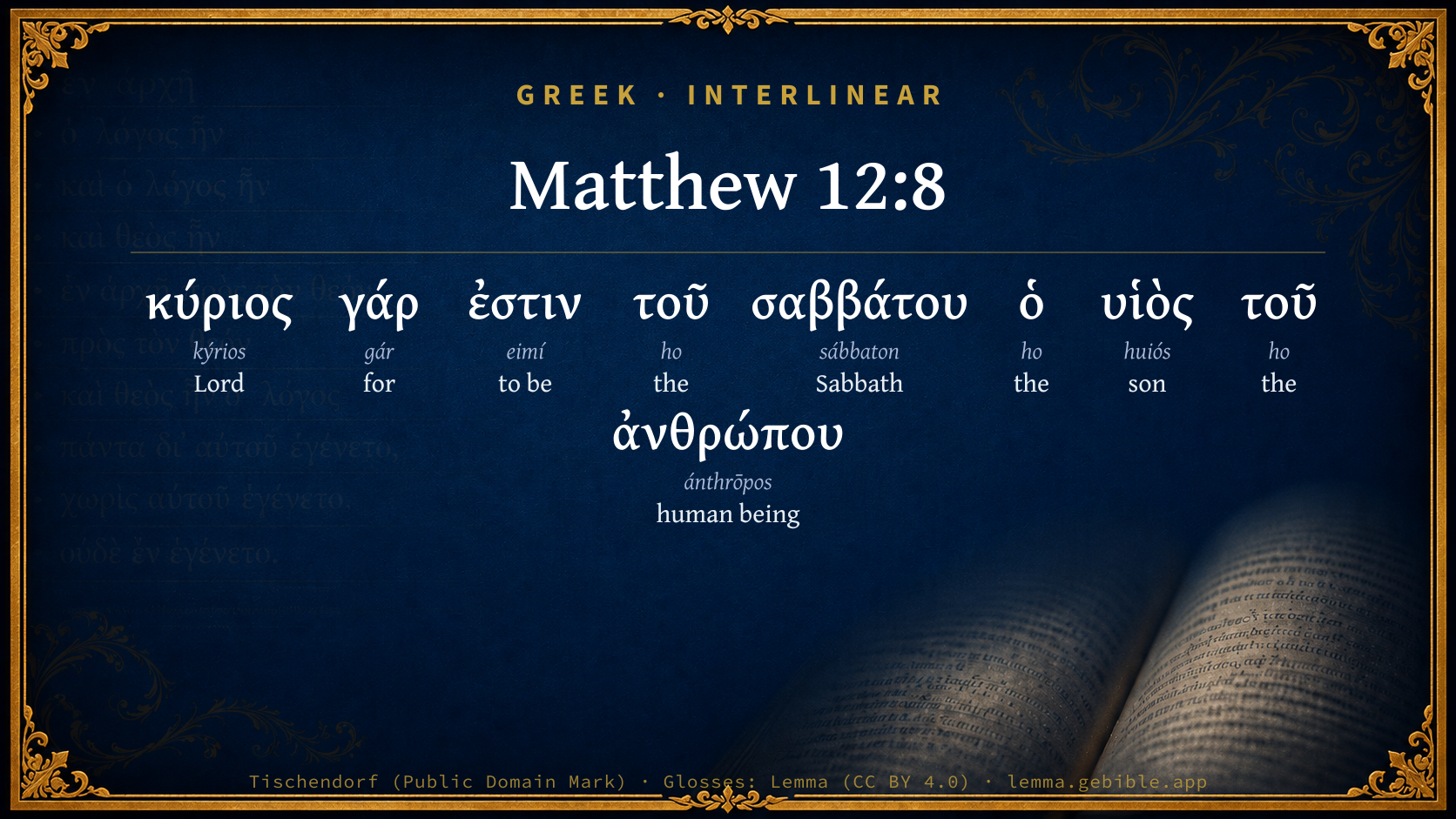
Greek (Tischendorf 8th ed.) Matthew 12:8 appears in the Greek New Testament. The text above is from the Tischendorf 8th edition. Each word links to its Strong’s number and a concise gloss. Click any word for its full Thayer’s Greek Lexicon entry.
Download image
Cite this verse

Matthew 12:8 (World English Bible). Public Domain. Lemma interlinear Bible study tool, https://lemma.gebible.app/v/matthew/12/8.

Show BibTeX & RIS
BibTeX
RIS
English Translation
For the Son of Man is Lord of the Sabbath."
World English Bible · Public Domain
Download a study sheet

One document with this verse’s original text, its word-by-word gloss line, the meaning frame, cross-references with their text, attributed commentary, and full source and license credits — printable, and it pastes into notes with its structure intact.

This verse Autodidact and up

Study sheet (.html) Plain text (.txt)

A passage Seminary Student

Up to 50 verses in one chapter. A passage sheet keeps up to 6 commentary sources and 12 cross-references per verse, in the order this page ranks them, and says so on the sheet whenever that leaves anything out. Ask for a single verse and you get the Autodidact verse sheet above.

Everything on this page stays free to read, with no account — the sheet is a download of what is already on screen, not access to it.

Want to remove ads? Support Godless Engineer
Compare translations 3

The same verse in 3 English versions, stacked beneath the original-language interlinear above. Click any original word for its lexicon entry.

Each is an independent rendering of the whole verse — the interlinear is not word-aligned to these translations.

Highlighted words mark where these versions differ — a whole-verse word diff, not a word-by-word alignment.

  • World English Bible Public Domain
    For the Son of Man is Lord of the Sabbath."
  • King James Version Public Domain
    For the Son of man is Lord even of the sabbath day.
  • unfoldingWord Literal Text CC BY-SA 4.0
    For the Son of Man is Lord of the Sabbath.”

unfoldingWord Literal Text — © unfoldingWord, licensed CC BY-SA 4.0. Word-aligned USFM3 via Door43 (git.door43.org/unfoldingWord/en_ult).

Versions to compare (up to 4)

3 of 4 selected

Show all 19 translations

Every available English version of this verse, each an independent rendering of the whole verse.

  • World English Bible Public Domain
    For the Son of Man is Lord of the Sabbath."
  • Berean Standard Bible Public Domain
    For the Son of Man is Lord of the Sabbath.”
  • Majority Standard Bible Public Domain
    For the Son of Man is Lord of the Sabbath.”
  • King James Version Public Domain
    For the Son of man is Lord even of the sabbath day.
  • American Standard Version (1901) Public Domain
    For the Son of man is lord of the sabbath.
  • Revised Version (1885) Public Domain
    For the Son of man is lord of the sabbath.
  • Geneva Bible (1599) Public Domain
    For the sonne of man is Lord, euen of the Sabbath.
  • Douay-Rheims (1899) Public Domain
    For the Son of man is Lord even of the sabbath.
  • Young's Literal Translation Public Domain
    for the son of man is lord even of the sabbath.'
  • Literal Standard Version CC BY-SA 4.0
    for the Son of Man is Lord even of the Sabbath.”
  • Unlocked Literal Bible CC BY-SA 4.0
    For the Son of Man is Lord of the Sabbath.”
  • unfoldingWord Literal Text CC BY-SA 4.0
    For the Son of Man is Lord of the Sabbath.”
  • Darby Bible Public Domain
    For the Son of man is Lord of the sabbath.
  • World Messianic Bible Public Domain
    For the Son of Man is Lord of the Sabbath.”
  • Webster's Bible Public Domain
    For the Son of man is Lord even of the sabbath.
  • Free Bible Version CC BY-SA 4.0
    For the Son of man is Lord of the Sabbath.”
  • Bible in Basic English Public Domain
    For the Son of man is lord of the Sabbath.
  • Text-Critical English NT CC BY 4.0
    For the Son of Man is Lord of the Sabbath.”
  • Tyndale New Testament (1534) Public Domain
    For the sonne of man is lord even of the saboth daye.

Literal Standard Version (2020), Covenant Press — licensed CC BY-SA 4.0. Text via the HelloAO Bible API (eBible.org). Unlocked Literal Bible (unfoldingWord) — licensed CC BY-SA 4.0. Text via the HelloAO Bible API (eBible.org). unfoldingWord Literal Text — © unfoldingWord, licensed CC BY-SA 4.0. Word-aligned USFM3 via Door43 (git.door43.org/unfoldingWord/en_ult). Free Bible Version, Dr. Jonathan Gallagher — licensed CC BY-SA 4.0. Text via the HelloAO Bible API (eBible.org).

Word by word

More ways to search: Search by grammar → Find every occurrence → Compare this word →

Practice this passage: Drill this verse → Learn its vocabulary →

About this verse

These counts appear in no published source. They are computed here, from the morphology-tagged text and Lemma’s own curated glosses. What Lemma adds →

9
words
7
distinct lemmas
Gospels
section

Repetition

A word recurs within this verse:

Cross-references

5

Topical passages linked to Matthew 12:8 in the Treasury of Scripture Knowledge — connected by theme and wording, ordered by reader-vote popularity; previews shown in the World English Bible.

  • Luke 6:5 He said to them, "The Son of Man is lord of the Sabbath."
  • Mark 2:28 Therefore the Son of Man is lord even of the Sabbath."
  • John 5:17–23 But Jesus answered them, "My Father is still working, so I am working, too."
  • Mark 9:4–7 Elijah and Moses appeared to them, and they were talking with Jesus.
  • Matthew 9:6 But that you may know that the Son of Man has authority on earth to forgive sins..." (then he said to the paralytic), "Get up, and take up your mat, and go up to your house."

Cross-references courtesy of OpenBible.info (CC BY 4.0).

Commentary

Notes on Matthew 12:8 from classic Christian and Jewish commentators (each source and its license shown beneath its notes). The classic Christian expositions comment on the surrounding passage and are grouped to its opening verse, so a note may address several verses; the Jewish commentaries on the Tanakh (Rashi and others) are per-verse, so they appear only where the commentator wrote on this verse.

Lemma curates 59 commentaries, every one of them public domain or Creative Commons licensed, each selected and text-cleaned for this edition rather than reprinted as found. About our sources →

Tyndale Open Study Notes

Tyndale Open Resources

12:8 Jesus is superior to David, the priests, and the Temple. He reigns even over the Sabbath.

Tyndale Open Study Notes — © Tyndale Open Resources, licensed CC BY-SA 4.0. Text via the HelloAO Bible API.

Bengel's Gnomon

Johann Albrecht Bengel

Mat 12:8. Κύριος, Lord) The innocence and liberty of the disciples is guaranteed by the majesty of Christ, and the authority[554] of the Son of Man manifests itself in mercy.—σαββάτου, of the Sabbath) The Lord of the Temple, and of all things else, is undoubtedly the Lord of the Sabbath; nor has He merely that right which David had.[555]

[554] “Dominatio”—domination, lordship. There is a play on the words dominus (lord) and dominatio, which cannot be preserved in English. It might be expressed by sovereign and sovereignty.—(I. B.)

[555] Mat 12:9. Καὶ) This was eight days after those things which have been just mentioned (V. g.), and eight days before the Passover. In this brief interval very many events happened of the greatest moment. The people were now getting ready for the feast. Hence a large (abundant) opportunity of doing good presented itself to the Saviour.—Harm., p. 309.

Bengel's Gnomon of the New Testament — English translation (T&T Clark, Edinburgh, 1860) — public domain. Text from a community e-Sword module.

Meyer's Critical & Exegetical Commentary

Heinrich August Wilhelm Meyer

Mat_12:8. Γάρ] τοὺς ἀναιτίους, I say, for, and so on. Majestate Christi nititur discipulorum innocentia et libertas, Bengel. The authority of the Messiah (under which His disciples have acted) is superior to the law of the Sabbath; the latter is subject to His disposal, and must yield to His will. Bertholdt, Christol. p. 162 f. For the idea, comp. Joh_5:18; Holtzmann, p. 458. Others (Grotius, Kuinoel) interpret thus: Man may set aside the laws regarding the Sabbath, whenever it is for his advantage to do so. In opposition to the regular use of ὁ υἱὸς τ. ἀνθρ., the argument is different in Mar_1:27.

Meyer — Critical and Exegetical Commentary on the New Testament — English translation by Peter Christie, edited by Frederick Crombie (T&T Clark, 1880) — public domain. Text from a community e-Sword module.

Expositor's Greek Testament

ed. W. Robertson Nicoll

Mat 12:8 . his weighty logion is best understood when taken along with that in Mar 2:27 = the Sabbath for man, not man for the Sabbath. The question is: Does it merely state a fact, or does it also contain the rationale of the fact? That depends on the sense we give to the title Son of Man . As a technical name = Messiah, it simply asserts the authority of Him who bears it to determine how the Sabbath is to be observed in the Kingdom of God. As a name of humility, making no obtrusive exceptional claims, like Son of David or Messiah, it suggests a reason for the lordship in sympathy with the ethical principle embodied in the prophetic oracle. The title does not indeed mean mankind, or any man, homo quivis , as Grotius and Kuinoel think. It points to Jesus, but to Him not as an exceptional man (“der einzigartige,” Weiss), but as the representative man, maintaining solidarity with humanity, standing for the human interest, as the Pharisees stood for the supposed divine , the real divine interest being identical with the human. The radical antithesis between Jesus and the Pharisees lay in their respective ideas of God . It is interesting to find a glimpse of the true sense of this logion in Chrysostom: περὶ ἑαυτοῦ λέγων . Ὁ δὲ Μάρκος καὶ περὶ τῆς κοινῆς φύσεως αὐτὸν τοῦτο εἰρηκέναι φησίν . Hom. xxxix. κύριος , not to the effect of abrogation but of interpretation and restoration to true use. The weekly rest is a beneficent institution, God’s holiday to weary men, and the Kingdom of Heaven, whose royal law is love, has no interest in its abolition.

The Expositor's Greek Testament, edited by W. Robertson Nicoll (1897–1910) — public domain. Text from a community e-Sword module.

Jamieson, Fausset & Brown

Robert Jamieson, A. R. Fausset & David Brown

For the Son of man is Lord even of the sabbath day--In what sense now is the Son of man Lord of the sabbath day? Not surely to abolish it--that surely were a strange lordship, especially just after saying that it was made or instituted for MAN--but to own it, to interpret it, to preside over it, and to ennoble it, by merging it in the "Lord's Day" (Rev 1:10), breathing into it an air of liberty and love necessarily unknown before, and thus making it the nearest resemblance to the eternal sabbatism.

Jamieson, Fausset & Brown — Commentary Critical and Explanatory on the Whole Bible (1871) — public domain (CC PDM 1.0). Text via the HelloAO Bible API.

Adam Clarke's Commentary

Verse 8. The Son of man is Lord even of the Sabbath-day.] The change of the Jewish into the Christian Sabbath, called the Lord's day, Re 1:10, shows that Christ is not only the Lord, but also the truth and completion of it. For it seems to have been by an especial providence that this change has been made and acknowledged all over the Christian world.

Adam Clarke's Commentary on the Bible (1810–1826) — public domain. Text from a community e-Sword/MySword module.

Ellicott's Commentary for English Readers

(8) For the Son of man.—The words contain the ground for the authoritative judgment of the previous verse. They assert that this also came within the limits of His jurisdiction as the Messiah, just as the power to forgive sins had been claimed by Him under the same title. In both instances, however, the choice of the title is significant. What is done is done by Him as the representative of humanity, acting, as it were, in its name, and claiming for it as such what He thus seems at first to claim for Himself as a special and absolute prerogative.

A Bible Commentary for English Readers, edited by Charles John Ellicott (1878–1897) — public domain. Text from a community e-Sword module.

John Gill's Exposition

For the Son of man is Lord even of the sabbath day. By "the Son of man" is meant, not any man, as some have thought; for no mere man is lord of any law, moral or ritual, natural or positive; or has a power of disposing of it, and dispensing with it at pleasure; but Christ himself; which is the constant sense of this phrase in the New Testament, and is a character of the Messiah in the old, Dan 7:13 who, as he was the institutor of the sabbath among the Jews, that being a ritual, and of mere positive institution, could dispense with it, and even abrogate it at his pleasure. The Jews so far agree to this, that he that commanded the law of the sabbath, could dispense with it; they say (z), that

"the day on which Jericho was taken was the sabbath day; and that though they slew and burnt on the sabbath day, , "he that commanded the observation of the sabbath, commanded the profanation of it".''

And since Christ is greater than the temple, and has all the perfections of the divine nature in him, is equal to the Father in power and glory; and even as mediator, has all power in heaven and earth given him; so as he is Lord of all other things, he is of the sabbath, and has a power of dispensing with it, and even of abolishing it; see Col 2:16 and since the Lord of the sabbath had a power of dispensing with it, and made use of it in the cases of David and his men, and of the priests in the temple formerly; the Pharisees ought not to think it strange, that the Son of man, who is equally Lord of the sabbath, dispensed with it in his disciples now.

(z) R. David Kimchi in Josh. vi. 11.

John Gill's Exposition of the Whole Bible (1746–1763) — public domain (CC PDM 1.0). Text via the HelloAO Bible API.

Trapp's Complete Commentary

John Trapp

8 For the Son of man is Lord even of the sabbath day.

Ver. 8. The Son of man is Lord of the Sabbath] q.d. Say they were not innocent, yet have you no cause to condemn them for Sabbath breach; since I am Lord of the Sabbath, and may do with mine own as to me seems best. True it is that Christ hates sin by nature, not by precept only; and therefore cannot dispense with the breach of his own laws, those that be moral in themselves, such as are all the ten, but the fourth. The fourth commandment is moral, not by nature, but by precept, saith one, and so the Lord of the Sabbath may dispense with the literal breach of the Sabbath.

John Trapp, A Commentary or Exposition upon All the Books of the Old and New Testament (1647–1656) — public domain. Text from a community e-Sword module.

Albert Barnes' Notes on the Bible

For the Son of man is Lord even of the Sabbath day - To crown all, Christ says that he was Lord of the Sabbath. He had a right to direct the manner of its observance - undoubted proof that he is divine.

Albert Barnes' Notes on the Bible (1834–1885) — public domain. Text from a community e-Sword/MySword module.

Haydock's Catholic Bible Commentary

Lord ... of the sabbath. He proves that he can dispense with the observation of the feast, because he is master of the feast. In St. Mark (ii. 27.) it is written, the sabbath was made for man, and not man for the sabbath; i.e. man’s salvation is to be preferred to the observation of the sabbath. (Menochius) --- In the concurrence of two incompatible precepts, we must give the preference to that which is the end and object of the other; thus we must prefer the preservation of life to the observance of the sabbath. (Haydock) --- These loaves were twelve, corresponding to the twelve tribes of Israel. They were set six and six, one upon another, at each end of the table. Upon the uppermost loaf of each heap stood a vessel, smoking with the sweetest incense. These loaves at the week’s end were, according to God’s order, eaten by the priests only, when they were replaced by twelve fresh ones, made like them, with the finest flour, tempered with oil. This offering of the shew-bread before the Lord, was a continual sacrifice, as the holy Fathers observe, and a figure of a more excellent kind of shew-bread, viz. Jesus Christ himself in the holy eucharist. (Haydock)

George Leo Haydock (1774–1849), Haydock's Catholic Family Bible and Commentary, 1859 edition — public domain. Excludes Psalms (Douay-Rheims chapter numbering differs from Protestant) and Deuterocanonical books (Catholic canon only).

Matthew Poole's English Annotations

This argument Luke hath, Luk 6:5. Mark hath it thus, Mar 2:27,28, And he said unto them, The sabbath was made for man, and not man the sabbath: therefore the Son of man is Lord also of the sabbath. Some interpreters make these two arguments:

1. The Son of man is Lord of the sabbath; therefore it is in my power to dispense with this action of my disciples, though it had been contrary to the letter of the law: or rather, therefore it is in my power to interpret the law, which I myself made.

2. The sabbath is made for man, not man for the sabbath. A law made for the good of another bindeth not, in such cases where the observation of it would be evidently for his harm and ruin. The law of the sabbath was made for the good of man, that he might have a solemn time, in which he should be under an obligation to pay his homage unto God; this must not be so interpreted as would tend to the destruction of a man.

I find interpreters divided about that term the Son of man. Some think that it is not to be interpreted, as usually in the gospel, concerning Christ; but of ordinary men, and that man’s lordship over the sabbath is proved by the subserviency of it to his good, to which end also it was ordained. But certainly that is both a dangerous and unscriptural interpretation: dangerous to give man a lordship over a moral law, for it is very improper to call any lord of a thing, because he hath the use of it, and it is for his advantage: I cannot see but we may as well make man lord of the whole ten commandments as of one of them. Unscriptural, for though our Saviour useth this term more than threescore times in the gospel, yet he always useth it with relation to himself, never with reference to any mere man; neither is there any necessity to understand it otherwise here. Christ affirming himself Lord of the sabbath, spake properly enough to the Pharisees’ quarrel; for it must needs then follow, that he had power to dispense with the observation of it at particular times, and much more to give a true and right interpretation of the law concerning it.

Matthew Poole's English Annotations on the Holy Bible (1683–1685) — public domain. Text from a community e-Sword/MySword module.

Whedon's Commentary on the Bible

Daniel D. Whedon

8. Lord even of the sabbath day — As the Lord said, in the sixth verse, that he was greater than the temple, now he affirms himself greater than the statute law of Moses; nay, he is greater than the Sabbath law established by God at the creation. Thus does he maintain himself to be the incarnate Legislator of the world, He is truly God manifest in the flesh. Our Lord here asserts his high dignity in order to silence the murmurings of the Jews at his assuming to change the fundamental interpretations of the law. But may we not also believe that he here hints as Lord of the Sabbath, that some change would be made in its observance under the new dispensation of the Son of man?

In regard to the Sabbath we may here observe, 1. There is good proof that it was established on the day of the holy rest of God, at the end of the creative week. That day was the first Sabbath, just as that week was the first week. This Sabbath formed a part of the patriarchal religion, and was adopted with the great body of the patriarchal system into the law of Moses. Yet under Moses much that was specially Jewish was overlaid upon the original Sabbath, so that a double Sabbath, as it were, existed on the same day.

Daniel D. Whedon (gen. ed.), Commentary on the Old and New Testaments (1874–1909) — public domain. Text from a community e-Sword module.

The Pulpit Commentary

Parallel passages: Mar_2:28 Luk_6:5. For. With immediate refer-once to guiltless. The Son of man is Lord even of the sabbath day; is Lord of the sabbath (Revised Version); ere, being added in the Received Text from Mark and Luke. Christ clinches the argument, and at the same time explains his phrase in ver. 6. The temple is greater than the sabbath; I am greater than the temple; these my disciples are therefore guiltless; for, to put it briefly, I, whom they are following, am greater than the sabbath and rule over it. Observe, however, that Christ does not directly say "I," but the Son of man. The reason is seen in Mark, where a connecting link is given: "The sabbath was made for man. and not man for the sabbath: so that the Son of man is Lord even of the sabbath." Christ there implies that the sabbath is inferior to man, not only because it exists for his sake, (cf. 1Co_11:9) but also because it falls under the lordship referred to in Gen_1:28; and therefore that he himself is really superior to it as man, anti much more as the ideal Man. (Mat_8:20, note) Our saying is very condensed, but includes the name thought, omitting even as unnecessary, after having definitely pronounced the innocence of his disciples. (For the thought of the saying, cf. RAPC 2Ma 5:19, "God did not choose the people for the place"s sake, but the place for the people"s sake," and the Midrash "Mechilta," on Exo_31:13, especially the words, "The sabbath is given to you, not yon to the sabbath." So also Talm. Bab., "Yoma," 85 b.)

HOMILIES BY W.F. ADENEY Ver. 8. The Lord of the sabbath.

Sabbath observance had been exalted into the chief position in the Jewish religion, so that to "sabbatize" was a proverbial expression, used to describe the following of Judaism, even among Latin writers, it was not the Law, it was the trivial and yet burdensome additions to the Law, that marked the later Jewish keeping of the sabbath, Many of these observances were as lax in spirit as they were strict in regard to the letter, and thus it was that the hypocrisy of the scribes and Pharisees was nowhere more pronounced than in their treatment of the sabbath.

I CHRIST IS SUPREME OVER ALL ORDINANCES.

1. By reason off, is Divinity. Here he speaks out of the calm consciousness of his Divine authority.

2. Through his human brotherhood. Christ speaks as the Son of man. He teaches us that the sabbath was made for man. (Mar_2:27) His rule is wise and beneficent because of his large human knowledge and sympathy. Our business is not to follow narrow laws like the Galatian Judaizers, but to follow our Lord and Master.

II OUR LORD GREATLY SHOCKED THE RELIGIOUS CLASSES BY HIS DARING INNOVATIONS. He did not take pleasure in paining any one, nor did he wish to offend religious prejudices merely for the sake of producing a sensation, merely to astonish people with novel practices. He was far too kind and earnest for any such conduct. But he said. and did what he felt to be right quite regardless of the fact that it would stir up a hornet"s nest of prejudices. It must be painful to a sensitive, devout mind to be accused of irreligion. Yet our Lord knowingly provoked this accusation. Truth is higher than any respected religions observance. It is more important to please God than to please the most worthy religious people. It may be a duty to offend good people in upsetting injurious customs. Men are not always the worse for having their cherished notions rudely shaken.

III GOD EXPECTS US TO BE HUMAN IN OUR RELIGION. St. James has shown us that the highest religious ritual consists in deeds of charity. (Jam_1:27) We can best serve God by doing kind deeds to our brother-men. St. John reminds us that if we do not love our brother whom we have seen, we cannot love God whom we have not seen. (1Jn_4:20) From these principles it follows, a fortiori, that any religious observances that involve unkindness to other people must be very displeasing to God. We only mock him when we offer him the formal rites he cares nothing about, and for the very sake of doing so restrain the charity that he really loves, or even perform directly unkind actions.

IV WE CAN ONLY KEEP THE SABBATH ARIGHT WHEN WE DO SO IN THE SPIRIT OF CHRIST.

1. Negatively. It is not to be kept for its own sake, as an ordinance valuable in itself; it is not to be kept in the letter to the neglect of its spirit; it is not to be so kept that it interferes with higher duties.

2. Positively. It is to be kept as Christ, kept it. It is not left to our caprice to decide how we shall use the privilege of the sabbath day"s rest.

Although we are not under the letter of the Jewish Law, the eternal principles of it are binding on us. Leisure from toil and an opportunity to "lift up our eyes" we all need. Only they who follow Christ can use the sabbath in the best way. We best keep it when we help our brother-men on that day. W.F.A.

The sabbath an agency within Christ"s control.

"For the Son of man is Lord even of the sabbath day." It would open up a most interesting subject if we were to inquire whether our Lord spoke these words in his personal or in his representative capacity whether he meant, "I, as an individual, am Lord of the sabbath," or whether he recant, "Every man, if he is a true man, with right motives and purposes, is lord of his sabbath, and has both the power and the liberty to arrange it as he thinks may be for the best.

I CHRIST WAS LORD OF HIS SABBATHS. It is familiar thought that he was Lord because he was Divine he was the Son of God; "all power was given unto him in heaven and in earth." But that is not his own ground of claim here. He was "Lord of the sabbath" because he was "the Son of man;" first of men model Man. His manhood gave him his rights. Had he been a man of wavering disposition, uncertain in his ideas of the right, ruled by self-pleasing, or with a poor sense of loyalty to God, he could not have managed his sabbaths. But, being the perfectly controlled, pious, cultured Man he was, we all feel at once that we could have no hesitation whatever in fully committing to him the management of his sabbaths, for himself, for his household, for his disciples. The perfect Divine Man can be "Lord of the sabbath;" he will do no wrong himself; he will let no wrong be done by those about him. If he permits his disciples to satisfy their hunger by plucking the ears of corn on the sabbath, those disciples do no wrong. Character, sanctified character, is the lord of the sabbath; and this is perfectly shown in the claims of Jesus, the ideal Man.

II CHRISTIANS ARE LORDS OF THEIR SABBATHS. Just in the degree in which they are Christians indeed, swayed by Christian principles, toned by the Christian spirit, moulded to the Christian model. We observe that we do, without thinking about it, fully permit established Christians to arrange their sabbaths how they please we easily let them be lords of the sabbath. Our anxiety concerns the ways in which the inexperienced Christians, the mere professors, and the worldly, keep the sabbath. It is only for their sakes that we ever think of making sabbath rules. If all men were such men as the Lord Jesus, we could banish every sabbath rule, and let them be "lords of their sabbaths;" and so it comes to view that what the world wants is the Divine life in souls, the Divine culture in life, the perfecting of manhood so that every man may become lord of his sabbath. R.T.

The Pulpit Commentary (1880–1919), ed. H.D.M. Spence-Jones & Joseph S. Exell — public domain. Text from a community e-Sword module.

John Wesley's Explanatory Notes

For the Son of man - Therefore they are guiltless, were it only on this account, that they act by my authority, and attend on me in my ministry, as the priests attended on God in the temple: is Lord even of the Sabbath - This certainly implies, that the Sabbath was an institution of great and distinguished importance; it may perhaps also refer to that signal act of authority which Christ afterward exerted over it, in changing it from the seventh to the first day of the week. If we suppose here is a transposition of the 7th and 8th verses, then the 8th verse is a proof of the 6th. Matt. xii, 7, 8, 6.

John Wesley, Explanatory Notes Upon the Whole Bible (1754–1765) — public domain. Text via the GEBible commentary corpus.

Burkitt's Expository Notes on the New Testament

William Burkitt

As if Christ had said, "I, who am Lord of the sabbath, declare to you, that I have a power to dispense with the observation of it: and it is my will that the sabbath, which was appointed for man, should yield to man’s safety and welfare." Christ the Son of man was really the son of God; and as such had power over the sabbath to dispense with it, yea, to abrogate and change it, at his pleasure.

William Burkitt's Expository Notes on the New Testament (1700–1703) — public domain. Text from a community e-Sword module.

The People's New Testament

B. W. Johnson

8. For the Son of man is Lord of the Sabbath day. Because the Sabbath is made for humanity, the Lord of humanity is the Lord of the Sabbath. Observe, is the Lord of the Sabbath. He does not, then, abolish it, but has the right to make any change in it, in the interest of mankind, that seems to him wise. Neither Moses, nor any other mortal, ever claimed to be Lord of the Sabbath. This is a declaration of Divinity.

B. W. Johnson's The People's New Testament with Notes (1889–1891) — public domain. Electronic text from the Christian Classics Ethereal Library (CCEL) ThML edition.

Alford’s Greek Testament

Henry Alford

8.] On the important verse preceding this in Mar 2:27, see note there. The sense of it must here be supplied to complete the inference. Since the Sabbath was an ordinance instituted for the use and benefit of man,—the Son of Man, who has taken upon Him full and complete Manhood, the great representative and Head of humanity, has this institution under his own power. See this teaching of the Lord illustrated and expanded in apostolic practice and injunctions, Rom 14:4, Rom 14:5, Rom 14:17: Col 2:16, Col 2:17.

Henry Alford, The Greek Testament (1849–1861) — public domain. Text from a community e-Sword module.

International Critical Commentary

(M) 8. For the Lord of the Sabbath is the Son of Man.] Mk. has: ὥστε κύριός ἐστιν ὁ υἱὸς τοῦ ἀνθρώπου καὶ τοῦ σαββάτου. Mt.’s γάρ is necessary to his argument. The Messiah is greater than the temple, for He is Lord of the Sabbath, i.e. = to God who ordained it.

International Critical Commentary — older volumes (1896–1929), various authors — public domain. Text from a community e-Sword module.

Lesson kit

Teaching starters — assembled from the data on this page, not authored interpretation. Every prompt links to the verse data it draws on. Edit before teaching.

Matthew, in the Gospels, opens this verse with 9 words (7 distinct Greek lemmas). Its most distinctive word is sábbaton (“Sabbath”). A historical commentator’s framing appears above. Read the whole chapter for the surrounding context.

Discussion questions

  1. What does “Sabbath” (sábbaton) contribute to the verse as a whole?
  2. How does Luke 6:5, which shares this passage’s theme, read alongside this verse?
  3. What does the repetition of “the” (3× in this one verse) do in this verse?
  4. These translations render this verse differently; the difference is in the English rendering, not the original. What questions does that raise?
  5. Compare how Tyndale Open Study Notes and Bengel's Gnomon read this verse. Where do they agree or differ?

Things to notice

  • These translations choose different wording for 2 words in this verse.
  • “the” occurs 3× in this single verse.
  • 7 distinct Greek lemmas span 9 words in this verse.

Reading settings

Reading text

Shown beneath each verse's original-language words.

Old Testament
Old Testament edition

Read the OT as the Masoretic Hebrew (MT) or the Greek Septuagint (LXX).

English shown for the Greek Septuagint (in the Hebrew ↔ Greek comparison).

Comparing translations? Open the Compare panel on any verse page to stack up to four side by side.