
Matthew 24:3

Greek (Tischendorf 8th ed.) Matthew 24:3 appears in the Greek New Testament. The text above is from the Tischendorf 8th edition. Each word links to its Strong’s number and a concise gloss. Click any word for its full Thayer’s Greek Lexicon entry.
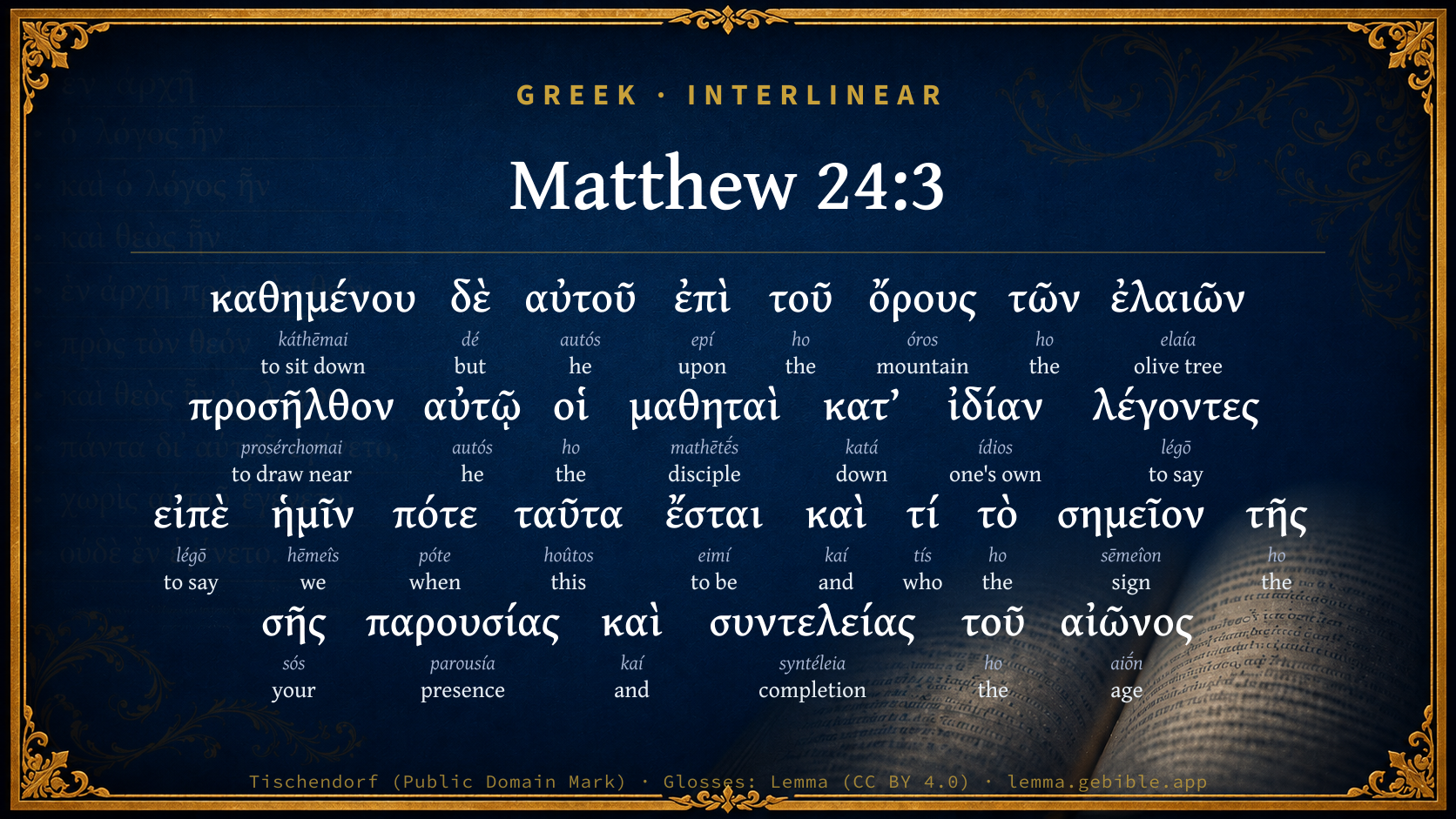
Download image
Cite this verse

Matthew 24:3 (World English Bible). Public Domain. Lemma interlinear Bible study tool, https://lemma.gebible.app/v/matthew/24/3.

Show BibTeX & RIS
BibTeX
RIS
English Translation
As he sat on the Mount of Olives, the disciples came to him privately, saying, "Tell us, when will these things be? What is the sign of your coming, and of the end of the age?"
World English Bible · Public Domain
Highlights
  • 1 first appearance in the Greek New Testament
Full analysis ↓
Download a study sheet

One document with this verse’s original text, its word-by-word gloss line, the meaning frame, cross-references with their text, attributed commentary, and full source and license credits — printable, and it pastes into notes with its structure intact.

This verse Autodidact and up

Study sheet (.html) Plain text (.txt)

A passage Seminary Student

Up to 50 verses in one chapter. A passage sheet keeps up to 6 commentary sources and 12 cross-references per verse, in the order this page ranks them, and says so on the sheet whenever that leaves anything out. Ask for a single verse and you get the Autodidact verse sheet above.

Everything on this page stays free to read, with no account — the sheet is a download of what is already on screen, not access to it.

Want to remove ads? Support Godless Engineer
Compare translations 3

The same verse in 3 English versions, stacked beneath the original-language interlinear above. Click any original word for its lexicon entry.

Each is an independent rendering of the whole verse — the interlinear is not word-aligned to these translations.

Highlighted words mark where these versions differ — a whole-verse word diff, not a word-by-word alignment.

  • World English Bible Public Domain
    As he sat on the Mount of Olives, the disciples came to him privately, saying, "Tell us, when will these things be? What is the sign of your coming, and of the end of the age?"
  • King James Version Public Domain
    And as he sat upon the mount of Olives, the disciples came unto him privately, saying, Tell us, when shall these things be? and what shall be the sign of thy coming, and of the end of the world?
  • unfoldingWord Literal Text CC BY-SA 4.0
    Now he was sitting on the Mount of Olives, the disciples approached him by themselves, saying, “Tell us, when will these things be? And what the sign of your coming and of the end of the age?”

unfoldingWord Literal Text — © unfoldingWord, licensed CC BY-SA 4.0. Word-aligned USFM3 via Door43 (git.door43.org/unfoldingWord/en_ult).

Versions to compare (up to 4)

3 of 4 selected

Show all 19 translations

Every available English version of this verse, each an independent rendering of the whole verse.

  • World English Bible Public Domain
    As he sat on the Mount of Olives, the disciples came to him privately, saying, "Tell us, when will these things be? What is the sign of your coming, and of the end of the age?"
  • Berean Standard Bible Public Domain
    While Jesus was sitting on the Mount of Olives, the disciples came to Him privately. “Tell us,” they said, “when will these things happen, and what will be the sign of Your coming and of the end of the age?”
  • Majority Standard Bible Public Domain
    While Jesus was sitting on the Mount of Olives, the disciples came to Him privately. “Tell us,” they said, “when will these things happen, and what will be the sign of Your coming and of the end of the age?”
  • King James Version Public Domain
    And as he sat upon the mount of Olives, the disciples came unto him privately, saying, Tell us, when shall these things be? and what shall be the sign of thy coming, and of the end of the world?
  • American Standard Version (1901) Public Domain
    And as he sat on the mount of Olives, the disciples came unto him privately, saying, Tell us, when shall these things be? and what `shall be' the sign of thy coming, and of the end of the world?
  • Revised Version (1885) Public Domain
    And as he sat on the mount of Olives, the disciples came unto him privately, saying, Tell us, when shall these things be? and what shall be the sign of thy coming, and of the end of the world?
  • Geneva Bible (1599) Public Domain
    And as he sate vpon the mount of Oliues, his disciples came vnto him apart, saying, Tell vs when these things shall be, and what signe shalbe of thy comming, and of the ende of the world.
  • Douay-Rheims (1899) Public Domain
    And when he was sitting on mount Olivet, the disciples came to him privately, saying: Tell us when shall these things be? and what shall be the sign of thy coming, and of the consummation of the world?
  • Young's Literal Translation Public Domain
    And when he is sitting on the mount of the Olives, the disciples came near to him by himself, saying, `Tell us, when shall these be? and what `is' the sign of thy presence, and of the full end of the age?'
  • Literal Standard Version CC BY-SA 4.0
    And when He is sitting on the Mount of Olives, the disciples came near to Him by Himself, saying, “Tell us, when will these be? And what [is] the sign of Your coming, and of the full end of the age?”
  • Unlocked Literal Bible CC BY-SA 4.0
    As he sat on the Mount of Olives, the disciples came to him privately and said, “Tell us, when will these things happen? What will be the sign of your coming and of the end of the age?”
  • unfoldingWord Literal Text CC BY-SA 4.0
    Now he was sitting on the Mount of Olives, the disciples approached him by themselves, saying, “Tell us, when will these things be? And what the sign of your coming and of the end of the age?”
  • Darby Bible Public Domain
    And as he was sitting upon the mount of Olives the disciples came to him privately, saying, Tell us, when shall these things be, and what is the sign of thy coming and [the] completion of the age?
  • World Messianic Bible Public Domain
    As he sat on the Mount of Olives, the disciples came to him privately, saying, “Tell us, when will these things be? What is the sign of your coming, and of the end of the age?”
  • Webster's Bible Public Domain
    And as he sat upon the mount of Olives, the disciples came to him privately, saying, Tell us, when will these things be? and what will be the sign of thy coming, and of the end of the world?
  • Free Bible Version CC BY-SA 4.0
    As Jesus sat on the Mount of Olives, the disciples came to him in private, and asked, “Please tell us when this will happen. What will be the sign of your coming and the end of the world?”
  • Bible in Basic English Public Domain
    And while he was seated on the Mountain of Olives, the disciples came to him privately, saying, Make clear to us, when will these things be? and what will be the sign of your coming and of the end of the world?
  • Text-Critical English NT CC BY 4.0
    Later, as Jesus was sitting on the Mount of Olives, the disciples came to him privately and said, “Tell us, when will these things happen? And what will be the sign of yoʋr coming and of the end of the age?”
  • Tyndale New Testament (1534) Public Domain
    And as he sat vpon the mout Olivete his disciples came vnto hym secretely sayinge. Tell vs when these thinges shalbe? and what signe shalbe of thy comynge and of the ende of the worlde?

Literal Standard Version (2020), Covenant Press — licensed CC BY-SA 4.0. Text via the HelloAO Bible API (eBible.org). Unlocked Literal Bible (unfoldingWord) — licensed CC BY-SA 4.0. Text via the HelloAO Bible API (eBible.org). unfoldingWord Literal Text — © unfoldingWord, licensed CC BY-SA 4.0. Word-aligned USFM3 via Door43 (git.door43.org/unfoldingWord/en_ult). Free Bible Version, Dr. Jonathan Gallagher — licensed CC BY-SA 4.0. Text via the HelloAO Bible API (eBible.org).

Word by word

More ways to search: Search by grammar → Find every occurrence → Compare this word →

Practice this passage: Drill this verse → Learn its vocabulary →

συντελείας
syntéleia
G4930
“completion”
Noun, Genitive, Singular, Feminine
Part of Speech
Noun
Case
Genitive
Number
Singular
Gender
Feminine
Full Thayer's Definition

Origin: from G4931

TDNT: 09:04,1

1. completion, consummation, end
  1. καθημένου káthēmai G2521 “to sit down” Verb, Present, Middle or Passive deponent, Participle, Genitive, Singular, Masculine
  2. δὲ dé G1161 “but” Conjunction
  3. αὐτοῦ autós G846 “he” Personal pronoun, Genitive, Singular, Masculine
  4. ἐπὶ epí G1909 “upon” Preposition
  5. τοῦ ho G3588 “the” Article, Genitive, Singular, Neuter
  6. ὄρους óros G3735 “mountain” Noun, Genitive, Singular, Neuter
  7. τῶν ho G3588 “the” Article, Genitive, Plural, Feminine
  8. ἐλαιῶν elaía G1636 “olive tree” Noun, Genitive, Plural, Feminine
  9. προσῆλθον prosérchomai G4334 “to draw near” Verb, Aorist, Active, Indicative, 3rd person, Plural
  10. αὐτῷ autós G846 “he” Personal pronoun, Dative, Singular, Masculine
  11. οἱ ho G3588 “the” Article, Nominative, Plural, Masculine
  12. μαθηταὶ mathētḗs G3101 “disciple” Noun, Nominative, Plural, Masculine
  13. κατ’ katá G2596 “down” Preposition
  14. ἰδίαν ídios G2398 “one's own” Adjective, Accusative, Singular, Feminine
  15. λέγοντες légō G3004 “to say” Verb, Present, Active, Participle, Nominative, Plural, Masculine
  16. εἰπὲ légō G3004 “to say” Verb, Aorist, Active, Imperative, 2nd person, Singular
  17. ἡμῖν hēmeîs G2249 “we” Personal pronoun, 1st person, Dative, Plural
  18. πότε póte G4219 “when” Particle, Interrogative
  19. ταῦτα hoûtos G3778 “this” Demonstrative pronoun, Nominative, Plural, Neuter
  20. ἔσται eimí G1510 “to be” Verb, Future, Middle deponent, Indicative, 3rd person, Singular
  21. καὶ kaí G2532 “and” Conjunction
  22. τί tís G5101 “who” Interrogative pronoun, Accusative, Singular, Neuter
  23. τὸ ho G3588 “the” Article, Nominative, Singular, Neuter
  24. σημεῖον sēmeîon G4592 “sign” Noun, Nominative, Singular, Neuter
  25. τῆς ho G3588 “the” Article, Genitive, Singular, Feminine
  26. σῆς sós G4674 “your” Possessive pronoun, 2nd person, Genitive, Singular, Feminine
  27. παρουσίας parousía G3952 “presence” Noun, Genitive, Singular, Feminine
  28. καὶ kaí G2532 “and” Conjunction
  29. τοῦ ho G3588 “the” Article, Genitive, Singular, Masculine
  30. αἰῶνος aiṓn G165 “age” Noun, Genitive, Singular, Masculine

About this verse

These counts appear in no published source. They are computed here, from the morphology-tagged text and Lemma’s own curated glosses. What Lemma adds →

31
words
23
distinct lemmas
Gospels
section

Notable vocabulary

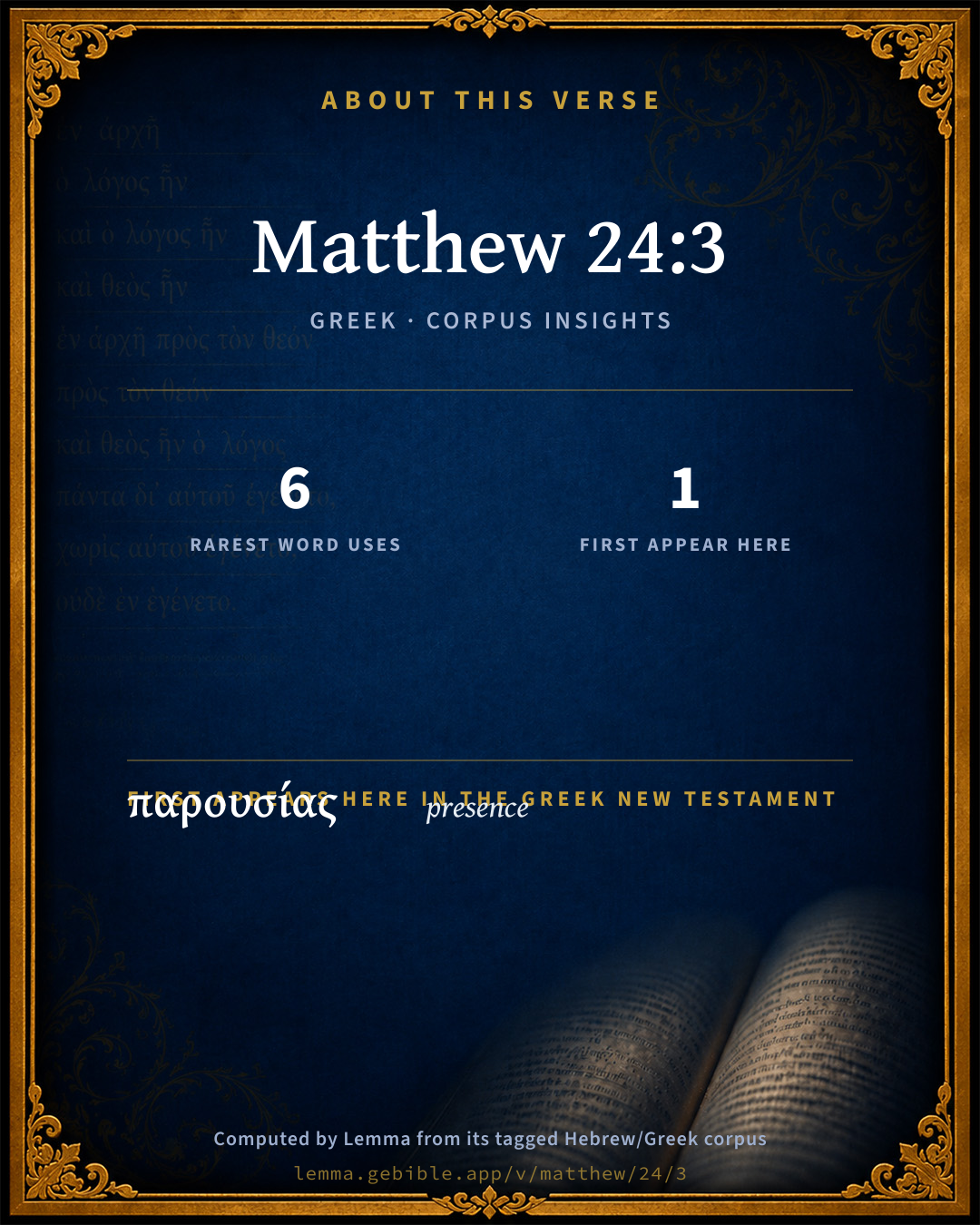
The rarest word here is συντελείας completion G4930 — appearing just 6 times in the whole Greek New Testament.

First appearance in Scripture

This word makes its first canonical appearance in the Greek New Testament here:

  • παρουσίας presence G3952

Shared distinctive vocabulary

συντελείας completion G4930 occurs in 6 verses of the Greek New Testament. Also found in:
Repetition

Words recur within this verse:

  • λέγοντες to say G3004 ×2
  • τοῦ the G3588 ×6
  • αὐτοῦ he G846 ×2
  • καὶ and G2532 ×2

Cross-references

20

Topical passages linked to Matthew 24:3 in the Treasury of Scripture Knowledge — connected by theme and wording, ordered by reader-vote popularity; previews shown in the World English Bible.

  • Mark 13:3–4 As he sat on the Mount of Olives opposite the temple, Peter, James, John, and Andrew asked him privately,
  • Acts 1:7 He said to them, "It isn't for you to know times or seasons which the Father has set within His own authority.
  • 1 Thessalonians 5:1–11 But concerning the times and the seasons, brothers, you have no need that anything be written to you.
  • Matthew 13:49 So will it be in the end of the world. The angels will come forth, and separate the wicked from among the righteous,
  • Matthew 24:37 "As the days of Noah were, so will be the coming of the Son of Man.
  • Daniel 12:6–8 One said to the man clothed in linen, who was above the waters of the river, How long shall it be to the end of these wonders?
  • Matthew 13:39–40 The enemy who sowed them is the devil. The harvest is the end of the age, and the reapers are angels.
  • Matthew 24:32–33 "Now from the fig tree learn this parable. When its branch has now become tender, and puts forth its leaves, you know that the summer is near.
  • Luke 21:7 They asked him, "Teacher, so when will these things be? What is the sign that these things are about to happen?"
  • Matthew 21:1 When they drew near to Jerusalem, and came to Bethsphage, to the Mount of Olives, then Jesus sent two disciples,
  • Matthew 24:27 For as the lightning comes forth from the east, and is seen even to the west, so will be the coming of the Son of Man.
  • Matthew 24:39 and they didn't know until the flood came, and took them all away, so will be the coming of the Son of Man.
  • Matthew 28:20 teaching them to observe all things that I commanded you. Behold, I am with you always, even to the end of the age." Amen.
  • Hebrews 9:26 or else he must have suffered often since the foundation of the world. But now once at the end of the ages, he has been revealed to put away sin by the sacrifice of himself.
  • Matthew 17:19 Then the disciples came to Jesus privately, and said, "Why weren't we able to cast it out?"
  • Matthew 24:43 But know this, that if the master of the house had known in what watch of the night the thief was coming, he would have watched, and would not have allowed his house to be broken into.
  • John 21:21–22 Peter seeing him, said to Jesus, "Lord, what about this man?"
  • Matthew 13:10–11 The disciples came, and said to him, "Why do you speak to them in parables?"
  • Matthew 13:36 Then Jesus sent the multitudes away, and went into the house. His disciples came to him, saying, "Explain to us the parable of the darnel of the field."
  • Matthew 15:12 Then the disciples came, and said to him, "Do you know that the Pharisees were offended, when they heard this saying?"

Cross-references courtesy of OpenBible.info (CC BY 4.0).

Commentary

Notes on Matthew 24:3 from classic Christian and Jewish commentators (each source and its license shown beneath its notes). The classic Christian expositions comment on the surrounding passage and are grouped to its opening verse, so a note may address several verses; the Jewish commentaries on the Tanakh (Rashi and others) are per-verse, so they appear only where the commentator wrote on this verse.

Lemma curates 59 commentaries, every one of them public domain or Creative Commons licensed, each selected and text-cleaned for this edition rather than reprinted as found. About our sources →

Joseph Benson's Commentary

Mat 24:3-5. And as he sat upon the mount of Olives, the disciples came unto him — The disciples were desirous to know more of these events, when they should be, and how they should be; but thought it not proper to ask him at present, the multitude probably still crowding about him, and therefore they take an opportunity of coming unto him privately, as he was sitting upon the mount of Olives, from whence they had a full view of the city and temple, and there they prefer their request to him. Tell us, when shall these things be? And what shall be the sign of thy coming, and of the end of the world? — These seem to be only different expressions to denote the same period with the destruction of Jerusalem, the disciples supposing, that when the destruction of Jerusalem should take place, then would be the coming of Christ and the end of the world, or, the conclusion of the age, as συντελεια του αιωνος should rather be translated here, and often signifies. See especially Hebrews 9:36; and 1Co 10:11. Accordingly, in the parallel place of Mar 13:4, their question is expressed thus, When shall these things be, and what shall be the sign when all these things shall be fulfilled? And in that of Luk 21:7, thus, When shall these things be? and what sign will there be when these things shall come to pass? The disciples therefore inquire concerning two things; 1st, the time of the destruction of Jerusalem; and, 2d, the signs of it. The latter part of the question our Lord answers first, and treats of the signs of his coming from the 4th to the 31st verse, inclusive; and then passes on to the other part of the question, concerning the time of his coming. Jesus answered, Take heed that no man deceive you — The caution was more particularly designed for the succeeding Christians, whom the apostles then represented. For many shall come in my name — That is, as Doctor Campbell renders it, many will assume my character; a reading which expresses our Lord’s meaning more precisely than ours. For to come in any one’s name signifies more properly with us, to come by one’s authority or order, real or pretended; in which sense the Messiah came in the name of God, the apostles came in the name of Christ. But this is far from being the sense of the phrase in this passage; where it plainly signifies that many would usurp his title, make pretensions to his office and character, and thereby lead their followers into the most fatal delusion, saying, I am Christ — Our Lord begins with this, according to all the evangelists, and they all represent him as using almost the same words: only in Luk 21:8, he adds, the time draweth near; and indeed within a very little time this part of the prophecy began to be fulfilled. Very soon after our Saviour’s decease appeared Simon Magus, who boasted himself among the Jews as the Son of God, and gave out among the Samaritans, that he was some great one, Act 8:9-10. Of the same stamp and character was Dositheus, the Samaritan, who pretended that he was the Christ foretold by Moses. In the reign of Claudius, about twelve years after the death of our Saviour, when Cuspius Fadus was procurator of Judea, an impostor, named Theudas, persuaded a great multitude to follow him, with their best effects, to the river Jordan, for he said that he was a prophet, and promised to divide the river for their passage; and saying these things, he deceived many, says Josephus. But Fadus sent a troop of horse against them, who, falling unexpectedly upon them, killed many, and made many prisoners; and having taken Theudas himself alive, they cut off his head and brought it to Jerusalem. A few years afterward, in the reign of Nero, when Felix was procurator of Judea, such a number of these impostors made their appearance, that many of them were apprehended and killed every day. They seduced great numbers of the people still expecting the Messiah. Our Saviour might well, therefore, caution his disciples against them.

Joseph Benson's Commentary on the Old and New Testaments (1811–1818) — public domain. Text from a community e-Sword module.

Tyndale Open Study Notes

Tyndale Open Resources

24:3 The Greek term translated return is parousia, which can mean coming or appearing. • end of the world (or end of the age): This expression refers to the climax and end of an epoch in salvation history (see 13:39-40, 49; also Heb 9:26). Jesus’ second coming will bring normal history to a close with decisive judgment. The disciples assumed that the destruction of the Temple and the end of history were closely connected.

Tyndale Open Study Notes — © Tyndale Open Resources, licensed CC BY-SA 4.0. Text via the HelloAO Bible API.

Bengel's Gnomon

Johann Albrecht Bengel

Mat 24:3. Ἐπὶ τοῦ ὄρους, on the mountain) Whence the temple could be seen, and where the siege operations were destined to commence.—τὸ σημεῖον, the sign) Signs have frequently been added to predictions of important events; hence arose the question of the disciples regarding the sign of that time.—τῆς σῆς παρουσίας, of thy coming) The disciples appear to refer to ch. Mat 23:39.

Bengel's Gnomon of the New Testament — English translation (T&T Clark, Edinburgh, 1860) — public domain. Text from a community e-Sword module.

Meyer's Critical & Exegetical Commentary

Heinrich August Wilhelm Meyer

Mat_24:3. Κατʼ ἰδίαν] unaccompanied by any but such as belonged to the number of the Twelve, because they were going to ask Him to favour them with a secret revelation. Differently Mar_13:3.

ταῦτα] those disastrous events of Mat_24:2.

καὶ τί τὸ σημεῖον, κ.τ.λ.] The disciples assume, as matter of course, that immediately after the destruction in question the Lord will appear, in accordance with what is said Mat_23:39, for the purpose of setting up His kingdom, and that with this the current (the pre-Messianic) era of the worlds history will come to an end. Consequently they wish to know, in the second place (for there are only two questions, not three, as Grotius, Ebrard suppose), what is to be the sign which, after the destruction of the temple, is to precede this second coming and the end of the world, that by it they may be able to recognise the approach of those events. The above assumption, on the part of the disciples, is founded on the doctrine respecting the הבלי המשיח, dolores Messiae, derived from Hos_13:13. See Schoettgen, II. p. 550; Bertholdt, Christol. p. 43 ff.

τῆς σῆς παρουσίας] After his repeated intimations of future suffering and death, the disciples could not conceive of the advent of Jesus (1Co_15:23; 1Th_2:19; in the Gospels peculiar to Matthew) to set up His kingdom and make a permanent stay in any other way than as a solemn second coming. After His resurrection they expected the Risen One straightway to set up His kingdom (Act_1:6),a very natural expectation when we bear in mind that the resurrection was an unlooked-for event; but, after the ascension, their hopes were directed, in accordance with the express promises of Jesus, to the coming from heaven, which they believed was going to take place ere long, Act_1:11; Act_3:20 f., al., and the numerous passages in the New Testament Epistles. Comp. Wittichen in the Jahrb. f. Deutsche Theol. 1862, p. 354 ff. Observe, too, the emphatic σῆς coming after the general expression ταῦτα.

καὶ συντελ. τοῦ αἰῶνος] In the Gospels we find no trace of the millenarian ideas of the Apocalypse. The τοῦ αἰῶνος, with the article, but not further defined, is to be understood as referring to the existing, the then current age of the world, i.e. to the αἰὼν οὗτος, which is brought to a close (συντέλεια) with the second coming, inasmuch as, with this latter event, the αἰὼν μέλλων begins. See on Mat_13:39. The second coming, the resurrection and the last judgment, fall upon the ἐσχάτη ἡμέρα (Joh_6:39; Joh_11:24), which, as it will be the last day of the αἰὼν οὗτος in general, so of the ἐσχάτων ἡμερῶν (Act_2:17; 2Ti_3:1; Jam_5:3; Heb_1:2; 2Pe_3:3) in particular, or of the καιρὸς ἔσχατος (1Pe_1:5), or of the χρόνος ἔσχατος (Jud_1:18; 1Pe_1:20), which John likewise calls the ἐσχάτη ὥρα (1Jn_2:18). This concluding period, which terminates with the last day, is to be characterized by abounding distress and wickedness (see on Gal_1:4). The article was unnecessary before συντελείας, seeing that it is followed by the genitive of specification; Winer, p. 118 f. [E. T. 155].

Meyer — Critical and Exegetical Commentary on the New Testament — English translation by Peter Christie, edited by Frederick Crombie (T&T Clark, 1880) — public domain. Text from a community e-Sword module.

Expositor's Greek Testament

ed. W. Robertson Nicoll

Mat 24:3 . n interval of silence would naturally follow so stern a speech. This verse accordingly shows us Jesus with His disciples now on the other side of the Kidron, and sitting on the slope of Olivet, with face turned towards Jerusalem; Master and disciples sitting apart, and thinking their own thoughts. Satisfied that the Master means what He has said, and not daring to dispute His prophetic insight, they accept the fate predicted for Jerusalem, and now desire to know the when and how. κατʼ ἰδίαν looks as if borrowed from Mk., where it refers to four of the disciples coming apart from the rest. It goes without saying that none but the Twelve were there. τί τὸ σημεῖον τ . σ . π ., etc. The questioners took for granted that all three things went together: destruction of temple, advent of Son of Man, end of the current age. Perhaps the association of the three helped them to accept the first as a fact. Weizsäcker ( Untersuchungen , p. 549, note 1) suggests that the second and third questions are filled in by the evangelist to correspond with the answer. So also Weiss in Meyer. The main subject of interrogation is the predicted ruin: when will it happen, and how shall it be known when it is at hand, so as to be prepared for it? Cf. Mk. and Lk., where this alone is the subject of question. παρουσία (literally presence , second presence) and συντέλεια τοῦ αἰῶνος are the technical terms of the apostolic age, for the second advent of Christ and the close of the present order of things, and they occur in Mt. only, so far as the Gospels are concerned. Do not the ideas also belong to that age, and are not the questions here put into the mouth of the Twelve too advanced for disciples?

The Expositor's Greek Testament, edited by W. Robertson Nicoll (1897–1910) — public domain. Text from a community e-Sword module.

Adam Clarke's Commentary

Verse 3. Tell us, when shall these things be?] There appear to be three questions asked here by the disciples.

1st. When shall these things be? viz. the destruction of the city, temple, and Jewish state.

2dly. What shall be the sign of thy coming? viz. to execute these judgments upon them, and to establish thy own Church: and

3dly. When shall this world end? When wilt thou come to judge the quick and the dead?

But there are some who maintain that these are but three parts of the same question, and that our Lord's answers only refer to the destruction of the Jewish state, and that nothing is spoken here concerning the LAST or judgment day.

End of the world] του αιωνος; or, of the age, viz. the Jewish economy, which is a frequent accommodated meaning of the word αιων, the proper meaning of which is, as Aristotle (De Caelo) observes, ETERNAL. αιων, quasi αει ων continual being: and no words can more forcibly point out eternity than these. See Clarke on Ge 21:33.

Adam Clarke's Commentary on the Bible (1810–1826) — public domain. Text from a community e-Sword/MySword module.

Ellicott's Commentary for English Readers

(3) The disciples came unto him privately.—From St. Mark we learn their names—“Peter, and James, and John, and Andrew;” i.e., the four in the first of the three groups that made up the Twelve. The position of Andrew as the last is noticeable, as connected with the general pre-eminence of the first three.

The sign of thy coming.—Literally, of Thy presence. The passage is memorable as the first occurrence of the word (παρονσία, parousia), which was so prominent in the teaching of the Epistles (1Th_2:19; 1Th_3:13; Jas_5:7; 1Jn_2:28, et al.). They had brought themselves to accept the thought of His departure and return, though time and manner were as yet hidden from them.

The end of the world.—Literally, the end of the age. In the common language of the day, which had passed from the schools of the Rabbis into popular use, “this age,” or “this world,” meant the time up to the coming of the Messiah; the “age or world to come” (Mat_13:40; Mat_19:28; Heb_2:5; Heb_6:5), the glorious time which He was to inaugurate. The disciples had heard their Lord speak in parables of such a coming, and they naturally connected it in their thoughts with the close of the age or period in which they lived.

A Bible Commentary for English Readers, edited by Charles John Ellicott (1878–1897) — public domain. Text from a community e-Sword module.

The Cambridge Bible for Schools and Colleges

gen. ed. J. J. S. Perowne

3. when shall these things be? and what shall be the sign of thy coming] The twofold question points to the nearer and the more distant event. See note at beginning of chapter.

thy coming] Rather, thy presence (parousia). The precise word “coming,” or “advent,” which the Church has adopted in reference to the second “presence” of Christ, does not occur in this prophecy.

the end of the world] See ch. Mat_13:39-40.

The Cambridge Bible for Schools and Colleges (gen. ed. J. J. S. Perowne; Cambridge University Press, 1878–1918) — public domain. Text from a community e-Sword module.

John Gill's Exposition

And as he sat upon the Mount of Olives,.... Which was on the east of the city of Jerusalem (a), "over against the temple", as Mark says, and where he could sit and take a full view of it; for the wall on the east side was lower than any other, and that for this reason; that when the high priest burnt the red heifer on this mount, as he did, and sprinkled the blood, he might have a view of the gate of the temple. It is said (b),

"all the walls which were there, were very high, except the eastern wall; for the high priest, when he burned the heifer, stood on the top of the mount of Olives, and directed himself, and looked to the gate of the temple, at the time he sprinkled the blood.''

This place, very probably, our Lord chose to sit in, that he might give his disciples an occasion to discourse more largely with him on this subject; and that he might take the opportunity of acquainting them with what would be the signs and forerunners of this desolation, and so it proved:

the disciples came to him privately; these four at least, Peter, and James, and John, and Andrew, as Mark relates; and that either separately from the rest of the disciples, or from the multitude: it might not be thought so proper, to ask the following questions before them, and they might suppose that Christ would not be so ready to give an answer to them plainly, before the common people; when they might hope to be indulged with one by him, in private:

saying, tell us, when shall these things be? That this house will be left desolate, these buildings will be destroyed, and not one stone left upon another? This first question relates purely to the destruction of the temple, and to this Christ first answers, from Mat 24:4.

And what shall be the sign of thy coming, and of the end of the world? Which two are put together, as what they supposed would be at the same time, and immediately follow the destruction of the temple. That he was come in the flesh, and was the true Messiah, they firmly believed: he was with them, and they expected he would continue with them, for they had no notion of his leaving them, and coming again. When he at any time spake of his dying and rising from the dead, they seemed not to understand it: wherefore this coming of his, the sign of which, they inquire, is not to be understood of his coming a second time to judge the world, at the last day; but of his coming in his kingdom and glory, which they had observed him some little time before to speak of; declaring that some present should not die, till they saw it: wherefore they wanted to be informed, by what sign they might know, when he would set up his temporal kingdom; for since the temple was to be destroyed, they might hope a new one would be built, much more magnificent than this, and which is a Jewish notion; and thai a new state of things would commence; the present world, or age, would be at a period; and the world to come, they had so often heard of from the Jewish doctors, would take place; and therefore they ask also, of the sign of the end of the world, or present state of things in the Jewish economy: to this Christ answers, in the latter part of this chapter, though not to the sense in which they put the questions; yet in the true sense of the coming of the son of man, and the end of the world; and in such a manner, as might be very instructive to them, and is to us.

(a) Bartenora in Misn. Middot, c. 1. sect. 3. (b) Misn. lb. c. 2. sect. 4.

John Gill's Exposition of the Whole Bible (1746–1763) — public domain (CC PDM 1.0). Text via the HelloAO Bible API.

Trapp's Complete Commentary

John Trapp

3 And as he sat upon the mount of Olives, the disciples came unto him privately, saying, Tell us, when shall these things be? and what shall be the sign of thy coming, and of the end of the world?

Ver. 3. Came unto him privately, saying] Because it was dangerous to speak publicly of the destruction of the temple, as the examples of Jeremiah and Stephen show. Howbeit, Micah the Morashite prophecied in the days of Hezekiah, saying, "Zion shall be ploughed, &c., and the mountain of this house shall be as the high places of a forest," Jer 26:18. And God stirred up many faithful witnesses to cry out against Rome in her ruff (pride), and to foretell her ruin. In the year 1159 lived Johannes Sarisburiensis, who reproved the pope to his face, and wrote his Polycraticon, wherein he freely taxeth all the Romish hierarchy. Bernard also told the bishops of his time, that they were not teachers, but seducers, not pastors, but impostors, not prelates, but Pilates, &c. And a certain painter, blamed by a cardinal for colouring the visages of Peter and Paul too red, tartly but fitly replied, that he painted them so, as blushing at the lives of their successors.

The sign of thy coming] viz. To destroy the temple.

And of the end of the world] Which they thought could not possibly outlast the temple. As they were wont to say in the primitive Church, Absque stationibus non staret mundus (Tertul.), the world could not stand if God’s people did not stand before him in prayer. Semen sanctum statumen terrae, as Tremellius reads Isa 6:13.

John Trapp, A Commentary or Exposition upon All the Books of the Old and New Testament (1647–1656) — public domain. Text from a community e-Sword module.

Albert Barnes' Notes on the Bible

He sat upon the Mount of Olives - See the notes at Mat 21:1. From that mount there was a magnificent view of the whole city.

The disciples came unto him privately - Not all of them, but Peter, James, John, and Andrew, Mar 13:3. The prediction that the temple would be destroyed Mat 24:2 had been made in the presence of all the apostles. A “part” now came privately to know more particularly when this would be.

When shall these things be? - There are three questions here:

1.When those things should take place

2.What should be the signs of his own coming

3.What should be the signs that the end of the world was near

To these questions He replies in this and the following chapters. This He does, not by noticing them distinctly, but by intermingling the descriptions of the destruction of Jerusalem and of the end of the world, so that it is sometimes difficult to tell to what particular subject his remarks apply. The principle on which this combined description of two events was spoken appears to be, that “they could be described in the same words,” and therefore the accounts are intermingled. A similar use of language is found in some parts of Isaiah, where the same language will describe the return from the Babylonian captivity, and deliverance by the Messiah. See Introduction to Isaiah, section 7.

Sign of thy coming - Evidence that thou art coming. By what token shall we know that thou art coming?

Albert Barnes' Notes on the Bible (1834–1885) — public domain. Text from a community e-Sword/MySword module.

Haydock's Catholic Bible Commentary

Tell us, when shall these things be? and what shall be the sign of thy coming, and of the consummation of the world?[1] We must take good notice with St. Jerome, that three questions are here joined together. 1. Concerning the destruction of Jerusalem; 2. of the coming of Christ; 3. of the end of the world. Christ’s answers and predictions in this chapter, are to be expounded with a reference to the three questions. This hath not been considered by those interpreters; who expound every thing here spoken by Christ of the destruction of Jerusalem; nor by others, who will have all understood of his coming to judgment, and of the end of the world. (Witham) --- It is probable the apostles themselves did not understand that they were asking about two distinct events. Being filled with the idea of a temporal kingdom, they thought that Christ’s second coming would take place soon; and that Jerusalem, once destroyed, the Messias would begin his reign on earth.

===============================

[BIBLIOGRAPHY]

St. Jerome on this place, says, Interrogant tria: quo tempore Jerusalem destruenda sit: quo venturus Christus: quo consummatio sæculi futura sit.

George Leo Haydock (1774–1849), Haydock's Catholic Family Bible and Commentary, 1859 edition — public domain. Excludes Psalms (Douay-Rheims chapter numbering differs from Protestant) and Deuterocanonical books (Catholic canon only).

Matthew Poole's English Annotations

Mark saith, Mar 13:3-5, And as he sat upon the mount of Olives over against the temple, Peter and James and John and Andrew asked him privately, Tell us, when shall these things be? and what shall be the sign when all these things shall be fulfilled? And Jesus answering them began to say, Take heed lest any man deceive you. Luke saith, Luk 21:7,8, And they asked him, saying, Master, but when shall these things be? and what sign will there be when these things shall come to pass? And he said, Take heed that ye be not deceived. Mark names the disciples which came to our Saviour privately, Peter, James, John, and Andrew. They seem to propound three questions to him:

1. What should be the sign of the destruction of Jerusalem?

2. Of his coming?

3. Of the end of the world?

It is probable they might send these four to propound these questions to our Savour. Three of them being such to whom Christ had showed signal and special favour before. Some doubt whether the questions propounded were three or two; if but two, the coming of Christ must either be the same with the first, or with the last. Those who understand Christ’s coming as a distinct period from the other two, think that the disciples refer to that secular kingdom which they fancied that the Messiah should exercise in the world. They desire to know the signs of these times, that is, prognostic signs, which might beforehand instruct them that the time was nigh, even at hand. They name two things there which time hath told us were to be at more than sixteen hundred years’ distance one from the other, for historians tell us that Jerusalem was destroyed within seventy or seventy-one years after our Saviour’s birth, within less than forty years after this discourse; but it is probable that they put them together, as believing that Jerusalem should not be destroyed till the day when Christ should come to judge the world, and that the end of the world and of the Jewish state should come together. And as we all are naturally curious to know things that are to come, so these disciples were in this thing particularly curious, having some particular apprehensions of the coming and kingdom of Christ, according to the mistaken notion which the Jews had of that kingdom which their expected Messiah should exercise in the world. Our blessed Lord at another time, Act 1:7, told them it was not for them to know the times or the seasons, which the Father hath put in his own power. He therefore giveth them no such certain signs of these things, as they could from them certainly conclude the particular time; but yet gives them some signs from whence they might conclude, when they saw them, that the time was hastening; which signs, though some have distinguished, appropriating those in the former part of the chapter to the destruction of Jerusalem, and those in the latter part to the day of judgment, yet they rather seem in our Saviour’s discourse mixed together; and time, which is the best interpreter of prophecies, must expound them to us. The destruction of Jerusalem is a thing past many hundreds of years since; so as by those histories which we have partly in holy writ, partly in other authors, it will not be hard to pick out what our Saviour intended for signs of that destruction, though there are some signs which were common signs both of that destruction and of the end of the world, and it is agreed by divines that the destruction of Jerusalem was a type of the destruction of the world, and therefore most of the signs are common to both. Paul was brought to Rome in the beginning of the reign of Nero, Act 27:1-44. Other historians tell us he and Peter were put to death about the end of his reign; within a year or two after Jerusalem was destroyed. Our Saviour prefaces his discourse of these signs with a usual caution to his disciples,

Take heed that no man deceive you.

Matthew Poole's English Annotations on the Holy Bible (1683–1685) — public domain. Text from a community e-Sword/MySword module.

Whedon's Commentary on the Bible

Daniel D. Whedon

3. As he sat upon the mount of Olives — We may suppose that toward the decline of Tuesday, of the Passion Week, our Lord lingered upon the Mount of Olives, and his disciples, perhaps in respect for his evident depth of grief, held themselves at a distance from him. But as he arrives at the point where the prospect of the city and temple is most unsurpassably gorgeous he takes a lonely seat. The disciples — That is, his three special disciples, Peter, James, and John; and also Andrew, as we learn by Mark. Came unto him privately — That is, they dared to put the question to him apart from the rest. Yet we may well suppose that, before the discourse itself was commenced, all the disciples gathered to hear its important announcement. Of the three evangelists who narrate the discourse, Matthew alone, we think, was present; and his report of it is by far the most complete and verbally exact.

Tell us — In order to comprehend this much misunderstood discourse, we must first well understand the question which drew it forth. Matthew states it with most completeness. And as he puts it there are TWO questions: the first is a simple, and the second a compound one. The first is, When shall THESE THINGS be? The second asks, What shall be the sign of the two events, (or one, as they may be,) namely, THY COMING, and the END OF THE WORLD? Here then are three points of inquiry; namely, THESE THINGS, THY COMING, and the END of the world.

In order to a full understanding of this most illustrious of prophecies, we require three things:

First, That we may be allowed to supply from one evangelist the omissions by another of important passages, and allow the parts so supplied to modify the meaning of the context which they supplement. Second, We must dismiss all self-contradictory double meaning in the words of our Lord. He spoke of momentous matters about which poetry deals; he described exciting events; but he spoke prose and no poetry. He delivered nought but literal descriptions. Third, We must make the meaning of the terms in the answer correspond with meaning of the terms in the question.

The main terms or points of the questions, as we have already remarked, are three:

A. THESE THINGS. The disciples ask When shall these things be? By this phrase in the question, and therefore in the answer, is clearly meant the events of the destruction of Jerusalem, of which he had just spoken.

He had just told them that the temple shall be totally demolished, and of the events attendant upon that matter they ask, When shall these things be? So in the discourse uttered an hour or so ago, (Mat_22:36,) he had said of the selfsame events: “Verily I say unto you, all THESE THINGS shall come upon this generation.” Just parallel to this is the celebrated Mat_24:34 of this chapter: “Verily I say unto you, this generation shall not pass till all THESE THINGS be fulfilled.” And so Luk_21:9 : “For THESE THINGS must first come to pass, but the end is not by and by.”

B. CHRIST’S COMING was the second point of inquiry. There can be no doubt what it means in the question; and, therefore, no doubt what it means in the answer. They meant to ask when would be his literal bodily coming; and if our Lord did not play with words, he also meant by these words in his answer his second personal appearing, and nothing else. And the word PAROUSIA, which the disciples used, never in the whole New Testament signifies anything else than a bodily presence. And the destruction of Jerusalem is never implied by that term. Nor is Christ ever represented as coming at the destruction of Jerusalem. In every instance, therefore, where the coming of our Lord is spoken of in this discourse, whether in the noun or verb form, common sense plainly dictates that the meaning should be the same, and the same as its meaning in the question, namely, the personal coming of our Lord at his second advent.

C. THE END. The disciples plainly ask about the END of the world. This our Lord plainly teaches will take place at his second advent, or PAROUSIA. So the disciples imply. The same common sense suggests, that in each of the cases where the word occurs, it should mean the end of the world at the judgment day.

With these postulates, we hope to clear this discourse of all artificial obscurities.

Daniel D. Whedon (gen. ed.), Commentary on the Old and New Testaments (1874–1909) — public domain. Text from a community e-Sword module.

The Pulpit Commentary

As he eat upon the Mount of Olives. On his way to Bethany towards the close of this day, he rested for a while and communed with the disciples, uttering the wonderful eschatological discourse which follows in this and the next chapter. It is noted that the siege of Jerusalem by the Romans began on the very spot where this prophecy of its destruction was delivered, strategical reasons compelling them to make their attack from this quarter. "A sudden turn in the road," writes Dr. Edersheim (2:431), "and the sacred building was once more in full view. Just then the western sun was pouring his golden beams on tops of marble cloisters and on the terraced courts, and glittering on the golden spikes on the roof of the holy place. In the setting, even more than in the rising sun, must the vast proportions, the symmetry, and the sparkling sheen of this mass of snowy marble and gold have stood out gloriously. And across the black valley, and up the slopes of Olivet, lay the dark shadows of those gigantic walls built of massive stones, some of them nearly twenty-four feet long. Even the rabbis, despite their hatred of Herod, grow enthusiastic, and dream that the very temple walls would have been covered with gold had not the variegated marble, resembling the waves of the sea, seemed more beauteous. It was probably, as they the disciples now gazed on all this grandeur and strength, that they broke the silence imposed on them by gloomy thoughts of the near desolateness of that house which the Lord predicted." Privately. Such questions were not to be asked openly in the hearing of any who might have followed him from the city. There was nothing more resented by the average Jew than any intimation of the destruction of the temple. It was one of the charges against Stephen that he had said that Jesus would destroy the temple. (Act_6:14) When, therefore, some of the apostles wished for more definite information on this subject, they took care to make their inquiry in private. Their questions were twofold they desired to know the time of the events, and the signs which should precede Christ"s coming and the end of the world. When shall these things be? "These things" refer to the destruction of the temple, and the course of events which, as they conceive, are dependent thereupon. (comp. Mat_23:36) To their minds, this catastrophe could only occur contemporaneously with the coming of Christ in glory and the end of the world. They saw in it a great revolution which should usher in the final consummation. But when should this come to pass? in their own day, or after many ages? in the lifetime of this generation, or at some far-distant period? It was not mere wanton curiosity to know the future which prompted the question, but rather a reverent desire to prepare for these great events, of the certainty of which they were now fully assured. So the next question shows no doubt concerning the facts, and asks, not the mode of the accomplishment, but only what anticipatory warning and indication were to be given. Sign of thy coming (thv shv parousiav), and of the end of the world (sunteleiav tou aiwnov). They look upon these two events as synchronous, or very closely connected. The word parousia, which in classical Greek means "presence," or "arrival," is used in the New Testament specially for the second advent of Christ to set up his eternal kingdom in full power and glory. (see in this chapter vers. 27, 37, 39; and comp. 1Co_15:23 1Th_2:19 1Th_3:13, etc.) Referring to the same event, we find in some places the term "epiphany" used, (see 1Ti_6:14 2Ti_4:1) and in others "revelation"; (apokaluqiv , 1Co_1:7 2Th_1:7) but the three expressions denote simply the open establishment of Messiah"s kingdom, indefinitely as to time and manner. The phrase translated "the end of the world "means literally the consummation of the age; (cf. Mat_13:39 Heb_9:26) consummationis saeculi (Vulgate); i.e. the close of this present seen, in contradistinction from the future aeon, or the world to come. This is "the last time," "the last days," spoken of elsewhere. (see 1Pe_1:5 1Jn_2:18; and comp. Isa_2:2 Mic_4:1)

HOMILIES BY R. TUCK Ver. 3. "The end of the world.

This term is a figure of speech. It represents something. It does not describe something. The actual ending of the world is an almost impossible conception. So far as we are able to trace Divine dealings, there are no "endings;" there are stages. But what we call an "ending" from one point of view is a "beginning" when seen from another point of view. What we ought to inquire is Was this a familiar figure of speech in the time of our Lord. and if it was, what ideas were attached to it as familiarly used? The patriarchal age came to an end, but there was no abrupt scene which can be called an ending. The same remark may be made concerning the closing of the Mosaic age. And we need imagine no catastrophe as the close of the Christian age. The coming of Messiah was, in Jewish thought, connected with the "end of the world," and vague, wild, and extraordinary were the things associated with that "coming" (see Stapler"s "Palestine in the Time of Christ," ch. 5).

I THE END OF THE WORLD IS THE END OF THE AGE. Distinctly present the truth that God ever works in stages, making each stage prepare the way for another and a higher. This may be shown by the revelations of the primeval ages made by geological researches; or by the history of separate nations; dynasties and royal houses represent distinct ages or dispensations. So we find stages within the history of Mosaism, the Jewish Church passing through several dispensations. Those who can read the philosophy of the Christian centuries can trace stages in them. One such stage was nearing completion in the time of Christ; and, with a very human tendency to exaggeration, men were imagining that an end of a particular polity for a small nation was to be the "end of the world.

II THE END OF THE AGE IS ALWAYS THE BEGINNING OF A NEW AGE. If we did but fully grasp this idea, we should be delivered from many hindering mistakes.

1. Endings are always local. There never has been any ending that concerned the whole world.

2. Endings insensibly glide into the new scenes. Abrupt endings may belong to man"s spheres, his dynasties, and his systems; but abruptness seldom, if ever, characterizes God"s ending. His spring has an ending, but it is a gliding into summer. If we can think of an actual "end of the world," we must think of a gliding into the new and eternal age. R.T.

The Pulpit Commentary (1880–1919), ed. H.D.M. Spence-Jones & Joseph S. Exell — public domain. Text from a community e-Sword module.

John Wesley's Explanatory Notes

As he sat on the Mount of Olives - Whence they had a full view of the temple. When shall these things be? And what shall be the sign of thy coming, and of the end of the world? - The disciples inquire confusedly

1. Concerning the time of the destruction of the temple;

2. Concerning the signs of Christ's coming, and of the end of the world, as if they imagined these two were the same thing. Our Lord answers distinctly concerning

1. The destruction of the temple and city, with the signs preceding, ver. 4, &c., 15, &c.

2. His own coming, and the end of the world, with the signs thereof, ver. 29-31.

3. The time of the destruction of the temple, ver. 32, &c.

4. The time of the end of the world, ver. 36.

John Wesley, Explanatory Notes Upon the Whole Bible (1754–1765) — public domain. Text via the GEBible commentary corpus.

Scofield Reference Notes

C. I. Scofield

Tell us

The beginning of the Olivet Discourse

Matthew 24 with Luk 21:20-24 answers the threefold question. The order is as follows: "when shall these things be?"--i.e. destruction of the temple and city. Answer: Luk 21:20-24.

Second and third questions: "And what shall be the sign of thy coming, and of the end of the age?" Answer: Mat 24:4-33.

Mat 24:4-14 have a double interpretation: They give:

(1) the character of the age--wars, international conflicts, famines, pestilences, persecutions, and false Christs (cf) Dan 9:26.

This is not the description of a converted world.

(2) But the same answer (Mat 24:4-14) applies in a specific way to the end of the age, viz. Daniel’s seventieth week. Dan 9:24-27. (See Scofield "Dan 9:24").

All that has characterized the age gathers into awful intensity at the end. Mat 24:14 has specific reference to the proclamation of the good news that the kingdom is again "at hand" by the Jewish remnant Isa 1:9; Rev 14:6; Rev 14:7. (See Scofield "Rom 11:5").

Mat 24:15 gives the sign of the abomination, (See Scofield "Dan 9:27"), the "man of sin," or "Beast" 2Th 2:3-8; Dan 9:27; Dan 12:11; Rev 13:4-7.

This introduces the great tribulation Psa 2:5. (See Scofield "Rev 7:14"), which runs its awful course of three and a half years, culminating in the battle of See Scofield "Rev 19:19" at which time Christ becomes the smiting Stone of Dan 2:34.

The detail of this period (Mat 24:15-28) is:

(1) The abomination in the holy place (Mat 24:15);

(2) the warning (Mat 24:16-20) to believing Jews who will then be in Jerusalem;

(3) the great tribulation, with renewed warning as to false Christs (Mat 24:21-26);

(4) the sudden smiting of the Gentile world-power (Mat 24:27; Mat 24:28);

(5) the glorious appearing of the Lord, visible to all nations, and the regathering of Israel (Mat 24:29-31);

(6) the sign of the fig-tree (Mat 24:32; Mat 24:33);

(7) warnings, applicable to this present age over which these events are ever impending (Mat 24:34-51). Php 4:5.

Careful study of Daniel 2, 7, 9, and Revelation 13 will make the interpretation clear. See, also, "Remnant" (Isa 1:9; Rom 11:5).

The Scofield Reference Bible (1917 edition), notes by C. I. Scofield — public domain. Text from a community e-Sword module.

Kretzmann's Popular Commentary

Paul E. Kretzmann

The question of the disciples as to details:

v. 3. And as He sat upon the Mount of Olives, the disciples came unto Him privately, saying, Tell us, when shall these things be, and what shall be the sign of Thy coming and of the end of the world?

v. 4. And Jesus answered and said unto them, Take heed that no man deceive you.

v. 5. For many shall come in My name, saying, I am Christ; and shall deceive many.

The blunt prediction of Christ made a deep impression upon the disciples, and therefore they took advantage of the fact that Christ sat down by the wayside, opposite the city, to ask Him concerning the fulfillment of this prophecy, which they associated with the end of the world. Peter, James, John, and Andrew were the ones that were most insistent. Mar 13:3. They were interested above all in the time of Christ’s return, and in the sign which would precede and foretell His coming to Judgment upon the city and upon the world. Note the three questions: When will the destruction of the Temple, city, and the Jewish state take place? What special sign will indicate Christ’s coming? When will the end of the world be, the judgment of the living and the dead take place? There is no trace of an idea of a millennium in this question. The belief which the Jews held, and which Christ here supports, is that the present age of the world, the age of sin and death, will end with the Last Judgment, without any intervening time of millennial glory. This is indicated also in the answer of Christ, when He tells them to see to it, to take heed, to guard against deception and terror. For the signs that would precede both the destruction of Jerusalem and the end of the world would be of a nature to demand calm minds and brave hearts. The first sign would be the coming of false teachers, of false Christs. They would come in His name, they would claim identity with Him. By the very boldness of their manner they would make an impression. Many would be deceived, many would listen to their lies and put their trust in them. This was true at the time of the destruction of Jerusalem, as Josephus relates, and it is true today. The number of false teachers with their sects is multiplying so rapidly that it is extremely difficult to keep records of them all.

Paul E. Kretzmann, Popular Commentary of the Bible (1921–1924) — public domain. Text from a community e-Sword module.

Burkitt's Expository Notes on the New Testament

William Burkitt

A double question is here propounded by the disciples to our Saviour.

First, As to the time of the temple’s destruction.

Secondly, as to the signs of that destruction.

As to the former, the time when the temple should be destroyed. See the curiosity of human nature, both in desiring to know what should be hereafter, and also when that hereafter should be.

Thence learn, That there is found with all of us an itching curiosity and desire, rather to inquire and pry into the hidden counsels of God’s secret will, than to obey the manifest declarations of God’s revealed will: Tell us when these things shall be.

As to their second question, What shall be the sign of his coming; our Saviour acquaints them with this among many others, That there should arise false Christs, false prophets, and seducers, a multitude of impostors, that would draw many after them; therefore he bids them take heed and beware.

Where observe, That Christ doth not gratify his disciples’ curiosity, but acquaints them with their present duty, to watch against deceivers and seducers, who should have the impudence to affirm themselves to be Christ. Some, Christ personal, or the Messiah; others Christ doctrinal, affirming their erroneous opinions to be Christ’s mind and doctrine.

From the whole, note, 1. That there will be many seducers, many erroneous persons, and false opinions, before the end of the world; for Jerusalem’s destruction was a type and emblem of the world’s destruction.

2. That such seducers will come in Christ’s name, and their errors and false opinions shall be given out to be the mind of Christ.

3. That many will be seduced and carried away with their fair pretences and plausible deceits.

4. That Christ’s own disciples had need to take heed, lest they themselves, being led away by the error of the wicked, do fall from their own steadfastness. Take heed that no man deceive you; for many will come in my name, saying, I am Christ, and shall deceive many.

William Burkitt's Expository Notes on the New Testament (1700–1703) — public domain. Text from a community e-Sword module.

The People's New Testament

B. W. Johnson

3. As he sat on the mount of Olives. Passing out of the city, over the valley of Jehoshaphat, he and his disciples climbed the mount and sat down on its crest overlooking the city and temple bathed in the sunset. Tell us. The disciples, still thinking of what the Lord had said, ask three questions: (1) When shall these things be? That is, the overthrow of the temple. (2) What shall be the sign of the coming? And (3) of the end of the world? They supposed these events would be simultaneous—a mistake. To understand what follows we must keep in mind that he has three questions to answer, nor are the answers blended.

B. W. Johnson's The People's New Testament with Notes (1889–1891) — public domain. Electronic text from the Christian Classics Ethereal Library (CCEL) ThML edition.

unfoldingWord translationNotes

Door43 World Missions Community

What will be the sign of your coming and of the end of the age

Here "your coming" refers to when Jesus will come in power, establishing God's reign on earth and bringing this age to an end. AT: "What will be the sign that you are about to come and that the world is about to end" (See: Assumed Knowledge and Implicit Information)

Be careful that no one leads you astray ... and will lead many astray

Here "leads you astray" is a metaphor for persuading someone to believe something that is not true. AT: "Be careful that no one deceives you ... and will deceive many people" (See: Metaphor)

many will come in my name

Here "name" refers to "in the authority" or "as the representative" of someone. AT: "many will claim that they have come as my representative" or "many will say they speak for me" (See: Metonymy)

translationWords

Mount of Olives

disciple

miracle

astray

Christ

unfoldingWord translationNotes — © Distant Shores Media and the Door43 World Missions Community, licensed CC BY-SA 4.0. Source: git.door43.org/Door43/en_tn.

Cambridge Greek Testament for Schools and Colleges

3. τῆς, omitted before συντελείας (א B C L). The omission has the effect of bringing the παρουσία into closer connection with the συντέλεια τοῦ αἰῶνος.

3. οἱ μαθηταί. St Mark names the four, Peter and James and John and Andrew.

τῆς σῆς παρουσίας. ‘Thy presence,’ used with the same special meaning, 1Th 2:19. Jas 5:7. 2Pe 1:16. 1Jn 2:28. The precise word ‘coming,’ or ‘advent,’ which the Church has adopted in reference to the second ‘presence’ of Christ, has no exact equivalent in this prophecy.

συντελείας τοῦ αἰῶνος. See ch. Mat 13:39-40.

Cambridge Greek Testament for Schools and Colleges (Cambridge University Press, 1896; 21 vols, various authors incl. Carr, Maclear, Plummer, Farrar, Lumby, Moule, M. R. James, Simcox) — public domain. Text from a community e-Sword module.

Alford’s Greek Testament

Henry Alford

3.] From Mark we learn, that it was Peter and James and John and Andrew who asked this question. With regard to the question itself, we must, I think, be careful not to press the clauses of it too much, so as to make them bear separate meanings corresponding to the arrangements of our Lord’s discourse. As expressed in the other Evangelists, the question was concerning the time, and the sign, of these things happening, viz. the overthrow of the temple and desolation of Judæa, with which, in the then idea of the Apostles, our Lord’s coming and the end of the world were connected. Against this mistake He warns them, vv. 6, 14,—Luke ver. 24,—and also in the two first parables in our ch. 25.

For the understanding of this necessarily difficult prophetic discourse, it must be borne in mind that the whole is spoken in the pregnant language of prophecy, in which various fulfilments are involved. (1) The view of the Jewish Church and its fortunes as representing the Christian Church and its history, is one key to the interpretation of this chapter.

Two parallel interpretations run through the former part as far as ver. 28; the destruction of Jerusalem and the final judgment being both enwrapped in the words, but the former, in this part of the chapter, predominating. Even in this part, however, we cannot tell how applicable the warnings given may be to the events of the last times, in which apparently Jerusalem is again to play so distinguished a part. From ver. 28, the lesser subject begins to be swallowed up by the greater, and our Lord’s second coming to be the predominant theme, with however certain hints thrown back as it were at the event which was immediately in question: till, in the latter part of the chapter and the whole of the next, the second advent, and, at last, the final judgment ensuing on it, are the subjects. (2) Another weighty matter for the understanding of this prophecy is, that (see Mar 13:32) any obscurity or concealment concerning the time of the Lord’s second coming, must be attributed to the right cause, which we know from His own mouth to be, that the divine Speaker Himself, in His humiliation, did not know the day nor the hour. All that He had heard of the Father, He made known unto His disciples (Joh 15:15): but that which the Father kept in His own power (Act 1:7), He did not in His abased humanity know. He told them the attendant circumstances of His coming; He gave them enough to guard them from error in supposing the day to be close at hand, and from carelessness in not expecting it as near. (Regarding Scripture prophecy as I do as a whole, and the same great process of events to be denoted by it all, it will be but waste labour to be continually at issue, in the notes of this and the succeeding chapter, with Meyer and others, who hold that the Gospel prophecies are inconsistent in their eschatology with those after the Ascension, and those again with the chiliastic ones of the Apocalypse. How untenable this view is, I hope the following notes will shew; but to be continually meeting it, is the office of polemic, not of exegetic theology.)

4,

Henry Alford, The Greek Testament (1849–1861) — public domain. Text from a community e-Sword module.

International Critical Commentary

(M) 3. And as He was sitting on the mount of Olives, His disciples came to Him privately, saying, Tell us, when shall these things be? and what (shall be) the sign of Thy coming, and of the consummation of the age?] Mk. has: “And as He was sitting at the mount of Olives over against the temple, Peter and James and John and Andrew were asking Him privately, Tell us, when shall these things be, and what shall be the sign when all these things are about to be consummated?” —ἐπί] for Mk.’s harsh εἰς.—προσῆλθον] see on 4:3. Mt., in view of Mk vv. 24-27, transforms Mk.’s question about the fall of Jerusalem into one concerning the second coming and the end of the age. He introduces παρουσία without any antecedent explanation. In so doing he overlooks the fact that the disciples, according to the Gospel narrative, had not the requisite understanding of the future for a question about Christ’s coming. For παρουσία cf. Secrets of Enoch 32:1 “My second coming,” 425 “the last coming.”—συντελείας τοῦ αἰῶνος] is a technical apocalyptic expression; cf. Volz, Jüd. Eschat. p. 166. Cf. Apoc. Bar 13:3 “the consummation of the times,” 27:15, 29:8, 30:3, 54:21, 56:2, 59:8, 82:2, 83:7, 23, Ass. Mos 1:18; cf. Enoch 16:1 “until the day when the great consummation of the great world be consummated” (μέχρις ἡμέρας τῆς τελειώσεως—ἐν ᾖ ὁ αἰὼν ὁ μέγας τελεσθήσεται), Dan 12:4 LXX., καιρὸς συντελείας; 12:13 LXX., συντέλεια ἡμερῶν; Test. Lev_10, συντέλεια τῶν αἰώνων.

International Critical Commentary — older volumes (1896–1929), various authors — public domain. Text from a community e-Sword module.

Vincent's Word Studies in the New Testament

Marvin R. Vincent

Coming [παρουσιας] . Originally, presence, from pareinai, to be present. In this sense Phi 2:12; 2Co 10:10. Also arrival, as in 1Co 16:17; 2Co 7:6, 7; 2Th 2:9; 2Pe 3:12. Of the second coming of Christ : Jas 5:8; 1Jo 2:28; 2Pe 3:4; 1Th 4:15.

Of the world [αιωνος] . Rather the existing, current age. They do not ask the signs of the Messiah 's coming at the end of all time, to judge the world.

Marvin R. Vincent, Word Studies in the New Testament (1887–1900) — public domain. Text from a community e-Sword/MySword module.

Lesson kit

Teaching starters — assembled from the data on this page, not authored interpretation. Every prompt links to the verse data it draws on. Edit before teaching.

Matthew, in the Gospels, opens this verse with 31 words (23 distinct Greek lemmas). Its most distinctive word is syntéleia (“completion”). A historical commentator’s framing appears above. Read the whole chapter for the surrounding context.

Discussion questions

  1. What does “completion” (syntéleia) contribute to the verse as a whole?
  2. This is the first place “presence” appears in Scripture (first appears here). What does its debut here establish?
  3. How does Matthew 13:39, which shares the word «completion», read alongside this verse?
  4. What does the repetition of “to say” (2× in this one verse) do in this verse?
  5. The translations on this page render this verse differently — a whole-verse word diff, not a word-by-word alignment. What might account for the different wordings?
  6. Compare how Joseph Benson's Commentary and Tyndale Open Study Notes read this verse. Where do they agree or differ?

Things to notice

  • 1 word makes its first canonical appearance in Scripture here.
  • These translations choose different wording for 12 words in this verse.
  • “to say” occurs 2× in this single verse.
  • 23 distinct Greek lemmas span 31 words in this verse.

Reading settings

Reading text

Shown beneath each verse's original-language words.

Old Testament
Old Testament edition

Read the OT as the Masoretic Hebrew (MT) or the Greek Septuagint (LXX).

English shown for the Greek Septuagint (in the Hebrew ↔ Greek comparison).

Comparing translations? Open the Compare panel on any verse page to stack up to four side by side.