

Matthew 13:39
Greek (Tischendorf 8th ed.) Matthew 13:39 appears in the Greek New Testament. The text above is from the Tischendorf 8th edition. Each word links to its Strong’s number and a concise gloss. Click any word for its full Thayer’s Greek Lexicon entry.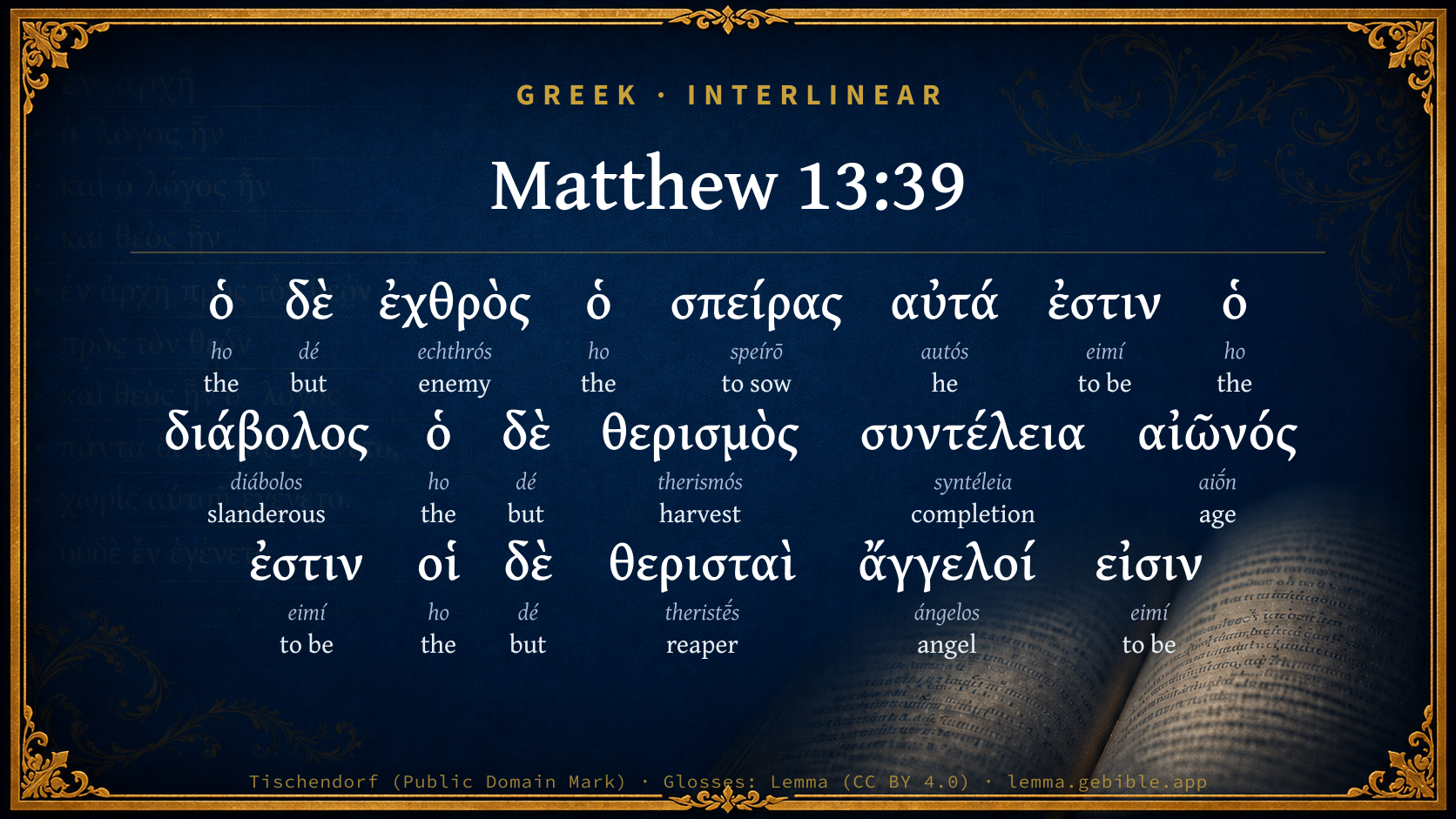
The enemy who sowed them is the devil. The harvest is the end of the age, and the reapers are angels.
Download a study sheet
One document with this verse’s original text, its word-by-word gloss line, the meaning frame, cross-references with their text, attributed commentary, and full source and license credits — printable, and it pastes into notes with its structure intact.
This verse Autodidact and up
A passage Seminary Student
Up to 50 verses in one chapter. A passage sheet keeps up to 6 commentary sources and 12 cross-references per verse, in the order this page ranks them, and says so on the sheet whenever that leaves anything out. Ask for a single verse and you get the Autodidact verse sheet above.
Everything on this page stays free to read, with no account — the sheet is a download of what is already on screen, not access to it.
Compare translations 3
The same verse in 3 English versions, stacked beneath the original-language interlinear above. Click any original word for its lexicon entry.
Each is an independent rendering of the whole verse — the interlinear is not word-aligned to these translations.
Highlighted words mark where these versions differ — a whole-verse word diff, not a word-by-word alignment.
-
World English Bible Public Domain
The enemy who sowed them is the devil. The harvest is the end of the age, and the reapers are angels.
-
King James Version Public Domain
The enemy that sowed them is the devil; the harvest is the end of the world; and the reapers are the angels.
-
unfoldingWord Literal Text CC BY-SA 4.0
and the enemy having sowed them is the devil. And the harvest is the end of the age, and the reapers are angels.
unfoldingWord Literal Text — © unfoldingWord, licensed CC BY-SA 4.0. Word-aligned USFM3 via Door43 (git.door43.org/unfoldingWord/en_ult).
Show all 19 translations
Every available English version of this verse, each an independent rendering of the whole verse.
-
World English Bible Public Domain
The enemy who sowed them is the devil. The harvest is the end of the age, and the reapers are angels.
-
Berean Standard Bible Public Domain
and the enemy who sows them is the devil. The harvest is the end of the age, and the harvesters are angels.
-
Majority Standard Bible Public Domain
and the enemy who sows them is the devil. The harvest is the end of the age, and the harvesters are angels.
-
King James Version Public Domain
The enemy that sowed them is the devil; the harvest is the end of the world; and the reapers are the angels.
-
American Standard Version (1901) Public Domain
and the enemy that sowed them is the devil: and the harvest is the end of the world; and the reapers are angels.
-
Revised Version (1885) Public Domain
and the enemy that sowed them is the devil: and the harvest is the end of the world; and the reapers are angels.
-
Geneva Bible (1599) Public Domain
And the enemie that soweth them, is the deuill, and the haruest is the end of the worlde, and the reapers be the Angels.
-
Douay-Rheims (1899) Public Domain
And the enemy that sowed them, is the devil. But the harvest is the end of the world. And the reapers are the angels.
-
Young's Literal Translation Public Domain
and the enemy who sowed them is the devil, and the harvest is a full end of the age, and the reapers are messengers.
-
Literal Standard Version CC BY-SA 4.0
and the enemy who sowed them is the Devil, and the harvest is [the] full end of the age, and the reapers are messengers.
-
Unlocked Literal Bible CC BY-SA 4.0
and the enemy who sowed them is the devil. The harvest is the end of the age, and the reapers are angels.
-
unfoldingWord Literal Text CC BY-SA 4.0
and the enemy having sowed them is the devil. And the harvest is the end of the age, and the reapers are angels.
-
Darby Bible Public Domain
and the enemy who has sowed it is the devil; and the harvest is [the] completion of [the] age, and the harvestmen are angels.
-
World Messianic Bible Public Domain
The enemy who sowed them is the devil. The harvest is the end of the age, and the reapers are angels.
-
Webster's Bible Public Domain
The enemy that sowed them is the devil; the harvest is the end of the world; and the reapers are the angels.
-
Free Bible Version CC BY-SA 4.0
The enemy that sowed the weed seeds is the devil. The harvest is the end of the world. The reapers are angels.
-
Bible in Basic English Public Domain
And he who put them in the earth is Satan; and the getting in of the grain is the end of the world; and those who get it in are the angels.
-
Text-Critical English NT CC BY 4.0
and the enemy who sowed them is the devil. The harvest is the end of the age, and the reapers are angels.
-
Tyndale New Testament (1534) Public Domain
And the enemye that soweth the is the devell. The harvest is the end of the worlde. And the repers be the angels.
Literal Standard Version (2020), Covenant Press — licensed CC BY-SA 4.0. Text via the HelloAO Bible API (eBible.org). Unlocked Literal Bible (unfoldingWord) — licensed CC BY-SA 4.0. Text via the HelloAO Bible API (eBible.org). unfoldingWord Literal Text — © unfoldingWord, licensed CC BY-SA 4.0. Word-aligned USFM3 via Door43 (git.door43.org/unfoldingWord/en_ult). Free Bible Version, Dr. Jonathan Gallagher — licensed CC BY-SA 4.0. Text via the HelloAO Bible API (eBible.org).
Word by word
More ways to search: Search by grammar → Find every occurrence → Compare this word →
Practice this passage: Drill this verse → Learn its vocabulary →
- Appears 2× in the Greek New Testament
- First appears at Matthew 13:30
- Part of Speech
- Noun
- Case
- Nominative
- Number
- Plural
- Gender
- Masculine
Full Thayer's Definition
- ὁ ho G3588 “the” Article, Nominative, Singular, Masculine
- δὲ dé G1161 “but” Conjunction
- ἐχθρὸς echthrós G2190 “enemy” Adjective, Nominative, Singular, Masculine
- ὁ ho G3588 “the” Article, Nominative, Singular, Masculine
- σπείρας speírō G4687 “to sow” Verb, Aorist, Active, Participle, Nominative, Singular, Masculine
- αὐτά autós G846 “he” Personal pronoun, Accusative, Plural, Neuter
- ἐστιν eimí G1510 “to be” Verb, Present, Active, Indicative, 3rd person, Singular
- ὁ ho G3588 “the” Article, Nominative, Singular, Masculine
- διάβολος diábolos G1228 “slanderous” Adjective, Nominative, Singular, Masculine
- ὁ ho G3588 “the” Article, Nominative, Singular, Masculine
- δὲ dé G1161 “but” Conjunction
- θερισμὸς therismós G2326 “harvest” Noun, Nominative, Singular, Masculine
- συντέλεια syntéleia G4930 “completion” Noun, Nominative, Singular, Feminine
- αἰῶνός aiṓn G165 “age” Noun, Genitive, Singular, Masculine
- ἐστιν eimí G1510 “to be” Verb, Present, Active, Indicative, 3rd person, Singular
- οἱ ho G3588 “the” Article, Nominative, Plural, Masculine
- δὲ dé G1161 “but” Conjunction
- θερισταὶ theristḗs G2327 “reaper” Noun, Nominative, Plural, Masculine
- ἄγγελοί ángelos G32 “angel” Noun, Nominative, Plural, Masculine
- εἰσιν eimí G1510 “to be” Verb, Present, Active, Indicative, 3rd person, Plural
About this verse
These counts appear in no published source. They are computed here, from the morphology-tagged text and Lemma’s own curated glosses. What Lemma adds →
- 20
- words
- 12
- distinct lemmas
- Gospels
- section
Notable vocabulary
The rarest word here is θερισταὶ reaper G2327 — appearing just 2 times in the whole Greek New Testament.
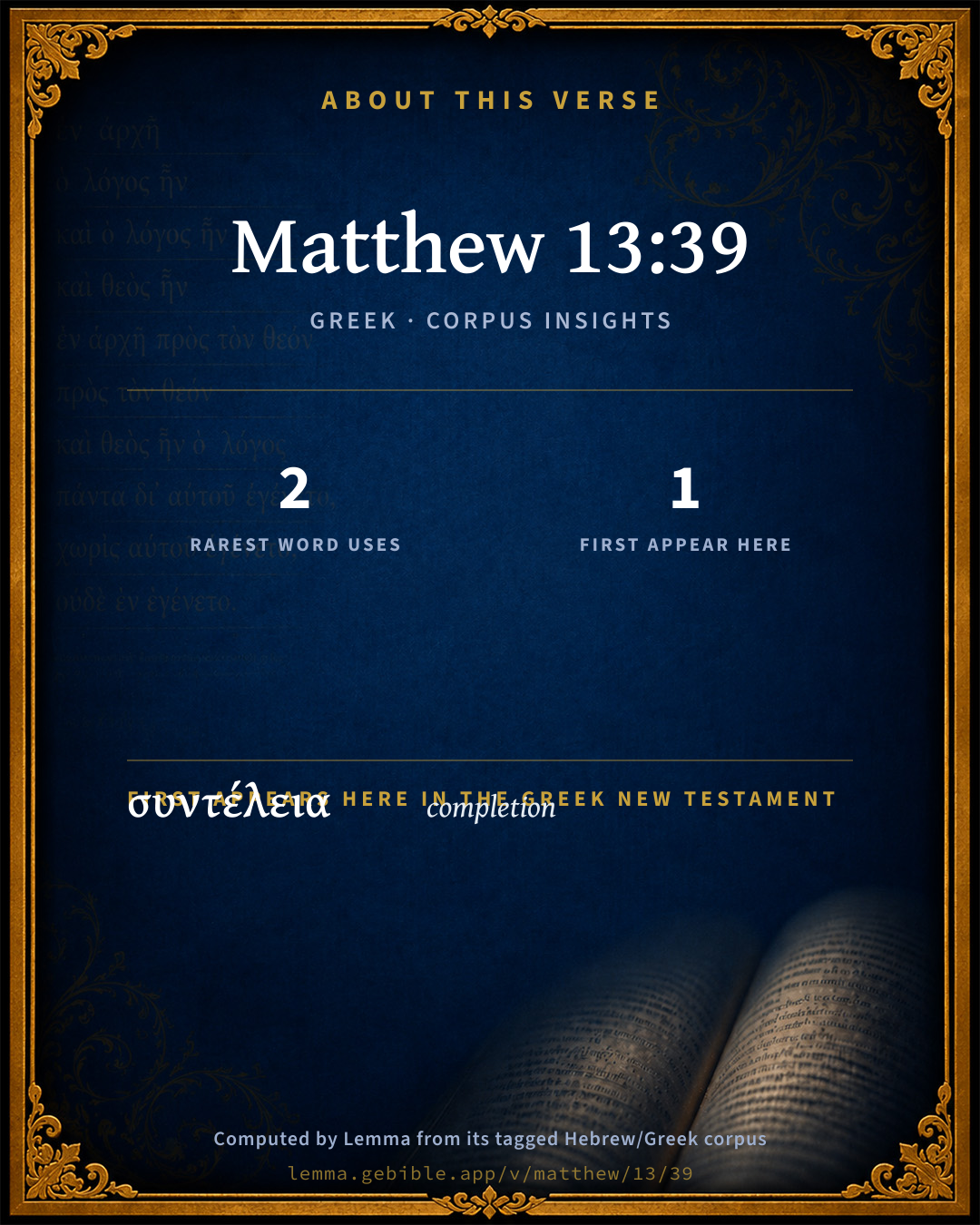
First appearance in Scripture
This word makes its first canonical appearance in the Greek New Testament here:
- συντέλεια completion G4930
Shared distinctive vocabulary
θερισταὶ reaper G2327 occurs in 2 verses of the Greek New Testament. Also found in:
Cross-references
24Topical passages linked to Matthew 13:39 in the Treasury of Scripture Knowledge — connected by theme and wording, ordered by reader-vote popularity; previews shown in the World English Bible.
- Matthew 13:49 So will it be in the end of the world. The angels will come forth, and separate the wicked from among the righteous,
- Revelation 14:15–19 Another angel came out from the temple, crying with a loud voice to him who sat on the cloud, "Send forth your sickle, and reap; for the hour to reap has come; for the harvest of the earth is ripe!"
- Matthew 25:31 "But when the Son of Man comes in his glory, and all the holy angels with him, then he will sit on the throne of his glory.
- Joel 3:13 Put in the sickle; For the harvest is ripe. Come, tread, for the winepress is full, The vats overflow, for their wickedness is great."
- Revelation 19:20 The beast was taken, and with him the false prophet who worked the signs in his sight, with which he deceived those who had received the mark of the beast and those who worshiped his image. These two were thrown alive into the lake of fire that burns with sulfur.
- Matthew 13:25 but while people slept, his enemy came and sowed darnel also among the wheat, and went away.
- Matthew 24:3 As he sat on the Mount of Olives, the disciples came to him privately, saying, "Tell us, when will these things be? What is the sign of your coming, and of the end of the age?"
- 2 Thessalonians 1:7–10 and to give relief to you that are afflicted with us, when the Lord Jesus is revealed from heaven with his mighty angels in flaming fire,
- Revelation 12:9 The great dragon was thrown down, the old serpent, he who is called the devil and Satan, the deceiver of the whole world. He was thrown down to the earth, and his angels were thrown down with him.
- Revelation 13:14 He deceives my own people who dwell on the earth because of the signs he was granted to do in front of the beast; saying to those who dwell on the earth, that they should make an image to the beast who had the sword wound and lived.
- Ephesians 6:11–12 Put on the whole armor of God, that you may be able to stand against the wiles of the devil.
- Hebrews 9:26 or else he must have suffered often since the foundation of the world. But now once at the end of the ages, he has been revealed to put away sin by the sacrifice of himself.
- 1 Peter 5:8 Be sober and self-controlled. Be watchful. Your adversary the devil, walks around like a roaring lion, seeking whom he may devour.
- Daniel 7:10 A fiery stream issued and came forth from before him: thousands of thousands ministered to him, and ten thousand times ten thousand stood before him: the judgment was set, and the books were opened.
- Matthew 13:28 "He said to them, 'An enemy has done this.' "The servants asked him, 'Do you want us to go and gather them up?'
- Matthew 28:20 teaching them to observe all things that I commanded you. Behold, I am with you always, even to the end of the age." Amen.
- 2 Corinthians 2:17 For we are not as so many, peddling the word of God. But as of sincerity, but as of God, in the sight of God, we speak in Christ.
- 2 Corinthians 11:3 But I am afraid that somehow, as the serpent deceived Eve in his craftiness, so your minds might be corrupted from the simplicity that is in Christ.
- 2 Corinthians 11:13–15 For such men are false apostles, deceitful workers, masquerading as Christ's apostles.
- Ephesians 2:2 in which you once walked according to the course of this world, according to the prince of the powers of the air, the spirit who now works in the children of disobedience;
- 2 Thessalonians 2:8–11 Then the lawless one will be revealed, whom the Lord will kill with the breath of his mouth, and bring to nothing by the brightness of his coming;
- Jude 1:14 About these also Enoch, the seventh from Adam, prophesied, saying, "Behold, the Lord came with ten thousands of his holy ones,
- Revelation 20:2–3 He seized the dragon, the old serpent, which is the devil and Satan, who deceives the whole inhabited earth, and bound him for a thousand years,
- Revelation 20:7–10 And after the thousand years, Satan will be released from his prison,
Cross-references courtesy of OpenBible.info (CC BY 4.0).
Lesson kit
Teaching starters — assembled from the data on this page, not authored interpretation. Every prompt links to the verse data it draws on. Edit before teaching.
Matthew, in the Gospels, opens this verse with 20 words (12 distinct Greek lemmas). Its most distinctive word is theristḗs (“reaper”). A historical commentator’s framing appears above. Read the whole chapter for the surrounding context.
Discussion questions
- The word theristḗs carries the sense “reaper.” How does it shape the verse?
- The word “completion” first appears here in Scripture. What is being introduced at this debut?
- Matthew 13:30 shares the word «reaper» with this verse. How do the two illuminate each other?
- “to be” occurs 3× in this one verse. What is the effect of the repetition?
- These translations render this verse differently. What is at stake in choosing one wording over another?
- Reading how Bengel's Gnomon and Meyer's Critical & Exegetical Commentary read this verse, where do the two commentators agree and where do they part?
Things to notice
- 1 word makes its first canonical appearance in Scripture here.
- These translations choose different wording for 4 words in this verse.
- “to be” occurs 3× in this single verse.
- 12 distinct Greek lemmas span 20 words in this verse.
Commentary
Notes on Matthew 13:39 from classic Christian and Jewish commentators (each source and its license shown beneath its notes). The classic Christian expositions comment on the surrounding passage and are grouped to its opening verse, so a note may address several verses; the Jewish commentaries on the Tanakh (Rashi and others) are per-verse, so they appear only where the commentator wrote on this verse.
Lemma curates 59 commentaries, every one of them public domain or Creative Commons licensed, each selected and text-cleaned for this edition rather than reprinted as found. About our sources →
Bengel's Gnomon
Johann Albrecht Bengel
Bengel's Gnomon of the New Testament — English translation (T&T Clark, Edinburgh, 1860) — public domain. Text from a community e-Sword module.
Meyer's Critical & Exegetical Commentary
Heinrich August Wilhelm Meyer
Meyer — Critical and Exegetical Commentary on the New Testament — English translation by Peter Christie, edited by Frederick Crombie (T&T Clark, 1880) — public domain. Text from a community e-Sword module.
Expositor's Greek Testament
ed. W. Robertson Nicoll
The Expositor's Greek Testament, edited by W. Robertson Nicoll (1897–1910) — public domain. Text from a community e-Sword module.
Jamieson, Fausset & Brown
Robert Jamieson, A. R. Fausset & David Brown
Jamieson, Fausset & Brown — Commentary Critical and Explanatory on the Whole Bible (1871) — public domain (CC PDM 1.0). Text via the HelloAO Bible API.
Ellicott's Commentary for English Readers
A Bible Commentary for English Readers, edited by Charles John Ellicott (1878–1897) — public domain. Text from a community e-Sword module.
John Gill's Exposition
John Gill's Exposition of the Whole Bible (1746–1763) — public domain (CC PDM 1.0). Text via the HelloAO Bible API.
Trapp's Complete Commentary
John Trapp
John Trapp, A Commentary or Exposition upon All the Books of the Old and New Testament (1647–1656) — public domain. Text from a community e-Sword module.
The Pulpit Commentary
The Pulpit Commentary (1880–1919), ed. H.D.M. Spence-Jones & Joseph S. Exell — public domain. Text from a community e-Sword module.
Scofield Reference Notes
C. I. Scofield
The Scofield Reference Bible (1917 edition), notes by C. I. Scofield — public domain. Text from a community e-Sword module.
Cambridge Greek Testament for Schools and Colleges
Cambridge Greek Testament for Schools and Colleges (Cambridge University Press, 1896; 21 vols, various authors incl. Carr, Maclear, Plummer, Farrar, Lumby, Moule, M. R. James, Simcox) — public domain. Text from a community e-Sword module.
International Critical Commentary
International Critical Commentary — older volumes (1896–1929), various authors — public domain. Text from a community e-Sword module.