
Matthew 24:9

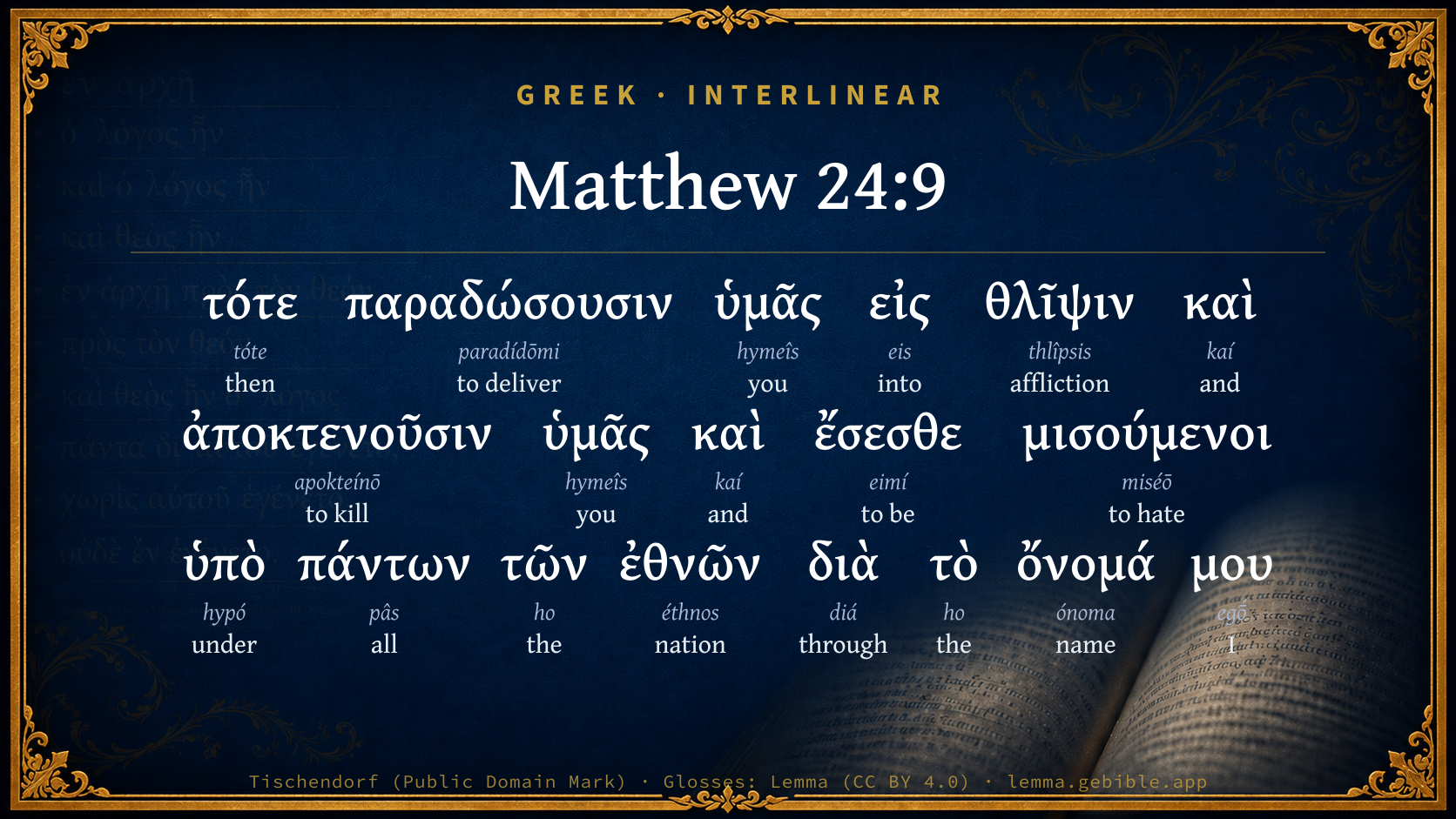
Greek (Tischendorf 8th ed.) Matthew 24:9 appears in the Greek New Testament. The text above is from the Tischendorf 8th edition. Each word links to its Strong’s number and a concise gloss. Click any word for its full Thayer’s Greek Lexicon entry.
Download image
Cite this verse

Matthew 24:9 (World English Bible). Public Domain. Lemma interlinear Bible study tool, https://lemma.gebible.app/v/matthew/24/9.

Show BibTeX & RIS
BibTeX
RIS
English Translation
Then they will deliver you up to oppression, and will kill you. You will be hated by all of the nations for my name's sake.
World English Bible · Public Domain
Download a study sheet

One document with this verse’s original text, its word-by-word gloss line, the meaning frame, cross-references with their text, attributed commentary, and full source and license credits — printable, and it pastes into notes with its structure intact.

This verse Autodidact and up

Study sheet (.html) Plain text (.txt)

A passage Seminary Student

Up to 50 verses in one chapter. A passage sheet keeps up to 6 commentary sources and 12 cross-references per verse, in the order this page ranks them, and says so on the sheet whenever that leaves anything out. Ask for a single verse and you get the Autodidact verse sheet above.

Everything on this page stays free to read, with no account — the sheet is a download of what is already on screen, not access to it.

Want to remove ads? Support Godless Engineer
Compare translations 3

The same verse in 3 English versions, stacked beneath the original-language interlinear above. Click any original word for its lexicon entry.

Each is an independent rendering of the whole verse — the interlinear is not word-aligned to these translations.

Highlighted words mark where these versions differ — a whole-verse word diff, not a word-by-word alignment.

  • World English Bible Public Domain
    Then they will deliver you up to oppression, and will kill you. You will be hated by all of the nations for my name's sake.
  • King James Version Public Domain
    Then shall they deliver you up to be afflicted, and shall kill you: and ye shall be hated of all nations for my name's sake.
  • unfoldingWord Literal Text CC BY-SA 4.0
    Then they will hand you over to tribulation and will kill you, and you will be hated by all the nations because of my name.

unfoldingWord Literal Text — © unfoldingWord, licensed CC BY-SA 4.0. Word-aligned USFM3 via Door43 (git.door43.org/unfoldingWord/en_ult).

Versions to compare (up to 4)

3 of 4 selected

Show all 19 translations

Every available English version of this verse, each an independent rendering of the whole verse.

  • World English Bible Public Domain
    Then they will deliver you up to oppression, and will kill you. You will be hated by all of the nations for my name's sake.
  • Berean Standard Bible Public Domain
    Then they will deliver you over to be persecuted and killed, and you will be hated by all nations because of My name.
  • Majority Standard Bible Public Domain
    Then they will deliver you over to be persecuted and killed, and you will be hated by all nations because of My name.
  • King James Version Public Domain
    Then shall they deliver you up to be afflicted, and shall kill you: and ye shall be hated of all nations for my name's sake.
  • American Standard Version (1901) Public Domain
    Then shall they deliver you up unto tribulation, and shall kill you: and ye shall be hated of all the nations for my name's sake.
  • Revised Version (1885) Public Domain
    Then shall they deliver you up unto tribulation, and shall kill you: and ye shall be hated of all the nations for my name’s sake.
  • Geneva Bible (1599) Public Domain
    Then shall they deliuer you vp to be afflicted, and shall kill you, and ye shall be hated of all nations for my Names sake.
  • Douay-Rheims (1899) Public Domain
    Then shall they deliver you up to be afflicted, and shall put you to death: and you shall be hated by all nations for my name's sake.
  • Young's Literal Translation Public Domain
    then they shall deliver you up to tribulation, and shall kill you, and ye shall be hated by all the nations because of my name;
  • Literal Standard Version CC BY-SA 4.0
    then they will deliver you up to tribulation, and will kill you, and you will be hated by all the nations because of My Name;
  • Unlocked Literal Bible CC BY-SA 4.0
    Then they will deliver you up to tribulation and kill you. You will be hated by all the nations for my name's sake.
  • unfoldingWord Literal Text CC BY-SA 4.0
    Then they will hand you over to tribulation and will kill you, and you will be hated by all the nations because of my name.
  • Darby Bible Public Domain
    Then shall they deliver you up to tribulation, and shall kill you; and ye will be hated of all the nations for my name's sake.
  • World Messianic Bible Public Domain
    “Then they will deliver you up to oppression and will kill you. You will be hated by all of the nations for my name’s sake.
  • Webster's Bible Public Domain
    Then will they deliver you up to be afflicted, and will kill you: and ye will be hated by all nations for my name's sake.
  • Free Bible Version CC BY-SA 4.0
    Then they will arrest you, they will persecute you, and they will kill you. All people will hate you because of me.
  • Bible in Basic English Public Domain
    Then they will be cruel to you, and will put you to death: and you will be hated by all nations because of my name.
  • Text-Critical English NT CC BY 4.0
    “Then they will hand you over to be tortured and will put you to death, and you will be hated by all nations because of my name.
  • Tyndale New Testament (1534) Public Domain
    Then shall they put you to trouble and shall kyll you: and ye shalbe hated of all nacions for my names sake.

Literal Standard Version (2020), Covenant Press — licensed CC BY-SA 4.0. Text via the HelloAO Bible API (eBible.org). Unlocked Literal Bible (unfoldingWord) — licensed CC BY-SA 4.0. Text via the HelloAO Bible API (eBible.org). unfoldingWord Literal Text — © unfoldingWord, licensed CC BY-SA 4.0. Word-aligned USFM3 via Door43 (git.door43.org/unfoldingWord/en_ult). Free Bible Version, Dr. Jonathan Gallagher — licensed CC BY-SA 4.0. Text via the HelloAO Bible API (eBible.org).

Word by word

More ways to search: Search by grammar → Find every occurrence → Compare this word →

Practice this passage: Drill this verse → Learn its vocabulary →

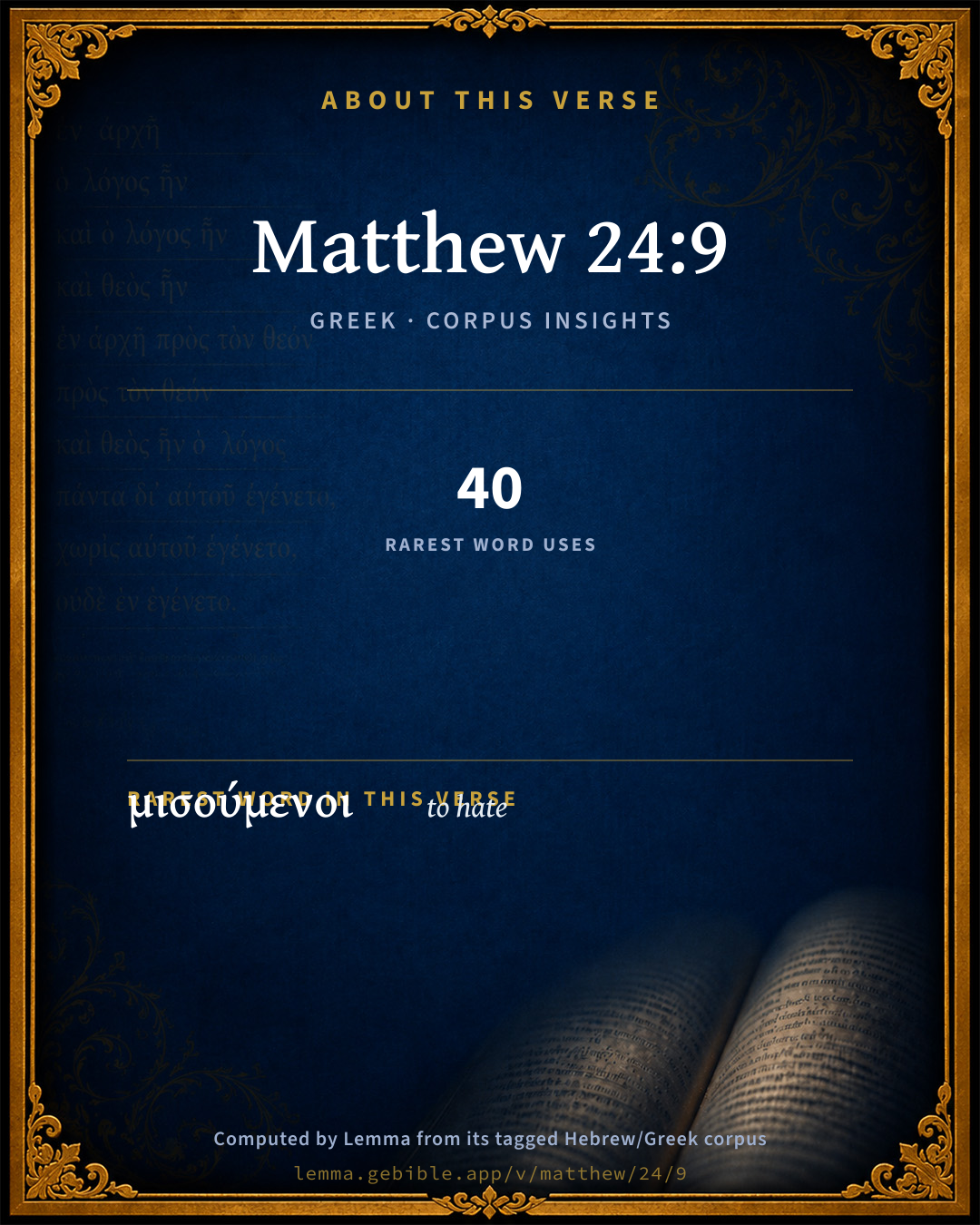
μισούμενοι
miséō
G3404
“to hate”
Verb, Present, Passive, Participle, Nominative, Plural, Masculine
Part of Speech
Verb
Tense
Present
Voice
Passive
Mood
Participle
Case
Nominative
Number
Plural
Gender
Masculine
Full Thayer's Definition

Origin: from a primary misos (hatred)

TDNT: 15:23,6

1. to hate, pursue with hatred, detest 2. to be hated, detested
  1. τότε tóte G5119 “then” Adverb
  2. παραδώσουσιν paradídōmi G3860 “to deliver” Verb, Future, Active, Indicative, 3rd person, Plural
  3. ὑμᾶς hymeîs G5210 “you” Personal pronoun, 2nd person, Accusative, Plural
  4. εἰς eis G1519 “into” Preposition
  5. θλῖψιν thlîpsis G2347 “affliction” Noun, Accusative, Singular, Feminine
  6. καὶ kaí G2532 “and” Conjunction
  7. ἀποκτενοῦσιν apokteínō G615 “to kill” Verb, Future, Active, Indicative, 3rd person, Plural
  8. ὑμᾶς hymeîs G5210 “you” Personal pronoun, 2nd person, Accusative, Plural
  9. καὶ kaí G2532 “and” Conjunction
  10. ἔσεσθε eimí G1510 “to be” Verb, Future, Middle deponent, Indicative, 2nd person, Plural
  11. ὑπὸ hypó G5259 “under” Preposition
  12. πάντων pâs G3956 “all” Adjective, Genitive, Plural, Neuter
  13. τῶν ho G3588 “the” Article, Genitive, Plural, Neuter
  14. ἐθνῶν éthnos G1484 “nation” Noun, Genitive, Plural, Neuter
  15. διὰ diá G1223 “through” Preposition
  16. τὸ ho G3588 “the” Article, Accusative, Singular, Neuter
  17. ὄνομά ónoma G3686 “name” Noun, Accusative, Singular, Neuter
  18. μου egṓ G1473 “I” Personal pronoun, 1st person, Genitive, Singular

About this verse

These counts appear in no published source. They are computed here, from the morphology-tagged text and Lemma’s own curated glosses. What Lemma adds →

19
words
16
distinct lemmas
Gospels
section

Shared distinctive vocabulary

μισούμενοι to hate G3404 occurs in 36 verses of the Greek New Testament. Also found in:
Repetition

Words recur within this verse:

Cross-references

22

Topical passages linked to Matthew 24:9 in the Treasury of Scripture Knowledge — connected by theme and wording, ordered by reader-vote popularity; previews shown in the World English Bible.

  • John 16:2 They will put you out of the synagogues. Yes, the time comes that whoever kills you will think that he offers service to God.
  • John 15:19–20 If you were of the world, the world would love its own. But because you are not of the world, since I chose you out of the world, therefore the world hates you.
  • Luke 21:16–17 You will be handed over even by parents, brothers, relatives, and friends. Some of you they will cause to be put to death.
  • Revelation 2:10 Don't be afraid of the things which you are about to suffer. Behold, the devil is about to throw some of you into prison, that you may be tested; and you will have oppression for ten days. Be faithful to death, and I will give you the crown of life.
  • Matthew 10:17–22 But beware of men: for they will deliver you up to councils, and in their synagogues they will scourge you.
  • Luke 21:12 But before all these things, they will lay their hands on you and will persecute you, delivering you up to synagogues and prisons, bringing you before kings and governors for my name's sake.
  • Mark 13:9–13 But watch yourselves, for they will deliver you up to councils. You will be beaten in synagogues. You will stand before rulers and kings for my sake, for a testimony to them.
  • Revelation 6:9–11 When he opened the fifth seal, I saw underneath the altar the souls of those who had been killed for the Word of God, and for the testimony of the Lamb which they had.
  • Revelation 7:14 I told him, "My lord, you know." He said to me, "These are those who came out of the great tribulation. They washed their robes, and made them white in the Lamb's blood.
  • 1 Peter 4:16 But if one of you suffers for being a Christian, let him not be ashamed; but let him glorify God in this matter.
  • Acts 5:40–41 They agreed with him. Summoning the apostles, they beat them and charged them not to speak in the name of Jesus, and let them go.
  • 1 Thessalonians 2:14–16 For you, brothers, became imitators of the assemblies of God which are in Judea in Christ Jesus; for you also suffered the same things from your own countrymen, even as they did from the Jews;
  • Acts 4:2–3 being upset because they taught the people and proclaimed in Jesus the resurrection from the dead.
  • Matthew 23:34 Therefore, behold, I send to you prophets, wise men, and scribes. Some of them you will kill and crucify; and some of them you will scourge in your synagogues, and persecute from city to city;
  • Luke 11:49 Therefore also the wisdom of God said, 'I will send to them prophets and apostles; and some of them they will kill and persecute,
  • Acts 7:59 They stoned Stephen as he called out, saying, "Lord Jesus, receive my Spirit!"
  • Acts 21:31–32 As they were trying to kill him, news came up to the commanding officer of the regiment that all Jerusalem was in an uproar.
  • Revelation 2:13 "I know your works and where you dwell, where Satan's throne is. You hold firmly to my name, and didn't deny my faith in the days of Antipas my witness, my faithful one, who was killed among you, where Satan dwells.
  • Matthew 22:6 and the rest grabbed his servants, and treated them shamefully, and killed them.
  • Acts 12:1–5 Now about that time, Herod the king stretched out his hands to oppress some of the assembly.
  • Acts 22:19–22 I said, 'Lord, they themselves know that I imprisoned and beat in every synagogue those who believed in you.
  • Acts 28:22 But we desire to hear from you what you think. For, as concerning this sect, it is known to us that everywhere it is spoken against."

Cross-references courtesy of OpenBible.info (CC BY 4.0).

Commentary

Notes on Matthew 24:9 from classic Christian and Jewish commentators (each source and its license shown beneath its notes). The classic Christian expositions comment on the surrounding passage and are grouped to its opening verse, so a note may address several verses; the Jewish commentaries on the Tanakh (Rashi and others) are per-verse, so they appear only where the commentator wrote on this verse.

Lemma curates 59 commentaries, every one of them public domain or Creative Commons licensed, each selected and text-cleaned for this edition rather than reprinted as found. About our sources →

Joseph Benson's Commentary

Mat 24:9. Then shall they deliver you up to be afflicted, &c. — From the calamities of the nation in general, he passes to those of the Christians in particular: and indeed the former were in a great measure the occasion of the latter; famines, pestilences, earthquakes, and the like calamities, being reckoned judgments for the sins of the Christians, and the poor Christians being often maltreated and persecuted on that account, as we learn from some of the earliest apologies for the Christian religion. Now the calamities which were to befall the Christians were cruel persecutions, and we need look no further than the Acts of the Apostles for the completion of this prediction. But if we would look further, we have still a more melancholy proof of the truth of it in the persecutions under Nero, in which, not to mention numberless other Christians, those two great champions of the Christian faith, Peter and Paul, fell. Indeed, as Tertullian calls it, it was nominis prælium, a war against the very name. For though a man was possessed of every human virtue, it was crime enough if he was a Christian; so true were our Saviour’s words, that they should be hated of all nations for his name’s sake.

Joseph Benson's Commentary on the Old and New Testaments (1811–1818) — public domain. Text from a community e-Sword module.

Tyndale Open Study Notes

Tyndale Open Resources

24:9 hated (see Acts 28:22): At the end of the first century, the Roman historian Tacitus described Christians as “the hated ones of mankind” (Tacitus, Annals 15.44). The affliction of the righteous sometimes has the purpose of inciting repentance and obedience (see Exod 4:31; Deut 4:30; Judg 10:6-16; Pss 34:19; 37:39; 50:15).

Tyndale Open Study Notes — © Tyndale Open Resources, licensed CC BY-SA 4.0. Text via the HelloAO Bible API.

Bengel's Gnomon

Johann Albrecht Bengel

Mat 24:9. Ἀποκτενοῦσιν ὑμᾶς, they shall kill you) sc. some of you; see Luk 21:16. The Lord does not point these out, in order that all may watch. Before the destruction of Jerusalem, James the Greater was slain by Herod, as St Luke mentions; Peter, by Nero, as ecclesiastical history hands down. You: as if you were in fault, and were the authors of the misery of the human race. This is the last consolation of the world. “Judgment begins with the house of God.”—μισούμενοι, hated) The Christian religion has something peculiar, hateful to the corrupt world, which tolerates all other denominations.

Bengel's Gnomon of the New Testament — English translation (T&T Clark, Edinburgh, 1860) — public domain. Text from a community e-Sword module.

Meyer's Critical & Exegetical Commentary

Heinrich August Wilhelm Meyer

Mat_24:9. Jesus now exhibits the sequel of this universal beginning of woes in its special bearing upon the disciples and the whole Christian community. Comp. on Mat_10:17 ff.

τότε] then, when what is said at Mat_24:7 will have begun. Differently in Luk_21:12 (πρὸ δὲ τούτων), where, though τότε is not in any way further defined (Cremer), we have clearly a correction in order to adapt the expression to the persecutions that in the evangelists time had already begun. Seeing that the expressions are distinctly different from each other. it is not enough to appeal to the elasticity of the τότε (Hoelemann).

ἀποκτενοῦσιν ὑμᾶς] spoken generally, not as intimating, nor even presupposing (Scholten), the death of all of them. After παραδώς. ὑμᾶς the current of prophetic utterance flows regularly on, leaving to the hearers themselves to make the necessary distinctions.

καὶ ἔσεσθε μισούμενοι] It is a mistake to suppose that we have here a reference to Neros persecution (proceeding upon an erroneous interpretation of the well-known odio humani generis in Tacit. Ann. xv. 44, see Orelli on the passage), because it is the disciples that are addressed; and to regard them as the representatives of Christians in general, or as the sum total of the church (Cremer), would be arbitrary in the highest degree; the discourse does not become general in its character till Mat_24:10. Comp. 1Co_4:13.

ὑπὸ πάντων τ. ἐθνῶν] by all nations. What a confirmation of this, in all general respects, is furnished by the history of the apostles, so far as it is known to us! But we are not justified in saying more, and especially when we take into account the prophetic colouring given to our discourse, must we beware of straining the πάντων in order to favour the notion that the expression contains an allusion to the vast and long-continued efforts that would be made to disseminate the gospel throughout the world (Dorner); let us repeat that it is the apostles who are in question here. Comp. Mat_10:17 f., 22.

Meyer — Critical and Exegetical Commentary on the New Testament — English translation by Peter Christie, edited by Frederick Crombie (T&T Clark, 1880) — public domain. Text from a community e-Sword module.

Expositor's Greek Testament

ed. W. Robertson Nicoll

Mat 24:9-14 . Third sign , drawn from apostolic experiences. This passage Weiss regards as an interpolation into the prophetic discourse by Matthew following Mark. It certainly resembles Mat 10:17-22 (much less, however, than the corresponding passage in Mk.), and individual phrases may be interpolations: but something of the kind was to be expected here. The disciples were not to be mere spectators of the tragedy of the Jewish nation destroying itself. They were to be active the while, preaching the gospel of the kingdom, propagating the new faith, bringing in a new world. Jesus would have them go on with their work undistracted by false enthusiasms, or warlike terrors, and to this end assures them that they will have both to do and to suffer a great deal before the final crisis of Jerusalem comes. The ground of this prophetic forecast as to their experience is faith that God will not allow the work He (Jesus) has inaugurated to perish. The gospel will be preached widely, with whatever tribulations to the preachers.

Mat 24:9 . θλίψιν , from θλίβω , originally pressure ( στένωσις , Hesychius), in N. T. tropical, pressure from the evils of life, affliction. Again in Mat 24:29 , in reference to the Jewish people. The apostles also are to have their thlipsis . ἀποκτενοῦσιν ὑμᾶς , they will kill you. Luk 21:16 has “some of you” ( ἐξ ὑμῶν ). Some qualification of the blunt statement is needed; such as: they will be in the mood to kill you ( cf. Joh 16:2 ). τῶν ἐθνῶν : not in Mark, universalising the statement = hated by all the nations, not Jews only.

The Expositor's Greek Testament, edited by W. Robertson Nicoll (1897–1910) — public domain. Text from a community e-Sword module.

Adam Clarke's Commentary

Verse 9. Then shall they deliver you up to be afflicted] Rather, Then they will deliver you up to affliction, εις θλιψιν. By a bold figure of speech, affliction is here personified. They are to be delivered into affliction's own hand, to be harassed by all the modes of inventive torture.

Ye shall be hated of all nations] Both Jew and Gentile will unite in persecuting and tormenting you. Perhaps παντων των εθνων means all the Gentiles, as in the parallel places in Mr 13:9-11, and in Lu 21:12-15, the Jewish persecution is mentioned distinctly. Ye shall be delivered up to COUNCILS and be beaten in SYNAGOGUES, and ye shall stand before governors and kings for my name's sake - be not anxiously careful beforehand what ye shall speak - for ye are not the speakers, but the Holy Spirit will speak by you - I will give you utterance and wisdom, which all your adversaries shall not be able to contradict or resist. We need go no farther than the Acts of the Apostles for the completion of these particulars. Some were delivered to councils, as Peter and John, Ac 4:5. Some were brought before rulers and kings, as Paul before Gallio, Ac 18:12, before Felix, Acts 24, before Festus and Agrippa, Acts 25. Some had utterance and wisdom which their adversaries were not able to resist: so Stephen, Ac 6:10, and Paul, who made even Felix himself tremble, Ac 24:25. Some were imprisoned, as Peter and John, Ac 4:3. Some were beaten, as Paul and Silas, Ac 16:23. Some were put to death, as Stephen, Ac 7:59, and James the brother of John, Ac 12:2. But if we look beyond the book of the Acts of the Apostles, to the bloody persecutions under Nero, we shall find these predictions still more amply fulfilled: in these, numberless Christians fell, besides those two champions of the faith Peter and Paul. And it was, as says Tertullian, nominis praelium, a war against the very name of Christ; for he who was called Christian had committed crime enough, in bearing the name, to be put to death. So true were our Saviour's words, that they should be hated of all men for his NAME'S sake.

But they were not only to be hated by the Gentiles, but they were to be betrayed by apostates.

Adam Clarke's Commentary on the Bible (1810–1826) — public domain. Text from a community e-Sword/MySword module.

Ellicott's Commentary for English Readers

(9) Then shall they deliver . . .—The adverb, here and in Mat_24:10, points to synchronism rather than sequence in its connection with Mat_24:8.

To be afflicted.—Literally, unto affliction. The words repeat in substance the predictions of Mat_10:22. (See Notes there.) Here we have “hated of all the nations,” i.e., heathen nations, instead of the wider “hated of all men.” So, when Paul reached Rome, the “sect” of the Christians was “everywhere spoken against” (Act_28:22) “as evildoers” (1Pe_2:12). So, a little later on, Tacitus describes them as “hated for their crimes” (Ann. xv. 44).

A Bible Commentary for English Readers, edited by Charles John Ellicott (1878–1897) — public domain. Text from a community e-Sword module.

John Gill's Exposition

Then shall they deliver you up to be afflicted,.... Our Lord proceeds to acquaint his disciples, what should befall them in this interval; and quite contrary to their expectations, who were looking for a temporal kingdom, and worldly grandeur, assures them of afflictions, persecutions, and death; that about these times, when these various signs should appear, and this beginning of sorrows take place; whilst these will be fulfilling in Judea, and other parts of the world; the Jews continuing in their obstinacy and unbelief, would deliver them up to the civil magistrates, to be scourged and imprisoned by them; either to their own sanhedrim, as were Peter and John; or to the Roman governors, Gallio, Festus, and Felix, as was the Apostle Paul.

And shall kill you; as the two James', Peter, Paul, and even all the apostles, excepting John, who suffered martyrdom, and that before the destruction of Jerusalem:

and ye shall be hated of all nations for my name's sake; as the apostles and first Christians were, both by Jews and Gentiles; the latter being stirred up against them by the former, wherever they came, and for no other reason, but because they professed and preached in the name of Christ, as the Acts of the Apostles show: and their hatred proceeded so far, as to charge all their calamities upon them; as war, famine, pestilence, earthquakes, &c. as the apologies of the first Christians declare.

John Gill's Exposition of the Whole Bible (1746–1763) — public domain (CC PDM 1.0). Text via the HelloAO Bible API.

Trapp's Complete Commentary

John Trapp

9 Then shall they deliver you up to be afflicted, and shall kill you: and ye shall be hated of all nations for my name’s sake.

Ver. 9. And shall kill you] Besides the butchcries at Jerusalem, that slaughter house of the saints, Nero orientem fidem primus Romae cruentacit, " Nero was the first Roman persecutor," saith Tertullian, who therefore calleth him Dedicator damnationis Christianorum, the dedicater of the condemnation of Christians. He is said to have made such a bloody decree as this, Quisquis Christianum se esse confitetur, is tanquam generis humani convictus hostis, sine ulteriori sui defensione capite plectitur, Whoso confesseth himself a Christian, let him be put to death without any more ado, as a convicted enemy of mankind.

John Trapp, A Commentary or Exposition upon All the Books of the Old and New Testament (1647–1656) — public domain. Text from a community e-Sword module.

Albert Barnes' Notes on the Bible

To be afflicted - By persecution, imprisonment, scourging, etc.

“They shall deliver you up to councils” (Mark). To the great council, or Sanhedrin - for this is the word in the original. See the notes at Mat 5:22. This was fulfilled when Peter and John were brought before the council, Act 4:5-7. Mark further adds Mar 13:9 that they should be delivered to synagogues and to prisons to be beaten, and should be brought before rulers and kings for his name’s sake. All this was remarkably fulfilled. Peter and John were imprisoned Act 4:3; Paul and Silas were imprisoned Act 16:24, and also beaten Act 16:23; Paul was brought before Gallic Act 18:12, before Felix Act 24:24, and before Agrippa Act 25:23.

And shall kill you - That is, shall kill some of you. Stephen was stoned Act 7:59; James was killed by Herod Act 12:2; and, in addition to all that the sacred writers have told us, the persecution under Nero took place before the destruction of Jerusalem, in which were put to death, with many others, Peter and Paul. Most of the apostles, it is believed, died by persecution.

When they were delivered up, Jesus told them not to premeditate what they should say, for he would give them a mouth and wisdom which all their adversaries would not be able to gainsay or resist, Luk 21:14-15. The fulfillment of this is recorded in the case of Stephen Act 6:10, and of Paul, who made Felix “tremble,” Act 24:25.

Ye shall be hated of all nations - This was fulfilled then, and has been in all ages. It was judged to be a crime to be a Christian. Multitudes for this, and for nothing else, were put to death.

For my name’s sake - On account of attachment to me, or because you bear my “name as Christians.”

Albert Barnes' Notes on the Bible (1834–1885) — public domain. Text from a community e-Sword/MySword module.

Haydock's Catholic Bible Commentary

Then shall they deliver you up, &c. The fourth sign, common to both these events, shall be the persecution raised against the Church, which will be two-fold; it will regard both body and soul. See Luke xxi. 12; Mark xiii. 9. All this happened to the apostles previously to the seige of Jerusalem, as well as to the martyrs in subsequent times. A similar persecution, attended probably with additional severity, will most probably be the lot of the faithful during the reign of Antichrist. The calamities, bloodshed, and utter ruin which took place at the destruction of the city and temple of Jerusalem, are a figure of the still more dreadful calamities, bloodshed, and ruin to be expected towards the end of the world; and which should be frequently present to our minds. The late learned and venerable prelate Walmesly admonishes all parents to be ever ready to meet, with Christian resignation, the awful and approaching event; for the rest of the world, as we learn from revelation, will be taken by surprise, as the people at the deluge. Yes, this last may literally be styled a bloody trial; for the Church, which was purified with blood, began in blood, increased in blood, and will end in blood. Sanguine mundata est ecclesia, sanguine cœpit,

Sanguine succrevit, sanguine finis erit.

The last chapter of the Apocalypse, which is the last communication of the divine will to man, is deserving our frequent and very attentive perusal. In it Jesus Christ, by his repeated warnings, wishes to awaken us to a sense of that day of general retribution, saying: surely I come quickly: behold I come quickly: and my reward is with me, to render to every man according to his work. (Behold the merit of good works proceeding from faith and charity.) With what earnestness have the servants of God, in every age, prayed with St. John: (ibid.) Come, Lord Jesus; come, put a final end to the reign of sin and Satan; come, admit thy elect, who have been purified in the waters of the great persecution, and in the blood of the Lamb, to thy heavenly bosom; to that happy sanctuary and asylum, where no hunger or thirst, no scorching heat or the sun, no fiery temptation will any more reach or molest them; where the sigh and the groan will not be heard; where all tears will be wiped away from every eye, and where they will be inebriated at the torrent of immortal delights, and will see and enjoy the Lord Jesus, without any apprehension of offending him, for ever and ever. (Haydock)

George Leo Haydock (1774–1849), Haydock's Catholic Family Bible and Commentary, 1859 edition — public domain. Excludes Psalms (Douay-Rheims chapter numbering differs from Protestant) and Deuterocanonical books (Catholic canon only).

Matthew Poole's English Annotations

Mark hath this thus, Mar 13:9, But take heed to yourselves: for they shall deliver you up to councils; and in the synagogues ye shall be beaten: and ye shall be brought before rulers and kings for my sake, for a testimony against them. Luke saith, Luk 21:12,13, But before all these, they shall lay their hands on you, and persecute you, delivering you up to the synagogues, and into prisons, being brought before kings and rulers for my name’s sake. And it shall turn to you for a testimony. Our Saviour, knowing that his disciples’ minds still ran upon a secular kingdom, here calls off their thoughts by giving them a sign of his coming, an account of those persecutions and trials which they should undergo before his coming, either in his power to the destruction of the Jews, or in his glory at the last day: the afflictions specified are, a being hated of all nations, delivered up to councils, beating in the synagogues, casting into prisons, and being killed; all which happened to the disciples of Christ before the destruction of Jerusalem. The Christians were counted a sect every where spoken against, Act 28:22. Stephen was stoned, Act 7:59. James was killed with the sword, Act 12:2. Paul and Silas were imprisoned, Act 16:23. Paul five times received of the Jews forty stripes save one; he was thrice beaten with rods, once stoned, 2Co 11:24,25. He was brought before king Agrippa and Festus. Peter and John were called before the council, Act 4:7; 5:21. So as all these things happened before the destruction of Jerusalem, and this may be interpreted as a sign of that great destruction; but not of that only, for the text saith,

ye shall be hated of all nations, which came to pass afterward, when Christianity was persecuted by heathens for three hundred years together. Mark saith, this should be done for a testimony against them, that is, the persecutors. Luke saith, it shall turn to you for a testimony. The persecutions of Christians are,

1. A testimony against the persecutors, of their ingratitude, and cruelty, and hatred to the name of Christ.

2. They are a testimony to the persecuted, of their faith, and patience, and courage, &c.

Matthew Poole's English Annotations on the Holy Bible (1683–1685) — public domain. Text from a community e-Sword/MySword module.

Whedon's Commentary on the Bible

Daniel D. Whedon

9. Then shall they deliver you up — Our Lord now proceeds to describe the persecutions which they should suffer in the propagation of the Gospel previous to the downfall of the Jewish power. Hated of all nations — Under the terrible slanders of their Jewish enemies, the early Christians were considered as atheists and devourers of children. Tacitus, the Roman historian, charges them with being enemies of the human race. All nations — All with whom you come into contact.

Daniel D. Whedon (gen. ed.), Commentary on the Old and New Testaments (1874–1909) — public domain. Text from a community e-Sword module.

The Pulpit Commentary

The Lord passes to the fate of his followers, or the corporate Church. Then. St Mark does not note the time; St. Luke writes, "before all these things." Hence we gather that the calamities now announced will precede, accompany, and follow those before mentioned. That which befell the apostles and early believers is an emblem of what Christianity will undergo at the hands of an antagonistic world. St. John, in the Revelation, has shadowed forth these things as doomed to fall upon the Church in the latter days. Shall they deliver you up to be afflicted. (comp. Mat_10:17, Mat_10:18) Christ is speaking, not only of the apostles, but of disciples generally. They shall deliver you over to the authorities, civil and religious, to be punished. The Book of the Acts contains numerous examples of such afflictions. (see Act_4:3 Act_8:1 Act_12:4 Act_13:50:14:19, etc.) Kill. As Stephen, (Act_7:59) James the brother of John, (Act_12:2) Peter and Paul (Eusebius, "Hist. Ec:," 2:25), and many others. Hated of all the nations. (Act_28:22, "As concerning this sect, it is known to us that everywhere it is spoken against Tacitus speaks of those "quos per flagitia invisos vulgus Christianos appellabat" ("Ann.," 15:44). The Romans seem to have placed Jews and Christians in the same category, and to have bestowed on the latter the hatred felt for the former. But the Lord"s words point to some feeling more universal and permanent than this temporary animosity, even to the hatred which occasioned the death of martyrs in all ages, the warfare between good end evil, faith and unbelief, which shall continue and increase in virulence unto the end. (Joh_15:20 Joh_16:2)

The mission of religious persecution.

Religious persecution is an evil, and a serious evil, but it cannot be called an unmitigated evil. Persecutors come under Divine judgments; but persecutors, in the Divine overruling, are made to do the Lord"s work. The Lord Jesus was persecuted, and we fully sympathize with him in those persecutions. And yet we only know him through them. His perfect obedience as a Son only comes to view on the background of the sufferings he endured. What is true of the Master is true of his Church. It has ever been sanctified through the persecutions it has been called to endure.

I ITS MISSION IN RELATION TO THE TRUTH OF THE CHURCH. Illustrate two points.

1. The conflicts of the Church have helped to formulate the doctrine of the Church. Persecutions have dealt with opinion, and have helped to make right opinion. It may even be shown that the influence on truth has not been altogether good, because the strain of persecution has tended to exaggerate particular opinions, and put them out of the Christian harmony.

2. The martyrdoms of persecuting times have vivified the leading truths of the Church. The things men have died for are all-important. They must be worth dying for; they are primary truths of the "faith.

II ITS MISSION IN RELATION TO THE SPIRIT OF THE CHURCH.

1. The ages of persecution have been spiritual ages. Then the critical spirit is wanting. Men easily believe. The underlying meaning of God"s Word is more important than its literary form. Men find they need "the sincere milk of the Word.

2. The ages of persecution have been ages of brotherhood. The common peril ensures common service. There is mutual shielding, mutual sympathy, and the records tell of heroic acts of self-sacrifice done at such times. The story of such ages acts upon us today as an inspiration to brotherhood.

III ITS MISSION IN RELATION TO THE SPREAD OF THE CHURCH. It has been, over and over again, as it was in the first Christian age. The disciples were "scattered abroad" in consequence of the persecution that arose over the preaching of Stephen, and they "went everywhere, preaching the Word.

1. At such times there is a secret spreading of the Church. Hidden, it works like leaven. Illustrate by history of the Church in Madagascar and Uganda.

2. At such times there is the entering of new spheres, and possession of new lands in the name of Christ (see story of the pilgrim Fathers). R.T.

The Pulpit Commentary (1880–1919), ed. H.D.M. Spence-Jones & Joseph S. Exell — public domain. Text from a community e-Sword module.

John Wesley's Explanatory Notes

Then shall they deliver you up to affliction - As if ye were the cause of all these evils. And ye shall be hated of all nations - Even of those who tolerate all other sects and parties; but in no nation will the children of the devil tolerate the children of God. Matt. x, 17.

John Wesley, Explanatory Notes Upon the Whole Bible (1754–1765) — public domain. Text via the GEBible commentary corpus.

Kretzmann's Popular Commentary

Paul E. Kretzmann

Persecutions:

v. 9. Then shall they deliver you up to be afflicted, and shall kill you; and ye shall be hated of all nations for My name’s sake.

v. 10. And then shall many be offended, and shall betray one another, and shall hate one another.

v. 11. And many false prophets shall rise, and shall deceive many.

v. 12. And because iniquity shall abound, the love of many shall wax cold.

v. 13. But he that shall endure unto the end, the same shall be saved.

v. 14. And this Gospel of the Kingdom shall be preached in all the world for a witness unto all nations; and then shall the end come.

It is a prophecy of the fate which was in store for the apostles and disciples during the generation preceding the fall of Jerusalem, as well as the persecutions that would fall to the lot of the confessing Christians of all times, especially that time just preceding the final dissolution of the world, the Last Judgment. Then they, the enemies, would deliver them into affliction, that the pressure of every form of hatred would encompass them. And this hatred would not hesitate at times, since this is its favorite mood, to put some of them to death, Luk 21:16; Joh 16:2. All this abundantly fell to the lot, not only of the early disciples and the Christians of the first three centuries, as in the ten persecutions, but also to the Bible Christians of the later centuries, when they became the victims of the inquisition, of religious wars, and of political machinations. The position of the followers of Christ of all times has been that of the hated ones for the sake of the Lord’s name. The mere bearing of the Christian name, in some of the early persecutions, was a crime to which was attached the death penalty. And the same hatred is abroad in the land today, intolerance and bigotry, not directed primarily against languages, but against the truth of Christianity. To the hatred of the enemies of Christ would be added betrayal by members of the Church themselves, who would finally take offense at the crosses which were laid upon the disciples. Offense, betrayal, hatred, is the natural course of events in a case of that kind, not only in the apostolic and ante-Nicene Church, where such former members of the congregations were designated by special names, but also in our days, when science, falsely so called, is causing many members to stumble and fall, and finally to become enemies of the Bible and of the Church.

These conditions would be rendered still more difficult to bear because false prophets would arise in the very midst of the congregations, Act 20:29-30; 2Ti 2:17-18, as they do today, counteracting the effect of the pure Gospel-preaching and causing further offense by leading many into error. And in the same measure and degree as godliness and iniquity increase, real love and charity among the Christians would decrease, would be chilled and killed by the winds of affliction. There the combined admonition and promise stands out like a glorious emblem. He that endures patiently, bearing all for the sake of the Lord’s name, he whose faith remains unwavering, and whose life bears witness to that faith, he shall be saved, shall finally be delivered from all evil and receive eternal glory as a reward of mercy. "This is what matters here, where we have a life full of crosses, and the devil and the world place many obstructions in the way, that the exponents of Christianity endure to the end, that is, valiantly conquer all obstructions and offenses, if thou desirest to be saved before God. For the kingdom of heaven, Christ says elsewhere, Mat 11:12, suffereth violence, and the violent take it by force. Therefore a Christian must not only begin in faith, hope, love, patience, and continue for a while, but also continue to the end. Otherwise, if all the good would materialize that we attempt, heaven would be on earth. ")

There is also a great deal of comfort in the second promise of the Lord, that the end of the world will come when the Gospel has been preached throughout the inhabited world. Jesus purposely does not fix exact limits, but makes His statement very general, in order to prevent the foolish reckoning of time, which has become such a fad in our days. Very extensively, throughout the heathen world, to and among all nations, to prevent false accusations as to favoritism, this Gospel, the Gospel of His grace and mercy, would be proclaimed. It is both promise and encouragement, promise of a shedding forth of His gracious message in abundant measure, encouragement to carry on the mission-work which thereby fell to their lot, with undaunted courage and willingness.

Paul E. Kretzmann, Popular Commentary of the Bible (1921–1924) — public domain. Text from a community e-Sword module.

Burkitt's Expository Notes on the New Testament

William Burkitt

Our Saviour here goes on in giving farther signs of the destruction of Jerusalem.

1. He declares the sharp persecutions which should fall upon the apostles themselves; They shall kill you.

Thence learn, That the keenest and sharpest edge of persecution is usually turned against the ambassadors of Christ, and falls heaviest on the ministers of God. You shall be hated and killed.

The next sign is the apostasy of professors upon the account of those persecutions: Then shall many be offended, and shall betray one another, and hate one another.

Learn hence, that times of persecution for Christianity are constantly times of apostasy from the Christian profession.

2. That apostates are usually the bitterest persecutors: Omnis apostata est osor sui ordinis. They shall betray one another, and hate one another.

A third sign is the abounding of false teachers: Many false prophets shall arise, and shall deceive many.

Where note, That the fair pretences and subtle practices of heretical teachers have drawn off many from the truth, whom open persecution could not drive from it.

A fourth sign is the decay and abatement of zeal for God, and love one to another: The love of many shall wax cold, that is, both towards God and towards man. When iniquity abounds, trouble waxes hot; false love waxes cold, and true love waxes warmer than it was before; the cold blasts of persecution blow up the love of a few, but blow out the love of many more.

These are the signs laid down by our Saviour foretelling the destruction of Jerusalem: and forasmuch as Jerusalem’s destruction was not only a forerunner, but a figure of Christ’s coming to judgment, these are also the signs foretelling the approach of that dreadful day. Verse 13. He that endureth to the end, the same shall be saved.

Our Saviour closes his discourse with an exhortation to constancy and perseverance: teaching us, That there is no such way to overcome temptation and persecution, as by keeping our integrity, and persevering in our fidelity to Christ.

2. That constancy and perseverance in our integrity and fidelity towards Christ, is sometimes attended with temporal salvation and deliverance in this life, but shall certainly be rewarded with eternal salvation in the next: He that endureth unto the end, the same shall be saved.

William Burkitt's Expository Notes on the New Testament (1700–1703) — public domain. Text from a community e-Sword module.

unfoldingWord translationNotes

Door43 World Missions Community

they will deliver you up to tribulation and kill you

"people will give you over to the authorities, who will make you suffer and will kill you."

You will be hated by all the nations

Here "nations" is a metonym, referring to the people of nations. This can be stated in active form. AT: "People from every nation will hate you" (See: Active or Passive and Metonymy)

for my name's sake

Here "name" refers to the complete person. AT: "because you believe in me" (See: Metonymy)

will rise up

"Rise" here is an idiom for "become established." AT: "will come" (See: Idiom)

and lead many astray

Here "lead ... astray" is a metaphor for persuading someone to believe something that is not true. AT: "and deceive many people" (See: Metaphor)

translationWords

deliver

tribulation

nation

stumble

betray

false prophet

unfoldingWord translationNotes — © Distant Shores Media and the Door43 World Missions Community, licensed CC BY-SA 4.0. Source: git.door43.org/Door43/en_tn.

Cambridge Greek Testament for Schools and Colleges

9. θλίψιν. Rare in the classics, the figurative sense is late in the noun but appears in the verb, Aristoph. Vespæ 1289 and elsewhere. In Php 1:17 the literal ‘pressure’ of the chain is thought of: θλίψιν ἐγείρειν, ‘to make my chain gall me’ (Bp. Lightfoot). θλίψις is preferable to θλίψις, though the latter is the Attic accentuation. The tendency of later Greek was to shorten the penultimate. See Winer, pp. 56, 57 and Dr Moulton’s note.

Cambridge Greek Testament for Schools and Colleges (Cambridge University Press, 1896; 21 vols, various authors incl. Carr, Maclear, Plummer, Farrar, Lumby, Moule, M. R. James, Simcox) — public domain. Text from a community e-Sword module.

Alford’s Greek Testament

Henry Alford

9-13.] τότε, at this time,—during this period, not ‘after these things have happened.’ De Wette presses this latter meaning, that he may find a contradiction to Luke, ver. 12, πρὸ δὲ τούτων πάντων.… These words serve only definitely to fix the time of the indefinite τότε, here and in ver. 10. The τότε in ver. 14 is, from the construction of the sentence, more definite. For ἀποκτ. ὑμ. Luke has θανατώσουσιν ἐξ ὑμῶν, viz. the Apostles. This sign was early given. James the brother of John was put to death, a.d. 44: Peter and Paul (traditionally, Euseb. H. E. ii. 25) and James the Lord’s brother, before the destruction of Jerusalem: and possibly others.

ἔσεσθε μισ.] see Act 28:22, ἡ αἵρεσις αὕτη.… πανταχοῦ ἀντιλέγεται: also Tacitus, Ann. xv. 44, where Nero, for the conflagration of Rome, persecutes ‘Christianos, genus hominum ob flagitia invisos:’ also see 1Pe 2:12; 1Pe 3:16; 1Pe 4:14-16. In chap. 10:22, from which these verses are repeated, we have only ὑπὸ πάντων—here τῶν ἐθνῶν is added, giving particularity to the prophecy.

Henry Alford, The Greek Testament (1849–1861) — public domain. Text from a community e-Sword module.

International Critical Commentary

(M) 9. Then shall they deliver you up to a affliction, and shall kill you.] In these words Mt. summarises Mk vv. 9b, 11, 12, which he has already inserted in 10:17-22, because they referred to the treatment of the Apostles.

(M) And you shall be hated of all nations for My name’s sake.] So Mar 13:18a omitting τῶν ἐθνῶν.

International Critical Commentary — older volumes (1896–1929), various authors — public domain. Text from a community e-Sword module.

Lesson kit

Teaching starters — assembled from the data on this page, not authored interpretation. Every prompt links to the verse data it draws on. Edit before teaching.

Matthew, in the Gospels, opens this verse with 19 words (16 distinct Greek lemmas). Its most distinctive word is miséō (“to hate”). A historical commentator’s framing appears above. Read the whole chapter for the surrounding context.

Discussion questions

  1. What does “to hate” (miséō) contribute to the verse as a whole?
  2. How does Matthew 5:43, which shares the word «to hate», read alongside this verse?
  3. What does the repetition of “you” (2× in this one verse) do in this verse?
  4. These translations render this verse differently. What is at stake in choosing one wording over another?
  5. Compare how Joseph Benson's Commentary and Tyndale Open Study Notes read this verse. Where do they agree or differ?

Things to notice

Reading settings

Reading text

Shown beneath each verse's original-language words.

Old Testament
Old Testament edition

Read the OT as the Masoretic Hebrew (MT) or the Greek Septuagint (LXX).

English shown for the Greek Septuagint (in the Hebrew ↔ Greek comparison).

Comparing translations? Open the Compare panel on any verse page to stack up to four side by side.