
Matthew 24:7

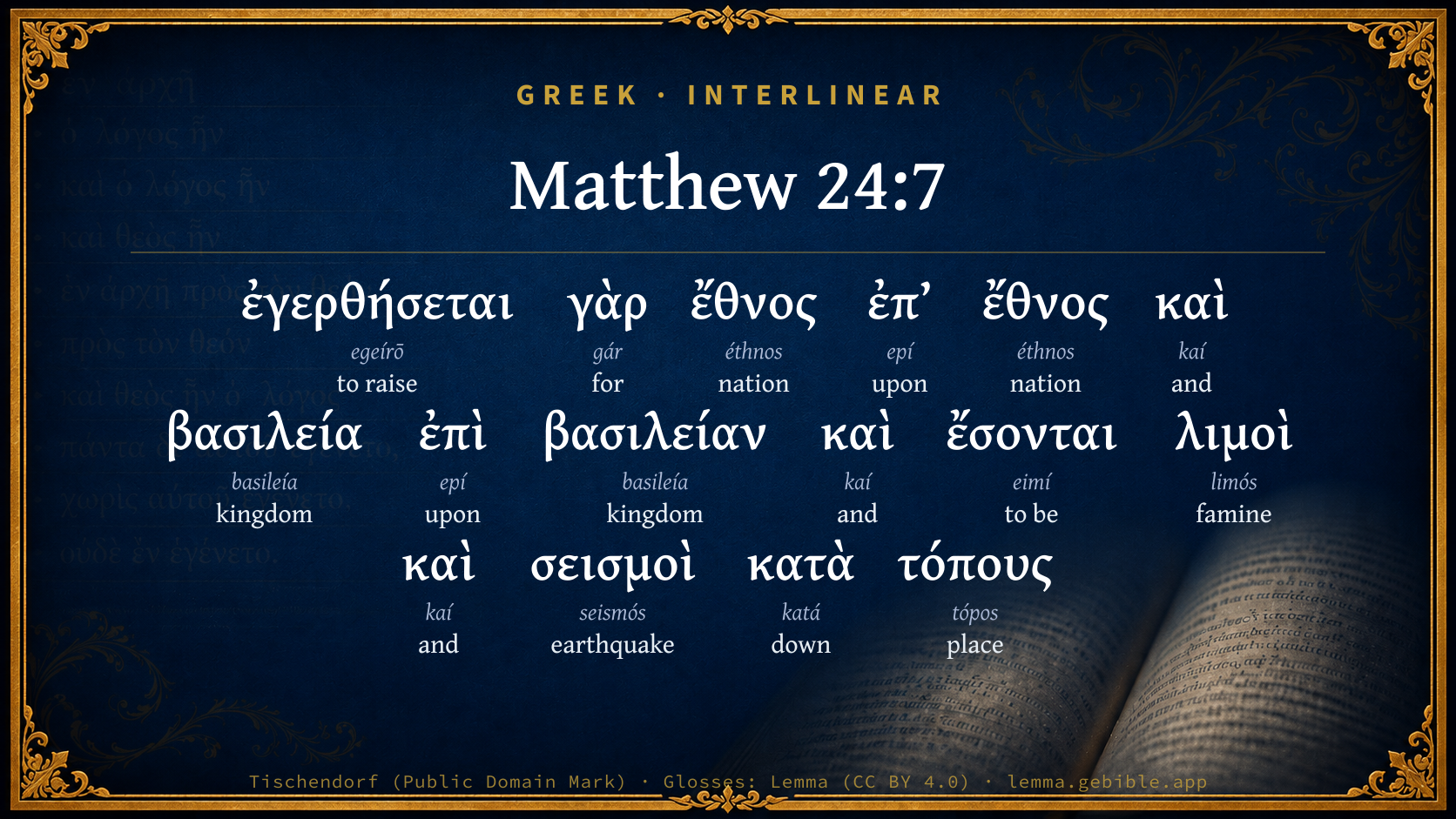
Greek (Tischendorf 8th ed.) Matthew 24:7 appears in the Greek New Testament. The text above is from the Tischendorf 8th edition. Each word links to its Strong’s number and a concise gloss. Click any word for its full Thayer’s Greek Lexicon entry.
Download image
Cite this verse

Matthew 24:7 (World English Bible). Public Domain. Lemma interlinear Bible study tool, https://lemma.gebible.app/v/matthew/24/7.

Show BibTeX & RIS
BibTeX
RIS
English Translation
For nation will rise against nation, and kingdom against kingdom; and there will be famines, plagues, and earthquakes in various places.
World English Bible · Public Domain
Highlights
  • 1 first appearance in the Greek New Testament
Full analysis ↓
Download a study sheet

One document with this verse’s original text, its word-by-word gloss line, the meaning frame, cross-references with their text, attributed commentary, and full source and license credits — printable, and it pastes into notes with its structure intact.

This verse Autodidact and up

Study sheet (.html) Plain text (.txt)

A passage Seminary Student

Up to 50 verses in one chapter. A passage sheet keeps up to 6 commentary sources and 12 cross-references per verse, in the order this page ranks them, and says so on the sheet whenever that leaves anything out. Ask for a single verse and you get the Autodidact verse sheet above.

Everything on this page stays free to read, with no account — the sheet is a download of what is already on screen, not access to it.

Want to remove ads? Support Godless Engineer
Compare translations 3

The same verse in 3 English versions, stacked beneath the original-language interlinear above. Click any original word for its lexicon entry.

Each is an independent rendering of the whole verse — the interlinear is not word-aligned to these translations.

Highlighted words mark where these versions differ — a whole-verse word diff, not a word-by-word alignment.

  • World English Bible Public Domain
    For nation will rise against nation, and kingdom against kingdom; and there will be famines, plagues, and earthquakes in various places.
  • King James Version Public Domain
    For nation shall rise against nation, and kingdom against kingdom: and there shall be famines, and pestilences, and earthquakes, in divers places.
  • unfoldingWord Literal Text CC BY-SA 4.0
    For nation will rise against nation, and kingdom against kingdom, and there will be famines and earthquakes in various places.

unfoldingWord Literal Text — © unfoldingWord, licensed CC BY-SA 4.0. Word-aligned USFM3 via Door43 (git.door43.org/unfoldingWord/en_ult).

Versions to compare (up to 4)

3 of 4 selected

Show all 19 translations

Every available English version of this verse, each an independent rendering of the whole verse.

  • World English Bible Public Domain
    For nation will rise against nation, and kingdom against kingdom; and there will be famines, plagues, and earthquakes in various places.
  • Berean Standard Bible Public Domain
    Nation will rise against nation, and kingdom against kingdom. There will be famines and earthquakes in various places.
  • Majority Standard Bible Public Domain
    Nation will rise against nation, and kingdom against kingdom. There will be famines, pestilences, and earthquakes in various places.
  • King James Version Public Domain
    For nation shall rise against nation, and kingdom against kingdom: and there shall be famines, and pestilences, and earthquakes, in divers places.
  • American Standard Version (1901) Public Domain
    For nation shall rise against nation, and kingdom against kingdom; and there shall be famines and earthquakes in divers places.
  • Revised Version (1885) Public Domain
    For nation shall rise against nation, and kingdom against kingdom: and there shall be famines and earthquakes in divers places.
  • Geneva Bible (1599) Public Domain
    For nation shall rise against nation, and realme against realme, and there shalbe famine, and pestilence, and earthquakes in diuers places.
  • Douay-Rheims (1899) Public Domain
    For nation shall rise against nation, and kingdom against kingdom; and there shall be pestilences, and famines, and earthquakes in places:
  • Young's Literal Translation Public Domain
    `For nation shall rise against nation, and kingdom against kingdom, and there shall be famines, and pestilences, and earthquakes, in divers places;
  • Literal Standard Version CC BY-SA 4.0
    For nation will rise against nation, and kingdom against kingdom, and there will be famines, and pestilences, and earthquakes, in various places;
  • Unlocked Literal Bible CC BY-SA 4.0
    For nation will rise against nation, and kingdom against kingdom. There will be famines and earthquakes in various places.
  • unfoldingWord Literal Text CC BY-SA 4.0
    For nation will rise against nation, and kingdom against kingdom, and there will be famines and earthquakes in various places.
  • Darby Bible Public Domain
    For nation shall rise up against nation, and kingdom against kingdom; and there shall be famines and pestilences, and earthquakes in divers places.
  • World Messianic Bible Public Domain
    For nation will rise against nation, and kingdom against kingdom; and there will be famines, plagues, and earthquakes in various places.
  • Webster's Bible Public Domain
    For nation will rise against nation, and kingdom against kingdom: and there will be famines, and pestilences, and earthquakes in divers places.
  • Free Bible Version CC BY-SA 4.0
    Nations will attack other nations, and kingdoms will fight against other kingdoms. There will be famines and earthquakes in various places,
  • Bible in Basic English Public Domain
    For nation will be moved against nation, and kingdom against kingdom, and men will be without food, and the earth will be shaking in different places;
  • Text-Critical English NT CC BY 4.0
    For nation will rise up against nation, and kingdom against kingdom. There will be famines, plagues, and earthquakes in various places.
  • Tyndale New Testament (1534) Public Domain
    For nacion shall ryse ageynste nacion and realme ageynste realme: and ther shalbe pestilence honger and erthquakes in all quarters.

Literal Standard Version (2020), Covenant Press — licensed CC BY-SA 4.0. Text via the HelloAO Bible API (eBible.org). Unlocked Literal Bible (unfoldingWord) — licensed CC BY-SA 4.0. Text via the HelloAO Bible API (eBible.org). unfoldingWord Literal Text — © unfoldingWord, licensed CC BY-SA 4.0. Word-aligned USFM3 via Door43 (git.door43.org/unfoldingWord/en_ult). Free Bible Version, Dr. Jonathan Gallagher — licensed CC BY-SA 4.0. Text via the HelloAO Bible API (eBible.org).

Word by word

More ways to search: Search by grammar → Find every occurrence → Compare this word →

Practice this passage: Drill this verse → Learn its vocabulary →

λιμοὶ
limós
G3042
“famine”
Noun, Nominative, Plural, Masculine
Part of Speech
Noun
Case
Nominative
Number
Plural
Gender
Masculine
Full Thayer's Definition

Origin: probably from G3007 (through the idea of destitution)

TDNT: 06:12,8

1. scarcity of harvest, famine
  1. ἐγερθήσεται egeírō G1453 “to raise” Verb, Future, Passive, Indicative, 3rd person, Singular
  2. γὰρ gár G1063 “for” Conjunction
  3. ἔθνος éthnos G1484 “nation” Noun, Nominative, Singular, Neuter
  4. ἐπ’ epí G1909 “upon” Preposition
  5. ἔθνος éthnos G1484 “nation” Noun, Accusative, Singular, Neuter
  6. καὶ kaí G2532 “and” Conjunction
  7. βασιλεία basileía G932 “kingdom” Noun, Nominative, Singular, Feminine
  8. ἐπὶ epí G1909 “upon” Preposition
  9. βασιλείαν basileía G932 “kingdom” Noun, Accusative, Singular, Feminine
  10. καὶ kaí G2532 “and” Conjunction
  11. ἔσονται eimí G1510 “to be” Verb, Future, Middle deponent, Indicative, 3rd person, Plural
  12. καὶ kaí G2532 “and” Conjunction
  13. σεισμοὶ seismós G4578 “earthquake” Noun, Nominative, Plural, Masculine
  14. κατὰ katá G2596 “down” Preposition
  15. τόπους tópos G5117 “place” Noun, Accusative, Plural, Masculine

About this verse

These counts appear in no published source. They are computed here, from the morphology-tagged text and Lemma’s own curated glosses. What Lemma adds →

16
words
11
distinct lemmas
Gospels
section

Notable vocabulary

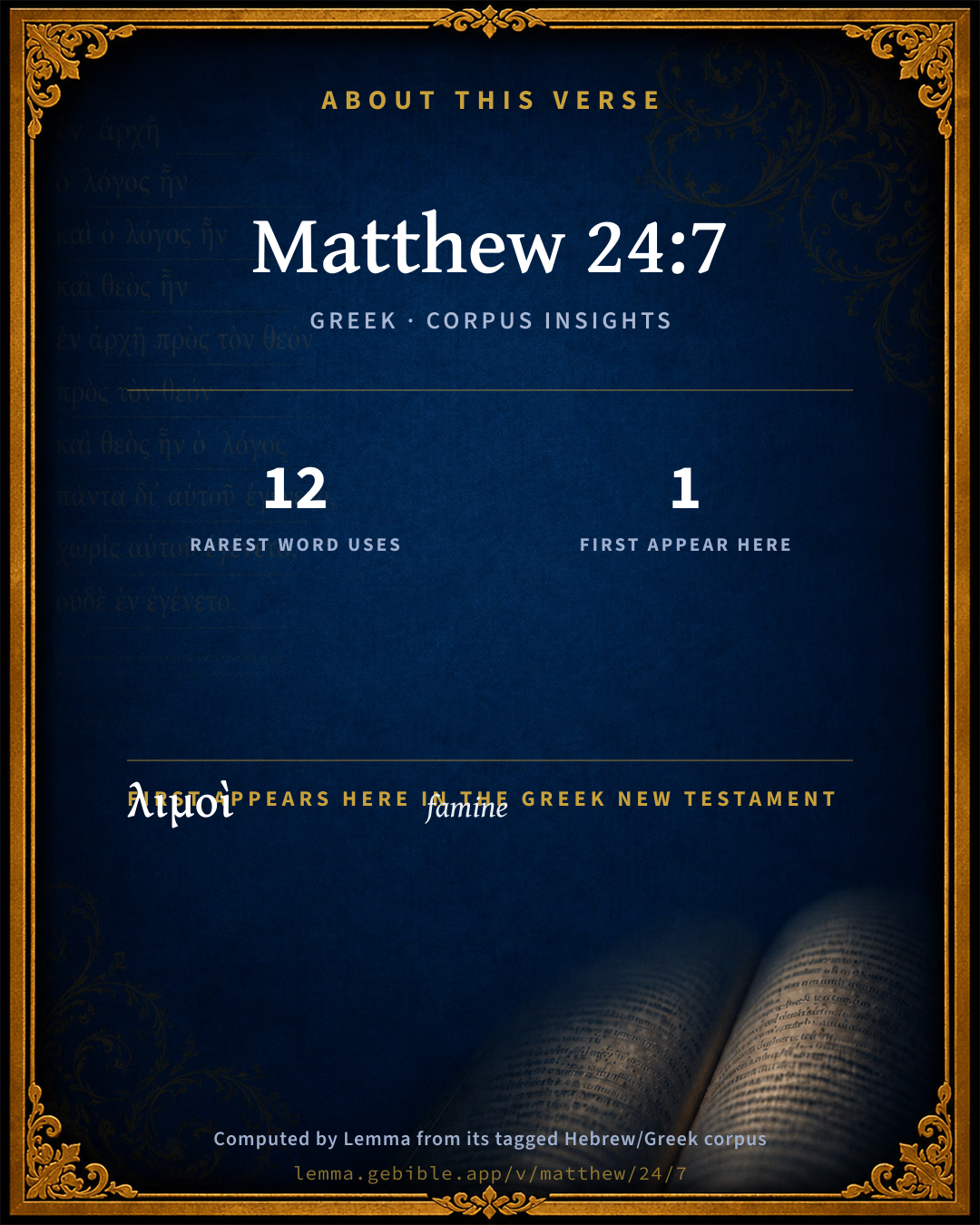
The rarest word here is λιμοὶ famine G3042 — appearing just 12 times in the whole Greek New Testament.

First appearance in Scripture

This word makes its first canonical appearance in the Greek New Testament here:

  • λιμοὶ famine G3042

Shared distinctive vocabulary

λιμοὶ famine G3042 occurs in 12 verses of the Greek New Testament. Also found in:
Repetition

Words recur within this verse:

  • ἔθνος nation G1484 ×2
  • ἐπ’ upon G1909 ×2
  • βασιλεία kingdom G932 ×2
  • καὶ and G2532 ×3

Cross-references

17

Topical passages linked to Matthew 24:7 in the Treasury of Scripture Knowledge — connected by theme and wording, ordered by reader-vote popularity; previews shown in the World English Bible.

  • Luke 21:11 There will be great earthquakes, famines, and plagues in various places. There will be terrors and great signs from heaven.
  • Revelation 6:8 And behold, a pale horse, and he who sat on it, his name was Death. Hades followed with him. Authority over one fourth of the earth, to kill with the sword, with famine, with death, and by the wild animals of the earth was given to him.
  • Isaiah 19:2 I will stir up the Egyptians against the Egyptians: and they shall fight everyone against his brother, and everyone against his neighbor; city against city, [and] kingdom against kingdom.
  • Zechariah 14:13 It will happen in that day, that a great panic from Yahweh will be among them; and they will lay hold everyone on the hand of his neighbor, and his hand will rise up against the hand of his neighbor.
  • 2 Chronicles 15:6 They were broken in pieces, nation against nation, and city against city; for God did vex them with all adversity.
  • Acts 11:28 One of them named Agabus stood up, and indicated by the Spirit that there should be a great famine all over the world, which also happened in the days of Claudius.
  • Revelation 6:12 I saw when he opened the sixth seal, and there was a great earthquake. The sun became black as sackcloth made of hair, and the whole moon became as blood.
  • Joel 2:30–31 I will show wonders in the heavens and in the earth: Blood, fire, and pillars of smoke.
  • Luke 21:25–26 There will be signs in the sun, moon, and stars; and on the earth anxiety of nations, in perplexity for the roaring of the sea and the waves;
  • Ezekiel 21:27 I will overturn, overturn, overturn it: this also shall be no more, until he come whose right it is; and I will give it [him].
  • Zechariah 14:2–4 For I will gather all nations against Jerusalem to battle; and the city will be taken, the houses rifled, and the women ravished. half of the city will go out into captivity, and the rest of the people will not be cut off from the city.
  • Hebrews 12:27 This phrase, "Yet once more," signifies the removing of those things that are shaken, as of things that have been made, that those things which are not shaken may remain.
  • Isaiah 24:19–23 The earth is utterly broken, the earth is torn apart, the earth is shaken violently.
  • Ezekiel 14:21 For thus says the Lord Yahweh: How much more when I send my four sore judgments on Jerusalem, the sword, and the famine, and the evil animals, and the pestilence, to cut off from it man and animal!
  • Haggai 2:21–22 "Speak to Zerubbabel, governor of Judah, saying, 'I will shake the heavens and the earth.
  • Isaiah 9:19–21 Through the wrath of Yahweh of hosts is the land burnt up; and the people are as the fuel of fire: no man spares his brother.
  • Acts 2:19 I will show wonders in the sky above, And signs on the earth beneath; Blood, and fire, and billows of smoke.

Cross-references courtesy of OpenBible.info (CC BY 4.0).

Where the printed editions differ

1 variant

Places in this verse where the major printed Greek editions disagree on the wording in a way that affects the translation — a comparison of editions, not a manuscript-by-manuscript collation. The editions are the modern critical texts (Nestlé-Aland 28/27, SBL, Westcott-Hort, Tregelles, Tyndale House) and the traditional texts behind the KJV (the Textus Receptus and the Byzantine/Majority text). It is not a claim about which reading is original.

  1. Extra text
    καὶ λοιμοὶ

    “and pestilences”

    In TRByz Not in NA28NA27TynSBLWHTreg

    καὶ λοιμοὶ (kai loimoi) 'and pestilences' is only in traditional manuscripts (TR+Byz)

Textual data: Translators Amalgamated Greek New Testament (STEPBible TAGNT) · CC BY 4.0.

Commentary

Notes on Matthew 24:7 from classic Christian and Jewish commentators (each source and its license shown beneath its notes). The classic Christian expositions comment on the surrounding passage and are grouped to its opening verse, so a note may address several verses; the Jewish commentaries on the Tanakh (Rashi and others) are per-verse, so they appear only where the commentator wrote on this verse.

Lemma curates 59 commentaries, every one of them public domain or Creative Commons licensed, each selected and text-cleaned for this edition rather than reprinted as found. About our sources →

The Biblical Illustrator

Joseph S. Exell

Mat_24:7

For nation shall rise against nation.

War for those who reject peace

See here the woeful effects of refusing Gods free offers of grace. They that would have none of the gospel of peace shall have the miseries of war. They that loathed the heavenly manna shall be hunger-starved. They that despised the only medicine of their souls shall be visited with the pestilence. They that would not suffer heart-quake shall suffer earthquake. Or, as Bradford, the martyr, expresses it, they that trembled not in hearing shall be crushed to pieces in feeling. As they heap up sin, as they treasure up wrath, as there hath been a conjuncture of offences, so there shall be of their miseries. The black horse is at the heels of the red, and the pale of the black (Rev_6:4). God left not Pharaoh, that sturdy rebel, till He had beaten the breath out of his body, nor will He cease pursuing men with His plagues till they throw the traitors head over the wall. (John Trapp.)

War

The relations of Christianity to war are at first sight an extraordinary enigma. The Christian recognition of the right of mar was contained in Christianitys original recognition of nations, as constituting at the same time the division and the structure of the human world. Gathering up the whole world into one communion spiritually, the new universal society yet announced its coalescence with mankinds divisions politically; it was one body of one kind, in many bodies of another kind. It gathered up into itself, not only the unions, but the chasms of the human race, all that separated as well as all that united. In some schools of thought there is a jealousy of this national sentiment, as belonging to members of the Church Catholic, as if it were a sentiment of nature which grace had obliterated. Christianity does not abolish but purify nature. It may be said that the tie of country is not inculcated in the New Testament; which, on the other hand, speaks of us as members of the Church which it contemplates extending over the whole world. Hooker says that Scripture, by leaving out, does not condemn, but only sends us back to natural law and reason. The Christian Church adopted nations with their inherent rights; took them into her enclosure. But war is one of these rights, because, under the division of mankind into distinct nations, it becomes a necessity. Questions of right and justice must arise between these independent centres. Christianity does not admit but condemns the motives which lead to war-selfish ambition, rapacity; but the condemnation of one side is the justification of the other; these very motives give the right of resistance to one side. Individuals can settle their disputes peaceably by the fact of being under government; but nations are not governed by a power above them. The aim of the nation in going to war is exactly the same as that of an individual entering a court. It is the same force in principle, only in court it is superior to all opposition; in war it is a contending force, and as such only can assert its supremacy. So far we have been dealing with wars of self defence, which by no means exhaust the whole rationale of war. War is caused by progress, selfish greed, the instinctive movements of nations for alteration and improvement. We must distinguish the moral effects of war and the physical. There is one side of the moral character of war in special harmony with the Christian type; death for the sake of the body to which he belongs. This consecrates war; it is elevated by sacrifice. Is, then, war to be regarded as an accident of society, which may some day be got rid of, or as something vested in it?

I. It is said that the progress of society will put an end to war. But human nature consists of such varied contents that it is very difficult to say that any one principle, such as what we call progress, can control it. But if progress stops war on one side it makes it on another, and war is its instrument; nor does it provide any instrument by which nations can gain their rights. The natural remedy for war would seem to be a government of nations; this would be a universal empire, and can this be accomplished by progress?

II. Are we then to look for a cessation of war from the side of Christianity. It assumes the world as it is; it does not profess to provide another world for us to live in. It is not remedial to the whole human race, but only to those who accept it. Prophecy foresees the time when nations shall beat their spears into pruning-hooks; but this applies as much to the civil governments of the world. It foresees a reign of universal love, when men shall no longer act by terror and compulsion. A kingdom of peace there will be. But Christianity only sanctions war through the medium of national society, and the hypothesis of a world at discord with itself. In her own world war would be impossible.

III. Lastly, Christianity comes as the consoler of the sufferinss of war. (J. B. Mozley, D. D.)

The Biblical Illustrator, edited by Joseph S. Exell (c. 1880s–1900s) — public domain. Text from a community e-Sword module.

Whedon's Commentary on the Bible

Daniel D. Whedon

II. THE COMMOTIONS PRECEDING THE DESTRUCTION CONTRASTED WITH THE MILLENNIAL EVANGELIZATION PREVIOUS TO THE END, Mat_24:7-14

Our Lord farther cautions the disciples that the ensuing troubles are not the tribulation preceding the end, from the fact that the Gospel must have a universal sway before the world ends. Christ has not come into the world for nothing. His Gospel, his doctrines, and his religion, as well as his atonement, are calculated for the world. And as the atonement is for all the race, so the preached Gospel is for all the world. Hence the disciples, in supposing that the end of the world was nigh at hand, and confounding the tribulation of Jerusalem with the tribulation that precedes the end of the world, were destroying the true length and breadth of the Christian dispensation.

7. For — Our Lord now proceeds to show what he means by saying that all these things must be. Commotions will spring up, both moral and physical.

Daniel D. Whedon (gen. ed.), Commentary on the Old and New Testaments (1874–1909) — public domain. Text from a community e-Sword module.

Bengel's Gnomon

Johann Albrecht Bengel

Mat 24:7. Ἐγερθήσεται, shall be roused) sc. after a period of greater peace.—ἔθνος, κ.τ.λ., nation, etc.) even beyond the limits of Judea.—λιμαὶ, καὶ λοιμοὶ, καὶ σεισμοὶ, famines, and pestilences, and earthquakes) Almost all matters treated of in the Novellæ, may be referred to one or the other of these classes, though historians frequently regard such things less than the deeds of men.—κατὰ τόπος, in divers places) There always have been pestilences, etc., but not of such frequent occurrence.

Bengel's Gnomon of the New Testament — English translation (T&T Clark, Edinburgh, 1860) — public domain. Text from a community e-Sword module.

Meyer's Critical & Exegetical Commentary

Heinrich August Wilhelm Meyer

Mat_24:7. Γάρ] it is not quite the end as yet; for the situation will become still more turbulent and distressing: nation will rise against nation, and kingdom against kingdom, etc. We have here depicted in colours borrowed from ancient prophecy (Isa_19:2), not only those risings, becoming more and more frequent, which, after a long ferment, culminated in the closing scene of the Jewish war and led to the destruction of Jerusalem, but also those convulsions in nature by which they were accompanied. That this prediction was fulfilled in its general aspects is amply confirmed, above all, by the well-known accounts of Josephus; but we are forbidden by the very nature of genuine prophecy, which cannot and is not meant to be restricted to isolated points, either to assume or try to prove that such and such historical events are special literal fulfilments in concrete of the individual features in the prophetic outlook before us,although this has been attempted very recently, by Köstlin in particular. As for the Parthian wars and the risings that took place some ten years after in Gaul and Spain, they had no connection whatever with Jerusalem or Judaea. There is as little reason to refer (Wetstein) the πολέμους of Mat_24:6 to the war waged by Asinaeus and Alinaeus against the Parthians (Joseph. Antt. xviii. 9. 1), and the ἀκοὰς πολέμων to the Parthian declaration of war against King Izates of Adiabene (Joseph. Antt. xx. 3. 3), or to explain the latter (ἀκοὰς πολέμων) of the struggles for the imperial throne that had broken out after the death of Nero (Hilgenfeld). Jesus, who sees rising before Him the horrors of war and other calamities connected, Mat_24:15, with the coming destruction of Jerusalem, presents a picture of them to the view of His hearers. Comp. 4 Esdr. Mat_13:21; Sohar Chadasch, f. viii. 4 : Illo tempore bella in mundo excitabuntur; gens erit contra gentem, et urbs contra urbem: angustiae multae contra hostes Israelitarum innovabuntur. Beresch. Rabba, 42 f., 41. 1 : Si videris regna contra se invicem insurgentia tunc attende, et adspice pedem Messiae.

λιμοὶ κ. σεισμοί] see critical notes. Nor, again, is this feature in the prediction to be restricted to some such special famine as that which occurred during the reign of Claudius (Act_11:28), too early a date for our passage, and to one or two particular cases of earthquake which happened in remote countries, and with which history has made us familiar (such as that in the neighbourhood of Colossae, Oros. Hist. vii. 7, Tacit. Ann. xiv. 27, and that at Pompeii).

κατὰ τόπους] which is applicable only to σεισμοί, as in Mar_13:8, is to be taken distributively (Bernhardy, p. 240; Kühner, II. 1, p. 414): locatim, travelling from one district to another. The equally grammatical interpretation: in various localities here and there (Grotius, Wetstein, Raphel, Kypke, Baumgarten-Crusius, Köstlin, Bleek), is rather too feeble to suit the extraordinary character of the events referred to. In Mat_24:6-7, Dorner finds merely an embodiment of the thought: evangelium gladii instar dissecabit male conjuncta, ut vere jungat; naturae autem phaenomena concomitantia quasi depingent motus et turbines in spiritualibus orbibus orturos.

Meyer — Critical and Exegetical Commentary on the New Testament — English translation by Peter Christie, edited by Frederick Crombie (T&T Clark, 1880) — public domain. Text from a community e-Sword module.

Expositor's Greek Testament

ed. W. Robertson Nicoll

Mat 24:7 . urther development of the war-portent, possibly here the prophetic range of vision widens beyond the bounds of Palestine, yet not necessarily. In support of limiting the reference to Palestine Kypke quotes from Josephus words describing the zealots as causing strife between people and people, city and city, and involving the nation in civil war (B. J., iv., 6). λιμοὶ καὶ λοιμοί , famines and pestilences, the usual accompaniments of war, every way likely to be named together as in T. R. καὶ σεισμοὶ , and earthquakes, representing all sorts of unusual physical phenomena having no necessary connection with the political, but appealing to the imagination at such times, so heightening the gloom. Several such specified in commentaries ( vide, e.g. , Speaker’s C. , and Alford, from whom the particulars are quoted), but no stress should be laid on them. κατὰ τόπους : most take this as meaning not earthquakes passing from place to place (Meyer) but here and there, passim. vide Elsner and Raphel, who cite classic examples. Grotius enumerates the places where they occurred.

The Expositor's Greek Testament, edited by W. Robertson Nicoll (1897–1910) — public domain. Text from a community e-Sword module.

Geneva Bible (1599)

Geneva Bible translators

Everywhere.

Geneva Bible (1599) marginal notes — public domain. Text via Bolls.life.

Adam Clarke's Commentary

Verse 7. Nation shall rise against nation] This portended the dissensions, insurrections and mutual slaughter of the Jews, and those of other nations, who dwelt in the same cities together; as particularly at Caesarea, where the Jews and Syrians contended about the right of the city, which ended there in the total expulsion of the Jews, above 20,000 of whom were slain. The whole Jewish nation being exasperated at this, flew to arms, and burnt and plundered the neighbouring cities and villages of the Syrians, making an immense slaughter of the people. The Syrians, in return, destroyed not a less number of the Jews. At Scythopolis they murdered upwards of 13,000. At Ascalon they killed 2,500. At Ptolemais they slew 2000, and made many prisoners. The Tyrians also put many Jews to death, and imprisoned more: the people of Gadara did likewise; and all the other cities of Syria in proportion, as they hated or feared the Jews. As Alexandria the Jews and heathens fought, and 50,000 of the former were slain. The people of Damascus conspired against the Jews of that city, and, assaulting them unarmed, killed 10,000 of them. See Bishop Newton, and Dr. Lardner.

Kingdom against kingdom] This portended the open wars of different tetrarchies and provinces against each other.

1st. That of the Jews and Galileans against the Samaritans, for the murder of some Galileans going up to the feast of Jerusalem, while Cumanus was procurator.

2dly. That of the whole nation of the Jews against the Romans and Agrippa, and other allies of the Roman empire; which began when Gessius Florus was procurator.

3dly. That of the civil war in Italy, while Otho and Vitellius were contending for the empire.

It is worthy of remark, that the Jews themselves say, "In the time of the Messiah, wars shall be stirred up in the world; nation shall rise against nation, and city against city." Sohar Kadash. "Again, Rab. Eleasar, the son of Abina, said, When ye see kingdom rising against kingdom, then expect the immediate appearance of the Messiah." Bereshith Rabba, sect. 42.

The THIRD sign, pestilence and famine.

It is farther added, that There shall be famines, and pestilences] There was a famine foretold by Agabus, (Ac 11:28,) which is mentioned by Suetonius, Tacitus, and Eusebius; which came to pass in the days of Claudius Caesar, and was so severe at Jerusalem that Josephus says (Ant. b. xx. c. 2.) many died for lack of food. Pestilences are the usual attendants of famines: as the scarcity and badness of provisions generally produce epidemic disorders.

The FOURTH sign, earthquakes or popular commotions.

Earthquakes, in divers places.] If we take the word σεισμοι from σειω to shake, in the first sense, then it means particularly those popular commotions and insurrections which have already been noted; and this I think to be the true meaning of the word: but if we confine it to earthquakes, there were several in those times to which our Lord refers; particularly one at Crete in the reign of Claudius, one at Smyrna, Miletus, Chios, Samos. See Grotius. One at Rome, mentioned by Tacitus; and one at Laodicea in the reign of Nero, in which the city was overthrown, as were likewise Hierapolis and Colosse. See Tacit. Annal. lib. xii. and lib. xiv. One at Campania, mentioned by Seneca; and one at Rome, in the reign of Galba, mentioned by Suetonius in the life of that emperor. Add to all these, a dreadful one in Judea, mentioned by Josephus (War, b. iv. c. 4.) accompanied by a dreadful tempest, violent winds, vehement showers, and continual lightnings and thunders; which led many to believe that these things portended some uncommon calamity.

The FIFTH sign, fearful portents.

To these St. Luke adds that there shall be fearful sights and great signs from heaven (Lu 21:11.) Josephus, in his preface to the Jewish war, enumerates these.

1st. A star hung over the city like a sword; and a comet continued a whole year.

2d. The people being assembled at the feast of unleavened bread, at the ninth hour of the night, a great light shone about the altar and the temple, and this continued for half an hour.

3d. At the same feast, a cow led to sacrifice brought forth a lamb in the midst of the temple!

4th. The eastern gate of the temple, which was of solid brass, and very heavy, and could hardly be shut by twenty men, and was fastened by strong bars and bolts, was seen at the sixth hour of the night to open of its own accord!

5th. Before sun-setting there were seen, over all the country, chariots and armies fighting in the clouds, and besieging cities.

6th. At the feast of pentecost, when the priests were going into the inner temple by night, to attend their service, they heard first a motion and noise, and then a voice, as of a multitude, saying, LET US DEPART HENCE! 7th. What Josephus reckons one of the most terrible signs of all was, that one Jesus, a country fellow, four years before the war began, and when the city was in peace and plenty, came to the feast of tabernacles, and ran crying up and down the streets, day and night: "A voice from the east! a voice from the west! a voice from the four winds! a voice against Jerusalem and the temple! a voice against the bridegrooms and the brides! and a voice against all the people!" Though the magistrates endeavoured by stripes and tortures to restrain him, yet he still cried, with a mournful voice, "Wo, wo to Jerusalem!" And this he continued to do for several years together, going about the walls and crying with a loud voice: "Wo, wo to the city, and to the people, and to the temple!" and as he added, "Wo, wo to myself!" a stone from some sling or engine struck him dead on the spot!

It is worthy of remark that Josephus appeals to the testimony of others, who saw and heard these fearful things. Tacitus, a Roman historian, gives very nearly the same account with that of Josephus. Hist. lib. v.

Adam Clarke's Commentary on the Bible (1810–1826) — public domain. Text from a community e-Sword/MySword module.

Ellicott's Commentary for English Readers

(7) Nation shall rise against nation.—Some of the more memorable of these are recorded by Josephus: one at Seleucia, in which 50,000 Jews are said to have perished (Ant. xviii. 9, §§ 8, 9); others at Cæsarea, Scythopolis, Joppa, Ascalon, and Tyre (Wars 2:18); and the memorable conflict between Jews and Greeks at Alexandria, under Caligula, A.D. 38, of which we learn from Philo. The whole period was, indeed, marked by tumults of this kind.

Famines.—Of these we know that of which Agabus prophesied (Act_11:28), and which was felt severely, in the ninth year of Claudius, not only in Syria, but in Rome (Jos. Ant. xx. 2). Suetonius (Claud. c. 18) speaks of the reign of that emperor as marked by “continual scarcity.”

Pestilences.—The word is not found in the best MSS., and has probably been inserted from the parallel passage in Luk_21:11. It was, however, the inevitable attendant on famine, and the Greek words for the two (λιμὸς, and λοιμὸς, limos and loimos) were so like each other that the omission may possibly have been an error of transcription. A pestilence is recorded as sweeping off 30,000 persons at Rome (Sueton. Nero, 39; Tacitus, Ann. xvi. 13).

Earthquakes, in divers places.—Perhaps no period in the world’s history has ever been so marked by these convulsions as that which intervenes between the Crucifixion and the destruction of Jerusalem. Josephus records one in Judæa (Wars, iv. 4, § 5); Tacitus tells of them in Crete, Rome, Apamea, Phrygia, Campania (Ann. xii. 58; xiv. 27; xv. 22); Seneca (Ep. 91), in A.D. 58, speaks of them as extending their devastations over Asia (the proconsular province, not the continent), Achaia, Syria, and Macedonia.

A Bible Commentary for English Readers, edited by Charles John Ellicott (1878–1897) — public domain. Text from a community e-Sword module.

The Cambridge Bible for Schools and Colleges

gen. ed. J. J. S. Perowne

7. famines, and pestilences, and earthquakes] The commentators enumerate instances of all these calamities recorded by the contemporary historians.

The Cambridge Bible for Schools and Colleges (gen. ed. J. J. S. Perowne; Cambridge University Press, 1878–1918) — public domain. Text from a community e-Sword module.

John Gill's Exposition

This seems to be a distinct and third sign, foreboding the general calamity of the Jews; that there should be not only seditions and intestine wars, in the midst of their country, but there should be wars in other nations, one with another; and with the Jews, and the Jews with them: and this also is made a sign of the Messiah's coming by them, for so they say (k);

"when thou seest, , "kingdoms stirred up one against another", look for the feet of the Messiah: know thou that so it shall be; for so it was in the days of Abraham: by the means of kingdoms stirred up one against another, redemption came to Abraham.''

Poor blinded creatures! when these very things were the forerunners of their destruction. And so it was, the Jewish nation rose up against others, the Samaritans, Syrians, and Romans: there were great commotions in the Roman empire, between Otho and Vitellius, and Vitellius and Vespasian; and at length the Romans rose up against the Jews, under the latter, and entirely destroyed them; compare the writings in 2 Esdras:

"And one shall undertake to fight against another, one city against another, one place against another, one people against another, and one realm against another.'' (2 Esdras 13:31)

"the beginning of sorrows and great mournings; the beginning of famine and great death; the beginning of wars, and the powers shall stand in fear; the beginning of evils! what shall I do when these evils shall come?'' (2 Esdras 16:18)

"Therefore when there shall be seen earthquakes and uproars of the people in the world:'' (2 Esdras 9:3)

And there shall be famines: a fourth sign of the desolation of the city and temple, and which the Jews also say, shall go before the coming of the Messiah:

"in the second year (of the week of years) in which the son of David comes, they say (l), there will be "arrows of famine" sent forth; and in the third year, , "a great famine": and men, women, and children, and holy men, and men of business, shall die.''

But these have been already; they followed the Messiah, and preceded their destruction: one of these famines was in Claudius Caesar's time, was foretold by Agabus, and is mentioned in Act 11:28 and most dreadful ones there were, whilst Jerusalem was besieged, and before its utter ruin, related by Josephus.

And pestilences: a pestilence is described by the Jews after this manner (m):

"a city that produces a thousand and five hundred footmen, as Cephar Aco, and nine dead men are carried out of it in three days, one after another, lo! , "this is a pestilence"; but if in one day, or in four days, it is no pestilence; and a city that produces five hundred footmen, as Cephar Amiko, and three dead men are carried out of it in three days, one after another, lo! this is a pestilence.''

These commonly attend famines, and are therefore mentioned together; and when the one was, the other may be supposed sooner or later to be:

and earthquakes in divers places of the world; as, at Crete (n), and in divers cities in Asia (o), in the times of Nero: particularly the three cities of Phrygia, Laodicea, Hierapolis, and Colosse; which were near to each other, and are all said to perish this way, in his reign (p);

"and Rome itself felt a tremor, in the reign of Galba (q).''

(k) Bereshit Rabba, sect. 42. fol. 37. 1. (l) T. Bab. Sanhedrin, fol. 97. 1. Misn. Sota, c. 9. sect. 15. (m) T. Bab. Taanith, fol. 21. & 19. 1. Maimon. Hilch. Taaniot, c. 2. sect. 5. (n) Philostrat. in vit. Apollon. l. 4. c. 11. (o) Sueton. in vit. Nero, c. 48. (p) Orosius, l. 7. c. 7. (q) Sueton. in vit. Galba, c. 13.

John Gill's Exposition of the Whole Bible (1746–1763) — public domain (CC PDM 1.0). Text via the HelloAO Bible API.

Trapp's Complete Commentary

John Trapp

7 For nation shall rise against nation, and kingdom against kingdom: and there shall be famines, and pestilences, and earthquakes, in divers places.

Ver. 7. For nation shall rise, &c.] See here the woeful effects of refusing God’s free offers of grace. They that would have none of the gospel of peace shall have the miseries of war. They that loathed the heavenly manna shall be hungerstarved. They that despised the only medicine of their souls shall be visited with the pestilence. They that would not suffer heart quake, shall suffer earthquake. Or as Bradford the martyr expresseth it, they that trembled not in hearing, shall be crushed to pieces in feeling. As they heap up sin, so they treasure up wrath; as there hath been a conjuncture of offences, so there shall be of their miseries. The black horse is at the heels of the red, and the pale of the black, Rev 6:4. God left not Pharaoh, that sturdy rebel, till he had beaten the breath out of his body, nor will he cease pursuing men with his plagues, one in the neck of another, till they throw the traitor’s head over the wall.

John Trapp, A Commentary or Exposition upon All the Books of the Old and New Testament (1647–1656) — public domain. Text from a community e-Sword module.

Albert Barnes' Notes on the Bible

Nation shall rise against nation, and kingdom against kingdom - At Caesarea the Jews and Syrians contended about the right to the city, and twenty thousand of the Jews were slain. At this blow the whole nation of the Jews was exasperated, and carried war and desolation through the Syrian cities and villages. Sedition and civil war spread throughout Judea; Italy was also thrown into civil war by the contests between Otho and Vitellius for the crown.

And there shall be famines - There was a famine foretold by Agabus Act 11:28, which is mentioned by Tacitus, Suetonius, and Eusebius, and which was so severe in Jerusalem, Josephus says, that many people perished for want of food, Antiq. xx. 2. Four times in the reign of Claudius (41-54 a.d.) famine prevailed in Rome, Palestine, and Greece.

Pestilences - Raging epidemic diseases; the plague, sweeping off multitudes of people at once. It is commonly the attendant of famine, and often produced by it. A pestilence is recorded as raging in Babylonia, 40 a.d. (Josephus, Antiq. xviii. 9. 8); in Italy, 66 a.d. (Tacitus 16. 13). Both of these took place before the destruction of Jerusalem.

Earthquakes - In prophetic language, earthquakes sometimes mean political commotions. Literally, they are tremors or shakings of the earth, often shaking cities and towns to ruin. The earth opens, and houses and people sink indiscriminately to destruction. Many of these are mentioned as preceding the destruction of Jerusalem. Tacitus mentions one in the reign of Claudius, at Rome, and says that in the reign of Nero the cities of Laodicea, Hierapolis, and Colosse were overthrown, and the celebrated Pompeii was overwhelmed and almost destroyed by an earthquake, Annales, 15. 22. Others are mentioned as occurring at Smyrna, Miletus, Chios, and Samos. Luke adds, “And fearful sights and great signs shall there be from heaven,” Luk 21:11. Josephus, who had probably never heard of this prophecy, and who certainly would have done nothing designedly to show its fulfillment, records the prodigies and signs which He says preceded the destruction of the city.

A star, says he, resembling a sword, stood over the city, and a comet that continued a whole year. At the feast of unleavened bread, during the night, a bright light shone round the altar and the temple, so that it seemed to be bright day, for half an hour. The eastern gate of the temple, of solid brass, fastened with strong bolts and bars, and which had been shut with difficulty by twenty men, opened in the night of its own accord. A few days after that feast, He says, “Before sunsetting, chariots and troops of soldiers in their armor were seen running about among the clouds, and surrounding of cities.” A great noise, as of the sound of a multitude, was heard in the temple, saying, “Let us remove hence.” Four years before the war began, Jesus, the son of Ananus, a plebeian and a husbandman, came to the feast of the tabernacles when the city was in peace and prosperity, and began to cry aloud, “A voice from the east, a voice from the west, a voice from the four winds, a voice against Jerusalem and the holy house, a voice against the bridegroom and the brides, and a voice against this whole people!” He was scourged, and at every stroke of the whip He cried, “Woe, woe to Jerusalem!” This cry, Josephus says, was continued every day for more than seven years, until He was killed in the siege of the city, exclaiming, “Woe, woe to myself also!” - Jewish Wars, b. 6 chapter 9, section 3.

Albert Barnes' Notes on the Bible (1834–1885) — public domain. Text from a community e-Sword/MySword module.

Haydock's Catholic Bible Commentary

And there shall be, according to the proverb, Greek: loimos meta limon, plague after famine, both natural daughters of war, with intestine divisions, earthquakes, and other calamities; the third sign. ... As the bodies of men generally grow weak and faint previous to dissolution, so will it be with the earth before the destruction of the world; so that this inferior globe will be shaken with unusual convulsions, as if making its last effort for existence. The air filled with destructive vapours will turn to the ruin of men, and the earth exhausted of its natural fertility, will refuse its accustomed support to the sons of Adam. Hence will arise wars and famines, insurrections, rebellions, and mobs; some driven on by famine and want, others by ambition and avarice. But if the corrupted heart of man shall refuse to depart from its evil ways, these calamities shall be increased; for all these are only the beginnings of more dreadful sorrows. (Origen)

George Leo Haydock (1774–1849), Haydock's Catholic Family Bible and Commentary, 1859 edition — public domain. Excludes Psalms (Douay-Rheims chapter numbering differs from Protestant) and Deuterocanonical books (Catholic canon only).

The Pulpit Commentary

Nation shall rise against nation, etc. This part of the prediction is inapplicable to the era preceding the ruin of Jerusalem, the disturbances that occurred then (e.g. at Alexandria, Seleucia, Jamnia, and other localities mentioned by Josephus, "Ant.," 18:9. 8, 9; "Bell. Jud:," 2:17:10 18:1-8 4:3:2; and by Philo, "Legat. ad Caium," could hardly have been indicated in such grand terms. More to the purpose is the sketch of the period given by Tacitus, at the opening of his history, though it embraces also details belonging to a somewhat later age: "I enter upon a work fertile in vicissitudes, stained with the blood of battles, embroiled with dissensions, horrible even in the intervals of peace. Four princes slain by the sword; three civil wars, more with foreign enemies, and sometimes both at once; prosperity in the East, disasters in the West; Illyricum disturbed; the Gauls ready to revolt; Britain conquered, and again lost; Sarmatians end Suevians conspiring against us; the Dacians renowned for defeats given and sustained; the Parthians almost aroused to arms by a counterfeit Nero. Italy afflicted with calamities unheard of, or recurring only after a long interval; cities overwhelmed or swallowed up in the fertile region of Campania; Rome itself laid waste by fire, the most ancient temples destroyed, the very capitol burned by its own citizens," etc. ("Hist.," I 2). But the Lord"s words seem to refer to times when Rome"s dominion had ceased, and nation warred against nation, as in later and modem days in Europe, Asia, and parts of Africa So again the prediction must be extended far beyond events in the Jewish cycle. Famines. Besides the famine mentioned in Act_11:28, there were others in Jerusalem and Judaea (Josephus, "Ant.," 3:15. 3; 20:2.6; 4. 2; "Bell. Jud.," yd. 3. 3). Suetonius ("Claud.," 18) speaks of "assiduas sterilitates;" and Tacitus ("Ann.," 12:43) records as happening at the same period, "frugum egestas, et orta ex eo fames." And pestilences; as consequent on famine. Hence the Greek paronomasia, limoi kai lamoi , in our text. But many editors expunge limoi , considering it, with some reason, to have been introduced from the parallel passage in St. Luke, where it is certainly genuine. Of pestilences we have notice in Josephus, ("Bell. Jud:," 4:6, 1) in Tacitus ("Ann.," 14:16), and Suetonius ("Nero," 39), where we read that at Rome in a single autumn thirty thousand persons perished. Wordsworth refers to Tertullian ("Apol.," 20.), Who sees in these predictions infallible proof of the inspiration of Scripture. "Hence it is that we come to be so certain of many things not yet come to pass, from the experience we have of those that are; because those were presignified by the same Spirit with these which we see fulfilling every day" (Reeve). Earthquakes. Commentators relate the occurrence of such commotions at Rome, in Crete, Laodicea, Campania, etc., and at Jerusalem (Josephus, "Bell. Jud:," 4:4:5; Tacitus, "Ann.," 12:43, 58; 14:27; 15:22; Seneca, "Ep.," 91. 9; Philostraius, "Vit. Apollon.," 4:34; Zonaras, "Ann.," 11:10). Nosgen takes the term "earthquakes" in a metaphorical sense as equivalent to taracai , and implying mental perturbations; but it seems incongruous to admit a metaphysical prognostication in the midst of a notice of a series of material phenomena. In divers places; kata topouv : per loca (Vulgate). Some render the words, "in all places," ubivis locorum, as in Luk_2:41, kat etov , "every year." But it is better to take the preposition distributively, "place by place," like kat andra : so equivalent to "here and there."

The Pulpit Commentary (1880–1919), ed. H.D.M. Spence-Jones & Joseph S. Exell — public domain. Text from a community e-Sword module.

Cambridge Greek Testament for Schools and Colleges

7. καὶ λοιμοί, omitted after λιμοί. Probably an insertion from Luke, not in the oldest MSS.

7. λιμοὶ καὶ σεισμοὶ κατὰ τόπους. The commentators enumerate instances of all these calamities recorded by the contemporary historians.

Cambridge Greek Testament for Schools and Colleges (Cambridge University Press, 1896; 21 vols, various authors incl. Carr, Maclear, Plummer, Farrar, Lumby, Moule, M. R. James, Simcox) — public domain. Text from a community e-Sword module.

International Critical Commentary

(M) 7. For nation shall rise against nation, and kingdom against kingdom: and there shall be famines, and earthquakes, in divers places.] Mk. has: “For nation shall rise against nation, and kingdom against kingdom. There shall be earthquakes in divers places. There shall be famines.” Mt. smooths the jerky style of Mk. by adding particles.

International Critical Commentary — older volumes (1896–1929), various authors — public domain. Text from a community e-Sword module.

Lesson kit

Teaching starters — assembled from the data on this page, not authored interpretation. Every prompt links to the verse data it draws on. Edit before teaching.

Matthew, in the Gospels, opens this verse with 16 words (11 distinct Greek lemmas). Its most distinctive word is limós (“famine”). A historical commentator’s framing appears above. Read the whole chapter for the surrounding context.

Discussion questions

  1. How does “famine” (limós) shape what this verse is saying?
  2. This is the first place “famine” appears in Scripture (first appears here). What does its debut here establish?
  3. How does Mark 13:8, which shares the word «famine», read alongside this verse?
  4. What does the repetition of “nation” (2× in this one verse) do in this verse?
  5. These translations render this verse differently. What is at stake in choosing one wording over another?
  6. Compare how The Biblical Illustrator and Whedon's Commentary on the Bible read this verse. Where do they agree or differ?

Things to notice

  • 1 word makes its first canonical appearance in Scripture here.
  • These translations choose different wording for 6 words in this verse.
  • “nation” occurs 2× in this single verse.
  • 11 distinct Greek lemmas span 16 words in this verse.

Reading settings

Reading text

Shown beneath each verse's original-language words.

Old Testament
Old Testament edition

Read the OT as the Masoretic Hebrew (MT) or the Greek Septuagint (LXX).

English shown for the Greek Septuagint (in the Hebrew ↔ Greek comparison).

Comparing translations? Open the Compare panel on any verse page to stack up to four side by side.