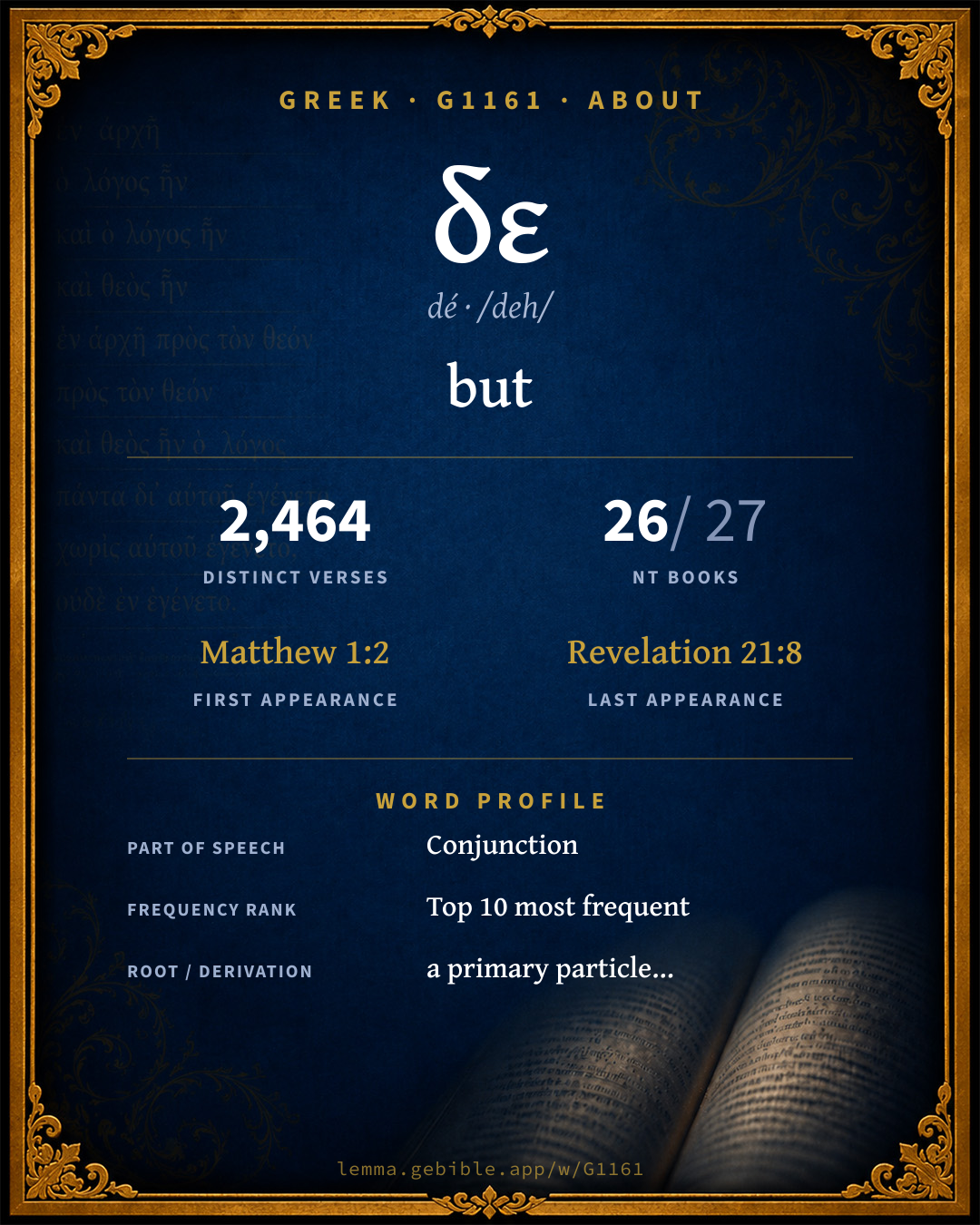
δέ
but
Full lexicon entry — Thayer's Greek Lexicon
From Thayer's Greek Lexicon
Where this word appears
Grammar key — what these labels mean
Part of speech
- Conjunction
- A joining word linking words or clauses.
Page 1 of 3 — showing verses 1–200 of 433 distinct verses where G1161 appears in the Book of Matthew. Click any verse to open its interlinear word-by-word view. Verse text shown in the World English Bible for context — . Each verse’s Greek form is shown with its reference; the English is not keyword-highlighted, since the data carries no word-level English alignment. Use “Compare translations” on any verse to read it across multiple English versions. This concordance covers the Greek New Testament; Septuagint (Greek Old Testament) occurrences of this word are not indexed here.
Matthew
- Matthew 1:2 δὲ δὲ conj conj Abraham became the father of Isaac. Isaac became the father of Jacob. Jacob became the father of Judah and his brothers.
- Matthew 1:3 δὲ δὲ δὲ conj conj conj Judah became the father of Perez and Zerah by Tamar. Perez became the father of Hezron. Hezron became the father of Ram.
- Matthew 1:4 δὲ δὲ δὲ conj conj conj Ram became the father of Amminadab. Amminadab became the father of Nahshon. Nahshon became the father of Salmon.
- Matthew 1:5 δὲ δὲ δὲ conj conj conj Salmon became the father of Boaz by Rahab. Boaz became the father of Obed by Ruth. Obed became the father of Jesse.
- Matthew 1:6 δὲ δὲ conj conj Jesse became the father of David the king. David became the father of Solomon by her who had been the wife of Uriah.
- Matthew 1:7 δὲ δὲ δὲ conj conj conj Solomon became the father of Rehoboam. Rehoboam became the father of Abijah. Abijah became the father of Asa.
- Matthew 1:8 δὲ δὲ δὲ conj conj conj Asa became the father of Jehoshaphat. Jehoshaphat became the father of Joram. Joram became the father of Uzziah.
- Matthew 1:9 δὲ δὲ δὲ conj conj conj Uzziah became the father of Jotham. Jotham became the father of Ahaz. Ahaz became the father of Hezekiah.
- Matthew 1:10 δὲ δὲ δὲ conj conj conj Hezekiah became the father of Manasseh. Manasseh became the father of Amon. Amon became the father of Josiah.
- Matthew 1:11 δὲ conj Josiah became the father of Jechoniah and his brothers, at the time of the exile to Babylon.
- Matthew 1:12 δὲ δὲ conj conj After the exile to Babylon, Jechoniah became the father of Shealtiel. Shealtiel became the father of Zerubbabel.
- Matthew 1:13 δὲ δὲ δὲ conj conj conj Zerubbabel became the father of Abiud. Abiud became the father of Eliakim. Eliakim became the father of Azor.
- Matthew 1:14 δὲ δὲ δὲ conj conj conj Azor became the father of Sadoc. Sadoc became the father of Achim. Achim became the father of Eliud.
- Matthew 1:15 δὲ δὲ δὲ conj conj conj Eliud became the father of Eleazar. Eleazar became the father of Matthan. Matthan became the father of Jacob.
- Matthew 1:16 δὲ conj Jacob became the father of Joseph, the husband of Mary, from whom was born Jesus, who is called Christ.
- Matthew 1:18 δὲ conj Now the birth of Jesus Christ was like this; for after his mother, Mary, was engaged to Joseph, before they came together, she was found pregnant by the Holy Spirit.
- Matthew 1:19 δὲ conj Joseph, her husband, being a righteous man, and not willing to make her a public example, intended to put her away secretly.
- Matthew 1:20 δὲ conj But when he thought about these things, behold, an angel of the Lord appeared to him in a dream, saying, "Joseph, son of David, don't be afraid to take to yourself Mary, your wife, for that which is conceived in her is of the Holy Spirit.
- Matthew 1:21 δὲ conj She shall bring forth a son. You shall call his name Jesus, for it is he who shall save his people from their sins."
- Matthew 1:22 δὲ conj Now all this has happened, that it might be fulfilled which was spoken by the Lord through the prophet, saying,
- Matthew 1:24 δὲ conj Joseph arose from his sleep, and did as the angel of the Lord commanded him, and took his wife to himself;
- Matthew 2:1 δὲ conj Now when Jesus was born in Bethlehem of Judea in the days of Herod the king, behold, wise men from the east came to Jerusalem, saying,
- Matthew 2:3 δὲ conj When Herod the king heard it, he was troubled, and all Jerusalem with him.
- Matthew 2:5 δὲ conj They said to him, "In Bethlehem of Judea, for thus it is written through the prophet,
- Matthew 2:8 δὲ conj He sent them to Bethlehem, and said, "Go and search diligently for the young child. When you have found him, bring me word, so that I also may come and worship him."
- Matthew 2:9 δὲ conj They, having heard the king, went their way; and behold, the star, which they saw in the east, went before them, until it came and stood over where the young child was.
- Matthew 2:10 δὲ conj When they saw the star, they rejoiced with exceedingly great joy.
- Matthew 2:13 δὲ conj Now when they had departed, behold, an angel of the Lord appeared to Joseph in a dream, saying, "Arise and take the young child and his mother, and flee into Egypt, and stay there until I tell you, for Herod will seek the young child to destroy him."
- Matthew 2:14 δὲ conj He arose and took the young child and his mother by night, and departed into Egypt,
- Matthew 2:19 δὲ conj But when Herod was dead, behold, an angel of the Lord appeared in a dream to Joseph in Egypt, saying,
- Matthew 2:21 δὲ conj He arose and took the young child and his mother, and came into the land of Israel.
- Matthew 2:22 δὲ δὲ conj conj But when he heard that Archelaus was reigning over Judea in the place of his father, Herod, he was afraid to go there. Being warned in a dream, he withdrew into the region of Galilee,
- Matthew 3:1 δὲ conj In those days, John the Baptizer came, preaching in the wilderness of Judea, saying,
- Matthew 3:4 δὲ δὲ conj conj Now John himself wore clothing made of camel's hair, with a leather belt around his waist. His food was locusts and wild honey.
- Matthew 3:7 δὲ conj But when he saw many of the Pharisees and Sadducees coming for his baptism, he said to them, "You offspring of vipers, who warned you to flee from the wrath to come?
- Matthew 3:10 δὲ conj "Even now the axe lies at the root of the trees. Therefore, every tree that doesn't bring forth good fruit is cut down, and cast into the fire.
- Matthew 3:11 δὲ conj I indeed baptize you in water for repentance, but he who comes after me is mightier than I, whose shoes I am not worthy to carry. He will baptize you in the Holy Spirit.
- Matthew 3:12 δὲ conj His winnowing fork is in his hand, and he will thoroughly cleanse his threshing floor. He will gather his wheat into the barn, but the chaff he will burn up with unquenchable fire."
- Matthew 3:14 δὲ conj But John would have hindered him, saying, "I need to be baptized by you, and you come to me?"
- Matthew 3:15 δὲ conj But Jesus, answering, said to him, "Allow it now, for this is the fitting way for us to fulfill all righteousness." Then he allowed him.
- Matthew 3:16 δὲ conj Jesus, when he was baptized, went up directly from the water: and behold, the heavens were opened to him. He saw the Spirit of God descending as a dove, and coming on him.
- Matthew 4:4 δὲ conj But he answered, "It is written, 'Man shall not live by bread alone, but by every word that proceeds out of the mouth of God.'"
- Matthew 4:12 δὲ conj Now when Jesus heard that John was delivered up, he withdrew into Galilee.
- Matthew 4:18 δὲ conj Walking by the sea of Galilee, he saw two brothers: Simon, who is called Peter, and Andrew, his brother, casting a net into the sea; for they were fishermen.
- Matthew 4:20 δὲ conj They immediately left their nets and followed him.
- Matthew 4:22 δὲ conj They immediately left the boat and their father, and followed him.
- Matthew 5:1 δὲ conj Seeing the multitudes, he went up onto the mountain. When he had sat down, his disciples came to him.
- Matthew 5:13 δὲ conj "You are the salt of the earth, but if the salt has lost its flavor, with what will it be salted? It is then good for nothing, but to be cast out and trodden under the feet of men.
- Matthew 5:19 δ’ conj Whoever, therefore, shall break one of these least commandments, and teach others to do so, shall be called least in the Kingdom of Heaven; but whoever shall do and teach them shall be called great in the Kingdom of Heaven.
- Matthew 5:21 δ’ conj "You have heard that it was said to the ancient ones, 'You shall not murder;' and 'Whoever shall murder shall be in danger of the judgment.'
- Matthew 5:22 δὲ δ’ δ’ conj conj conj But I tell you, that everyone who is angry with his brother without a cause shall be in danger of the judgment; and whoever shall say to his brother, 'Raca!' shall be in danger of the council; and whoever shall say, 'You fool!' shall be in danger of the fire of Gehenna.
- Matthew 5:28 δὲ conj but I tell you that everyone who gazes at a woman to lust after her has committed adultery with her already in his heart.
- Matthew 5:29 δὲ conj If your right eye causes you to stumble, pluck it out and throw it away from you. For it is more profitable for you that one of your members should perish, than for your whole body to be cast into Gehenna.
- Matthew 5:31 δέ conj "It was also said, 'Whoever shall put away his wife, let him give her a writing of divorce,'
- Matthew 5:32 δὲ conj but I tell you that whoever puts away his wife, except for the cause of sexual immorality, makes her an adulteress; and whoever marries her when she is put away commits adultery.
- Matthew 5:33 δὲ conj "Again you have heard that it was said to them of old time, 'You shall not make false vows, but shall perform to the Lord your vows,'
- Matthew 5:34 δὲ conj but I tell you, don't swear at all: neither by heaven, for it is the throne of God;
- Matthew 5:37 δὲ δὲ conj conj But let your 'Yes' be 'Yes' and your 'No' be 'no.' Whatever is more than these is of the evil one.
- Matthew 5:39 δὲ conj But I tell you, don't resist him who is evil; but whoever strikes you on your right cheek, turn to him the other also.
- Matthew 5:44 δὲ conj But I tell you, love your enemies, bless those who curse you, do good to those who hate you, and pray for those who mistreat you and persecute you,
- Matthew 6:1 δὲ δὲ conj conj "Be careful that you don't do your charitable giving before men, to be seen by them, or else you have no reward from your Father who is in heaven.
- Matthew 6:3 δὲ conj But when you do merciful deeds, don't let your left hand know what your right hand does,
- Matthew 6:6 δὲ conj But you, when you pray, enter into your inner chamber, and having shut your door, pray to your Father who is in secret, and your Father who sees in secret will reward you openly.
- Matthew 6:7 δὲ conj In praying, don't use vain repetitions, as the Gentiles do; for they think that they will be heard for their much speaking.
- Matthew 6:15 δὲ conj But if you don't forgive men their trespasses, neither will your Father forgive your trespasses.
- Matthew 6:16 δὲ conj "Moreover when you fast, don't be like the hypocrites, with sad faces. For they disfigure their faces, that they may be seen by men to be fasting. Most assuredly I tell you, they have received their reward.
- Matthew 6:17 δὲ conj But you, when you fast, anoint your head, and wash your face;
- Matthew 6:20 δὲ conj but lay up for yourselves treasures in heaven, where neither moth nor rust consume, and where thieves don't break through and steal;
- Matthew 6:23 δὲ conj But if your eye is evil, your whole body will be full of darkness. If therefore the light that is in you is darkness, how great is the darkness!
- Matthew 6:27 δὲ conj "Which of you, by being anxious, can add one cubit to the measure of his life?
- Matthew 6:29 δὲ conj yet I tell you that even Solomon in all his glory was not dressed like one of these.
- Matthew 6:30 δὲ conj But if God so clothes the grass of the field, which today exists, and tomorrow is thrown into the oven, won't he much more clothe you, you of little faith?
- Matthew 6:33 δὲ conj But seek first God's Kingdom, and his righteousness; and all these things will be given to you as well.
- Matthew 7:3 δὲ δὲ conj conj Why do you see the speck that is in your brother's eye, but don't consider the beam that is in your own eye?
- Matthew 7:15 δέ conj "Beware of false prophets, who come to you in sheep's clothing, but inwardly are ravening wolves.
- Matthew 7:17 δὲ conj Even so, every good tree produces good fruit; but the corrupt tree produces evil fruit.
- Matthew 8:1 δὲ conj When he came down from the mountain, great multitudes followed him.
- Matthew 8:5 δὲ conj When he came into Capernaum, a centurion came to him, asking him,
- Matthew 8:8 δὲ conj The centurion answered, "Lord, I'm not worthy for you to come under my roof. Just say the word, and my servant will be healed.
- Matthew 8:10 δὲ conj When Jesus heard it, he marveled, and said to those who followed, "Most assuredly I tell you, I haven't found so great a faith, not even in Israel.
- Matthew 8:11 δὲ conj I tell you that many will come from the east and the west, and will sit down with Abraham, Isaac, and Jacob in the Kingdom of Heaven,
- Matthew 8:12 δὲ conj but the children of the Kingdom will be thrown out into the outer darkness. There will be weeping and the gnashing of teeth."
- Matthew 8:16 δὲ conj When evening came, they brought to him many possessed with demons. He cast out the spirits with a word, and healed all who were sick;
- Matthew 8:18 δὲ conj Now when Jesus saw great multitudes around him, he gave the order to depart to the other side.
- Matthew 8:20 δὲ conj Jesus said to him, "The foxes have holes, and the birds of the sky have nests, but the Son of Man has nowhere to lay his head."
- Matthew 8:21 δὲ conj Another of his disciples said to him, "Lord, allow me first to go and bury my father."
- Matthew 8:22 δὲ conj But Jesus said to him, "Follow me, and leave the dead to bury their own dead."
- Matthew 8:24 δὲ conj Behold, a great tempest arose in the sea, so much that the boat was covered with the waves, but he was asleep.
- Matthew 8:27 δὲ conj The men marveled, saying, "What kind of man is this, that even the wind and the sea obey him?"
- Matthew 8:30 δὲ conj Now there was a herd of many pigs feeding far away from them.
- Matthew 8:31 δὲ conj The demons begged him, saying, "If you cast us out, permit us to go away into the herd of pigs."
- Matthew 8:32 δὲ conj He said to them, "Go!" They came out, and went into the herd of pigs: and behold, the whole herd of pigs rushed down the cliff into the sea, and died in the water.
- Matthew 8:33 δὲ conj Those who fed them fled, and went away into the city, and told everything, including what happened to those who were possessed with demons.
- Matthew 9:6 δὲ conj But that you may know that the Son of Man has authority on earth to forgive sins..." (then he said to the paralytic), "Get up, and take up your mat, and go up to your house."
- Matthew 9:8 δὲ conj But when the multitudes saw it, they marveled and glorified God, who had given such authority to men.
- Matthew 9:12 δὲ conj When Jesus heard it, he said to them, "Those who are healthy have no need for a physician, but those who are sick do.
- Matthew 9:13 δὲ conj But you go and learn what this means: 'I desire mercy, and not sacrifice,' for I came not to call the righteous, but sinners to repentance."
- Matthew 9:14 δὲ conj Then John's disciples came to him, saying, "Why do we and the Pharisees fast often, but your disciples don't fast?"
- Matthew 9:15 δὲ conj Jesus said to them, "Can the friends of the bridegroom mourn, as long as the bridegroom is with them? But the days will come when the bridegroom will be taken away from them, and then they will fast.
- Matthew 9:16 δὲ conj No one puts a piece of unshrunk cloth on an old garment; for the patch would tear away from the garment, and a worse hole is made.
- Matthew 9:17 δὲ conj Neither do people put new wine into old wineskins, or else the skins would burst, and the wine be spilled, and the skins ruined. No, they put new wine into fresh wineskins, and both are preserved."
- Matthew 9:22 δὲ conj But Jesus, turning around and seeing her, said, "Daughter, cheer up! Your faith has made you well." And the woman was made well from that hour.
- Matthew 9:25 δὲ conj But when the crowd was put out, he entered in, took her by the hand, and the girl arose.
- Matthew 9:28 δὲ conj When he had come into the house, the blind men came to him. Jesus said to them, "Do you believe that I am able to do this?" They told him, "Yes, Lord."
- Matthew 9:31 δὲ conj But they went out and spread abroad his fame in all that land.
- Matthew 9:32 δὲ conj As they went out, behold, a mute man who was demon possessed was brought to him.
- Matthew 9:34 δὲ conj But the Pharisees said, "By the prince of the demons, he casts out demons."
- Matthew 9:36 δὲ conj But when he saw the multitudes, he was moved with compassion for them, because they were harassed and scattered, like sheep without a shepherd.
- Matthew 9:37 δὲ conj Then he said to his disciples, "The harvest indeed is plentiful, but the laborers are few.
- Matthew 10:2 δὲ conj Now the names of the twelve apostles are these. The first, Simon, who is called Peter; Andrew, his brother; James the son of Zebedee; John, his brother;
- Matthew 10:6 δὲ conj Rather, go to the lost sheep of the house of Israel.
- Matthew 10:7 δὲ conj As you go, preach, saying, 'The Kingdom of Heaven is at hand!'
- Matthew 10:11 δ’ conj Into whatever city or village you enter, find out who in it is worthy; and stay there until you go on.
- Matthew 10:12 δὲ conj As you enter into the household, greet it.
- Matthew 10:13 δὲ conj If the household is worthy, let your peace come on it, but if it isn't worthy, let your peace return to you.
- Matthew 10:17 δὲ conj But beware of men: for they will deliver you up to councils, and in their synagogues they will scourge you.
- Matthew 10:18 δὲ conj Yes, and you will be brought before governors and kings for my sake, for a testimony to them and to the Gentiles.
- Matthew 10:19 δὲ conj But when they deliver you up, don't be anxious how or what you will say, for it will be given you in that hour what you will say.
- Matthew 10:21 δὲ conj "Brother will deliver up brother to death, and the father his child. Children will rise up against parents, and cause them to be put to death.
- Matthew 10:22 δὲ conj You will be hated by all men for my name's sake, but he who endures to the end will be saved.
- Matthew 10:23 δὲ conj But when they persecute you in this city, flee into the next, for most assuredly I tell you, you will not have gone through the cities of Israel, until the Son of Man has come.
- Matthew 10:28 δὲ δὲ conj conj Don't be afraid of those who kill the body, but are not able to kill the soul. Rather, fear him who is able to destroy both soul and body in Gehenna.
- Matthew 10:30 δὲ conj but the very hairs of your head are all numbered.
- Matthew 10:33 δ’ conj But whoever denies me before men, him I will also deny before my Father who is in heaven.
- Matthew 11:2 δὲ conj Now when John heard in the prison the works of Christ, he sent two of his disciples
- Matthew 11:7 δὲ conj As these went their way, Jesus began to say to the multitudes concerning John, "What did you go out into the wilderness to see? A reed shaken by the wind?
- Matthew 11:11 δὲ conj Most assuredly I tell you, among those who are born of women there has not arisen anyone greater than John the Baptizer; yet he who is least in the Kingdom of Heaven is greater than he.
- Matthew 11:12 δὲ conj From the days of John the Baptizer until now, the Kingdom of Heaven suffers violence, and the violent take it by force.
- Matthew 11:16 δὲ conj "But to what shall I compare this generation? It is like children sitting in the marketplaces, who call to their companions
- Matthew 12:1 δὲ conj At that time, Jesus went on the Sabbath day through the grain fields. His disciples were hungry and began to pluck heads of grain and to eat.
- Matthew 12:2 δὲ conj But the Pharisees, when they saw it, said to him, "Behold, your disciples do what is not lawful to do on the Sabbath."
- Matthew 12:3 δὲ conj But he said to them, "Haven't you read what David did, when he was hungry, and those who were with him;
- Matthew 12:6 δὲ conj But I tell you that one greater than the temple is here.
- Matthew 12:7 δὲ conj But if you had known what this means, 'I desire mercy, and not sacrifice,' you would not have condemned the guiltless.
- Matthew 12:11 δὲ conj He said to them, "What man is there among you, who has one sheep, and if this one falls into a pit on the Sabbath day, won't he grab on to it, and lift it out?
- Matthew 12:14 δὲ conj But the Pharisees went out, and conspired against him, how they might destroy him.
- Matthew 12:15 δὲ conj Jesus, perceiving that, withdrew from there. Great multitudes followed him; and he healed them all,
- Matthew 12:24 δὲ conj But when the Pharisees heard it, they said, "This man does not cast out demons, except by Beelzebul, the prince of the demons."
- Matthew 12:25 δὲ conj Knowing their thoughts, Jesus said to them, "Every kingdom divided against itself is brought to desolation, and every city or house divided against itself will not stand.
- Matthew 12:28 δὲ conj But if I by the Spirit of God cast out demons, then the Kingdom of God has come upon you.
- Matthew 12:31 δὲ conj Therefore I tell you, every sin and blasphemy will be forgiven men, but the blasphemy against the Spirit will not be forgiven men.
- Matthew 12:32 δ’ conj Whoever speaks a word against the Son of Man, it will be forgiven him; but whoever speaks against the Holy Spirit, it will not be forgiven him, neither in this age, nor in that which is to come.
- Matthew 12:36 δὲ conj I tell you that every idle word that men speak, they will give account of it in the day of judgment.
- Matthew 12:39 δὲ conj But he answered them, "An evil and adulterous generation seeks after a sign, but no sign will be given it but the sign of Jonah the prophet.
- Matthew 12:43 δὲ conj But the unclean spirit, when he is gone out of the man, passes through waterless places, seeking rest, and doesn't find it.
- Matthew 12:47 δέ conj One said to him, "Behold, your mother and your brothers stand outside, seeking to speak to you."
- Matthew 12:48 δὲ conj But he answered him who spoke to him, "Who is my mother? Who are my brothers?"
- Matthew 13:5 δὲ conj Others fell on rocky ground, where they didn't have much soil, and immediately they sprang up, because they had no depth of earth.
- Matthew 13:6 δὲ conj When the sun had risen, they were scorched. Because they had no root, they withered away.
- Matthew 13:7 δὲ conj Others fell among thorns. The thorns grew up and choked them:
- Matthew 13:8 δὲ δὲ δὲ conj conj conj and others fell on good soil, and yielded fruit: some one hundred times as much, some sixty, and some thirty.
- Matthew 13:11 δὲ δὲ conj conj He answered them, "To you it is given to know the mysteries of the Kingdom of Heaven, but it is not given to them.
- Matthew 13:12 δὲ conj For whoever has, to him will be given, and he will have abundance, but whoever doesn't have, from him will be taken away even that which he has.
- Matthew 13:16 δὲ conj "But blessed are your eyes, for they see; and your ears, for they hear.
- Matthew 13:20 δὲ conj What was sown on the rocky places, this is he who hears the word, and immediately with joy receives it;
- Matthew 13:21 δὲ δὲ conj conj yet he has no root in himself, but endures for a while. When oppression or persecution arises because of the word, immediately he stumbles.
- Matthew 13:22 δὲ conj What was sown among the thorns, this is he who hears the word, but the cares of this age and the deceitfulness of riches choke the word, and he becomes unfruitful.
- Matthew 13:23 δὲ δὲ δὲ conj conj conj What was sown on the good ground, this is he who hears the word, and understands it, who most assuredly bears fruit, and brings forth, some one hundred times as much, some sixty, and some thirty."
- Matthew 13:25 δὲ conj but while people slept, his enemy came and sowed darnel also among the wheat, and went away.
- Matthew 13:26 δὲ conj But when the blade sprang up and brought forth fruit, then the darnel appeared also.
- Matthew 13:27 δὲ conj The servants of the householder came and said to him, 'Sir, didn't you sow good seed in your field? Where did this darnel come from?'
- Matthew 13:28 δὲ δὲ conj conj "He said to them, 'An enemy has done this.' "The servants asked him, 'Do you want us to go and gather them up?'
- Matthew 13:29 δέ conj "But he said, 'No, lest perhaps while you gather up the darnel, you root up the wheat with them.
- Matthew 13:30 δὲ conj Let both grow together until the harvest, and in the harvest time I will tell the reapers, "First, gather up the darnel, and bind them in bundles to burn them; but gather the wheat into my barn."'"
- Matthew 13:32 δὲ conj which indeed is smaller than all seeds. But when it is grown, it is greater than the herbs, and becomes a tree, so that the birds of the air come and lodge in its branches."
- Matthew 13:37 δὲ conj He answered them, "He who sows the good seed is the Son of Man,
- Matthew 13:38 δὲ δὲ δὲ conj conj conj the field is the world; and the good seed, these are the children of the Kingdom; and the darnel are the children of the evil one.
- Matthew 13:39 δὲ δὲ δὲ conj conj conj The enemy who sowed them is the devil. The harvest is the end of the age, and the reapers are angels.
- Matthew 13:46 δὲ conj who having found one pearl of great price, he went and sold all that he had, and bought it.
- Matthew 13:48 δὲ conj which, when it was filled, they drew up on the beach. They sat down, and gathered the good into containers, but the bad they threw away.
- Matthew 13:52 δὲ conj He said to them, "Therefore, every scribe who has been made a disciple in the Kingdom of Heaven is like a man who is a householder, who brings out of his treasure new and old things."
- Matthew 13:57 δὲ conj They were offended by him. But Jesus said to them, "A prophet is not without honor, except in his own country, and in his own house."
- Matthew 14:6 δὲ conj But when Herod's birthday came, the daughter of Herodias danced among them and pleased Herod.
- Matthew 14:8 δὲ conj She, being prompted by her mother, said, "Give me here on a platter the head of John the Baptizer."
- Matthew 14:13 δὲ conj Now when Jesus heard this, he withdrew from there in a boat, to a deserted place apart. When the multitudes heard it, they followed him on foot from the cities.
- Matthew 14:15 δὲ conj When evening had come, his disciples came to him, saying, "This place is deserted, and the hour is already late. Send the multitudes away, that they may go into the villages, and buy themselves food."
- Matthew 14:16 δὲ conj But Jesus said to them, "They don't need to go away. You give them something to eat."
- Matthew 14:17 δὲ conj They told him, "We only have here five loaves and two fish."
- Matthew 14:18 δὲ conj He said, "Bring them here to me."
- Matthew 14:19 δὲ conj He commanded the multitudes to sit down on the grass; and he took the five loaves and the two fish, and looking up to heaven, he blessed, broke and gave the loaves to the disciples, and the disciples gave to the multitudes.
- Matthew 14:21 δὲ conj Those who ate were about five thousand men, besides women and children.
- Matthew 14:23 δὲ conj After he had sent the multitudes away, he went up into the mountain by himself to pray. When evening had come, he was there alone.
- Matthew 14:24 δὲ conj But the boat was now in the middle of the sea, distressed by the waves, for the wind was contrary.
- Matthew 14:25 δὲ conj In the fourth watch of the night, Jesus came to them, walking on the sea.
- Matthew 14:26 δὲ conj When the disciples saw him walking on the sea, they were troubled, saying, "It's a ghost!" and they cried out for fear.
- Matthew 14:27 δὲ conj But immediately Jesus spoke to them, saying "Cheer up! I AM! Don't be afraid."
- Matthew 14:28 δὲ conj Peter answered him and said, "Lord, if it is you, command me to come to you on the waters."
- Matthew 14:29 δὲ conj He said, "Come!" Peter stepped down from the boat, and walked on the waters to come to Jesus.
- Matthew 14:30 δὲ conj But when he saw that the wind was strong, he was afraid, and beginning to sink, he cried out, saying, "Lord, save me!"
- Matthew 14:31 δὲ conj Immediately Jesus stretched out his hand, took hold of him, and said to him, "You of little faith, why did you doubt?"
- Matthew 14:33 δὲ conj Those who were in the boat came and worshiped him, saying, "You are truly the Son of God!"
- Matthew 15:3 δὲ conj He answered them, "Why do you also disobey the commandment of God because of your tradition?
- Matthew 15:5 δὲ conj But you say, 'Whoever may tell his father or his mother, "Whatever help you might otherwise have gotten from me is a gift devoted to God,"
- Matthew 15:8 δὲ conj 'These people draw near to me with their mouth, And honor me with their lips; But their heart is far from me.
- Matthew 15:9 δὲ conj And in vain do they worship me, Teaching as doctrine rules made by men.'"
- Matthew 15:13 δὲ conj But he answered, "Every plant which my heavenly Father didn't plant will be uprooted.
- Matthew 15:14 δὲ conj Leave them alone. They are blind guides of the blind. If the blind guide the blind, both will fall into a pit."
- Matthew 15:15 δὲ conj Peter answered him, "Explain the parable to us."
- Matthew 15:16 δὲ conj So Jesus said, "Do you also still not understand?
- Matthew 15:18 δὲ conj But the things which proceed out of the mouth come out of the heart, and they defile the man.
About this entry
At a glance — auto-summarized from this page’s data, not written by a person. Every figure links to its source below. This summary describes the numbers; it doesn’t interpret them.
δε — transliterated dé — is a Greek conjunction carrying the sense “but.” Its earliest occurrence is Matthew 1:2. It appears 2,464 verses across 26 books of the Greek New Testament, among its most common vocabulary. It shares a root with δη. Each statement above links to its evidence; the full detail follows below.
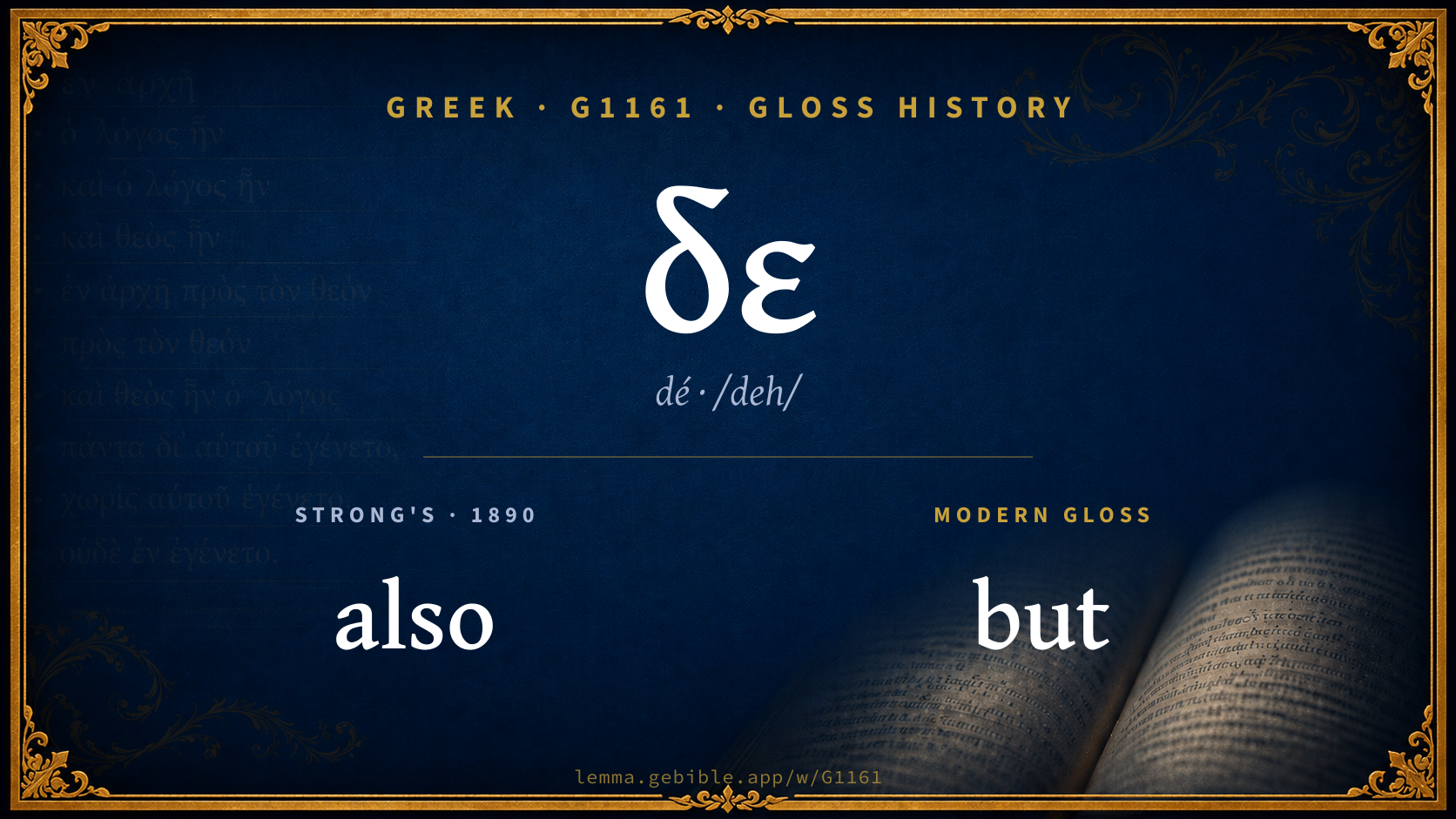
Gloss history
Strong's 1890 vs modern scholarship
About this word
Strong's G1161 catalogs a Greek word from the Greek New Testament.
These counts are not copied from any lexicon or concordance. They are computed here, from the morphology-tagged Greek New Testament. What Lemma adds →
- 2,464
- distinct verses
- The word appears in 2,464 distinct verses.
- 26 / 27
- NT books
- The word appears in 26 of 27 New Testament books.
- #4
- by frequency
- Top 10 most frequent Greek words (rank 4 of 5,347 Greek words by occurrence).
View all 2,464 occurrences in the concordance →
By section of the New Testament
By traditional corpus
Conventional, traditional groupings — biblical authorship is debated, so this is a traditional corpus grouping, not an authorship claim. Some books belong to more than one corpus (Luke is in both the Gospels and the Lukan corpus, and so on), so these shares overlap and need not total 100%. Each figure is a share of the word’s 2,464 distinct verses.
- Gospels 1,258 verses · 51%
- Lukan (Luke–Acts) 971 verses · 39%
- Pauline corpus 547 verses · 22%
- Johannine 211 verses · 9%
- General (Catholic) Epistles 93 verses · 4%
- Hebrews 68 verses · 3%
- Revelation 7 verses · 0%
How translations render this word
Counts come from each version’s own published word-to-Strong’s tagging or interlinear alignment — an approximate guide to how each version renders this word, not a word-level alignment the data otherwise carries. Because each total is that version’s own tagged count, the per-version totals vary from one another and need not match the appearance or distinct-verse counts above. These counts may also differ from a printed concordance because Lemma counts each distinctly tagged rendering and does not collapse phrase taggings into a single head-word total. This is a fixed set of word-tagged versions (KJV, ASV, BSB, ULT) and does not change with the reading translation you choose elsewhere. Each version’s license is shown beside its name below (and on Sources).
- King James Version: And 1,228×, But 929×, Now 166×
- American Standard Version: And 1,179×, But 999×, Now 171×
- Berean Standard Bible: But 784×, And 339×, Now 116×
- unfoldingWord Literal Text: But 1,407×, And 745×, Now 419×
King James Version Public Domain
Renders G1161 across 2,711 tagged occurrences — most commonly:
Plus other, less common renderings. Plus 42 renderings that appear only once — usually multi-word phrases or single function words the recovered tagging swept in, not distinct renderings. Not rendered by a distinct English word in 159 further occurrences.
American Standard Version Public Domain
Renders G1161 across 2,640 tagged occurrences — most commonly:
Plus other, less common renderings. Plus 75 renderings that appear only once — usually multi-word phrases or single function words the recovered tagging swept in, not distinct renderings. Not rendered by a distinct English word in 34 further occurrences.
Berean Standard Bible Public Domain
Renders G1161 across 1,643 tagged occurrences — most commonly:
Plus other, less common renderings. Plus 38 renderings that appear only once — usually multi-word phrases or single function words the recovered tagging swept in, not distinct renderings. Not rendered by a distinct English word in 1,112 further occurrences.
unfoldingWord Literal Text CC BY-SA 4.0
Renders G1161 across 2,802 tagged occurrences — most commonly:
Plus other, less common renderings. Plus 9 renderings that appear only once — usually multi-word phrases or single function words the recovered tagging swept in, not distinct renderings.
Senses in Thayer's
The 1 sense Thayer's distinguishes for this word, in lexicon order (not ranked by frequency or importance). The full entry — with sub-senses — is in the Lexicon Entry tab.
- but, moreover, and, etc.
Word origin
Origin: a primary particle (adversative or continuative)
A primary particle (adversative or continuative); but and etc. : - also and but moreover now [ often unexpressed in English ].
— Strong’s Exhaustive Concordance (1890), public domain.
Forms in the corpus
The 3 distinct written forms G1161 takes in the Greek New Testament, most frequent first — each parse links to that case’s occurrences in the concordance.
| Form | Parsing | Example | Uses |
|---|---|---|---|
| δὲ dè | Conjunction | Matthew 1:2 | 2,602 |
| δέ dé | Conjunction | Matthew 5:31 | 147 |
| δ’ d | Conjunction | Matthew 5:19 | 22 |
Same root — word family
Other Thayer's entries built from the same root as G1161, grouped by Strong’s listed origin. These share a root / origin per the lexicon — not necessarily a shared meaning. Each links to that word’s own entry.
Derived from this word
Compare all same-root words → They share a root, not necessarily a meaning.
Septuagint usage
The same Greek word δε appears 3,556 times in the Greek Old Testament (Septuagint), across 3,042 verses in 35 books.
- 3,556
- LXX occurrences
- Tagged occurrences of this Greek word in the Septuagint.
- 3,042
- verses
- Distinct Septuagint verses containing this word.
- 35 / 39
- OT books
- The word appears in 35 of the 39 Old Testament books.
Sample Septuagint occurrences
- Genesis 1:2 δέ
- Exodus 1:5 δέ
- Leviticus 1:9 δέ
- Numbers 1:47 δέ
- Deuteronomy 4:4 δέ
- Joshua 1:14 δέ
- Judges 1:11 δέ
- Ruth 1:14 δέ
- 1 Samuel 7:17 δέ
- 2 Samuel 3:30 δέ
- 1 Kings 1:17 δέ
- 2 Kings 3:15 δέ
Septuagint occurrences (same lexeme)
Every verse where the same Strong’s number (G1161) appears in the Greek Septuagint — showing the first 50 of 3,042. Verse text shown in the World English Bible for context; the Greek form is the matched word — the English is not keyword-highlighted.
- Genesis 1:2 δέ Now the earth was formless and empty. Darkness was on the surface of the deep. God's Spirit was hovering over the surface of the waters.
- Genesis 2:6 δέ but a mist went up from the earth, and watered the whole surface of the ground.
- Genesis 2:10 δέ A river went out of Eden to water the garden; and from there it was parted, and became four heads.
- Genesis 2:12 δέ and the gold of that land is good. There is aromatic resin and the onyx stone.
- Genesis 2:14 δέ The name of the third river is Hiddekel: this is the one which flows in front of Assyria. The fourth river is the Euphrates.
- Genesis 2:17 δέ but of the tree of the knowledge of good and evil, you shall not eat of it: for in the day that you eat of it you will surely die."
- Genesis 2:20 δέ The man gave names to all cattle, and to the birds of the sky, and to every animal of the field; but for man there was not found a helper suitable for him.
- Genesis 3:1 δέ Now the serpent was more subtle than any animal of the field which Yahweh God had made. He said to the woman, "Yes, has God said, 'You shall not eat of any tree of the garden?'"
- Genesis 3:3 δέ but of the fruit of the tree which is in the midst of the garden, God has said, 'You shall not eat of it, neither shall you touch it, lest you die.'"
- Genesis 3:17 δέ To Adam he said, "Because you have listened to your wife's voice, and have eaten of the tree, of which I commanded you, saying, 'You shall not eat of it,' cursed is the ground for your sake. In toil you will eat of it all the days of your life.
- Genesis 4:1 δέ The man knew Eve his wife. She conceived, and gave birth to Cain, and said, "I have gotten a man with Yahweh's help."
- Genesis 4:2 δέ Again she gave birth, to Cain's brother Abel. Abel was a keeper of sheep, but Cain was a tiller of the ground.
- Genesis 4:5 δέ but he didn't respect Cain and his offering. Cain was very angry, and the expression on his face fell.
- Genesis 4:7 δέ If you do well, will it not be lifted up? If you don't do well, sin crouches at the door. Its desire is for you, but you are to rule over it."
- Genesis 4:9 δέ Yahweh said to Cain, "Where is Abel, your brother?" He said, "I don't know. Am I my brother's keeper?"
- Genesis 4:16 δέ Cain went out from Yahweh's presence, and dwelt in the land of Nod, on the east of Eden.
- Genesis 4:18 δέ To Enoch was born Irad. Irad became the father of Mehujael. Mehujael became the father of Methushael. Methushael became the father of Lamech.
- Genesis 4:22 δέ Zillah also gave birth to Tubal Cain, the forger of every cutting instrument of brass and iron. Tubal Cain's sister was Naamah.
- Genesis 4:23 δέ Lamech said to his wives, "Adah and Zillah, Hear my voice, You wives of Lamech, listen to my speech, For I have slain a man for wounding me, A young man for bruising me.
- Genesis 4:24 δέ If Cain will be avenged seven times, Truly Lamech seventy-seven times."
- Genesis 4:25 δέ Adam knew his wife again. She gave birth to a son, and named him Seth. For, she said, "God has appointed me another child instead of Abel, for Cain killed him."
- Genesis 4:26 δέ There was also born a son to Seth, and he named him Enosh. Then men began to call on Yahweh's name.
- Genesis 5:3 δέ Adam lived one hundred thirty years, and became the father of a son in his own likeness, after his image, and named him Seth.
- Genesis 5:4 δέ The days of Adam after he became the father of Seth were eight hundred years, and he became the father of sons and daughters.
- Genesis 5:6 δέ Seth lived one hundred five years, and became the father of Enosh.
- Genesis 5:22 δέ Enoch walked with God after he became the father of Methuselah three hundred years, and became the father of sons and daughters.
- Genesis 6:2 δέ that God's sons saw that men's daughters were beautiful, and they took for themselves wives of all that they chose.
- Genesis 6:3 δέ Yahweh said, "My Spirit will not strive with man forever, because he also is flesh; yet will his days be one hundred twenty years."
- Genesis 6:4 δέ The Nephilim were in the earth in those days, and also after that, when God's sons came to men's daughters. They bore children to them: the same were the mighty men who were of old, men of renown.
- Genesis 6:5 δέ Yahweh saw that the wickedness of man was great in the earth, and that every imagination of the thoughts of his heart was only evil continually.
- Genesis 6:8 δέ But Noah found favor in Yahweh's eyes.
- Genesis 6:9 δέ This is the history of the generations of Noah. Noah was a righteous man, blameless among the people of his time. Noah walked with God.
- Genesis 6:10 δέ Noah became the father of three sons: Shem, Ham, and Japheth.
- Genesis 6:11 δέ The earth was corrupt before God, and the earth was filled with violence.
- Genesis 6:16 δέ You shall make a roof in the ark, and to a cubit shall you finish it upward. You shall set the door of the ark in the side of it. You shall make it with lower, second, and third levels.
- Genesis 6:17 δέ I, even, I do bring the flood of waters on this earth, to destroy all flesh having the breath of life from under the sky. Everything that is in the earth will die.
- Genesis 6:18 δέ But I will establish my covenant with you. You shall come into the ark, you, your sons, your wife, and your sons' wives with you.
- Genesis 6:21 δέ Take with you of all food that is eaten, and gather it to you; and it will be for food for you, and for them."
- Genesis 7:2 δέ You shall take seven pairs of every clean animal with you, the male and his female. Of the animals that are not clean, take two, the male and his female.
- Genesis 7:6 δέ Noah was six hundred years old when the flood of waters came on the earth.
- Genesis 7:7 δέ Noah went into the ark with his sons, his wife, and his sons' wives, because of the waters of the flood.
- Genesis 7:19 δέ The waters prevailed exceedingly on the earth. All the high mountains that were under the whole sky were covered.
- Genesis 8:5 δέ The waters receded continually until the tenth month. In the tenth month, on the first day of the month, the tops of the mountains were seen.
- Genesis 8:14 δέ In the second month, on the twenty-seventh day of the month, the earth was dry.
- Genesis 9:7 δέ Be fruitful, and multiply. Bring forth abundantly in the earth, and multiply in it."
- Genesis 9:18 δέ The sons of Noah who went forth from the ark were Shem, Ham, and Japheth. Ham is the father of Canaan.
- Genesis 9:24 δέ Noah awoke from his wine, and knew what his youngest son had done to him.
- Genesis 9:28 δέ Noah lived three hundred fifty years after the flood.
- Genesis 10:1 δέ Now this is the history of the generations of the sons of Noah and of Shem, Ham, and Japheth. Sons were born to them after the flood.
- Genesis 10:6 δέ The sons of Ham: Cush, Mizraim, Put, and Canaan.
These are occurrences of the same Greek lexeme (G1161) in the Septuagint — not a translation of any one Hebrew word. The store carries no word-level Hebrew↔Greek alignment, so no Hebrew original is asserted here. Counts come from the recovered LXX Strong's tagging — high-frequency vocabulary is well covered, while rare or late forms may be untagged — so they reflect tagged occurrences and may slightly undercount.