
Matthew 1:5

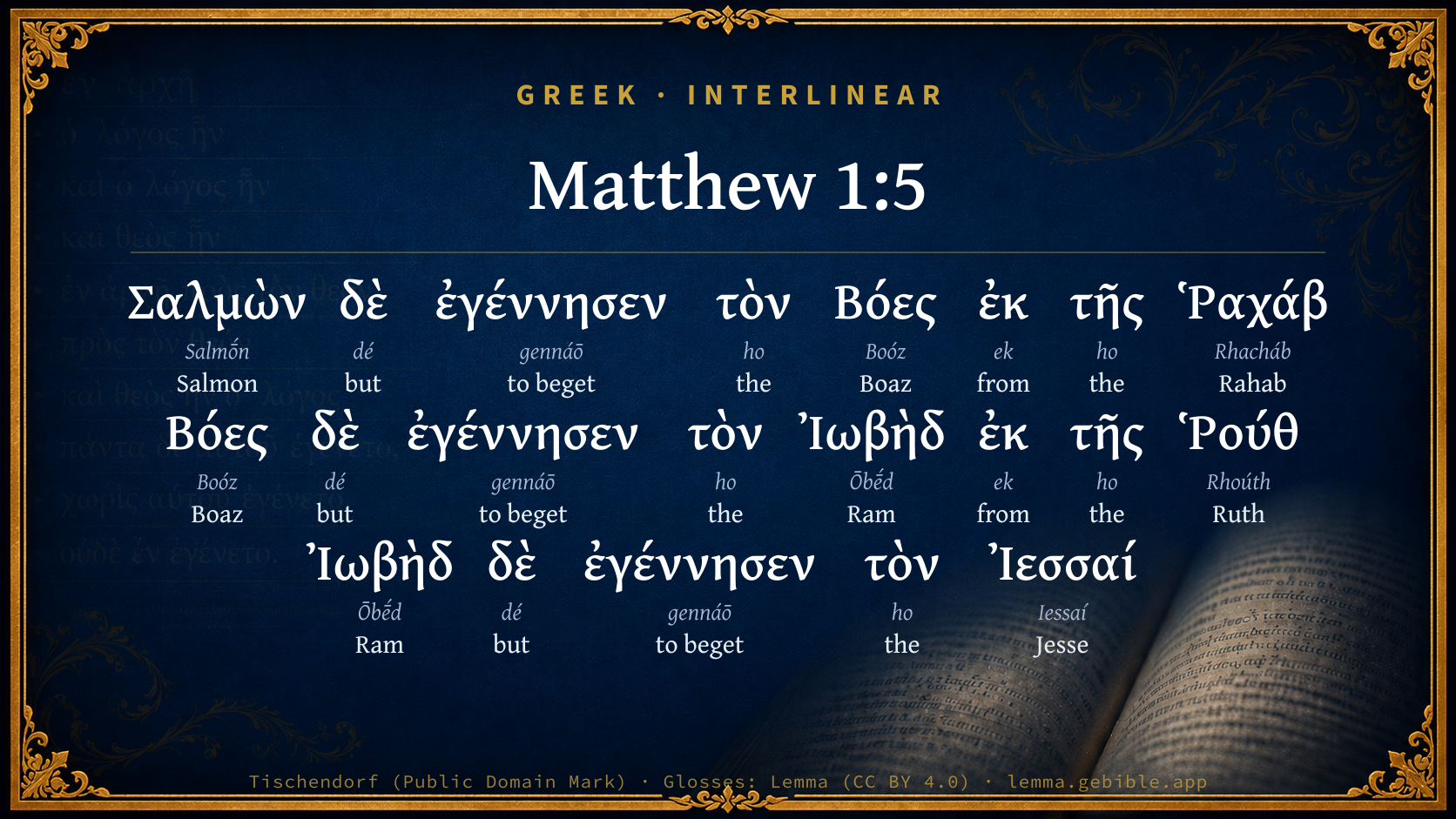
Greek (Tischendorf 8th ed.) Matthew 1:5 appears in the Greek New Testament. The text above is from the Tischendorf 8th edition. Each word links to its Strong’s number and a concise gloss. Click any word for its full Thayer’s Greek Lexicon entry.
Download image
Cite this verse

Matthew 1:5 (World English Bible). Public Domain. Lemma interlinear Bible study tool, https://lemma.gebible.app/v/matthew/1/5.

Show BibTeX & RIS
BibTeX
RIS
English Translation
Salmon became the father of Boaz by Rahab. Boaz became the father of Obed by Ruth. Obed became the father of Jesse.
World English Bible · Public Domain
Highlights
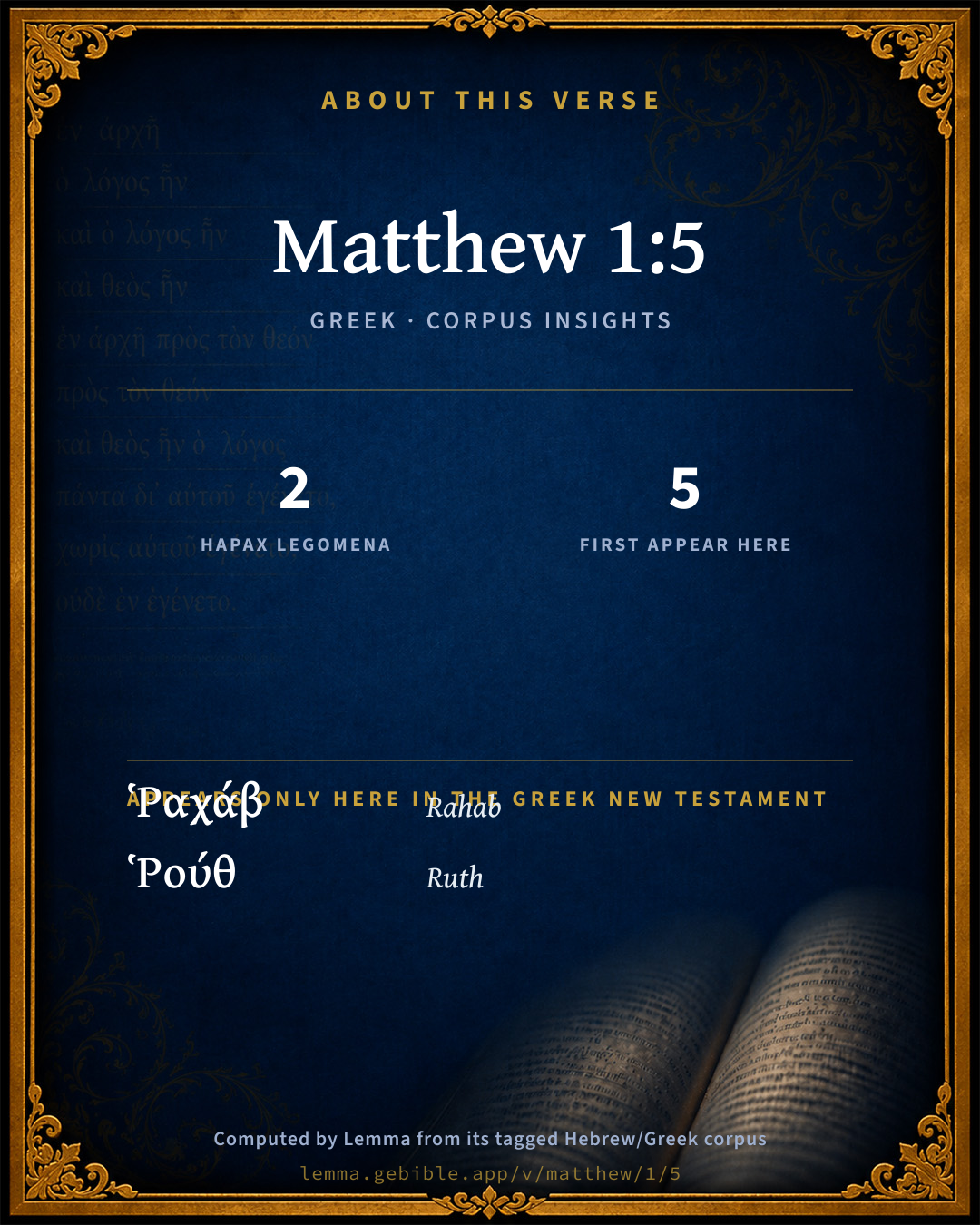
  • 2 hapax legomena — only here in the Greek New Testament
  • 5 first appearances in the Greek New Testament
Full analysis ↓
Download a study sheet

One document with this verse’s original text, its word-by-word gloss line, the meaning frame, cross-references with their text, attributed commentary, and full source and license credits — printable, and it pastes into notes with its structure intact.

This verse Autodidact and up

Study sheet (.html) Plain text (.txt)

A passage Seminary Student

Up to 50 verses in one chapter. A passage sheet keeps up to 6 commentary sources and 12 cross-references per verse, in the order this page ranks them, and says so on the sheet whenever that leaves anything out. Ask for a single verse and you get the Autodidact verse sheet above.

Everything on this page stays free to read, with no account — the sheet is a download of what is already on screen, not access to it.

Want to remove ads? Support Godless Engineer
Compare translations 3

The same verse in 3 English versions, stacked beneath the original-language interlinear above. Click any original word for its lexicon entry.

Each is an independent rendering of the whole verse — the interlinear is not word-aligned to these translations.

Highlighted words mark where these versions differ — a whole-verse word diff, not a word-by-word alignment.

  • World English Bible Public Domain
    Salmon became the father of Boaz by Rahab. Boaz became the father of Obed by Ruth. Obed became the father of Jesse.
  • King James Version Public Domain
    And Salmon begat Booz of Rachab; and Booz begat Obed of Ruth; and Obed begat Jesse;
  • unfoldingWord Literal Text CC BY-SA 4.0
    and Salmon fathered Boaz by Rahab, and Boaz fathered Obed by Ruth, and Obed fathered Jesse,

unfoldingWord Literal Text — © unfoldingWord, licensed CC BY-SA 4.0. Word-aligned USFM3 via Door43 (git.door43.org/unfoldingWord/en_ult).

Versions to compare (up to 4)

3 of 4 selected

Show all 19 translations

Every available English version of this verse, each an independent rendering of the whole verse.

  • World English Bible Public Domain
    Salmon became the father of Boaz by Rahab. Boaz became the father of Obed by Ruth. Obed became the father of Jesse.
  • Berean Standard Bible Public Domain
    Salmon was the father of Boaz by Rahab, Boaz the father of Obed by Ruth, Obed the father of Jesse,
  • Majority Standard Bible Public Domain
    Salmon was the father of Boaz by Rahab, Boaz the father of Obed by Ruth, Obed the father of Jesse,
  • King James Version Public Domain
    And Salmon begat Booz of Rachab; and Booz begat Obed of Ruth; and Obed begat Jesse;
  • American Standard Version (1901) Public Domain
    and Salmon begat Boaz of Rahab; and Boaz begat Obed of Ruth; and Obed begat Jesse;
  • Revised Version (1885) Public Domain
    and Salmon begat Boaz of Rahab; and Boaz begat Obed of Ruth; and Obed begat Jesse;
  • Geneva Bible (1599) Public Domain
    And Salmon begate Booz of Rachab. And Booz begat Obed of Ruth. and Obed begat Iesse.
  • Douay-Rheims (1899) Public Domain
    And Salmon begot Booz of Rahab. And Booz begot Obed of Ruth. And Obed begot Jesse.
  • Young's Literal Translation Public Domain
    and Salmon begat Boaz of Rahab, and Boaz begat Obed of Ruth, and Obed begat Jesse,
  • Literal Standard Version CC BY-SA 4.0
    and Salmon begot Boaz of Rahab, and Boaz begot Obed of Ruth, and Obed begot Jesse,
  • Unlocked Literal Bible CC BY-SA 4.0
    Salmon was the father of Boaz by Rahab, Boaz the father of Obed by Ruth, Obed the father of Jesse.
  • unfoldingWord Literal Text CC BY-SA 4.0
    and Salmon fathered Boaz by Rahab, and Boaz fathered Obed by Ruth, and Obed fathered Jesse,
  • Darby Bible Public Domain
    and Salmon begat Booz of Rachab; and Booz begat Obed of Ruth; and Obed begat Jesse,
  • World Messianic Bible Public Domain
    Salmon became the father of Boaz by Rahab. Boaz became the father of Obed by Ruth. Obed became the father of Jesse.
  • Webster's Bible Public Domain
    And Salmon begat Booz of Rachab; and Booz begat Obed of Ruth; and Obed begat Jesse;
  • Free Bible Version CC BY-SA 4.0
    and Salmon the father of Boaz (his mother was Rahab); and Boaz the father of Obed (his mother was Ruth); and Obed the father of Jesse;
  • Bible in Basic English Public Domain
    And the son of Salmon by Rahab was Boaz; and the son of Boaz by Ruth was Obed; and the son of Obed was Jesse;
  • Text-Critical English NT CC BY 4.0
    Salmon was the father of Boaz by Rahab, Boaz was the father of Obed by Ruth, Obed was the father of Jesse,
  • Tyndale New Testament (1534) Public Domain
    Salmon begat Boos of Rahab: Boos begat Obed of Ruth: Obed begat Iesse:

Literal Standard Version (2020), Covenant Press — licensed CC BY-SA 4.0. Text via the HelloAO Bible API (eBible.org). Unlocked Literal Bible (unfoldingWord) — licensed CC BY-SA 4.0. Text via the HelloAO Bible API (eBible.org). unfoldingWord Literal Text — © unfoldingWord, licensed CC BY-SA 4.0. Word-aligned USFM3 via Door43 (git.door43.org/unfoldingWord/en_ult). Free Bible Version, Dr. Jonathan Gallagher — licensed CC BY-SA 4.0. Text via the HelloAO Bible API (eBible.org).

Word by word

More ways to search: Search by grammar → Find every occurrence → Compare this word →

Practice this passage: Drill this verse → Learn its vocabulary →

Ῥαχάβ
Rhacháb
G4477
“Rahab”
Noun, Proper, indeclinable
Part of Speech
Noun · Proper, indeclinable
Full Thayer's Definition

Origin: from the same as G4460

TDNT: 03:01,3

Rahab = "wide" 1. a harlot of Jericho
  1. Σαλμὼν Salmṓn G4533 “Salmon” Noun, Proper, indeclinable
  2. δὲ dé G1161 “but” Conjunction
  3. ἐγέννησεν gennáō G1080 “to beget” Verb, Aorist, Active, Indicative, 3rd person, Singular
  4. τὸν ho G3588 “the” Article, Accusative, Singular, Masculine
  5. Βόες Boóz G1003 “Boaz” Noun, Proper, indeclinable
  6. ἐκ ek G1537 “from” Preposition
  7. τῆς ho G3588 “the” Article, Genitive, Singular, Feminine
  8. Βόες Boóz G1003 “Boaz” Noun, Proper, indeclinable
  9. δὲ dé G1161 “but” Conjunction
  10. ἐγέννησεν gennáō G1080 “to beget” Verb, Aorist, Active, Indicative, 3rd person, Singular
  11. τὸν ho G3588 “the” Article, Accusative, Singular, Masculine
  12. Ἰωβὴδ Ōbḗd G5601 “Ram” Noun, Proper, indeclinable
  13. ἐκ ek G1537 “from” Preposition
  14. τῆς ho G3588 “the” Article, Genitive, Singular, Feminine
  15. Ῥούθ Rhoúth G4503 “Ruth” Noun, Proper, indeclinable
  16. Ἰωβὴδ Ōbḗd G5601 “Ram” Noun, Proper, indeclinable
  17. δὲ dé G1161 “but” Conjunction
  18. ἐγέννησεν gennáō G1080 “to beget” Verb, Aorist, Active, Indicative, 3rd person, Singular
  19. τὸν ho G3588 “the” Article, Accusative, Singular, Masculine
  20. Ἰεσσαί Iessaí G2421 “Jesse” Noun, Proper, indeclinable

About this verse

These counts appear in no published source. They are computed here, from the morphology-tagged text and Lemma’s own curated glosses. What Lemma adds →

21
words
10
distinct lemmas
Gospels
section

Notable vocabulary

2 hapax legomena — words that appear only here in the entire Greek New Testament:

First appearance in Scripture

These words make their first canonical appearance in the Greek New Testament here:

Shared distinctive vocabulary

Σαλμὼν Salmon G4533 occurs in 2 verses of the Greek New Testament. Also found in:
Repetition

Words recur within this verse:

  • ἐγέννησεν to beget G1080 ×3
  • Βόες Boaz G1003 ×2
  • Ἰωβὴδ Ram G5601 ×2
  • τὸν the G3588 ×5
  • δὲ but G1161 ×3
  • ἐκ from G1537 ×2

Cross-references

10

Topical passages linked to Matthew 1:5 in the Treasury of Scripture Knowledge — connected by theme and wording, ordered by reader-vote popularity; previews shown in the World English Bible.

  • Ruth 1:16–17 Ruth said, "Don't entreat me to leave you, and to return from following after you, for where you go, I will go; and where you lodge, I will lodge; your people shall be my people, and your God my God;
  • Hebrews 11:31 By faith, Rahab the prostitute, didn't perish with those who were disobedient, having received the spies in peace.
  • James 2:25 In like manner wasn't Rahab the prostitute also justified by works, in that she received the messengers, and sent them out another way?
  • Joshua 6:22–25 Joshua said to the two men who had spied out the land, Go into the prostitute's house, and bring out there the woman, and all that she has, as you swore to her.
  • Ruth 1:4 They took them wives of the women of Moab; the name of the one was Orpah, and the name of the other Ruth: and they lived there about ten years.
  • Ruth 1:22–2:4 So Naomi returned, and Ruth the Moabitess, her daughter-in-law, with her, who returned out of the country of Moab: and they came to Bethlehem in the beginning of barley harvest.
  • Ruth 4:21 and Salmon became the father of Boaz, and Boaz became the father of Obed,
  • 1 Chronicles 2:11–12 and Nahshon became the father of Salma, and Salma became the father of Boaz,
  • Joshua 2:1–22 Joshua the son of Nun sent out of Shittim two men as spies secretly, saying, Go, view the land, and Jericho. They went and came into the house of a prostitute whose name was Rahab, and lay there.
  • Luke 3:32 the son of Jesse, the son of Obed, the son of Boaz, the son of Salmon, the son of Nahshon,

Cross-references courtesy of OpenBible.info (CC BY 4.0).

Commentary

Notes on Matthew 1:5 from classic Christian and Jewish commentators (each source and its license shown beneath its notes). The classic Christian expositions comment on the surrounding passage and are grouped to its opening verse, so a note may address several verses; the Jewish commentaries on the Tanakh (Rashi and others) are per-verse, so they appear only where the commentator wrote on this verse.

Lemma curates 59 commentaries, every one of them public domain or Creative Commons licensed, each selected and text-cleaned for this edition rather than reprinted as found. About our sources →

Joseph Benson's Commentary

Mat 1:5. Salmon begat Booz of Rachab — Viz., after their settlement in Canaan. It is not exact said that this woman was Rahab of Jericho, commonly called the harlot, but it is highly probable she was; for that Rahab was contemporary with Salmon, and a remarkable person, and there was no other of that name, especially of that age, of whom the compiler of the table could possibly suppose his reader to have any knowledge. It is true she was of one of those idolatrous nations with which the Israelites were forbidden to marry. But as the reason of that prohibition was only lest they should be tempted to idolatry, it could have no force in the case of Rahab, who, before her marriage with Salmon, undoubtedly acknowledged the God of Israel for the true God, and became a proselyte of righteousness. And Booz begat Obed of Ruth — Although the son of a Moabite by an Israelitish woman was forbidden to enter into the congregation of the Lord; that is, at least was rendered incapable of being a prince in Israel, and perhaps even of being naturalized by circumcision; yet it evidently appears from this celebrated instance, Ruth being a Moabitess, that this precept was not understood as excluding the descendants of an Israelite by a Moabitish woman from any hereditary honours and privileges, otherwise the kinsman of Booz would not have wanted a much better reason than any he assigned, (Rth 4:6,) for refusing to marry Ruth, when she became a widow. And Obed begat Jesse — Inasmuch as there were at least 300 years between Salmon and David, and only three persons are here named as intervening to fill up that space of time, viz., Booz, Obed, and Jesse, they must each of them have been about 100 years old at the birth of his son, here named, which is not to be wondered at, considering the age in which they lived. Moses, a little before their time, had lived 120 years, when his natural strength was not abated. And Caleb, at 85, was strong and fit for war. Add to this, that they were persons of eminent piety, and therefore, probably, God vouchsafed to each of them a longer life than ordinary, and continued their strength to a late period thereof.

Joseph Benson's Commentary on the Old and New Testaments (1811–1818) — public domain. Text from a community e-Sword module.

Tyndale Open Study Notes

Tyndale Open Resources

1:5 Rahab was the Gentile prostitute who risked her life to harbor Joshua’s two spies in Jericho (Josh 2:1-21). Her inclusion in the ancestry of the Messiah emphasizes the grace of God. Elsewhere she is commended for her faith in the God of Israel and for righteous deeds (Heb 11:31; Jas 2:25).

Tyndale Open Study Notes — © Tyndale Open Resources, licensed CC BY-SA 4.0. Text via the HelloAO Bible API.

Bengel's Gnomon

Johann Albrecht Bengel

Mat 1:5. τὸν Βοὸζ ἐκ τῆς Ῥαχάβ, Boaz of Rahab) Some think that the immediate ancestors of Boaz have been passed over; but it stands thus also in Rth 4:21: nor can the first Fourteen, the standard of the two others, admit of an hiatus. More correct is their opinion, who maintain that, in such a length of time, some of the ancestors mentioned lived to a great age. The definite article, τῆς, placed before the proper name Ῥαχάβ, shows that Rahab of Jericho is here meant; nor does the orthography of the word Ῥαχάβ interfere with this hypothesis: for both Ῥαάβ (Raab or Rahab) and Ῥαχάβ (Rachab) are written for רחב. See Hiller’s[5] Onomasticon Sacrum, p. 695. The Rahab of Jericho was very young when she hid the spies (Jos 6:23): she outlived, however, Joshua and the elders (Ibid. Mat 24:29-30); and her marriage with Salmon must have taken place still later, as it is not mentioned in that book, though it is recorded that she dwelt in Israel (See Jos 6:25). In Rth 1:1, the earliest times of the Judges seem to be meant, so that the verb שפט (which might otherwise be supposed redundant) may have an inceptive[6] force, as in like manner מלך[7] often signifies he took the kingdom, or began to reign: and Naomi must have gone into Moab, before the Moabite domination mentioned in Jdg 3:12. Rahab might therefore have been, as she actually was, the mother of Boaz. He did not marry Ruth till he was far advanced in life (see Rth 3:10); and their grandson, Jesse, was very old (see 1Sa 17:12; 1Sa 17:14), when he became the father of David.—Cf. concerning Jehoiada, 2Ch 24:15.

[5] Matthew Hiller, a Lutheran divine and learned Orientalist, born at Stuttgard, 1646. Successively Professor at various universities with great reputation. Died 1725.—(I. B.)

[6] Bengel means, that שְׁפ̇ט חַשֹֽׁפְטִים (translated in the E. V. the Judges ruled, marg. judged) ought to be rendered the Judges began to judge, so as to indicate with greater exactness the date of the event, at the commencement of the era of the Judges.—(I. B.)

[7] יִמְלדְ מָלַד 1) to regin, to be king; (2) to become king, 2Sa 15:10; 2Sa 16:8; 1Ki 14:2.—GESENIUS.—(I. B.)

Bengel's Gnomon of the New Testament — English translation (T&T Clark, Edinburgh, 1860) — public domain. Text from a community e-Sword module.

Meyer's Critical & Exegetical Commentary

Heinrich August Wilhelm Meyer

Mat_1:5. Boaz is also called, in Rth_4:21 and 1Ch_2:11, son of Salma; but his mother Rahab is not mentioned. The author without doubt drew from a tradition which was then current, and presupposed as known (according to Ewald it was apocryphal), which gave Salma as a wife to her who had risen to honour by her conduct in. Jericho (Heb_11:31; Jam_2:25). The difficulties which, according to Rosenmüller, Kuinoel, and Gratz, arise from the chronology,namely, that Rahab must have become a mother at seventy or eighty years of age,are, considering the uncertainty of the genealogical tradition, which already appeals in Rth_4:20, as well as the freedom of Orientals in general with regard to genealogies, not sufficient to justify here the assumption of some other Rahab. According to Megill. f. 14, 2, and Koheleth R. 8, 10, Joshua married Rahab,a tradition which is not followed by our genealogy.

Meyer — Critical and Exegetical Commentary on the New Testament — English translation by Peter Christie, edited by Frederick Crombie (T&T Clark, 1880) — public domain. Text from a community e-Sword module.

Ellicott's Commentary for English Readers

(5) Rachab.—The Old Testament records are silent as to the marriage of Salmon with the harlot of Jericho. When they were compiled it was probably thought of as a blot rather than a glory; but the fact may have been preserved in the traditions of the house of David. It has been conjectured that Salmon may have been one of the two unnamed spies whose lives were saved by Rahab, when he was doing the work which Caleb had done before him. The mention of Rahab in Jas_2:25, Heb_11:31, shows that her fame had risen at the time when St. Matthew wrote. The Talmud legends, curiously enough, reckon eight prophets among her descendants, including Jeremiah and Baruch, but not any of the line of David. Assuming the connection between St. Matthew and St. James, which has been shown in the Introduction to this Gospel to be probable, the mention of Rahab by both takes its place as an interesting coincidence.

Booz.—The succession is the same as in Rth_4:21. The new fact of Salmon’s marriage explains some of the features of that history—the readiness with which the sons of Naomi marry two women of the Moabites; the absence of any repugnance to such a union on the part of Boaz; perhaps the reference to Tamar in the benediction of Rth_4:12. Salmon would seem to have been the first of the house to have had land at Bethlehem (1Ch_2:54), and to have gained this in part through his adoption into the family of Caleb.

A Bible Commentary for English Readers, edited by Charles John Ellicott (1878–1897) — public domain. Text from a community e-Sword module.

The Cambridge Bible for Schools and Colleges

gen. ed. J. J. S. Perowne

5. Salmon … Jesse] According to the received chronology the space of time between Salmon and Jesse was not less than 400 years. In that space there are only four generations recorded in the text. Either then the received chronology is wrong or the genealogy not complete. In all probability the former is at fault, and the shortening of the period named would bring “Jewish history into harmony with Egyptian and with the internal evidence of the Israelitish history itself.” See art. Genealogy in Bib. Dict. for this and other points.

The Cambridge Bible for Schools and Colleges (gen. ed. J. J. S. Perowne; Cambridge University Press, 1878–1918) — public domain. Text from a community e-Sword module.

Trapp's Complete Commentary

John Trapp

5 And Salmon begat Booz of Rachab; and Booz begat Obed of Ruth; and Obed begat Jesse;

Ver. 5. And Salmon begat Booz of Rachab] This the Evangelist might have by tradition. Salmon’s genealogy is set down, 1Ch 2:9-17 Rth 4:18-22; but whom he married, nothing is reported.

And Booz begat Obed of Ruth] While Orphah lacks bread in her own country, Ruth is grown a great lady in Bethlehem, and advanced to be great grandmother to the King of kings. There is nothing lost by God’s service. η μυριομακαριοτης εστιν εν τη ευσεβεια.

And Obed begat Jesse] A good old man, but not very famous. Retired it seems he was, and drawn much up into himself; {a} neither thinking great things of himself, nor seeking great things for himself; but living among his own people; much of his son David’s disposition, who loves his book the better since he saw the court, and sings, Beatas ille qui procul negotiis, &c. (Horat.) Non vixit male, qui natus moriensque fefellit. He is not the least happy that is least observed.

{a} Λαθε βιωσας. Vivetibi, quantumque potes, praelustria vita.

John Trapp, A Commentary or Exposition upon All the Books of the Old and New Testament (1647–1656) — public domain. Text from a community e-Sword module.

Haydock's Catholic Bible Commentary

See Josue. chap. ii. & dein. We nowhere else find the marriage of Salmon with Rahab; but this event might have been known by tradition, the truth of which the divinely inspired evangelist here confirms. (Bible de Vence) Rahab was a debauched woman, preserved in the pillage of Jericho, where she had been born. In this genealogy only four women are mentioned, of which two are Gentiles, and two adulteresses. Here the greatest sinners may find grounds for confidence in the mercies of Jesus Christ, and hopes of pardon, when they observed how the Lord of life and glory, to cure our pride, not only humbled himself by taking upon himself the likeness of sinful flesh, but by deriving his descent from sinners, and inspiring the holy evangelist to record the same to all posterity. (Haydock)

George Leo Haydock (1774–1849), Haydock's Catholic Family Bible and Commentary, 1859 edition — public domain. Excludes Psalms (Douay-Rheims chapter numbering differs from Protestant) and Deuterocanonical books (Catholic canon only).

Matthew Poole's English Annotations

This agreeth with Rth 4:22; 1Sa 16:1; 1Sa 16:13. Here now ariseth the first difficulty we meet with in this genealogy, and it rather an appearance of a difficulty than a real one.

Salmon being the son of Aminadab, who was the prince of the children of Judah in Moses's time, Salmon cannot be imagined to have lived later than in the times of Joshua.

Boaz seemeth to have lived in Eli's time, which (if chronologers count right) was three hundred years after: here are but four men named to take up these years, Salmon, Booz, Obed, Jesse.

Answer. The world according to chronologers, wanted but five of two thousand five hundred years old, when the Israelites (under the conduct of Joshua) entered into Canaan: we will suppose Salmon to have then been a young man. Eli is by them said to have lived about the two thousand eight hundred and tenth. So that the distance is three hundred and fifteen years. David is said to have been born in the two thousand eight hundred and sixtieth. So as from Salmon to David are three hundred and sixty-five years. Admit Salmon, Boaz, Obed, and Jesse to have each of them lived a hundred years, or upward, in admitting this, if we consider the age and vigour of persons in that age of the world. Moses (though a man spent with travels and battles) lived one hundred and twenty years, Deu 34:7. Caleb at eighty-five years was strong and as fit for war as ever, Jos 4:11-12. If we allow these four men the life of Moses they might live four hundred and eighty years, which might allow to each of them fifteen or sixteen years apiece for the concurrency of their lives with their parents, yet three hundred and sixty-five years might be well allowed for all their time: nor is it unreasonable for us to suppose, that God might allow those whom he intended thus to dignify a something longer life than the ordinary sort of men lived in that age of the world. So as the thing being neither naturally impossible (for in our age we see particular persons live upward of a hundred years) nor morally improbable, and directly affirmed in three or four texts, they must have a great mind to quarrel with a Divine revelation who question the truth of it upon such a pretence; especially considering that the lives of men in our declining and debauched age of the world, are no measures by which we can guess at the lives of extraordinary persons who lived near three thousand years ago.

David the king: possibly that term is added to distinguish the David here intended from others of the same name; or because he was the first king of the tribe of Judah, to whom the sceptre of Israel was promised, Gen 49:10; or the first king not given to the Israelites in wrath, as Saul was upon their murmuring against Samuel: or to show that Christ descended from that family, to whom the promise of the Messias was made, Jer 23:5, and a kingdom established for ever, Psa 89:36-37. Thus our evangelist hath given us the names in his first period of fourteen generations: Abraham, Isaac, Jacob, Judas, Phares, Esrom, Aram, Aminadab, Naasson, Salmon, Boaz, Obed, Jesse, David.

Solomon was not the eldest child of David by Bathsheba; that died, 2Sa 12:22-23. He was born after David had taken Bathsheba (who had been the wife of Uriah) for his wife, 2Sa 12:25, compared with 2Sa 11:27.

Matthew Poole's English Annotations on the Holy Bible (1683–1685) — public domain. Text from a community e-Sword/MySword module.

The Pulpit Commentary

Salmon begat Booz (Boaz, Revised Version) of Rachab (Rahab, Revised Version). That this was Rahab of Jericho has been generally received, and it is clear from the narrative in Jos_2:11, where Rahab declares, "The Lord your God, he is God in heaven above, and on earth beneath," that, whatever this woman"s previous life and character may have been, she was then not unlikely to join herself to the Israelites. Moreover, her great services rendered to the spies, and the conspicuous way in which she and her house were singled out for preservation from all the rest of the city, may have.marked her as not unfit to become the wife of a chief man in Israel. The Old Testament says nothing of this marriage, but there has been no endeavour made in the Bible to preserve every detail of the genealogies, the record of the successive fathers being all that for Jewish purposes was required. But that Rahab of Jericho was received among the people of Israel, not merely as one dwelling in their midst, (Jos_6:25) but to a place of honour among them, was an old tradition among the Jews; cf. T. B. Meg., 14 b (vide Lightfoot, "Her. Hebr."), where Neriah, Baruch, Seraiah, Maaseiah, Jeremiah, Hilkiah, Hanameel, and Shallum, and also Huldah, are all said to have sprung from her. Some also say that she was made a proselyte, and was married to Joshua a tradition followed, as it seems, in the Midrash "Koh.," on Ecc_8:10.

The Pulpit Commentary (1880–1919), ed. H.D.M. Spence-Jones & Joseph S. Exell — public domain. Text from a community e-Sword module.

John Wesley's Explanatory Notes

Obed begat Jesse -- the providence of God was peculiarly shown in this, that Salmon, Boaz, and Obed, must each of them have been near a hundred years old, at the birth of his son here recorded.

John Wesley, Explanatory Notes Upon the Whole Bible (1754–1765) — public domain. Text via the GEBible commentary corpus.

Burkitt's Expository Notes on the New Testament

William Burkitt

Observe, Here are several women mentioned in our Savior’s genealogy, and all, or most of them, have a brand of infamy upon them. Thamar was one, with whom her father-in-law, Judah, committed incest; Rahab is called an harlot; Ruth came of Moab, whom Lot begat of his own daughter; and Bathsheba, the wife of Uriah, was one with whom David had committed adultery.

Now the wisdom of God has thought fit to leave all this upon record for several ends and purposes.

1. To denote the freeness of God’s grace, which extends itself in the saving effects and benefits of it to them that are most unworthy and ill-derserving.

2. To encourage the greatest sinners to unto Christ by faith, and seek to be ingrafted into him: for as Christ, by the power of his godhead, did purify our nature from all the pollution of our ancestors, so he can, by the power of his grace and spirit, sanctify our persons and natures, how foul and impure soever they either are or have been.

3. Hereby our Lord gives us to understand, That he came to save the most notorious sinners, as well as those lives have been less scandalous.

4. This is recorded for the support of such as are illegitimate and base-born, how vile soever their parents’ sin has rendered them in the eyes of men, it is their own sin only which exposes them to contempt in the sight of God. It is not illegitimacy, but unregeneracy, that makes us objects of God’s wrath.

William Burkitt's Expository Notes on the New Testament (1700–1703) — public domain. Text from a community e-Sword module.

Cambridge Greek Testament for Schools and Colleges

5. Σαλμὼν … Ἰεσσαί. According to the received chronology the space of time between Salmon and Jesse was not less than 400 years. In that space there are only four generations recorded in the text. Either then the received chronology is wrong or the genealogy not complete. In all probability the former is at fault, and the shortening of the period named would bring ‘Jewish history into harmony with Egyptian and with the internal evidence of the Israelitish history itself.’ See Art. ‘Genealogy’ in Bib. Dict. for this and other points.

Cambridge Greek Testament for Schools and Colleges (Cambridge University Press, 1896; 21 vols, various authors incl. Carr, Maclear, Plummer, Farrar, Lumby, Moule, M. R. James, Simcox) — public domain. Text from a community e-Sword module.

Alford’s Greek Testament

Henry Alford

5. Ῥαχάβ] “Rachab illam Hierichuntinam dici, vel articulus, τῆς Ῥ., ejusque vis relativa docet.” Bengel. It has been imagined, on chronological grounds, that this Rachab must be a different person from Rahab of Jericho. But those very grounds completely tally with their identity. For Naashon (father of Salmon), prince of Judah (1Ch 2:10), offered his offering at the setting up of the tabernacle (Num 7:12) 39 years before the taking of Jericho. So that Salmon would be of mature age at or soon after that event; at which time Rahab was probably young, as her father and mother were living (Jos 6:23). Nor is it any objection that Achan, the fourth in descent from Judah by Zara, is contemporary with Salmon, the sixth of the other branch: since the generations in the line of Zara average 69 years, and those in the line of Phares 49, both within the limits of probability. The difficulty of the interval of 366 years between Rahab and David does not belong to this passage only, but equally to Rth 4:21, Rth 4:22; and is by no means insuperable, especially when the extreme old age of Jesse, implied in 1Sa 17:12, is considered.

I may add that, considering Rahab’s father and mother were alive, the house would hardly be called the house of Rahab except on account of the character commonly assigned to her.

Henry Alford, The Greek Testament (1849–1861) — public domain. Text from a community e-Sword module.

International Critical Commentary

(E) 5. And Naasson begat Boes from Rahab; and Boes begat Iobed from Ruth; and Iobed begat Jessai.]—Βόοζ] In 1Ch 2:11, 1Ch 2:12 B has Βόος, but A Luc. βόοζ.—ἐκ τῆς Ῥαχάβ] For the insertion, see on v. 1. Ῥαχάβ is not a Septuagintal form. This version uniformly has Ῥαάβ However, Josephus has ἡ Ῥαχάβη or Ῥαάβη, Ant. v. 8, 11, 15. The editor adopts here a form which represents the Hebrew more nearly than Ῥαάβ. Ἰωβήδ and Ἰεσσαί are the Septuagintal forms of עוֹבד and יִשַׁי or אִישׁי. They come from 1Ch 2:12, where B has Ὠβήδ and A Ἰωβήδ.

5. Βοές] א B Ox k; Βοός, C 33; Βοόζ, E K al; LXX. has Βοός, Βοόζ. In 1Ch 2:11, 1Ch 2:12 B Βοός, A Luc. Βοόζ, Josephus Βόαζος, Βοώζης.—Ῥαχάβ] LXX. Ῥαάβ. Josephus Ῥαάβη, Ῥαχάβη.—Ἰωβήδ] א B Ox Ὠβήὃ E K al; LXX. has Ὠβήδ, Ἰωβήδ (A). In 1Ch 2:12, 1Ch 2:13 B Luc. Ὠβήδ, A Ἰωβήδ, Josephus Ὠβήδης.—Ῥούθ] So LXX. Josephus Ῥούθη.—Ἰεσσαί] So LXX. Josephus Ἰεσσαῖος.

International Critical Commentary — older volumes (1896–1929), various authors — public domain. Text from a community e-Sword module.

Lesson kit

Teaching starters — assembled from the data on this page, not authored interpretation. Every prompt links to the verse data it draws on. Edit before teaching.

Matthew, in the Gospels, opens this verse with 21 words (10 distinct Greek lemmas). Its most distinctive word is Rhacháb (“Rahab”). A historical commentator’s framing appears above. Read the whole chapter for the surrounding context.

Discussion questions

  1. How does “Rahab” (Rhacháb) shape what this verse is saying?
  2. This verse holds 2 words here found nowhere else in the Greek New Testament. What might the rare words draw attention to?
  3. 5 words here appear for the first time in Scripture. What is being introduced at this debut?
  4. Matthew 1:4 shares the word «Salmon» with this verse. How do the two illuminate each other?
  5. “to beget” occurs 3× in this one verse. What is the effect of the repetition?
  6. These translations render this verse differently. What is at stake in choosing one wording over another?
  7. Reading how Joseph Benson's Commentary and Tyndale Open Study Notes read this verse, where do the two commentators agree and where do they part?

Things to notice

  • 2 words in this verse appear nowhere else in the Greek New Testament.
  • 5 words make their first canonical appearance in Scripture here.
  • These translations choose different wording for 8 words in this verse.
  • “to beget” occurs 3× in this single verse.
  • 10 distinct Greek lemmas span 21 words in this verse.

Reading settings

Reading text

Shown beneath each verse's original-language words.

Old Testament
Old Testament edition

Read the OT as the Masoretic Hebrew (MT) or the Greek Septuagint (LXX).

English shown for the Greek Septuagint (in the Hebrew ↔ Greek comparison).

Comparing translations? Open the Compare panel on any verse page to stack up to four side by side.