

Matthew 2:8
Greek (Tischendorf 8th ed.) Matthew 2:8 appears in the Greek New Testament. The text above is from the Tischendorf 8th edition. Each word links to its Strong’s number and a concise gloss. Click any word for its full Thayer’s Greek Lexicon entry.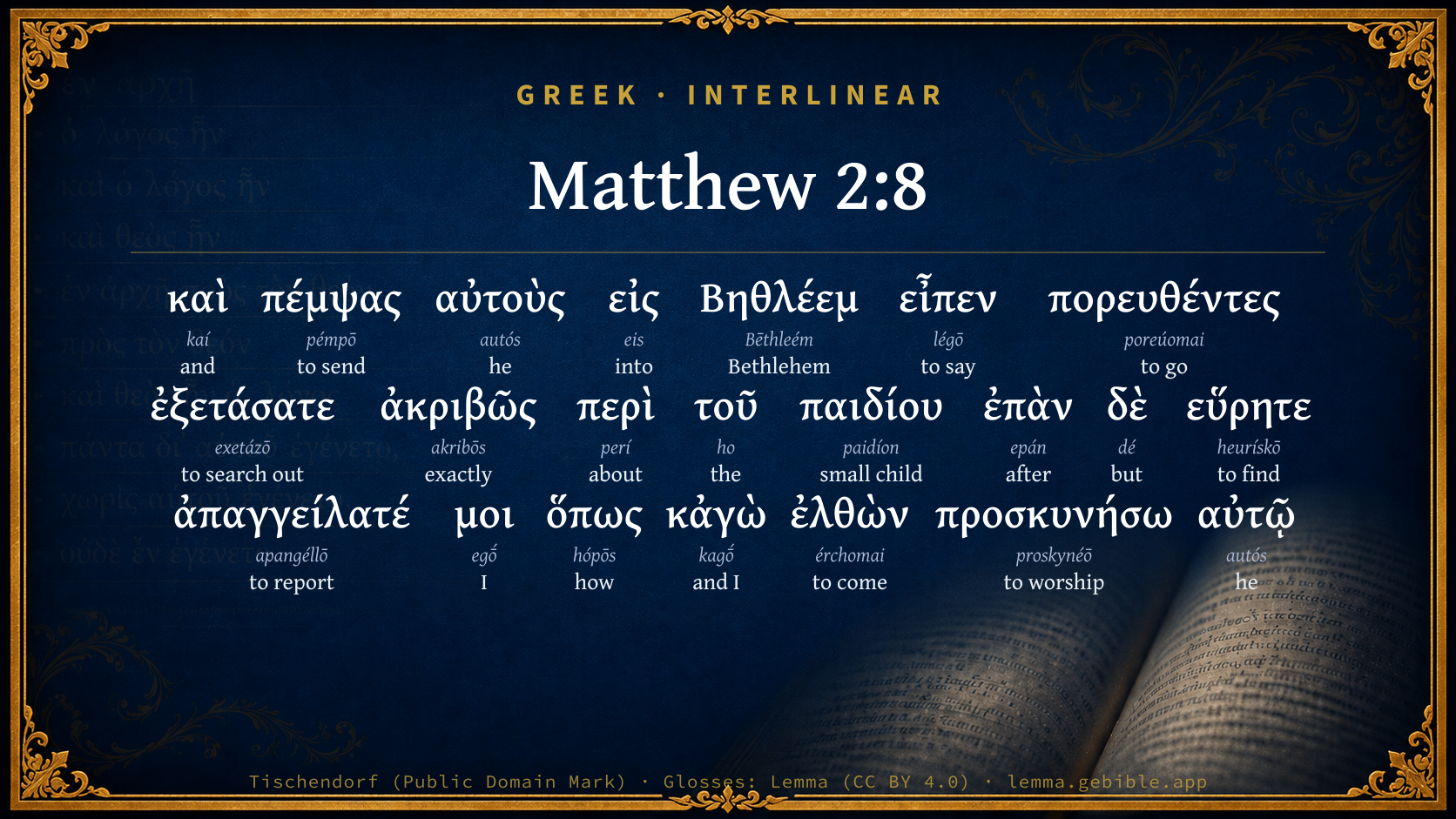
He sent them to Bethlehem, and said, "Go and search diligently for the young child. When you have found him, bring me word, so that I also may come and worship him."
Download a study sheet
One document with this verse’s original text, its word-by-word gloss line, the meaning frame, cross-references with their text, attributed commentary, and full source and license credits — printable, and it pastes into notes with its structure intact.
This verse Autodidact and up
A passage Seminary Student
Up to 50 verses in one chapter. A passage sheet keeps up to 6 commentary sources and 12 cross-references per verse, in the order this page ranks them, and says so on the sheet whenever that leaves anything out. Ask for a single verse and you get the Autodidact verse sheet above.
Everything on this page stays free to read, with no account — the sheet is a download of what is already on screen, not access to it.
Compare translations 3
The same verse in 3 English versions, stacked beneath the original-language interlinear above. Click any original word for its lexicon entry.
Each is an independent rendering of the whole verse — the interlinear is not word-aligned to these translations.
Highlighted words mark where these versions differ — a whole-verse word diff, not a word-by-word alignment.
-
World English Bible Public Domain
He sent them to Bethlehem, and said, "Go and search diligently for the young child. When you have found him, bring me word, so that I also may come and worship him."
-
King James Version Public Domain
And he sent them to Bethlehem, and said, Go and search diligently for the young child; and when ye have found him, bring me word again, that I may come and worship him also.
-
unfoldingWord Literal Text CC BY-SA 4.0
And having sent them to Bethlehem, he said, “Having gone, search carefully for the young child, and after you have found him, report to me so that I also, having come, might worship him.”
unfoldingWord Literal Text — © unfoldingWord, licensed CC BY-SA 4.0. Word-aligned USFM3 via Door43 (git.door43.org/unfoldingWord/en_ult).
Show all 19 translations
Every available English version of this verse, each an independent rendering of the whole verse.
-
World English Bible Public Domain
He sent them to Bethlehem, and said, "Go and search diligently for the young child. When you have found him, bring me word, so that I also may come and worship him."
-
Berean Standard Bible Public Domain
And sending them to Bethlehem, he said: “Go and search carefully for the Child, and when you find Him, report to me, so that I too may go and worship Him.”
-
Majority Standard Bible Public Domain
And sending them to Bethlehem, he said: “Go and search carefully for the Child, and when you find Him, report to me, so that I too may go and worship Him.”
-
King James Version Public Domain
And he sent them to Bethlehem, and said, Go and search diligently for the young child; and when ye have found him, bring me word again, that I may come and worship him also.
-
American Standard Version (1901) Public Domain
And he sent them to Bethlehem, and said, Go and search out exactly concerning the young child; and when ye have found `him,' bring me word, that I also may come and worship him.
-
Revised Version (1885) Public Domain
And he sent them to Bethlehem, and said, Go and search out carefully concerning the young child; and when ye have found him, bring me word, that I also may come and worship him.
-
Geneva Bible (1599) Public Domain
And sent them to Beth-leem, saying, Goe, and searche diligently for the babe: and when ye haue founde him, bring mee worde againe, that I may come also, and worship him.
-
Douay-Rheims (1899) Public Domain
And sending them into Bethlehem, said: Go and diligently inquire after the child, and when you have found him, bring me word again, that I also may come to adore him.
-
Young's Literal Translation Public Domain
and having sent them to Beth-Lehem, he said, `Having gone -- inquire ye exactly for the child, and whenever ye may have found, bring me back word, that I also having come may bow to him.'
-
Literal Standard Version CC BY-SA 4.0
and having sent them to Beth-Lehem, he said, “Having gone—inquire exactly for the Child, and whenever you may have found, bring me back word, that I also having come may worship Him.”
-
Unlocked Literal Bible CC BY-SA 4.0
He sent them to Bethlehem, saying, “Go and search carefully for the young child. When you have found him, bring me word, so that I also may come and worship him.”
-
unfoldingWord Literal Text CC BY-SA 4.0
And having sent them to Bethlehem, he said, “Having gone, search carefully for the young child, and after you have found him, report to me so that I also, having come, might worship him.”
-
Darby Bible Public Domain
and having sent them to Bethlehem, said, Go, search out accurately concerning the child, and when ye shall have found [him] bring me back word, so that *I* also may come and do him homage.
-
World Messianic Bible Public Domain
He sent them to Bethlehem, and said, “Go and search diligently for the young child. When you have found him, bring me word, so that I also may come and worship him.”
-
Webster's Bible Public Domain
And he sent them to Bethlehem, and said, Go, and search diligently for the young child; and when ye have found him, bring me word again, that I may come and worship him also.
-
Free Bible Version CC BY-SA 4.0
He sent them to Bethlehem, telling them, “When you get there, search for the child. Once you find him let me know so that I can come and worship him too.”
-
Bible in Basic English Public Domain
And he sent them to Beth-lehem and said, Go and make certain where the young child is; and when you have seen him, let me have news of it, so that I may come and give him worship.
-
Text-Critical English NT CC BY 4.0
He sent them to Bethlehem and said, “Go search diligently for the child, and when you have found him, bring me word so that I too may go and worship him.”
-
Tyndale New Testament (1534) Public Domain
and sent the to Bethleem saynge: Goo and searche dyligetly for the chylde. And when ye have founde hym bringe me worde that I maye come and worshippe hym also.
Literal Standard Version (2020), Covenant Press — licensed CC BY-SA 4.0. Text via the HelloAO Bible API (eBible.org). Unlocked Literal Bible (unfoldingWord) — licensed CC BY-SA 4.0. Text via the HelloAO Bible API (eBible.org). unfoldingWord Literal Text — © unfoldingWord, licensed CC BY-SA 4.0. Word-aligned USFM3 via Door43 (git.door43.org/unfoldingWord/en_ult). Free Bible Version, Dr. Jonathan Gallagher — licensed CC BY-SA 4.0. Text via the HelloAO Bible API (eBible.org).
Word by word
More ways to search: Search by grammar → Find every occurrence → Compare this word →
Practice this passage: Drill this verse → Learn its vocabulary →
- Appears 3× in the Greek New Testament
- First appears here
- Part of Speech
- Verb
- Tense
- Aorist
- Voice
- Active
- Mood
- Imperative
- Person
- 2nd person
- Number
- Plural
Full Thayer's Definition
- καὶ kaí G2532 “and” Conjunction
- πέμψας pémpō G3992 “to send” Verb, Aorist, Active, Participle, Nominative, Singular, Masculine
- αὐτοὺς autós G846 “he” Personal pronoun, Accusative, Plural, Masculine
- εἰς eis G1519 “into” Preposition
- Βηθλέεμ Bēthleém G965 “Bethlehem” Noun, Proper, indeclinable
- εἶπεν légō G3004 “to say” Verb, Aorist, Active, Indicative, 3rd person, Singular
- πορευθέντες poreúomai G4198 “to go” Verb, Aorist, Passive deponent, Participle, Nominative, Plural, Masculine
- ἐξετάσατε exetázō G1833 “to search out” Verb, Aorist, Active, Imperative, 2nd person, Plural
- ἀκριβῶς akribōs G199 “exactly” Adverb
- περὶ perí G4012 “about” Preposition
- τοῦ ho G3588 “the” Article, Genitive, Singular, Neuter
- παιδίου paidíon G3813 “small child” Noun, Genitive, Singular, Neuter
- ἐπὰν epán G1875 “after” Conjunction
- δὲ dé G1161 “but” Conjunction
- εὕρητε heurískō G2147 “to find” Verb, Aorist, Active, Subjunctive, 2nd person, Plural
- ἀπαγγείλατέ apangéllō G518 “to report” Verb, Aorist, Active, Imperative, 2nd person, Plural
- μοι egṓ G1473 “I” Personal pronoun, 1st person, Dative, Singular
- ὅπως hópōs G3704 “how” Adverb
- κἀγὼ kagṓ G2504 “and I” Personal pronoun, 1st person, Nominative, Singular, Aramaic form
- ἐλθὼν érchomai G2064 “to come” Verb, Aorist, Active, Participle, Nominative, Singular, Masculine
- προσκυνήσω proskynéō G4352 “to worship” Verb, Aorist, Active, Subjunctive, 1st person, Singular
- αὐτῷ autós G846 “he” Personal pronoun, Dative, Singular, Masculine
About this verse
These counts appear in no published source. They are computed here, from the morphology-tagged text and Lemma’s own curated glosses. What Lemma adds →
- 22
- words
- 21
- distinct lemmas
- Gospels
- section
Notable vocabulary
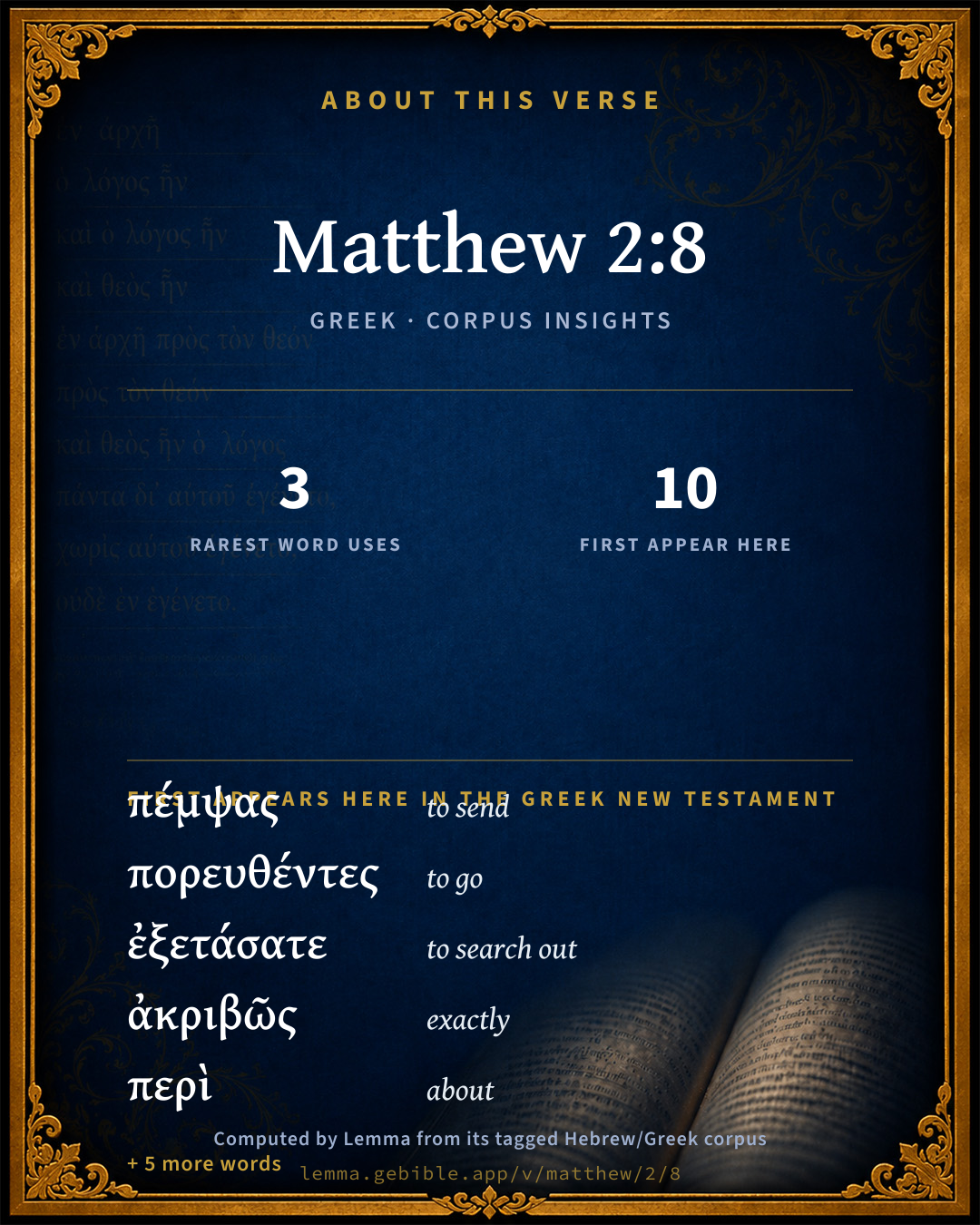
The rarest word here is ἐξετάσατε to search out G1833 — appearing just 3 times in the whole Greek New Testament.
First appearance in Scripture
These words make their first canonical appearance in the Greek New Testament here (10 in total — showing 8):
Shared distinctive vocabulary
ἐξετάσατε to search out G1833 occurs in 3 verses of the Greek New Testament. Also found in:
Repetition
A word recurs within this verse:
- αὐτοὺς he G846 ×2
Cross-references
17Topical passages linked to Matthew 2:8 in the Treasury of Scripture Knowledge — connected by theme and wording, ordered by reader-vote popularity; previews shown in the World English Bible.
- 1 Corinthians 3:19–20 For the wisdom of this world is foolishness with God. For it is written, "He has taken the wise in their craftiness."
- Jeremiah 41:5–7 that there came men from Shechem, from Shiloh, and from Samaria, even eighty men, having their beards shaved and their clothes torn, and having cut themselves, with meal-offerings and frankincense in their hand, to bring them to the house of Yahweh.
- Luke 20:20–21 They watched him, and sent out spies, who pretended to be righteous, that they might trap him in something he said, so as to deliver him up to the power and authority of the governor.
- 1 Samuel 23:22–23 Please go make yet more sure, and know and see his place where his haunt is, [and] who has seen him there; for it is told me that he deals very subtly.
- 2 Samuel 17:14 Absalom and all the men of Israel said, The counsel of Hushai the Archite is better than the counsel of Ahithophel. For Yahweh had ordained to defeat the good counsel of Ahithophel, to the intent that Yahweh might bring evil on Absalom.
- 1 Kings 19:2 Then Jezebel send a messenger to Elijah, saying, So let the gods do to me, and more also, if I don't make your life as the life of one of them by tomorrow about this time.
- 2 Kings 10:18–19 Jehu gathered all the people together, and said to them, Ahab served Baal a little; but Jehu will serve him much.
- Ezra 4:1–2 Now when the adversaries of Judah and Benjamin heard that the children of the captivity were building a temple to Yahweh, the God of Israel;
- Job 5:12–13 He frustrates the devices of the crafty, So that their hands can't perform their enterprise.
- Psalms 12:2–3 Everyone lies to his neighbor. They speak with flattering lips, and with a double heart.
- Psalms 33:10–11 Yahweh brings the counsel of the nations to nothing. He makes the thoughts of the peoples to be of no effect.
- Psalms 55:11–15 Destructive forces are within her. Threats and lies don't depart from her streets.
- Proverbs 21:30 There is no wisdom nor understanding Nor counsel against Yahweh.
- Proverbs 26:24–25 A malicious man disguises himself with his lips, But he harbors evil in his heart.
- Lamentations 3:37 Who is he who says, and it comes to pass, when the Lord doesn't command it?
- Matthew 26:48–49 Now he who betrayed him gave them a sign, saying, "Whoever I kiss, he is the one. Seize him."
- 2 Samuel 15:7–12 It happened at the end of forty years, that Absalom said to the king, please let me go and pay my vow, which I have vowed to Yahweh, in Hebron.
Cross-references courtesy of OpenBible.info (CC BY 4.0).
Lesson kit
Teaching starters — assembled from the data on this page, not authored interpretation. Every prompt links to the verse data it draws on. Edit before teaching.
Matthew, in the Gospels, opens this verse with 22 words (21 distinct Greek lemmas). Its most distinctive word is exetázō (“to search out”). A historical commentator’s framing appears above. Read the whole chapter for the surrounding context.
Discussion questions
- What does “to search out” (exetázō) contribute to the verse as a whole?
- 10 words here appear for the first time in Scripture. What is being introduced at this debut?
- Matthew 10:11 shares the word «to search out» with this verse. How do the two illuminate each other?
- “he” occurs 2× in this one verse. What is the effect of the repetition?
- These translations render this verse differently; the difference is in the English rendering, not the original. What questions does that raise?
- Reading how Joseph Benson's Commentary and Tyndale Open Study Notes read this verse, where do the two commentators agree and where do they part?
Things to notice
- 10 words make their first canonical appearance in Scripture here.
- These translations choose different wording for 14 words in this verse.
- “he” occurs 2× in this single verse.
- 21 distinct Greek lemmas span 22 words in this verse.
Commentary
Notes on Matthew 2:8 from classic Christian and Jewish commentators (each source and its license shown beneath its notes). The classic Christian expositions comment on the surrounding passage and are grouped to its opening verse, so a note may address several verses; the Jewish commentaries on the Tanakh (Rashi and others) are per-verse, so they appear only where the commentator wrote on this verse.
Lemma curates 59 commentaries, every one of them public domain or Creative Commons licensed, each selected and text-cleaned for this edition rather than reprinted as found. About our sources →
Joseph Benson's Commentary
Joseph Benson's Commentary on the Old and New Testaments (1811–1818) — public domain. Text from a community e-Sword module.
Tyndale Open Study Notes
Tyndale Open Resources
Tyndale Open Study Notes — © Tyndale Open Resources, licensed CC BY-SA 4.0. Text via the HelloAO Bible API.
Bengel's Gnomon
Johann Albrecht Bengel
Bengel's Gnomon of the New Testament — English translation (T&T Clark, Edinburgh, 1860) — public domain. Text from a community e-Sword module.
Expositor's Greek Testament
ed. W. Robertson Nicoll
The Expositor's Greek Testament, edited by W. Robertson Nicoll (1897–1910) — public domain. Text from a community e-Sword module.
Jamieson, Fausset & Brown
Robert Jamieson, A. R. Fausset & David Brown
Jamieson, Fausset & Brown — Commentary Critical and Explanatory on the Whole Bible (1871) — public domain (CC PDM 1.0). Text via the HelloAO Bible API.
Adam Clarke's Commentary
Adam Clarke's Commentary on the Bible (1810–1826) — public domain. Text from a community e-Sword/MySword module.
Ellicott's Commentary for English Readers
A Bible Commentary for English Readers, edited by Charles John Ellicott (1878–1897) — public domain. Text from a community e-Sword module.
The Cambridge Bible for Schools and Colleges
gen. ed. J. J. S. Perowne
The Cambridge Bible for Schools and Colleges (gen. ed. J. J. S. Perowne; Cambridge University Press, 1878–1918) — public domain. Text from a community e-Sword module.
John Gill's Exposition
John Gill's Exposition of the Whole Bible (1746–1763) — public domain (CC PDM 1.0). Text via the HelloAO Bible API.
Trapp's Complete Commentary
John Trapp
John Trapp, A Commentary or Exposition upon All the Books of the Old and New Testament (1647–1656) — public domain. Text from a community e-Sword module.
Albert Barnes' Notes on the Bible
Albert Barnes' Notes on the Bible (1834–1885) — public domain. Text from a community e-Sword/MySword module.
Matthew Poole's English Annotations
Matthew Poole's English Annotations on the Holy Bible (1683–1685) — public domain. Text from a community e-Sword/MySword module.
Whedon's Commentary on the Bible
Daniel D. Whedon
Daniel D. Whedon (gen. ed.), Commentary on the Old and New Testaments (1874–1909) — public domain. Text from a community e-Sword module.
The Pulpit Commentary
The Pulpit Commentary (1880–1919), ed. H.D.M. Spence-Jones & Joseph S. Exell — public domain. Text from a community e-Sword module.
John Wesley's Explanatory Notes
John Wesley, Explanatory Notes Upon the Whole Bible (1754–1765) — public domain. Text via the GEBible commentary corpus.
Kretzmann's Popular Commentary
Paul E. Kretzmann
Paul E. Kretzmann, Popular Commentary of the Bible (1921–1924) — public domain. Text from a community e-Sword module.
The People's New Testament
B. W. Johnson
B. W. Johnson's The People's New Testament with Notes (1889–1891) — public domain. Electronic text from the Christian Classics Ethereal Library (CCEL) ThML edition.
Cambridge Greek Testament for Schools and Colleges
Cambridge Greek Testament for Schools and Colleges (Cambridge University Press, 1896; 21 vols, various authors incl. Carr, Maclear, Plummer, Farrar, Lumby, Moule, M. R. James, Simcox) — public domain. Text from a community e-Sword module.
Alford’s Greek Testament
Henry Alford
Henry Alford, The Greek Testament (1849–1861) — public domain. Text from a community e-Sword module.
International Critical Commentary
International Critical Commentary — older volumes (1896–1929), various authors — public domain. Text from a community e-Sword module.