Matthew 8:33

Greek (Tischendorf 8th ed.) Matthew 8:33 appears in the Greek New Testament. The text above is from the Tischendorf 8th edition. Each word links to its Strong’s number and a concise gloss. Click any word for its full Thayer’s Greek Lexicon entry.
Download image
Cite this verse

Matthew 8:33 (World English Bible). Public Domain. Lemma interlinear Bible study tool, https://lemma.gebible.app/v/matthew/8/33.

Show BibTeX & RIS
BibTeX
RIS
English Translation
Those who fed them fled, and went away into the city, and told everything, including what happened to those who were possessed with demons.
World English Bible · Public Domain
Download a study sheet

One document with this verse’s original text, its word-by-word gloss line, the meaning frame, cross-references with their text, attributed commentary, and full source and license credits — printable, and it pastes into notes with its structure intact.

This verse Autodidact and up

Study sheet (.html) Plain text (.txt)

A passage Seminary Student

Up to 50 verses in one chapter. A passage sheet keeps up to 6 commentary sources and 12 cross-references per verse, in the order this page ranks them, and says so on the sheet whenever that leaves anything out. Ask for a single verse and you get the Autodidact verse sheet above.

Everything on this page stays free to read, with no account — the sheet is a download of what is already on screen, not access to it.

Want to remove ads? Support Godless Engineer
Compare translations 3

The same verse in 3 English versions, stacked beneath the original-language interlinear above. Click any original word for its lexicon entry.

Each is an independent rendering of the whole verse — the interlinear is not word-aligned to these translations.

Highlighted words mark where these versions differ — a whole-verse word diff, not a word-by-word alignment.

  • World English Bible Public Domain
    Those who fed them fled, and went away into the city, and told everything, including what happened to those who were possessed with demons.
  • King James Version Public Domain
    And they that kept them fled, and went their ways into the city, and told every thing, and what was befallen to the possessed of the devils.
  • unfoldingWord Literal Text CC BY-SA 4.0
    Now the ones feeding them ran away and, having gone away to the city, they reported everything, and the the ones possessed by demons.

unfoldingWord Literal Text — © unfoldingWord, licensed CC BY-SA 4.0. Word-aligned USFM3 via Door43 (git.door43.org/unfoldingWord/en_ult).

Versions to compare (up to 4)

3 of 4 selected

Show all 19 translations

Every available English version of this verse, each an independent rendering of the whole verse.

  • World English Bible Public Domain
    Those who fed them fled, and went away into the city, and told everything, including what happened to those who were possessed with demons.
  • Berean Standard Bible Public Domain
    Those tending the pigs ran off into the town and reported all this, including the account of the demon-possessed men.
  • Majority Standard Bible Public Domain
    Those tending the pigs ran off into the town and reported all this, including the account of the demon-possessed men.
  • King James Version Public Domain
    And they that kept them fled, and went their ways into the city, and told every thing, and what was befallen to the possessed of the devils.
  • American Standard Version (1901) Public Domain
    And they that fed them fled, and went away into the city, and told everything, and what was befallen to them that were possessed with demons.
  • Revised Version (1885) Public Domain
    And they that fed them fled, and went away into the city, and told everything, and what was befallen to them that were possessed with devils.
  • Geneva Bible (1599) Public Domain
    Then the heardmen fled: and when they were come into the citie, they tolde all things, and what was become of them that were possessed with the deuils.
  • Douay-Rheims (1899) Public Domain
    And they that kept them fled: and coming into the city, told every thing, and concerning them that had been possessed by the devils.
  • Young's Literal Translation Public Domain
    and those feeding did flee, and, having gone to the city, they declared all, and the matter of the demoniacs.
  • Literal Standard Version CC BY-SA 4.0
    and those feeding fled, and having gone into the city, they declared all, and the matter of the demoniacs.
  • Unlocked Literal Bible CC BY-SA 4.0
    Those who had been tending the pigs ran away and they went into the city and reported everything, especially what had happened to the men who had been possessed by demons.
  • unfoldingWord Literal Text CC BY-SA 4.0
    Now the ones feeding them ran away and, having gone away to the city, they reported everything, and the the ones possessed by demons.
  • Darby Bible Public Domain
    But they that fed them fled, and went away into the city and related everything, and what had happened as to those possessed by demons.
  • World Messianic Bible Public Domain
    Those who fed them fled and went away into the city and told everything, including what happened to those who were possessed with demons.
  • Webster's Bible Public Domain
    And they that kept them, fled, and went into the city, and told every thing; and what had befallen to the possessed with demons.
  • Free Bible Version CC BY-SA 4.0
    The pig herders ran away. They went to the town and told the people there everything that had taken place, and what had happened to the demon-possessed men.
  • Bible in Basic English Public Domain
    And their keepers went in flight to the town and gave an account of everything, and of the men who had the evil spirits.
  • Text-Critical English NT CC BY 4.0
    Those who had been feeding the pigs then ran off, went into the city, and reported everything, including what had happened to the demon-possessed men.
  • Tyndale New Testament (1534) Public Domain
    Then the heerdmen fleed and wet their ways in to the cyte and tolde every thinge and what had fortuned vnto the possessed of the devyls.

Literal Standard Version (2020), Covenant Press — licensed CC BY-SA 4.0. Text via the HelloAO Bible API (eBible.org). Unlocked Literal Bible (unfoldingWord) — licensed CC BY-SA 4.0. Text via the HelloAO Bible API (eBible.org). unfoldingWord Literal Text — © unfoldingWord, licensed CC BY-SA 4.0. Word-aligned USFM3 via Door43 (git.door43.org/unfoldingWord/en_ult). Free Bible Version, Dr. Jonathan Gallagher — licensed CC BY-SA 4.0. Text via the HelloAO Bible API (eBible.org).

Word by word

More ways to search: Search by grammar → Find every occurrence → Compare this word →

Practice this passage: Drill this verse → Learn its vocabulary →

βόσκοντες
bóskō
G1006
“to feed”
Verb, Present, Active, Participle, Nominative, Plural, Masculine
Part of Speech
Verb
Tense
Present
Voice
Active
Mood
Participle
Case
Nominative
Number
Plural
Gender
Masculine
Full Thayer's Definition

Origin: a prol. form of a primary verb, cf G977 &version=kjv& G1016

TDNT: None

1. to feed a. portraying the duty of a Christian teacher to promote in every way the spiritual welfare of the members of the church
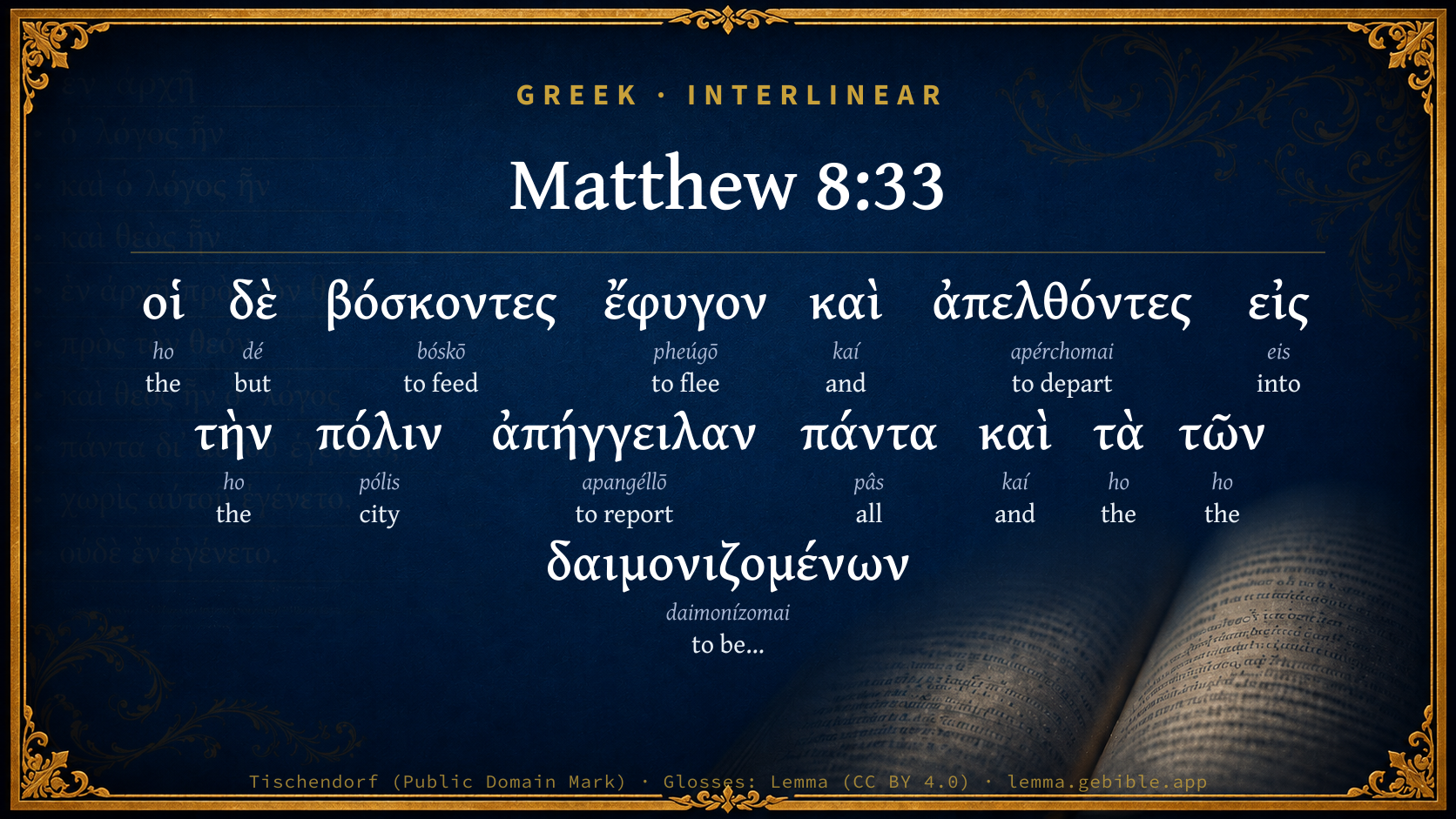
  1. οἱ ho G3588 “the” Article, Nominative, Plural, Masculine
  2. δὲ dé G1161 “but” Conjunction
  3. ἔφυγον pheúgō G5343 “to flee” Verb, Aorist, Active, Indicative, 3rd person, Plural
  4. καὶ kaí G2532 “and” Conjunction
  5. ἀπελθόντες apérchomai G565 “to depart” Verb, Aorist, Active, Participle, Nominative, Plural, Masculine
  6. εἰς eis G1519 “into” Preposition
  7. τὴν ho G3588 “the” Article, Accusative, Singular, Feminine
  8. πόλιν pólis G4172 “city” Noun, Accusative, Singular, Feminine
  9. ἀπήγγειλαν apangéllō G518 “to report” Verb, Aorist, Active, Indicative, 3rd person, Plural
  10. πάντα pâs G3956 “all” Adjective, Accusative, Plural, Neuter
  11. καὶ kaí G2532 “and” Conjunction
  12. τὰ ho G3588 “the” Article, Accusative, Plural, Neuter
  13. τῶν ho G3588 “the” Article, Genitive, Plural, Masculine
  14. δαιμονιζομένων daimonízomai G1139 “to be demon-possessed” Verb, Present, Middle or Passive deponent, Participle, Genitive, Plural, Masculine

About this verse

These counts appear in no published source. They are computed here, from the morphology-tagged text and Lemma’s own curated glosses. What Lemma adds →

15
words
11
distinct lemmas
Gospels
section

Notable vocabulary

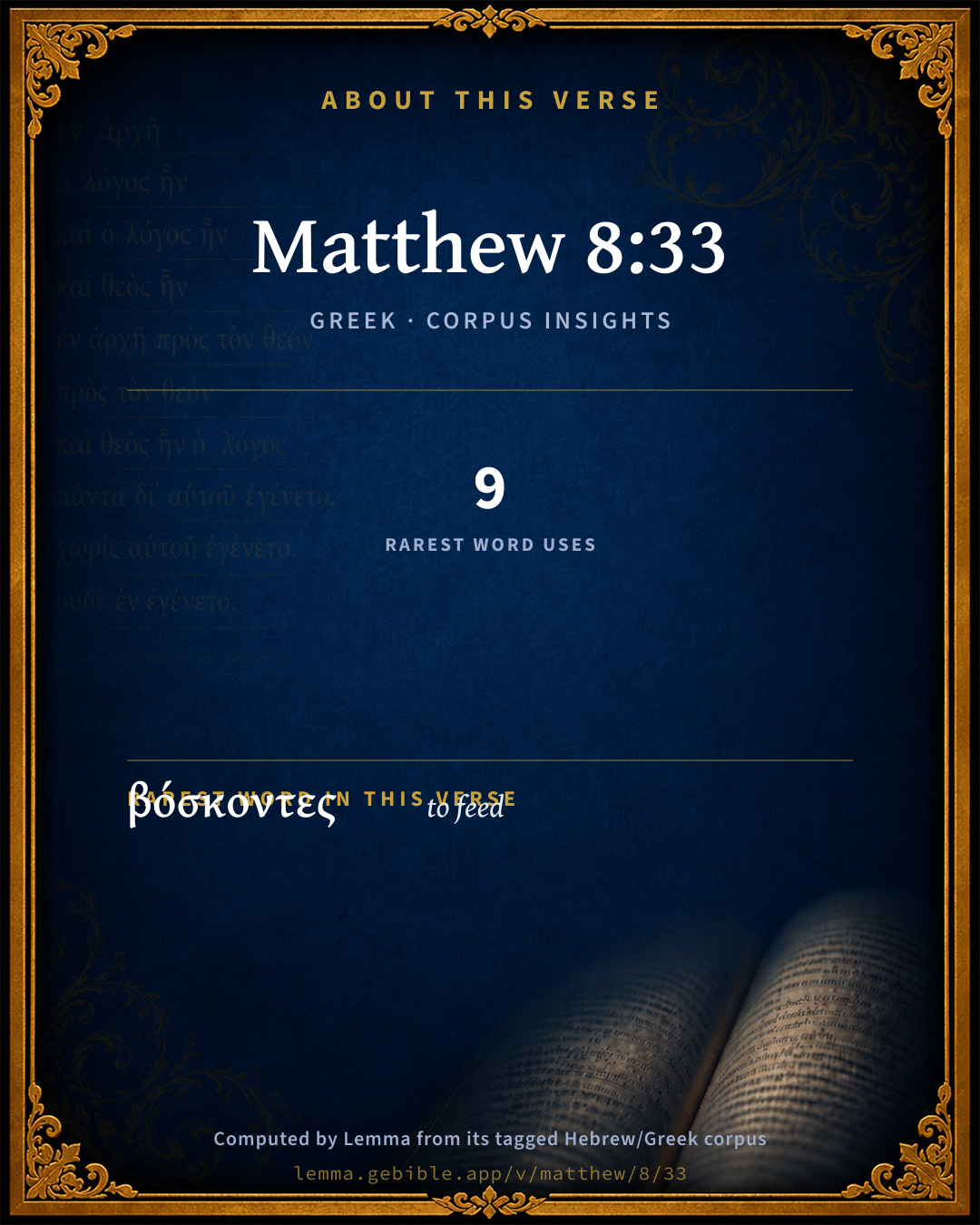
The rarest word here is βόσκοντες to feed G1006 — appearing just 9 times in the whole Greek New Testament.

Shared distinctive vocabulary

βόσκοντες to feed G1006 occurs in 9 verses of the Greek New Testament. Also found in:

Repetition

Words recur within this verse:

Cross-references

3

Topical passages linked to Matthew 8:33 in the Treasury of Scripture Knowledge — connected by theme and wording, ordered by reader-vote popularity; previews shown in the World English Bible.

  • Mark 5:14–16 Those who fed them fled, and told it in the city and in the country. The people came to see what it was that had happened.
  • Luke 8:34–36 When those who fed them saw what had happened, they fled, and told it in the city and in the country.
  • Acts 19:15–17 The evil spirit answered, "Jesus I know, and Paul I know, but who are you?"

Cross-references courtesy of OpenBible.info (CC BY 4.0).

Commentary

Notes on Matthew 8:33 from classic Christian and Jewish commentators (each source and its license shown beneath its notes). The classic Christian expositions comment on the surrounding passage and are grouped to its opening verse, so a note may address several verses; the Jewish commentaries on the Tanakh (Rashi and others) are per-verse, so they appear only where the commentator wrote on this verse.

Lemma curates 59 commentaries, every one of them public domain or Creative Commons licensed, each selected and text-cleaned for this edition rather than reprinted as found. About our sources →

Joseph Benson's Commentary

Mat 8:33-34. They that kept them — went into the city, and told every thing — And also in the country, Luk 8:34. They circumstantially related what had happened to the two demoniacs, and how the demons had been ejected from them. And the whole city came out to meet Jesus — Their curiosity was excited, and they went out in crowds to see what was done, and to satisfy themselves, on the testimony of their own senses, as to the truth of so unparalleled a fact. And when they saw him — And observed the demoniacs sitting at his feet, clothed, and in their right minds: (the disciples having, it seems, charitably supplied them with such upper garments as they could spare,) they perceived how great Christ’s power was, and were exceedingly afraid, having trespassed in the matter of the swine, which was an unclean food; or, if the herd belonged to the Syrian inhabitants of the town, they might know the law, and consequently, taking the destruction of their cattle as a rebuke, they could not but dread further punishment from this prophet of the Jews, who was come to vindicate the neglected institutions of Moses; and therefore besought him that he would depart out of their coasts — For they loved their swine better than their souls! And are not many of the same mind? And Jesus, who never forced his company on those who were so insensible of its value as not to desire it, nor wrought miracles of healing without being asked, went into the ship and returned back again, Luk 8:37. Thus the destruction of the swine had the effect which the devils proposed. The men, however, who had been possessed by the demons, but were now delivered, and in their right minds, and, no doubt, full of the praises of Jesus, remained in the country, by his direction, to be living witnesses of his power and goodness, and of the stupidity and ingratitude of these Gadarenes. Mar 5:19.

Joseph Benson's Commentary on the Old and New Testaments (1811–1818) — public domain. Text from a community e-Sword module.

Bengel's Gnomon

Johann Albrecht Bengel

Mat 8:33. Οί βόσκοντες, they who fed) Although they were not professedly herdsmen by occupation.—ἔφυγον, fled) The devils could not overtake them.

Bengel's Gnomon of the New Testament — English translation (T&T Clark, Edinburgh, 1860) — public domain. Text from a community e-Sword module.

Meyer's Critical & Exegetical Commentary

Heinrich August Wilhelm Meyer

Mat_8:33-34. Πάντα καὶ, κ.τ.λ.] They reported everything, and especially how it had fared from first to last with the two demoniacs (Mat_21:21).

πᾶσα ἡ πόλις] the Gadarenes. See Mat_8:28.

παρεκάλεσαν, ὅπως μεταβῇ, κ.τ.λ.] The subject of the request is conceived as the aim in asking (Mat_14:36; Mar_5:10).

The motive for the request was fear lest a greater disaster should follow.

REMARK.

Seeing that all the attempts that have been made to evade the force of this narrativesuch as saying that the demoniacs themselves had rushed in among the swine, or that the herd perished through some accidental and unknown circumstance (Neander), or that in the εἰσέρχεσθαι we have merely to think of an operating in some way or other upon the animals as a whole (Olshausen)run counter to what is clearly recorded, nothing remains but either to take the whole account as real history, and just as it stands (Krabbe, Ebrard, Delitzsch, bibl. Psychol. p. 296 ff.; Klostermann, Markusevang. p. 101 ff.; Steinmeyer, apolog. Beitr. I. p. 144 ff.), in which case it will be necessary to dispose of objections in the best way possible,[435] or else to admit the existence of legendary elements, and then eliminate them. The latter course is imperative and inevitable if we are not to look upon the condition of the demoniacs as a case of possession at all (see on Mat_4:24, note). According to this view of the matter, Jesus is supposed to have cured the two maniacs by means of His wonderful power, transmitting its influence through a humouring of their capricious fancies, and that this yielding to their request to be allowed to enter the swine may have led in a subsequent form of the traditiona tradition, at the same time, which did not require to be assisted by the supposed recollection of some disaster to a herd of swine that happened about the same time on that side of the laketo the statement being added about the drowning of the whole herd, which addition might take place all the more readily from the fact that swine were unclean and forbidden animals, and considering also how much is often due to the play of popular wit (Ewald), which, in the death of the swine, would pretend to see the demons going down at length to the hell they feared so much. Strangely enough, Lange, L. J. II. p. 661, inserts in the text that the hideous yell of the demoniac in his last paroxysm has acted like an electric shock upon the herd. Ewald likewise supposes that the last fearful convulsions of the sufferer just before he was quieted may have occasioned such a terror as might readily communicate itself to a whole herd. But in this affair of the demons, not one of the three accounts says anything whatever about last convulsions and such like. Yet Schenkel, too, boldly asserts that, just before the cure took place, there were violent outbursts of the malady, which threw a herd of swine into a panic, and sent them rushing into the water. Keim, on the other hand, favours the view that the introduction of the four-footed beasts owes its origin to legend, inasmuch as it sought to expound the healing from the life, and with bitter mockery of the Jews to explain and avenge the banishing of Jesus from the district. If this is to ascribe too much to legend,too much to invention and wit, had not, indeed, the presence of a herd offered a handle for it,then, to say the least of it, Weizsäcker followed the more cautious course when he abandoned the idea of finding out the fact on which the obscure reminiscence may probably have been founded,although, when we consider the essential uniformity of the three evangelic narratives in other respects, the obscurity, if we keep out of view the difference in the naming of the locality, may not appear sufficiently great to warrant such entire abandonment.

[435] Paulus and Strauss object that the demons would have acted the part of very silly devils, if they had gone so far as immediately to destroy again their new abodes. It is observed by Ebrard, on the other hand, that they were unable to control their wicked desires, or (on Olshausen, p. 306) that the shock to the nervous system of the animals was so much greater than was expected. Theophylact and Euth. Zigabenus suppose that their intention was to do damage to the owners, that they might not be disposed to welcome Jesus. Some explain one way and others another. In reply to the objection founded on the morality of the thing, Ebrard (comp. Wetstein) pleads the absolute right of the Son of God, and that the object was to punish the Gadarenes for their avarice. Similarly Luther. Comp. Bengel: rei erant Gergeseni amittendi gregis; jus et potestatem Jesu res ipsa ostendit; so Olshausen, coupling with his own the opinion of Theophylact. Schegg contents himself with supposing that what happened was by way of testing the Gadarenes to see whether, to them, the possession of eternal was of more consequence than the loss of temporal things, therefore a matter of discipline and to awaken faith; comp. Arnoldi and Ullmann, Sündlosigk. p. 176. Bleek thinks the whole question of the morality is one with which he is not called upon to deal, inasmuch as the destruction was not the doing of Jesus, but of the lunatic. According to Steinmeyer, it was not the doing of the demons, but of the animals. The only way of deciding this question is to reply that, according to the text, it was not the demoniacs but the demons that caused the destruction of the swinea result which Jesus did not anticipate. Otherwise it is vain to try further to help matters by the view that it was the Redeemer offering Himself to deliver from the power of Satan and calling for the feeling that nothing was too dear to sacrifice for the sake of this deliverance (Klostermann), in violation of that principle of justice which forbids the use of means so flagrantly unrighteous to attain a holy end.

Meyer — Critical and Exegetical Commentary on the New Testament — English translation by Peter Christie, edited by Frederick Crombie (T&T Clark, 1880) — public domain. Text from a community e-Sword module.

Expositor's Greek Testament

ed. W. Robertson Nicoll

Mat 8:33-34 . The sequel. ἔφυγον : the swineherds fled. No wonder, in view of such a disaster. If the demoniacs, in the final paroxysm before return to sanity, had anything to do with bringing it about, the superstitious terror with which they were regarded would add to the panic. ἀπήγγειλαν : they reported what had happened to their masters and to everybody they met in the town. πάντα , what had befallen the swine. καὶ τὰ τ . δαιμονιζομένων : they could not know the whole truth about the demoniacs. The reference must be to some visible connection between the behaviour of the madmen and the destruction of the herd. They told the story from their own point of view, not after interviewing Jesus and His company.

The Expositor's Greek Testament, edited by W. Robertson Nicoll (1897–1910) — public domain. Text from a community e-Sword module.

Adam Clarke's Commentary

Verse 33. And they that kept them fled] Terrified at what had happened to the swine.

Adam Clarke's Commentary on the Bible (1810–1826) — public domain. Text from a community e-Sword/MySword module.

The Cambridge Bible for Schools and Colleges

gen. ed. J. J. S. Perowne

33. they that kept them] It does not appear whether these were Jews or Gentiles, more probably the latter; if the former, they were transgressing the law.

(1) This narrative may be regarded as a signal instance of Metanoia, or change from the old evil state to the new life. (2) It recalls the connection between sin and disease. The majority of cases of mania may be traced to sins of impurity; the impurity expelled, the man becomes sound in body as well as in mind. (3) The destruction of the swine should present no difficulty. The same God, who, for purposes often hidden, allows men to die by thousands in war or by pestilence, here, by the destruction of a herd of swine, enforces a moral lesson which the world has never forgotten.

The Cambridge Bible for Schools and Colleges (gen. ed. J. J. S. Perowne; Cambridge University Press, 1878–1918) — public domain. Text from a community e-Sword module.

John Gill's Exposition

And behold, the whole city,.... The inhabitants of it, not every individual person, but the greater number of them, or, at least, a very great number of them. Luke says, "the whole multitude of the country of the Gadarenes round about": for as the news was carried both into the city and country, great numbers flocked from all parts,

and came out to meet Jesus: not out of any love and respect to him, and in order to invite him, and conduct him into their city, and there receive him kindly, and treat him with due honour and reverence; but either out of curiosity to see such an extraordinary person, which, doubtless, was the case of many; or, else being terrified at the report concerning him, and distressed with their present loss, which was the case of others, went out to prevent his coming any further, lest they should suffer something worse: accordingly,

when they saw him, they besought him that he would depart out of their coasts; which was done not as though they thought themselves unworthy the presence of so great a person, as did the "centurion", in the former part of this "chapter", or, as Peter, when he said, "depart from me, I am a sinful man"; but as fearing, lest some greater punishment should be inflicted on them for their sins, of which they were conscious; and therefore make no complaint of any injustice being done them by the loss of their swine; though these they preferred to the presence of Christ, and even to any cures wrought, or which might have been wrought, either upon the bodies, or souls of men.

Next: Matthew Chapter 9

John Gill's Exposition of the Whole Bible (1746–1763) — public domain (CC PDM 1.0). Text via the HelloAO Bible API.

Trapp's Complete Commentary

John Trapp

33 And they that kept them fled, and went their ways into the city, and told every thing, and what was befallen to the possessed of the devils.

Ver. 33. And they that kept them fled] So do parasitical pastors leave their forlorn flocks to danger and destruction; letting the devils hurry them to hell, and not caring whether they sink or swim. They that go down into this pit, or suffer others to go down by their default, cannot hope for God’s truth, Isa 38:18.

John Trapp, A Commentary or Exposition upon All the Books of the Old and New Testament (1647–1656) — public domain. Text from a community e-Sword module.

Matthew Poole's English Annotations

Mark and Luke in this differ not from Matthew, only they add, that they told it in the city and country. Those that most serve the devil are afraid of him when he cometh to show himself in his true colours. These men go and publish abroad the miracle, what had happened to the man that was so famous an object of the devil’s malice, and what had happened to the swine.

Matthew Poole's English Annotations on the Holy Bible (1683–1685) — public domain. Text from a community e-Sword/MySword module.

Kretzmann's Popular Commentary

Paul E. Kretzmann

The result:

v. 33. And they that kept them fled, and went their ways into the city, and told everything, and what was befallen to the possessed of the devils.

v. 34. And, behold, the whole city came out to meet Jesus; and when they saw Him, they besought Him that He would depart out of their coasts.

The swineherds fled. The disaster that befell their herds sent them back to the city in haste, superstitious terror filling their hearts. As much as they had seen and the conclusions they had drawn while they were out on the hills: their account may have been fanciful and garbled enough. All those that heard the story and were foot-loose turned out, probably with the idea of taking summary vengeance on whatever person proved guilty of the loss of their swine. They learned the truth. They were awed by the presence of Him whose power over the demons had been demonstrated beyond a doubt. And so their vindictive attitude gave way to a respectful pleading. They besought Him to go away from their coasts, to leave their country. They feared that they might be compelled to sustain still greater damage. The loss of the swine was to them a calamity. And they felt uncomfortable in the presence of the Holy One of God. They much preferred their swine and their sinful life to His pure presence. They repudiated this opportunity for grace.

Summary.Christ heals a leper, restores the sick servant of the centurion whose faith amazed Him, performs a number of other miracles, gives a lesson in discipleship, stills the tempest, and drives out the devils from two Gadarene demoniacs.

Paul E. Kretzmann, Popular Commentary of the Bible (1921–1924) — public domain. Text from a community e-Sword module.

Burkitt's Expository Notes on the New Testament

William Burkitt

Observe, 1. What a contary effect this miracle which Christ wrought had upon these people: instead of believing on him for his miraculous cure of the opssessed, the loss of their swine enraged them, and makes them desire Christ to depart from them. Temporal losses are so great in worldly men’s estimation, that spiritual advantages are nothing esteemed: carnal hearts perfer their swine before their Saviour; and had rather lose Christ’s presence than their worldly profits.

Observe, 2. How unanimous and importunate the Gadarenes were to get rid of Christ, the whole city came out, and are not only willing to his departure, but they beseech him to depart out of their coasts.

Learn, hence, That deplorably sad is the condition of such from whom Christ departs; more deplorably sad is their state who say unto Christ, depart; but most deplorably sad is the case of them that intreat and beseech Christ to depart, from them. Thus did the Gadarenes, and accordingly Christ took ship and departed from them, and we never read of his return unto them.

William Burkitt's Expository Notes on the New Testament (1700–1703) — public domain. Text from a community e-Sword module.

unfoldingWord translationNotes

Door43 World Missions Community

Connecting Statement:

This concludes the account of Jesus healing two demon-possessed men.

tending the pigs

"taking care of the pigs"

what had happened to the men who had been possessed by demons

This can be stated in active form. AT: "what Jesus did to help the men whom demons had controlled" (See: Active or Passive)

Behold

This marks the beginning of another event in the larger story. It may involve different people than the previous events. Your language may have a way of showing this.

all the city

The word "city" is a metonym for the people of the city. The word "all" is probably an exaggeration to emphasize how very many people came out. Not necessarily every person came out. (See: Metonymy and Hyperbole and Generalization)

their region

"their area"

translationWords

demon-possessed

beg

unfoldingWord translationNotes — © Distant Shores Media and the Door43 World Missions Community, licensed CC BY-SA 4.0. Source: git.door43.org/Door43/en_tn.

Cambridge Greek Testament for Schools and Colleges

33. οἱ δὲ βόσκοντες. It does not appear whether these were Jews or Gentiles, more probably the latter; if the former, they were transgressing the law.

(1) This narrative may be regarded as a signal instance of μετάνοια, or change from the old evil state to the new life. (2) It recalls the connection between sin and disease. The majority of cases of mania may be traced to sins of impurity; the impurity expelled, the man becomes sound in body as well as in mind. (3) The destruction of the swine should present no difficulty. The same God, who, for purposes often hidden, allows men to die by thousands in war or by pestilence, here, by the destruction of a herd of swine, enforces a moral lesson which the world has never forgotten.

Cambridge Greek Testament for Schools and Colleges (Cambridge University Press, 1896; 21 vols, various authors incl. Carr, Maclear, Plummer, Farrar, Lumby, Moule, M. R. James, Simcox) — public domain. Text from a community e-Sword module.

International Critical Commentary

33. And the herdsmen fled, and went away into the city, and reported all things, and the (affairs) of the demoniacs.] Mk. has: “And the herdsmen fled, and reported into the city and into the country.”—οἱ δέ] For Mk.’s καί as usual, see Introduction, p. xx.—εἰς τὴν πόλιν] Mk. adds καὶ εἰς τοὺς άγρούς. Mk. uses ἀγρός here and in 6:36, 56 in the sense of “farm” or “hamlet.” Mt. avoids it in this sense.

(M)

International Critical Commentary — older volumes (1896–1929), various authors — public domain. Text from a community e-Sword module.

Lesson kit

Teaching starters — assembled from the data on this page, not authored interpretation. Every prompt links to the verse data it draws on. Edit before teaching.

Matthew, in the Gospels, opens this verse with 15 words (11 distinct Greek lemmas). Its most distinctive word is bóskō (“to feed”). A historical commentator’s framing appears above. Read the whole chapter for the surrounding context.

Discussion questions

  1. The word bóskō carries the sense “to feed.” How does it shape the verse?
  2. Matthew 8:30 shares the word «to feed» with this verse. How do the two illuminate each other?
  3. “the” occurs 4× in this one verse. What is the effect of the repetition?
  4. The translations on this page render this verse differently — a whole-verse word diff, not a word-by-word alignment. What might account for the different wordings?
  5. Reading how Joseph Benson's Commentary and Bengel's Gnomon read this verse, where do the two commentators agree and where do they part?

Things to notice

Reading settings

Reading text

Shown beneath each verse's original-language words.

Old Testament
Old Testament edition

Read the OT as the Masoretic Hebrew (MT) or the Greek Septuagint (LXX).

English shown for the Greek Septuagint (in the Hebrew ↔ Greek comparison).

Comparing translations? Open the Compare panel on any verse page to stack up to four side by side.