
Matthew 10:12

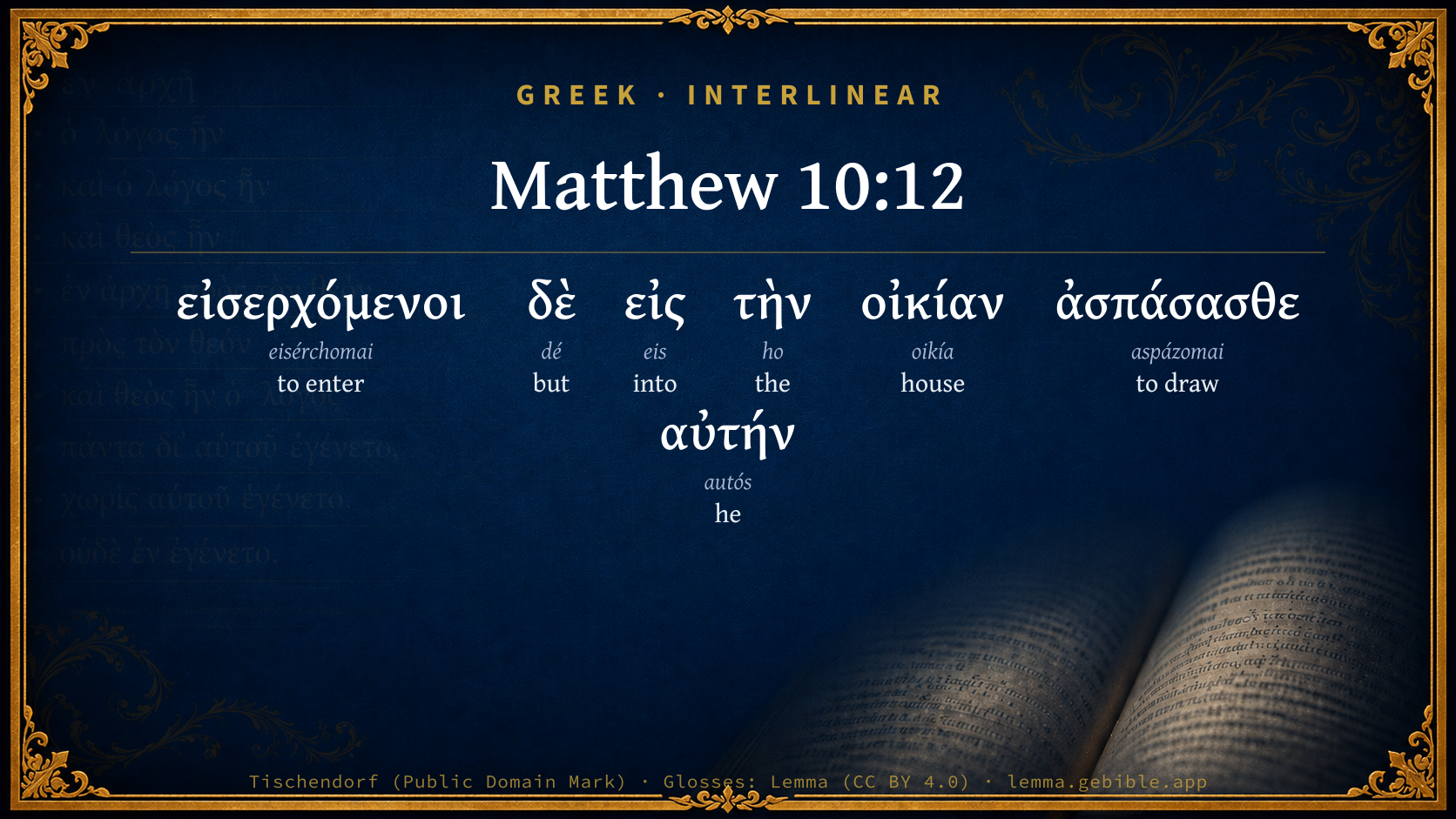
Greek (Tischendorf 8th ed.) Matthew 10:12 appears in the Greek New Testament. The text above is from the Tischendorf 8th edition. Each word links to its Strong’s number and a concise gloss. Click any word for its full Thayer’s Greek Lexicon entry.
Download image
Cite this verse

Matthew 10:12 (World English Bible). Public Domain. Lemma interlinear Bible study tool, https://lemma.gebible.app/v/matthew/10/12.

Show BibTeX & RIS
BibTeX
RIS
English Translation
As you enter into the household, greet it.
World English Bible · Public Domain
Download a study sheet

One document with this verse’s original text, its word-by-word gloss line, the meaning frame, cross-references with their text, attributed commentary, and full source and license credits — printable, and it pastes into notes with its structure intact.

This verse Autodidact and up

Study sheet (.html) Plain text (.txt)

A passage Seminary Student

Up to 50 verses in one chapter. A passage sheet keeps up to 6 commentary sources and 12 cross-references per verse, in the order this page ranks them, and says so on the sheet whenever that leaves anything out. Ask for a single verse and you get the Autodidact verse sheet above.

Everything on this page stays free to read, with no account — the sheet is a download of what is already on screen, not access to it.

Want to remove ads? Support Godless Engineer
Compare translations 3

The same verse in 3 English versions, stacked beneath the original-language interlinear above. Click any original word for its lexicon entry.

Each is an independent rendering of the whole verse — the interlinear is not word-aligned to these translations.

Highlighted words mark where these versions differ — a whole-verse word diff, not a word-by-word alignment.

  • World English Bible Public Domain
    As you enter into the household, greet it.
  • King James Version Public Domain
    And when ye come into an house, salute it.
  • unfoldingWord Literal Text CC BY-SA 4.0
    Now entering into the house, greet it.

unfoldingWord Literal Text — © unfoldingWord, licensed CC BY-SA 4.0. Word-aligned USFM3 via Door43 (git.door43.org/unfoldingWord/en_ult).

Versions to compare (up to 4)

3 of 4 selected

Show all 19 translations

Every available English version of this verse, each an independent rendering of the whole verse.

  • World English Bible Public Domain
    As you enter into the household, greet it.
  • Berean Standard Bible Public Domain
    As you enter the home, greet its occupants.
  • Majority Standard Bible Public Domain
    As you enter the home, greet its occupants.
  • King James Version Public Domain
    And when ye come into an house, salute it.
  • American Standard Version (1901) Public Domain
    And as ye enter into the house, salute it.
  • Revised Version (1885) Public Domain
    And as ye enter into the house, salute it.
  • Geneva Bible (1599) Public Domain
    And when yee come into an house, salute the same.
  • Douay-Rheims (1899) Public Domain
    And when you come into the house, salute it, saying: Peace be to this house.
  • Young's Literal Translation Public Domain
    And coming to the house salute it,
  • Literal Standard Version CC BY-SA 4.0
    And coming into the house greet it,
  • Unlocked Literal Bible CC BY-SA 4.0
    As you enter into the house, greet it.
  • unfoldingWord Literal Text CC BY-SA 4.0
    Now entering into the house, greet it.
  • Darby Bible Public Domain
    And as ye enter into a house salute it.
  • World Messianic Bible Public Domain
    As you enter into the household, greet it.
  • Webster's Bible Public Domain
    And when ye come into a house, salute it.
  • Free Bible Version CC BY-SA 4.0
    When you enter the house, give it your blessing.
  • Bible in Basic English Public Domain
    And when you go in, say, May peace be on this house.
  • Text-Critical English NT CC BY 4.0
    As you enter the house, greet the people who live there.
  • Tyndale New Testament (1534) Public Domain
    And when ye come in to an housse salute the same.

Literal Standard Version (2020), Covenant Press — licensed CC BY-SA 4.0. Text via the HelloAO Bible API (eBible.org). Unlocked Literal Bible (unfoldingWord) — licensed CC BY-SA 4.0. Text via the HelloAO Bible API (eBible.org). unfoldingWord Literal Text — © unfoldingWord, licensed CC BY-SA 4.0. Word-aligned USFM3 via Door43 (git.door43.org/unfoldingWord/en_ult). Free Bible Version, Dr. Jonathan Gallagher — licensed CC BY-SA 4.0. Text via the HelloAO Bible API (eBible.org).

Word by word

More ways to search: Search by grammar → Find every occurrence → Compare this word →

Practice this passage: Drill this verse → Learn its vocabulary →

About this verse

These counts appear in no published source. They are computed here, from the morphology-tagged text and Lemma’s own curated glosses. What Lemma adds →

7
words
7
distinct lemmas
Gospels
section

Shared distinctive vocabulary

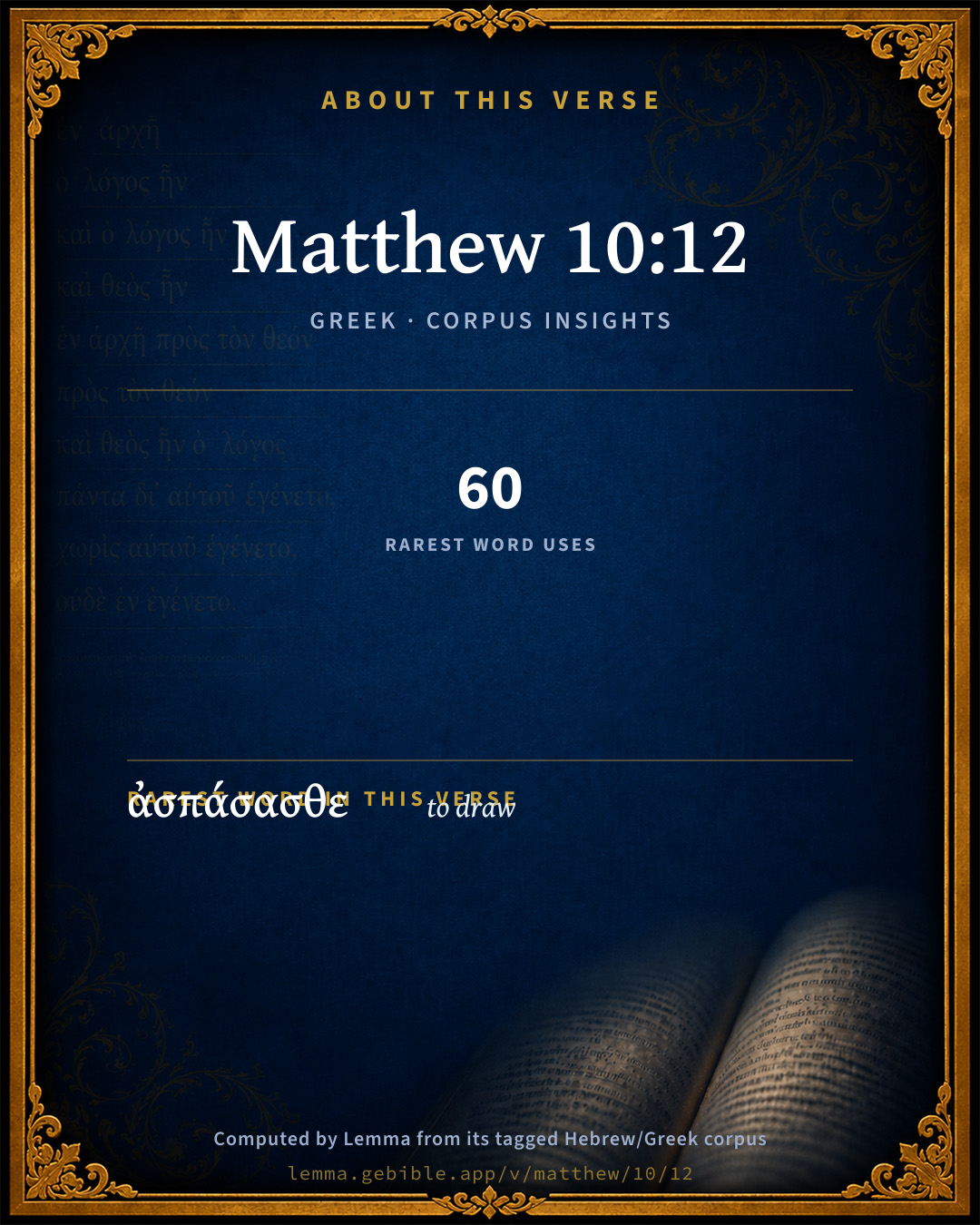
ἀσπάσασθε to draw G782 occurs in 48 verses of the Greek New Testament. Also found in:
Cross-references

5

Topical passages linked to Matthew 10:12 in the Treasury of Scripture Knowledge — connected by theme and wording, ordered by reader-vote popularity; previews shown in the World English Bible.

  • 1 Samuel 25:6 and thus shall you tell him who lives [in prosperity], Peace be to you, and peace be to your house, and peace be to all that you have.
  • Luke 10:5–6 Into whatever house you enter, first say, 'Peace be to this house.'
  • Acts 10:36 The word which he sent to the children of Israel, preaching good news of peace by Jesus Christ--he is Lord of all--
  • 2 Corinthians 5:20 We are therefore ambassadors on behalf of Christ, as though God were entreating by us. We beg you on behalf of Christ, be reconciled to God.
  • 3 John 1:14 but I hope to see you soon, and we will speak face to face. Peace be to you. The friends greet you. Greet the friends by name.

Cross-references courtesy of OpenBible.info (CC BY 4.0).

Commentary

Notes on Matthew 10:12 from classic Christian and Jewish commentators (each source and its license shown beneath its notes). The classic Christian expositions comment on the surrounding passage and are grouped to its opening verse, so a note may address several verses; the Jewish commentaries on the Tanakh (Rashi and others) are per-verse, so they appear only where the commentator wrote on this verse.

Lemma curates 59 commentaries, every one of them public domain or Creative Commons licensed, each selected and text-cleaned for this edition rather than reprinted as found. About our sources →

The Biblical Illustrator

Joseph S. Exell

Mat_10:12-13

And if the house be worthy.

The happy family

Illustrate the transcendent importance of religion by presenting some of the leading characteristics of the family which is governed by its influence.

I. The general aim of its arrangements.

II. Its department of education.

III. Its every-day pursuits-its ordinary habits and dispositions.

IV. Amid the sacred employment of the sabbath,

V. In its seasons of prosperity and adversity.

VI. In its final union in heaven. (J. Nilson, A. M.)

The peaceful salutation

1. The clergyman is to be the minister of peace.

2. But it all depends upon adaptation-the peace is to the house, but the question whether the house or any one in it can say, the peace turns upon the point of adaptation. If the house is worthy i.e., if there be fitness in the house to receive it. What that peace means:

1. It is peace with God.

2. It is peace through the blood of Jesus Christ.

3. It is a peace within.

4. It is peace with the whole world. (J. Vaughan M. A.)

Spiritual adaptation

It is a principle which pervades everything. To select the congenial soil, or by art to make it congenial to the seed, is the secret of husbandry. The man of physical science is certain of the properties and powers of natural substances; but his difficulty is to secure that the state of the recipient match with its virtues. In the most exquisite and delicate of modern inventions, the capability of the ray of light to leave its impression, is invariable and undoubted; the science lies in procuring a material which is capable to take and to retain it. Nothing lives, nothing really exercises its being, but in that to which it stands in a certain sympathy and proportion. So grace is to the gracious, and peace to the men of peace. (J. Vaughan M. A.)

Saluting a house

When a Persian enters an assembly, after having left his shoes without, he makes the usual salutation of Peace be unto you, which is addressed to the whole assembly-as it were, saluting the house. (Morier.)

The Biblical Illustrator, edited by Joseph S. Exell (c. 1880s–1900s) — public domain. Text from a community e-Sword module.

Tyndale Open Study Notes

Tyndale Open Resources

10:12 give it your blessing: Greetings were more significant than a simple hello. Often, a greeting would convey a blessing for those who received it (cp. Ruth 2:4).

Tyndale Open Study Notes — © Tyndale Open Resources, licensed CC BY-SA 4.0. Text via the HelloAO Bible API.

Bengel's Gnomon

Johann Albrecht Bengel

Mat 10:12. Ἀσπάσασθε, salute) i.e. say שלום, peace, mentioned in Mat 10:13, i.e. salvation. Our Lord adopted formulז and ceremonies already observed, but He elevated them to a higher use.

Bengel's Gnomon of the New Testament — English translation (T&T Clark, Edinburgh, 1860) — public domain. Text from a community e-Sword module.

Meyer's Critical & Exegetical Commentary

Heinrich August Wilhelm Meyer

Mat_10:12. Εἰς τὴν οἰκίαν] This does not mean the house at which you arrive (de Wette), but that which belongs to him whom, on inquiry, you find to be worthy of you (Mat_10:11), and where, if the owner is worthy, you are to stay until you remove to another locality. The article is definite as referring to κἀκεῖ.

ἀσπάσασθε αὐτήν] Euth. Zigabenus: ἐπεύχεσθε εἰρήνην αὐτῇ, the usual form of salutation, שָׁלוֹם לְךָ, Gen_40:23; Jdg_19:20; Luk_10:5.

Meyer — Critical and Exegetical Commentary on the New Testament — English translation by Peter Christie, edited by Frederick Crombie (T&T Clark, 1880) — public domain. Text from a community e-Sword module.

Expositor's Greek Testament

ed. W. Robertson Nicoll

Mat 10:12 . τὴν οἰκίαν , the house selected after due inquiry. ἀσπάσασθε , salute it, not as a matter of formal courtesy, but with a serious mind, saying: “peace be with you,” thinking the while of what peace the kingdom can bring.

The Expositor's Greek Testament, edited by W. Robertson Nicoll (1897–1910) — public domain. Text from a community e-Sword module.

Jamieson, Fausset & Brown

Robert Jamieson, A. R. Fausset & David Brown

And when ye come into an house--or "the house," but it means not the worthy house, but the house ye first enter, to try if it be worthy.

salute it--show it the usual civilities.

Jamieson, Fausset & Brown — Commentary Critical and Explanatory on the Whole Bible (1871) — public domain (CC PDM 1.0). Text via the HelloAO Bible API.

Adam Clarke's Commentary

Verse 12. Salute it] Λεγουτες, ειρηνη εν τω οικω τουτω, saying, "Peace be to this house." This clause, which, as explanatory of the word ασπασασθε, is necessary to the connection in which it now stands, is added, by the MSS. D and L, and forty-three others, the Armenian, Ethiopic, Slavonic, Saxon, Vulgate, all the copies of the old Itala, Theophylact, and Hilary. The clause is also found in several modern versions. The modern Greek has λεγοντες· ειρηνη εις το σκηπρι τουτο. The Italian, by Matthew, of Erberg, and of Diodati, renders it thus: Pace sia a questa casa. Peace be to this house.

It is found also in Wickliff, and in my old MS. Seyinge, pees be to this hous. Some suppose it is an addition taken from Luke; but there is nearly as much reason to believe he took it from Matthew.

Peace, שלום, among the Hebrews, had a very extensive meaning: - it comprehended all blessings, spiritual and temporal. Hence that saying of the rabbins, גדול שלום שכל הברכות כלולות בו Gadal shalom, shecol haberacoth culoloth bo. Great is PEACE, for all other blessings are comprehended in it. To wish peace to a family, in the name and by the authority of Christ, was in effect a positive promise, on the Lord's side, of all the good implied in the wish. This was paying largely even beforehand. Whoever receives the messengers of God into his house confers the highest honour upon himself, and not upon the preacher, whose honour is from God, and who comes with the blessings of life eternal to that man and his family who receives him.

In India, it is customary for a way-faring man, when night draws on, to enter a house, and simply say, "Sir, I am a guest with you this night." If the owner cannot lodge him, he makes an apology, and the traveller proceeds to another house.

Adam Clarke's Commentary on the Bible (1810–1826) — public domain. Text from a community e-Sword/MySword module.

Ellicott's Commentary for English Readers

(12) When ye come into an house.—The English indefinite article is misleading. We must read “into the house,” i.e., the dwelling of the man who had been reported as worthy. The salutation, as the words that follow imply, was the familiar, “Peace be with thee—Peace be to this house” (Luk_10:5).

A Bible Commentary for English Readers, edited by Charles John Ellicott (1878–1897) — public domain. Text from a community e-Sword module.

The Cambridge Bible for Schools and Colleges

gen. ed. J. J. S. Perowne

12. when ye come into a house] Translate, when ye are entering into the house, i. e. the house of him who is indicated as “worthy.” The injunction to remain in the same house was, perhaps, partly to avoid feasting from house to house, partly for the sake of secrecy—a necessary precaution in after times. Such “worthy” hosts of the Church afterwards were Lydia at Philippi (“If ye have judged me to be faithful to the Lord, come into my house and abide there.” Act_16:15), Jason at Thessalonica, Gaius perhaps at Derbe, see Rom_16:23. This kind of general hospitality is still recognised as a duty in the East, where indeed it may be regarded as a necessity.

salute it] Saying “Peace be unto you,” (shalom l’cha,) the usual salutation at this day.

The Cambridge Bible for Schools and Colleges (gen. ed. J. J. S. Perowne; Cambridge University Press, 1878–1918) — public domain. Text from a community e-Sword module.

John Gill's Exposition

And if the house be worthy,.... If the family, and particularly the master of it, appeared to be civil, courteous, friendly, and hospitable, upon such a salutation, and ready to receive and embrace them, and provide for them,

let your peace come upon it, or it shall come upon it; the imperative for the future, which is not unusual; and so read the Syriac and Vulgate Latin. The sense is, the peace the apostles wished for, in their form of salutation, should come, and abide on the family; for not the Gospel of peace, and the preaching of it, are here meant, but the salutation itself, or the things desired in it, which should be granted, and the house be blessed for their sake, and as a reward of their generosity, and hospitality:

but if it be not worthy: does not prove to be what it was said to be, and they expected; namely, to be generous, liberal, and beneficent; but, on the contrary, uncivil and churlish, should neglect their salutation, discover an unwillingness to receive them, and turn their backs upon them:

let your peace return to you, or "it shall return to you"; the happiness wished for shall not come upon them, and the prayers and good wishes of the apostles shall be void, and of none effect, with respect to that family, but should be made good to themselves; and they should be directed to another house, where they should find persons more generous and free to entertain them.

John Gill's Exposition of the Whole Bible (1746–1763) — public domain (CC PDM 1.0). Text via the HelloAO Bible API.

Trapp's Complete Commentary

John Trapp

12 And when ye come into an house, salute it.

Ver. 12. And when ye come into an house] Into the synagogues and other places of public meeting, our Saviour sends them not as yet, because they were but young beginners and lacked boldness and other abilities; but bids them teach privately, catechise from house to house, and not stretch the wing beyond the nest till better fledged and fitted for flight.

John Trapp, A Commentary or Exposition upon All the Books of the Old and New Testament (1647–1656) — public domain. Text from a community e-Sword module.

Haydock's Catholic Bible Commentary

Peace be to, &c. Heb. shalom, "peace be to you." The custom of salutation here recommended by our Saviour to his disciples, as St. Jerome informs us, was very prevalent among the Hebrews and Syrians. --- This was an ordinary salutation among the Jews, by which they wished happiness and prosperity. (Witham)

George Leo Haydock (1774–1849), Haydock's Catholic Family Bible and Commentary, 1859 edition — public domain. Excludes Psalms (Douay-Rheims chapter numbering differs from Protestant) and Deuterocanonical books (Catholic canon only).

Whedon's Commentary on the Bible

Daniel D. Whedon

12. Salute it — According to the customary form among the Jews, namely, “Peace be to this house.” But this was not to be a mere form. In that phrase of technical politeness, religion should breathe a divine power. It is not a compliment, but a prayer and a blessing.

Daniel D. Whedon (gen. ed.), Commentary on the Old and New Testaments (1874–1909) — public domain. Text from a community e-Sword module.

The Pulpit Commentary

Vers. 12, 13. Parallel passage: Luk_10:5, 6 (the seventy). Your very entrance is to be an occasion of imparting spiritual blessing if the house be receptive of it.

And when ye come; and as ye enter (Revised Version), synchronous with the moment of your entrance. (cf. Luk_17:12) Into a house; the house (Revised Version); i.e. of him who is worthy. Salute it. With the usual greeting of "Peace". (Jud_1:18:15 1Sa_25:5, 1Sa_25:6) Observe that Christ practised what he preached. (Joh_20:19 Luk_24:3)

The Pulpit Commentary (1880–1919), ed. H.D.M. Spence-Jones & Joseph S. Exell — public domain. Text from a community e-Sword module.

John Wesley's Explanatory Notes

Salute it - In the usual Jewish form, "Peace (that is, all blessings) be to this house."

John Wesley, Explanatory Notes Upon the Whole Bible (1754–1765) — public domain. Text via the GEBible commentary corpus.

Kretzmann's Popular Commentary

Paul E. Kretzmann

Parable of the straying sheep:

v. 12. How think ye? If a man have an hundred sheep, and one of them be gone astray, doth he not leave the ninety and nine, and goeth into the mountains, and seeketh that which is gone astray?

v. 13. And if so be that he find it, verily, I say unto you, he rejoiceth more of that sheep than of the ninety and nine which went not astray.

v. 14. Even so it is not the will of your Father which is in heaven that one of these little ones should perish.

A most effective comparison! The picture is that of a mountain meadow, where the shepherd has taken his flock to give them the full benefit of the rich grass. But now it happens that one goes astray, leaving the richness of the meadow for an occasional hummock of bunch grass, exchanging the safety of the shepherd’s protecting care for the uncertainty of the gullies and canyons, with the danger of rock-slides and bloodthirsty animals. For the shepherd that one sheep then becomes an object of concern. Leaving the other sheep behind him, he climbs up into the pathless mountains, and searches for the stray. And if he has the good fortune to see his toil rewarded, his joy over that one sheep will be greater than that over the others that have not felt the temptation to leave the meadow in search of adventures. Most solemnly Jesus emphasizes, most solemnly He states the conclusion: In the same manner it is not the object of the heavenly Father’s will that even a single one of the lowly and humble disciples be lost, especially not on account of an offense given by a brother in the faith. The Father in heaven has only one will, the will to save; only one desire He has, to save by grace. The idea of a predestination to damnation is as ridiculous as it is blasphemous.

Paul E. Kretzmann, Popular Commentary of the Bible (1921–1924) — public domain. Text from a community e-Sword module.

The People's New Testament

B. W. Johnson

12. When you come into an house, salute it. Courteously salute the household.

B. W. Johnson's The People's New Testament with Notes (1889–1891) — public domain. Electronic text from the Christian Classics Ethereal Library (CCEL) ThML edition.

Cambridge Greek Testament for Schools and Colleges

12. εἰσερχόμενοι εἰς τὴν οἰκίαν. ‘When ye are entering into the house,’ i.e. the house of him who is indicated as ‘worthy.’ The injunction to remain in the same house was, perhaps, partly to avoid feasting from house to house, partly for the sake of secrecy—a necessary precaution in after times. Such ‘worthy’ hosts of the Church afterwards were Lydia at Philippi (‘If ye have judged me to be faithful to the Lord, come into my house and abide there,’ Act 16:15), Jason at Thessalonica, Gaius perhaps at Derbe, see Rom 16:23. This kind of general hospitality is still recognised as a duty in the East, where indeed it may be regarded as a necessity.

ἀσπάσασθε. ‘Salute it,’ saying ‘Peace (εἰρήνη) be unto you’ (Shalom l’cha), the usual salutation at this day. This of course explains εἰρήνη in the next verse. The ordinary and conventional salutation acquires a sacred depth of meaning on the lips of Christ, Luk 24:36 and Joh 14:27.

Cambridge Greek Testament for Schools and Colleges (Cambridge University Press, 1896; 21 vols, various authors incl. Carr, Maclear, Plummer, Farrar, Lumby, Moule, M. R. James, Simcox) — public domain. Text from a community e-Sword module.

Alford’s Greek Testament

Henry Alford

12. τὴν οἰκίαν] Not the house of the ἄξιος, for this would be sure to be worthy; but any house, as is necessary from the subsequent ἐὰν ᾖ ἡ οἰκ. ἀξ., which on the other supposition (Meyer, &c.) would have been ascertained already. The full command as to their conduct, from arriving to departing, is given in ver. 11. Then, the subject being taken up again at their arrival in the city, the method of ἐξέτασις is prescribed to them in vv. 12, 13. When they enter into an house, (so, idiomatically, E. V.,) they are to salute it: and if on enquiry it prove worthy, then &c. See notes on ch. 9:1, 28.

Henry Alford, The Greek Testament (1849–1861) — public domain. Text from a community e-Sword module.

International Critical Commentary

(L) 12, 13. And when you enter into the house, salute it. And if the house be worthy, let your peace come upon it; but if it be not worthy, let your peace return to you.] Mk. has no parallel words; but Lk., in the charge to the Seventy (10:5, 6) has: “And into whatsoever house you enter, first say, Peace to this house. And if a son of peace be there, your peace shall rest upon him. But if not, it shall return to you.” The words differ from those in Mt. The two Evangelists are drawing from different sources.

International Critical Commentary — older volumes (1896–1929), various authors — public domain. Text from a community e-Sword module.

Vincent's Word Studies in the New Testament

Marvin R. Vincent

When ye come into [εισερχομενοι] . The Greek indicates more distinctly the simultaneousness of the entrance and the salutation : as ye are entering. Rev., as ye enter. So of the departure, as ye are going forth (ejxercomenoi, ver. 14).

Marvin R. Vincent, Word Studies in the New Testament (1887–1900) — public domain. Text from a community e-Sword/MySword module.

Lesson kit

Teaching starters — assembled from the data on this page, not authored interpretation. Every prompt links to the verse data it draws on. Edit before teaching.

Matthew, in the Gospels, opens this verse with 7 words (7 distinct Greek lemmas). Its most distinctive word is aspázomai (“to draw”). A historical commentator’s framing appears above. Read the whole chapter for the surrounding context.

Discussion questions

  1. What does “to draw” (aspázomai) contribute to the verse as a whole?
  2. Matthew 5:47 shares the word «to draw» with this verse. How do the two illuminate each other?
  3. These translations render this verse differently. What is at stake in choosing one wording over another?
  4. Reading how The Biblical Illustrator and Tyndale Open Study Notes read this verse, where do the two commentators agree and where do they part?

Things to notice

Reading settings

Reading text

Shown beneath each verse's original-language words.

Old Testament
Old Testament edition

Read the OT as the Masoretic Hebrew (MT) or the Greek Septuagint (LXX).

English shown for the Greek Septuagint (in the Hebrew ↔ Greek comparison).

Comparing translations? Open the Compare panel on any verse page to stack up to four side by side.