2 Samuel 3:30

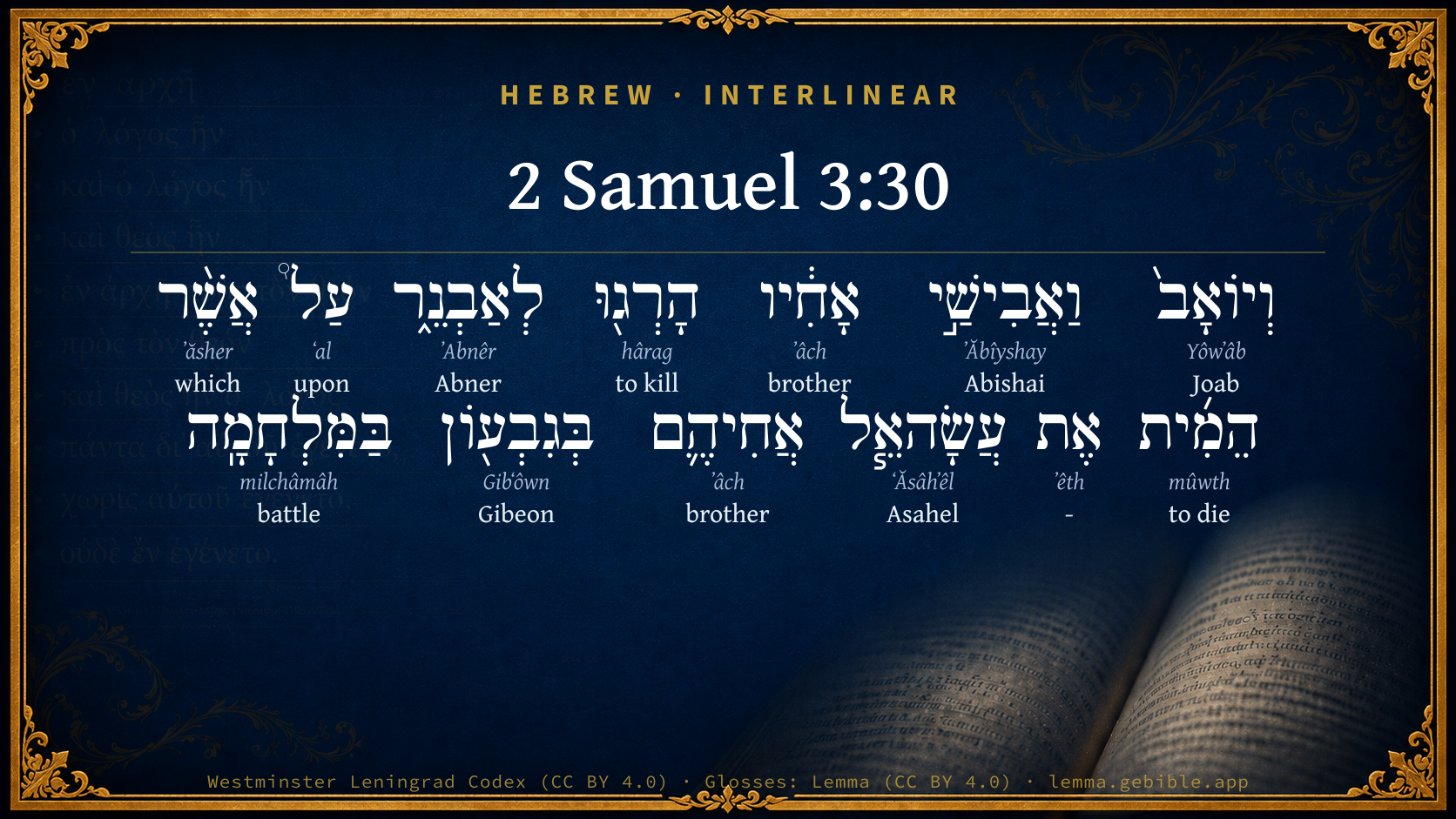
Hebrew (Westminster Leningrad Codex) 2 Samuel 3:30 appears in the Hebrew Old Testament. The text above is from the Westminster Leningrad Codex. Each word links to its Strong’s number, a concise gloss, and parsing drawn from the Open Scriptures Hebrew Bible morphology. Click any word for its full Brown-Driver-Briggs (BDB) entry.
Download image
Cite this verse

2 Samuel 3:30 (World English Bible). Public Domain. Lemma interlinear Bible study tool, https://lemma.gebible.app/v/2-samuel/3/30.

Show BibTeX & RIS
BibTeX
RIS
English Translation
So Joab and Abishai his brother killed Abner, because he had killed their brother Asahel at Gibeon in the battle.
World English Bible · Public Domain
Download a study sheet

One document with this verse’s original text, its word-by-word gloss line, the meaning frame, cross-references with their text, attributed commentary, and full source and license credits — printable, and it pastes into notes with its structure intact.

This verse Autodidact and up

Study sheet (.html) Plain text (.txt)

A passage Seminary Student

Up to 50 verses in one chapter. A passage sheet keeps up to 6 commentary sources and 12 cross-references per verse, in the order this page ranks them, and says so on the sheet whenever that leaves anything out. Ask for a single verse and you get the Autodidact verse sheet above.

Everything on this page stays free to read, with no account — the sheet is a download of what is already on screen, not access to it.

Want to remove ads? Support Godless Engineer
Compare translations 3

The same verse in 3 English versions, stacked beneath the original-language interlinear above. Click any original word for its lexicon entry.

Each is an independent rendering of the whole verse — the interlinear is not word-aligned to these translations.

Highlighted words mark where these versions differ — a whole-verse word diff, not a word-by-word alignment.

  • World English Bible Public Domain
    So Joab and Abishai his brother killed Abner, because he had killed their brother Asahel at Gibeon in the battle.
  • King James Version Public Domain
    So Joab, and Abishai his brother slew Abner, because he had slain their brother Asahel at Gibeon in the battle.
  • unfoldingWord Literal Text CC BY-SA 4.0
    Now Joab and Abishai his brother had murdered Abner because he had killed Asahel their brother at Gibeon in the battle.

unfoldingWord Literal Text — © unfoldingWord, licensed CC BY-SA 4.0. Word-aligned USFM3 via Door43 (git.door43.org/unfoldingWord/en_ult).

Versions to compare (up to 4)

3 of 4 selected

Show all 18 translations

Every available English version of this verse, each an independent rendering of the whole verse.

  • World English Bible Public Domain
    So Joab and Abishai his brother killed Abner, because he had killed their brother Asahel at Gibeon in the battle.
  • Berean Standard Bible Public Domain
    (Joab and his brother Abishai murdered Abner because he had killed their brother Asahel in the battle at Gibeon.)
  • Majority Standard Bible Public Domain
    (Joab and his brother Abishai murdered Abner because he had killed their brother Asahel in the battle at Gibeon.)
  • King James Version Public Domain
    So Joab, and Abishai his brother slew Abner, because he had slain their brother Asahel at Gibeon in the battle.
  • American Standard Version (1901) Public Domain
    So Joab and Abishai his brother slew Abner, because he had killed their brother Asahel at Gibeon in the battle.
  • Revised Version (1885) Public Domain
    So Joab and Abishai his brother slew Abner, because he had killed their brother Asahel at Gibeon in the battle.
  • Geneva Bible (1599) Public Domain
    (So Ioab and Abishai his brother slewe Abner, because he had slaine their brother Asahel at Gibeon in battel)
  • Douay-Rheims (1899) Public Domain
    So Joab and Abisai his brother slew Abner, because he had killed their brother Asael at Gabaon in the battle.
  • Young's Literal Translation Public Domain
    And Joab and Abishai his brother slew Abner because that he put to death Asahel their brother, in Gibeon, in battle.
  • Literal Standard Version CC BY-SA 4.0
    And Joab and his brother Abishai slew Abner because that he put their brother Asahel to death in Gibeon, in battle.
  • Unlocked Literal Bible CC BY-SA 4.0
    So Joab and Abishai his brother killed Abner, because he had killed their brother Asahel at Gibeon in battle.
  • unfoldingWord Literal Text CC BY-SA 4.0
    Now Joab and Abishai his brother had murdered Abner because he had killed Asahel their brother at Gibeon in the battle.
  • Darby Bible Public Domain
    So Joab and Abishai his brother killed Abner, because he had slain their brother Asahel at Gibeon in the battle.
  • World Messianic Bible Public Domain
    So Joab and Abishai his brother killed Abner, because he had killed their brother Asahel at Gibeon in the battle.
  • Webster's Bible Public Domain
    So Joab and Abishai his brother slew Abner, because he had slain their brother Asahel at Gibeon in the battle.
  • Free Bible Version CC BY-SA 4.0
    (This is why Joab and Abishai his brother killed Abner, because he had killed their brother Asahel during the battle at Gibeon.)
  • Bible in Basic English Public Domain
    So Joab and Abishai his brother put Abner to death, because he had put to death their brother Asahel in the fight at Gibeon.
  • JPS Tanakh (1917) Public Domain
    So Joab and Abishai his brother slew Abner, because he had killed their brother Asahel at Gibeon in the battle.

Literal Standard Version (2020), Covenant Press — licensed CC BY-SA 4.0. Text via the HelloAO Bible API (eBible.org). Unlocked Literal Bible (unfoldingWord) — licensed CC BY-SA 4.0. Text via the HelloAO Bible API (eBible.org). unfoldingWord Literal Text — © unfoldingWord, licensed CC BY-SA 4.0. Word-aligned USFM3 via Door43 (git.door43.org/unfoldingWord/en_ult). Free Bible Version, Dr. Jonathan Gallagher — licensed CC BY-SA 4.0. Text via the HelloAO Bible API (eBible.org).

Word by word

More ways to search: Search by grammar → Find every occurrence → Compare this word →

Practice this passage: Drill this verse → Learn its vocabulary →

עֲשָׂהאֵ֧ל
ʻĂsâhʼêl
H6214
“Asahel”
Noun, Proper
Part of Speech
Noun
Type
Proper
Full BDB Definition

Origin: from H6213 and H410

TWOT: None

Asahel = "God-made" - nephew of David, son of David's sister Zeruiah, and brother of Joab and Abishai; swift of foot he was killed by Abner when he pursued him in battle and caught him - a Levite in the reign of king Jehoshaphat of Judah who went through the kingdom giving instruction in the law - a Levite in the reign of king Hezekiah of Judah in charge of the tithes and dedicated things in the temple - a priest, father of Jonathan, in the time of Ezra
  1. וְיוֹאָב֙ Yôwʼâb H3097 “and · Joab” Conjunction + Noun, Proper
  2. וַאֲבִישַׁ֣י ʼĂbîyshay H52 “and · Abishai” Conjunction + Noun, Proper
  3. אָחִ֔יו ʼâch H251 “brother · his” Noun, Common, Masculine, Singular, Construct + Suffix, Personal, 3rd Person, Masculine, Singular
  4. הָרְג֖וּ hârag H2026 “to kill” Verb, Qal, Perfect, 3rd Person, Common, Plural
  5. לְאַבְנֵ֑ר ʼAbnêr H74 “to/for · Abner” Preposition + Noun, Proper
  6. עַל֩ ʻal H5921 “upon” Preposition
  7. אֲשֶׁ֨ר ʼăsher H834 “which” Particle, Relative
  8. הֵמִ֜ית mûwth H4191 “to die” Verb, Hiphil, Perfect, 3rd Person, Masculine, Singular
  9. אֶת ʼêth H853 “-” Particle, Direct Object
  10. אֲחִיהֶ֛ם ʼâch H251 “brother · their” Noun, Common, Masculine, Singular, Construct + Suffix, Personal, 3rd Person, Masculine, Plural
  11. בְּגִבְע֖וֹן Gibʻôwn H1391 “in/at · Gibeon” Preposition + Noun, Proper
  12. בַּמִּלְחָמָֽה milchâmâh H4421 “in/at the · battle” Preposition, Determined + Noun, Common, Feminine, Singular, Absolute

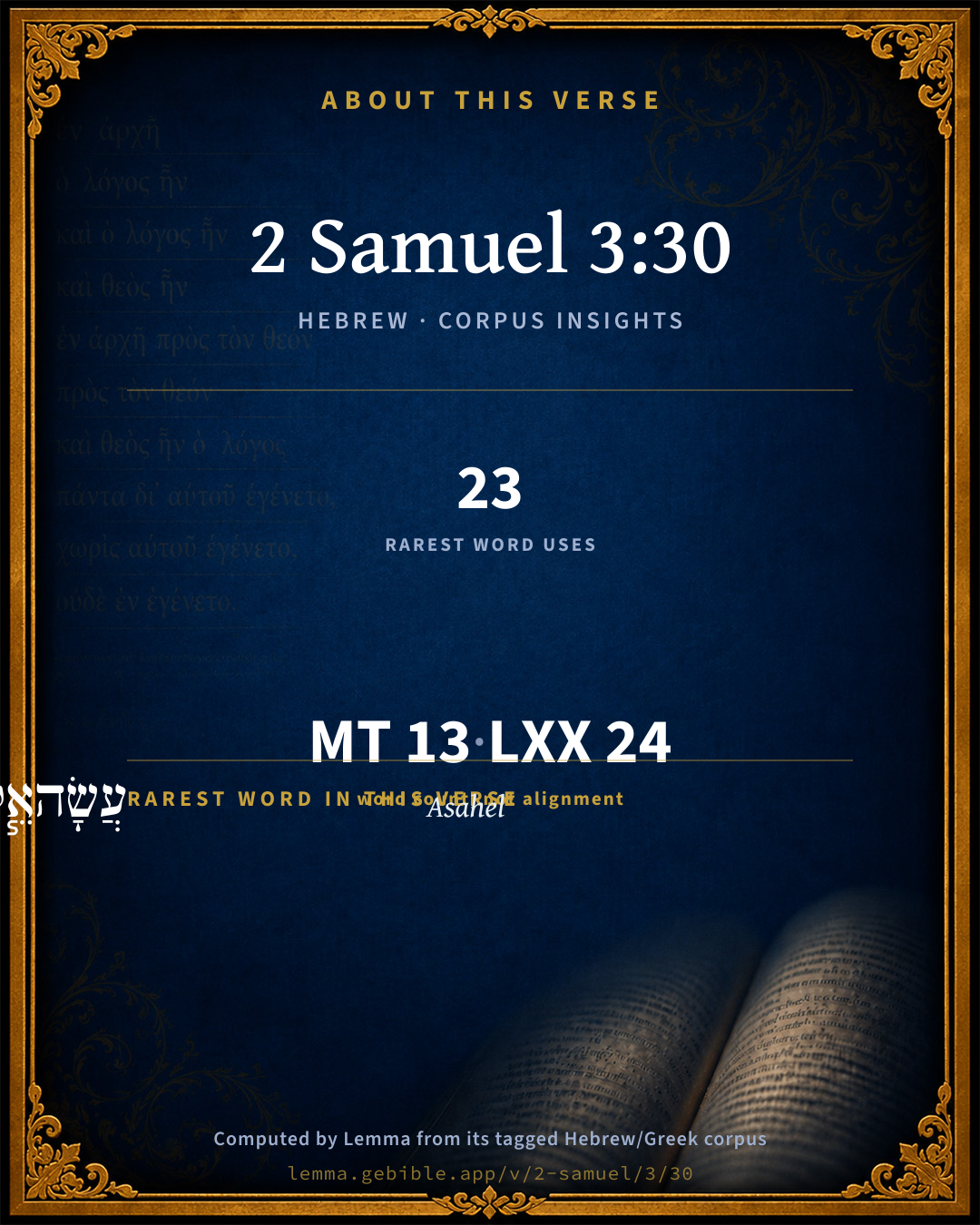
About this verse

These counts appear in no published source. They are computed here, from the morphology-tagged text and Lemma’s own curated glosses. What Lemma adds →

13
words
12
distinct lemmas
Historical
section

Notable vocabulary

The rarest word here is עֲשָׂהאֵ֧ל Asahel H6214 — appearing just 23 times in the whole Hebrew Bible.

Shared distinctive vocabulary

עֲשָׂהאֵ֧ל Asahel H6214 occurs in 17 verses of the Hebrew Bible. Also found in:

Grammatical profile

  • 2 verbs
  • 8 nouns
  • 1 preposition
  • 2 particles

Verb forms

  • הָרְג֖וּ Qal · Perfect
  • הֵמִ֜ית Hiphil · Perfect

Repetition

A word recurs within this verse — often emphatic in Hebrew:

  • אָחִ֔יו brother H251 ×2

Hebrew & Septuagint length

In English translation the verse runs 20 words from the Hebrew and 22 from the Septuagint (LXX English) — closely comparable.

A rough comparison of the two English renderings, which tokenize alike — not a word-level alignment.

Word counts can differ between the Hebrew and the Greek without any difference in meaning — e.g. the Hebrew direct-object marker אֵת has no separate Greek word, and Greek often adds the article ὁ.

In the original languages it is 13 Hebrew tokens and 24 Greek tokens — but the two are counted differently (Hebrew bundles its prefixes and suffixes into one token; the Greek is in lemma form), so that isn’t a like-for-like length.

Cross-references

3

Topical passages linked to 2 Samuel 3:30 in the Treasury of Scripture Knowledge — connected by theme and wording, ordered by reader-vote popularity; previews shown in the World English Bible.

  • 2 Samuel 2:19–23 Asahel pursued after Abner; and in going he didn't turn to the right hand nor to the left from following Abner.
  • Proverbs 28:17 A man who is tormented by life blood will be a fugitive until death; No one will support him.
  • Acts 28:4 When the natives saw the creature hanging from his hand, they said one to another, "No doubt this man is a murderer, whom, though he has escaped from the sea, yet Justice has not allowed to live."

Cross-references courtesy of OpenBible.info (CC BY 4.0).

Hebrew and Greek witnesses Masoretic Hebrew ↔ Greek Septuagint

The same verse in the two great witnesses to the Old Testament, shown verse-for-verse.

These are two independent witnesses, not word-aligned to each other, and the Septuagint is shown in lemma (dictionary) form.

Hebrew 2 Samuel 3:30 Masoretic · Westminster Leningrad Codex

וְיוֹאָב֙ וַאֲבִישַׁ֣י אָחִ֔יו הָרְג֖וּ לְאַבְנֵ֑ר עַל֩ אֲשֶׁ֨ר הֵמִ֜ית אֶת עֲשָׂהאֵ֧ל אֲחִיהֶ֛ם בְּגִבְע֖וֹן בַּמִּלְחָמָֽה

So Joab and Abishai his brother killed Abner, because he had killed their brother Asahel at Gibeon in the battle.

World English Bible · Public Domain

Greek LXX 2 Samuel 3:30 Septuagint · lemma form

ιωαβ δέ καί αβεσσα ὁ ἀδελφός αὐτός δια παρατηρέω ὁ αβεννηρ ἀντί ὅς θανατόω ὁ ασαηλ ὁ ἀδελφός αὐτός ἐν γαβαων ἐν ὁ πόλεμος

For Joab and Abessa his brother laid wait continually for Abenner, because he killed Asael their brother at Gabaon in the battle.

LXX2012 (modern English Septuagint) · Public Domain

Hebrew: Westminster Leningrad Codex (CC BY 4.0). Greek: Septuagint (public domain); English from LXX2012 (modern English Septuagint) (Public Domain). How the Septuagint differs from the Hebrew →

Targum (Aramaic paraphrase)

1

The Targum is the ancient Jewish Aramaic paraphrase of the Hebrew Scriptures — an interpretive translation, not the Hebrew text itself. Onkelos (literal) and Pseudo-Jonathan (expansive) render the Torah, and Jonathan the Prophets. Coverage is partial: where no permissively-licensed English translation exists for a verse, only the Aramaic is shown. This is verse-level text, not a word-by-word alignment to the Hebrew.

  1. Targum Jonathan Prophets (Joshua–Malachi)
    וְיוֹאָב וַאֲבִישַׁי אֲחוּהִי קְטָלוּ לְאַבְנֵר עַל דְקָטַל יַת עֲשָׂהאֵל אֲחוּהוֹן בְּגִבְעוֹן בִּקְרָבָא:

    (no public-domain English translation for this verse)

    Targum Jonathan — Aramaic: “Mikraot Gedolot” (public domain). English: “Sefaria Community Translation” (CC0 1.0 (public-domain dedication)); “London "Chaldee Paraphrase," 1871” (public domain). Text via Sefaria.

Commentary

Notes on 2 Samuel 3:30 from classic Christian and Jewish commentators (each source and its license shown beneath its notes). The classic Christian expositions comment on the surrounding passage and are grouped to its opening verse, so a note may address several verses; the Jewish commentaries on the Tanakh (Rashi and others) are per-verse, so they appear only where the commentator wrote on this verse.

Lemma curates 59 commentaries, every one of them public domain or Creative Commons licensed, each selected and text-cleaned for this edition rather than reprinted as found. About our sources →

Trapp's Complete Commentary

John Trapp

2Sa 3:30 So Joab and Abishai his brother slew Abner, because he had slain their brother Asahel at Gibeon in the battle.

Ver. 30. So Joab and Abishai his brother slew Abner.] Joab did, but not without the privity and consent of his brother Abishai. Now there is little difference, faveasve sceleri, an illud facias; to hold the bag is as bad as to fill it.

John Trapp, A Commentary or Exposition upon All the Books of the Old and New Testament (1647–1656) — public domain. Text from a community e-Sword module.

Joseph Benson's Commentary

2Sa 3:30. So Joab and Abishai his brother slew Abner — For though Joab only committed the murder, yet Abishai was chargeable with the guilt of it, because it was done with his consent, counsel, and approbation. And he probably was near at hand when the bloody deed was perpetrated, ready to assist Joab if there should be need. Because he had slain their brother Asahel in battle — Which he did for his own necessary defence, and therefore it was no justification of this treacherous murder.

Joseph Benson's Commentary on the Old and New Testaments (1811–1818) — public domain. Text from a community e-Sword module.

Tyndale Open Study Notes

Tyndale Open Resources

3:30 See 2:18-28.

Tyndale Open Study Notes — © Tyndale Open Resources, licensed CC BY-SA 4.0. Text via the HelloAO Bible API.

Geneva Bible (1599)

Geneva Bible translators

Abishai is said to slay him with Joab, because he consented to the murder.

Geneva Bible (1599) marginal notes — public domain. Text via Bolls.life.

Ellicott's Commentary for English Readers

(30) Slew . . . had slain.—The words are different in Hebrew, the former denoting violence. Translate the latter had put to death. By this strong disapproval of Joab’s act, David shows that it was done without his knowledge or consent. He still remains at fault, however, for continuing Joab in his high and responsible position; but this seems to have been the result of inability to inflict proper punishment upon so powerful a subject, an inability which David on his death-bed sought to remedy by his charge to Solomon. (See 2Sa_3:39; 1Ki_2:5.)

A Bible Commentary for English Readers, edited by Charles John Ellicott (1878–1897) — public domain. Text from a community e-Sword module.

The Cambridge Bible for Schools and Colleges

gen. ed. J. J. S. Perowne

30. slew … slain] Murdered Abner, because he had slain, &c. The words in the Heb. are different, and the first denotes the violent character of the act. The Sept. however gives another reading, “Now Joab and Abishai were lying in wait for Abner, because &c.”

The Cambridge Bible for Schools and Colleges (gen. ed. J. J. S. Perowne; Cambridge University Press, 1878–1918) — public domain. Text from a community e-Sword module.

John Gill's Exposition

So Joab and Abishai his brother slew Abner,.... For though it was only Joab that gave him the thrust of which he died, Abishai was in the secret, and was consenting and advising to his death, and so an accessory to it; and might be present, ready to assist in it, if occasion required; and so Josephus (k) expressly says, that Abishai his brother was with him when he drew his sword, and smote him:

because he had slain their brother Asahel at Gibeon in the battle: which was no just reason at all; his blood was shed in war, this in peace, in cold blood, and under the guise of friendship; that was shed with reluctance, and after fair warning, and in defence of himself; but this wilfully in Joab, unawares to Abner, and in great deceit and hypocrisy; see Kg1 2:5.

(k) Ut supra. (Antiqu. l. 7. c. 1. sect. 6.)

John Gill's Exposition of the Whole Bible (1746–1763) — public domain (CC PDM 1.0). Text via the HelloAO Bible API.

Matthew Poole's English Annotations

Joab and Abishai; for though Joab only committed the murder, yet Abishai was guilty of it, because it was done with his consent, and counsel, and help, and approbation; for by these and such-like actions men are involved in the guilt of other men’s sins, at least in God’s judgment. Abner slew Asahel in the fury of battle, and for his own necessary defence; and therefore it was no justification of this unnecessary and treacherous murder in a time of peace.

Matthew Poole's English Annotations on the Holy Bible (1683–1685) — public domain. Text from a community e-Sword/MySword module.

Whedon's Commentary on the Bible

Daniel D. Whedon

30. Joab and Abishai — Joab’s sword and Abishai’s ready consent and counsel accomplished Abner’s fall.

Daniel D. Whedon (gen. ed.), Commentary on the Old and New Testaments (1874–1909) — public domain. Text from a community e-Sword module.

The Pulpit Commentary

Joab and Abishai his brother. Nothing is said of Abishai having taken part in the murder, but the words suggest that it was a premeditated act, and that Abishai was privy to it.

The Pulpit Commentary (1880–1919), ed. H.D.M. Spence-Jones & Joseph S. Exell — public domain. Text from a community e-Sword module.

John Wesley's Explanatory Notes

Abishai - For though Joab only committed the murder, yet Abishai was guilty of it, because it was done with his consent, and counsel, and approbation. In battle - Which he did for his own necessary defense; and therefore it was no justification of this treacherous murder.

John Wesley, Explanatory Notes Upon the Whole Bible (1754–1765) — public domain. Text via the GEBible commentary corpus.

Rashi

Rabbi Shlomo Yitzchaki (Rashi)

Killed Avner. [As if to say] Avner and similar to it [we find] "Snatch me, be my surety" (Yeshaiya 38, 14), Snatch me and also similarly (Bamidbar 12,13), "Please heal her" Heal her and similarly to this (Divrei Hayomin II, 17, 7) "He sent his officers, Ben Chayil, and Ovadiah… to teach in the cities of Yehudah and it's meaning is: He sent his officers, Ben Chayil.

Rashi on the Tanakh — English translations: “The Judaica Press complete Tanach with Rashi, translated by A. J. Rosenberg” (CC BY 4.0); “Pentateuch with Rashi's commentary by M. Rosenbaum and A.M. Silbermann, 1929-1934” (public domain); “The Metsudah Tanach series, Lakewood, N.J” (CC BY 4.0); and “The Book of Joshua, Metsudah Publications, 1997” (CC BY 4.0). Text via Sefaria.

Lesson kit

Teaching starters — assembled from the data on this page, not authored interpretation. Every prompt links to the verse data it draws on. Edit before teaching.

2 Samuel, in the Historical, opens this verse with 13 words (12 distinct Hebrew lemmas). Its most distinctive word is ʻĂsâhʼêl (“Asahel”). A historical commentator’s framing appears above. Read the whole chapter for the surrounding context.

Discussion questions

  1. How does “Asahel” (ʻĂsâhʼêl) shape what this verse is saying?
  2. How does 2 Samuel 2:18, which shares the word «Asahel», read alongside this verse?
  3. What does the repetition of “brother” (2× in this one verse) do in this verse?
  4. These translations render this verse differently; the difference is in the English rendering, not the original. What questions does that raise?
  5. «הָרְג֖וּ» is a Qal Perfect verb. How does that grammatical form shape the action described?
  6. Compare how Trapp's Complete Commentary and Joseph Benson's Commentary read this verse. Where do they agree or differ?

Things to notice

Reading settings

Reading text

Shown beneath each verse's original-language words.

Old Testament
Old Testament edition

Read the OT as the Masoretic Hebrew (MT) or the Greek Septuagint (LXX).

English shown for the Greek Septuagint (in the Hebrew ↔ Greek comparison).

Comparing translations? Open the Compare panel on any verse page to stack up to four side by side.