
Matthew 10:17

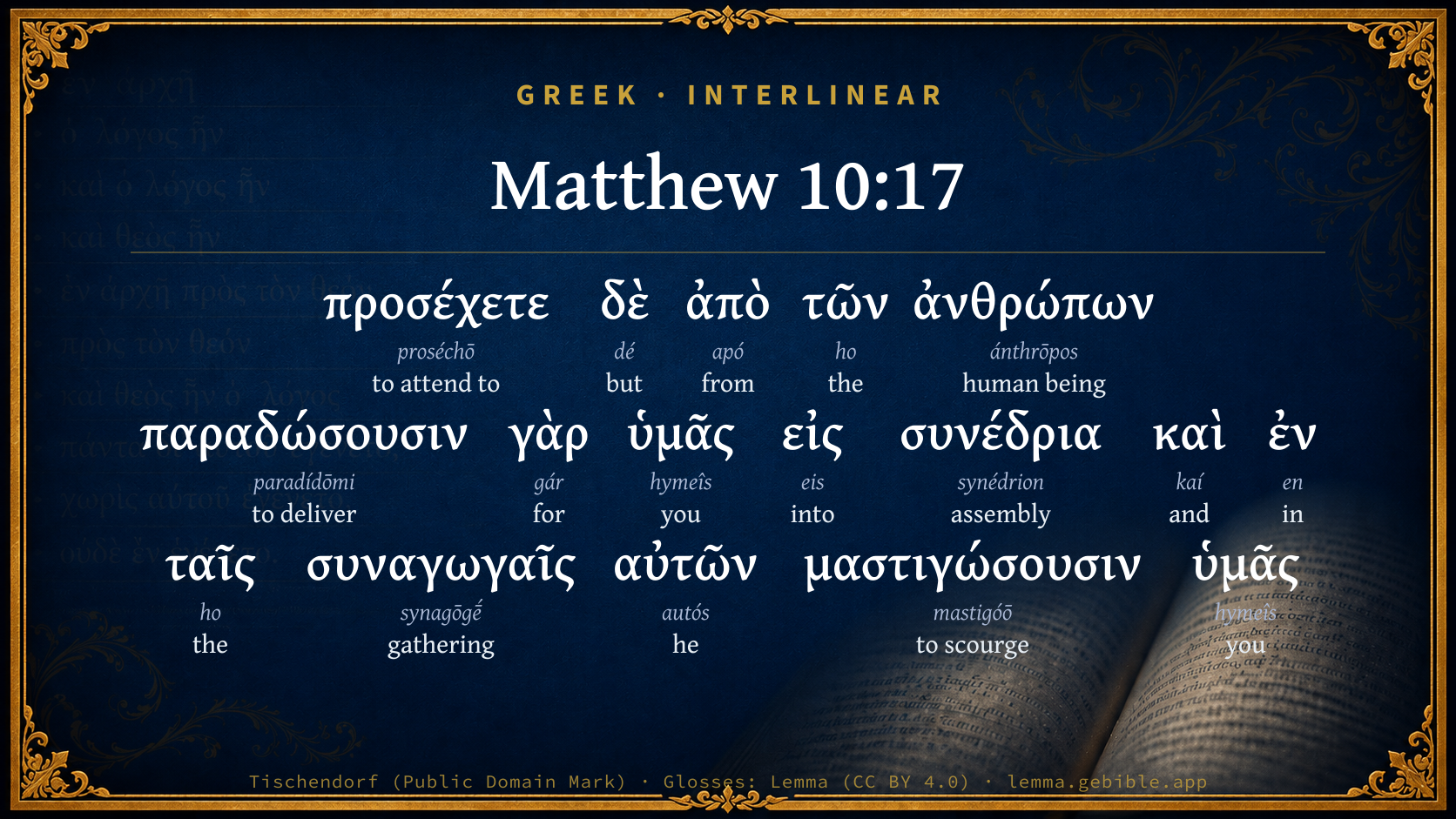
Greek (Tischendorf 8th ed.) Matthew 10:17 appears in the Greek New Testament. The text above is from the Tischendorf 8th edition. Each word links to its Strong’s number and a concise gloss. Click any word for its full Thayer’s Greek Lexicon entry.
Download image
Cite this verse

Matthew 10:17 (World English Bible). Public Domain. Lemma interlinear Bible study tool, https://lemma.gebible.app/v/matthew/10/17.

Show BibTeX & RIS
BibTeX
RIS
English Translation
But beware of men: for they will deliver you up to councils, and in their synagogues they will scourge you.
World English Bible · Public Domain
Highlights
  • 1 first appearance in the Greek New Testament
Full analysis ↓
Download a study sheet

One document with this verse’s original text, its word-by-word gloss line, the meaning frame, cross-references with their text, attributed commentary, and full source and license credits — printable, and it pastes into notes with its structure intact.

This verse Autodidact and up

Study sheet (.html) Plain text (.txt)

A passage Seminary Student

Up to 50 verses in one chapter. A passage sheet keeps up to 6 commentary sources and 12 cross-references per verse, in the order this page ranks them, and says so on the sheet whenever that leaves anything out. Ask for a single verse and you get the Autodidact verse sheet above.

Everything on this page stays free to read, with no account — the sheet is a download of what is already on screen, not access to it.

Want to remove ads? Support Godless Engineer
Compare translations 3

The same verse in 3 English versions, stacked beneath the original-language interlinear above. Click any original word for its lexicon entry.

Each is an independent rendering of the whole verse — the interlinear is not word-aligned to these translations.

Highlighted words mark where these versions differ — a whole-verse word diff, not a word-by-word alignment.

  • World English Bible Public Domain
    But beware of men: for they will deliver you up to councils, and in their synagogues they will scourge you.
  • King James Version Public Domain
    But beware of men: for they will deliver you up to the councils, and they will scourge you in their synagogues;
  • unfoldingWord Literal Text CC BY-SA 4.0
    But beware of the men, for they will hand you over to councils, and they will whip you in their synagogues;

unfoldingWord Literal Text — © unfoldingWord, licensed CC BY-SA 4.0. Word-aligned USFM3 via Door43 (git.door43.org/unfoldingWord/en_ult).

Versions to compare (up to 4)

3 of 4 selected

Show all 19 translations

Every available English version of this verse, each an independent rendering of the whole verse.

  • World English Bible Public Domain
    But beware of men: for they will deliver you up to councils, and in their synagogues they will scourge you.
  • Berean Standard Bible Public Domain
    But beware of men; for they will hand you over to their councils and flog you in their synagogues.
  • Majority Standard Bible Public Domain
    But beware of men, for they will hand you over to their councils and flog you in their synagogues.
  • King James Version Public Domain
    But beware of men: for they will deliver you up to the councils, and they will scourge you in their synagogues;
  • American Standard Version (1901) Public Domain
    But beware of men: for they will deliver you up to councils, and in theirs synagogues they will scourge you;
  • Revised Version (1885) Public Domain
    But beware of men: for they will deliver you up to councils, and in their synagogues they will scourge you;
  • Geneva Bible (1599) Public Domain
    But beware of men, for they will deliuer you vp to the Councils, and will scourge you in their Synagogues.
  • Douay-Rheims (1899) Public Domain
    But beware of men. For they will deliver you up in councils, and they will scourge you in their synagogues.
  • Young's Literal Translation Public Domain
    And, take ye heed of men, for they will give you up to sanhedrims, and in their synagogues they will scourge you,
  • Literal Standard Version CC BY-SA 4.0
    And take heed of men, for they will give you up to Sanhedrins, and in their synagogues they will scourge you,
  • Unlocked Literal Bible CC BY-SA 4.0
    Watch out for people! They will deliver you up to councils, and they will whip you in their synagogues.
  • unfoldingWord Literal Text CC BY-SA 4.0
    But beware of the men, for they will hand you over to councils, and they will whip you in their synagogues;
  • Darby Bible Public Domain
    But beware of men; for they will deliver you up to sanhedrims, and scourge you in their synagogues;
  • World Messianic Bible Public Domain
    But beware of men, for they will deliver you up to councils, and in their synagogues they will scourge you.
  • Webster's Bible Public Domain
    But beware of men: for they will deliver you to the councils, and they will scourge you in their synagogues.
  • Free Bible Version CC BY-SA 4.0
    Watch out for those who will hand you over to be tried by town councils and will whip you in their synagogues.
  • Bible in Basic English Public Domain
    But be on the watch against men: for they will give you up to the Sanhedrins, and in their Synagogues they will give you blows;
  • Text-Critical English NT CC BY 4.0
    But beware of men, for they will deliver you up to councils and flog you in their synagogues.
  • Tyndale New Testament (1534) Public Domain
    Beware of men for they shall deliver you vp to the consels and shall scourge you in their synagoges.

Literal Standard Version (2020), Covenant Press — licensed CC BY-SA 4.0. Text via the HelloAO Bible API (eBible.org). Unlocked Literal Bible (unfoldingWord) — licensed CC BY-SA 4.0. Text via the HelloAO Bible API (eBible.org). unfoldingWord Literal Text — © unfoldingWord, licensed CC BY-SA 4.0. Word-aligned USFM3 via Door43 (git.door43.org/unfoldingWord/en_ult). Free Bible Version, Dr. Jonathan Gallagher — licensed CC BY-SA 4.0. Text via the HelloAO Bible API (eBible.org).

Word by word

More ways to search: Search by grammar → Find every occurrence → Compare this word →

Practice this passage: Drill this verse → Learn its vocabulary →

μαστιγώσουσιν
mastigóō
G3146
“to scourge”
Verb, Future, Active, Indicative, 3rd person, Plural
Part of Speech
Verb
Tense
Future
Voice
Active
Mood
Indicative
Person
3rd person
Number
Plural
Full Thayer's Definition

Origin: from G3148

TDNT: 12:35,6

1. to scourge
  1. προσέχετε proséchō G4337 “to attend to” Verb, Present, Active, Imperative, 2nd person, Plural
  2. δὲ dé G1161 “but” Conjunction
  3. ἀπὸ apó G575 “from” Preposition
  4. τῶν ho G3588 “the” Article, Genitive, Plural, Masculine
  5. ἀνθρώπων ánthrōpos G444 “human being” Noun, Genitive, Plural, Masculine
  6. παραδώσουσιν paradídōmi G3860 “to deliver” Verb, Future, Active, Indicative, 3rd person, Plural
  7. γὰρ gár G1063 “for” Conjunction
  8. ὑμᾶς hymeîs G5210 “you” Personal pronoun, 2nd person, Accusative, Plural
  9. εἰς eis G1519 “into” Preposition
  10. συνέδρια synédrion G4892 “assembly” Noun, Accusative, Plural, Neuter
  11. καὶ kaí G2532 “and” Conjunction
  12. ἐν en G1722 “in” Preposition
  13. ταῖς ho G3588 “the” Article, Dative, Plural, Feminine
  14. συναγωγαῖς synagōgḗ G4864 “gathering” Noun, Dative, Plural, Feminine
  15. αὐτῶν autós G846 “he” Personal pronoun, Genitive, Plural, Masculine
  16. ὑμᾶς hymeîs G5210 “you” Personal pronoun, 2nd person, Accusative, Plural

About this verse

These counts appear in no published source. They are computed here, from the morphology-tagged text and Lemma’s own curated glosses. What Lemma adds →

17
words
15
distinct lemmas
Gospels
section

Notable vocabulary

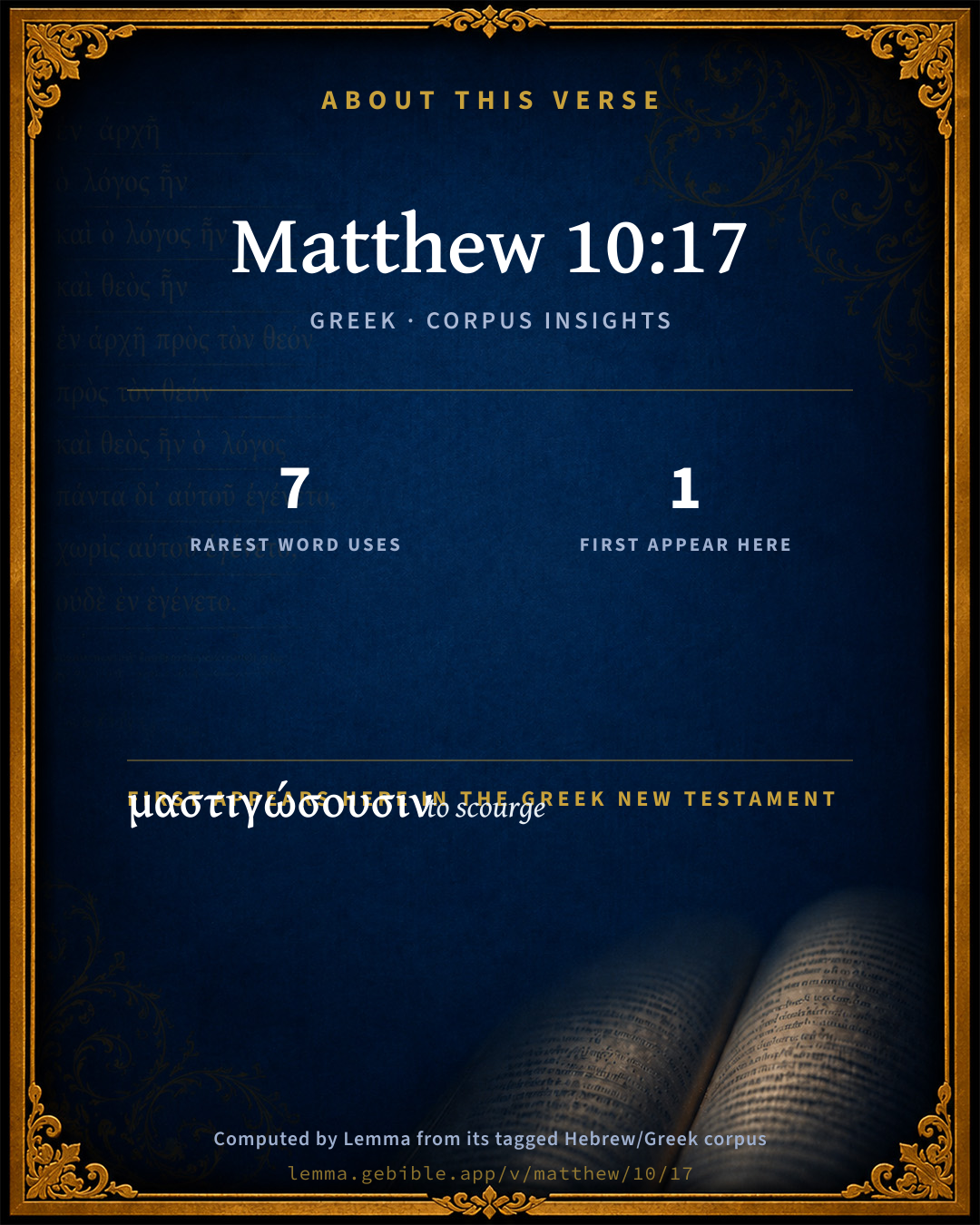
The rarest word here is μαστιγώσουσιν to scourge G3146 — appearing just 7 times in the whole Greek New Testament.

First appearance in Scripture

This word makes its first canonical appearance in the Greek New Testament here:

  • μαστιγώσουσιν to scourge G3146

Shared distinctive vocabulary

μαστιγώσουσιν to scourge G3146 occurs in 7 verses of the Greek New Testament. Also found in:
Repetition

Words recur within this verse:

Cross-references

24

Topical passages linked to Matthew 10:17 in the Treasury of Scripture Knowledge — connected by theme and wording, ordered by reader-vote popularity; previews shown in the World English Bible.

  • Mark 13:9 But watch yourselves, for they will deliver you up to councils. You will be beaten in synagogues. You will stand before rulers and kings for my sake, for a testimony to them.
  • Matthew 23:34 Therefore, behold, I send to you prophets, wise men, and scribes. Some of them you will kill and crucify; and some of them you will scourge in your synagogues, and persecute from city to city;
  • Matthew 5:22 But I tell you, that everyone who is angry with his brother without a cause shall be in danger of the judgment; and whoever shall say to his brother, 'Raca!' shall be in danger of the council; and whoever shall say, 'You fool!' shall be in danger of the fire of Gehenna.
  • Luke 12:11 When they bring you before the synagogues, the rulers, and the authorities, don't be anxious how or what you will answer, or what you will say;
  • John 16:2 They will put you out of the synagogues. Yes, the time comes that whoever kills you will think that he offers service to God.
  • Acts 26:11 Punishing them often in all the synagogues, I tried to make them blaspheme. Being exceedingly enraged against them, I persecuted them even to foreign cities.
  • Matthew 24:9–10 Then they will deliver you up to oppression, and will kill you. You will be hated by all of the nations for my name's sake.
  • Micah 7:5 Don't trust in a neighbor. Don't put confidence in a friend. With the woman lying in your embrace, Be careful of the words of your mouth!
  • Acts 22:19 I said, 'Lord, they themselves know that I imprisoned and beat in every synagogue those who believed in you.
  • Deuteronomy 25:2–3 and it shall be, if the wicked man be worthy to be beaten, that the judge shall cause him to lie down, and to be beaten before his face, according to his wickedness, by number.
  • Matthew 26:59 Now the chief priests, the elders, and the whole council sought false testimony against Jesus, that they might put him to death;
  • Mark 13:12 "Brother will deliver up brother to death, and the father his child. Children will rise up against parents, and cause them to be put to death.
  • Luke 21:12–13 But before all these things, they will lay their hands on you and will persecute you, delivering you up to synagogues and prisons, bringing you before kings and governors for my name's sake.
  • John 11:47 The chief priests therefore and the Pharisees gathered a council, and said, "What are we doing? For this man does many signs.
  • Acts 4:6–22 Annas the high priest was there, with Caiaphas, John, Alexander, and as many as were relatives of the high priest.
  • Acts 5:26–42 Then the captain went with the officers, and brought them without violence, for they were afraid that the people might stone them.
  • Acts 14:5–6 When some of both the Gentiles and the Jews, with their rulers, made a violent attempt to mistreat and stone them,
  • Acts 23:1–22 Paul, looking steadfastly at the council, said, "Brothers, I have lived before God in all good conscience until this day."
  • 2 Corinthians 11:24–26 Five times from the Jews I received forty stripes minus one.
  • Philippians 3:2 Beware of the dogs, beware of the evil workers, beware of the false circumcision.
  • 2 Timothy 4:15 of whom you also must beware; for he greatly opposed our words.
  • Hebrews 11:36 Others were tried by mocking and scourging, yes, moreover by bonds and imprisonment.
  • Matthew 20:19 and will hand him over to the Gentiles to mock, to scourge, and to crucify; and the third day he will be raised up."
  • Acts 17:14 Then the brothers immediately sent out Paul to go as far as to the sea, and Silas and Timothy still stayed there.

Cross-references courtesy of OpenBible.info (CC BY 4.0).

Commentary

Notes on Matthew 10:17 from classic Christian and Jewish commentators (each source and its license shown beneath its notes). The classic Christian expositions comment on the surrounding passage and are grouped to its opening verse, so a note may address several verses; the Jewish commentaries on the Tanakh (Rashi and others) are per-verse, so they appear only where the commentator wrote on this verse.

Lemma curates 59 commentaries, every one of them public domain or Creative Commons licensed, each selected and text-cleaned for this edition rather than reprinted as found. About our sources →

Joseph Benson's Commentary

Mat 10:17-18. Beware of men — That is, be on your guard against the men of the world with whom you converse, that you do not, by any inadvertency, give them advantage against you: and think not that all your innocence and all your wisdom united can screen you from persecution. For they will deliver you up to the councils — They will seek all occasions of mischief against you, and deliver you up to the sanhedrim, and other inferior courts of judicature: and they will scourge you in their synagogues — A sort of discipline which was used in their synagogues, where they held their courts about both civil and ecclesiastical affairs. Comp. Mat 23:34, and Act 22:19. And ye shall be brought before governors — Namely, to be punished by them as malefactors, not for any crimes wherewith they can charge you, but for my sake. Although these things did not happen while the apostles were out on their first mission, yet they came to pass after Christ’s ascension, when Peter and John were called before the sanhedrim, Act 4:6-7, and beaten, Act 5:40 : also when James and Peter were brought before Herod, Act 12:3; Paul before Agrippa and his wife, and the Roman governors, Gallio, Felix, Festus; and, last of all, before the Emperor Nero, and his prefect, Helius Cæsarianus. For a testimony against them and the Gentiles — All these things will be permitted to befall you, that your innocence may be manifested, the truth of the gospel demonstrated, and an opportunity afforded you of testifying it with greater solemnity both to Jews and Gentiles. “The patience which the apostles showed under continual persecutions, and the courage wherewith they went to death, in confirmation of their doctrine, became strong proofs of their innocence and of the truth of the gospel. Moreover, if the apostles had never been brought before the supreme powers, nor defended their cause in the presence of kings and governors, it might have been said that because Christianity could not bear a strict examination from able judges, it was preached to none but men of vulgar understanding, who were not capable of detecting it. But, when persons of the highest distinction for birth, fortune, capacity, and learning, had the gospel laid before them in the defences which the apostles were obliged to make, at the public tribunals of every country, its standing such a trial was certainly a great confirmation of its truth to persons of inferior note.” — Macknight.

Joseph Benson's Commentary on the Old and New Testaments (1811–1818) — public domain. Text from a community e-Sword module.

Bengel's Gnomon

Johann Albrecht Bengel

Mat 10:17. Προσεχετε δὲ ἀπὸ τῶν ἀνθρώπων, but beware of men) The expression used in the last verse, “Be ye wise,” is now explained; and the force of the injunction is extended,[465] for the word men is of general signification; cf. Joh 2:24.[466]—ΣΥΝΈΔΡΙΑ—ΣΥΝΑΓΩΓΑῖς, councils—synagogues) The councils, where the chief men assemble; the synagogues, where the people also resort.—ἐν ταῖς συναγωγαῖς, in the synagogues) They will consider the action so holy, that it may be performed even in the synagogue, which is put in opposition to the council; see ch. Mat 23:34.—μαστιγώσουσιν, they shall scourge) Hard things are foretold, yet they were actually endured by the apostles, and even by our Lord Himself.

[465] In the original, “Declaratur τὸ prudentes: acceditque moniti extensio.”—(I. B.)

[466] How strong are the reasons for being on our guard against men, is especially then made manifest, when one has to be conversant (to have intercourse) with them at a time of their being under the constraint of no external consideration.—V. g.

Bengel's Gnomon of the New Testament — English translation (T&T Clark, Edinburgh, 1860) — public domain. Text from a community e-Sword module.

Meyer's Critical & Exegetical Commentary

Heinrich August Wilhelm Meyer

Mat_10:17. Δέ] denoting continuation of this same matter: But in order to comply with this injunction (usually the wisdom alone is arbitrarily supposed to be referred to), be on your guard, and so on. The passage that now follows on to Mat_10:23 originally formed part (comp. Mar_13:9 ff.) of the eschatological utterances, but the connection in which it now stands was probably that in which it was already met with in the collection of our Lords sayings. Comp. Mat_24:9-13; Luk_21:12 ff. Then again, taken in detail, the different portions of this address, as given by Matthew, possess the advantage of originality. Comp. Weizsäcker, p. 160 ff.

ἀπὸ τῶν ἀνθρώπων] The article is not meant to indicate men who are hostile (Mat_10:16, Erasmus, Fritzsche), who must have been indicated in some other way than by the simple article (by τῶν τοιούτων, or such like), or by the general expression ἀνθρώπων; but it is to be understood generically: men in general, taken as a whole, are conceived of as hostile, in accordance with the idea of that κόσμος to which the disciples do not belong (Joh_15:19), and by which they are hated (Joh_17:14).

συνέδρια] taken generally, tribunals in general.

ἐν ταῖς συναγ.] That scourging also belonged to the synagogal forms of punishment, as a matter of synagogue discipline, is placed beyond a doubt by the New Testament. See, besides the Synoptists, Act_22:19; Act_26:11; 2Co_11:24. The evidence from Rabbinical literature is doubtful.

Meyer — Critical and Exegetical Commentary on the New Testament — English translation by Peter Christie, edited by Frederick Crombie (T&T Clark, 1880) — public domain. Text from a community e-Sword module.

Expositor's Greek Testament

ed. W. Robertson Nicoll

Mat 10:17 . τῶν ἀνθρώπων : Weiss, regarding Mat 10:17 as the beginning of an interpolation, takes τῶν generically = the whole race of men conceived of as on the whole hostile to the truth = κόσμος in the fourth Gospel (Mat 15:19 ; Mat 17:14 ). It seems more natural to find in it a reference to the λύκοι of Mat 10:16 . Beware of the class of men I have in view. So Eras., Elsner, Fritzsche. συνέδρια , the higher tribunals, selected to represent courts of justice of all grades, to denote the serious nature of the danger. συναγωγαῖς . The synagogue is referred to here, not merely as a place of worship, but as a juridical assembly exercising discipline and inflicting penalties (Grotius). Among these was scourging ( μαστιγώσουσιν , vide Act 22:19 ; Act 26:11 ; 2Co 11:24 ).

The Expositor's Greek Testament, edited by W. Robertson Nicoll (1897–1910) — public domain. Text from a community e-Sword module.

Geneva Bible (1599)

Geneva Bible translators

For in the cause of religion men are wolves one to another.

Geneva Bible (1599) marginal notes — public domain. Text via Bolls.life.

Jamieson, Fausset & Brown

Robert Jamieson, A. R. Fausset & David Brown

But beware of men; for they will deliver you up to the councils--the local courts, used here for civil magistrates in general.

and they will scourge you in their synagogues--By this is meant persecution at the hands of the ecclesiastics.

Jamieson, Fausset & Brown — Commentary Critical and Explanatory on the Whole Bible (1871) — public domain (CC PDM 1.0). Text via the HelloAO Bible API.

Adam Clarke's Commentary

Verse 17. But beware of men] Or, be on your guard against men, των ανθρωπων THESE men; i.e. your countrymen; those from whom you might have reasonably expected comfort and support; and especially those in power, who will abuse that power to oppress you.

Councils] συνεδρια, sanhedrins and synagogues. See Clarke on Mt 5:22. "By synagogues we may understand here, not the places of public worship, but assemblies where three magistrates, chosen out of the principal members of the synagogue, presided to adjust differences among the people: these had power, in certain cases, to condemn to the scourge, but not to death. See Ac 22:19; 2Co 11:24, compared with Lu 12:11." See Lightfoot.

Adam Clarke's Commentary on the Bible (1810–1826) — public domain. Text from a community e-Sword/MySword module.

Ellicott's Commentary for English Readers

(17) To the councils.—The plural shows that our Lord referred, not to the Great Council or Sanhedrin at Jerusalem, but to the lesser councils connected with provincial synagogues that had power to judge and punish persons accused of offences against religion.

They will scourge you in their synagogues.—The words imply the actual infliction of the punishment within the walls of the building. To us this appears something like desecration, but there is no reason for thinking that it did so to the Jews, and St. Paul’s language in Act_22:19; Act_26:11, seems to place the fact beyond the shadow of a doubt. The stripes of which the Apostle speaks in 2Co_11:24, were probably thus and there inflicted.

A Bible Commentary for English Readers, edited by Charles John Ellicott (1878–1897) — public domain. Text from a community e-Sword module.

The Cambridge Bible for Schools and Colleges

gen. ed. J. J. S. Perowne

17. beware of men] Perhaps with a reference to the serpents and the doves, which shun the approach of men; but comp. ch. Mat_17:22, “The Son of Man shall be betrayed into the hands of men.”

councils] i. e. provincial synagogue-tribunals. See note, ch. Mat_4:23.

The Cambridge Bible for Schools and Colleges (gen. ed. J. J. S. Perowne; Cambridge University Press, 1878–1918) — public domain. Text from a community e-Sword module.

John Gill's Exposition

And ye shall be brought before governors,.... Meaning Roman governors; so Paul was had before Gallio, Felix, and Festas; for judgments relating to life and death were to be taken away, and were taken away from the Jewish sanhedrim; and as they themselves say (f), forty years before the destruction of the second temple, which was much about the time of Christ's death: so that what power they had, was only with regard to lesser matters, and to inflict lesser punishments, as beating and scourging: if they sought to take away life, they were obliged to bring the cause before the governors of the Roman provinces, who are here intended:

and kings for my sake; as Herod, Agrippa, Nero, Domitian, and others, before whom one or other of the apostles were brought; not as thieves, or murderers, or traitors, and seditious persons, or for having done any wrong or injury to any man's person or property; but purely for the sake of Christ, for the profession of their faith in him, and for preaching his Gospel; of all which they had no reason to be ashamed, nor were they:

for a testimony against, or "to"

them, and the Gentiles; that is, that thereby they might have an opportunity of bearing a testimony to the truths of the Gospel, which would be either to the conviction and conversion of many Gentiles, as well as Jews; or would be a testimony which would stand against them another day, both against the Jews, who charged, and accused them, and brought them before the Heathen kings and governors, to punish them with death; and against those Gentile magistrates, and others, who should join with them in rejecting the Gospel, and putting them to death for preaching it: so that they should have no pretext or excuse; since the Gospel had been faithfully and clearly preached to them, and they had despised it, and evil treated the ministers of it. This confirms what is before observed, that this passage refers to an after mission.

(f) Hieros. Sanhedrim, fol. 18. 1. & 24. 2. Juchasin, fol. 26. 2. & 51. 1. Maimon. Hilch. Sanhedrim. c. 14. sect. 13.

John Gill's Exposition of the Whole Bible (1746–1763) — public domain (CC PDM 1.0). Text via the HelloAO Bible API.

Trapp's Complete Commentary

John Trapp

17 But beware of men: for they will deliver you up to the councils, and they will scourge you in their synagogues;

Ver. 17. But beware of men] Absurd and wicked men, saith Paul, 2Th 3:2; "brutish men, skilful to destroy," saith the prophet, Eze 21:31; "Men eaters," saith the Psalmist, Psa 14:4; cannibals, that make no more conscience to mischief God’s people than to eat a meal’s meat when they are hungry. These be those lycanthropi, those wolves mentioned in the former verse. These are those mankind men that St Paul met with at Ephesus, 1Co 15:32. He fought with beasts after the manner of men, that is (as some interpret it), men fought with him after the manner of beasts. Such a man was that monster of Milan, in Bodin. de Repub. Such were the primitive persecutors, and such are the pseudo-catholics of these times. A Dutch woman they buried alive for religion, with thorns under her. Another they shamefully defiled in the sight of her husband, and then forced her to draw a sword and give her husband a deadly wound, her hands being ordered by them. The town of Burre, in France, being taken by the Papists, all kind of cruelty was there used. Children were cut up, the guts and hearts of some of them pulled out, which in rage they gnawed with their teeth. The Italians which served the king, did for hatred of religion break forth into such fury, that they ripped up a living child, and took his liver, being as yet red hot, and ate it as meat. John Burgeolus, president of Turin, an old man, being suspected to be a Protestant, and having bought his life with a great sum of money, was notwithstanding taken and beaten cruelly with clubs and staves; and being stripped of his clothes, was brought to the bank of the river Liger, and hanged, his feet upward, and head downward in the water, up to his breast. Then, he being yet alive, they opened his belly, pulled out his guts, and threw them into the river. And taking his heart they put it upon a spear, carrying it with contumelious words about the city. (Thuanus.) Were these men? or rather devils in the shape of men? What should I instance further in those late Irish unheard of cruelties, so well known, and so much written about? such as whereof the devil himself might be ashamed, had he any shame in him. Lithgow, a Scot, after he had with King James’s letters travelled through the greatest part of the known world, was, as he returned through Spain, in the city of Maligo, surprised by nine sergeants {a} and carried before the governor, by whose appointment they stripped him of his clothes, robbed him of his money, put him into a dark dungeon, shackled him, starved him, wounded him, &c. In 10 hours he received 70 different torments. At last, all the lords inquisitors commanded him to receive 11 strangling torments at midnight, and to be burnt body and bones to ashes, though they had nothing against him but suspicion of religion. And yet after this God wonderfully delivered him. He was brought on his bed to our king, wounded and broken, and made this account to the face of Gundamor, the Spanish ambassador.

They will scourge you] John Fortune, a martyr in Queen Mary’s days, was thus threatened by one Mr Foster: You shall be whipped and burned for this gear, I think. His answer was, I shall be full glad of that. For it is written, "They will scourge you in their synagogues." And since the time that the sword of tyranny came into your hand, I heard of none that were whipped. Happy were I if I had the maidenhead of that persecution.

{a} An officer whose duty is to enforce the judgments of a tribunal or the commands of a person in authority; one who is charged with the arrest of offenders or the summoning of persons to appear before the court. ŒD

John Trapp, A Commentary or Exposition upon All the Books of the Old and New Testament (1647–1656) — public domain. Text from a community e-Sword module.

Albert Barnes' Notes on the Bible

But beware of men - That is, be on your guard against people who are like wolves, Mat 10:16. Do not run unnecessarily into danger. Use suitable prudence and caution, and do not needlessly endanger your lives.

Councils - The word used here commonly signifies the great council of the nation, the Sanhedrin. See the notes at Mat 5:22. Here it seems to refer to any judicial tribunal, of which there were some in every village.

They will scourge you in their synagogues - Scourging, or “whipping,” is often mentioned in the New Testament as a mode of punishment. The law of Moses directed that the number of stripes should not exceed 40, but might be any number less, at the discretion of the judge, Deu 25:2-3. The person who was sentenced to scourging was formerly laid upon the ground, and the blows inflicted on his back in the presence of the judge. In later times the criminal was tied to a low post. Scourging is still practiced in the East, but the blows are commonly inflicted on the soles of the feet. It is called the “bastinado.”

The instrument formerly used was a “rod.” Afterward they employed thongs or lashes attached to the rod. To make the blows severe and more painful, they sometimes fastened sharp points of iron or pieces of lead in the thongs. These were called “scorpions,” 1Ki 12:11. The law was express that the number of stripes should not exceed forty. The Jews, to secure greater accuracy in counting, used a scourge with three lashes, which inflicted three stripes at once. With this the criminal was struck thirteen times, making the number of blows thirty-nine. Paul was five times scourged in this way. See 2Co 11:24.

The Romans did not feel themselves bound by the law of the Jews in regard to the “number” of stripes, but inflicted them at pleasure. Thus our Saviour was scourged until he was so weak as not to be able to bear his cross. This was often done in the synagogue. See Mat 23:34; Act 22:19; Act 26:11.

Albert Barnes' Notes on the Bible (1834–1885) — public domain. Text from a community e-Sword/MySword module.

Haydock's Catholic Bible Commentary

They will deliver you up in councils. Christ, in this and the following verse, warns his apostles of the many troubles and persecutions to which the preaching of the faith would expose them. St. Chrysostom assigns several reasons for his choosing to foretell them such sufferings: 1st. that he might shew that he had the gift of prophecy; 2nd. that they might not think such evils came upon them on account of his weakness; 3rd. that knowing beforehand the great trials to which they would be exposed, they might not be discouraged when they happened. (St. John Chrysostom, in St. Thomas Aquinas)

George Leo Haydock (1774–1849), Haydock's Catholic Family Bible and Commentary, 1859 edition — public domain. Excludes Psalms (Douay-Rheims chapter numbering differs from Protestant) and Deuterocanonical books (Catholic canon only).

Matthew Poole's English Annotations

The last word, Gentiles, maketh it plain, that our blessed Lord is not here arming his disciples so much against any opposition they were like to meet with upon this their first going out, for they were not to go to the Gentiles, as those they should meet with some years after his ascension; yet not excluding what they should meet with from the Jews, for what is said about delivering up to the councils and scourging in the synagogues seemeth to have a particular reference to the Jews. This scripture was most eminently fulfilled, as to the apostles, Act 4:1-3 &c Act 5:27; 6:12; and as to being brought before governors and kings, there are instances enough in the Acts, more in ecclesiastical stories. Neither do I think our Saviour hath in these words any reference to the distinction of their councils amongst the Jews; he only designed to let them know the time would come, when, for their owning him, and preaching his gospel, they should be brought before all sorts of magistrates, and in all kinds of courts. That phrase,

and they will scourge you in their synagogues, hath mightily perplexed some, especially such as have dreamed religious synagogues too holy places for such offices: but there is no need that we should take the term synagogues here for the places of their worship, it doth as well signify, in their conventions; and there are some that think that they had, adjoining to their synagogues, a place in which they punished offenders upon the account of religion; certain it is, 2Co 11:24, that Paul was five times scourged by the Jews according to their law, Deu 25:3. For a testimony against them and the Gentiles: a testimony for me, that is expressed in those words, for my sake; and against them, whether Jews or Gentiles. A testimony against them in the day of judgment, εις μαρτυριον, hence our terms of martyr and martyrdom, the one signifies a witness, the other a testimony.

Matthew Poole's English Annotations on the Holy Bible (1683–1685) — public domain. Text from a community e-Sword/MySword module.

Whedon's Commentary on the Bible

Daniel D. Whedon

17. Beware of men — These wolves are men. And men, as such, are depraved in heart. Of all such, in their depraved, unregenerated character, have a care, for evil is to be expected from them. The evils to be expected our Lord next describes. Councils — The smaller courts in Palestine, yet including the grand Sanhedrim in Jerusalem.

Scourge you in their synagogues — Scourging is mentioned as a punishment in the Mosaic law. (Deu_25:13.) The criminal, being laid upon the ground, was scourged with a whip of three lashes, so that thirteen blows should inflict thirty-nine stripes. This was the forty save one which St. Paul received, 2Co_11:24. In their synagogues — The synagogue was the ordinary place of the Jewish courts of justice. Mat_23:24; Act_22:19.

Daniel D. Whedon (gen. ed.), Commentary on the Old and New Testaments (1874–1909) — public domain. Text from a community e-Sword module.

The Pulpit Commentary

Vers. 17-22 are remarkable as being practically identical with Mar_13:9-13, to which the parallels are Luk_21:12-19 and Mat_24:9-14. It is hard to resist the conclusion that St. Matthew

(1) has incorporated into the present address of our Lord"s on missionary work warnings actually given in his great address at Jerusalem on the fall of the city and the end of the world; and

(2) to some extent repeats these warnings in their proper place. (For the further parallel of vers. 19, 20 to Luk_12:11:12, vide in loc.; cf. also the note on "and they will scourge," in this verse.) But beware . Apparently in contrast to being only "dove-like"; but it is no wonder that the connexion with ver. 16 should be rather harsh if the passage be really taken from a later speech ("But take ye heed," etc., Mar_13:9). Of men. Generically ( twn anyrwpwn), regarded.as one hostile body (cf. Meyer). The culminating point of that opposition to God which is innate in fallen humanity is found in the deification of the Roman emperors (cf. Bishop Westcott"s essay on the Two Empires, in his Epistles of St. John). For they will deliver you up to the (omit "the," with the Revised Version) councils (eiv sunedria , Mat_5:22, note); "Synedria, uhi proceres conveniunt; synagogae, ubi etiam populus" (Bengel). And they will scourge you in their synagogues (the order of the words is reversed in the Revised Version). With this compare Mat_23:34, where our Lord says, "Therefore, behold, I send idou egw apostellw : cf. ver. 16, note unto you prophets.., and some of them ye shall scourge in your synagogues, and (cf. ver. 23, infra) persecute from city to city." Is our present passage a reminiscence of this also? For the fulfilment of this prophecy of. Act_22:19. (Act_26:11) Farrar ("St. Paul," 1. App. 11) thus summarizes the enactments on Jewish scourging as recorded in the Mishna ("Makkoth"): "Even a single Jewish scourging might well entitle any man to be regarded as a martyr. Thirty-nine blows were inflicted, unless, indeed, it was found that the strength of the patient was too much exhausted to admit of his receiving the full number. Both of his bands were tied to what is sometimes called a column. but which was in reality a stake a cubit and a half high. The public officer then tore down his robe until his breast was laid bare. The executioner stood on a stone behind the criminal. The scourge consisted of two thongs, one of which was composed of four strands of calf"s skin, and one or two strands of ass"s skin, which passed through a hole in a handle. The executioner, who was ordinarily the Chazzan of the synagogue, could thus shorten or lengthen them at will, so as not to strike too low. The prisoner bent to receive the blows, which were inflicted with one hand, but with all the force of the striker, thirteen on the breast, thirteen on the right and thirteen on the left shoulder. While the punishment was going on, the chief judge read aloud Deu_28:58, Deu_28:59, "If thou wilt not observe to do all the words of this law that are written in this book, that thou mayest fear this glorious and fearful name, the Lord thy God; then the Lord will make thy plagues "strokes wonderful, and the plagues of thy seed." He then read Deu_29:9, "Keep therefore the words of this covenant, and do them, that ye may prosper in all ye do;" and lastly, Psa_78:38, Psa_78:39, "But he, being full of compassion, forgave their iniquity, and destroyed them not: yea, many a time turned he his anger away. and did not stir up all his wrath." If the punishment was not over by the time that these three passages were read, they were again repeated, and so timed as to end exactly with the punishment itself Meanwhile a second judge numbered the blows, and a third before each blow exclaimed, Hakkehu"("strike him") The severity of the pain may best be estimated by the brief addition, If the criminal die under the infliction, the executioner is not accounted guilty unless he gives by mistake a single blow too many, in which case he is banished.

The Pulpit Commentary (1880–1919), ed. H.D.M. Spence-Jones & Joseph S. Exell — public domain. Text from a community e-Sword module.

John Wesley's Explanatory Notes

But think not that all your innocence and all your wisdom will screen you from persecution. They will scourge you in their synagogues - In these the Jews held their courts of judicature, about both civil and ecclesiastical affairs. Matt. xxiv, 9.

John Wesley, Explanatory Notes Upon the Whole Bible (1754–1765) — public domain. Text via the GEBible commentary corpus.

Kretzmann's Popular Commentary

Paul E. Kretzmann

The enmity of men:

v. 17. But beware of men; for they will deliver you up to the councils, and they will scourge you in their synagogues.

v. 18. And ye shall be brought before governors and kings for My sake, for a testimony against them and the Gentiles.

Be on your guard against such men as might turn out to be wolves in disguise. Do not, in general, trust yourselves to men, beware of confiding trustfulness, which delivers you into their power, Joh 2:24. A cordial aloofness may sound like a paradox, but describes the proper attitude. Upon occasion and with the slightest excuse, the enmity of men, directed in reality against the Word, will find its outlet in persecution of the hearers of the Word. Both the higher tribunals of justice, where the punishment might take a very serious form, and the synagogues, whose assemblies, as lower courts, exercised discipline and inflicted penalties, such as scourging, would be used by the enemies. Act 22:19; 2Co 11:24. In the present instance even the civil courts may be called upon to pronounce judgment against the servants of Christ on all kinds of trumped-up charges. The Lord refers not only to the provincial governors of Palestine, but, by His omniscience, He looks far forward into the future, where He sees His confessors cited to appear before the mightiest rulers of the world. A tribulation, indeed, but also an honor, since it is for His sake, on His account. And theirs will be the glorious opportunity of witnessing for the Master, of declaring His testimony in the midst of such adverse circumstances to the enemies, who, in the earlier period, were Jews, and to the Gentiles, such as the governors and the court officers and attendants would usually be. This testimony would, as always, have the purpose of calling the sinners to repentance and of hardening the deliberately obstinate to their own damnation.

Paul E. Kretzmann, Popular Commentary of the Bible (1921–1924) — public domain. Text from a community e-Sword module.

Burkitt's Expository Notes on the New Testament

William Burkitt

Here our Saviour lets his apostles know that for their owning him, and preaching his gospel, they shall be brought before all sorts of magistrates, and in all kinds of courts: but he advises them, when they are brought before kings and princes, not to be anxiously thoughtful what they should say; for it should be given them in that hour what they should answer.

Learn hence, That though truth may be opposed, yet truth’s defenders should never be ashamed; and rather than they shall want a tongue to plead for it, God himself will prompt them by his Spirit, and suggest such truths to their minds as all their opposers should not be able to gainsay.

Yet, note, That Christ doth not here forbid all fore-thoughts what to say, but only distrustful thoughts; that they should not, like orators or advocates, strive to make studied pleas or rhetorical apologies for themselves, since the Spirit would be in their mouths, and give them immediate supplies.

Note also, That because Christ here promised his apostles and immediate assistance from the Holy Spirit, how vain the Anabaptists and Quakers are, who by virtue of this promise do now expect the same assistance in prayer and preaching: but they may as well pretend to cast out devils as the apostles did, by virtue of the same assistance which the apostles had; whereas these extraordinary gifts have long ceased.

William Burkitt's Expository Notes on the New Testament (1700–1703) — public domain. Text from a community e-Sword module.

The People's New Testament

B. W. Johnson

17. Beware of men. The wolves. To councils. To the local courts to be tried for heresy and other offenses. In their synagogues. The Jewish assemblages corresponding to modern churches. They will scourge you. This punishment was inflicted on offenders in the synagogues. See Acts 22:19 and 26:11. The Talmud states that scourging was inflicted by the officers of the synagogue.

B. W. Johnson's The People's New Testament with Notes (1889–1891) — public domain. Electronic text from the Christian Classics Ethereal Library (CCEL) ThML edition.

Cambridge Greek Testament for Schools and Colleges

17. προσέχετε ἀπὸ τῶν ἀνθρώπων. Perhaps with a reference to the serpents and the doves, which shun the approach of men; but comp. ch. Mat 17:22, μέλλει ὁ υἱὸς τοῦ ἀνθρώπου παραδίδοσθαι εἰς χεῖρας ἀνθρώπων.

συνέδρια. i.e. provincial synagogue-tribunals. See note, ch. Mat 4:23.

Cambridge Greek Testament for Schools and Colleges (Cambridge University Press, 1896; 21 vols, various authors incl. Carr, Maclear, Plummer, Farrar, Lumby, Moule, M. R. James, Simcox) — public domain. Text from a community e-Sword module.

Alford’s Greek Testament

Henry Alford

17. προσέχετε] The wisdom of the serpent is needed for this part of their course; the simplicity of the dove for the μὴ μεριμνήσητε in ver. 19.

The δέ turns from the internal character to behaviour in regard of outward circumstances.

συνέδρια] See Act 4:6, Act 4:7; Act 5:40. They are the courts of seven (on which see Deu 16:18), appointed in every city, to take cognizance of causes both civil and criminal, ch. 5:21: here perhaps put for any courts of assembly in general.

ἐν τ. συν. μαστιγ. ὑ.] See Act 22:19; Act 26:11. Euseb. Hist. Ecc 5:16, quoting a book against the Montanists, οὐδὲ μὴν οὐδὲ ἐν συναγωγαῖς Ἰουδαίων τῶν γυναικῶν τις ἐμαστιγώθη ποτέ, ἢ ἐλιθοβολήθη· οὐδαμόσε οὐδαμῶς. The scourging in the synagogues is supposed to have been inflicted by order of the Tribunal of Three, who judged in them.

Henry Alford, The Greek Testament (1849–1861) — public domain. Text from a community e-Sword module.

International Critical Commentary

17-22.

23-11:1.

omit. 6:12-13.

It is clear that Mk describes a sending out of the Twelve on a definite occasion. They go forth in pairs, Mar 6:7. Their activity brings the name of Jesus to the notice of Herod, 6:14. They return and report the result of their work, 6:30. To the editor of the first Gospel this mission of the Twelve during Christ’s lifetime seems to have had little interest. He omits the statement that they went forth, and the notice that they returned. Further, he draws together here sayings that clearly refer to the work of the Apostles in the interval between Christ’s death and His return, e.g. 17-23, 38-39. His discourse seems to have in view the circumstances of the band of disciples after His death whilst they were still in Palestine expecting their Master’s return. The startling feature in it is that Christ is represented as bidding His disciples to limit their preaching to the Jews (v. 6), and as assuring them that they will not have exhausted the cities of Israel before His return (v. 23). We may compare with this the parallel conception that Christ’s return would immediately follow the fall of Jerusalem. It might be possible to harmonise these sayings with the rest of the Gospel by interpreting “cities of Israel,” not geographically, but ethnographically = “cities where Israelites lived,” thus including the Jews of the dispersion. Along these lines v. 6 would mean “do not go out of your way to preach to non-Israelites, rather go to the dispersion of the Jews.” But it seems more probable that the two sources Mk. and the Logia, which the editor of the Gospel is combining, represented different standpoints on this question. The compiler of the Jewish Christian Logia preferred to emphasise those sayings of Christ’s teaching which seemed to limit the preaching of the kingdom to the Jewish people. The Twelve were to preach in Palestine, 10:6, 23; but the Jews in the dispersion, and proselytes from the heathen, would also furnish disciples of the kingdom, 8:11.

In Mk., on the other hand, emphasis is laid on a preaching to all nations; cf. 13:10 “The good news must first be preached to all nations,” and Mat 28:19 “all nations,” which probably comes from Mk.’s lost ending. Mt. borrows these passages, but defines the object of the preaching of Mar 13:10 as εἰς μαρτύριον πᾶσιν τοῖς ἔθνεσιν. He seems to have found it possible to combine the ideas of a coming of Christ to usher in the end of the world immediately after the fall of Jerusalem, and of a previous preaching of the good news of the Kingdom to all nations. We may suppose that to him the phrase “all nations” was only a wide generalisation, and that he saw no difficulty in the idea that the good news could be preached “in all the world” within a single generation. The difficulty of completely harmonising 10:23 with other parts of the Gospel, arises from the fact that the editor is borrowing from sources representing different points of view, which he has not found it possible to blend so thoroughly that no trace of the original divergence remains.

17. The editor is reminded by the ἐν μέσῳ λύκων which he has just written of a passage which occurs later in Mk.’s Gospel (13:9b-13). He therefore inserts it here, though it is clear that it does not, like the preceding sayings, refer to the Apostolic mission during Christ’s lifetime, but to their preaching after His death.

(M) But beware of men: for they shall deliver you up to Sanhedrins, and in their synagogues shall they scourge you.] Mk. has: “But take ye heed to yourselves. They shall deliver you up to Sanhedrins, and in synagogues shall ye be beaten.”—προσέχετε ἀπό] cf. 7:15, and Blass, p. 126. Mk. has βλέπετε δὲ ὑμεῖς ἑαυτούς; cf. Mar 8:15 βλέπετε ἀπό, where Mt. again has προσέχετε ἀπό. Mt. omits βλέπετε from Mar 13:23, Mar 13:33.—παραδώσουσι] Mt. as often inserts a connecting particle, here γάρ.—συνέδρια] the local courts of justice; see Schürer, 11. i. 151.—καὶ ἐν ταῖς συναγωγαῖς μαστιγώσουσιν ὑμᾶς] Mk. has the harsh καὶ εἰς συναγωγὰς δαρήσεσθε. For the substitution of ἐν for εἰς, cf. 24:18 = Mar 13:16, and Introduction, p. xxvii.

International Critical Commentary — older volumes (1896–1929), various authors — public domain. Text from a community e-Sword module.

Vincent's Word Studies in the New Testament

Marvin R. Vincent

Of men [των ανθρωπων] . Lit., "the men," already alluded to under the term wolves.

Marvin R. Vincent, Word Studies in the New Testament (1887–1900) — public domain. Text from a community e-Sword/MySword module.

Lesson kit

Teaching starters — assembled from the data on this page, not authored interpretation. Every prompt links to the verse data it draws on. Edit before teaching.

Matthew, in the Gospels, opens this verse with 17 words (15 distinct Greek lemmas). Its most distinctive word is mastigóō (“to scourge”). A historical commentator’s framing appears above. Read the whole chapter for the surrounding context.

Discussion questions

  1. What does “to scourge” (mastigóō) contribute to the verse as a whole?
  2. This is the first place “to scourge” appears in Scripture (first appears here). What does its debut here establish?
  3. How does Matthew 20:19, which shares the word «to scourge», read alongside this verse?
  4. What does the repetition of “the” (2× in this one verse) do in this verse?
  5. These translations render this verse differently. What is at stake in choosing one wording over another?
  6. Compare how Joseph Benson's Commentary and Bengel's Gnomon read this verse. Where do they agree or differ?

Things to notice

  • 1 word makes its first canonical appearance in Scripture here.
  • These translations choose different wording for 6 words in this verse.
  • “the” occurs 2× in this single verse.
  • 15 distinct Greek lemmas span 17 words in this verse.

Reading settings

Reading text

Shown beneath each verse's original-language words.

Old Testament
Old Testament edition

Read the OT as the Masoretic Hebrew (MT) or the Greek Septuagint (LXX).

English shown for the Greek Septuagint (in the Hebrew ↔ Greek comparison).

Comparing translations? Open the Compare panel on any verse page to stack up to four side by side.