
Matthew 13:16

Greek (Tischendorf 8th ed.) Matthew 13:16 appears in the Greek New Testament. The text above is from the Tischendorf 8th edition. Each word links to its Strong’s number and a concise gloss. Click any word for its full Thayer’s Greek Lexicon entry.
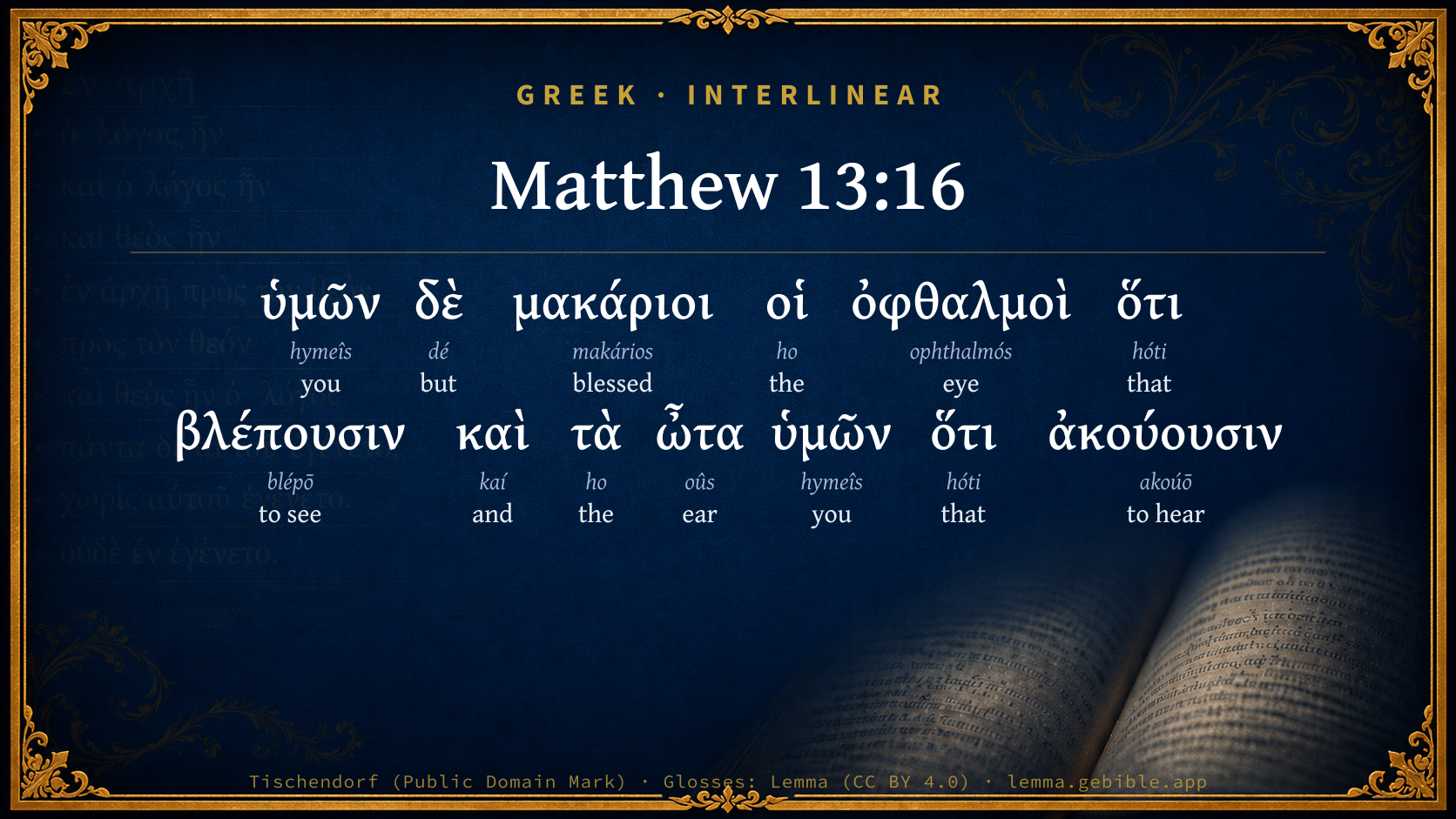
Download image
Cite this verse

Matthew 13:16 (World English Bible). Public Domain. Lemma interlinear Bible study tool, https://lemma.gebible.app/v/matthew/13/16.

Show BibTeX & RIS
BibTeX
RIS
English Translation
"But blessed are your eyes, for they see; and your ears, for they hear.
World English Bible · Public Domain
Download a study sheet

One document with this verse’s original text, its word-by-word gloss line, the meaning frame, cross-references with their text, attributed commentary, and full source and license credits — printable, and it pastes into notes with its structure intact.

This verse Autodidact and up

Study sheet (.html) Plain text (.txt)

A passage Seminary Student

Up to 50 verses in one chapter. A passage sheet keeps up to 6 commentary sources and 12 cross-references per verse, in the order this page ranks them, and says so on the sheet whenever that leaves anything out. Ask for a single verse and you get the Autodidact verse sheet above.

Everything on this page stays free to read, with no account — the sheet is a download of what is already on screen, not access to it.

Want to remove ads? Support Godless Engineer
Compare translations 3

The same verse in 3 English versions, stacked beneath the original-language interlinear above. Click any original word for its lexicon entry.

Each is an independent rendering of the whole verse — the interlinear is not word-aligned to these translations.

Highlighted words mark where these versions differ — a whole-verse word diff, not a word-by-word alignment.

  • World English Bible Public Domain
    "But blessed are your eyes, for they see; and your ears, for they hear.
  • King James Version Public Domain
    But blessed are your eyes, for they see: and your ears, for they hear.
  • unfoldingWord Literal Text CC BY-SA 4.0
    But blessed your eyes, for they see; and your ears, for they hear.

unfoldingWord Literal Text — © unfoldingWord, licensed CC BY-SA 4.0. Word-aligned USFM3 via Door43 (git.door43.org/unfoldingWord/en_ult).

Versions to compare (up to 4)

3 of 4 selected

Show all 19 translations

Every available English version of this verse, each an independent rendering of the whole verse.

  • World English Bible Public Domain
    "But blessed are your eyes, for they see; and your ears, for they hear.
  • Berean Standard Bible Public Domain
    But blessed are your eyes because they see, and your ears because they hear.
  • Majority Standard Bible Public Domain
    But blessed are your eyes because they see, and your ears because they hear.
  • King James Version Public Domain
    But blessed are your eyes, for they see: and your ears, for they hear.
  • American Standard Version (1901) Public Domain
    But blessed are your eyes, for they see; and your ears, for they hear.
  • Revised Version (1885) Public Domain
    But blessed are your eyes, for they see; and your ears, for they hear.
  • Geneva Bible (1599) Public Domain
    But blessed are your eyes, for they see: and your eares, for they heare.
  • Douay-Rheims (1899) Public Domain
    But blessed are your eyes, because they see, and your ears, because they hear.
  • Young's Literal Translation Public Domain
    `And happy are your eyes because they see, and your ears because they hear,
  • Literal Standard Version CC BY-SA 4.0
    And blessed are your eyes because they see, and your ears because they hear,
  • Unlocked Literal Bible CC BY-SA 4.0
    But blessed are your eyes, for they see; and your ears, for they hear.
  • unfoldingWord Literal Text CC BY-SA 4.0
    But blessed your eyes, for they see; and your ears, for they hear.
  • Darby Bible Public Domain
    But blessed are *your* eyes because they see, and your ears because they hear;
  • World Messianic Bible Public Domain
    “But blessed are your eyes, for they see; and your ears, for they hear.
  • Webster's Bible Public Domain
    But blessed are your eyes, for they see: and your ears, for they hear.
  • Free Bible Version CC BY-SA 4.0
    Your eyes are blessed, for they see. Your ears are blessed too, for they hear.
  • Bible in Basic English Public Domain
    But a blessing be on your eyes, because they see; and on your ears, because they are open.
  • Text-Critical English NT CC BY 4.0
    But blessed are your eyes because they see, and your ears because they hear.
  • Tyndale New Testament (1534) Public Domain
    But blessed are youre eyes for they se: and youre eares for they heare.

Literal Standard Version (2020), Covenant Press — licensed CC BY-SA 4.0. Text via the HelloAO Bible API (eBible.org). Unlocked Literal Bible (unfoldingWord) — licensed CC BY-SA 4.0. Text via the HelloAO Bible API (eBible.org). unfoldingWord Literal Text — © unfoldingWord, licensed CC BY-SA 4.0. Word-aligned USFM3 via Door43 (git.door43.org/unfoldingWord/en_ult). Free Bible Version, Dr. Jonathan Gallagher — licensed CC BY-SA 4.0. Text via the HelloAO Bible API (eBible.org).

Word by word

More ways to search: Search by grammar → Find every occurrence → Compare this word →

Practice this passage: Drill this verse → Learn its vocabulary →

About this verse

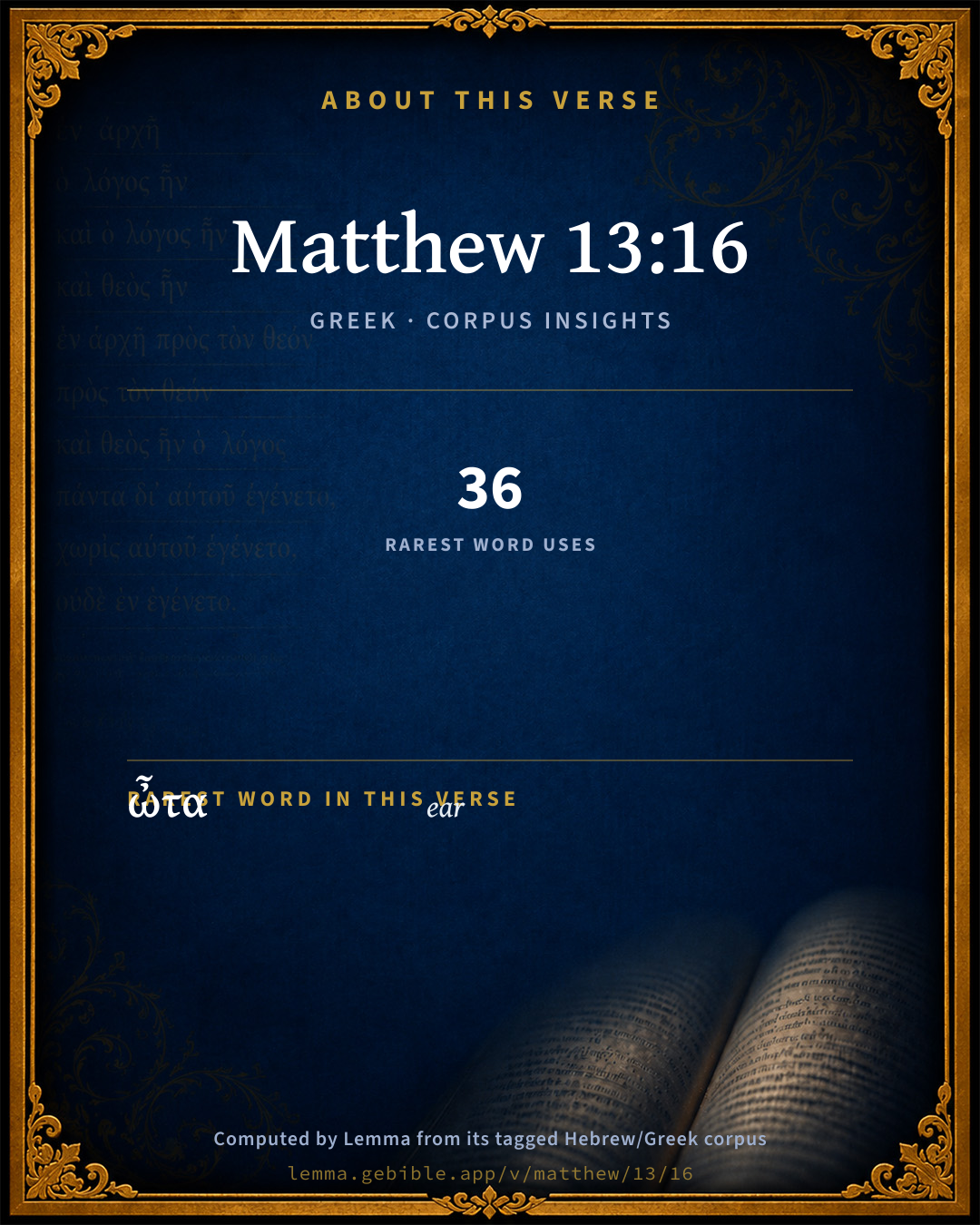
These counts appear in no published source. They are computed here, from the morphology-tagged text and Lemma’s own curated glosses. What Lemma adds →

13
words
10
distinct lemmas
Gospels
section

Shared distinctive vocabulary

ὦτα ear G3775 occurs in 34 verses of the Greek New Testament. Also found in:
Repetition

Words recur within this verse:

Cross-references

8

Topical passages linked to Matthew 13:16 in the Treasury of Scripture Knowledge — connected by theme and wording, ordered by reader-vote popularity; previews shown in the World English Bible.

  • Luke 10:23–24 Turning to the disciples, he said privately, "Blessed are the eyes which see the things that you see,
  • Ephesians 1:17–18 that the God of our Lord Jesus Christ, the Father of glory, may give to you a spirit of wisdom and revelation in the knowledge of him;
  • Matthew 16:17 Jesus answered him, "Blessed are you, Simon Bar Jonah, for flesh and blood has not revealed this to you, but my Father who is in heaven.
  • John 20:29 Jesus said to him, "Because you have seen me, you have believed. Blessed are those who have not seen, and have believed."
  • Acts 26:18 to open their eyes, that they may turn from darkness to light and from the power of Satan to God, that they may receive remission of sins and an inheritance among those who are sanctified by faith in me.'
  • 2 Corinthians 4:6 seeing it is God who said, "Light will shine out of darkness," who has shone in our hearts, to give the light of the knowledge of the glory of God in the face of Jesus Christ.
  • Luke 2:29–30 "Now you are releasing your servant, Master, According to your word, in peace;
  • Matthew 5:3–11 "Blessed are the poor in spirit, For theirs is the Kingdom of Heaven.

Cross-references courtesy of OpenBible.info (CC BY 4.0).

Commentary

Notes on Matthew 13:16 from classic Christian and Jewish commentators (each source and its license shown beneath its notes). The classic Christian expositions comment on the surrounding passage and are grouped to its opening verse, so a note may address several verses; the Jewish commentaries on the Tanakh (Rashi and others) are per-verse, so they appear only where the commentator wrote on this verse.

Lemma curates 59 commentaries, every one of them public domain or Creative Commons licensed, each selected and text-cleaned for this edition rather than reprinted as found. About our sources →

Joseph Benson's Commentary

Mat 13:16-17. But blessed are your eyes, &c. — For you both see and hear, and understand. You have not only greater opportunities of instruction than others, but you both know how to prize, and are concerned to improve them. For verily I say unto you, That many prophets — Who prophesied of the coming of the Messiah; and righteous men — To whom God familiarly showed himself, and made known his will, as he did to Abraham and the patriarchs; and many kings, Luk 10:24; from whose seed the Messiah was to spring, and whose kingdoms and persons were types of him and his kingdom, have desired to see — Before their eyes, those things which ye thus see, and have not seen them, they only seeing them afar off in the promises made to them concerning these days. See Heb 11:13; and 1Pe 1:11-12.

Joseph Benson's Commentary on the Old and New Testaments (1811–1818) — public domain. Text from a community e-Sword module.

Tyndale Open Study Notes

Tyndale Open Resources

13:16-17 Jesus brought into reality what the prophets and Old Testament saints desired to see and hear, that is, the fulfillment of Old Testament promises (see Isa 52:15; John 8:56; 1 Pet 1:10).

Tyndale Open Study Notes — © Tyndale Open Resources, licensed CC BY-SA 4.0. Text via the HelloAO Bible API.

Bengel's Gnomon

Johann Albrecht Bengel

Mat 13:16. Ὀφθαλμοὶ—ὦτα, eyes—ears) i.e. those of your body, above the saints of the Old Testament; those of your soul, above the people now present. Their eyes and ears were the subject of which blessedness could be predicated.[611]

[611] “Subjectum quo beatitudinis.”—(I. B.)

Bengel's Gnomon of the New Testament — English translation (T&T Clark, Edinburgh, 1860) — public domain. Text from a community e-Sword module.

Meyer's Critical & Exegetical Commentary

Heinrich August Wilhelm Meyer

Mat_13:16-17. Ὑμῶν] stands first for sake of emphasis, and in contrast to the stupid multitude.

μακάριοι οἱ ὀφθαλμοί] Personification of the faculty of sight. Luk_11:27; Act_5:9; Isa_52:7.

ὅτι βλέπουσι … ὅτι ἀκούει] The thought underlying this (and keeping in view Mat_13:13; Mat_13:15) may be stated thus: your intellect, as regards the apprehension of divine truth, is not unreceptive and obtuse, but susceptible and active.

γάρ] justifies the congratulation on the ground of the important nature of the matter in question.

δίκαιοι] Upright, holy men of old. Comp. Mat_10:41, Mat_23:29, also ἅγιοι, Mat_27:52.

ἰδεῖν ἃ βλέπετε, κ.τ.λ.] the μυστήρια τῆς βασιλείας, Mat_13:11; Heb_11:13; Heb_11:39. The vision of Abraham, Joh_8:56, is foreign to the present passage, from the fact of its not having been seen during his life in the body.

The βλέπειν in Mat_13:16 was equivalent to, to be capable of seeing, while here it means simply to see. Comp. note on Joh_9:39. But there is no ground for supposing that Matthew has mixed up two distinct discourses (de Wette).

Meyer — Critical and Exegetical Commentary on the New Testament — English translation by Peter Christie, edited by Frederick Crombie (T&T Clark, 1880) — public domain. Text from a community e-Sword module.

Expositor's Greek Testament

ed. W. Robertson Nicoll

Mat 13:16-17 . In Mk. (Mar 4:13 ) Jesus reproaches the disciples for their ignorance; here He congratulates them on their faculty of seeing and hearing (spiritually). ὑμῶν : in emphatic position, suggesting contrast between disciples and the multitude. μακάριοι , vide on chap. Mat 5:3 . ὅτι βλ ., because, not for what , they see. ἀμὴν γὰρ λέγω : introducing an important statement. προφῆται καὶ δίκαιοι , same combination as in Mat 10:41 . The felicity now consists in the things seen and heard. The perceiving senses and the things to be perceived imply each other, neither by themselves yield enjoyment. This passage is given by Lk. (Luk 10:23-24 ) in a more suitable connection (report on their mission by the Seventy). Here it creates an exaggerated impression as to the extent of the new departure. The parabolic teaching of Jesus, as exemplified in the Sower and other parables here collected, was not an absolutely new feature. He had always been speaking more or less in parables (“Fishers of Men,” Mat 4:19 ; “Salt of the Earth,” “City on a Hill,” Mat 5:13-14 ; “Two Builders,” Mat 7:24-27 ; “Whole need not a Physician,” Mat 9:12 ; “New Garment and New Wine,” Mat 9:16-17 , etc.). Some of the parables in this connection, the Treasure and the Pearl , e.g. , may be gems preserved from some otherwise forgotten synagogue discourses, say those delivered in the preaching tour through Galilee.

The Expositor's Greek Testament, edited by W. Robertson Nicoll (1897–1910) — public domain. Text from a community e-Sword module.

Geneva Bible (1599)

Geneva Bible translators

The condition of the Church under and since Christ, is better than it was in the time of the Fathers under the Law.

Geneva Bible (1599) marginal notes — public domain. Text via Bolls.life.

Jamieson, Fausset & Brown

Robert Jamieson, A. R. Fausset & David Brown

But blessed are your eyes, for they see; and your cars, for they hear--that is, "Happy ye, whose eyes and ears, voluntarily and gladly opened, are drinking in the light divine."

Jamieson, Fausset & Brown — Commentary Critical and Explanatory on the Whole Bible (1871) — public domain (CC PDM 1.0). Text via the HelloAO Bible API.

Adam Clarke's Commentary

Verse 16. But blessed are your eyes] Ye improve the light which God has given you; and you receive an increase of heavenly wisdom by every miracle and by every sermon.

Adam Clarke's Commentary on the Bible (1810–1826) — public domain. Text from a community e-Sword/MySword module.

Ellicott's Commentary for English Readers

(16) Blessed are your eyes.—The words are spoken to the small company of disciples in the boat. They were not as the multitude. They might see but dimly, and be slow of heart to understand, but, at least, they had eyes that looked for light, and ears that were open to the divine voice.

A Bible Commentary for English Readers, edited by Charles John Ellicott (1878–1897) — public domain. Text from a community e-Sword module.

The Cambridge Bible for Schools and Colleges

gen. ed. J. J. S. Perowne

16. blessed are your eyes] The disciples have discernment to understand the explanation which would be thrown away on the uninstructed multitude.

The Cambridge Bible for Schools and Colleges (gen. ed. J. J. S. Perowne; Cambridge University Press, 1878–1918) — public domain. Text from a community e-Sword module.

John Gill's Exposition

For verily I say unto you,.... This is added for the further confirmation of what is before said, concerning the happiness of the disciples, in seeing and hearing what they did:

that many prophets, and righteous men; Luke says, Luk 10:24 "kings"

have desired to see those things which ye see, and have not seen them, and to hear those things which ye hear, and have not heard them. To see Christ in the flesh, and have a clearer insight into the knowledge of the mysteries of grace, were things very desirable to men of the highest class in church and state, and of the best characters, such as Abraham, Joh 8:56. Jacob, Gen 49:18. David, Psa 14:7. Solomon, and the church in his time, Sol 8:1. Isaiah, and the saints with him, Isa 25:9 with many others. These indeed had a sight of Christ, but a very distant one; they saw him afar off in the promises and prophecies of him; and not very clearly, but through dark types and cloudy sacrifices; whereas the disciples saw him in person, heard him preach, took in the evidence of his miracles, and felt the power of his doctrines, and spiritually and savingly understood them. A way of speaking, somewhat like this, stands in the Talmud (p);

"Many have watched to expound in Mercavah (the beginning of Ezekiel's prophecy), , "and have not seen it all their days".''

(p) T. Bab. Megilla, fol. 24. 2.

John Gill's Exposition of the Whole Bible (1746–1763) — public domain (CC PDM 1.0). Text via the HelloAO Bible API.

Trapp's Complete Commentary

John Trapp

16 But blessed are your eyes, for they see: and your ears, for they hear.

Ver. 16. But blessed are your eyes, &c.] Demaratus of Corinth was wont to say, that those Grecians lost a great part of the comfort of their lives, that had not seen great Alexander sitting on Darius’s throne. St Austin wished but to have seen three sights, Romam in flore, Paulum in ore, Christum in corpore, Rome in the flourish, Paul in the pulpit, Christ in the flesh.

And your ears, for they hear] The turtle’s voice, the joyful sound, the lively oracles, the precious promises of the word, therefore called "the word" by a specialty, because our ears should listen after no other word but that. Origen chides his hearers for nothing so much as for this, that they came so seldom to hear God’s word; and that when they came, they heard it so carelessly, recte iudicans, saith Erasmus, hinc esse praecipuum pietatis profectum ant defectum, as one that well knew that men’s growth in grace is according to their heed in hearing.

John Trapp, A Commentary or Exposition upon All the Books of the Old and New Testament (1647–1656) — public domain. Text from a community e-Sword module.

Haydock's Catholic Bible Commentary

But blessed are your eyes. As the eyes of such as see and will not believe are miserable, so, he says, blessed are your eyes; you see my miracles, you hear my heavenly doctrines, &c. (St. Thomas Aquinas) --- Had we not read in a preceding part, that Christ exhorted his auditors to search after the knowledge of his words, we might perhaps have thought that Jesus here spoke of corporal eyes and ears; but the eyes here mentioned, seem to me to be those which can discern the mysteries of Christ. (St. Jerome in St. Thomas Aquinas)

George Leo Haydock (1774–1849), Haydock's Catholic Family Bible and Commentary, 1859 edition — public domain. Excludes Psalms (Douay-Rheims chapter numbering differs from Protestant) and Deuterocanonical books (Catholic canon only).

Matthew Poole's English Annotations

Luke repeateth this passage, Luk 10:23, but not as annexed to this parable.

Blessed are your eyes; the eyes of your bodies and of your minds. With the eyes of your bodies you have seen the promised Messias, come in the flesh; and you have seen the works which I have done, confirming me to be the Messiah: and with the eyes of your minds you have understood and believed.

For many prophets and righteous men (Luke adds, kings)

have desired to see those things which ye see, &c. From the very first giving out of the promise of Christ to Adam, upon the fall, Gen 3:15, there was in believers an expectation of the Messiah, who being so great a good, so infinite a blessing to mankind, they could not but have a desire (if God had so pleased) to have seen him. But we are told that Abraham saw Christ’s day and rejoiced. And Simeon’s and Anna’s expectation of him, mentioned Luk 2:34-38, lets us know that other pious souls had such desires. Our Saviour blesseth his disciples, that they had seen with the eyes of their bodies, what others had only seen afar off by the eyes of their minds, Heb 11:13.

Matthew Poole's English Annotations on the Holy Bible (1683–1685) — public domain. Text from a community e-Sword/MySword module.

Whedon's Commentary on the Bible

Daniel D. Whedon

16. Blessed are your eyes — You have loved the teacher and accepted the truth. They see — Your blessed eyes see not only the outside shell of truth, but the inner kernel. They hear — Not only the literal narrative of the parable, but its secret meaning. And that hidden meaning is the very substance of divine wisdom. It reveals the truths of the Messiah’s kingdom of grace on earth and of glory in heaven. It opens the truths of the Old Testament to the mind, and explains the mysteries dimly seen by the ancient prophets.

Daniel D. Whedon (gen. ed.), Commentary on the Old and New Testaments (1874–1909) — public domain. Text from a community e-Sword module.

The Pulpit Commentary

Vers. 16, 17. Parallel passage: Luk_10:23, Luk_10:24, after the return of the seventy, and immediately following our Mat_11:25, Mat_11:27. The verses stand there, that is to say, in close connexion with the other great utterance contrasting God"s revelation of spiritual things to some and his hiding them from others. Possibly he spoke the verses only once (cf. the repetitions in the Prophets), but, in view of the frequency with which Christ"s utterances are placed out of their original connexion, the assumption should be the other way. If he really only spoke them once, we cannot be sure which the occasion was, but the possibility that they do not properly belong here is increased by the doubt whether also ver. 12 was originally spoken now.

But blessed (Mat_5:3, note) are your eyes. Christ now returns to emphasize ver. 11 a. For they see (oti blepousin). This may refer to the disciples being able to see spiritual truths before God"s special grace given them by way of reward to this effect, but this hardly suits the context from the phrase, "it is given" (ver. 12). It is, therefore, better to understand the verse to refer to their seeing and hearing things by virtue of grace given in reward for earlier faithfulness. Edersheim ("Life," 1:594) gives a striking illustration of the thought of this verse from the "Pesiqta" (edit. Buber, p. 149).

The Pulpit Commentary (1880–1919), ed. H.D.M. Spence-Jones & Joseph S. Exell — public domain. Text from a community e-Sword module.

John Wesley's Explanatory Notes

But blessed are your eyes - For you both see and understand. You know how to prize the light which is given you. Luke x, 23.

John Wesley, Explanatory Notes Upon the Whole Bible (1754–1765) — public domain. Text via the GEBible commentary corpus.

Kretzmann's Popular Commentary

Paul E. Kretzmann

The blessedness of Christ’s followers:

v. 16. But blessed are your eyes, for they see; and your ears, for they hear.

v. 17. For verily I say unto you, That many prophets and righteous men have desired to see those things which ye see, and have not seen them; and to hear those things which ye hear, and have not heard them.

The full and true happiness is that of having eyes and ears opened by the benign mercy of Jesus. Not only were the outward members of the disciples’ bodies blessed for being witnesses of the fulfillment of the Old Testament, of seeing Him and being in constant, intimate communion with Him, to whom the whole ancient covenant pointed forward, whom the prophets and the righteous people from Eve and Jacob to Malachi and Simeon had longed to behold, but the eyes of their understanding were enlightened by His power. They knew Jesus as their Savior, and were happy in this knowledge.

Paul E. Kretzmann, Popular Commentary of the Bible (1921–1924) — public domain. Text from a community e-Sword module.

Burkitt's Expository Notes on the New Testament

William Burkitt

Here our Saviour pronounces such of his disciples and followers blessed, who received the truths of the gospel so far as they were already taught them: he assures them that they shall receive farther light and fuller measures of spiritual illumination: Blessed are your eyes, for they see.

Learn, That such as have received the least measures of spiritual knowledge and saving illumination, and do improve it, are in a happy and blessed condition; for as they are capable of further measures of divine knowledge, so shall they be partakers of them.

William Burkitt's Expository Notes on the New Testament (1700–1703) — public domain. Text from a community e-Sword module.

unfoldingWord translationNotes

Door43 World Missions Community

Connecting Statement:

Jesus finishes explaining to his disciples why he teaches with parables.

But blessed are your eyes, for they see; and your ears, for they hear

Both of these statements mean the same thing. Jesus is emphasizing that they have pleased God because they have believed what Jesus has said and done. (See: Parallelism)

But blessed are your eyes, for they see

Here "eyes" refers to the whole person. AT: "You are blessed because your eyes are able to see" (See: Synecdoche)

your ... you

All occurrences of these words are plural and refer to the disciples. (See: Forms of You)

your ears, for they hear

Here "ears" refer to the whole person. You can also make clear the understood information. AT: "you are blessed because your ears are able to hear" (See: Synecdoche and Ellipsis)

Truly I say to you

"I tell you the truth." This adds emphasis to what Jesus says next.

the things that you see

You can make explicit what they have seen. AT: "the things you have seen me do" (See: Assumed Knowledge and Implicit Information)

the things that you hear

You can make explicit what they have heard. AT: "the things you have heard me say" (See: Assumed Knowledge and Implicit Information)

translationWords

bless

amen

prophet

righteous

unfoldingWord translationNotes — © Distant Shores Media and the Door43 World Missions Community, licensed CC BY-SA 4.0. Source: git.door43.org/Door43/en_tn.

Cambridge Greek Testament for Schools and Colleges

16. ὑμῶν δὲ μακάριοι οἱ ὀφθαλμοί. The disciples have discernment to understand the explanation which would be thrown away on the unistructed multitude.

Cambridge Greek Testament for Schools and Colleges (Cambridge University Press, 1896; 21 vols, various authors incl. Carr, Maclear, Plummer, Farrar, Lumby, Moule, M. R. James, Simcox) — public domain. Text from a community e-Sword module.

International Critical Commentary

16-17. Cf. Luk 10:23-24, Mar 4:13.

(L) But blessed are your eyes, for they see; and your ears, for they hear. For verily I say to you, That many prophets and righteous men desired to see the things which ye see, and did not see; and to hear the things which ye hear, and did not hear.] Mk. has: “And He saith to them, Do ye not know (οἴδατε) this parable, and how shall you understand (γνώσεσθε) all the parables ?” Mt. omits this reproach (see Introduction, p. xxxiii), and substitutes for it a passage from the Logia containing a statement of the privileges of the disciples. This saying also occurs in Luk 10:23-24 in a different context (the return of the Seventy), and differently worded: “And turning to the disciples, privately He said, Blessed are the eyes which see the things which ye see; for I say to you, that many prophets and kings wished to see the things which ye see, and did not see; and to hear the things which ye hear, and did not hear.”

ὑμῶν δέ.] The ὑμῶν is emphatic, and contains a direct contrast to those referred to in αὐτοῖς, vv. 10-13, ἐκείνοις, v. 11, and in vv. 13-15. “They” cannot understand the parablies, and that is why I use the parabolic method, because they are not capable of appreciating the “secrets” when plainly taught in literal language; “for they have blinded their eyes to the light of divine truth. But blessed are your eyes, for they see this divine light.”

International Critical Commentary — older volumes (1896–1929), various authors — public domain. Text from a community e-Sword module.

Lesson kit

Teaching starters — assembled from the data on this page, not authored interpretation. Every prompt links to the verse data it draws on. Edit before teaching.

Matthew, in the Gospels, opens this verse with 13 words (10 distinct Greek lemmas). Its most distinctive word is oûs (“ear”). A historical commentator’s framing appears above. Read the whole chapter for the surrounding context.

Discussion questions

  1. How does “ear” (oûs) shape what this verse is saying?
  2. How does Matthew 10:27, which shares the word «ear», read alongside this verse?
  3. What does the repetition of “you” (2× in this one verse) do in this verse?
  4. Compare how Joseph Benson's Commentary and Tyndale Open Study Notes read this verse. Where do they agree or differ?

Things to notice

Reading settings

Reading text

Shown beneath each verse's original-language words.

Old Testament
Old Testament edition

Read the OT as the Masoretic Hebrew (MT) or the Greek Septuagint (LXX).

English shown for the Greek Septuagint (in the Hebrew ↔ Greek comparison).

Comparing translations? Open the Compare panel on any verse page to stack up to four side by side.