
Matthew 5:44

Greek (Tischendorf 8th ed.) Matthew 5:44 appears in the Greek New Testament. The text above is from the Tischendorf 8th edition. Each word links to its Strong’s number and a concise gloss. Click any word for its full Thayer’s Greek Lexicon entry.

Download image
Cite this verse

Matthew 5:44 (World English Bible). Public Domain. Lemma interlinear Bible study tool, https://lemma.gebible.app/v/matthew/5/44.

Show BibTeX & RIS
BibTeX
RIS
English Translation
But I tell you, love your enemies, bless those who curse you, do good to those who hate you, and pray for those who mistreat you and persecute you,
World English Bible · Public Domain
Highlights
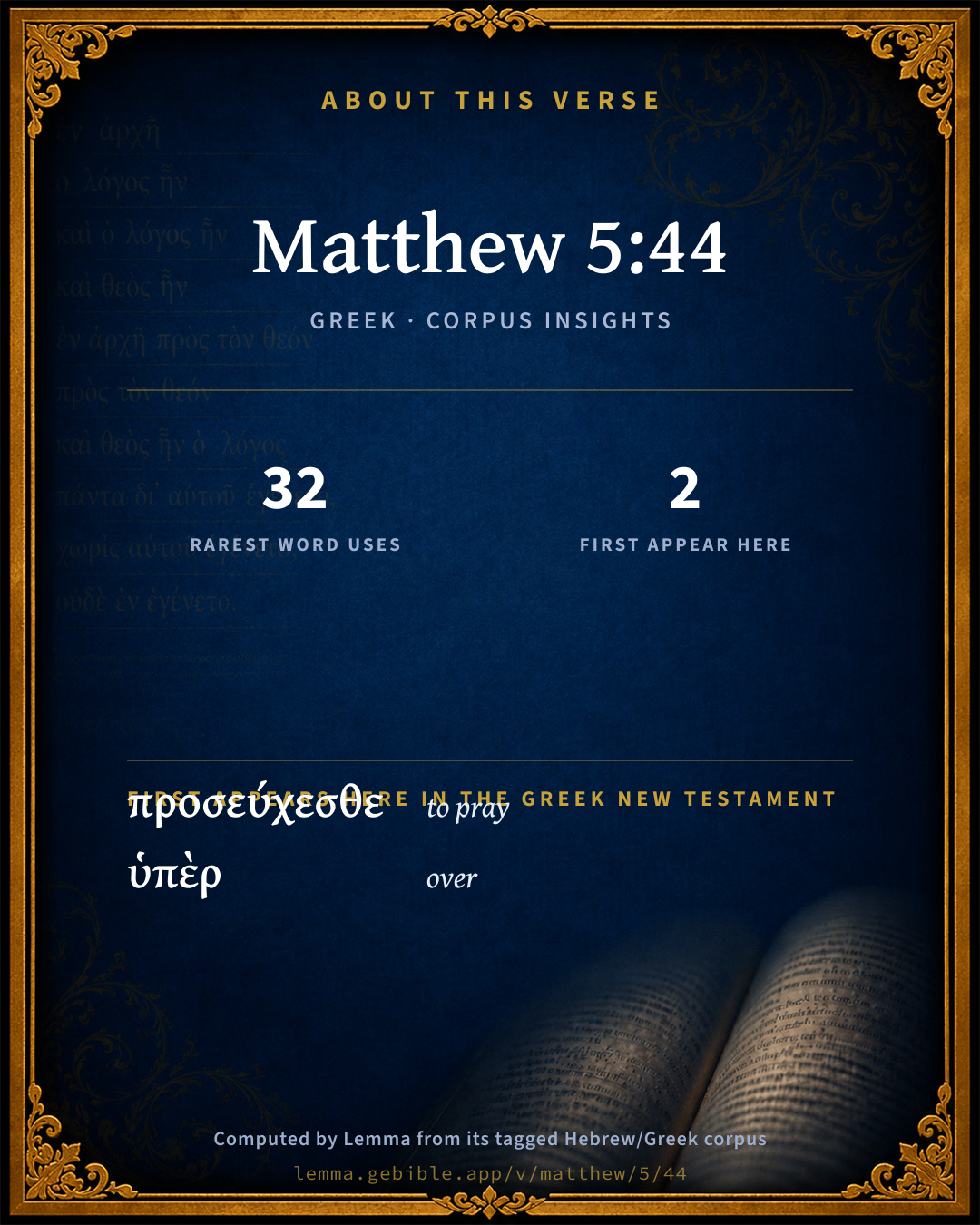
  • 2 first appearances in the Greek New Testament
Full analysis ↓
Download a study sheet

One document with this verse’s original text, its word-by-word gloss line, the meaning frame, cross-references with their text, attributed commentary, and full source and license credits — printable, and it pastes into notes with its structure intact.

This verse Autodidact and up

Study sheet (.html) Plain text (.txt)

A passage Seminary Student

Up to 50 verses in one chapter. A passage sheet keeps up to 6 commentary sources and 12 cross-references per verse, in the order this page ranks them, and says so on the sheet whenever that leaves anything out. Ask for a single verse and you get the Autodidact verse sheet above.

Everything on this page stays free to read, with no account — the sheet is a download of what is already on screen, not access to it.

Want to remove ads? Support Godless Engineer
Compare translations 3

The same verse in 3 English versions, stacked beneath the original-language interlinear above. Click any original word for its lexicon entry.

Each is an independent rendering of the whole verse — the interlinear is not word-aligned to these translations.

Highlighted words mark where these versions differ — a whole-verse word diff, not a word-by-word alignment.

  • World English Bible Public Domain
    But I tell you, love your enemies, bless those who curse you, do good to those who hate you, and pray for those who mistreat you and persecute you,
  • King James Version Public Domain
    But I say unto you, Love your enemies, bless them that curse you, do good to them that hate you, and pray for them which despitefully use you, and persecute you;
  • unfoldingWord Literal Text CC BY-SA 4.0
    But I say to you, love your enemies and pray on behalf of the ones persecuting you

unfoldingWord Literal Text — © unfoldingWord, licensed CC BY-SA 4.0. Word-aligned USFM3 via Door43 (git.door43.org/unfoldingWord/en_ult).

Versions to compare (up to 4)

3 of 4 selected

Show all 19 translations

Every available English version of this verse, each an independent rendering of the whole verse.

  • World English Bible Public Domain
    But I tell you, love your enemies, bless those who curse you, do good to those who hate you, and pray for those who mistreat you and persecute you,
  • Berean Standard Bible Public Domain
    But I tell you, love your enemies and pray for those who persecute you,
  • Majority Standard Bible Public Domain
    But I tell you, love your enemies, bless those who curse you, do good to those who hate you, and pray for those who mistreat you and persecute you,
  • King James Version Public Domain
    But I say unto you, Love your enemies, bless them that curse you, do good to them that hate you, and pray for them which despitefully use you, and persecute you;
  • American Standard Version (1901) Public Domain
    but I say unto you, love your enemies, and pray for them that persecute you;
  • Revised Version (1885) Public Domain
    but I say unto you, Love your enemies, and pray for them that persecute you;
  • Geneva Bible (1599) Public Domain
    But I say vnto you, Loue your enemies: blesse them that curse you: doe good to them that hate you, and pray for them which hurt you, and persecute you,
  • Douay-Rheims (1899) Public Domain
    But I say to you, Love your enemies: do good to them that hate you: and pray for them that persecute and calumniate you:
  • Young's Literal Translation Public Domain
    but I -- I say to you, Love your enemies, bless those cursing you, do good to those hating you, and pray for those accusing you falsely, and persecuting you,
  • Literal Standard Version CC BY-SA 4.0
    but I say to you, love your enemies, bless those cursing you, do good to those hating you, and pray for those accusing you falsely, and persecuting you,
  • Unlocked Literal Bible CC BY-SA 4.0
    But I say to you, love your enemies and pray for those who persecute you,
  • unfoldingWord Literal Text CC BY-SA 4.0
    But I say to you, love your enemies and pray on behalf of the ones persecuting you
  • Darby Bible Public Domain
    But *I* say unto you, Love your enemies, [bless those who curse you,] do good to those who hate you, and pray for those who [insult you and] persecute you,
  • World Messianic Bible Public Domain
    But I tell you, love your enemies, bless those who curse you, do good to those who hate you, and pray for those who mistreat you and persecute you,
  • Webster's Bible Public Domain
    But I say to you, Love your enemies, bless them that curse you, do good to them that hate you, and pray for them who despitefully use you, and persecute you;
  • Free Bible Version CC BY-SA 4.0
    But I tell you, love your enemies and pray for those who persecute you,
  • Bible in Basic English Public Domain
    But I say to you, Have love for those who are against you, and make prayer for those who are cruel to you;
  • Text-Critical English NT CC BY 4.0
    But I say to you, love your enemies, bless those who curse you, do good to those who hate you, and pray for those who mistreat you and persecute you,
  • Tyndale New Testament (1534) Public Domain
    But I saye vnto you love youre enimies. Blesse the that coursse you. Do good to them that hate you. Praye for them which doo you wronge and persecute you

Literal Standard Version (2020), Covenant Press — licensed CC BY-SA 4.0. Text via the HelloAO Bible API (eBible.org). Unlocked Literal Bible (unfoldingWord) — licensed CC BY-SA 4.0. Text via the HelloAO Bible API (eBible.org). unfoldingWord Literal Text — © unfoldingWord, licensed CC BY-SA 4.0. Word-aligned USFM3 via Door43 (git.door43.org/unfoldingWord/en_ult). Free Bible Version, Dr. Jonathan Gallagher — licensed CC BY-SA 4.0. Text via the HelloAO Bible API (eBible.org).

Word by word

More ways to search: Search by grammar → Find every occurrence → Compare this word →

Practice this passage: Drill this verse → Learn its vocabulary →

ἐχθροὺς
echthrós
G2190
“enemy”
Adjective, Accusative, Plural, Masculine
Part of Speech
Adjective
Case
Accusative
Number
Plural
Gender
Masculine
Full Thayer's Definition

Origin: "from a primary echtho (to hate); hateful (passively, odious, or actively, hostile)"

TDNT: 15:31,3

1. hated, odious, hateful 2. hostile, hating, and opposing another a. used of men as at enmity with God by their sin 1. opposing (God) in the mind 2. a man that is hostile 3. a certain enemy 4. the hostile one 5. the devil who is the most bitter enemy of the divine government
  1. ἐγὼ egṓ G1473 “I” Personal pronoun, 1st person, Nominative, Singular
  2. δὲ dé G1161 “but” Conjunction
  3. λέγω légō G3004 “to say” Verb, Present, Active, Indicative, 1st person, Singular
  4. ὑμῖν hymeîs G5210 “you” Personal pronoun, 2nd person, Dative, Plural
  5. ἀγαπᾶτε agapáō G25 “to love” Verb, Present, Active, Imperative, 2nd person, Plural
  6. τοὺς ho G3588 “the” Article, Accusative, Plural, Masculine
  7. ὑμῶν hymeîs G5210 “you” Personal pronoun, 2nd person, Genitive, Plural
  8. καὶ kaí G2532 “and” Conjunction
  9. προσεύχεσθε proseúchomai G4336 “to pray” Verb, Present, Middle or Passive deponent, Imperative, 2nd person, Plural
  10. ὑπὲρ hypér G5228 “over” Preposition
  11. τῶν ho G3588 “the” Article, Genitive, Plural, Masculine
  12. διωκόντων diṓkō G1377 “to persecute” Verb, Present, Active, Participle, Genitive, Plural, Masculine
  13. ὑμᾶς hymeîs G5210 “you” Personal pronoun, 2nd person, Accusative, Plural

About this verse

These counts appear in no published source. They are computed here, from the morphology-tagged text and Lemma’s own curated glosses. What Lemma adds →

14
words
11
distinct lemmas
Gospels
section

First appearance in Scripture

These words make their first canonical appearance in the Greek New Testament here:

  • προσεύχεσθε to pray G4336
  • ὑπὲρ over G5228

Shared distinctive vocabulary

ἐχθροὺς enemy G2190 occurs in 32 verses of the Greek New Testament. Also found in:
Repetition

Words recur within this verse:

  • ὑμῖν you G5210 ×3
  • τοὺς the G3588 ×2

Cross-references

16

Topical passages linked to Matthew 5:44 in the Treasury of Scripture Knowledge — connected by theme and wording, ordered by reader-vote popularity; previews shown in the World English Bible.

  • Romans 12:14 Bless those who persecute you; bless, and don't curse.
  • 1 Peter 3:9 not rendering evil for evil, or reviling for reviling; but instead blessing; knowing that to this were you called, that you may inherit a blessing.
  • Luke 6:27–28 "But I tell you who hear: love your enemies, do good to those who hate you,
  • Romans 12:20–21 Therefore "If your enemy is hungry, feed him. If he is thirsty, give him a drink. For in doing so, you will heap coals of fire on his head."
  • Proverbs 25:21–22 If your enemy is hungry, give him food to eat; If he is thirsty, give him water to drink:
  • Luke 23:34 Jesus said, "Father, forgive them, for they don't know what they are doing." Dividing his garments among them, they cast lots.
  • 1 Peter 2:23 Who, when he was cursed, didn't curse back. When he suffered, didn't threaten, but committed himself to him who judges righteously;
  • Acts 7:60 He kneeled down, and cried with a loud voice, "Lord, don't hold this sin against them!" When he had said this, he fell asleep.
  • Luke 6:34–35 If you lend to those from whom you hope to receive, what credit is that to you? Even sinners lend to sinners, to receive back as much.
  • 1 Corinthians 4:12–13 We toil, working with our own hands. When people curse us, we bless. Being persecuted, we endure.
  • 2 Kings 6:22 He answered, You shall not strike them: would you strike those whom you have taken captive with your sword and with your bow? set bread and water before them, that they may eat and drink, and go to their master.
  • 1 Corinthians 13:4–8 Love is patient and is kind; love doesn't envy. Love doesn't brag, is not proud,
  • Exodus 23:4–5 "If you meet your enemy's ox or his donkey going astray, you shall surely bring it back to him again.
  • Psalms 7:4 If I have rewarded evil to him who was at peace with me (Yes, I have delivered him who without cause was my adversary),
  • Psalms 35:13–14 But as for me, when they were sick, my clothing was sackcloth. I afflicted my soul with fasting. My prayer returned into my own bosom.
  • 2 Chronicles 28:9–15 But a prophet of Yahweh was there, whose name was Oded: and he went out to meet the host that came to Samaria, and said to them, Behold, because Yahweh, the God of your fathers, was angry with Judah, he has delivered them into your hand, and you have slain them in a rage which has reached up to heaven.

Cross-references courtesy of OpenBible.info (CC BY 4.0).

Where the printed editions differ

3 variants

Places in this verse where the major printed Greek editions disagree on the wording in a way that affects the translation — a comparison of editions, not a manuscript-by-manuscript collation. The editions are the modern critical texts (Nestlé-Aland 28/27, SBL, Westcott-Hort, Tregelles, Tyndale House) and the traditional texts behind the KJV (the Textus Receptus and the Byzantine/Majority text). It is not a claim about which reading is original.

  1. Extra text
    εὐλογεῖτε τοὺς καταρωμένους ὑμᾶς καλῶς ποιεῖτε

    “do bless those cursing you well do”

    In TRByz Not in NA28NA27TynSBLWHTreg
  2. Extra text
    ὑμᾶς

    “you”

    In TRByz Not in NA28NA27TynSBLWHTreg

    εὐλογεῖτε τοὺς καταρωμένους ὑμᾶς καλῶς ποιεῖτε τοὺς μισοῦντας ὑμᾶς (eulogeite tous katarōmenous humas kalōs poieite tous misountas humas) 'do bless those cursing you well do to those hating you' is only in traditional manuscripts (TR+Byz)

  3. Extra text
    ἐπηρεαζόντων ὑμᾶς καὶ

    “mistreating you and”

    In TRByz Not in NA28NA27TynSBLWHTreg

    ἐπηρεαζόντων ὑμᾶς καὶ (epēreazontōn humas kai) 'mistreating you and' is only in traditional manuscripts (TR+Byz)

Textual data: Translators Amalgamated Greek New Testament (STEPBible TAGNT) · CC BY 4.0.

Commentary

Notes on Matthew 5:44 from classic Christian and Jewish commentators (each source and its license shown beneath its notes). The classic Christian expositions comment on the surrounding passage and are grouped to its opening verse, so a note may address several verses; the Jewish commentaries on the Tanakh (Rashi and others) are per-verse, so they appear only where the commentator wrote on this verse.

Lemma curates 59 commentaries, every one of them public domain or Creative Commons licensed, each selected and text-cleaned for this edition rather than reprinted as found. About our sources →

The Biblical Illustrator

Joseph S. Exell

Mat_5:44

But I say unto you.

The imperatives of Jesus

I. The range and extent of Jesus imperative speeches. He keeps up to His own superior level of command upon all occasions and before all men. Men like us only assume without offence an imperative mood in certain relations of life. Christ did before the Rulers, before the Roman power.

II. The nature and significance of these relations of life, and those elements of human nature, over which Jesus quietly assumed mastery.

1. The miracles of Christ not the greatest of His wonderful works; a greater assumption of power to exercise authority over the higher principles and laws of our human nature, than to claim authority over winds and waves.

2. With what calm consciousness of right Jesus assumes this authority-which belongs to God alone-over human hearts.

3. The nature or right of this supremacy of the Christ.

(1) One ever-present illustration of what Jesus is to this universe we have within us in conscience. Hence you have a means of understanding the authority of Christ.

(2) It reappears in the law of love. He is the righteousness of God with man.

4. We should bring obedience.

5. Do we not need, all of us, to be most thoroughly commanded by something higher and better than ourselves? We fall from our own possibilities, and need a command to step forth like princes to our high calling. (Newman Smyth, D. D.)

The authority of Jesus over human nature and history resembles the lordship of the sun over the earth

The world feels it from centre to circumference; every fruitful field rejoices in it, and this earth would be indeed worthless and dark without it; but we can only make guesses at the riddle of its gravitation and its light; and while any child knows that it is, the wisest can only declare in part, in very little part, how it is. (Newman Smyth, D. D.)

The Biblical Illustrator, edited by Joseph S. Exell (c. 1880s–1900s) — public domain. Text from a community e-Sword module.

Bengel's Gnomon

Johann Albrecht Bengel

Mat 5:44. Ἀγαπᾶτε, love ye—εὐλογεῖτε, bless ye—καλῶς ποιεῖτε, do ye good to—καὶ προσεύχεσθε ὑπὲρ, and pray ye for) Here are four clauses, the second and third of which are wanting in some of the ancients—the second in the Vulgate, the third in Tertullian,[231] De Patientia, ch. 6. Four clauses ought, therefore, to be read, although the third is almost contained in the first, and the second in the fourth by Chiasmus:[232] on which account St Luke transposes them.[233] In Mat 5:46, the verb ἀγαπάω, to love, occurs again, and in Mat 5:47, the word ἀσπάσησθε, salute, corresponds with εὐλογεῖτε in the present verse.—τῶν ἐπηρεαζόντων ὑμᾶς, them which despitefully use you) ἐπήρεια, [the substantive from which the verb ἐπηρεάζω is derived] signifies an injury inflicted, not for the benefit of the injurer, but for the damage of the injured party.—See my notes to Chrysostom on the Priesthood, p. 429. It is, therefore, a sign of extreme hatred. A striking contrast. Pray for such persons as these: obtain by your prayers blessings for those, who take blessings from you.

[231] Quintus Septimius Florens Tertullianus, a native of Carthage, where he became a Presbyter, the earliest of the Latin fathers, flourished in the third century.—(I. B.)

[232] See explanation of technical terms in Appendix.—(I. B.)

[233] Vulg. Memph. Versions, Orig. 4,329c; 351a; Cypr. 248, 260, 319, Hil. 303 omit εὐλογεὶτε τ. καταρωμένους ὑμᾶς, καλῶς ποιεῖτε τοῖς μισοῦσιν ὑμᾶς. Dcd Lucif. insert these words with Rec. Text (which, however, has τ. μισοῦντας.)—ED.

Bengel's Gnomon of the New Testament — English translation (T&T Clark, Edinburgh, 1860) — public domain. Text from a community e-Sword module.

Meyer's Critical & Exegetical Commentary

Heinrich August Wilhelm Meyer

Mat_5:44. Observe the entire love which is here required: disposition, word, act, intercession; primo fere continetur tertium, et secundum quarto (Bengel). But it is as ἀγαπᾶν (to esteem highly), not as φιλεῖν (amare), that we are required to love our enemy. Comp. on Joh_11:5. It rests upon the clearness and strength of the moral will to separate between the person of the enemy and his hostile disposition towards us, so that the latter does not prevent us from esteeming the former, from blessing it, and applying to it acts of kindness and intercession. The Christian receives this moral clearness and strength, and the consecration of enthusiasm thereto, in his self-experience of the divine love of ones enemy in Christ (Mat_18:21 ff.; Eph_4:32; Php_2:1 f.; 1Jn_4:10 f.).

Meyer — Critical and Exegetical Commentary on the New Testament — English translation by Peter Christie, edited by Frederick Crombie (T&T Clark, 1880) — public domain. Text from a community e-Sword module.

Expositor's Greek Testament

ed. W. Robertson Nicoll

Mat 5:44 . ἐχθροὺς may be taken in all senses: national, private, religious. Jesus absolutely negatives hatred as inhuman. But the sequel shows that He has in view the enemies whom it is most difficult to love διωκόντων : those who persecute on account of religion. The clauses imported into the T. R. from Luke have a more general reference to enmities arising from any cause, although they also receive a very emphatic meaning when the cause of alienation is religious differences. There are no hatreds so bitter and ruthless as those originating therein. How hard to love the persecutor who thinks he does God service by heaping upon you all manner of indignities. But the man who can rejoice in persecution (Mat 5:12 ) can love and pray for the persecutor. The cleavage between Christians and unbelievers took the place of that between the chosen race and the Gentiles, and tempted to the same sin.

The Expositor's Greek Testament, edited by W. Robertson Nicoll (1897–1910) — public domain. Text from a community e-Sword module.

Jamieson, Fausset & Brown

Robert Jamieson, A. R. Fausset & David Brown

But I say unto you, Love your enemies--The word here used denotes moral love, as distinguished from the other word, which expresses personal affection. Usually, the former denotes "complacency in the character" of the person loved; but here it denotes the benignant, compassionate outgoings of desire for another's good.

bless them that curse you, do good to them that hate you, and pray for them which despitefully use you, and persecute you--The best commentary on these matchless counsels is the bright example of Him who gave them. (See Pe1 2:21-24; and compare Rom 12:20-21; Co1 4:12; Pe1 3:9). But though such precepts were never before expressed--perhaps not even conceived--with such breadth, precision, and sharpness as here, our Lord is here only the incomparable Interpreter of the law in force from the beginning; and this is the only satisfactory view of the entire strain of this discourse.

Jamieson, Fausset & Brown — Commentary Critical and Explanatory on the Whole Bible (1871) — public domain (CC PDM 1.0). Text via the HelloAO Bible API.

Adam Clarke's Commentary

Verse 44. Love your enemies] This is the most sublime piece of morality ever given to man. Has it appeared unreasonable and absurd to some? It has. And why? Because it is natural to man to avenge himself, and plague those who plague him; and he will ever find abundant excuse for his conduct, in the repeated evils he receives from others; for men are naturally hostile to each other. Jesus Christ design's to make men happy. Now he is necessarily miserable who hates another. Our Lord prohibits that only which, from its nature, is opposed to man's happiness. This is therefore one of the most reasonable precepts in the universe. But who can obey it? None but he who has the mind of Christ. But I have it not. Seek it from God; it is that kingdom of heaven which Christ came to establish upon earth. See on Mt 3:2. This one precept is a sufficient proof of the holiness of the Gospel, and of the truth of the Christian religion. Every false religion flatters man, and accommodates itself to his pride and his passions. None but God could have imposed a yoke so contrary to self-love; and nothing but the supreme eternal love can enable men to practise a precept so insupportable to corrupt nature. Sentiments like this are found among Asiatic writers, and in select cases were strongly applied; but as a general command this was never given by them, or any other people. It is not an absolute command in any of the books which they consider to be Divinely inspired. Sir William Jones lays by far too much stress on the casual introduction of such sentiments as this in the Asiatic writers. See his WORKS, vol. i. p. 168, where the sentiment is connected with circumstances both extravagant and unnatural; and thus it is nullified by the pretended recommendation.

Bless them that curse you] ευλογειτε, give them good words for their bad words. See Clarke on Ge 2:3.

Do good to them that hate you] Give your enemy every proof that you love him. We must not love in tongue, but in deed and in truth.

Pray for them which despitefully use you] επηρεαζοντων from επι against, and αρης Mars, the heathen god of war. Those who are making continual war upon you, and constantly harassing and calumniating you. Pray for them - This is another exquisitely reasonable precept. I cannot change that wicked man's heart; and while it is unchanged he will continue to harass me: God alone can change it: then I must implore him to do that which will at once secure the poor man's salvation, and contribute so much to my own peace.

And persecute you] διωκοντων, those who press hard on and pursue you with hatred and malice accompanied with repeated acts of enmity.

In this verse our Lord shows us that a man may be our enemy in three different ways.

First, in his heart, by hatred.

Secondly, in his words by cursing or using direful imprecations (καταρωμενους) against us.

Thirdly, in his actions, by continually harassing and abusing us.

He shows us also how we are to behave to those.

The hatred of the first we are to meet with love.

The cursings or evil words of the second, we are to meet with good words and blessings.

And the repeated injurious acts of the third, we are to meet with continual prayer to God for the man's salvation.

Adam Clarke's Commentary on the Bible (1810–1826) — public domain. Text from a community e-Sword/MySword module.

Ellicott's Commentary for English Readers

(44) Bless them that curse you, do good to them that hate you.—The latter words are omitted in so many of the most ancient MSS. that most recent editors hold that they were inserted in the fourth or fifth century, so as to bring the verse into verbal agreement with Luk_6:28. Taking it as it stands here, we note (1) the extension of the command to love our neighbour (Lev_19:18), so that it includes even those whom natural impulse prompts us to hate; (2) the stress laid on prayer as the highest utterance of that love. In such cases, circumstances may preclude acts which would be rejected, and words that would be met with scorn, but the prayer that they too may be delivered from the evil which has been their curse is always in our power, and in so praying we are drawing near to the mind of God, and asking that our wills may be as His.

A Bible Commentary for English Readers, edited by Charles John Ellicott (1878–1897) — public domain. Text from a community e-Sword module.

The Cambridge Bible for Schools and Colleges

gen. ed. J. J. S. Perowne

44. Several editors, with high MS. authority, omit the words “bless them that curse you, do good to them that hate you,” and “despitefully use you and.” The omission, however, breaks the gradation and balance of the paragraph. The contrast between love and hate is exhibited in four degrees, the antithesis widens, the deeper the hate the higher the love. (1) Feel love towards those who are enemies by position merely. (2) Say loving words in return for enmity that shews itself in curses. (3) Towards those who hate you do not only feel love, but prove love by charitable deeds. (4) To enemies whose hate is active, even to persecution, offer the highest act of love in prayer.

despitefully use you] A forcible word, meaning “to vex out of spite with the sole object of inflicting harm.” In 1Pe_3:16 it is rendered “to accuse falsely.” The word occurs also in Luk_6:28.

The Cambridge Bible for Schools and Colleges (gen. ed. J. J. S. Perowne; Cambridge University Press, 1878–1918) — public domain. Text from a community e-Sword module.

John Gill's Exposition

But I say unto you, love your enemies,.... That is, as the Apostle Paul may be thought to interpret the words of Christ, Rom 12:20. "If thine enemy hunger, feed him: if he thirst, give him drink": unless our Lord should be supposed rather to regard the internal affection of the mind; since outward expressions of love, by words and works, are urged in the following exhortations: the actions of a man may be hated, and just indignation be expressed against them, and yet his person be loved, tenderness be used to him, and pity shown him: all men, even enemies, are to be loved with a natural love, as men; though they cannot be loved with a spiritual affection, as brethren in Christ: and in natural affection there are degrees, according to the relation and circumstances that persons stand in to one another.

Bless them that curse you: when wicked men curse you, as Shimei cursed David, do not "render evil for evil, or railing for railing, but contrariwise, blessing"; give good words, use kind language, mild and soft expressions; such as may either win upon them, or put them to shame and silence: "bless, and curse not"; the latter belongs to them, the former to you; "let them curse, but bless thou": curses better fit their mouths, and blessings thine. Blessing here, does not signify praising them, for that would be sinful, which is sometimes the sense of the word; nor wishing, or praying for a blessing on them, which is right and good; but this is mentioned afterwards, as distinct from blessing; wherefore, it is better to understand it of a sweet and engaging address unto, and behaviour and conduct towards such, whose mouths are full of cursing and bitterness.

Do good to them that hate you; such as hate you in their hearts, and discover their hatred by their actions; do not make returns in the same way, but on the contrary, do them all the good you can; perform all the kind offices that lie in your power; let them partake of your bounty and liberality; if poor, feed, clothe, and supply them, as you are able, with the necessaries of life; and give them wholesome advice for the good of their souls: by "so doing", you will "heap coals of fire on their heads"; of enemies, make them friends; engage their affections to you, and you may be happy instruments in doing them good, both in soul and body:

and pray for them that despitefully use you and persecute you. What Christ here commands and advises to, he himself did; for as he hung upon the cross, he prayed for his crucifiers, who were then using him in the most despiteful, as well as cruel manner; saying, "Father, forgive them, for they know not what they do": and in this he has left us an example, that we should tread in his steps; and here in he was quickly followed by his holy martyr Stephen; who, whilst he was being stoned, prayed for his persecutors and murderers, saying, "Lord, lay not this sin to their charge". This breathes out the true spirit of Christianity, and is peculiar to it. The whole of this is directly opposite to the tenets of the Jews, particularly the Scribes and Pharisees; who allowed of revenge, and keeping anger against any person that had done them an injury, as has been observed: and which were also the sentiments of the Karaites, or Scripturarians, another sect among them who kept to the letter of the Scriptures, and rejected the traditions of the elders, which the Pharisees held: but in this they agreed with them,

"that it was right to do good to their friends, and to forgive them that asked pardon of them; but to such men who rendered evil, and did not return to do well, that they might receive forgiveness, , "it is not forbidden to revenge, and to keep anger against them" (s).''

It is indeed said (t) of their former holy men, "Hasideans", which some have thought to be the same with the "Essenes", and a sort of Christians; however, were a better sort of Jews; that these

"heard their reproach, but did not return it; and not only so, but they pardoned him that reproached them, and forgave him.''

And it is reported of these men, that they used to pray to God to pardon and forgive all that disturbed them. But the Pharisees, whom Christ had to do with, and against whom he inveighs, were men of another complexion.

(s) R. Eliahu in Adderet, c. 3. apud Trigland. de Sect. Karaeorum, c. 10. p. 166, 167. (t) Maimon. Hilch. Talmud Tora. c. 7. sect. 13.

John Gill's Exposition of the Whole Bible (1746–1763) — public domain (CC PDM 1.0). Text via the HelloAO Bible API.

Trapp's Complete Commentary

John Trapp

44 But I say unto you, Love your enemies, bless them that curse you, do good to them that hate you, and pray for them which despitefully use you, and persecute you;

Ver. 44. But I say unto you, Love your enemies] A hard task, I must needs say, but, hard or not hard, it must be done, be it never so contrary to our foul nature and former practice. "The spirit that is in us lusteth after envy, but the Scripture teacheth better things," Jas 4:5-6. And what are those? To go no further than the present text: 1. "Love your enemies," for the inside, be tenderly affected toward them as heartily wishing their good every way; being glad of their welfare, and grieved when it happens otherwise. Thus David was a sorrowful man when his enemies were in affliction, and put on sackcloth (αγαπατε, quasi αγαν πενεσθε, Psa 35:13). 2. Seal up our love to them by all good expressions, which are here referred to these three heads. 2a. Bless them (ευλογειτε), that is, speak kindly to them, and of them, let them have your good word. 2b. Do good, that is, be ready to help them and relieve them at all essays. 3. Pray for them, that God would pardon their sins and turn their hearts. This is our Saviour’s precept, and this was his practice. He melted over Jerusalem (the slaughterhouse of his saints and himself), and was grieved at the hardness of their hearts, Mar 6:3-4. Next (for words) he called Judas, friend, not devil; and prayed, "Father, forgive them." And (for deeds) he not only not called for fire from heaven, or legions of angels against them, but did them all good for bodies and souls; for he healed Malchus’ ear, washed Judas’ feet, &c.; like that good Samaritan, he was at pains and cost with them, instructing them with patience, and proving if at any time he might pull them out of the snare of the devil, by whom they were taken alive at his pleasure. {a} Which also he did. For he converted the thief on the cross, who at first had reviled him, and graciously received those three thousand souls that had imbrued their villanous hands in his innocent blood, Act 2:22-23; Act 2:37-41 Thus our Saviour, full of grace and truth. And of his fulness (of redundance, of his over measure) we have all received, and grace for grace, as the child receiveth from the father limb for limb, part for part, &c., Joh 1:16. He is the father of eternity; and all his children, in all ages of the Church, have resembled him somewhat in this sweet property, Isa 9:6. Abraham rescueth his nephew Lot, that had dealt so discourteously with him. Isaac expostulates the wrong done him by Abimelech and his servants, and forgiveth and feasteth them. Absalom inviteth Amnon to a feast, and Alexander, Philotas, to kill them thereat; but good Isaac doth it, to show there was no grudge or purpose of revenge. Jacob was faithful to Laban, who changed his wages ten times, and ever for the worse. Joseph entertained his malicious brethren at his house. And whereas their guilty hearts misgave them, that he "rolled himself upon them thereby," he feasted them on purpose to be reconciled unto them. As the Romans had their χαρισθια, to the which were invited none but kinsfolks to continue love and to seek reconciliation, if there had been any breach. (Val. Max. ii. 1.) But to speak forward. Moses stands up in the gap for them that had so soon forgotten him. Joshua marcheth all night and fighteth all day for the Gibeonites that had deceived him. Samuel prayeth (and God forbid he should do otherwise) for an ungrateful people that had rejected him. David put on sackcloth, he wept and fasted, when his enemies were afflicted; he spared Saul’s life, and afterwards Shimei’s, when Abishai’s fingers even itched to be taking off their heads, Psa 7:5. Elisha set bread and water before the Syrians that came to surprise him; and provided a table for them that had provided a grave for him. The disciples were solicitous of the salvation of the Pharisees that had accused them at the same time to our Saviour, Mat 15:12. {b} Stephen prays heartily for his persecutors, and prevailed (as St Austin thinketh) for Paul’s conversion. And being reviled, saith he, we bless; being defamed, we pray, 1Co 4:12-13. Do my lord of Canterbury a shrewd turn, and then you may be sure to have him your friend while he liveth. This was grown to a common proverb concerning Archbishop Cranmer. And Lawrence Saunders, the martyr, being sent to prison by Stephen Gardner, Bishop of Winchester (who bade carry away this frensy fool, &c.), praised God for a place of rest and quiet, where to pray for the bishop’s conversion. In the year of grace 1541, Robert Holgat obtained a benefice in a place where one Sir Francis Askew, of Lincolnshire, dwelt, by whom he was much troubled and molested in law. Upon occasion of these suits, he was fain to repair to London, where being he found means to become the king’s chaplain, and by him was made Archbishop of York and President of the King’s Council for the North. The knight before mentioned happened to have a suit before the council there, and doubted much of hard measure from the Archbishop, whose adversary he had been; but he, remembering this rule of our Saviour, "Do good to them that hate you," &c., yielded him all favour that with justice he might, saying afterward merrily to his friends, he was much beholden to Sir Francis Askew, &c. This bishop, in the beginning of Queen Mary, was committed to the Tower, where he lay a year and half, and was at last deprived.

{a} 2Ti 2:25-26. εζωγρημενοι, taken alive, and in hunting by that hellish Nimrod.

{b} Charitatis hoc fuit. Suos vituperatores in veritate informari cupiunt, &c. Cart.

John Trapp, A Commentary or Exposition upon All the Books of the Old and New Testament (1647–1656) — public domain. Text from a community e-Sword module.

Albert Barnes' Notes on the Bible

Love your enemies - There are two kinds of love, involving the same general feeling, or springing from the same fountain of good-will to all mankind, but differing so far as to admit of separation in idea. The one is that feeling by which we approve of the conduct of another, commonly called the love of complacency; the other, that by which we wish well to the person of another, though we cannot approve his conduct. This is the love of benevolence, and this love we are to bear toward our enemies. It is impossible to love the conduct of a person who curses and reviles us, who injures our person or property, or who violates all the laws of God; but, though we may hate his conduct, and suffer keenly when we are affected by it, yet we may still wish well to the person; we may pity his madness and folly; we may speak kindly of him and to him; we may return good for evil; we may aid him in the time of trial; we may seek to do him good here and to promote his eternal welfare hereafter, Rom 12:17-20. This seems to be what is meant by loving our enemies; and this is a special law of Christianity, and the highest possible test of piety, and probably the most difficult of all duties to be performed.

Bless them that curse you - The word “bless” here means to “speak well of” or “speak well to:” - not to curse again or to slander, but to speak of those things which we can commend in an enemy; or, if there is nothing that we can commend, to say nothing about him. The word “bless,” spoken of God, means to regard with favor or to confer benefits, as when God is said to bless his people. When we speak of our “blessing God,” it means to praise Him or give thanks to Him. When we speak of blessing people, it “unites” the two meanings, and signifies to confer favor, to thank, or to speak well of.

Despitefully use you - The word thus translated means, first, to injure by prosecution in law; then, wantonly and unjustly to accuse, and to injure in any way. This seems to be its meaning here.

Persecute - See the notes at Mat 5:10.

Albert Barnes' Notes on the Bible (1834–1885) — public domain. Text from a community e-Sword/MySword module.

Haydock's Catholic Bible Commentary

I come to establish the purity of the law, which they have corrupted. (Haydock)

George Leo Haydock (1774–1849), Haydock's Catholic Family Bible and Commentary, 1859 edition — public domain. Excludes Psalms (Douay-Rheims chapter numbering differs from Protestant) and Deuterocanonical books (Catholic canon only).

Matthew Poole's English Annotations

1. Of not seeking unlawful private revenge. Bless them that curse you: do not return reviling for reviling, while they curse do you bless.

2. Doing them common offices of kindness. If thine enemy hunger, feed him; if he thirst, give him to drink, Ro 12:20. This is a doing good to them that hate us, relieving them in their pressing necessities.

3. Doing them all the good we can for their souls. Pray for them which despitefully use you, and persecute you. So did our Saviour, Lu 23:34 and Stephen, Ac 7:60; so did David, Ps 35:13-15. In the mean time we may hate those who are God’s enemies, as such, Ps 139:21,22; and for such we may seek a due revenge of God’s honour upon them.

And for our enemies, this precept prohibits not the seeking of a just satisfaction for wrongs done unto us in a way of public justice, yet not without a mixture of charity.

Matthew Poole's English Annotations on the Holy Bible (1683–1685) — public domain. Text from a community e-Sword/MySword module.

Whedon's Commentary on the Bible

Daniel D. Whedon

44. Love… bless… do good… pray — These are the Christian modes of feeling toward enemies. The external act of conciliation is good, and may perhaps prevail. It may immensely benefit our enemy, and yet it may fail of good to ourselves. It may proceed from mere policy. There may be a Pharisaic pride in so managing an impetuous man. Then, alas! though our act was right, yet our heart was not right in the act. We may save our enemy, and lose ourselves. It should be the case that the action springs from love. Then the same love that saves one will save both. For our own sake, our heart must be converted from hate. That same indwelling love by which we love God with all our heart, must love our neighbour, including our enemy, even as ourself.

And even if our act of conciliation fails, if our enemy remain enemy, our feelings must still be love. The same tranquil, masterly desire to do him good, and to watch the vulnerable point by which he can be approached, and his enmity slain, must be preserved. How happy is such a heart in its own great calmness, even though in the midst of foes, and girt with enmities. Yet nothing but the grace of God, co-operated with by our own determinations, guided by the precepts of Jesus, is ever likely to produce such a state in the heart. When every Christian attains this state, and every man becomes Christian, then complete will be the reign of the Prince of Peace.

Daniel D. Whedon (gen. ed.), Commentary on the Old and New Testaments (1874–1909) — public domain. Text from a community e-Sword module.

The Pulpit Commentary

Parallel passage: Luk_6:27, Luk_6:28. But I say unto you, Love your enemies. Of all kinds, whether personal or opponents of you as Christians. Bless them that curse you, do good to them that hate you. Rightly omitted by the Revised Version as interpolated from Luke, (For the thought, cf. 1Co_4:12 Rom_12:14) And pray. In fullest contrast to the continual ill-wishing of the enemy. "They who can pray for their enemies can accomplish the rest" (Weiss, "Life," 2:154). Thus to pray is to come very near to the spirit of Christ. (cf. Luk_23:34 Act_7:60) As a modern example: "Some persons had never had a particular place in my prayers, but for the injuries they have done to me" (Burkitt, "Diary," in Ford, on ver. 5). For them that despitefully use you, and persecute you. The words, "that despitefully use you and," are to be omitted, with the Revised Version, as in effect interpolated from Luke.

The Pulpit Commentary (1880–1919), ed. H.D.M. Spence-Jones & Joseph S. Exell — public domain. Text from a community e-Sword module.

John Wesley's Explanatory Notes

Bless them that curse you - Speak all the good you can to and of them, who speak all evil to and of you. Repay love in thought, word, and deed, to those who hate you, and show it both in word and deed. Luke vi, 27, 35.

John Wesley, Explanatory Notes Upon the Whole Bible (1754–1765) — public domain. Text via the GEBible commentary corpus.

The People's New Testament

B. W. Johnson

44. I say … Love your enemies. The fundamental law of Christ's kingdom. Henceforth love is to be boundless as the ocean. His own earthly life is its perfect application. The enemies are to be conquered by love. See John 3:16. Love will return blessing for cursing, good will for hating, prayers for evil treatment and persecution. Christ on the cross prayed for his enemies; so did Stephen, the first Christian martyr.

B. W. Johnson's The People's New Testament with Notes (1889–1891) — public domain. Electronic text from the Christian Classics Ethereal Library (CCEL) ThML edition.

Cambridge Greek Testament for Schools and Colleges

44. Here we miss the beautiful words undoubtedly spoken by Christ but omitted in this passage by א B and many of the fathers and versions, εὐλογεῖτε τοὺς καταρωμένους ὑμᾶς καλῶς ποιεῖτε τοὺς μισοῦντας ὑμᾶς. After προσεύχεσθε ὑπὲρ τῶν the receptus has ἐπηρεαζόντων ὑμᾶς καί, the evidence is especially weighty against the three last words. The passage is probably an insertion borrowed from Luk 6:27-28.

44. See critical notes supra.

Cambridge Greek Testament for Schools and Colleges (Cambridge University Press, 1896; 21 vols, various authors incl. Carr, Maclear, Plummer, Farrar, Lumby, Moule, M. R. James, Simcox) — public domain. Text from a community e-Sword module.

International Critical Commentary

44. τοὺς ἐχθροὺς ὑμῶν] Add εὐλογεῖτε τοὺς καταρωμένους ὑμᾶς καλῶς ποιεῖτε τοὺς μισοῦντας ὑμᾶς, D al from Luk 6:28.

ὑπὲρ τῶν] Add ἐπηρεαζόντων ὑμᾶς καί, D al from Luk 6:26; cf. note on 1:25.

International Critical Commentary — older volumes (1896–1929), various authors — public domain. Text from a community e-Sword module.

Lesson kit

Teaching starters — assembled from the data on this page, not authored interpretation. Every prompt links to the verse data it draws on. Edit before teaching.

Matthew, in the Gospels, opens this verse with 14 words (11 distinct Greek lemmas). Its most distinctive word is echthrós (“enemy”). A historical commentator’s framing appears above. Read the whole chapter for the surrounding context.

Discussion questions

  1. What does “enemy” (echthrós) contribute to the verse as a whole?
  2. 2 words make their first appearance in Scripture here. What does this debut establish?
  3. How does Matthew 5:43, which shares the word «enemy», read alongside this verse?
  4. What does the repetition of “you” (3× in this one verse) do in this verse?
  5. These translations render this verse differently. What is at stake in choosing one wording over another?
  6. Compare how The Biblical Illustrator and Bengel's Gnomon read this verse. Where do they agree or differ?

Things to notice

  • 2 words make their first canonical appearance in Scripture here.
  • These translations choose different wording for 16 words in this verse.
  • “you” occurs 3× in this single verse.
  • 11 distinct Greek lemmas span 14 words in this verse.

Reading settings

Reading text

Shown beneath each verse's original-language words.

Old Testament
Old Testament edition

Read the OT as the Masoretic Hebrew (MT) or the Greek Septuagint (LXX).

English shown for the Greek Septuagint (in the Hebrew ↔ Greek comparison).

Comparing translations? Open the Compare panel on any verse page to stack up to four side by side.