
Matthew 12:28

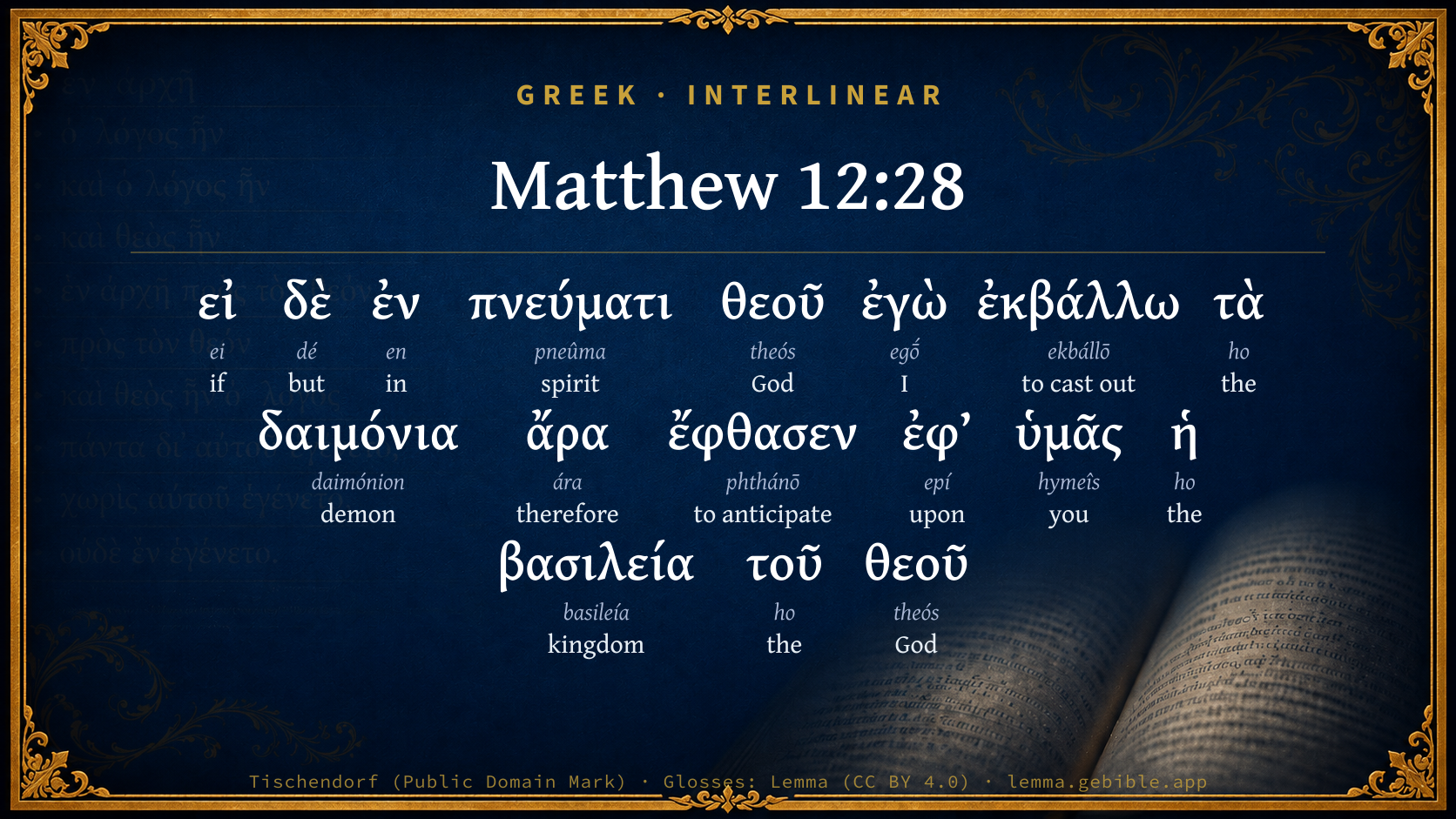
Greek (Tischendorf 8th ed.) Matthew 12:28 appears in the Greek New Testament. The text above is from the Tischendorf 8th edition. Each word links to its Strong’s number and a concise gloss. Click any word for its full Thayer’s Greek Lexicon entry.
Download image
Cite this verse

Matthew 12:28 (World English Bible). Public Domain. Lemma interlinear Bible study tool, https://lemma.gebible.app/v/matthew/12/28.

Show BibTeX & RIS
BibTeX
RIS
English Translation
But if I by the Spirit of God cast out demons, then the Kingdom of God has come upon you.
World English Bible · Public Domain
Highlights
  • 1 first appearance in the Greek New Testament
Full analysis ↓
Download a study sheet

One document with this verse’s original text, its word-by-word gloss line, the meaning frame, cross-references with their text, attributed commentary, and full source and license credits — printable, and it pastes into notes with its structure intact.

This verse Autodidact and up

Study sheet (.html) Plain text (.txt)

A passage Seminary Student

Up to 50 verses in one chapter. A passage sheet keeps up to 6 commentary sources and 12 cross-references per verse, in the order this page ranks them, and says so on the sheet whenever that leaves anything out. Ask for a single verse and you get the Autodidact verse sheet above.

Everything on this page stays free to read, with no account — the sheet is a download of what is already on screen, not access to it.

Want to remove ads? Support Godless Engineer
Compare translations 3

The same verse in 3 English versions, stacked beneath the original-language interlinear above. Click any original word for its lexicon entry.

Each is an independent rendering of the whole verse — the interlinear is not word-aligned to these translations.

Highlighted words mark where these versions differ — a whole-verse word diff, not a word-by-word alignment.

  • World English Bible Public Domain
    But if I by the Spirit of God cast out demons, then the Kingdom of God has come upon you.
  • King James Version Public Domain
    But if I cast out devils by the Spirit of God, then the kingdom of God is come unto you.
  • unfoldingWord Literal Text CC BY-SA 4.0
    But if I cast out the demons by the Spirit of God, then the kingdom of God has come upon you.

unfoldingWord Literal Text — © unfoldingWord, licensed CC BY-SA 4.0. Word-aligned USFM3 via Door43 (git.door43.org/unfoldingWord/en_ult).

Versions to compare (up to 4)

3 of 4 selected

Show all 19 translations

Every available English version of this verse, each an independent rendering of the whole verse.

  • World English Bible Public Domain
    But if I by the Spirit of God cast out demons, then the Kingdom of God has come upon you.
  • Berean Standard Bible Public Domain
    But if I drive out demons by the Spirit of God, then the kingdom of God has come upon you.
  • Majority Standard Bible Public Domain
    But if I drive out demons by the Spirit of God, then the kingdom of God has come upon you.
  • King James Version Public Domain
    But if I cast out devils by the Spirit of God, then the kingdom of God is come unto you.
  • American Standard Version (1901) Public Domain
    But if I by the Spirit of God cast out demons, then is the kingdom of God come upon you.
  • Revised Version (1885) Public Domain
    But if I by the Spirit of God cast out devils, then is the kingdom of God come upon you.
  • Geneva Bible (1599) Public Domain
    But if I cast out deuils by ye Spirit of God, then is the kingdome of God come vnto you.
  • Douay-Rheims (1899) Public Domain
    But if I by the Spirit of God cast out devils, then is the kingdom of God come upon you.
  • Young's Literal Translation Public Domain
    `But if I, by the Spirit of God, do cast out the demons, then come already unto you did the reign of God.
  • Literal Standard Version CC BY-SA 4.0
    But if I, by the Spirit of God, cast out the demons, then the Kingdom of God has already come to you.
  • Unlocked Literal Bible CC BY-SA 4.0
    But if I drive out demons by the Spirit of God, then the kingdom of God has come upon you.
  • unfoldingWord Literal Text CC BY-SA 4.0
    But if I cast out the demons by the Spirit of God, then the kingdom of God has come upon you.
  • Darby Bible Public Domain
    But if *I* by [the] Spirit of God cast out demons, then indeed the kingdom of God is come upon you.
  • World Messianic Bible Public Domain
    But if I by the Spirit of God cast out demons, then God’s Kingdom has come upon you.
  • Webster's Bible Public Domain
    But if I cast out demons by the Spirit of God, then the kingdom of God is come to you.
  • Free Bible Version CC BY-SA 4.0
    But if I'm throwing out demons through the power of the Spirit of God, then the kingdom of God has come to you!
  • Bible in Basic English Public Domain
    But if I by the Spirit of God send out evil spirits, then is the kingdom of God come on you.
  • Text-Critical English NT CC BY 4.0
    But if I cast out demons by the Spirit of God, then the kingdom of God has come upon you.
  • Tyndale New Testament (1534) Public Domain
    But if I cast out the devyls by the sprite of God: then is the kyngdome of god come on you?

Literal Standard Version (2020), Covenant Press — licensed CC BY-SA 4.0. Text via the HelloAO Bible API (eBible.org). Unlocked Literal Bible (unfoldingWord) — licensed CC BY-SA 4.0. Text via the HelloAO Bible API (eBible.org). unfoldingWord Literal Text — © unfoldingWord, licensed CC BY-SA 4.0. Word-aligned USFM3 via Door43 (git.door43.org/unfoldingWord/en_ult). Free Bible Version, Dr. Jonathan Gallagher — licensed CC BY-SA 4.0. Text via the HelloAO Bible API (eBible.org).

Word by word

More ways to search: Search by grammar → Find every occurrence → Compare this word →

Practice this passage: Drill this verse → Learn its vocabulary →

ἔφθασεν
phthánō
G5348
“to anticipate”
Verb, Aorist, Active, Indicative, 3rd person, Singular
Part of Speech
Verb
Tense
Aorist
Voice
Active
Mood
Indicative
Person
3rd person
Number
Singular
Full Thayer's Definition

Origin: apparently a primary verb

TDNT: 10:28,1

1. to come before, precede, anticipate 2. to come to, arrive at 3. to reach, attain to
  1. εἰ ei G1487 “if” Conditional
  2. δὲ dé G1161 “but” Conjunction
  3. ἐν en G1722 “in” Preposition
  4. πνεύματι pneûma G4151 “spirit” Noun, Dative, Singular, Neuter
  5. θεοῦ theós G2316 “God” Noun, Genitive, Singular, Masculine
  6. ἐγὼ egṓ G1473 “I” Personal pronoun, 1st person, Nominative, Singular
  7. ἐκβάλλω ekbállō G1544 “to cast out” Verb, Present, Active, Indicative, 1st person, Singular
  8. τὰ ho G3588 “the” Article, Accusative, Plural, Neuter
  9. δαιμόνια daimónion G1140 “demon” Noun, Accusative, Plural, Neuter
  10. ἄρα ára G686 “therefore” Particle
  11. ἐφ’ epí G1909 “upon” Preposition
  12. ὑμᾶς hymeîs G5210 “you” Personal pronoun, 2nd person, Accusative, Plural
  13. ἡ ho G3588 “the” Article, Nominative, Singular, Feminine
  14. βασιλεία basileía G932 “kingdom” Noun, Nominative, Singular, Feminine
  15. τοῦ ho G3588 “the” Article, Genitive, Singular, Masculine
  16. θεοῦ theós G2316 “God” Noun, Genitive, Singular, Masculine

About this verse

These counts appear in no published source. They are computed here, from the morphology-tagged text and Lemma’s own curated glosses. What Lemma adds →

17
words
14
distinct lemmas
Gospels
section

Notable vocabulary

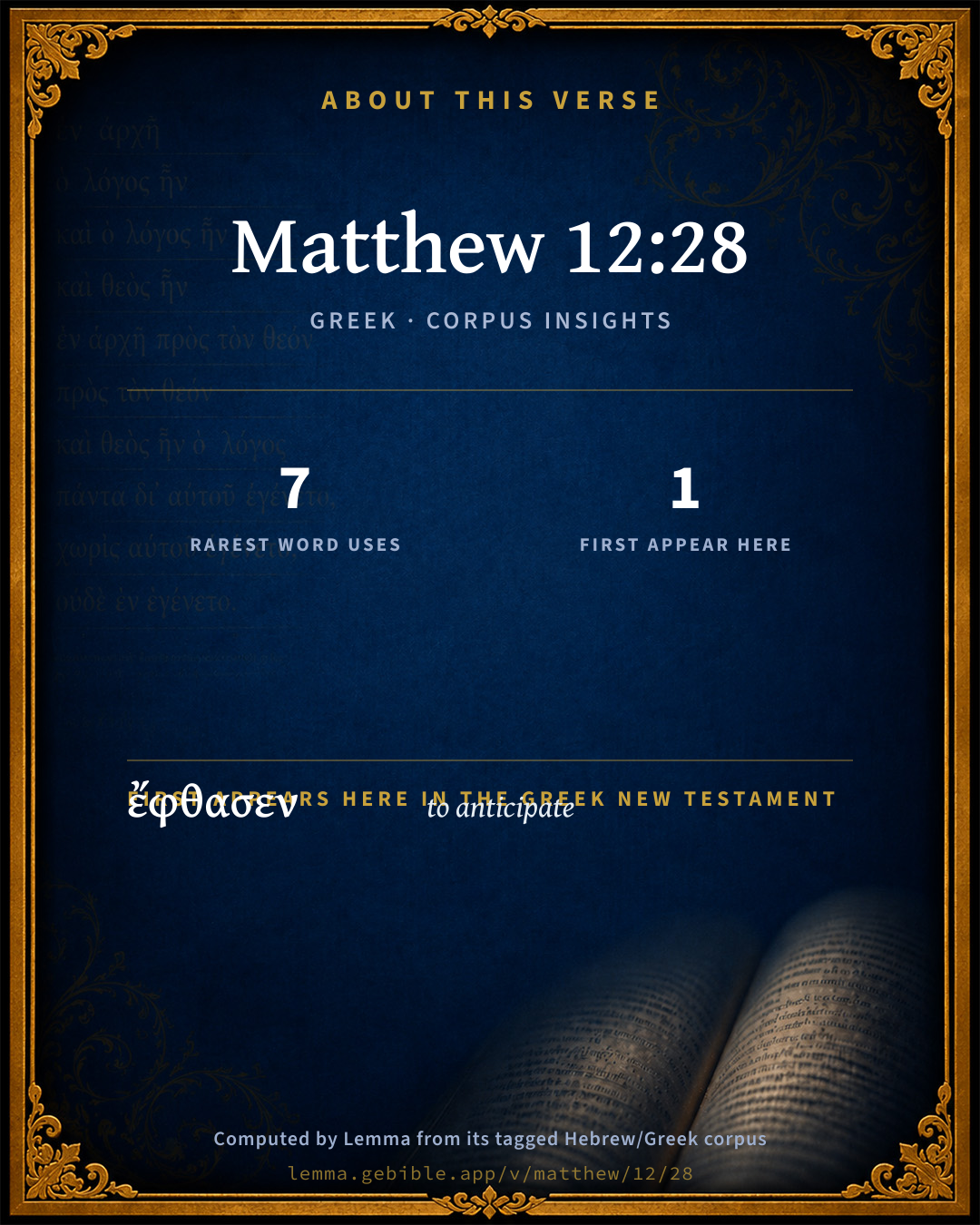
The rarest word here is ἔφθασεν to anticipate G5348 — appearing just 7 times in the whole Greek New Testament.

First appearance in Scripture

This word makes its first canonical appearance in the Greek New Testament here:

  • ἔφθασεν to anticipate G5348

Shared distinctive vocabulary

ἔφθασεν to anticipate G5348 occurs in 7 verses of the Greek New Testament. Also found in:
Repetition

Words recur within this verse:

Cross-references

20

Topical passages linked to Matthew 12:28 in the Treasury of Scripture Knowledge — connected by theme and wording, ordered by reader-vote popularity; previews shown in the World English Bible.

  • Luke 11:20 But if I by the finger of God cast out demons, then the Kingdom of God has come to you.
  • Daniel 7:14 There was given him dominion, and glory, and a kingdom, that all the peoples, nations, and languages should serve him: his dominion is an everlasting dominion, which shall not pass away, and his kingdom that which shall not be destroyed.
  • Matthew 6:33 But seek first God's Kingdom, and his righteousness; and all these things will be given to you as well.
  • Acts 10:38 even Jesus of Nazareth, how God anointed him with the Holy Spirit and with power, who went about doing good and healing all who were oppressed by the devil, for God was with him.
  • Matthew 21:43 "Therefore I tell you, the Kingdom of God will be taken away from you, and will be given to a nation bringing forth its fruits.
  • Colossians 1:13 who delivered us out of the power of darkness, and translated us into the Kingdom of the Son of his love;
  • Matthew 21:31 Which of the two did the will of his father?" They said to him, "The first." Jesus said to them, "Most assuredly I tell you that the tax collectors and the prostitutes are entering into the Kingdom of God before you.
  • Mark 1:15 and saying, "The time is fulfilled, and the Kingdom of God is at hand! Repent, and believe in the Gospel."
  • Luke 16:16 The law and the prophets were until John. From that time the Gospel of the Kingdom of God is preached, and everyone is forcing his way into it.
  • Luke 17:20–21 Being asked by the Pharisees when the Kingdom of God would come, he answered them, "The Kingdom of God doesn't come with observation;
  • Isaiah 9:6–7 For to us a child is born, to us a son is given; and the government shall be on his shoulder: and his name shall be called Wonderful, Counselor, Mighty God, Everlasting Father, Prince of Peace.
  • Daniel 2:44 In the days of those kings shall the God of heaven set up a kingdom which shall never be destroyed, nor shall the sovereignty of it be left to another people; but it shall break in pieces and consume all these kingdoms, and it shall stand forever.
  • Romans 14:17 for the Kingdom of God is not eating and drinking, but righteousness, peace, and joy in the Holy Spirit.
  • Mark 11:10 Blessed is the kingdom of our father David that is coming in the name of the Lord! Hosanna in the highest!"
  • Mark 16:17 These signs will accompany those who believe: in my name they will cast out demons; they will speak with new languages;
  • Luke 1:32–33 He will be great, and will be called the Son of the Most High. The Lord God will give him the throne of his father, David,
  • Luke 9:2 He sent them forth to preach the Kingdom of God, and to heal the sick.
  • Luke 10:11 'Even the dust from your city that clings to us, we wipe off against you. Nevertheless know this, that the Kingdom of God has come near to you.'
  • Hebrews 12:28 Therefore, receiving a Kingdom that can't be shaken, let us have grace, through which we serve God acceptably, with reverence and awe,
  • Matthew 12:18 "Behold, my servant whom I have chosen; My beloved in whom my soul is well pleased: I will put my Spirit on him. He will proclaim justice to the Gentiles.

Cross-references courtesy of OpenBible.info (CC BY 4.0).

Commentary

Notes on Matthew 12:28 from classic Christian and Jewish commentators (each source and its license shown beneath its notes). The classic Christian expositions comment on the surrounding passage and are grouped to its opening verse, so a note may address several verses; the Jewish commentaries on the Tanakh (Rashi and others) are per-verse, so they appear only where the commentator wrote on this verse.

Lemma curates 59 commentaries, every one of them public domain or Creative Commons licensed, each selected and text-cleaned for this edition rather than reprinted as found. About our sources →

Tyndale Open Study Notes

Tyndale Open Resources

12:28 The Pharisees were being confronted with and were rejecting the Kingdom of God itself (see Luke 17:20-21; 1 Jn 3:8). Jesus’ miracles brought the power of the Kingdom into the present reality; its ultimate consummation awaits Christ’s second coming.

Tyndale Open Study Notes — © Tyndale Open Resources, licensed CC BY-SA 4.0. Text via the HelloAO Bible API.

Bengel's Gnomon

Johann Albrecht Bengel

Mat 12:28. Εἰ, κ.τ.λ. if, etc.) The first portion of the dilemma having been dismissed, this particle has the force of since.—ἐκβάλλω, I cast out) Jesus in every way destroyed the kingdom of Satan.—ἄρα, therefore) The expulsion of Satan, together with his belongings, is the mark and token of the kingdom of God; for this was reserved for the Messiah.—ἔφθασεν, has prevented)[572] This word is used here in its strict and proper sense, and intimates something important; cf. πρῶτον, first, Mat 12:29.—ἡ βασιλεία τοῦ Θεοῦ, the kingdom of God) in contradistinction to that of Satan, mentioned in Mat 12:20.

[572] Prœvenit. Wesley, who avowedly copied from Bengel, explains the passage, “The Kingdom of God is come upon you—unawares, before you expected: so the word implies.” Bengel himself renders it, “So ist je das Reich Gottes bereits über euch kommen.”—(I. B.)

Bengel's Gnomon of the New Testament — English translation (T&T Clark, Edinburgh, 1860) — public domain. Text from a community e-Sword module.

Meyer's Critical & Exegetical Commentary

Heinrich August Wilhelm Meyer

Mat_12:28. Previously it was ἐγώ that was emphatic in the antecedent clause; but here it is ἐν πνεύματι θεοῦ: but if it is by THE POWER OF GODS SPIRIT that I, on the other hand, cast out the demons, then it follows that the KINGDOM OF GOD has come to you; in the consequent clause (the apodosis) the emphasis is on the words: the kingdom of God has come, etc. The reasoning is founded on the axiom, that such deeds, wrought as they are by the power of Gods Spirit, go to prove that He who performs them is no other than He who brings in the kingdomthe Messiah. Where the Messiah is present and working, there, too, is the kingdom; not yet, of course, as completely.established, but preparing to become so through its preliminary development in the world. See on Luk_17:20 f. For φθάνειν (used by classical writers as meaning to anticipate, 1Th_4:15), in the simple sense of to reach, arrive at, see on Php_3:16; Fritzsche, ad Rom. II. p. 356; Lünemanns note on 1Th_2:16.

Notice, in the form of the reasoning in Mat_12:27-28, the real dilemma (tertium non datur): εἰ δέ, etc.

Meyer — Critical and Exegetical Commentary on the New Testament — English translation by Peter Christie, edited by Frederick Crombie (T&T Clark, 1880) — public domain. Text from a community e-Sword module.

Expositor's Greek Testament

ed. W. Robertson Nicoll

Mat 12:28 . The alternative : if not by Satan then by the Spirit of God, with an inevitable inference as to the worker and His work. ἐν πνεύματι θεοῦ . Luke has ἐν δακτύλῳ θ . The former seems more in keeping with the connection of thought as defending the ethical character of Christ’s work assailed by the Pharisees. If, indeed, the spirit of God were regarded from the charismatic point of view, as the source of miraculous gifts, the two expressions would be synonymous. But there is reason to believe that by the time our Gospel was written the Pauline conception of the Holy Spirit’s influence as chiefly ethical and immanent , as distinct from that of the primitive apostolic church, in which it was charismatic and transcendent, had gained currency ( vide my St. Paul’s Conception of Christianity , chap. xiii.). A trace of the new Pauline view may be found in Mat 10:20 : “It is not ye that speak, but the Spirit of your Father speaking in you”. The influence is within , and the product is not unintelligible utterance, like that of the speaker with tongues (1Co 12:14 ), but wise, sincere apology for the faith. But why then did Luke not adopt this Pauline phrase? Because one of his main aims was to bring out the miraculousness of Christ’s healing works; that they were done by the very finger of God (Exo 8:19 ). ἔφθασεν . Fritzsche takes this word strictly as signifying not merely: the kingdom of God has come nigh you ( ἤγγικεν , Luk 10:9 ), but: has come nigh sooner than you expected. The more general sense, however, seems most suitable, as it is the usual sense in the N. T. The point at issue was: do the events in question mean Satan’s kingdom come or God’s kingdom come? It must be one or other; make up your minds which.

The Expositor's Greek Testament, edited by W. Robertson Nicoll (1897–1910) — public domain. Text from a community e-Sword module.

Jamieson, Fausset & Brown

Robert Jamieson, A. R. Fausset & David Brown

But if I cast out devils by the Spirit of God--In Luke (Luk 11:20) it is, "with (or 'by') the finger of God." This latter expression is just a figurative way of representing the power of God, while the former tells us the living Personal Agent was made use of by the Lord Jesus in every exercise of that power.

then--"no doubt" (Luk 11:20).

the kingdom of God is come unto you--rather "upon you," as the same expression is rendered in Luke (Luk 11:20): --that is, "If this expulsion of Satan is, and can be, by no other than the Spirit of God, then is his Destroyer already in the midst of you, and that kingdom which is destined to supplant his is already rising on its ruins."

Jamieson, Fausset & Brown — Commentary Critical and Explanatory on the Whole Bible (1871) — public domain (CC PDM 1.0). Text via the HelloAO Bible API.

Adam Clarke's Commentary

Verse 28. But if I cast out devils by the Spirit of God] Perhaps the Spirit of God is here mentioned by way of opposition to the magical incantations of the Jews; for it is well known that by fumigations and magical washings, they professed to cast out devils. See a case mentioned by Schoettgen on this verse.

Then the kingdom of God] For the destruction of the kingdom of Satan plainly implies the setting up of the kingdom of God.

Is come unto you.] Is come unexpectedly upon you. εφθασεν, from φθανω, to appear suddenly - unexpectedly.

They pretended to be in expectation of the kingdom of God, and consequently of the destruction of the kingdom of Satan. But, by being not prepared to receive Christ in these proofs of his Divine mission, they showed that their expectation was but pretended. They were too carnal to mind spiritual things.

Adam Clarke's Commentary on the Bible (1810–1826) — public domain. Text from a community e-Sword/MySword module.

Ellicott's Commentary for English Readers

(28) By the Spirit of God.—In Luk_11:20 we have as an equivalent phrase, “the finger of God.” So in Old Testament language the fulness of the prophet’s inspiration was expressed in the words, “the hand of the Lord was strong upon me” (Eze_3:14). The second hymn in the Ordination Service reproduces the symbolism in the words addressed to the Holy Spirit—

“In faithful hearts thou writ’st thy law,

The finger of God’s hand;”

and it obviously connects itself with the older language which describes the Ten Commandments as written on the two tables of stone with “the finger of God” (Exo_31:18).

Then the kingdom of God is come unto you.—The word describes a coming suddenly, unlooked for, sooner than men expected. The argument may be briefly formulated thus:—The work was confessedly superhuman, either from the power of Satan or that of God, but the former hypothesis was excluded by the reasoning of Mat_12:25-27; the latter was therefore the only explanation. But if so, if Jesus gave proof that He was thus filled with the power of the Spirit to heal and save, then He was what He claimed to be, the Head of the divine kingdom. That kingdom had burst upon men unawares.

A Bible Commentary for English Readers, edited by Charles John Ellicott (1878–1897) — public domain. Text from a community e-Sword module.

The Cambridge Bible for Schools and Colleges

gen. ed. J. J. S. Perowne

28. is come unto you] Literally, surprised you by coming, came upon you unawares.

The Cambridge Bible for Schools and Colleges (gen. ed. J. J. S. Perowne; Cambridge University Press, 1878–1918) — public domain. Text from a community e-Sword module.

John Gill's Exposition

Either make the tree good, and his fruit good,.... That is, either assert them both good, or

else make the tree corrupt, and his fruit corrupt: say they are both evil, for the contrary cannot be affirmed with any consistency and propriety: the matter is easy to be determined,

for the tree is known by his fruit; fruit will discover what a tree is, and accordingly judgment may be made. No man will say a tree is good, and its fruit corrupt; or say, that a tree is corrupt, and its fruit good: these are glaring contradictions, and can never be reconciled. The case Christ here puts, is a very easy and familiar one, and is obvious to common sense: the application of it may be made, either to the foregoing instance of Christ's casting out devils, which the Jews ascribed to the help of Satan; and then the sense is, either say I am a good man, and do good works, or that I am an evil man, and do evil works: to say that I do good works, as the casting out of devils must be allowed to be, and yet am an evil man, and do this under satanical influence, is as great an inconsistency, as to say that a corrupt tree brings forth good fruit; either therefore condemn these miracles as evil actions, done by confederacy with Satan; or if you will allow them to be good ones, as you do, ascribe them to the Spirit of God; for these things may as easily be determined, as the cause by its effect, or as a tree is known by its fruit: or else this may be applied unto the Pharisees, who, though wicked men, pretended to do good works; and though they set up for men of religion and holiness, yet did evil things, as their words and actions testified; particularly the blasphemy just now uttered by them, charging the miracles of Christ as done by the assistance of the devil, which discovered the malignity and rottenness of their hearts: and the meaning of Christ is, that they would either both say, and do, that which is right and good; or relinquish their pretensions to the character of good and religious men: nothing can be concluded from hence in favour of free will, or a power in the creature to make himself good; for the word "make", here signifies to "say, affirm, assert", and the like; see Joh 5:18. Though it may be fairly inferred from hence, that a man must first be a good man, ever he can perform good works, truly and properly so called; and that these are fruits and evidences of the inward real goodness of a man; which must be understood not of a few single actions, but of the common, constant series and course of life.

John Gill's Exposition of the Whole Bible (1746–1763) — public domain (CC PDM 1.0). Text via the HelloAO Bible API.

Trapp's Complete Commentary

John Trapp

28 But if I cast out devils by the Spirit of God, then the kingdom of God is come unto you.

Ver. 28. Then the kingdom of God is come unto you] A certain sign of the setting up whereof among you, is this casting out of devils "by the Spirit of God;" or as Luke hath it, "by the finger of God;" for the Holy Ghost is the essential power of the Father and the Son.

John Trapp, A Commentary or Exposition upon All the Books of the Old and New Testament (1647–1656) — public domain. Text from a community e-Sword module.

Haydock's Catholic Bible Commentary

Kingdom of God. Christ either calls himself and his coming the kingdom of God, because it was the beginning of the kingdom of God, and laid open the way to us: or the sense may be, If I, as proved in an argument above, cast out devils by the spirit of God, therefore what I, my apostles, and John preach, is true, viz. that the kingdom of God is at hand; because the Holy Ghost, who worketh miracles by us, proveth that our preaching is true. (Maldonatus)

George Leo Haydock (1774–1849), Haydock's Catholic Family Bible and Commentary, 1859 edition — public domain. Excludes Psalms (Douay-Rheims chapter numbering differs from Protestant) and Deuterocanonical books (Catholic canon only).

Matthew Poole's English Annotations

Luke hath the same, Luk 11:20, only for the Spirit of God he hath the finger of God. By the kingdom of God he here meaneth the coming of the Messiah, which is so called, Dan 2:44. The time is come, when the Lord begins his kingdom of grace, setting up his King upon his holy hill of Zion, Psa 2:6; whence we may observe, that Christ giveth in his casting out of devils by a Divine power, as an argument to prove himself the Messiah; for saith he, By this you may know the kingdom of God is come amongst you, that there is one come among you who by the finger, power, or Spirit of God casts out devils. But where had the force of this argument been, if the Jews had had exorcists whom God had so honoured, though vagabonds, as to cast out devils, upon their calling upon the God of Abraham, Isaac, and Jacob, while in the mean time they derided and contemned Christ?

Matthew Poole's English Annotations on the Holy Bible (1683–1685) — public domain. Text from a community e-Sword/MySword module.

Whedon's Commentary on the Bible

Daniel D. Whedon

28. The kingdom of God — So numerous and powerful had been our Saviour’s works that the Jews had ascribed them, not to a spirit of common order, but to the very prince of hell. But if they were as beneficent as they were powerful, why not ascribe them to the prince of heaven, and so conclude that the kingdom of heaven had come?

Daniel D. Whedon (gen. ed.), Commentary on the Old and New Testaments (1874–1909) — public domain. Text from a community e-Sword module.

The Pulpit Commentary

The argument continues: "But if this be so (I say nothing about your disciples, but speak only of my own works) if I really cast out devils by God"s help, this shows such a strange putting forth of God"s strength that it can mean nothing else but the coming of the Messianic kingdom." Observe that this could not be affirmed from the success of the Pharisees" disciples, for with them expulsion of devils, even if it were real, was, as it were, accidental, standing in no close connexion with their work. (cf. Mat_7:22, note) Besides, they did not, as our Lord did, claim to be the Messiah, and to inaugurate the kingdom. But if I cast out devils by the Spirit of God; but if I by the Spirit of God, etc. (Revised Version).

The chief emphasis lies on by the Spirit of God, and there is a secondary emphasis on J, as compared with "your sons." Observe the absence of the article in en pneumati Yeou ; contrast vers. 31, 32, and comp. Mat_1:18, note. Luke has, "by the finger of God," a term used to designate God"s power as put forth upon nature. (cf. Exo_8:19 Exo_31:18 Psa_8:3) Then. Little as you think it (ara); cf. Luk_11:48. The kingdom of God. In contrast to Satan"s kingdom (ver. 26). Is come (efyasaen : praevenit, Codex Brixianus; cf. Wordsworth and White"s Vulgate). This may mean

(1) it has come sooner than you expected, it has got the start of you; (cf. 1Th_4:15) or

(2) it has actually come as far as you, it has arrived. This latter sense seems to be more in accordance with Hellenistic usage. (cf. Php_3:16 1Th_2:16) Unto you; upon you (Revised Version), ef umav ..

An argument with a warning.

"But if I cast out devils by the Spirit of God, then the kingdom of God is come unto you." The sin against the Holy Ghost, which cannot be forgiven, has been so much misunderstood, because its immediate relations have not been sufficiently noticed. It has been treated as a general form of sin, of which any one may be guilty, rather than as a specific sin, of which a particular class of persons in a particular age were guilty. Our Lord was replying to certain Pharisaic objectors. He claimed to work miracles in the power of the Spirit of God. They declared that he worked the miracles in the power of the chief of the evil spirits. To say that was to offer open insult to the Holy Spirit in Jesus. And that is a hopeless kind of sin, because only in the power of the Spirit can men be saved. He who calls the Spirit Beelzebub will never seek his saving help, and so he never will be forgiven or regenerated. Forgiveness only comes to the penitent and humble. It is quite clear that they are neither penitent nor humble who think the Holy Spirit in Jesus is Beelzebub.

I TWO POSSIBLE EXPLANATIONS OF OUR LORD"S CASTING OUT DEVILS. He may do it with the help of the prince of the devils. Is that a reasonable explanation? If it were merely directing the movements of devils from one sphere of work to another, it might be reasonable; but the case before us is distinctly one of stopping the devilswork. Jesus "cast out" the devils. It is not reasonable to think of princes of devils stopping their subordinates" work. Then see that these Pharisees were shut up to, and obliged to accept, the other possible explanation. Jesus cast out devils by the Spirit of God; that is every way reasonable, according to their own showing, for the good God must be opposed to the work of evil spirits.

II THE CONSEQUENCES OF ADMITTING THE ONLY REASONABLE EXPLANATION. These Pharisees came under the gravest responsibility. If Jesus wrought in the power of the Spirit, they were bound to believe him, and come into discipleship with him. This they would not do. Then Christ presses home the consequences of their wilfulness. They sinned against light; they resisted inward convictions; they grieved the Spirit; they blasphemed the Spirit; they put themselves into such moral attitudes that they could not be forgiven; forgiveness is of no value to those who are not humble. R.T.

The Pulpit Commentary (1880–1919), ed. H.D.M. Spence-Jones & Joseph S. Exell — public domain. Text from a community e-Sword module.

The People's New Testament

B. W. Johnson

28. If I by the Spirit of God, etc. If it is the power of God manifest in me, then it demonstrates that I am the expected Messiah King, the Son of David, of whom the multitude spoke. See verse 23.

B. W. Johnson's The People's New Testament with Notes (1889–1891) — public domain. Electronic text from the Christian Classics Ethereal Library (CCEL) ThML edition.

unfoldingWord translationNotes

Door43 World Missions Community

Connecting Statement:

Jesus continues to respond to the Pharisees.

But if I

Here "if" does not mean Jesus is questioning how he drives out demons. Here Jesus uses the word to introduce a true statement. AT: "But because I"

then the kingdom of God has come upon you

"then the kingdom of God has arrived among you." Here "kingdom" refers to God's rule as king. AT: "this means God is establishing his rule among you" (See: Metonymy)

come upon you

Here "you" is plural and refers to the people of Israel. (See: Forms of You)

How can anyone enter the house ... belongings from his house

Jesus uses a parable to continue his response to the Pharisees. Jesus means he can drive out demons because he is more powerful than Satan. (See: Parables)

How can anyone enter ... without tying up the strong man first?

Jesus uses a question to teach the Pharisees and the crowd. AT: "No one can enter ... without tying up the strong man first." or "If a person wants to enter ... he must first tie up the strong man." (See: Rhetorical Question)

without tying up the strong man first

"without taking control of the strong man first"

Then he will steal

"The he can steal" or "Then he will be able to steal"

who is not with me

"who does not support me" or "who does not work with me"

is against me

"opposes me" or "works against me"

the one who does not gather with me scatters

Jesus is using a metaphor that refers to a person either gathering the flock of sheep to a shepherd or making them scatter away from the shepherd. Jesus means that a person is either helping to make people become disciples of Jesus or he is making people reject Jesus. (See: Metaphor)

translationWords

cast out

Holy Spirit

kingdom of God

unfoldingWord translationNotes — © Distant Shores Media and the Door43 World Missions Community, licensed CC BY-SA 4.0. Source: git.door43.org/Door43/en_tn.

Cambridge Greek Testament for Schools and Colleges

28. ἐν πνεύματι θεοῦ. ἐν δακτύλῳ θεοῦ (Luke).

ἔφθασεν ἐφʼ ὑμᾶς. ‘Came upon you,’ surprised you; aorist of immediate past. φθάνειν, from its classical force of ‘anticipating,’ or ‘coming before others,’ passes to that of simply coming and arriving at a place. This was indeed probably the original meaning of the word (Geldart, Mod. Greek, p. 206). It is also the modern meaning; προφθάνειν being used in the sense of ‘to anticipate.’ But in such a phrase as ἔφθασα τὸ ἀτμόπλοιον, ‘I caught the steamer,’ a trace of the prevailing classical use is discerned. Both senses are found in N.T. For the first, 1Th 4:15, οὐ μὴ φθάσωμεν τοὺς κοιμηθέντας, for the second, Rom 9:31, Ἰσραὴλ δὲ διώκων νόμον δικαιοσύνης εἰς νόμον οὐκ ἔφθασεν. In 2Co 10:14, φθάνειν is synonymous with ἐφικνεῖσθαι.

Cambridge Greek Testament for Schools and Colleges (Cambridge University Press, 1896; 21 vols, various authors incl. Carr, Maclear, Plummer, Farrar, Lumby, Moule, M. R. James, Simcox) — public domain. Text from a community e-Sword module.

Alford’s Greek Testament

Henry Alford

28.] ἐν πνεύματι θ. = ἐν δακτύλῳ θ., Luke; see Exo 8:19.

ἔφθασεν] emphatic in position: but merely, has come upon you: not in the more proper sense of φθάνω, ‘is already upon you,’ i.e. ‘before you looked for it,’—as Stier and Wesley. It does not seem to occur in this latter sense in the N.T. But Fritzsche’s dictum, ad Rom. 2:356, “Alexandrinis scriptoribus φθάνειν nihil nisi venire, pervenire, pertinere valet,” certainly is not right; for we have it indisputably in the sense of to anticipate, prevent, 1Th 4:15.

Henry Alford, The Greek Testament (1849–1861) — public domain. Text from a community e-Sword module.

Vincent's Word Studies in the New Testament

Marvin R. Vincent

Is come unto you [εφθασεν εφ υμας] . The verb is used in the simple sense to arrive at (2Co 10:14; Phi 3:16), and sometimes to anticipate (1Th 4:15). Here with a suggestion of the latter sense, which is also conveyed by the Rev., "come upon." It has come upon you before you expected it.

Marvin R. Vincent, Word Studies in the New Testament (1887–1900) — public domain. Text from a community e-Sword/MySword module.

Lesson kit

Teaching starters — assembled from the data on this page, not authored interpretation. Every prompt links to the verse data it draws on. Edit before teaching.

Matthew, in the Gospels, opens this verse with 17 words (14 distinct Greek lemmas). Its most distinctive word is phthánō (“to anticipate”). A historical commentator’s framing appears above. Read the whole chapter for the surrounding context.

Discussion questions

  1. What does “to anticipate” (phthánō) contribute to the verse as a whole?
  2. This is the first place “to anticipate” appears in Scripture (first appears here). What does its debut here establish?
  3. How does Luke 11:20, which shares the word «to anticipate», read alongside this verse?
  4. What does the repetition of “God” (2× in this one verse) do in this verse?
  5. These translations render this verse differently; the difference is in the English rendering, not the original. What questions does that raise?
  6. Compare how Tyndale Open Study Notes and Bengel's Gnomon read this verse. Where do they agree or differ?

Things to notice

  • 1 word makes its first canonical appearance in Scripture here.
  • These translations choose different wording for 4 words in this verse.
  • “God” occurs 2× in this single verse.
  • 14 distinct Greek lemmas span 17 words in this verse.

Reading settings

Reading text

Shown beneath each verse's original-language words.

Old Testament
Old Testament edition

Read the OT as the Masoretic Hebrew (MT) or the Greek Septuagint (LXX).

English shown for the Greek Septuagint (in the Hebrew ↔ Greek comparison).

Comparing translations? Open the Compare panel on any verse page to stack up to four side by side.